Half- past Two Ursula Fanthorpe Annotate your anthology! This poem is about a young child who is not able to tell time. He is issued a (possibly) lunch time detention for doing something wrong but we are never told what he had done. The
"Half- past Two Ursula Fanthorpe Annotate your" is the property of its rightful owner. Permission is granted to
download and print the materials on this website for personal, non-commercial use only, and to display it
on your personal computer provided you do not modify the materials and that you retain all copyright
notices contained in the materials. By downloading content from our website, you accept the terms of this
agreement.
Presentation Transcript
01
Half- past Two Ursula Fanthorpe<br>
02
Annotate your anthology!<br>
03
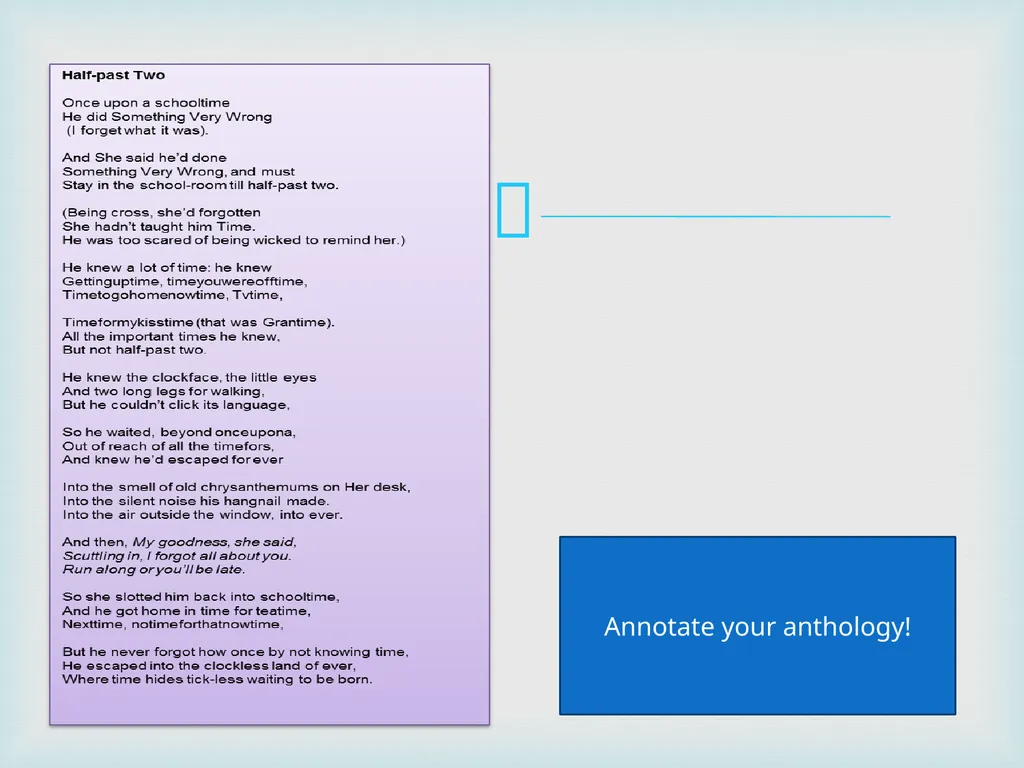
This poem is about a young child who is not able to tell time. He is issued a (possibly) lunch time detention for doing something wrong but we are never told what he had done.
The poem does not have a single voice so it is quite confusing to know who is speaking when.
The author does this to show us how confusing it must be for the child not knowing the time.
This is intentional! What is this poem about?<br>
04
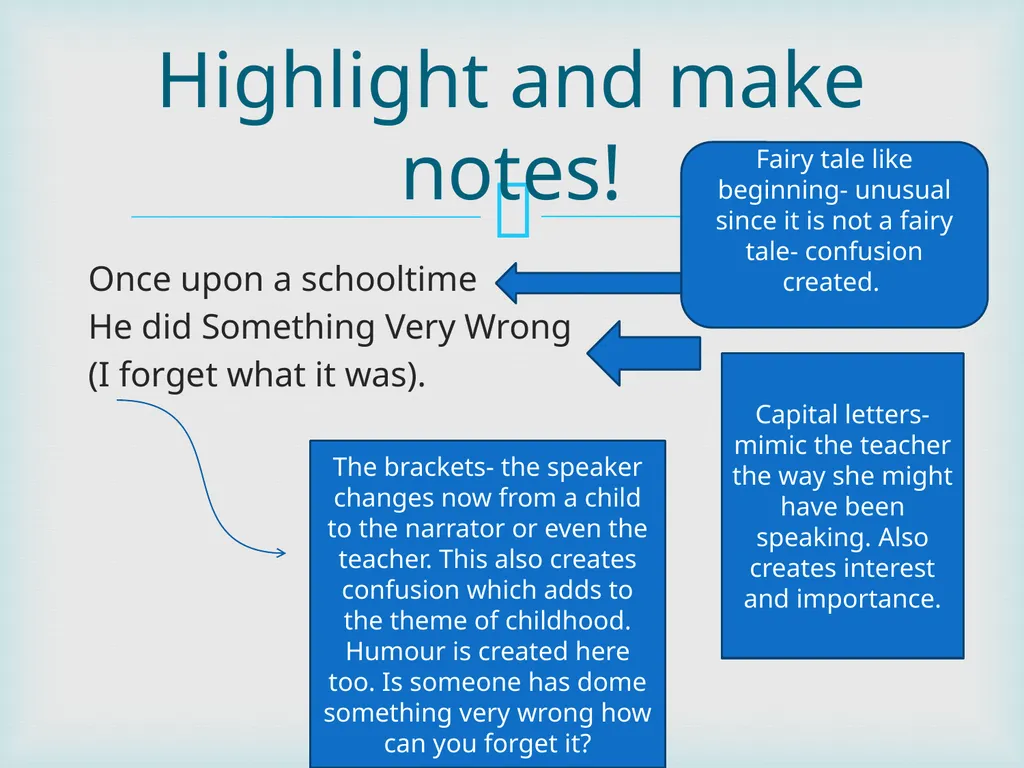
Once upon a schooltime
He did Something Very Wrong
(I forget what it was). Highlight and make notes! Fairy tale like beginning- unusual since it is not a fairy tale- confusion created. Capital letters- mimic the teacher the way she might have been speaking. Also creates interest and importance. The brackets- the speaker changes now from a child to the narrator or even the teacher. This also creates confusion which adds to the theme of childhood. Humour is created here too. Is someone has dome something very wrong how can you forget it?<br>
05
And She said he’d done
Something Very Wrong, and must
Stay in the school-room till half-past two. Stanza 2 Capitalisation for the ‘she’ because of respect for the teacher this is the boy telling us this as he makes a mistake and says ‘till’ and not ‘until’ Note that the boy gets a lower case letter – he.
He does not get as much respect as the teacher even though Her name is not mentioned. Why? Enjambment is used as this line carries into the next without punctuation. This speeds up our reading process.<br>
06
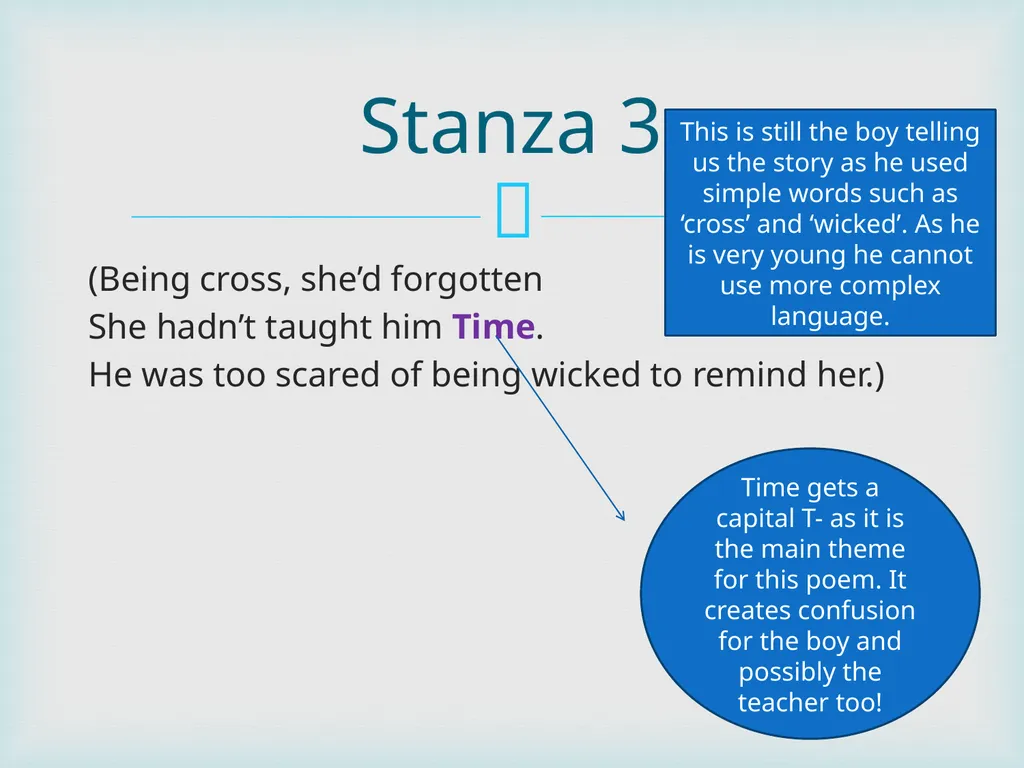
(Being cross, she’d forgotten
She hadn’t taught him Time.
He was too scared of being wicked to remind her.) Stanza 3 This is still the boy telling us the story as he used simple words such as ‘cross’ and ‘wicked’. As he is very young he cannot use more complex language. Time gets a capital T- as it is the main theme for this poem. It creates confusion for the boy and possibly the teacher too!<br>
07
He knew a lot of time: he knew
Gettinguptime, timeyouwereofftime,
Timetogohomenowtime, Tvtime, Stanza 4 Compound words- he does not know the precise time when he does these particular things but he knows them by the name. Maybe he is mimicking his parents the way they say it?
Once again this is narrated by the boy as he is telling us all the times he does recognise. Enjambment used to speed up the pace. Children often speak without pausing. Trying to recreate their language. Where does this comma lead?<br>
08
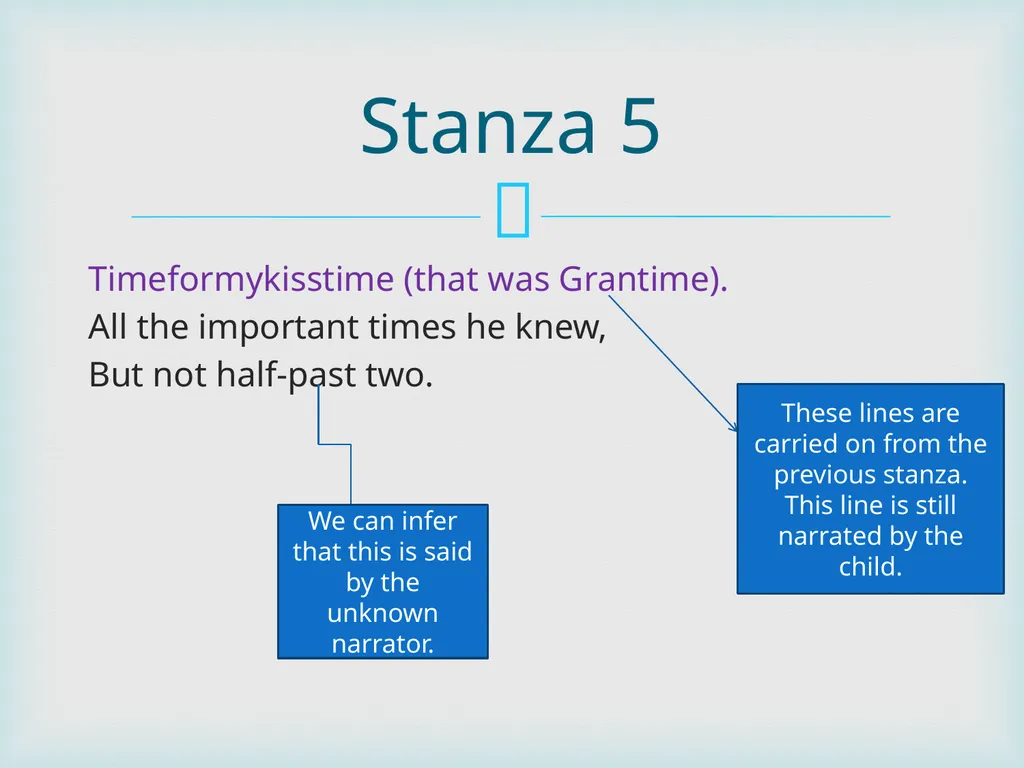
Timeformykisstime (that was Grantime).
All the important times he knew,
But not half-past two. Stanza 5 These lines are carried on from the previous stanza. This line is still narrated by the child. We can infer that this is said by the unknown narrator.<br>
09
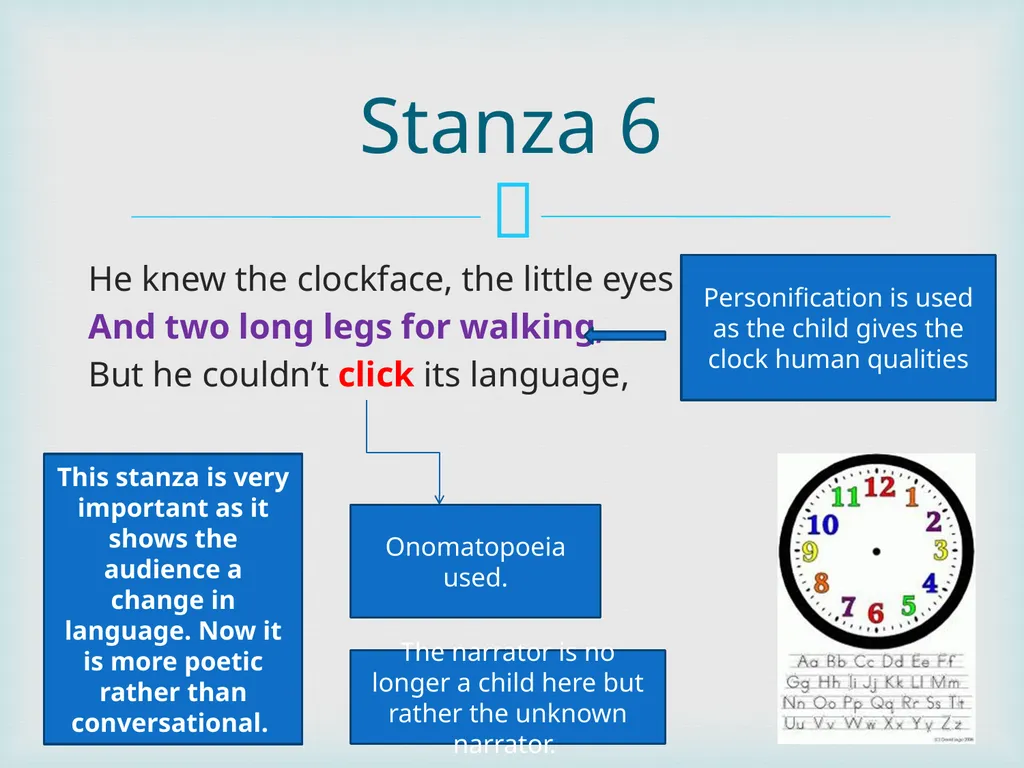
He knew the clockface, the little eyes
And two long legs for walking,
But he couldn’t click its language, Stanza 6 Personification is used as the child gives the clock human qualities Onomatopoeia used. This stanza is very important as it shows the audience a change in language. Now it is more poetic rather than conversational. The narrator is no longer a child here but rather the unknown narrator.<br>
10
So he waited, beyond onceupona,
Out of reach of all the timefors,
And knew he’d escaped for ever Stanza 7 Enjambment is used throughout this stanza. Why? The boy waits a long time (as we are told ‘beyond onceupona’). No more of a fairy tale like feel. We see that this has a negative effect on the boy.<br>
11
Into the smell of old chrysanthemums on Her desk,
Into the silent noise his hangnail made.
Into the air outside the window, into ever. Stanza 8 The only escape the child has is through the window. Obviously this is not the literal meaning. His mind escapes. Narrated by the unknown speaker. The use of senses: sound and smell. oxymoron. How can silence make a noise? She is forgetful too as these flowers are old. Criticism for adults Repetition of ‘into’
Why?<br>
12
And then, My goodness, she said,
Scuttling in, I forgot all about you.
Run along or you’ll be late. Stanza 9 Speech in italics – this is the teacher talking now. Her exact words. Scuttling – quite a negative verb used to describe the teacher. Almost like an animal.<br>
13
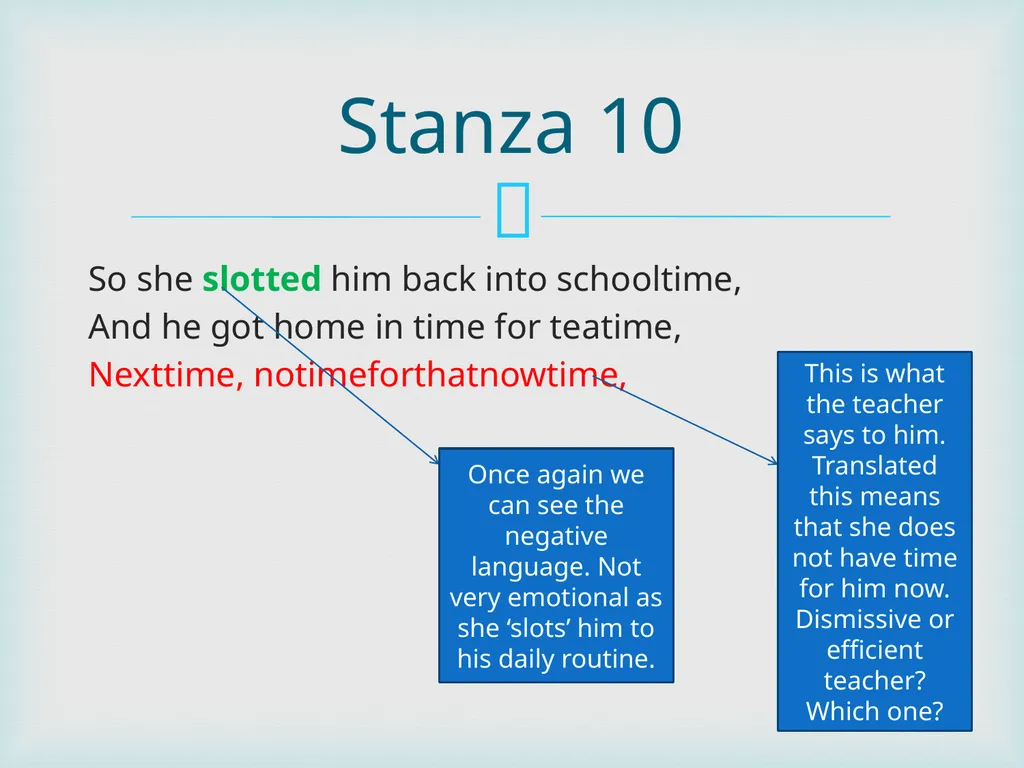
So she slotted him back into schooltime,
And he got home in time for teatime,
Nexttime, notimeforthatnowtime, Stanza 10 Once again we can see the negative language. Not very emotional as she ‘slots’ him to his daily routine. This is what the teacher says to him. Translated this means that she does not have time for him now. Dismissive or efficient teacher? Which one?<br>
14
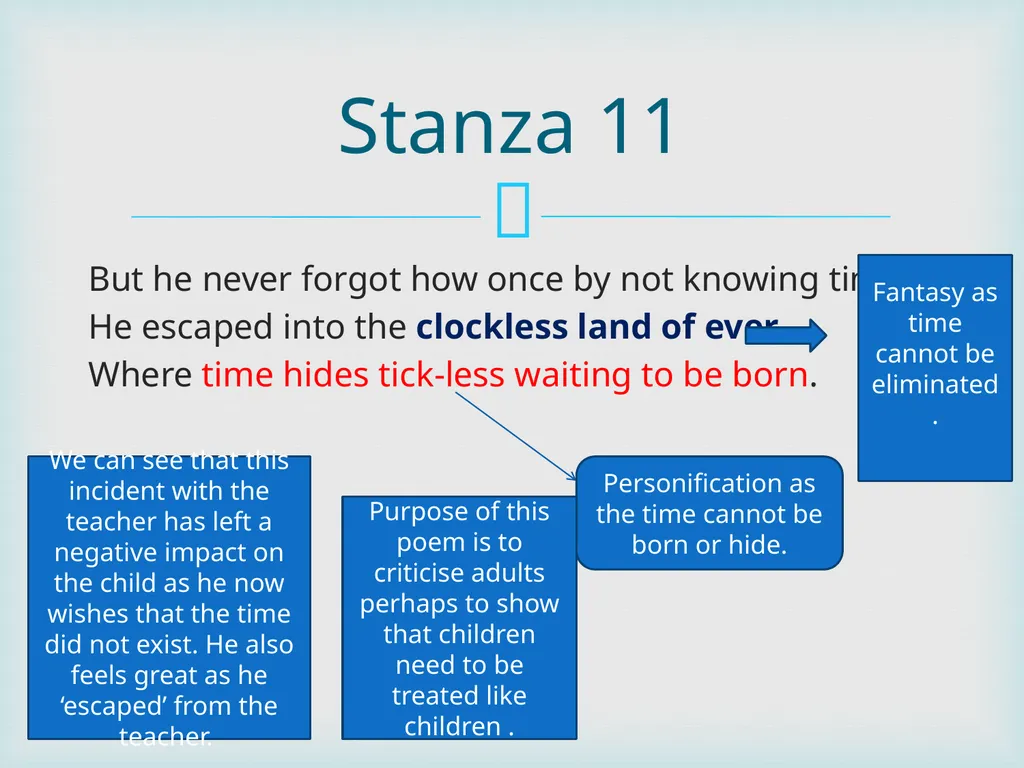
But he never forgot how once by not knowing time,
He escaped into the clockless land of ever,
Where time hides tick-less waiting to be born. Stanza 11 Personification as the time cannot be born or hide. Fantasy as time cannot be eliminated. We can see that this incident with the teacher has left a negative impact on the child as he now wishes that the time did not exist. He also feels great as he ‘escaped’ from the teacher. Purpose of this poem is to criticise adults perhaps to show that children need to be treated like children .<br>