Heat Capacity, C Specific heat capacity, c the specific heat of a sample characterizes its change in temperature per unit mass. Amount of heat needed to raise the temperature of an object per degree temperature increase More fundamental
"Heat Capacity, C Specific heat capacity, c the" is the property of its rightful owner. Permission is granted to
download and print the materials on this website for personal, non-commercial use only, and to display it
on your personal computer provided you do not modify the materials and that you retain all copyright
notices contained in the materials. By downloading content from our website, you accept the terms of this
agreement.
Presentation Transcript
01
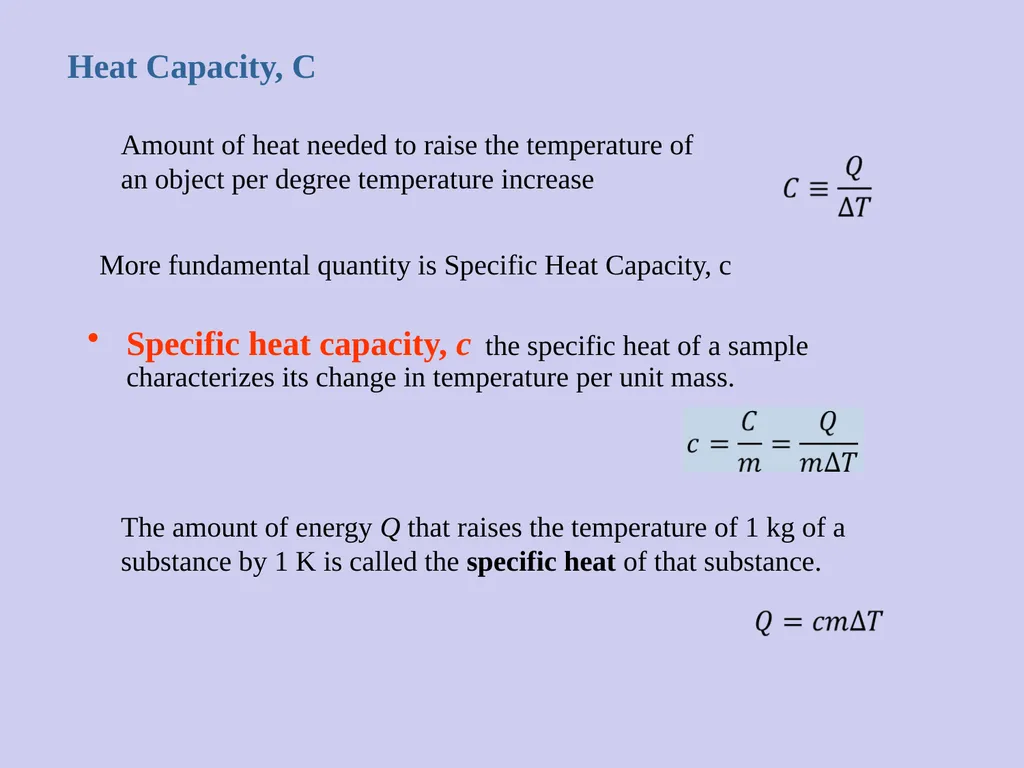
Heat Capacity, C Specific heat capacity, c the specific heat of a sample characterizes its change in temperature per unit mass. Amount of heat needed to raise the temperature of an object per degree temperature increase More fundamental quantity is Specific Heat Capacity, c The amount of energy Q that raises the temperature of 1 kg of a substance by 1 K is called the specific heat of that substance.<br>
02
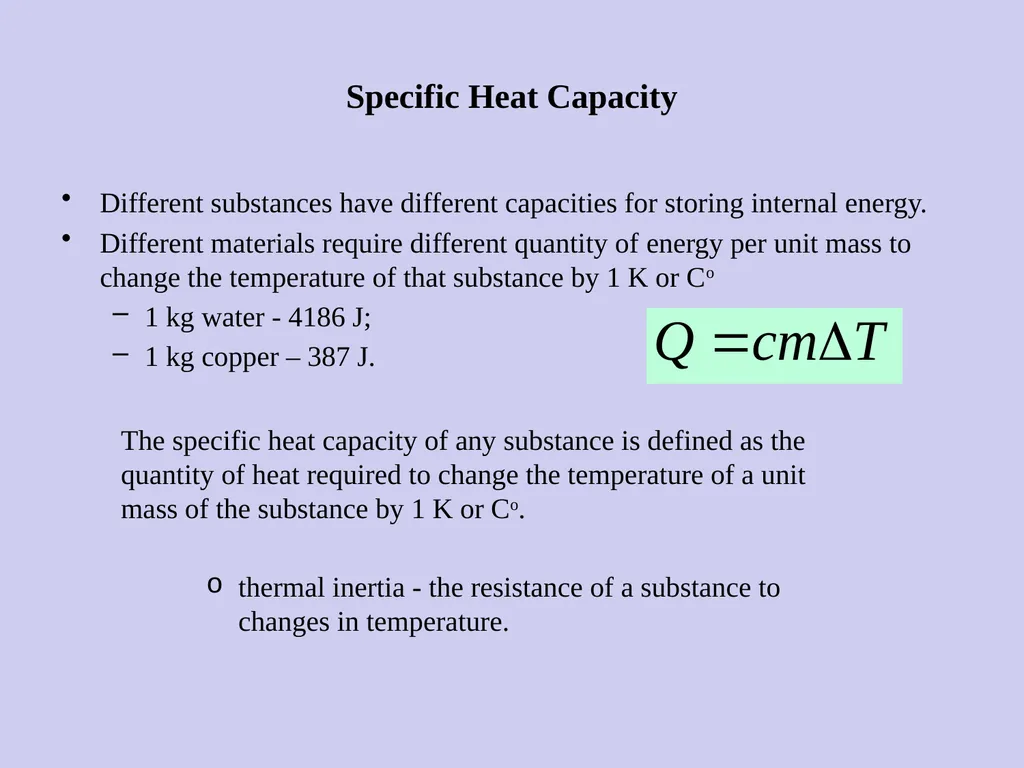
Specific Heat Capacity Different substances have different capacities for storing internal energy.
Different materials require different quantity of energy per unit mass to change the temperature of that substance by 1 K or Co
1 kg water - 4186 J;
1 kg copper – 387 J. The specific heat capacity of any substance is defined as the quantity of heat required to change the temperature of a unit mass of the substance by 1 K or Co. thermal inertia - the resistance of a substance to changes in temperature.<br>
03
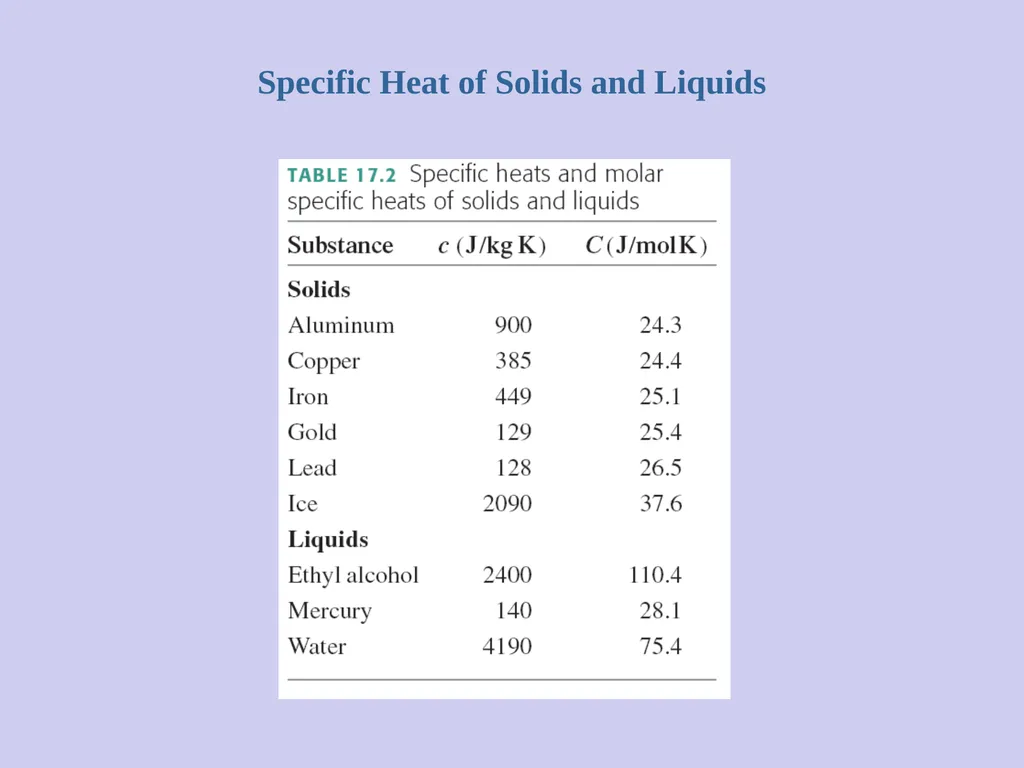
Specific Heat of Solids and Liquids<br>
04
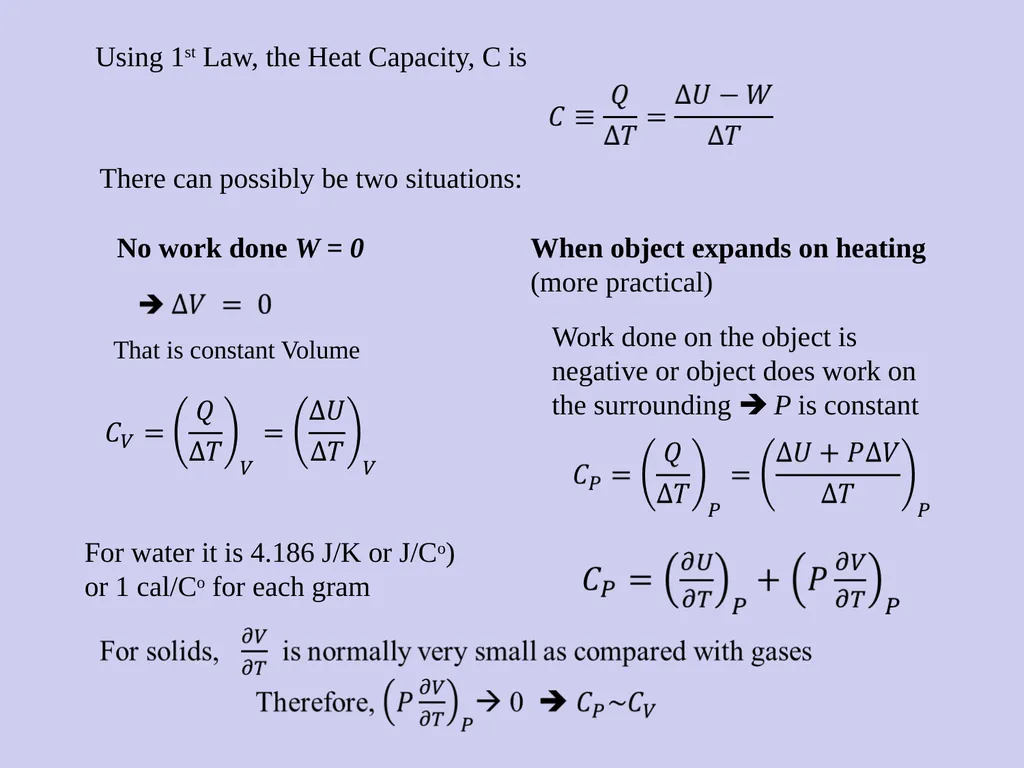
Using 1st Law, the Heat Capacity, C is There can possibly be two situations: No work done W = 0 That is constant Volume For water it is 4.186 J/K or J/Co) or 1 cal/Co for each gram When object expands on heating (more practical) Work done on the object is negative or object does work on the surrounding P is constant<br>
05
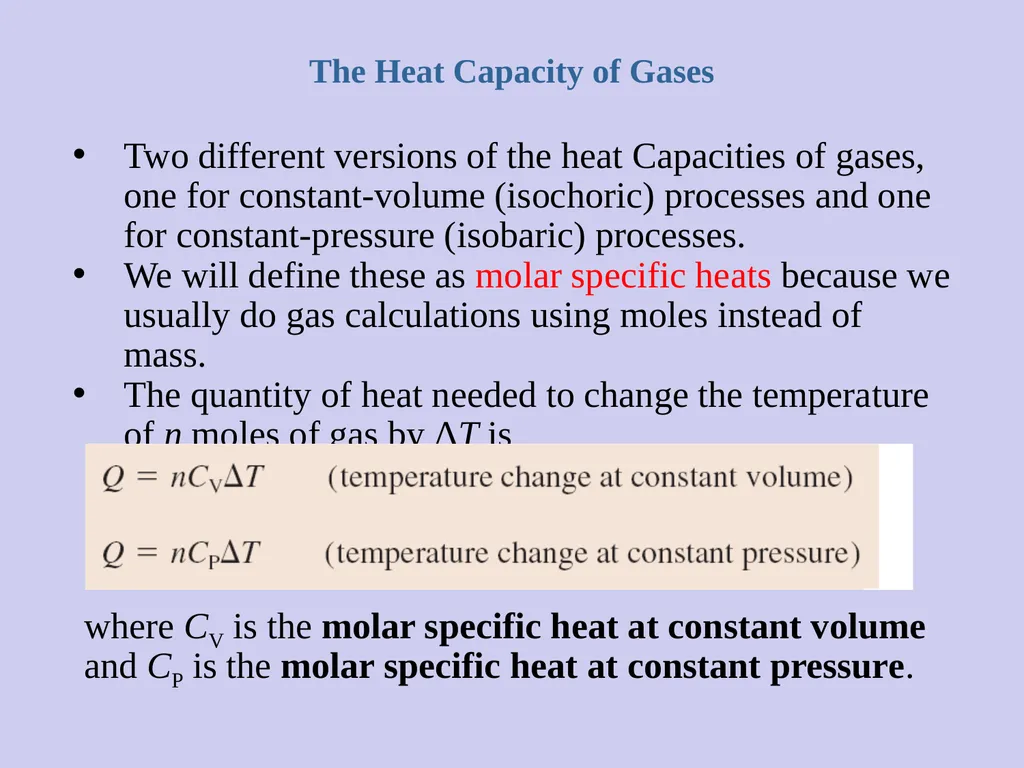
The Heat Capacity of Gases Two different versions of the heat Capacities of gases, one for constant-volume (isochoric) processes and one for constant-pressure (isobaric) processes.
We will define these as molar specific heats because we usually do gas calculations using moles instead of mass.
The quantity of heat needed to change the temperature of n moles of gas by ΔT is where CV is the molar specific heat at constant volume and CP is the molar specific heat at constant pressure.<br>
06
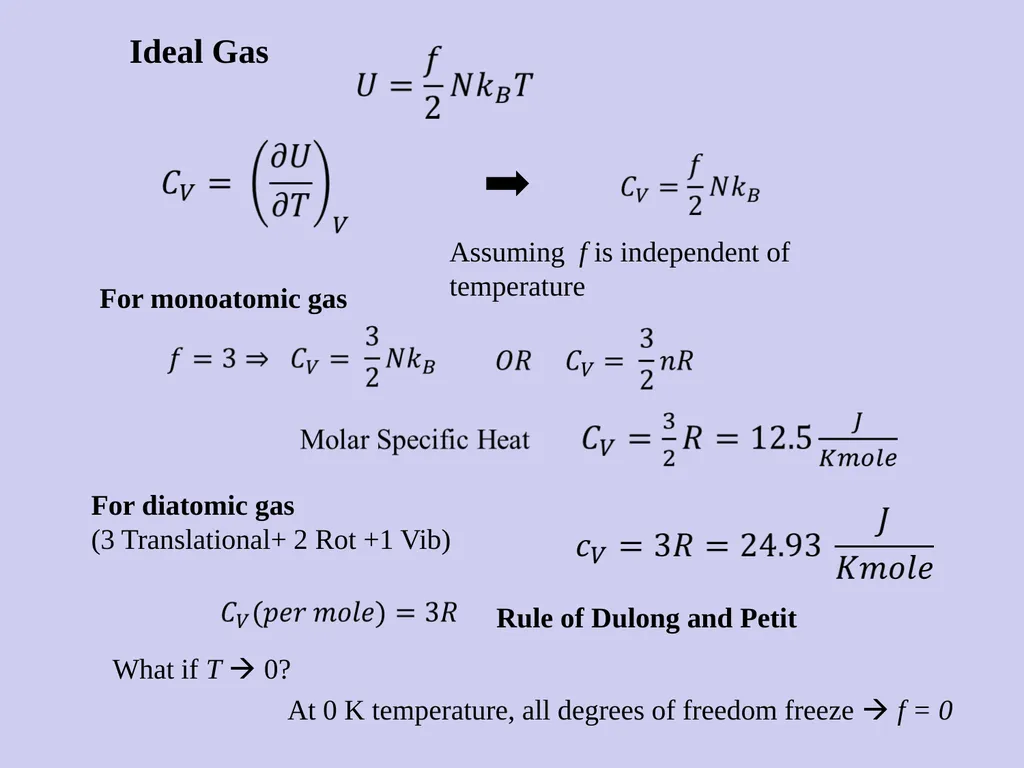
Ideal Gas Assuming f is independent of temperature For monoatomic gas For diatomic gas
(3 Translational+ 2 Rot +1 Vib) Rule of Dulong and Petit What if T 0? At 0 K temperature, all degrees of freedom freeze f = 0<br>
07
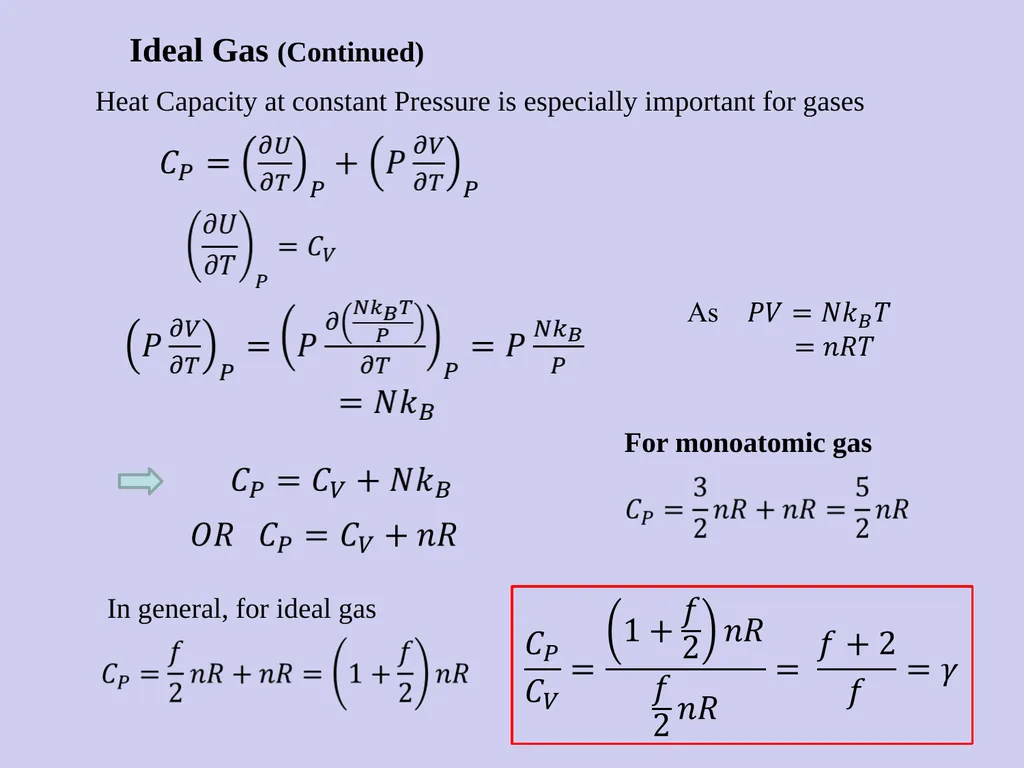
Heat Capacity at constant Pressure is especially important for gases Ideal Gas (Continued) For monoatomic gas In general, for ideal gas<br>
08
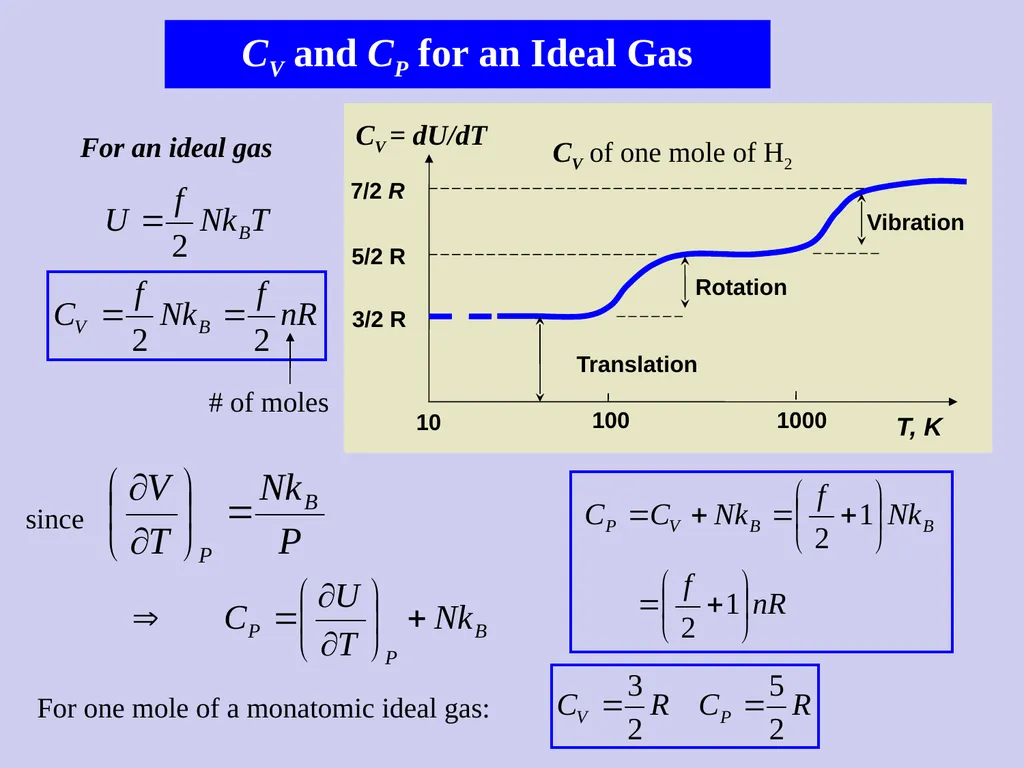
CV and CP for an Ideal Gas For an ideal gas # of moles For one mole of a monatomic ideal gas: since<br>
09
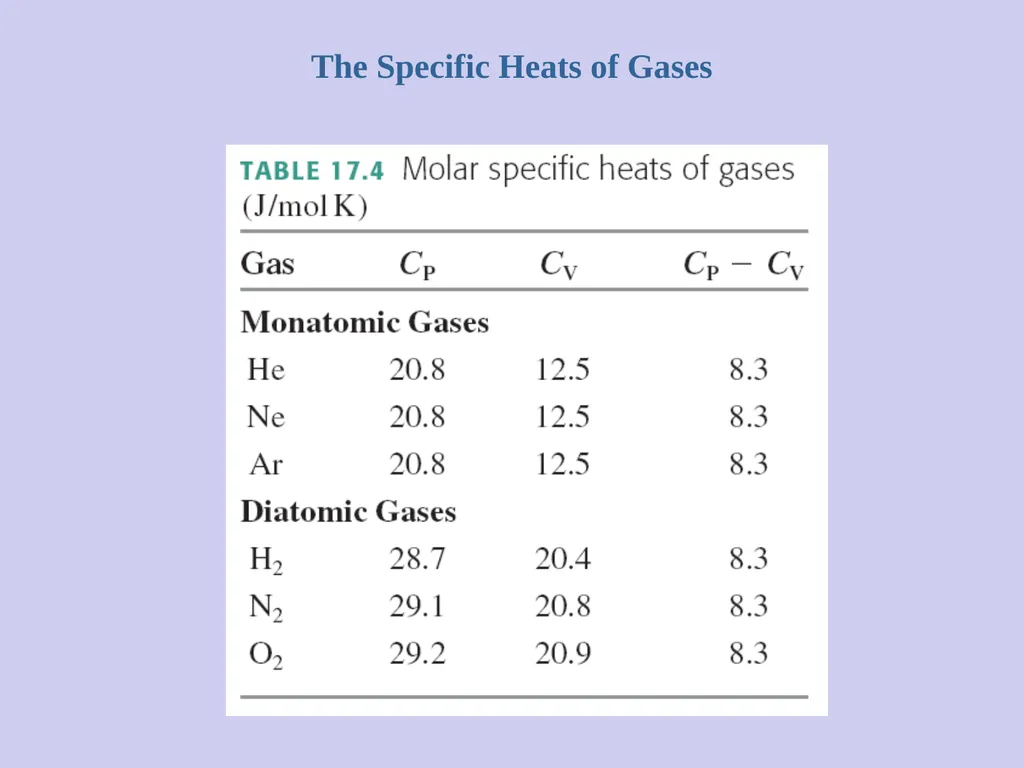
The Specific Heats of Gases<br>
10
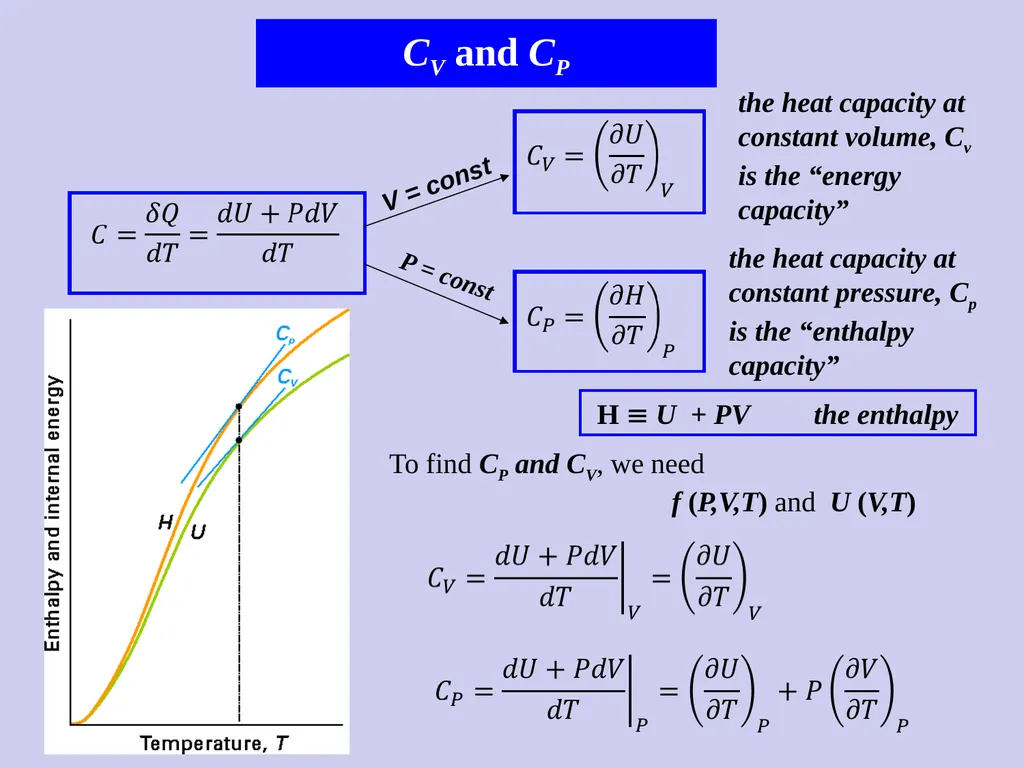
CV and CP V = const P = const the heat capacity at constant volume, Cv is the “energy capacity” the heat capacity at constant pressure, Cp is the “enthalpy capacity” H U + PV the enthalpy To find CP and CV, we need f (P,V,T) and U (V,T)<br>
11
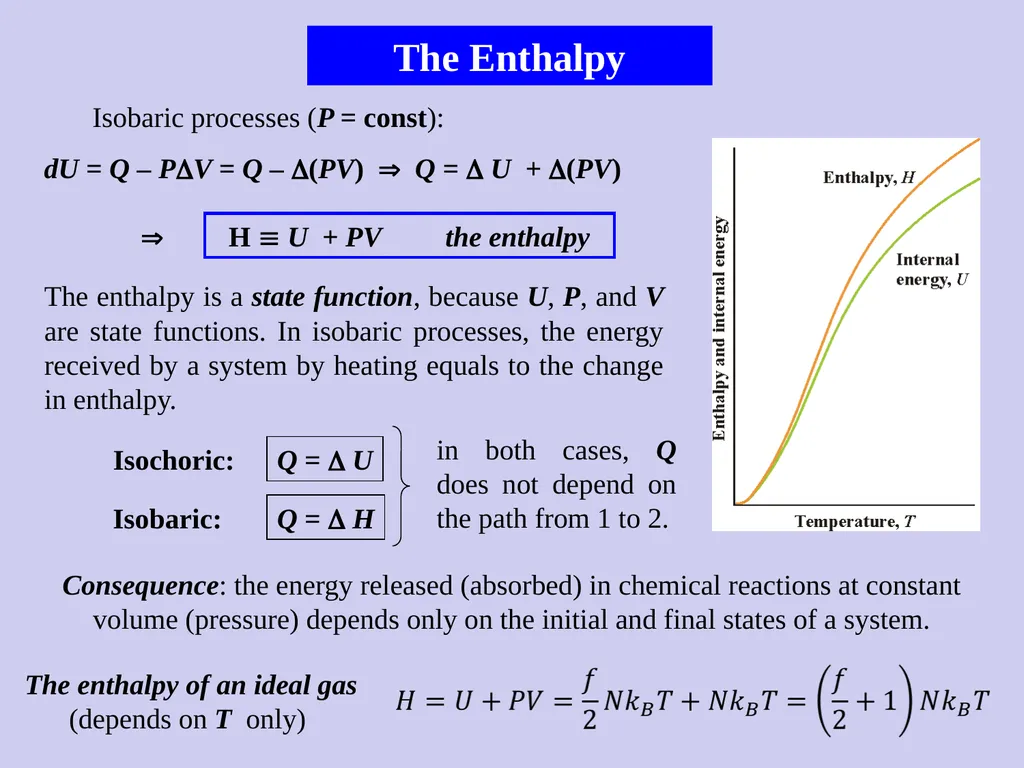
The Enthalpy Isobaric processes (P = const): dU = Q – PV = Q – (PV) Q = U + (PV) The enthalpy is a state function, because U, P, and V are state functions. In isobaric processes, the energy received by a system by heating equals to the change in enthalpy. Q = H Isochoric: Isobaric: in both cases, Q does not depend on the path from 1 to 2. Consequence: the energy released (absorbed) in chemical reactions at constant volume (pressure) depends only on the initial and final states of a system. H U + PV the enthalpy The enthalpy of an ideal gas
(depends on T only) Q = U<br>
12
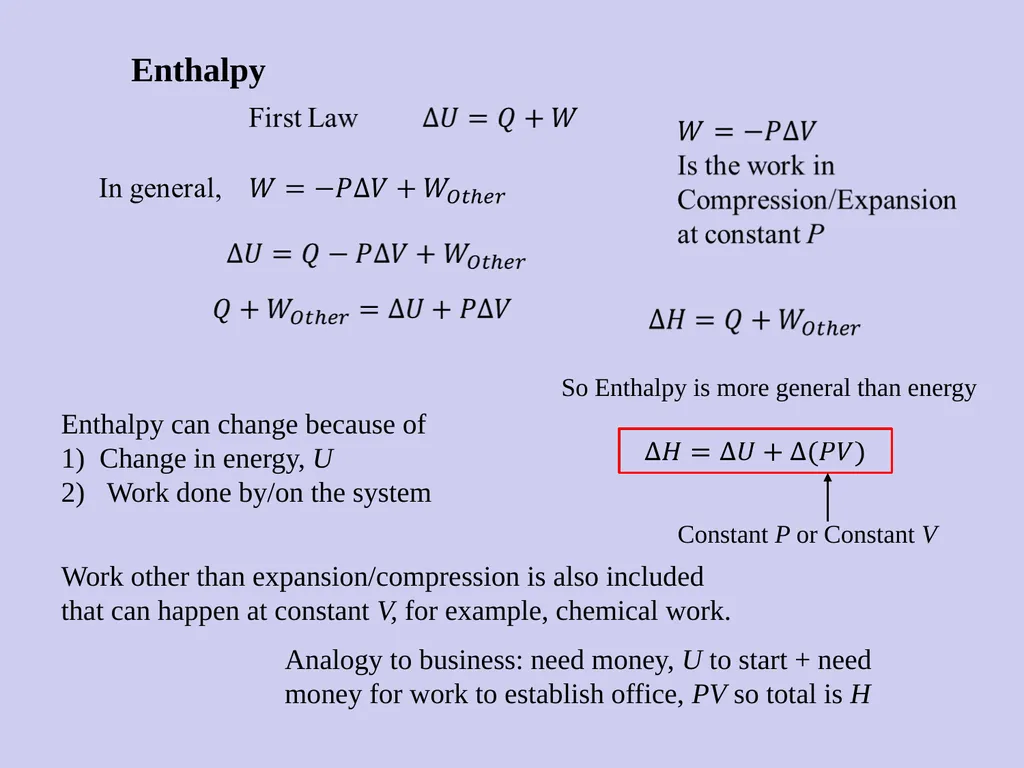
Enthalpy Enthalpy can change because of
Change in energy, U
Work done by/on the system So Enthalpy is more general than energy Constant P or Constant V Work other than expansion/compression is also included that can happen at constant V, for example, chemical work. Analogy to business: need money, U to start + need money for work to establish office, PV so total is H<br>
13
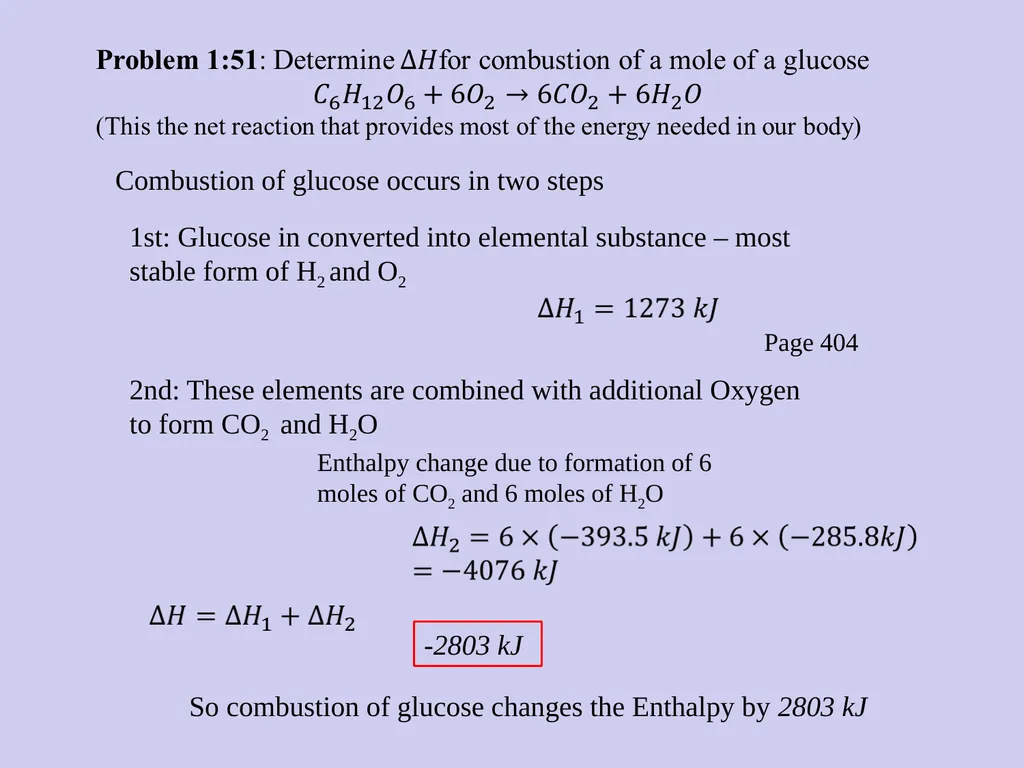
Combustion of glucose occurs in two steps 1st: Glucose in converted into elemental substance – most stable form of H2 and O2 2nd: These elements are combined with additional Oxygen to form CO2 and H2O Page 404 Enthalpy change due to formation of 6 moles of CO2 and 6 moles of H2O -2803 kJ So combustion of glucose changes the Enthalpy by 2803 kJ<br>
14
Problems for practice on Friday:
1.33, 1.34, 1.36, 1.43, 1.56, 1.61 and 1.63 Assignment#3 Due 2/11/2022
1.41, 1.49, 1.59, 1.60, and 1.64 Next:
Conductivity, Viscosity and Diffusion<br>