
HMH Science Dimensions Physics Unit 2: Energy and
JO
Published · 37 slides · 0 views
1 / 1
Description
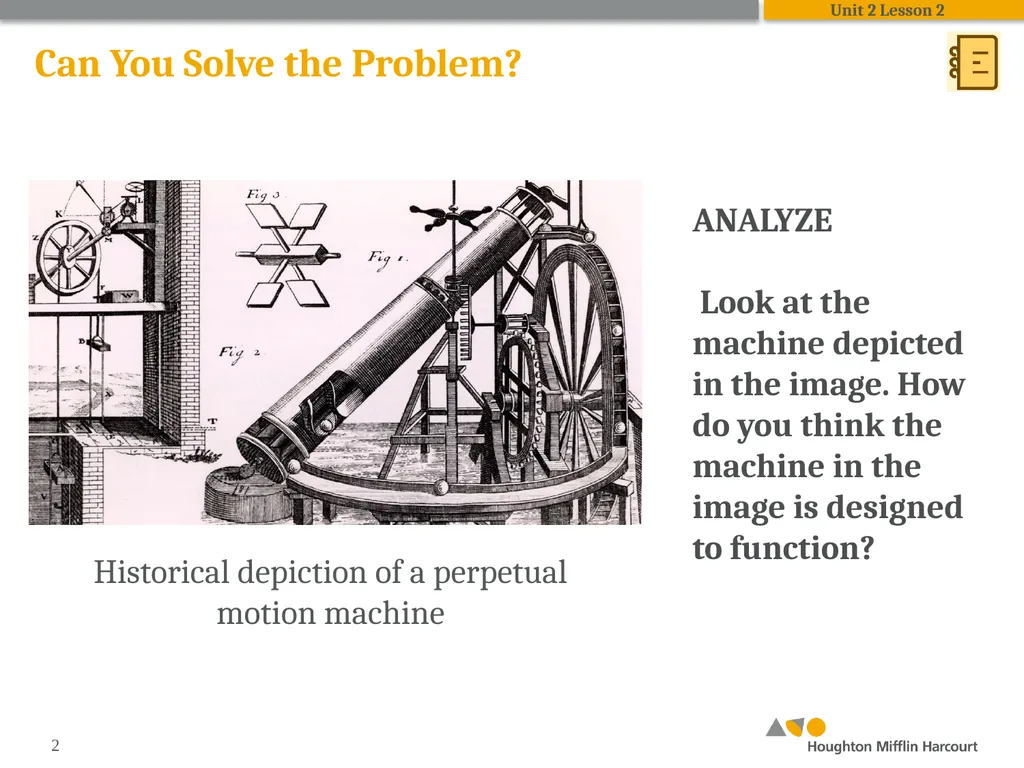
HMH Science Dimensions Physics Unit 2: Energy and Motion Lesson 2: Analyzing Energy in Systems Can You Solve the Problem? 2 Unit 2 Lesson 2 ANALYZE Look at the machine depicted in the image. How do you think the machine in the image is
Related Topics
Share
Embed code
Download this presentation From Below
"HMH Science Dimensions Physics Unit 2: Energy and" is the property of its rightful owner. Permission is granted to download and print the materials on this website for personal, non-commercial use only, and to display it on your personal computer provided you do not modify the materials and that you retain all copyright notices contained in the materials. By downloading content from our website, you accept the terms of this agreement.
Presentation Transcript
01
HMH Science Dimensions
Physics
Unit 2: Energy and Motion
Lesson 2: Analyzing Energy in Systems<br>
Physics
Unit 2: Energy and Motion
Lesson 2: Analyzing Energy in Systems<br>
02
Can You Solve the Problem? 2 Unit 2 Lesson 2 ANALYZE
Look at the machine depicted in the image. How do you think the machine in the image is designed to function? Historical depiction of a perpetual motion machine<br>
Look at the machine depicted in the image. How do you think the machine in the image is designed to function? Historical depiction of a perpetual motion machine<br>
03
Energy and Systems 3 COLLABORATE
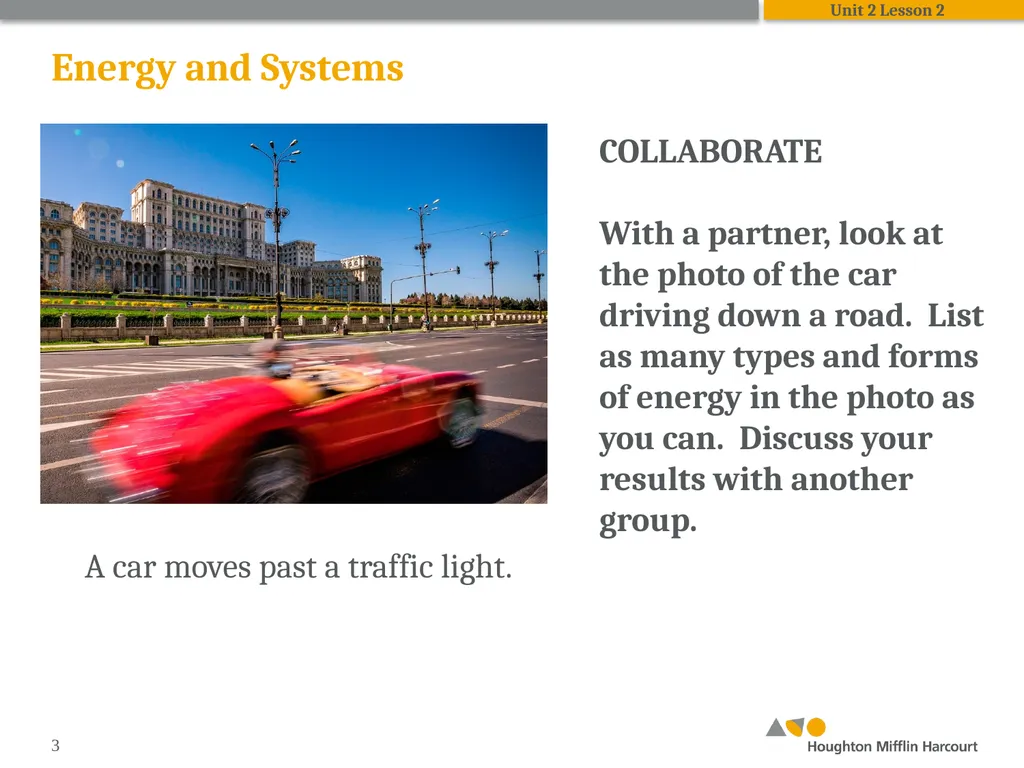
With a partner, look at the photo of the car driving down a road. List as many types and forms of energy in the photo as you can. Discuss your results with another group. Unit 2 Lesson 2 A car moves past a traffic light.<br>
With a partner, look at the photo of the car driving down a road. List as many types and forms of energy in the photo as you can. Discuss your results with another group. Unit 2 Lesson 2 A car moves past a traffic light.<br>
04
Energy and Systems 4 Energy is a measure of a system's ability to change or move matter.
Kinetic energy is the type of energy due to the motion of an object.
The energy of a system due to its position or state is called potential energy. Unit 2 Lesson 2<br>
Kinetic energy is the type of energy due to the motion of an object.
The energy of a system due to its position or state is called potential energy. Unit 2 Lesson 2<br>
05
Energy and Systems
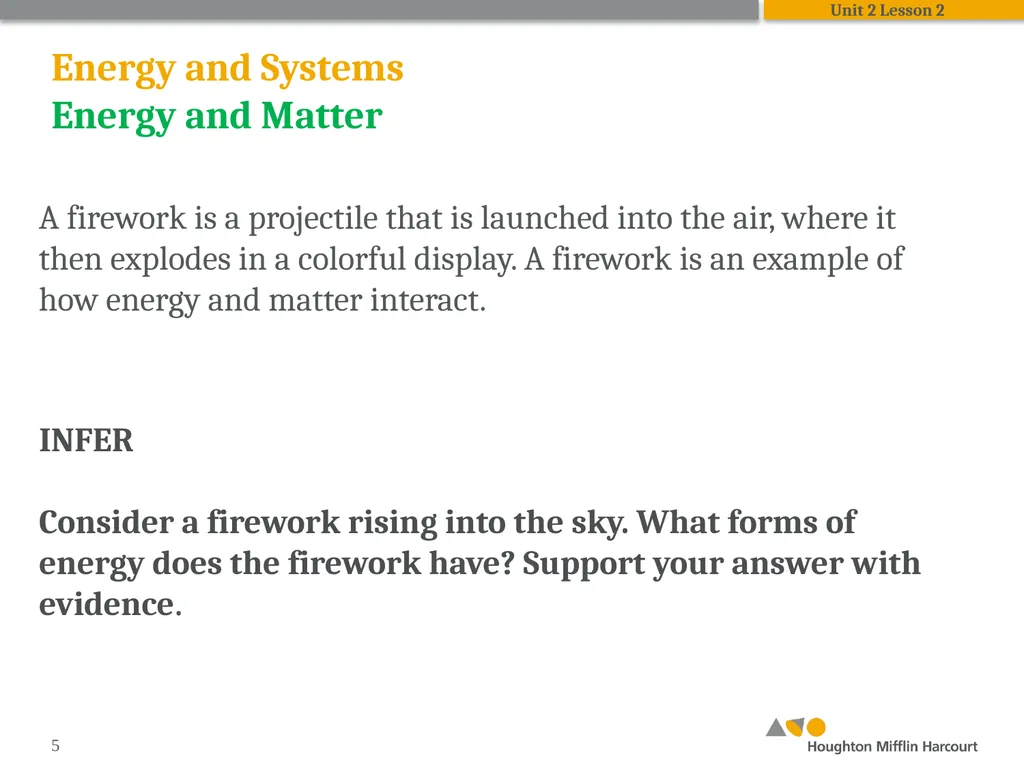
Energy and Matter 5 Unit 2 Lesson 2 A firework is a projectile that is launched into the air, where it then explodes in a colorful display. A firework is an example of how energy and matter interact. INFER
Consider a firework rising into the sky. What forms of energy does the firework have? Support your answer with evidence.<br>
Consider a firework rising into the sky. What forms of energy does the firework have? Support your answer with evidence.<br>
06
Energy and Systems
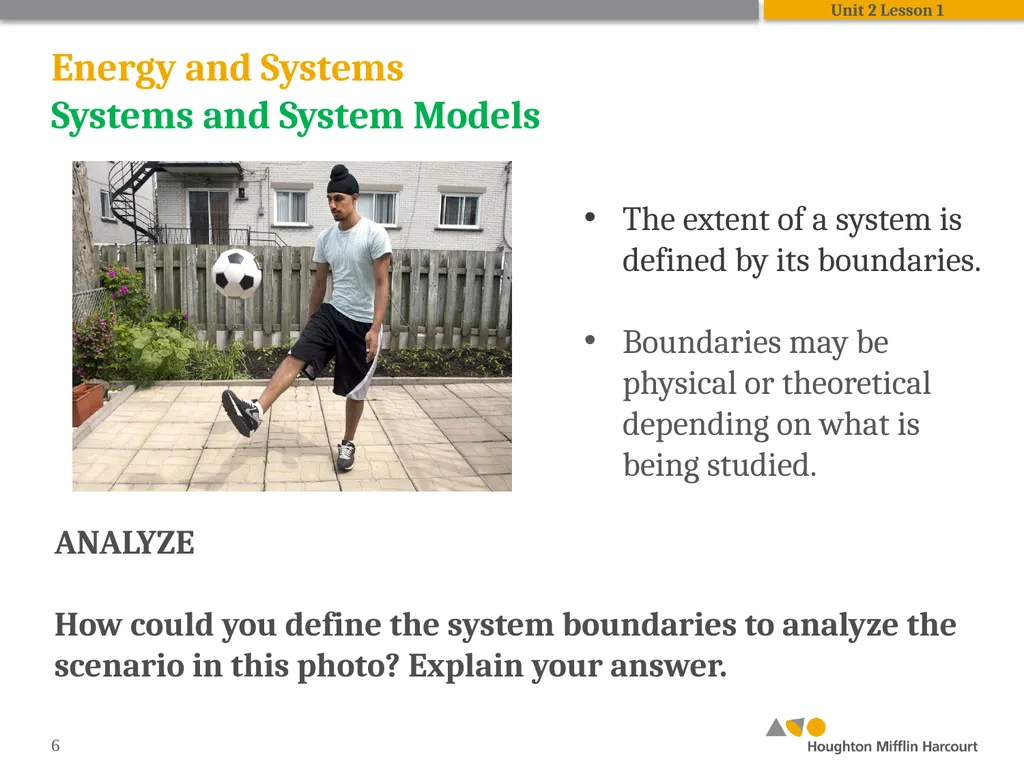
Systems and System Models 6 Unit 2 Lesson 1 The extent of a system is defined by its boundaries.
Boundaries may be physical or theoretical depending on what is being studied. ANALYZE
How could you define the system boundaries to analyze the scenario in this photo? Explain your answer.<br>
Boundaries may be physical or theoretical depending on what is being studied. ANALYZE
How could you define the system boundaries to analyze the scenario in this photo? Explain your answer.<br>
07
Energy and Systems 7 Unit 2 Lesson 2 EXPLAIN
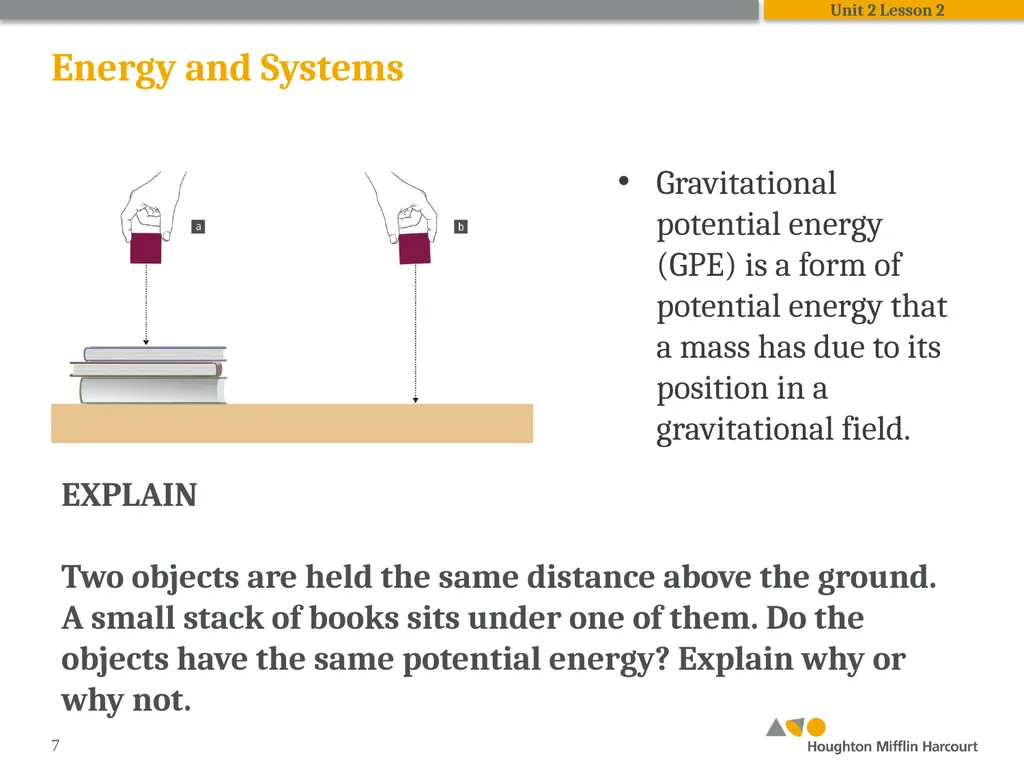
Two objects are held the same distance above the ground. A small stack of books sits under one of them. Do the objects have the same potential energy? Explain why or why not. Gravitational potential energy (GPE) is a form of potential energy that a mass has due to its position in a gravitational field.<br>
Two objects are held the same distance above the ground. A small stack of books sits under one of them. Do the objects have the same potential energy? Explain why or why not. Gravitational potential energy (GPE) is a form of potential energy that a mass has due to its position in a gravitational field.<br>
08
Energy and Systems 8 Unit 2 Lesson 1 Watch the video of the apple being dropped 1 m.<br>
09
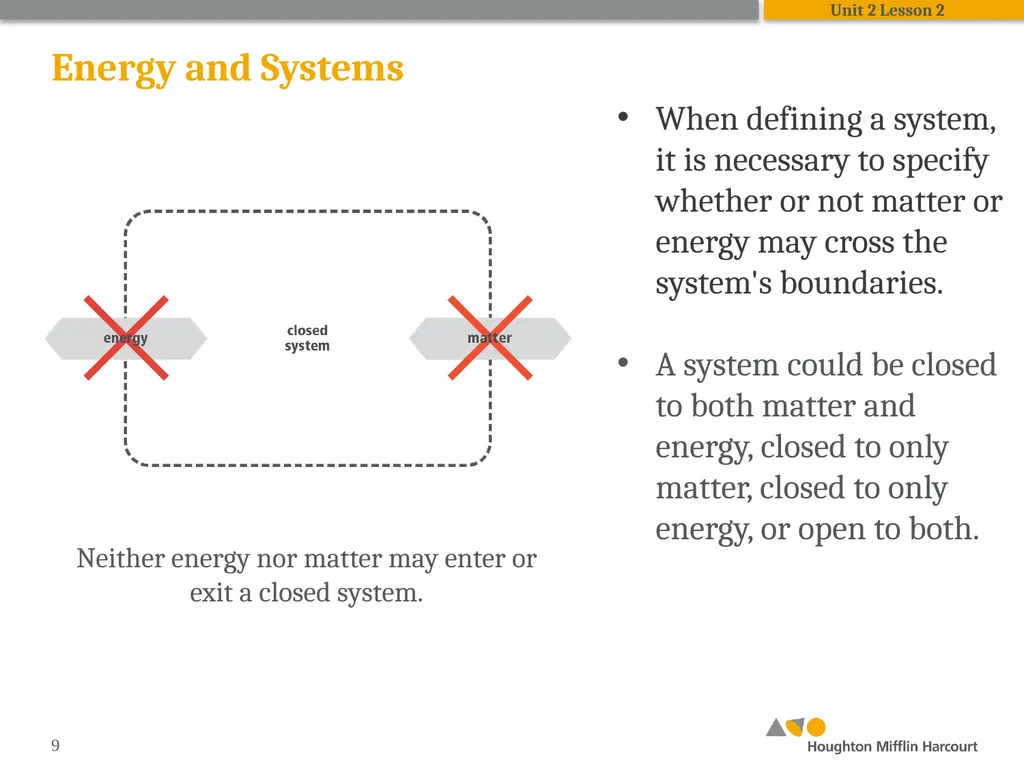
Energy and Systems 9 Unit 2 Lesson 2 Neither energy nor matter may enter or exit a closed system. When defining a system, it is necessary to specify whether or not matter or energy may cross the system's boundaries.
A system could be closed to both matter and energy, closed to only matter, closed to only energy, or open to both.<br>
A system could be closed to both matter and energy, closed to only matter, closed to only energy, or open to both.<br>
10
Energy and Systems
Energy and Matter 10 Unit 2 Lesson 2 Consider a system where the boundaries are closed to both matter and energy along with concepts of conservation of mass and conservation of energy. In this type of system, the amount of mass and energy in the system will remain constant. For a system closed to energy and matter, which equation models the relationship between the kinetic energy (KE) and potential energy (PE) in the system at two different times, 1 and 2? KE1 + KE2 = PE1 + PE2
KE1 + PE2 = KE2 + PE1
KE1 + PE1 = KE2 + PE2<br>
KE1 + PE2 = KE2 + PE1
KE1 + PE1 = KE2 + PE2<br>
11
Energy and Systems 11 Unit 2 Lesson 2 In your Evidence Notebook, sketch a model of a pot of water boiling on a stove as it is being warmed by the stovetop. Define the system boundaries, and show whether matter or energy crosses the boundaries as clearly as possible. Identify the forms of energy where possible.<br>
12
Energy and Systems
Systems and System Models 12 Models can be used to simulate systems and interactions, but models are limited in how completely or accurately they can represent a system. Unit 2 Lesson 2 ARGUE
Describe how scientists and engineers can use models effectively, even when they are partially inaccurate or simplified.<br>
Describe how scientists and engineers can use models effectively, even when they are partially inaccurate or simplified.<br>
13
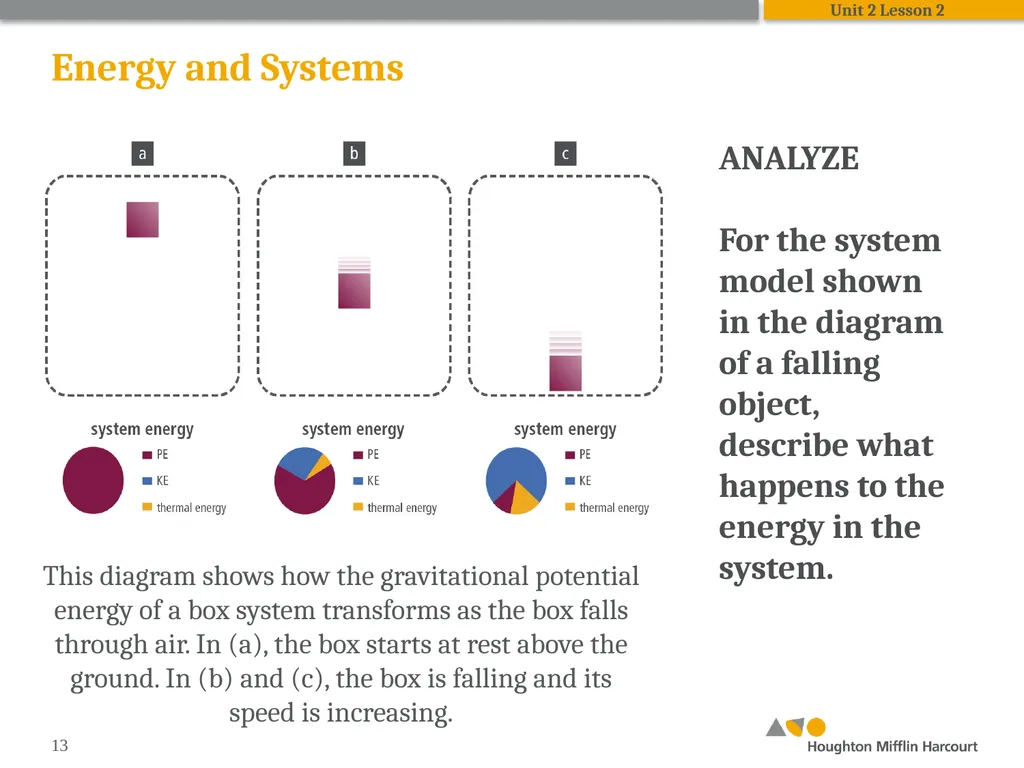
Energy and Systems 13 Unit 2 Lesson 2 This diagram shows how the gravitational potential energy of a box system transforms as the box falls through air. In (a), the box starts at rest above the ground. In (b) and (c), the box is falling and its speed is increasing. ANALYZE
For the system model shown in the diagram of a falling object, describe what happens to the energy in the system.<br>
For the system model shown in the diagram of a falling object, describe what happens to the energy in the system.<br>
14
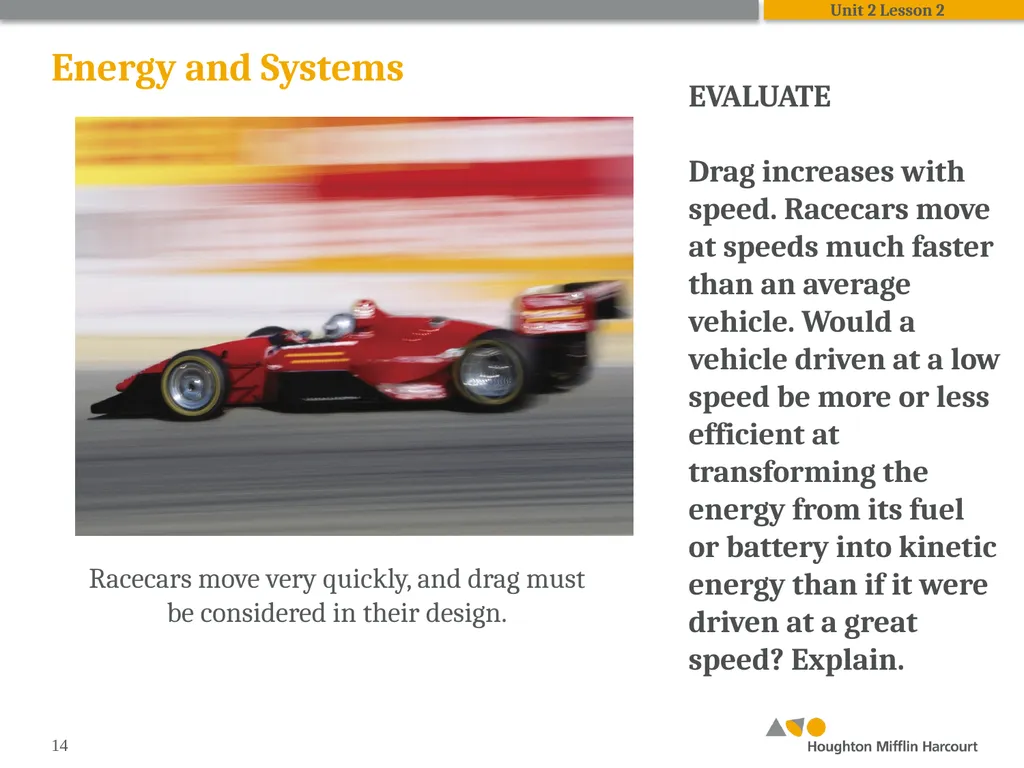
Energy and Systems 14 Unit 2 Lesson 2 Racecars move very quickly, and drag must be considered in their design. EVALUATE
Drag increases with speed. Racecars move at speeds much faster than an average vehicle. Would a vehicle driven at a low speed be more or less efficient at transforming the energy from its fuel or battery into kinetic energy than if it were driven at a great speed? Explain.<br>
Drag increases with speed. Racecars move at speeds much faster than an average vehicle. Would a vehicle driven at a low speed be more or less efficient at transforming the energy from its fuel or battery into kinetic energy than if it were driven at a great speed? Explain.<br>
15
Energy and Systems 15 Unit 2 Lesson 2 For a perpetual motion machine to exist, what would need to be true about energy transfers and transformations in the system and the amount of energy in the system?<br>
16
Energy Transfer in a Collision
Hands-On Lab: The Composition of Hydrates 16 Unit 2 Lesson 2 How is energy related to the distance the cardstock plow moves after its collision with the ball?<br>
17
Energy Transfer in a Collision 17 Unit 2 Lesson 2 For a perpetual motion machine to exist, what would need to be true about energy transfers and transformations in the system and the amount of energy in the system?<br>
18
Quantifying Energy 18 INFER
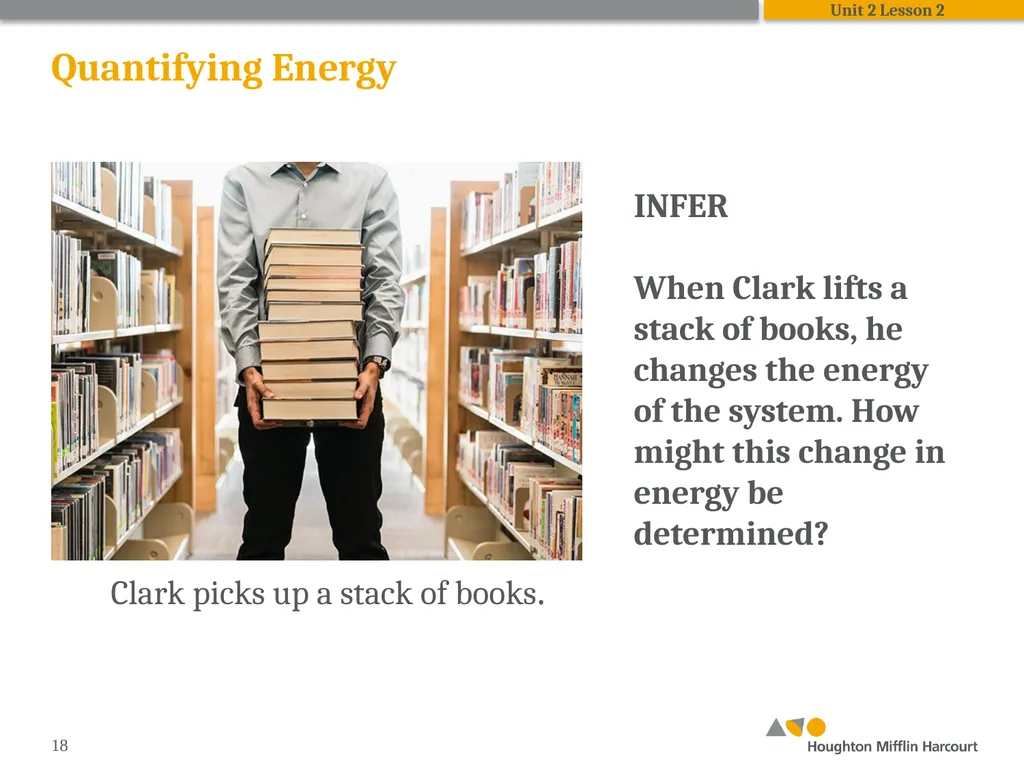
When Clark lifts a stack of books, he changes the energy of the system. How might this change in energy be determined? Unit 2 Lesson 2 Clark picks up a stack of books.<br>
When Clark lifts a stack of books, he changes the energy of the system. How might this change in energy be determined? Unit 2 Lesson 2 Clark picks up a stack of books.<br>
19
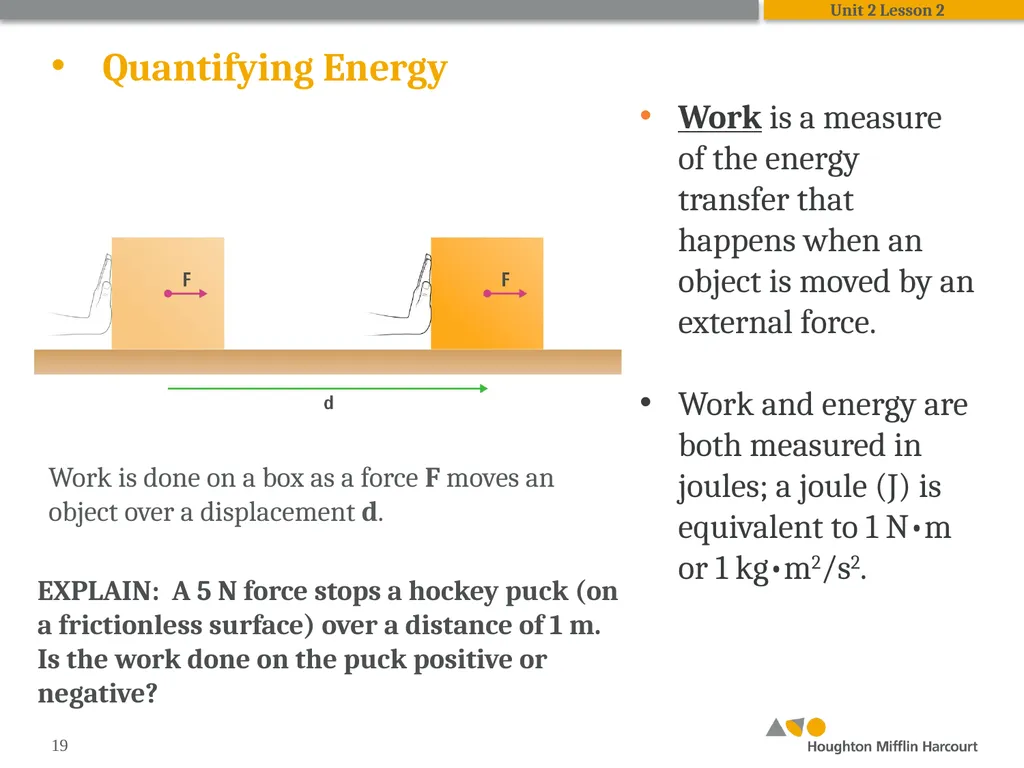
Quantifying Energy 19 Unit 2 Lesson 2 Work is a measure of the energy transfer that happens when an object is moved by an external force.
Work and energy are both measured in joules; a joule (J) is equivalent to 1 N•m or 1 kg•m2/s2. Work is done on a box as a force F moves an object over a displacement d. EXPLAIN: A 5 N force stops a hockey puck (on a frictionless surface) over a distance of 1 m. Is the work done on the puck positive or negative?<br>
Work and energy are both measured in joules; a joule (J) is equivalent to 1 N•m or 1 kg•m2/s2. Work is done on a box as a force F moves an object over a displacement d. EXPLAIN: A 5 N force stops a hockey puck (on a frictionless surface) over a distance of 1 m. Is the work done on the puck positive or negative?<br>
20
Quantifying Energy 20 Unit 2 Lesson 2 The amount of work done by a force can be calculated using the equation W = F • d. EXPLAIN
A 5 N force stops a hockey puck (on a frictionless surface) over a distance of 1 m. Is the work done on the puck positive or negative?<br>
A 5 N force stops a hockey puck (on a frictionless surface) over a distance of 1 m. Is the work done on the puck positive or negative?<br>
21
Quantifying Energy 21 Unit 2 Lesson 2 In the unit project, you design an overly complex machine known as a Rube Goldberg machine. How might the concept of work be used to predict how objects can be moved in a Rube Goldberg machine?<br>
22
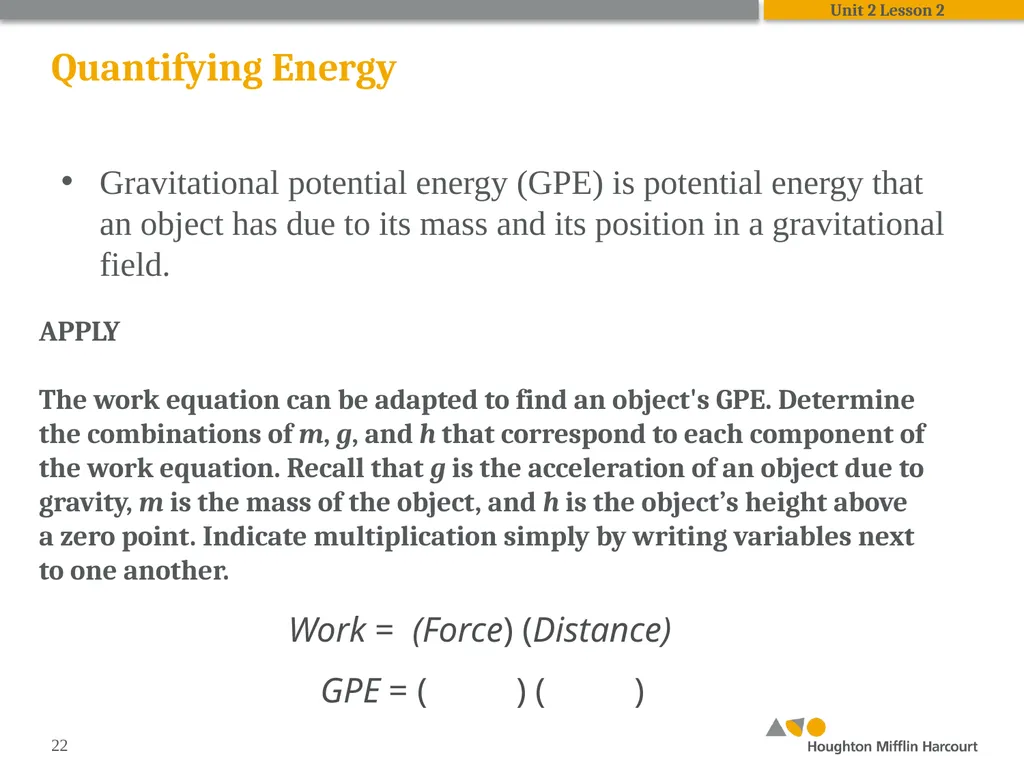
Quantifying Energy 22 Unit 2 Lesson 2 Gravitational potential energy (GPE) is potential energy that an object has due to its mass and its position in a gravitational field. APPLY
The work equation can be adapted to find an object's GPE. Determine the combinations of m, g, and h that correspond to each component of the work equation. Recall that g is the acceleration of an object due to gravity, m is the mass of the object, and h is the object’s height above a zero point. Indicate multiplication simply by writing variables next to one another. Work = (Force) (Distance) GPE = ( ) ( )<br>
The work equation can be adapted to find an object's GPE. Determine the combinations of m, g, and h that correspond to each component of the work equation. Recall that g is the acceleration of an object due to gravity, m is the mass of the object, and h is the object’s height above a zero point. Indicate multiplication simply by writing variables next to one another. Work = (Force) (Distance) GPE = ( ) ( )<br>
23
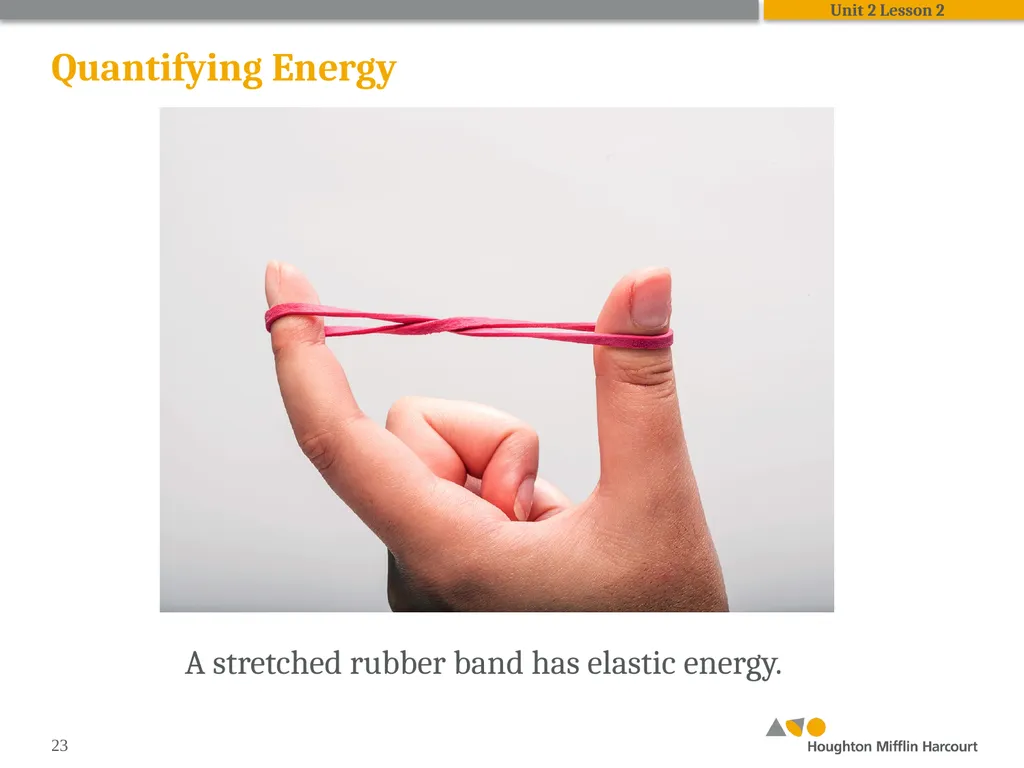
Quantifying Energy 23 Unit 2 Lesson 2 A stretched rubber band has elastic energy.<br>
24
24 Unit 2 Lesson 2 Quantifying Energy
Engineering Some early clocks, such as grandfather clocks, harnessed GPE to keep time. Later clocks, such as pocket watches, harnessed the EPE of springs to keep time.
IDENTIFY CONSTRAINTS
Compare the different types of timekeeping devices. Could a device like a pocket watch be run by GPE? Explain.<br>
IDENTIFY CONSTRAINTS
Compare the different types of timekeeping devices. Could a device like a pocket watch be run by GPE? Explain.<br>
25
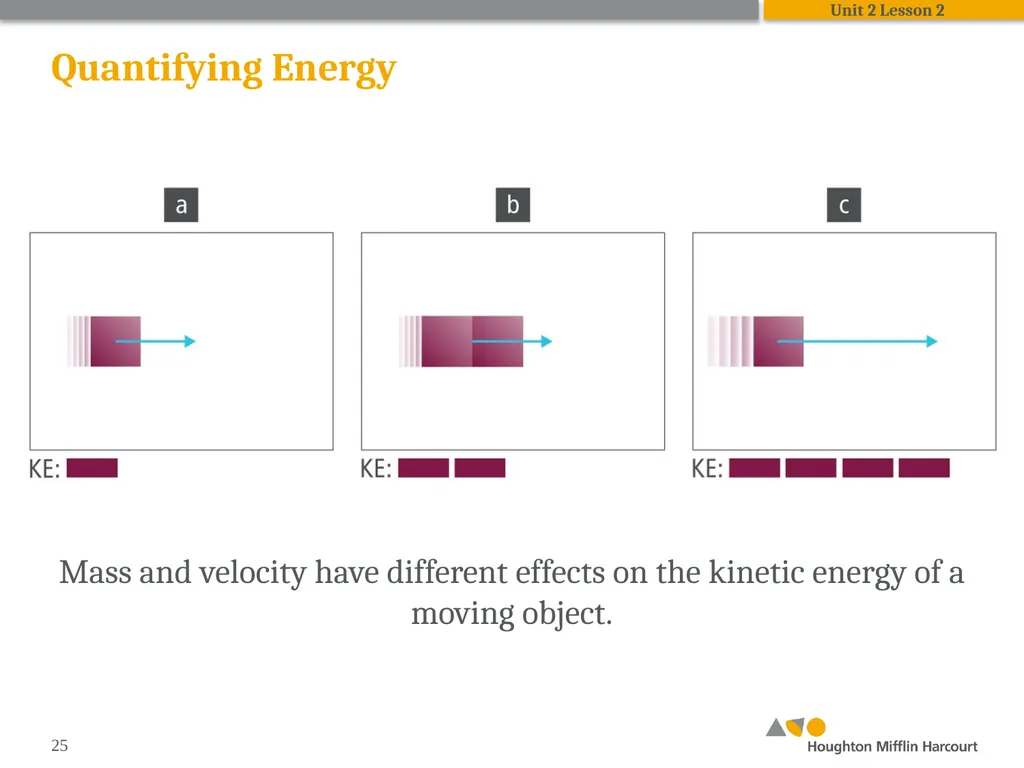
Quantifying Energy 25 Unit 2 Lesson 2 Mass and velocity have different effects on the kinetic energy of a moving object.<br>
26
Quantifying Energy
Problem Solving 26 Sample Problem
Analyze
Plan
Solve Unit 2 Lesson 2 SOLVE
A sled rider is given a push at the top of an icy hill, giving her an initial speed of 1.0 m/s. If the hill is 4.0 m tall from its base, how fast is the sled rider moving at the bottom of the hill? Assume that the icy hill is frictionless and air resistance is negligible.<br>
Analyze
Plan
Solve Unit 2 Lesson 2 SOLVE
A sled rider is given a push at the top of an icy hill, giving her an initial speed of 1.0 m/s. If the hill is 4.0 m tall from its base, how fast is the sled rider moving at the bottom of the hill? Assume that the icy hill is frictionless and air resistance is negligible.<br>
27
Quantifying Energy 27 Unit 2 Lesson 2 GATHER EVIDENCE
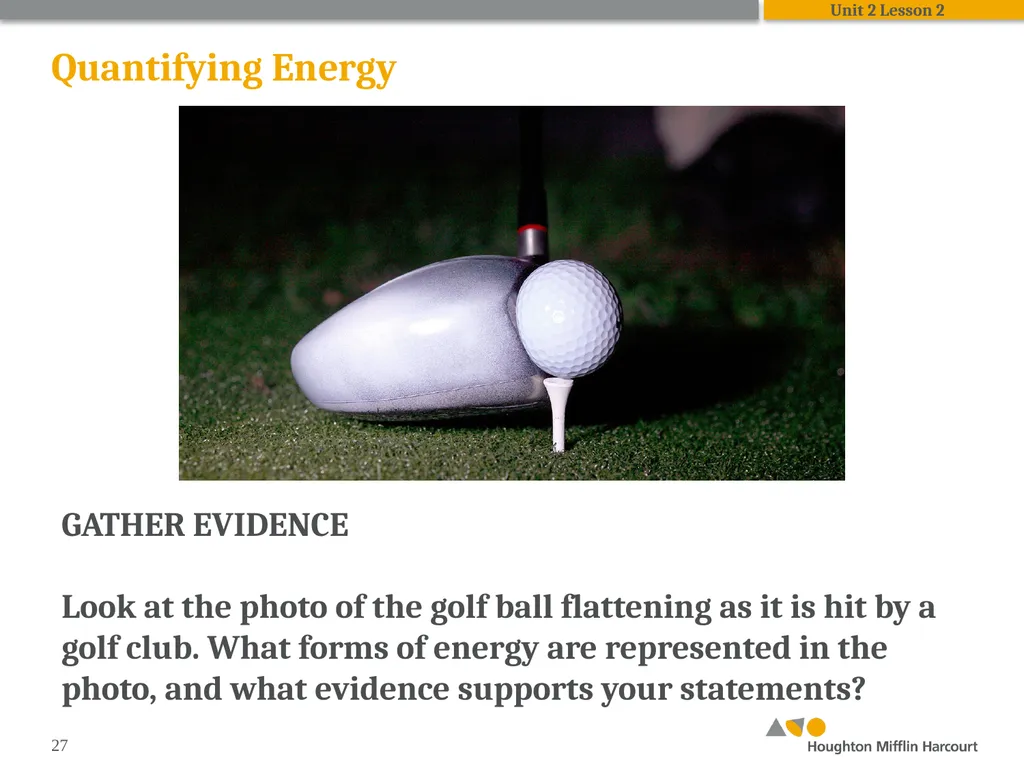
Look at the photo of the golf ball flattening as it is hit by a golf club. What forms of energy are represented in the photo, and what evidence supports your statements?<br>
Look at the photo of the golf ball flattening as it is hit by a golf club. What forms of energy are represented in the photo, and what evidence supports your statements?<br>
28
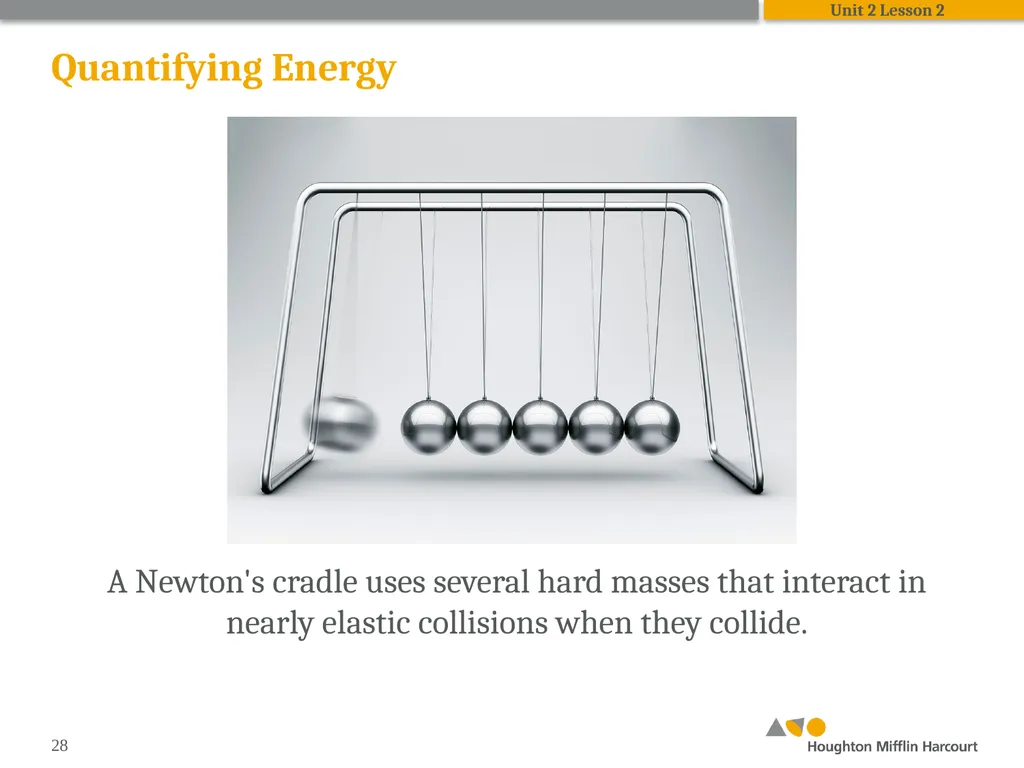
Quantifying Energy 28 Unit 2 Lesson 2 A Newton's cradle uses several hard masses that interact in nearly elastic collisions when they collide.<br>
29
Quantifying Energy 29 Unit 2 Lesson 2 When analyzing systems, scientists often assume energy transfers and transformations lose no energy. How would this impact a proposed perpetual motion machine?<br>
30
Case Study: Energy for Vehicles 30 Unit 2 Lesson 2 EXPLAIN
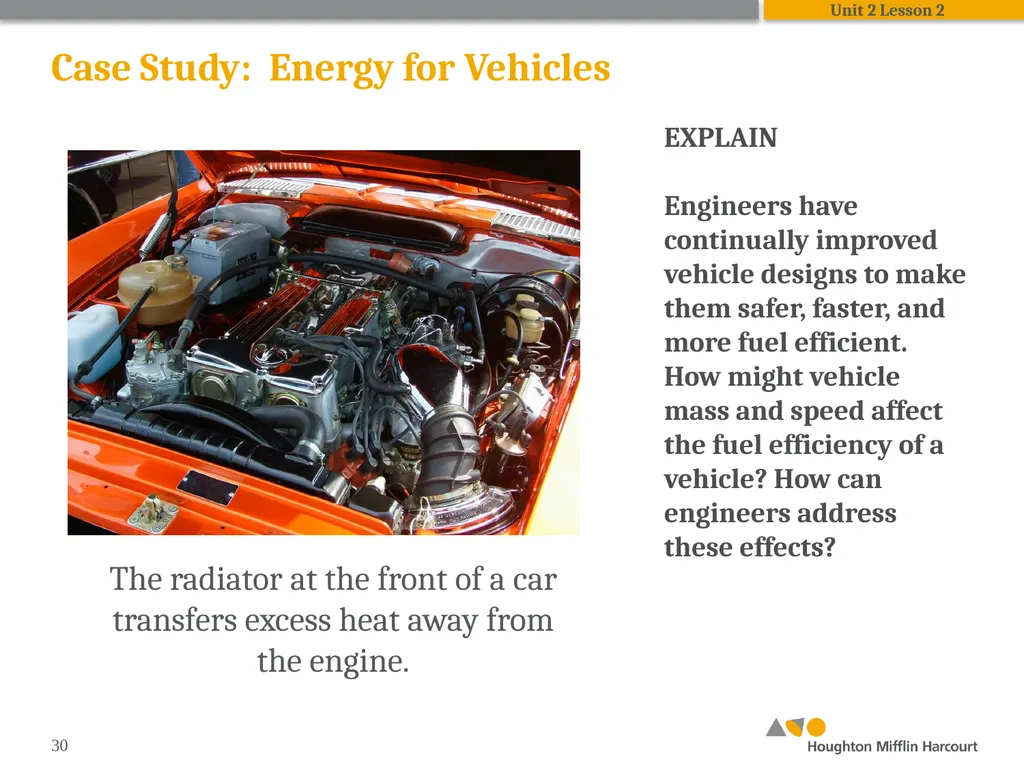
Engineers have continually improved vehicle designs to make them safer, faster, and more fuel efficient. How might vehicle mass and speed affect the fuel efficiency of a vehicle? How can engineers address these effects? The radiator at the front of a car transfers excess heat away from the engine.<br>
Engineers have continually improved vehicle designs to make them safer, faster, and more fuel efficient. How might vehicle mass and speed affect the fuel efficiency of a vehicle? How can engineers address these effects? The radiator at the front of a car transfers excess heat away from the engine.<br>
31
Case Study: Energy for Vehicles 31 Unit 4 Lesson 2 DESIGN
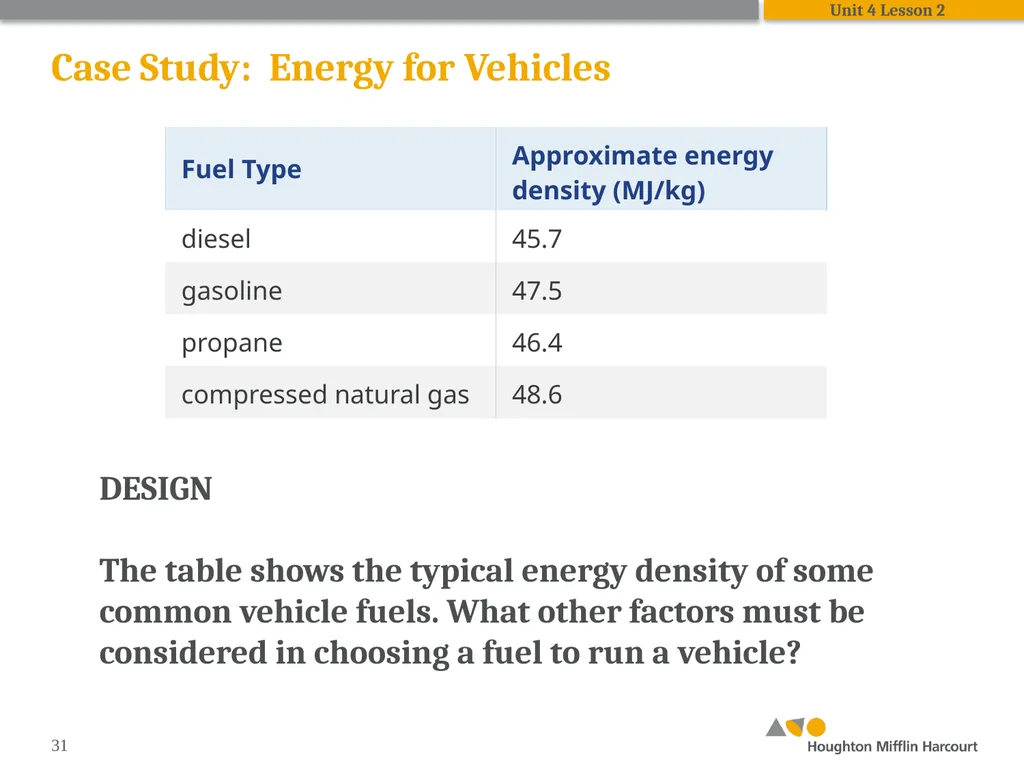
The table shows the typical energy density of some common vehicle fuels. What other factors must be considered in choosing a fuel to run a vehicle?<br>
The table shows the typical energy density of some common vehicle fuels. What other factors must be considered in choosing a fuel to run a vehicle?<br>
32
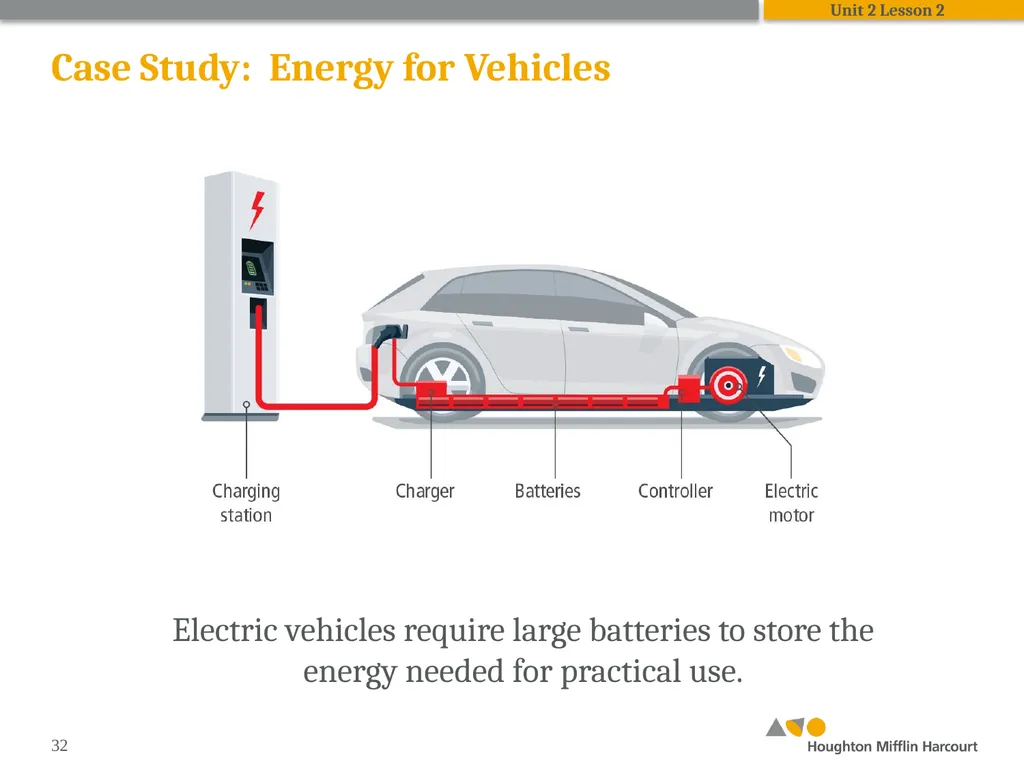
Case Study: Energy for Vehicles 32 Unit 2 Lesson 2 Electric vehicles require large batteries to store the energy needed for practical use.<br>
33
Case Study: Energy for Vehicles
Math Connection 33 Analyze
Solve Unit 2 Lesson 2 If a vehicle has a fuel efficiency of 10 km/L and a fuel tank that holds 95 L, how far can the vehicle go on a single tank? Report two significant figures.<br>
Solve Unit 2 Lesson 2 If a vehicle has a fuel efficiency of 10 km/L and a fuel tank that holds 95 L, how far can the vehicle go on a single tank? Report two significant figures.<br>
34
Case Study: Energy for Vehicles 34 Unit 2 Lesson 2 Could one make a solar-powered vehicle that could run forever? If so, would that vehicle be considered a perpetual motion machine?<br>
35
35 Continue Your Exploration Choose one of the paths below to continue your exploration:
Transforming Potential Energy
Kinetic Energy and Momentum
Energy on Earth
Solve an Elastic Collision Unit 2 Lesson 2<br>
Transforming Potential Energy
Kinetic Energy and Momentum
Energy on Earth
Solve an Elastic Collision Unit 2 Lesson 2<br>
36
Can You Explain the Phenomenon? 36 Unit 2 Lesson 2 Refer to your notes in your Evidence Notebook to explain the connection between energy and the implementation of a perpetual motion machine.
Claim Why have inventors not successfully built a perpetual motion machine?
Evidence Provide evidence to support your claim. Observations from your own experiments, observations of real-life systems, or scientific laws can serve as evidence.
Reasoning Use your evidence to support your claim. Make clear connections between the evidence you provide and the argument you are making. Include what conditions are necessary for a perpetual motion machine to be possible.<br>
Claim Why have inventors not successfully built a perpetual motion machine?
Evidence Provide evidence to support your claim. Observations from your own experiments, observations of real-life systems, or scientific laws can serve as evidence.
Reasoning Use your evidence to support your claim. Make clear connections between the evidence you provide and the argument you are making. Include what conditions are necessary for a perpetual motion machine to be possible.<br>
37
Image Credits Unit 2 Lesson 2
perpetual motion machine ©PHOTOS.com/Getty Images Plus/Getty Images; fast car on city street ©Nikolay Pandev/EyeEm/Getty Images; Sikh man kicking soccer ball ©Ryan Remiorz/The Canadian Press/AP Images; video: girl dropping apple ©Houghton Mifflin Harcourt; race car ©David Madison/Stone/Getty Images; man holding books ©Hill Street Studios/Blend Images/Getty Images; hand stretching elastic band ©Houghton Mifflin Harcourt; golf club and ball ©Ted Kinsman/Science Source; Newton's cradle ©zentilla/iStock/Getty Images Plus/Getty Images; car engine ©risteski goce/Shutterstock 37<br>
perpetual motion machine ©PHOTOS.com/Getty Images Plus/Getty Images; fast car on city street ©Nikolay Pandev/EyeEm/Getty Images; Sikh man kicking soccer ball ©Ryan Remiorz/The Canadian Press/AP Images; video: girl dropping apple ©Houghton Mifflin Harcourt; race car ©David Madison/Stone/Getty Images; man holding books ©Hill Street Studios/Blend Images/Getty Images; hand stretching elastic band ©Houghton Mifflin Harcourt; golf club and ball ©Ted Kinsman/Science Source; Newton's cradle ©zentilla/iStock/Getty Images Plus/Getty Images; car engine ©risteski goce/Shutterstock 37<br>