
HORTICULTURE What is Horticulture ? Horticulture
KB
Published · 30 slides · 0 views

1 / 1






Description
HORTICULTURE What is Horticulture ? Horticulture consists of two parts, viz. Hortus meaning garden and Colere meaning to grow or to cultivate ( Cultura meaning cultivation ). The word horticulture - first conceived by PETER LAURENBERG. The
Related Topics
Share
Embed code
Download this presentation From Below
"HORTICULTURE What is Horticulture ? Horticulture" is the property of its rightful owner. Permission is granted to download and print the materials on this website for personal, non-commercial use only, and to display it on your personal computer provided you do not modify the materials and that you retain all copyright notices contained in the materials. By downloading content from our website, you accept the terms of this agreement.
Presentation Transcript
01
HORTICULTURE<br>
02
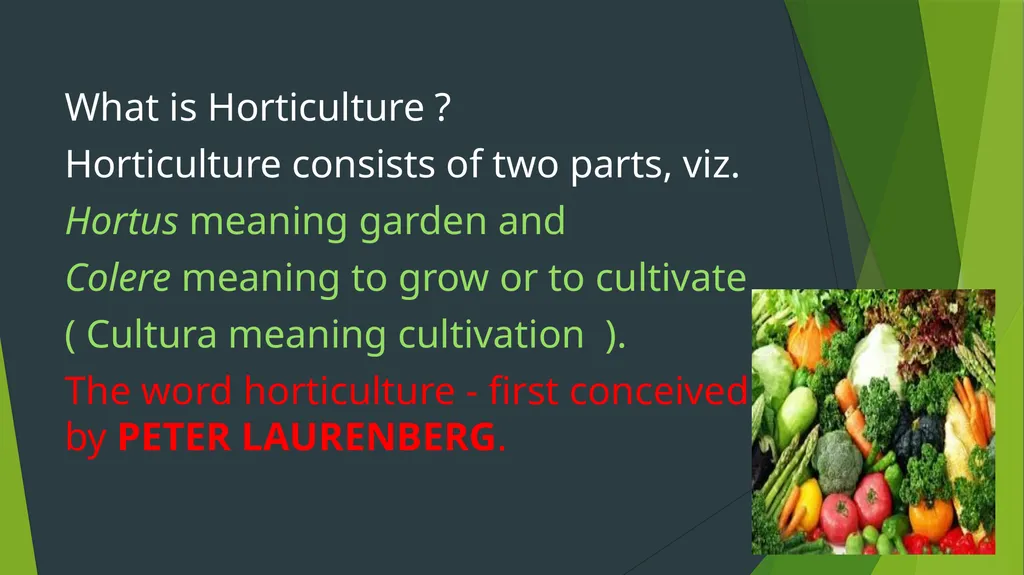
What is Horticulture ?
Horticulture consists of two parts, viz.
Hortus meaning garden and
Colere meaning to grow or to cultivate
( Cultura meaning cultivation ).
The word horticulture - first conceived by PETER LAURENBERG.<br>
Horticulture consists of two parts, viz.
Hortus meaning garden and
Colere meaning to grow or to cultivate
( Cultura meaning cultivation ).
The word horticulture - first conceived by PETER LAURENBERG.<br>
03
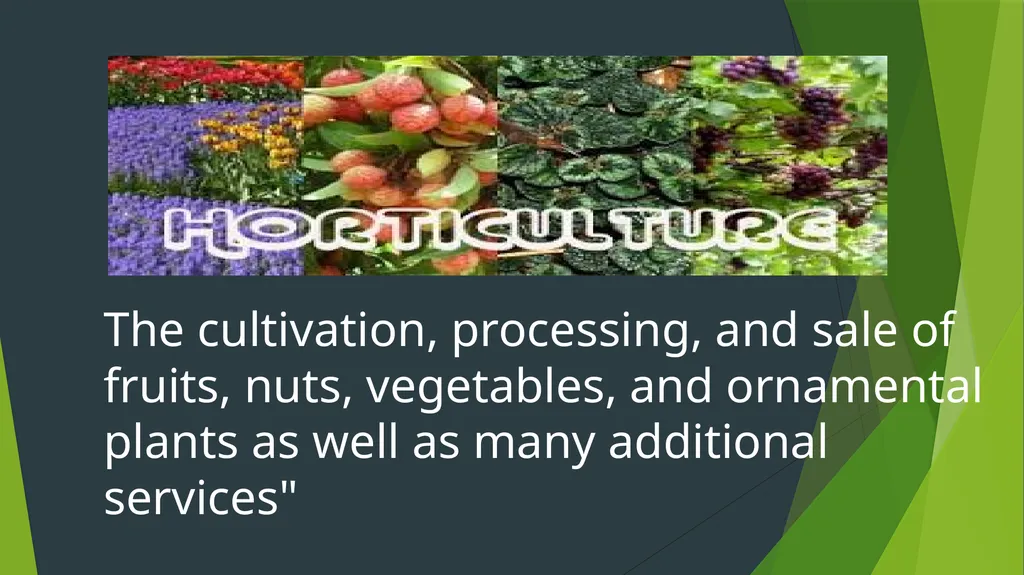
The cultivation, processing, and sale of fruits, nuts, vegetables, and ornamental plants as well as many additional services"<br>
04
In English language the word HORTICULTURE -used for the first time in 1678 in a book entitled “New World of Words” by Phillips
Garden -a broad term. Garden - originated from the latin term Gyrdan meaning to enclose.
When fruits are grown in a definite area then that part is called as an Orchard.
Hence, horticulture is that branch of Agriculture which concerns with the garden crops.<br>
Garden -a broad term. Garden - originated from the latin term Gyrdan meaning to enclose.
When fruits are grown in a definite area then that part is called as an Orchard.
Hence, horticulture is that branch of Agriculture which concerns with the garden crops.<br>
05
Origins of Horticultural Science The origin of horticultural science derives from a coming together of three events:
-the formation of scientific societies in the 17th century,
the creation of agricultural and horticultural societies in the 18th century, and
the establishment of state-supported agricultural research in the 19th century in different countries.<br>
-the formation of scientific societies in the 17th century,
the creation of agricultural and horticultural societies in the 18th century, and
the establishment of state-supported agricultural research in the 19th century in different countries.<br>
06
In England Two seminal horticultural societies involved:
The Horticultural Society of London (later the
Royal Horticulture Society) founded in 1804 and
The Society for Horticultural Science (later the American Society for Horticultural Science) founded in 1903.<br>
The Horticultural Society of London (later the
Royal Horticulture Society) founded in 1804 and
The Society for Horticultural Science (later the American Society for Horticultural Science) founded in 1903.<br>
07
Main distinguishing features of horticulture
Horticulture crops are used in a living state while others like grains etc. are not used in a living state.
Horticulture crops are comparatively more intensively cultivated than field crops.
Horticulture crops have high water content and are highly perishable.
Cultural operations like propagation, training, pruning and harvesting are skilled and specific to horticultural crops.
Horticultural produce are rich source of vitamins and minerals and alkaloids.<br>
Horticulture crops are used in a living state while others like grains etc. are not used in a living state.
Horticulture crops are comparatively more intensively cultivated than field crops.
Horticulture crops have high water content and are highly perishable.
Cultural operations like propagation, training, pruning and harvesting are skilled and specific to horticultural crops.
Horticultural produce are rich source of vitamins and minerals and alkaloids.<br>
08
DIVISIONS OF HORTICULTURE
Production of edible fruit crops ---Pomology pomum = fruits, logy = science,
Production of vegetable crops ---Olericulture oleris = pot herb
Production of ornamental crops ---Floriculture and Landscaping
Preservation of horticulture produce for
consumption ---Fruit Technology<br>
Production of edible fruit crops ---Pomology pomum = fruits, logy = science,
Production of vegetable crops ---Olericulture oleris = pot herb
Production of ornamental crops ---Floriculture and Landscaping
Preservation of horticulture produce for
consumption ---Fruit Technology<br>
09
POMOLOGY
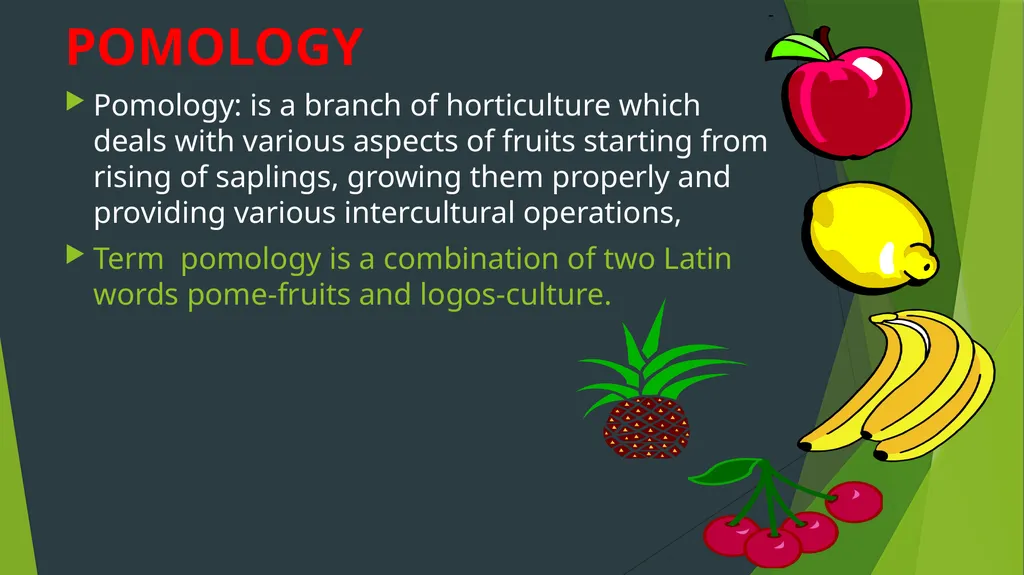
Pomology: is a branch of horticulture which deals with various aspects of fruits starting from rising of saplings, growing them properly and providing various intercultural operations,
Term pomology is a combination of two Latin words pome-fruits and logos-culture.<br>
Pomology: is a branch of horticulture which deals with various aspects of fruits starting from rising of saplings, growing them properly and providing various intercultural operations,
Term pomology is a combination of two Latin words pome-fruits and logos-culture.<br>
10
0LERICULTURE refers to cultivation of vegetables..
VITICULTURE includes the production and marketing of grapes.
.<br>
VITICULTURE includes the production and marketing of grapes.
.<br>
11
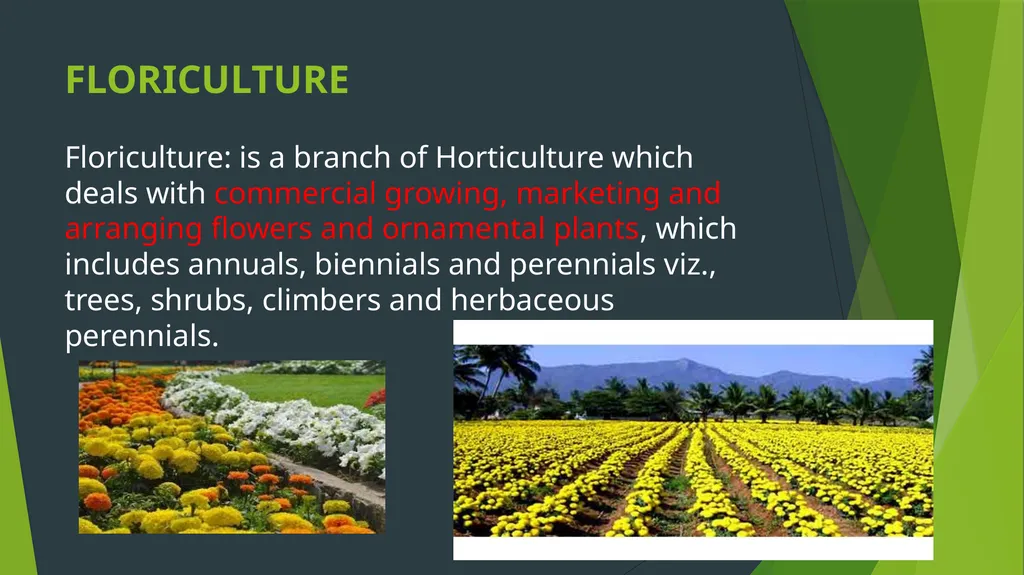
FLORICULTURE Floriculture: is a branch of Horticulture which deals with commercial growing, marketing and arranging flowers and ornamental plants, which includes annuals, biennials and perennials viz., trees, shrubs, climbers and herbaceous perennials.<br>
12
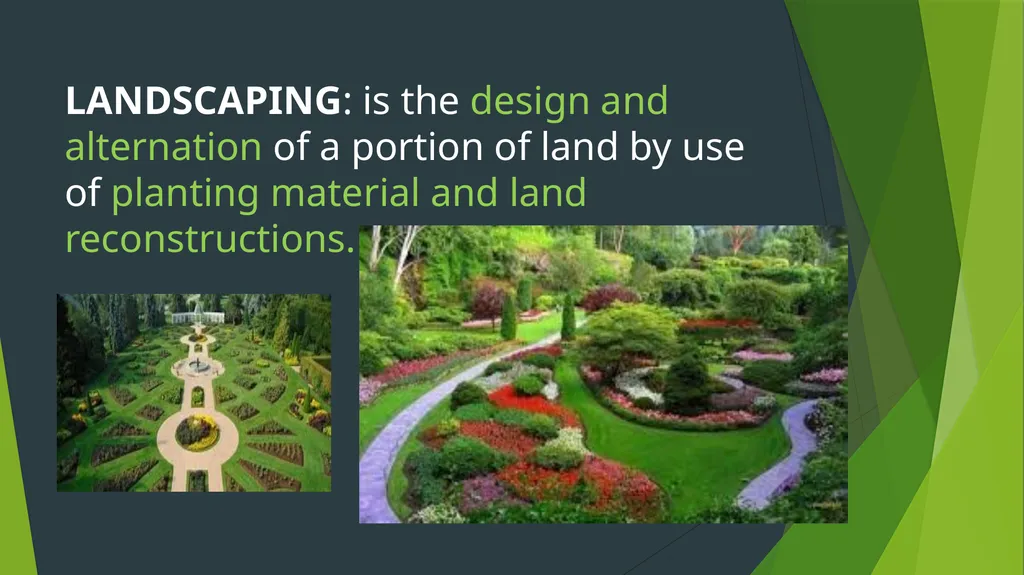
LANDSCAPING: is the design and alternation of a portion of land by use of planting material and land reconstructions.<br>
13
Post Harvest Technology It deals with post harvest handling,
Grading
packaging
storage
Processing
marketing<br>
Grading
packaging
storage
Processing
marketing<br>
14
IMPORTANCE OF HORTICULTURE
Diet
Entertainment
Medicinal purposes
Employment
Aesthetic value
Economic value<br>
Diet
Entertainment
Medicinal purposes
Employment
Aesthetic value
Economic value<br>
15
Economic Importance Increased production possible in comparison to other Agronomical crops because trees have a longer life and their production increases with advancement in age provided a proper care is taken.
Similarly vegetables can also be grown 3 to 4 times each year giving the products all the time they are grown. More number of crops can be grown from same piece of land.<br>
Similarly vegetables can also be grown 3 to 4 times each year giving the products all the time they are grown. More number of crops can be grown from same piece of land.<br>
16
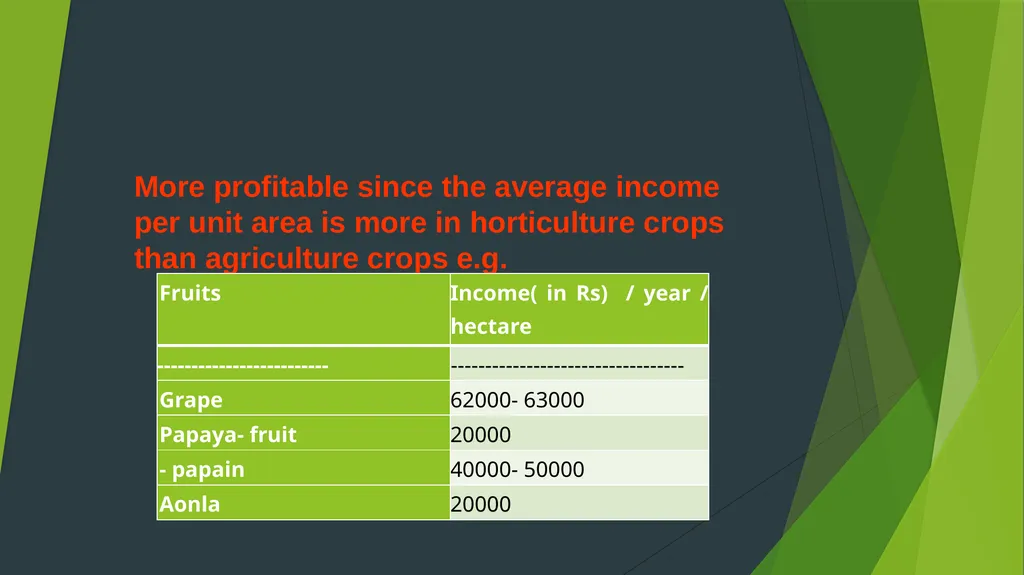
More profitable since the average income per unit area is more in horticulture crops than agriculture crops e.g.<br>
17
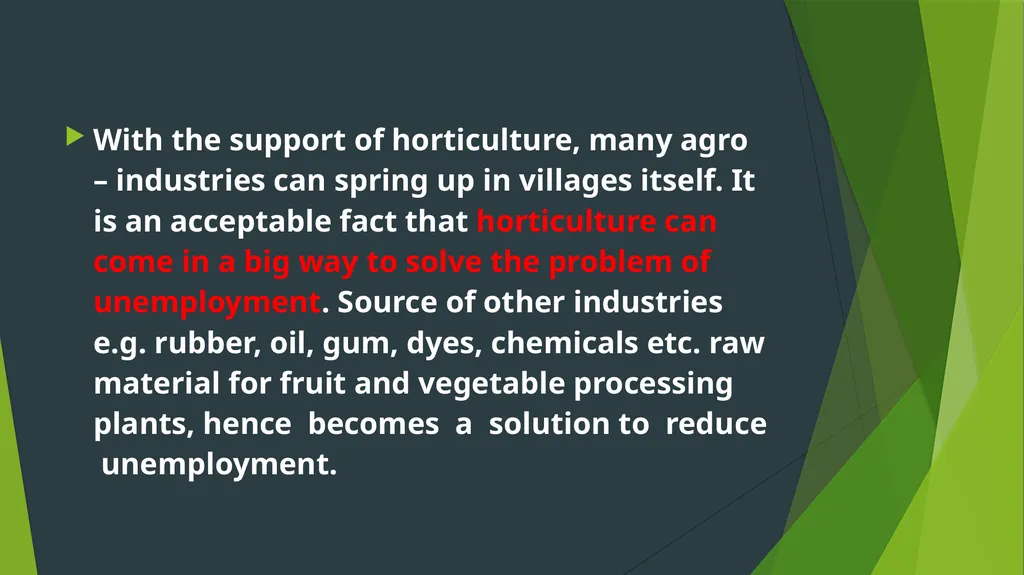
With the support of horticulture, many agro – industries can spring up in villages itself. It is an acceptable fact that horticulture can come in a big way to solve the problem of unemployment. Source of other industries e.g. rubber, oil, gum, dyes, chemicals etc. raw material for fruit and vegetable processing plants, hence becomes a solution to reduce unemployment.<br>
18
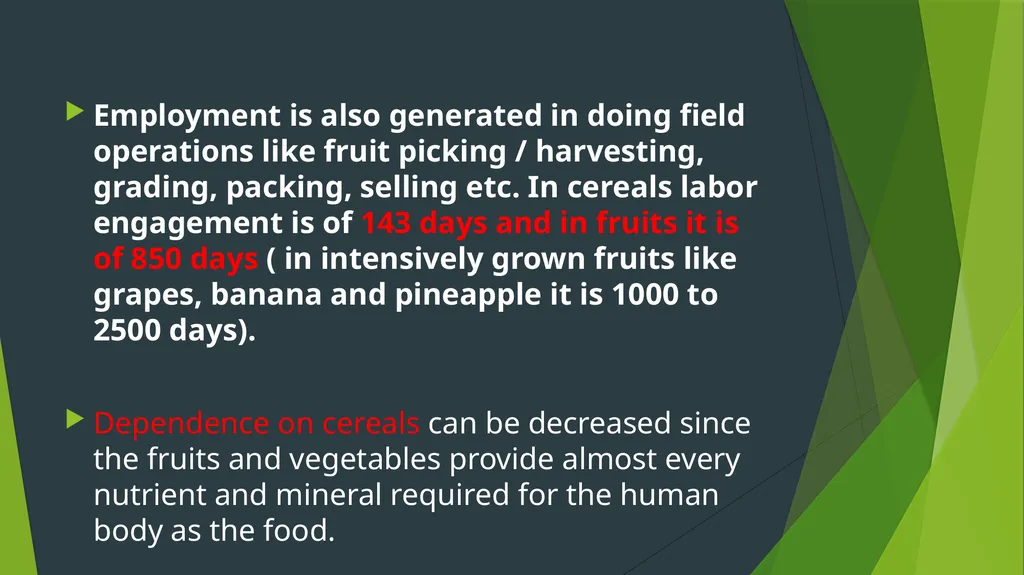
Employment is also generated in doing field operations like fruit picking / harvesting, grading, packing, selling etc. In cereals labor engagement is of 143 days and in fruits it is of 850 days ( in intensively grown fruits like grapes, banana and pineapple it is 1000 to 2500 days).
Dependence on cereals can be decreased since the fruits and vegetables provide almost every nutrient and mineral required for the human body as the food.<br>
Dependence on cereals can be decreased since the fruits and vegetables provide almost every nutrient and mineral required for the human body as the food.<br>
19
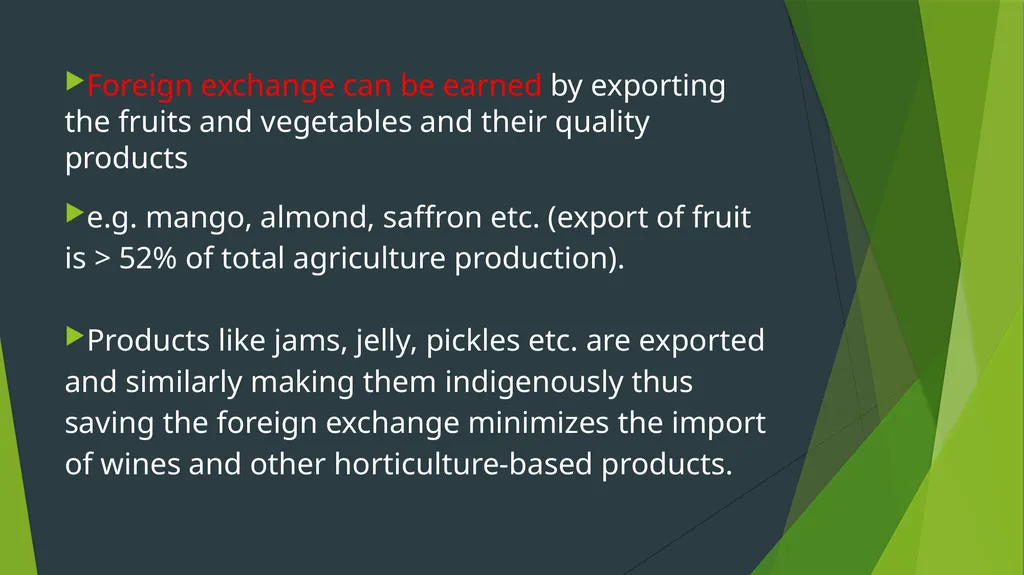
Foreign exchange can be earned by exporting the fruits and vegetables and their quality products
e.g. mango, almond, saffron etc. (export of fruit is > 52% of total agriculture production).
Products like jams, jelly, pickles etc. are exported and similarly making them indigenously thus saving the foreign exchange minimizes the import of wines and other horticulture-based products.<br>
e.g. mango, almond, saffron etc. (export of fruit is > 52% of total agriculture production).
Products like jams, jelly, pickles etc. are exported and similarly making them indigenously thus saving the foreign exchange minimizes the import of wines and other horticulture-based products.<br>
20
Areas related to horticulture for providing employment Fruit cultivation
Vegetable cultivation
Plantation and spice crop cultivation
Vegetable F1 seed production
Vegetable and flower seed production for export
Cut flower production and floriculture<br>
Vegetable cultivation
Plantation and spice crop cultivation
Vegetable F1 seed production
Vegetable and flower seed production for export
Cut flower production and floriculture<br>
21
Landscaping
Nursery raising
Tissue culture
Marketing
Processing of horticulture produce
Government development departments
Ancillary services (fertilizers, tools, insecticides –pesticides , irrigation equipments, chemicals like growth regulators etc. –manufacture , sale essence and consultancy services)
Research and education<br>
Nursery raising
Tissue culture
Marketing
Processing of horticulture produce
Government development departments
Ancillary services (fertilizers, tools, insecticides –pesticides , irrigation equipments, chemicals like growth regulators etc. –manufacture , sale essence and consultancy services)
Research and education<br>
22
Entertainment Roaming in the gardens, orchards or places well planted with flowerbeds etc. gives mental piece to the persons.
One enjoys fresh air and natural beauty, sheds of tension making him fresh.<br>
One enjoys fresh air and natural beauty, sheds of tension making him fresh.<br>
23
Medicines The parts like stem, leaf, flowers, roots and even the fruits of horticulture plants are used to make drugs, chemicals, insecticides, germicides etc. e.g. rose water is used to cure eyes ailments. Similarly saffron is important ingredient of many medicines.
Papain is a digestive enzyme, citrus fruit like sweet lime is used for liver ailment, rind of pomegranate and pectin from guava used for stomach upset, neem water for skin irritation and allergies etc.<br>
Papain is a digestive enzyme, citrus fruit like sweet lime is used for liver ailment, rind of pomegranate and pectin from guava used for stomach upset, neem water for skin irritation and allergies etc.<br>
24
Aesthetic value and religious importance Aesthetic value and religious importance is the unique factor distinguishing it from agricultural activities.
Mango leaves, wood, banana leaves etc. are used for religious functions.
Similarly the plantation of banana tree in the court yard or tulsi plantation is said to bring prosperity as per Hindu religion.
This aspect of horticulture has lead to its universal popularity.
Paradise means garden. The hanging garden of Babylon (one of the 7th wonders of the world) and the Versailles garden of 17th century are unique examples.<br>
Mango leaves, wood, banana leaves etc. are used for religious functions.
Similarly the plantation of banana tree in the court yard or tulsi plantation is said to bring prosperity as per Hindu religion.
This aspect of horticulture has lead to its universal popularity.
Paradise means garden. The hanging garden of Babylon (one of the 7th wonders of the world) and the Versailles garden of 17th century are unique examples.<br>
25
LIMITATION / PROBLEMS OF FRUIT PRODUCTION 1. High initial investment :-
The initial investment on new orchard is very
high e. g. cost of land, layout, digging of pit, cost of plants and planting, cost of fertilizers, F.Y.M, insecticides, pesticides etc.
In plants requiring special system of pruning
and training e. g. in Kiwi, Grapes etc. the initial cost further increases because of investment on erecting special training structures.
Therefore, every person cannot afford to take up fruit production as an enterprise.
2. Non-availability of quality planting material :-
Adequate availability of quality plants is
essential for orchard establishment.<br>
The initial investment on new orchard is very
high e. g. cost of land, layout, digging of pit, cost of plants and planting, cost of fertilizers, F.Y.M, insecticides, pesticides etc.
In plants requiring special system of pruning
and training e. g. in Kiwi, Grapes etc. the initial cost further increases because of investment on erecting special training structures.
Therefore, every person cannot afford to take up fruit production as an enterprise.
2. Non-availability of quality planting material :-
Adequate availability of quality plants is
essential for orchard establishment.<br>
26
plants can result in disastrous results. No proper legislation is enforced to curb sale of inferior plants through footpath sellers or by private nurseries resulting in the dissemination of the inferior plants to growers in most of the cases.
Citrus plants are very often infected with
citrus canker, leaf minor, similarly mango plants with malformation, peach with leaf curl and nematodes etc.
3. Long juvenile period :-
Most of the fruit crops have a long juvenile period and thus bear their first crop after a good many years e.g. stone fruits take 4 to 5 years, pecan nuts 10 to 12 years etc.
Orchardist, hence, has to bear the cost of maintaining the plants through some other sources for such number of years.
Though practice of planting fillers is being adopted for substantiating the income till the main crop comes into bearing.<br>
Citrus plants are very often infected with
citrus canker, leaf minor, similarly mango plants with malformation, peach with leaf curl and nematodes etc.
3. Long juvenile period :-
Most of the fruit crops have a long juvenile period and thus bear their first crop after a good many years e.g. stone fruits take 4 to 5 years, pecan nuts 10 to 12 years etc.
Orchardist, hence, has to bear the cost of maintaining the plants through some other sources for such number of years.
Though practice of planting fillers is being adopted for substantiating the income till the main crop comes into bearing.<br>
27
4. Perishable nature :-
Horticulture plants have high water content, hence, are of perishable nature.
The technologies for increasing the shelf life are lacking and more over the facilities for providing the cold store are quite scarce in number.
This causes the over flooding of the fruits in market during the peak-harvesting season, resulting in the crash in the prices of the commodity.
5. Lack of processing unit :-
Very limited scale processing industries are available in our country.
The fruits growing in abundance e.g. mango, banana, citrus, pineapple etc. could othe<br>
Horticulture plants have high water content, hence, are of perishable nature.
The technologies for increasing the shelf life are lacking and more over the facilities for providing the cold store are quite scarce in number.
This causes the over flooding of the fruits in market during the peak-harvesting season, resulting in the crash in the prices of the commodity.
5. Lack of processing unit :-
Very limited scale processing industries are available in our country.
The fruits growing in abundance e.g. mango, banana, citrus, pineapple etc. could othe<br>
28
Lack of knowledge in procuring quality
rwise give higher returns if processed in different products and exported.
6. Lack of proper storage and transportation facilities :-
This results in the loss of 15% in most of the fruit crops. Our country still lacks the fleet of refrigerated railway carriages, which is the most suitable and smooth way of transportation of fruits.
7. Faulty marketing system :-
Most of the profits (upto 65%) is taken away by middlemen the fruit mandis where the grower is basically compelled to sell the fruit.
From the grower the fruit passes through
the hands of big contractor to small contractor, commission agent, whole saler, retailer before reaching the consumer. Thus the grower gets a margin of the profits only.
8. Low purchasing power :-
Irrespective of the low pricing of the fruit
during the glut, it still remains out of reach of the common man who constitute most of our country’s population.<br>
rwise give higher returns if processed in different products and exported.
6. Lack of proper storage and transportation facilities :-
This results in the loss of 15% in most of the fruit crops. Our country still lacks the fleet of refrigerated railway carriages, which is the most suitable and smooth way of transportation of fruits.
7. Faulty marketing system :-
Most of the profits (upto 65%) is taken away by middlemen the fruit mandis where the grower is basically compelled to sell the fruit.
From the grower the fruit passes through
the hands of big contractor to small contractor, commission agent, whole saler, retailer before reaching the consumer. Thus the grower gets a margin of the profits only.
8. Low purchasing power :-
Irrespective of the low pricing of the fruit
during the glut, it still remains out of reach of the common man who constitute most of our country’s population.<br>
29
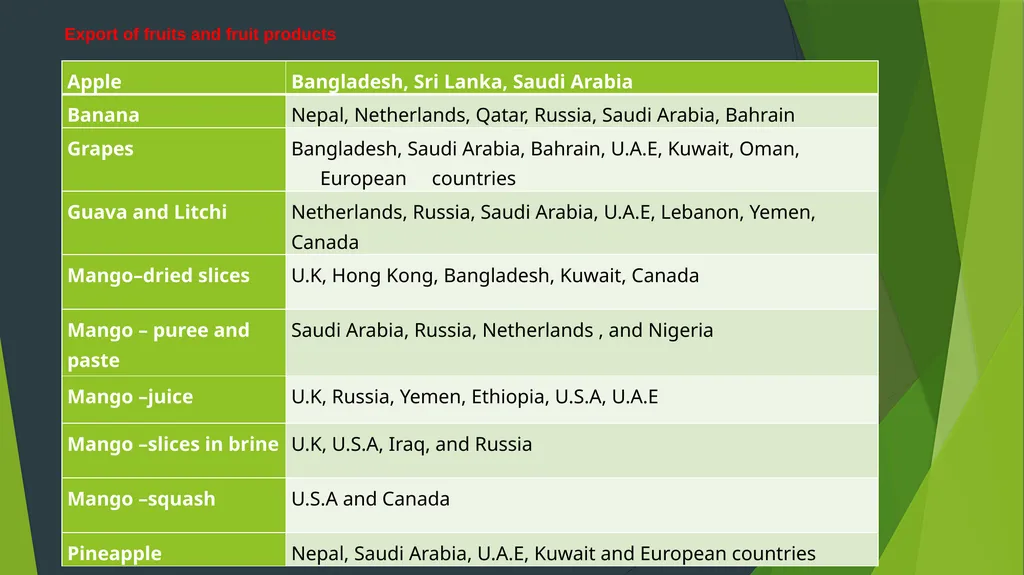
Export of fruits and fruit products<br>
30
Thank you<br>