HOSTED BY 26-27 September 2017 The Impact of Artificial Intelligence and Autonomous Functions on the ETSI work-programme Francisco da Silva, Senior Councillor, Huawei Pg 2 Cognitive Technologies in the Focus of ETSI ETSI puts focus on
"HOSTED BY 26-27 September 2017 The Impact of" is the property of its rightful owner. Permission is granted to
download and print the materials on this website for personal, non-commercial use only, and to display it
on your personal computer provided you do not modify the materials and that you retain all copyright
notices contained in the materials. By downloading content from our website, you accept the terms of this
agreement.
Presentation Transcript
01
HOSTED BY 26-27 September 2017 The Impact of Artificial Intelligence and Autonomous Functions on the ETSI work-programme
Francisco da Silva, Senior Councillor, Huawei<br>
02
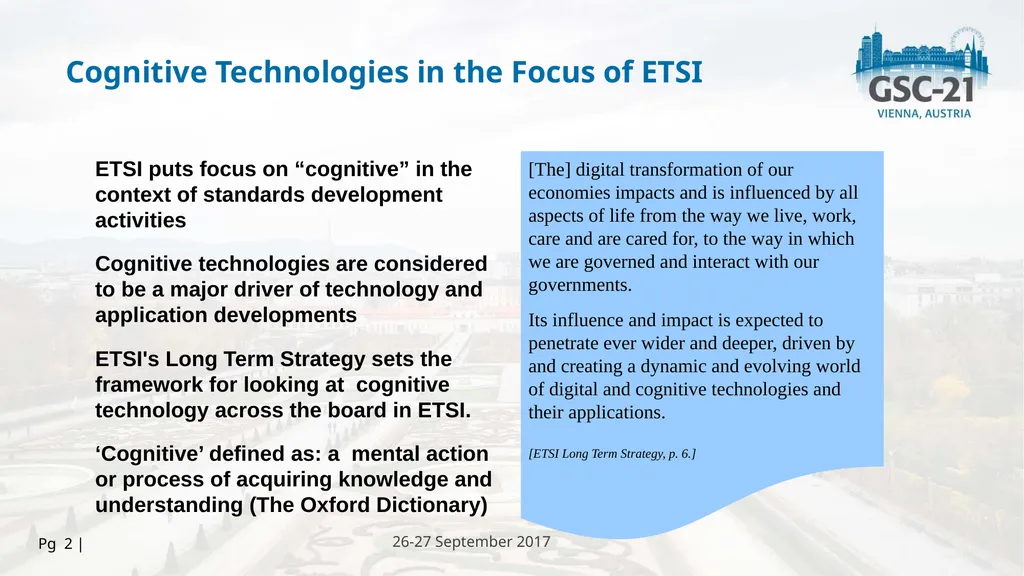
Pg 2 | Cognitive Technologies in the Focus of ETSI ETSI puts focus on “cognitive” in the context of standards development activities
Cognitive technologies are considered to be a major driver of technology and application developments
ETSI's Long Term Strategy sets the framework for looking at cognitive technology across the board in ETSI.
‘Cognitive’ defined as: a mental action or process of acquiring knowledge and understanding (The Oxford Dictionary) [The] digital transformation of our economies impacts and is influenced by all aspects of life from the way we live, work, care and are cared for, to the way in which we are governed and interact with our governments.
Its influence and impact is expected to penetrate ever wider and deeper, driven by and creating a dynamic and evolving world of digital and cognitive technologies and their applications.
[ETSI Long Term Strategy, p. 6.]<br>
03
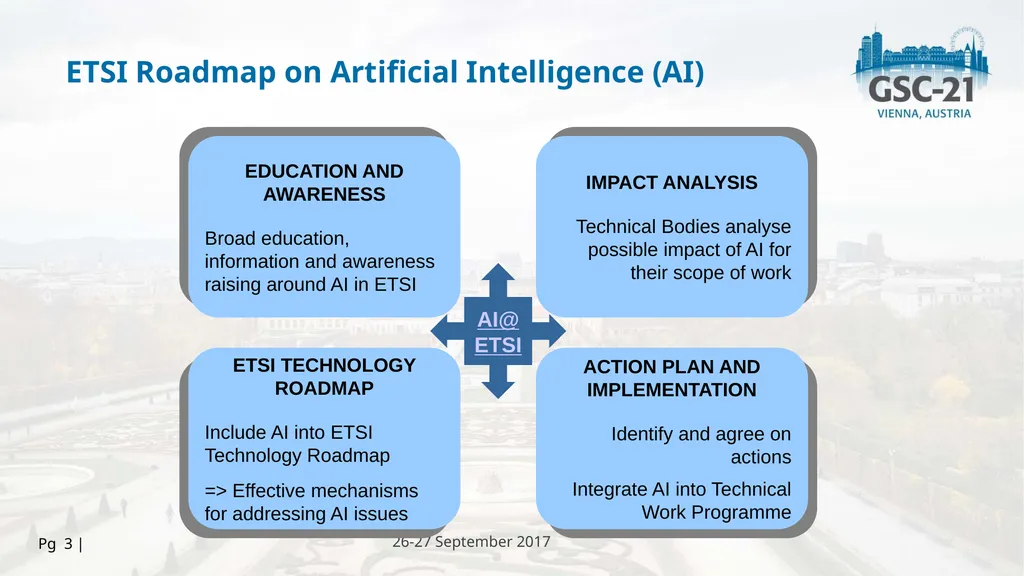
Pg 3 | ETSI Roadmap on Artificial Intelligence (AI) ACTION PLAN AND IMPLEMENTATION
Identify and agree on actions
Integrate AI into Technical Work Programme ETSI TECHNOLOGY ROADMAP
Include AI into ETSI Technology Roadmap
=> Effective mechanisms for addressing AI issues IMPACT ANALYSIS
Technical Bodies analyse possible impact of AI for their scope of work EDUCATION AND AWARENESS
Broad education, information and awareness raising around AI in ETSI AI@
ETSI<br>
04
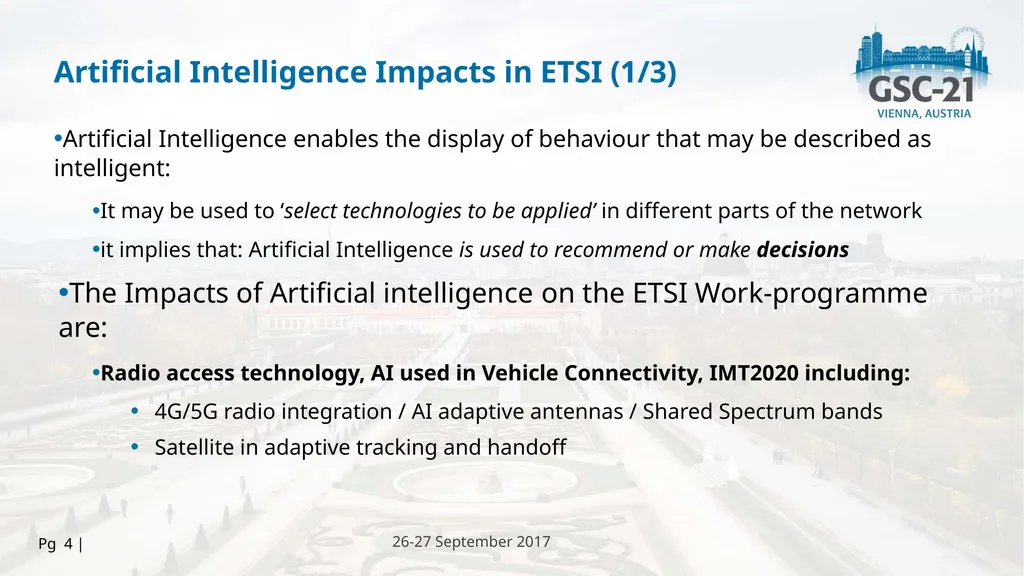
Pg 4 | Artificial Intelligence Impacts in ETSI (1/3) Artificial Intelligence enables the display of behaviour that may be described as intelligent:
It may be used to ‘select technologies to be applied’ in different parts of the network
it implies that: Artificial Intelligence is used to recommend or make decisions
The Impacts of Artificial intelligence on the ETSI Work-programme are:
Radio access technology, AI used in Vehicle Connectivity, IMT2020 including:
4G/5G radio integration / AI adaptive antennas / Shared Spectrum bands
Satellite in adaptive tracking and handoff<br>
05
Pg 5 | Artificial Intelligence Impacts in ETSI (2/3) Access, x-Haul and Core network technologies, Network Management & Control, including:
Network Slicing - Fixed-Mobile Integration
Autonomic Management & Control (AMC) Paradigm for networks is specified to use AI, network planning and service introduction, Autonomics may use AI
Administration and day-to-day network organization to recommend optimised use of resources
Closed loop learning and context-aware policies
Virtualization and Orchestration
Network routing and optimisation<br>
06
Pg 6 | Artificial Intelligence Impacts in ETSI (3/3) Critical communications maintenance Policy and operation – AI for Secure Communications
AI Techniques to rapidly compute Cryptographic codes
Lawful Interception - Analysing Big data to track intercepted content
Home Networking (Wireline ,Wireless ,Optical) plans to use “AI Gateway applications” in their many and possible variants
IoT devices will use AI coordination, needing standards for ontologies and big data processing, including standards for quality of data and tracking of data usage for liability etc.<br>
07
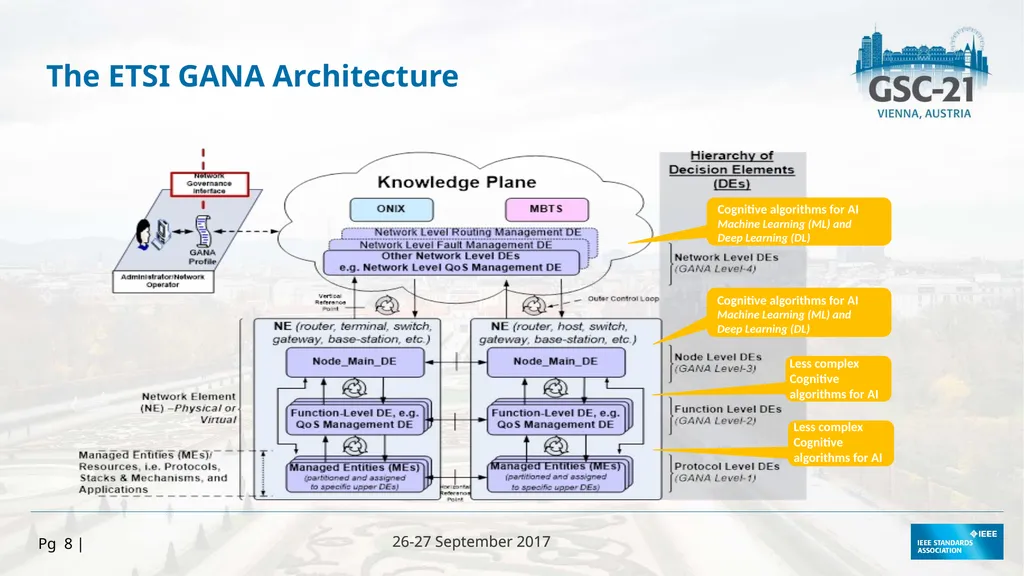
Pg 7 | AI in Autonomic Functions for the Autonomic Management & Control (AMC) Paradigm ETSI has a project on Generic Autonomic Networking Architecture; Autonomic Functions using the AMC Paradigm. This is currently managed within TC NTECH Working Group AFI.
GANA AFs are Autonomic Decision-Making Elements for Network Management & Control that can be instrumented at 4 basic complementary abstraction levels for Self-Management within Network Nodes and in the Outer Management and Control realm
Autonomics algorithms include Cognitive algorithms for Artificial Intelligence — such as Machine Learning and Deep Learning, and other algorithms that can be employed in Decision-Making Elements (DEs) closed-loop operations<br>
08
Pg 8 | The ETSI GANA Architecture<br>
09
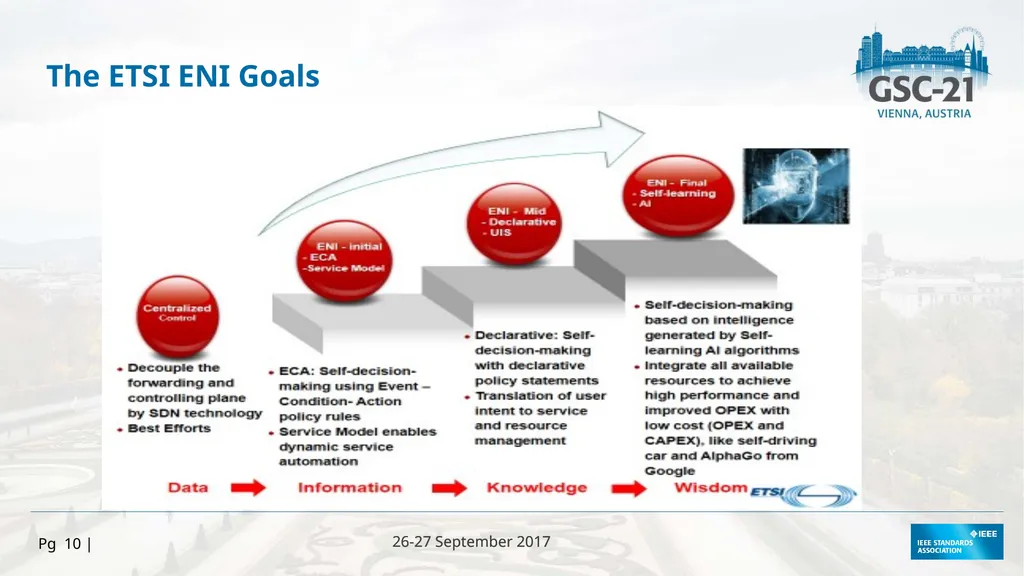
Pg 9 | Administration and day-to-day network organization – Optimised use of resources - Closed loop learning & context-aware policies ETSI has a project called: Experiential Networked Intelligence.
ENI will specify a set of use cases, and the generic technology independent architecture, for a network supervisory assistant system based on the ‘observe-orient-decide-act’ control loop model.
This model can assist decision-making systems, such as network control and management systems, to adjust services and resources offered based on changes in user needs, environmental conditions and business goals.
The ETSI Work on ENI focuses on improving the operator experience, adding closed-loop artificial intelligence mechanisms based on context-aware, metadata-driven policies to more quickly recognize and incorporate new and changed knowledge, and hence, make actionable decisions.<br>
10
Pg 10 | The ETSI ENI Goals<br>
11
Thank you For more information, please contact:
Francisco da Silva Francisco.daSilva@huawei.com
Ray Forbes rayforbes@mail01.huawei.com