
ICT IN TEACHER EDUCATION INFORMATION AND

Description: ICT IN TEACHER EDUCATION INFORMATION AND COMMUNICATION TECHNOLOGY (ICT) ICT refers to technologies, which are being used for collecting, storing, editing and passing on information in various forms. Information and Communication
Related Topics
Download Presentation
"ICT IN TEACHER EDUCATION INFORMATION AND" is the property of its rightful owner. Permission is granted to download and print the materials on this website for personal, non-commercial use only, and to display it on your personal computer provided you do not modify the materials and that you retain all copyright notices contained in the materials. By downloading content from our website, you accept the terms of this agreement.
Presentation Transcript
slide1. ICT IN TEACHER EDUCATION<br>
slide2. INFORMATION AND COMMUNICATION TECHNOLOGY (ICT) ICT refers to technologies, which are being used for collecting, storing, editing and passing on information in various forms. Information and Communication Technologies, (ICT’s) are one of the major contemporary factors shaping the global economy and producing rapid changes in society. ICT have fundamentally changed the way of learning and communicating. ICT can transform the nature of education, where and how learning takes place and the roles of students and teachers in the teaching learning process.<br>
slide3. TEACHER EDUCATION The NCTE has defined teacher education as – A programme of education, research and training of persons to teach from pre-primary to higher education level.
Teacher education TE or teacher training refers to the policies, procedures and provision designed to equip prospective teachers with the knowledge, attitudes, behaviors and skills they require to perform their tasks effectively in the classroom, school, and wider community. The professionals who engage in training the prospective teachers are called Teacher educators or teacher trainers.
Teacher education is a formal programs that have been established for the preparation of teachers at the elementary- and secondary-school levels.<br>
slide4. Introduction The National Knowledge Commission (NKC) has observed that teachers are the single most important element of the education system and the country is already facing a severe shortage of qualified and motivated teachers at different levels. The training of teachers is a major area of concern at present as both pre-service and in service training of teachers are extremely inadequate and poorly managed in most states. Pre-service training needs to be improved and differently regulated both in public and private institutions.<br>
slide5. Teacher Education Reform: Context and Concerns Time is not sufficient: Most of the teacher educators felt that comprehensive Experiences can’t be given in the one year duration of teacher training course and was very difficult to imbibe skills and aptitude. It was also opined (opinion of state) there was a mismatch between the training student teachers get in the colleges with the real teaching Experience they had in the regular classrooms.
On supportive to the above statements the Honourable Justice Verma committee proposed to have 2 years B.Ed. course and NCTE has suggested to have the Blend of technology (ICT) with all subjects and Experiences of training.<br>
slide6. Need of ICT in Teacher Education The face of classroom is changing. The teachers should prepare to keep up with technology utility in the classroom. ICT is not only an essential tool for teachers in their day to day work, but also offers them opportunities for their own professional development.
In conventional teaching most of the time is consumed for the input output and less time left for the process. But in teaching with ICT the input and output time is reduced and process time is increased. When the process time is increased, time of students’ activities, discussion, correlation with other subjects, brainstorming and learning etc. will increase.<br>
slide7. The integration of ICTs in teaching and teacher education is the need of the day. The use of ICTs can make substantial changes both for teaching and training mainly in two ways.
Firstly, the rich representation of information changes learner’s perception and understanding of the context.
Secondly, the vast distribution and easy access to information can change relationships between teachers and taught. ICTs can also provide powerful support for educational innovation.<br>
slide8. To effectively harness the power of (ICTs) to improve learning, the following essential conditions must be met: Students and teachers must have sufficient access to digital technologies and the Internet in their classrooms, schools, and teacher education institutions.
High quality, meaningful, and culturally responsive digital content must be available for teachers and learners.
Teachers must have the knowledge and skills to use the new digital tools and resources to help all students achieve high academic standards.<br>
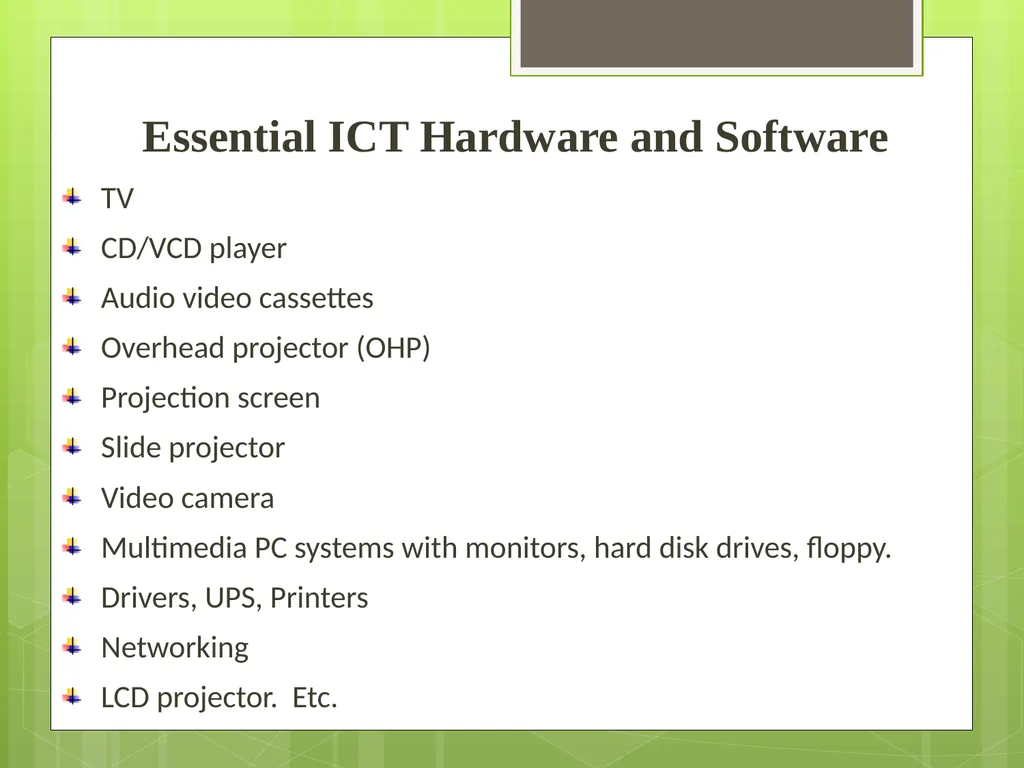
slide9. Essential ICT Hardware and Software TV
CD/VCD player
Audio video cassettes
Overhead projector (OHP)
Projection screen
Slide projector
Video camera
Multimedia PC systems with monitors, hard disk drives, floppy.
Drivers, UPS, Printers
Networking
LCD projector. Etc.<br>
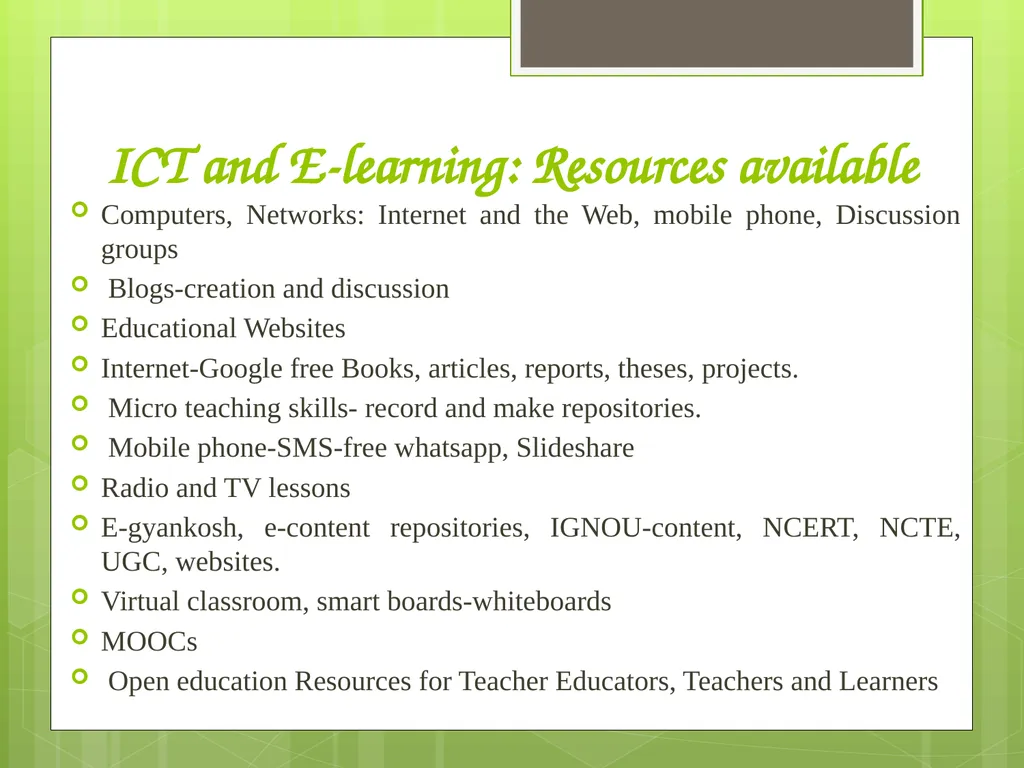
slide10. ICT and E-learning: Resources available Computers, Networks: Internet and the Web, mobile phone, Discussion groups
Blogs-creation and discussion
Educational Websites
Internet-Google free Books, articles, reports, theses, projects.
Micro teaching skills- record and make repositories.
Mobile phone-SMS-free whatsapp, Slideshare
Radio and TV lessons
E-gyankosh, e-content repositories, IGNOU-content, NCERT, NCTE, UGC, websites.
Virtual classroom, smart boards-whiteboards
MOOCs
Open education Resources for Teacher Educators, Teachers and Learners<br>
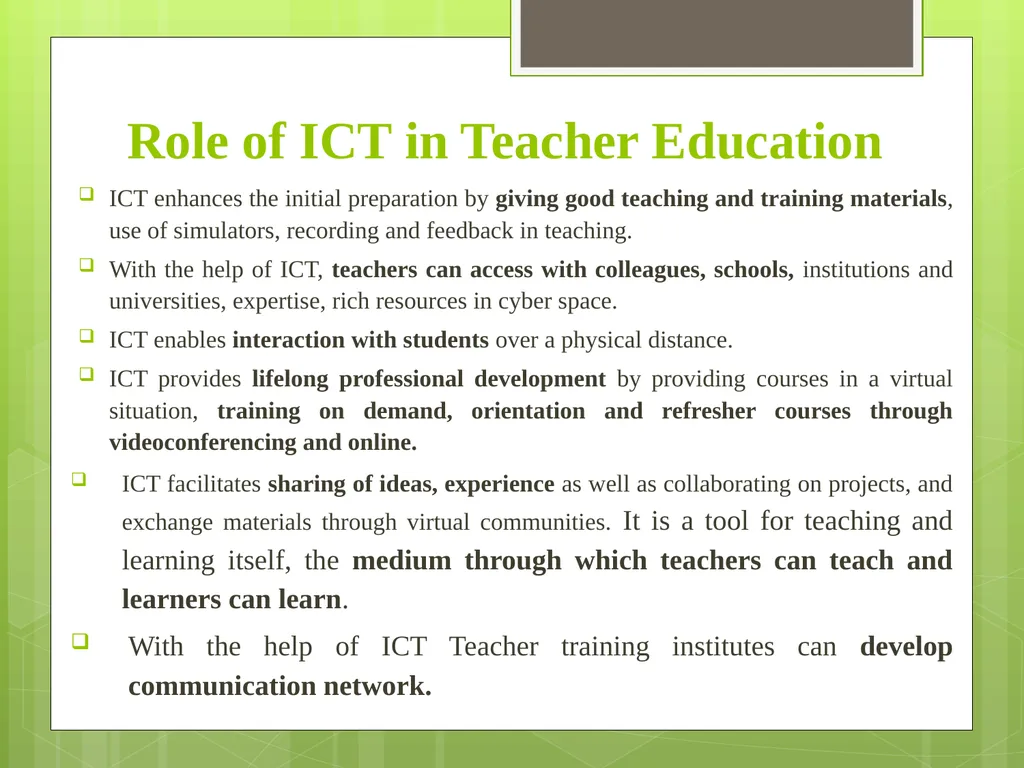
slide11. Role of ICT in Teacher Education ICT enhances the initial preparation by giving good teaching and training materials, use of simulators, recording and feedback in teaching.
With the help of ICT, teachers can access with colleagues, schools, institutions and universities, expertise, rich resources in cyber space.
ICT enables interaction with students over a physical distance.
ICT provides lifelong professional development by providing courses in a virtual situation, training on demand, orientation and refresher courses through videoconferencing and online.
ICT facilitates sharing of ideas, experience as well as collaborating on projects, and exchange materials through virtual communities. It is a tool for teaching and learning itself, the medium through which teachers can teach and learners can learn.
With the help of ICT Teacher training institutes can develop communication network.<br>
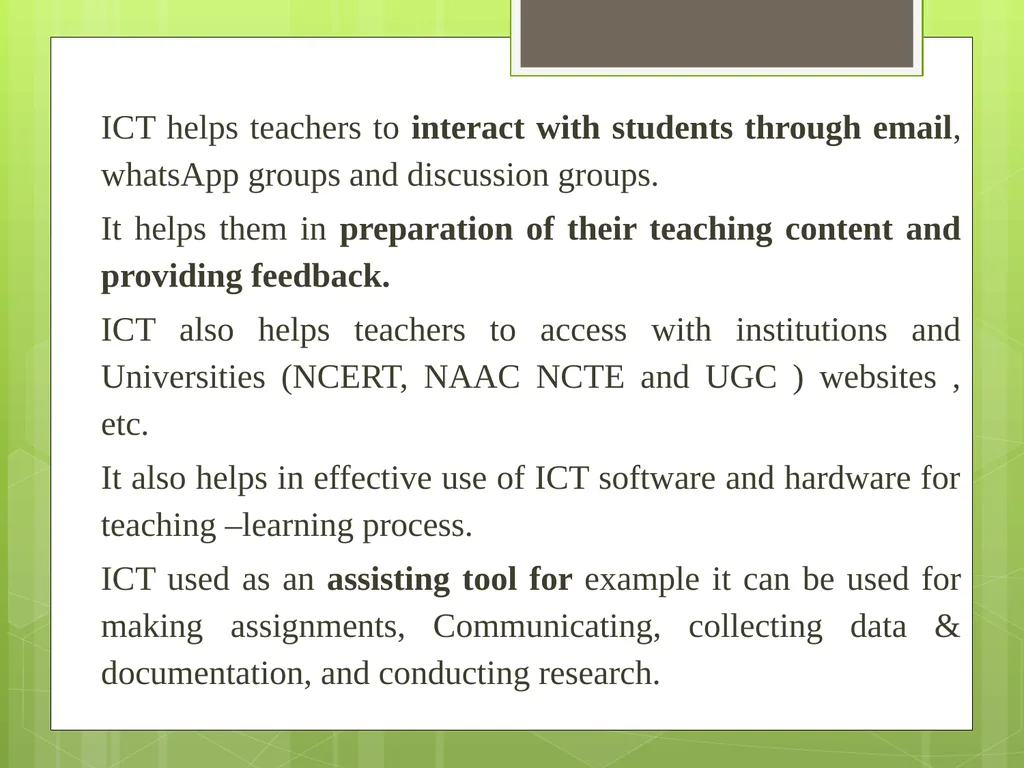
slide12. ICT helps teachers to interact with students through email, whatsApp groups and discussion groups.
It helps them in preparation of their teaching content and providing feedback.
ICT also helps teachers to access with institutions and Universities (NCERT, NAAC NCTE and UGC ) websites , etc.
It also helps in effective use of ICT software and hardware for teaching –learning process.
ICT used as an assisting tool for example it can be used for making assignments, Communicating, collecting data & documentation, and conducting research.<br>
slide13. Impact of ICT on Teacher Education Faster learning: With the use of ICT students still learn up to twice as much in the half time that they would in classroom teaching.
Consistent instruction: Every instructor has his or her own style, which may not the best for students. Some days the instructor is on top form and delivers a great class. Other day he or she may be bored, tired or simply unmotivated. With ICT the course is software driven and each student receives the same high quality content.
Incredible saving of time and money: ICT means no travel, no schedule conflicts, no equipment issues, consistent instruction, higher retention and less money than instructor led training.<br>
slide14. Higher level of retention: ICT can increase the retention over instructor led-training up to 40% .
Greater level of assessment: With an ICT learning solution student activity can be tracked down to the finest level. Every student response to quizzes, simulations and exams can be tracked and fed into customizable reports.
Up to date knowledge: ICT acts as the gateway to the world of information and helps teachers to be updated. It creates awareness of innovative trends in instructional methodologies, evaluation mechanism etc. for professional development.
No need for classroom: Through ICT learning there is no actual classroom, no teacher or no textbooks, but it gives the impression of studying in a classroom.<br>
slide15. Conclusion By using ICT technologies such as Computer, Laptop, Digital Camera, Video, Internet, Websites, application of software such as word-processing, spread sheet, e-mail, digital libraries, computer mediating conferencing, videoconferencing, projectors etc. we can overcome all barriers in communication and instruction. So Teacher Education institutions should prepare pre-service (prospective) teachers to keep up with the technology utility in the classroom. Full integrating of ICT in education is still far from the desired in teacher education. On-line activities used are limited but should be given special emphasis on the use and integration of on-line resources.<br>
slide2. INFORMATION AND COMMUNICATION TECHNOLOGY (ICT) ICT refers to technologies, which are being used for collecting, storing, editing and passing on information in various forms. Information and Communication Technologies, (ICT’s) are one of the major contemporary factors shaping the global economy and producing rapid changes in society. ICT have fundamentally changed the way of learning and communicating. ICT can transform the nature of education, where and how learning takes place and the roles of students and teachers in the teaching learning process.<br>
slide3. TEACHER EDUCATION The NCTE has defined teacher education as – A programme of education, research and training of persons to teach from pre-primary to higher education level.
Teacher education TE or teacher training refers to the policies, procedures and provision designed to equip prospective teachers with the knowledge, attitudes, behaviors and skills they require to perform their tasks effectively in the classroom, school, and wider community. The professionals who engage in training the prospective teachers are called Teacher educators or teacher trainers.
Teacher education is a formal programs that have been established for the preparation of teachers at the elementary- and secondary-school levels.<br>
slide4. Introduction The National Knowledge Commission (NKC) has observed that teachers are the single most important element of the education system and the country is already facing a severe shortage of qualified and motivated teachers at different levels. The training of teachers is a major area of concern at present as both pre-service and in service training of teachers are extremely inadequate and poorly managed in most states. Pre-service training needs to be improved and differently regulated both in public and private institutions.<br>
slide5. Teacher Education Reform: Context and Concerns Time is not sufficient: Most of the teacher educators felt that comprehensive Experiences can’t be given in the one year duration of teacher training course and was very difficult to imbibe skills and aptitude. It was also opined (opinion of state) there was a mismatch between the training student teachers get in the colleges with the real teaching Experience they had in the regular classrooms.
On supportive to the above statements the Honourable Justice Verma committee proposed to have 2 years B.Ed. course and NCTE has suggested to have the Blend of technology (ICT) with all subjects and Experiences of training.<br>
slide6. Need of ICT in Teacher Education The face of classroom is changing. The teachers should prepare to keep up with technology utility in the classroom. ICT is not only an essential tool for teachers in their day to day work, but also offers them opportunities for their own professional development.
In conventional teaching most of the time is consumed for the input output and less time left for the process. But in teaching with ICT the input and output time is reduced and process time is increased. When the process time is increased, time of students’ activities, discussion, correlation with other subjects, brainstorming and learning etc. will increase.<br>
slide7. The integration of ICTs in teaching and teacher education is the need of the day. The use of ICTs can make substantial changes both for teaching and training mainly in two ways.
Firstly, the rich representation of information changes learner’s perception and understanding of the context.
Secondly, the vast distribution and easy access to information can change relationships between teachers and taught. ICTs can also provide powerful support for educational innovation.<br>
slide8. To effectively harness the power of (ICTs) to improve learning, the following essential conditions must be met: Students and teachers must have sufficient access to digital technologies and the Internet in their classrooms, schools, and teacher education institutions.
High quality, meaningful, and culturally responsive digital content must be available for teachers and learners.
Teachers must have the knowledge and skills to use the new digital tools and resources to help all students achieve high academic standards.<br>
slide9. Essential ICT Hardware and Software TV
CD/VCD player
Audio video cassettes
Overhead projector (OHP)
Projection screen
Slide projector
Video camera
Multimedia PC systems with monitors, hard disk drives, floppy.
Drivers, UPS, Printers
Networking
LCD projector. Etc.<br>
slide10. ICT and E-learning: Resources available Computers, Networks: Internet and the Web, mobile phone, Discussion groups
Blogs-creation and discussion
Educational Websites
Internet-Google free Books, articles, reports, theses, projects.
Micro teaching skills- record and make repositories.
Mobile phone-SMS-free whatsapp, Slideshare
Radio and TV lessons
E-gyankosh, e-content repositories, IGNOU-content, NCERT, NCTE, UGC, websites.
Virtual classroom, smart boards-whiteboards
MOOCs
Open education Resources for Teacher Educators, Teachers and Learners<br>
slide11. Role of ICT in Teacher Education ICT enhances the initial preparation by giving good teaching and training materials, use of simulators, recording and feedback in teaching.
With the help of ICT, teachers can access with colleagues, schools, institutions and universities, expertise, rich resources in cyber space.
ICT enables interaction with students over a physical distance.
ICT provides lifelong professional development by providing courses in a virtual situation, training on demand, orientation and refresher courses through videoconferencing and online.
ICT facilitates sharing of ideas, experience as well as collaborating on projects, and exchange materials through virtual communities. It is a tool for teaching and learning itself, the medium through which teachers can teach and learners can learn.
With the help of ICT Teacher training institutes can develop communication network.<br>
slide12. ICT helps teachers to interact with students through email, whatsApp groups and discussion groups.
It helps them in preparation of their teaching content and providing feedback.
ICT also helps teachers to access with institutions and Universities (NCERT, NAAC NCTE and UGC ) websites , etc.
It also helps in effective use of ICT software and hardware for teaching –learning process.
ICT used as an assisting tool for example it can be used for making assignments, Communicating, collecting data & documentation, and conducting research.<br>
slide13. Impact of ICT on Teacher Education Faster learning: With the use of ICT students still learn up to twice as much in the half time that they would in classroom teaching.
Consistent instruction: Every instructor has his or her own style, which may not the best for students. Some days the instructor is on top form and delivers a great class. Other day he or she may be bored, tired or simply unmotivated. With ICT the course is software driven and each student receives the same high quality content.
Incredible saving of time and money: ICT means no travel, no schedule conflicts, no equipment issues, consistent instruction, higher retention and less money than instructor led training.<br>
slide14. Higher level of retention: ICT can increase the retention over instructor led-training up to 40% .
Greater level of assessment: With an ICT learning solution student activity can be tracked down to the finest level. Every student response to quizzes, simulations and exams can be tracked and fed into customizable reports.
Up to date knowledge: ICT acts as the gateway to the world of information and helps teachers to be updated. It creates awareness of innovative trends in instructional methodologies, evaluation mechanism etc. for professional development.
No need for classroom: Through ICT learning there is no actual classroom, no teacher or no textbooks, but it gives the impression of studying in a classroom.<br>
slide15. Conclusion By using ICT technologies such as Computer, Laptop, Digital Camera, Video, Internet, Websites, application of software such as word-processing, spread sheet, e-mail, digital libraries, computer mediating conferencing, videoconferencing, projectors etc. we can overcome all barriers in communication and instruction. So Teacher Education institutions should prepare pre-service (prospective) teachers to keep up with the technology utility in the classroom. Full integrating of ICT in education is still far from the desired in teacher education. On-line activities used are limited but should be given special emphasis on the use and integration of on-line resources.<br>