
IFC’s Environmental and Social Lessons Learned


Description: IFCs Environmental and Social Lessons Learned April 9, 2014 CSO Session AGENDA Dinant: Lessons Learned CAO Audit Learning Adapting Key themes Links to recent cases Dinant: Update on Action Plan Discussion 2 Dinant: Key Lessons Learned
Related Topics
Download Presentation
"IFC’s Environmental and Social Lessons Learned" is the property of its rightful owner. Permission is granted to download and print the materials on this website for personal, non-commercial use only, and to display it on your personal computer provided you do not modify the materials and that you retain all copyright notices contained in the materials. By downloading content from our website, you accept the terms of this agreement.
Presentation Transcript
slide1. IFC’s Environmental
and Social Lessons Learned
April 9, 2014
CSO Session<br>
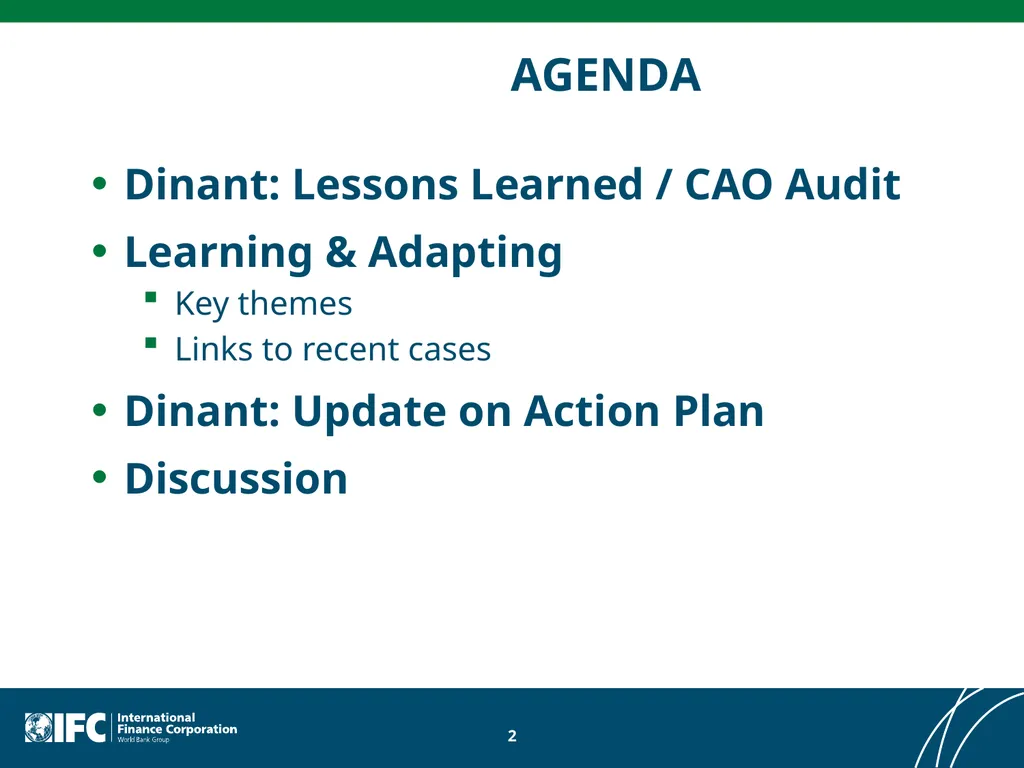
slide2. AGENDA Dinant: Lessons Learned / CAO Audit
Learning & Adapting
Key themes
Links to recent cases
Dinant: Update on Action Plan
Discussion 2<br>
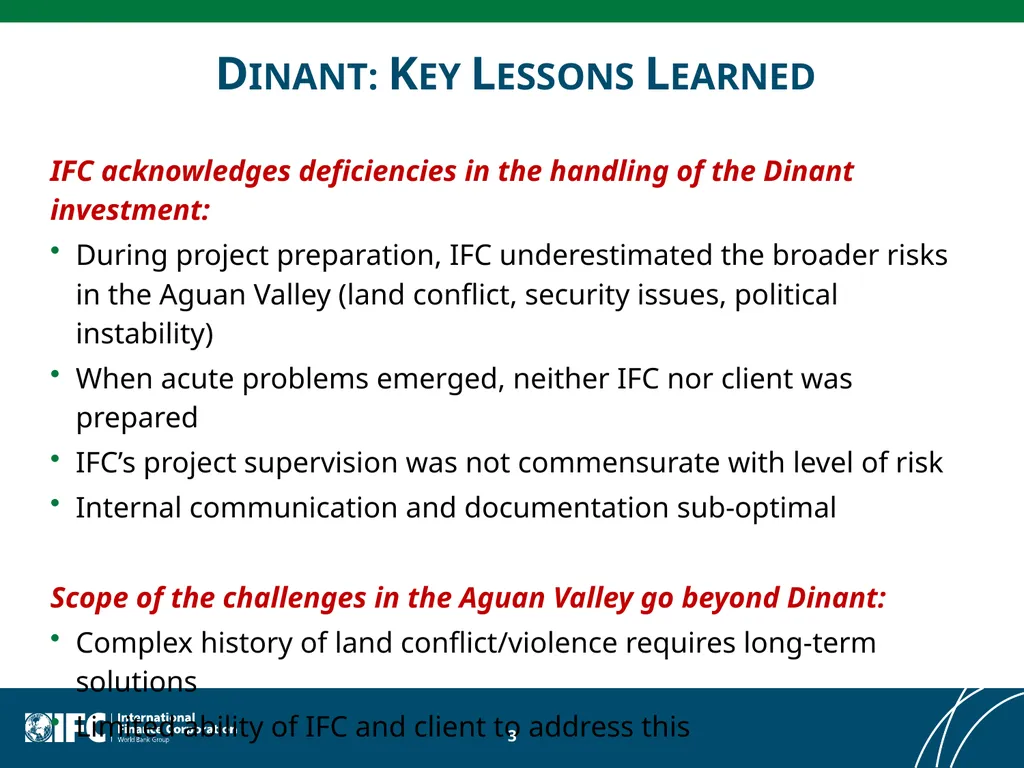
slide3. Dinant: Key Lessons Learned IFC acknowledges deficiencies in the handling of the Dinant investment:
During project preparation, IFC underestimated the broader risks in the Aguan Valley (land conflict, security issues, political instability)
When acute problems emerged, neither IFC nor client was prepared
IFC’s project supervision was not commensurate with level of risk
Internal communication and documentation sub-optimal
Scope of the challenges in the Aguan Valley go beyond Dinant:
Complex history of land conflict/violence requires long-term solutions
Limited ability of IFC and client to address this 3<br>
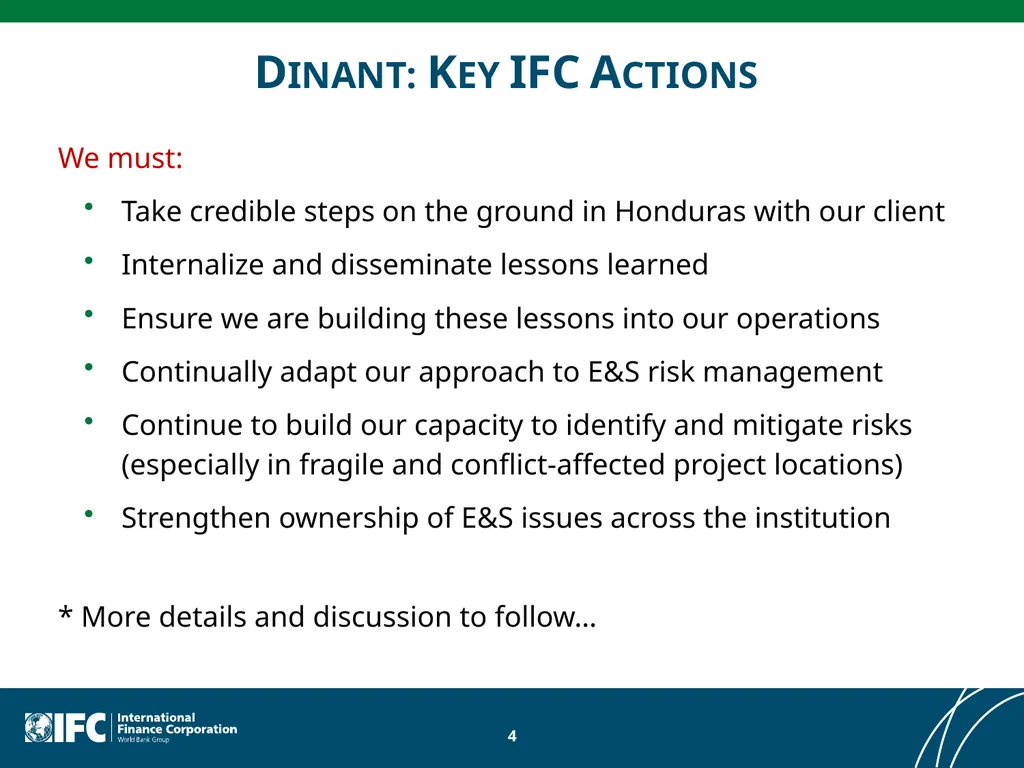
slide4. Dinant: Key IFC Actions We must:
Take credible steps on the ground in Honduras with our client
Internalize and disseminate lessons learned
Ensure we are building these lessons into our operations
Continually adapt our approach to E&S risk management
Continue to build our capacity to identify and mitigate risks (especially in fragile and conflict-affected project locations)
Strengthen ownership of E&S issues across the institution
* More details and discussion to follow… 4<br>
slide5. How IFC is Learning from Recent Experiences 5<br>
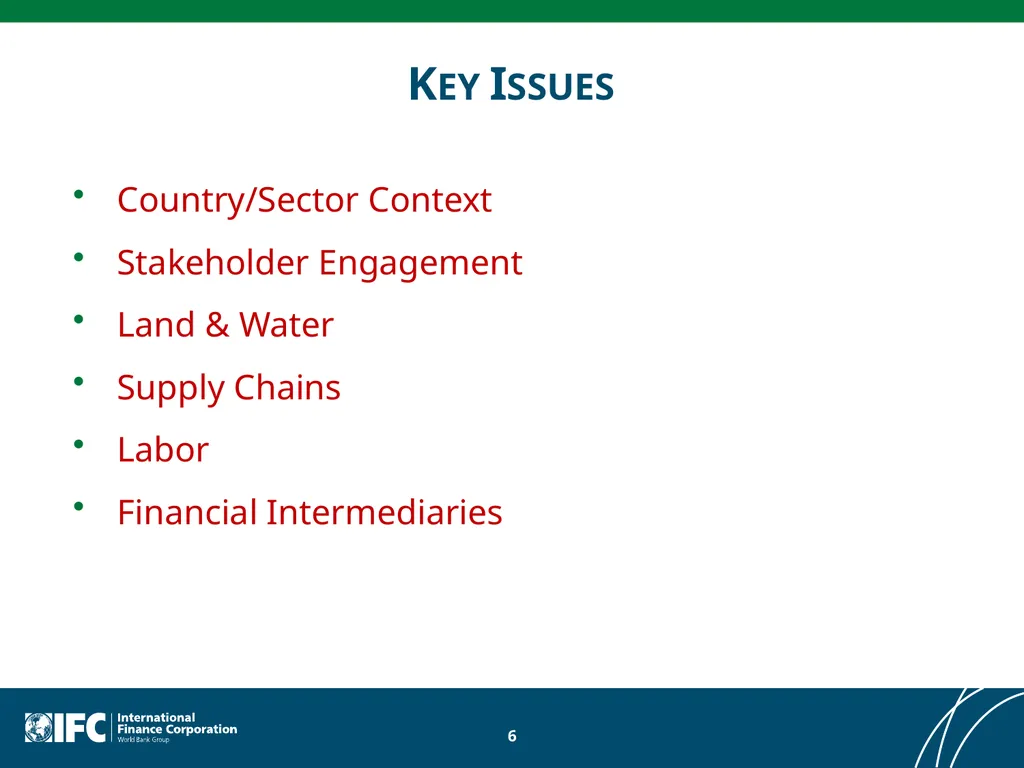
slide6. Key Issues Country/Sector Context
Stakeholder Engagement
Land & Water
Supply Chains
Labor
Financial Intermediaries 6<br>
slide7. IFC’s target markets are high risk environments
Fragile and conflict situations
Limited capacity and resources on the ground
Low client capacity
Weak Institutions
Robust E&S risk management will be a key factor in our ability to achieve objectives
Broader contextual risks often cannot be addressed through a single transaction alone
Enhanced collaboration across WBG is key to success 7 IFC Facing Increasingly Complex Challenges<br>
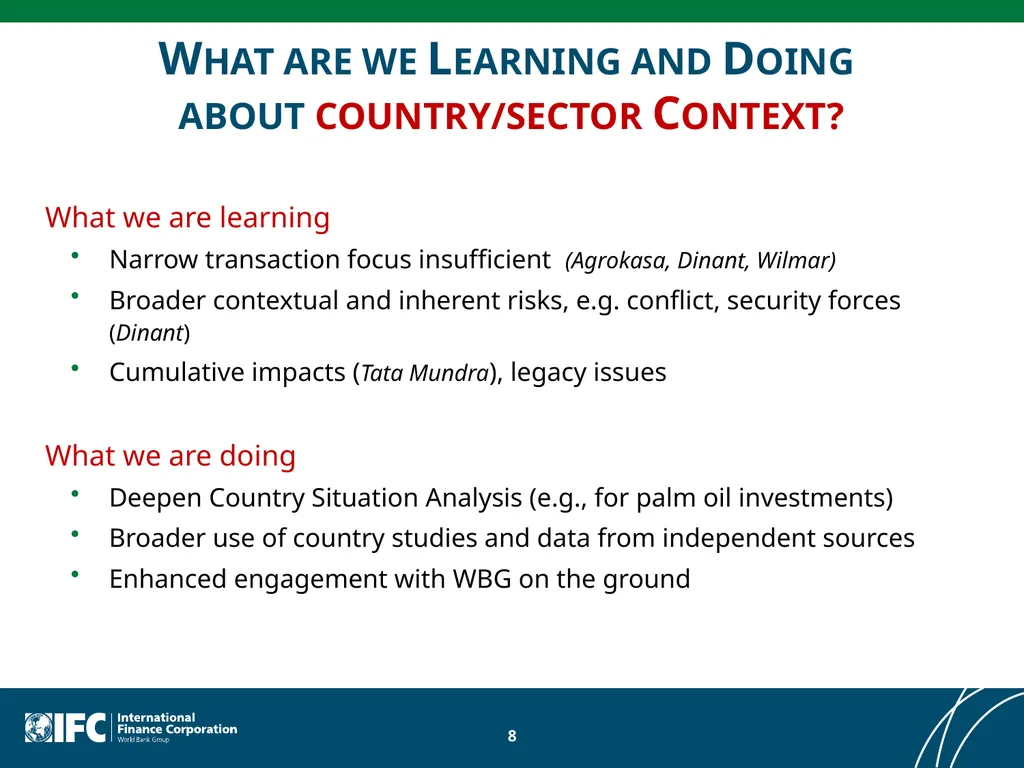
slide8. What are we Learning and Doing about country/sector Context? What we are learning
Narrow transaction focus insufficient (Agrokasa, Dinant, Wilmar)
Broader contextual and inherent risks, e.g. conflict, security forces (Dinant)
Cumulative impacts (Tata Mundra), legacy issues
What we are doing
Deepen Country Situation Analysis (e.g., for palm oil investments)
Broader use of country studies and data from independent sources
Enhanced engagement with WBG on the ground 8<br>
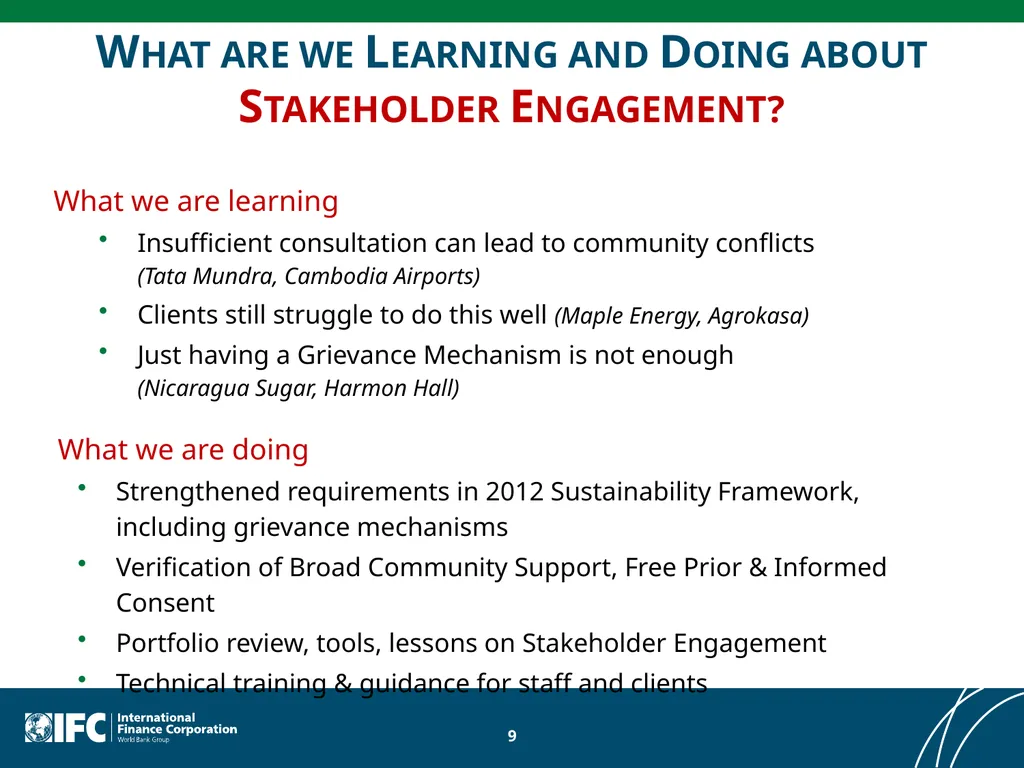
slide9. What are we Learning and Doing about Stakeholder Engagement? What we are learning
Insufficient consultation can lead to community conflicts (Tata Mundra, Cambodia Airports)
Clients still struggle to do this well (Maple Energy, Agrokasa)
Just having a Grievance Mechanism is not enough (Nicaragua Sugar, Harmon Hall) 9 What we are doing
Strengthened requirements in 2012 Sustainability Framework, including grievance mechanisms
Verification of Broad Community Support, Free Prior & Informed Consent
Portfolio review, tools, lessons on Stakeholder Engagement
Technical training & guidance for staff and clients<br>
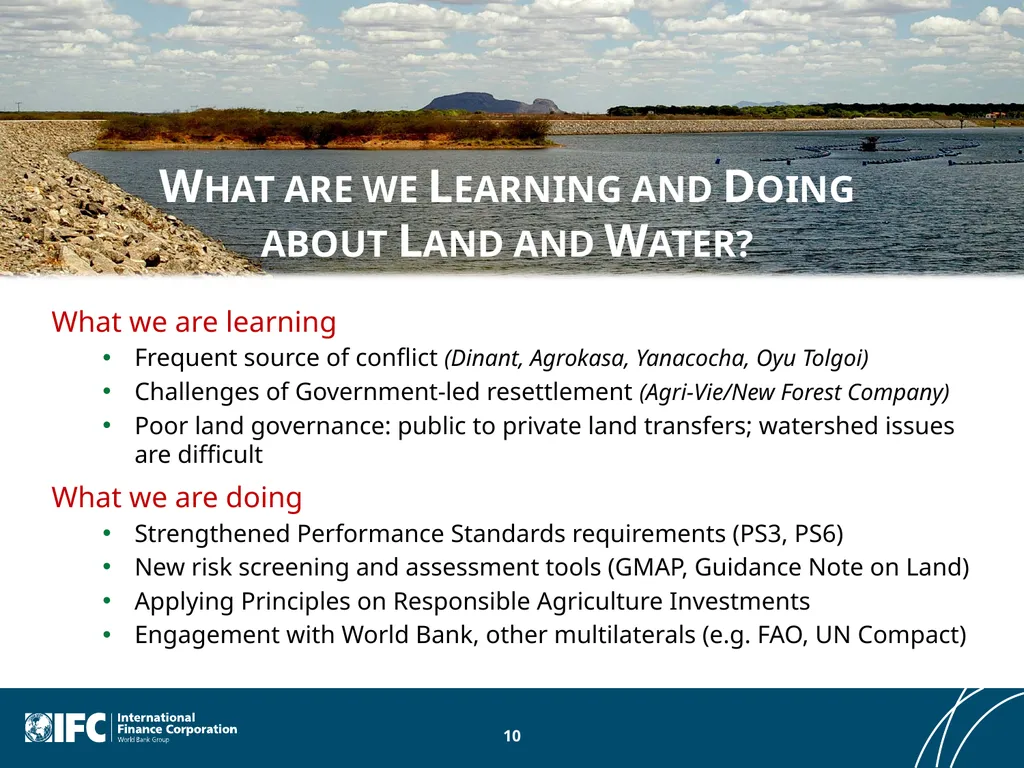
slide10. What are we Learning and Doing about Land and Water? 10 What we are learning
Frequent source of conflict (Dinant, Agrokasa, Yanacocha, Oyu Tolgoi)
Challenges of Government-led resettlement (Agri-Vie/New Forest Company)
Poor land governance: public to private land transfers; watershed issues are difficult
What we are doing
Strengthened Performance Standards requirements (PS3, PS6)
New risk screening and assessment tools (GMAP, Guidance Note on Land)
Applying Principles on Responsible Agriculture Investments
Engagement with World Bank, other multilaterals (e.g. FAO, UN Compact)<br>
slide11. What are we Learning and Doing about Supply Chain Issues? What we are learning
Verification in extended supply chains is difficult (Bujagali)
Clients often have limited leverage to improve practices
Need for better screening on High Risk Commodities (Wilmar)
Labor
Biodiversity
What we are doing
Good practice guidance
Agro-commodities and supply chain
Child Labor Monitoring Tool
Commodity roundtables
Expanded scope of verification
Better screening tools (Trade Finance due diligence) 11<br>
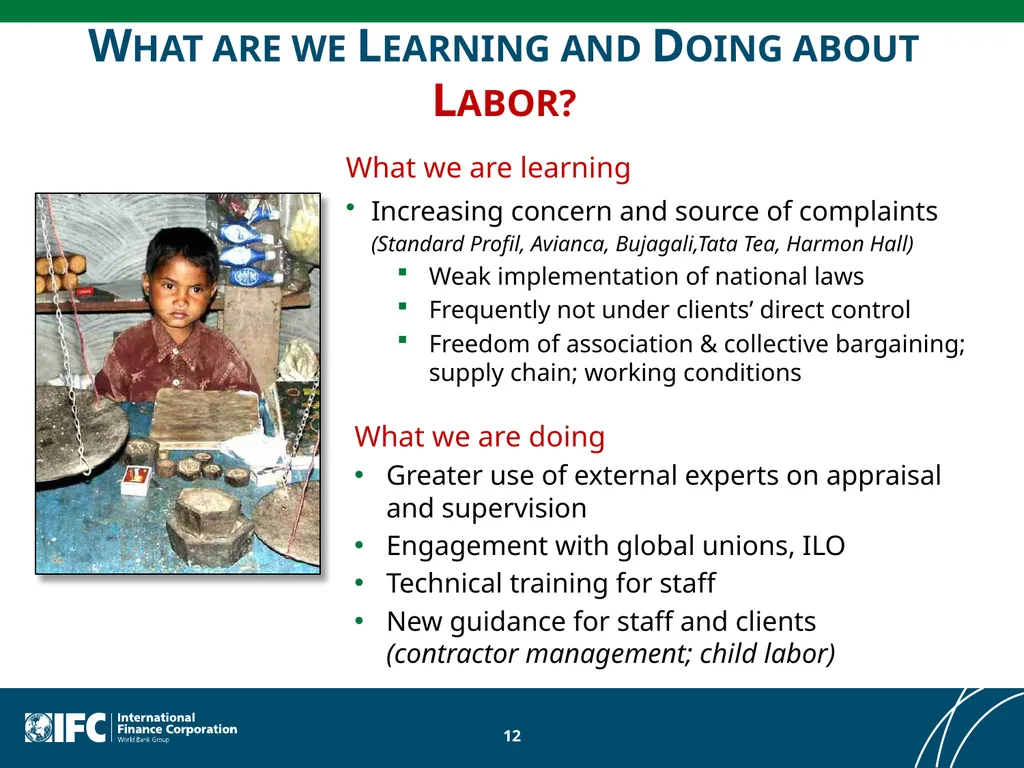
slide12. What are we Learning and Doing about Labor? What we are learning
Increasing concern and source of complaints (Standard Profil, Avianca, Bujagali,Tata Tea, Harmon Hall)
Weak implementation of national laws
Frequently not under clients’ direct control
Freedom of association & collective bargaining; supply chain; working conditions 12 What we are doing
Greater use of external experts on appraisal and supervision
Engagement with global unions, ILO
Technical training for staff
New guidance for staff and clients (contractor management; child labor)<br>
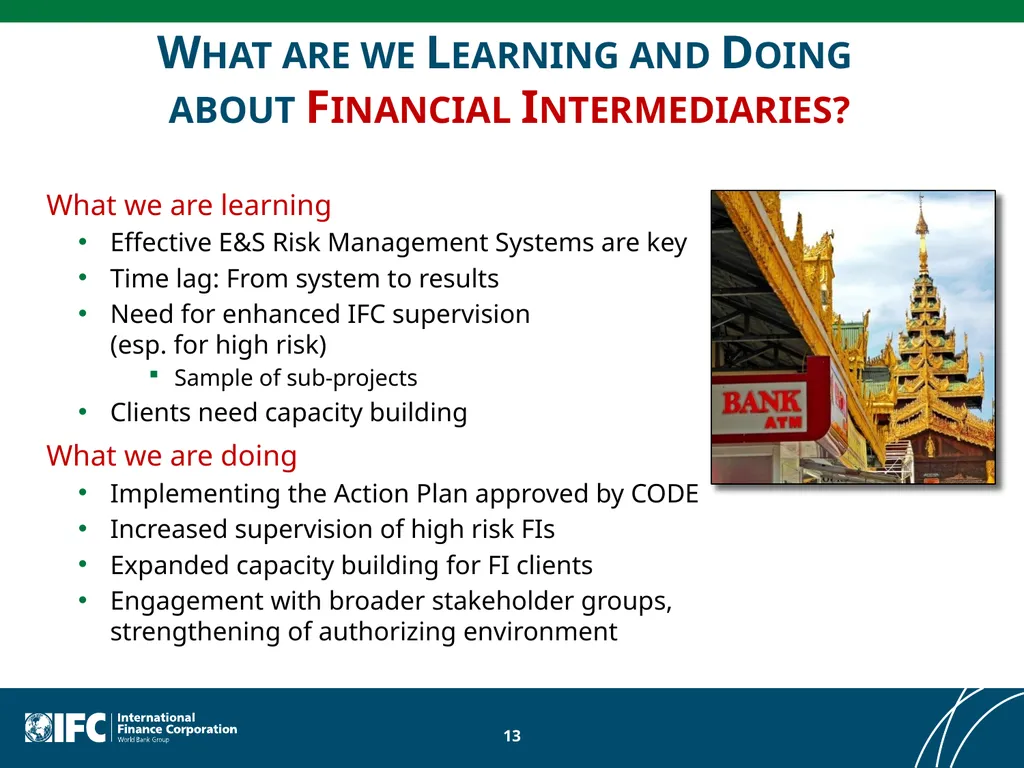
slide13. What are we Learning and Doing about Financial Intermediaries? What we are learning
Effective E&S Risk Management Systems are key
Time lag: From system to results
Need for enhanced IFC supervision (esp. for high risk)
Sample of sub-projects
Clients need capacity building
What we are doing
Implementing the Action Plan approved by CODE
Increased supervision of high risk FIs
Expanded capacity building for FI clients
Engagement with broader stakeholder groups, strengthening of authorizing environment 13<br>
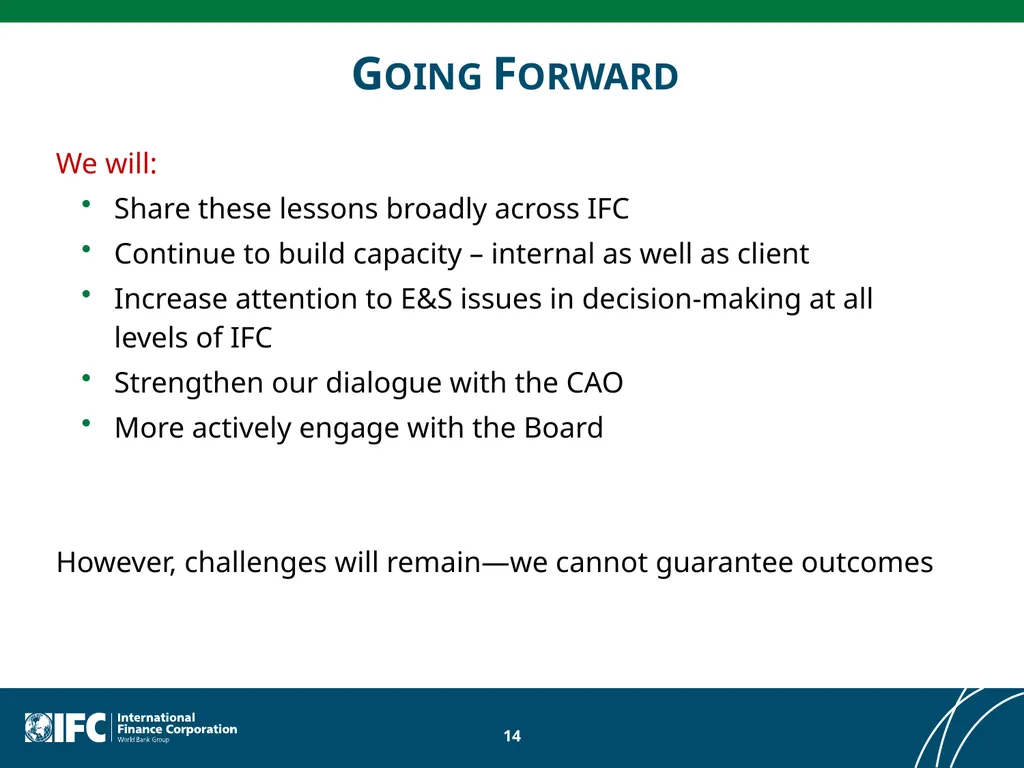
slide14. Going Forward 14 We will:
Share these lessons broadly across IFC
Continue to build capacity – internal as well as client
Increase attention to E&S issues in decision-making at all levels of IFC
Strengthen our dialogue with the CAO
More actively engage with the Board
However, challenges will remain—we cannot guarantee outcomes<br>
slide15. Dinant: Update on Action Plan 15<br>
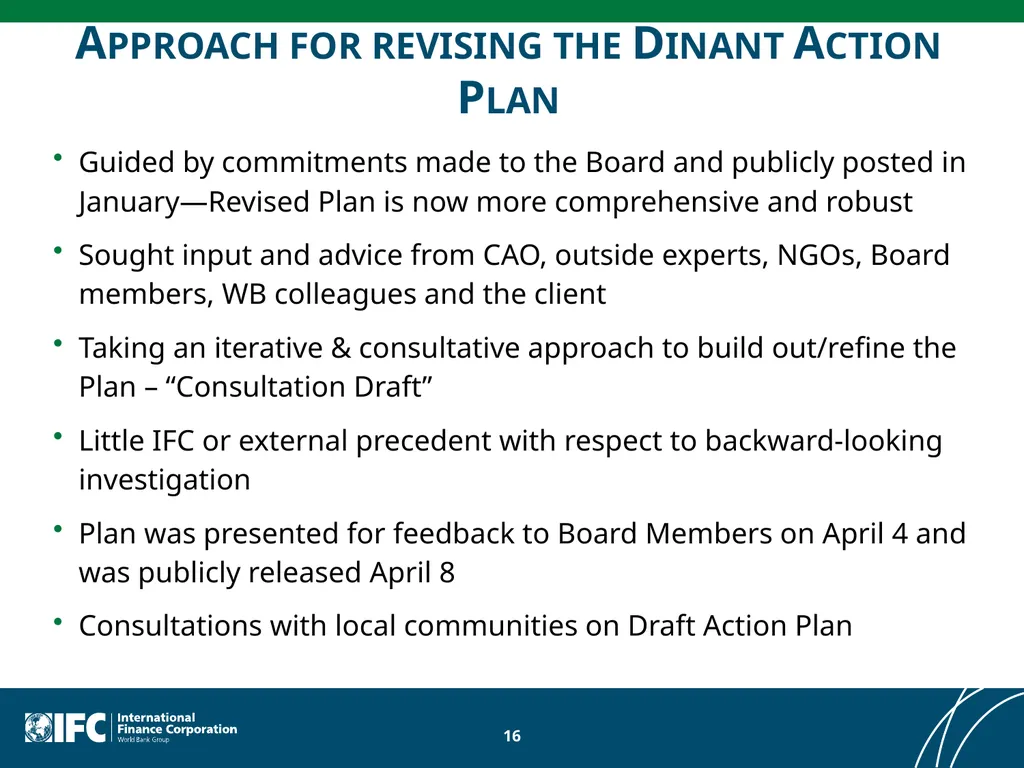
slide16. Approach for revising the Dinant Action Plan Guided by commitments made to the Board and publicly posted in January—Revised Plan is now more comprehensive and robust
Sought input and advice from CAO, outside experts, NGOs, Board members, WB colleagues and the client
Taking an iterative & consultative approach to build out/refine the Plan – “Consultation Draft”
Little IFC or external precedent with respect to backward-looking investigation
Plan was presented for feedback to Board Members on April 4 and was publicly released April 8
Consultations with local communities on Draft Action Plan 16<br>
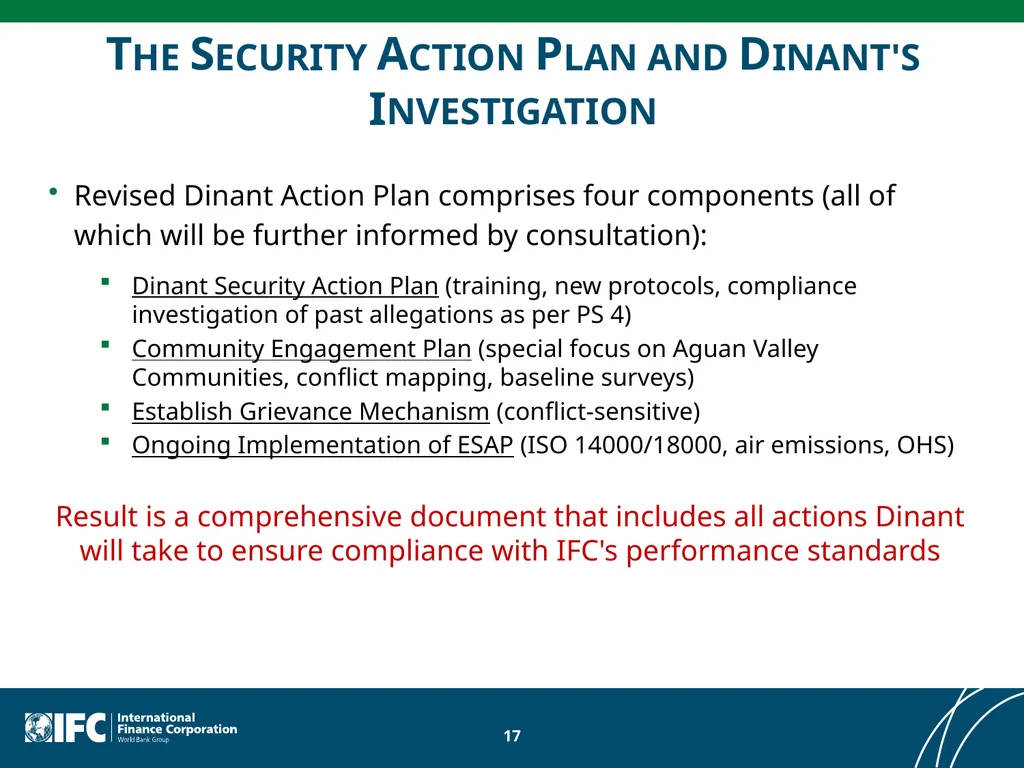
slide17. The Security Action Plan and Dinant's Investigation Revised Dinant Action Plan comprises four components (all of which will be further informed by consultation):
Dinant Security Action Plan (training, new protocols, compliance investigation of past allegations as per PS 4)
Community Engagement Plan (special focus on Aguan Valley Communities, conflict mapping, baseline surveys)
Establish Grievance Mechanism (conflict-sensitive)
Ongoing Implementation of ESAP (ISO 14000/18000, air emissions, OHS)
Result is a comprehensive document that includes all actions Dinant will take to ensure compliance with IFC's performance standards 17<br>
slide18. IFC to Monitor as Guided by External Expertise Investigation of past allegations
No IFC precedent nor expertise for the investigation that Dinant is required to undertake in compliance with PS 4
IFC will hire a security expert to advise us, review ToR, and monitor implementation
Stakeholder, CAO and expert input indicates need for reputable third party investigator to lead investigation – candidate must be acceptable to IFC
“Compliance” investigation by client versus “criminal” investigation by GoH
If wrongdoing is found corrective actions will be taken (including disciplinary measures and compensation as warranted)
Community Engagement
Recognize that some communities may be in conflict with Dinant – consultations facilitated by international consultants with participation of client and IFC
There is a need for specialized expertise familiar with working on dispute resolution and in conflict zones
IFC will hire its own conflict mediation consultants to support client’s consultation process with affected Aguan Valley communities 18<br>
slide19. Next Steps “Consultation Draft” of Revised Action Plan has been posted on IFC’s website, and will be reviewed with civil society at Spring Meetings
Dinant will develop the Security Action Plan and the Community Engagement Plan (including Grievance Mechanism) in consultation with local communities (now through December)
IFC will hire its own expert advisor on security issues/investigations
IFC will monitor Action Plan implementation directly and via input/guidance from external experts
“Lessons Learned” has also been posted on IFC’s website
WBG to continue outreach to the Government of Honduras & partners 19<br>
slide20. 20 Discussion<br>
slide21. Annex: Addressing the Broader Challenges in the Aguan Stakeholders have made clear that resolving Dinant-specific issues via the Action Plan is a start but not the answer to what drives conflict in the Aguan
There seem to be at least two key areas of focus to reduce tensions:
Restore the rule of law and personal security/prosecute human rights crimes
Establish a stakeholder dialogue that enables farmer, community, private sector and Government representatives to map the sources of conflict and define a future vision for economic and social development for the Aguan
The World Bank Group is reviewing what role we might play based on expertise and convening power (or lack thereof)
The Government is central to any solution and multiple partnerships will be necessary 21<br>
April 9, 2014
CSO Session<br>
slide2. AGENDA Dinant: Lessons Learned / CAO Audit
Learning & Adapting
Key themes
Links to recent cases
Dinant: Update on Action Plan
Discussion 2<br>
slide3. Dinant: Key Lessons Learned IFC acknowledges deficiencies in the handling of the Dinant investment:
During project preparation, IFC underestimated the broader risks in the Aguan Valley (land conflict, security issues, political instability)
When acute problems emerged, neither IFC nor client was prepared
IFC’s project supervision was not commensurate with level of risk
Internal communication and documentation sub-optimal
Scope of the challenges in the Aguan Valley go beyond Dinant:
Complex history of land conflict/violence requires long-term solutions
Limited ability of IFC and client to address this 3<br>
slide4. Dinant: Key IFC Actions We must:
Take credible steps on the ground in Honduras with our client
Internalize and disseminate lessons learned
Ensure we are building these lessons into our operations
Continually adapt our approach to E&S risk management
Continue to build our capacity to identify and mitigate risks (especially in fragile and conflict-affected project locations)
Strengthen ownership of E&S issues across the institution
* More details and discussion to follow… 4<br>
slide5. How IFC is Learning from Recent Experiences 5<br>
slide6. Key Issues Country/Sector Context
Stakeholder Engagement
Land & Water
Supply Chains
Labor
Financial Intermediaries 6<br>
slide7. IFC’s target markets are high risk environments
Fragile and conflict situations
Limited capacity and resources on the ground
Low client capacity
Weak Institutions
Robust E&S risk management will be a key factor in our ability to achieve objectives
Broader contextual risks often cannot be addressed through a single transaction alone
Enhanced collaboration across WBG is key to success 7 IFC Facing Increasingly Complex Challenges<br>
slide8. What are we Learning and Doing about country/sector Context? What we are learning
Narrow transaction focus insufficient (Agrokasa, Dinant, Wilmar)
Broader contextual and inherent risks, e.g. conflict, security forces (Dinant)
Cumulative impacts (Tata Mundra), legacy issues
What we are doing
Deepen Country Situation Analysis (e.g., for palm oil investments)
Broader use of country studies and data from independent sources
Enhanced engagement with WBG on the ground 8<br>
slide9. What are we Learning and Doing about Stakeholder Engagement? What we are learning
Insufficient consultation can lead to community conflicts (Tata Mundra, Cambodia Airports)
Clients still struggle to do this well (Maple Energy, Agrokasa)
Just having a Grievance Mechanism is not enough (Nicaragua Sugar, Harmon Hall) 9 What we are doing
Strengthened requirements in 2012 Sustainability Framework, including grievance mechanisms
Verification of Broad Community Support, Free Prior & Informed Consent
Portfolio review, tools, lessons on Stakeholder Engagement
Technical training & guidance for staff and clients<br>
slide10. What are we Learning and Doing about Land and Water? 10 What we are learning
Frequent source of conflict (Dinant, Agrokasa, Yanacocha, Oyu Tolgoi)
Challenges of Government-led resettlement (Agri-Vie/New Forest Company)
Poor land governance: public to private land transfers; watershed issues are difficult
What we are doing
Strengthened Performance Standards requirements (PS3, PS6)
New risk screening and assessment tools (GMAP, Guidance Note on Land)
Applying Principles on Responsible Agriculture Investments
Engagement with World Bank, other multilaterals (e.g. FAO, UN Compact)<br>
slide11. What are we Learning and Doing about Supply Chain Issues? What we are learning
Verification in extended supply chains is difficult (Bujagali)
Clients often have limited leverage to improve practices
Need for better screening on High Risk Commodities (Wilmar)
Labor
Biodiversity
What we are doing
Good practice guidance
Agro-commodities and supply chain
Child Labor Monitoring Tool
Commodity roundtables
Expanded scope of verification
Better screening tools (Trade Finance due diligence) 11<br>
slide12. What are we Learning and Doing about Labor? What we are learning
Increasing concern and source of complaints (Standard Profil, Avianca, Bujagali,Tata Tea, Harmon Hall)
Weak implementation of national laws
Frequently not under clients’ direct control
Freedom of association & collective bargaining; supply chain; working conditions 12 What we are doing
Greater use of external experts on appraisal and supervision
Engagement with global unions, ILO
Technical training for staff
New guidance for staff and clients (contractor management; child labor)<br>
slide13. What are we Learning and Doing about Financial Intermediaries? What we are learning
Effective E&S Risk Management Systems are key
Time lag: From system to results
Need for enhanced IFC supervision (esp. for high risk)
Sample of sub-projects
Clients need capacity building
What we are doing
Implementing the Action Plan approved by CODE
Increased supervision of high risk FIs
Expanded capacity building for FI clients
Engagement with broader stakeholder groups, strengthening of authorizing environment 13<br>
slide14. Going Forward 14 We will:
Share these lessons broadly across IFC
Continue to build capacity – internal as well as client
Increase attention to E&S issues in decision-making at all levels of IFC
Strengthen our dialogue with the CAO
More actively engage with the Board
However, challenges will remain—we cannot guarantee outcomes<br>
slide15. Dinant: Update on Action Plan 15<br>
slide16. Approach for revising the Dinant Action Plan Guided by commitments made to the Board and publicly posted in January—Revised Plan is now more comprehensive and robust
Sought input and advice from CAO, outside experts, NGOs, Board members, WB colleagues and the client
Taking an iterative & consultative approach to build out/refine the Plan – “Consultation Draft”
Little IFC or external precedent with respect to backward-looking investigation
Plan was presented for feedback to Board Members on April 4 and was publicly released April 8
Consultations with local communities on Draft Action Plan 16<br>
slide17. The Security Action Plan and Dinant's Investigation Revised Dinant Action Plan comprises four components (all of which will be further informed by consultation):
Dinant Security Action Plan (training, new protocols, compliance investigation of past allegations as per PS 4)
Community Engagement Plan (special focus on Aguan Valley Communities, conflict mapping, baseline surveys)
Establish Grievance Mechanism (conflict-sensitive)
Ongoing Implementation of ESAP (ISO 14000/18000, air emissions, OHS)
Result is a comprehensive document that includes all actions Dinant will take to ensure compliance with IFC's performance standards 17<br>
slide18. IFC to Monitor as Guided by External Expertise Investigation of past allegations
No IFC precedent nor expertise for the investigation that Dinant is required to undertake in compliance with PS 4
IFC will hire a security expert to advise us, review ToR, and monitor implementation
Stakeholder, CAO and expert input indicates need for reputable third party investigator to lead investigation – candidate must be acceptable to IFC
“Compliance” investigation by client versus “criminal” investigation by GoH
If wrongdoing is found corrective actions will be taken (including disciplinary measures and compensation as warranted)
Community Engagement
Recognize that some communities may be in conflict with Dinant – consultations facilitated by international consultants with participation of client and IFC
There is a need for specialized expertise familiar with working on dispute resolution and in conflict zones
IFC will hire its own conflict mediation consultants to support client’s consultation process with affected Aguan Valley communities 18<br>
slide19. Next Steps “Consultation Draft” of Revised Action Plan has been posted on IFC’s website, and will be reviewed with civil society at Spring Meetings
Dinant will develop the Security Action Plan and the Community Engagement Plan (including Grievance Mechanism) in consultation with local communities (now through December)
IFC will hire its own expert advisor on security issues/investigations
IFC will monitor Action Plan implementation directly and via input/guidance from external experts
“Lessons Learned” has also been posted on IFC’s website
WBG to continue outreach to the Government of Honduras & partners 19<br>
slide20. 20 Discussion<br>
slide21. Annex: Addressing the Broader Challenges in the Aguan Stakeholders have made clear that resolving Dinant-specific issues via the Action Plan is a start but not the answer to what drives conflict in the Aguan
There seem to be at least two key areas of focus to reduce tensions:
Restore the rule of law and personal security/prosecute human rights crimes
Establish a stakeholder dialogue that enables farmer, community, private sector and Government representatives to map the sources of conflict and define a future vision for economic and social development for the Aguan
The World Bank Group is reviewing what role we might play based on expertise and convening power (or lack thereof)
The Government is central to any solution and multiple partnerships will be necessary 21<br>