
Immediate care at birth Goal and learning outcomes
TD
Published · 41 slides · 0 views

1 / 1





Description
Immediate care at birth Goal and learning outcomes The situation Care in the first minutes after birth Care through the first hour Summary Clinical practice Quality improvement References and additional resources Content Goal and learning
Related Topics
Share
Embed code
Download this presentation From Below
"Immediate care at birth Goal and learning outcomes" is the property of its rightful owner. Permission is granted to download and print the materials on this website for personal, non-commercial use only, and to display it on your personal computer provided you do not modify the materials and that you retain all copyright notices contained in the materials. By downloading content from our website, you accept the terms of this agreement.
Presentation Transcript
01
Immediate care at birth<br>
02
Goal and learning outcomes
The situation
Care in the first minutes after birth
Care through the first hour
Summary
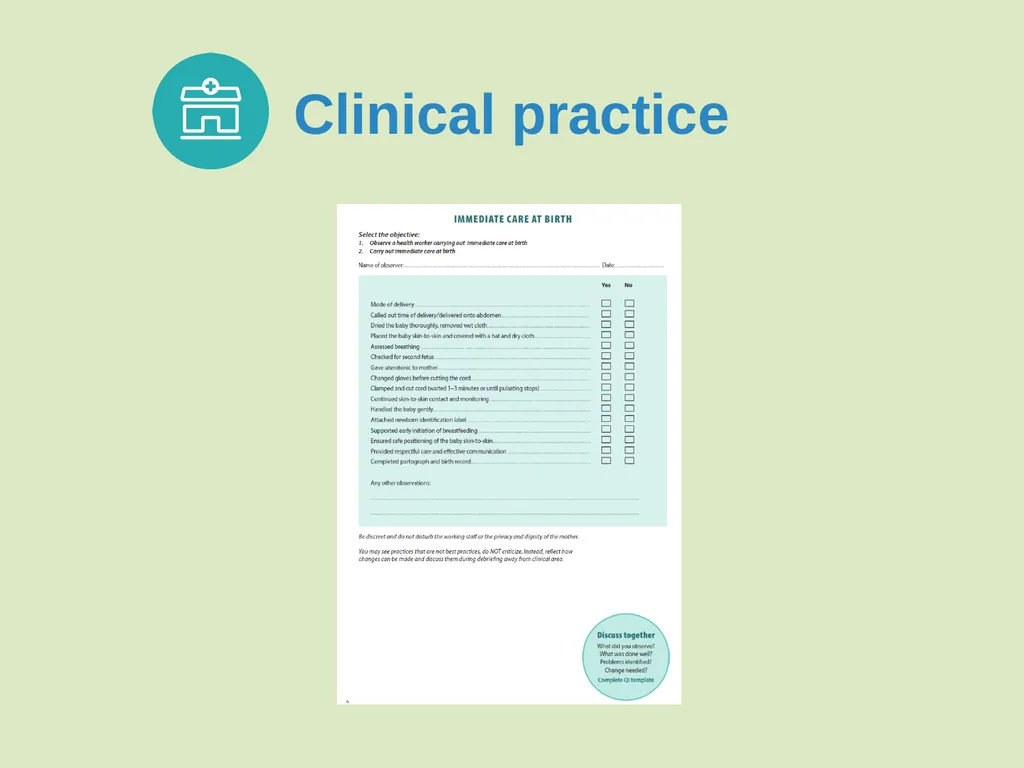
Clinical practice
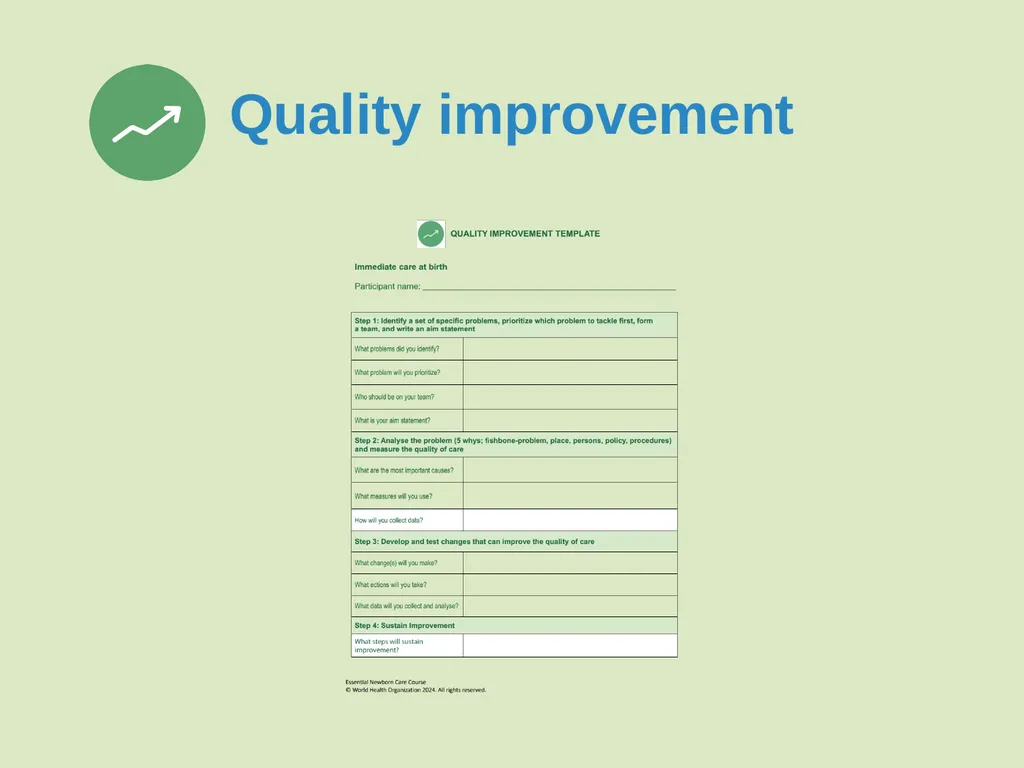
Quality improvement
References and additional resources Content<br>
The situation
Care in the first minutes after birth
Care through the first hour
Summary
Clinical practice
Quality improvement
References and additional resources Content<br>
03
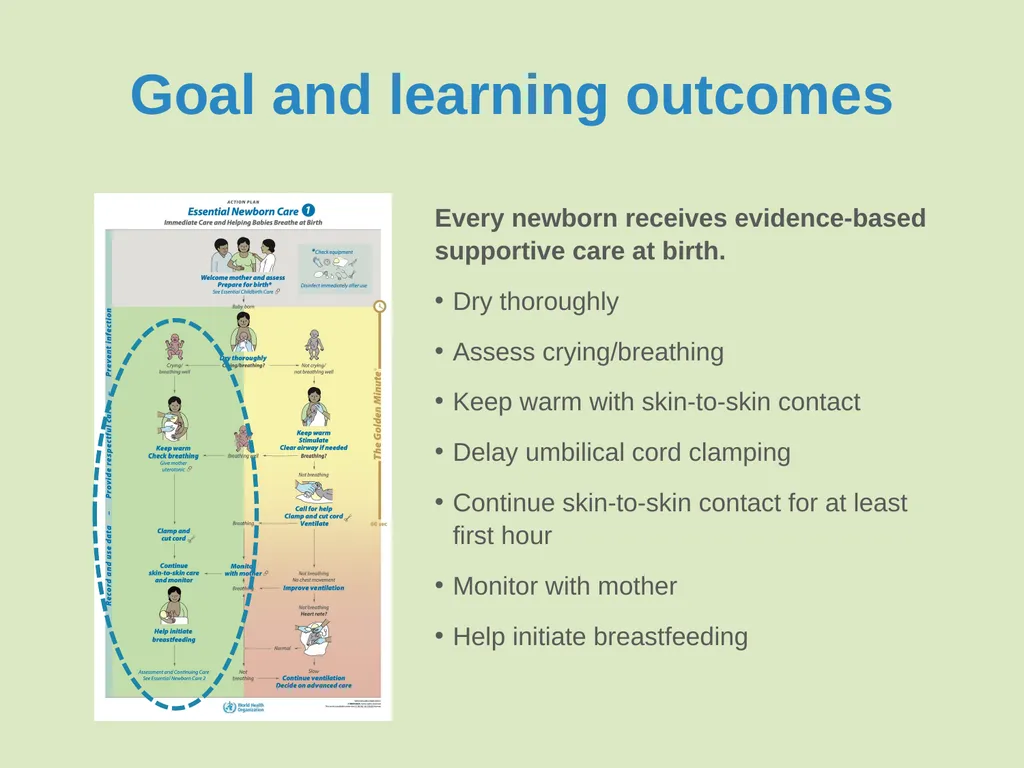
Goal and learning outcomes Every newborn receives evidence-based
supportive care at birth.
Dry thoroughly
Assess crying/breathing
Keep warm with skin-to-skin contact
Delay umbilical cord clamping
Continue skin-to-skin contact for at least first hour
Monitor with mother
Help initiate breastfeeding<br>
Dry thoroughly
Assess crying/breathing
Keep warm with skin-to-skin contact
Delay umbilical cord clamping
Continue skin-to-skin contact for at least first hour
Monitor with mother
Help initiate breastfeeding<br>
04
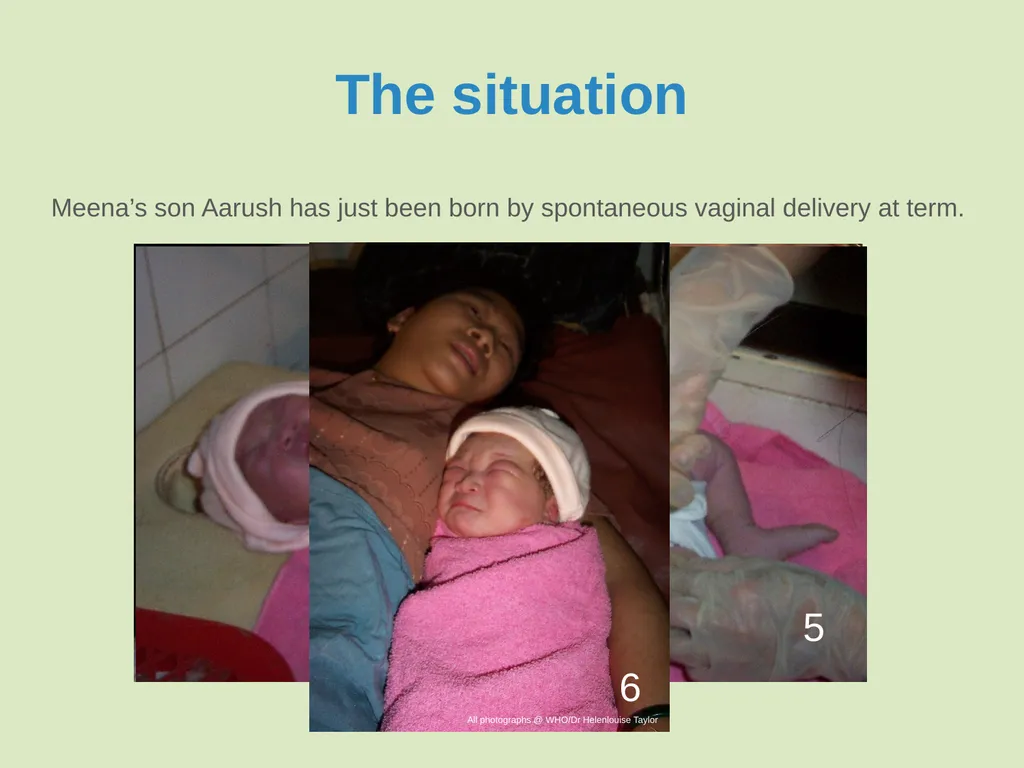
Meena’s son Aarush has just been born by spontaneous vaginal delivery at term. The situation All photographs @ WHO/Dr Helenlouise Taylor<br>
05
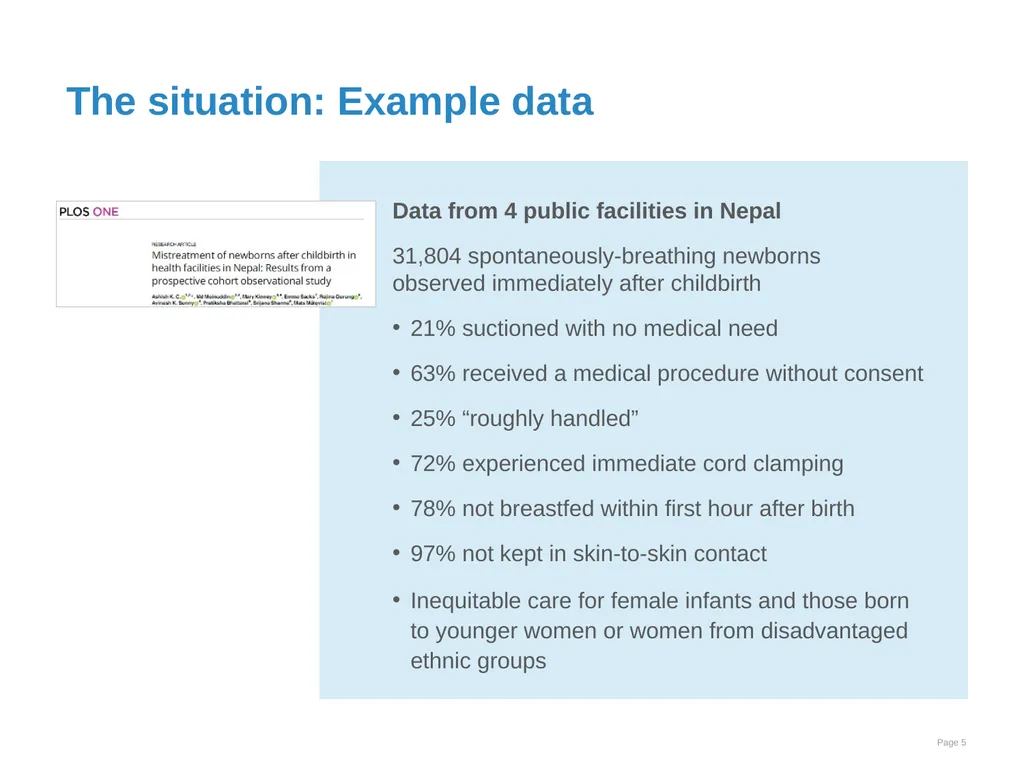
The situation: Example data Data from 4 public facilities in Nepal
31,804 spontaneously-breathing newborns observed immediately after childbirth
21% suctioned with no medical need
63% received a medical procedure without consent
25% “roughly handled”
72% experienced immediate cord clamping
78% not breastfed within first hour after birth
97% not kept in skin-to-skin contact
Inequitable care for female infants and those born to younger women or women from disadvantaged ethnic groups<br>
31,804 spontaneously-breathing newborns observed immediately after childbirth
21% suctioned with no medical need
63% received a medical procedure without consent
25% “roughly handled”
72% experienced immediate cord clamping
78% not breastfed within first hour after birth
97% not kept in skin-to-skin contact
Inequitable care for female infants and those born to younger women or women from disadvantaged ethnic groups<br>
06
Care in the first minutes
after birth<br>
07
Immediate care at birth Form groups (mother, companion and midwife). Meena had an uneventful pregnancy without complications.
She gives birth to her son Aarush by normal vaginal delivery at term.
Aarush breathes and cries. Receive Aarush, carry out immediate newborn care and communicate with mother.
Debrief with your team and facilitator.<br>
She gives birth to her son Aarush by normal vaginal delivery at term.
Aarush breathes and cries. Receive Aarush, carry out immediate newborn care and communicate with mother.
Debrief with your team and facilitator.<br>
08
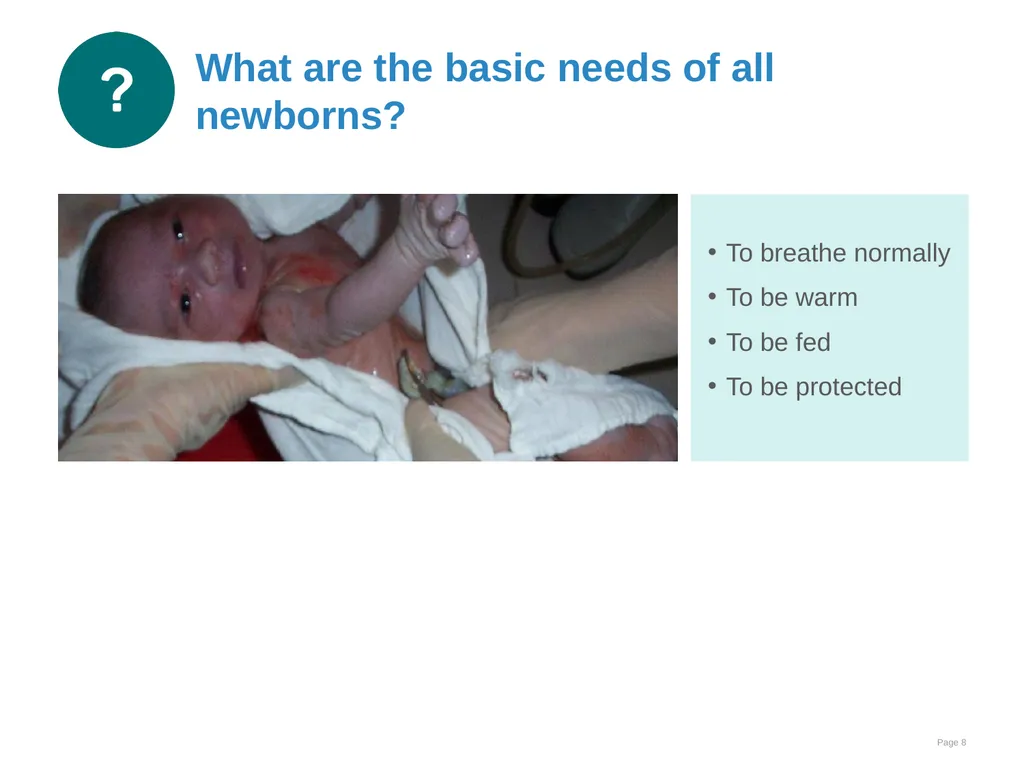
What are the basic needs of all newborns? To breathe normally
To be warm
To be fed
To be protected<br>
To be warm
To be fed
To be protected<br>
09
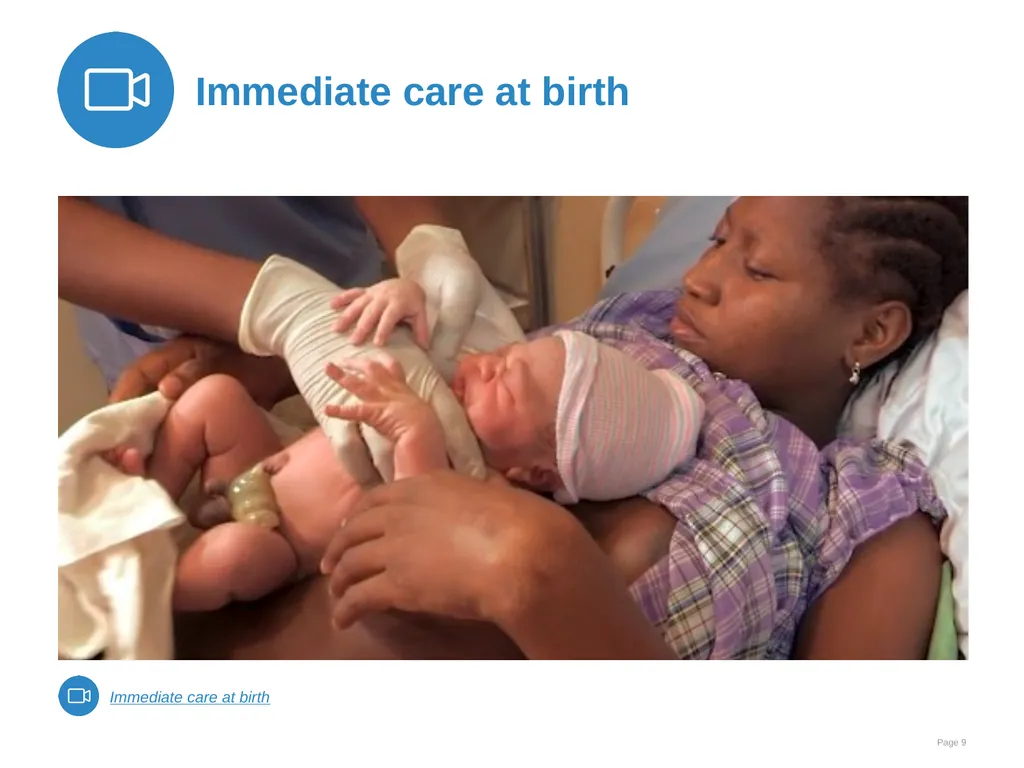
Immediate care at birth<br>
10
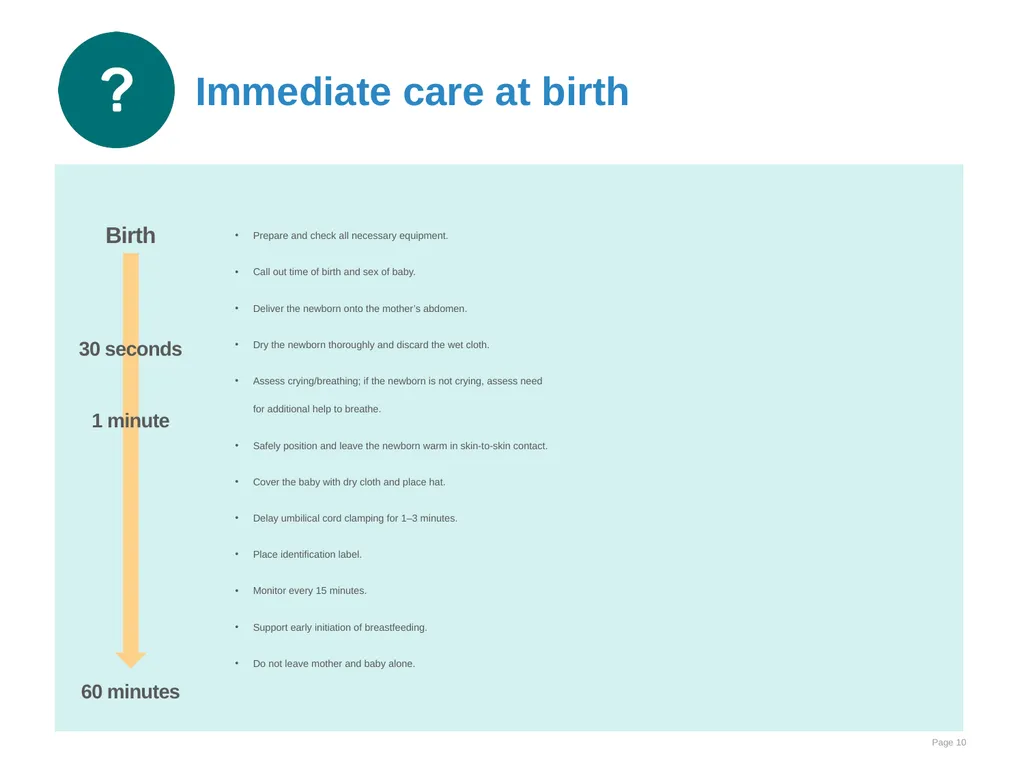
Immediate care at birth Prepare and check all necessary equipment.
Call out time of birth and sex of baby.
Deliver the newborn onto the mother’s abdomen.
Dry the newborn thoroughly and discard the wet cloth.
Assess crying/breathing; if the newborn is not crying, assess need for additional help to breathe.
Safely position and leave the newborn warm in skin-to-skin contact.
Cover the baby with dry cloth and place hat.
Delay umbilical cord clamping for 1–3 minutes.
Place identification label.
Monitor every 15 minutes.
Support early initiation of breastfeeding.
Do not leave mother and baby alone.<br>
Call out time of birth and sex of baby.
Deliver the newborn onto the mother’s abdomen.
Dry the newborn thoroughly and discard the wet cloth.
Assess crying/breathing; if the newborn is not crying, assess need for additional help to breathe.
Safely position and leave the newborn warm in skin-to-skin contact.
Cover the baby with dry cloth and place hat.
Delay umbilical cord clamping for 1–3 minutes.
Place identification label.
Monitor every 15 minutes.
Support early initiation of breastfeeding.
Do not leave mother and baby alone.<br>
11
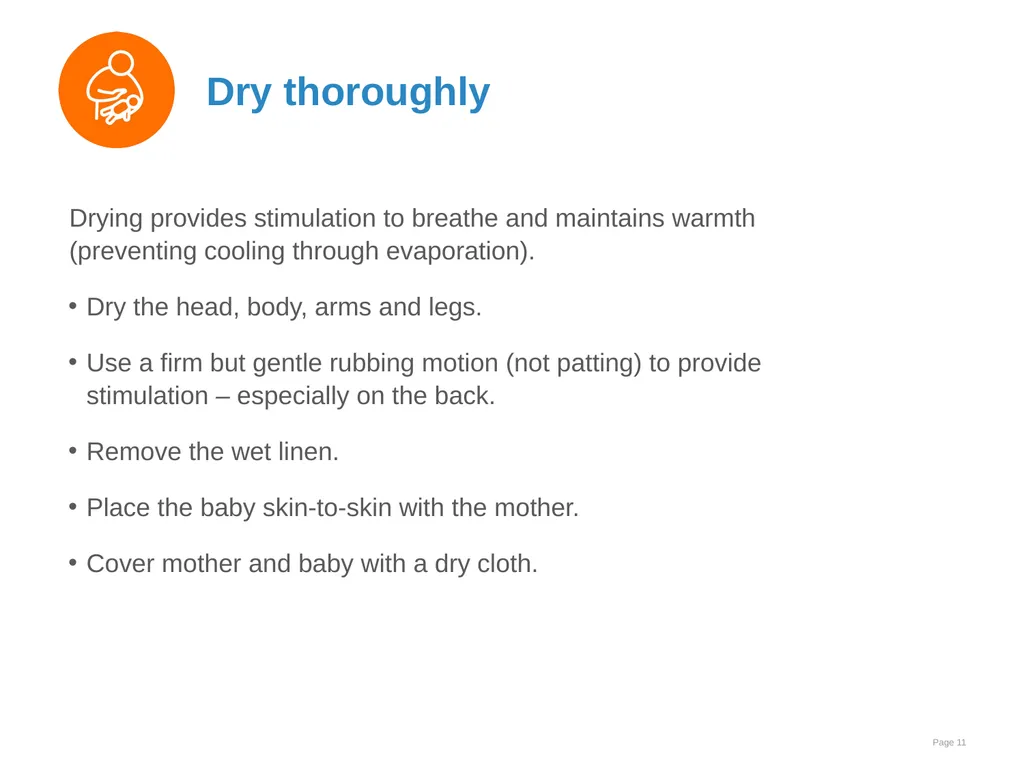
Dry thoroughly Drying provides stimulation to breathe and maintains warmth
(preventing cooling through evaporation).
Dry the head, body, arms and legs.
Use a firm but gentle rubbing motion (not patting) to provide stimulation – especially on the back.
Remove the wet linen.
Place the baby skin-to-skin with the mother.
Cover mother and baby with a dry cloth.<br>
Dry the head, body, arms and legs.
Use a firm but gentle rubbing motion (not patting) to provide stimulation – especially on the back.
Remove the wet linen.
Place the baby skin-to-skin with the mother.
Cover mother and baby with a dry cloth.<br>
12
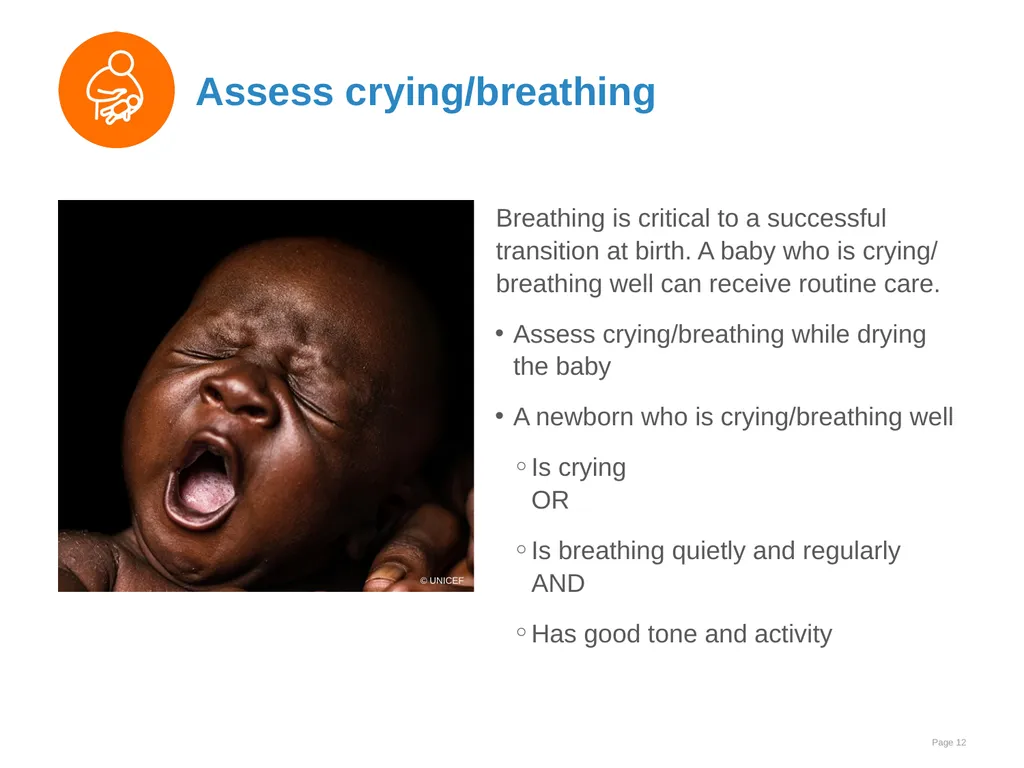
Assess crying/breathing Breathing is critical to a successful
transition at birth. A baby who is crying/
breathing well can receive routine care.
Assess crying/breathing while drying the baby
A newborn who is crying/breathing well
Is crying OR
Is breathing quietly and regularly AND
Has good tone and activity © UNICEF<br>
Assess crying/breathing while drying the baby
A newborn who is crying/breathing well
Is crying OR
Is breathing quietly and regularly AND
Has good tone and activity © UNICEF<br>
13
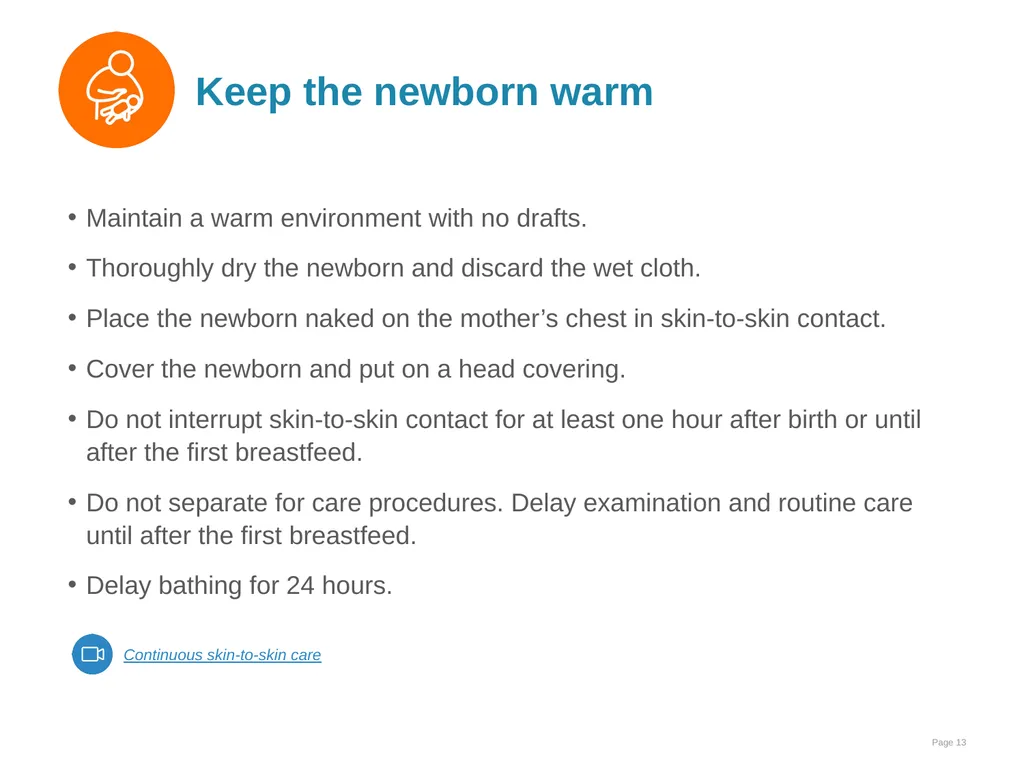
Keep the newborn warm Maintain a warm environment with no drafts.
Thoroughly dry the newborn and discard the wet cloth.
Place the newborn naked on the mother’s chest in skin-to-skin contact.
Cover the newborn and put on a head covering.
Do not interrupt skin-to-skin contact for at least one hour after birth or until after the first breastfeed.
Do not separate for care procedures. Delay examination and routine care until after the first breastfeed.
Delay bathing for 24 hours.<br>
Thoroughly dry the newborn and discard the wet cloth.
Place the newborn naked on the mother’s chest in skin-to-skin contact.
Cover the newborn and put on a head covering.
Do not interrupt skin-to-skin contact for at least one hour after birth or until after the first breastfeed.
Do not separate for care procedures. Delay examination and routine care until after the first breastfeed.
Delay bathing for 24 hours.<br>
14
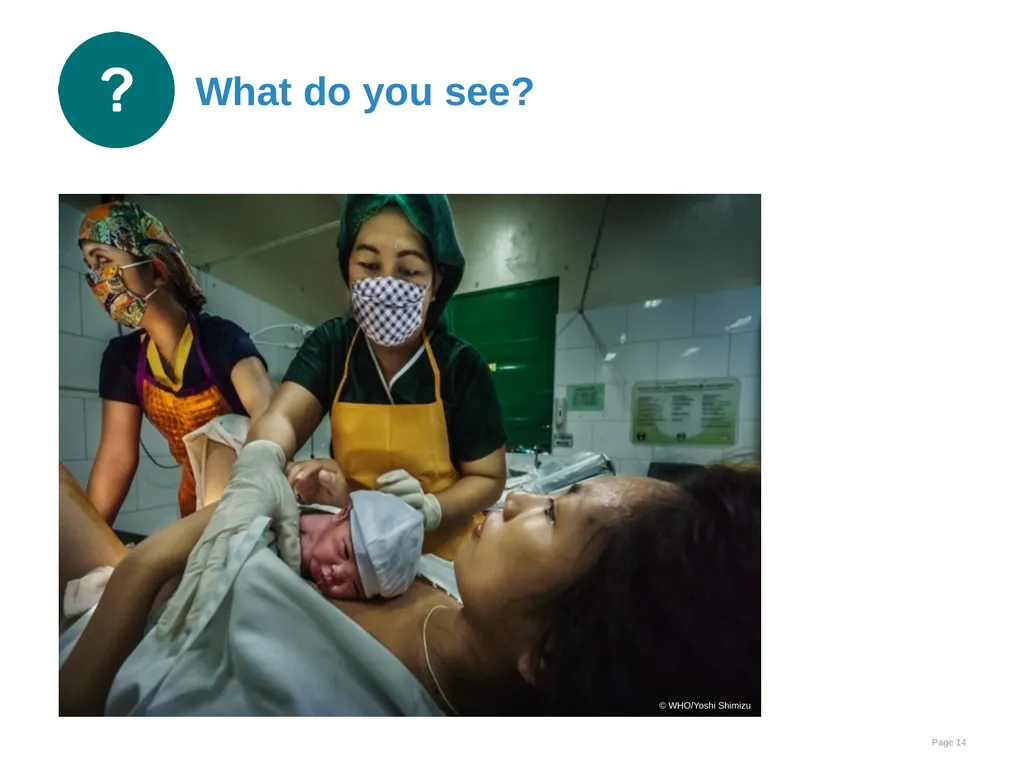
What do you see? © WHO/Yoshi Shimizu<br>
15
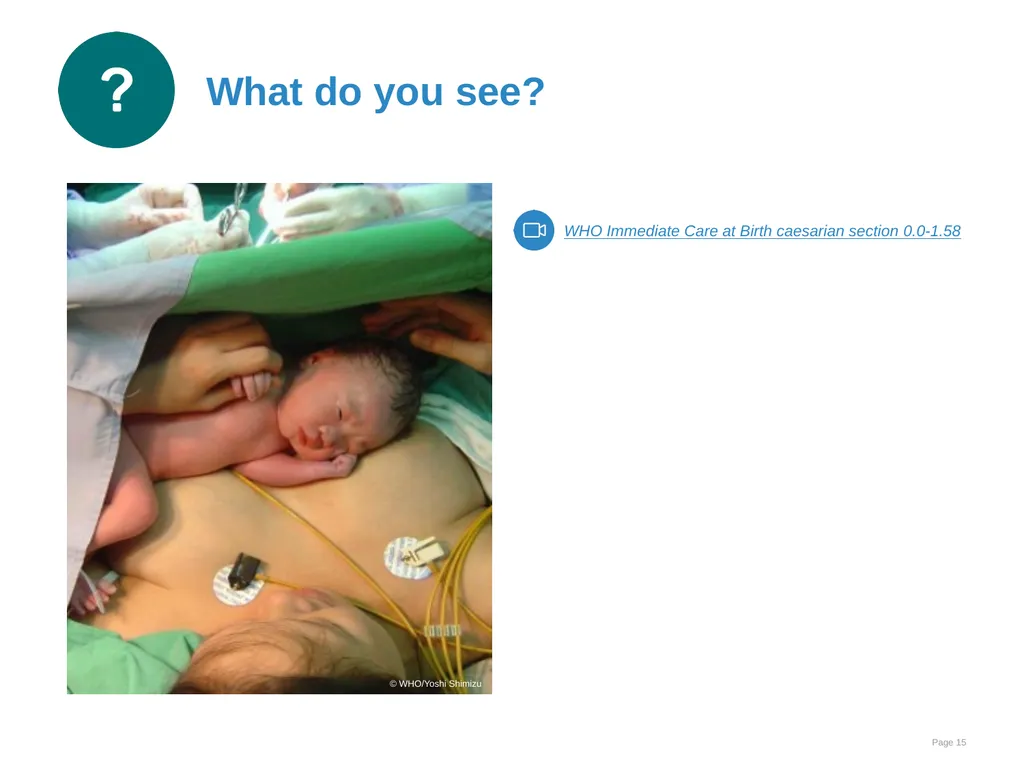
What do you see? © WHO/Yoshi Shimizu<br>
16
What are the recommendations for umbilical cord management? Find the recommendations and guideline. See page 160 See page 7-9<br>
17
Recommendation and reasons Delayed umbilical cord clamping (not earlier than 1 minute after birth)
is recommended for improved maternal and infant health and nutrition outcomes.
Benefits of delaying umbilical cord clamping
Lowers the risk of iron deficiency
Reduces the need for blood transfusion of preterm newborns and may lower the risk of necrotizing enterocolitis and intraventricular hemorrhage
Reduces retained placenta<br>
Benefits of delaying umbilical cord clamping
Lowers the risk of iron deficiency
Reduces the need for blood transfusion of preterm newborns and may lower the risk of necrotizing enterocolitis and intraventricular hemorrhage
Reduces retained placenta<br>
18
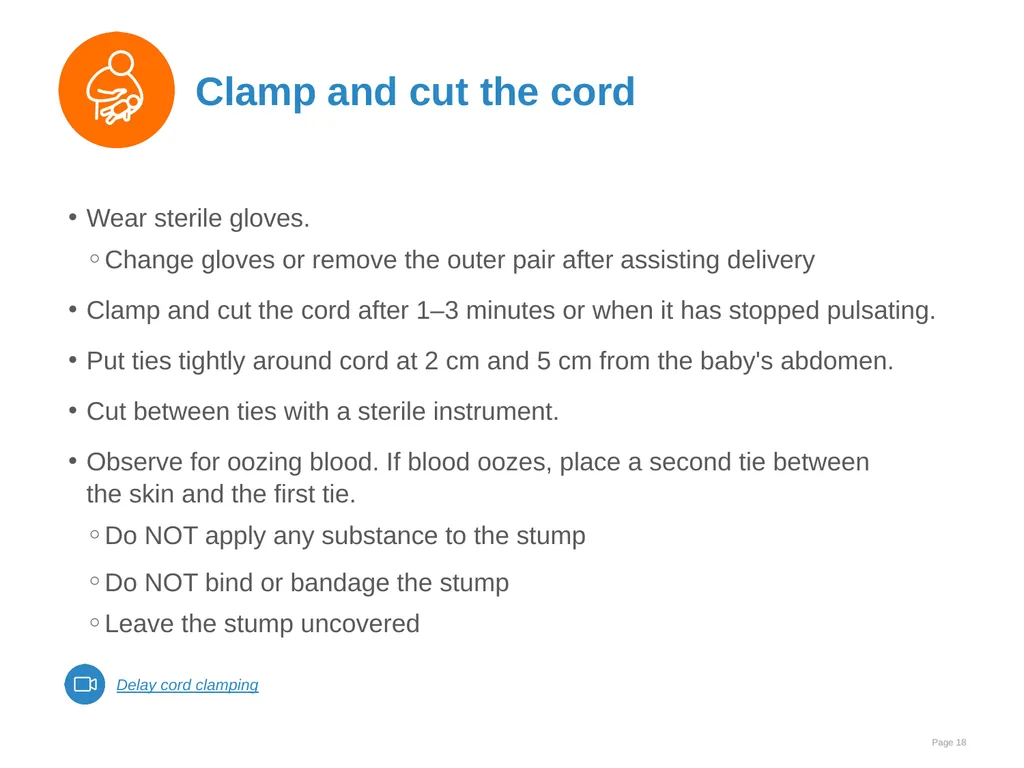
Clamp and cut the cord Wear sterile gloves.
Change gloves or remove the outer pair after assisting delivery
Clamp and cut the cord after 1–3 minutes or when it has stopped pulsating.
Put ties tightly around cord at 2 cm and 5 cm from the baby's abdomen.
Cut between ties with a sterile instrument.
Observe for oozing blood. If blood oozes, place a second tie between the skin and the first tie.
Do NOT apply any substance to the stump
Do NOT bind or bandage the stump
Leave the stump uncovered<br>
Change gloves or remove the outer pair after assisting delivery
Clamp and cut the cord after 1–3 minutes or when it has stopped pulsating.
Put ties tightly around cord at 2 cm and 5 cm from the baby's abdomen.
Cut between ties with a sterile instrument.
Observe for oozing blood. If blood oozes, place a second tie between the skin and the first tie.
Do NOT apply any substance to the stump
Do NOT bind or bandage the stump
Leave the stump uncovered<br>
19
What are the benefits of delayed cord clamping? Maternal No effect on maternal bleeding or third stage of labour
Decreased incidence of retained placenta Full-term infants Adequate blood volume and birth iron stores
Increased haematocrit and haemoglobin
Improved haematological status at 2–4 months
Improved iron status up to 6 months Preterm/low birthweight Decreased risk of death in the first 28 days
Less need for transfusion
Increased haematocrit, haemoglobin, blood pressure, cerebral oxygenation and blood flow; haemoglobin at 10 weeks of age
Improved neurodevelopmental outcomes<br>
Decreased incidence of retained placenta Full-term infants Adequate blood volume and birth iron stores
Increased haematocrit and haemoglobin
Improved haematological status at 2–4 months
Improved iron status up to 6 months Preterm/low birthweight Decreased risk of death in the first 28 days
Less need for transfusion
Increased haematocrit, haemoglobin, blood pressure, cerebral oxygenation and blood flow; haemoglobin at 10 weeks of age
Improved neurodevelopmental outcomes<br>
20
Care through the first hour<br>
21
Continue skin-to-skin contact for at least one hour Skin-to-skin contact keeps the newborn warm, promotes early
breastfeeding and connects mother and newborn emotionally.
Help mother find a comfortable semi-reclining position.
Position the newborn on mother’s abdomen or between the breasts.
Turn the newborn’s head to the side and extend the neck slightly.
Make sure the newborn’s face is visible and mouth and nose uncovered. Continue skin-to-skin contact for at least one hour after birth.
Avoid interruption for routine care.<br>
Help mother find a comfortable semi-reclining position.
Position the newborn on mother’s abdomen or between the breasts.
Turn the newborn’s head to the side and extend the neck slightly.
Make sure the newborn’s face is visible and mouth and nose uncovered. Continue skin-to-skin contact for at least one hour after birth.
Avoid interruption for routine care.<br>
22
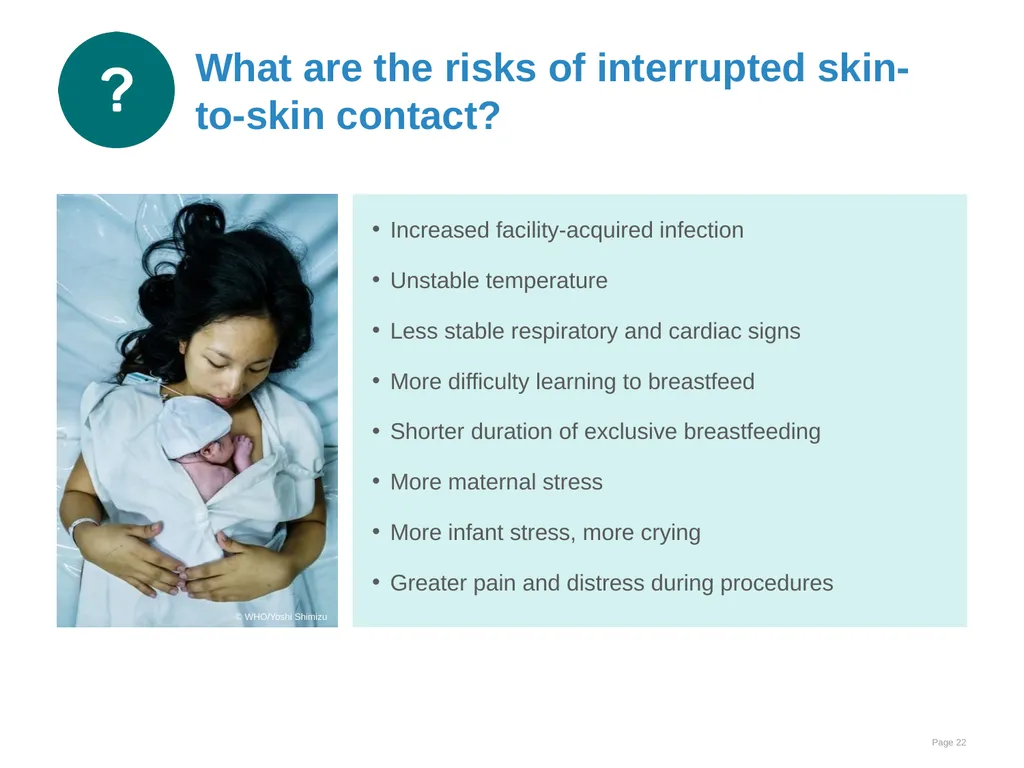
What are the risks of interrupted skin-
to-skin contact? Increased facility-acquired infection
Unstable temperature
Less stable respiratory and cardiac signs
More difficulty learning to breastfeed
Shorter duration of exclusive breastfeeding
More maternal stress
More infant stress, more crying
Greater pain and distress during procedures © WHO/Yoshi Shimizu<br>
Unstable temperature
Less stable respiratory and cardiac signs
More difficulty learning to breastfeed
Shorter duration of exclusive breastfeeding
More maternal stress
More infant stress, more crying
Greater pain and distress during procedures © WHO/Yoshi Shimizu<br>
23
Monitor the newborn with mother Monitor mother and newborn every 15 minutes.
Observe breathing, colour, and temperature
Ensure safe skin-to-skin position:
Mother semi-reclined and responsive
Newborn face visible, mouth and nose uncovered
Monitor mother for bleeding. Continue close monitoring for at least one hour after birth.
Do not leave mother and baby alone.<br>
Observe breathing, colour, and temperature
Ensure safe skin-to-skin position:
Mother semi-reclined and responsive
Newborn face visible, mouth and nose uncovered
Monitor mother for bleeding. Continue close monitoring for at least one hour after birth.
Do not leave mother and baby alone.<br>
24
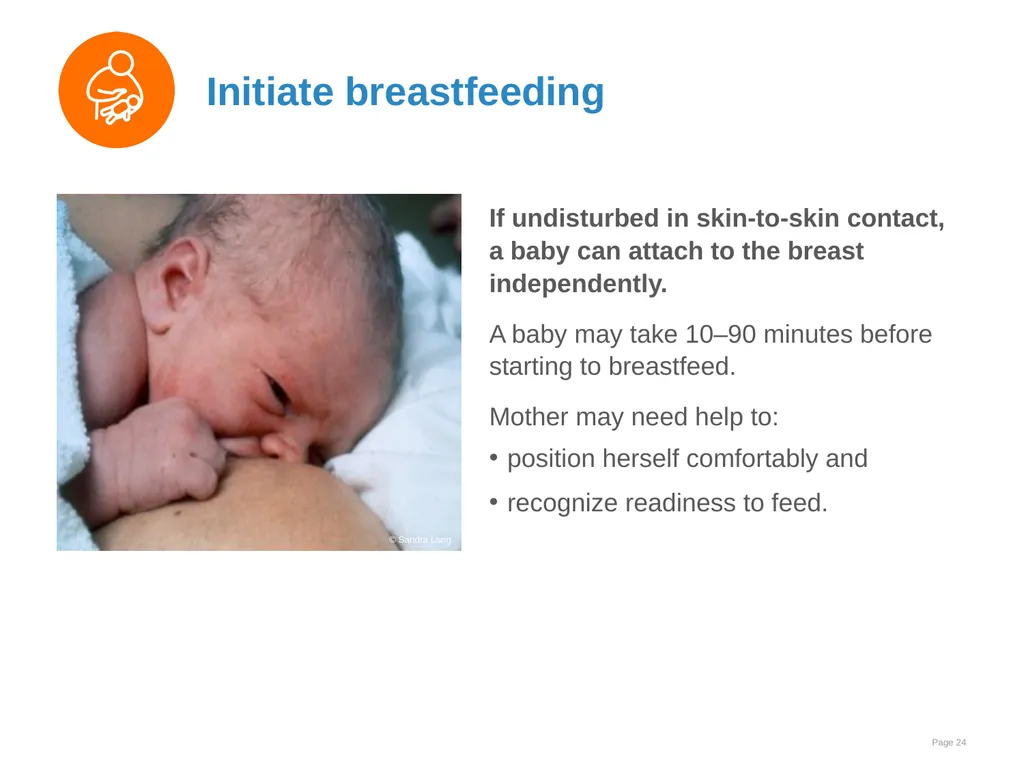
Initiate breastfeeding If undisturbed in skin-to-skin contact, a baby can attach to the breast
independently.
A baby may take 10–90 minutes before starting to breastfeed.
Mother may need help to:
position herself comfortably and
recognize readiness to feed. © Sandra Lang<br>
A baby may take 10–90 minutes before starting to breastfeed.
Mother may need help to:
position herself comfortably and
recognize readiness to feed. © Sandra Lang<br>
25
What signs of readiness and actions allow Aarush to reach Meena’s breast? All images: © WHO/Yoshi Shimizu<br>
26
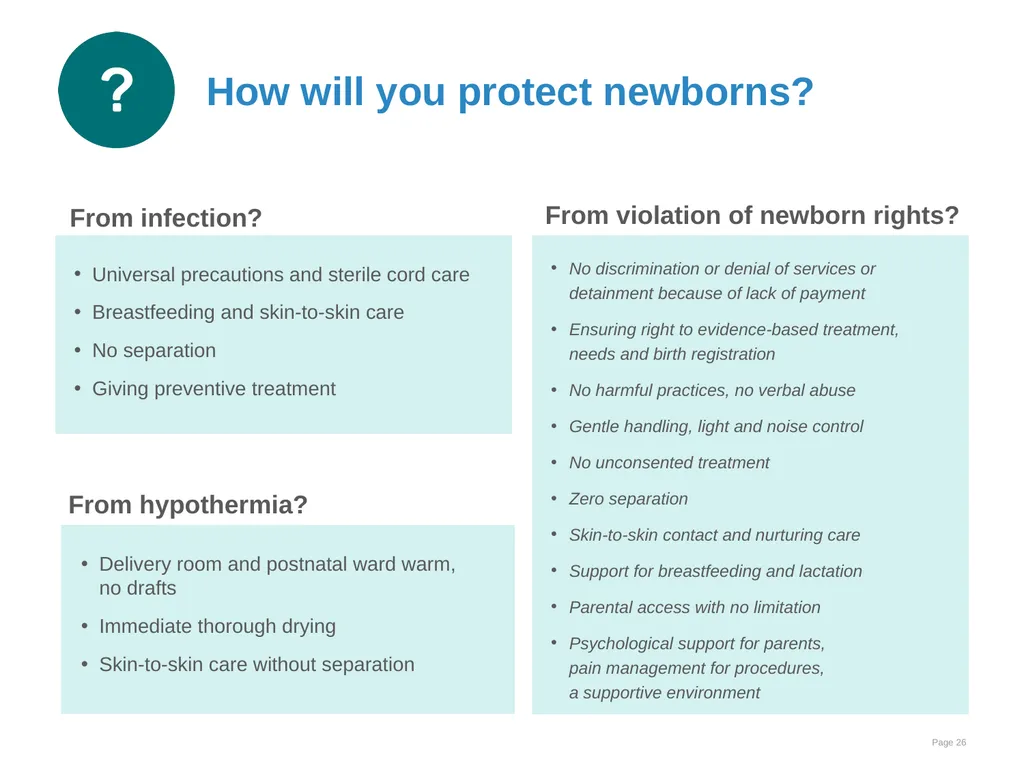
How will you protect newborns? From infection? Universal precautions and sterile cord care
Breastfeeding and skin-to-skin care
No separation
Giving preventive treatment From hypothermia? Delivery room and postnatal ward warm, no drafts
Immediate thorough drying
Skin-to-skin care without separation From violation of newborn rights? No discrimination or denial of services or detainment because of lack of payment
Ensuring right to evidence-based treatment, needs and birth registration
No harmful practices, no verbal abuse
Gentle handling, light and noise control
No unconsented treatment
Zero separation
Skin-to-skin contact and nurturing care
Support for breastfeeding and lactation
Parental access with no limitation
Psychological support for parents, pain management for procedures, a supportive environment<br>
Breastfeeding and skin-to-skin care
No separation
Giving preventive treatment From hypothermia? Delivery room and postnatal ward warm, no drafts
Immediate thorough drying
Skin-to-skin care without separation From violation of newborn rights? No discrimination or denial of services or detainment because of lack of payment
Ensuring right to evidence-based treatment, needs and birth registration
No harmful practices, no verbal abuse
Gentle handling, light and noise control
No unconsented treatment
Zero separation
Skin-to-skin contact and nurturing care
Support for breastfeeding and lactation
Parental access with no limitation
Psychological support for parents, pain management for procedures, a supportive environment<br>
27
Meena delivers her son Aarush Form groups (mother, companion and doctor).
Receive Aarush and carry out immediate newborn care.
Debrief in your group and with your facilitator. Meena delivers her son Aarush by normal vaginal delivery at term.
There are no complications.
Aarush breathes and cries.<br>
Receive Aarush and carry out immediate newborn care.
Debrief in your group and with your facilitator. Meena delivers her son Aarush by normal vaginal delivery at term.
There are no complications.
Aarush breathes and cries.<br>
28
Summary:
Immediate care at birth In this module, you have demonstrated the steps in immediate care for a baby who is crying/breathing well at birth:
Thorough drying
Maintaining warmth
Delayed cord clamping
Continuous skin-to-skin contact for at least one hour
Monitoring of breathing, colour, temperature
Support for initiation of breastfeeding<br>
Thorough drying
Maintaining warmth
Delayed cord clamping
Continuous skin-to-skin contact for at least one hour
Monitoring of breathing, colour, temperature
Support for initiation of breastfeeding<br>
29
Clinical practice<br>
30
Quality improvement<br>
31
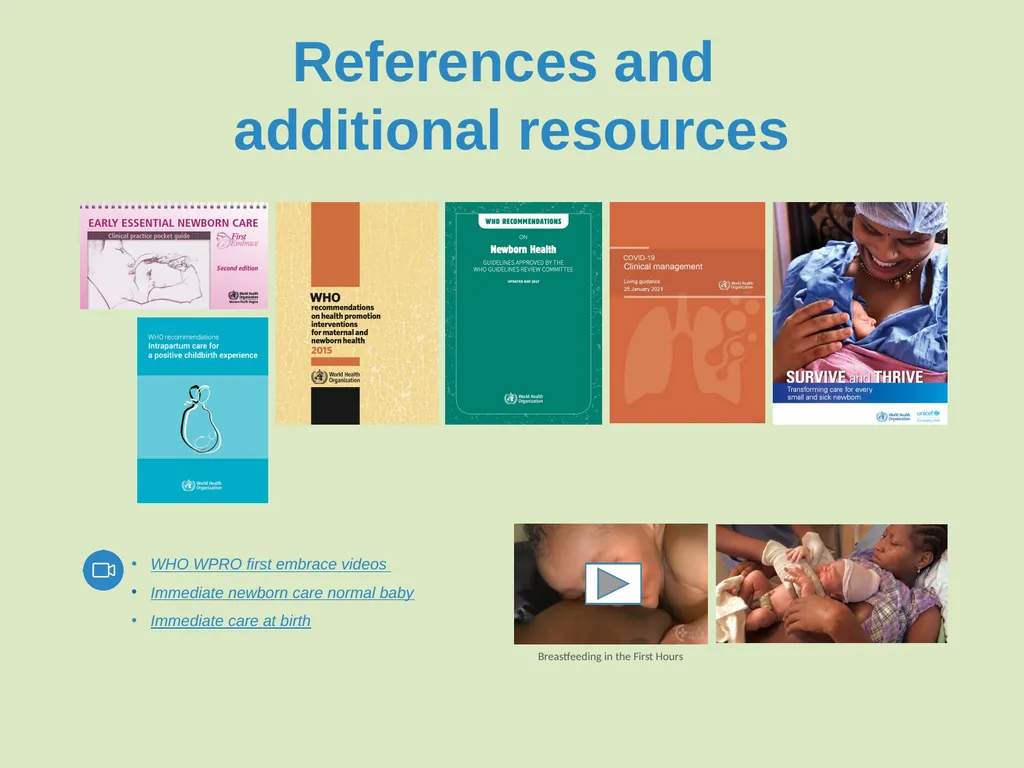
References and
additional resources WHO WPRO first embrace videos
Immediate newborn care normal baby
Immediate care at birth<br>
Immediate newborn care normal baby
Immediate care at birth<br>
32
Why is routine suctioning NOT recommended? Find the recommendations on pages 26–27.<br>
33
Recommendation and reasons In neonates born through clear amniotic fluid who start breathing on their
own after birth, suctioning of the mouth and nose should NOT be performed.
Harms of suctioning for normal healthy newborns:
Lower oxygen saturation levels in normal healthy neonates
Lower Apgar scores in normal healthy neonates<br>
Harms of suctioning for normal healthy newborns:
Lower oxygen saturation levels in normal healthy neonates
Lower Apgar scores in normal healthy neonates<br>
34
Enzo is delivered using a clean
delivery kit In groups (mother, midwife and companion). Maria is healthy and her pregnancy was uneventful.
She is in labour at term in an emergency hospital structure (tent). There are no delivery beds. The midwife uses a clean delivery kit.
She delivers Enzo by normal vaginal delivery on a clean plastic sheet on the floor.
Enzo breathes and cries. Debrief in your group and with your facilitator. Receive Enzo and carry out immediate newborn care.<br>
She is in labour at term in an emergency hospital structure (tent). There are no delivery beds. The midwife uses a clean delivery kit.
She delivers Enzo by normal vaginal delivery on a clean plastic sheet on the floor.
Enzo breathes and cries. Debrief in your group and with your facilitator. Receive Enzo and carry out immediate newborn care.<br>
35
Tatiana is delivered by caesarean section Form groups (mother, obstetrician midwife, companion). Tatiana is delivered at 38 weeks gestation by planned caesarian section.
She breathes and cries after stimulation. Debrief in your group and with your facilitator. Receive Tatiana and carry out immediate newborn care.<br>
She breathes and cries after stimulation. Debrief in your group and with your facilitator. Receive Tatiana and carry out immediate newborn care.<br>
36
Benjamin is delivered by ventouse Form groups (mother, midwife and companion). Benjamin is delivered at term after a long labour by ventouse.
His estimated weight is 3 kg.
He breathes and cries. Debrief in your group and with your facilitator. Receive Benjamin and carry out immediate newborn care.<br>
His estimated weight is 3 kg.
He breathes and cries. Debrief in your group and with your facilitator. Receive Benjamin and carry out immediate newborn care.<br>
37
Leo is delivered at 35 weeks Form groups (mother, midwife and companion). Leo is delivered by spontaneous vaginal delivery at 35 weeks gestation
in the district hospital to Debbie (42 years).
This is her first child.
Leo breathes and cries. His estimated weight is 1.8 kg. Debrief with your team and facilitator. Receive Leo and carry out immediate newborn care.<br>
This is her first child.
Leo breathes and cries. His estimated weight is 1.8 kg. Debrief with your team and facilitator. Receive Leo and carry out immediate newborn care.<br>
38
Twins are born at term Form groups (mother, midwife and companion). Charity and Patience (twins) are born by spontaneous vaginal delivery
at 37 weeks gestation 7 minutes apart to Leonie.
They both breathe and cry immediately. Debrief with your team and facilitator. Receive the twins and carry out immediate newborn care.<br>
They both breathe and cry immediately. Debrief with your team and facilitator. Receive the twins and carry out immediate newborn care.<br>
39
Samuel is born to a young mother Form groups (Amy, midwife, grandmother). Amy, age 15 years, presents in advanced labour.
She thinks that she is 34 weeks pregnant.
At her only antenatal visit two days ago ultrasound showed the baby to be small.
Samuel cries immediately at birth. Debrief with your team and facilitator. Receive Samuel, carry out immediate newborn care and communicate with the mother and grandmother.<br>
She thinks that she is 34 weeks pregnant.
At her only antenatal visit two days ago ultrasound showed the baby to be small.
Samuel cries immediately at birth. Debrief with your team and facilitator. Receive Samuel, carry out immediate newborn care and communicate with the mother and grandmother.<br>
40
Fatima is born with forceps assistance Form groups (mother, obstetrician midwife, companion). After a long labour, Fatima is finally delivered to Aysha by instrumental (forceps) delivery.
Fatima breathes and cries. Debrief with your team and facilitator. Receive Fatima and carry out immediate newborn care.<br>
Fatima breathes and cries. Debrief with your team and facilitator. Receive Fatima and carry out immediate newborn care.<br>
41
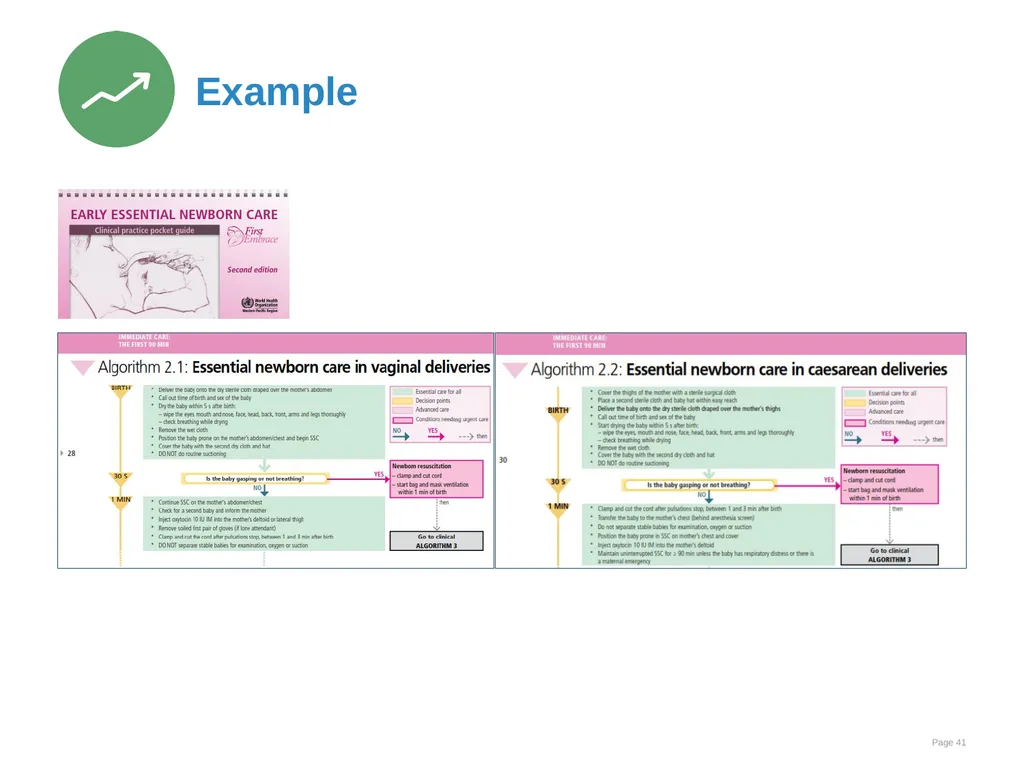
Example<br>