Inclusion Wellbeing Equalities Professional Learning Framework Regulate-Relate-Reason-Restore: The Sequence of Engagement Level Informed ESInclusionTeam For Scotlands learners, with Scotlands educators Do luchd-ionnsachaidh na
"Inclusion Wellbeing & Equalities Professional" is the property of its rightful owner. Permission is granted to
download and print the materials on this website for personal, non-commercial use only, and to display it
on your personal computer provided you do not modify the materials and that you retain all copyright
notices contained in the materials. By downloading content from our website, you accept the terms of this
agreement.
Presentation Transcript
01
Inclusion Wellbeing & Equalities Professional Learning Framework
Regulate-Relate-Reason-Restore: The Sequence of Engagement Level – Informed @ESInclusionTeam For Scotland's learners, with Scotland's educators
Do luchd-ionnsachaidh na h-Alba, le luchd-foghlaim Alba<br>
02
Pause for Thought… How to use this resource These slides can be used to facilitate professional learning in a group or
whole setting, or as a self-directed learning activity as an individual.
Facilitation notes are included at the bottom of each slide
Please do not remove or change any of the slides included.
Facilitators are welcome to add slides or activities relevant to your own setting, to support discussion and exploration of the topic. Facilitators will know their participants’ needs best.
Anyone who works in an educational setting can be a facilitator and use these slides.
For reflection or discussion activities, it is important to establish a safe space which encourages respect and honesty to ensure that everyone is able to participate.<br>
03
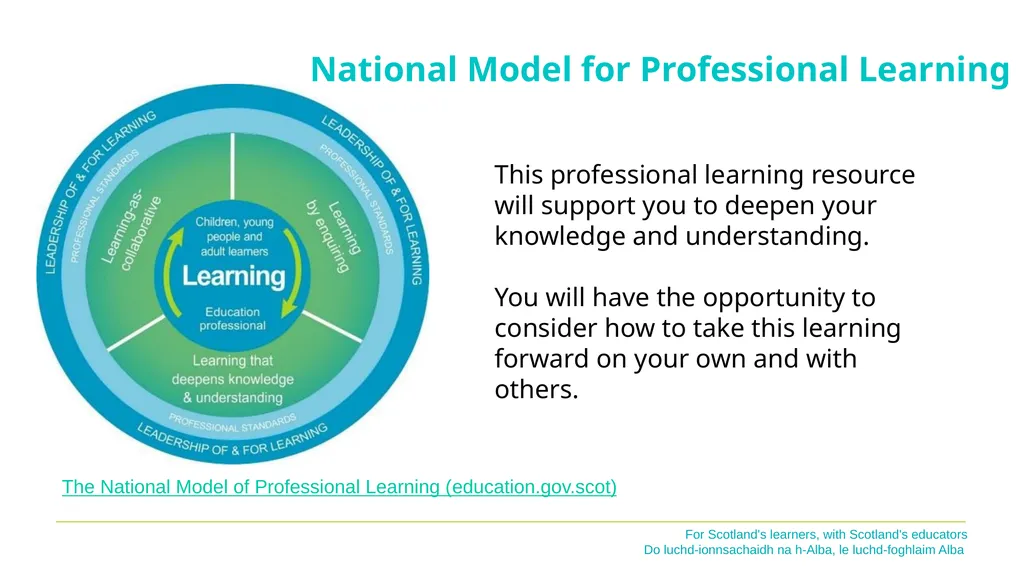
The National Model of Professional Learning (education.gov.scot) This professional learning resource will support you to deepen your knowledge and understanding.
You will have the opportunity to consider how to take this learning forward on your own and with others. National Model for Professional Learning<br>
04
Pause for Thought… Welcome This session provides an opportunity to:
To explore The Neurosequential Model & The Sequence of Engagement (RRR)
To consider a 4th R – Restore
To understand the ‘why’ and the ‘how’ behind Regulate, Relate, Reason and Restore<br>
05
The Sequence of Engagement (The Neurosequential Model) 6:39 min
From
The Neurosequential Network If viewing as a PDF please click this link to watch the film https://youtu.be/_3is_3XHKKs<br>
06
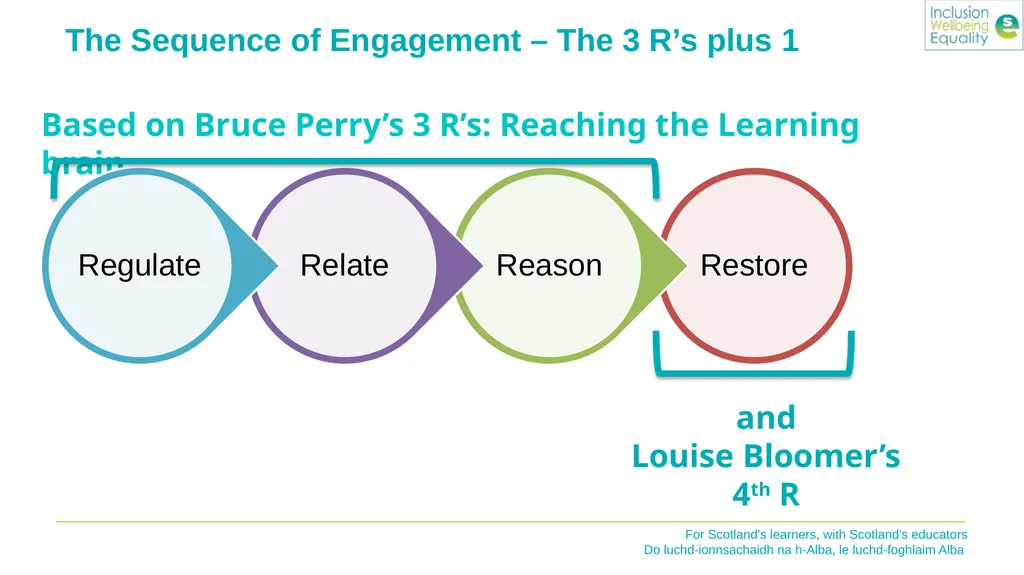
The Sequence of Engagement – The 3 R’s plus 1 Based on Bruce Perry’s 3 R’s: Reaching the Learning brain and
Louise Bloomer’s
4th R<br>
07
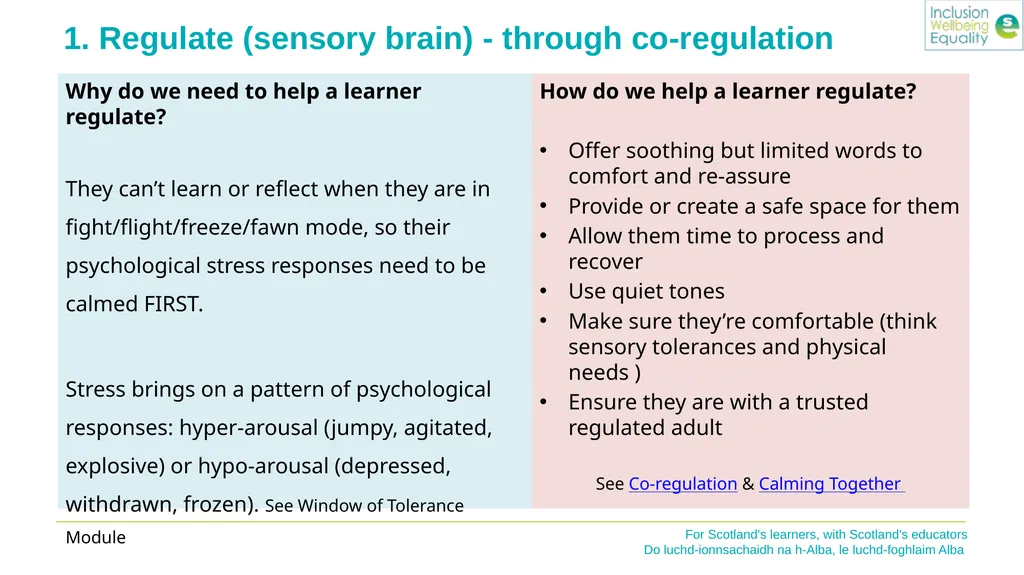
1. Regulate (sensory brain) - through co-regulation Why do we need to help a learner regulate?
They can’t learn or reflect when they are in fight/flight/freeze/fawn mode, so their psychological stress responses need to be calmed FIRST.
Stress brings on a pattern of psychological responses: hyper-arousal (jumpy, agitated, explosive) or hypo-arousal (depressed, withdrawn, frozen). See Window of Tolerance Module How do we help a learner regulate?
Offer soothing but limited words to comfort and re-assure
Provide or create a safe space for them
Allow them time to process and recover
Use quiet tones
Make sure they’re comfortable (think sensory tolerances and physical needs )
Ensure they are with a trusted regulated adult
See Co-regulation & Calming Together<br>
08
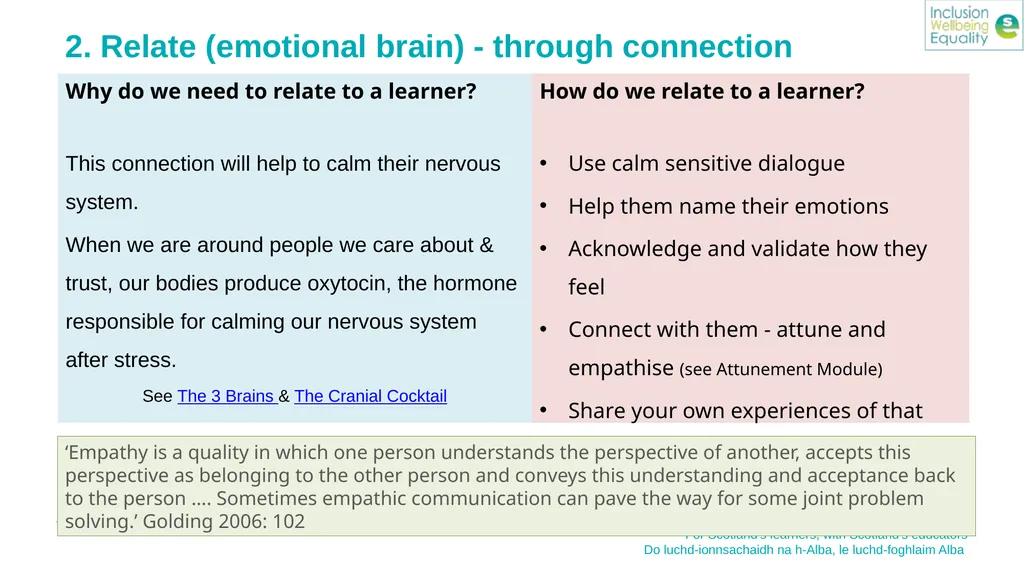
Why do we need to relate to a learner?
This connection will help to calm their nervous system.
When we are around people we care about & trust, our bodies produce oxytocin, the hormone responsible for calming our nervous system after stress.
See The 3 Brains & The Cranial Cocktail How do we relate to a learner?
Use calm sensitive dialogue
Help them name their emotions
Acknowledge and validate how they feel
Connect with them - attune and empathise (see Attunement Module)
Share your own experiences of that emotion (only share what is safe to share) ‘Empathy is a quality in which one person understands the perspective of another, accepts this perspective as belonging to the other person and conveys this understanding and acceptance back to the person …. Sometimes empathic communication can pave the way for some joint problem solving.’ Golding 2006: 102 2. Relate (emotional brain) - through connection<br>
09
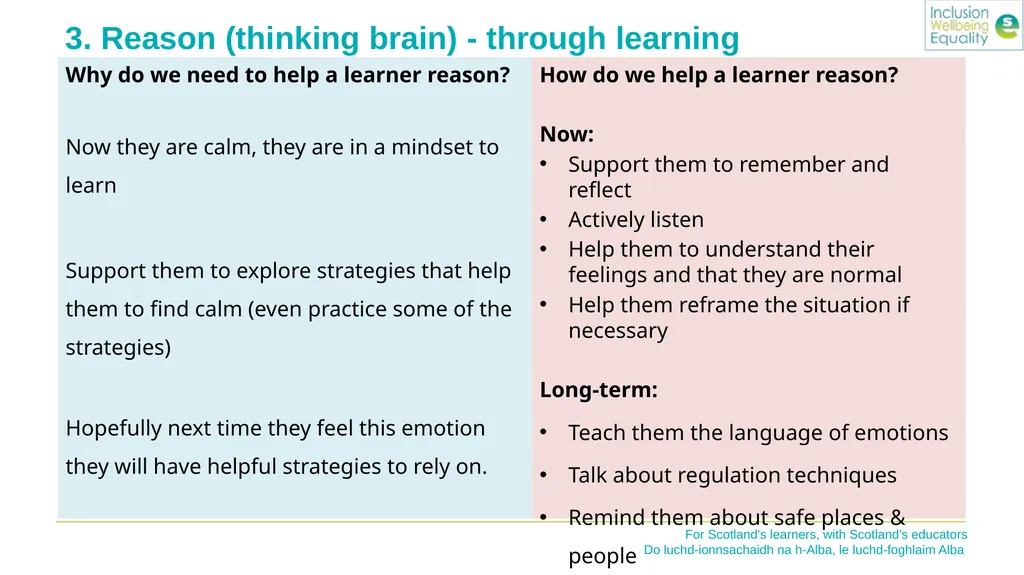
Why do we need to help a learner reason?
Now they are calm, they are in a mindset to learn
Support them to explore strategies that help them to find calm (even practice some of the strategies)
Hopefully next time they feel this emotion they will have helpful strategies to rely on. How do we help a learner reason?
Now:
Support them to remember and reflect
Actively listen
Help them to understand their feelings and that they are normal
Help them reframe the situation if necessary
Long-term:
Teach them the language of emotions
Talk about regulation techniques
Remind them about safe places & people 3. Reason (thinking brain) - through learning<br>
10
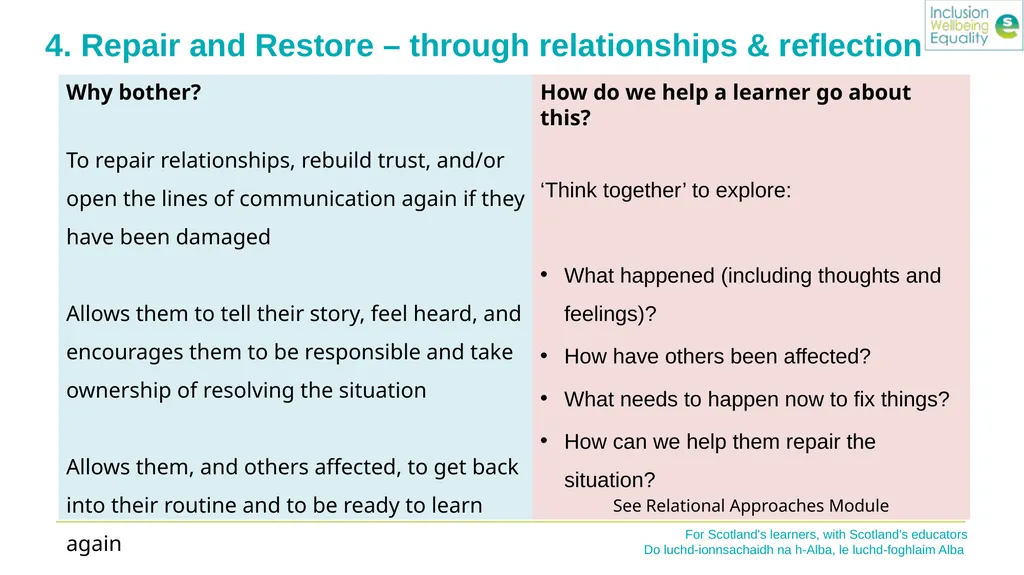
Why bother?
To repair relationships, rebuild trust, and/or open the lines of communication again if they have been damaged
Allows them to tell their story, feel heard, and encourages them to be responsible and take ownership of resolving the situation
Allows them, and others affected, to get back into their routine and to be ready to learn again How do we help a learner go about this?
‘Think together’ to explore:
What happened (including thoughts and feelings)?
How have others been affected?
What needs to happen now to fix things?
How can we help them repair the situation?
See Relational Approaches Module 4. Repair and Restore – through relationships & reflection<br>
11
How do we help someone who is dysregulated? Reflection Activity (individually or as a group):
What can we do help someone to regulate?
What can we relate to someone?
What do we need to consider when reasoning with someone who has been dysregulated?
What do we need to do next?<br>
12
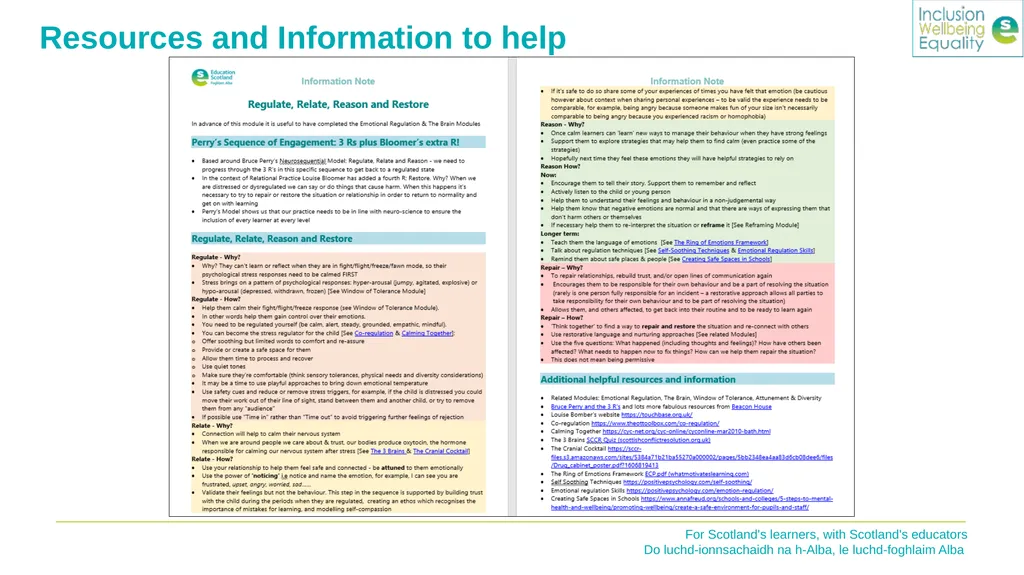
Resources and Information to help<br>
13
Reflection From what you have learned so far, think about:
How has this made you feel?
What has this made you think about?
What one action would you like to take forward?
How can you link what you plan to do with others in your setting?
How you will know that this learning has made a difference?<br>
14
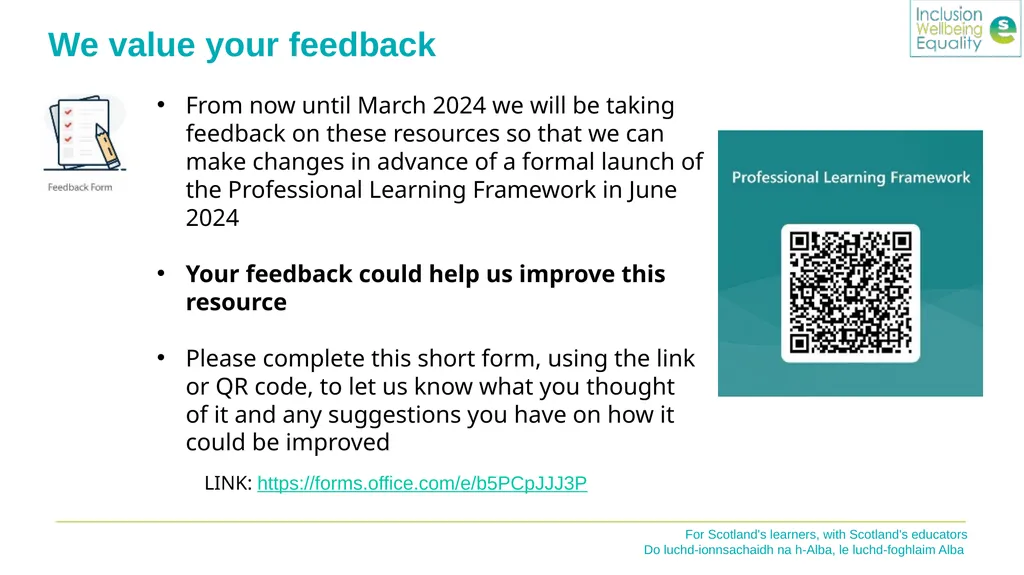
We value your feedback From now until March 2024 we will be taking feedback on these resources so that we can make changes in advance of a formal launch of the Professional Learning Framework in June 2024
Your feedback could help us improve this resource
Please complete this short form, using the link or QR code, to let us know what you thought of it and any suggestions you have on how it could be improved LINK: https://forms.office.com/e/b5PCpJJJ3P<br>
15
Education Scotland
Denholm House
Almondvale Business Park
Almondvale Way
Livingston EH54 6GA
T +44 (0)131 244 5000
E enquiries@educationscotland.gsi.gov.uk For Scotland's learners, with Scotland's educators
Do luchd-ionnsachaidh na h-Alba, le luchd-foghlaim Alba<br>