
Indirect realism Michael Lacewing Indirect realism

Description: Indirect realism Michael Lacewing Indirect realism We perceive physical objects which are mind-independent. But we do so via, or in virtue of, perceiving mind-dependent sense-data. Sense-data are caused by and represent physical objects.
Related Topics
Download Presentation
"Indirect realism Michael Lacewing Indirect realism" is the property of its rightful owner. Permission is granted to download and print the materials on this website for personal, non-commercial use only, and to display it on your personal computer provided you do not modify the materials and that you retain all copyright notices contained in the materials. By downloading content from our website, you accept the terms of this agreement.
Presentation Transcript
slide1. Indirect realism Michael Lacewing<br>
slide2. Indirect realism We perceive physical objects which are mind-independent.
But we do so via, or in virtue of, perceiving mind-dependent sense-data.
Sense-data are caused by and represent physical objects.
Therefore, we perceive sense-data immediately, and physical objects indirectly.<br>
slide3. Arguments in favour How does the argument from perceptual variation support indirect realism?
How does the argument from illusion support indirect realism?<br>
slide4. The argument from illusion In illusions, we see sense-data, and not physical objects, immediately.
Illusions can be ‘subjectively indistinguishable’ from veridical perception.
Therefore, we see the same thing, namely sense-data, in both illusions and veridical perception.
Therefore, in all cases, we see sense-data, and not physical objects, immediately.
Therefore, indirect realism is true.<br>
slide5. Sense-data in more detail Sense-data: The content of my sensation, appearances
E.g. the colour and shape of the desk as I see it now.
Sense-data are mental things which are the way we perceive them to be
Physical objects can appear differently from how they really are.
Sense-data only exist while they are being experienced.
Physical objects can exist when no one experiences them.
Sense-data are ‘private’. No one else can experience your sense-data.
Physical objects are ‘public’. One and the same object can be experienced by different people.<br>
slide6. The big objection<br>
slide7. Scepticism about the existence of mind-independent objects To know that physical objects cause sense-data, we first have to know that physical objects exist. How can we know this, when the only access we have to physical objects is through our sense-data?
Argument map p. 85<br>
slide8. Scepticism about the existence of mind-independent objects A bad response: because other people see the same thing
Objection: how do you know other people (physical objects) exist?<br>
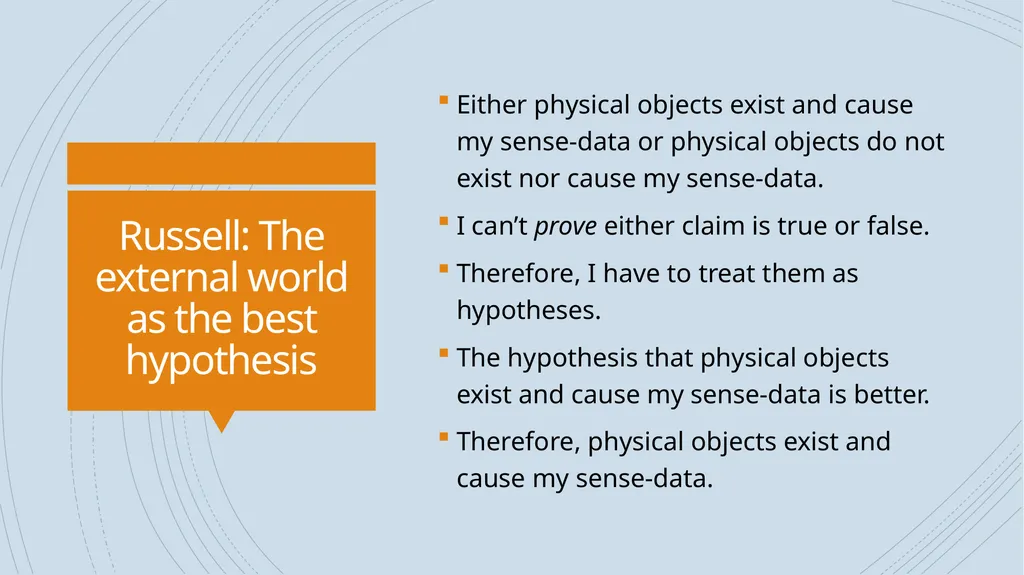
slide9. Russell: The external world as the best hypothesis Either physical objects exist and cause my sense-data or physical objects do not exist nor cause my sense-data.
I can’t prove either claim is true or false.
Therefore, I have to treat them as hypotheses.
The hypothesis that physical objects exist and cause my sense-data is better.
Therefore, physical objects exist and cause my sense-data.<br>
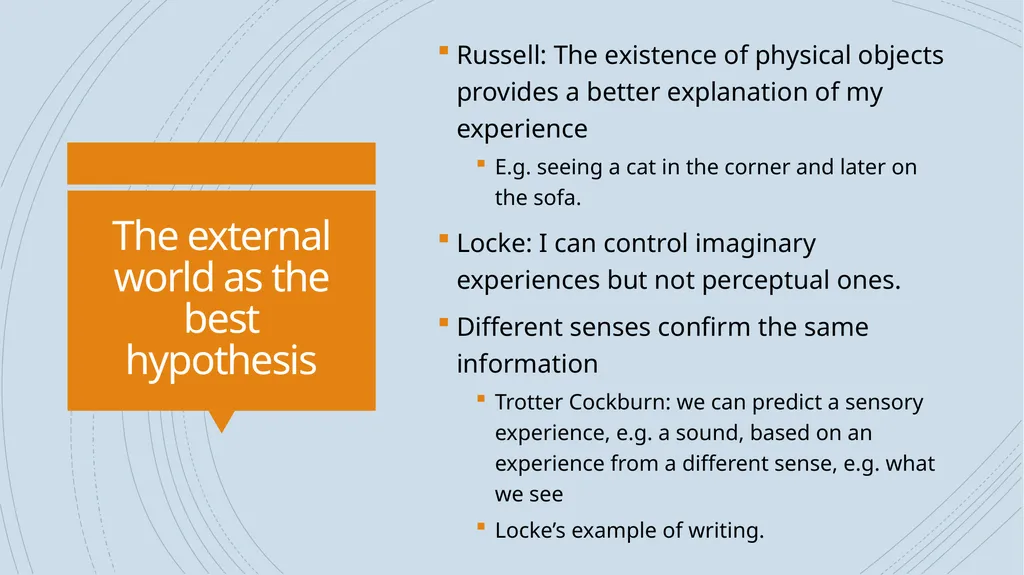
slide10. The external world as the best hypothesis Russell: The existence of physical objects provides a better explanation of my experience
E.g. seeing a cat in the corner and later on the sofa.
Locke: I can control imaginary experiences but not perceptual ones.
Different senses confirm the same information
Trotter Cockburn: we can predict a sensory experience, e.g. a sound, based on an experience from a different sense, e.g. what we see
Locke’s example of writing.<br>
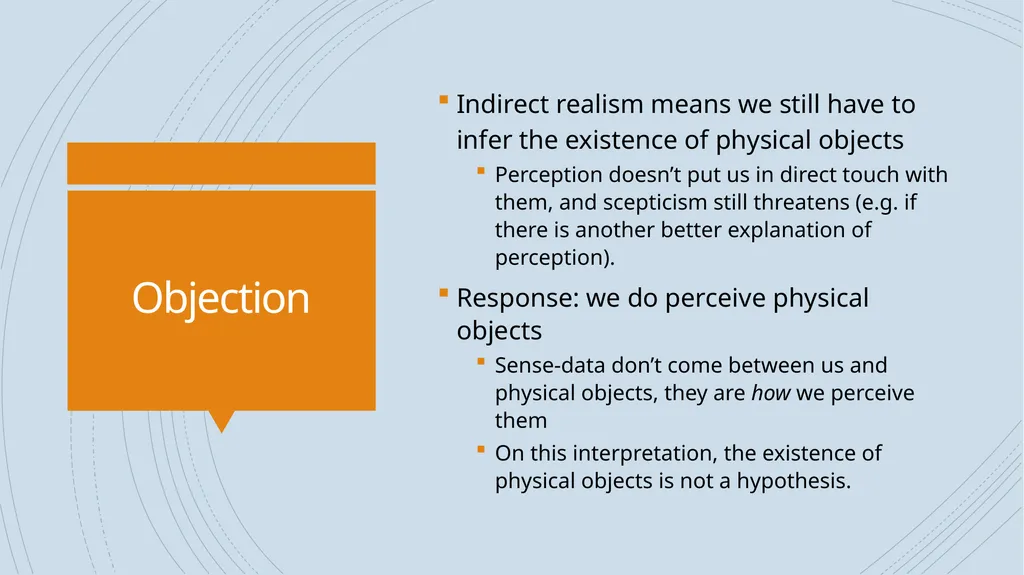
slide11. Objection Indirect realism means we still have to infer the existence of physical objects
Perception doesn’t put us in direct touch with them, and scepticism still threatens (e.g. if there is another better explanation of perception).
Response: we do perceive physical objects
Sense-data don’t come between us and physical objects, they are how we perceive them
On this interpretation, the existence of physical objects is not a hypothesis.<br>
slide2. Indirect realism We perceive physical objects which are mind-independent.
But we do so via, or in virtue of, perceiving mind-dependent sense-data.
Sense-data are caused by and represent physical objects.
Therefore, we perceive sense-data immediately, and physical objects indirectly.<br>
slide3. Arguments in favour How does the argument from perceptual variation support indirect realism?
How does the argument from illusion support indirect realism?<br>
slide4. The argument from illusion In illusions, we see sense-data, and not physical objects, immediately.
Illusions can be ‘subjectively indistinguishable’ from veridical perception.
Therefore, we see the same thing, namely sense-data, in both illusions and veridical perception.
Therefore, in all cases, we see sense-data, and not physical objects, immediately.
Therefore, indirect realism is true.<br>
slide5. Sense-data in more detail Sense-data: The content of my sensation, appearances
E.g. the colour and shape of the desk as I see it now.
Sense-data are mental things which are the way we perceive them to be
Physical objects can appear differently from how they really are.
Sense-data only exist while they are being experienced.
Physical objects can exist when no one experiences them.
Sense-data are ‘private’. No one else can experience your sense-data.
Physical objects are ‘public’. One and the same object can be experienced by different people.<br>
slide6. The big objection<br>
slide7. Scepticism about the existence of mind-independent objects To know that physical objects cause sense-data, we first have to know that physical objects exist. How can we know this, when the only access we have to physical objects is through our sense-data?
Argument map p. 85<br>
slide8. Scepticism about the existence of mind-independent objects A bad response: because other people see the same thing
Objection: how do you know other people (physical objects) exist?<br>
slide9. Russell: The external world as the best hypothesis Either physical objects exist and cause my sense-data or physical objects do not exist nor cause my sense-data.
I can’t prove either claim is true or false.
Therefore, I have to treat them as hypotheses.
The hypothesis that physical objects exist and cause my sense-data is better.
Therefore, physical objects exist and cause my sense-data.<br>
slide10. The external world as the best hypothesis Russell: The existence of physical objects provides a better explanation of my experience
E.g. seeing a cat in the corner and later on the sofa.
Locke: I can control imaginary experiences but not perceptual ones.
Different senses confirm the same information
Trotter Cockburn: we can predict a sensory experience, e.g. a sound, based on an experience from a different sense, e.g. what we see
Locke’s example of writing.<br>
slide11. Objection Indirect realism means we still have to infer the existence of physical objects
Perception doesn’t put us in direct touch with them, and scepticism still threatens (e.g. if there is another better explanation of perception).
Response: we do perceive physical objects
Sense-data don’t come between us and physical objects, they are how we perceive them
On this interpretation, the existence of physical objects is not a hypothesis.<br>