
Instructions for use This resource is not a





Description: Instructions for use This resource is not a teaching and learning program. It should be used in conjunction with 12.4 The craft of writing English Advanced program available on the English Advanced page of Planning programming and
Related Topics
Download Presentation
"Instructions for use This resource is not a" is the property of its rightful owner. Permission is granted to download and print the materials on this website for personal, non-commercial use only, and to display it on your personal computer provided you do not modify the materials and that you retain all copyright notices contained in the materials. By downloading content from our website, you accept the terms of this agreement.
Presentation Transcript
slide1. Instructions for use This resource is not a teaching and learning program. It should be used in conjunction with 12.4 – ‘The craft of writing’ English Advanced program available on the English Advanced page of Planning programming and assessing English 11–12
Classroom teachers are encouraged to add and adapt slides as required to meet the needs of their students.
Save a copy of the file to make changes to the slide deck. Go to File > Download a Copy (this downloads a copy to the computer to edit in the PowerPoint application).
To convert the PowerPoint to Google Slides:
Upload the file into Google Drive and open it.
Go to File > Save as Google Slides.
(Note – conversion may cause formatting changes in the slides.) 1<br>
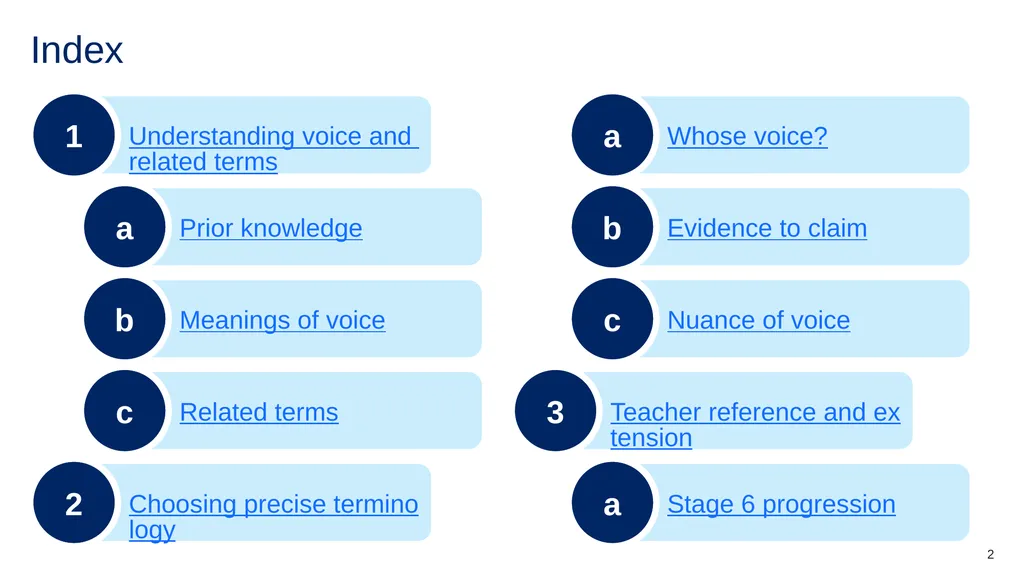
slide2. Index 2<br>
slide3. Support for terminology – voice Stage 6 English Advanced – 12.4 ‘The craft of writing’ Year 12, Program 12.4 Photo by Steve A Johnson on Unsplash<br>
slide4. Sharing learning intentions and success criteria<br>
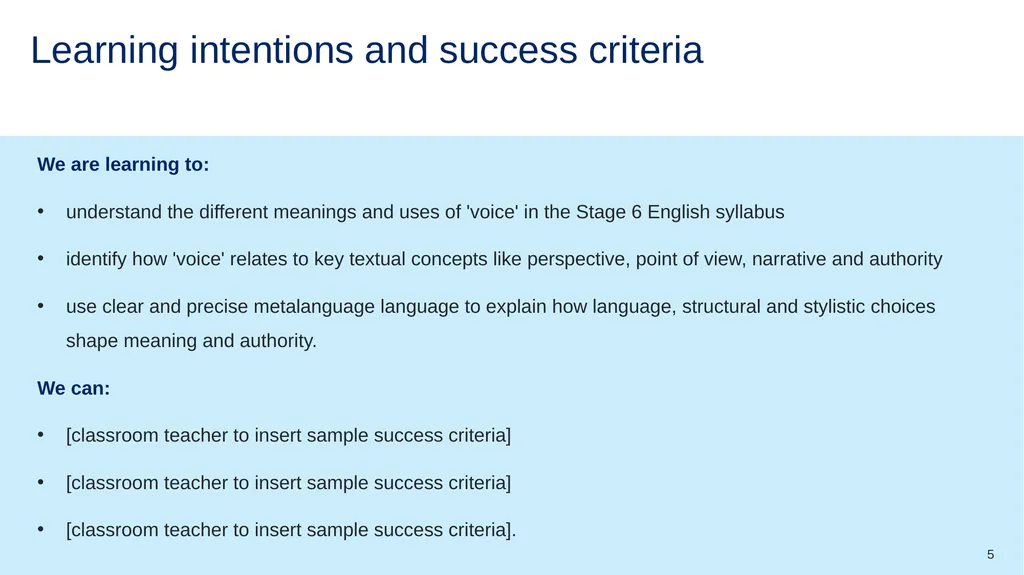
slide5. Learning intentions and success criteria We are learning to:
understand the different meanings and uses of 'voice' in the Stage 6 English syllabus
identify how 'voice' relates to key textual concepts like perspective, point of view, narrative and authority
use clear and precise metalanguage language to explain how language, structural and stylistic choices shape meaning and authority.
We can:
[classroom teacher to insert sample success criteria]
[classroom teacher to insert sample success criteria]
[classroom teacher to insert sample success criteria]. 5<br>
slide6. Understanding voice and related terms Photo by Steve A Johnson on Unsplash<br>
slide7. Connecting learning 7<br>
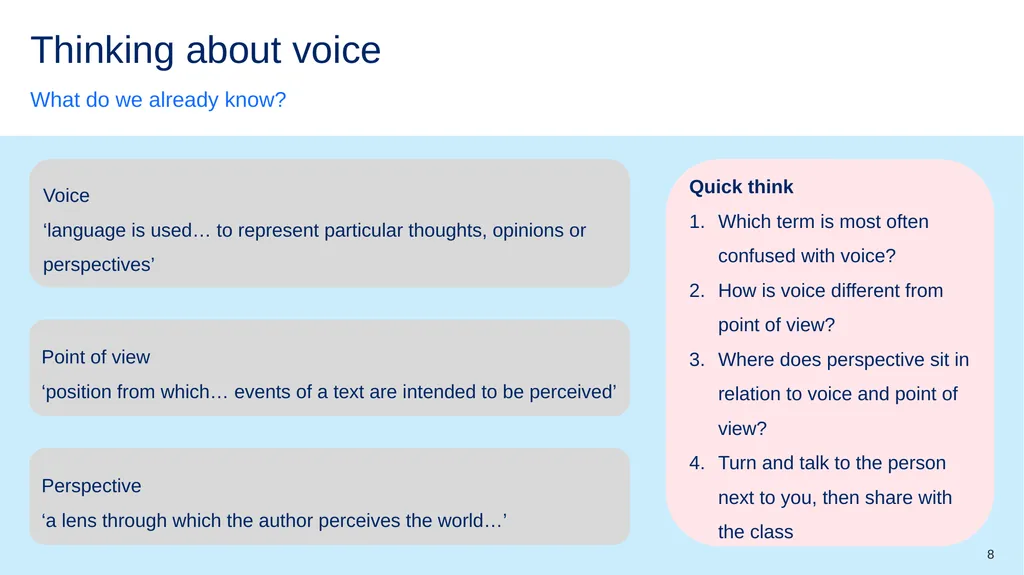
slide8. Thinking about voice What do we already know? Voice
‘language is used… to represent particular thoughts, opinions or perspectives’ Point of view
‘position from which… events of a text are intended to be perceived’ Perspective
‘a lens through which the author perceives the world…’ Quick think
Which term is most often confused with voice?
How is voice different from point of view?
Where does perspective sit in relation to voice and point of view?
Turn and talk to the person next to you, then share with the class 8<br>
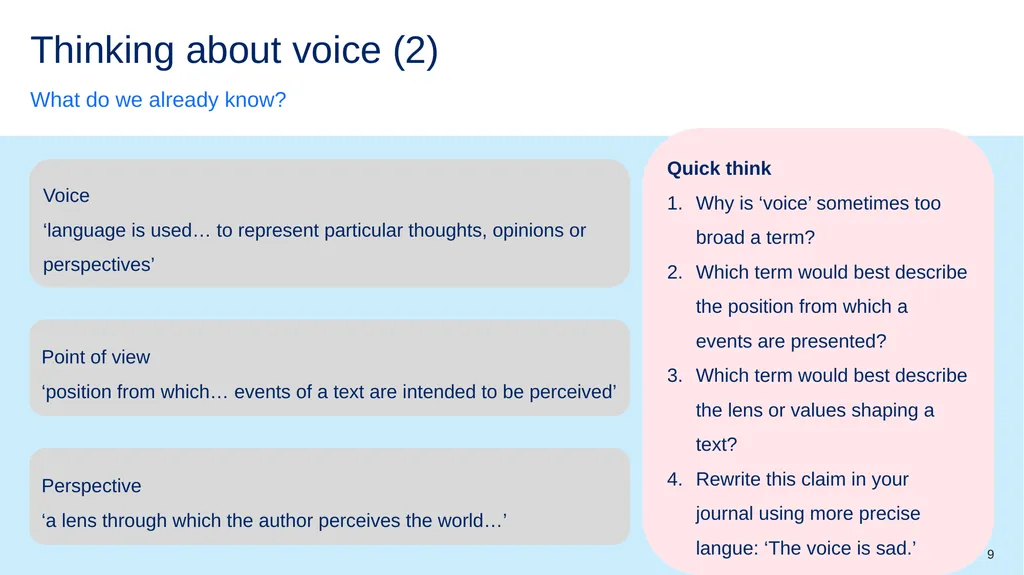
slide9. Thinking about voice (2) What do we already know? Voice
‘language is used… to represent particular thoughts, opinions or perspectives’ Point of view
‘position from which… events of a text are intended to be perceived’ Perspective
‘a lens through which the author perceives the world…’ Quick think
Why is ‘voice’ sometimes too broad a term?
Which term would best describe the position from which a events are presented?
Which term would best describe the lens or values shaping a text?
Rewrite this claim in your journal using more precise langue: ‘The voice is sad.’ 9<br>
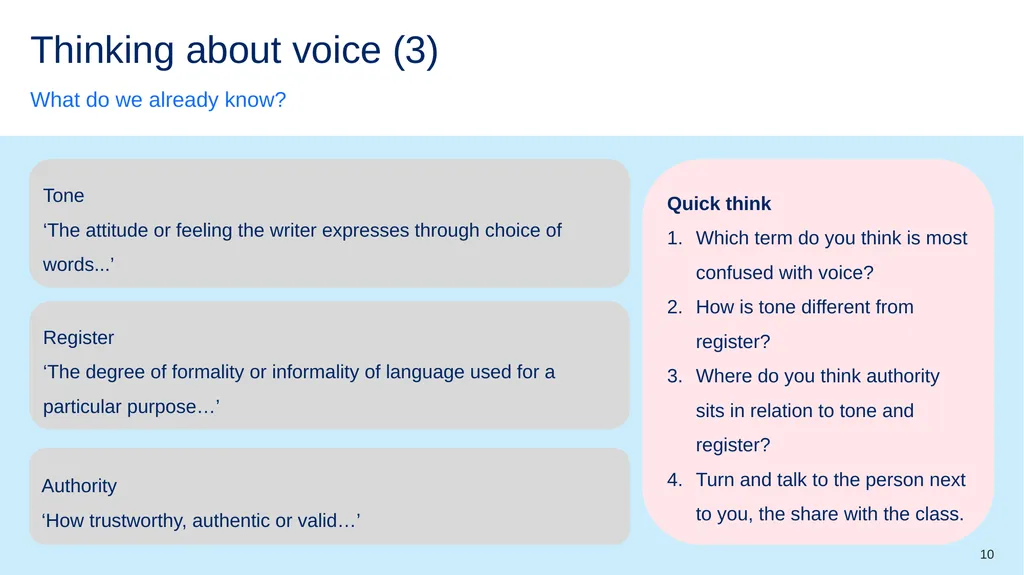
slide10. Thinking about voice (3) What do we already know? Tone
‘The attitude or feeling the writer expresses through choice of words...’ Register
‘The degree of formality or informality of language used for a particular purpose…’ Authority
‘How trustworthy, authentic or valid…’ Quick think
Which term do you think is most confused with voice?
How is tone different from register?
Where do you think authority sits in relation to tone and register?
Turn and talk to the person next to you, the share with the class. 10<br>
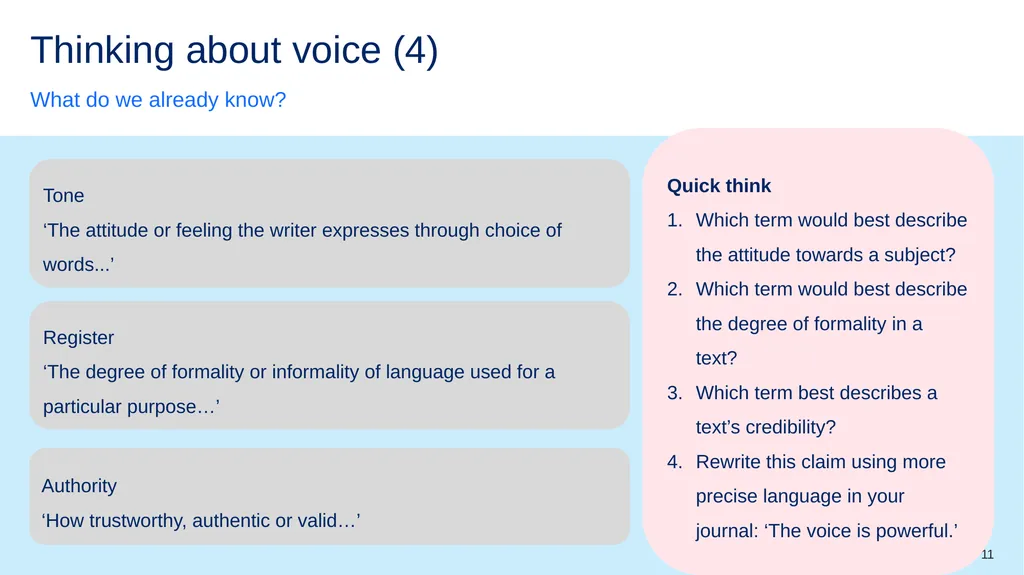
slide11. Thinking about voice (4) What do we already know? Tone
‘The attitude or feeling the writer expresses through choice of words...’ Register
‘The degree of formality or informality of language used for a particular purpose…’ Authority
‘How trustworthy, authentic or valid…’ Quick think
Which term would best describe the attitude towards a subject?
Which term would best describe the degree of formality in a text?
Which term best describes a text’s credibility?
Rewrite this claim using more precise language in your journal: ‘The voice is powerful.’ 11<br>
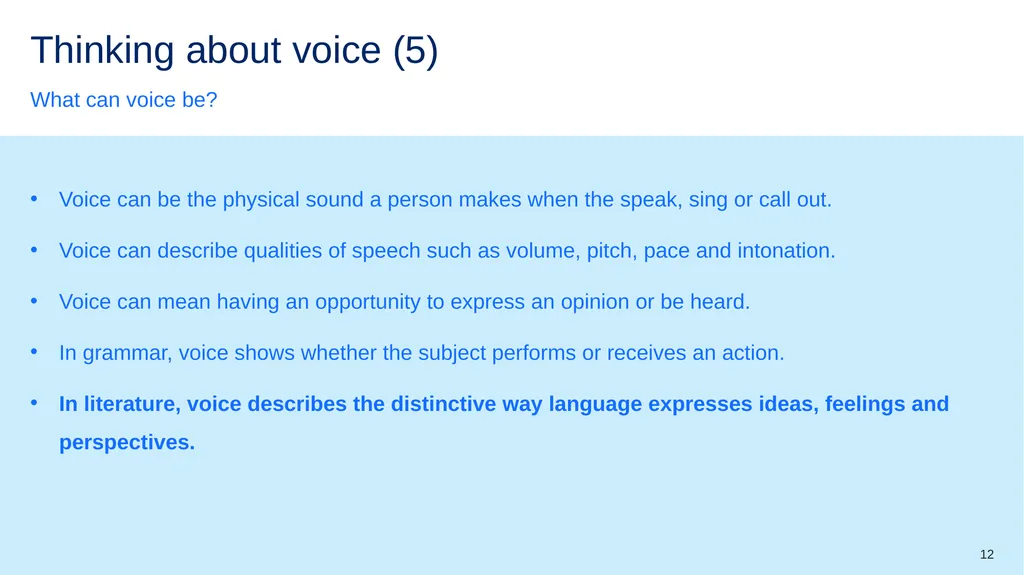
slide12. Thinking about voice (5) What can voice be? Voice can be the physical sound a person makes when the speak, sing or call out.
Voice can describe qualities of speech such as volume, pitch, pace and intonation.
Voice can mean having an opportunity to express an opinion or be heard.
In grammar, voice shows whether the subject performs or receives an action.
In literature, voice describes the distinctive way language expresses ideas, feelings and perspectives. 12<br>
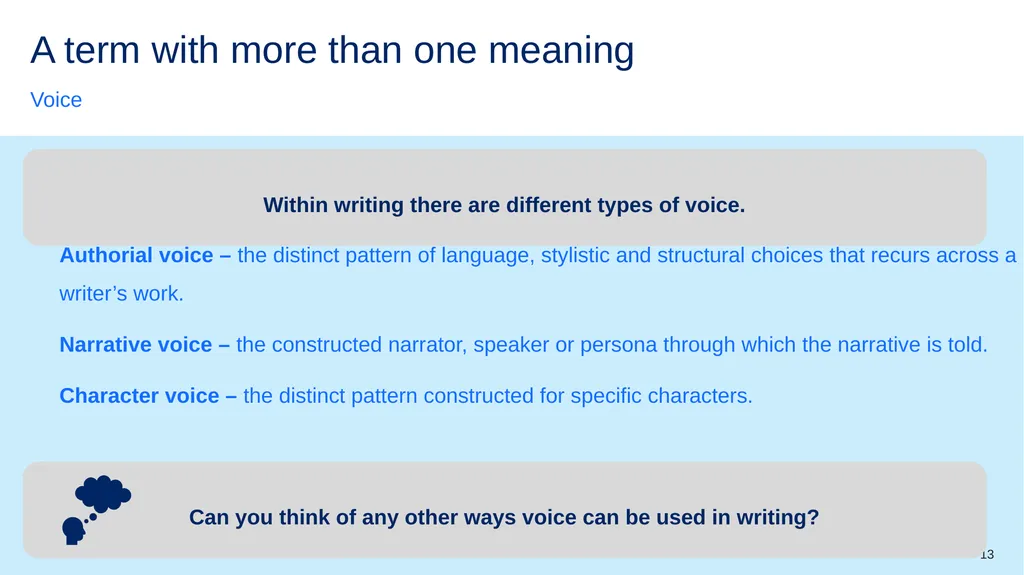
slide13. A term with more than one meaning Voice Within writing there are different types of voice. Authorial voice – the distinct pattern of language, stylistic and structural choices that recurs across a writer’s work.
Narrative voice – the constructed narrator, speaker or persona through which the narrative is told.
Character voice – the distinct pattern constructed for specific characters. Can you think of any other ways voice can be used in writing? 13<br>
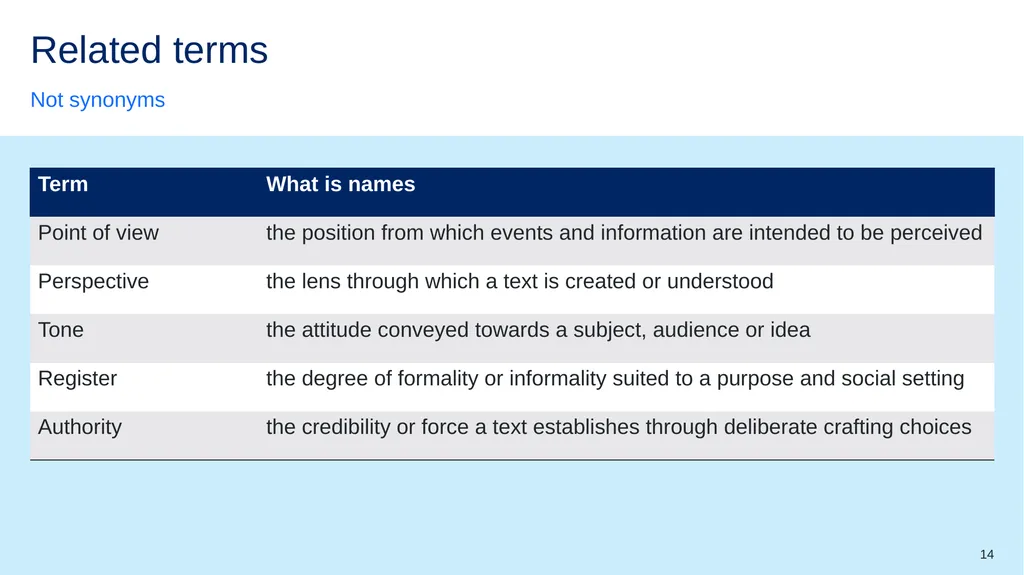
slide14. Related terms Not synonyms 14<br>
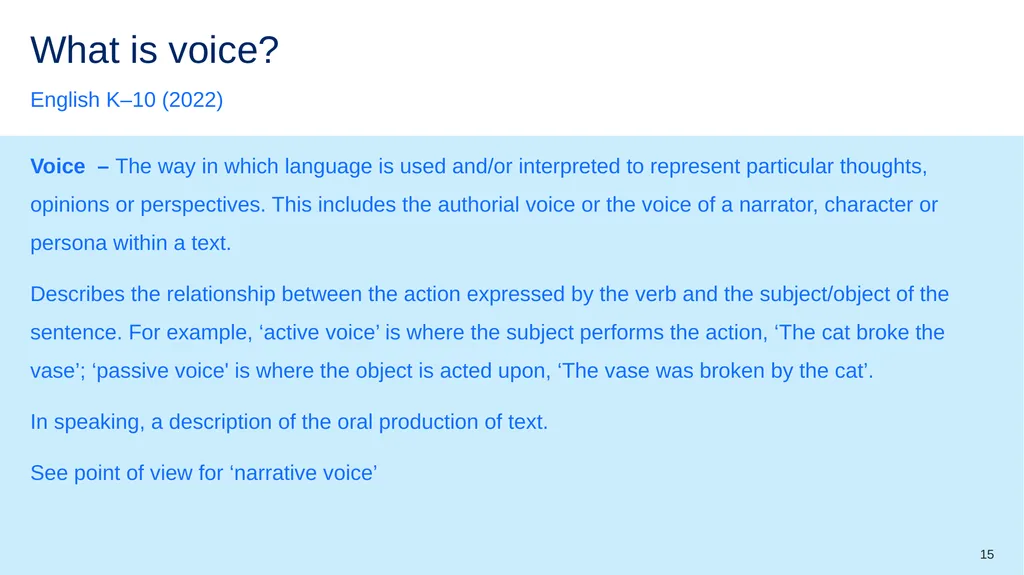
slide15. What is voice? English K–10 (2022) Voice – The way in which language is used and/or interpreted to represent particular thoughts, opinions or perspectives. This includes the authorial voice or the voice of a narrator, character or persona within a text.
Describes the relationship between the action expressed by the verb and the subject/object of the sentence. For example, ‘active voice’ is where the subject performs the action, ‘The cat broke the vase’; ‘passive voice' is where the object is acted upon, ‘The vase was broken by the cat’.
In speaking, a description of the oral production of text.
See point of view for ‘narrative voice’ 15<br>
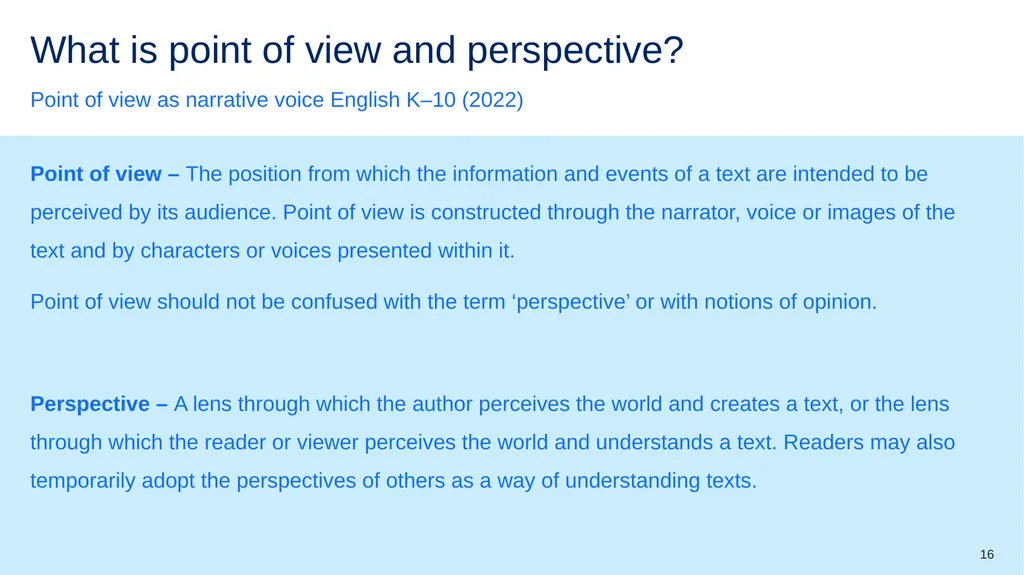
slide16. What is point of view and perspective? Point of view as narrative voice English K–10 (2022) Point of view – The position from which the information and events of a text are intended to be perceived by its audience. Point of view is constructed through the narrator, voice or images of the text and by characters or voices presented within it.
Point of view should not be confused with the term ‘perspective’ or with notions of opinion.
Perspective – A lens through which the author perceives the world and creates a text, or the lens through which the reader or viewer perceives the world and understands a text. Readers may also temporarily adopt the perspectives of others as a way of understanding texts. 16<br>
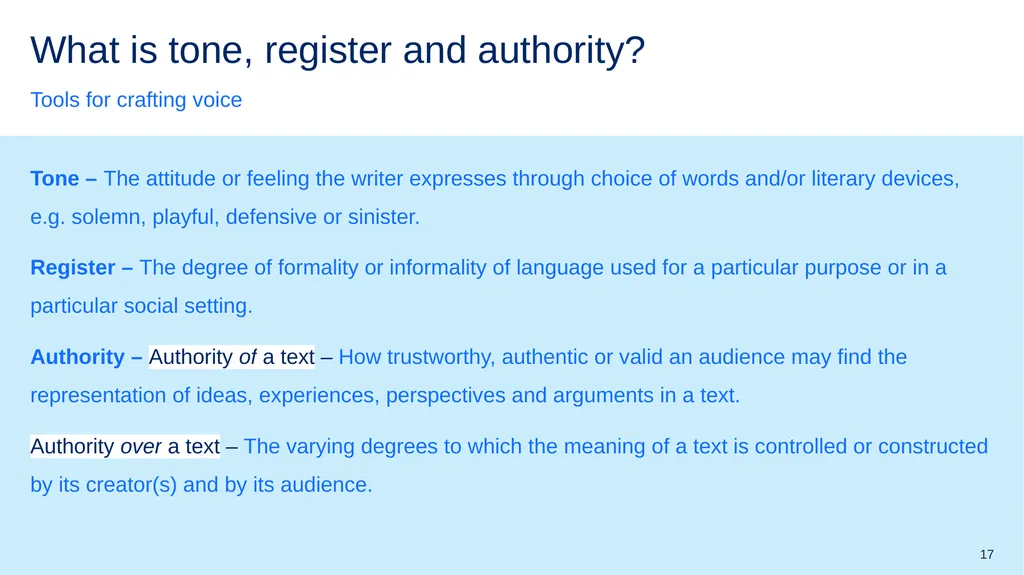
slide17. What is tone, register and authority? Tools for crafting voice Tone – The attitude or feeling the writer expresses through choice of words and/or literary devices, e.g. solemn, playful, defensive or sinister.
Register – The degree of formality or informality of language used for a particular purpose or in a particular social setting.
Authority – Authority of a text – How trustworthy, authentic or valid an audience may find the representation of ideas, experiences, perspectives and arguments in a text.
Authority over a text – The varying degrees to which the meaning of a text is controlled or constructed by its creator(s) and by its audience. 17<br>
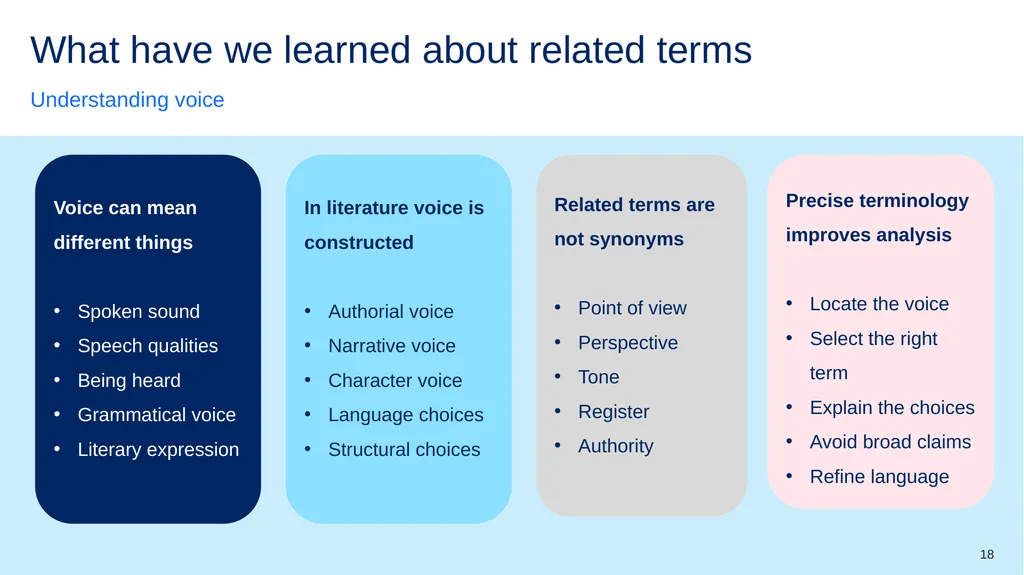
slide18. What have we learned about related terms Understanding voice Voice can mean different things
Spoken sound
Speech qualities
Being heard
Grammatical voice
Literary expression In literature voice is constructed
Authorial voice
Narrative voice
Character voice
Language choices
Structural choices Related terms are not synonyms
Point of view
Perspective
Tone
Register
Authority Precise terminology improves analysis
Locate the voice
Select the right term
Explain the choices
Avoid broad claims
Refine language 18<br>
slide19. Choosing precise terminology Photo by Steve A Johnson on Unsplash<br>
slide20. Chunking and sequencing learning 20<br>
slide21. Whose voices are we discussing? When is ‘voice’ the right word Voice can operate at different levels in a text. Key distinctions First person is not automatically character voice, it may be a narrator or speaker mediating events and experience. One quotation does not establish authorial voice. Authorial voice emerges through recurring patterns across a writer’s work. Character voice is more than dialogue. A character's perspective, diction and manner of expression can also construct voice. 21<br>
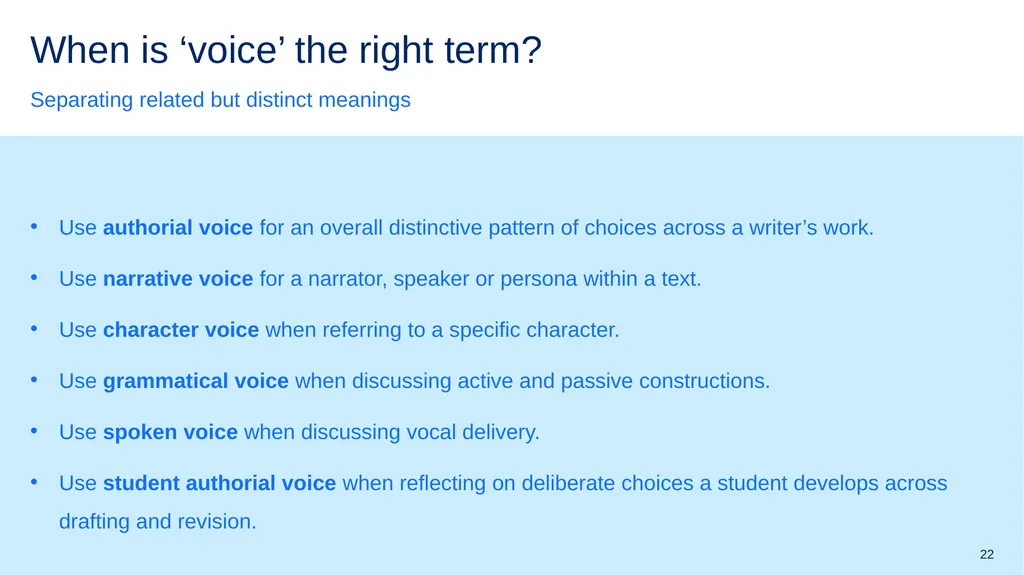
slide22. When is ‘voice’ the right term? Separating related but distinct meanings Use authorial voice for an overall distinctive pattern of choices across a writer’s work.
Use narrative voice for a narrator, speaker or persona within a text.
Use character voice when referring to a specific character.
Use grammatical voice when discussing active and passive constructions.
Use spoken voice when discussing vocal delivery.
Use student authorial voice when reflecting on deliberate choices a student develops across drafting and revision. 22<br>
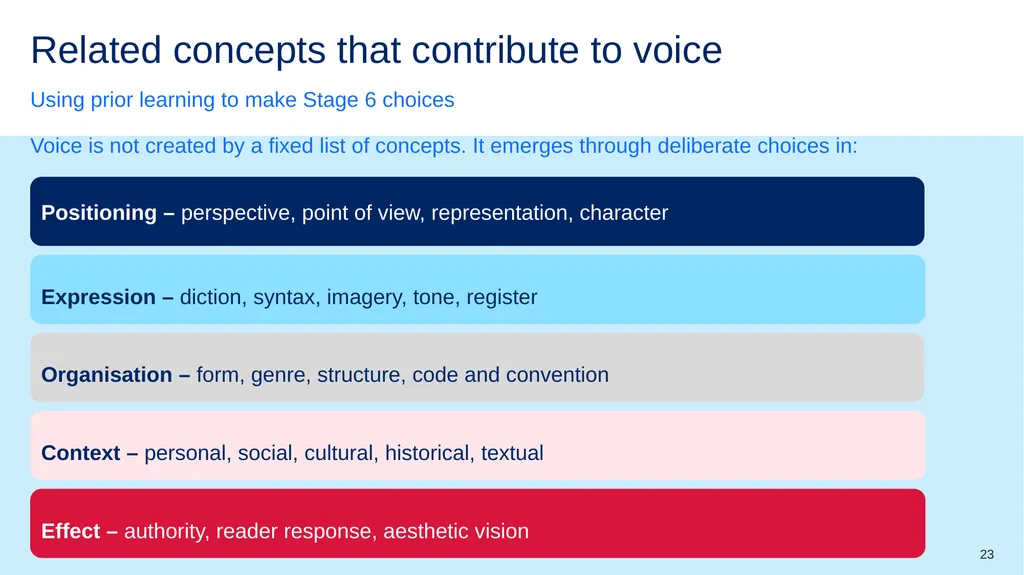
slide23. Related concepts that contribute to voice Using prior learning to make Stage 6 choices Voice is not created by a fixed list of concepts. It emerges through deliberate choices in: Positioning – perspective, point of view, representation, character Expression – diction, syntax, imagery, tone, register Organisation – form, genre, structure, code and convention Context – personal, social, cultural, historical, textual Effect – authority, reader response, aesthetic vision 23<br>
slide24. Using effective questioning<br>
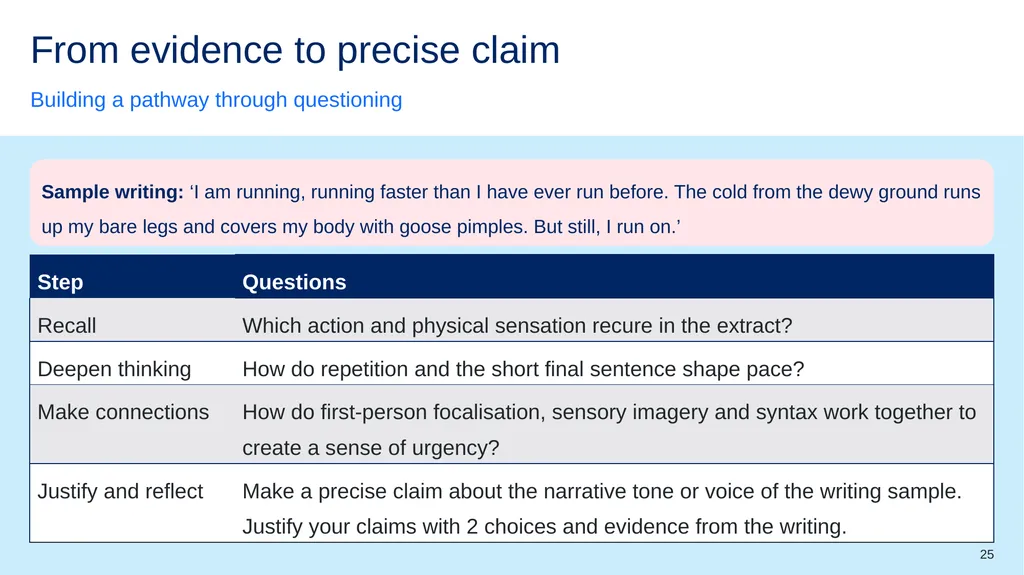
slide25. From evidence to precise claim Building a pathway through questioning Sample writing: ‘I am running, running faster than I have ever run before. The cold from the dewy ground runs up my bare legs and covers my body with goose pimples. But still, I run on.’ 25<br>
slide26. Gradual release of responsibility<br>
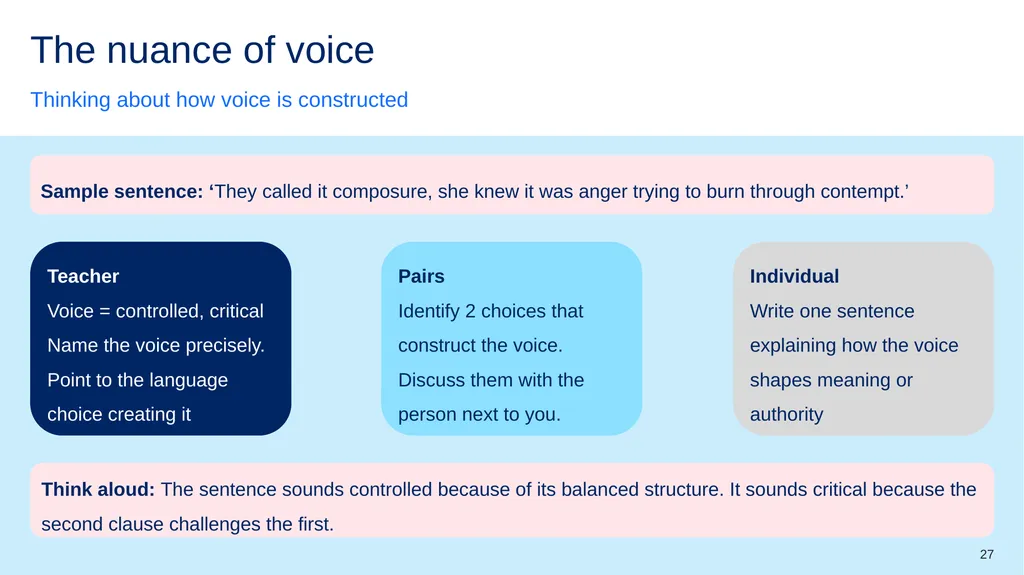
slide27. The nuance of voice Thinking about how voice is constructed Sample sentence: ‘They called it composure, she knew it was anger trying to burn through contempt.’ Teacher
Voice = controlled, critical
Name the voice precisely. Point to the language choice creating it Pairs
Identify 2 choices that construct the voice.
Discuss them with the person next to you. Individual
Write one sentence explaining how the voice shapes meaning or authority Think aloud: The sentence sounds controlled because of its balanced structure. It sounds critical because the second clause challenges the first. 27<br>
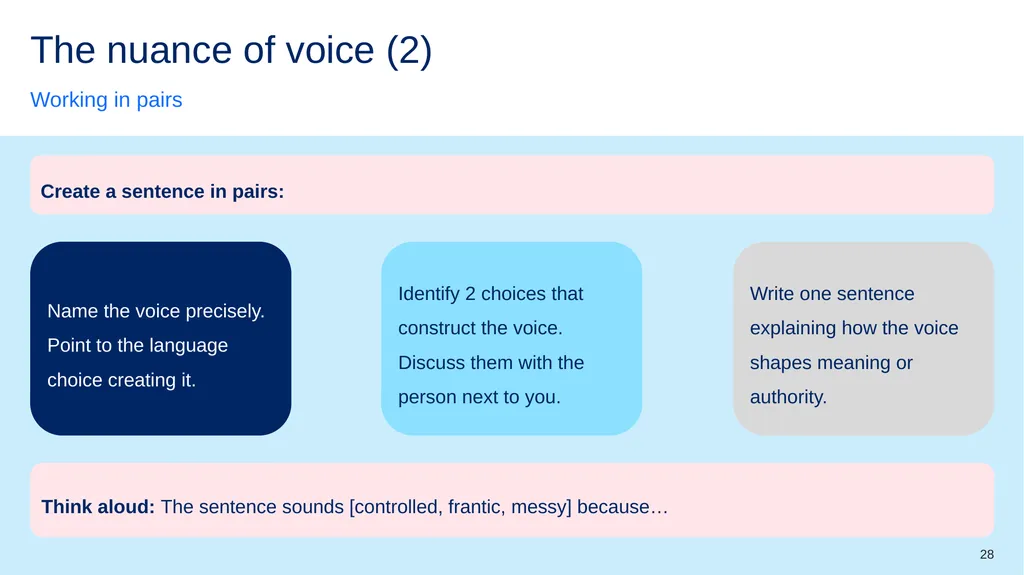
slide28. The nuance of voice (2) Working in pairs Create a sentence in pairs: Name the voice precisely. Point to the language choice creating it. Identify 2 choices that construct the voice.
Discuss them with the person next to you. Write one sentence explaining how the voice shapes meaning or authority. Think aloud: The sentence sounds [controlled, frantic, messy] because… 28<br>
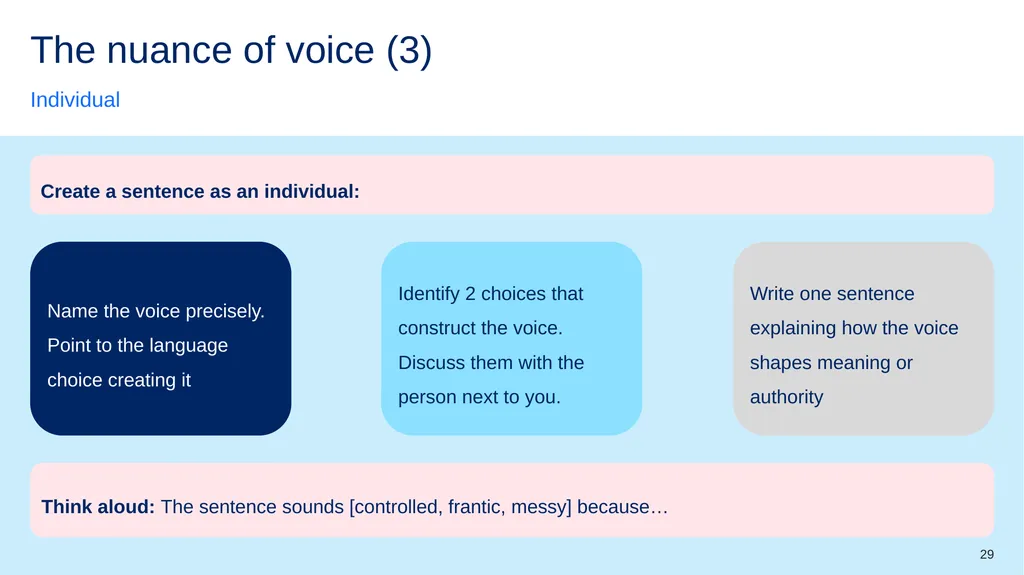
slide29. The nuance of voice (3) Individual Create a sentence as an individual: Name the voice precisely. Point to the language choice creating it Identify 2 choices that construct the voice.
Discuss them with the person next to you. Write one sentence explaining how the voice shapes meaning or authority Think aloud: The sentence sounds [controlled, frantic, messy] because… 29<br>
slide30. Checking for understanding<br>
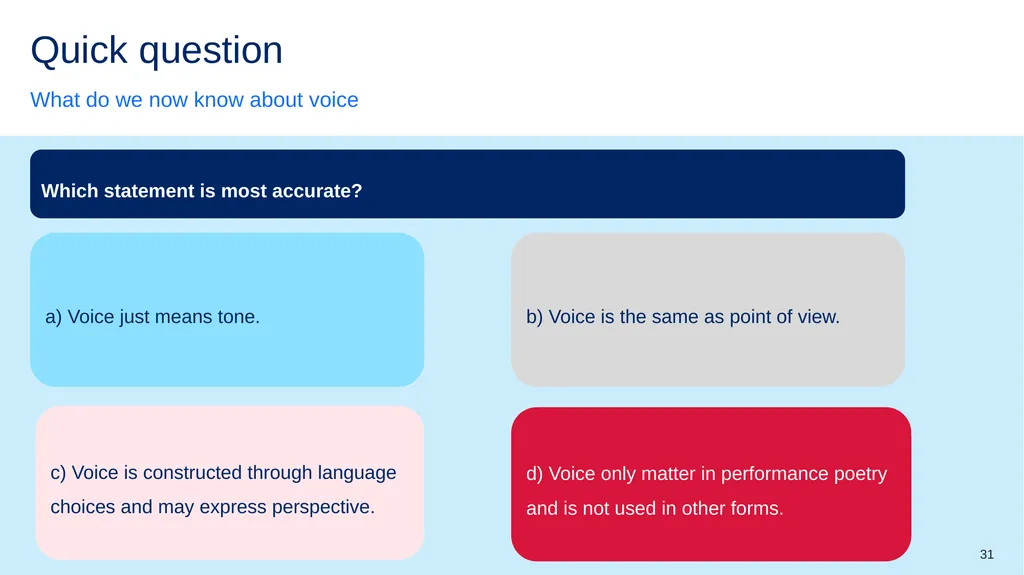
slide31. Quick question What do we now know about voice Which statement is most accurate? a) Voice just means tone. b) Voice is the same as point of view. c) Voice is constructed through language choices and may express perspective. d) Voice only matter in performance poetry and is not used in other forms. 31<br>
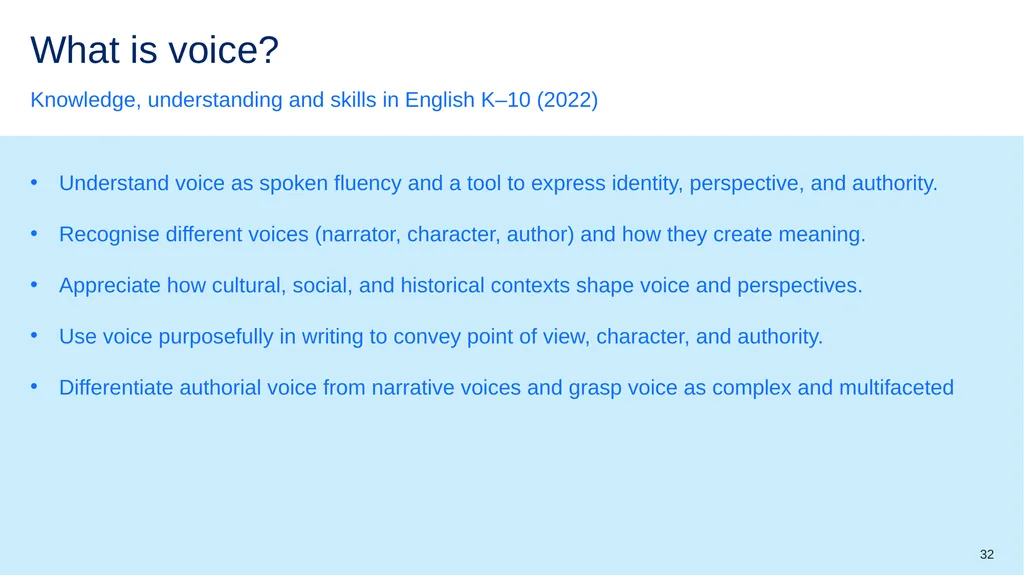
slide32. What is voice? Knowledge, understanding and skills in English K–10 (2022) Understand voice as spoken fluency and a tool to express identity, perspective, and authority.
Recognise different voices (narrator, character, author) and how they create meaning.
Appreciate how cultural, social, and historical contexts shape voice and perspectives.
Use voice purposefully in writing to convey point of view, character, and authority.
Differentiate authorial voice from narrative voices and grasp voice as complex and multifaceted 32<br>
slide33. Strengthening how we refer to voice Moving from vague to precise Sample writing: ‘When the exam came back I tried to look untouched. My teacher walked the rows, face unreadable, stacks of scripts made a papery sound that meant nothing and everything. You pretend you don’t care but your body betrays you. A tightened jaw, a jittery tap of the foot. My paper came. I did not say what I wanted it to say. 33<br>
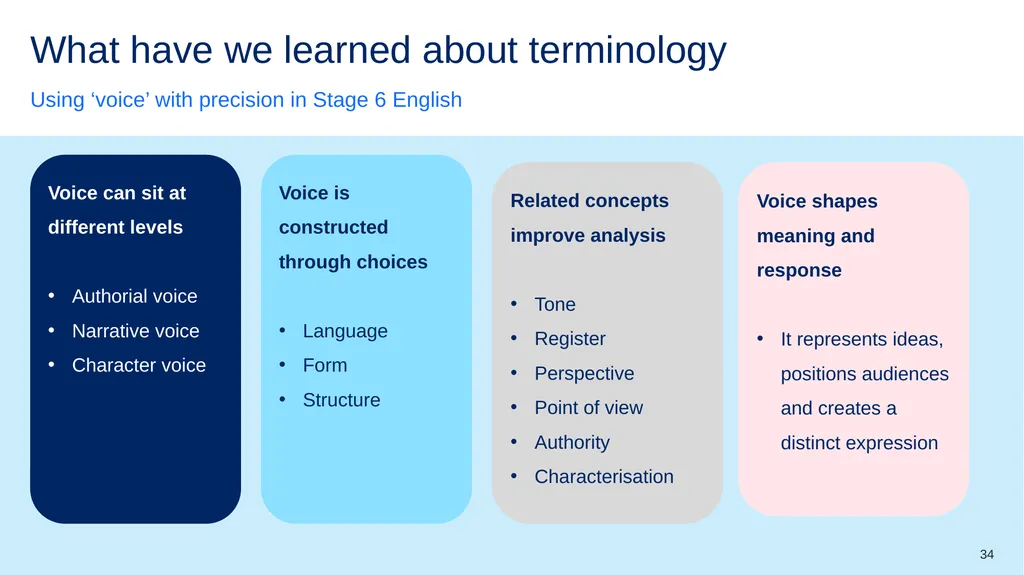
slide34. What have we learned about terminology Using ‘voice’ with precision in Stage 6 English Voice can sit at different levels
Authorial voice
Narrative voice
Character voice Voice is constructed through choices
Language
Form
Structure Related concepts improve analysis
Tone
Register
Perspective
Point of view
Authority
Characterisation Voice shapes meaning and response
It represents ideas, positions audiences and creates a distinct expression 34<br>
slide35. Teacher reference and extension Photo by Steve A Johnson on Unsplash<br>
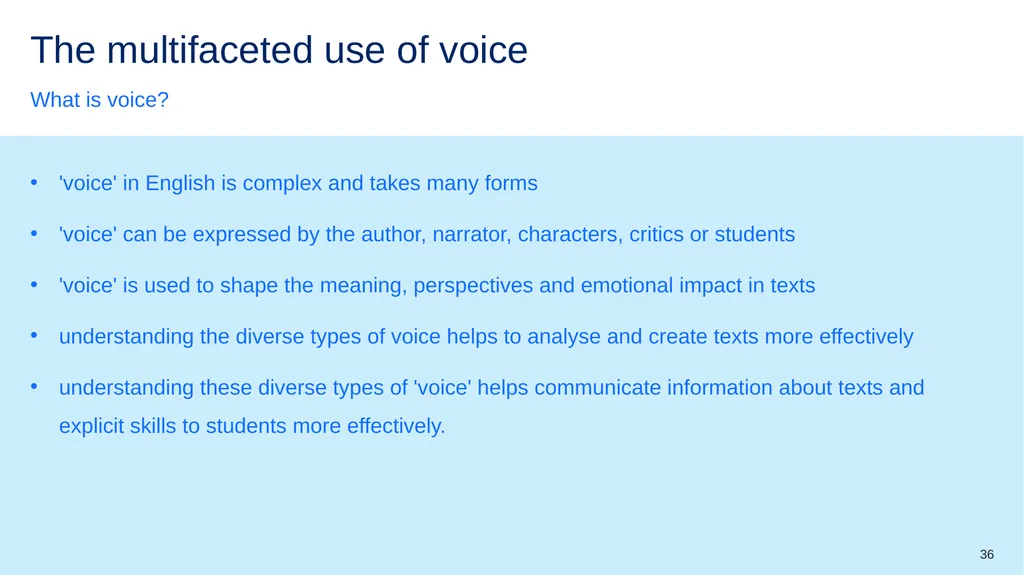
slide36. The multifaceted use of voice What is voice? 'voice' in English is complex and takes many forms
'voice' can be expressed by the author, narrator, characters, critics or students
'voice' is used to shape the meaning, perspectives and emotional impact in texts
understanding the diverse types of voice helps to analyse and create texts more effectively
understanding these diverse types of 'voice' helps communicate information about texts and explicit skills to students more effectively. 36<br>
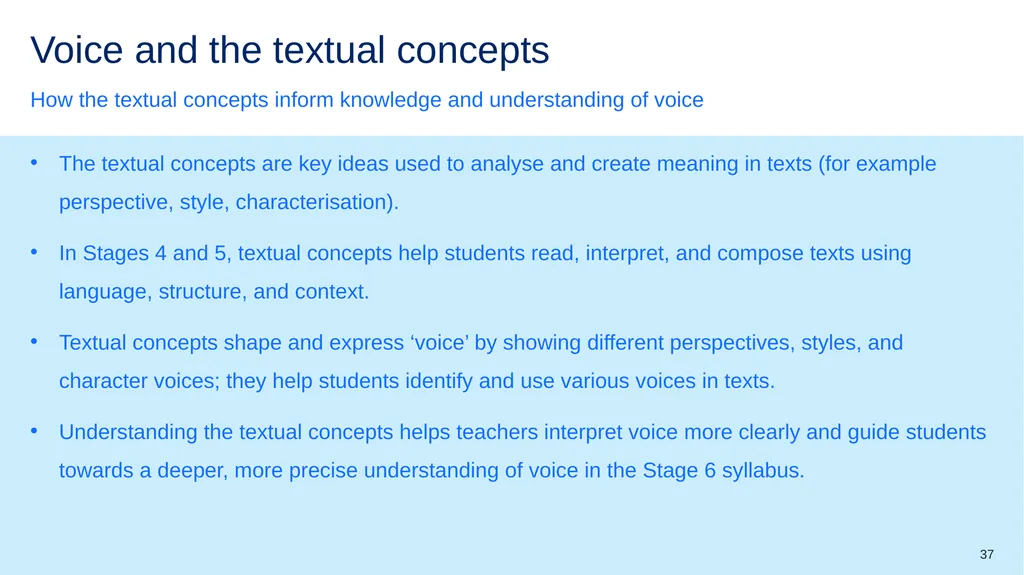
slide37. Voice and the textual concepts How the textual concepts inform knowledge and understanding of voice The textual concepts are key ideas used to analyse and create meaning in texts (for example perspective, style, characterisation).
In Stages 4 and 5, textual concepts help students read, interpret, and compose texts using language, structure, and context.
Textual concepts shape and express ‘voice’ by showing different perspectives, styles, and character voices; they help students identify and use various voices in texts.
Understanding the textual concepts helps teachers interpret voice more clearly and guide students towards a deeper, more precise understanding of voice in the Stage 6 syllabus. 37<br>
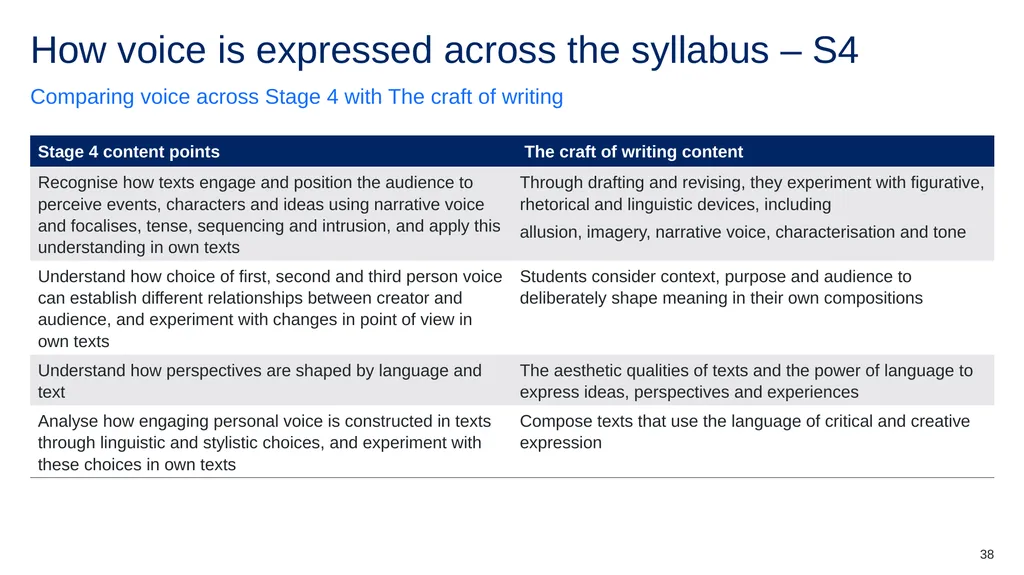
slide38. How voice is expressed across the syllabus – S4 Comparing voice across Stage 4 with The craft of writing 38<br>
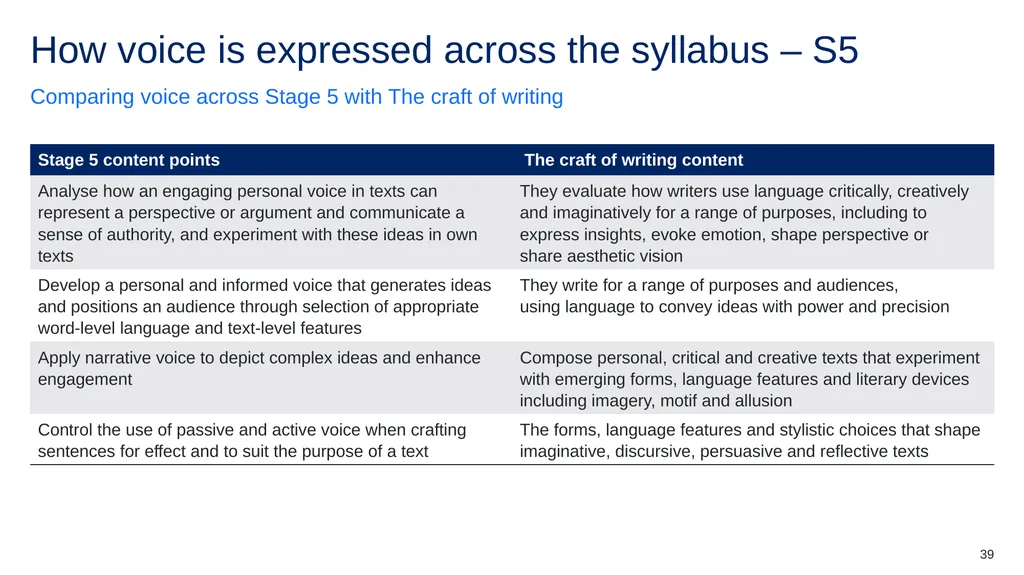
slide39. How voice is expressed across the syllabus – S5 Comparing voice across Stage 5 with The craft of writing 39<br>
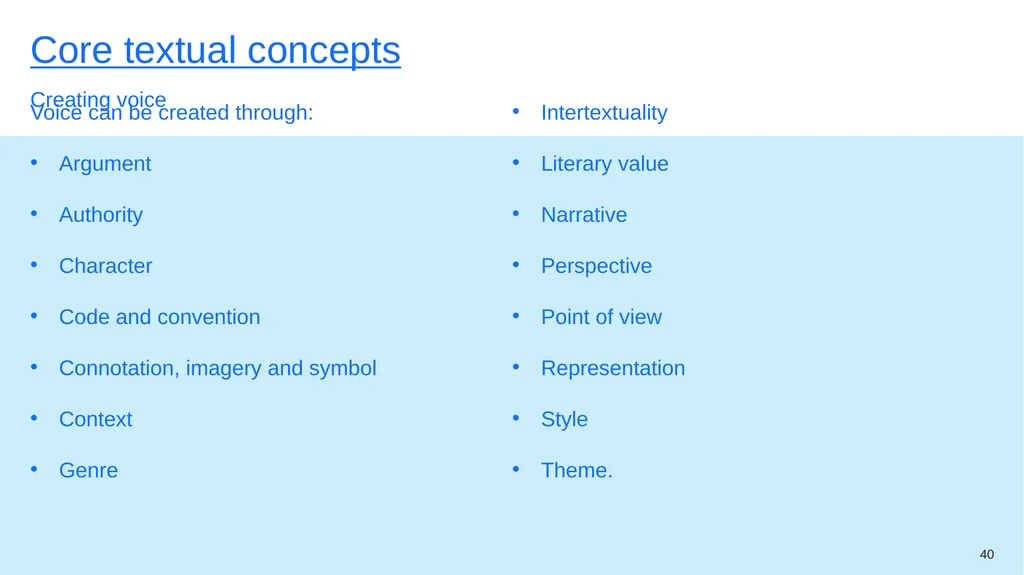
slide40. Core textual concepts Creating voice Voice can be created through:
Argument
Authority
Character
Code and convention
Connotation, imagery and symbol
Context
Genre
Intertextuality
Literary value
Narrative
Perspective
Point of view
Representation
Style
Theme. 40<br>
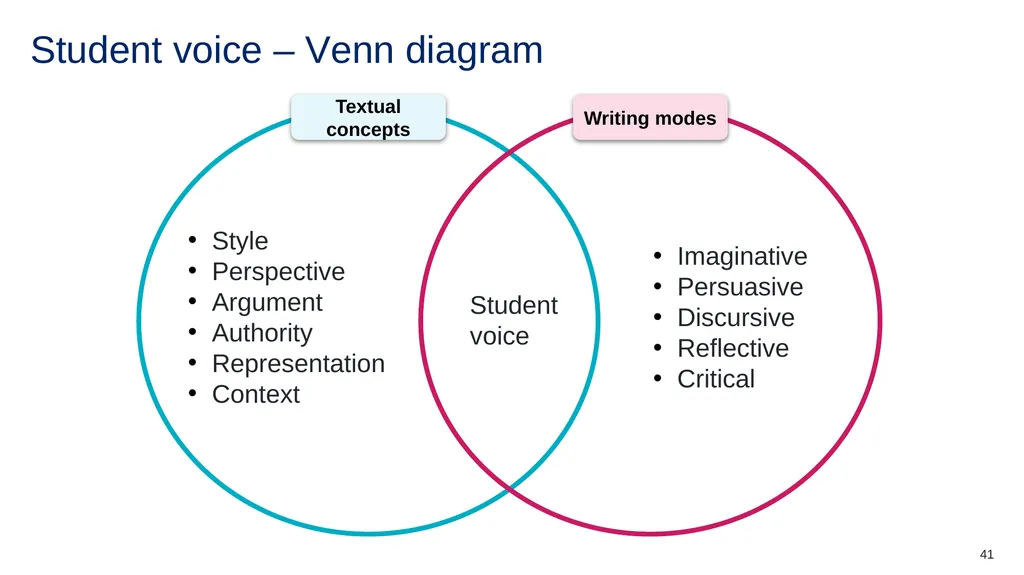
slide41. Student voice – Venn diagram Style
Perspective
Argument
Authority
Representation
Context Imaginative
Persuasive
Discursive
Reflective
Critical Student voice 41<br>
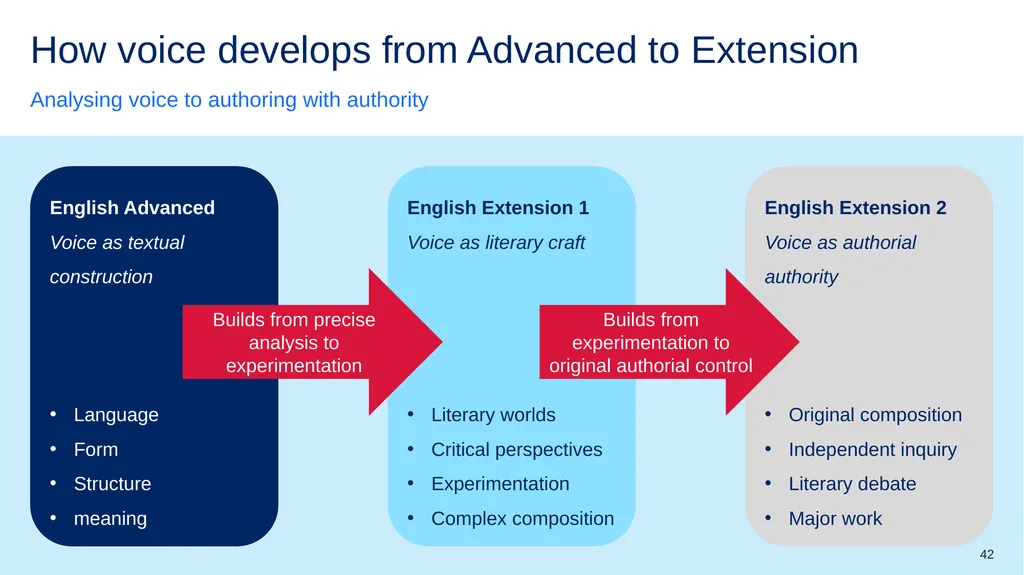
slide42. How voice develops from Advanced to Extension Analysing voice to authoring with authority English Advanced
Voice as textual construction
Language
Form
Structure
meaning English Extension 1
Voice as literary craft
Literary worlds
Critical perspectives
Experimentation
Complex composition English Extension 2
Voice as authorial authority
Original composition
Independent inquiry
Literary debate
Major work Builds from precise analysis to experimentation Builds from experimentation to original authorial control 42<br>
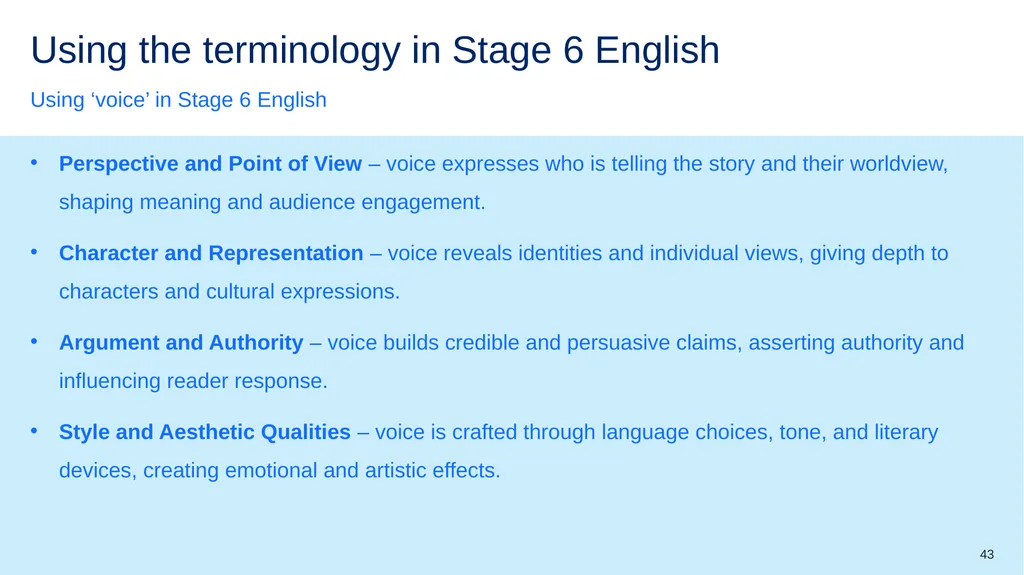
slide43. Using the terminology in Stage 6 English Using ‘voice’ in Stage 6 English Perspective and Point of View – voice expresses who is telling the story and their worldview, shaping meaning and audience engagement.
Character and Representation – voice reveals identities and individual views, giving depth to characters and cultural expressions.
Argument and Authority – voice builds credible and persuasive claims, asserting authority and influencing reader response.
Style and Aesthetic Qualities – voice is crafted through language choices, tone, and literary devices, creating emotional and artistic effects. 43<br>
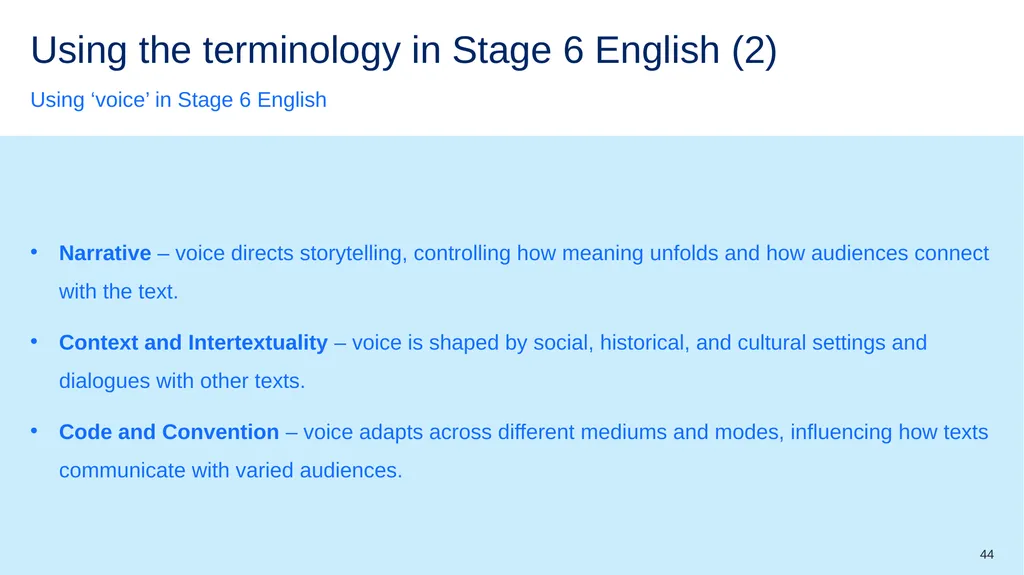
slide44. Using the terminology in Stage 6 English (2) Using ‘voice’ in Stage 6 English Narrative – voice directs storytelling, controlling how meaning unfolds and how audiences connect with the text.
Context and Intertextuality – voice is shaped by social, historical, and cultural settings and dialogues with other texts.
Code and Convention – voice adapts across different mediums and modes, influencing how texts communicate with varied audiences. 44<br>
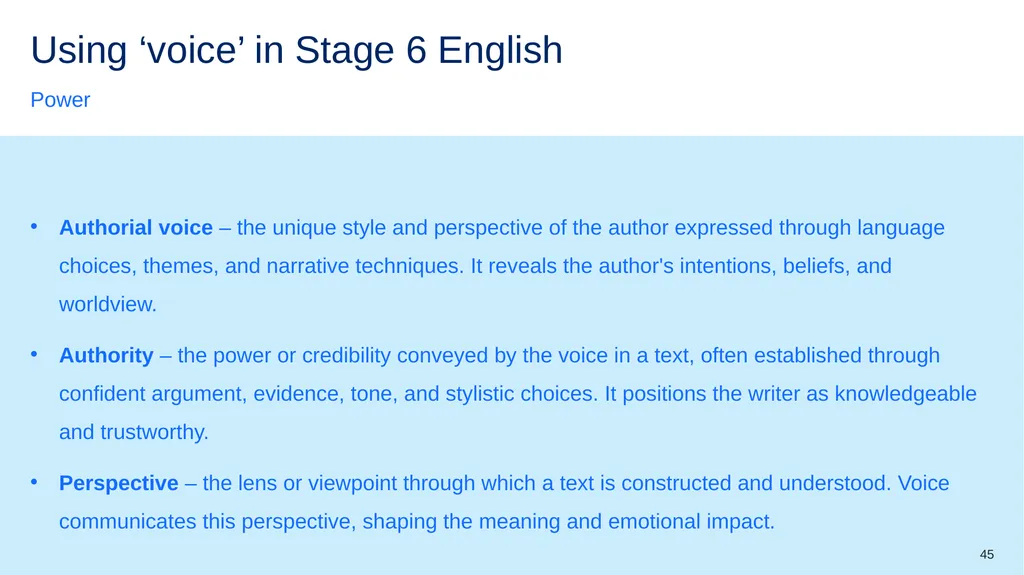
slide45. Using ‘voice’ in Stage 6 English Power Authorial voice – the unique style and perspective of the author expressed through language choices, themes, and narrative techniques. It reveals the author's intentions, beliefs, and worldview.
Authority – the power or credibility conveyed by the voice in a text, often established through confident argument, evidence, tone, and stylistic choices. It positions the writer as knowledgeable and trustworthy.
Perspective – the lens or viewpoint through which a text is constructed and understood. Voice communicates this perspective, shaping the meaning and emotional impact. 45<br>
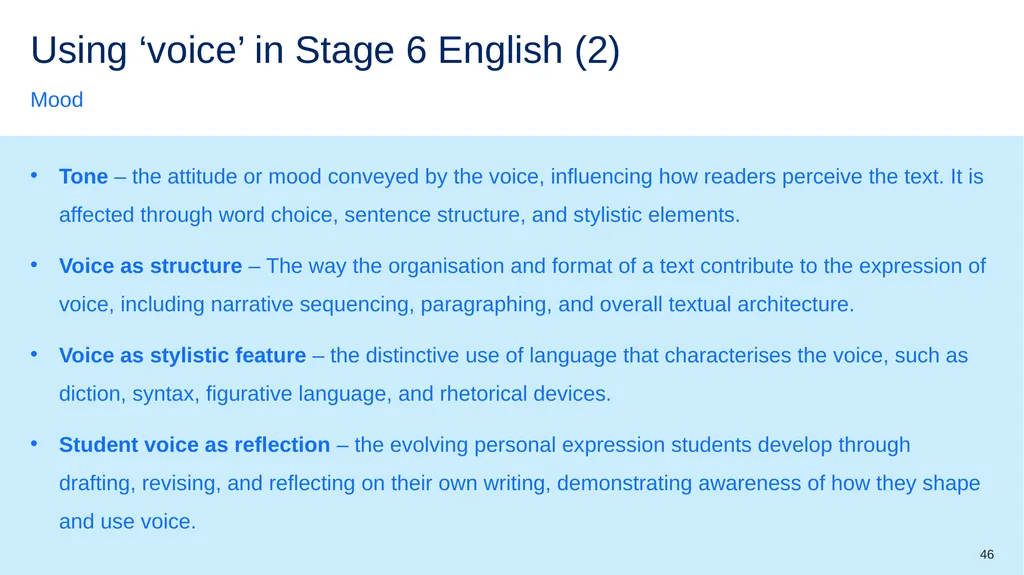
slide46. Using ‘voice’ in Stage 6 English (2) Mood Tone – the attitude or mood conveyed by the voice, influencing how readers perceive the text. It is affected through word choice, sentence structure, and stylistic elements.
Voice as structure – The way the organisation and format of a text contribute to the expression of voice, including narrative sequencing, paragraphing, and overall textual architecture.
Voice as stylistic feature – the distinctive use of language that characterises the voice, such as diction, syntax, figurative language, and rhetorical devices.
Student voice as reflection – the evolving personal expression students develop through drafting, revising, and reflecting on their own writing, demonstrating awareness of how they shape and use voice. 46<br>
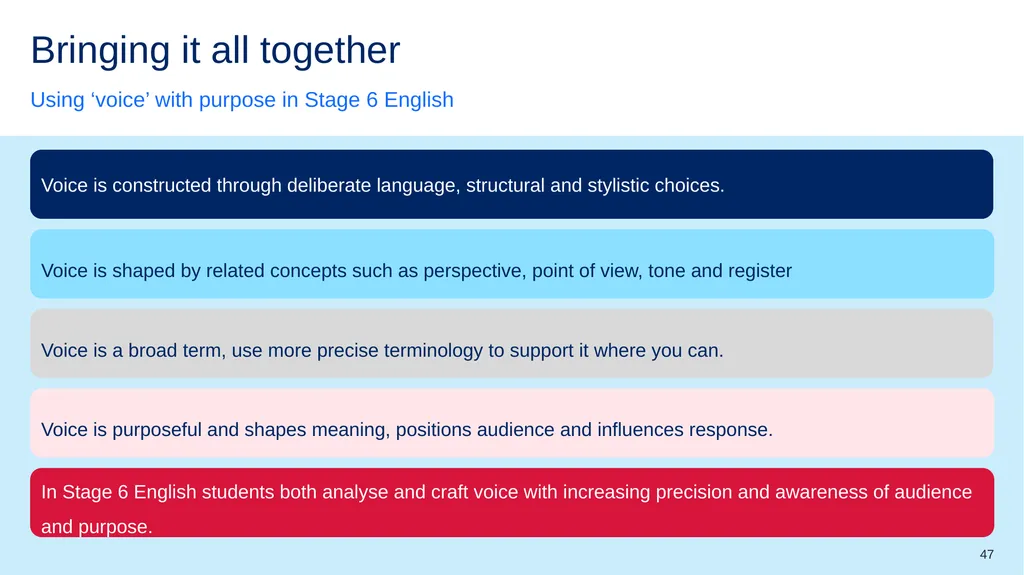
slide47. Bringing it all together Using ‘voice’ with purpose in Stage 6 English Voice is constructed through deliberate language, structural and stylistic choices. Voice is shaped by related concepts such as perspective, point of view, tone and register Voice is a broad term, use more precise terminology to support it where you can. Voice is purposeful and shapes meaning, positions audience and influences response. In Stage 6 English students both analyse and craft voice with increasing precision and awareness of audience and purpose. 47<br>
slide48. References This presentation contains NSW Curriculum and syllabus content. The NSW Curriculum is developed by the NSW Education Standards Authority. This content is prepared by NESA for and on behalf of the Crown in the right of the State of New South Wales. The material is protected by Crown copyright.
Please refer to the NESA Copyright for more information.
NESA holds the only official and up-to-date versions of the NSW Curriculum and syllabus documents. Please visit the NSW Education Standards Authority (NESA) website https://educationstandards.nsw.edu.au/wps/portal/nesa/home and the NSW Curriculum website https://curriculum.nsw.edu.au. English Advanced 11–12 Syllabus (2024) © NSW Education Standards Authority (NESA) for and on behalf of the Crown in right of the State of New South Wales, 2024.
English 7–10 Syllabus (2022)) © NSW Education Standards Authority (NESA) for and on behalf of the Crown in right of the State of New South Wales, 2024.
Australian Education Research Organisation (AERO) (2024a) Explain learning objectives, AERO, accessed 16 April 2024.
AERO (Australian Education Research Organisation) (2024b) Why explicit instruction works, AERO website, accessed 16 April 2024.
Black P and Wiliam D (2018) ‘Classroom assessment and pedagogy’, Assessment in Education Principles Policy and Practice, 25(1):1–25.
CESE (Centre for Education Statistics and Evaluation) (2017) Cognitive load theory: Research that teachers really need to understand, NSW Department of Education, accessed 16 April 2024.
Clarke S (2014) Outstanding formative assessment: culture and practice, Hodder Education, Great Britain.
Clarke S, Timperley H, Hattie J (2003) Unlocking formative assessment: Practical strategies for enhancing students’ learning in the primary and intermediate classroom, Hodder Moa Beckett, Auckland NZ, 2003. 48<br>
slide49. References (2) Griffin P (2018) Assessment for teaching, Cambridge University Press.
NESA (NSW Education Standards Authority) (n.d.) Collaborative curriculum planning, NESA website, accessed 19 May 2025.
State of New South Wales (Department of Education) (2024.) Explicit teaching strategies, NSW Department of Education website, accessed 5 April 2024.
State of New South Wales (Department of Education) (2024) the Explicit teaching – Driving learning and engagement, Centre for Education Statistics and Evaluation website, accessed 5 April 2024.
State of New South Wales (Department of Education) (n.d.) Digital Learning Selector, NSW Department of Education website, accessed 5 April 2024.
Wiliam D (2014) ‘The right questions, the right way ’, Educational Leadership, 71(6). 49<br>
slide50. Copyright © State of New South Wales (Department of Education), 2026 The copyright material published in this resource is subject to the Copyright Act 1968 (Cth) and is owned by the NSW Department of Education or, where indicated, by a party other than the NSW Department of Education (third-party material).
Copyright material available in this resource and owned by the NSW Department of Education is licensed under a Creative Commons Attribution 4.0 International (CC BY 4.0) license.
This license allows you to share and adapt the material for any purpose, even commercially.
Attribution should be given to © State of New South Wales (Department of Education), 2026.
Material in this resource not available under a Creative Commons license:
the NSW Department of Education logo, other logos and trademark-protected material
Material owned by a third party that has been reproduced with permission. You will need to obtain permission from the third party to reuse its material.
Links to third-party material and websites
Please note that the provided (reading/viewing material/list/links/texts) are a suggestion only and implies no endorsement, by the New South Wales Department of Education, of any author, publisher, or book title. School principals and teachers are best placed to assess the suitability of resources that would complement the curriculum and reflect the needs and interests of their students.
If you use the links provided in this document to access a third-party’s website, you acknowledge that the terms of use, including licence terms set out on the third-party’s website apply to the use which may be made of the materials on that third-party website or where permitted by the Copyright Act 1968 (Cth). The department accepts no responsibility for content on third-party websites.<br>
Classroom teachers are encouraged to add and adapt slides as required to meet the needs of their students.
Save a copy of the file to make changes to the slide deck. Go to File > Download a Copy (this downloads a copy to the computer to edit in the PowerPoint application).
To convert the PowerPoint to Google Slides:
Upload the file into Google Drive and open it.
Go to File > Save as Google Slides.
(Note – conversion may cause formatting changes in the slides.) 1<br>
slide2. Index 2<br>
slide3. Support for terminology – voice Stage 6 English Advanced – 12.4 ‘The craft of writing’ Year 12, Program 12.4 Photo by Steve A Johnson on Unsplash<br>
slide4. Sharing learning intentions and success criteria<br>
slide5. Learning intentions and success criteria We are learning to:
understand the different meanings and uses of 'voice' in the Stage 6 English syllabus
identify how 'voice' relates to key textual concepts like perspective, point of view, narrative and authority
use clear and precise metalanguage language to explain how language, structural and stylistic choices shape meaning and authority.
We can:
[classroom teacher to insert sample success criteria]
[classroom teacher to insert sample success criteria]
[classroom teacher to insert sample success criteria]. 5<br>
slide6. Understanding voice and related terms Photo by Steve A Johnson on Unsplash<br>
slide7. Connecting learning 7<br>
slide8. Thinking about voice What do we already know? Voice
‘language is used… to represent particular thoughts, opinions or perspectives’ Point of view
‘position from which… events of a text are intended to be perceived’ Perspective
‘a lens through which the author perceives the world…’ Quick think
Which term is most often confused with voice?
How is voice different from point of view?
Where does perspective sit in relation to voice and point of view?
Turn and talk to the person next to you, then share with the class 8<br>
slide9. Thinking about voice (2) What do we already know? Voice
‘language is used… to represent particular thoughts, opinions or perspectives’ Point of view
‘position from which… events of a text are intended to be perceived’ Perspective
‘a lens through which the author perceives the world…’ Quick think
Why is ‘voice’ sometimes too broad a term?
Which term would best describe the position from which a events are presented?
Which term would best describe the lens or values shaping a text?
Rewrite this claim in your journal using more precise langue: ‘The voice is sad.’ 9<br>
slide10. Thinking about voice (3) What do we already know? Tone
‘The attitude or feeling the writer expresses through choice of words...’ Register
‘The degree of formality or informality of language used for a particular purpose…’ Authority
‘How trustworthy, authentic or valid…’ Quick think
Which term do you think is most confused with voice?
How is tone different from register?
Where do you think authority sits in relation to tone and register?
Turn and talk to the person next to you, the share with the class. 10<br>
slide11. Thinking about voice (4) What do we already know? Tone
‘The attitude or feeling the writer expresses through choice of words...’ Register
‘The degree of formality or informality of language used for a particular purpose…’ Authority
‘How trustworthy, authentic or valid…’ Quick think
Which term would best describe the attitude towards a subject?
Which term would best describe the degree of formality in a text?
Which term best describes a text’s credibility?
Rewrite this claim using more precise language in your journal: ‘The voice is powerful.’ 11<br>
slide12. Thinking about voice (5) What can voice be? Voice can be the physical sound a person makes when the speak, sing or call out.
Voice can describe qualities of speech such as volume, pitch, pace and intonation.
Voice can mean having an opportunity to express an opinion or be heard.
In grammar, voice shows whether the subject performs or receives an action.
In literature, voice describes the distinctive way language expresses ideas, feelings and perspectives. 12<br>
slide13. A term with more than one meaning Voice Within writing there are different types of voice. Authorial voice – the distinct pattern of language, stylistic and structural choices that recurs across a writer’s work.
Narrative voice – the constructed narrator, speaker or persona through which the narrative is told.
Character voice – the distinct pattern constructed for specific characters. Can you think of any other ways voice can be used in writing? 13<br>
slide14. Related terms Not synonyms 14<br>
slide15. What is voice? English K–10 (2022) Voice – The way in which language is used and/or interpreted to represent particular thoughts, opinions or perspectives. This includes the authorial voice or the voice of a narrator, character or persona within a text.
Describes the relationship between the action expressed by the verb and the subject/object of the sentence. For example, ‘active voice’ is where the subject performs the action, ‘The cat broke the vase’; ‘passive voice' is where the object is acted upon, ‘The vase was broken by the cat’.
In speaking, a description of the oral production of text.
See point of view for ‘narrative voice’ 15<br>
slide16. What is point of view and perspective? Point of view as narrative voice English K–10 (2022) Point of view – The position from which the information and events of a text are intended to be perceived by its audience. Point of view is constructed through the narrator, voice or images of the text and by characters or voices presented within it.
Point of view should not be confused with the term ‘perspective’ or with notions of opinion.
Perspective – A lens through which the author perceives the world and creates a text, or the lens through which the reader or viewer perceives the world and understands a text. Readers may also temporarily adopt the perspectives of others as a way of understanding texts. 16<br>
slide17. What is tone, register and authority? Tools for crafting voice Tone – The attitude or feeling the writer expresses through choice of words and/or literary devices, e.g. solemn, playful, defensive or sinister.
Register – The degree of formality or informality of language used for a particular purpose or in a particular social setting.
Authority – Authority of a text – How trustworthy, authentic or valid an audience may find the representation of ideas, experiences, perspectives and arguments in a text.
Authority over a text – The varying degrees to which the meaning of a text is controlled or constructed by its creator(s) and by its audience. 17<br>
slide18. What have we learned about related terms Understanding voice Voice can mean different things
Spoken sound
Speech qualities
Being heard
Grammatical voice
Literary expression In literature voice is constructed
Authorial voice
Narrative voice
Character voice
Language choices
Structural choices Related terms are not synonyms
Point of view
Perspective
Tone
Register
Authority Precise terminology improves analysis
Locate the voice
Select the right term
Explain the choices
Avoid broad claims
Refine language 18<br>
slide19. Choosing precise terminology Photo by Steve A Johnson on Unsplash<br>
slide20. Chunking and sequencing learning 20<br>
slide21. Whose voices are we discussing? When is ‘voice’ the right word Voice can operate at different levels in a text. Key distinctions First person is not automatically character voice, it may be a narrator or speaker mediating events and experience. One quotation does not establish authorial voice. Authorial voice emerges through recurring patterns across a writer’s work. Character voice is more than dialogue. A character's perspective, diction and manner of expression can also construct voice. 21<br>
slide22. When is ‘voice’ the right term? Separating related but distinct meanings Use authorial voice for an overall distinctive pattern of choices across a writer’s work.
Use narrative voice for a narrator, speaker or persona within a text.
Use character voice when referring to a specific character.
Use grammatical voice when discussing active and passive constructions.
Use spoken voice when discussing vocal delivery.
Use student authorial voice when reflecting on deliberate choices a student develops across drafting and revision. 22<br>
slide23. Related concepts that contribute to voice Using prior learning to make Stage 6 choices Voice is not created by a fixed list of concepts. It emerges through deliberate choices in: Positioning – perspective, point of view, representation, character Expression – diction, syntax, imagery, tone, register Organisation – form, genre, structure, code and convention Context – personal, social, cultural, historical, textual Effect – authority, reader response, aesthetic vision 23<br>
slide24. Using effective questioning<br>
slide25. From evidence to precise claim Building a pathway through questioning Sample writing: ‘I am running, running faster than I have ever run before. The cold from the dewy ground runs up my bare legs and covers my body with goose pimples. But still, I run on.’ 25<br>
slide26. Gradual release of responsibility<br>
slide27. The nuance of voice Thinking about how voice is constructed Sample sentence: ‘They called it composure, she knew it was anger trying to burn through contempt.’ Teacher
Voice = controlled, critical
Name the voice precisely. Point to the language choice creating it Pairs
Identify 2 choices that construct the voice.
Discuss them with the person next to you. Individual
Write one sentence explaining how the voice shapes meaning or authority Think aloud: The sentence sounds controlled because of its balanced structure. It sounds critical because the second clause challenges the first. 27<br>
slide28. The nuance of voice (2) Working in pairs Create a sentence in pairs: Name the voice precisely. Point to the language choice creating it. Identify 2 choices that construct the voice.
Discuss them with the person next to you. Write one sentence explaining how the voice shapes meaning or authority. Think aloud: The sentence sounds [controlled, frantic, messy] because… 28<br>
slide29. The nuance of voice (3) Individual Create a sentence as an individual: Name the voice precisely. Point to the language choice creating it Identify 2 choices that construct the voice.
Discuss them with the person next to you. Write one sentence explaining how the voice shapes meaning or authority Think aloud: The sentence sounds [controlled, frantic, messy] because… 29<br>
slide30. Checking for understanding<br>
slide31. Quick question What do we now know about voice Which statement is most accurate? a) Voice just means tone. b) Voice is the same as point of view. c) Voice is constructed through language choices and may express perspective. d) Voice only matter in performance poetry and is not used in other forms. 31<br>
slide32. What is voice? Knowledge, understanding and skills in English K–10 (2022) Understand voice as spoken fluency and a tool to express identity, perspective, and authority.
Recognise different voices (narrator, character, author) and how they create meaning.
Appreciate how cultural, social, and historical contexts shape voice and perspectives.
Use voice purposefully in writing to convey point of view, character, and authority.
Differentiate authorial voice from narrative voices and grasp voice as complex and multifaceted 32<br>
slide33. Strengthening how we refer to voice Moving from vague to precise Sample writing: ‘When the exam came back I tried to look untouched. My teacher walked the rows, face unreadable, stacks of scripts made a papery sound that meant nothing and everything. You pretend you don’t care but your body betrays you. A tightened jaw, a jittery tap of the foot. My paper came. I did not say what I wanted it to say. 33<br>
slide34. What have we learned about terminology Using ‘voice’ with precision in Stage 6 English Voice can sit at different levels
Authorial voice
Narrative voice
Character voice Voice is constructed through choices
Language
Form
Structure Related concepts improve analysis
Tone
Register
Perspective
Point of view
Authority
Characterisation Voice shapes meaning and response
It represents ideas, positions audiences and creates a distinct expression 34<br>
slide35. Teacher reference and extension Photo by Steve A Johnson on Unsplash<br>
slide36. The multifaceted use of voice What is voice? 'voice' in English is complex and takes many forms
'voice' can be expressed by the author, narrator, characters, critics or students
'voice' is used to shape the meaning, perspectives and emotional impact in texts
understanding the diverse types of voice helps to analyse and create texts more effectively
understanding these diverse types of 'voice' helps communicate information about texts and explicit skills to students more effectively. 36<br>
slide37. Voice and the textual concepts How the textual concepts inform knowledge and understanding of voice The textual concepts are key ideas used to analyse and create meaning in texts (for example perspective, style, characterisation).
In Stages 4 and 5, textual concepts help students read, interpret, and compose texts using language, structure, and context.
Textual concepts shape and express ‘voice’ by showing different perspectives, styles, and character voices; they help students identify and use various voices in texts.
Understanding the textual concepts helps teachers interpret voice more clearly and guide students towards a deeper, more precise understanding of voice in the Stage 6 syllabus. 37<br>
slide38. How voice is expressed across the syllabus – S4 Comparing voice across Stage 4 with The craft of writing 38<br>
slide39. How voice is expressed across the syllabus – S5 Comparing voice across Stage 5 with The craft of writing 39<br>
slide40. Core textual concepts Creating voice Voice can be created through:
Argument
Authority
Character
Code and convention
Connotation, imagery and symbol
Context
Genre
Intertextuality
Literary value
Narrative
Perspective
Point of view
Representation
Style
Theme. 40<br>
slide41. Student voice – Venn diagram Style
Perspective
Argument
Authority
Representation
Context Imaginative
Persuasive
Discursive
Reflective
Critical Student voice 41<br>
slide42. How voice develops from Advanced to Extension Analysing voice to authoring with authority English Advanced
Voice as textual construction
Language
Form
Structure
meaning English Extension 1
Voice as literary craft
Literary worlds
Critical perspectives
Experimentation
Complex composition English Extension 2
Voice as authorial authority
Original composition
Independent inquiry
Literary debate
Major work Builds from precise analysis to experimentation Builds from experimentation to original authorial control 42<br>
slide43. Using the terminology in Stage 6 English Using ‘voice’ in Stage 6 English Perspective and Point of View – voice expresses who is telling the story and their worldview, shaping meaning and audience engagement.
Character and Representation – voice reveals identities and individual views, giving depth to characters and cultural expressions.
Argument and Authority – voice builds credible and persuasive claims, asserting authority and influencing reader response.
Style and Aesthetic Qualities – voice is crafted through language choices, tone, and literary devices, creating emotional and artistic effects. 43<br>
slide44. Using the terminology in Stage 6 English (2) Using ‘voice’ in Stage 6 English Narrative – voice directs storytelling, controlling how meaning unfolds and how audiences connect with the text.
Context and Intertextuality – voice is shaped by social, historical, and cultural settings and dialogues with other texts.
Code and Convention – voice adapts across different mediums and modes, influencing how texts communicate with varied audiences. 44<br>
slide45. Using ‘voice’ in Stage 6 English Power Authorial voice – the unique style and perspective of the author expressed through language choices, themes, and narrative techniques. It reveals the author's intentions, beliefs, and worldview.
Authority – the power or credibility conveyed by the voice in a text, often established through confident argument, evidence, tone, and stylistic choices. It positions the writer as knowledgeable and trustworthy.
Perspective – the lens or viewpoint through which a text is constructed and understood. Voice communicates this perspective, shaping the meaning and emotional impact. 45<br>
slide46. Using ‘voice’ in Stage 6 English (2) Mood Tone – the attitude or mood conveyed by the voice, influencing how readers perceive the text. It is affected through word choice, sentence structure, and stylistic elements.
Voice as structure – The way the organisation and format of a text contribute to the expression of voice, including narrative sequencing, paragraphing, and overall textual architecture.
Voice as stylistic feature – the distinctive use of language that characterises the voice, such as diction, syntax, figurative language, and rhetorical devices.
Student voice as reflection – the evolving personal expression students develop through drafting, revising, and reflecting on their own writing, demonstrating awareness of how they shape and use voice. 46<br>
slide47. Bringing it all together Using ‘voice’ with purpose in Stage 6 English Voice is constructed through deliberate language, structural and stylistic choices. Voice is shaped by related concepts such as perspective, point of view, tone and register Voice is a broad term, use more precise terminology to support it where you can. Voice is purposeful and shapes meaning, positions audience and influences response. In Stage 6 English students both analyse and craft voice with increasing precision and awareness of audience and purpose. 47<br>
slide48. References This presentation contains NSW Curriculum and syllabus content. The NSW Curriculum is developed by the NSW Education Standards Authority. This content is prepared by NESA for and on behalf of the Crown in the right of the State of New South Wales. The material is protected by Crown copyright.
Please refer to the NESA Copyright for more information.
NESA holds the only official and up-to-date versions of the NSW Curriculum and syllabus documents. Please visit the NSW Education Standards Authority (NESA) website https://educationstandards.nsw.edu.au/wps/portal/nesa/home and the NSW Curriculum website https://curriculum.nsw.edu.au. English Advanced 11–12 Syllabus (2024) © NSW Education Standards Authority (NESA) for and on behalf of the Crown in right of the State of New South Wales, 2024.
English 7–10 Syllabus (2022)) © NSW Education Standards Authority (NESA) for and on behalf of the Crown in right of the State of New South Wales, 2024.
Australian Education Research Organisation (AERO) (2024a) Explain learning objectives, AERO, accessed 16 April 2024.
AERO (Australian Education Research Organisation) (2024b) Why explicit instruction works, AERO website, accessed 16 April 2024.
Black P and Wiliam D (2018) ‘Classroom assessment and pedagogy’, Assessment in Education Principles Policy and Practice, 25(1):1–25.
CESE (Centre for Education Statistics and Evaluation) (2017) Cognitive load theory: Research that teachers really need to understand, NSW Department of Education, accessed 16 April 2024.
Clarke S (2014) Outstanding formative assessment: culture and practice, Hodder Education, Great Britain.
Clarke S, Timperley H, Hattie J (2003) Unlocking formative assessment: Practical strategies for enhancing students’ learning in the primary and intermediate classroom, Hodder Moa Beckett, Auckland NZ, 2003. 48<br>
slide49. References (2) Griffin P (2018) Assessment for teaching, Cambridge University Press.
NESA (NSW Education Standards Authority) (n.d.) Collaborative curriculum planning, NESA website, accessed 19 May 2025.
State of New South Wales (Department of Education) (2024.) Explicit teaching strategies, NSW Department of Education website, accessed 5 April 2024.
State of New South Wales (Department of Education) (2024) the Explicit teaching – Driving learning and engagement, Centre for Education Statistics and Evaluation website, accessed 5 April 2024.
State of New South Wales (Department of Education) (n.d.) Digital Learning Selector, NSW Department of Education website, accessed 5 April 2024.
Wiliam D (2014) ‘The right questions, the right way ’, Educational Leadership, 71(6). 49<br>
slide50. Copyright © State of New South Wales (Department of Education), 2026 The copyright material published in this resource is subject to the Copyright Act 1968 (Cth) and is owned by the NSW Department of Education or, where indicated, by a party other than the NSW Department of Education (third-party material).
Copyright material available in this resource and owned by the NSW Department of Education is licensed under a Creative Commons Attribution 4.0 International (CC BY 4.0) license.
This license allows you to share and adapt the material for any purpose, even commercially.
Attribution should be given to © State of New South Wales (Department of Education), 2026.
Material in this resource not available under a Creative Commons license:
the NSW Department of Education logo, other logos and trademark-protected material
Material owned by a third party that has been reproduced with permission. You will need to obtain permission from the third party to reuse its material.
Links to third-party material and websites
Please note that the provided (reading/viewing material/list/links/texts) are a suggestion only and implies no endorsement, by the New South Wales Department of Education, of any author, publisher, or book title. School principals and teachers are best placed to assess the suitability of resources that would complement the curriculum and reflect the needs and interests of their students.
If you use the links provided in this document to access a third-party’s website, you acknowledge that the terms of use, including licence terms set out on the third-party’s website apply to the use which may be made of the materials on that third-party website or where permitted by the Copyright Act 1968 (Cth). The department accepts no responsibility for content on third-party websites.<br>