
Intellectual Property Basics and Sticking Points
PM
Published · 56 slides · 0 views
1 / 1
Description
Intellectual Property Basics and Sticking Points for Negotiating Research Agreements BethLynn Maxwell, Ph.D., J.D. The University of Texas System Office of General Counsel Presentation to UT San Antonio October 26, 2006 UT - San Antonio
Related Topics
Share
Embed code
Download this presentation From Below
"Intellectual Property Basics and Sticking Points" is the property of its rightful owner. Permission is granted to download and print the materials on this website for personal, non-commercial use only, and to display it on your personal computer provided you do not modify the materials and that you retain all copyright notices contained in the materials. By downloading content from our website, you accept the terms of this agreement.
Presentation Transcript
01
Intellectual Property Basics and Sticking Points for Negotiating Research Agreements BethLynn Maxwell, Ph.D., J.D.
The University of Texas System
Office of General Counsel
Presentation to UT – San Antonio
October 26, 2006<br>
Presentation to UT – San Antonio
October 26, 2006<br>
02
UT - San Antonio Presentation - October 26, 2006 - San Antonio, TX 2 Discussion Points Patent Law Primer
Four Major Areas in Research Contracts
Intellectual Property
Troublesome Clauses in Research Contracts
Confidentiality
Publication
Indemnification<br>
Four Major Areas in Research Contracts
Intellectual Property
Troublesome Clauses in Research Contracts
Confidentiality
Publication
Indemnification<br>
03
UT - San Antonio Presentation - October 26, 2006 - San Antonio, TX 3 Patent Law Primer<br>
04
UT - San Antonio Presentation - October 26, 2006 - San Antonio, TX 4 Types of
Intellectual Property Trademarks ~ identifies source of goods or services
Copyrights ~ protect works fixed in a medium
Trade Secrets ~ best where the subject matter can’t be easily “reverse engineered”
Patents ~ 3 kinds: design, plant and utility<br>
Copyrights ~ protect works fixed in a medium
Trade Secrets ~ best where the subject matter can’t be easily “reverse engineered”
Patents ~ 3 kinds: design, plant and utility<br>
05
UT - San Antonio Presentation - October 26, 2006 - San Antonio, TX 5 The United States
Patent System Government sponsored “monopoly”; limited by time and geography
Does not convey affirmative right – only the right to exclude others
Article I of the Constitution provides the legal foundation
Administered by the Commerce Department through the U.S. PTO<br>
Does not convey affirmative right – only the right to exclude others
Article I of the Constitution provides the legal foundation
Administered by the Commerce Department through the U.S. PTO<br>
06
UT - San Antonio Presentation - October 26, 2006 - San Antonio, TX 6 Protection for Inventions ~
Disclosure and Evaluation Evaluate the disclosure
Identify the subject matter to be protected
Determine what is patentable
Select the best type of claims for the invention<br>
Identify the subject matter to be protected
Determine what is patentable
Select the best type of claims for the invention<br>
07
UT - San Antonio Presentation - October 26, 2006 - San Antonio, TX 7 Requirements for
Securing a Patent in U.S. Statutory Subject Matter ~ category
Novelty ~ new, first to invent
Utility ~ specific, substantial, credible use
Not obvious ~ person of ordinary skill in the art
Written Description ~ clear and concise terms
Enablement ~ enable others to make and use
Best Mode ~ to carry out invention<br>
Novelty ~ new, first to invent
Utility ~ specific, substantial, credible use
Not obvious ~ person of ordinary skill in the art
Written Description ~ clear and concise terms
Enablement ~ enable others to make and use
Best Mode ~ to carry out invention<br>
08
UT - San Antonio Presentation - October 26, 2006 - San Antonio, TX 8 What is Patentable Subject Matter ? 35 U.S.C. § 101 Novel Subject Matter – new, not made or done before
What is the invention? A process, machine, manufacture, composition or improvement?
Cannot claim products of nature, physical & chemical principles<br>
What is the invention? A process, machine, manufacture, composition or improvement?
Cannot claim products of nature, physical & chemical principles<br>
09
UT - San Antonio Presentation - October 26, 2006 - San Antonio, TX 9 Utility ~
Usefulness of an Invention Specific utility
Is the utility specific for the claimed invention?
Credible utility
Is that specific utility credible?
Substantial utility
Does the utility have real world value?<br>
Is the utility specific for the claimed invention?
Credible utility
Is that specific utility credible?
Substantial utility
Does the utility have real world value?<br>
10
UT - San Antonio Presentation - October 26, 2006 - San Antonio, TX 10 Specific Utility The utility has to be specific to the subject matter claimed.
Contrast this to a general utility that would apply to the general class of invention.<br>
Contrast this to a general utility that would apply to the general class of invention.<br>
11
UT - San Antonio Presentation - October 26, 2006 - San Antonio, TX 11 Credible Utility Standard is whether a person of ordinary skill in the art would accept that the disclosed invention is currently available for such use
Perpetual motion machines
But, some nucleic acids might be used as probes, chromosome markers, or forensic or diagnostic markers<br>
Perpetual motion machines
But, some nucleic acids might be used as probes, chromosome markers, or forensic or diagnostic markers<br>
12
UT - San Antonio Presentation - October 26, 2006 - San Antonio, TX 12 Substantial Utility “Real world” use
Must not require further research to identify or confirm a real world context
Throw away utilities are not substantial uses unless nature of invention is specifically directed to such uses<br>
Must not require further research to identify or confirm a real world context
Throw away utilities are not substantial uses unless nature of invention is specifically directed to such uses<br>
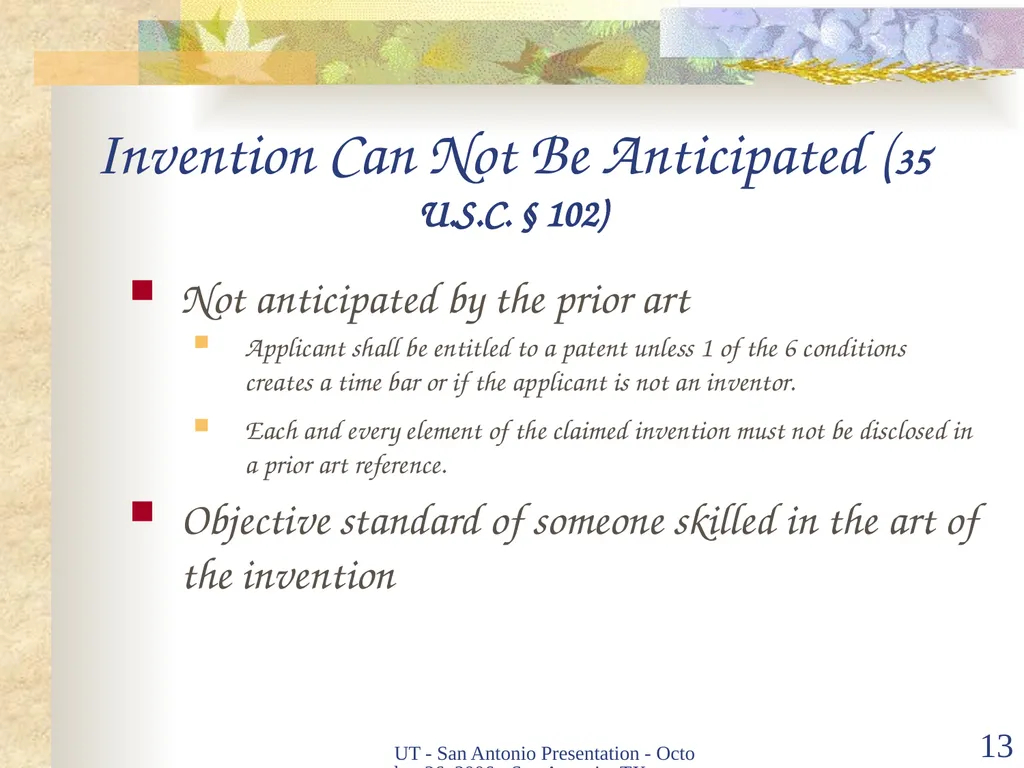
13
UT - San Antonio Presentation - October 26, 2006 - San Antonio, TX 13 Invention Can Not Be Anticipated (35 U.S.C. § 102) Not anticipated by the prior art
Applicant shall be entitled to a patent unless 1 of the 6 conditions creates a time bar or if the applicant is not an inventor.
Each and every element of the claimed invention must not be disclosed in a prior art reference.
Objective standard of someone skilled in the art of the invention<br>
Applicant shall be entitled to a patent unless 1 of the 6 conditions creates a time bar or if the applicant is not an inventor.
Each and every element of the claimed invention must not be disclosed in a prior art reference.
Objective standard of someone skilled in the art of the invention<br>
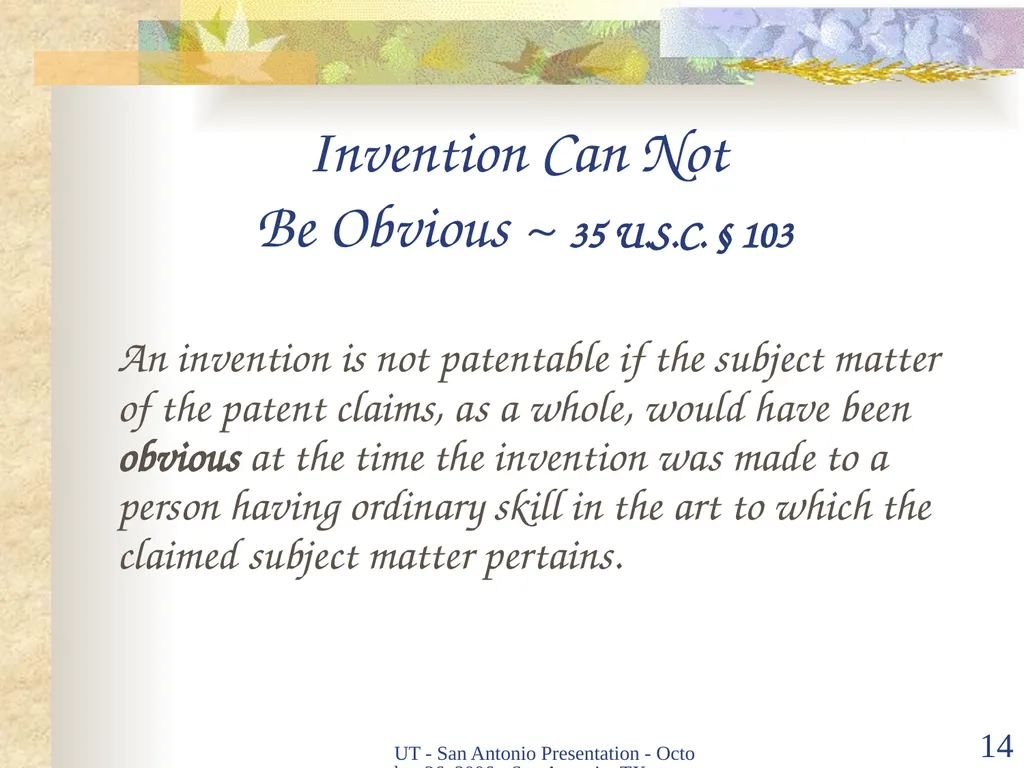
14
UT - San Antonio Presentation - October 26, 2006 - San Antonio, TX 14 Invention Can Not
Be Obvious ~ 35 U.S.C. § 103 An invention is not patentable if the subject matter of the patent claims, as a whole, would have been obvious at the time the invention was made to a person having ordinary skill in the art to which the claimed subject matter pertains.<br>
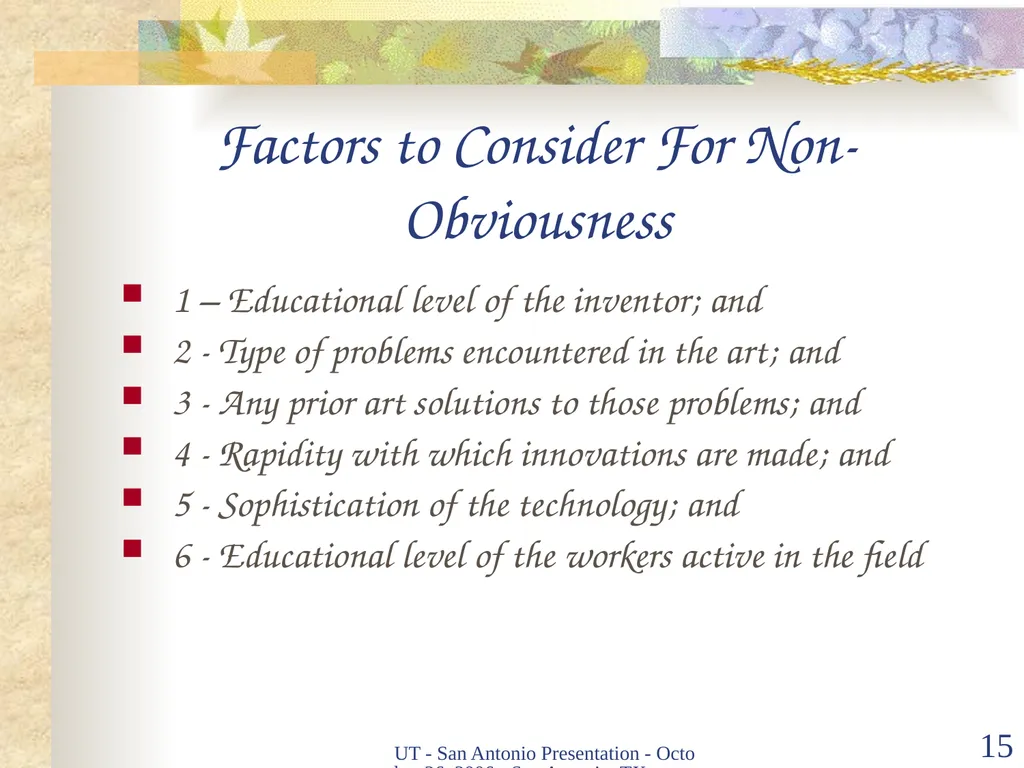
15
UT - San Antonio Presentation - October 26, 2006 - San Antonio, TX 15 Factors to Consider For Non-Obviousness 1 – Educational level of the inventor; and
2 - Type of problems encountered in the art; and
3 - Any prior art solutions to those problems; and
4 - Rapidity with which innovations are made; and
5 - Sophistication of the technology; and
6 - Educational level of the workers active in the field<br>
2 - Type of problems encountered in the art; and
3 - Any prior art solutions to those problems; and
4 - Rapidity with which innovations are made; and
5 - Sophistication of the technology; and
6 - Educational level of the workers active in the field<br>
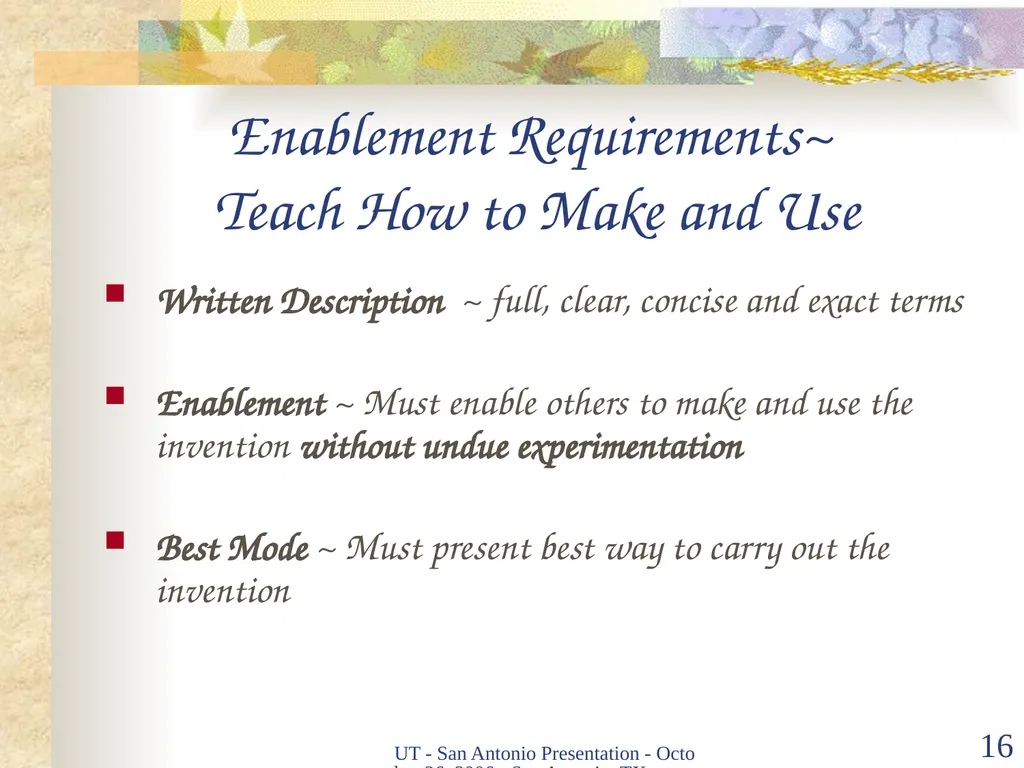
16
UT - San Antonio Presentation - October 26, 2006 - San Antonio, TX 16 Enablement Requirements~
Teach How to Make and Use Written Description ~ full, clear, concise and exact terms
Enablement ~ Must enable others to make and use the invention without undue experimentation
Best Mode ~ Must present best way to carry out the invention<br>
Enablement ~ Must enable others to make and use the invention without undue experimentation
Best Mode ~ Must present best way to carry out the invention<br>
17
UT - San Antonio Presentation - October 26, 2006 - San Antonio, TX 17 Non-Infringement
Patent Disputes Inventorship disputes – defining inventorship is difficult
Interferences – who was the first to invent
Ownership – research agreements, MTA’s
Most turn on who did what and when<br>
Interferences – who was the first to invent
Ownership – research agreements, MTA’s
Most turn on who did what and when<br>
18
UT - San Antonio Presentation - October 26, 2006 - San Antonio, TX 18 One Final Point ~
Patenting Strategies Develop a Patent Claim Drafting Strategy
Select Type(s) of Claims
Prioritize Goals for Maximum Protection
Include Licensing Safeguards
Analyze Potential Revenue Flow ~ Carefully Define Field of Use
Analyze Target Infringers
Address all Statutory Hurdles<br>
Select Type(s) of Claims
Prioritize Goals for Maximum Protection
Include Licensing Safeguards
Analyze Potential Revenue Flow ~ Carefully Define Field of Use
Analyze Target Infringers
Address all Statutory Hurdles<br>
19
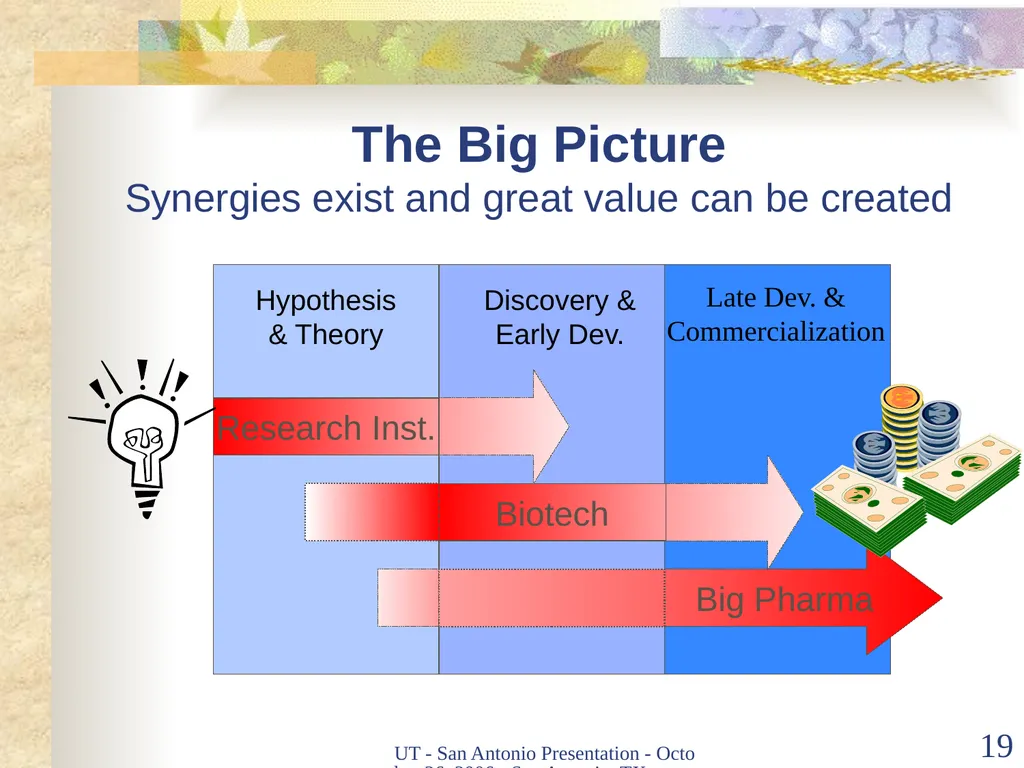
UT - San Antonio Presentation - October 26, 2006 - San Antonio, TX 19 The Big Picture
Synergies exist and great value can be created Hypothesis
& Theory Discovery &
Early Dev. Late Dev. &
Commercialization<br>
Synergies exist and great value can be created Hypothesis
& Theory Discovery &
Early Dev. Late Dev. &
Commercialization<br>
20
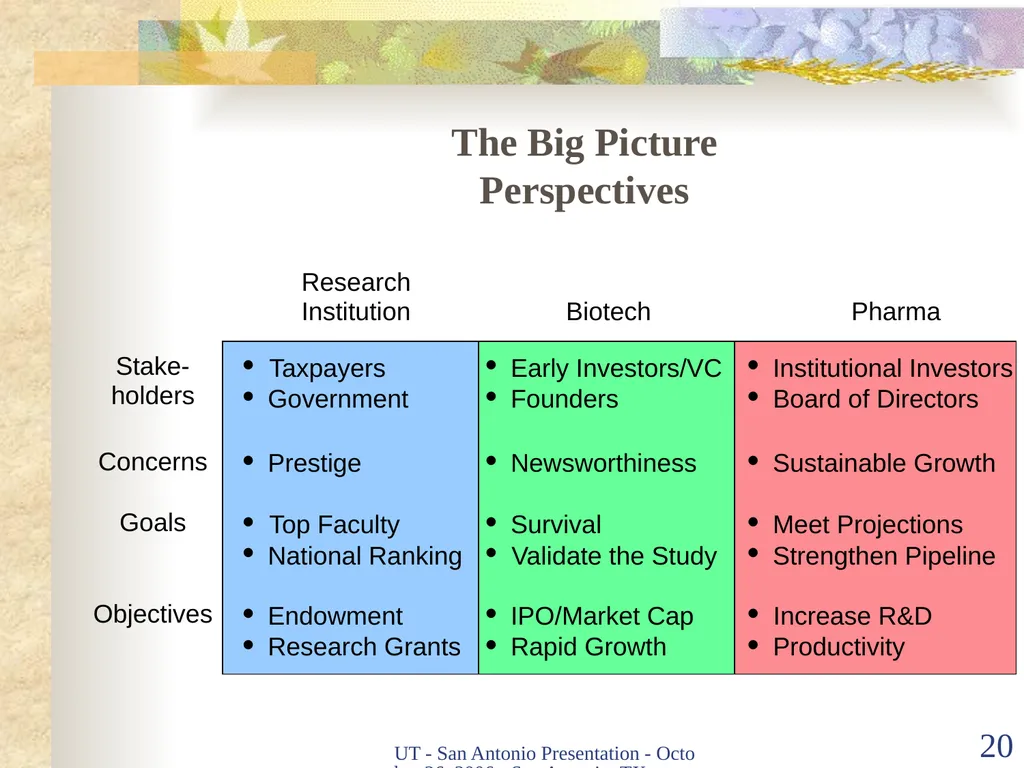
UT - San Antonio Presentation - October 26, 2006 - San Antonio, TX 20 The Big Picture
Perspectives<br>
21
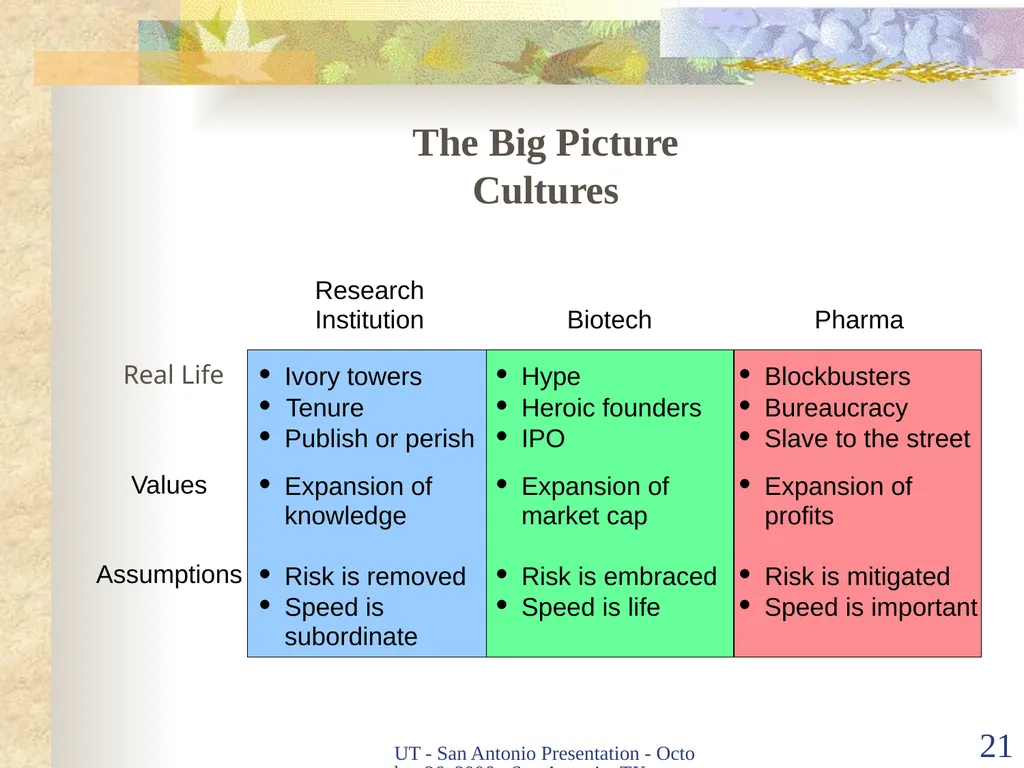
UT - San Antonio Presentation - October 26, 2006 - San Antonio, TX 21 The Big Picture
Cultures<br>
22
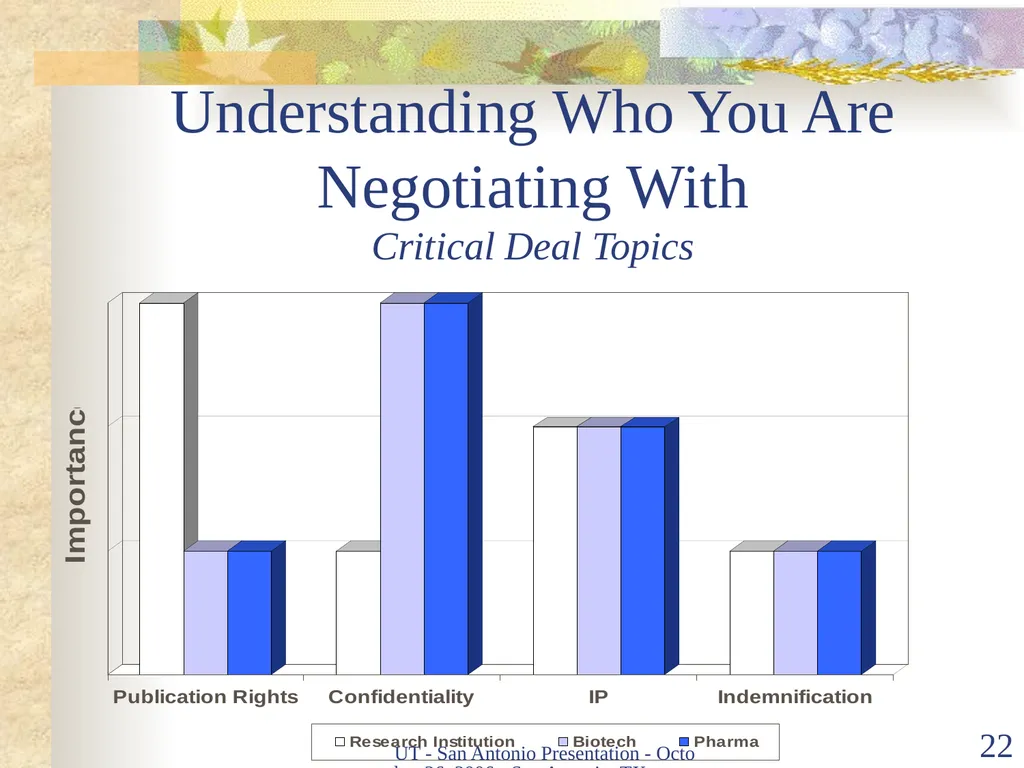
UT - San Antonio Presentation - October 26, 2006 - San Antonio, TX 22 Understanding Who You Are Negotiating With
Critical Deal Topics<br>
23
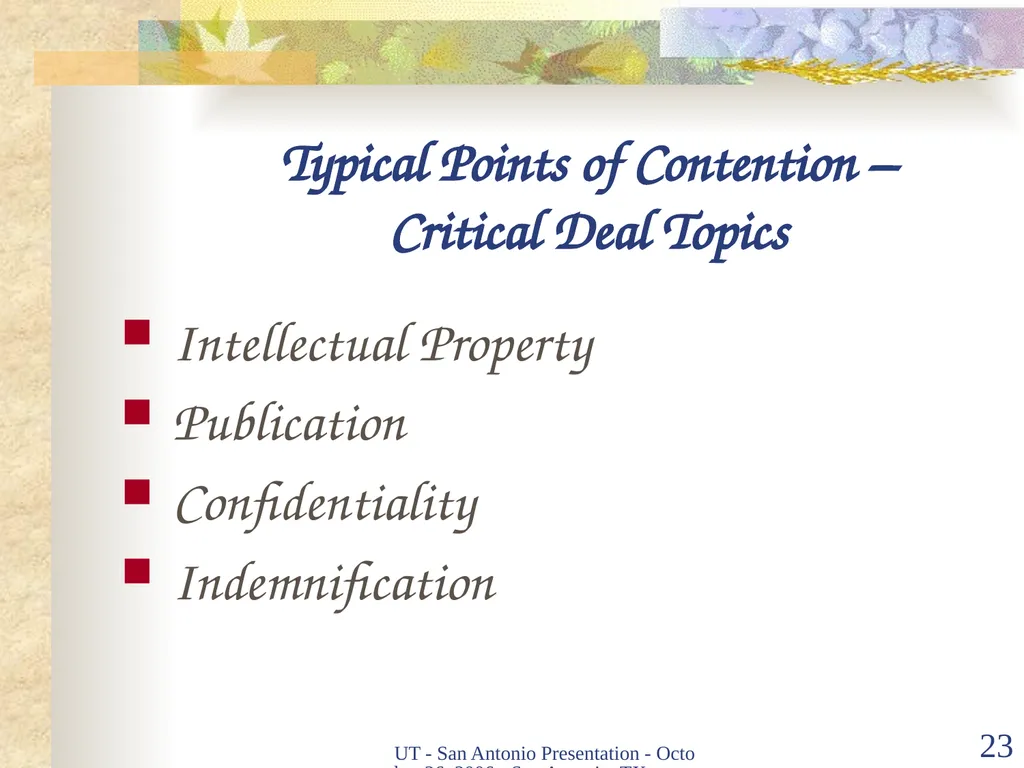
UT - San Antonio Presentation - October 26, 2006 - San Antonio, TX 23 Typical Points of Contention –
Critical Deal Topics Intellectual Property
Publication
Confidentiality
Indemnification<br>
Publication
Confidentiality
Indemnification<br>
24
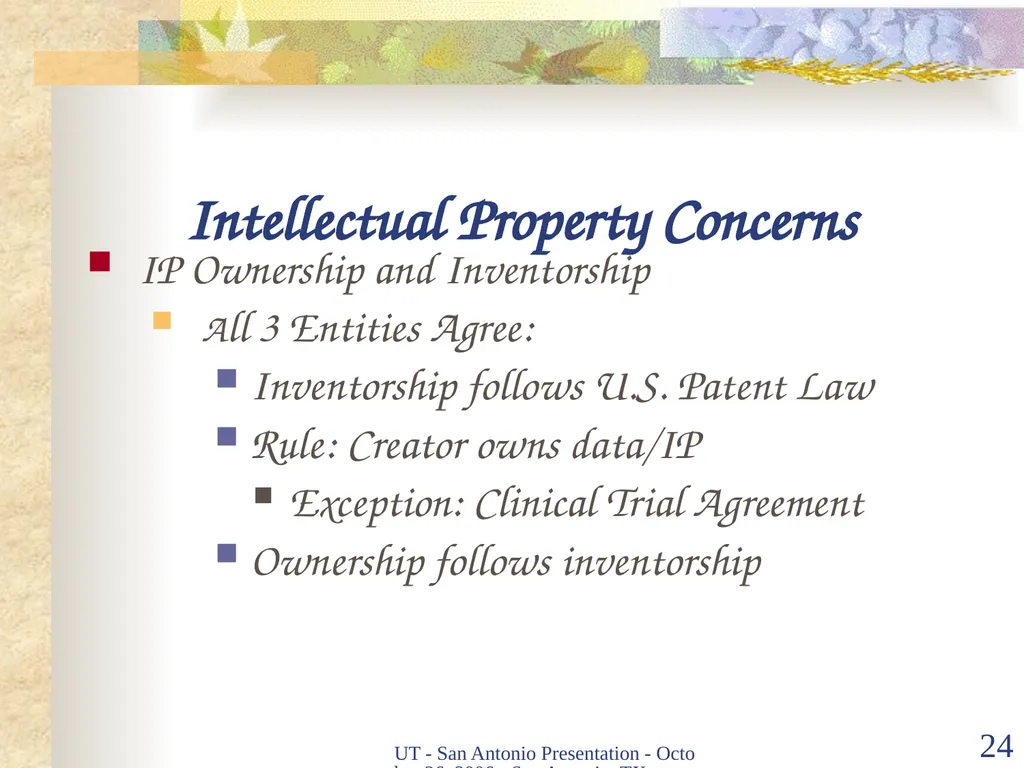
UT - San Antonio Presentation - October 26, 2006 - San Antonio, TX 24 Intellectual Property Concerns IP Ownership and Inventorship
All 3 Entities Agree:
Inventorship follows U.S. Patent Law
Rule: Creator owns data/IP
Exception: Clinical Trial Agreement
Ownership follows inventorship<br>
All 3 Entities Agree:
Inventorship follows U.S. Patent Law
Rule: Creator owns data/IP
Exception: Clinical Trial Agreement
Ownership follows inventorship<br>
25
UT - San Antonio Presentation - October 26, 2006 - San Antonio, TX 25 How is Inventorship Determined? Definition
According to US Patent Law
Different from authorship
Why can’t UTSA decide in advance who the inventor will be for IP resulting from the research<br>
According to US Patent Law
Different from authorship
Why can’t UTSA decide in advance who the inventor will be for IP resulting from the research<br>
26
UT - San Antonio Presentation - October 26, 2006 - San Antonio, TX 26 Intellectual Property Should be Treated Same for All Agreements
Sponsored Research Agreement
Material Transfer Agreement
Clinical Trial Agreement<br>
Sponsored Research Agreement
Material Transfer Agreement
Clinical Trial Agreement<br>
27
UT - San Antonio Presentation - October 26, 2006 - San Antonio, TX 27 Ideal IP Clause
for All Agreements What you invent is yours
What I invent is mine
What we jointly invent is jointly owned
Inventorship follows US patent law
Ownership follows inventorship
$$$ does NOT equal ownership<br>
What I invent is mine
What we jointly invent is jointly owned
Inventorship follows US patent law
Ownership follows inventorship
$$$ does NOT equal ownership<br>
28
UT - San Antonio Presentation - October 26, 2006 - San Antonio, TX 28 Why Can’t UTSA Give Unknown IP Away To Sponsor Before It Is Created? Who owns the IP once it is created?
Board of Regents of The UT System
Use of State of Texas resources, personnel and equipment
Adequate compensation for IP
How can that be determined if you don’t know what the IP is?<br>
Board of Regents of The UT System
Use of State of Texas resources, personnel and equipment
Adequate compensation for IP
How can that be determined if you don’t know what the IP is?<br>
29
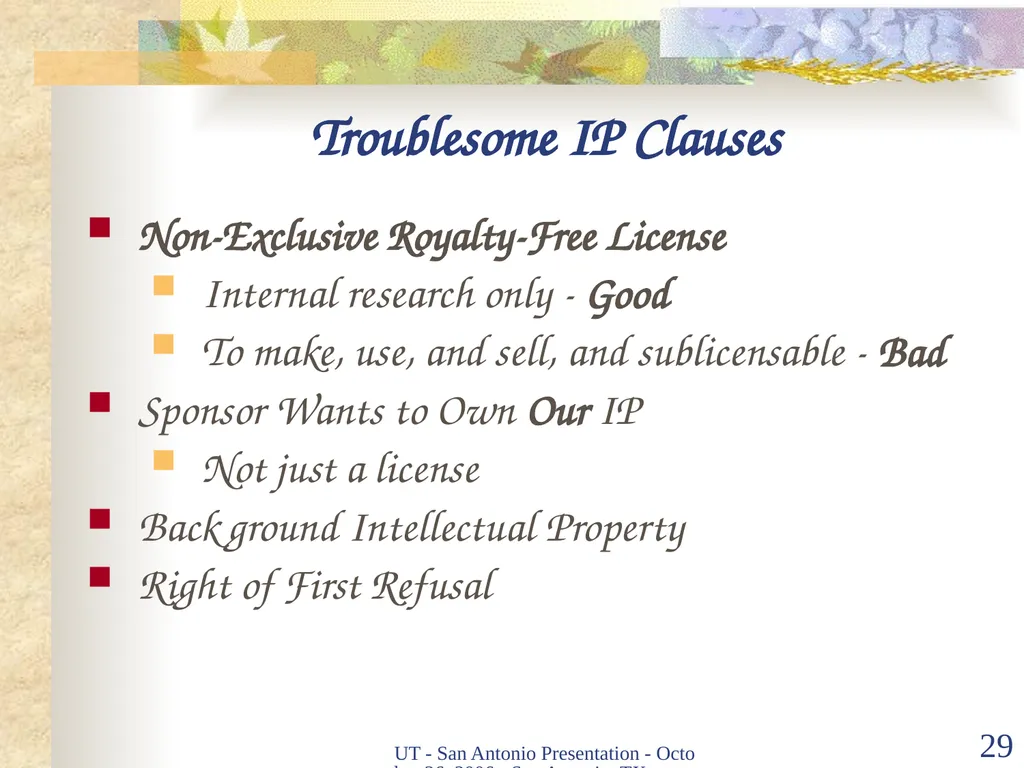
UT - San Antonio Presentation - October 26, 2006 - San Antonio, TX 29 Troublesome IP Clauses Non-Exclusive Royalty-Free License
Internal research only - Good
To make, use, and sell, and sublicensable - Bad
Sponsor Wants to Own Our IP
Not just a license
Background Intellectual Property
Right of First Refusal<br>
Internal research only - Good
To make, use, and sell, and sublicensable - Bad
Sponsor Wants to Own Our IP
Not just a license
Background Intellectual Property
Right of First Refusal<br>
30
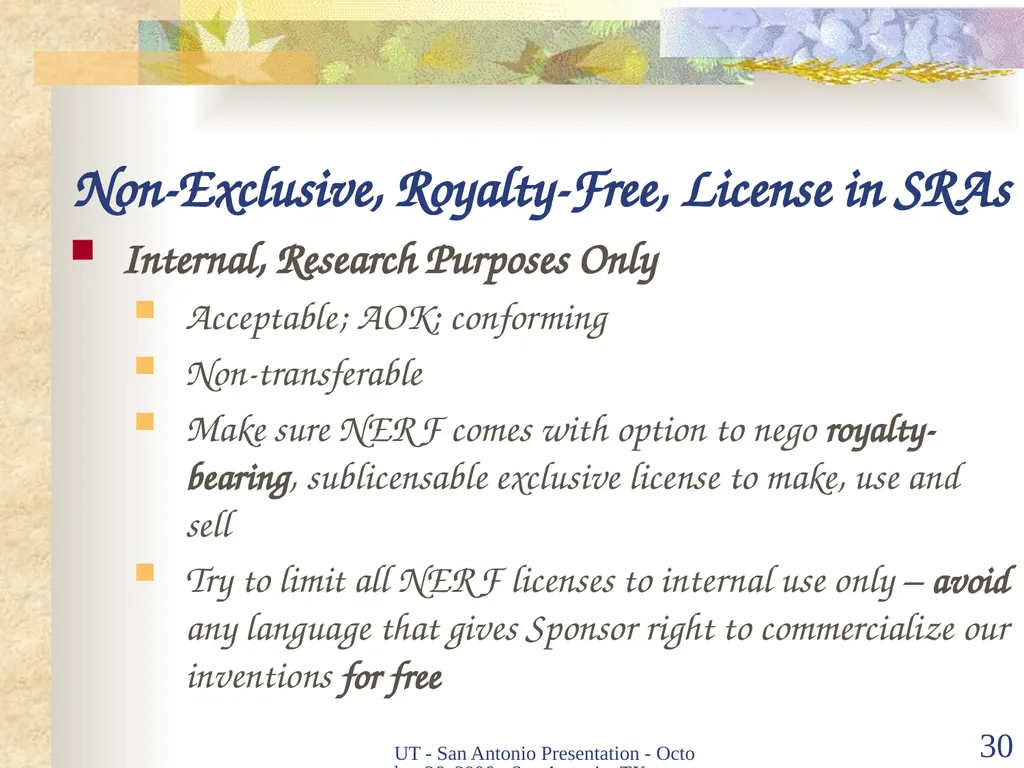
UT - San Antonio Presentation - October 26, 2006 - San Antonio, TX 30 Non-Exclusive, Royalty-Free, License in SRAs Internal, Research Purposes Only
Acceptable; AOK; conforming
Non-transferable
Make sure NERF comes with option to nego royalty-bearing, sublicensable exclusive license to make, use and sell
Try to limit all NERF licenses to internal use only – avoid any language that gives Sponsor right to commercialize our inventions for free<br>
Acceptable; AOK; conforming
Non-transferable
Make sure NERF comes with option to nego royalty-bearing, sublicensable exclusive license to make, use and sell
Try to limit all NERF licenses to internal use only – avoid any language that gives Sponsor right to commercialize our inventions for free<br>
31
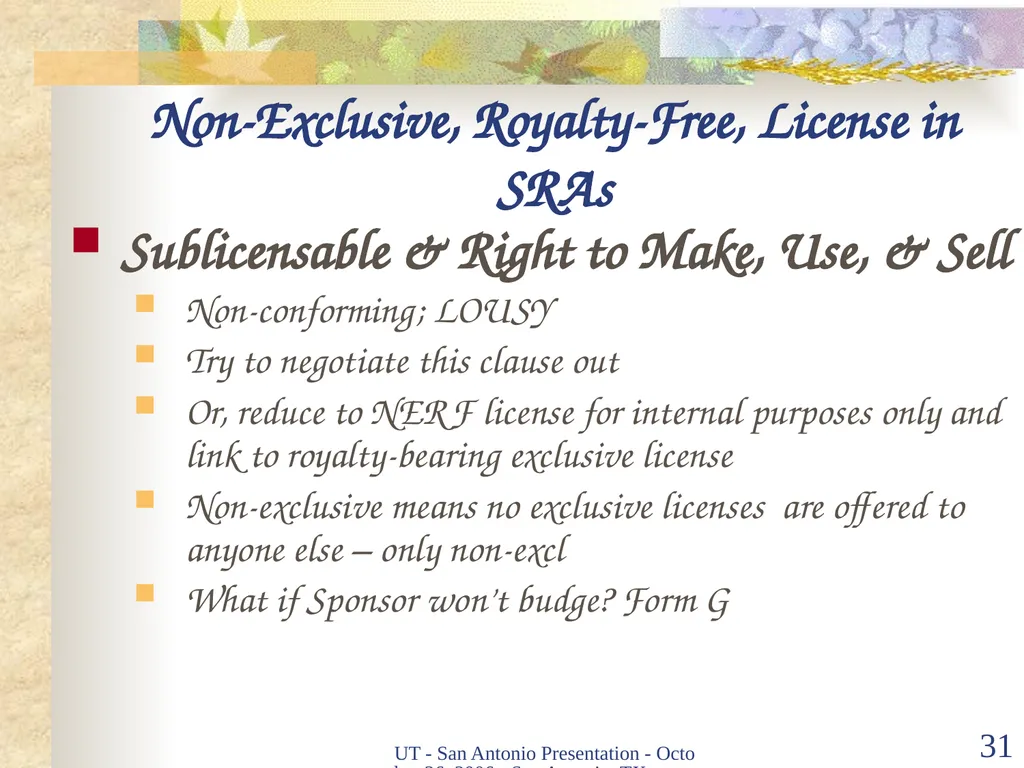
UT - San Antonio Presentation - October 26, 2006 - San Antonio, TX 31 Non-Exclusive, Royalty-Free, License in SRAs Sublicensable & Right to Make, Use, & Sell
Non-conforming; LOUSY
Try to negotiate this clause out
Or, reduce to NERF license for internal purposes only and link to royalty-bearing exclusive license
Non-exclusive means no exclusive licenses are offered to anyone else – only non-excl
What if Sponsor won’t budge? Form G<br>
Non-conforming; LOUSY
Try to negotiate this clause out
Or, reduce to NERF license for internal purposes only and link to royalty-bearing exclusive license
Non-exclusive means no exclusive licenses are offered to anyone else – only non-excl
What if Sponsor won’t budge? Form G<br>
32
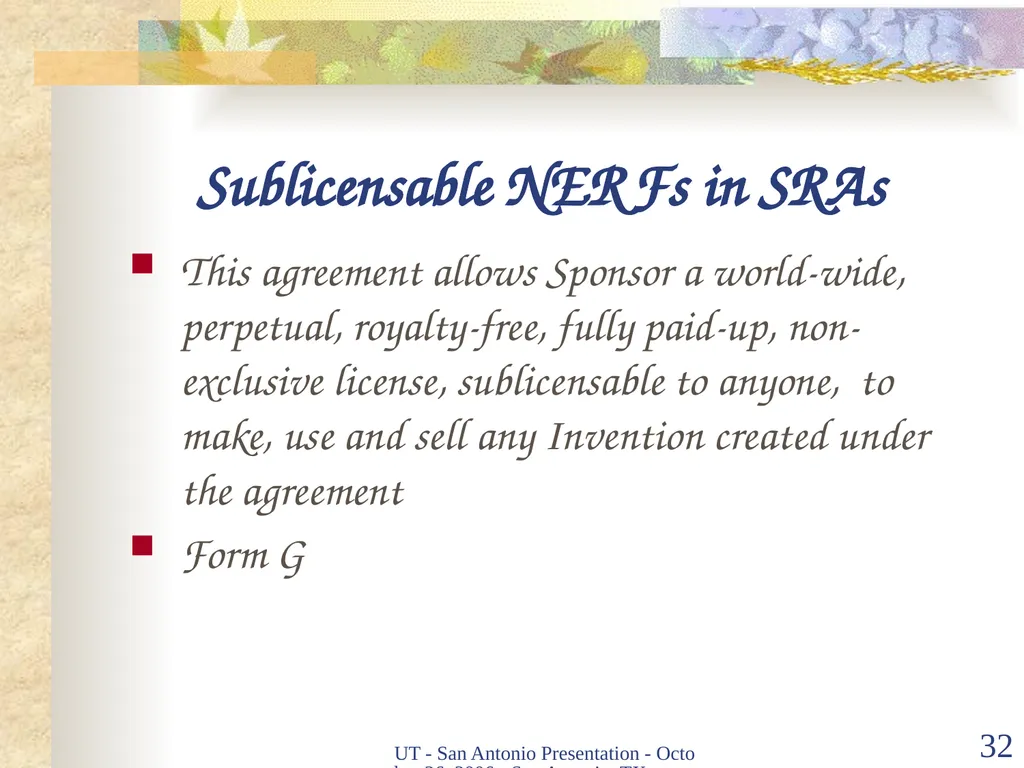
UT - San Antonio Presentation - October 26, 2006 - San Antonio, TX 32 Sublicensable NERFs in SRAs This agreement allows Sponsor a world-wide, perpetual, royalty-free, fully paid-up, non-exclusive license, sublicensable to anyone, to make, use and sell any Invention created under the agreement
Form G<br>
Form G<br>
33
UT - San Antonio Presentation - October 26, 2006 - San Antonio, TX 33 What if Sponsor Wants to Own Our IP? Not Okay in Sponsored Research Ag
$$ does not equal ownership
We should own what we invent
Grant royalty-bearing license, make, use, or sell
Grant NERF license for internal purposes only
Okay in Limited Instances
Sponsor Initiated Clinical Trial Agreement
Why is it okay here and not elsewhere???
Not Okay in PI initiated CTAs. Why?<br>
$$ does not equal ownership
We should own what we invent
Grant royalty-bearing license, make, use, or sell
Grant NERF license for internal purposes only
Okay in Limited Instances
Sponsor Initiated Clinical Trial Agreement
Why is it okay here and not elsewhere???
Not Okay in PI initiated CTAs. Why?<br>
34
UT - San Antonio Presentation - October 26, 2006 - San Antonio, TX 34 Clinical Trial Agreements Sponsor Initiated CTA
Okay for Sponsor to own IP – Why?
Principal Investigator Initiated CTA
Institution should own IP
Sponsor will usually insist on owning our IP
Jointly Initiated CTA
Both Institution and Sponsor should own IP<br>
Okay for Sponsor to own IP – Why?
Principal Investigator Initiated CTA
Institution should own IP
Sponsor will usually insist on owning our IP
Jointly Initiated CTA
Both Institution and Sponsor should own IP<br>
35
UT - San Antonio Presentation - October 26, 2006 - San Antonio, TX 35 Background IP What is it?
Stuff you own going into an Agreement
Why would Sponsor want it?
What should you do?
Don’t agree to BIP
OR – narrowly define it to one piece of IP
Problems with Background IP
Scope
Identify it
Limit it to one PI
Control it
Compare to Foreground IP<br>
Stuff you own going into an Agreement
Why would Sponsor want it?
What should you do?
Don’t agree to BIP
OR – narrowly define it to one piece of IP
Problems with Background IP
Scope
Identify it
Limit it to one PI
Control it
Compare to Foreground IP<br>
36
UT - San Antonio Presentation - October 26, 2006 - San Antonio, TX 36 Right of First Refusal What is it?
Gives the holder the right to meet any other offer before the proposed contract is accepted.
When Sponsor has a NERF license and does not exercise its option to negotiate an exclusive, royalty-bearing license
AND, reserves a right of first refusal
What Does it Mean?
If you negotiate an exclusive, royalty-bearing license with another company, before you sign contract, you have to offer that deal to Sponsor.<br>
Gives the holder the right to meet any other offer before the proposed contract is accepted.
When Sponsor has a NERF license and does not exercise its option to negotiate an exclusive, royalty-bearing license
AND, reserves a right of first refusal
What Does it Mean?
If you negotiate an exclusive, royalty-bearing license with another company, before you sign contract, you have to offer that deal to Sponsor.<br>
37
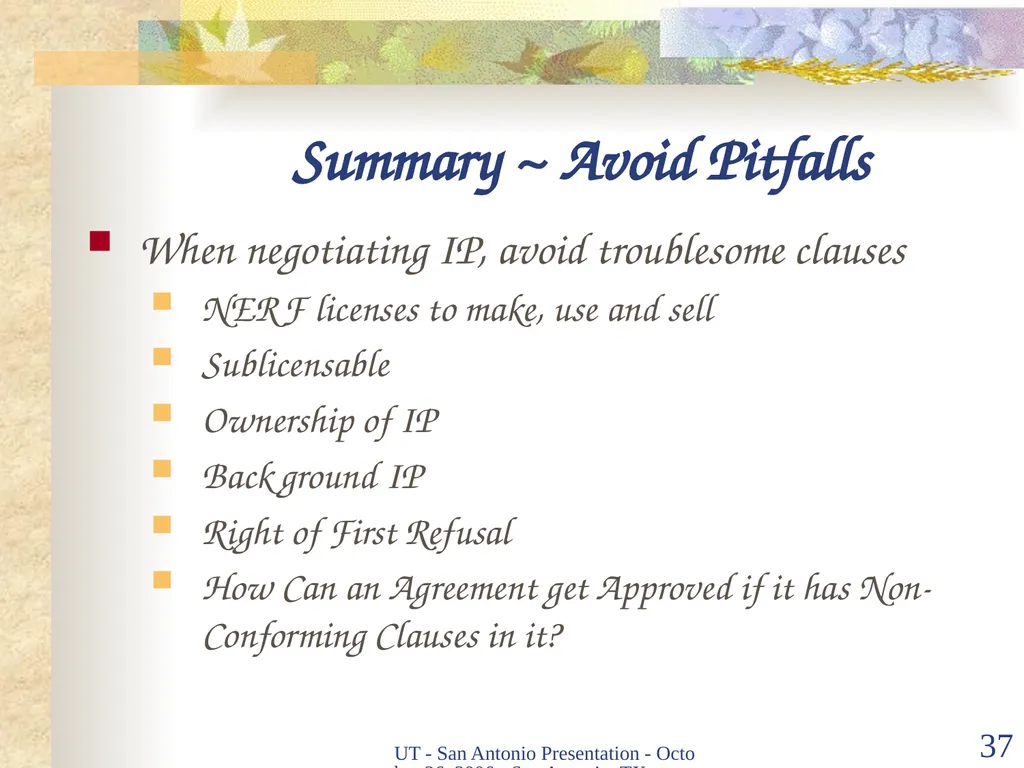
UT - San Antonio Presentation - October 26, 2006 - San Antonio, TX 37 Summary ~ Avoid Pitfalls When negotiating IP, avoid troublesome clauses
NERF licenses to make, use and sell
Sublicensable
Ownership of IP
Background IP
Right of First Refusal
How Can an Agreement get Approved if it has Non-Conforming Clauses in it?<br>
NERF licenses to make, use and sell
Sublicensable
Ownership of IP
Background IP
Right of First Refusal
How Can an Agreement get Approved if it has Non-Conforming Clauses in it?<br>
38
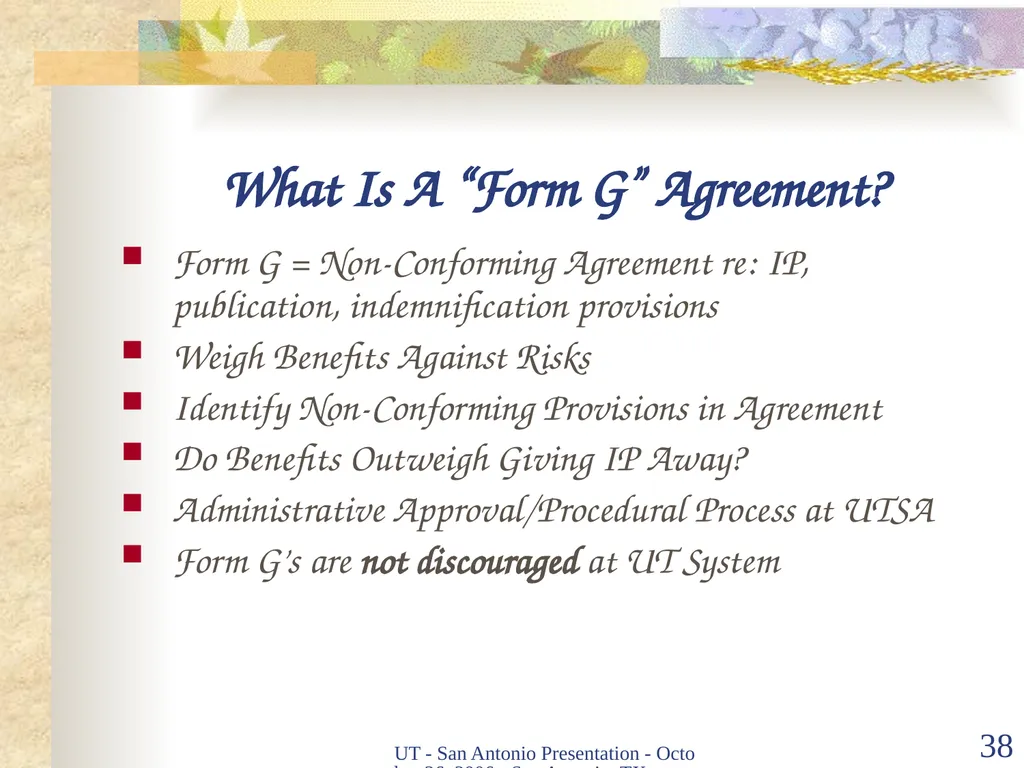
UT - San Antonio Presentation - October 26, 2006 - San Antonio, TX 38 What Is A “Form G” Agreement? Form G = Non-Conforming Agreement re: IP, publication, indemnification provisions
Weigh Benefits Against Risks
Identify Non-Conforming Provisions in Agreement
Do Benefits Outweigh Giving IP Away?
Administrative Approval/Procedural Process at UTSA
Form G’s are not discouraged at UT System<br>
Weigh Benefits Against Risks
Identify Non-Conforming Provisions in Agreement
Do Benefits Outweigh Giving IP Away?
Administrative Approval/Procedural Process at UTSA
Form G’s are not discouraged at UT System<br>
39
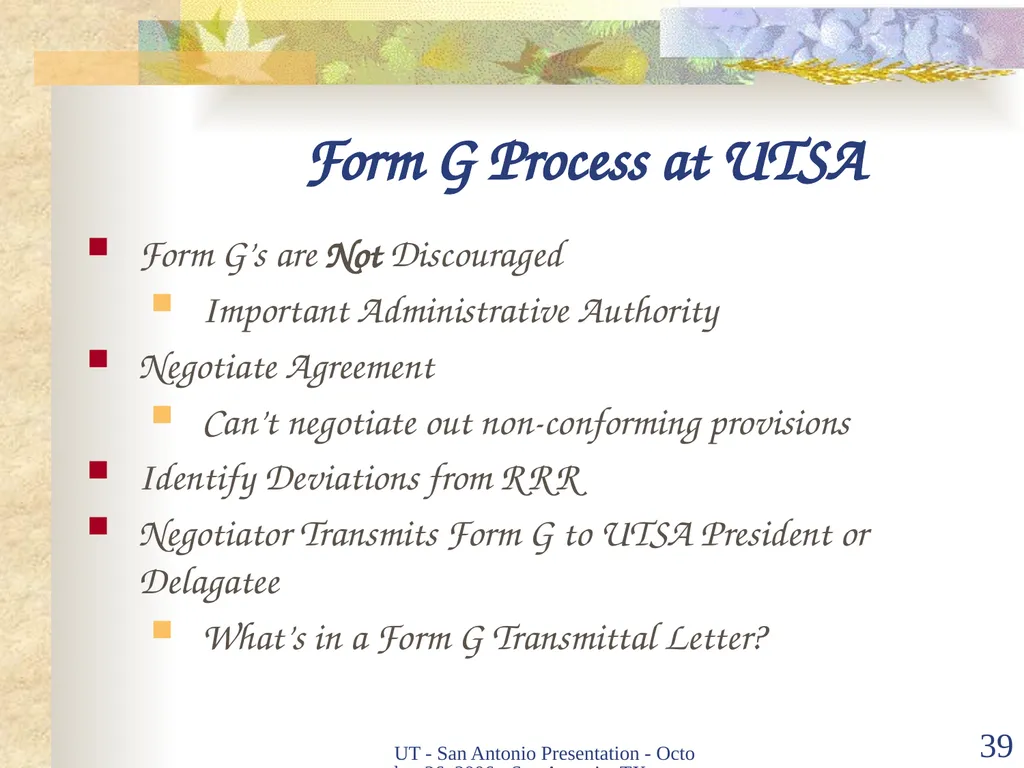
UT - San Antonio Presentation - October 26, 2006 - San Antonio, TX 39 Form G Process at UTSA Form G’s are Not Discouraged
Important Administrative Authority
Negotiate Agreement
Can’t negotiate out non-conforming provisions
Identify Deviations from RRR
Negotiator Transmits Form G to UTSA President or Delagatee
What’s in a Form G Transmittal Letter?<br>
Important Administrative Authority
Negotiate Agreement
Can’t negotiate out non-conforming provisions
Identify Deviations from RRR
Negotiator Transmits Form G to UTSA President or Delagatee
What’s in a Form G Transmittal Letter?<br>
40
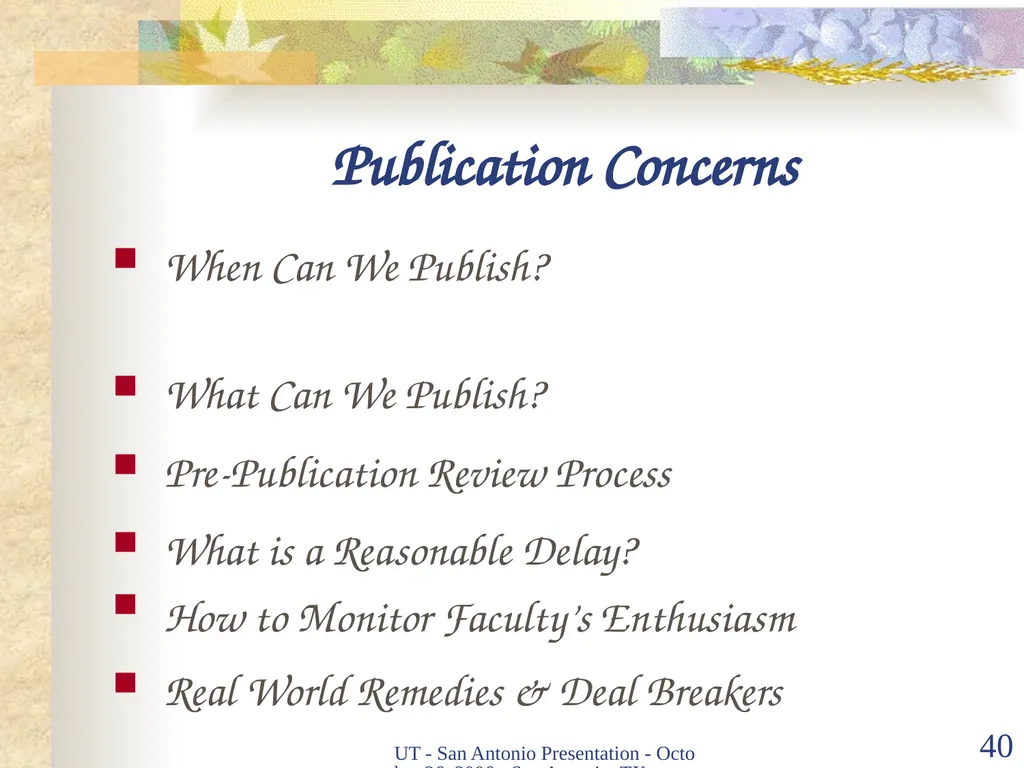
UT - San Antonio Presentation - October 26, 2006 - San Antonio, TX 40 Publication Concerns When Can We Publish?
What Can We Publish?
Pre-Publication Review Process
What is a Reasonable Delay?
How to Monitor Faculty’s Enthusiasm
Real World Remedies & Deal Breakers<br>
What Can We Publish?
Pre-Publication Review Process
What is a Reasonable Delay?
How to Monitor Faculty’s Enthusiasm
Real World Remedies & Deal Breakers<br>
41
UT - San Antonio Presentation - October 26, 2006 - San Antonio, TX 41 When/How Can We Publish?
Research Institutions – Non-Negotiable Preserve Institution/Principal Investigator’s absolute right to publish
Sponsor cannot “control” our publication rights or “approve” contents of publication
Cross reference right to publish in confidentiality and ownership of data §§
Principal Investigator owns the copyright in his/her publications<br>
Sponsor cannot “control” our publication rights or “approve” contents of publication
Cross reference right to publish in confidentiality and ownership of data §§
Principal Investigator owns the copyright in his/her publications<br>
42
UT - San Antonio Presentation - October 26, 2006 - San Antonio, TX 42 Pre-Publication Review Process
Research Institutions All 3 understand why the review is necessary
Constantly reminding other 2 that we need unrestricted publication rights
Review periods must be reasonable
Need to educate our faculty to submit sooner instead of later<br>
Constantly reminding other 2 that we need unrestricted publication rights
Review periods must be reasonable
Need to educate our faculty to submit sooner instead of later<br>
43
UT - San Antonio Presentation - October 26, 2006 - San Antonio, TX 43 When Can We Publish?
Research Institutions - Negotiable Review periods
Must be reasonable
Balance publish or perish
Length of review period
30 - 60 days for manuscripts and 15 for abstracts – longer times discussed with and initialed by PI
Delay publication to protect intellectual property
Must be reasonable delay and must be specified
Average ~ 60 – 90 additional days for filing
Multi-site/center clinical trial studies
Preserve Institution/PI’s right to publish separate from multi-site joint publication after reasonable delay
Reasonable delays permitted until joint publication is published OR 12 – 18 months after our study is over (whichever is shorter)<br>
Must be reasonable
Balance publish or perish
Length of review period
30 - 60 days for manuscripts and 15 for abstracts – longer times discussed with and initialed by PI
Delay publication to protect intellectual property
Must be reasonable delay and must be specified
Average ~ 60 – 90 additional days for filing
Multi-site/center clinical trial studies
Preserve Institution/PI’s right to publish separate from multi-site joint publication after reasonable delay
Reasonable delays permitted until joint publication is published OR 12 – 18 months after our study is over (whichever is shorter)<br>
44
UT - San Antonio Presentation - October 26, 2006 - San Antonio, TX 44 What Can We Publish?
Research Institutions We must have an unrestricted right to publish
We want to publish everything
Publish or perish – educate faculty
Balance between publishing all versus publishing enough data to support conclusions
If data and results are made confidential:
Delete section that makes data/results confidential
Preserve absolute right to publish info that supports conclusions
Problems with young data (not raw data)
Company/Sponsor wants to delay publishing until data is matured (or is it now stale?). Data is not like fine wine.<br>
We want to publish everything
Publish or perish – educate faculty
Balance between publishing all versus publishing enough data to support conclusions
If data and results are made confidential:
Delete section that makes data/results confidential
Preserve absolute right to publish info that supports conclusions
Problems with young data (not raw data)
Company/Sponsor wants to delay publishing until data is matured (or is it now stale?). Data is not like fine wine.<br>
45
UT - San Antonio Presentation - October 26, 2006 - San Antonio, TX 45 How to Monitor
Faculty’s Enthusiasm
Research Institutions Once it is out of the bag …
Educate, educate, educate
Stress importance of “no headlines”
Emphasize their reputation is at stake
Administrative oversight<br>
Educate, educate, educate
Stress importance of “no headlines”
Emphasize their reputation is at stake
Administrative oversight<br>
46
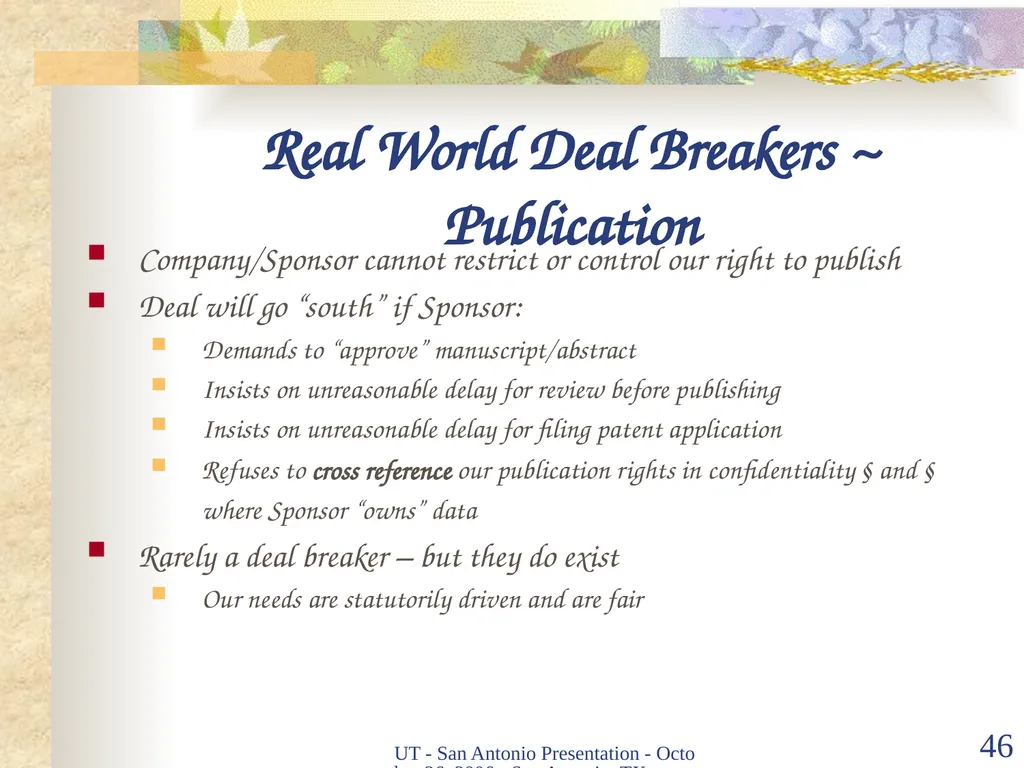
UT - San Antonio Presentation - October 26, 2006 - San Antonio, TX 46 Real World Deal Breakers ~ Publication Company/Sponsor cannot restrict or control our right to publish
Deal will go “south” if Sponsor:
Demands to “approve” manuscript/abstract
Insists on unreasonable delay for review before publishing
Insists on unreasonable delay for filing patent application
Refuses to cross reference our publication rights in confidentiality § and § where Sponsor “owns” data
Rarely a deal breaker – but they do exist
Our needs are statutorily driven and are fair<br>
Deal will go “south” if Sponsor:
Demands to “approve” manuscript/abstract
Insists on unreasonable delay for review before publishing
Insists on unreasonable delay for filing patent application
Refuses to cross reference our publication rights in confidentiality § and § where Sponsor “owns” data
Rarely a deal breaker – but they do exist
Our needs are statutorily driven and are fair<br>
47
UT - San Antonio Presentation - October 26, 2006 - San Antonio, TX 47 Ideal Publication Clause ~
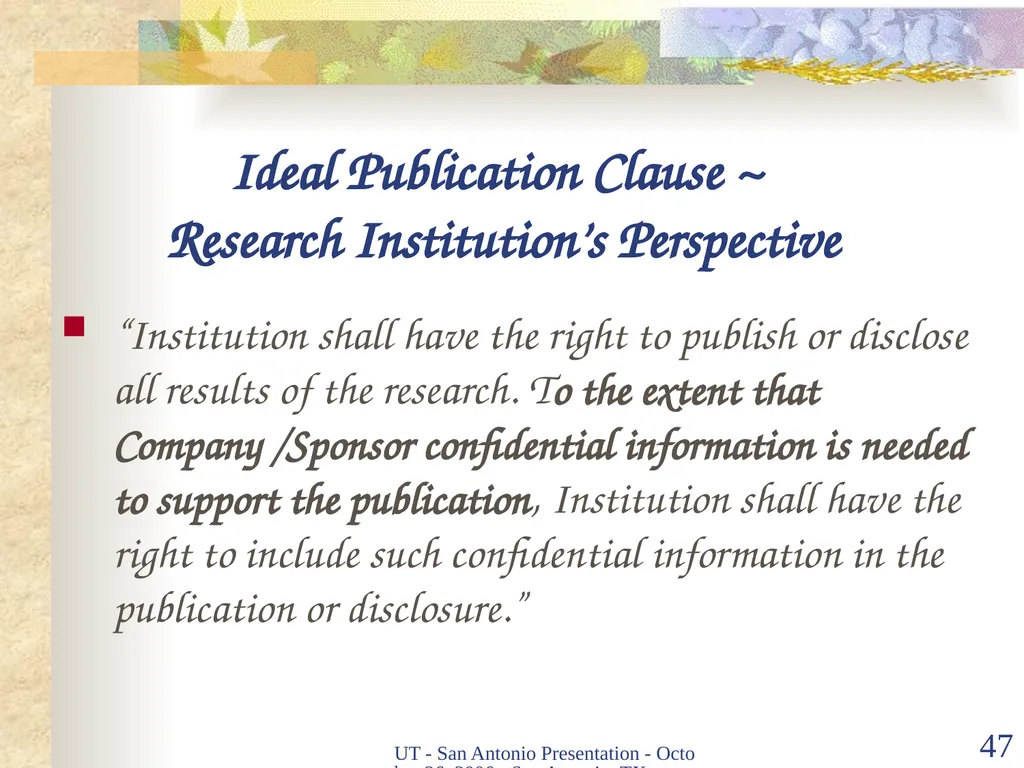
Research Institution’s Perspective “Institution shall have the right to publish or disclose all results of the research. To the extent that Company /Sponsor confidential information is needed to support the publication, Institution shall have the right to include such confidential information in the publication or disclosure.”<br>
48
UT - San Antonio Presentation - October 26, 2006 - San Antonio, TX 48 Ideal Publication Clause ~
Industry’s Perspective “Institution shall not publish or disclose any results of the research.”<br>
49
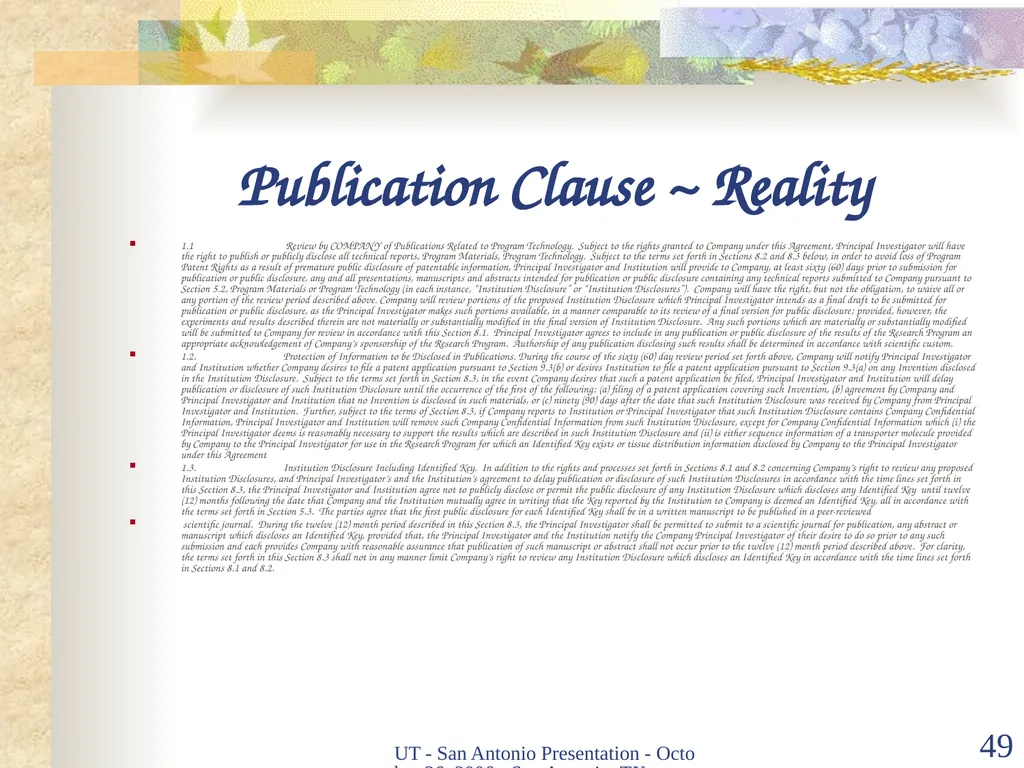
UT - San Antonio Presentation - October 26, 2006 - San Antonio, TX 49 Publication Clause ~ Reality 1.1 Review by COMPANY of Publications Related to Program Technology. Subject to the rights granted to Company under this Agreement, Principal Investigator will have the right to publish or publicly disclose all technical reports, Program Materials, Program Technology. Subject to the terms set forth in Sections 8.2 and 8.3 below, in order to avoid loss of Program Patent Rights as a result of premature public disclosure of patentable information, Principal Investigator and Institution will provide to Company, at least sixty (60) days prior to submission for publication or public disclosure, any and all presentations, manuscripts and abstracts intended for publication or public disclosure containing any technical reports submitted to Company pursuant to Section 5.2, Program Materials or Program Technology (in each instance, “Institution Disclosure” or “Institution Disclosures”). Company will have the right, but not the obligation, to waive all or any portion of the review period described above. Company will review portions of the proposed Institution Disclosure which Principal Investigator intends as a final draft to be submitted for publication or public disclosure, as the Principal Investigator makes such portions available, in a manner comparable to its review of a final version for public disclosure; provided, however, the experiments and results described therein are not materially or substantially modified in the final version of Institution Disclosure. Any such portions which are materially or substantially modified will be submitted to Company for review in accordance with this Section 8.1. Principal Investigator agrees to include in any publication or public disclosure of the results of the Research Program an appropriate acknowledgement of Company’s sponsorship of the Research Program. Authorship of any publication disclosing such results shall be determined in accordance with scientific custom.
1.2. Protection of Information to be Disclosed in Publications. During the course of the sixty (60) day review period set forth above, Company will notify Principal Investigator and Institution whether Company desires to file a patent application pursuant to Section 9.3(b) or desires Institution to file a patent application pursuant to Section 9.3(a) on any Invention disclosed in the Institution Disclosure. Subject to the terms set forth in Section 8.3, in the event Company desires that such a patent application be filed, Principal Investigator and Institution will delay publication or disclosure of such Institution Disclosure until the occurrence of the first of the following: (a) filing of a patent application covering such Invention, (b) agreement by Company and Principal Investigator and Institution that no Invention is disclosed in such materials, or (c) ninety (90) days after the date that such Institution Disclosure was received by Company from Principal Investigator and Institution. Further, subject to the terms of Section 8.3, if Company reports to Institution or Principal Investigator that such Institution Disclosure contains Company Confidential Information, Principal Investigator and Institution will remove such Company Confidential Information from such Institution Disclosure, except for Company Confidential Information which (i) the Principal Investigator deems is reasonably necessary to support the results which are described in such Institution Disclosure and (ii) is either sequence information of a transporter molecule provided by Company to the Principal Investigator for use in the Research Program for which an Identified Key exists or tissue distribution information disclosed by Company to the Principal Investigator under this Agreement
1.3. Institution Disclosure Including Identified Key. In addition to the rights and processes set forth in Sections 8.1 and 8.2 concerning Company’s right to review any proposed Institution Disclosures, and Principal Investigator’s and the Institution’s agreement to delay publication or disclosure of such Institution Disclosures in accordance with the time lines set forth in this Section 8.3, the Principal Investigator and Institution agree not to publicly disclose or permit the public disclosure of any Institution Disclosure which discloses any Identified Key until twelve (12) months following the date that Company and the Institution mutually agree in writing that the Key reported by the Institution to Company is deemed an Identified Key, all in accordance with the terms set forth in Section 5.3. The parties agree that the first public disclosure for each Identified Key shall be in a written manuscript to be published in a peer-reviewed
scientific journal. During the twelve (12) month period described in this Section 8.3, the Principal Investigator shall be permitted to submit to a scientific journal for publication, any abstract or manuscript which discloses an Identified Key, provided that, the Principal Investigator and the Institution notify the Company Principal Investigator of their desire to do so prior to any such submission and each provides Company with reasonable assurance that publication of such manuscript or abstract shall not occur prior to the twelve (12) month period described above. For clarity, the terms set forth in this Section 8.3 shall not in any manner limit Company’s right to review any Institution Disclosure which discloses an Identified Key in accordance with the time lines set forth in Sections 8.1 and 8.2.<br>
1.2. Protection of Information to be Disclosed in Publications. During the course of the sixty (60) day review period set forth above, Company will notify Principal Investigator and Institution whether Company desires to file a patent application pursuant to Section 9.3(b) or desires Institution to file a patent application pursuant to Section 9.3(a) on any Invention disclosed in the Institution Disclosure. Subject to the terms set forth in Section 8.3, in the event Company desires that such a patent application be filed, Principal Investigator and Institution will delay publication or disclosure of such Institution Disclosure until the occurrence of the first of the following: (a) filing of a patent application covering such Invention, (b) agreement by Company and Principal Investigator and Institution that no Invention is disclosed in such materials, or (c) ninety (90) days after the date that such Institution Disclosure was received by Company from Principal Investigator and Institution. Further, subject to the terms of Section 8.3, if Company reports to Institution or Principal Investigator that such Institution Disclosure contains Company Confidential Information, Principal Investigator and Institution will remove such Company Confidential Information from such Institution Disclosure, except for Company Confidential Information which (i) the Principal Investigator deems is reasonably necessary to support the results which are described in such Institution Disclosure and (ii) is either sequence information of a transporter molecule provided by Company to the Principal Investigator for use in the Research Program for which an Identified Key exists or tissue distribution information disclosed by Company to the Principal Investigator under this Agreement
1.3. Institution Disclosure Including Identified Key. In addition to the rights and processes set forth in Sections 8.1 and 8.2 concerning Company’s right to review any proposed Institution Disclosures, and Principal Investigator’s and the Institution’s agreement to delay publication or disclosure of such Institution Disclosures in accordance with the time lines set forth in this Section 8.3, the Principal Investigator and Institution agree not to publicly disclose or permit the public disclosure of any Institution Disclosure which discloses any Identified Key until twelve (12) months following the date that Company and the Institution mutually agree in writing that the Key reported by the Institution to Company is deemed an Identified Key, all in accordance with the terms set forth in Section 5.3. The parties agree that the first public disclosure for each Identified Key shall be in a written manuscript to be published in a peer-reviewed
scientific journal. During the twelve (12) month period described in this Section 8.3, the Principal Investigator shall be permitted to submit to a scientific journal for publication, any abstract or manuscript which discloses an Identified Key, provided that, the Principal Investigator and the Institution notify the Company Principal Investigator of their desire to do so prior to any such submission and each provides Company with reasonable assurance that publication of such manuscript or abstract shall not occur prior to the twelve (12) month period described above. For clarity, the terms set forth in this Section 8.3 shall not in any manner limit Company’s right to review any Institution Disclosure which discloses an Identified Key in accordance with the time lines set forth in Sections 8.1 and 8.2.<br>
50
UT - San Antonio Presentation - October 26, 2006 - San Antonio, TX 50 Confidentiality Concerns
Research Institutions vs. Biotech Company vs. Big Pharma Length of Confidentiality Obligations
Balancing Reasonable with Realistic
How to Prevent Leakage<br>
Balancing Reasonable with Realistic
How to Prevent Leakage<br>
51
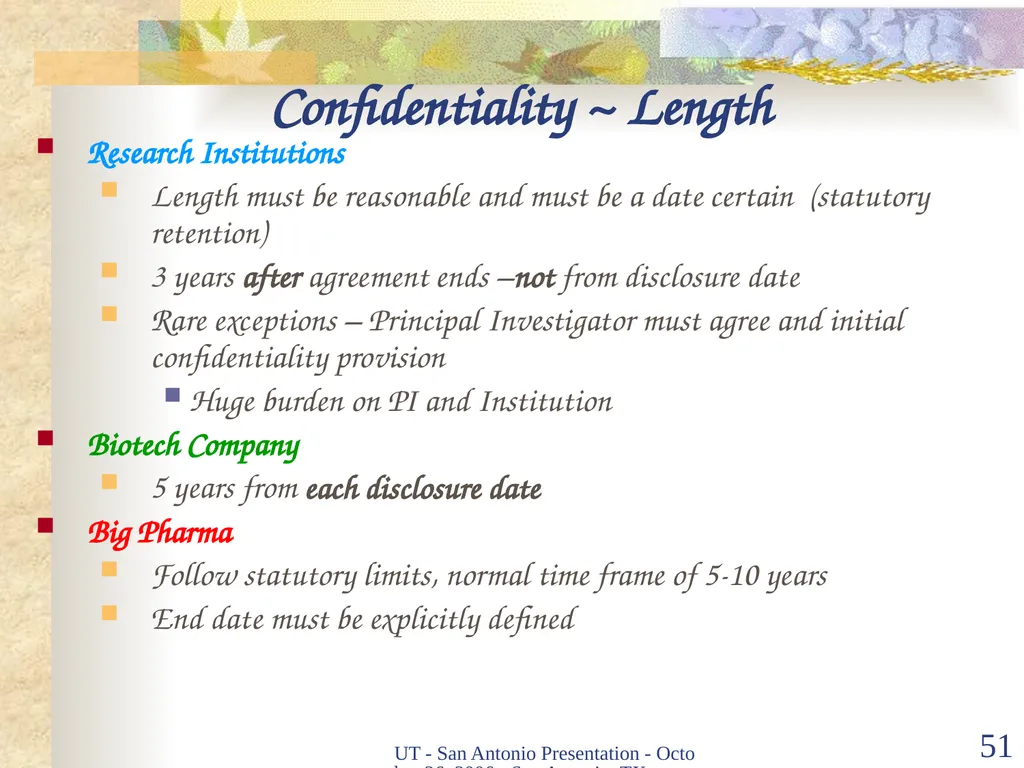
UT - San Antonio Presentation - October 26, 2006 - San Antonio, TX 51 Confidentiality ~ Length Research Institutions
Length must be reasonable and must be a date certain (statutory retention)
3 years after agreement ends –not from disclosure date
Rare exceptions – Principal Investigator must agree and initial confidentiality provision
Huge burden on PI and Institution
Biotech Company
5 years from each disclosure date
Big Pharma
Follow statutory limits, normal time frame of 5-10 years
End date must be explicitly defined<br>
Length must be reasonable and must be a date certain (statutory retention)
3 years after agreement ends –not from disclosure date
Rare exceptions – Principal Investigator must agree and initial confidentiality provision
Huge burden on PI and Institution
Biotech Company
5 years from each disclosure date
Big Pharma
Follow statutory limits, normal time frame of 5-10 years
End date must be explicitly defined<br>
52
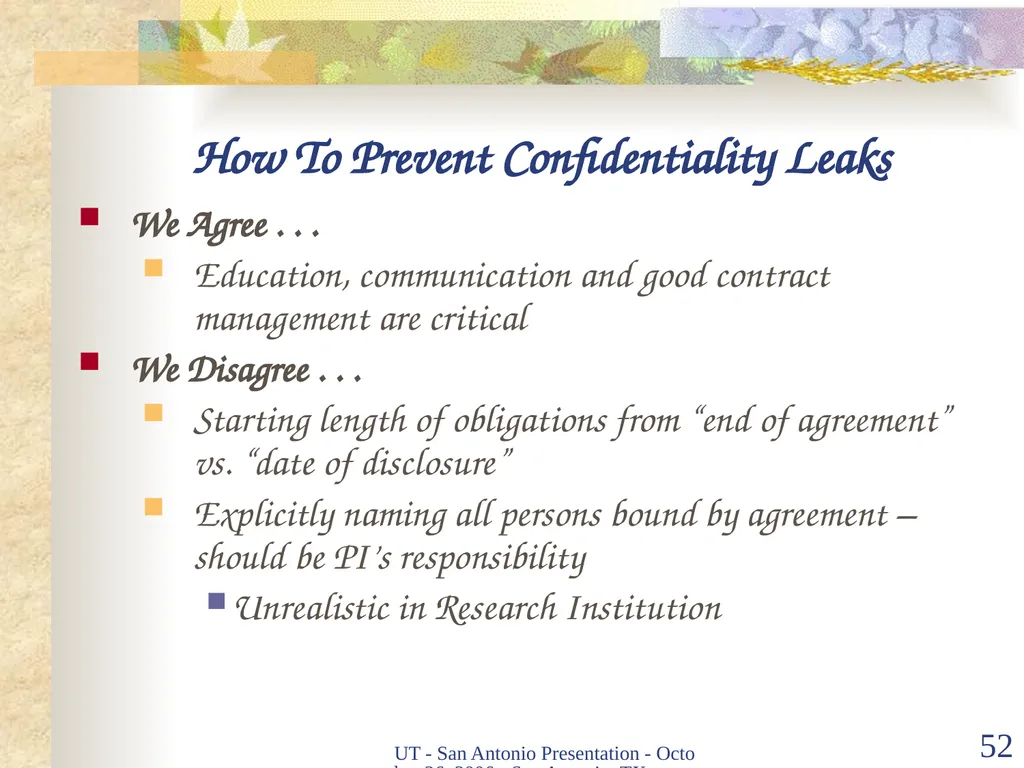
UT - San Antonio Presentation - October 26, 2006 - San Antonio, TX 52 How To Prevent Confidentiality Leaks We Agree . . .
Education, communication and good contract management are critical
We Disagree . . .
Starting length of obligations from “end of agreement” vs. “date of disclosure”
Explicitly naming all persons bound by agreement – should be PI’s responsibility
Unrealistic in Research Institution<br>
Education, communication and good contract management are critical
We Disagree . . .
Starting length of obligations from “end of agreement” vs. “date of disclosure”
Explicitly naming all persons bound by agreement – should be PI’s responsibility
Unrealistic in Research Institution<br>
53
UT - San Antonio Presentation - October 26, 2006 - San Antonio, TX 53 Indemnification Concerns Needs
Allocation of Risk in Clinical Setting
Real World Deal Breakers<br>
Allocation of Risk in Clinical Setting
Real World Deal Breakers<br>
54
UT - San Antonio Presentation - October 26, 2006 - San Antonio, TX 54 Our Indemnification Needs Seek broadest indemnification possible
Full indemnity – Sponsor’s drug/Sponsor’s protocol – Institution does what Sponsor says (“arising out of the activities…”)
Product liability
Defects in design or manufacture of drug
Sponsor’s negligence
Use of Institution’s results - least amount of coverage
Institution’s protocol; and
Sponsor has little or no control over what Institution does;
Then Sponsor must indemnify Institution for Sponsor’s use of Institution’s results
Institution can only indemnify Sponsor for Institution’s negligence (to the extent authorized by Constitution and laws of State of Texas<br>
Full indemnity – Sponsor’s drug/Sponsor’s protocol – Institution does what Sponsor says (“arising out of the activities…”)
Product liability
Defects in design or manufacture of drug
Sponsor’s negligence
Use of Institution’s results - least amount of coverage
Institution’s protocol; and
Sponsor has little or no control over what Institution does;
Then Sponsor must indemnify Institution for Sponsor’s use of Institution’s results
Institution can only indemnify Sponsor for Institution’s negligence (to the extent authorized by Constitution and laws of State of Texas<br>
55
UT - San Antonio Presentation - October 26, 2006 - San Antonio, TX 55 Our Indemnification Needs Must include proper parties
System, Regents, Institution, officers, employees, agents
Should cover all kinds of claims
Claims, demands, costs, liabilities, or judgments
Should broadly cover us if we do exactly what Sponsor directs us to do – “Full Indemnity”
“Arising out of the activities to be carried out under this Ag”
Should also include Sponsor’s use of our results
Carve-outs
Our negligence voids Sponsor’s indemnification
If Sponsor wants to control the defense – “subject to the statutory duties of the Texas Attorney General”<br>
System, Regents, Institution, officers, employees, agents
Should cover all kinds of claims
Claims, demands, costs, liabilities, or judgments
Should broadly cover us if we do exactly what Sponsor directs us to do – “Full Indemnity”
“Arising out of the activities to be carried out under this Ag”
Should also include Sponsor’s use of our results
Carve-outs
Our negligence voids Sponsor’s indemnification
If Sponsor wants to control the defense – “subject to the statutory duties of the Texas Attorney General”<br>
56
UT - San Antonio Presentation - October 26, 2006 - San Antonio, TX 56 Indemnification ~
Allocation of Risk Sponsor’s Protocol and Sponsor’s Drug
We receive no $ from Sponsor after Study is done
Sponsor stands to gain a lot of money from the study
Sponsor must broadly indemnify us if we do exactly what Sponsor directs us to do (“Full Indemnity”)
Institution’s Protocol and Sponsor’s Drug
Sponsor should bear all risk b/c it stands to gain a lot financially
Sponsor must also indemnify us for its use of our results
Sponsor can control defense and settlement only …
“subject to the statutory duties of the Texas Attorney General”<br>
We receive no $ from Sponsor after Study is done
Sponsor stands to gain a lot of money from the study
Sponsor must broadly indemnify us if we do exactly what Sponsor directs us to do (“Full Indemnity”)
Institution’s Protocol and Sponsor’s Drug
Sponsor should bear all risk b/c it stands to gain a lot financially
Sponsor must also indemnify us for its use of our results
Sponsor can control defense and settlement only …
“subject to the statutory duties of the Texas Attorney General”<br>
57
UT - San Antonio Presentation - October 26, 2006 - San Antonio, TX 57 Indemnification ~
Real World Deal Breakers Sponsor won’t broadly indemnify us for following their protocol and using their drug
Sponsor wants a mirror indemnity - not only ‘as to our negligence’
Sponsor won’t indemnify us for its use of our results (standard CTA and principal investigator initiated protocol)
Sponsor won’t agree to include language that allows them to control defense<br>
Sponsor wants a mirror indemnity - not only ‘as to our negligence’
Sponsor won’t indemnify us for its use of our results (standard CTA and principal investigator initiated protocol)
Sponsor won’t agree to include language that allows them to control defense<br>
58
UT - San Antonio Presentation - October 26, 2006 - San Antonio, TX 58 SUMMARY Critical Deal Concepts That May Profoundly Impact Your Negotiations:
Intellectual Property
Publication
Confidentiality
Indemnification<br>
Intellectual Property
Publication
Confidentiality
Indemnification<br>