Intellectual Property Rights and Limits on HFCs: Pathways Forward Steve Seidel OEWG, Vienna July 15, 2016 Background Intellectual Property Rights: OEWG, Vienna 2 Center for Climate and Energy Solutions An independent, nonpartisan, nonprofit
"Intellectual Property Rights and Limits on HFCs:" is the property of its rightful owner. Permission is granted to
download and print the materials on this website for personal, non-commercial use only, and to display it
on your personal computer provided you do not modify the materials and that you retain all copyright
notices contained in the materials. By downloading content from our website, you accept the terms of this
agreement.
Presentation Transcript
01
Intellectual Property Rights and Limits on HFCs: Pathways Forward Steve Seidel OEWG, Vienna July 15, 2016<br>
02
Background Intellectual Property Rights: OEWG, Vienna 2 Center for Climate and Energy Solutions
An independent, nonpartisan, nonprofit organization working to advance strong policy and action to address our climate and energy challenges.
Launched in 2011, C2ES is the successor to the Pew Center on Global Climate Change, long recognized in the United States and abroad as an influential and pragmatic voice on climate issues.<br>
03
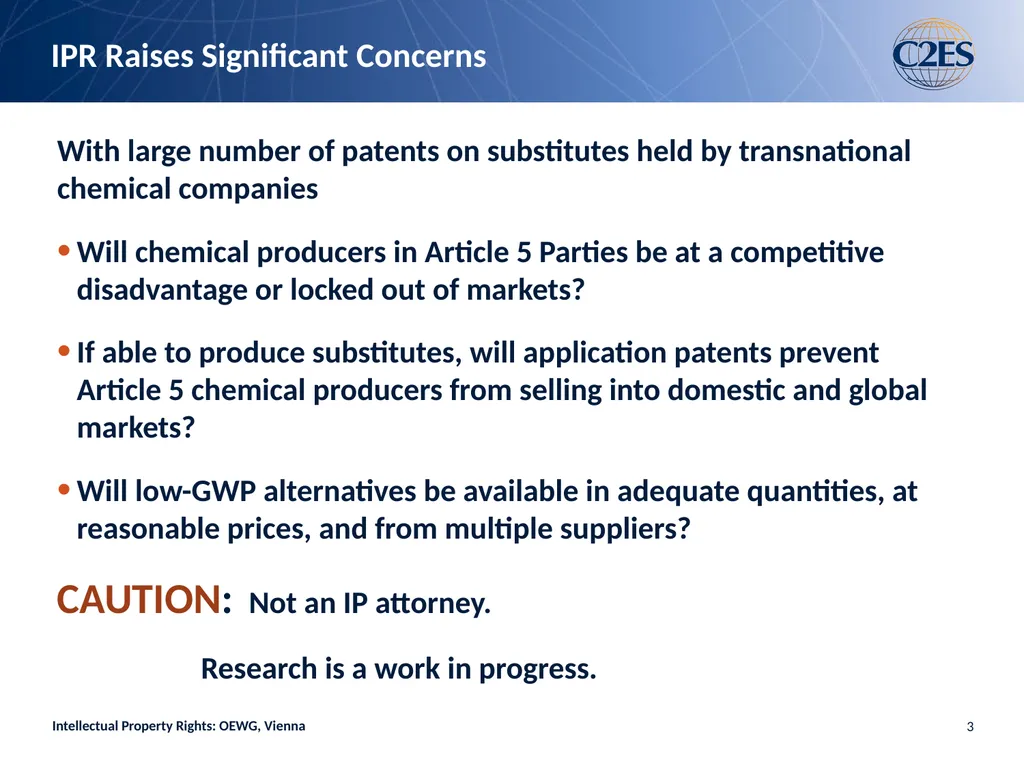
IPR Raises Significant Concerns Intellectual Property Rights: OEWG, Vienna 3 With large number of patents on substitutes held by transnational chemical companies
Will chemical producers in Article 5 Parties be at a competitive disadvantage or locked out of markets?
If able to produce substitutes, will application patents prevent Article 5 chemical producers from selling into domestic and global markets?
Will low-GWP alternatives be available in adequate quantities, at reasonable prices, and from multiple suppliers?
CAUTION: Not an IP attorney.
Research is a work in progress.<br>
04
Overview Intellectual Property Rights: OEWG, Vienna 4 Four possible pathways/solutions to address these concerns:
Role of the Multilateral Fund in paying for patents and licensing fees
Standard commercial arrangements (licensing, joint ventures)
Expiration dates for some key patents
Legal challenges to some key patents
All could play a role going forward
But first a few basics about IPR………<br>
05
IPR Basics Intellectual Property Rights: OEWG, Vienna 5 Patents seek to balance goals both of rewarding and advancing innovation.
Time-limited exclusivity in return for making innovative information public
Only applicable in country where patent filed – vast majority of Article 5 Parties not directly impacted
Expire after 20 years, but when clock starts ticking is critical
Not new or unique to fluorocarbons, but number of patents have increased
Patents and royalties an issue in 1990 when Protocol’s MLF established
Patents in three areas relevant here
Production process patents (to make HFO-1234yf)
Composition and use/application patents (to use yf in mobile AC)
Equipment patents (design of compressor or other ac component)<br>
06
Solutions: Multilateral Fund (MLF) Pays for Patents or Licensing Intellectual Property Rights: OEWG, Vienna 6 Indicative list of categories of incremental costs guides what the MLF pays for
Includes “cost of patents and design and incremental costs of royalties” for
Converting existing production facilities
Establishing new production facilities
Use in manufacturing as an intermediate good (e.g., refrigerators, foam, aerosols)
General principles also guide funding decisions
Most cost-effective and efficient option taking into account industrial strategy of recipient Party (cost-effectiveness thresholds)
Avoid double counting, limits on payments of operational costs<br>
07
Past Experience under MLF Intellectual Property Rights: OEWG, Vienna 7 To what extent have patents been paid for by MLF?
Several areas where patents and licensing fees played a role:
Technology sector guidelines developed by the Executive Committee
Small number of investment projects where fees explicitly paid
Vast majority of projects either patent costs embedded in technology costs or technology not covered by patent<br>
08
Why Patents Paid for In So few Projects? Intellectual Property Rights: OEWG, Vienna 8 Many alternative technologies in the public domain
Never subject to a patent or patent had expired
MLF focus on proven, widely available, cost-effective technologies
Some cases of patents voluntarily made available for use
Significant shift to not-in-kind alternatives (NIKs)
Could be more cases where patent costs are incurred
Depends on timing of investments (compared to expiration of patents) and role of NIKs<br>
09
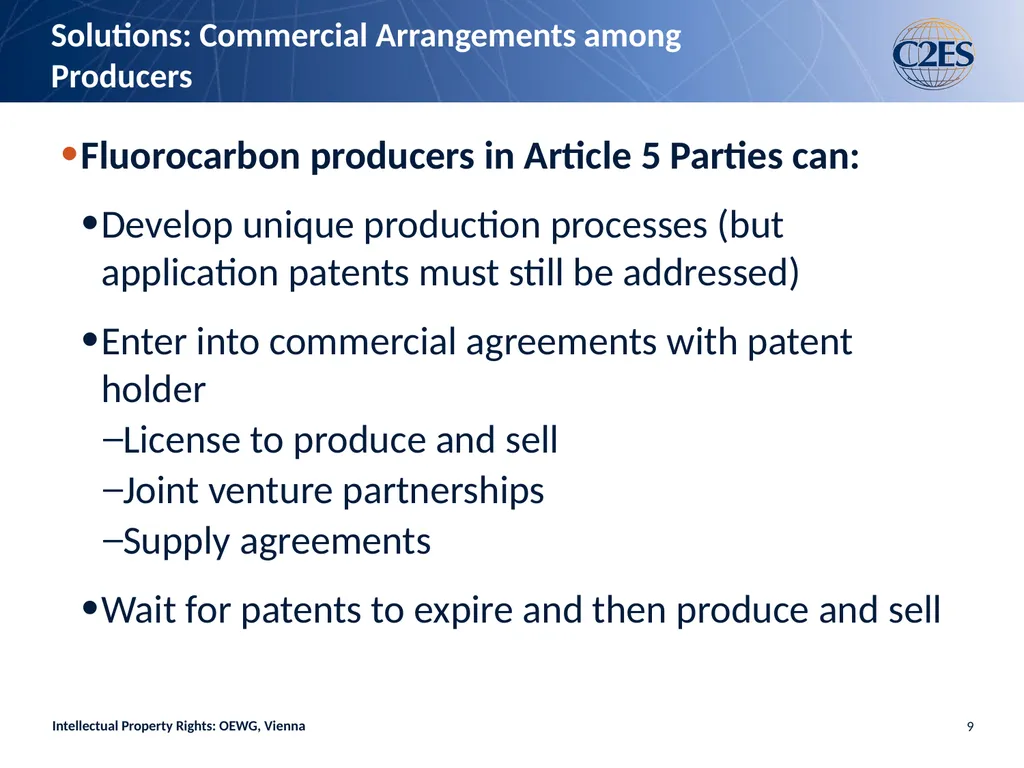
Solutions: Commercial Arrangements among Producers Intellectual Property Rights: OEWG, Vienna 9 Fluorocarbon producers in Article 5 Parties can:
Develop unique production processes (but application patents must still be addressed)
Enter into commercial agreements with patent holder
License to produce and sell
Joint venture partnerships
Supply agreements
Wait for patents to expire and then produce and sell<br>
10
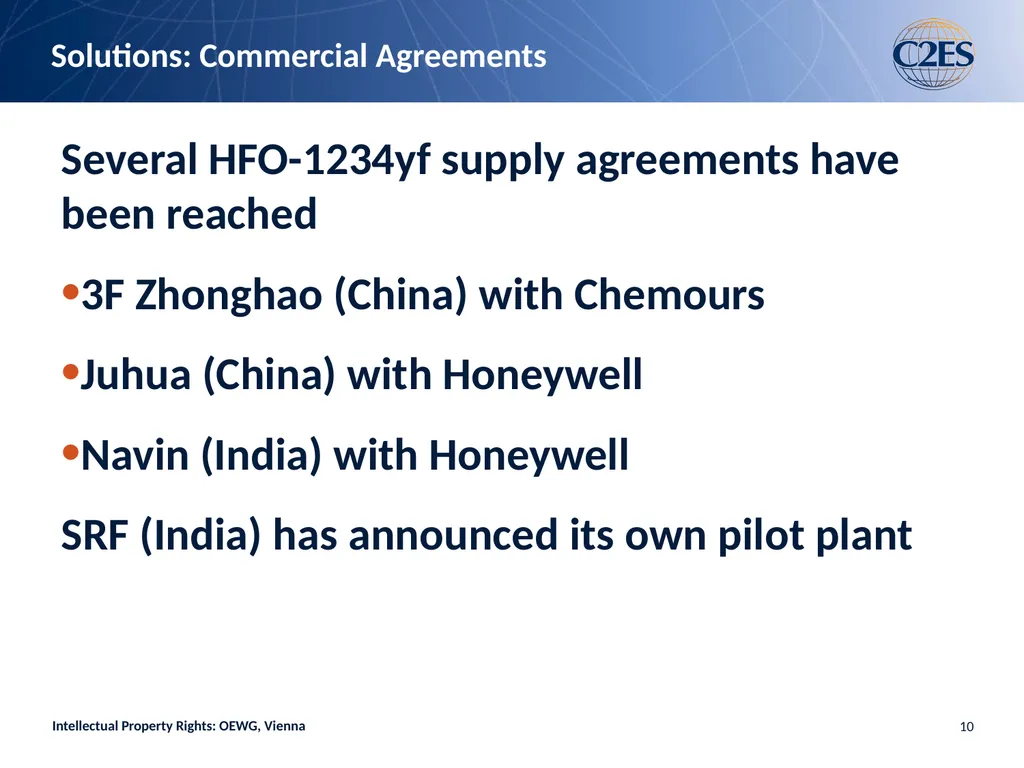
Solutions: Commercial Agreements Intellectual Property Rights: OEWG, Vienna 10 Several HFO-1234yf supply agreements have been reached
3F Zhonghao (China) with Chemours
Juhua (China) with Honeywell
Navin (India) with Honeywell
SRF (India) has announced its own pilot plant<br>
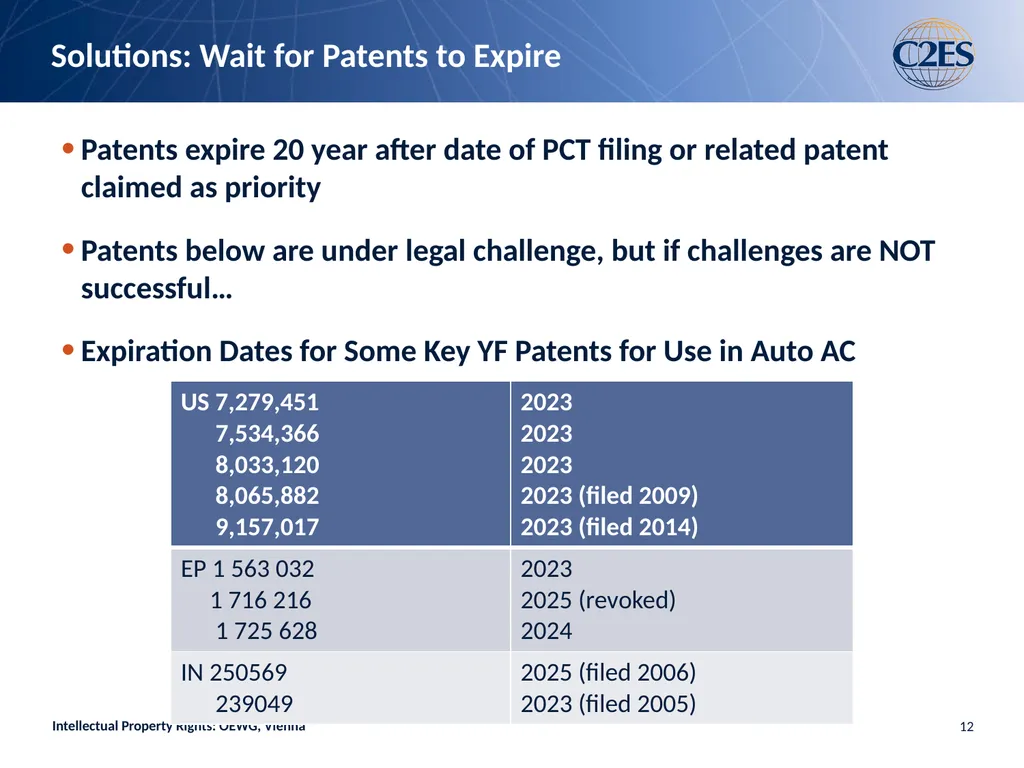
Solutions: Wait for Patents to Expire Intellectual Property Rights: OEWG, Vienna 12 Patents expire 20 year after date of PCT filing or related patent claimed as priority
Patents below are under legal challenge, but if challenges are NOT successful…
Expiration Dates for Some Key YF Patents for Use in Auto AC<br>
13
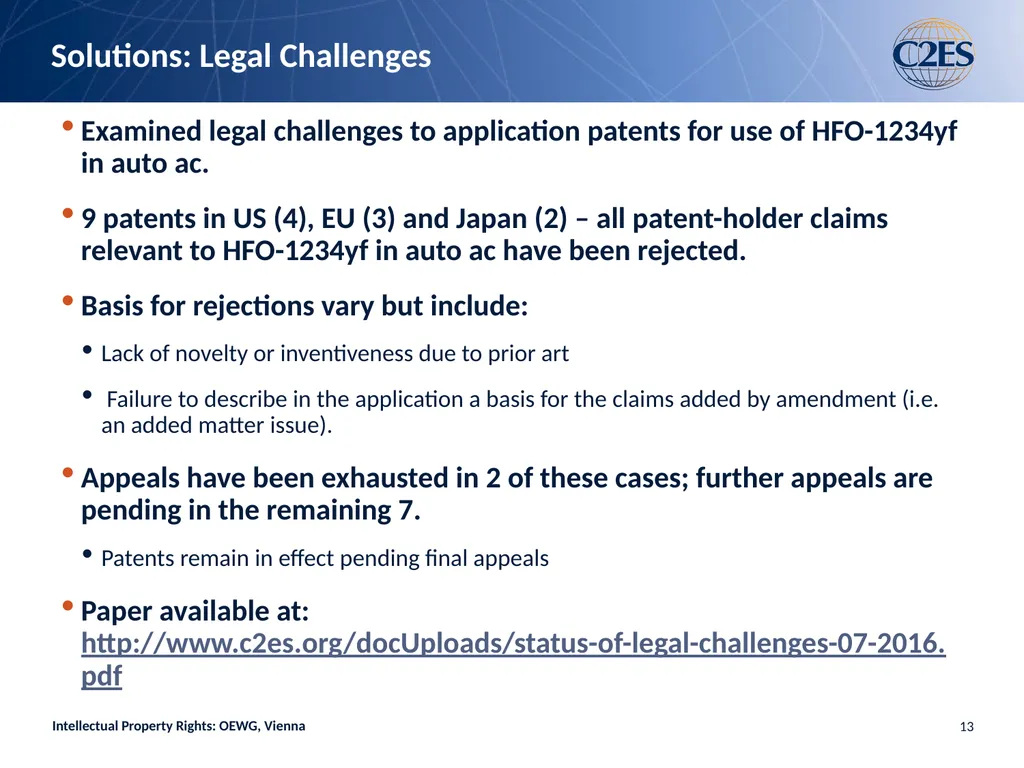
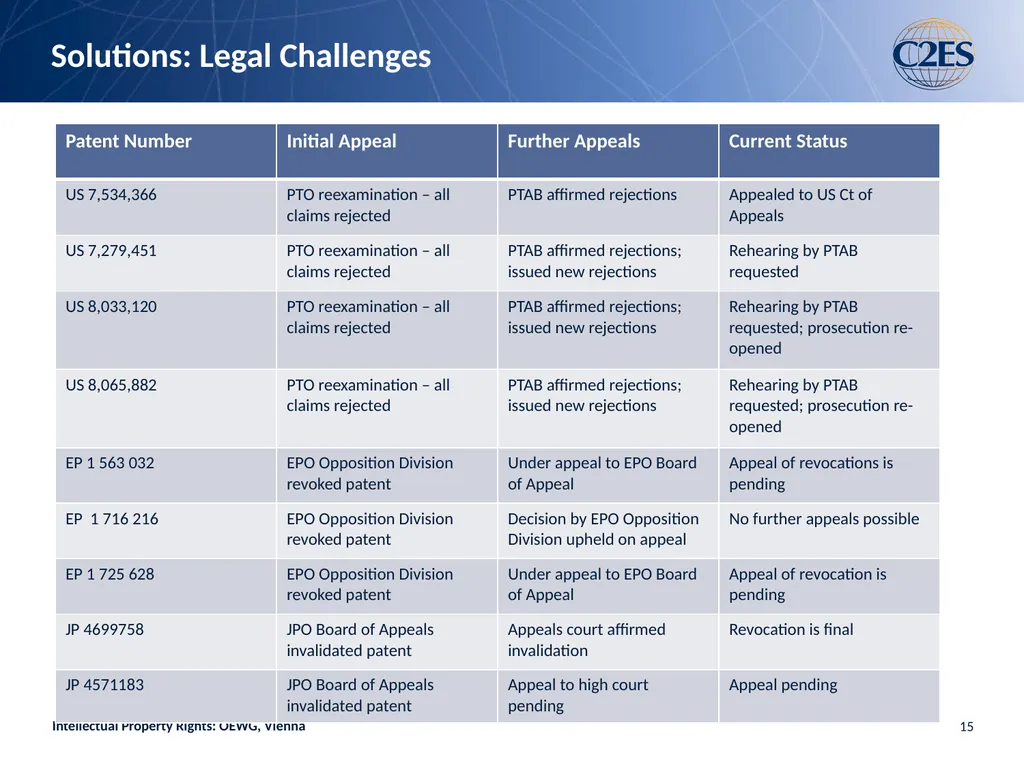
Solutions: Legal Challenges Intellectual Property Rights: OEWG, Vienna 13 Examined legal challenges to application patents for use of HFO-1234yf in auto ac.
9 patents in US (4), EU (3) and Japan (2) – all patent-holder claims relevant to HFO-1234yf in auto ac have been rejected.
Basis for rejections vary but include:
Lack of novelty or inventiveness due to prior art
Failure to describe in the application a basis for the claims added by amendment (i.e. an added matter issue).
Appeals have been exhausted in 2 of these cases; further appeals are pending in the remaining 7.
Patents remain in effect pending final appeals
Paper available at: http://www.c2es.org/docUploads/status-of-legal-challenges-07-2016.pdf<br>
14
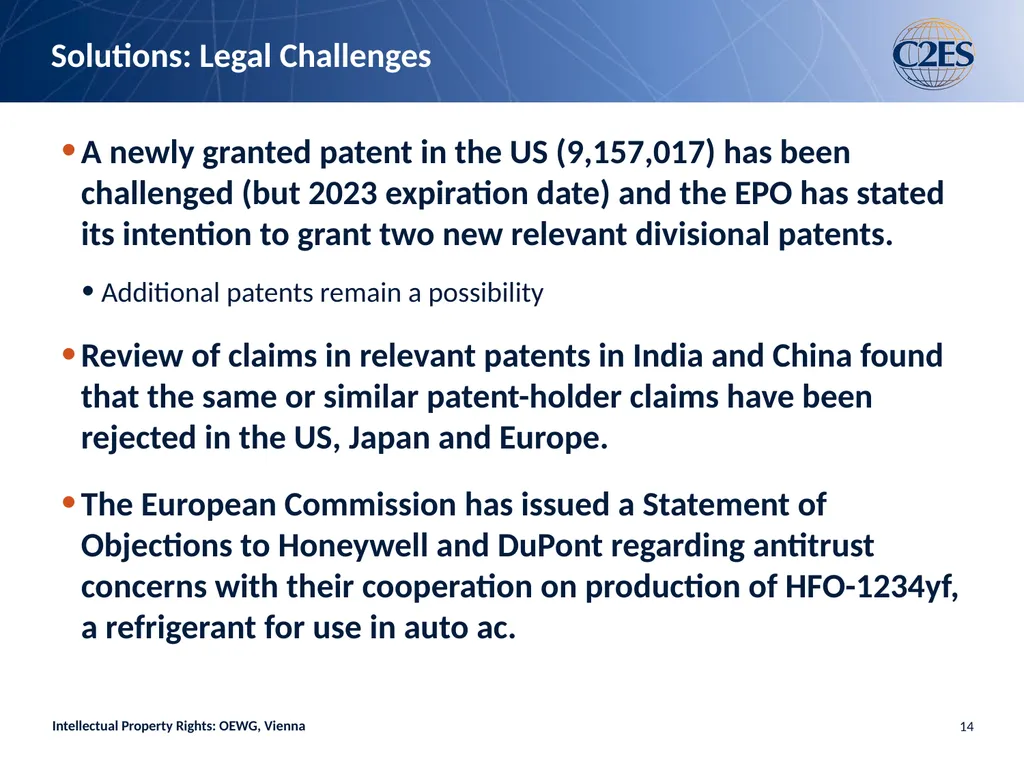
Solutions: Legal Challenges Intellectual Property Rights: OEWG, Vienna 14 A newly granted patent in the US (9,157,017) has been challenged (but 2023 expiration date) and the EPO has stated its intention to grant two new relevant divisional patents.
Additional patents remain a possibility
Review of claims in relevant patents in India and China found that the same or similar patent-holder claims have been rejected in the US, Japan and Europe.
The European Commission has issued a Statement of Objections to Honeywell and DuPont regarding antitrust concerns with their cooperation on production of HFO-1234yf, a refrigerant for use in auto ac.<br>
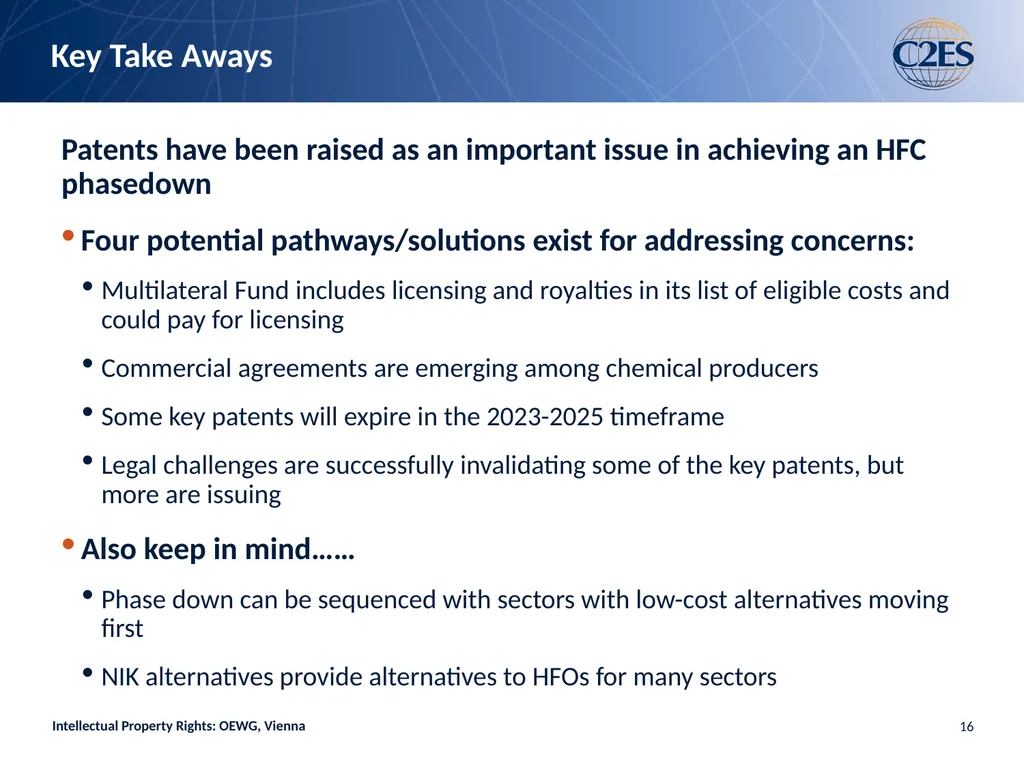
Key Take Aways Intellectual Property Rights: OEWG, Vienna 16 Patents have been raised as an important issue in achieving an HFC phasedown
Four potential pathways/solutions exist for addressing concerns:
Multilateral Fund includes licensing and royalties in its list of eligible costs and could pay for licensing
Commercial agreements are emerging among chemical producers
Some key patents will expire in the 2023-2025 timeframe
Legal challenges are successfully invalidating some of the key patents, but more are issuing
Also keep in mind……
Phase down can be sequenced with sectors with low-cost alternatives moving first
NIK alternatives provide alternatives to HFOs for many sectors<br>
17
seidels@c2es.org<br>
18
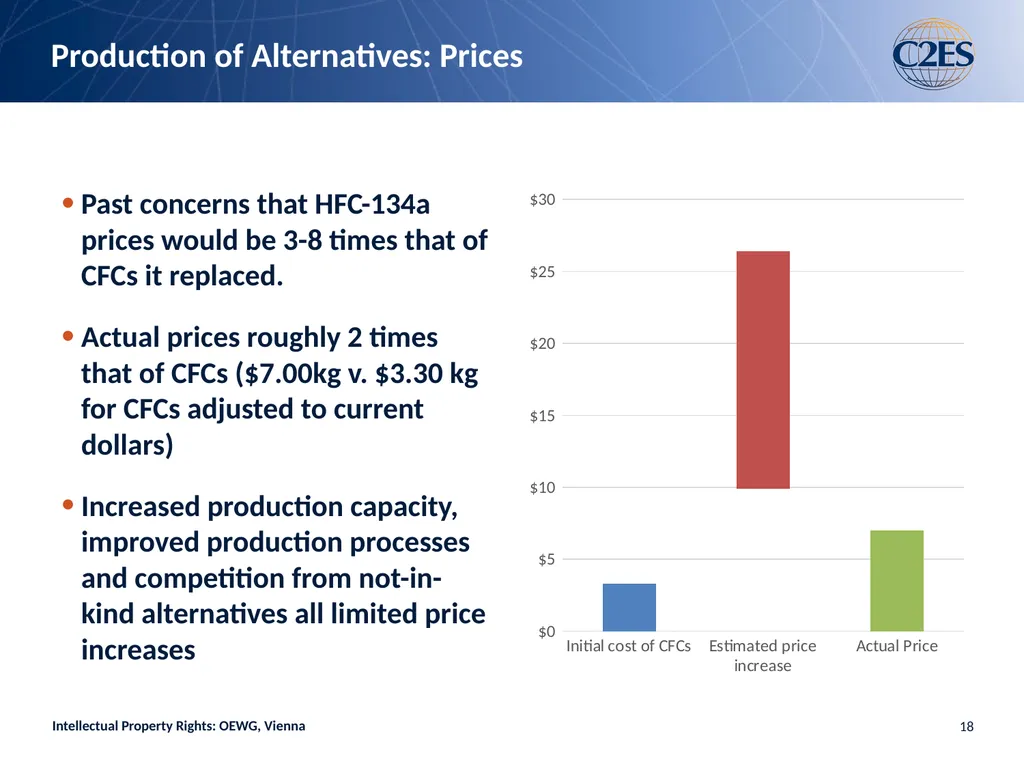
Production of Alternatives: Prices Past concerns that HFC-134a prices would be 3-8 times that of CFCs it replaced.
Actual prices roughly 2 times that of CFCs ($7.00kg v. $3.30 kg for CFCs adjusted to current dollars)
Increased production capacity, improved production processes and competition from not-in-kind alternatives all limited price increases Intellectual Property Rights: OEWG, Vienna 18<br>
19
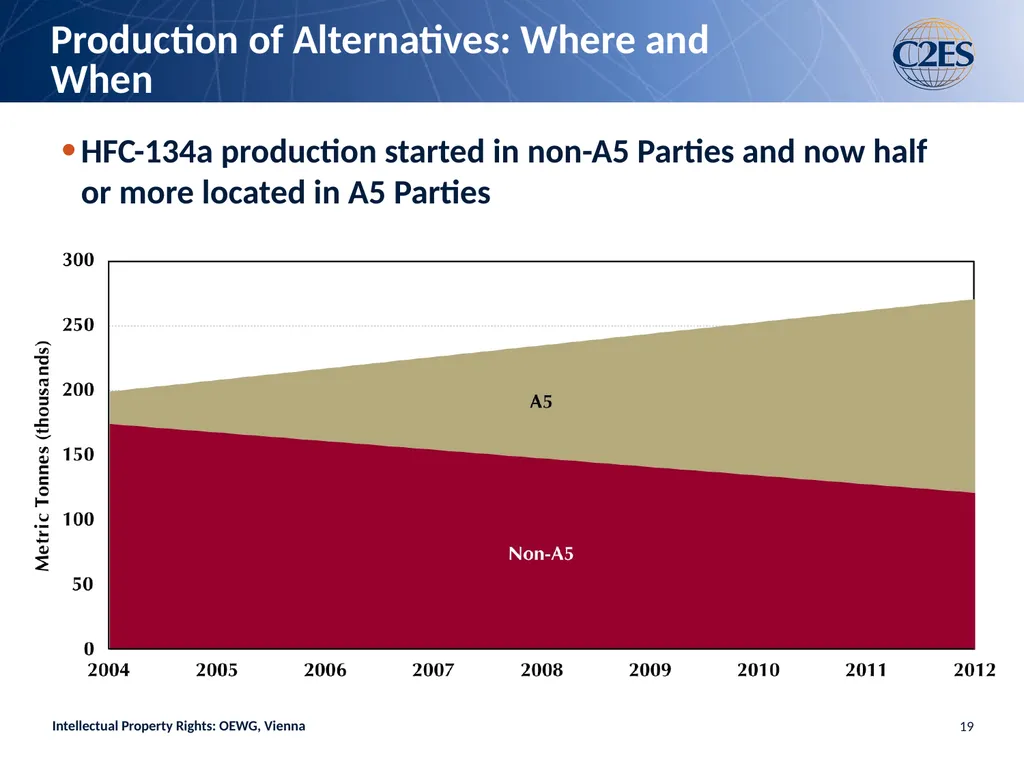
Production of Alternatives: Where and When HFC-134a production started in non-A5 Parties and now half or more located in A5 Parties Intellectual Property Rights: OEWG, Vienna 19<br>
20
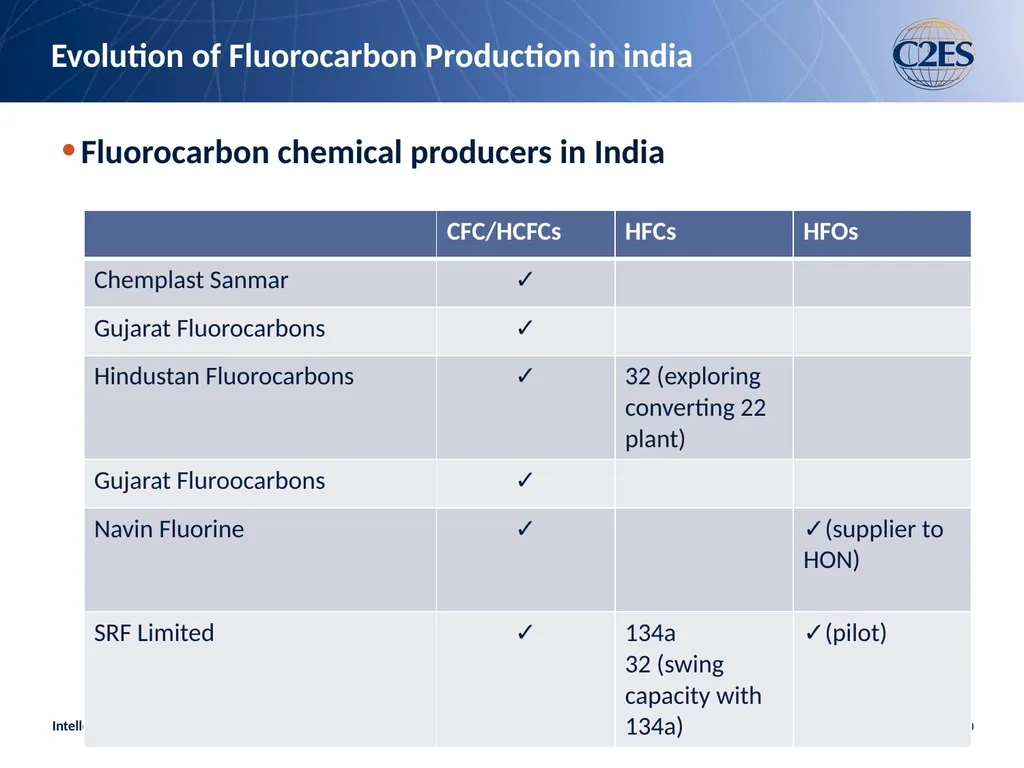
Evolution of Fluorocarbon Production in india Intellectual Property Rights: OEWG, Vienna 20 Fluorocarbon chemical producers in India<br>