Introduction Math Selected Themes Assessment targets Progress Map Math Learning Progression 4 building blocks Learning Progression Item Design OutcomesScoring Assessment Quality Bear Assessment System Stage 1 Focus on the process of
"Introduction Math Selected Themes Assessment" is the property of its rightful owner. Permission is granted to
download and print the materials on this website for personal, non-commercial use only, and to display it
on your personal computer provided you do not modify the materials and that you retain all copyright
notices contained in the materials. By downloading content from our website, you accept the terms of this
agreement.
Presentation Transcript
01
Introduction
Math Selected Themes
Assessment targets
Progress Map Math Learning Progression<br>
02
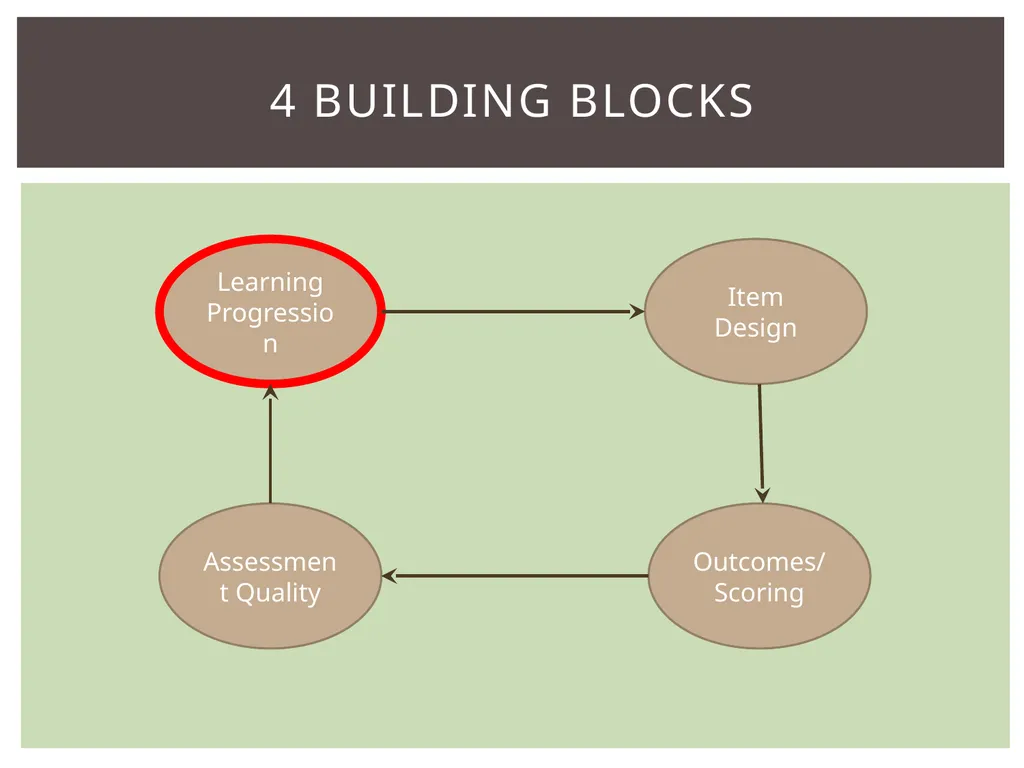
4 building blocks Learning Progression Item Design Outcomes/Scoring Assessment Quality<br>
03
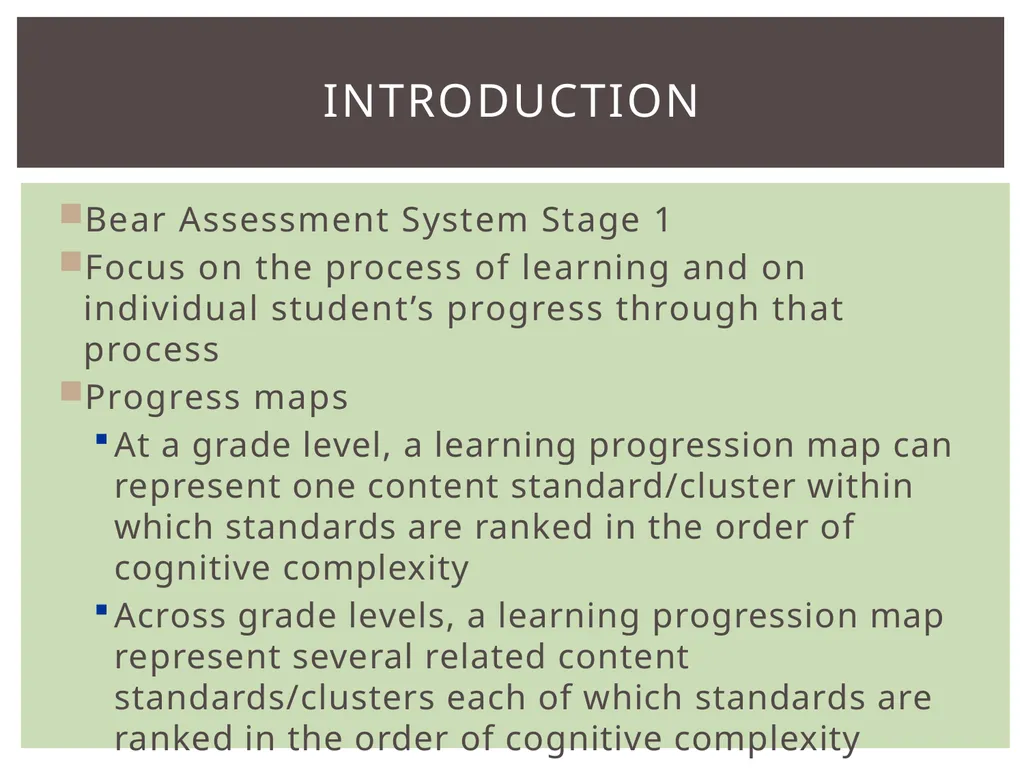
Bear Assessment System Stage 1
Focus on the process of learning and on individual student’s progress through that process
Progress maps
At a grade level, a learning progression map can represent one content standard/cluster within which standards are ranked in the order of cognitive complexity
Across grade levels, a learning progression map represent several related content standards/clusters each of which standards are ranked in the order of cognitive complexity Introduction<br>
04
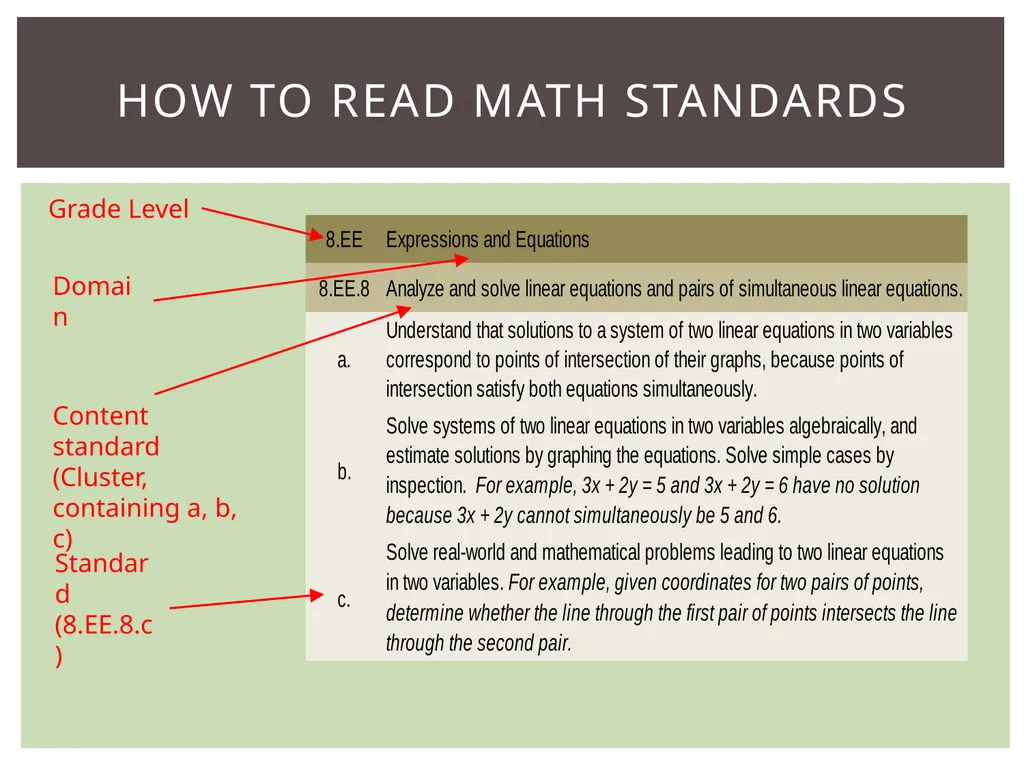
How to Read Math Standards Domain Content standard
(Cluster, containing a, b, c) Standard
(8.EE.8.c) Grade Level<br>
05
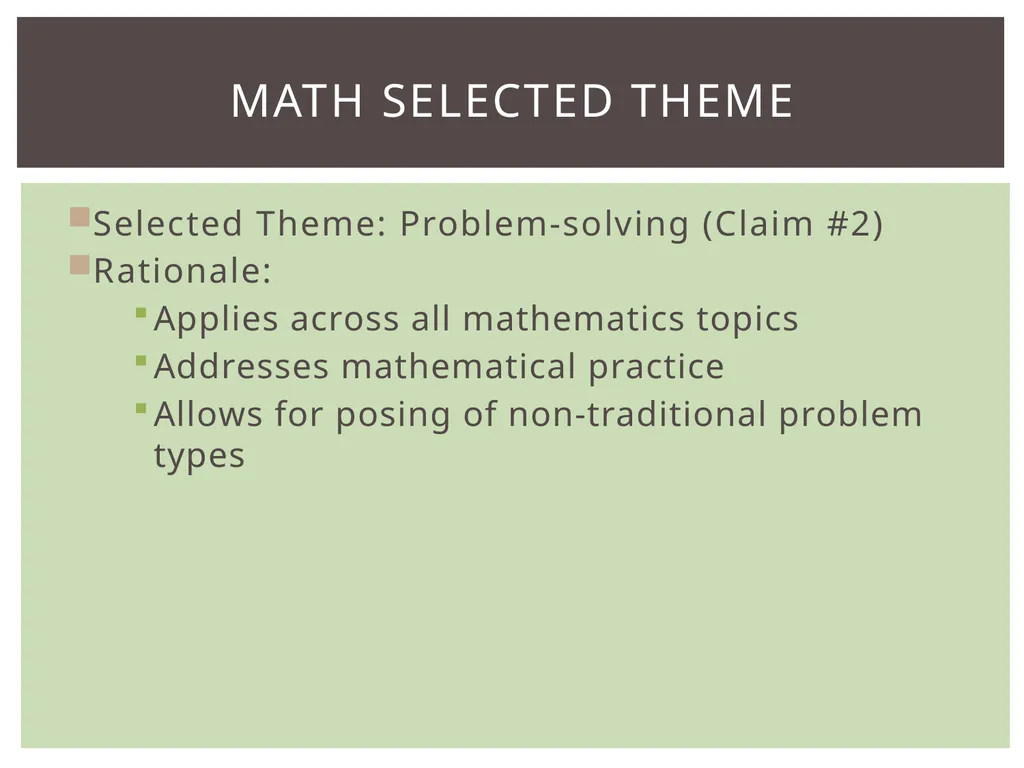
MATH selected theme Selected Theme: Problem-solving (Claim #2)
Rationale:
Applies across all mathematics topics
Addresses mathematical practice
Allows for posing of non-traditional problem types<br>
06
A glimpse at the whole LP! We’ll be looking at an example from this portion, upper elementary to middle school<br>
07
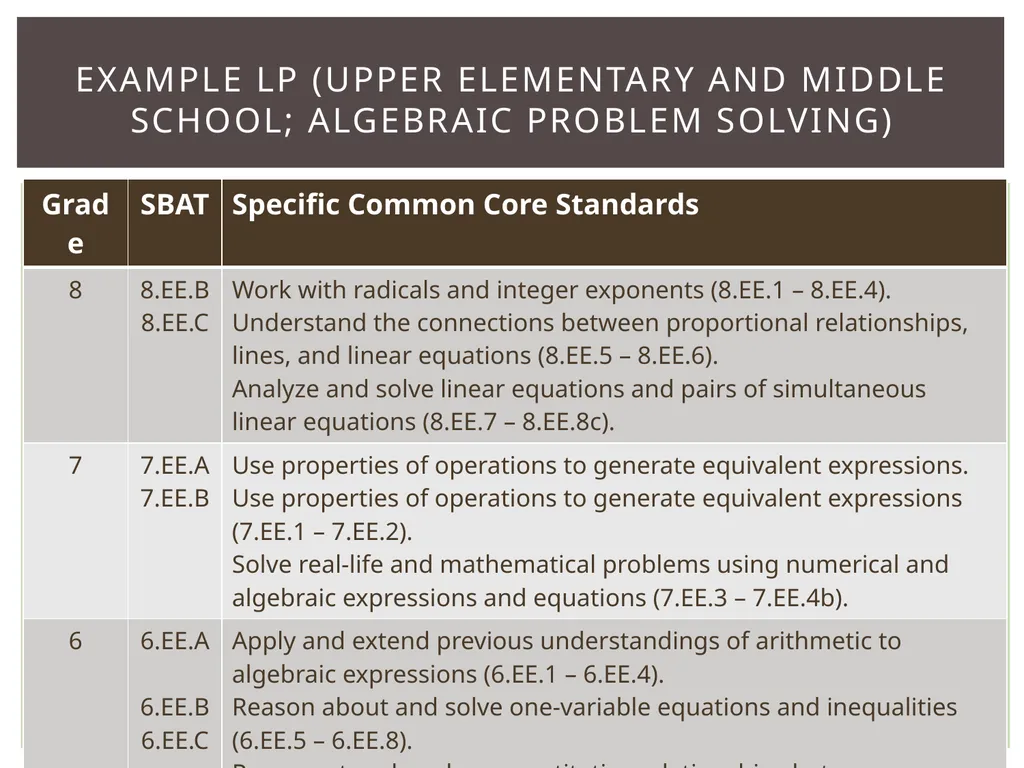
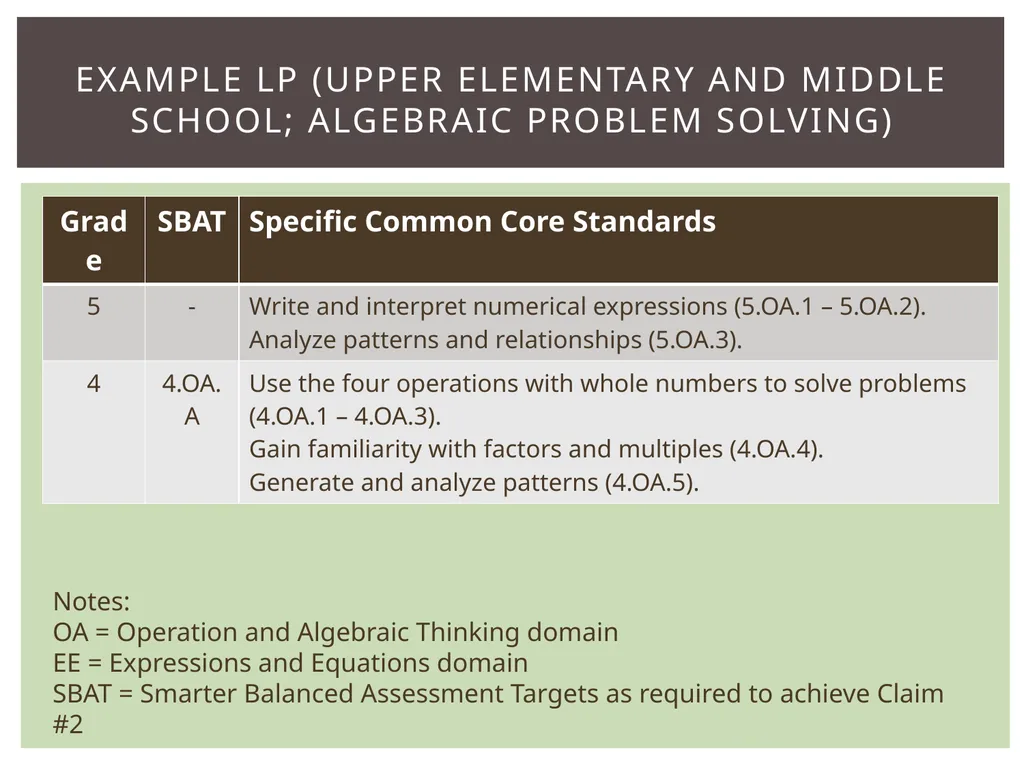
Example LP (upper elementary and middle school; Algebraic problem solving)<br>
08
Example LP (upper elementary and middle school; Algebraic problem solving) Notes:
OA = Operation and Algebraic Thinking domain
EE = Expressions and Equations domain
SBAT = Smarter Balanced Assessment Targets as required to achieve Claim #2<br>
09
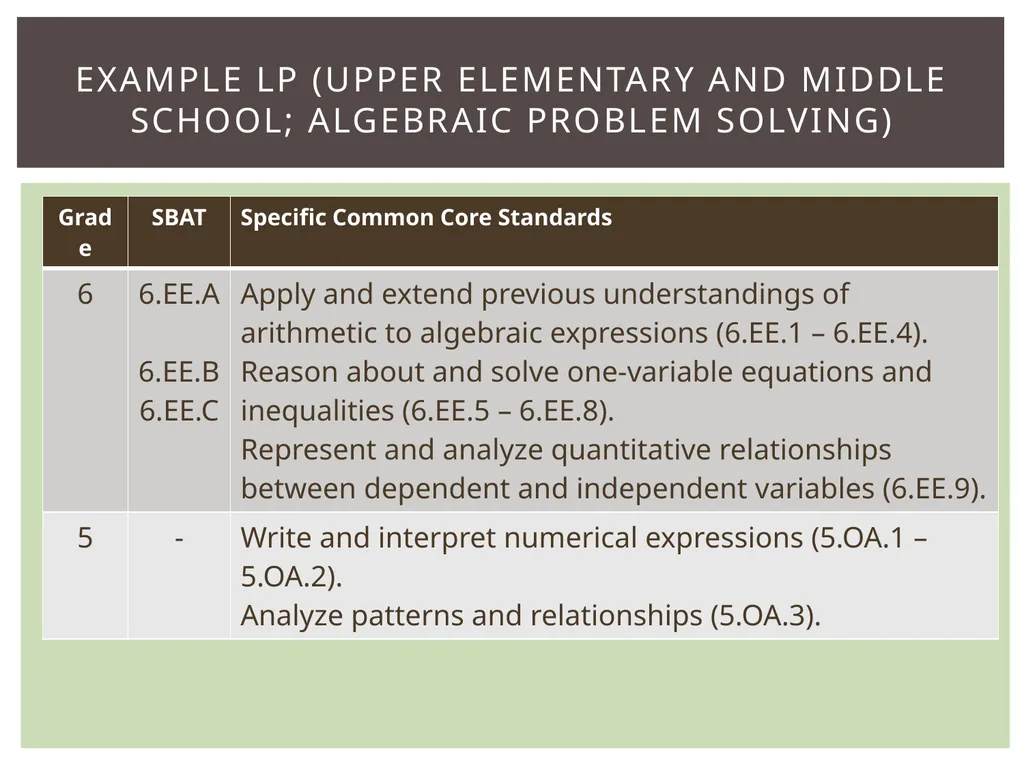
Example LP (upper elementary and middle school; Algebraic problem solving)<br>
10
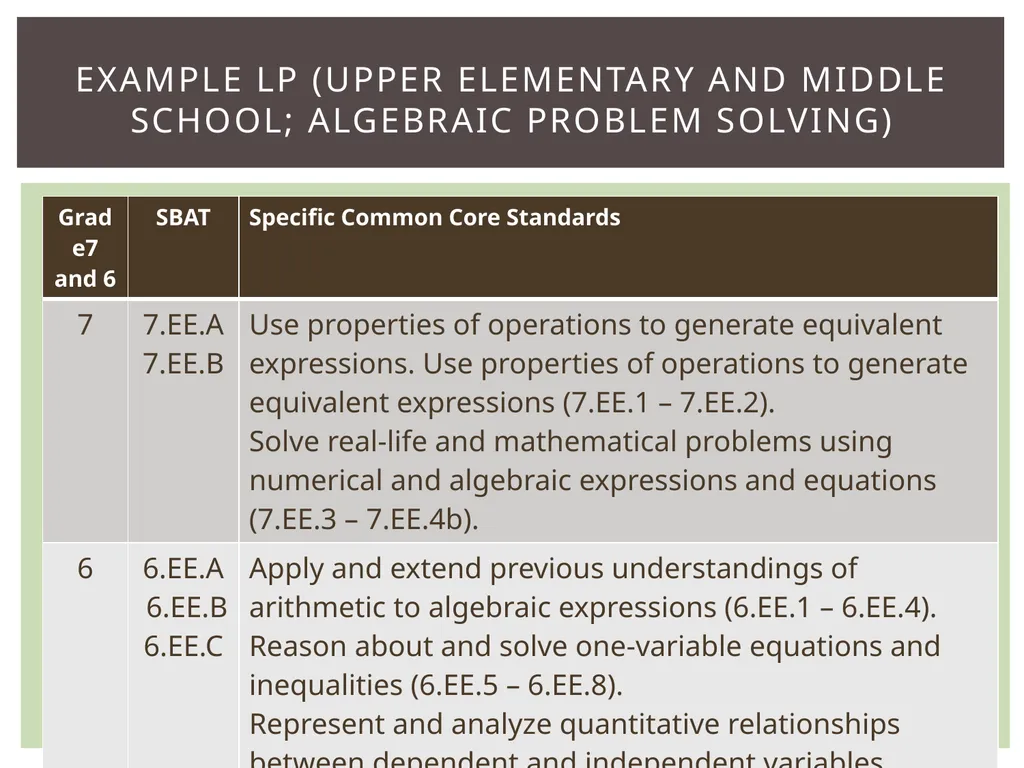
Example LP (upper elementary and middle school; Algebraic problem solving)<br>
11
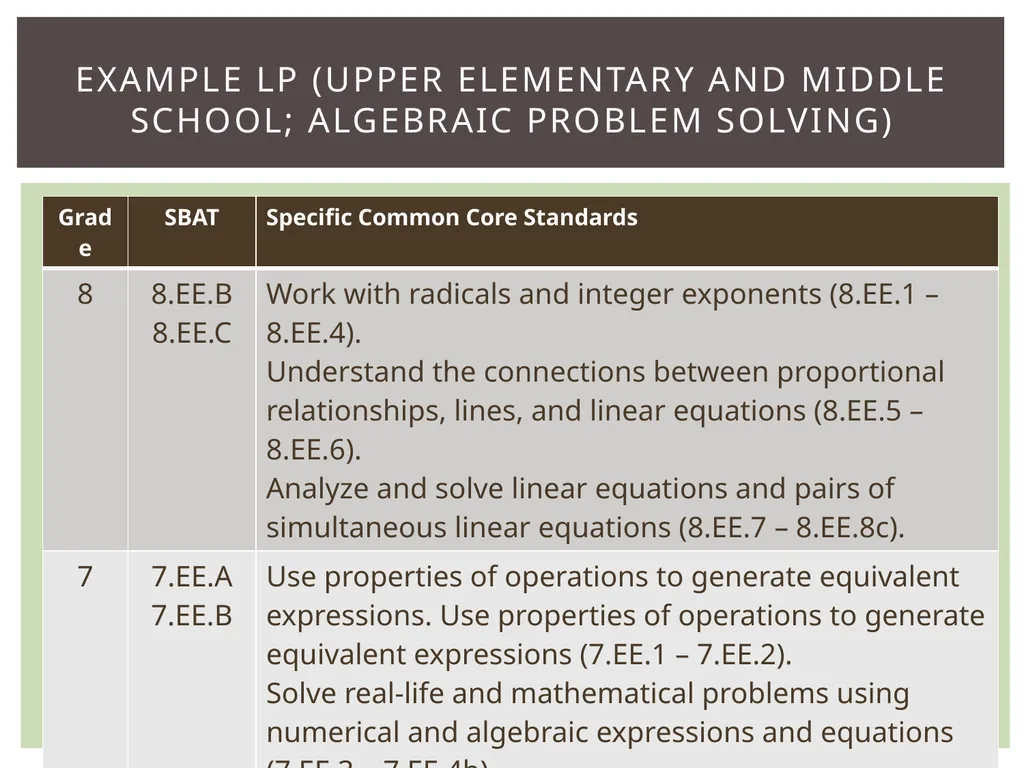
Example LP (upper elementary and middle school; Algebraic problem solving)<br>
12
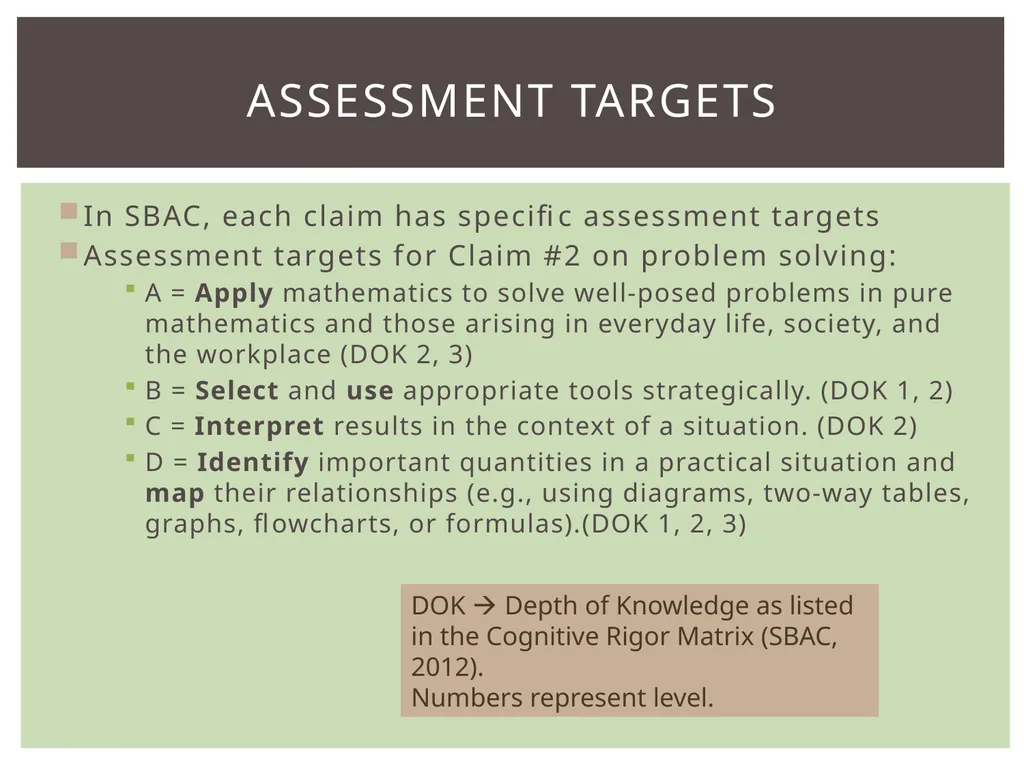
In SBAC, each claim has specific assessment targets
Assessment targets for Claim #2 on problem solving:
A = Apply mathematics to solve well-posed problems in pure mathematics and those arising in everyday life, society, and the workplace (DOK 2, 3)
B = Select and use appropriate tools strategically. (DOK 1, 2)
C = Interpret results in the context of a situation. (DOK 2)
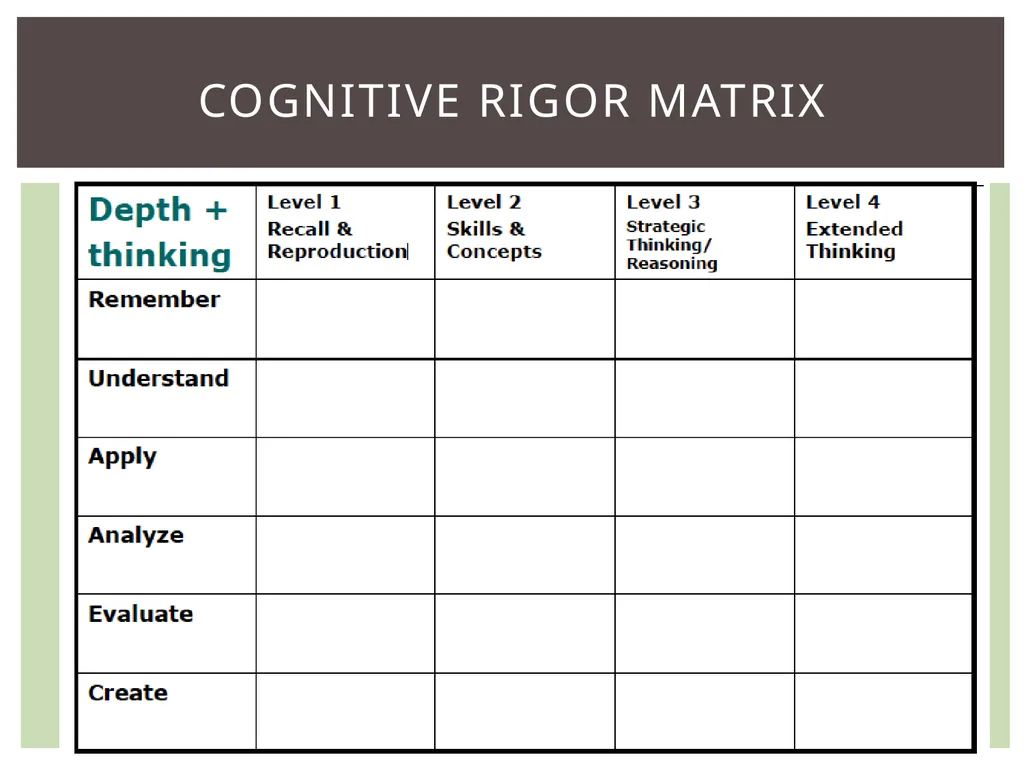
D = Identify important quantities in a practical situation and map their relationships (e.g., using diagrams, two-way tables, graphs, flowcharts, or formulas).(DOK 1, 2, 3) Assessment targets DOK Depth of Knowledge as listed in the Cognitive Rigor Matrix (SBAC, 2012).
Numbers represent level.<br>
13
Cognitive rigor matrix<br>
14
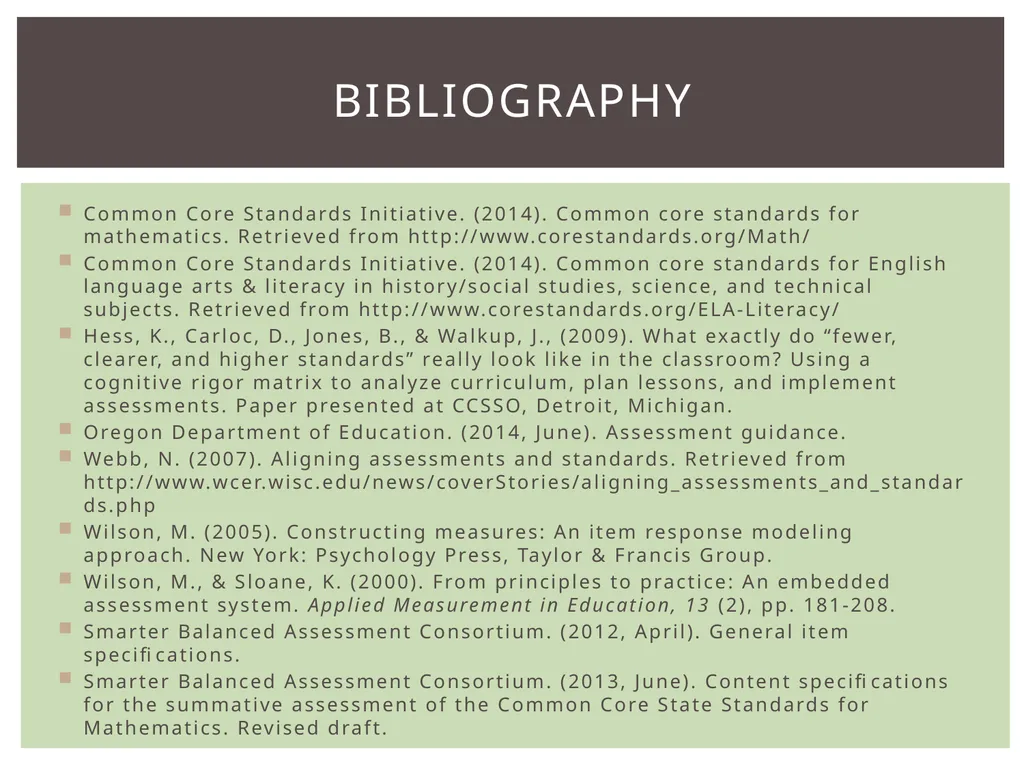
Common Core Standards Initiative. (2014). Common core standards for mathematics. Retrieved from http://www.corestandards.org/Math/
Common Core Standards Initiative. (2014). Common core standards for English language arts & literacy in history/social studies, science, and technical subjects. Retrieved from http://www.corestandards.org/ELA-Literacy/
Hess, K., Carloc, D., Jones, B., & Walkup, J., (2009). What exactly do “fewer, clearer, and higher standards” really look like in the classroom? Using a cognitive rigor matrix to analyze curriculum, plan lessons, and implement assessments. Paper presented at CCSSO, Detroit, Michigan.
Oregon Department of Education. (2014, June). Assessment guidance.
Webb, N. (2007). Aligning assessments and standards. Retrieved from http://www.wcer.wisc.edu/news/coverStories/aligning_assessments_and_standards.php
Wilson, M. (2005). Constructing measures: An item response modeling approach. New York: Psychology Press, Taylor & Francis Group.
Wilson, M., & Sloane, K. (2000). From principles to practice: An embedded assessment system. Applied Measurement in Education, 13 (2), pp. 181-208.
Smarter Balanced Assessment Consortium. (2012, April). General item specifications.
Smarter Balanced Assessment Consortium. (2013, June). Content specifications for the summative assessment of the Common Core State Standards for Mathematics. Revised draft. Bibliography<br>
15
Introduction to Learning Progressions (Math) PPT by the Oregon Department of Education and Berkeley Evaluation and Assessment Research Center is licensed under a CC BY 4.0.
You are free to:
Share — copy and redistribute the material in any medium or format
Adapt — remix, transform, and build upon the material
Under the following terms:
Attribution — You must give appropriate credit, provide a link to the license, and indicate if changes were made. You may do so in any reasonable manner, but not in any way that suggests the licensor endorses you or your use.
NonCommercial — You may not use the material for commercial purposes.
ShareAlike — If you remix, transform, or build upon the material, you must distribute your contributions under the same license as the original.
Oregon Department of Education welcomes editing of these resources and would greatly appreciate being able to learn from the changes made. To share an edited version of this resource, please contact Cristen McLean, cristen.mclean@state.or.us. Creative Commons License<br>