
Introduction to Artificial Intelligence (AI) What


Description: Introduction to Artificial Intelligence (AI) What is Artificial Intelligence? - Simulation of human intelligence in machines - Core abilities: learning, reasoning, perception, interaction - Types of AI Narrow AI vs. General AI vs. Super AI
Related Topics
Download Presentation
"Introduction to Artificial Intelligence (AI) What" is the property of its rightful owner. Permission is granted to download and print the materials on this website for personal, non-commercial use only, and to display it on your personal computer provided you do not modify the materials and that you retain all copyright notices contained in the materials. By downloading content from our website, you accept the terms of this agreement.
Presentation Transcript
slide1. Introduction to Artificial Intelligence (AI)<br>
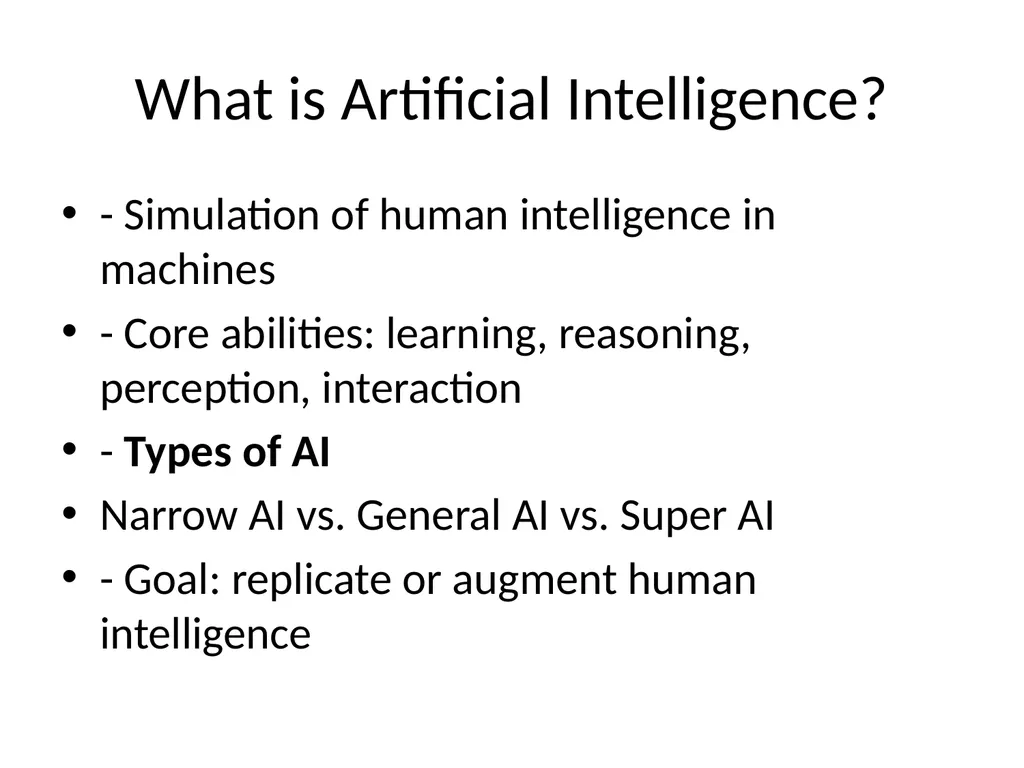
slide2. What is Artificial Intelligence? - Simulation of human intelligence in machines
- Core abilities: learning, reasoning, perception, interaction
- Types of AI
Narrow AI vs. General AI vs. Super AI
- Goal: replicate or augment human intelligence<br>
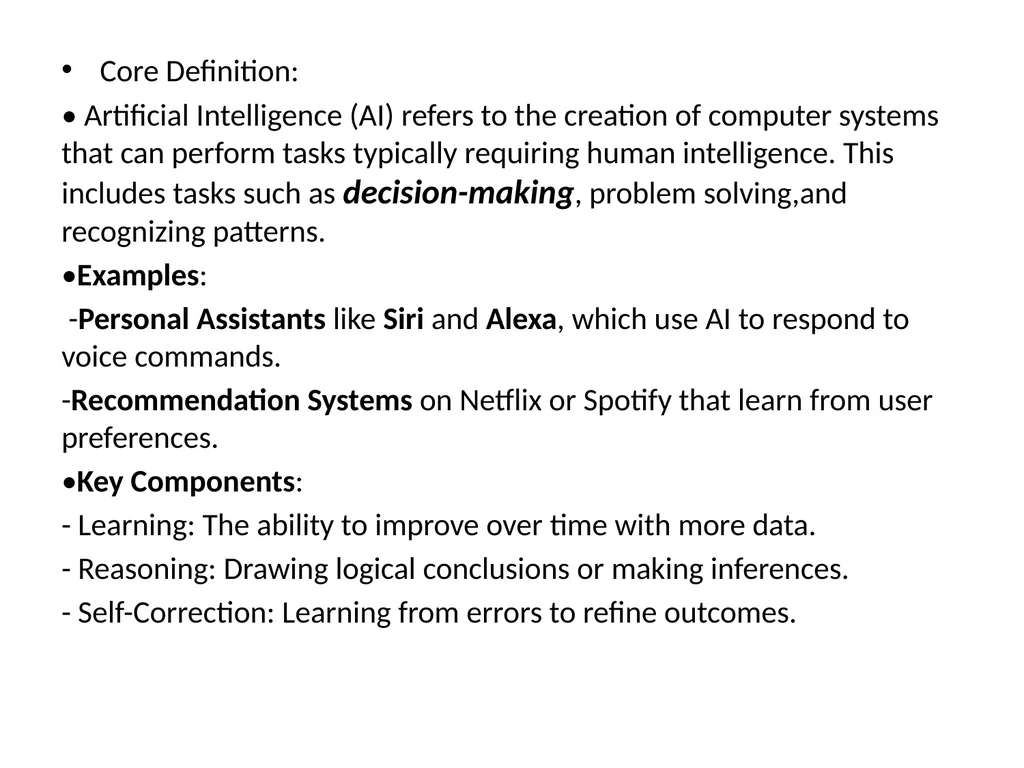
slide3. Core Definition:
• Artificial Intelligence (AI) refers to the creation of computer systems that can perform tasks typically requiring human intelligence. This includes tasks such as decision-making, problem solving,and recognizing patterns.
•Examples:
-Personal Assistants like Siri and Alexa, which use AI to respond to voice commands.
-Recommendation Systems on Netflix or Spotify that learn from user preferences.
•Key Components:
- Learning: The ability to improve over time with more data.
- Reasoning: Drawing logical conclusions or making inferences.
- Self-Correction: Learning from errors to refine outcomes.<br>
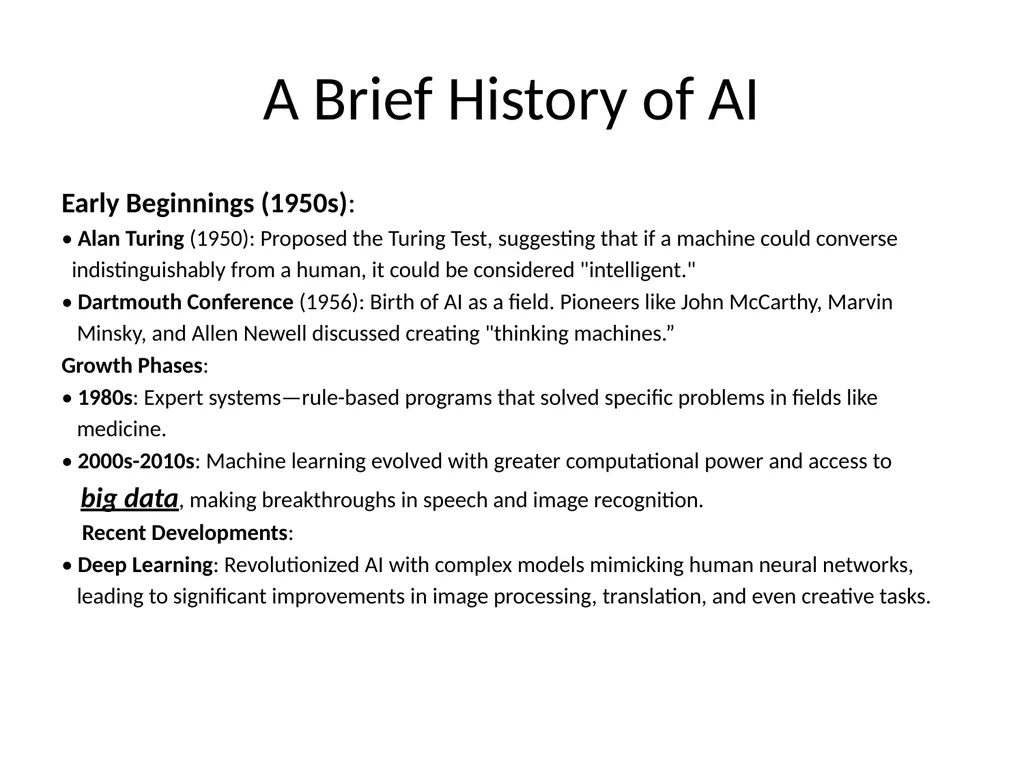
slide4. A Brief History of AI Early Beginnings (1950s):
• Alan Turing (1950): Proposed the Turing Test, suggesting that if a machine could converse
indistinguishably from a human, it could be considered "intelligent."
• Dartmouth Conference (1956): Birth of AI as a field. Pioneers like John McCarthy, Marvin
Minsky, and Allen Newell discussed creating "thinking machines.”
Growth Phases:
• 1980s: Expert systems—rule-based programs that solved specific problems in fields like
medicine.
• 2000s-2010s: Machine learning evolved with greater computational power and access to
big data, making breakthroughs in speech and image recognition.
Recent Developments:
• Deep Learning: Revolutionized AI with complex models mimicking human neural networks,
leading to significant improvements in image processing, translation, and even creative tasks.<br>
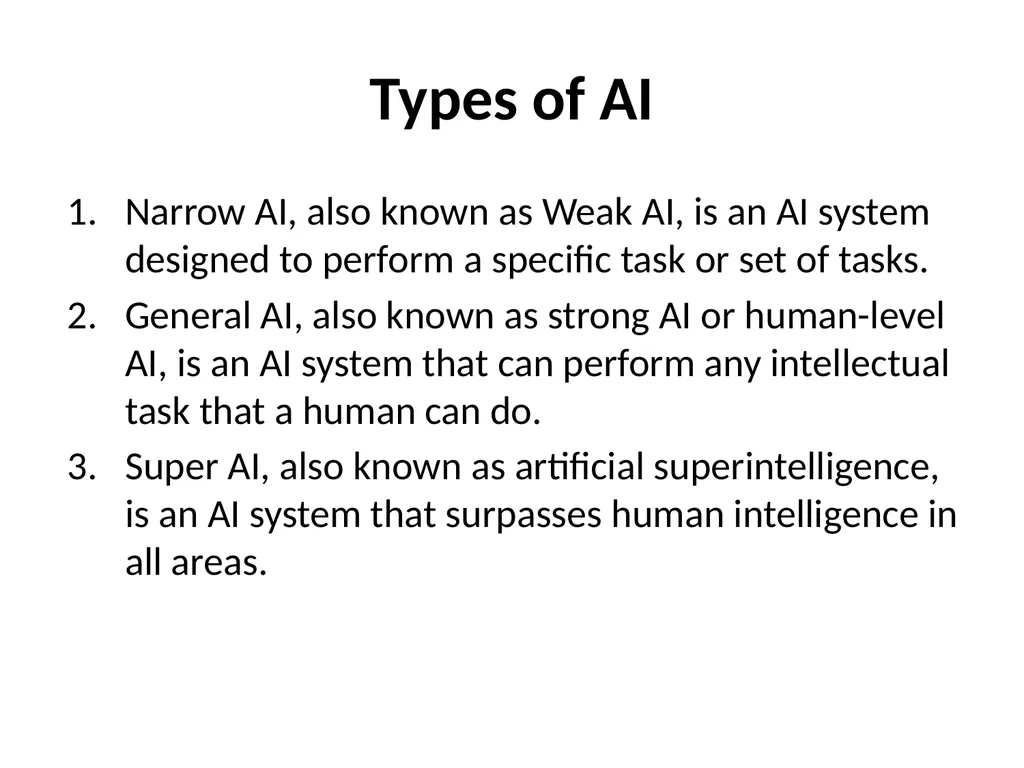
slide5. Types of AI Narrow AI, also known as Weak AI, is an AI system designed to perform a specific task or set of tasks.
General AI, also known as strong AI or human-level AI, is an AI system that can perform any intellectual task that a human can do.
Super AI, also known as artificial superintelligence, is an AI system that surpasses human intelligence in all areas.<br>
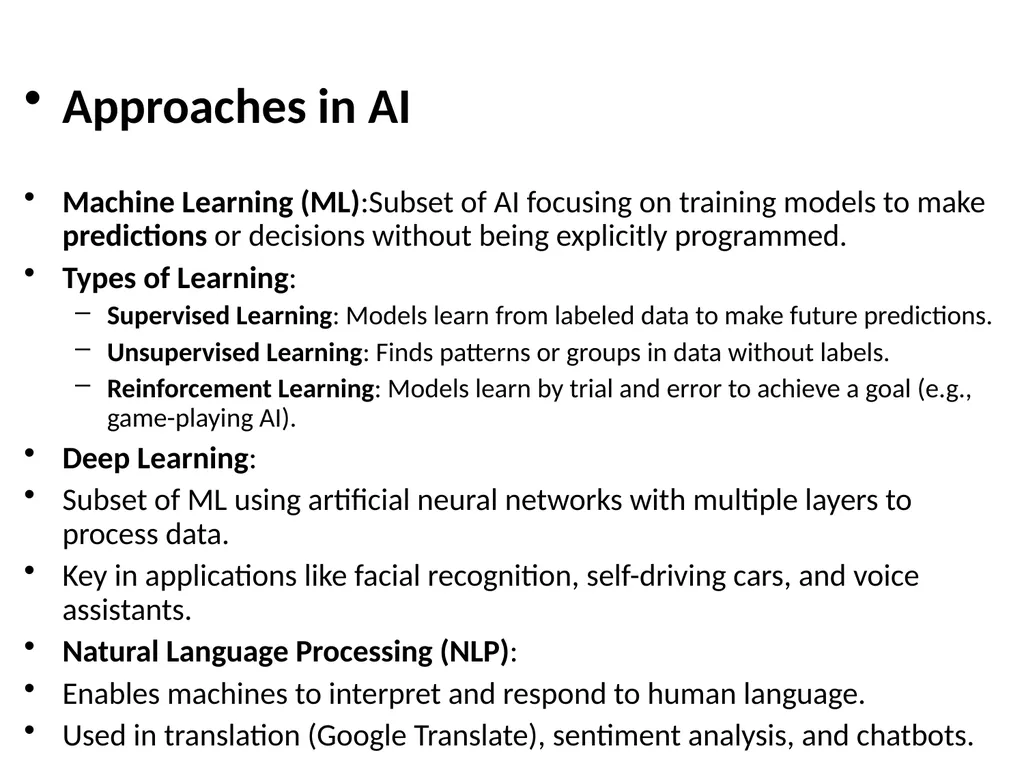
slide6. Approaches in AI
Machine Learning (ML):Subset of AI focusing on training models to make predictions or decisions without being explicitly programmed.
Types of Learning:
Supervised Learning: Models learn from labeled data to make future predictions.
Unsupervised Learning: Finds patterns or groups in data without labels.
Reinforcement Learning: Models learn by trial and error to achieve a goal (e.g., game-playing AI).
Deep Learning:
Subset of ML using artificial neural networks with multiple layers to process data.
Key in applications like facial recognition, self-driving cars, and voice assistants.
Natural Language Processing (NLP):
Enables machines to interpret and respond to human language.
Used in translation (Google Translate), sentiment analysis, and chatbots.<br>
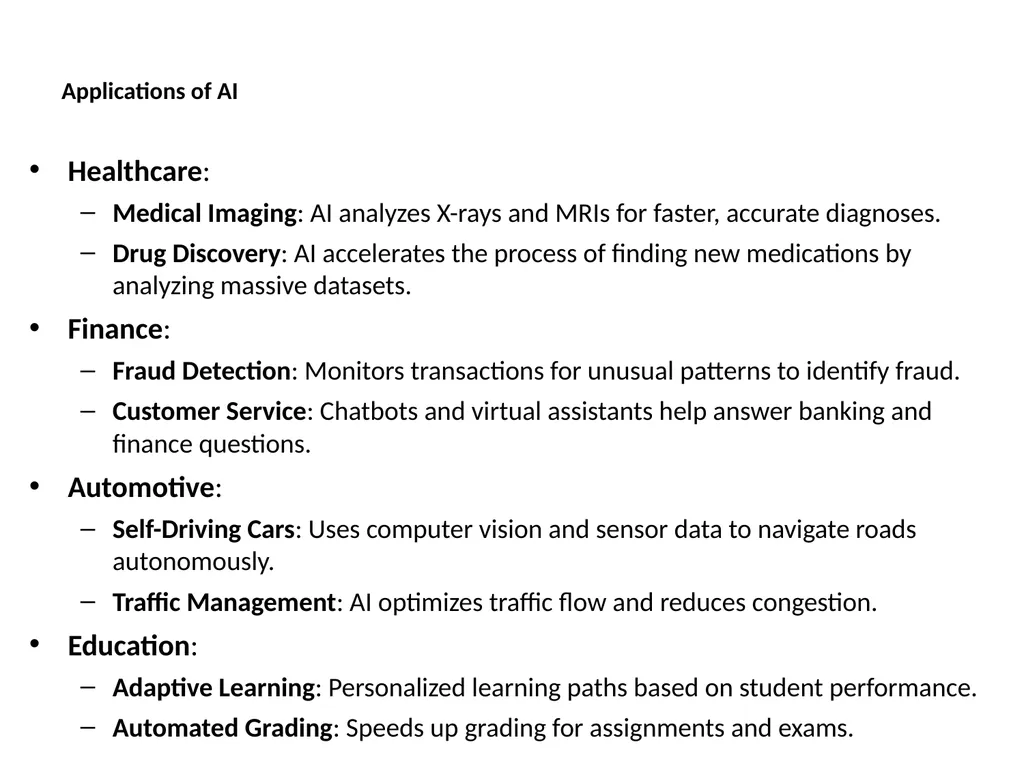
slide7. Applications of AI Healthcare:
Medical Imaging: AI analyzes X-rays and MRIs for faster, accurate diagnoses.
Drug Discovery: AI accelerates the process of finding new medications by analyzing massive datasets.
Finance:
Fraud Detection: Monitors transactions for unusual patterns to identify fraud.
Customer Service: Chatbots and virtual assistants help answer banking and finance questions.
Automotive:
Self-Driving Cars: Uses computer vision and sensor data to navigate roads autonomously.
Traffic Management: AI optimizes traffic flow and reduces congestion.
Education:
Adaptive Learning: Personalized learning paths based on student performance.
Automated Grading: Speeds up grading for assignments and exams.<br>
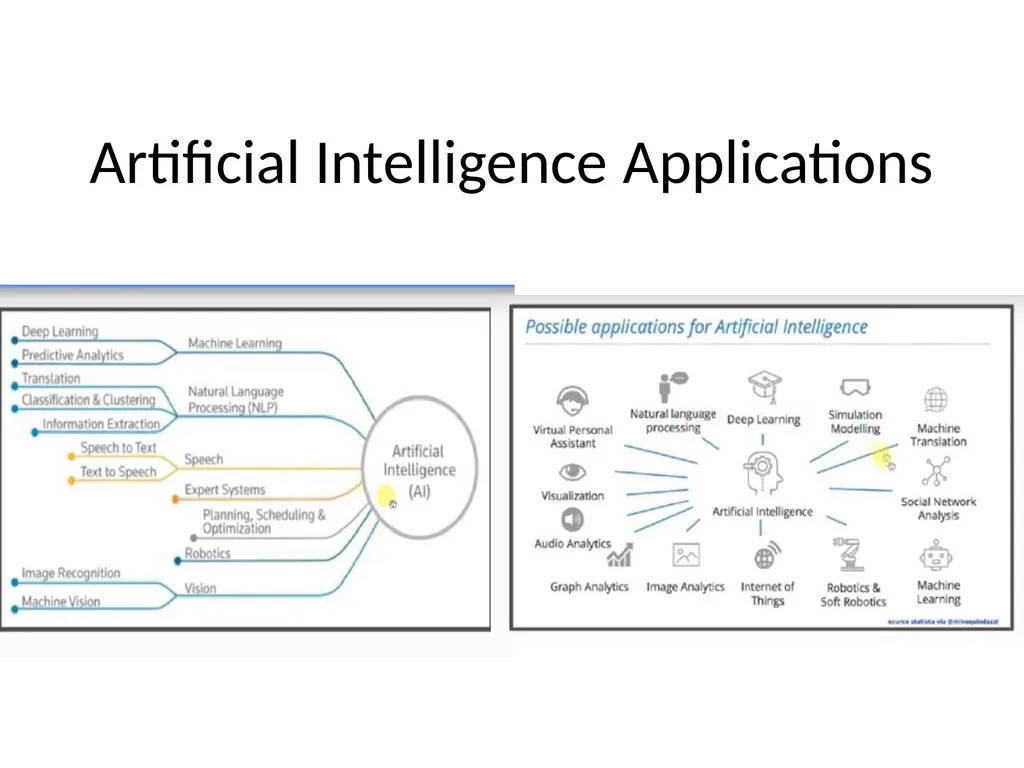
slide8. Artificial Intelligence Applications<br>
slide9. Challenges in AI Data Quality and Quantity:
AI models need large amounts of high-quality data to be effective, but not all fields have this data readily available.
Example: Medical AI systems may struggle in regions where electronic health records are not commonly used.
Complexity of Models:
Some models, particularly deep neural networks, require vast computational resources, making them costly and energy-intensive.
Lack of Transparency (the "Black Box" Issue):
Some AI models are so complex that even developers cannot fully understand how they make decisions.
Raises questions about accountability in fields like finance and law.<br>
slide10. Ethical Considerations in AI Bias and Fairness:
AI models can inherit biases from the data they are trained on, which can result in unfair outcomes.
Example: AI in hiring processes could unintentionally favor certain demographics.
Privacy:
AI systems often rely on personal data, raising concerns about how this data is stored and used.
Example: Facial recognition in public spaces may infringe on individual privacy rights.
Autonomy and Accountability:
AI systems that operate autonomously, such as drones or robots, require clear protocols for human oversight and control.
Ethical Dilemma: How do we ensure humans are ultimately responsible for actions taken by AI systems?<br>
slide11. Future of AI Emerging Trends:
Explainable AI: Research into creating models whose decision-making processes are understandable to humans.
Sustainable AI: Efforts to reduce the environmental impact of AI technologies, such as by improving energy efficiency.
Potential vs. Caution:
AI has the potential to solve major problems but requires careful oversight to avoid misuse.
Career Opportunities:
AI is opening up job roles in data science, machine learning engineering, and ethics advising, among others.<br>
slide12. example of interpretability problem قَالَ فَإِنَّهَا مُحَرَّمَةٌ عَلَيْهِمْ ۛ أَرْبَعِينَ سَنَةً ۛ يَتِيهُونَ فِي الْأَرْضِ ۚ فَلَا تَأْسَ عَلَى الْقَوْمِ الْفَاسِقِينَ .
***************************************
“A woman, without her man, is nothing.”
“A woman, without her,man is nothing.”<br>
slide2. What is Artificial Intelligence? - Simulation of human intelligence in machines
- Core abilities: learning, reasoning, perception, interaction
- Types of AI
Narrow AI vs. General AI vs. Super AI
- Goal: replicate or augment human intelligence<br>
slide3. Core Definition:
• Artificial Intelligence (AI) refers to the creation of computer systems that can perform tasks typically requiring human intelligence. This includes tasks such as decision-making, problem solving,and recognizing patterns.
•Examples:
-Personal Assistants like Siri and Alexa, which use AI to respond to voice commands.
-Recommendation Systems on Netflix or Spotify that learn from user preferences.
•Key Components:
- Learning: The ability to improve over time with more data.
- Reasoning: Drawing logical conclusions or making inferences.
- Self-Correction: Learning from errors to refine outcomes.<br>
slide4. A Brief History of AI Early Beginnings (1950s):
• Alan Turing (1950): Proposed the Turing Test, suggesting that if a machine could converse
indistinguishably from a human, it could be considered "intelligent."
• Dartmouth Conference (1956): Birth of AI as a field. Pioneers like John McCarthy, Marvin
Minsky, and Allen Newell discussed creating "thinking machines.”
Growth Phases:
• 1980s: Expert systems—rule-based programs that solved specific problems in fields like
medicine.
• 2000s-2010s: Machine learning evolved with greater computational power and access to
big data, making breakthroughs in speech and image recognition.
Recent Developments:
• Deep Learning: Revolutionized AI with complex models mimicking human neural networks,
leading to significant improvements in image processing, translation, and even creative tasks.<br>
slide5. Types of AI Narrow AI, also known as Weak AI, is an AI system designed to perform a specific task or set of tasks.
General AI, also known as strong AI or human-level AI, is an AI system that can perform any intellectual task that a human can do.
Super AI, also known as artificial superintelligence, is an AI system that surpasses human intelligence in all areas.<br>
slide6. Approaches in AI
Machine Learning (ML):Subset of AI focusing on training models to make predictions or decisions without being explicitly programmed.
Types of Learning:
Supervised Learning: Models learn from labeled data to make future predictions.
Unsupervised Learning: Finds patterns or groups in data without labels.
Reinforcement Learning: Models learn by trial and error to achieve a goal (e.g., game-playing AI).
Deep Learning:
Subset of ML using artificial neural networks with multiple layers to process data.
Key in applications like facial recognition, self-driving cars, and voice assistants.
Natural Language Processing (NLP):
Enables machines to interpret and respond to human language.
Used in translation (Google Translate), sentiment analysis, and chatbots.<br>
slide7. Applications of AI Healthcare:
Medical Imaging: AI analyzes X-rays and MRIs for faster, accurate diagnoses.
Drug Discovery: AI accelerates the process of finding new medications by analyzing massive datasets.
Finance:
Fraud Detection: Monitors transactions for unusual patterns to identify fraud.
Customer Service: Chatbots and virtual assistants help answer banking and finance questions.
Automotive:
Self-Driving Cars: Uses computer vision and sensor data to navigate roads autonomously.
Traffic Management: AI optimizes traffic flow and reduces congestion.
Education:
Adaptive Learning: Personalized learning paths based on student performance.
Automated Grading: Speeds up grading for assignments and exams.<br>
slide8. Artificial Intelligence Applications<br>
slide9. Challenges in AI Data Quality and Quantity:
AI models need large amounts of high-quality data to be effective, but not all fields have this data readily available.
Example: Medical AI systems may struggle in regions where electronic health records are not commonly used.
Complexity of Models:
Some models, particularly deep neural networks, require vast computational resources, making them costly and energy-intensive.
Lack of Transparency (the "Black Box" Issue):
Some AI models are so complex that even developers cannot fully understand how they make decisions.
Raises questions about accountability in fields like finance and law.<br>
slide10. Ethical Considerations in AI Bias and Fairness:
AI models can inherit biases from the data they are trained on, which can result in unfair outcomes.
Example: AI in hiring processes could unintentionally favor certain demographics.
Privacy:
AI systems often rely on personal data, raising concerns about how this data is stored and used.
Example: Facial recognition in public spaces may infringe on individual privacy rights.
Autonomy and Accountability:
AI systems that operate autonomously, such as drones or robots, require clear protocols for human oversight and control.
Ethical Dilemma: How do we ensure humans are ultimately responsible for actions taken by AI systems?<br>
slide11. Future of AI Emerging Trends:
Explainable AI: Research into creating models whose decision-making processes are understandable to humans.
Sustainable AI: Efforts to reduce the environmental impact of AI technologies, such as by improving energy efficiency.
Potential vs. Caution:
AI has the potential to solve major problems but requires careful oversight to avoid misuse.
Career Opportunities:
AI is opening up job roles in data science, machine learning engineering, and ethics advising, among others.<br>
slide12. example of interpretability problem قَالَ فَإِنَّهَا مُحَرَّمَةٌ عَلَيْهِمْ ۛ أَرْبَعِينَ سَنَةً ۛ يَتِيهُونَ فِي الْأَرْضِ ۚ فَلَا تَأْسَ عَلَى الْقَوْمِ الْفَاسِقِينَ .
***************************************
“A woman, without her man, is nothing.”
“A woman, without her,man is nothing.”<br>