
Introduction to Language Acquisition Linguistics



















Description: Introduction to Language Acquisition Linguistics Module Topic 1 Introduction to areas of linguistics and problem-solving Topic 2 Historical Linguistics Topic 3 Phonetics Topic 4 Sociolinguistics Topic 5 Writing systems Topic 6 Language
Related Topics
Download Presentation
"Introduction to Language Acquisition Linguistics" is the property of its rightful owner. Permission is granted to download and print the materials on this website for personal, non-commercial use only, and to display it on your personal computer provided you do not modify the materials and that you retain all copyright notices contained in the materials. By downloading content from our website, you accept the terms of this agreement.
Presentation Transcript
slide1. Introduction to Language Acquisition Linguistics Module<br>
slide2. Topic 1 Introduction to areas of linguistics and problem-solving
Topic 2 Historical Linguistics
Topic 3 Phonetics
Topic 4 Sociolinguistics
Topic 5 Writing systems
Topic 6 Language Acquisition
Topic 7 Morphology
Topic 8 Syntax
Topic 9 Psycholinguistics / Neurolinguistics
Topic 10 Machine Translation Overview of this Linguistics Module 2<br>
slide3. In this topic, we look at:
First Language Acquisition: How do babies and young children acquire their first language?
Second Language Learning: How do teenagers and adults learn a foreign language? Topic 6: Overview 3<br>
slide4. 4 Task 6.1:
First Language Acquisition<br>
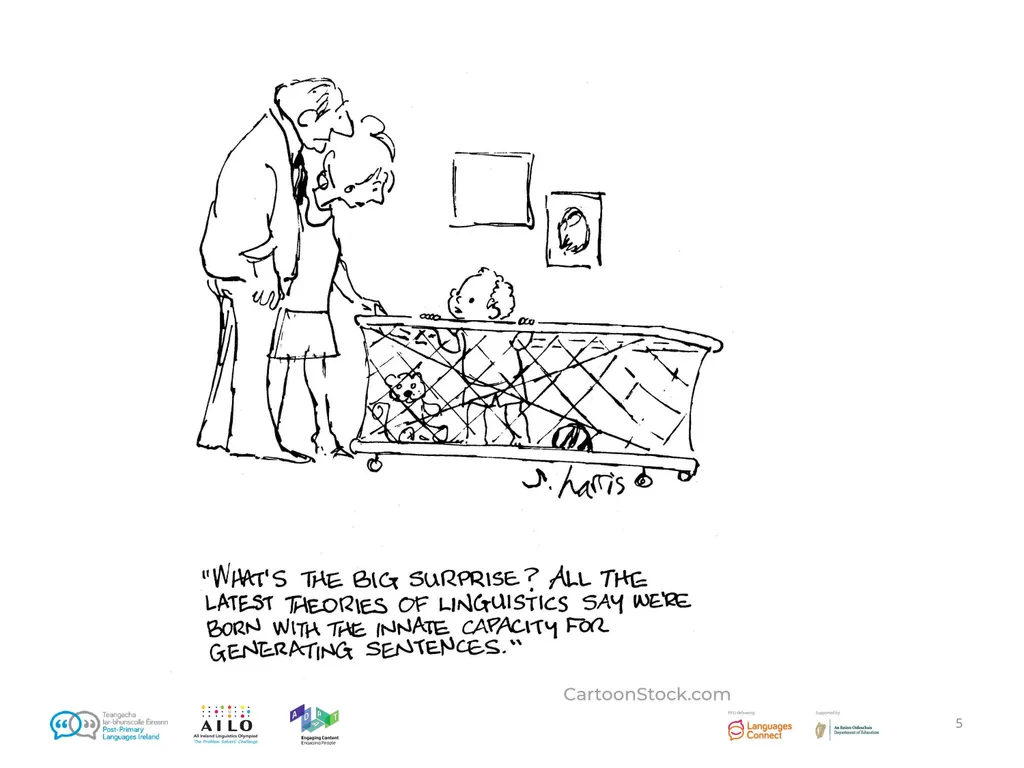
slide5. 5<br>
slide6. The acquisition of language by babies and young children is an astonishing process.
Before they start school, typically developing children (i.e. children with no developmental difficulties) know most of the complex grammatical structures of their native language(s).
First language acquisition is spontaneous and takes place without explicit teaching in a relatively short period of time.
How do very young children master the complexities of language?
We will see that children are far superior to any other creature or computer in their ability to learn their native language. Task 6.1 First Language Acquisition 6<br>
slide7. Task 6.1: Watch the following TED Talk by Professor Patricia Kuhl and complete Worksheet 6.1, Exercise 1 7<br>
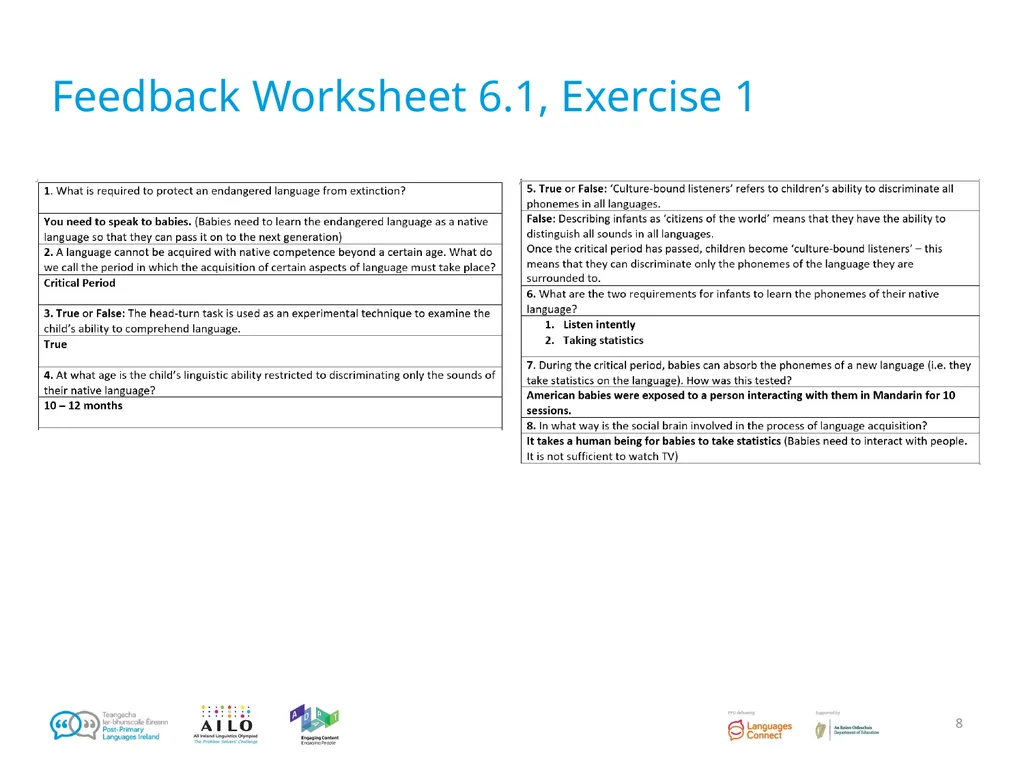
slide8. Feedback Worksheet 6.1, Exercise 1 8<br>
slide9. What are the implications of the critical period for the preservation of Irish?
What are the implications of the critical period of phonology for foreign language learning?
What are the implications of the critical period for the best time in the teaching cycles to introduce and teach a foreign language? How is that consistent with current government policy in Ireland?
Think of examples of critical periods in other areas of child development! Discussion/Project Topics (Optional) 9<br>
slide10. We have seen that babies are efficient language learners well before they are able to produce their first words.
But how do you think children actually learn how to produce grammatically correct sentences? How do children learn the grammar of their first language?
One possibility is that children imitate adult speech.
Another possibility is that they receive reinforcement from adults. This means that parents provide positive feedback when children say grammatically correct sentences. In turn, they are corrected (negative feedback) when they make mistakes. First Language Acquisition 10<br>
slide11. CHILD: My teacher holded the baby rabbits and we patted them.
ADULT: Did you say your teacher held the baby rabbits?
CHILD : Yes.
ADULT : And what did you say she did?
CHILD : She holded the baby rabbits and we patted them.
ADULT : Did you say she held them tightly?
CHILD : No, she holded them loosely.
(C. Cazden, 1972) Do children learn language by imitating adult speech? 11<br>
slide12. Imitation may play some role in First Language Acquisition, but its role is limited.
If children were merely imitating the adults, we would not expect babies to produce words and sentences that are ungrammatical in the adult language.
The dialogue on the previous slide shows that the child produces forms such as holded. Children do not hear these forms in the input as parents don’t usually make these errors (they say held).
However, these types of errors are common and systematic in early child language. Do children learn language by imitating adult speech? 12<br>
slide13. CHILD: Nobody don’t like me.
MOTHER: No, say “nobody likes me.”
CHILD : Nobody don’t like me.
(eight repetitions of this dialogue)
MOTHER: No, listen carefully; say “nobody likes me”.
CHILD : Oh! Nobody don’t likes me.
(McNeill, 1966) Do children learn language by being reinforced? 13<br>
slide14. CHILD: Want other one spoon, Daddy.
FATHER: You mean, you want the other spoon.
CHILD : Yes, I want other one spoon, please Daddy.
FATHER : Can you say “the other spoon”?
CHILD : Other … one … spoon.
FATHER : Say “other.”
CHILD : Other.
FATHER : “Spoon”.
CHILD : Spoon.
FATHER : “Other spoon.”
CHILD : Other … spoon. Now give me other one spoon?
(Braine 1971) Do children learn language by being reinforced? 14<br>
slide15. The children generally resist corrections.
If children learned language through reinforcement, they would take on board the adult corrections.
However, children tend to be immune to parents’ corrections.
Furthermore, most parents don’t bother correcting grammatical mistakes. Do children learn language by being reinforced? 15 Reinforcement and imitation do not play a crucial role in First Language Acquisition.<br>
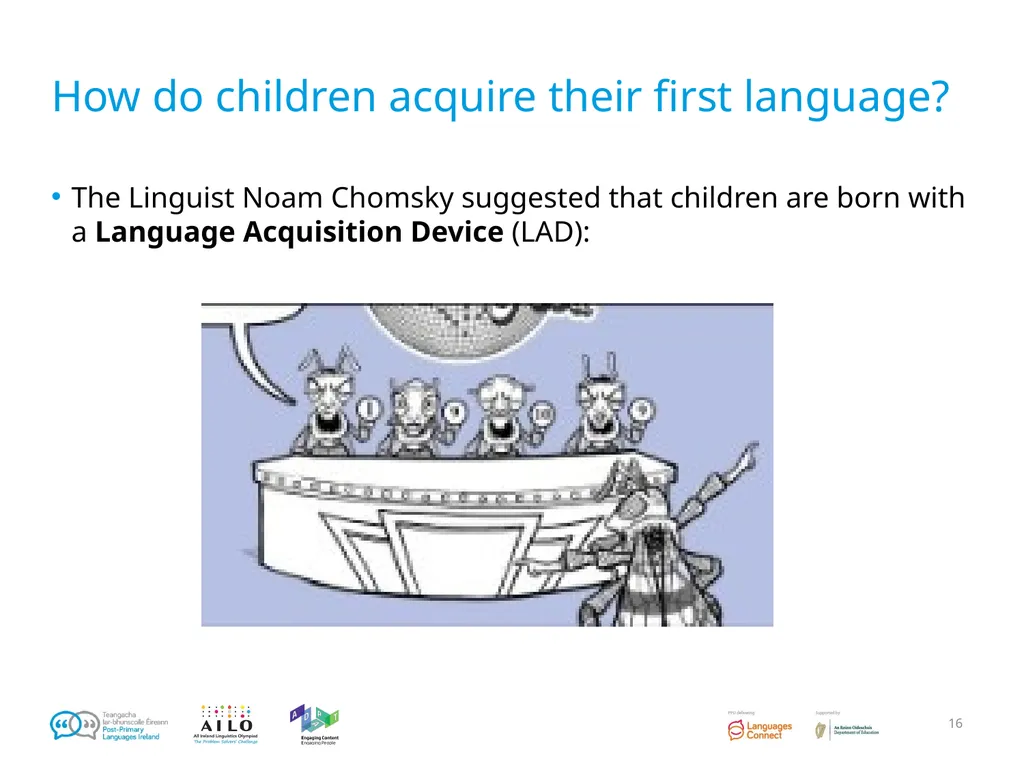
slide16. The Linguist Noam Chomsky suggested that children are born with a Language Acquisition Device (LAD): How do children acquire their first language? 16<br>
slide17. Humans have a genetic predisposition for language.
The Language Acquisition Device (LAD) enables children to acquire their first language.
Children know more about language that they can ever extract from the input (i.e. the language they are surrounded by). This argument for the innateness hypothesis is called the poverty of the stimulus.
However, the mere genetic predisposition for language alone does not ensure successful language development.
In her TED Talk, Patricia Kuhl mentioned another crucial factor that is necessary for language development to take place:
For successful language development, children need to be exposed to language input: they need to listen to language and interact with native speakers. How do children acquire their first language? 17<br>
slide18. Remember from Patricia Kuhl’s presentation that the exact timing of input is crucial for sound development.
This is the Critical Period of phonological development.
Just as with phonological development, there is also a Critical Period for grammatical development.
That means that grammatical development of the first language has to take place in a certain time window. If this window is missed, children are no longer able to acquire important aspects of the language properly. How do children acquire their first language? 18<br>
slide19. The timing of input is crucial for normal first language development.
Children who are not exposed to language during their early years cannot acquire a fully developed grammar.
Evidence comes from children who grow up in isolation and who have not been exposed to human language during their isolation.
Theses are sometimes referred to as feral children.
The two most famous cases of input-deprived children are Genie and Victor. Critical Period of grammatical development 19<br>
slide20. Genie was discovered on the 4th November 1970.
She had spent almost all her childhood locked in a small room, mostly tied to a potty chair, isolated and abused.
When she was discovered, Genie had no language.
Genie’s case was the first to put the Critical Period to the test: Could a child who had been deprived of any human contact and without exposure to language develop language? Genie 20<br>
slide21. Genie managed to develop some language.
She learned many content words (including colours, shapes, objects, abstract and concrete nouns)
Her syntax (sentence structure) and morphology (word structure) never fully developed.
The Linguist Susan Curtiss, who worked with Genie for a few years, described Genie’s language as “the stringing together of content words, often with rich and clear meaning, but with little grammatical structure”.
Genie’s utterances often resembled those of two-year old children and of patients who suffer from Broca’s Aphasia (we will learn more about that in Topic 9): Genie’s language development 21<br>
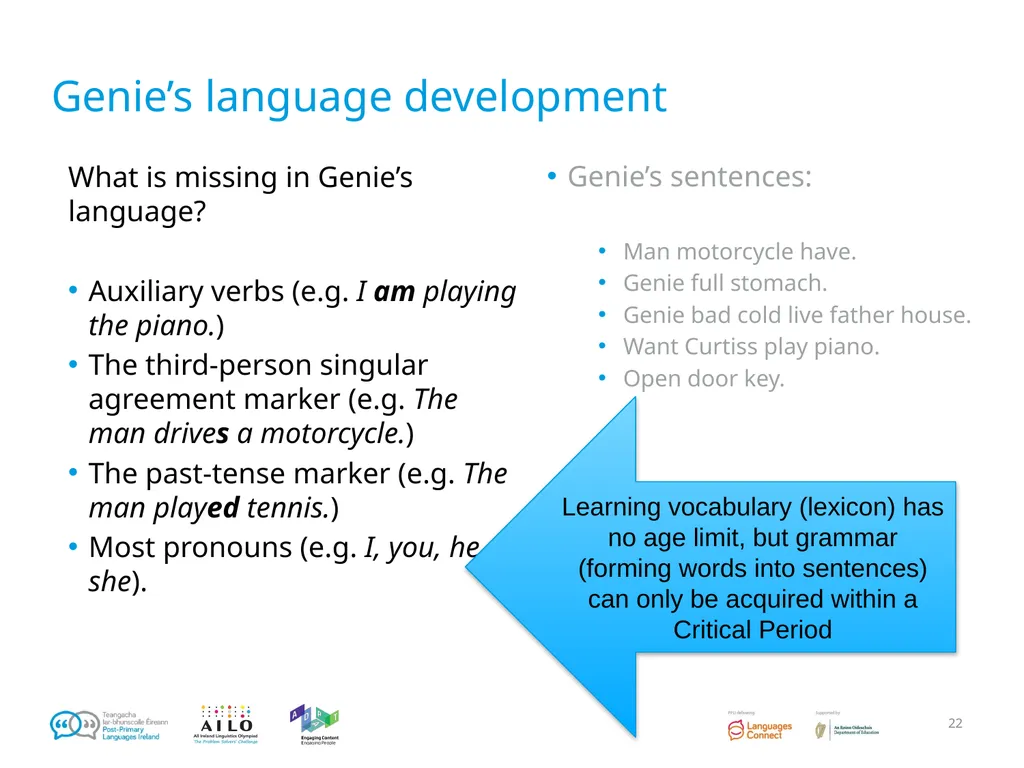
slide22. Genie’s language development Genie’s sentences:
Man motorcycle have.
Genie full stomach.
Genie bad cold live father house.
Want Curtiss play piano.
Open door key. What is missing in Genie’s language?
Auxiliary verbs (e.g. I am playing the piano.)
The third-person singular agreement marker (e.g. The man drives a motorcycle.)
The past-tense marker (e.g. The man played tennis.)
Most pronouns (e.g. I, you, he, she). 22 Learning vocabulary (lexicon) has no age limit, but grammar (forming words into sentences) can only be acquired within a Critical Period<br>
slide23. Complete Exercise 2 on Worksheet 6.1. Task 6.1: Worksheet 6.1 23<br>
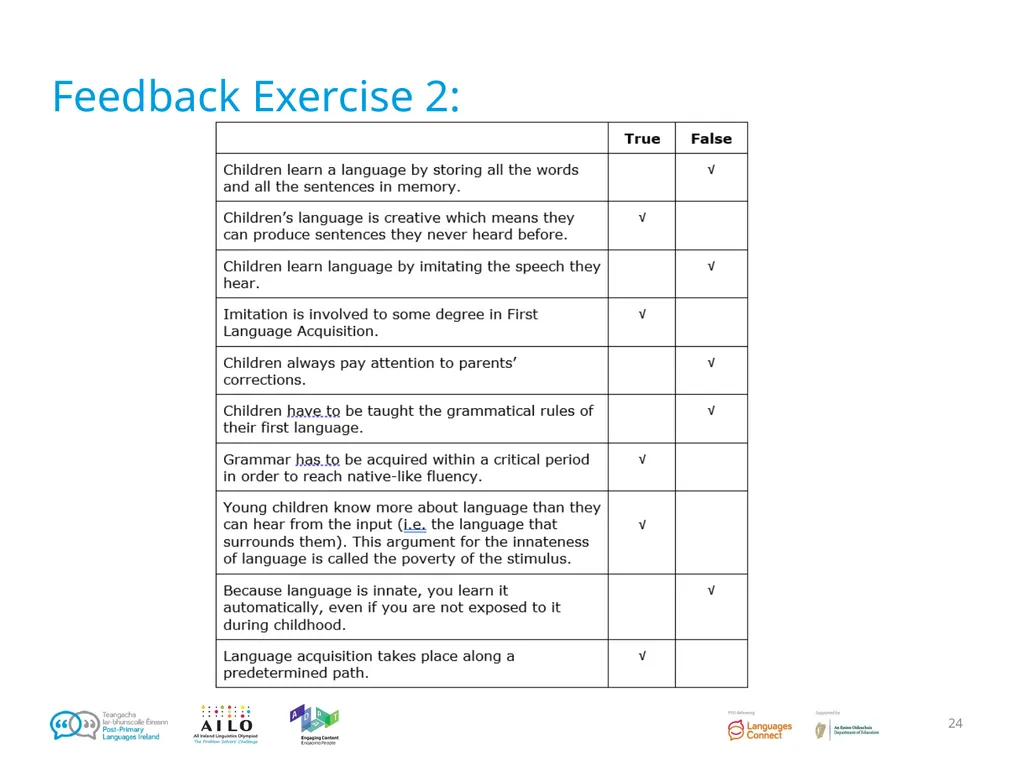
slide24. Feedback Exercise 2: 24<br>
slide25. 25 Task 6.2:
The Wug Test<br>
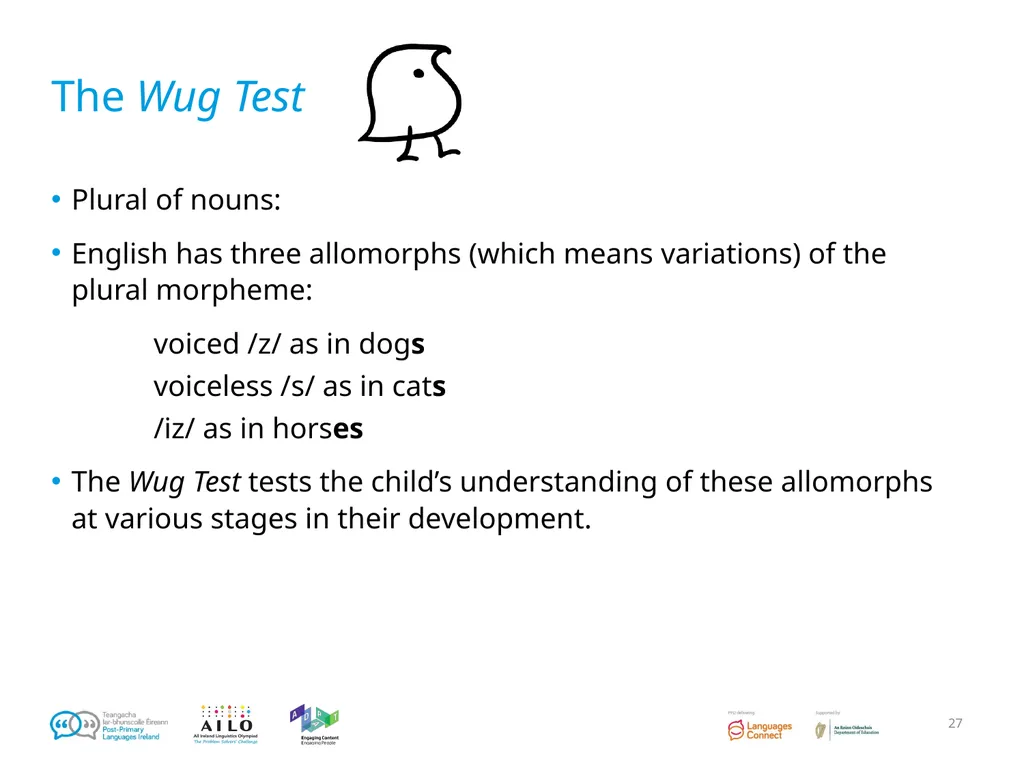
slide26. The Wug Test The psycholinguist Jean Berko Gleason created the Wug Test in 1958.
It was designed to investigate the acquisition of nominal and verbal inflectional morphemes in children learning English.
The Wug Test provided evidence that children recognise patterns in the language they acquire rather than simply imitating the speech around them.
They implicitly know the patterns for noun plurals and verb tenses.
The Wug Test provides evidence that language acquisition is rule-based: Children are able to attach the appropriate endings to nonsense words that they could not have heard before. 26<br>
slide27. The Wug Test Plural of nouns:
English has three allomorphs (which means variations) of the plural morpheme:
voiced /z/ as in dogs
voiceless /s/ as in cats
/iz/ as in horses
The Wug Test tests the child’s understanding of these allomorphs at various stages in their development. 27<br>
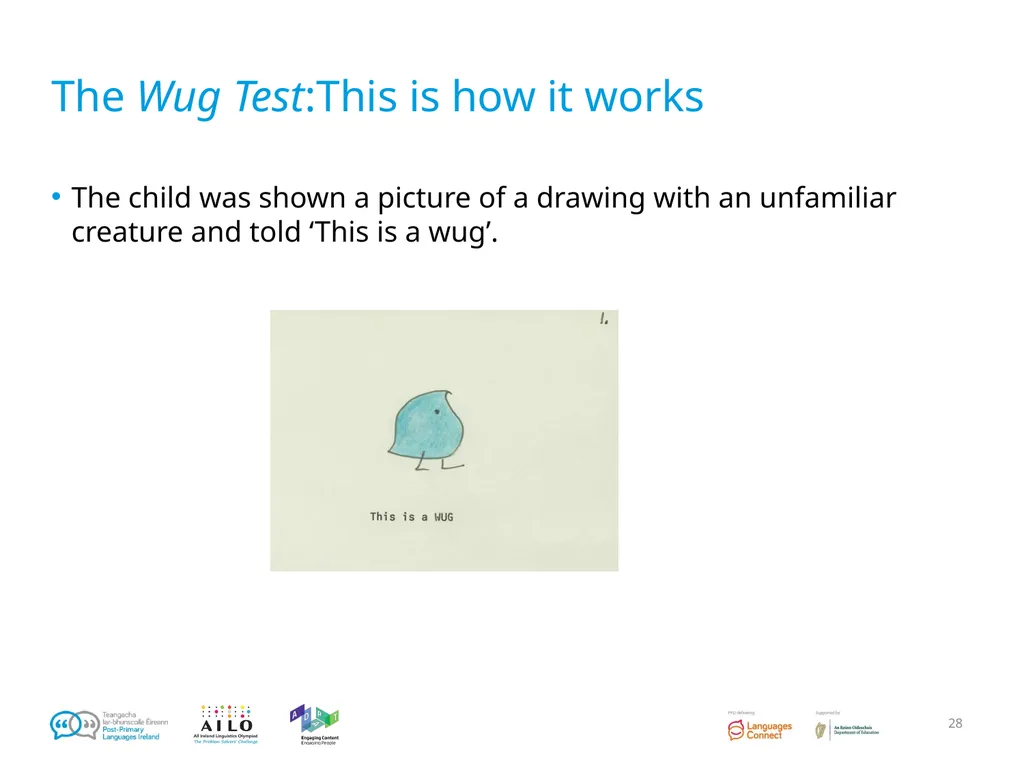
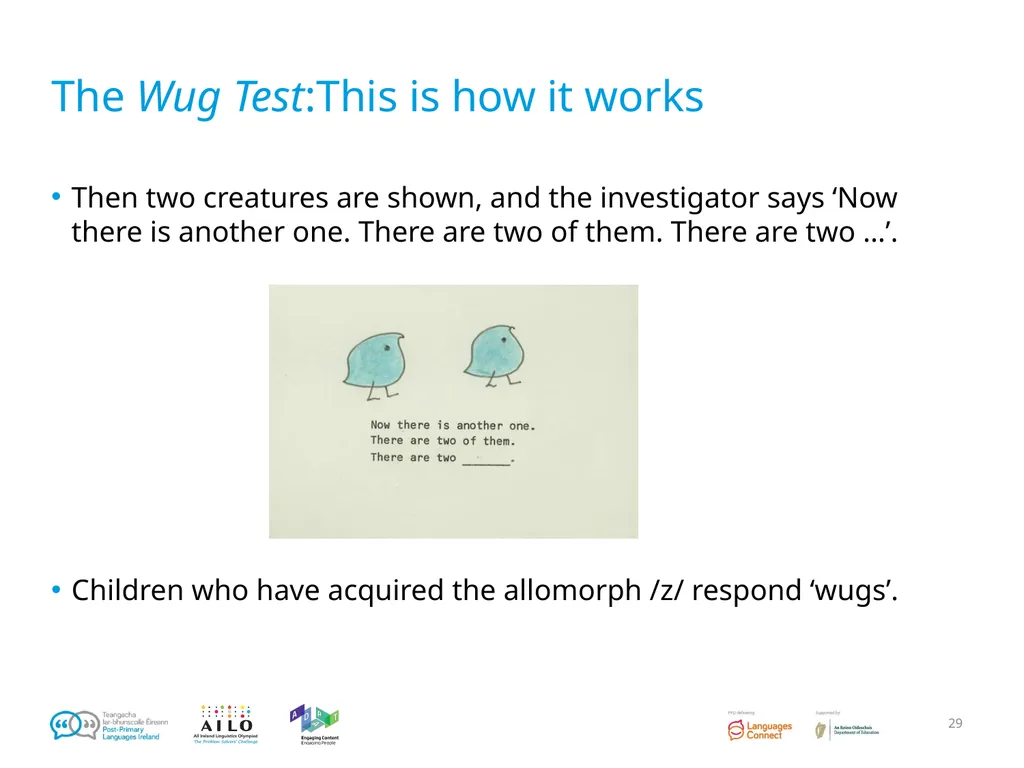
slide28. The Wug Test:This is how it works The child was shown a picture of a drawing with an unfamiliar creature and told ‘This is a wug’. 28<br>
slide29. The Wug Test:This is how it works Then two creatures are shown, and the investigator says ‘Now there is another one. There are two of them. There are two …’.
Children who have acquired the allomorph /z/ respond ‘wugs’. 29<br>
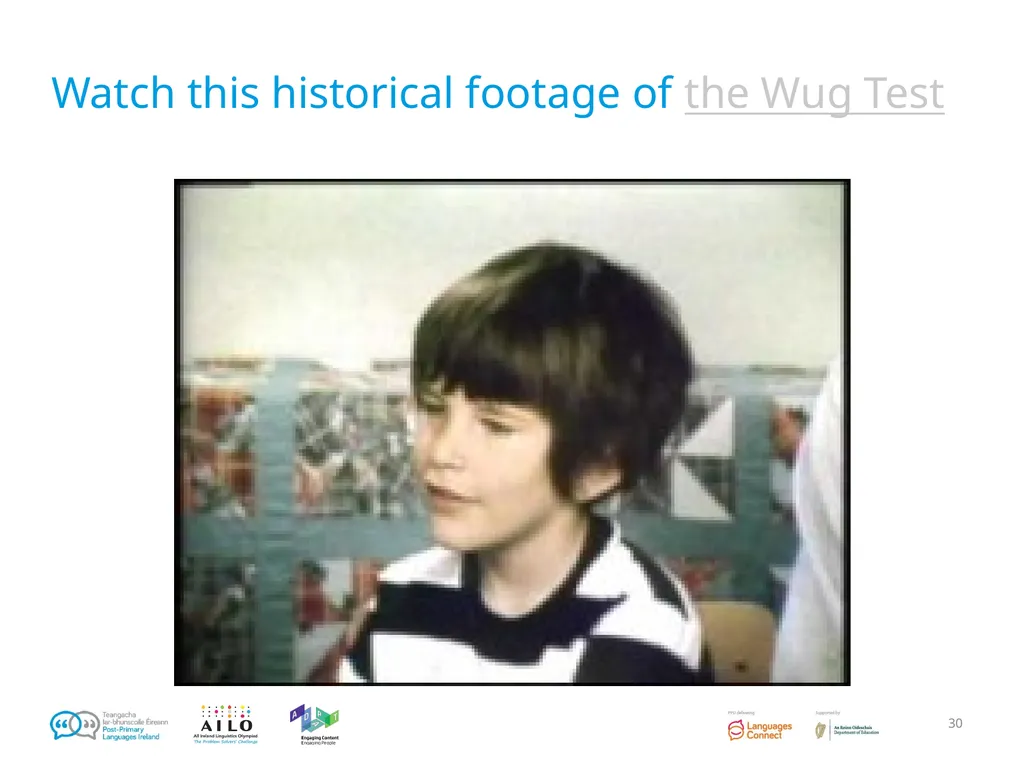
slide30. Watch this historical footage of the Wug Test 30<br>
slide31. Jean Berko Gleason’s Brief But Spectacular take on language 31<br>
slide32. Complete both exercises on Worksheet 6.2 Task 6.2: Worksheet 6.2 32<br>
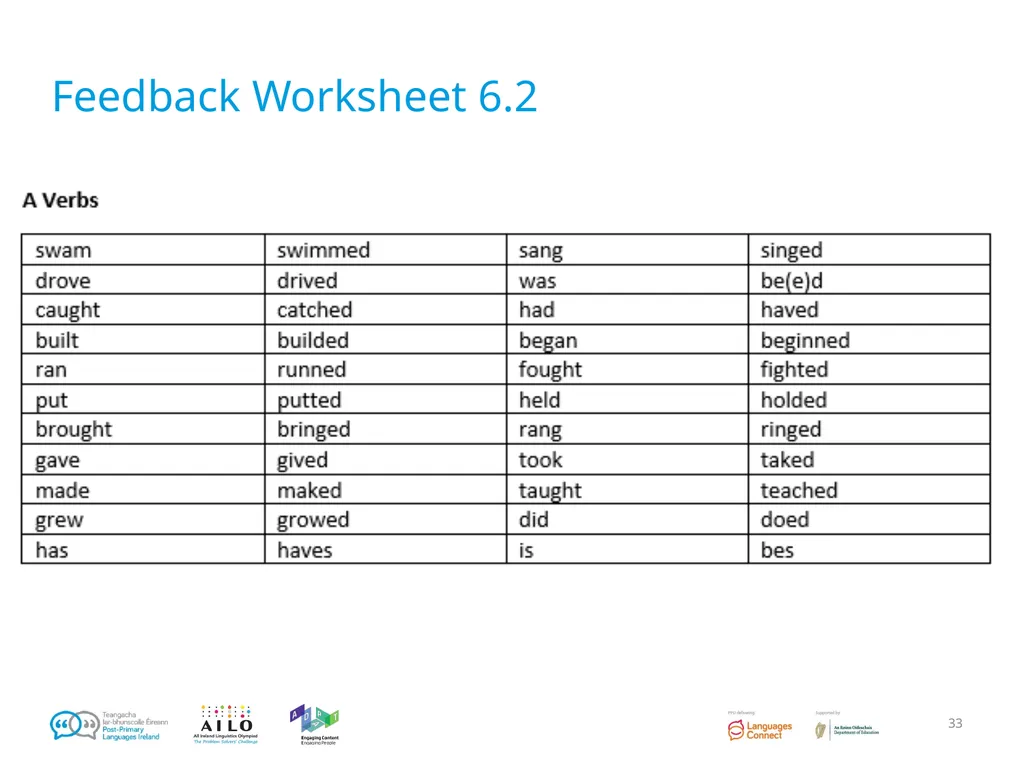
slide33. Feedback Worksheet 6.2 33<br>
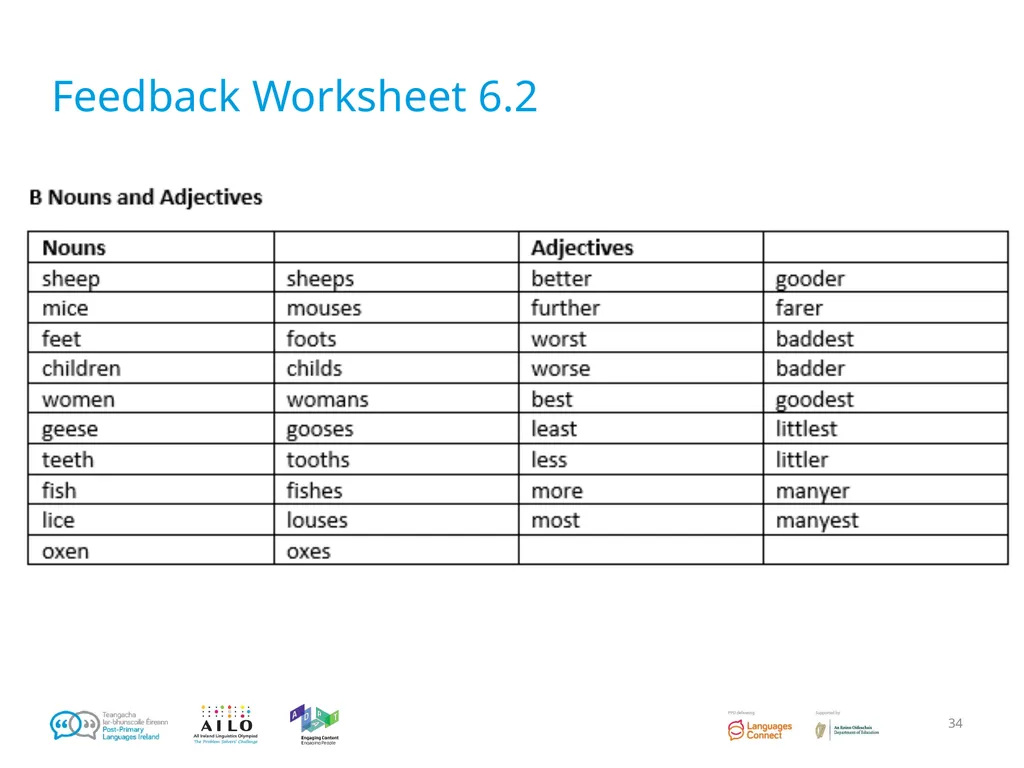
slide34. Feedback Worksheet 6.2 34<br>
slide35. Complete the AILO Puzzle: We are all molistic in a way.
There is a video that talks you through ‘We are all molistic in a way’:
https://www.youtube.com/watch?v=O6Cel0m73MY Task 6.2: Puzzle 35<br>
slide36. The Wug Test has been recreated in different forms. Check out the following:
https://sites.psu.edu/linguisticexperiments/files/2021/07/Wug-Test-Nouns.pdf
https://sites.psu.edu/linguisticexperiments/files/2020/07/Wug-Test-Verbs.pdf
Suggestion for a project/optional task: Create your own Wug Test. You can either do it with verbs or with nouns. The Wug Test 36<br>
slide37. Task 6.3:
Second Language
Acquisition 37<br>
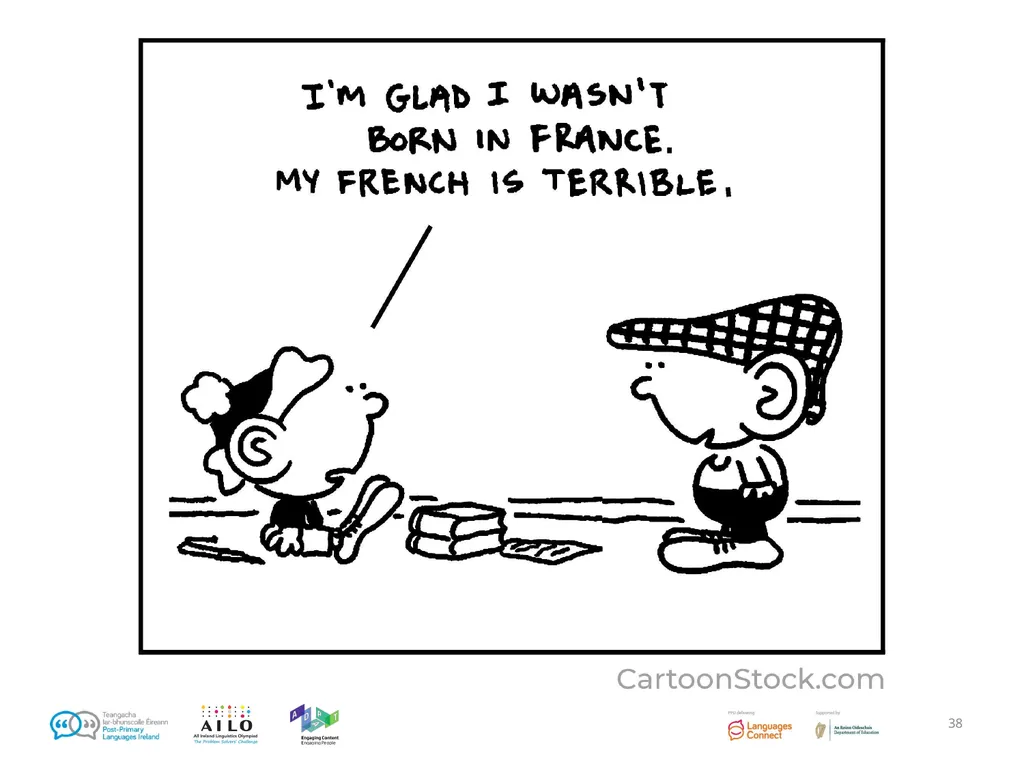
slide38. 38<br>
slide39. Exercise 1: Reflect on your own language learning. Take some time to consider the following questions:
Do you learn a foreign language other than your native language(s)?
Are you able to learn the foreign language as perfectly and with little conscious effort as your native language(s)?
Which aspects of second language learning are easy?
Which aspects of second language learning are more difficult?
Why do you think certain aspects of the language are easier to learn than others?
Do you think you are a ‘good’ or ‘poor’ L2 learner? Why do you think so? Is your level of achievement/success due to linguistic (e.g. similarities between the languages you learn), psychological (do you have difficulty with language such as dyslexia), educational (the way you were taught) or social reasons (for example does the language you learn have a high social status)? Worksheet 6.3: Exercise 1 Why is it more difficult to learn a foreign language than acquiring your first language? 39<br>
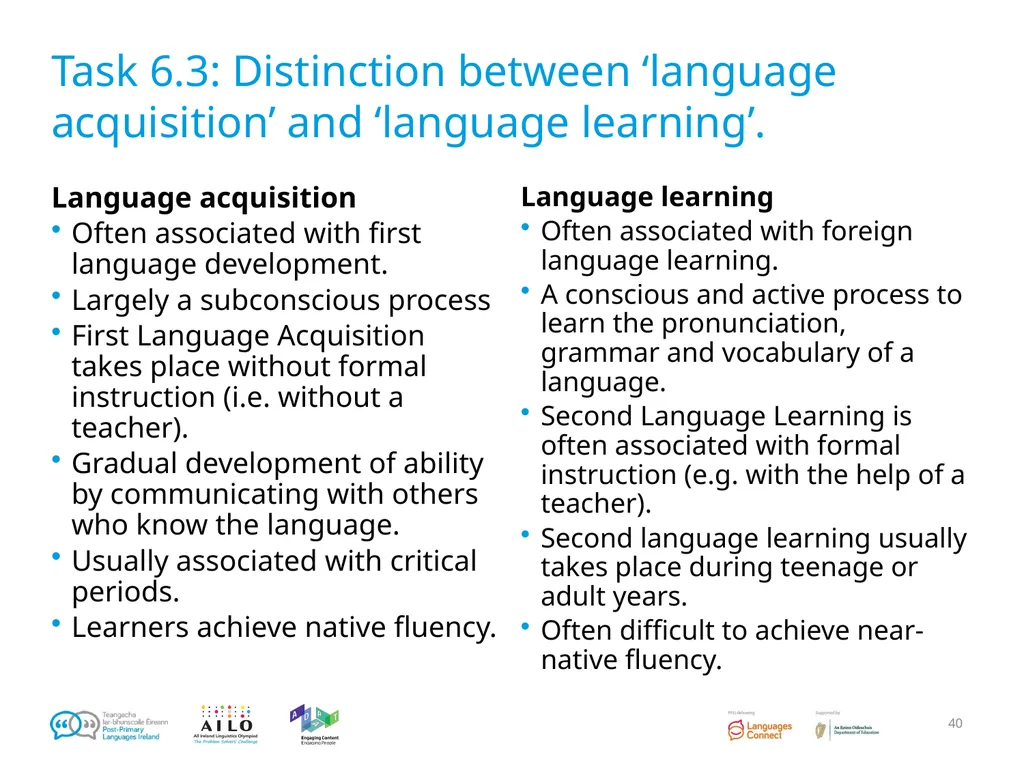
slide40. Task 6.3: Distinction between ‘language acquisition’ and ‘language learning’. Language acquisition
Often associated with first language development.
Largely a subconscious process
First Language Acquisition takes place without formal instruction (i.e. without a teacher).
Gradual development of ability by communicating with others who know the language.
Usually associated with critical periods.
Learners achieve native fluency. Language learning
Often associated with foreign language learning.
A conscious and active process to learn the pronunciation, grammar and vocabulary of a language.
Second Language Learning is often associated with formal instruction (e.g. with the help of a teacher).
Second language learning usually takes place during teenage or adult years.
Often difficult to achieve near-native fluency. 40<br>
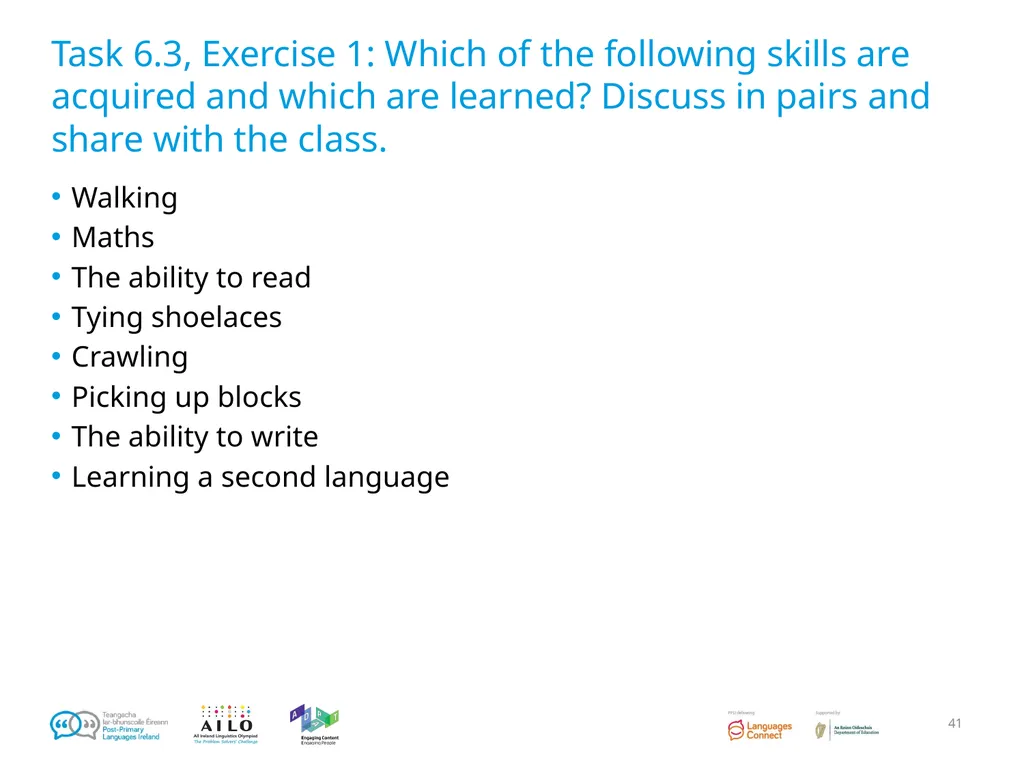
slide41. Walking
Maths
The ability to read
Tying shoelaces
Crawling
Picking up blocks
The ability to write
Learning a second language Task 6.3, Exercise 1: Which of the following skills are acquired and which are learned? Discuss in pairs and share with the class. 41<br>
slide42. Your first language (L1): You already know your native language which might interfere with the second language (L2) (Transfer).
Your age: We have seen that the younger the child, the easier it is to ‘pick up’ a language. After the age of 7, our ability to acquire a language declines.
Motivation: If you want to learn the L2 in order to achieve some goal (such as for travelling, job, university), you are more likely to be successful.
Personality: If you have an outgoing personality, it might be easier for you to communicate with others in the L2. In turn, if you are shy, it might be more difficult to chat to others.
Exposure to L2: If you learn the L2 in the country where it is spoken with frequent exposure, you are likely to make much faster progress than if you study the language two to three hours a week in school. What affects foreign language learning? 42<br>
slide43. Translate the five sentences on the worksheet into a language you study.
Identify differences between your L1 and L2.
Evaluate your efforts in the light of what you have learned about first and second language acquisition Worksheet 6.3: Exercise 2 43<br>
slide44. Feral children/Genie
http://web.archive.org/web/20101008200326/http://www.feralchildren.com/en/index.php
https://www.theguardian.com/society/2016/jul/14/genie-feral-child-los-angeles-researchers Further resources 44<br>
slide45. Fromkin, V., R. Rodman & N. Hyams. 2003. An Introduction to Language. Thomson Heinle.
Guasti, M.T. 2002. Language Acquisition: The Growth of Grammar. MIT Press. References 45<br>
slide46. 46<br>
slide2. Topic 1 Introduction to areas of linguistics and problem-solving
Topic 2 Historical Linguistics
Topic 3 Phonetics
Topic 4 Sociolinguistics
Topic 5 Writing systems
Topic 6 Language Acquisition
Topic 7 Morphology
Topic 8 Syntax
Topic 9 Psycholinguistics / Neurolinguistics
Topic 10 Machine Translation Overview of this Linguistics Module 2<br>
slide3. In this topic, we look at:
First Language Acquisition: How do babies and young children acquire their first language?
Second Language Learning: How do teenagers and adults learn a foreign language? Topic 6: Overview 3<br>
slide4. 4 Task 6.1:
First Language Acquisition<br>
slide5. 5<br>
slide6. The acquisition of language by babies and young children is an astonishing process.
Before they start school, typically developing children (i.e. children with no developmental difficulties) know most of the complex grammatical structures of their native language(s).
First language acquisition is spontaneous and takes place without explicit teaching in a relatively short period of time.
How do very young children master the complexities of language?
We will see that children are far superior to any other creature or computer in their ability to learn their native language. Task 6.1 First Language Acquisition 6<br>
slide7. Task 6.1: Watch the following TED Talk by Professor Patricia Kuhl and complete Worksheet 6.1, Exercise 1 7<br>
slide8. Feedback Worksheet 6.1, Exercise 1 8<br>
slide9. What are the implications of the critical period for the preservation of Irish?
What are the implications of the critical period of phonology for foreign language learning?
What are the implications of the critical period for the best time in the teaching cycles to introduce and teach a foreign language? How is that consistent with current government policy in Ireland?
Think of examples of critical periods in other areas of child development! Discussion/Project Topics (Optional) 9<br>
slide10. We have seen that babies are efficient language learners well before they are able to produce their first words.
But how do you think children actually learn how to produce grammatically correct sentences? How do children learn the grammar of their first language?
One possibility is that children imitate adult speech.
Another possibility is that they receive reinforcement from adults. This means that parents provide positive feedback when children say grammatically correct sentences. In turn, they are corrected (negative feedback) when they make mistakes. First Language Acquisition 10<br>
slide11. CHILD: My teacher holded the baby rabbits and we patted them.
ADULT: Did you say your teacher held the baby rabbits?
CHILD : Yes.
ADULT : And what did you say she did?
CHILD : She holded the baby rabbits and we patted them.
ADULT : Did you say she held them tightly?
CHILD : No, she holded them loosely.
(C. Cazden, 1972) Do children learn language by imitating adult speech? 11<br>
slide12. Imitation may play some role in First Language Acquisition, but its role is limited.
If children were merely imitating the adults, we would not expect babies to produce words and sentences that are ungrammatical in the adult language.
The dialogue on the previous slide shows that the child produces forms such as holded. Children do not hear these forms in the input as parents don’t usually make these errors (they say held).
However, these types of errors are common and systematic in early child language. Do children learn language by imitating adult speech? 12<br>
slide13. CHILD: Nobody don’t like me.
MOTHER: No, say “nobody likes me.”
CHILD : Nobody don’t like me.
(eight repetitions of this dialogue)
MOTHER: No, listen carefully; say “nobody likes me”.
CHILD : Oh! Nobody don’t likes me.
(McNeill, 1966) Do children learn language by being reinforced? 13<br>
slide14. CHILD: Want other one spoon, Daddy.
FATHER: You mean, you want the other spoon.
CHILD : Yes, I want other one spoon, please Daddy.
FATHER : Can you say “the other spoon”?
CHILD : Other … one … spoon.
FATHER : Say “other.”
CHILD : Other.
FATHER : “Spoon”.
CHILD : Spoon.
FATHER : “Other spoon.”
CHILD : Other … spoon. Now give me other one spoon?
(Braine 1971) Do children learn language by being reinforced? 14<br>
slide15. The children generally resist corrections.
If children learned language through reinforcement, they would take on board the adult corrections.
However, children tend to be immune to parents’ corrections.
Furthermore, most parents don’t bother correcting grammatical mistakes. Do children learn language by being reinforced? 15 Reinforcement and imitation do not play a crucial role in First Language Acquisition.<br>
slide16. The Linguist Noam Chomsky suggested that children are born with a Language Acquisition Device (LAD): How do children acquire their first language? 16<br>
slide17. Humans have a genetic predisposition for language.
The Language Acquisition Device (LAD) enables children to acquire their first language.
Children know more about language that they can ever extract from the input (i.e. the language they are surrounded by). This argument for the innateness hypothesis is called the poverty of the stimulus.
However, the mere genetic predisposition for language alone does not ensure successful language development.
In her TED Talk, Patricia Kuhl mentioned another crucial factor that is necessary for language development to take place:
For successful language development, children need to be exposed to language input: they need to listen to language and interact with native speakers. How do children acquire their first language? 17<br>
slide18. Remember from Patricia Kuhl’s presentation that the exact timing of input is crucial for sound development.
This is the Critical Period of phonological development.
Just as with phonological development, there is also a Critical Period for grammatical development.
That means that grammatical development of the first language has to take place in a certain time window. If this window is missed, children are no longer able to acquire important aspects of the language properly. How do children acquire their first language? 18<br>
slide19. The timing of input is crucial for normal first language development.
Children who are not exposed to language during their early years cannot acquire a fully developed grammar.
Evidence comes from children who grow up in isolation and who have not been exposed to human language during their isolation.
Theses are sometimes referred to as feral children.
The two most famous cases of input-deprived children are Genie and Victor. Critical Period of grammatical development 19<br>
slide20. Genie was discovered on the 4th November 1970.
She had spent almost all her childhood locked in a small room, mostly tied to a potty chair, isolated and abused.
When she was discovered, Genie had no language.
Genie’s case was the first to put the Critical Period to the test: Could a child who had been deprived of any human contact and without exposure to language develop language? Genie 20<br>
slide21. Genie managed to develop some language.
She learned many content words (including colours, shapes, objects, abstract and concrete nouns)
Her syntax (sentence structure) and morphology (word structure) never fully developed.
The Linguist Susan Curtiss, who worked with Genie for a few years, described Genie’s language as “the stringing together of content words, often with rich and clear meaning, but with little grammatical structure”.
Genie’s utterances often resembled those of two-year old children and of patients who suffer from Broca’s Aphasia (we will learn more about that in Topic 9): Genie’s language development 21<br>
slide22. Genie’s language development Genie’s sentences:
Man motorcycle have.
Genie full stomach.
Genie bad cold live father house.
Want Curtiss play piano.
Open door key. What is missing in Genie’s language?
Auxiliary verbs (e.g. I am playing the piano.)
The third-person singular agreement marker (e.g. The man drives a motorcycle.)
The past-tense marker (e.g. The man played tennis.)
Most pronouns (e.g. I, you, he, she). 22 Learning vocabulary (lexicon) has no age limit, but grammar (forming words into sentences) can only be acquired within a Critical Period<br>
slide23. Complete Exercise 2 on Worksheet 6.1. Task 6.1: Worksheet 6.1 23<br>
slide24. Feedback Exercise 2: 24<br>
slide25. 25 Task 6.2:
The Wug Test<br>
slide26. The Wug Test The psycholinguist Jean Berko Gleason created the Wug Test in 1958.
It was designed to investigate the acquisition of nominal and verbal inflectional morphemes in children learning English.
The Wug Test provided evidence that children recognise patterns in the language they acquire rather than simply imitating the speech around them.
They implicitly know the patterns for noun plurals and verb tenses.
The Wug Test provides evidence that language acquisition is rule-based: Children are able to attach the appropriate endings to nonsense words that they could not have heard before. 26<br>
slide27. The Wug Test Plural of nouns:
English has three allomorphs (which means variations) of the plural morpheme:
voiced /z/ as in dogs
voiceless /s/ as in cats
/iz/ as in horses
The Wug Test tests the child’s understanding of these allomorphs at various stages in their development. 27<br>
slide28. The Wug Test:This is how it works The child was shown a picture of a drawing with an unfamiliar creature and told ‘This is a wug’. 28<br>
slide29. The Wug Test:This is how it works Then two creatures are shown, and the investigator says ‘Now there is another one. There are two of them. There are two …’.
Children who have acquired the allomorph /z/ respond ‘wugs’. 29<br>
slide30. Watch this historical footage of the Wug Test 30<br>
slide31. Jean Berko Gleason’s Brief But Spectacular take on language 31<br>
slide32. Complete both exercises on Worksheet 6.2 Task 6.2: Worksheet 6.2 32<br>
slide33. Feedback Worksheet 6.2 33<br>
slide34. Feedback Worksheet 6.2 34<br>
slide35. Complete the AILO Puzzle: We are all molistic in a way.
There is a video that talks you through ‘We are all molistic in a way’:
https://www.youtube.com/watch?v=O6Cel0m73MY Task 6.2: Puzzle 35<br>
slide36. The Wug Test has been recreated in different forms. Check out the following:
https://sites.psu.edu/linguisticexperiments/files/2021/07/Wug-Test-Nouns.pdf
https://sites.psu.edu/linguisticexperiments/files/2020/07/Wug-Test-Verbs.pdf
Suggestion for a project/optional task: Create your own Wug Test. You can either do it with verbs or with nouns. The Wug Test 36<br>
slide37. Task 6.3:
Second Language
Acquisition 37<br>
slide38. 38<br>
slide39. Exercise 1: Reflect on your own language learning. Take some time to consider the following questions:
Do you learn a foreign language other than your native language(s)?
Are you able to learn the foreign language as perfectly and with little conscious effort as your native language(s)?
Which aspects of second language learning are easy?
Which aspects of second language learning are more difficult?
Why do you think certain aspects of the language are easier to learn than others?
Do you think you are a ‘good’ or ‘poor’ L2 learner? Why do you think so? Is your level of achievement/success due to linguistic (e.g. similarities between the languages you learn), psychological (do you have difficulty with language such as dyslexia), educational (the way you were taught) or social reasons (for example does the language you learn have a high social status)? Worksheet 6.3: Exercise 1 Why is it more difficult to learn a foreign language than acquiring your first language? 39<br>
slide40. Task 6.3: Distinction between ‘language acquisition’ and ‘language learning’. Language acquisition
Often associated with first language development.
Largely a subconscious process
First Language Acquisition takes place without formal instruction (i.e. without a teacher).
Gradual development of ability by communicating with others who know the language.
Usually associated with critical periods.
Learners achieve native fluency. Language learning
Often associated with foreign language learning.
A conscious and active process to learn the pronunciation, grammar and vocabulary of a language.
Second Language Learning is often associated with formal instruction (e.g. with the help of a teacher).
Second language learning usually takes place during teenage or adult years.
Often difficult to achieve near-native fluency. 40<br>
slide41. Walking
Maths
The ability to read
Tying shoelaces
Crawling
Picking up blocks
The ability to write
Learning a second language Task 6.3, Exercise 1: Which of the following skills are acquired and which are learned? Discuss in pairs and share with the class. 41<br>
slide42. Your first language (L1): You already know your native language which might interfere with the second language (L2) (Transfer).
Your age: We have seen that the younger the child, the easier it is to ‘pick up’ a language. After the age of 7, our ability to acquire a language declines.
Motivation: If you want to learn the L2 in order to achieve some goal (such as for travelling, job, university), you are more likely to be successful.
Personality: If you have an outgoing personality, it might be easier for you to communicate with others in the L2. In turn, if you are shy, it might be more difficult to chat to others.
Exposure to L2: If you learn the L2 in the country where it is spoken with frequent exposure, you are likely to make much faster progress than if you study the language two to three hours a week in school. What affects foreign language learning? 42<br>
slide43. Translate the five sentences on the worksheet into a language you study.
Identify differences between your L1 and L2.
Evaluate your efforts in the light of what you have learned about first and second language acquisition Worksheet 6.3: Exercise 2 43<br>
slide44. Feral children/Genie
http://web.archive.org/web/20101008200326/http://www.feralchildren.com/en/index.php
https://www.theguardian.com/society/2016/jul/14/genie-feral-child-los-angeles-researchers Further resources 44<br>
slide45. Fromkin, V., R. Rodman & N. Hyams. 2003. An Introduction to Language. Thomson Heinle.
Guasti, M.T. 2002. Language Acquisition: The Growth of Grammar. MIT Press. References 45<br>
slide46. 46<br>