
IST 597 Deep Learning Class Introduction Thanks to
JO
Published · 32 slides · 0 views
1 / 1
Description
IST 597 Deep Learning Class Introduction Thanks to Dhruv Batra Georgia Tech http:clgiles.ist.psu.eduIST597 IST 597 OER Course IST 597 is a mostly an Open Educational Resource class. Open educational resources (OERs) are freely
Related Topics
Share
Embed code
Download this presentation From Below
"IST 597 Deep Learning Class Introduction Thanks to" is the property of its rightful owner. Permission is granted to download and print the materials on this website for personal, non-commercial use only, and to display it on your personal computer provided you do not modify the materials and that you retain all copyright notices contained in the materials. By downloading content from our website, you accept the terms of this agreement.
Presentation Transcript
01
IST 597 Deep Learning Class Introduction Thanks to Dhruv Batra
Georgia Tech http://clgiles.ist.psu.edu/IST597<br>
02
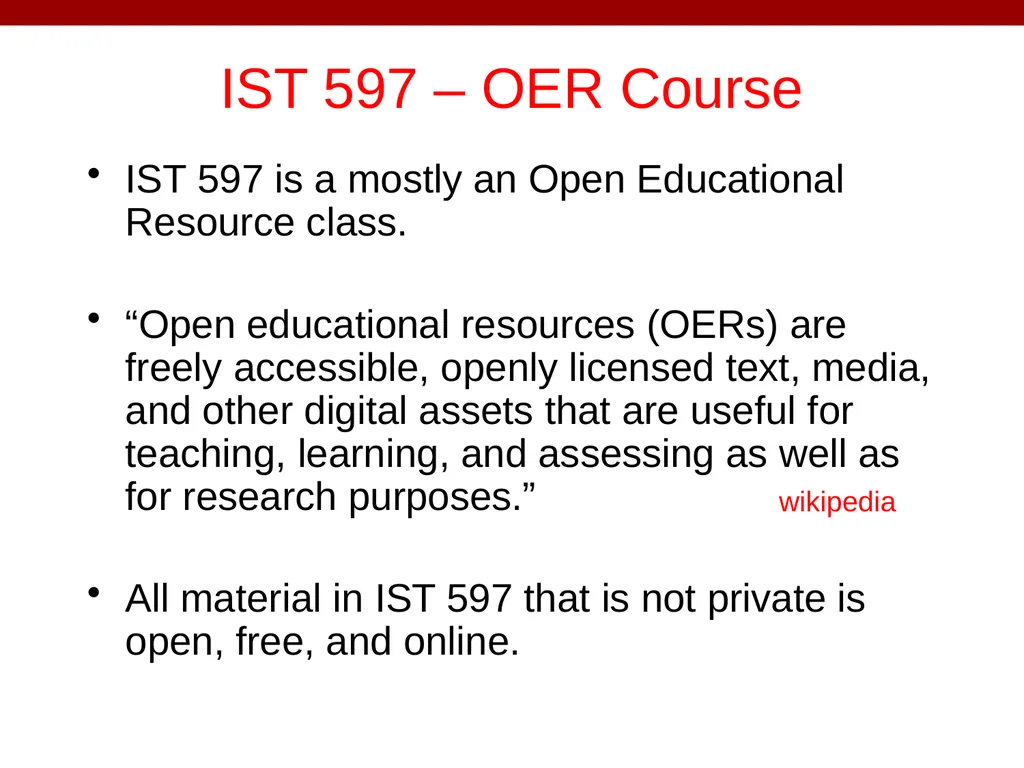
IST 597 – OER Course IST 597 is a mostly an Open Educational Resource class.
“Open educational resources (OERs) are freely accessible, openly licensed text, media, and other digital assets that are useful for teaching, learning, and assessing as well as for research purposes.”
All material in IST 597 that is not private is open, free, and online. wikipedia<br>
“Open educational resources (OERs) are freely accessible, openly licensed text, media, and other digital assets that are useful for teaching, learning, and assessing as well as for research purposes.”
All material in IST 597 that is not private is open, free, and online. wikipedia<br>
03
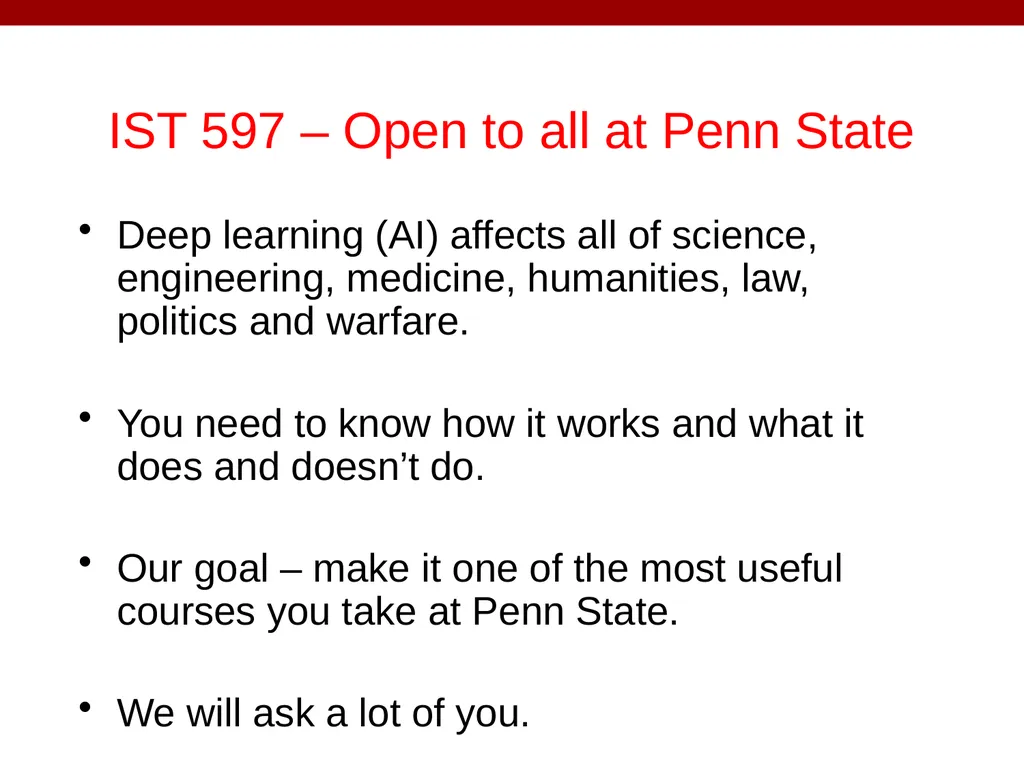
IST 597 – Open to all at Penn State Deep learning (AI) affects all of science, engineering, medicine, humanities, law, politics and warfare.
You need to know how it works and what it does and doesn’t do.
Our goal – make it one of the most useful courses you take at Penn State.
We will ask a lot of you.<br>
You need to know how it works and what it does and doesn’t do.
Our goal – make it one of the most useful courses you take at Penn State.
We will ask a lot of you.<br>
04
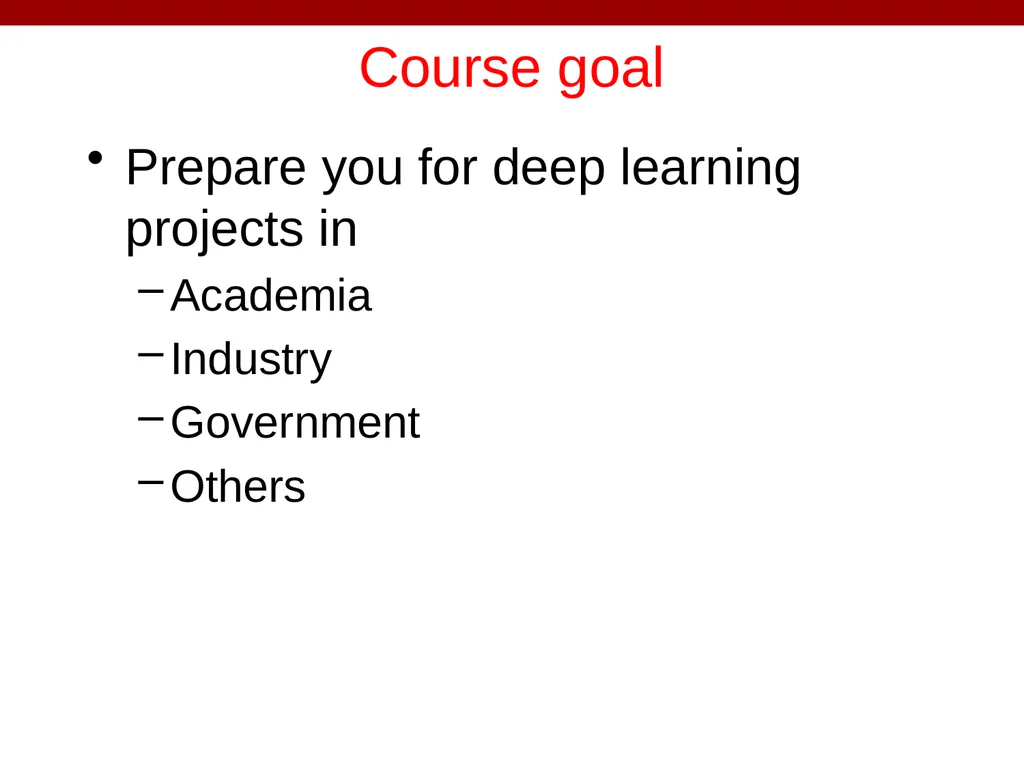
Course goal Prepare you for deep learning projects in
Academia
Industry
Government
Others<br>
Academia
Industry
Government
Others<br>
05
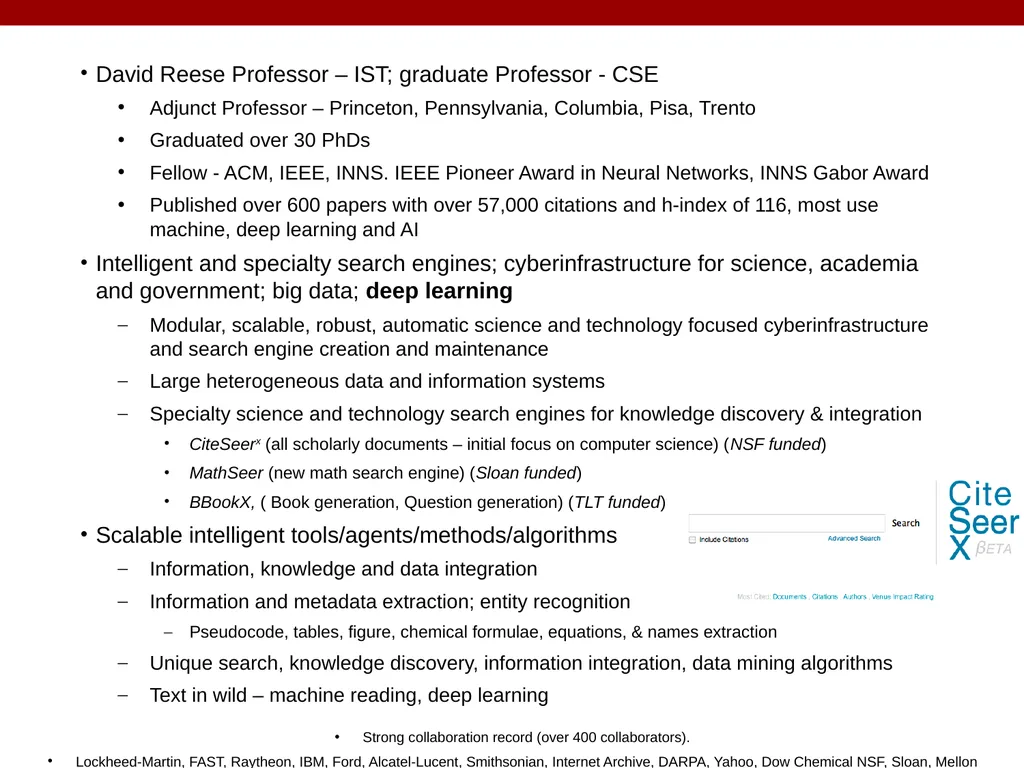
David Reese Professor – IST; graduate Professor - CSE
Adjunct Professor – Princeton, Pennsylvania, Columbia, Pisa, Trento
Graduated over 30 PhDs
Fellow - ACM, IEEE, INNS. IEEE Pioneer Award in Neural Networks, INNS Gabor Award
Published over 600 papers with over 57,000 citations and h-index of 116, most use machine, deep learning and AI
Intelligent and specialty search engines; cyberinfrastructure for science, academia and government; big data; deep learning
Modular, scalable, robust, automatic science and technology focused cyberinfrastructure and search engine creation and maintenance
Large heterogeneous data and information systems
Specialty science and technology search engines for knowledge discovery & integration
CiteSeerx (all scholarly documents – initial focus on computer science) (NSF funded)
MathSeer (new math search engine) (Sloan funded)
BBookX, ( Book generation, Question generation) (TLT funded)
Scalable intelligent tools/agents/methods/algorithms
Information, knowledge and data integration
Information and metadata extraction; entity recognition
Pseudocode, tables, figure, chemical formulae, equations, & names extraction
Unique search, knowledge discovery, information integration, data mining algorithms
Text in wild – machine reading, deep learning Strong collaboration record (over 400 collaborators).
Lockheed-Martin, FAST, Raytheon, IBM, Ford, Alcatel-Lucent, Smithsonian, Internet Archive, DARPA, Yahoo, Dow Chemical NSF, Sloan, Mellon<br>
Adjunct Professor – Princeton, Pennsylvania, Columbia, Pisa, Trento
Graduated over 30 PhDs
Fellow - ACM, IEEE, INNS. IEEE Pioneer Award in Neural Networks, INNS Gabor Award
Published over 600 papers with over 57,000 citations and h-index of 116, most use machine, deep learning and AI
Intelligent and specialty search engines; cyberinfrastructure for science, academia and government; big data; deep learning
Modular, scalable, robust, automatic science and technology focused cyberinfrastructure and search engine creation and maintenance
Large heterogeneous data and information systems
Specialty science and technology search engines for knowledge discovery & integration
CiteSeerx (all scholarly documents – initial focus on computer science) (NSF funded)
MathSeer (new math search engine) (Sloan funded)
BBookX, ( Book generation, Question generation) (TLT funded)
Scalable intelligent tools/agents/methods/algorithms
Information, knowledge and data integration
Information and metadata extraction; entity recognition
Pseudocode, tables, figure, chemical formulae, equations, & names extraction
Unique search, knowledge discovery, information integration, data mining algorithms
Text in wild – machine reading, deep learning Strong collaboration record (over 400 collaborators).
Lockheed-Martin, FAST, Raytheon, IBM, Ford, Alcatel-Lucent, Smithsonian, Internet Archive, DARPA, Yahoo, Dow Chemical NSF, Sloan, Mellon<br>
06
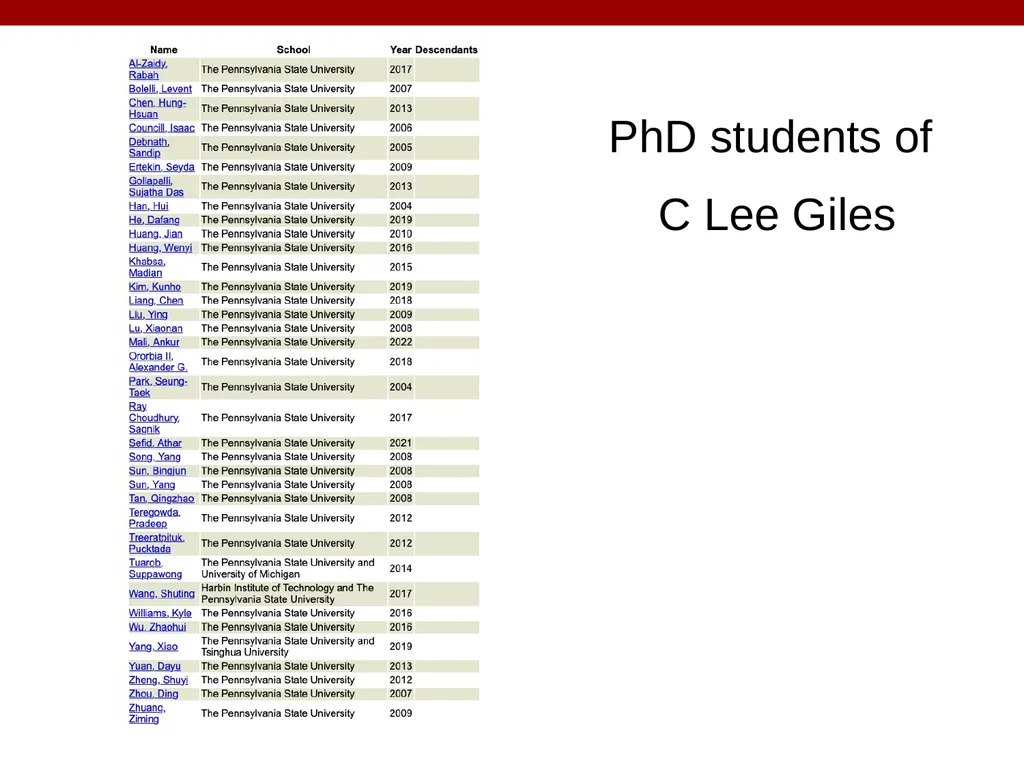
PhD students of
C Lee Giles<br>
C Lee Giles<br>
07
More detail you don’t need PhD in optical sciences (physicist)
Top 200 computer scientist world wide according to h-index
Giles academic genealogy
4th and 5th dissertation advisors Nobel Laureates
Felix Block
Werner Heisenberg
3rd and 6th advisors nominated for the Nobel prize.
Carson Jefferies
Arnold Sommerfeld
Academic genealogy
Klein
Lipschitz
Gauss
Dirichlet
Poisson
Fourier
Lagrange
…<br>
Top 200 computer scientist world wide according to h-index
Giles academic genealogy
4th and 5th dissertation advisors Nobel Laureates
Felix Block
Werner Heisenberg
3rd and 6th advisors nominated for the Nobel prize.
Carson Jefferies
Arnold Sommerfeld
Academic genealogy
Klein
Lipschitz
Gauss
Dirichlet
Poisson
Fourier
Lagrange
…<br>
08
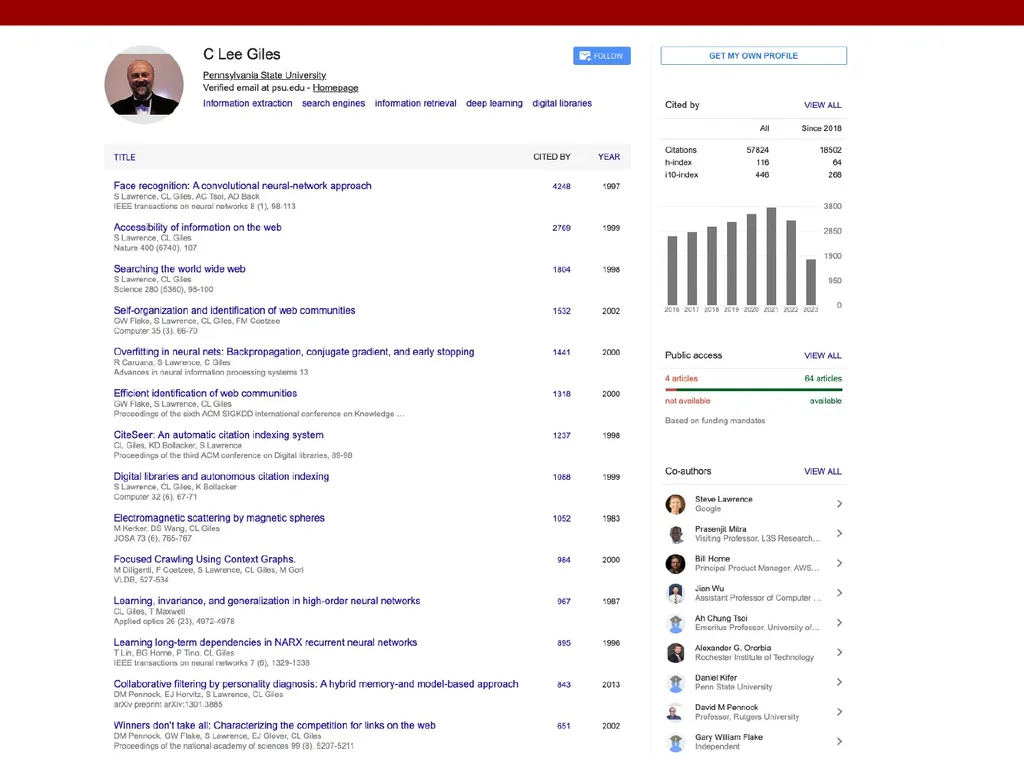
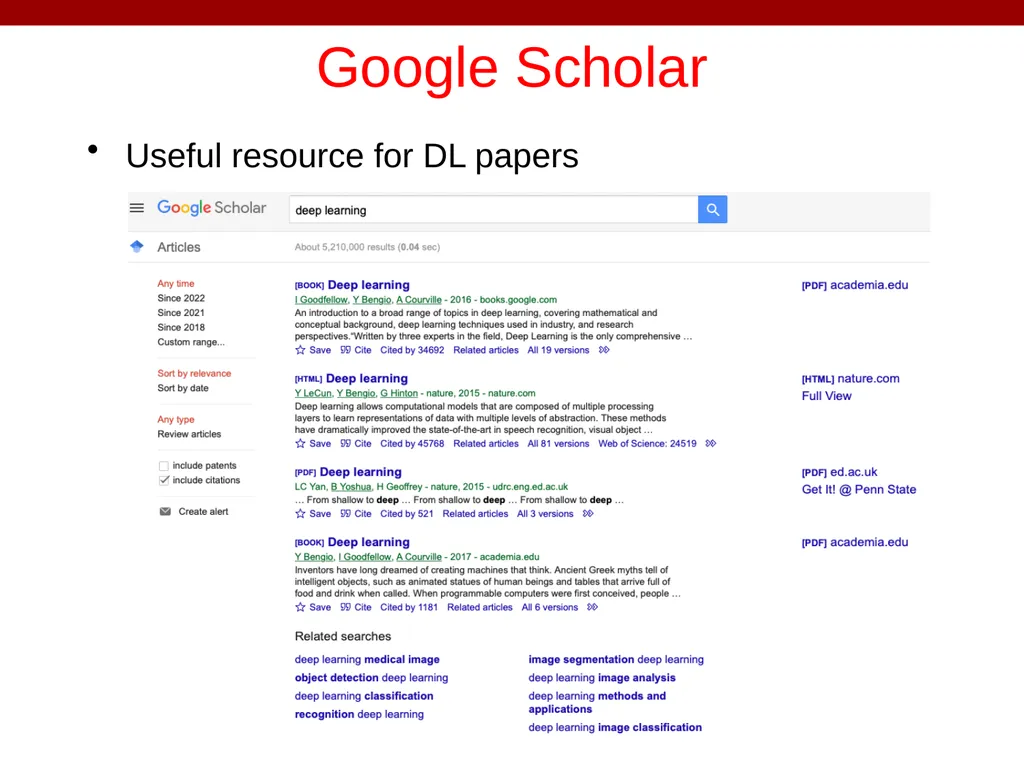
Google Scholar Useful resource for DL papers<br>
09
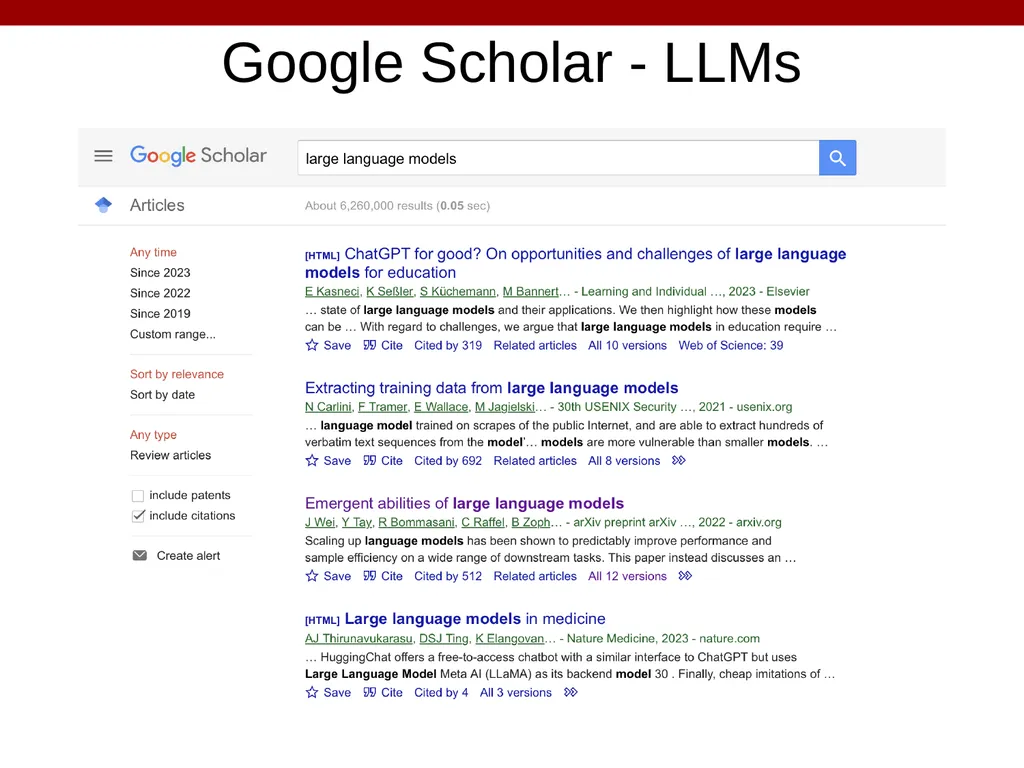
Google Scholar - LLMs<br>
10
Machine Learning Who here has had a machine learning course?
Computer science
Statistics
Mathematics
Engineering
Science
Others<br>
Computer science
Statistics
Mathematics
Engineering
Science
Others<br>
11
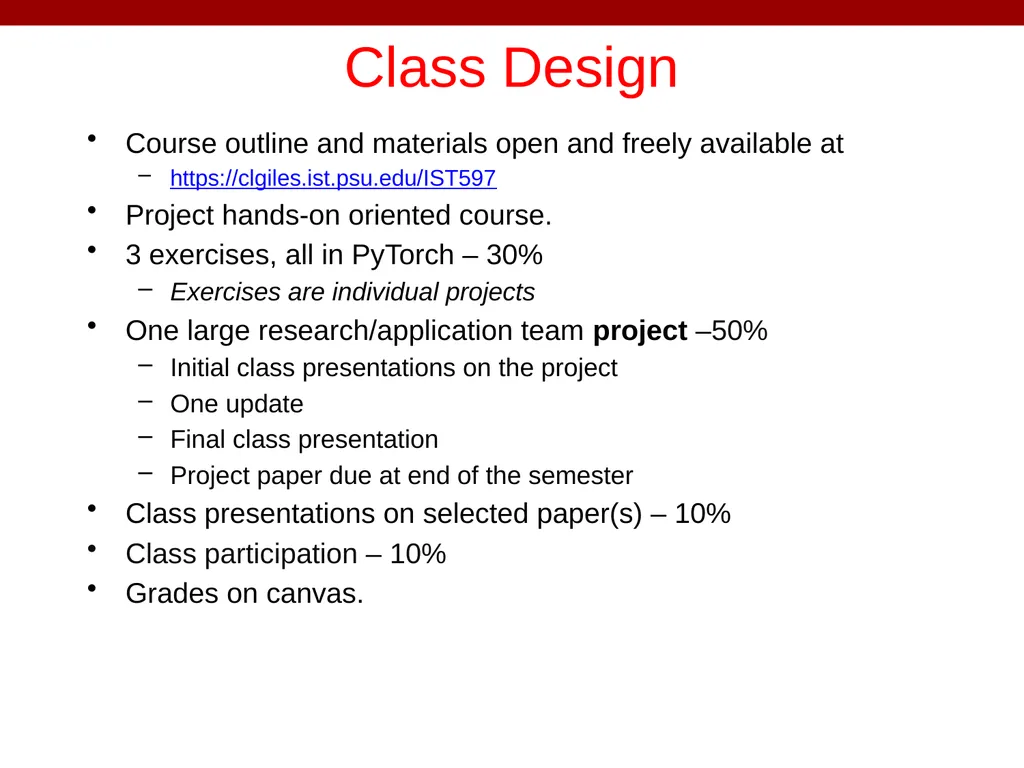
Class Design Course outline and materials open and freely available at
https://clgiles.ist.psu.edu/IST597
Project hands-on oriented course.
3 exercises, all in PyTorch – 30%
Exercises are individual projects
One large research/application team project –50%
Initial class presentations on the project
One update
Final class presentation
Project paper due at end of the semester
Class presentations on selected paper(s) – 10%
Class participation – 10%
Grades on canvas.<br>
https://clgiles.ist.psu.edu/IST597
Project hands-on oriented course.
3 exercises, all in PyTorch – 30%
Exercises are individual projects
One large research/application team project –50%
Initial class presentations on the project
One update
Final class presentation
Project paper due at end of the semester
Class presentations on selected paper(s) – 10%
Class participation – 10%
Grades on canvas.<br>
12
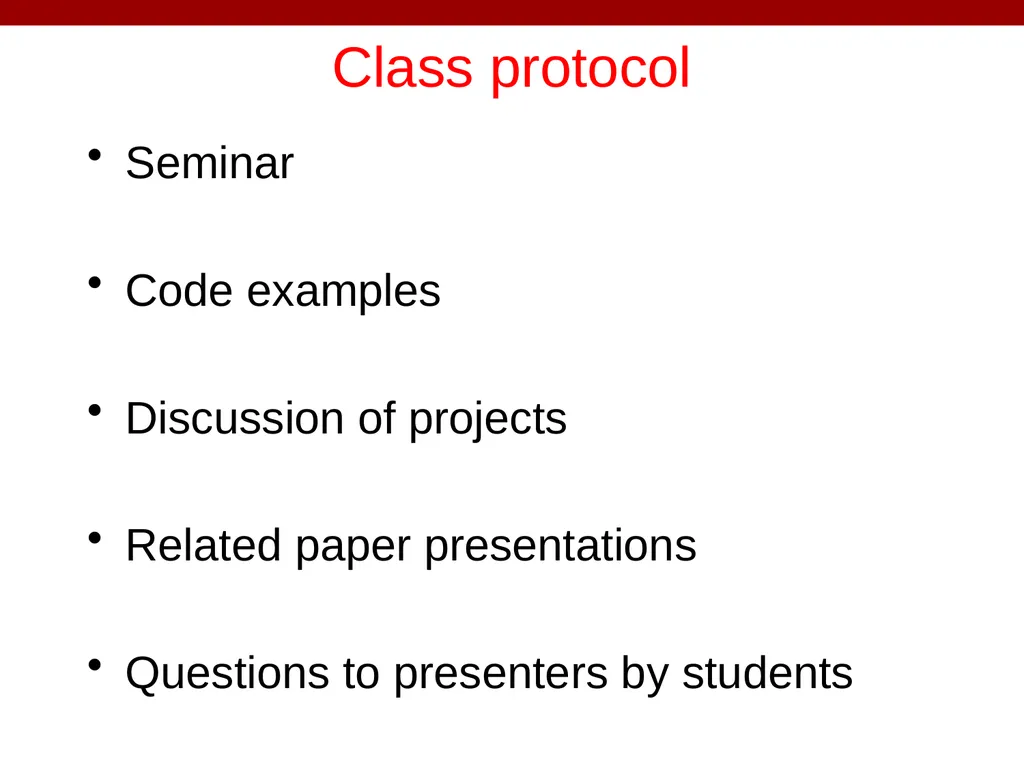
Class protocol Seminar
Code examples
Discussion of projects
Related paper presentations
Questions to presenters by students<br>
Code examples
Discussion of projects
Related paper presentations
Questions to presenters by students<br>
13
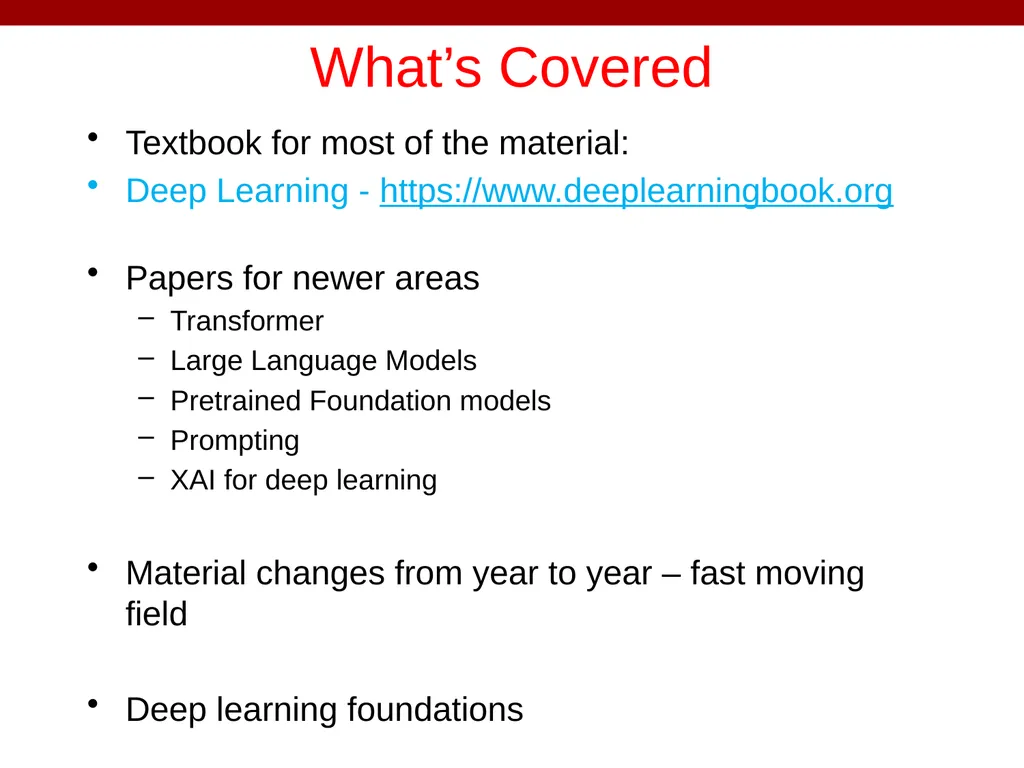
What’s Covered Textbook for most of the material:
Deep Learning - https://www.deeplearningbook.org
Papers for newer areas
Transformer
Large Language Models
Pretrained Foundation models
Prompting
XAI for deep learning
Material changes from year to year – fast moving field
Deep learning foundations<br>
Deep Learning - https://www.deeplearningbook.org
Papers for newer areas
Transformer
Large Language Models
Pretrained Foundation models
Prompting
XAI for deep learning
Material changes from year to year – fast moving field
Deep learning foundations<br>
14
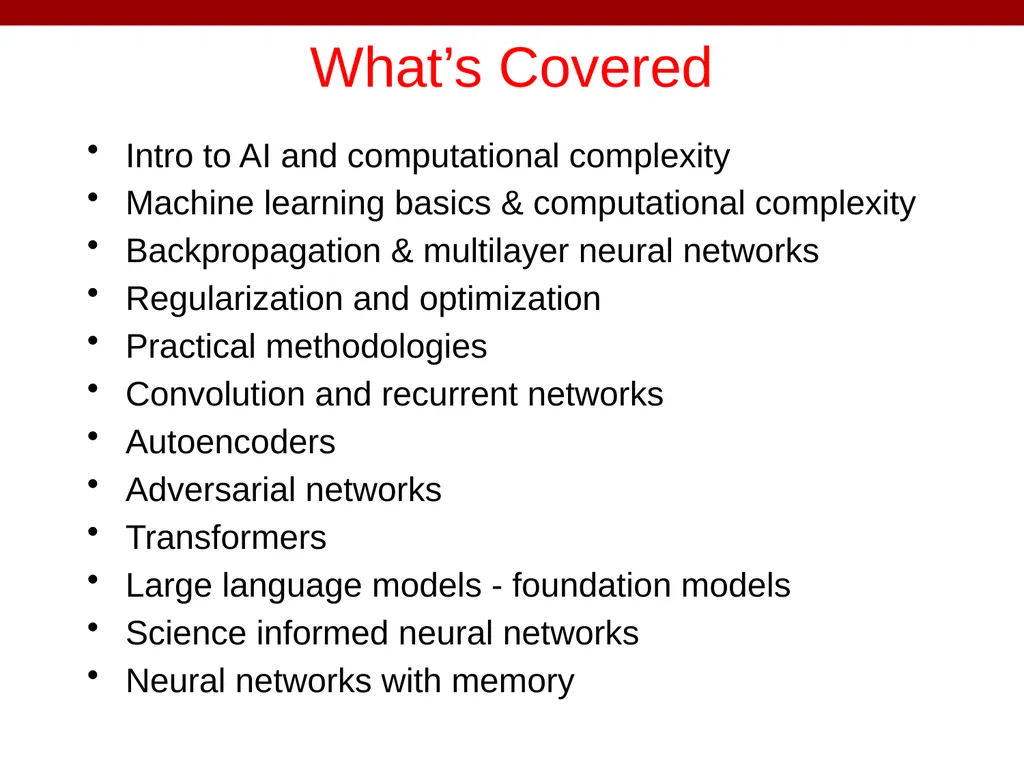
What’s Covered Intro to AI and computational complexity
Machine learning basics & computational complexity
Backpropagation & multilayer neural networks
Regularization and optimization
Practical methodologies
Convolution and recurrent networks
Autoencoders
Adversarial networks
Transformers
Large language models - foundation models
Science informed neural networks
Neural networks with memory<br>
Machine learning basics & computational complexity
Backpropagation & multilayer neural networks
Regularization and optimization
Practical methodologies
Convolution and recurrent networks
Autoencoders
Adversarial networks
Transformers
Large language models - foundation models
Science informed neural networks
Neural networks with memory<br>
15
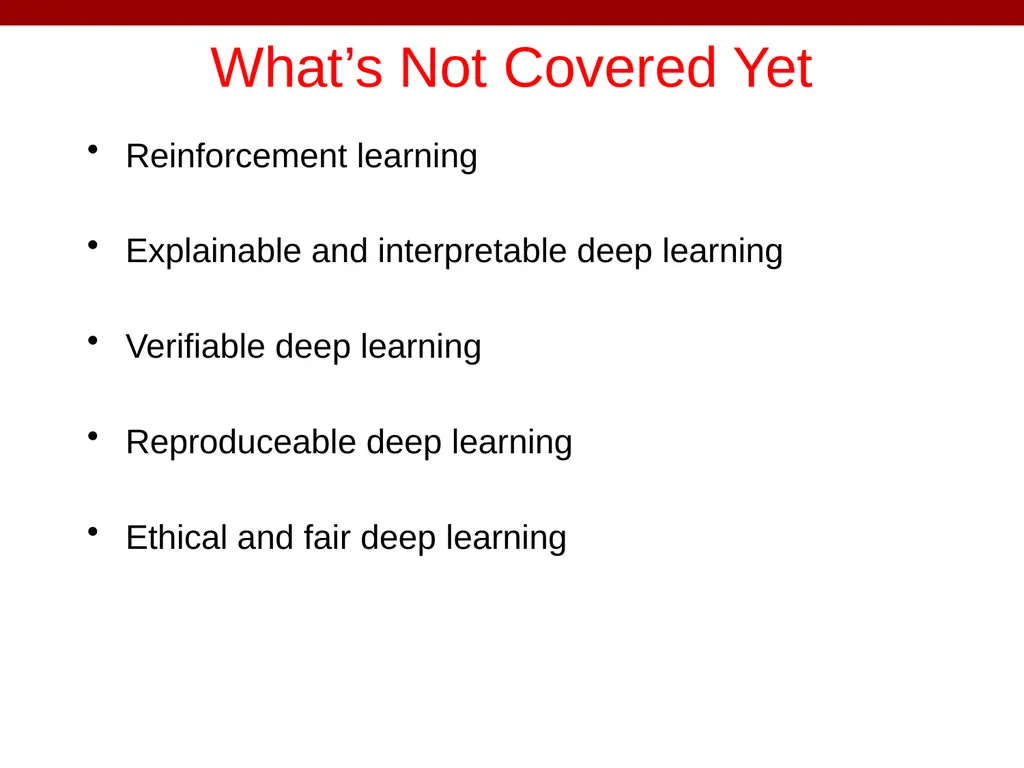
What’s Not Covered Yet Reinforcement learning
Explainable and interpretable deep learning
Verifiable deep learning
Reproduceable deep learning
Ethical and fair deep learning<br>
Explainable and interpretable deep learning
Verifiable deep learning
Reproduceable deep learning
Ethical and fair deep learning<br>
16
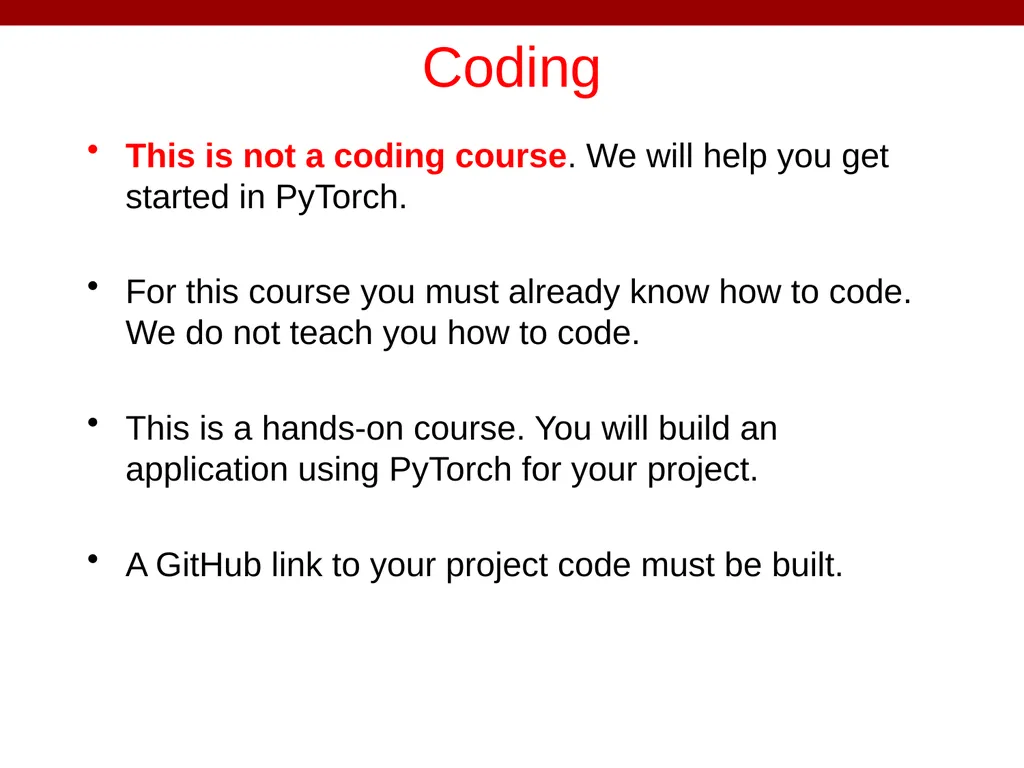
Coding This is not a coding course. We will help you get started in PyTorch.
For this course you must already know how to code. We do not teach you how to code.
This is a hands-on course. You will build an application using PyTorch for your project.
A GitHub link to your project code must be built.<br>
For this course you must already know how to code. We do not teach you how to code.
This is a hands-on course. You will build an application using PyTorch for your project.
A GitHub link to your project code must be built.<br>
17
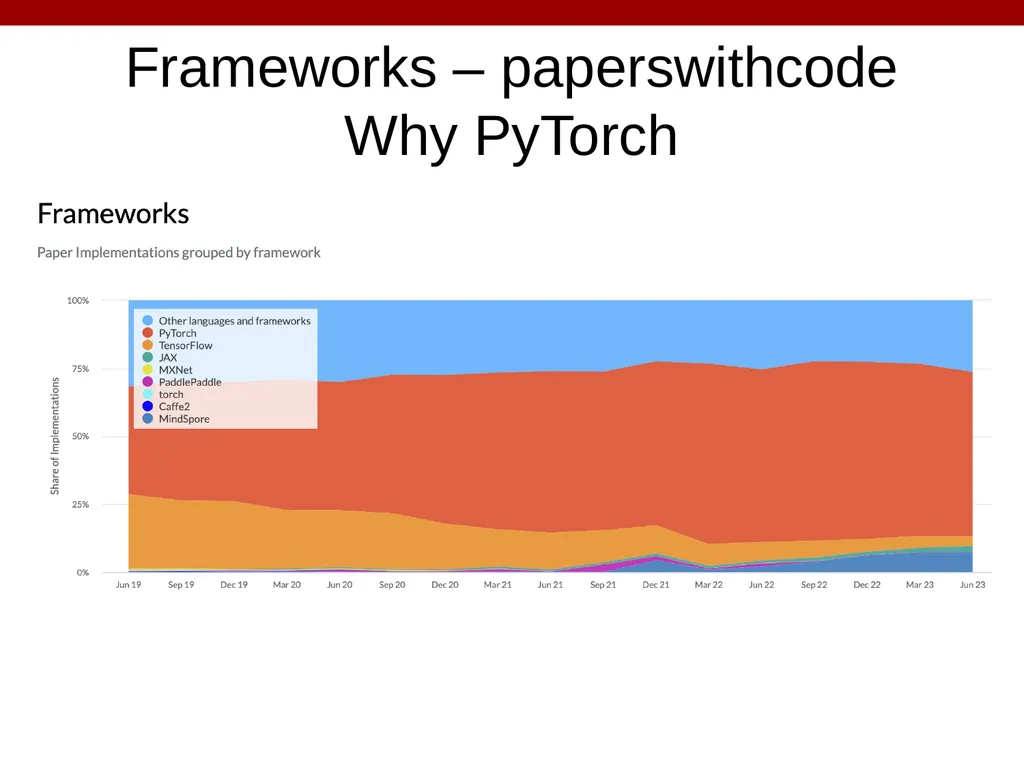
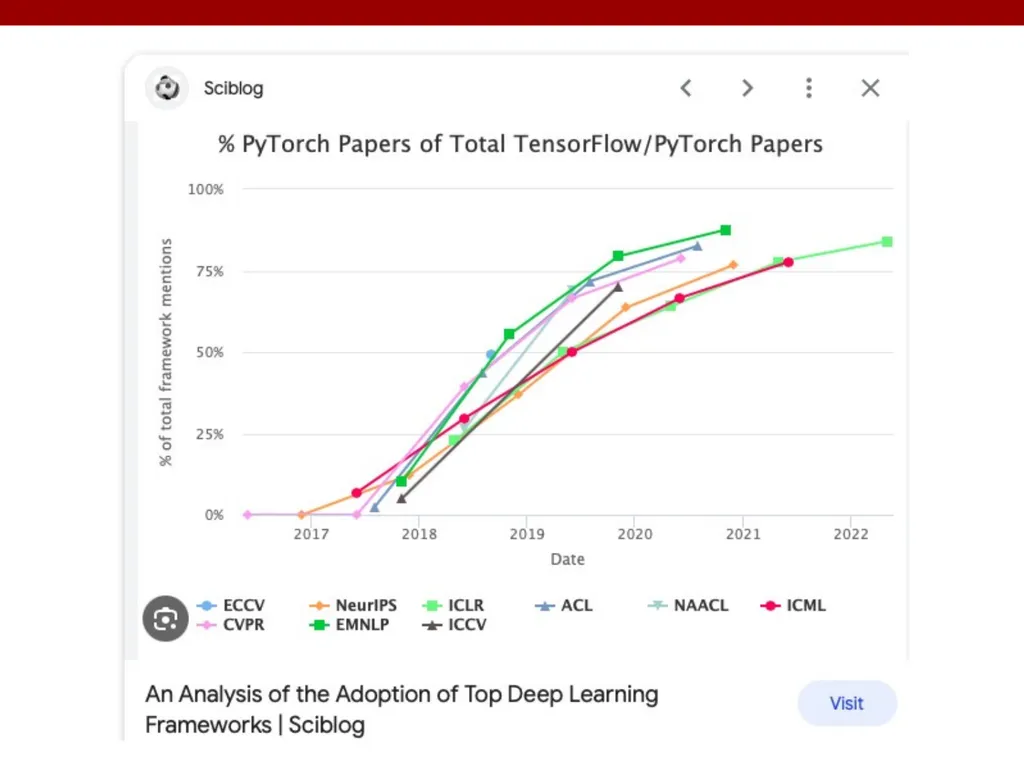
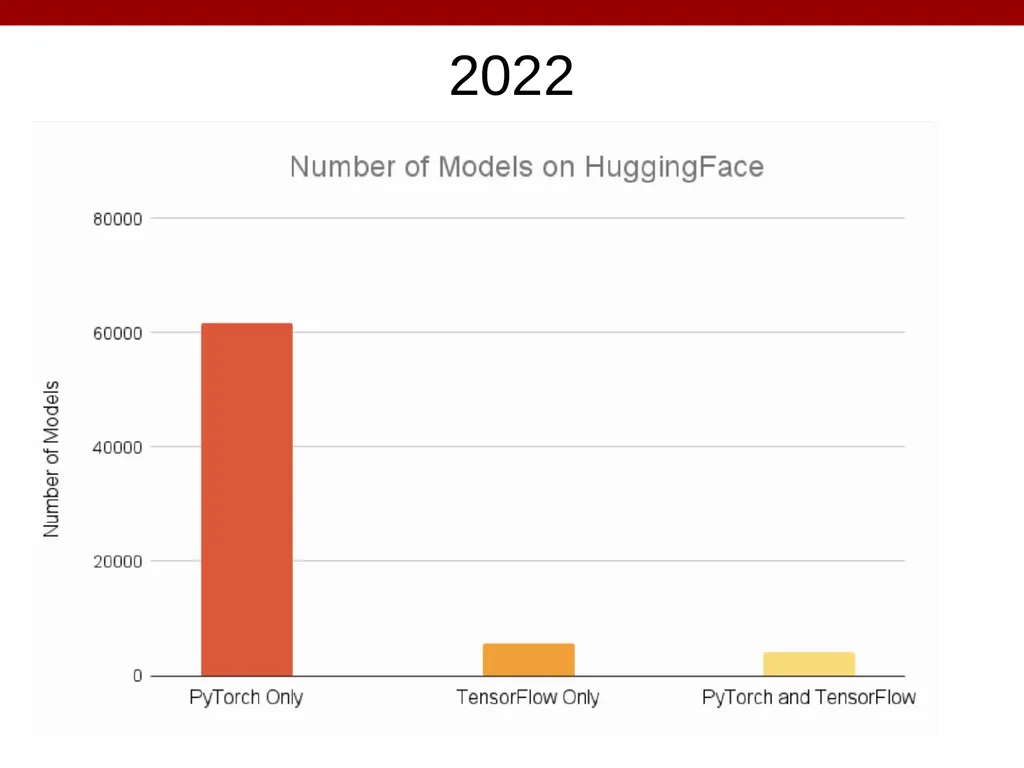
Frameworks – paperswithcode
Why PyTorch<br>
18
2022<br>
19
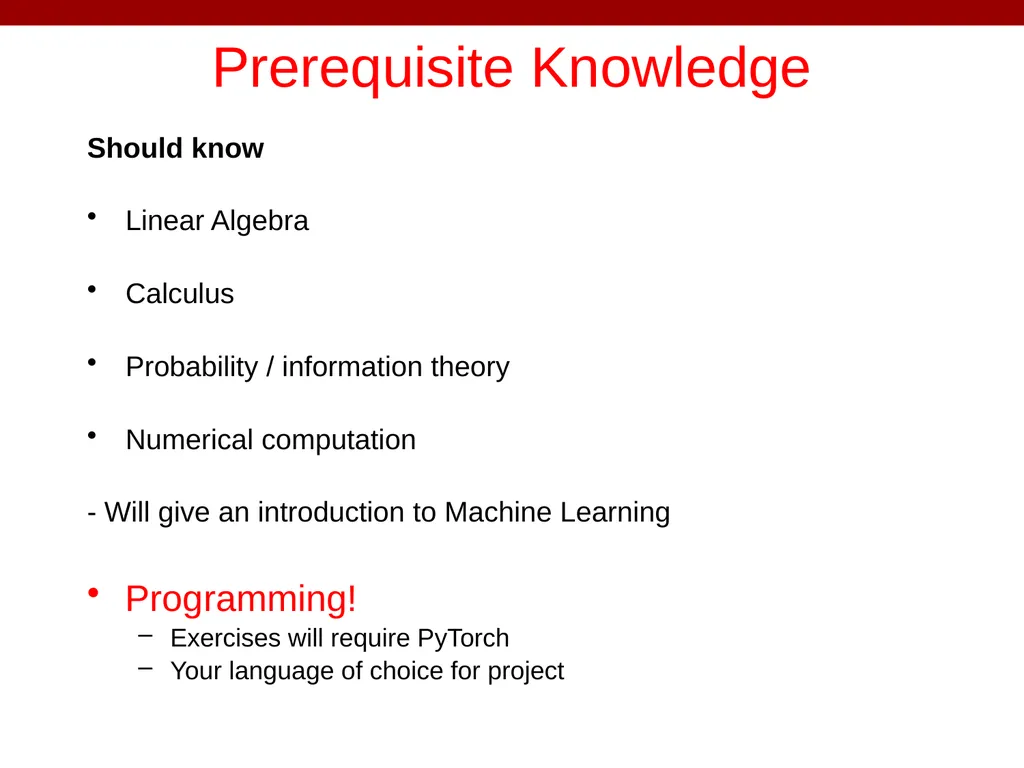
Prerequisite Knowledge Should know
Linear Algebra
Calculus
Probability / information theory
Numerical computation
- Will give an introduction to Machine Learning
Programming!
Exercises will require PyTorch
Your language of choice for project<br>
Linear Algebra
Calculus
Probability / information theory
Numerical computation
- Will give an introduction to Machine Learning
Programming!
Exercises will require PyTorch
Your language of choice for project<br>
20
Prerequisites Intro Machine Learning
Classifiers, regressors, loss functions, MLE, MAP
Linear Algebra
Matrix multiplication, eigenvalues, positive semi-definiteness…
Calculus
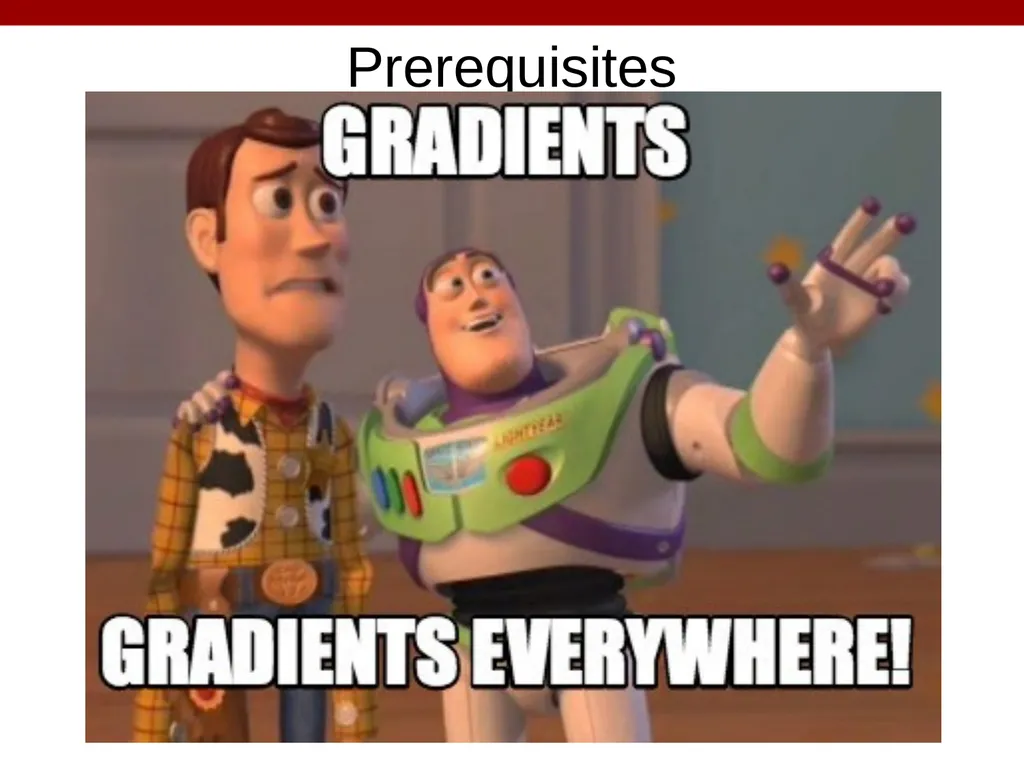
Multi-variate gradients, hessians, jacobians…<br>
Classifiers, regressors, loss functions, MLE, MAP
Linear Algebra
Matrix multiplication, eigenvalues, positive semi-definiteness…
Calculus
Multi-variate gradients, hessians, jacobians…<br>
21
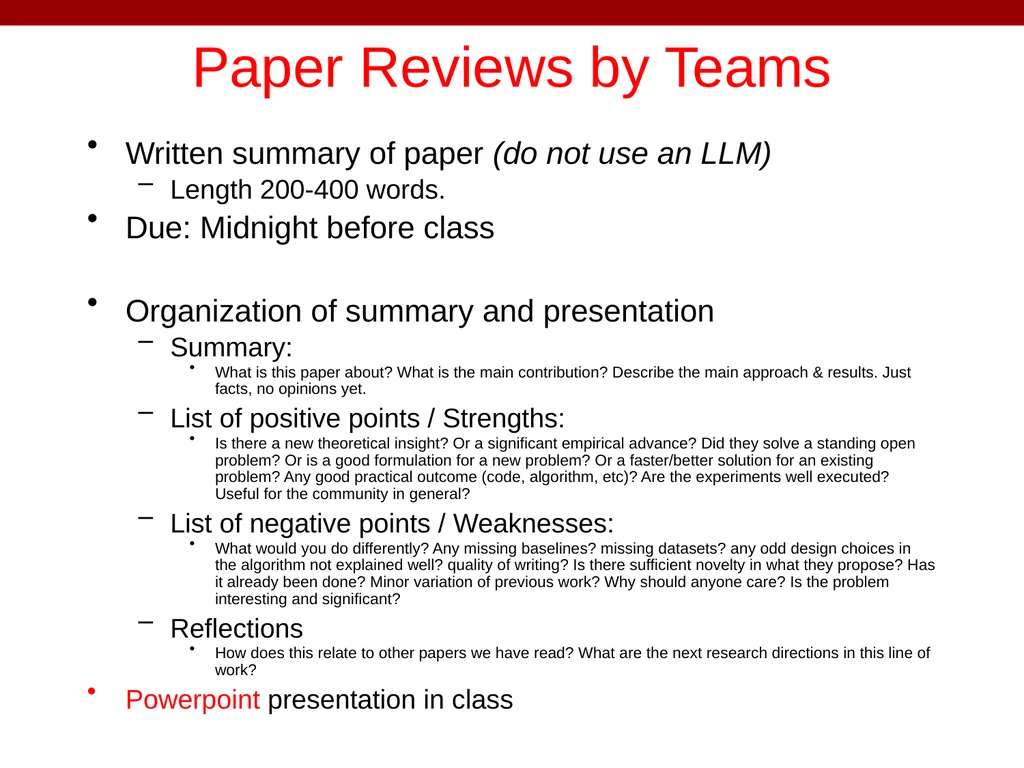
Paper Reviews by Teams Written summary of paper (do not use an LLM)
Length 200-400 words.
Due: Midnight before class
Organization of summary and presentation
Summary:
What is this paper about? What is the main contribution? Describe the main approach & results. Just facts, no opinions yet.
List of positive points / Strengths:
Is there a new theoretical insight? Or a significant empirical advance? Did they solve a standing open problem? Or is a good formulation for a new problem? Or a faster/better solution for an existing problem? Any good practical outcome (code, algorithm, etc)? Are the experiments well executed? Useful for the community in general?
List of negative points / Weaknesses:
What would you do differently? Any missing baselines? missing datasets? any odd design choices in the algorithm not explained well? quality of writing? Is there sufficient novelty in what they propose? Has it already been done? Minor variation of previous work? Why should anyone care? Is the problem interesting and significant?
Reflections
How does this relate to other papers we have read? What are the next research directions in this line of work?
Powerpoint presentation in class<br>
Length 200-400 words.
Due: Midnight before class
Organization of summary and presentation
Summary:
What is this paper about? What is the main contribution? Describe the main approach & results. Just facts, no opinions yet.
List of positive points / Strengths:
Is there a new theoretical insight? Or a significant empirical advance? Did they solve a standing open problem? Or is a good formulation for a new problem? Or a faster/better solution for an existing problem? Any good practical outcome (code, algorithm, etc)? Are the experiments well executed? Useful for the community in general?
List of negative points / Weaknesses:
What would you do differently? Any missing baselines? missing datasets? any odd design choices in the algorithm not explained well? quality of writing? Is there sufficient novelty in what they propose? Has it already been done? Minor variation of previous work? Why should anyone care? Is the problem interesting and significant?
Reflections
How does this relate to other papers we have read? What are the next research directions in this line of work?
Powerpoint presentation in class<br>
22
Questions by Teams Each team presents 2 questions to the presenter after the presentation.
Questions should be about the paper presented.
Questions are written on canvas during class<br>
Questions should be about the paper presented.
Questions are written on canvas during class<br>
23
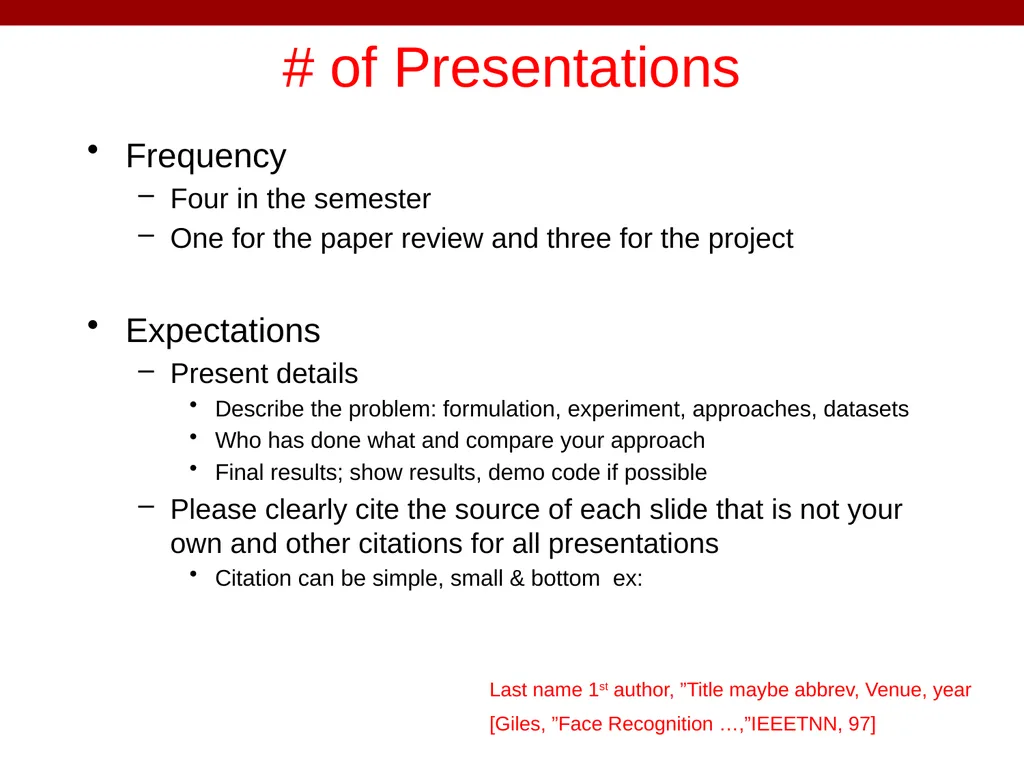
# of Presentations Frequency
Four in the semester
One for the paper review and three for the project
Expectations
Present details
Describe the problem: formulation, experiment, approaches, datasets
Who has done what and compare your approach
Final results; show results, demo code if possible
Please clearly cite the source of each slide that is not your own and other citations for all presentations
Citation can be simple, small & bottom ex: Last name 1st author, ”Title maybe abbrev, Venue, year
[Giles, ”Face Recognition …,”IEEETNN, 97]<br>
Four in the semester
One for the paper review and three for the project
Expectations
Present details
Describe the problem: formulation, experiment, approaches, datasets
Who has done what and compare your approach
Final results; show results, demo code if possible
Please clearly cite the source of each slide that is not your own and other citations for all presentations
Citation can be simple, small & bottom ex: Last name 1st author, ”Title maybe abbrev, Venue, year
[Giles, ”Face Recognition …,”IEEETNN, 97]<br>
24
Team Project Goal
Chance to try Deep Learning
Encouraged to apply to your research (computer vision, NLP, robotics,…)
Must be done this semester.
Can combine with other classes
get permission from both instructors; delineate different parts
Extra credit for shooting for a publication
Teams constructed by instructor
All students will fill out our an experience form<br>
Chance to try Deep Learning
Encouraged to apply to your research (computer vision, NLP, robotics,…)
Must be done this semester.
Can combine with other classes
get permission from both instructors; delineate different parts
Extra credit for shooting for a publication
Teams constructed by instructor
All students will fill out our an experience form<br>
25
Team Project Main categories
Competitions
Compete in a machine learning competition (ongoing or completed) using a different deep learning
Formulation/Development
Formulate a new model or algorithm for a new or old problem
Theory
Theoretically analyze an existing algorithm
Application
Compare a bunch of existing algorithms on a new application domain of your interest
Instructor/TA have projects if needed<br>
Competitions
Compete in a machine learning competition (ongoing or completed) using a different deep learning
Formulation/Development
Formulate a new model or algorithm for a new or old problem
Theory
Theoretically analyze an existing algorithm
Application
Compare a bunch of existing algorithms on a new application domain of your interest
Instructor/TA have projects if needed<br>
26
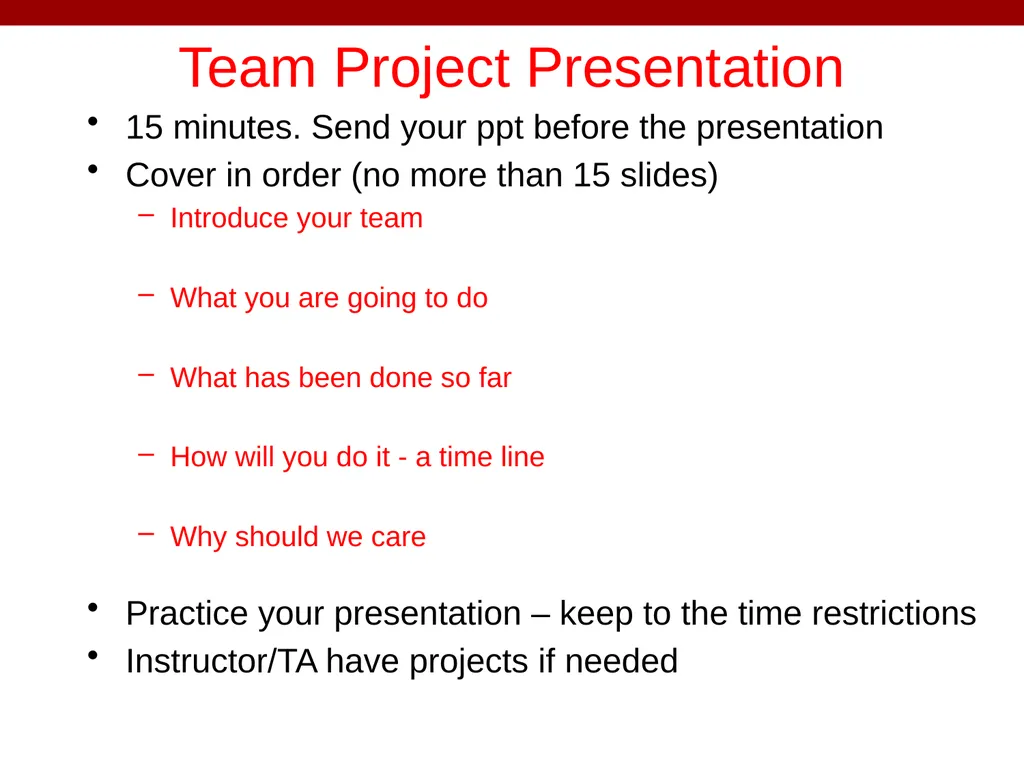
Team Project Presentation 15 minutes. Send your ppt before the presentation
Cover in order (no more than 15 slides)
Introduce your team
What you are going to do
What has been done so far
How will you do it - a time line
Why should we care
Practice your presentation – keep to the time restrictions
Instructor/TA have projects if needed<br>
Cover in order (no more than 15 slides)
Introduce your team
What you are going to do
What has been done so far
How will you do it - a time line
Why should we care
Practice your presentation – keep to the time restrictions
Instructor/TA have projects if needed<br>
27
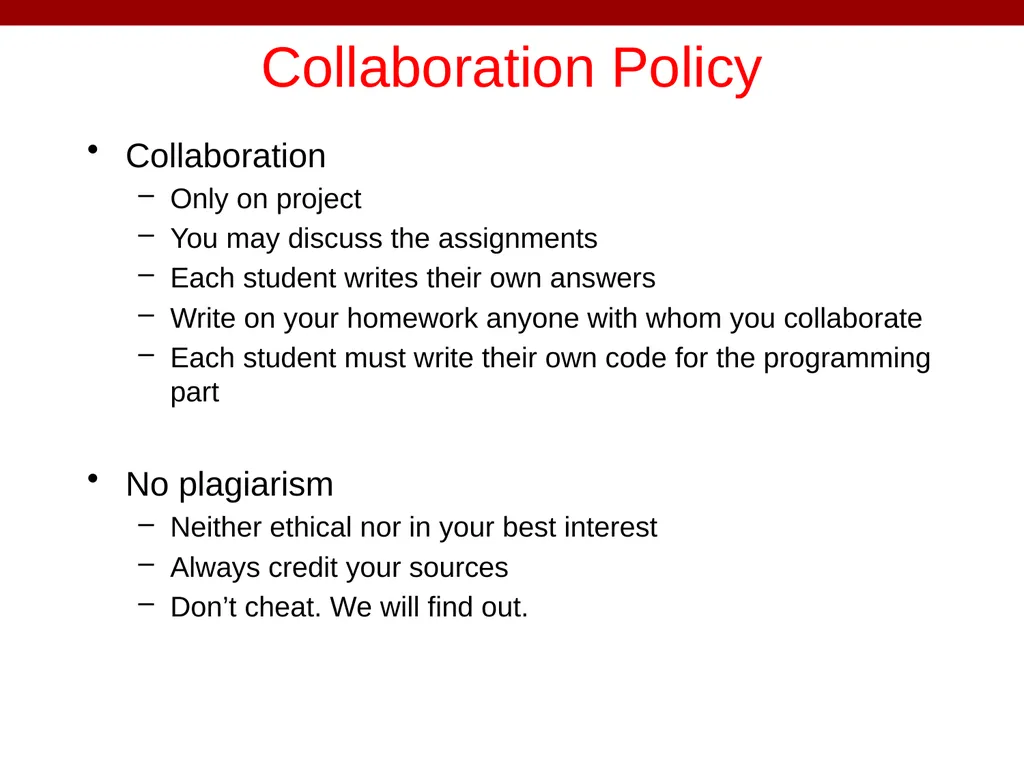
Collaboration Policy Collaboration
Only on project
You may discuss the assignments
Each student writes their own answers
Write on your homework anyone with whom you collaborate
Each student must write their own code for the programming part
No plagiarism
Neither ethical nor in your best interest
Always credit your sources
Don’t cheat. We will find out.<br>
Only on project
You may discuss the assignments
Each student writes their own answers
Write on your homework anyone with whom you collaborate
Each student must write their own code for the programming part
No plagiarism
Neither ethical nor in your best interest
Always credit your sources
Don’t cheat. We will find out.<br>
28
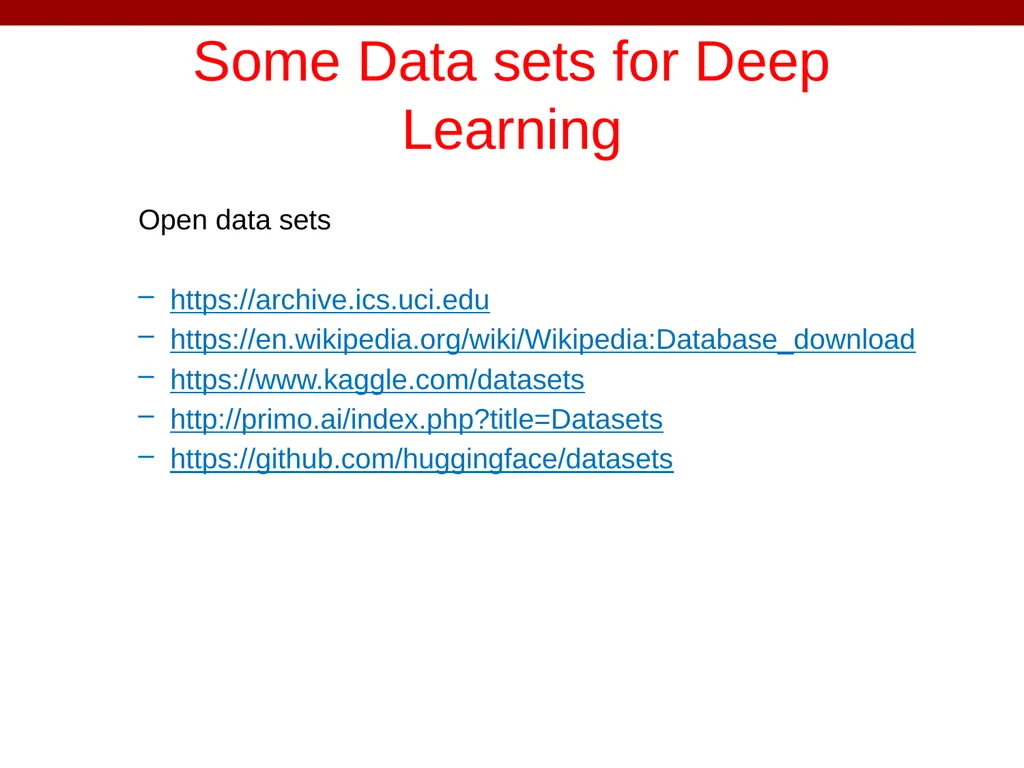
Some Data sets for Deep Learning Open data sets
https://archive.ics.uci.edu
https://en.wikipedia.org/wiki/Wikipedia:Database_download
https://www.kaggle.com/datasets
http://primo.ai/index.php?title=Datasets
https://github.com/huggingface/datasets<br>
https://archive.ics.uci.edu
https://en.wikipedia.org/wiki/Wikipedia:Database_download
https://www.kaggle.com/datasets
http://primo.ai/index.php?title=Datasets
https://github.com/huggingface/datasets<br>
29
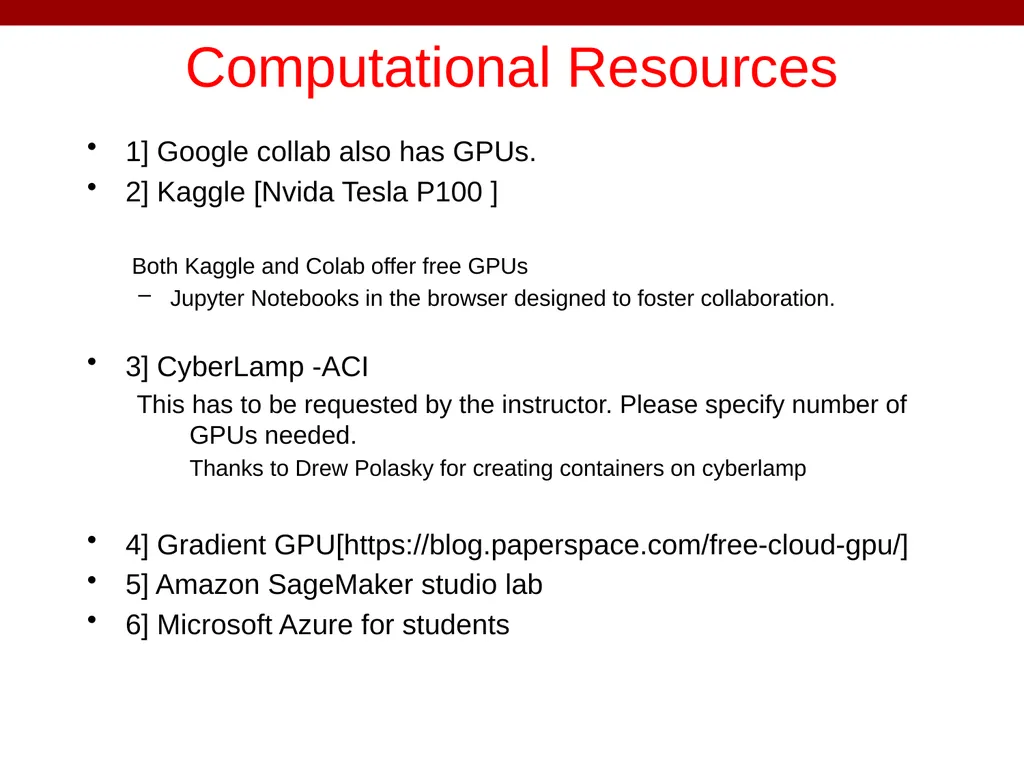
Computational Resources 1] Google collab also has GPUs.
2] Kaggle [Nvida Tesla P100 ]
Both Kaggle and Colab offer free GPUs
Jupyter Notebooks in the browser designed to foster collaboration.
3] CyberLamp -ACI
This has to be requested by the instructor. Please specify number of GPUs needed.
Thanks to Drew Polasky for creating containers on cyberlamp
4] Gradient GPU[https://blog.paperspace.com/free-cloud-gpu/]
5] Amazon SageMaker studio lab
6] Microsoft Azure for students<br>
2] Kaggle [Nvida Tesla P100 ]
Both Kaggle and Colab offer free GPUs
Jupyter Notebooks in the browser designed to foster collaboration.
3] CyberLamp -ACI
This has to be requested by the instructor. Please specify number of GPUs needed.
Thanks to Drew Polasky for creating containers on cyberlamp
4] Gradient GPU[https://blog.paperspace.com/free-cloud-gpu/]
5] Amazon SageMaker studio lab
6] Microsoft Azure for students<br>
30
Most of what you will use can be accessed from this page http://clgiles.ist.psu.edu/IST597 Questions? Grades on canvas; also some assignments (exercises)<br>