Leading Faculty Through the Promotion &/or Tenure
Description: Leading Faculty Through the Promotion or Tenure Process Lisa Tannock, MD Associate Provost for Faculty Advancement Chairs Responsibilities for APT Keep faculty on track for promotion Review statement of evidences and ensure faculty meets
Related Topics
Download Presentation
"Leading Faculty Through the Promotion &/or Tenure" is the property of its rightful owner. Permission is granted to download and print the materials on this website for personal, non-commercial use only, and to display it on your personal computer provided you do not modify the materials and that you retain all copyright notices contained in the materials. By downloading content from our website, you accept the terms of this agreement.
Presentation Transcript
slide1. Leading Faculty Through the Promotion &/or Tenure Process Lisa Tannock, MD
Associate Provost for Faculty Advancement<br>
slide2. Chair’s Responsibilities for APT Keep faculty on track for promotion
Review statement of evidences and ensure faculty meets these
Guide faculty through their part in dossier preparation<br>
slide3. Chair/ Director Responsibilities Keep faculty on track
This starts in their first year
2 and 4 year reviews
Encourage clock extensions if eligible
Ensure expectations are clear
Watch for (unintentional) mis-mentoring
Watch for undocumented unit culture expectations
Hold faculty accountable<br>
slide4. Unit Statements of Evidence You should be the expert on unit’s SOE
Update as needed
Ensure clarity
Review them with faculty regularly<br>
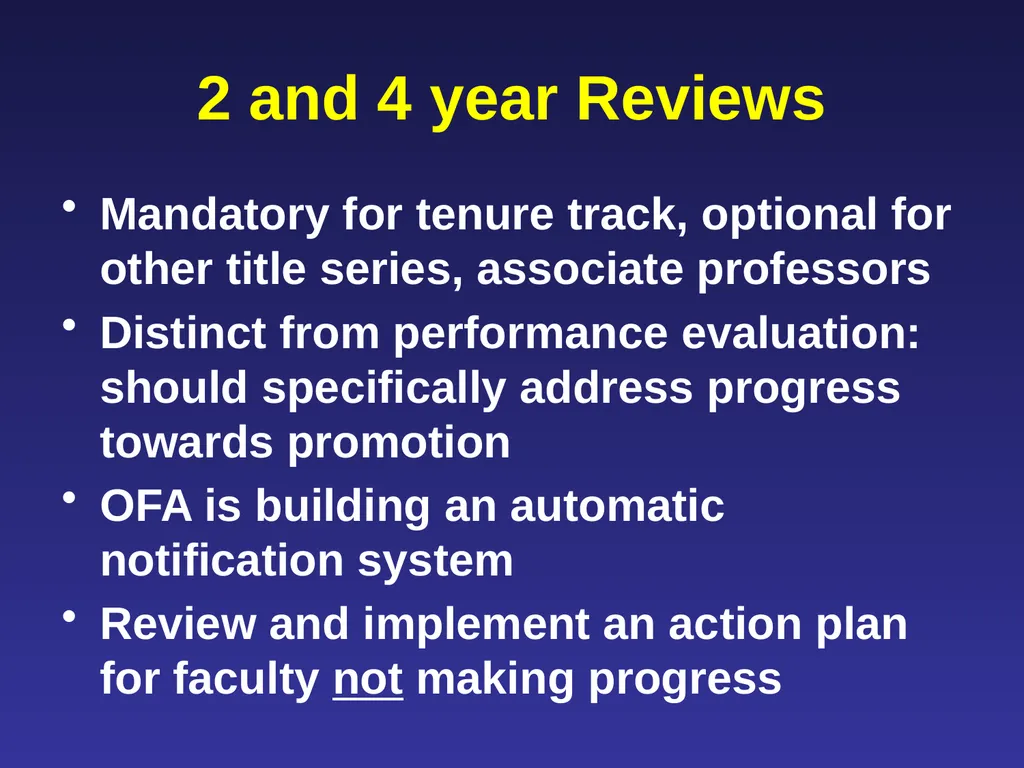
slide5. 2 and 4 year Reviews Mandatory for tenure track, optional for other title series, associate professors
Distinct from performance evaluation: should specifically address progress towards promotion
OFA is building an automatic notification system
Review and implement an action plan for faculty not making progress<br>
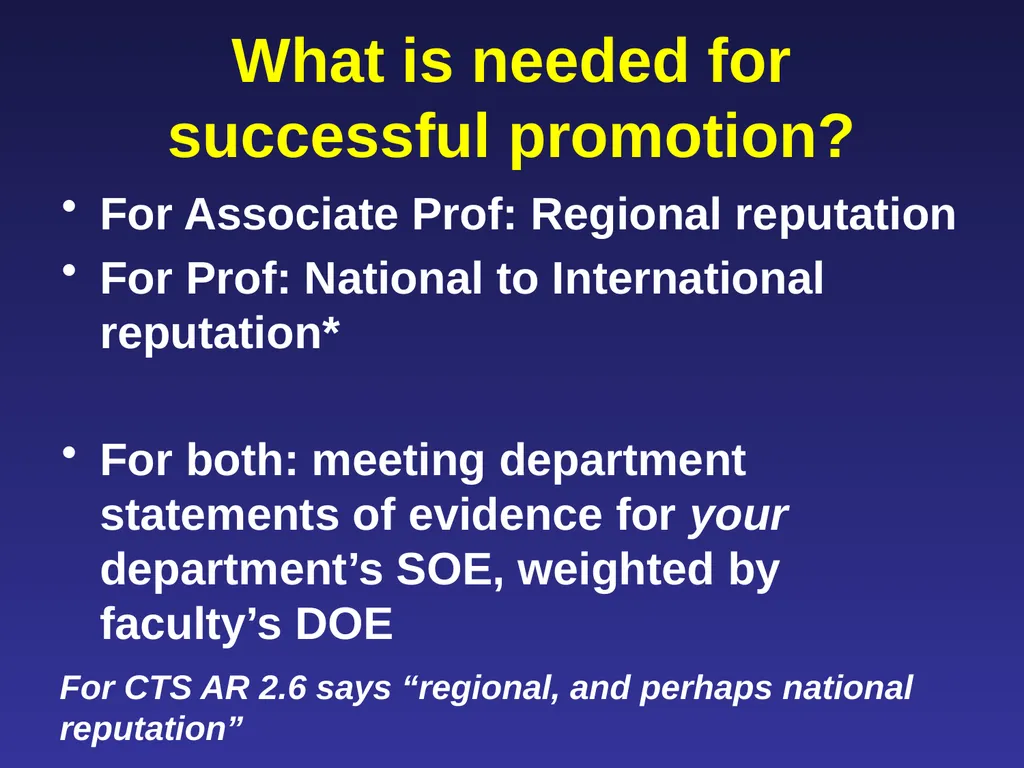
slide6. What is needed for successful promotion? For Associate Prof: Regional reputation
For Prof: National to International reputation*
For both: meeting department statements of evidence for your department’s SOE, weighted by faculty’s DOE For CTS AR 2.6 says “regional, and perhaps national reputation”<br>
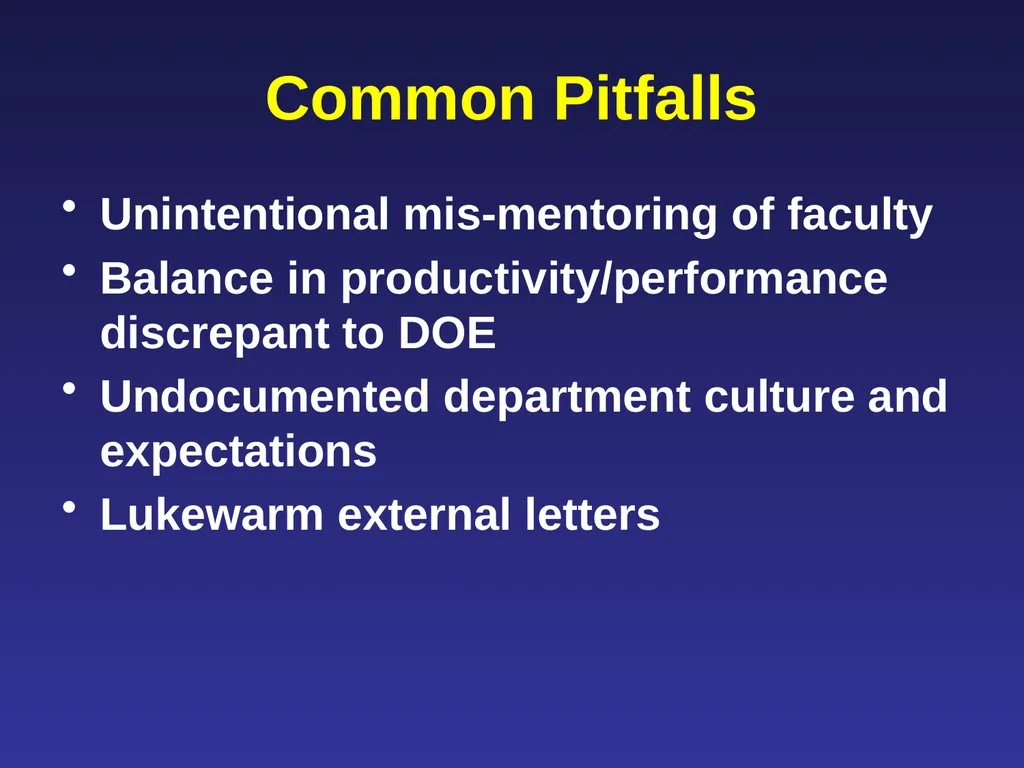
slide7. Common Pitfalls Unintentional mis-mentoring of faculty
Balance in productivity/performance discrepant to DOE
Undocumented department culture and expectations
Lukewarm external letters<br>
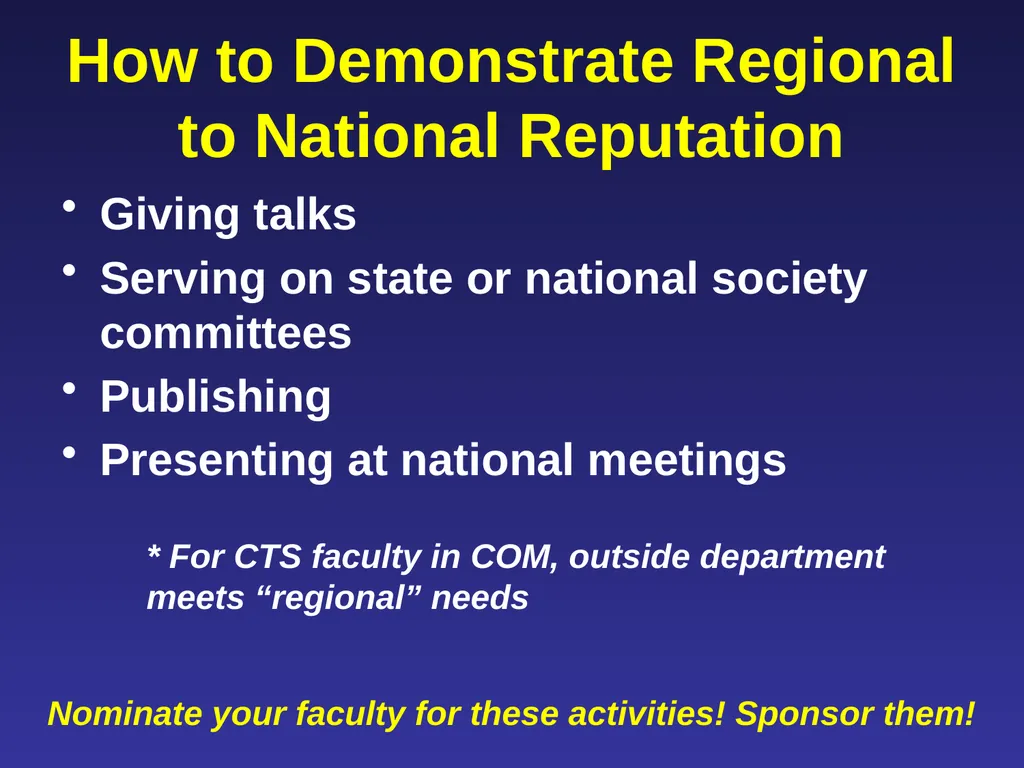
slide8. How to Demonstrate Regional to National Reputation Giving talks
Serving on state or national society committees
Publishing
Presenting at national meetings * For CTS faculty in COM, outside department meets “regional” needs Nominate your faculty for these activities! Sponsor them!<br>
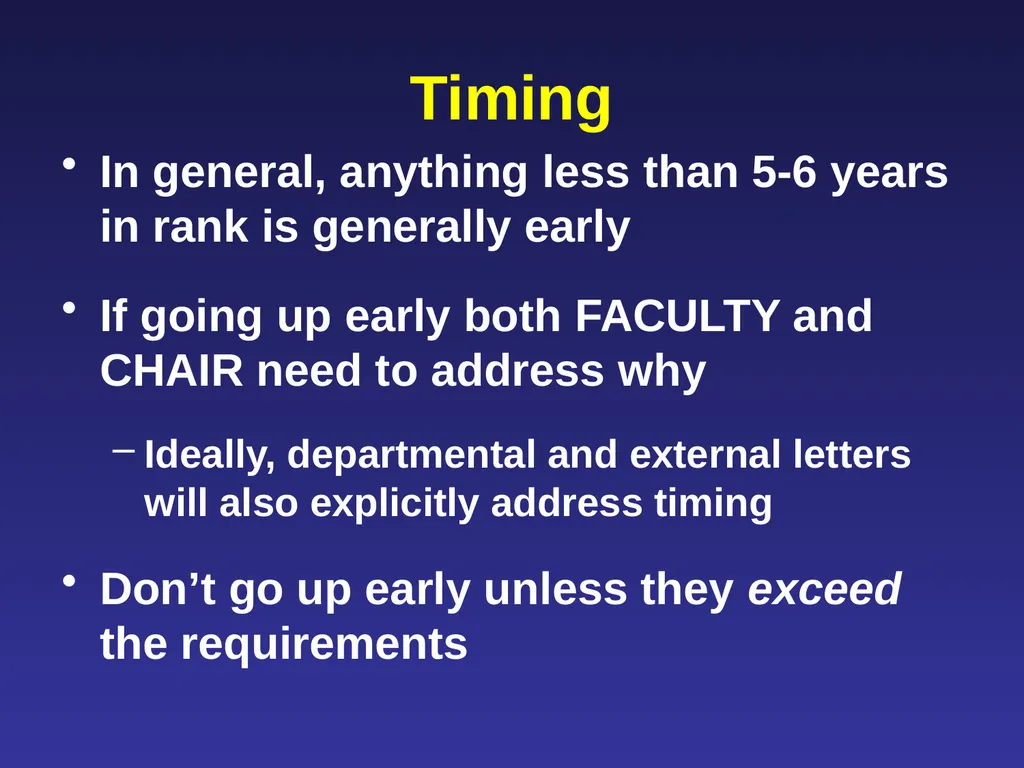
slide9. Timing In general, anything less than 5-6 years in rank is generally early
If going up early both FACULTY and CHAIR need to address why
Ideally, departmental and external letters will also explicitly address timing
Don’t go up early unless they exceed the requirements<br>
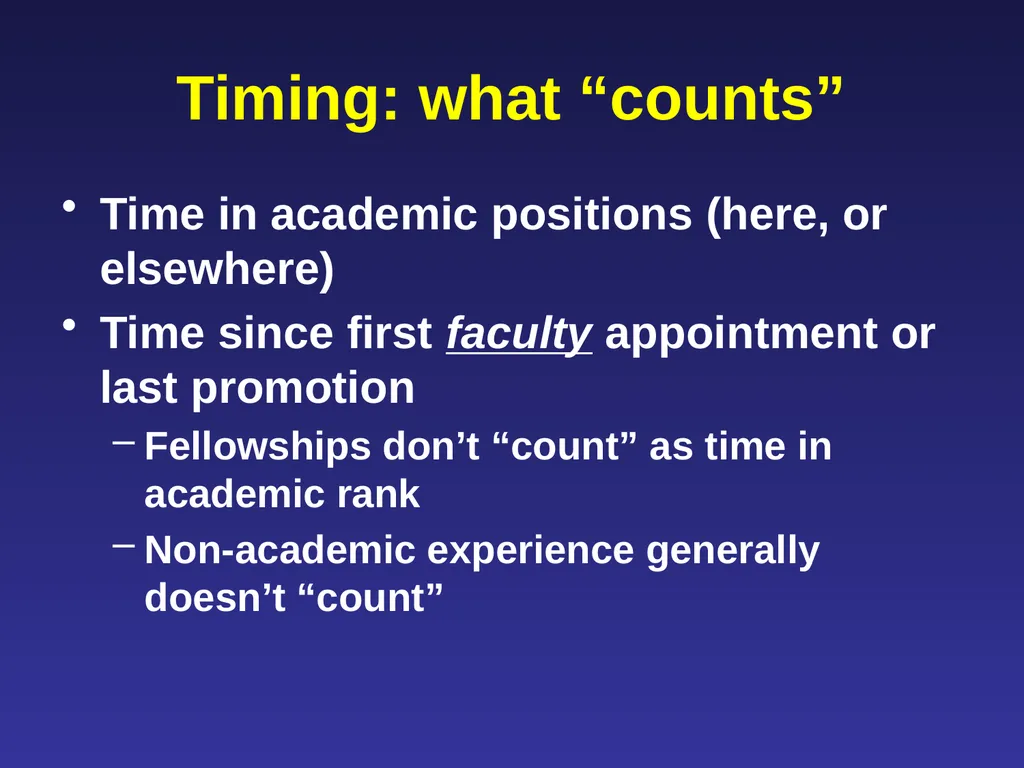
slide10. Timing: what “counts” Time in academic positions (here, or elsewhere)
Time since first faculty appointment or last promotion
Fellowships don’t “count” as time in academic rank
Non-academic experience generally doesn’t “count”<br>
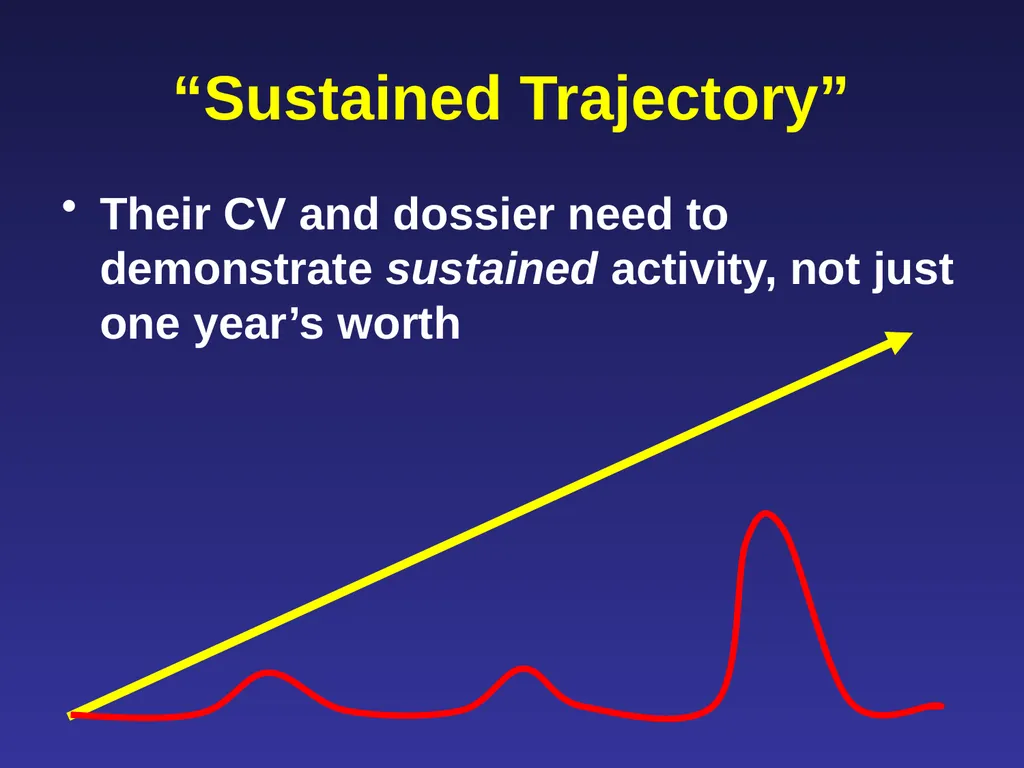
slide11. “Sustained Trajectory” Their CV and dossier need to demonstrate sustained activity, not just one year’s worth<br>
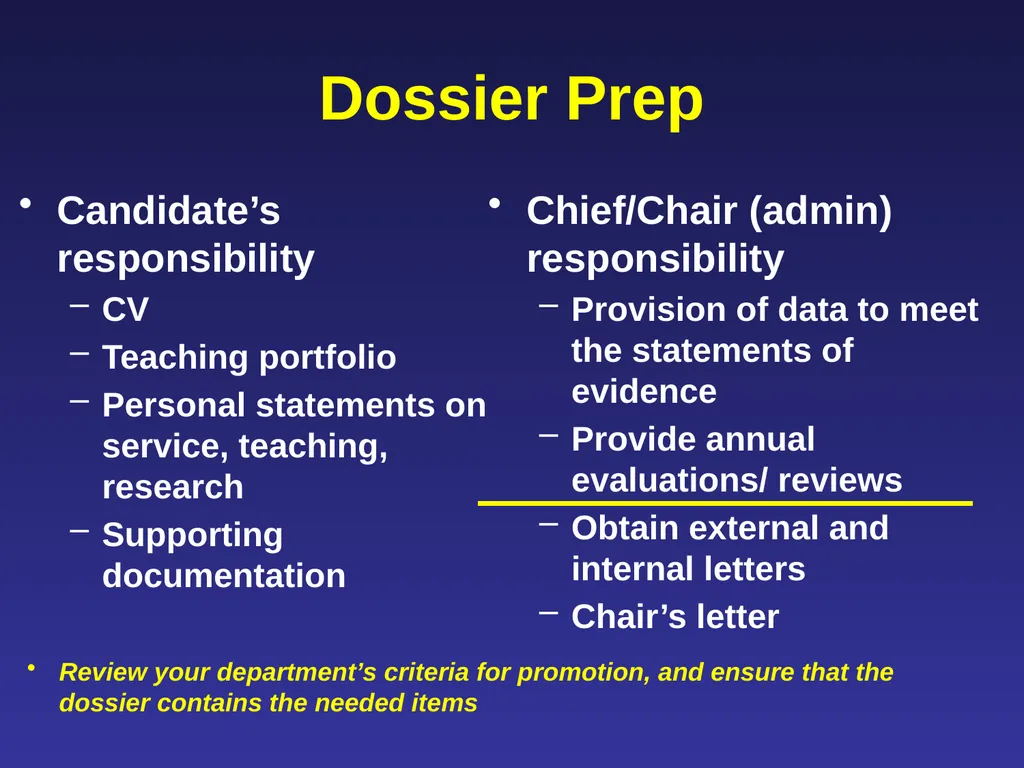
slide12. Dossier Prep Candidate’s responsibility
CV
Teaching portfolio
Personal statements on service, teaching, research
Supporting documentation Chief/Chair (admin) responsibility
Provision of data to meet the statements of evidence
Provide annual evaluations/ reviews
Obtain external and internal letters
Chair’s letter Review your department’s criteria for promotion, and ensure that the dossier contains the needed items<br>
slide13. Dossier Preparation Steps Faculty candidate prepares CV, personal statements, collects evidence
Job description, DOE, performance evals, student letters
Dossier sent out for external review
Department faculty review entire dossier including external letters
Chair’s letter summarizes entire package<br>
slide14. Chair’s Responsibilities for APT Outside letters: 6
4 need to be suggested by chair/chief
2 suggested by faculty candidate
All 6 are arm’s length
This can be a difficult and lengthy process, allow sufficient time
All letters that come in need to be added to dossier This is often the hardest part; as a chair, build your network<br>
slide15. Arm’s Length Letters NOT related to them, not a friend
They didn’t train the faculty, the faculty didn’t train them (including thesis committee members)
Haven’t published or had a grant together in > 5 yrs
So who?
People who have read their papers, or seen them give talks
Colleagues from a national committee your faculty served on<br>
slide16. External Reviews You invite them; send them the complete dossier, and ask them to compare the dossier against the units’ statements of evidence
We DO NOT care if our faculty would merit a promotion at their institution
We highly recommend you communicate UK’s expectations by title series<br>
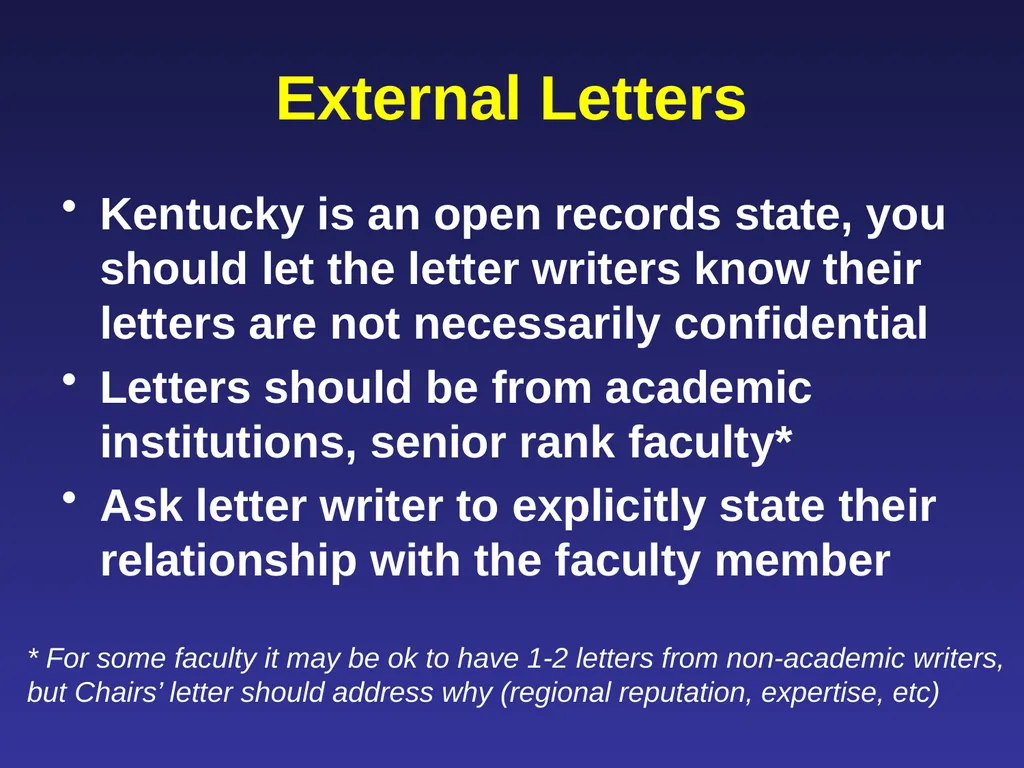
slide17. External Letters Kentucky is an open records state, you should let the letter writers know their letters are not necessarily confidential
Letters should be from academic institutions, senior rank faculty*
Ask letter writer to explicitly state their relationship with the faculty member * For some faculty it may be ok to have 1-2 letters from non-academic writers, but Chairs’ letter should address why (regional reputation, expertise, etc)<br>
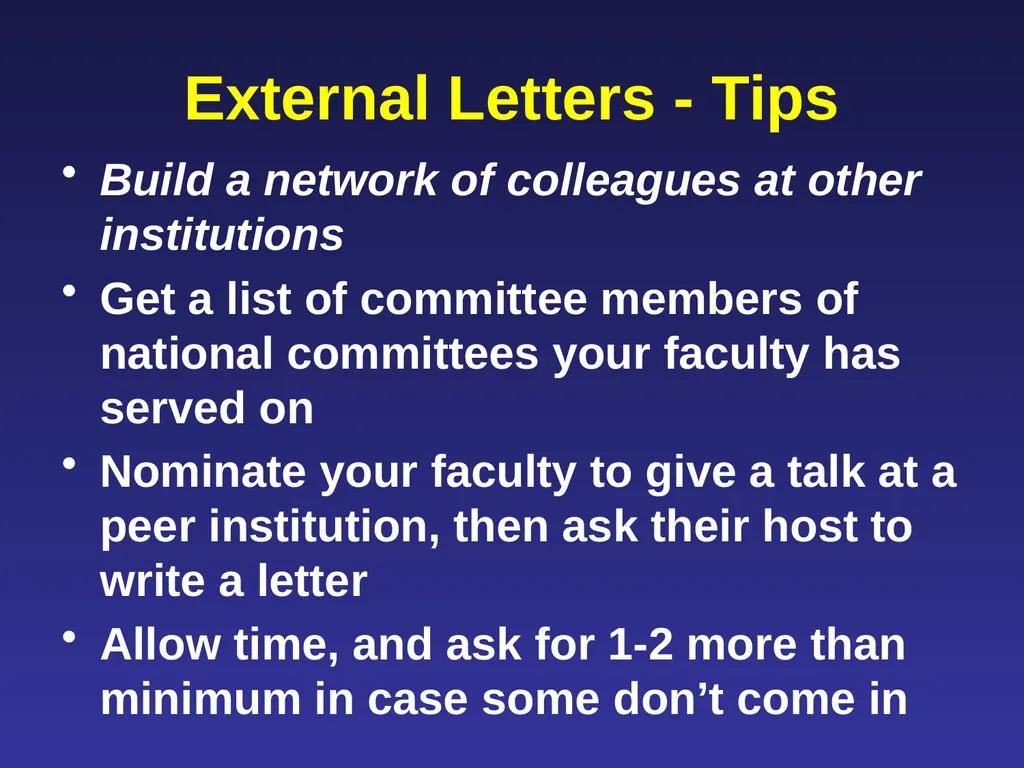
slide18. External Letters - Tips Build a network of colleagues at other institutions
Get a list of committee members of national committees your faculty has served on
Nominate your faculty to give a talk at a peer institution, then ask their host to write a letter
Allow time, and ask for 1-2 more than minimum in case some don’t come in<br>
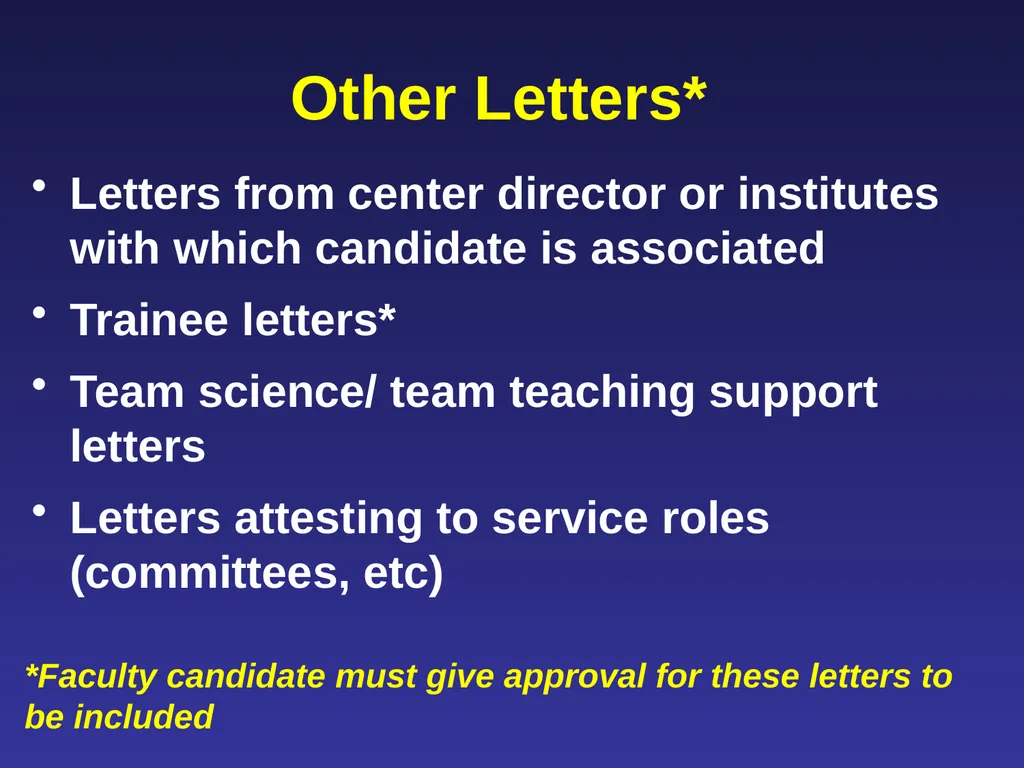
slide19. Other Letters* Letters from center director or institutes with which candidate is associated
Trainee letters*
Team science/ team teaching support letters
Letters attesting to service roles (committees, etc) *Faculty candidate must give approval for these letters to be included<br>
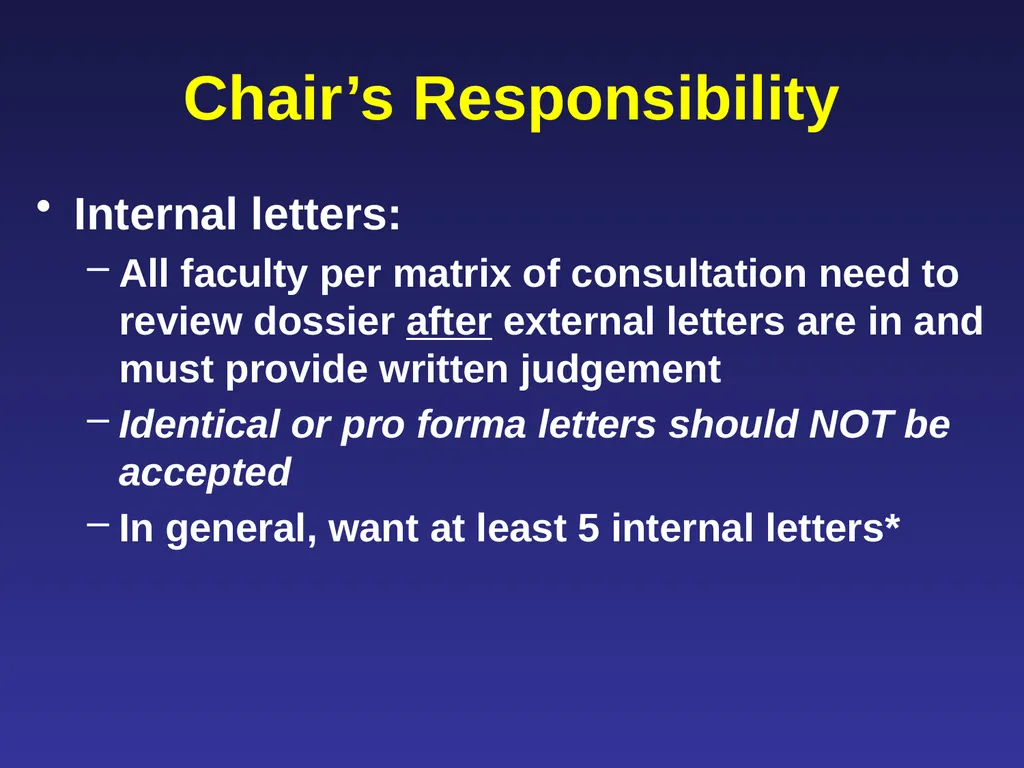
slide20. Chair’s Responsibility Internal letters:
All faculty per matrix of consultation need to review dossier after external letters are in and must provide written judgement
Identical or pro forma letters should NOT be accepted
In general, want at least 5 internal letters*<br>
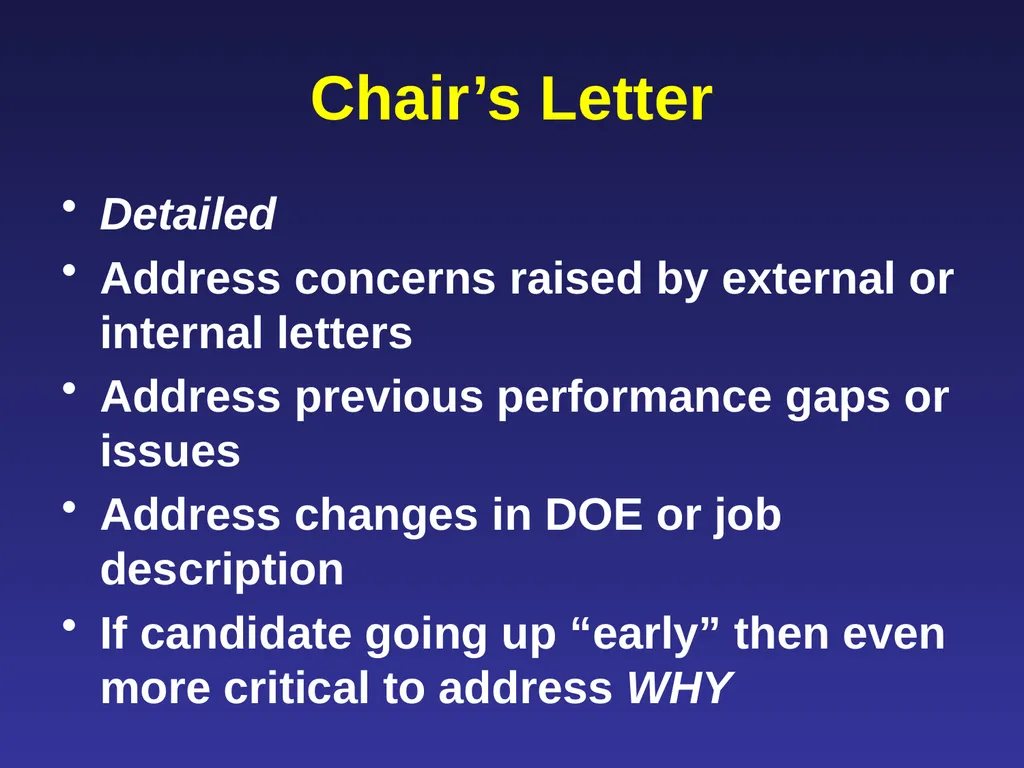
slide21. Chair’s Letter Detailed
Address concerns raised by external or internal letters
Address previous performance gaps or issues
Address changes in DOE or job description
If candidate going up “early” then even more critical to address WHY<br>
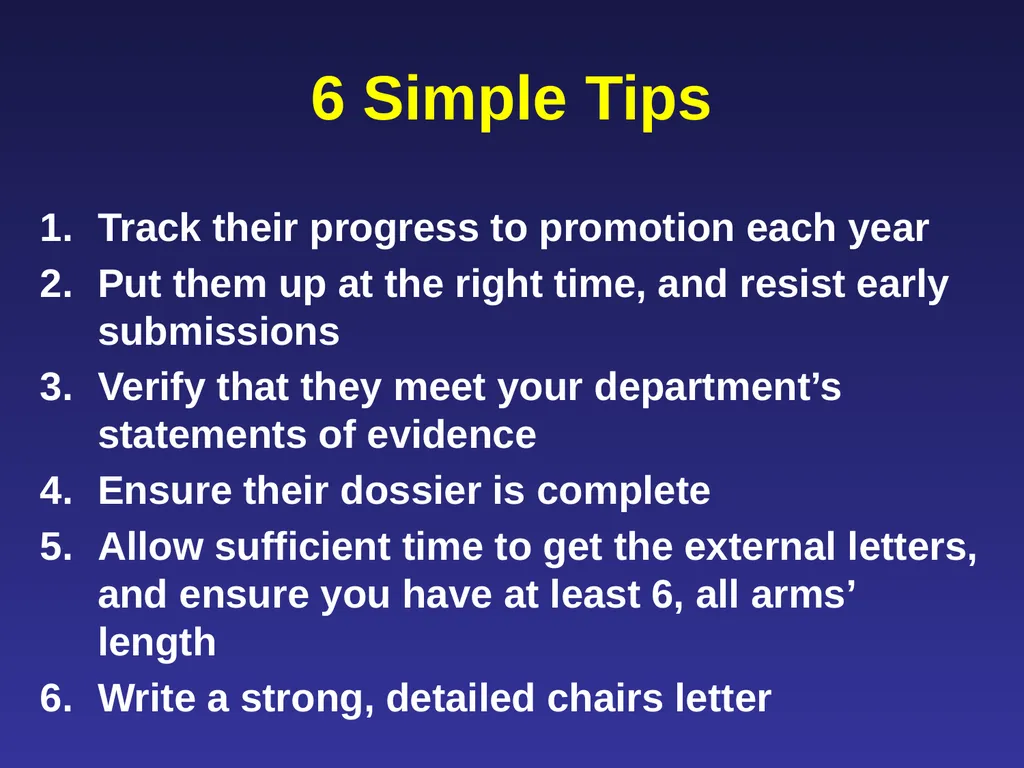
slide22. 6 Simple Tips Track their progress to promotion each year
Put them up at the right time, and resist early submissions
Verify that they meet your department’s statements of evidence
Ensure their dossier is complete
Allow sufficient time to get the external letters, and ensure you have at least 6, all arms’ length
Write a strong, detailed chairs letter<br>
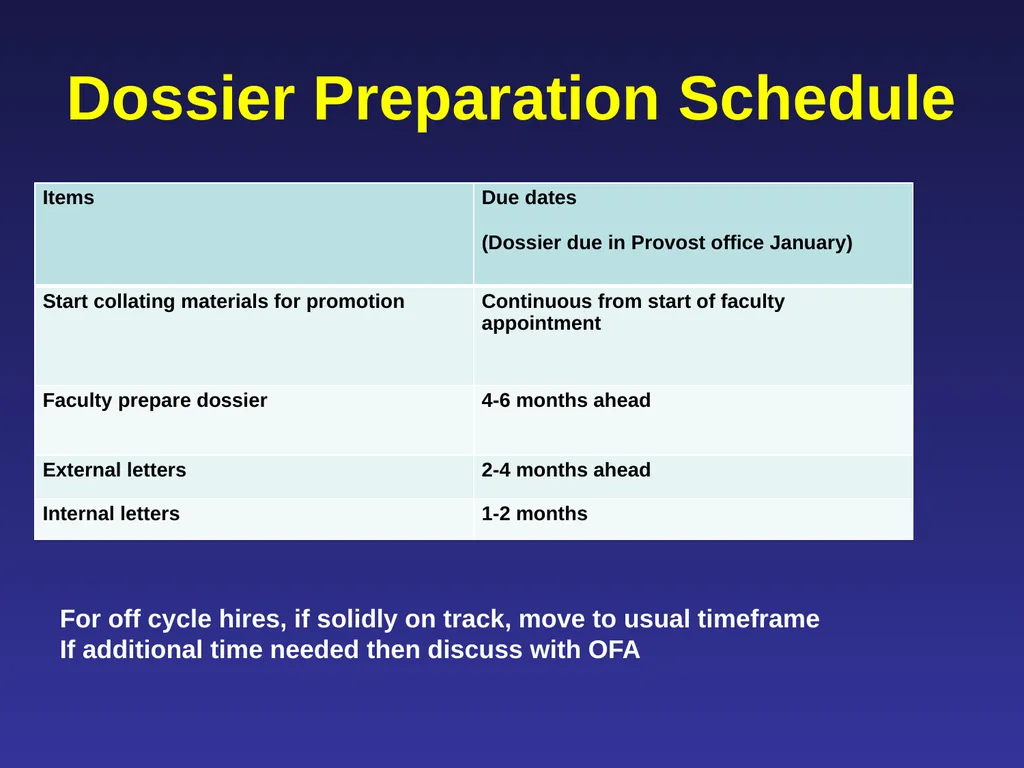
slide23. Dossier Preparation Schedule For off cycle hires, if solidly on track, move to usual timeframe
If additional time needed then discuss with OFA<br>
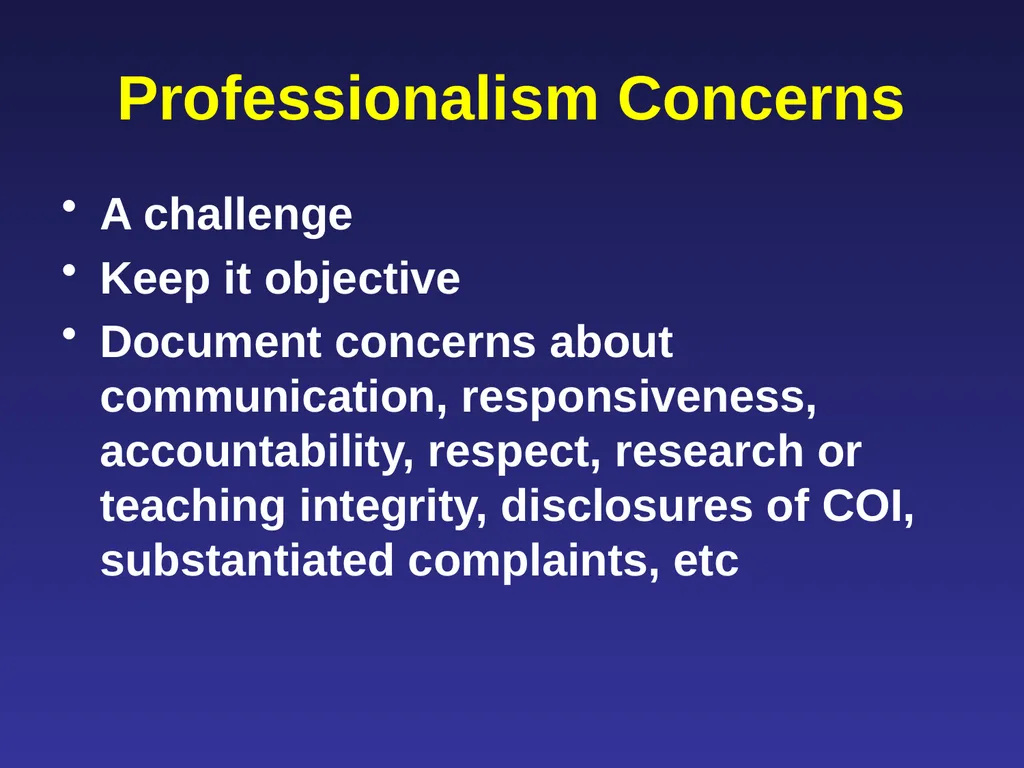
slide24. Professionalism Concerns A challenge
Keep it objective
Document concerns about communication, responsiveness, accountability, respect, research or teaching integrity, disclosures of COI, substantiated complaints, etc<br>
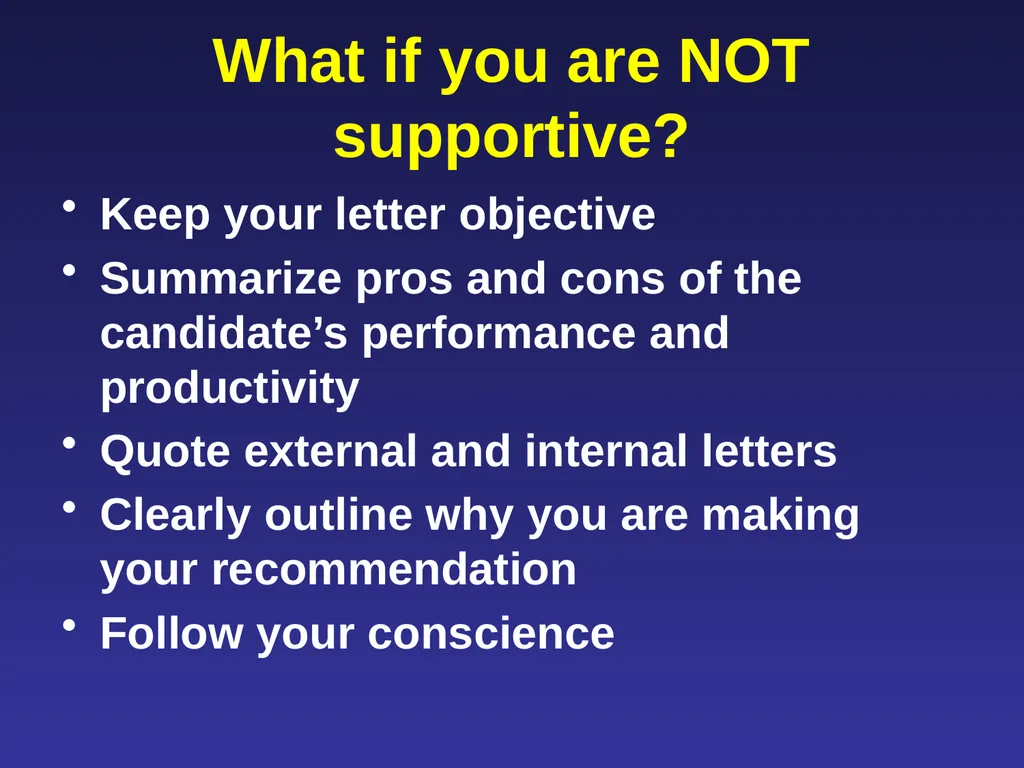
slide25. What if you are NOT supportive? Keep your letter objective
Summarize pros and cons of the candidate’s performance and productivity
Quote external and internal letters
Clearly outline why you are making your recommendation
Follow your conscience<br>
slide26. What if you “inherited” a faculty who is not on track Review prior documents (2 and 4 year reviews, annual evals, etc)
Meet with the faculty and their mentors
Can clock be extended?<br>

slide27. Other Challenges?<br>
Associate Provost for Faculty Advancement<br>
slide2. Chair’s Responsibilities for APT Keep faculty on track for promotion
Review statement of evidences and ensure faculty meets these
Guide faculty through their part in dossier preparation<br>
slide3. Chair/ Director Responsibilities Keep faculty on track
This starts in their first year
2 and 4 year reviews
Encourage clock extensions if eligible
Ensure expectations are clear
Watch for (unintentional) mis-mentoring
Watch for undocumented unit culture expectations
Hold faculty accountable<br>
slide4. Unit Statements of Evidence You should be the expert on unit’s SOE
Update as needed
Ensure clarity
Review them with faculty regularly<br>
slide5. 2 and 4 year Reviews Mandatory for tenure track, optional for other title series, associate professors
Distinct from performance evaluation: should specifically address progress towards promotion
OFA is building an automatic notification system
Review and implement an action plan for faculty not making progress<br>
slide6. What is needed for successful promotion? For Associate Prof: Regional reputation
For Prof: National to International reputation*
For both: meeting department statements of evidence for your department’s SOE, weighted by faculty’s DOE For CTS AR 2.6 says “regional, and perhaps national reputation”<br>
slide7. Common Pitfalls Unintentional mis-mentoring of faculty
Balance in productivity/performance discrepant to DOE
Undocumented department culture and expectations
Lukewarm external letters<br>
slide8. How to Demonstrate Regional to National Reputation Giving talks
Serving on state or national society committees
Publishing
Presenting at national meetings * For CTS faculty in COM, outside department meets “regional” needs Nominate your faculty for these activities! Sponsor them!<br>
slide9. Timing In general, anything less than 5-6 years in rank is generally early
If going up early both FACULTY and CHAIR need to address why
Ideally, departmental and external letters will also explicitly address timing
Don’t go up early unless they exceed the requirements<br>
slide10. Timing: what “counts” Time in academic positions (here, or elsewhere)
Time since first faculty appointment or last promotion
Fellowships don’t “count” as time in academic rank
Non-academic experience generally doesn’t “count”<br>
slide11. “Sustained Trajectory” Their CV and dossier need to demonstrate sustained activity, not just one year’s worth<br>
slide12. Dossier Prep Candidate’s responsibility
CV
Teaching portfolio
Personal statements on service, teaching, research
Supporting documentation Chief/Chair (admin) responsibility
Provision of data to meet the statements of evidence
Provide annual evaluations/ reviews
Obtain external and internal letters
Chair’s letter Review your department’s criteria for promotion, and ensure that the dossier contains the needed items<br>
slide13. Dossier Preparation Steps Faculty candidate prepares CV, personal statements, collects evidence
Job description, DOE, performance evals, student letters
Dossier sent out for external review
Department faculty review entire dossier including external letters
Chair’s letter summarizes entire package<br>
slide14. Chair’s Responsibilities for APT Outside letters: 6
4 need to be suggested by chair/chief
2 suggested by faculty candidate
All 6 are arm’s length
This can be a difficult and lengthy process, allow sufficient time
All letters that come in need to be added to dossier This is often the hardest part; as a chair, build your network<br>
slide15. Arm’s Length Letters NOT related to them, not a friend
They didn’t train the faculty, the faculty didn’t train them (including thesis committee members)
Haven’t published or had a grant together in > 5 yrs
So who?
People who have read their papers, or seen them give talks
Colleagues from a national committee your faculty served on<br>
slide16. External Reviews You invite them; send them the complete dossier, and ask them to compare the dossier against the units’ statements of evidence
We DO NOT care if our faculty would merit a promotion at their institution
We highly recommend you communicate UK’s expectations by title series<br>
slide17. External Letters Kentucky is an open records state, you should let the letter writers know their letters are not necessarily confidential
Letters should be from academic institutions, senior rank faculty*
Ask letter writer to explicitly state their relationship with the faculty member * For some faculty it may be ok to have 1-2 letters from non-academic writers, but Chairs’ letter should address why (regional reputation, expertise, etc)<br>
slide18. External Letters - Tips Build a network of colleagues at other institutions
Get a list of committee members of national committees your faculty has served on
Nominate your faculty to give a talk at a peer institution, then ask their host to write a letter
Allow time, and ask for 1-2 more than minimum in case some don’t come in<br>
slide19. Other Letters* Letters from center director or institutes with which candidate is associated
Trainee letters*
Team science/ team teaching support letters
Letters attesting to service roles (committees, etc) *Faculty candidate must give approval for these letters to be included<br>
slide20. Chair’s Responsibility Internal letters:
All faculty per matrix of consultation need to review dossier after external letters are in and must provide written judgement
Identical or pro forma letters should NOT be accepted
In general, want at least 5 internal letters*<br>
slide21. Chair’s Letter Detailed
Address concerns raised by external or internal letters
Address previous performance gaps or issues
Address changes in DOE or job description
If candidate going up “early” then even more critical to address WHY<br>
slide22. 6 Simple Tips Track their progress to promotion each year
Put them up at the right time, and resist early submissions
Verify that they meet your department’s statements of evidence
Ensure their dossier is complete
Allow sufficient time to get the external letters, and ensure you have at least 6, all arms’ length
Write a strong, detailed chairs letter<br>
slide23. Dossier Preparation Schedule For off cycle hires, if solidly on track, move to usual timeframe
If additional time needed then discuss with OFA<br>
slide24. Professionalism Concerns A challenge
Keep it objective
Document concerns about communication, responsiveness, accountability, respect, research or teaching integrity, disclosures of COI, substantiated complaints, etc<br>
slide25. What if you are NOT supportive? Keep your letter objective
Summarize pros and cons of the candidate’s performance and productivity
Quote external and internal letters
Clearly outline why you are making your recommendation
Follow your conscience<br>
slide26. What if you “inherited” a faculty who is not on track Review prior documents (2 and 4 year reviews, annual evals, etc)
Meet with the faculty and their mentors
Can clock be extended?<br>
slide27. Other Challenges?<br>