
Learning Outcomes Participants will be able to:
KL
Published · 30 slides · 0 views
1 / 1





Description
Learning Outcomes Participants will be able to: Describe and discuss five ways of addressing low-income housing in African cities Understand the role of women in housing Explain how housing is a human right 2 Structure of the Module
Related Topics
Share
Embed code
Download this presentation From Below
"Learning Outcomes Participants will be able to:" is the property of its rightful owner. Permission is granted to download and print the materials on this website for personal, non-commercial use only, and to display it on your personal computer provided you do not modify the materials and that you retain all copyright notices contained in the materials. By downloading content from our website, you accept the terms of this agreement.
Presentation Transcript
01
Learning Outcomes Participants will be able to:
Describe and discuss five ways of addressing low-income housing in African cities
Understand the role of women in housing
Explain how housing is a human right 2<br>
Describe and discuss five ways of addressing low-income housing in African cities
Understand the role of women in housing
Explain how housing is a human right 2<br>
02
Structure of the Module Definition of slums
Women and low-income housing
Right to adequate housing
Five approaches to low-income housing 3<br>
Women and low-income housing
Right to adequate housing
Five approaches to low-income housing 3<br>
03
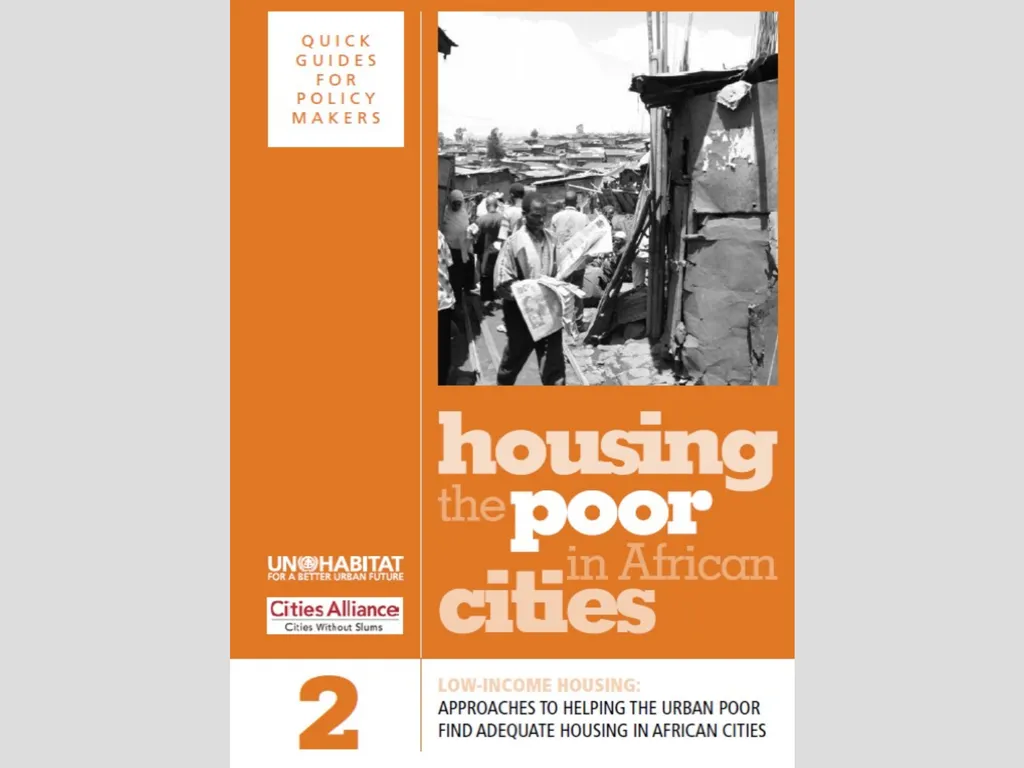
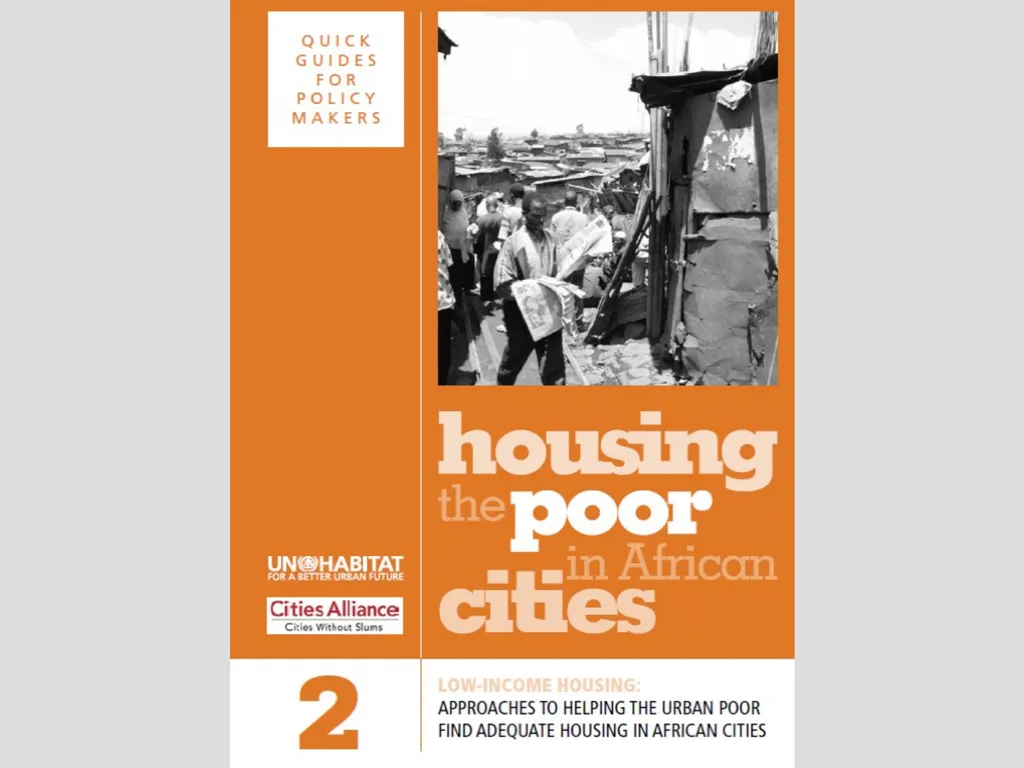
What is a Slum? ‘UN-Habitat defines a slum household as a group of people living under the same roof in an urban area who lack one or more of the following conditions: durable housing, sufficient living area, access to clean water, access to proper sanitation and secure tenure.’ 4<br>
04
Degrees of Deprivation Household deprivations can be grouped as:
Moderate: having one deprivation (slide 4)
Severe: having two
Extreme: having three or more
This categorization enables a more effective tracking of degrees of deprivation or degrees of improvement 5<br>
Moderate: having one deprivation (slide 4)
Severe: having two
Extreme: having three or more
This categorization enables a more effective tracking of degrees of deprivation or degrees of improvement 5<br>
05
When is an Urban Community a Slum? Lacks basic services
Contains dilapidated and poor-quality housing structures
Overcrowded or with extremely high density of dwellings and people
Unhealthy living environment, and perhaps located on ‘hazardous’ or ‘undevelopable’ land
Residents have insecure land tenure
Residents experience high levels of poverty and social exclusion 6<br>
Contains dilapidated and poor-quality housing structures
Overcrowded or with extremely high density of dwellings and people
Unhealthy living environment, and perhaps located on ‘hazardous’ or ‘undevelopable’ land
Residents have insecure land tenure
Residents experience high levels of poverty and social exclusion 6<br>
06
Slums and Informal Settlements:
Why do They Exist? Competition for urban land and high cost of land and housing
Poor people find it hard to access housing finance
Powerful groups skew housing development in their favour
Poor communities find it hard to overcome bureaucracy
Local and national governments lack political will to address overall housing strategy
Planning is constrained by lack of information about the conditions and needs of people living in informal settlements
Speed of supplying housing does not keep up with rate of urbanization
>>Question:
What options do poor people have? 7<br>
Poor people find it hard to access housing finance
Powerful groups skew housing development in their favour
Poor communities find it hard to overcome bureaucracy
Local and national governments lack political will to address overall housing strategy
Planning is constrained by lack of information about the conditions and needs of people living in informal settlements
Speed of supplying housing does not keep up with rate of urbanization
>>Question:
What options do poor people have? 7<br>
07
Key aspects of Informal Housing Development Housing: Of a wide variety of structures and quality, and different levels of poverty, freedom from housing regulations
Infrastructure: Where basic infrastructure is in place, it is often piecemeal, poorly planned and implemented
Location: Very important for the urban poor in relation to income earning opportunities – but often people are forced to squat on hazardous sites
Land tenure: One of the most serious problems faced by informal urban settlers – insecurity of tenure means that residents have little or no incentive to improve their housing 8<br>
Infrastructure: Where basic infrastructure is in place, it is often piecemeal, poorly planned and implemented
Location: Very important for the urban poor in relation to income earning opportunities – but often people are forced to squat on hazardous sites
Land tenure: One of the most serious problems faced by informal urban settlers – insecurity of tenure means that residents have little or no incentive to improve their housing 8<br>
08
Women and Low-income Housing ‘The full involvement of women is the best guarantee that any housing project will succeed.’
>>Question:
Do you agree with this statement – and for what reasons? 9<br>
>>Question:
Do you agree with this statement – and for what reasons? 9<br>
09
Women and Low-income Housing 2 Women are the key stakeholders – the most concerned about housing conditions for their families
They have the intimate knowledge of their community and its problems
They have strong social networks within the community – hence the ability to mobilise support
Involving women in housing projects can counteract entrenched patterns of inequality 10<br>
They have the intimate knowledge of their community and its problems
They have strong social networks within the community – hence the ability to mobilise support
Involving women in housing projects can counteract entrenched patterns of inequality 10<br>
10
Gender Discrimination ‘…women often face both hidden and open discrimination when they try to meet their own and family’s housing needs, through laws and customs in their countries which restrict their ability to legally own, lease, inherit or control the use of property, and to obtain housing finance loans.’
>>Questions:
How valid is this statement?
What is the situation in your country?
What is being done about it?
What should be done? 11<br>
>>Questions:
How valid is this statement?
What is the situation in your country?
What is being done about it?
What should be done? 11<br>
11
Right to Adequate Housing Freedoms
Protection against forced evictions and the arbitrary destruction and demolition of one’s home
The right to be free from arbitrary interference with one’s home, privacy and family
The right to choose one’s residence, to determine where to live and to freedom of movement
Source: The United Nations Committee on Economic, Social and Cultural Rights 12<br>
Protection against forced evictions and the arbitrary destruction and demolition of one’s home
The right to be free from arbitrary interference with one’s home, privacy and family
The right to choose one’s residence, to determine where to live and to freedom of movement
Source: The United Nations Committee on Economic, Social and Cultural Rights 12<br>
12
Right to Adequate Housing Entitlements
Security of tenure
Housing, land and property restitution
Equal and non-discriminatory access to adequate housing
Participation in housing-related decision-making at the national and community levels.
Source: The United Nations Committee on Economic, Social and Cultural Rights 13<br>
Security of tenure
Housing, land and property restitution
Equal and non-discriminatory access to adequate housing
Participation in housing-related decision-making at the national and community levels.
Source: The United Nations Committee on Economic, Social and Cultural Rights 13<br>
13
Approaches to Low-income Housing On-site upgrading
Resettlement on suitable land
Government-led new public schemes
Sites-and-services and incremental land development
City-wide housing strategies 14<br>
Resettlement on suitable land
Government-led new public schemes
Sites-and-services and incremental land development
City-wide housing strategies 14<br>
14
1. On-site Upgrading: Definition Means improving the physical, social and economic environment of an existing informal settlement, without displacing the people who live there
As well as improving infrastructure, a comprehensive scheme can involve improvements to:
Houses
Land tenure
Income-generating opportunities
Common facilities
Access to public services
Welfare 15<br>
As well as improving infrastructure, a comprehensive scheme can involve improvements to:
Houses
Land tenure
Income-generating opportunities
Common facilities
Access to public services
Welfare 15<br>
15
On-site Upgrading: Best Option? ‘When cities and governments support the process of upgrading informal communities, it is the least expensive, most humane way of enhancing a city’s much-needed stock of affordable housing, instead of destroying it.’
>>Questions:
Do you agree?
Why or why not? 16<br>
>>Questions:
Do you agree?
Why or why not? 16<br>
16
On-site Upgrading: An Argument Against ‘One of the first arguments against upgrading informal settlements in situ is that the land they occupy is needed for other purposes.’
>>Question:
Is this the case for your situation? 17<br>
>>Question:
Is this the case for your situation? 17<br>
17
The Question of Standards ‘Standards in upgrading projects have been a source of controversy. While donor agencies seek to reduce standards as a way of ensuring the widest possible provision of needed housing government agencies are intent on imposing high standards on all construction projects – at best because they are keen to reduce maintenance costs and at worst because they aspire to a highly formalised utopian vision of their cities.’
>>Question:
How is it in your own case? 18<br>
>>Question:
How is it in your own case? 18<br>
18
Principles of Successful Upgrading It has to be participatory
It has to be done in partnership
It has to provide secure land tenure
Communities have to contribute
Upgrading must be affordable
The project must be financially sustainable
It should be part of the larger urban development strategy
>>Questions:
Is there any way you would amend these principles?
Are they being upheld in your own situation? 19<br>
It has to be done in partnership
It has to provide secure land tenure
Communities have to contribute
Upgrading must be affordable
The project must be financially sustainable
It should be part of the larger urban development strategy
>>Questions:
Is there any way you would amend these principles?
Are they being upheld in your own situation? 19<br>
19
Stages of Upgrading Projects Selecting the settlement to be upgraded – by what criteria?
Strengthening the community’s internal organization - how and by whom?
Organizing meetings to get stakeholders involved – with what kind of agenda?
Surveying all aspects of the community – what kind of information is needed?
Designing all aspects of the upgrading plan – with which elements?
Carrying out the actual upgrading work - by contracting out or through community action?
Continue with meetings as a platform for further work – with what purpose? 20<br>
Strengthening the community’s internal organization - how and by whom?
Organizing meetings to get stakeholders involved – with what kind of agenda?
Surveying all aspects of the community – what kind of information is needed?
Designing all aspects of the upgrading plan – with which elements?
Carrying out the actual upgrading work - by contracting out or through community action?
Continue with meetings as a platform for further work – with what purpose? 20<br>
20
2. Resettlement on Suitable Land ‘Experience shows that it costs ten to 15 times more to develop new housing than it costs to upgrade the housing, living environments and settlements in which people have already lived and have already invested.’
>>Questions:
Would you challenge this assessment?
Why or why not?
What are the implications for deciding on resettlement or upgrading?
Do you agree that resettlement should never be the first choice? 21<br>
>>Questions:
Would you challenge this assessment?
Why or why not?
What are the implications for deciding on resettlement or upgrading?
Do you agree that resettlement should never be the first choice? 21<br>
21
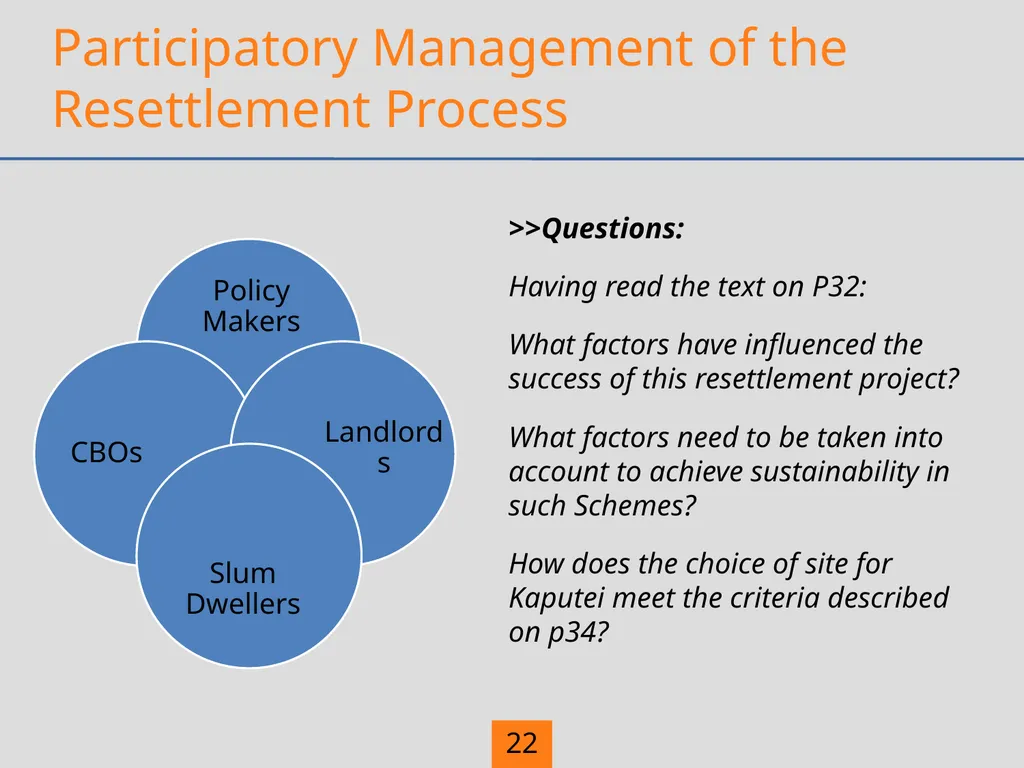
Participatory Management of the Resettlement Process >>Questions:
Having read the text on P32:
What factors have influenced the success of this resettlement project?
What factors need to be taken into account to achieve sustainability in such Schemes?
How does the choice of site for Kaputei meet the criteria described on p34? 22 CBOs Slum Dwellers Landlords<br>
Having read the text on P32:
What factors have influenced the success of this resettlement project?
What factors need to be taken into account to achieve sustainability in such Schemes?
How does the choice of site for Kaputei meet the criteria described on p34? 22 CBOs Slum Dwellers Landlords<br>
22
3. Government-Led New Public housing ‘Experience shows that large-scale public housing delivery is not a solution.’
Questions:
Is that your own experience?
Why is that the case?
‘Public resources are better spent on improving the existing stock of affordable housing (no matter how substandard) and implementing a range of innovative and flexible approaches to creating new stock.’
>>Questions:
Do you agree?
Why or why not? 23<br>
Questions:
Is that your own experience?
Why is that the case?
‘Public resources are better spent on improving the existing stock of affordable housing (no matter how substandard) and implementing a range of innovative and flexible approaches to creating new stock.’
>>Questions:
Do you agree?
Why or why not? 23<br>
23
4. Sites-And-Services and Incremental Land Development ‘Governments provide plots and basic services in a planned manner but let people build their own houses on that land.’
‘In some projects that take a cost-recovery approach, the people may be expected to repay the cost of land and development gradually, but in other projects these are provided free as a public subsidy.’ 24<br>
‘In some projects that take a cost-recovery approach, the people may be expected to repay the cost of land and development gradually, but in other projects these are provided free as a public subsidy.’ 24<br>
24
Benefits of Sites-And-Services (S.A.S) Schemes Enable governments to share responsibility with low-income groups
Provision of infrastructure and services are planned and cheaper
Beneficiaries are in control of the pace and form of house construction
Schemes can reach large numbers of people
Can be used in essential resettlement projects
Can be a flexible way of meeting future housing needs 25<br>
Provision of infrastructure and services are planned and cheaper
Beneficiaries are in control of the pace and form of house construction
Schemes can reach large numbers of people
Can be used in essential resettlement projects
Can be a flexible way of meeting future housing needs 25<br>
25
Ways to Better S.A.S Schemes Provide land in good locations
Recognize that sites do not have to be huge or at the city edge
Keep plot sizes small
Reduce services costs through good planning
Develop incrementally to reduce people’s costs
>>Questions:
To what extent are these principles being followed in S.A.S schemes in your context?
What factors can lead to failure? 26<br>
Recognize that sites do not have to be huge or at the city edge
Keep plot sizes small
Reduce services costs through good planning
Develop incrementally to reduce people’s costs
>>Questions:
To what extent are these principles being followed in S.A.S schemes in your context?
What factors can lead to failure? 26<br>
26
5. City-wide Housing Strategies Conditions:
Horizontal links between poor communities – to provide networks of mutual support
Room for innovation in the policy environment – loosening and adjusting regulations
Public investment in infrastructure
Investment in building vision and capacity – of communities, architects, NGOs, governments and other stakeholders 27<br>
Horizontal links between poor communities – to provide networks of mutual support
Room for innovation in the policy environment – loosening and adjusting regulations
Public investment in infrastructure
Investment in building vision and capacity – of communities, architects, NGOs, governments and other stakeholders 27<br>
27
Scaling up City-wide:
What is Needed? (1) Political will
Integrated approaches and a city vision – long-term planning
Supportive local policy environment – including a good information base
Appropriate national regulatory framework – stimulating upgrading and service provision
Responsive land and housing policies – releasing unused public land for low-income housing 28<br>
Integrated approaches and a city vision – long-term planning
Supportive local policy environment – including a good information base
Appropriate national regulatory framework – stimulating upgrading and service provision
Responsive land and housing policies – releasing unused public land for low-income housing 28<br>
28
Scaling up city-wide:
What is Needed? (2) Policies to secure land tenure
Mechanisms for financial sustainability – subsidy systems and cost recovery strategies
Strategic alliances - partnerships that include poor communities, local authorities, utility companies, landowners, land developers, NGOs, private sector etc. Strong and well-coordinated institutions
Technical capacity – supporting communities and implementing agencies
>>Question:
To what extent are these conditions being met in your cities? 29<br>
Mechanisms for financial sustainability – subsidy systems and cost recovery strategies
Strategic alliances - partnerships that include poor communities, local authorities, utility companies, landowners, land developers, NGOs, private sector etc. Strong and well-coordinated institutions
Technical capacity – supporting communities and implementing agencies
>>Question:
To what extent are these conditions being met in your cities? 29<br>
29
Conclusions A slum is a household in an urban area that lacks one or more of the five key elements
Everyone has the right to adequate housing
There are different policy options for low-income housing
On-site upgrading is often the best option 30<br>
Everyone has the right to adequate housing
There are different policy options for low-income housing
On-site upgrading is often the best option 30<br>