
Lecture 07: Arithmetic Operators Topics: Addition
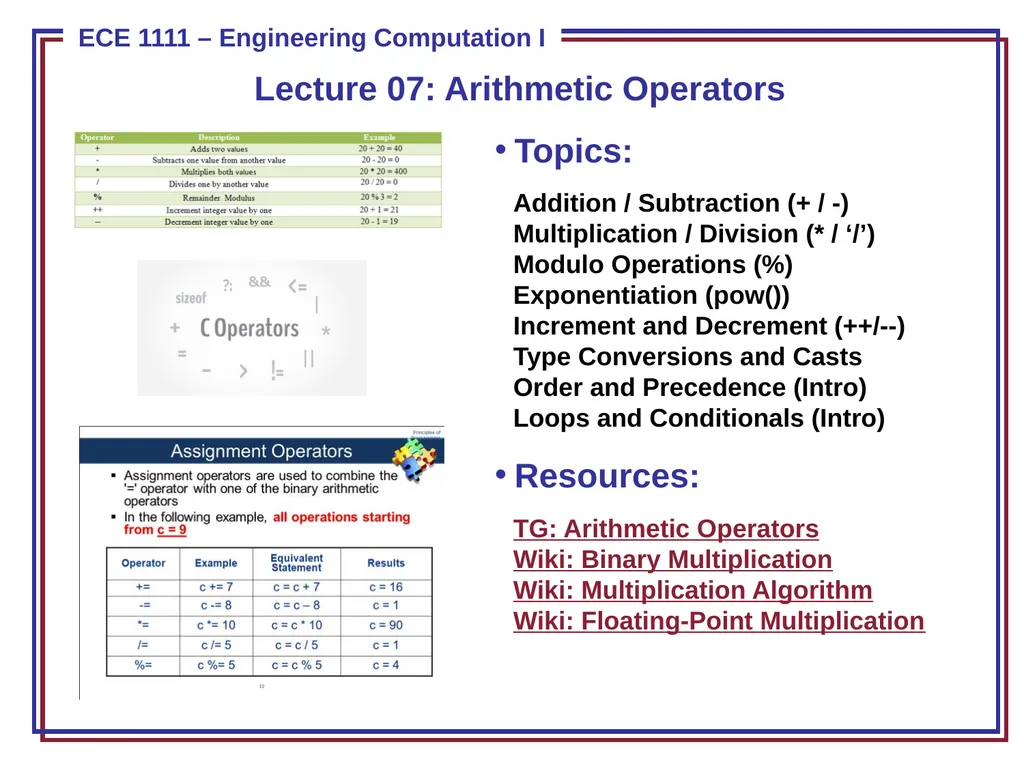
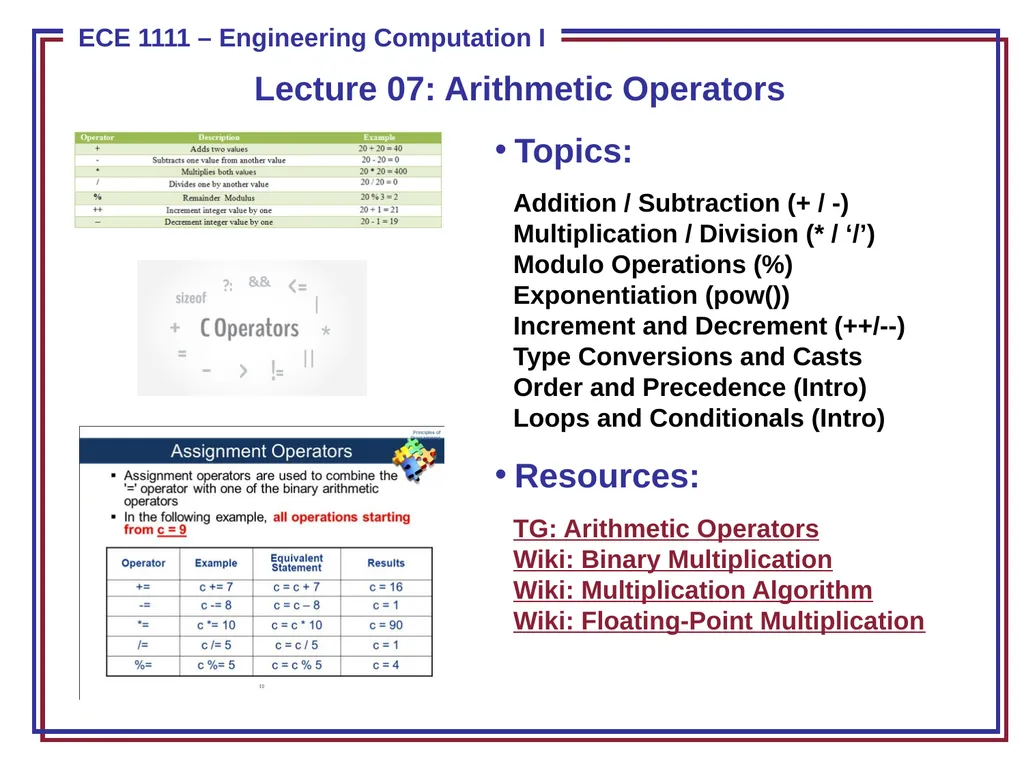
Description: Lecture 07: Arithmetic Operators Topics: Addition Subtraction ( -) Multiplication Division ( ) Modulo Operations () Exponentiation (pow()) Increment and Decrement (--) Type Conversions and Casts Order and Precedence (Intro)
Related Topics
Download Presentation
"Lecture 07: Arithmetic Operators Topics: Addition" is the property of its rightful owner. Permission is granted to download and print the materials on this website for personal, non-commercial use only, and to display it on your personal computer provided you do not modify the materials and that you retain all copyright notices contained in the materials. By downloading content from our website, you accept the terms of this agreement.
Presentation Transcript
slide1. Lecture 07: Arithmetic Operators Topics:
Addition / Subtraction (+ / -)
Multiplication / Division (* / ‘/’)
Modulo Operations (%)
Exponentiation (pow())
Increment and Decrement (++/--)
Type Conversions and Casts
Order and Precedence (Intro)
Loops and Conditionals (Intro) Resources:
TG: Arithmetic Operators
Wiki: Binary Multiplication
Wiki: Multiplication Algorithm
Wiki: Floating-Point Multiplication<br>
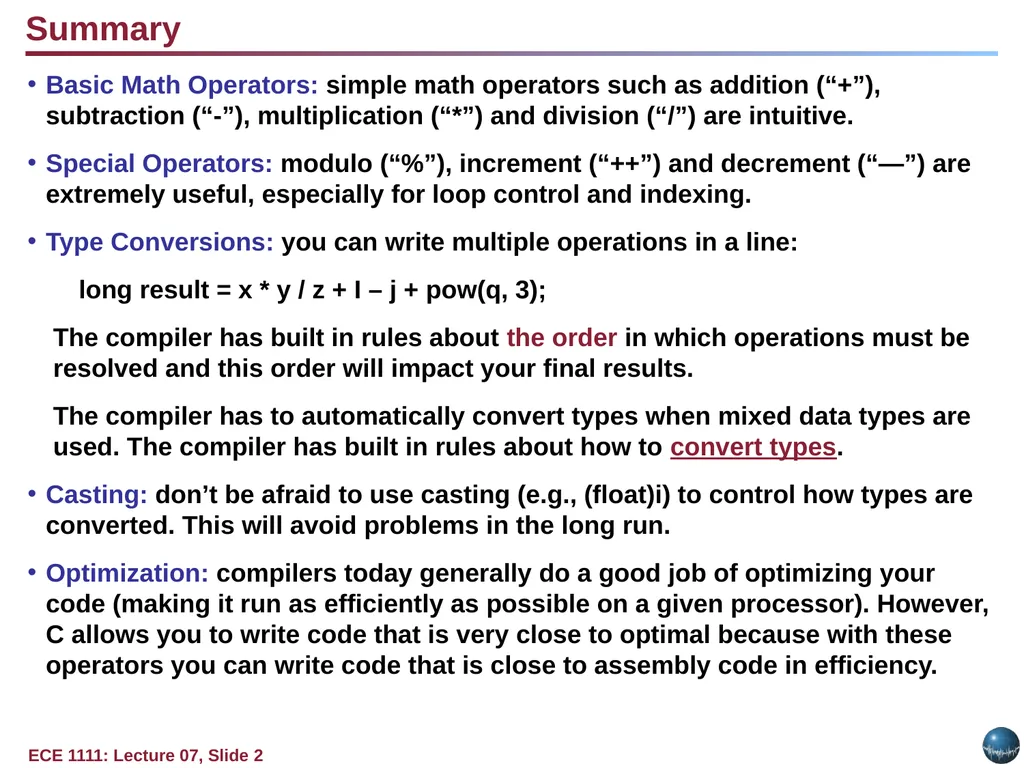
slide2. Summary Basic Math Operators: simple math operators such as addition (“+”), subtraction (“-”), multiplication (“*”) and division (“/”) are intuitive.
Special Operators: modulo (“%”), increment (“++”) and decrement (“—”) are extremely useful, especially for loop control and indexing.
Type Conversions: you can write multiple operations in a line:
long result = x * y / z + I – j + pow(q, 3);
The compiler has built in rules about the order in which operations must be resolved and this order will impact your final results.
The compiler has to automatically convert types when mixed data types are used. The compiler has built in rules about how to convert types.
Casting: don’t be afraid to use casting (e.g., (float)i) to control how types are converted. This will avoid problems in the long run.
Optimization: compilers today generally do a good job of optimizing your code (making it run as efficiently as possible on a given processor). However, C allows you to write code that is very close to optimal because with these operators you can write code that is close to assembly code in efficiency.<br>
Addition / Subtraction (+ / -)
Multiplication / Division (* / ‘/’)
Modulo Operations (%)
Exponentiation (pow())
Increment and Decrement (++/--)
Type Conversions and Casts
Order and Precedence (Intro)
Loops and Conditionals (Intro) Resources:
TG: Arithmetic Operators
Wiki: Binary Multiplication
Wiki: Multiplication Algorithm
Wiki: Floating-Point Multiplication<br>
slide2. Summary Basic Math Operators: simple math operators such as addition (“+”), subtraction (“-”), multiplication (“*”) and division (“/”) are intuitive.
Special Operators: modulo (“%”), increment (“++”) and decrement (“—”) are extremely useful, especially for loop control and indexing.
Type Conversions: you can write multiple operations in a line:
long result = x * y / z + I – j + pow(q, 3);
The compiler has built in rules about the order in which operations must be resolved and this order will impact your final results.
The compiler has to automatically convert types when mixed data types are used. The compiler has built in rules about how to convert types.
Casting: don’t be afraid to use casting (e.g., (float)i) to control how types are converted. This will avoid problems in the long run.
Optimization: compilers today generally do a good job of optimizing your code (making it run as efficiently as possible on a given processor). However, C allows you to write code that is very close to optimal because with these operators you can write code that is close to assembly code in efficiency.<br>