
Lecture 10: Scaling Laws Presenters: Carter Blair
PM
Published · 61 slides · 0 views

1 / 1


Description
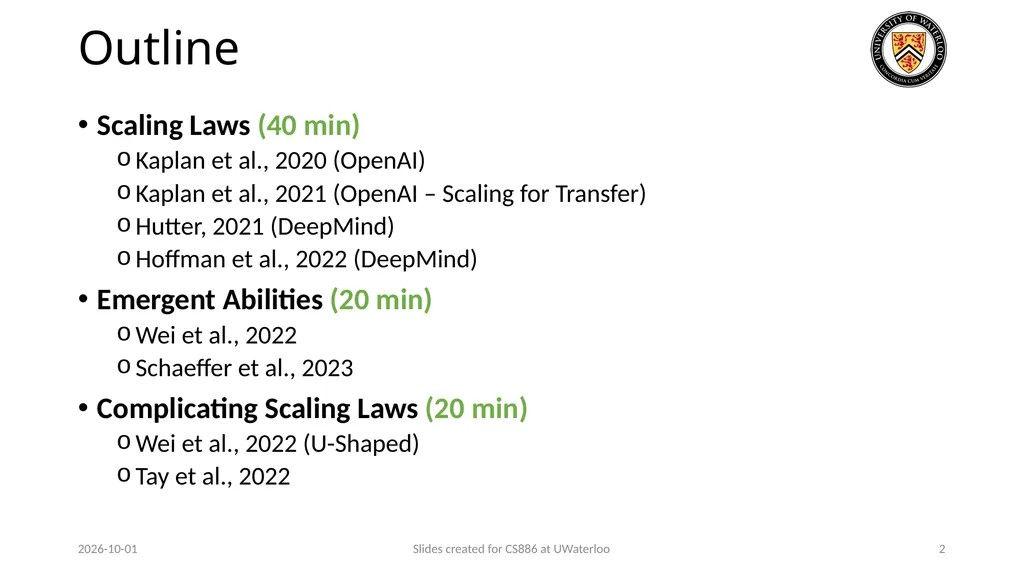
Lecture 10: Scaling Laws Presenters: Carter Blair and Cole Wyeth 2024-03-31 Slides created for CS886 at UWaterloo 1 Outline Scaling Laws (40 min) Kaplan et al., 2020 (OpenAI) Kaplan et al., 2021 (OpenAI Scaling for Transfer) Hutter, 2021
Related Topics
Share
Embed code
Download this presentation From Below
"Lecture 10: Scaling Laws Presenters: Carter Blair" is the property of its rightful owner. Permission is granted to download and print the materials on this website for personal, non-commercial use only, and to display it on your personal computer provided you do not modify the materials and that you retain all copyright notices contained in the materials. By downloading content from our website, you accept the terms of this agreement.
Presentation Transcript
01
Lecture 10: Scaling Laws Presenters: Carter Blair and Cole Wyeth 2024-03-31 Slides created for CS886 at UWaterloo 1<br>
02
Outline Scaling Laws (40 min)
Kaplan et al., 2020 (OpenAI)
Kaplan et al., 2021 (OpenAI – Scaling for Transfer)
Hutter, 2021 (DeepMind)
Hoffman et al., 2022 (DeepMind)
Emergent Abilities (20 min)
Wei et al., 2022
Schaeffer et al., 2023
Complicating Scaling Laws (20 min)
Wei et al., 2022 (U-Shaped)
Tay et al., 2022 2024-03-31 Slides created for CS886 at UWaterloo 2<br>
Kaplan et al., 2020 (OpenAI)
Kaplan et al., 2021 (OpenAI – Scaling for Transfer)
Hutter, 2021 (DeepMind)
Hoffman et al., 2022 (DeepMind)
Emergent Abilities (20 min)
Wei et al., 2022
Schaeffer et al., 2023
Complicating Scaling Laws (20 min)
Wei et al., 2022 (U-Shaped)
Tay et al., 2022 2024-03-31 Slides created for CS886 at UWaterloo 2<br>
03
Motivation Scientific problem: How does model performance change with increasing scale?
Engineering importance: Training frontier models costs millions of dollars
Safety importance: Models are black boxes with often unexpected capabilities 2024-03-31 Slides created for CS886 at UWaterloo 3<br>
Engineering importance: Training frontier models costs millions of dollars
Safety importance: Models are black boxes with often unexpected capabilities 2024-03-31 Slides created for CS886 at UWaterloo 3<br>
04
Scaling Laws 2024-03-31 Slides created for CS886 at UWaterloo 4<br>
05
Scaling Laws for Neural Language Models,
Kaplan et al. 2020 Main RQ: What is the relationship between compute, data, the number of parameters, and performance? 2024-03-31 Slides created for CS886 at UWaterloo 5<br>
06
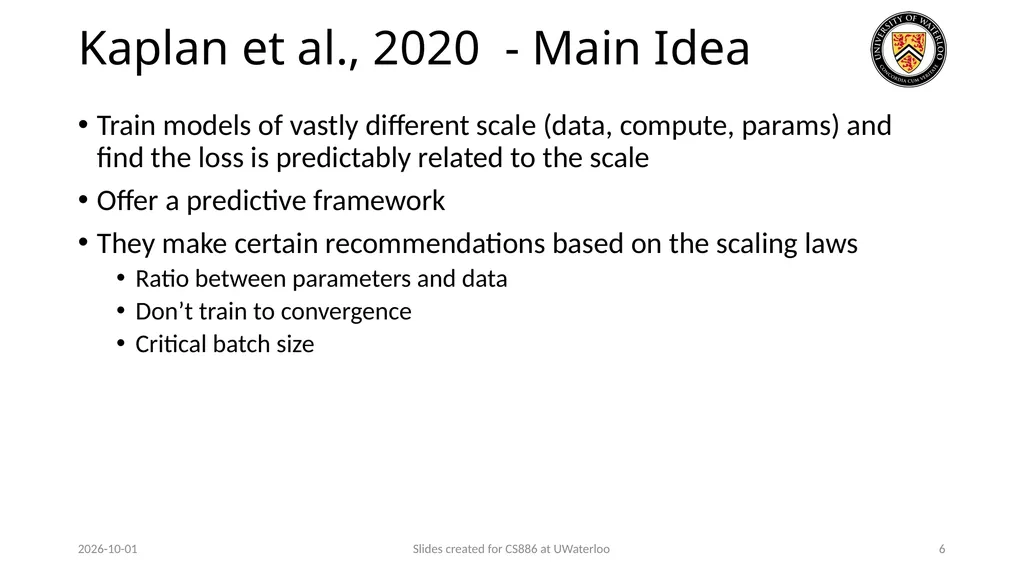
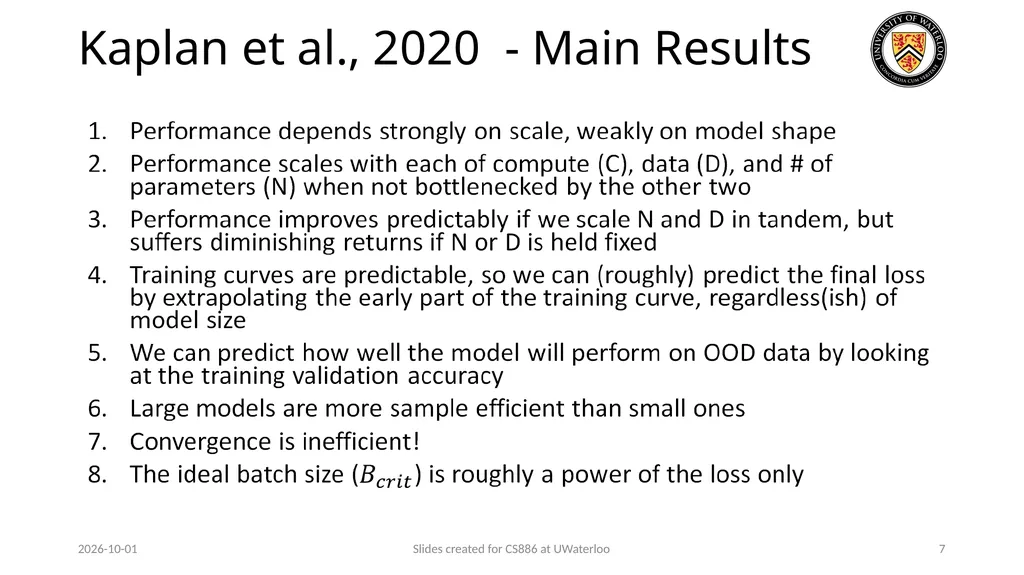
Kaplan et al., 2020 - Main Idea Train models of vastly different scale (data, compute, params) and find the loss is predictably related to the scale
Offer a predictive framework
They make certain recommendations based on the scaling laws
Ratio between parameters and data
Don’t train to convergence
Critical batch size 2024-03-31 Slides created for CS886 at UWaterloo 6<br>
Offer a predictive framework
They make certain recommendations based on the scaling laws
Ratio between parameters and data
Don’t train to convergence
Critical batch size 2024-03-31 Slides created for CS886 at UWaterloo 6<br>
07
Kaplan et al., 2020 - Main Results 2024-03-31 Slides created for CS886 at UWaterloo 7<br>
08
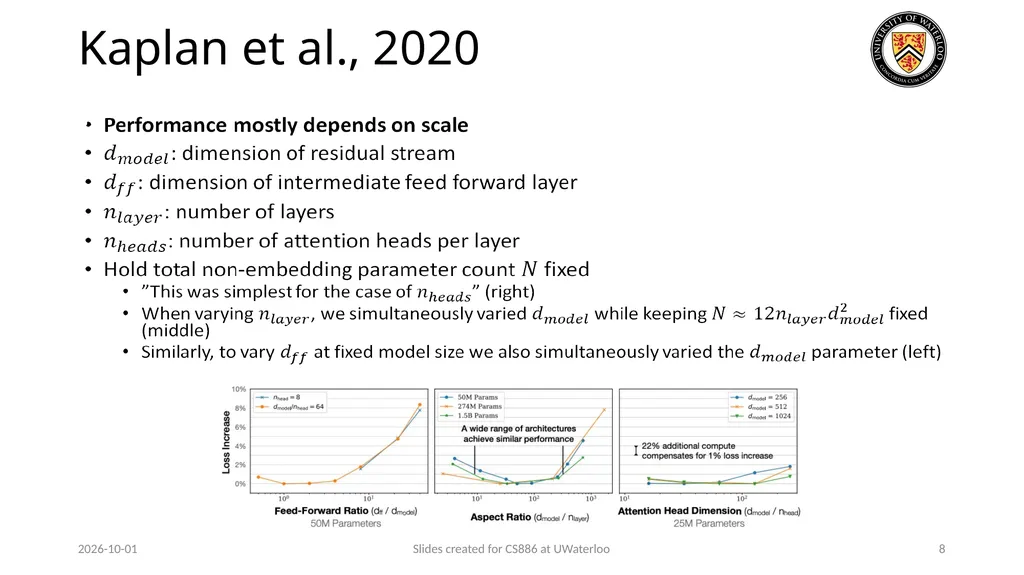
Kaplan et al., 2020 2024-03-31 Slides created for CS886 at UWaterloo 8<br>
09
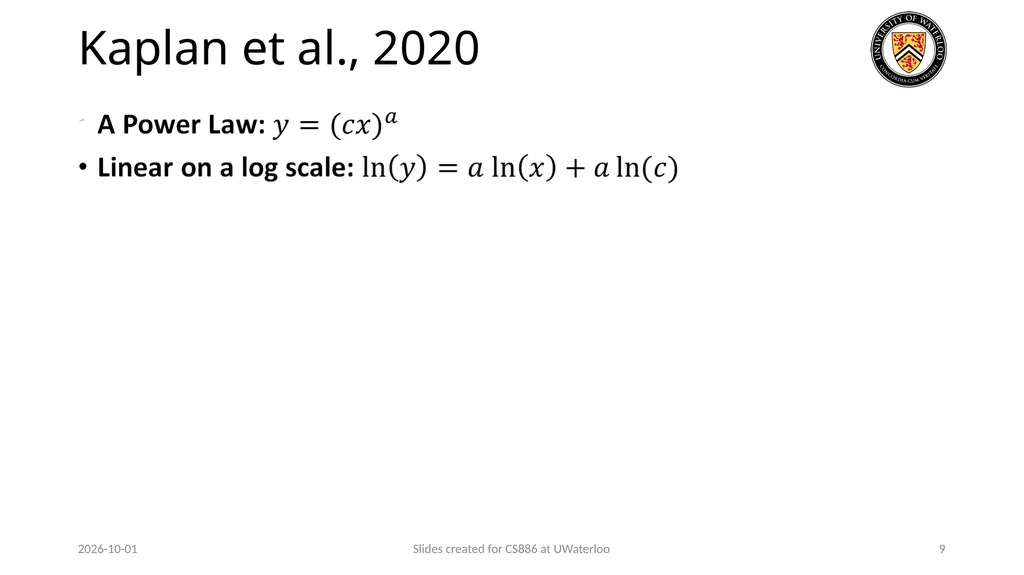
Kaplan et al., 2020 2024-03-31 Slides created for CS886 at UWaterloo 9<br>
10
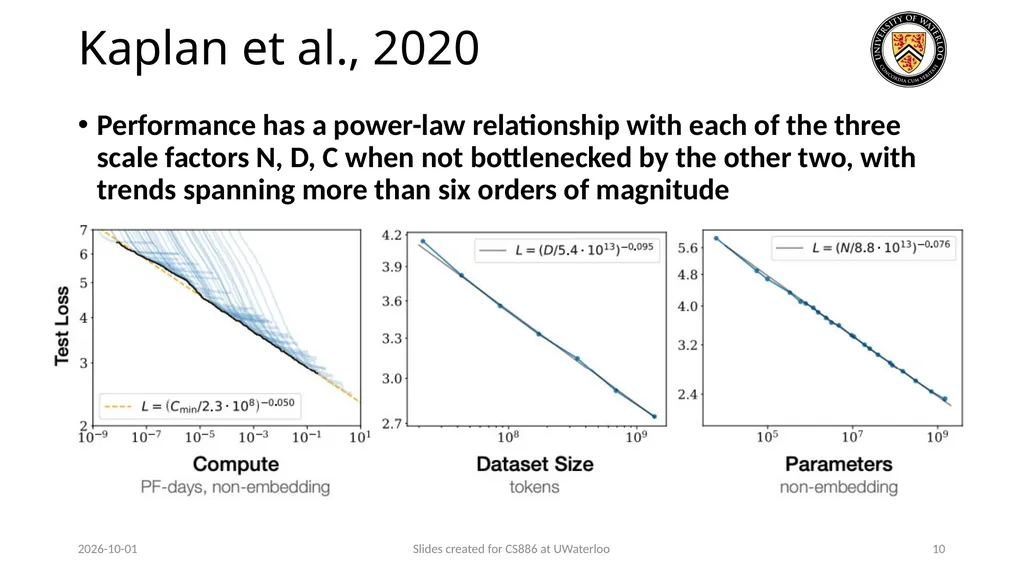
Kaplan et al., 2020 Performance has a power-law relationship with each of the three scale factors N, D, C when not bottlenecked by the other two, with trends spanning more than six orders of magnitude 2024-03-31 Slides created for CS886 at UWaterloo 10<br>
11
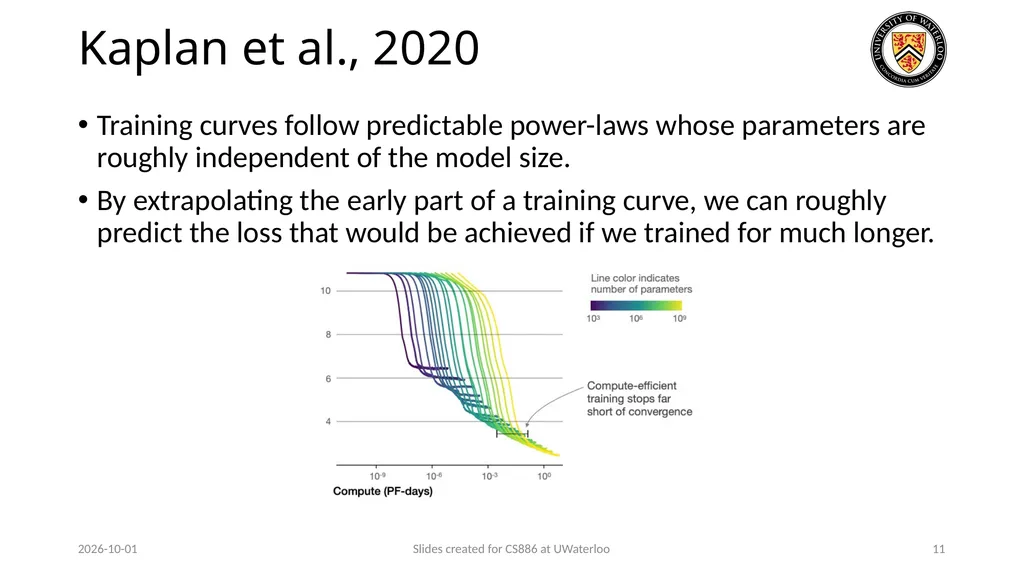
Kaplan et al., 2020 Training curves follow predictable power-laws whose parameters are roughly independent of the model size.
By extrapolating the early part of a training curve, we can roughly predict the loss that would be achieved if we trained for much longer. 2024-03-31 Slides created for CS886 at UWaterloo 11<br>
By extrapolating the early part of a training curve, we can roughly predict the loss that would be achieved if we trained for much longer. 2024-03-31 Slides created for CS886 at UWaterloo 11<br>
12
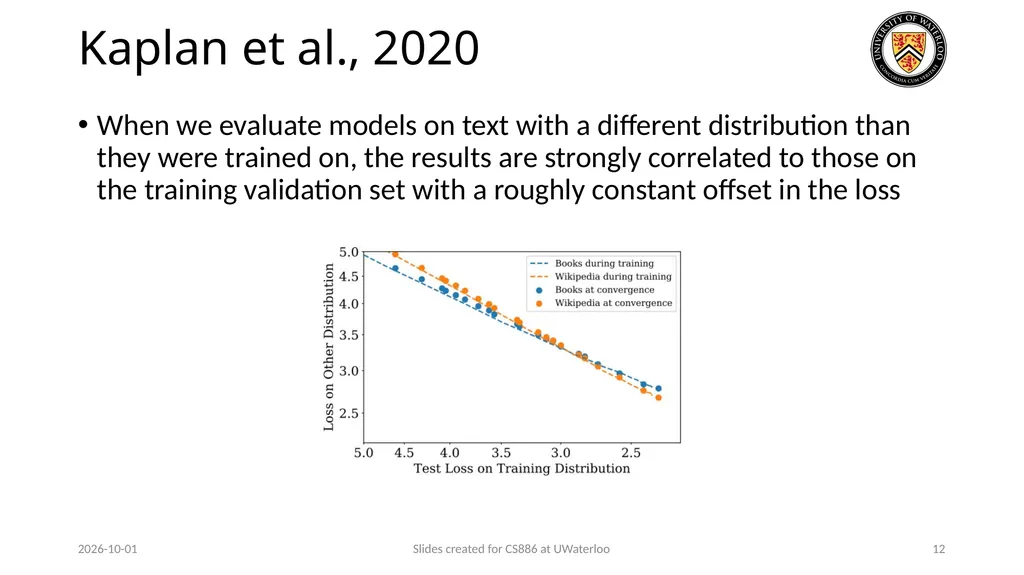
Kaplan et al., 2020 When we evaluate models on text with a different distribution than they were trained on, the results are strongly correlated to those on the training validation set with a roughly constant offset in the loss 2024-03-31 Slides created for CS886 at UWaterloo 12<br>
13
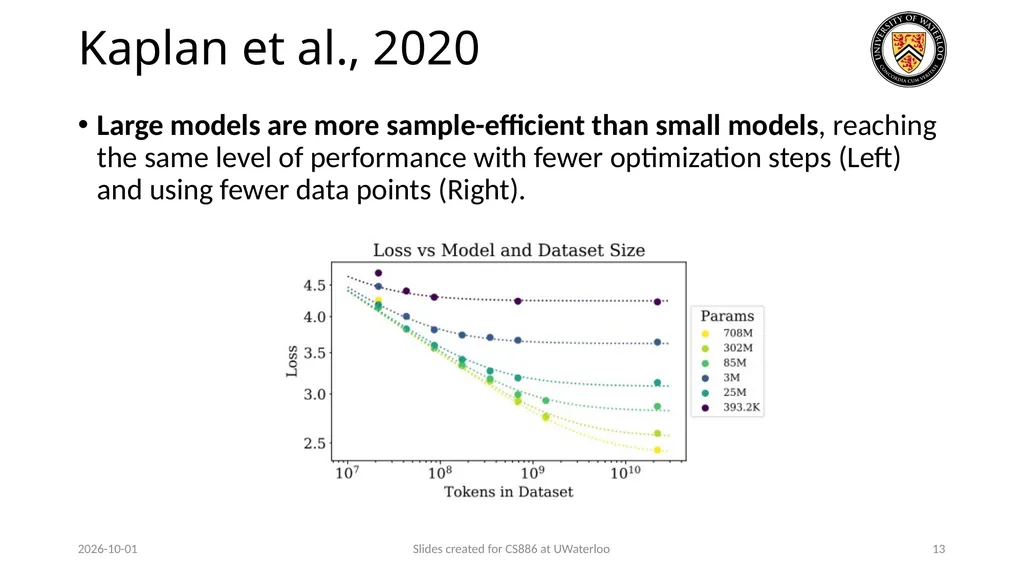
Kaplan et al., 2020 Large models are more sample-efficient than small models, reaching the same level of performance with fewer optimization steps (Left) and using fewer data points (Right). 2024-03-31 Slides created for CS886 at UWaterloo 13<br>
14
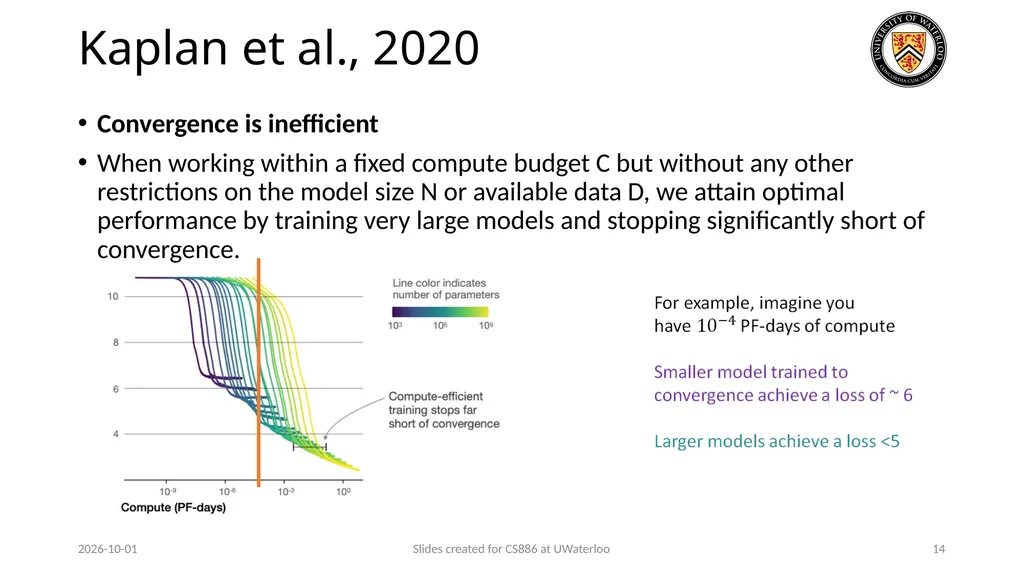
Kaplan et al., 2020 Convergence is inefficient
When working within a fixed compute budget C but without any other restrictions on the model size N or available data D, we attain optimal performance by training very large models and stopping significantly short of convergence. 2024-03-31 Slides created for CS886 at UWaterloo 14<br>
When working within a fixed compute budget C but without any other restrictions on the model size N or available data D, we attain optimal performance by training very large models and stopping significantly short of convergence. 2024-03-31 Slides created for CS886 at UWaterloo 14<br>
15
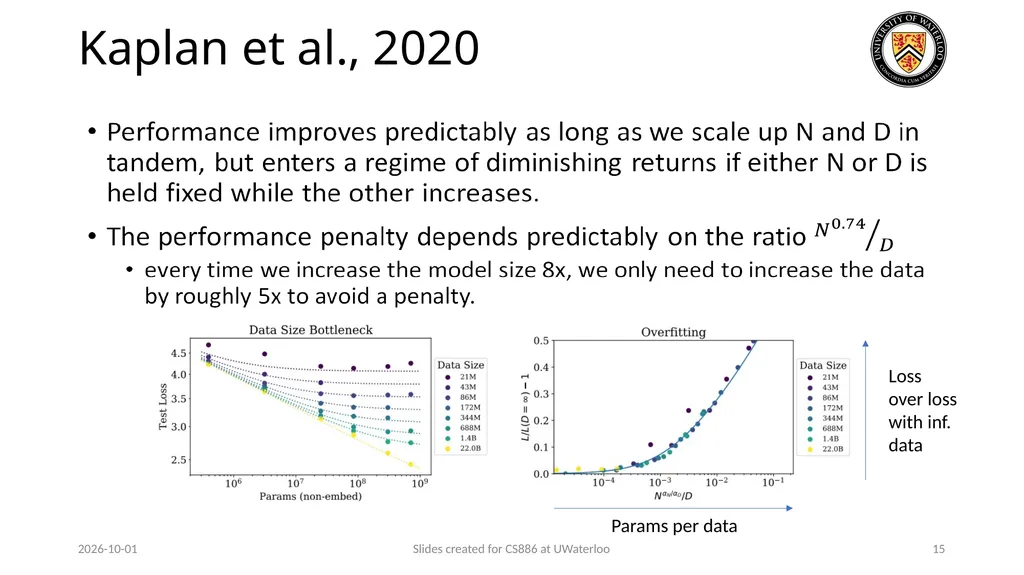
Kaplan et al., 2020 2024-03-31 Slides created for CS886 at UWaterloo 15 Params per data Loss over loss with inf. data<br>
16
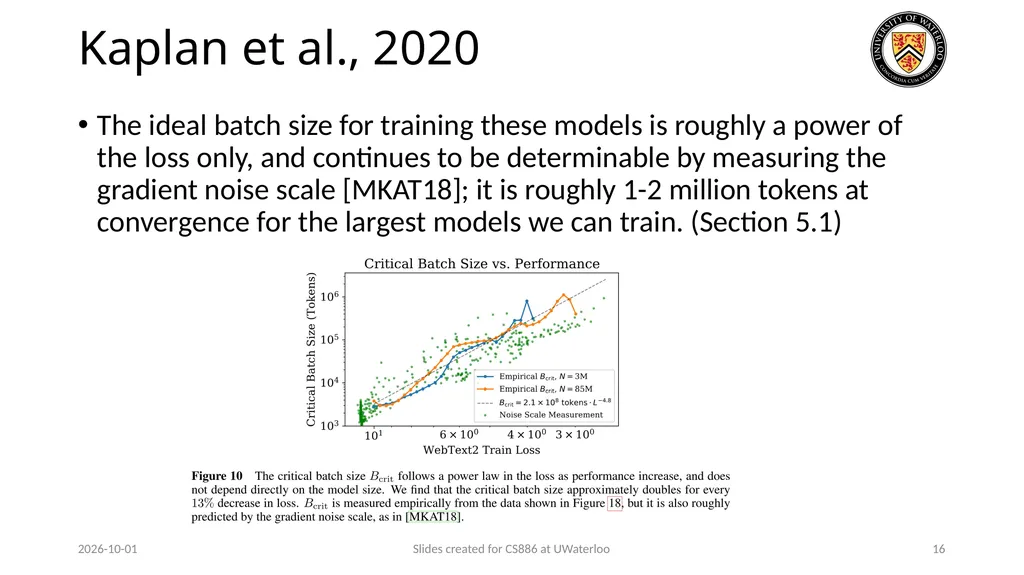
Kaplan et al., 2020 The ideal batch size for training these models is roughly a power of the loss only, and continues to be determinable by measuring the gradient noise scale [MKAT18]; it is roughly 1-2 million tokens at convergence for the largest models we can train. (Section 5.1) 2024-03-31 Slides created for CS886 at UWaterloo 16<br>
17
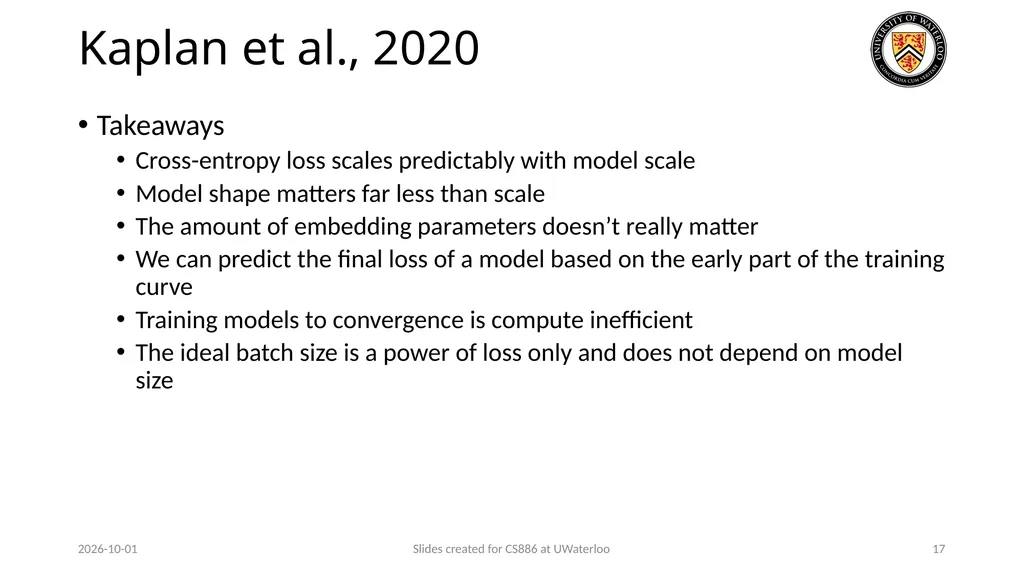
Kaplan et al., 2020 Takeaways
Cross-entropy loss scales predictably with model scale
Model shape matters far less than scale
The amount of embedding parameters doesn’t really matter
We can predict the final loss of a model based on the early part of the training curve
Training models to convergence is compute inefficient
The ideal batch size is a power of loss only and does not depend on model size 2024-03-31 Slides created for CS886 at UWaterloo 17<br>
Cross-entropy loss scales predictably with model scale
Model shape matters far less than scale
The amount of embedding parameters doesn’t really matter
We can predict the final loss of a model based on the early part of the training curve
Training models to convergence is compute inefficient
The ideal batch size is a power of loss only and does not depend on model size 2024-03-31 Slides created for CS886 at UWaterloo 17<br>
18
Scaling Laws for Transfer, Kaplan et. al. 2021 Main RQ: What are the empirical scaling laws for transfer learning? 2024-03-31 Slides created for CS886 at UWaterloo 18<br>
19
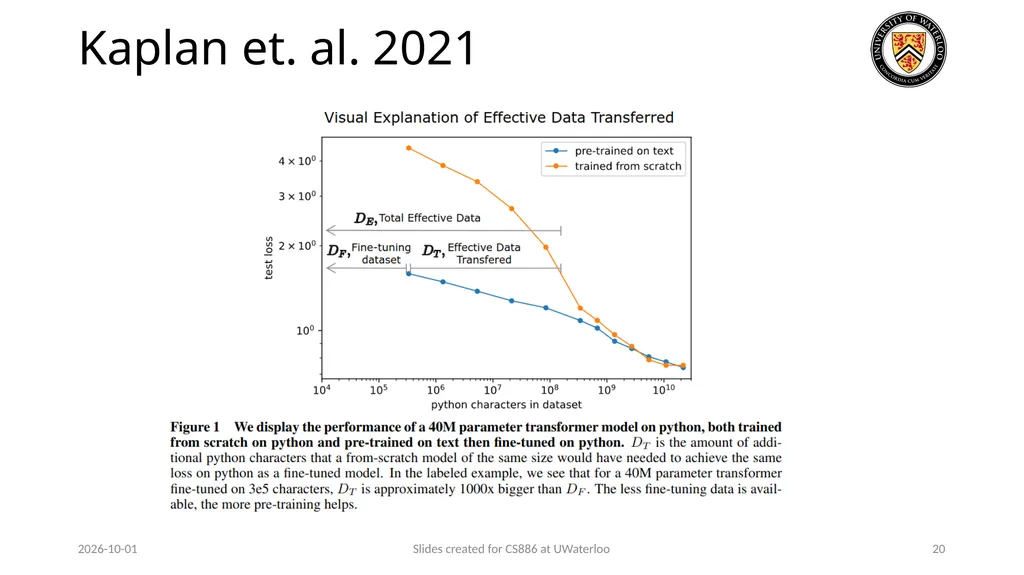
Kaplan et. al. 2021 – Main Results Pretraining is very valuable in the low-data regime
Quantify "effective data transferred" with (yet) another power law
Conjectured measurement of similarity between datasets
Investigate "ossification": Can pretraining hurt performance? 2024-03-31 Slides created for CS886 at UWaterloo 19<br>
Quantify "effective data transferred" with (yet) another power law
Conjectured measurement of similarity between datasets
Investigate "ossification": Can pretraining hurt performance? 2024-03-31 Slides created for CS886 at UWaterloo 19<br>
20
Kaplan et. al. 2021 2024-03-31 Slides created for CS886 at UWaterloo 20<br>
21
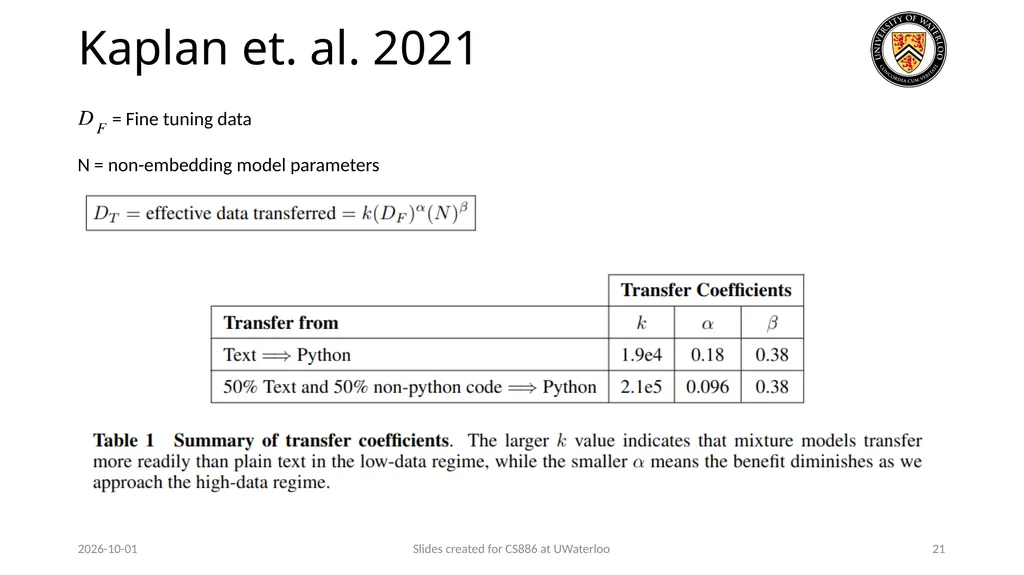
Kaplan et. al. 2021 2024-03-31 Slides created for CS886 at UWaterloo 21 = Fine tuning data
N = non-embedding model parameters<br>
N = non-embedding model parameters<br>
22
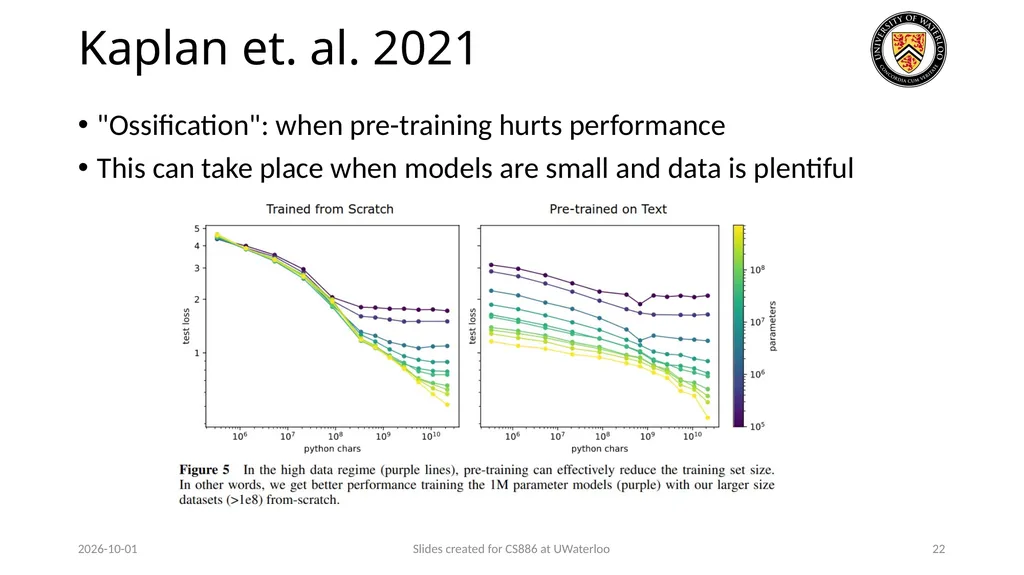
Kaplan et. al. 2021 "Ossification": when pre-training hurts performance
This can take place when models are small and data is plentiful 2024-03-31 Slides created for CS886 at UWaterloo 22<br>
This can take place when models are small and data is plentiful 2024-03-31 Slides created for CS886 at UWaterloo 22<br>
23
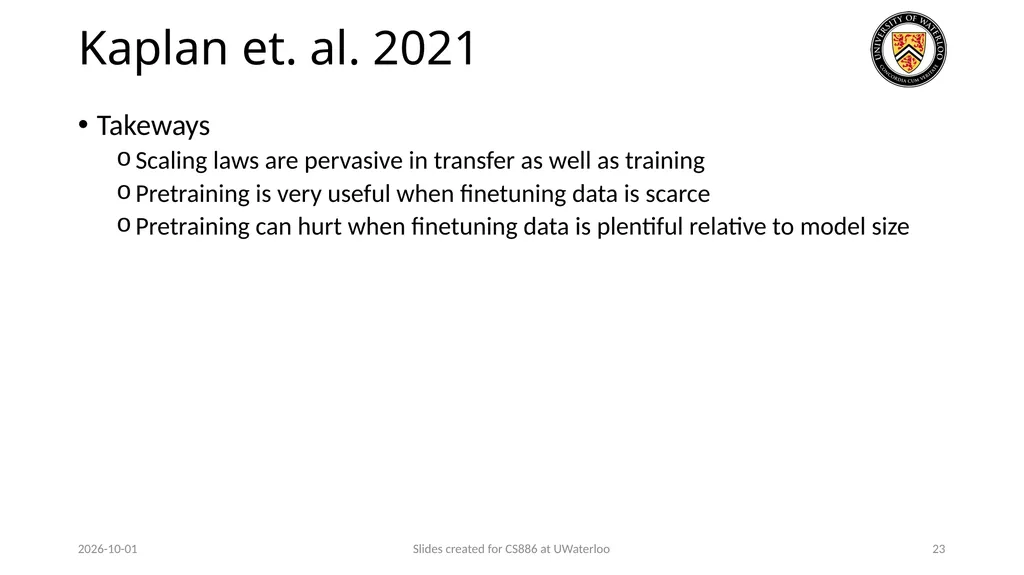
Kaplan et. al. 2021 Takeways
Scaling laws are pervasive in transfer as well as training
Pretraining is very useful when finetuning data is scarce
Pretraining can hurt when finetuning data is plentiful relative to model size 2024-03-31 Slides created for CS886 at UWaterloo 23<br>
Scaling laws are pervasive in transfer as well as training
Pretraining is very useful when finetuning data is scarce
Pretraining can hurt when finetuning data is plentiful relative to model size 2024-03-31 Slides created for CS886 at UWaterloo 23<br>
24
Learning Curve Theory, Hutter 2021 Main RQ: Can we mathematically replicate the observed neural scaling power laws? 2024-03-31 Slides created for CS886 at UWaterloo 24<br>
25
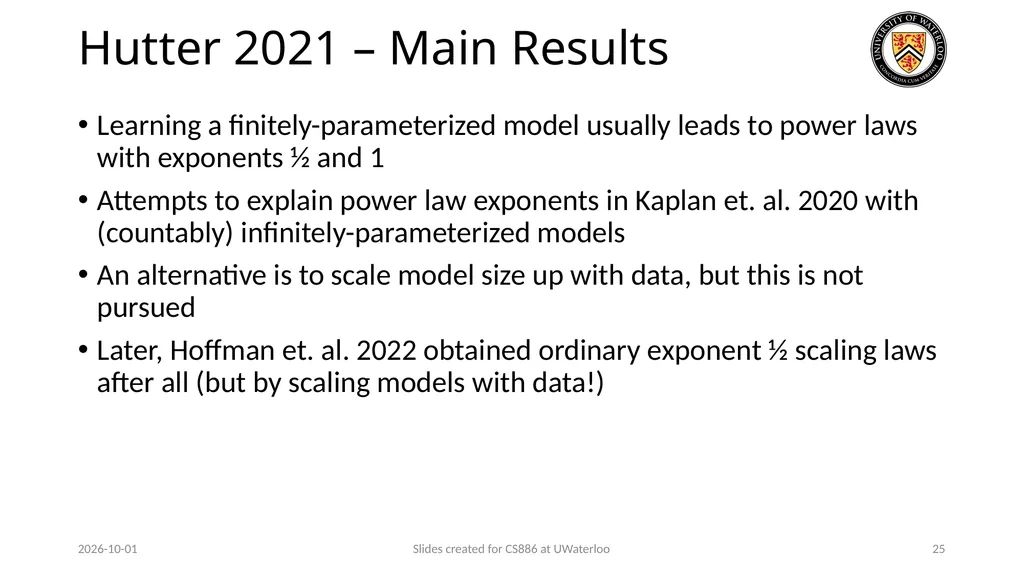
Hutter 2021 – Main Results Learning a finitely-parameterized model usually leads to power laws with exponents ½ and 1
Attempts to explain power law exponents in Kaplan et. al. 2020 with (countably) infinitely-parameterized models
An alternative is to scale model size up with data, but this is not pursued
Later, Hoffman et. al. 2022 obtained ordinary exponent ½ scaling laws after all (but by scaling models with data!) 2024-03-31 Slides created for CS886 at UWaterloo 25<br>
Attempts to explain power law exponents in Kaplan et. al. 2020 with (countably) infinitely-parameterized models
An alternative is to scale model size up with data, but this is not pursued
Later, Hoffman et. al. 2022 obtained ordinary exponent ½ scaling laws after all (but by scaling models with data!) 2024-03-31 Slides created for CS886 at UWaterloo 25<br>
26
Training Compute Optimal Large Language Models, Hoffmann et. al. 2022 Main RQ: What is the optimal tradeoff between model size and number of tokens given a fixed compute budget? 2024-03-31 Slides created for CS886 at UWaterloo 26<br>
27
Hoffman et. al. 2022 – Main Results Large languages models are significantly undertrained (perhaps because of scaling strategies from Kaplan et. al., 2022)
Model size and number of training tokens should be scaled equally
Introduces the Chinchilla model and finds that it outperforms the much larger Gopher by training on more tokens. 2024-03-31 Slides created for CS886 at UWaterloo 27<br>
Model size and number of training tokens should be scaled equally
Introduces the Chinchilla model and finds that it outperforms the much larger Gopher by training on more tokens. 2024-03-31 Slides created for CS886 at UWaterloo 27<br>
28
Hoffman et. al. 2022 2024-03-31 Slides created for CS886 at UWaterloo 28 A better learning rate schedule leads to experimental results drastically different from Kaplan et. al., 2020
". . . we find that setting the learning rate schedule to approximately match the number of training tokens results in the best final loss regardless of model size." (Hoffman et. al. 2022)<br>
". . . we find that setting the learning rate schedule to approximately match the number of training tokens results in the best final loss regardless of model size." (Hoffman et. al. 2022)<br>
29
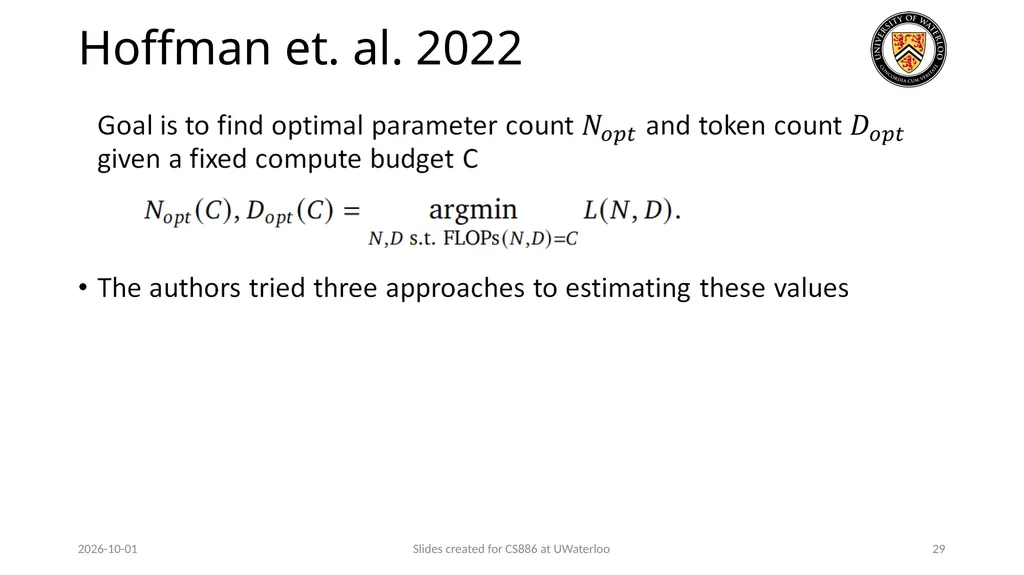
Hoffman et. al. 2022 2024-03-31 Slides created for CS886 at UWaterloo 29<br>
30
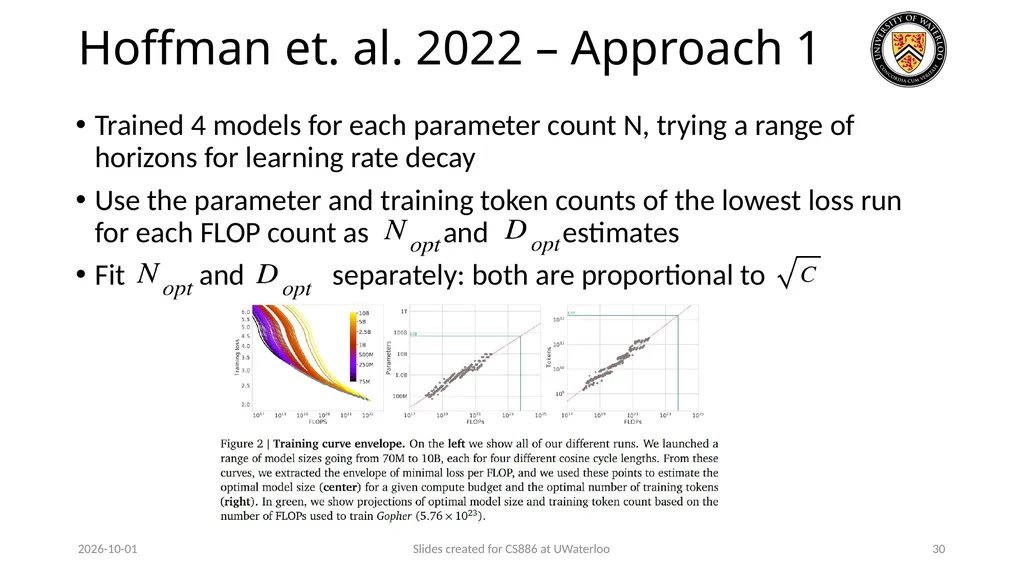
Hoffman et. al. 2022 – Approach 1 Trained 4 models for each parameter count N, trying a range of horizons for learning rate decay
Use the parameter and training token counts of the lowest loss run for each FLOP count as and estimates
Fit and separately: both are proportional to 2024-03-31 Slides created for CS886 at UWaterloo 30<br>
Use the parameter and training token counts of the lowest loss run for each FLOP count as and estimates
Fit and separately: both are proportional to 2024-03-31 Slides created for CS886 at UWaterloo 30<br>
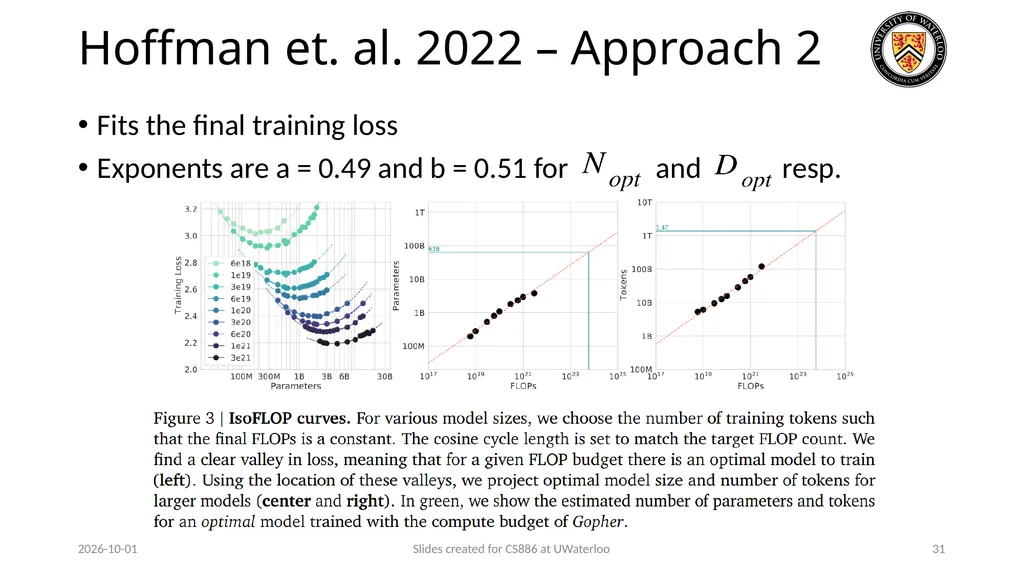
31
Hoffman et. al. 2022 – Approach 2 Fits the final training loss
Exponents are a = 0.49 and b = 0.51 for and resp. 2024-03-31 Slides created for CS886 at UWaterloo 31<br>
Exponents are a = 0.49 and b = 0.51 for and resp. 2024-03-31 Slides created for CS886 at UWaterloo 31<br>
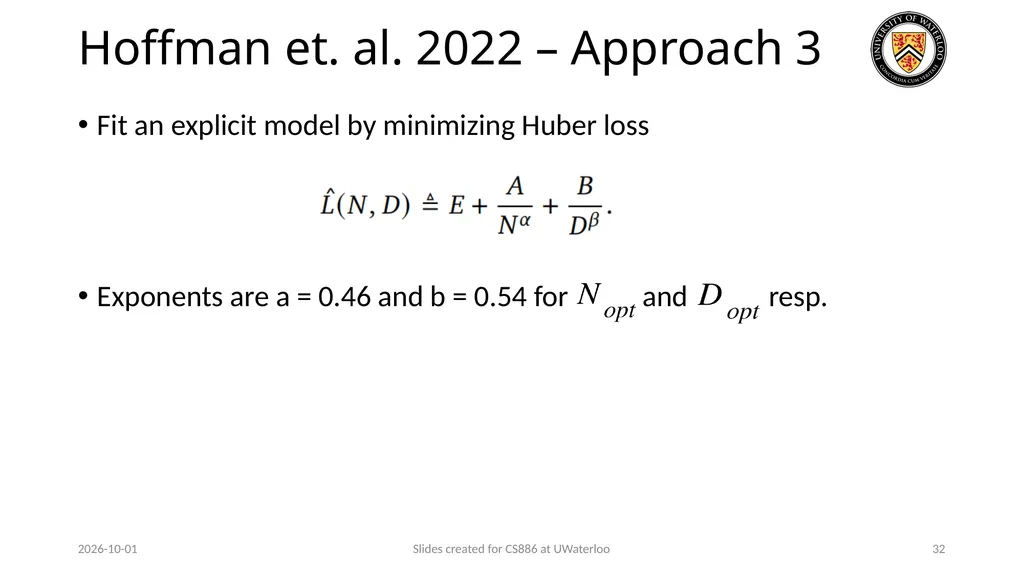
32
Hoffman et. al. 2022 – Approach 3 Fit an explicit model by minimizing Huber loss
Exponents are a = 0.46 and b = 0.54 for and resp. 2024-03-31 Slides created for CS886 at UWaterloo 32<br>
Exponents are a = 0.46 and b = 0.54 for and resp. 2024-03-31 Slides created for CS886 at UWaterloo 32<br>
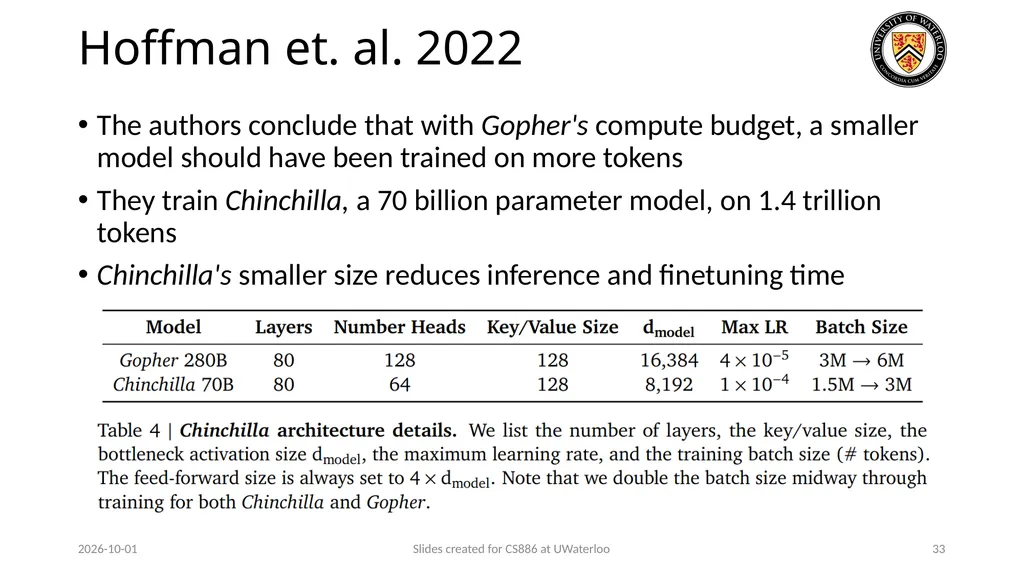
33
Hoffman et. al. 2022 The authors conclude that with Gopher's compute budget, a smaller model should have been trained on more tokens
They train Chinchilla, a 70 billion parameter model, on 1.4 trillion tokens
Chinchilla's smaller size reduces inference and finetuning time 2024-03-31 Slides created for CS886 at UWaterloo 33<br>
They train Chinchilla, a 70 billion parameter model, on 1.4 trillion tokens
Chinchilla's smaller size reduces inference and finetuning time 2024-03-31 Slides created for CS886 at UWaterloo 33<br>
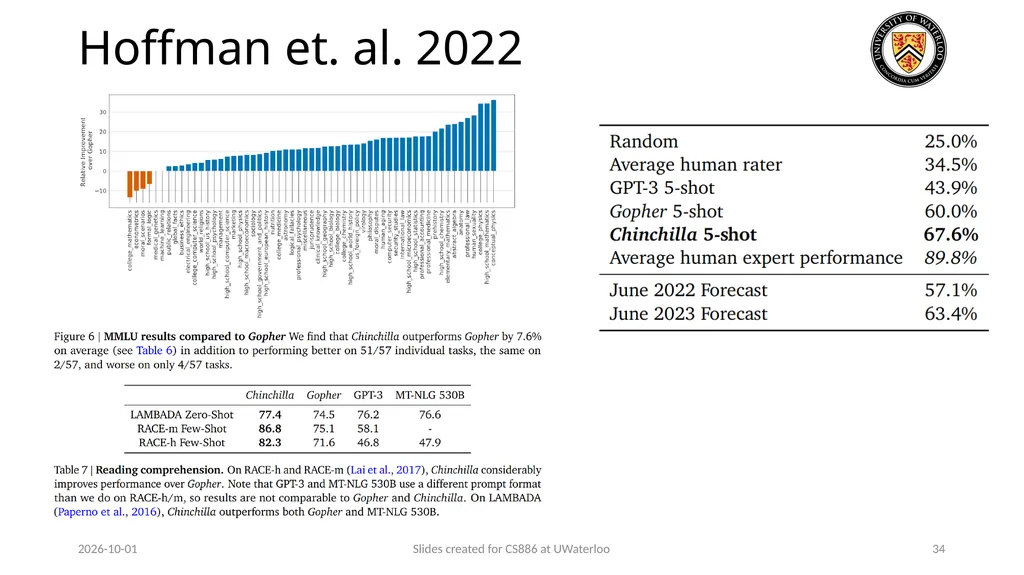
34
Hoffman et. al. 2022 2024-03-31 Slides created for CS886 at UWaterloo 34<br>
35
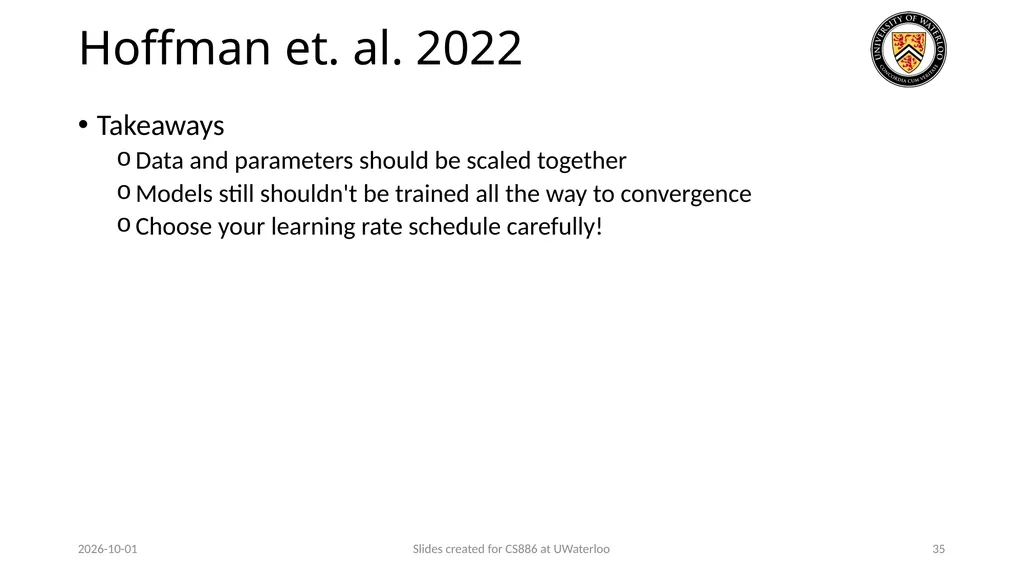
Hoffman et. al. 2022 Takeaways
Data and parameters should be scaled together
Models still shouldn't be trained all the way to convergence
Choose your learning rate schedule carefully! 2024-03-31 Slides created for CS886 at UWaterloo 35<br>
Data and parameters should be scaled together
Models still shouldn't be trained all the way to convergence
Choose your learning rate schedule carefully! 2024-03-31 Slides created for CS886 at UWaterloo 35<br>
36
Emergent Abilities 2024-03-31 Slides created for CS886 at UWaterloo 36<br>
37
Emergent Abilities of Large Language Models,
Wei et al, 2022 Main RQ: A survey and discussion of emergent abilities and their causes 2024-03-31 Slides created for CS886 at UWaterloo 37<br>
38
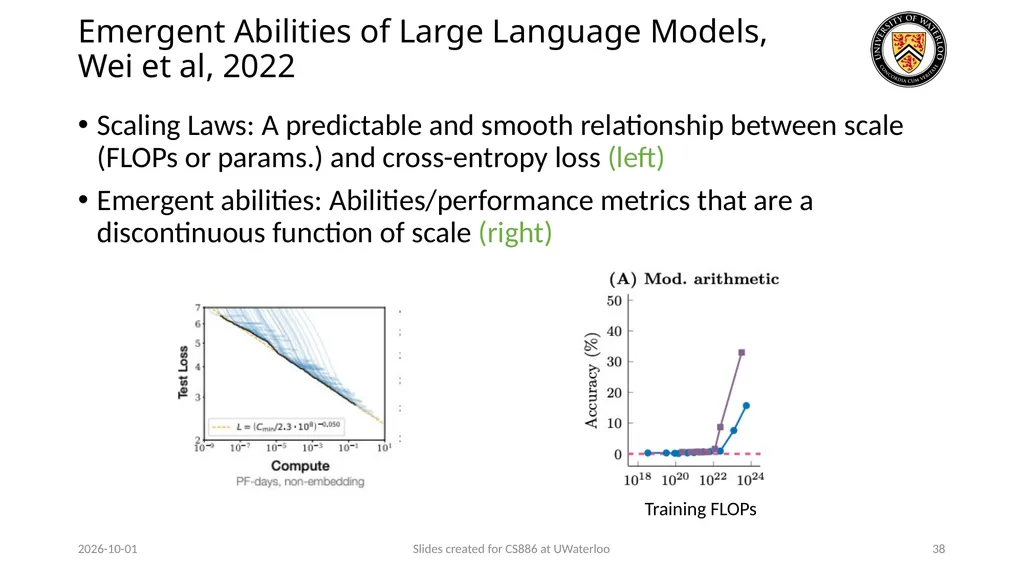
Emergent Abilities of Large Language Models,
Wei et al, 2022 Scaling Laws: A predictable and smooth relationship between scale (FLOPs or params.) and cross-entropy loss (left)
Emergent abilities: Abilities/performance metrics that are a discontinuous function of scale (right) 2024-03-31 Slides created for CS886 at UWaterloo 38 Training FLOPs<br>
Emergent abilities: Abilities/performance metrics that are a discontinuous function of scale (right) 2024-03-31 Slides created for CS886 at UWaterloo 38 Training FLOPs<br>
39
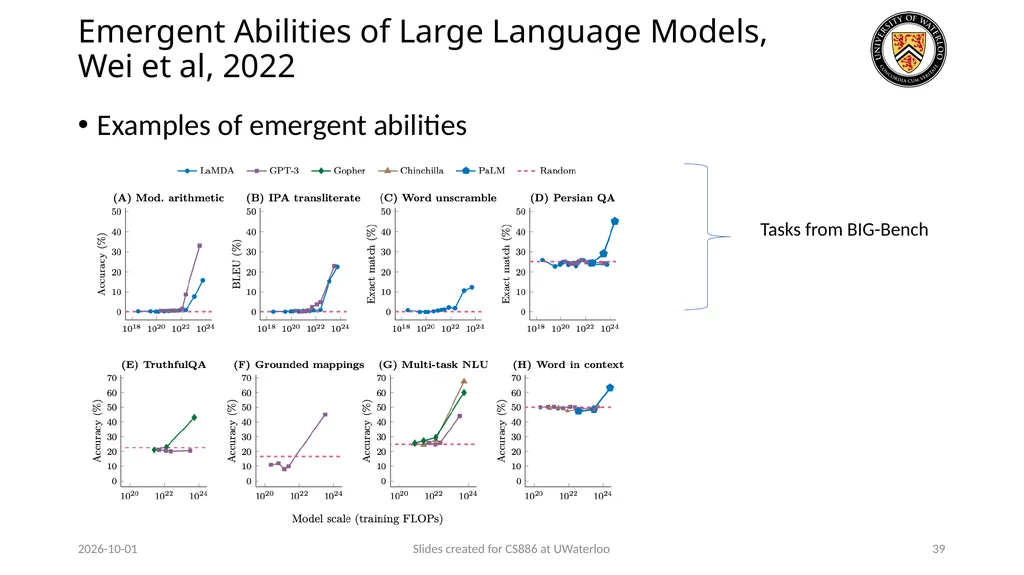
Emergent Abilities of Large Language Models,
Wei et al, 2022 Examples of emergent abilities 2024-03-31 Slides created for CS886 at UWaterloo 39 Tasks from BIG-Bench<br>
40
Emergent Abilities of Large Language Models,
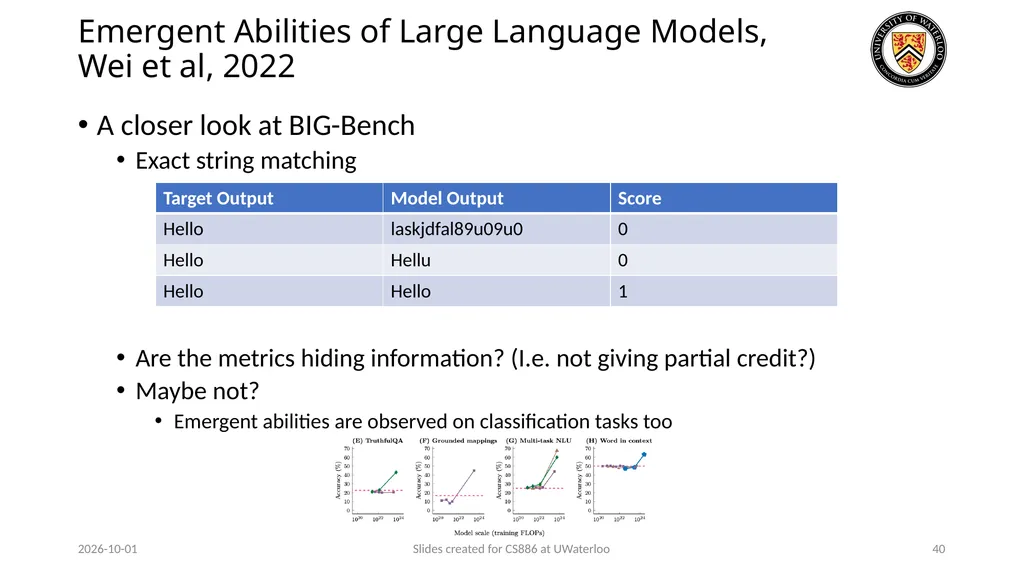
Wei et al, 2022 A closer look at BIG-Bench
Exact string matching
Are the metrics hiding information? (I.e. not giving partial credit?)
Maybe not?
Emergent abilities are observed on classification tasks too 2024-03-31 Slides created for CS886 at UWaterloo 40<br>
Exact string matching
Are the metrics hiding information? (I.e. not giving partial credit?)
Maybe not?
Emergent abilities are observed on classification tasks too 2024-03-31 Slides created for CS886 at UWaterloo 40<br>
41
Emergent Abilities of Large Language Models,
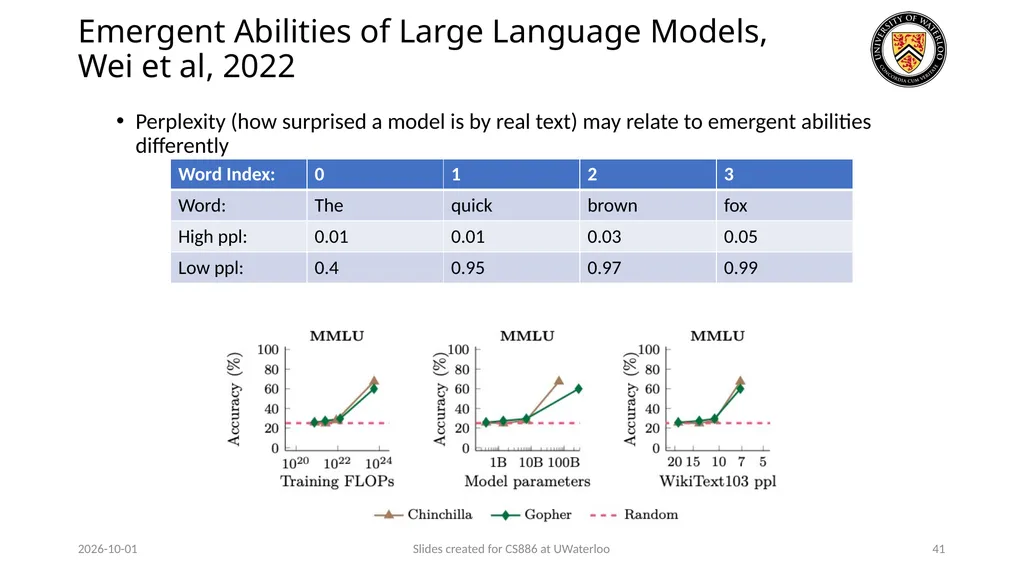
Wei et al, 2022 Perplexity (how surprised a model is by real text) may relate to emergent abilities differently 2024-03-31 Slides created for CS886 at UWaterloo 41<br>
42
Emergent Abilities of Large Language Models,
Wei et al, 2022 Takeaways:
Overall, emergent abilities should probably be viewed as a function of many correlated variables.
This analysis does not explain why downstream metrics are emergent or enable us to predict the scale at which emergence occurs.
Even though we can predict the loss with model scale, we can’t use the loss to predict what abilities a model will have 2024-03-31 Slides created for CS886 at UWaterloo 42<br>
Overall, emergent abilities should probably be viewed as a function of many correlated variables.
This analysis does not explain why downstream metrics are emergent or enable us to predict the scale at which emergence occurs.
Even though we can predict the loss with model scale, we can’t use the loss to predict what abilities a model will have 2024-03-31 Slides created for CS886 at UWaterloo 42<br>
43
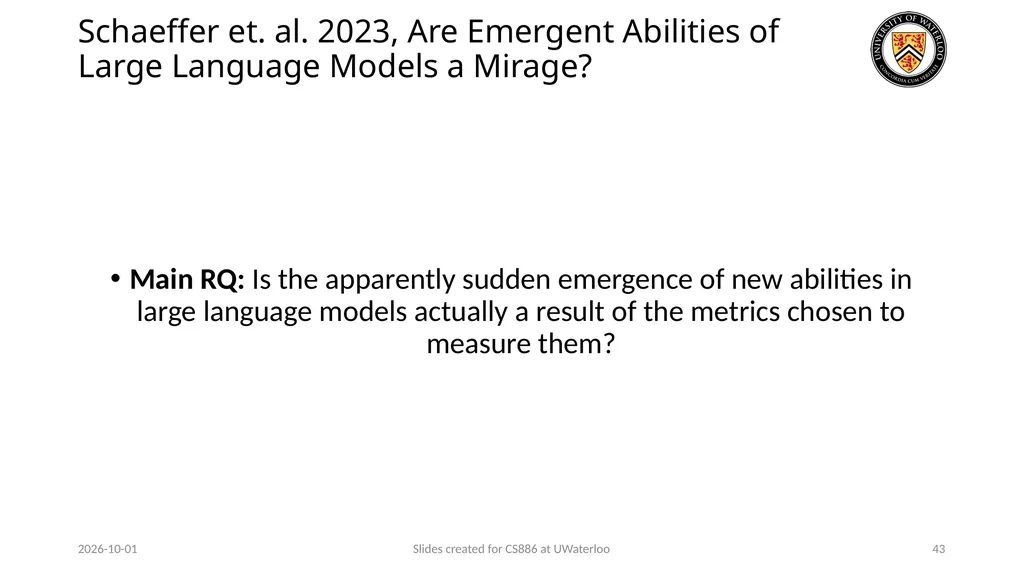
Schaeffer et. al. 2023, Are Emergent Abilities of Large Language Models a Mirage? Main RQ: Is the apparently sudden emergence of new abilities in large language models actually a result of the metrics chosen to measure them? 2024-03-31 Slides created for CS886 at UWaterloo 43<br>
44
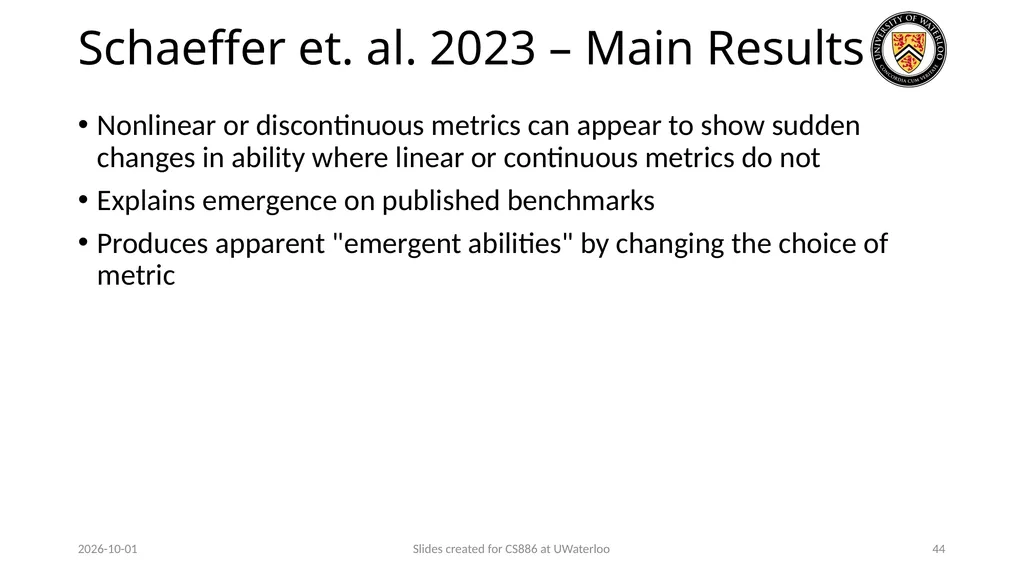
Schaeffer et. al. 2023 – Main Results Nonlinear or discontinuous metrics can appear to show sudden changes in ability where linear or continuous metrics do not
Explains emergence on published benchmarks
Produces apparent "emergent abilities" by changing the choice of metric 2024-03-31 Slides created for CS886 at UWaterloo 44<br>
Explains emergence on published benchmarks
Produces apparent "emergent abilities" by changing the choice of metric 2024-03-31 Slides created for CS886 at UWaterloo 44<br>
45
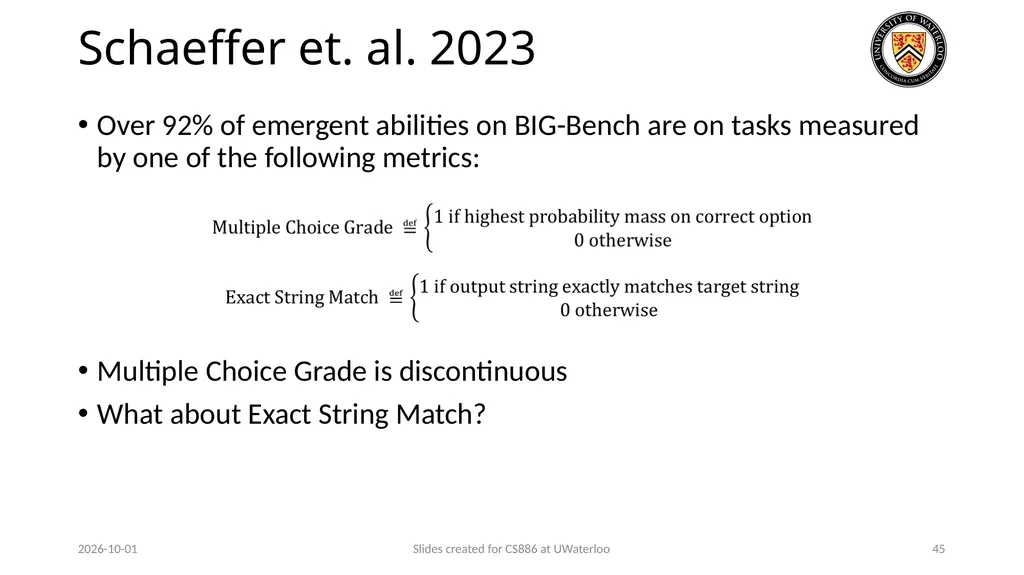
Schaeffer et. al. 2023 Over 92% of emergent abilities on BIG-Bench are on tasks measured by one of the following metrics:
Multiple Choice Grade is discontinuous
What about Exact String Match? 2024-03-31 Slides created for CS886 at UWaterloo 45<br>
Multiple Choice Grade is discontinuous
What about Exact String Match? 2024-03-31 Slides created for CS886 at UWaterloo 45<br>
46
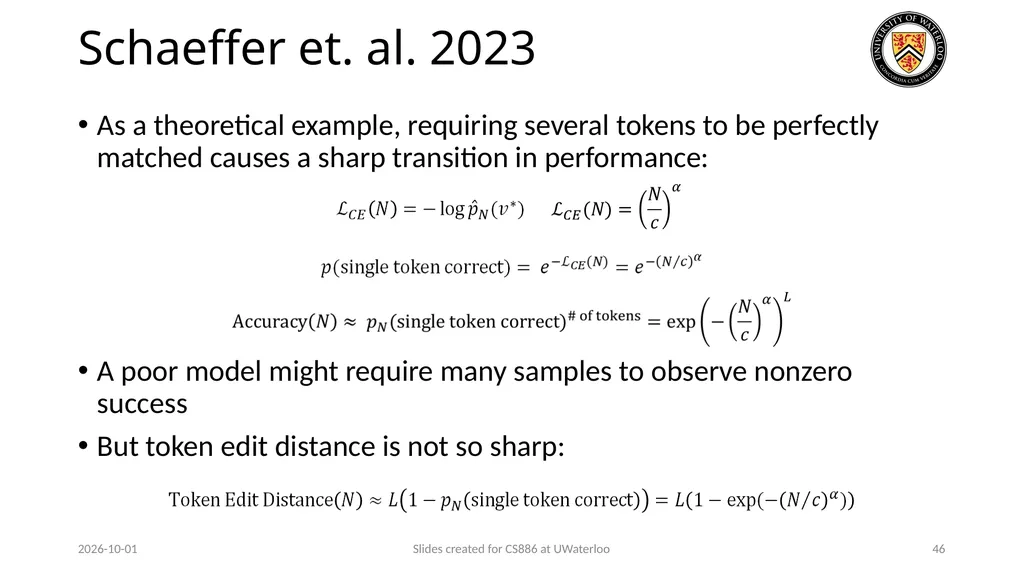
Schaeffer et. al. 2023 As a theoretical example, requiring several tokens to be perfectly matched causes a sharp transition in performance:
A poor model might require many samples to observe nonzero success
But token edit distance is not so sharp: 2024-03-31 Slides created for CS886 at UWaterloo 46<br>
A poor model might require many samples to observe nonzero success
But token edit distance is not so sharp: 2024-03-31 Slides created for CS886 at UWaterloo 46<br>
47
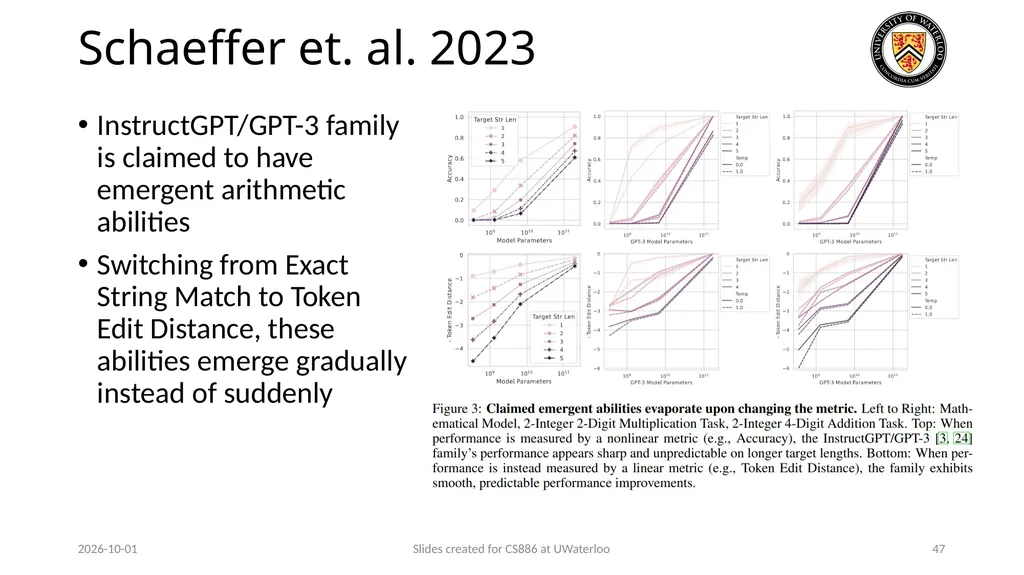
Schaeffer et. al. 2023 InstructGPT/GPT-3 family is claimed to have emergent arithmetic abilities
Switching from Exact String Match to Token Edit Distance, these abilities emerge gradually instead of suddenly 2024-03-31 Slides created for CS886 at UWaterloo 47<br>
Switching from Exact String Match to Token Edit Distance, these abilities emerge gradually instead of suddenly 2024-03-31 Slides created for CS886 at UWaterloo 47<br>
48
Schaeffer et. al. 2023 Many cases of "emergent abilities" can be attributed to the choice of metric and the resolution of measurements
Deliberately choosing a poor metric can induce apparently emergent abilities
Some candidate emergent abilities remain (under BLEU and normalized aggregate score metrics) 2024-03-31 Slides created for CS886 at UWaterloo 48<br>
Deliberately choosing a poor metric can induce apparently emergent abilities
Some candidate emergent abilities remain (under BLEU and normalized aggregate score metrics) 2024-03-31 Slides created for CS886 at UWaterloo 48<br>
49
Complicating Scaling Laws 2024-03-31 Slides created for CS886 at UWaterloo 49<br>
50
Inverse scaling can become U-shaped,
Wei et al., 2022 Main RQ: Over what scales does inverse scaling on certain tasks hold? 2024-03-31 Slides created for CS886 at UWaterloo 50<br>
51
Inverse scaling can become U-shaped,
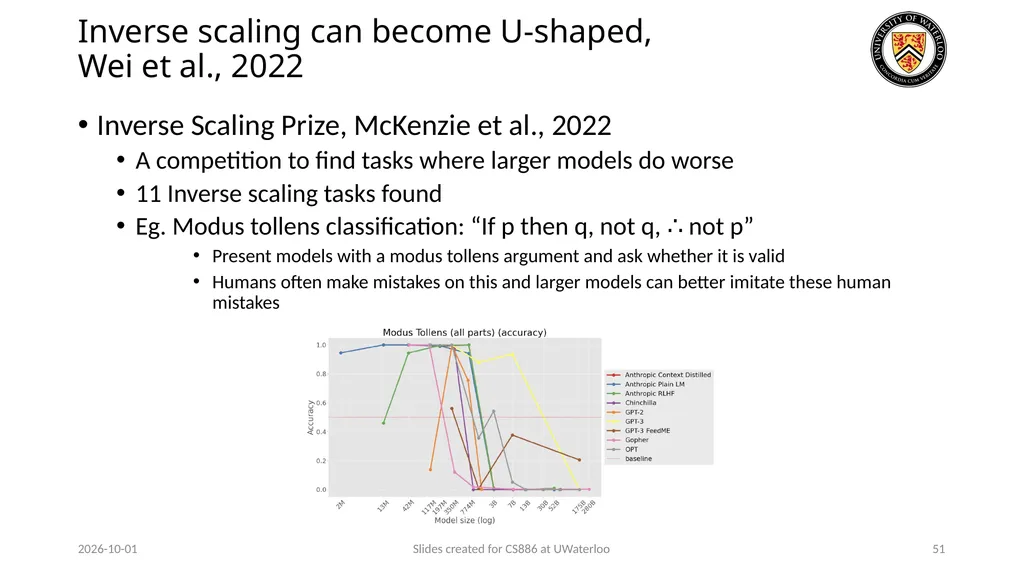
Wei et al., 2022 Inverse Scaling Prize, McKenzie et al., 2022
A competition to find tasks where larger models do worse
11 Inverse scaling tasks found
Eg. Modus tollens classification: “If p then q, not q, ∴ not p”
Present models with a modus tollens argument and ask whether it is valid
Humans often make mistakes on this and larger models can better imitate these human mistakes 2024-03-31 Slides created for CS886 at UWaterloo 51<br>
A competition to find tasks where larger models do worse
11 Inverse scaling tasks found
Eg. Modus tollens classification: “If p then q, not q, ∴ not p”
Present models with a modus tollens argument and ask whether it is valid
Humans often make mistakes on this and larger models can better imitate these human mistakes 2024-03-31 Slides created for CS886 at UWaterloo 51<br>
52
Inverse scaling can become U-shaped,
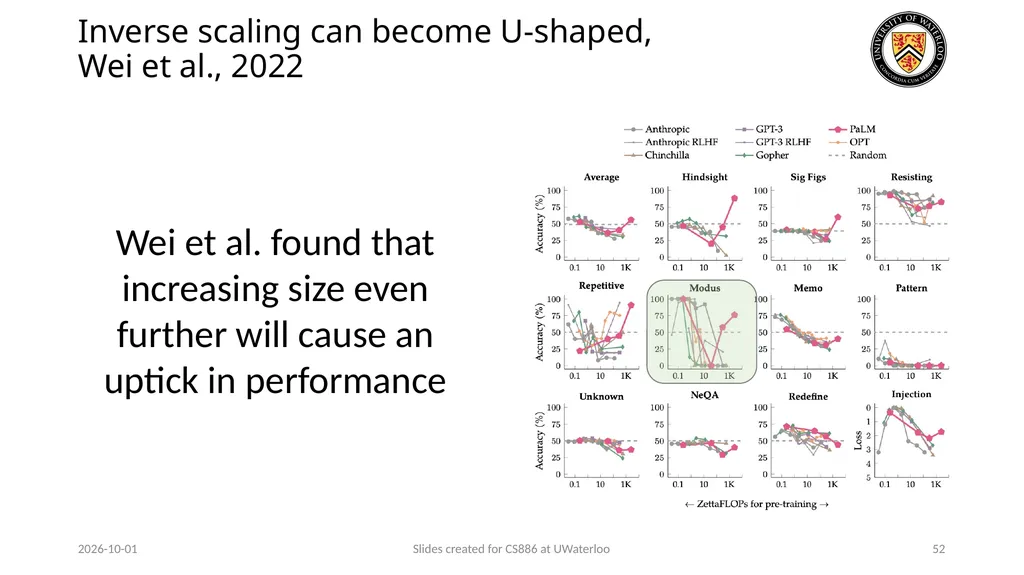
Wei et al., 2022 2024-03-31 Slides created for CS886 at UWaterloo 52 Wei et al. found that increasing size even further will cause an uptick in performance<br>
53
Inverse scaling can become U-shaped,
Wei et al., 2022 How to explain U-shaped scaling?
“We do not experimentally investigate how or why U-shaped scaling occurs, but we hypothesize that it can happen when a task contains a “distractor task”. Medium-sized models can perform the distractor task better than smaller models, which hurts performance in comparison to the smaller models. As the models scale further, the larger models can ignore the distractor task and perform the true task, which can be seen as an emergent ability that derives from scaling”
E.g.. For modus tollens
Distractor task: Produce most likely answer (and replicate common human errors)
True task: Perform valid logical reasoning 2024-03-31 Slides created for CS886 at UWaterloo 53<br>
“We do not experimentally investigate how or why U-shaped scaling occurs, but we hypothesize that it can happen when a task contains a “distractor task”. Medium-sized models can perform the distractor task better than smaller models, which hurts performance in comparison to the smaller models. As the models scale further, the larger models can ignore the distractor task and perform the true task, which can be seen as an emergent ability that derives from scaling”
E.g.. For modus tollens
Distractor task: Produce most likely answer (and replicate common human errors)
True task: Perform valid logical reasoning 2024-03-31 Slides created for CS886 at UWaterloo 53<br>
54
Inverse scaling can become U-shaped,
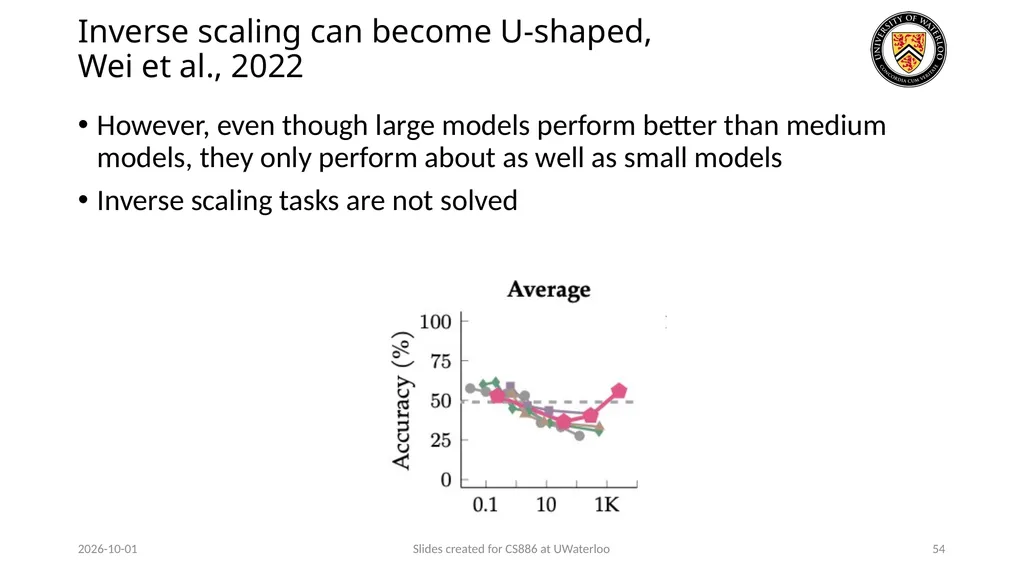
Wei et al., 2022 However, even though large models perform better than medium models, they only perform about as well as small models
Inverse scaling tasks are not solved 2024-03-31 Slides created for CS886 at UWaterloo 54<br>
Inverse scaling tasks are not solved 2024-03-31 Slides created for CS886 at UWaterloo 54<br>
55
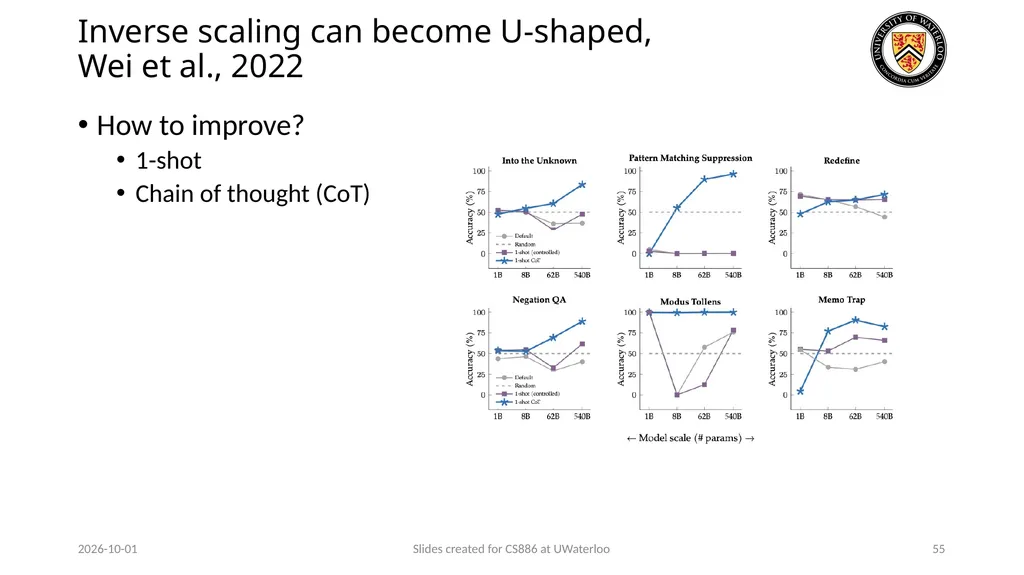
Inverse scaling can become U-shaped,
Wei et al., 2022 How to improve?
1-shot
Chain of thought (CoT) 2024-03-31 Slides created for CS886 at UWaterloo 55<br>
1-shot
Chain of thought (CoT) 2024-03-31 Slides created for CS886 at UWaterloo 55<br>
56
Inverse scaling can become U-shaped,
Wei et al., 2022 Takeaways
Increasing scale seems to turn inverse scaling into U-shaped scaling
Inverse scaling may not be a big issue
However, there is still room for improvement
Techniques like 1-shot prompting and CoT can help 2024-03-31 Slides created for CS886 at UWaterloo 56<br>
Increasing scale seems to turn inverse scaling into U-shaped scaling
Inverse scaling may not be a big issue
However, there is still room for improvement
Techniques like 1-shot prompting and CoT can help 2024-03-31 Slides created for CS886 at UWaterloo 56<br>
57
Transcending Scaling Laws with 0.1% Extra Compute, Tay et al., 2022 Main RQ: Can new training techniques improve scaling? 2024-03-31 Slides created for CS886 at UWaterloo 57<br>
58
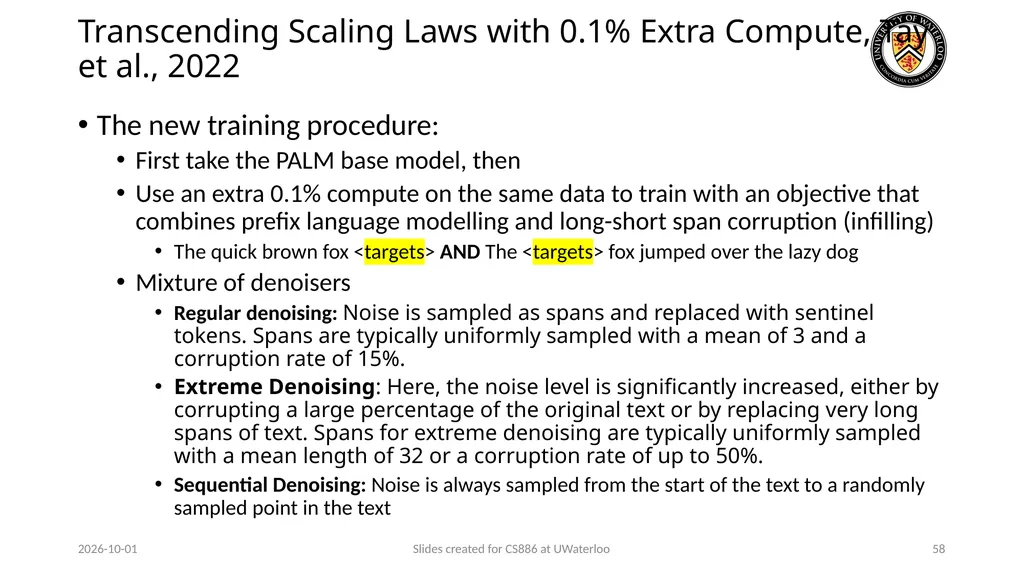
Transcending Scaling Laws with 0.1% Extra Compute, Tay et al., 2022 The new training procedure:
First take the PALM base model, then
Use an extra 0.1% compute on the same data to train with an objective that combines prefix language modelling and long-short span corruption (infilling)
The quick brown fox <targets> AND The <targets> fox jumped over the lazy dog
Mixture of denoisers
Regular denoising: Noise is sampled as spans and replaced with sentinel tokens. Spans are typically uniformly sampled with a mean of 3 and a corruption rate of 15%.
Extreme Denoising: Here, the noise level is significantly increased, either by corrupting a large percentage of the original text or by replacing very long spans of text. Spans for extreme denoising are typically uniformly sampled with a mean length of 32 or a corruption rate of up to 50%.
Sequential Denoising: Noise is always sampled from the start of the text to a randomly sampled point in the text 2024-03-31 Slides created for CS886 at UWaterloo 58<br>
First take the PALM base model, then
Use an extra 0.1% compute on the same data to train with an objective that combines prefix language modelling and long-short span corruption (infilling)
The quick brown fox <targets> AND The <targets> fox jumped over the lazy dog
Mixture of denoisers
Regular denoising: Noise is sampled as spans and replaced with sentinel tokens. Spans are typically uniformly sampled with a mean of 3 and a corruption rate of 15%.
Extreme Denoising: Here, the noise level is significantly increased, either by corrupting a large percentage of the original text or by replacing very long spans of text. Spans for extreme denoising are typically uniformly sampled with a mean length of 32 or a corruption rate of up to 50%.
Sequential Denoising: Noise is always sampled from the start of the text to a randomly sampled point in the text 2024-03-31 Slides created for CS886 at UWaterloo 58<br>
59
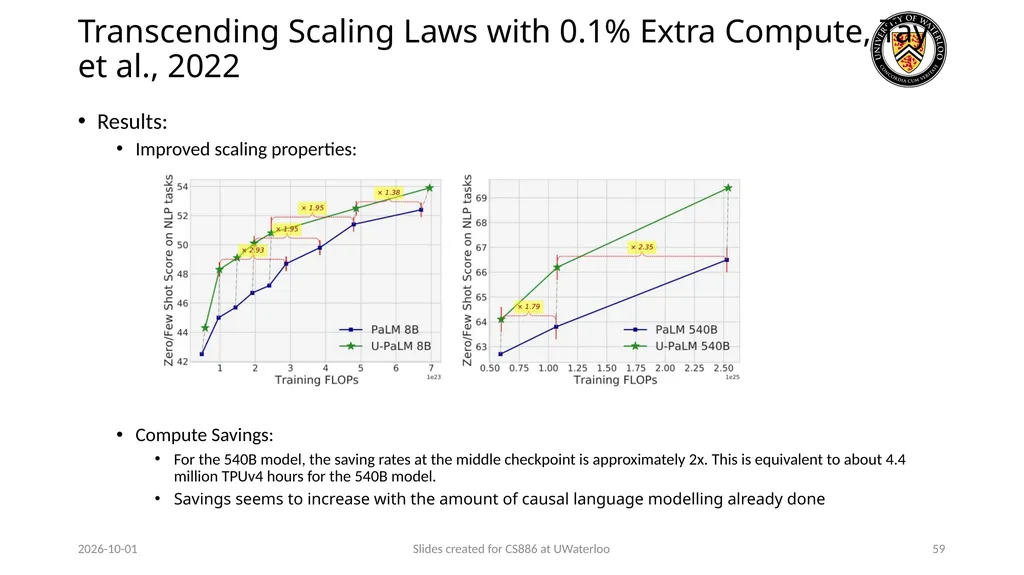
Transcending Scaling Laws with 0.1% Extra Compute, Tay et al., 2022 Results:
Improved scaling properties:
Compute Savings:
For the 540B model, the saving rates at the middle checkpoint is approximately 2x. This is equivalent to about 4.4 million TPUv4 hours for the 540B model.
Savings seems to increase with the amount of causal language modelling already done 2024-03-31 Slides created for CS886 at UWaterloo 59<br>
Improved scaling properties:
Compute Savings:
For the 540B model, the saving rates at the middle checkpoint is approximately 2x. This is equivalent to about 4.4 million TPUv4 hours for the 540B model.
Savings seems to increase with the amount of causal language modelling already done 2024-03-31 Slides created for CS886 at UWaterloo 59<br>
60
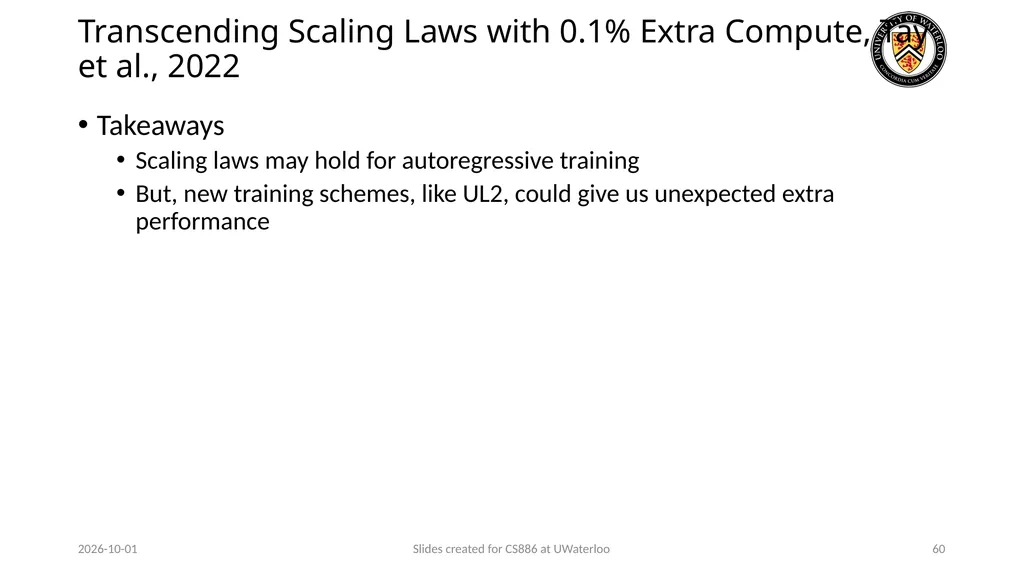
Transcending Scaling Laws with 0.1% Extra Compute, Tay et al., 2022 Takeaways
Scaling laws may hold for autoregressive training
But, new training schemes, like UL2, could give us unexpected extra performance 2024-03-31 Slides created for CS886 at UWaterloo 60<br>
Scaling laws may hold for autoregressive training
But, new training schemes, like UL2, could give us unexpected extra performance 2024-03-31 Slides created for CS886 at UWaterloo 60<br>
61
Final Questions? 2024-03-31 Slides created for CS886 at UWaterloo 61<br>