
LESSON-1 BASIC TERMINOLOGY AND CLASSIFICATION OF
DJ
Published · 37 slides · 0 views
1 / 1



Description
LESSON-1 BASIC TERMINOLOGY AND CLASSIFICATION OF CARBOHYDRATES Objectives: Know the basic terminology related to carbohydrates of different nature. Know the classifications of carbohydrates available in nature. Basic terminology related to
Related Topics
Share
Embed code
Download this presentation From Below
"LESSON-1 BASIC TERMINOLOGY AND CLASSIFICATION OF" is the property of its rightful owner. Permission is granted to download and print the materials on this website for personal, non-commercial use only, and to display it on your personal computer provided you do not modify the materials and that you retain all copyright notices contained in the materials. By downloading content from our website, you accept the terms of this agreement.
Presentation Transcript
01
LESSON-1
BASIC TERMINOLOGY AND CLASSIFICATION OF CARBOHYDRATES<br>
BASIC TERMINOLOGY AND CLASSIFICATION OF CARBOHYDRATES<br>
02
Objectives:
Know the basic terminology related to carbohydrates of different nature.
Know the classifications of carbohydrates available in nature.<br>
Know the basic terminology related to carbohydrates of different nature.
Know the classifications of carbohydrates available in nature.<br>
03
Basic terminology related to carbohydrates
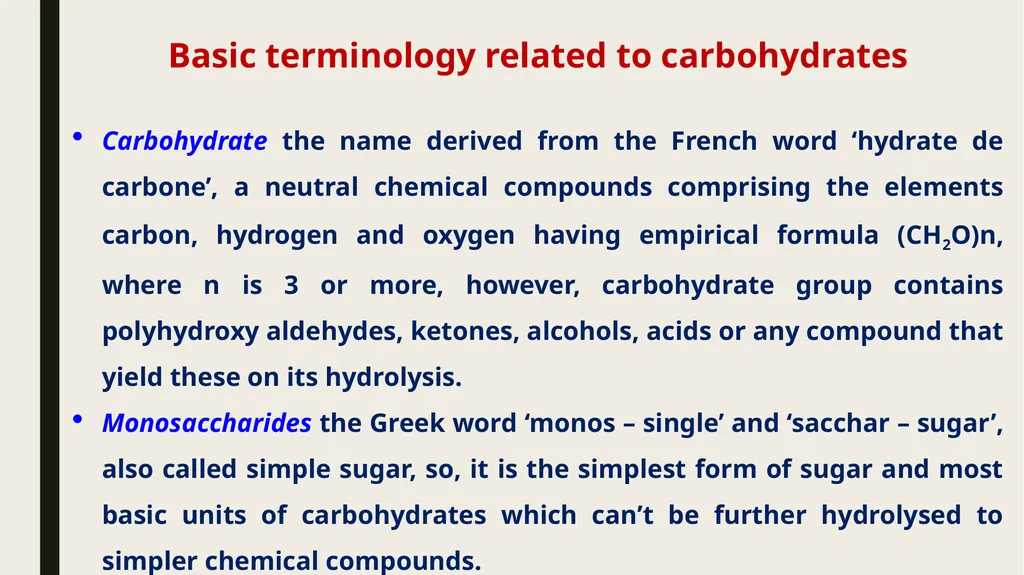
Carbohydrate the name derived from the French word ‘hydrate de carbone’, a neutral chemical compounds comprising the elements carbon, hydrogen and oxygen having empirical formula (CH2O)n, where n is 3 or more, however, carbohydrate group contains polyhydroxy aldehydes, ketones, alcohols, acids or any compound that yield these on its hydrolysis.
Monosaccharides the Greek word ‘monos – single’ and ‘sacchar – sugar’, also called simple sugar, so, it is the simplest form of sugar and most basic units of carbohydrates which can’t be further hydrolysed to simpler chemical compounds.<br>
04
Cont……..
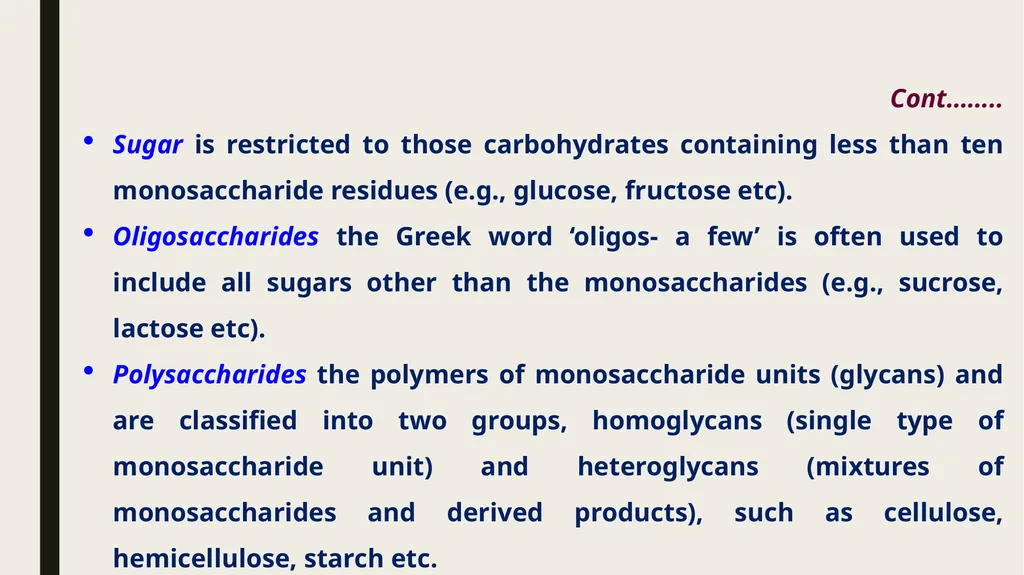
Sugar is restricted to those carbohydrates containing less than ten monosaccharide residues (e.g., glucose, fructose etc).
Oligosaccharides the Greek word ‘oligos- a few’ is often used to include all sugars other than the monosaccharides (e.g., sucrose, lactose etc).
Polysaccharides the polymers of monosaccharide units (glycans) and are classified into two groups, homoglycans (single type of monosaccharide unit) and heteroglycans (mixtures of monosaccharides and derived products), such as cellulose, hemicellulose, starch etc.<br>
05
Cont….
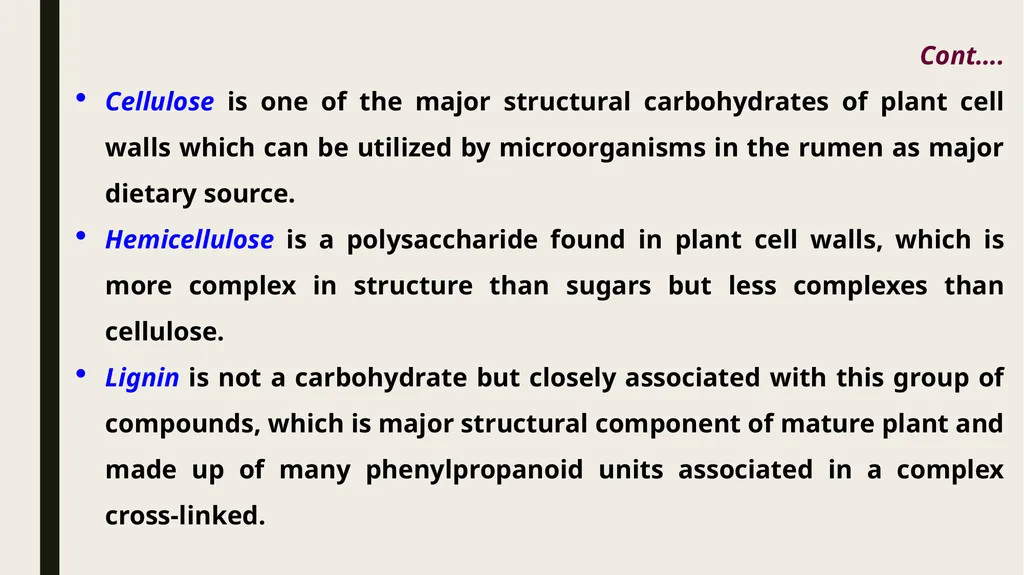
Cellulose is one of the major structural carbohydrates of plant cell walls which can be utilized by microorganisms in the rumen as major dietary source.
Hemicellulose is a polysaccharide found in plant cell walls, which is more complex in structure than sugars but less complexes than cellulose.
Lignin is not a carbohydrate but closely associated with this group of compounds, which is major structural component of mature plant and made up of many phenylpropanoid units associated in a complex cross-linked.<br>
06
Basic functions of carbohydrates
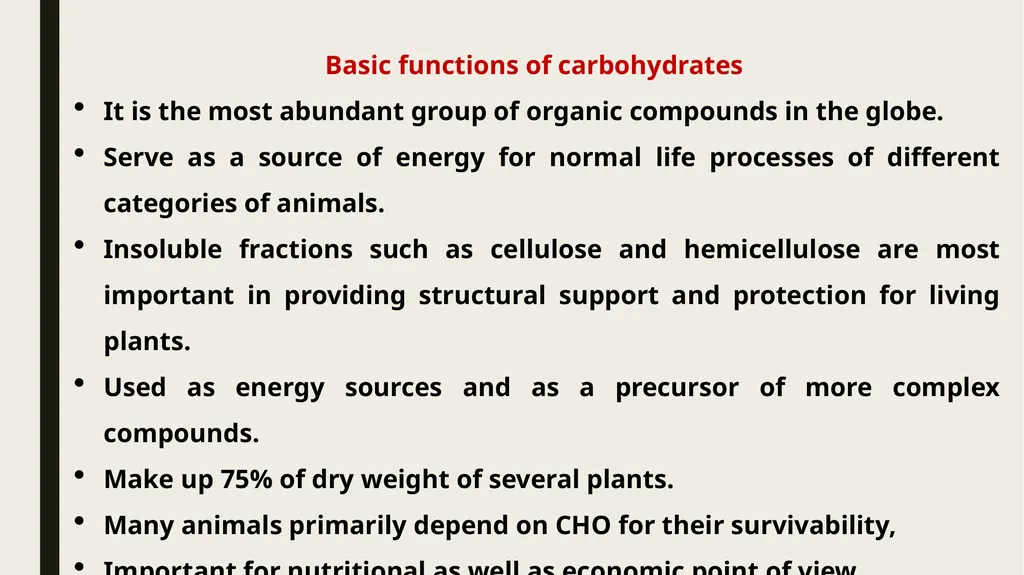
It is the most abundant group of organic compounds in the globe.
Serve as a source of energy for normal life processes of different categories of animals.
Insoluble fractions such as cellulose and hemicellulose are most important in providing structural support and protection for living plants.
Used as energy sources and as a precursor of more complex compounds.
Make up 75% of dry weight of several plants.
Many animals primarily depend on CHO for their survivability,
Important for nutritional as well as economic point of view.<br>
07
Classification of carbohydrate
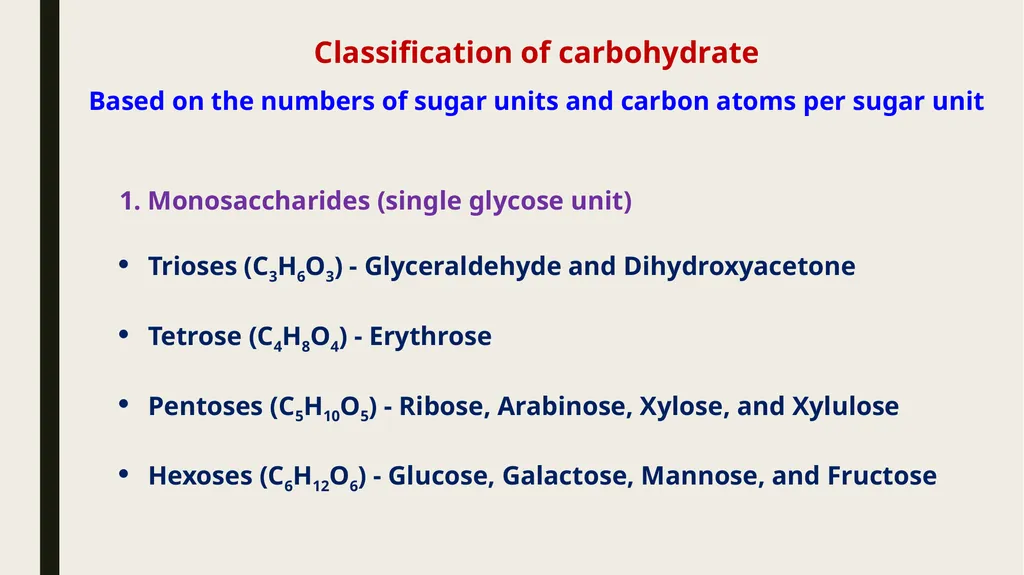
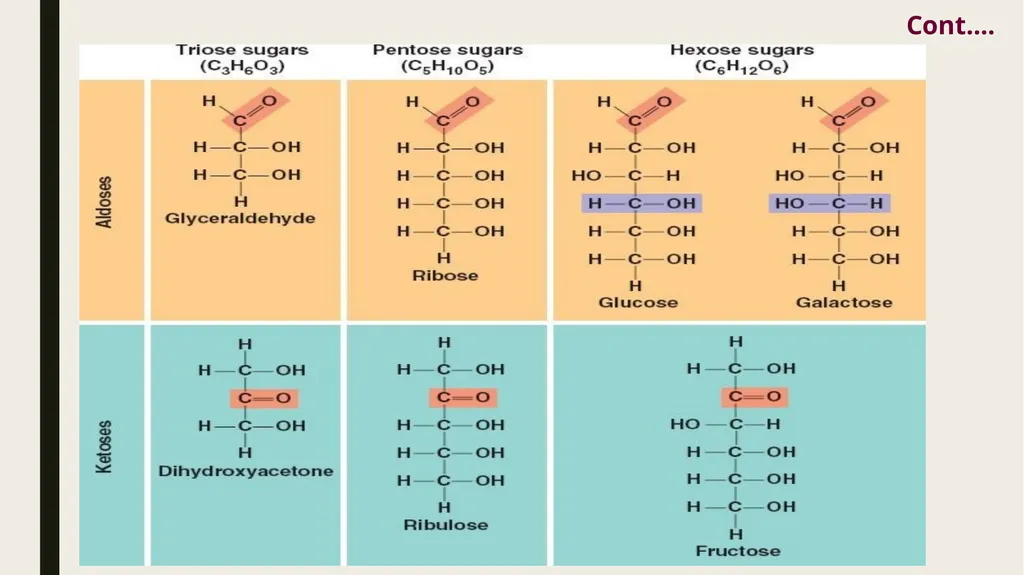
Based on the numbers of sugar units and carbon atoms per sugar unit 1. Monosaccharides (single glycose unit)
Trioses (C3H6O3) - Glyceraldehyde and Dihydroxyacetone
Tetrose (C4H8O4) - Erythrose
Pentoses (C5H10O5) - Ribose, Arabinose, Xylose, and Xylulose
Hexoses (C6H12O6) - Glucose, Galactose, Mannose, and Fructose<br>
08
Cont....<br>
09
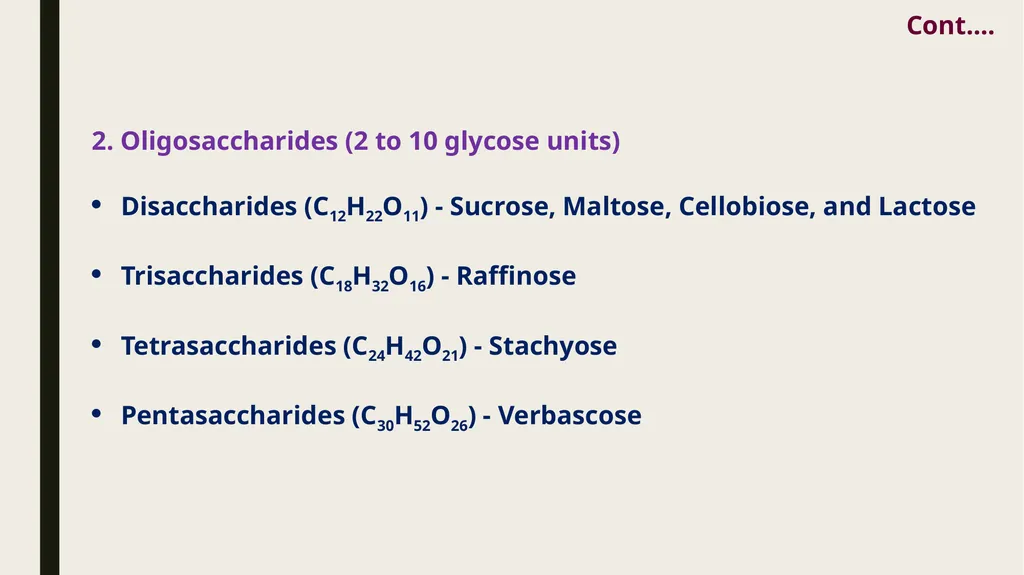
2. Oligosaccharides (2 to 10 glycose units)
Disaccharides (C12H22O11) - Sucrose, Maltose, Cellobiose, and Lactose
Trisaccharides (C18H32O16) - Raffinose
Tetrasaccharides (C24H42O21) - Stachyose
Pentasaccharides (C30H52O26) - Verbascose Cont....<br>
Disaccharides (C12H22O11) - Sucrose, Maltose, Cellobiose, and Lactose
Trisaccharides (C18H32O16) - Raffinose
Tetrasaccharides (C24H42O21) - Stachyose
Pentasaccharides (C30H52O26) - Verbascose Cont....<br>
10
Cont....<br>
11
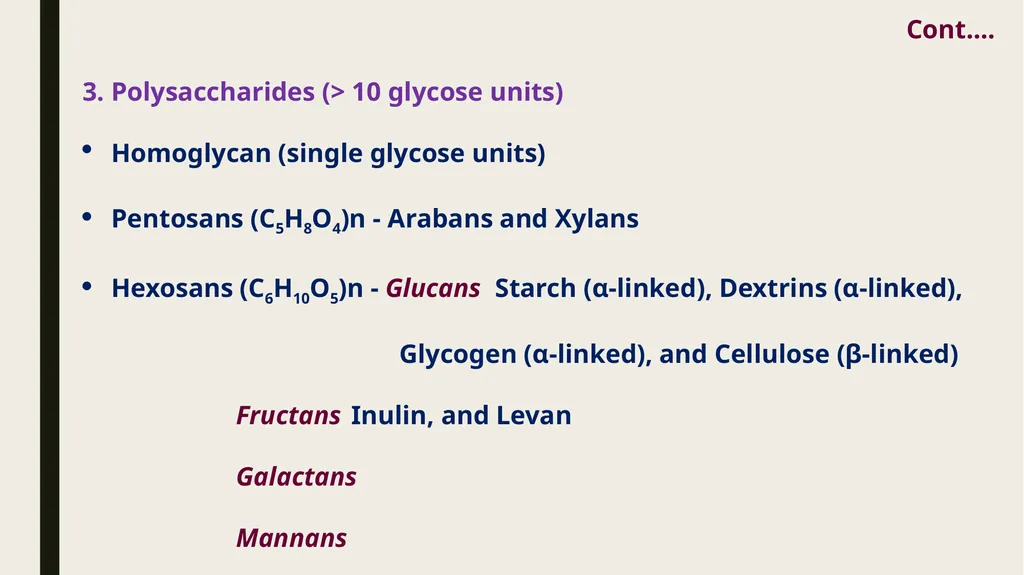
3. Polysaccharides (> 10 glycose units)
Homoglycan (single glycose units)
Pentosans (C5H8O4)n - Arabans and Xylans
Hexosans (C6H10O5)n - Glucans Starch (α-linked), Dextrins (α-linked),
Glycogen (α-linked), and Cellulose (β-linked)
Fructans Inulin, and Levan
Galactans
Mannans Cont....<br>
Homoglycan (single glycose units)
Pentosans (C5H8O4)n - Arabans and Xylans
Hexosans (C6H10O5)n - Glucans Starch (α-linked), Dextrins (α-linked),
Glycogen (α-linked), and Cellulose (β-linked)
Fructans Inulin, and Levan
Galactans
Mannans Cont....<br>
12
Heteroglycan (2-6 dissimilar kinds of glycose units)
Pectins (α-linked), Hemicellulose (β-linked), Gums & Mucilages and Mucopolysaccharides Cont.... 4. Specialized compounds
Chitin
Lignin (not a true carbohydrate)<br>
Pectins (α-linked), Hemicellulose (β-linked), Gums & Mucilages and Mucopolysaccharides Cont.... 4. Specialized compounds
Chitin
Lignin (not a true carbohydrate)<br>
13
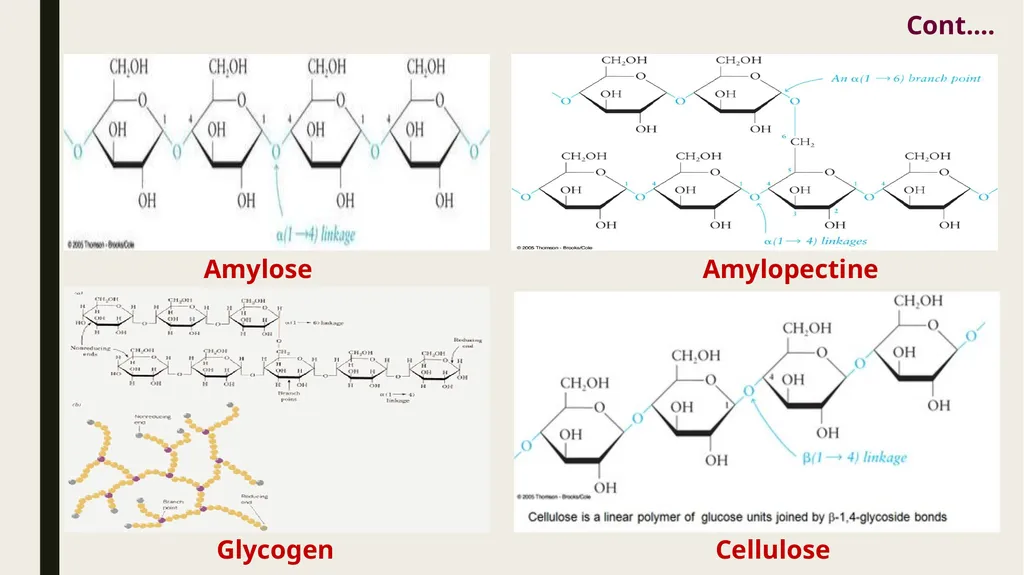
Cont.... Amylose Amylopectine Glycogen Cellulose<br>
14
Cont....<br>
15
Classification based on dietary forms
1. Free (not associated with the cellular structure of food)
Lactose – milk
Fructose – honey
Trehalose – haemolymph<br>
1. Free (not associated with the cellular structure of food)
Lactose – milk
Fructose – honey
Trehalose – haemolymph<br>
16
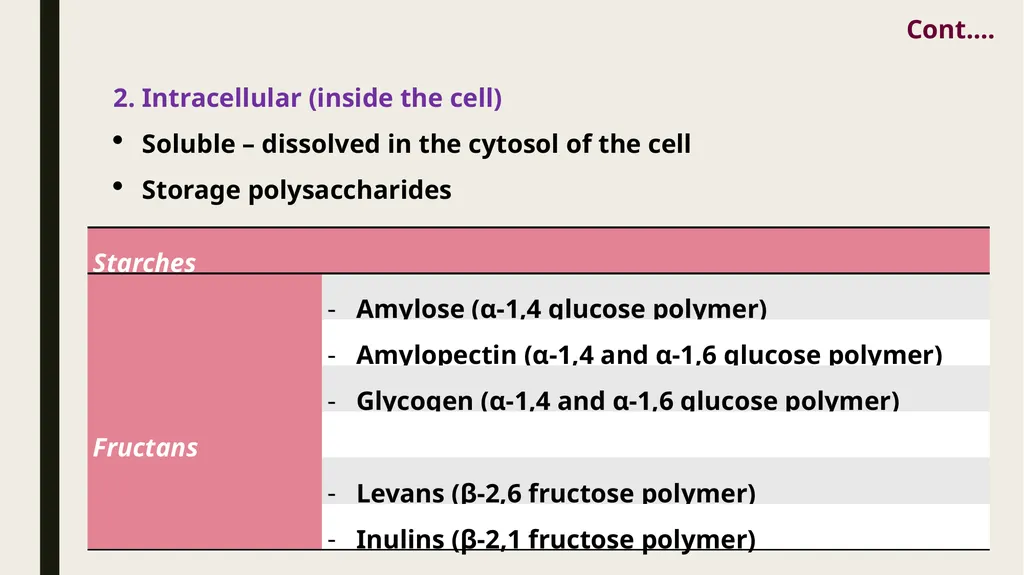
2. Intracellular (inside the cell)
Soluble – dissolved in the cytosol of the cell
Storage polysaccharides Cont....<br>
Soluble – dissolved in the cytosol of the cell
Storage polysaccharides Cont....<br>
17
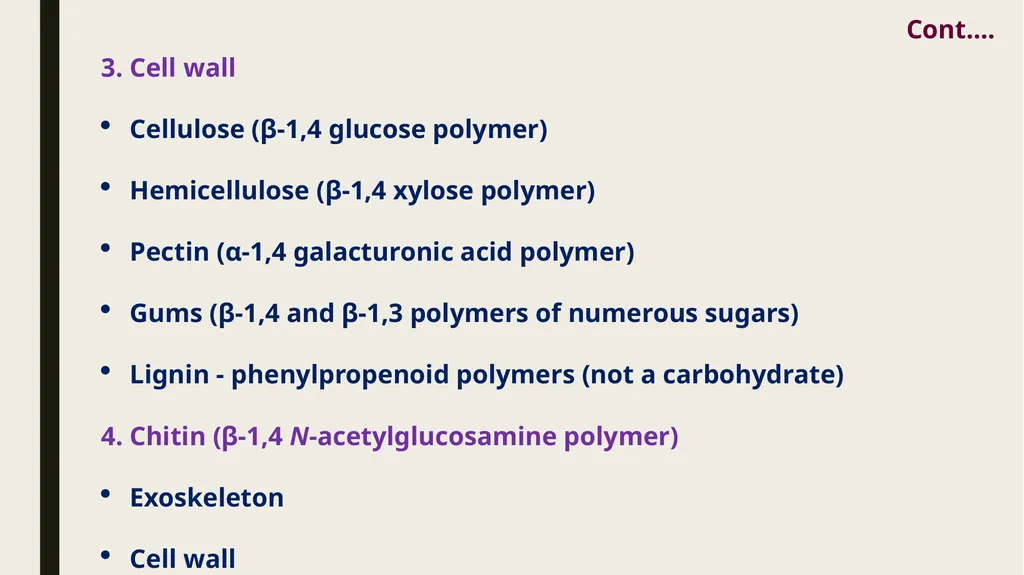
3. Cell wall
Cellulose (β-1,4 glucose polymer)
Hemicellulose (β-1,4 xylose polymer)
Pectin (α-1,4 galacturonic acid polymer)
Gums (β-1,4 and β-1,3 polymers of numerous sugars)
Lignin - phenylpropenoid polymers (not a carbohydrate) Cont.... 4. Chitin (β-1,4 N-acetylglucosamine polymer)
Exoskeleton
Cell wall<br>
Cellulose (β-1,4 glucose polymer)
Hemicellulose (β-1,4 xylose polymer)
Pectin (α-1,4 galacturonic acid polymer)
Gums (β-1,4 and β-1,3 polymers of numerous sugars)
Lignin - phenylpropenoid polymers (not a carbohydrate) Cont.... 4. Chitin (β-1,4 N-acetylglucosamine polymer)
Exoskeleton
Cell wall<br>
18
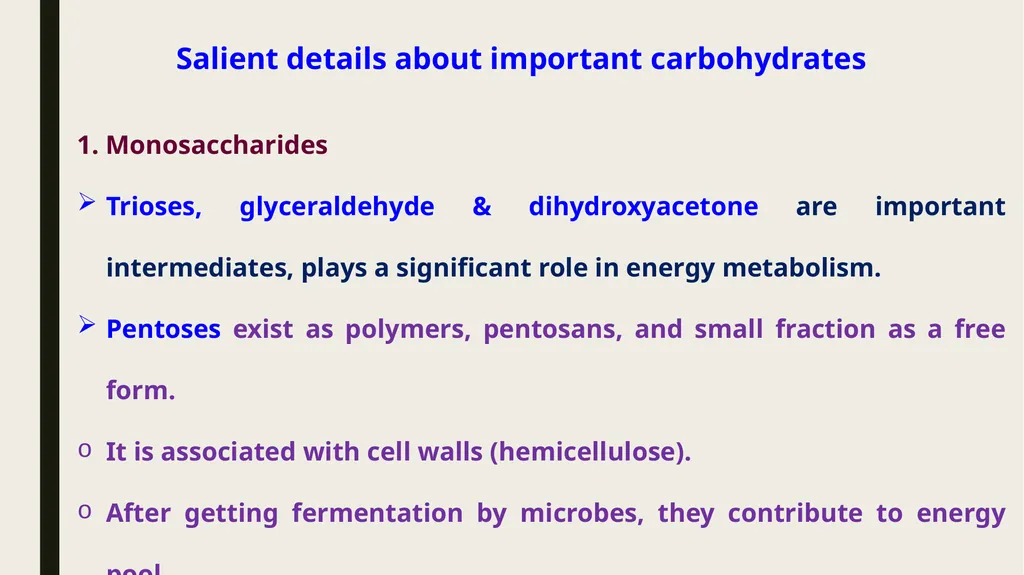
Salient details about important carbohydrates 1. Monosaccharides
Trioses, glyceraldehyde & dihydroxyacetone are important intermediates, plays a significant role in energy metabolism.
Pentoses exist as polymers, pentosans, and small fraction as a free form.
It is associated with cell walls (hemicellulose).
After getting fermentation by microbes, they contribute to energy pool.<br>
19
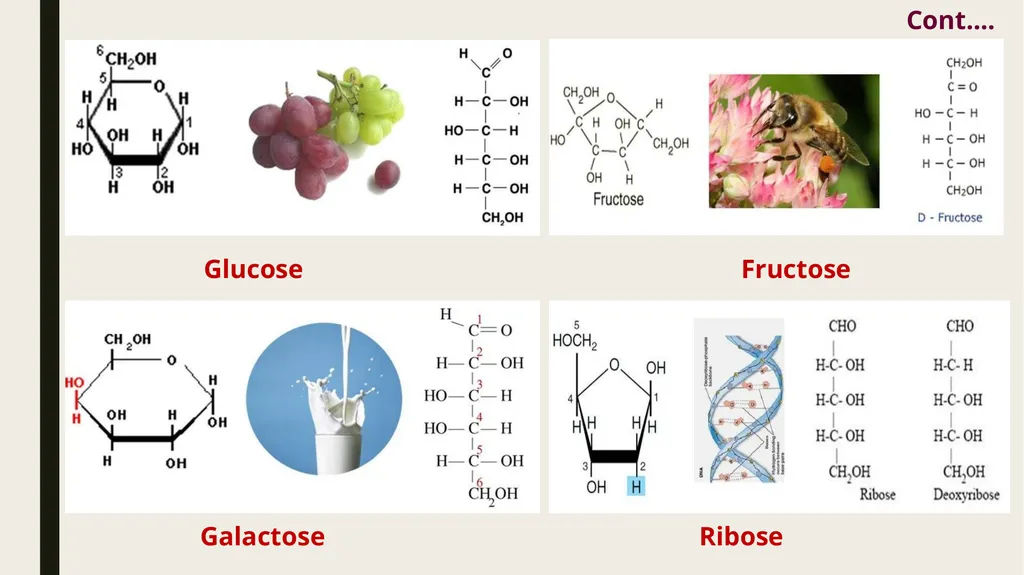
Ribose arise in a number of compounds/intermediates such as ATP, ADP, DNA, RNA, etc. and also in several vitamins and coenzymes.
It can be synthesized by animals.
Glucose occur in free as well as in combined form in plants, fruits, honey, blood, lymph and cerebrospinal fluid.
Major component of many oligosaccharides, polysaccharides and glucosides.
Significant source of energy (probably the most important sugar).
White crystalline solid in pure state and soluble in water.
End product of starch digestion. Cont....<br>
20
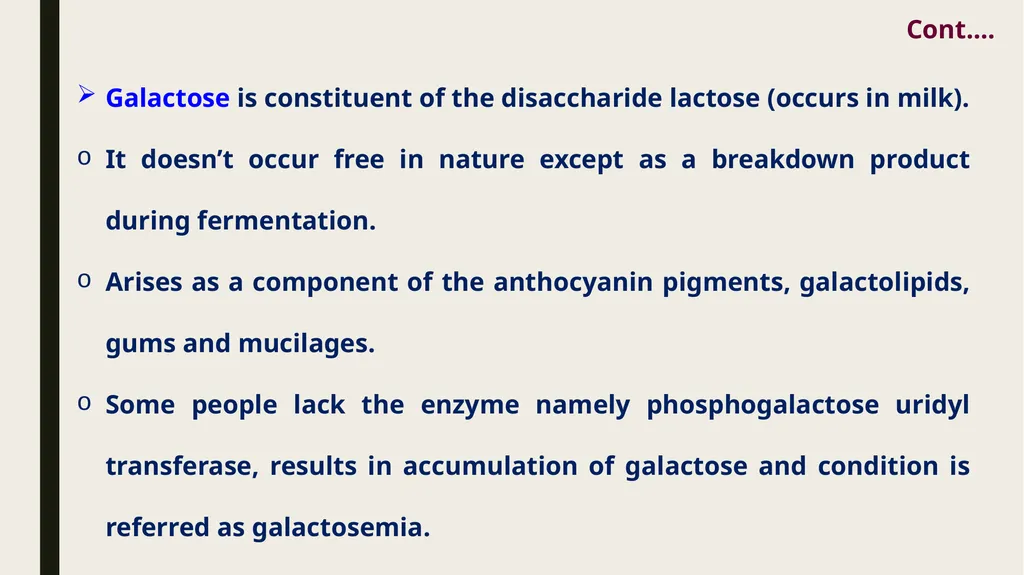
Galactose is constituent of the disaccharide lactose (occurs in milk).
It doesn’t occur free in nature except as a breakdown product during fermentation.
Arises as a component of the anthocyanin pigments, galactolipids, gums and mucilages.
Some people lack the enzyme namely phosphogalactose uridyl transferase, results in accumulation of galactose and condition is referred as galactosemia. Cont....<br>
21
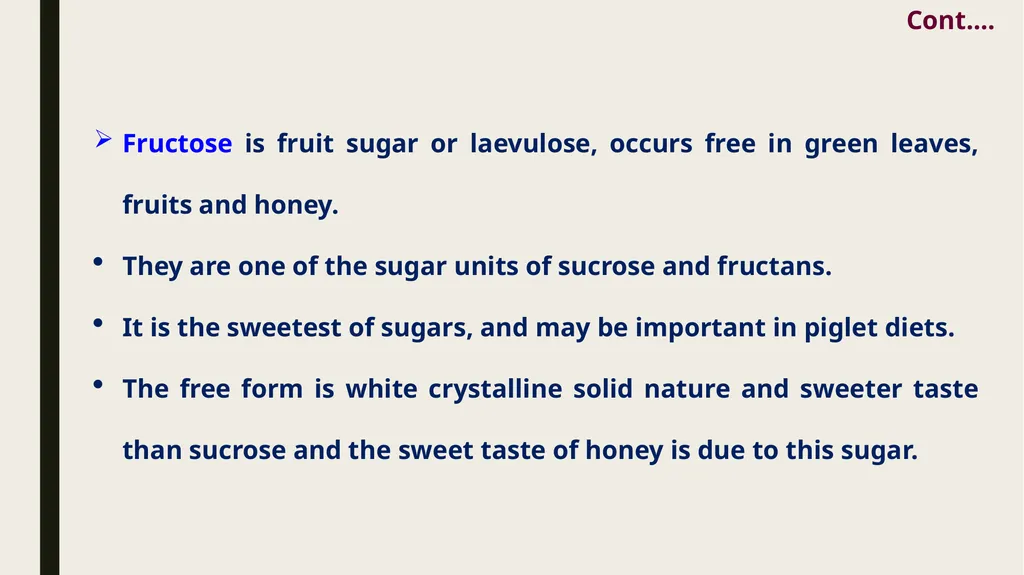
Fructose is fruit sugar or laevulose, occurs free in green leaves, fruits and honey.
They are one of the sugar units of sucrose and fructans.
It is the sweetest of sugars, and may be important in piglet diets.
The free form is white crystalline solid nature and sweeter taste than sucrose and the sweet taste of honey is due to this sugar. Cont....<br>
They are one of the sugar units of sucrose and fructans.
It is the sweetest of sugars, and may be important in piglet diets.
The free form is white crystalline solid nature and sweeter taste than sucrose and the sweet taste of honey is due to this sugar. Cont....<br>
22
Glucose Fructose Galactose Ribose Cont....<br>
23
2. Oligosaccharides
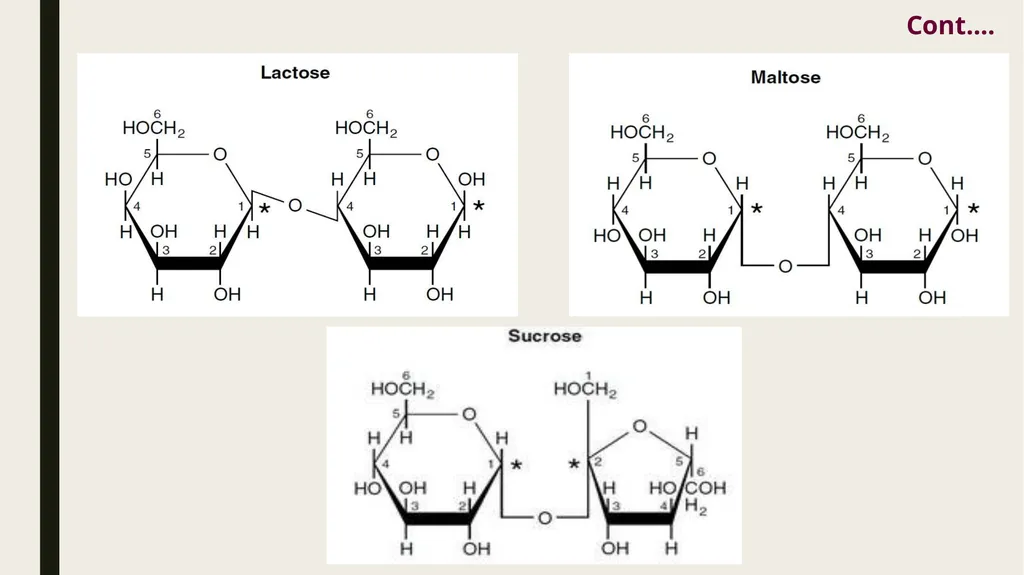
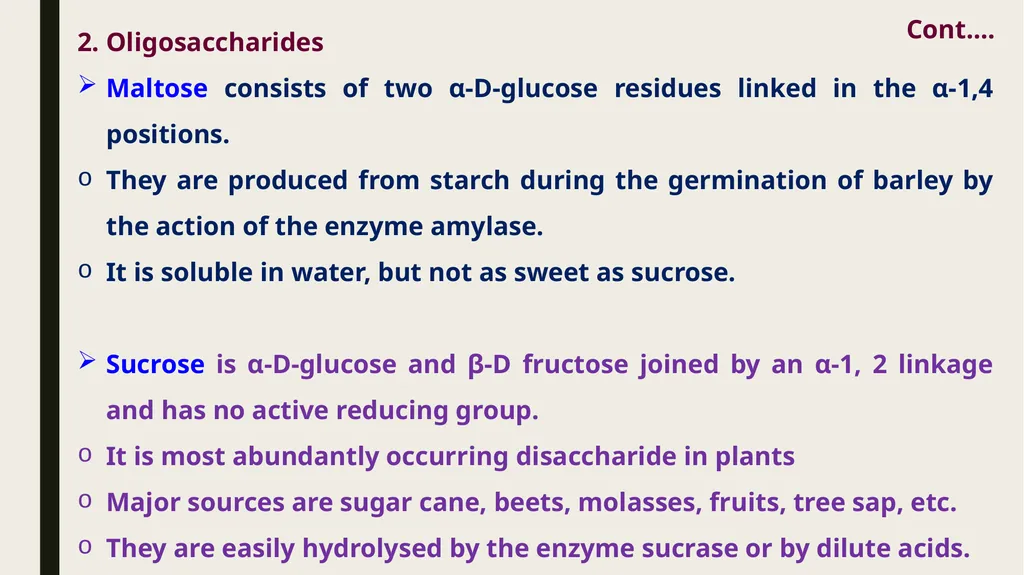
Maltose consists of two α-D-glucose residues linked in the α-1,4 positions.
They are produced from starch during the germination of barley by the action of the enzyme amylase.
It is soluble in water, but not as sweet as sucrose.
Sucrose is α-D-glucose and β-D fructose joined by an α-1, 2 linkage and has no active reducing group.
It is most abundantly occurring disaccharide in plants
Major sources are sugar cane, beets, molasses, fruits, tree sap, etc.
They are easily hydrolysed by the enzyme sucrase or by dilute acids. Cont....<br>
24
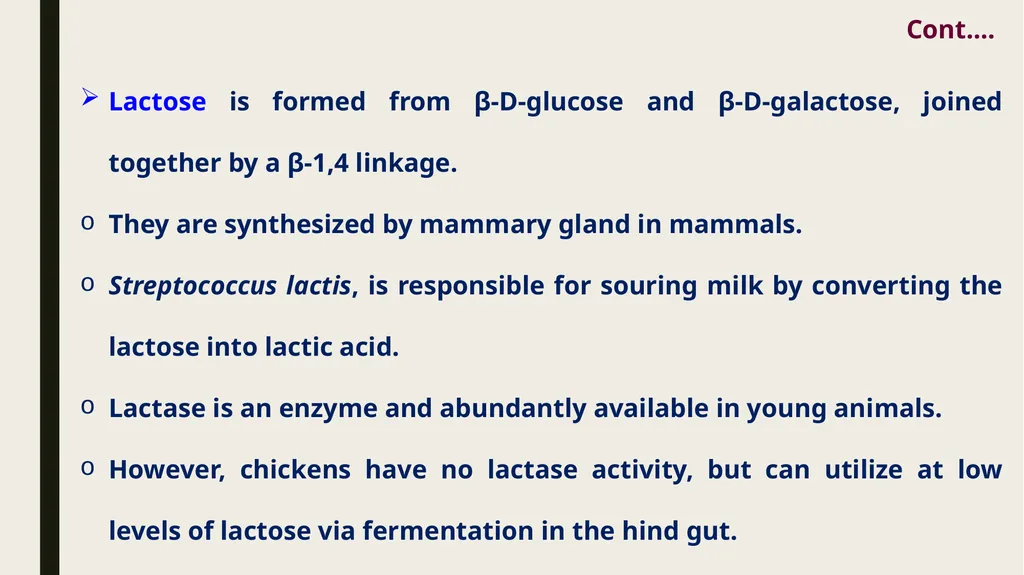
Lactose is formed from β-D-glucose and β-D-galactose, joined together by a β-1,4 linkage.
They are synthesized by mammary gland in mammals.
Streptococcus lactis, is responsible for souring milk by converting the lactose into lactic acid.
Lactase is an enzyme and abundantly available in young animals.
However, chickens have no lactase activity, but can utilize at low levels of lactose via fermentation in the hind gut. Cont....<br>
25
Cellobiose is composed of two β-D-glucose residues, joined through a β-1,4 linkage
It can’t be fragmented by mammalian digestive enzymes, but can be split by microbial enzymes.
It does not exist naturally as a free sugar, and is a basic repeating unit of cellulose. Cont....<br>
It can’t be fragmented by mammalian digestive enzymes, but can be split by microbial enzymes.
It does not exist naturally as a free sugar, and is a basic repeating unit of cellulose. Cont....<br>
26
3. Polysaccharides
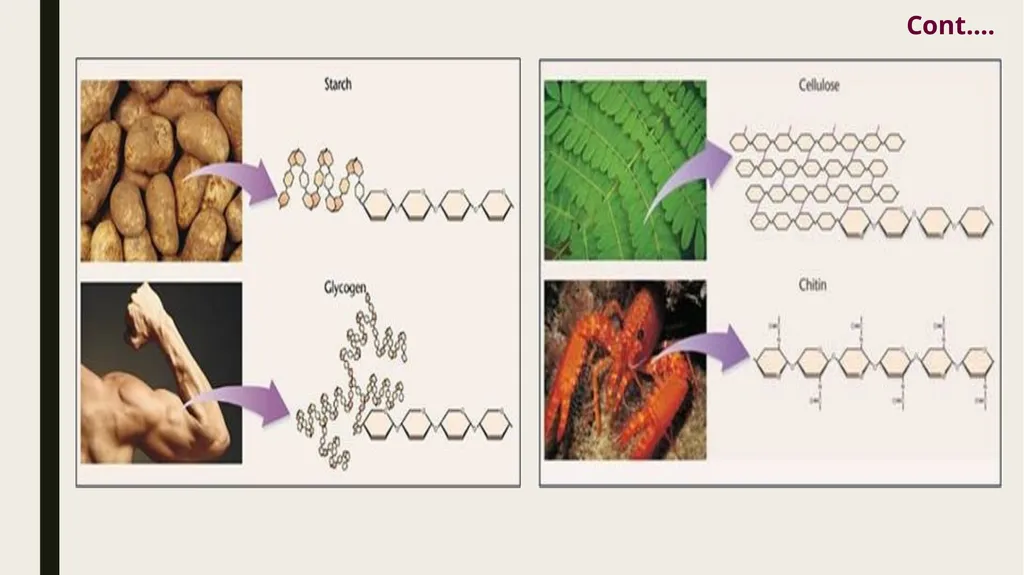
Starch is reserve carbohydrate of seeds, fruits, tubers, roots etc.
It is quantitatively a major source of energy for animals.
Differ in their chemical composition have amylose (α-1,4 linkage) and amylopectin (α-1,4 & α-1,6 linkages).
In most starch, amylopectin is the main component, which accounts about 70-80 % of the total starch component.
Insoluble in cold water, but in water hot it swells & eventually gelatinise.
Iodine reactions gives a deep blue colour for amylose, whereas, amylopectin solutions produce a blue-violet or purple colour. Cont....<br>
27
Dextrin is an intermediate product of the hydrolysis of starch and glycogen and called ‘α-limit dextrins’ because of inability of α-amylase to break α-1,6 bonds.
They are soluble in water and produce gum-like solutions.
It can be hydrolysed at the brush boarder by α-dextranase.
Dextrin gives a characteristic flavour to foods. Cont....<br>
They are soluble in water and produce gum-like solutions.
It can be hydrolysed at the brush boarder by α-dextranase.
Dextrin gives a characteristic flavour to foods. Cont....<br>
28
Glycogen is a group of highly branched polysaccharides.
Isolated from animals or microorganisms and frequently called ‘animal starch’.
They occur in the liver, muscle and other animal tissues and plays an essential role in energy metabolism. Cont....<br>
Isolated from animals or microorganisms and frequently called ‘animal starch’.
They occur in the liver, muscle and other animal tissues and plays an essential role in energy metabolism. Cont....<br>
29
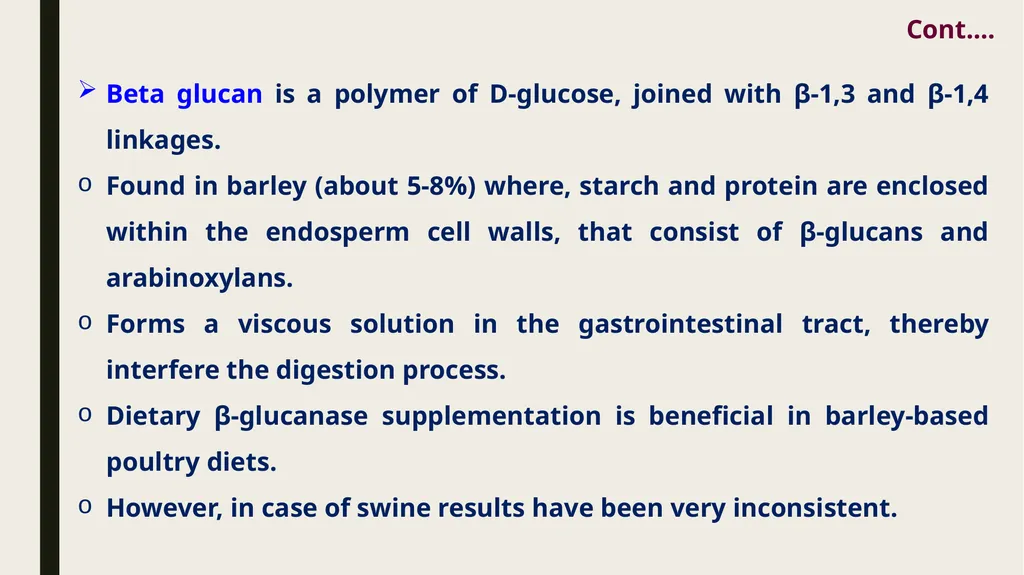
Beta glucan is a polymer of D-glucose, joined with β-1,3 and β-1,4 linkages.
Found in barley (about 5-8%) where, starch and protein are enclosed within the endosperm cell walls, that consist of β-glucans and arabinoxylans.
Forms a viscous solution in the gastrointestinal tract, thereby interfere the digestion process.
Dietary β-glucanase supplementation is beneficial in barley-based poultry diets.
However, in case of swine results have been very inconsistent. Cont....<br>
30
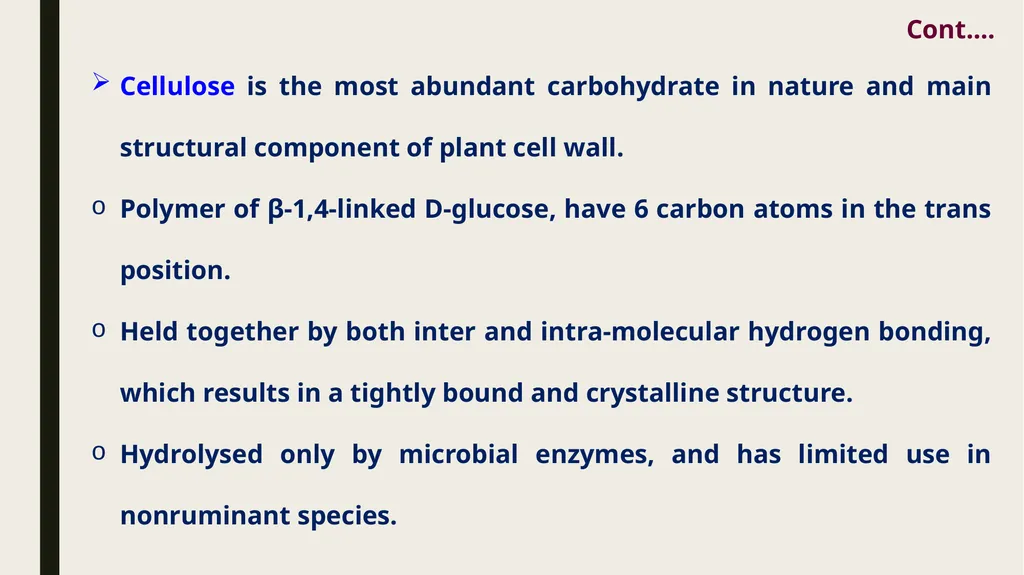
Cellulose is the most abundant carbohydrate in nature and main structural component of plant cell wall.
Polymer of β-1,4-linked D-glucose, have 6 carbon atoms in the trans position.
Held together by both inter and intra-molecular hydrogen bonding, which results in a tightly bound and crystalline structure.
Hydrolysed only by microbial enzymes, and has limited use in nonruminant species. Cont....<br>
Polymer of β-1,4-linked D-glucose, have 6 carbon atoms in the trans position.
Held together by both inter and intra-molecular hydrogen bonding, which results in a tightly bound and crystalline structure.
Hydrolysed only by microbial enzymes, and has limited use in nonruminant species. Cont....<br>
31
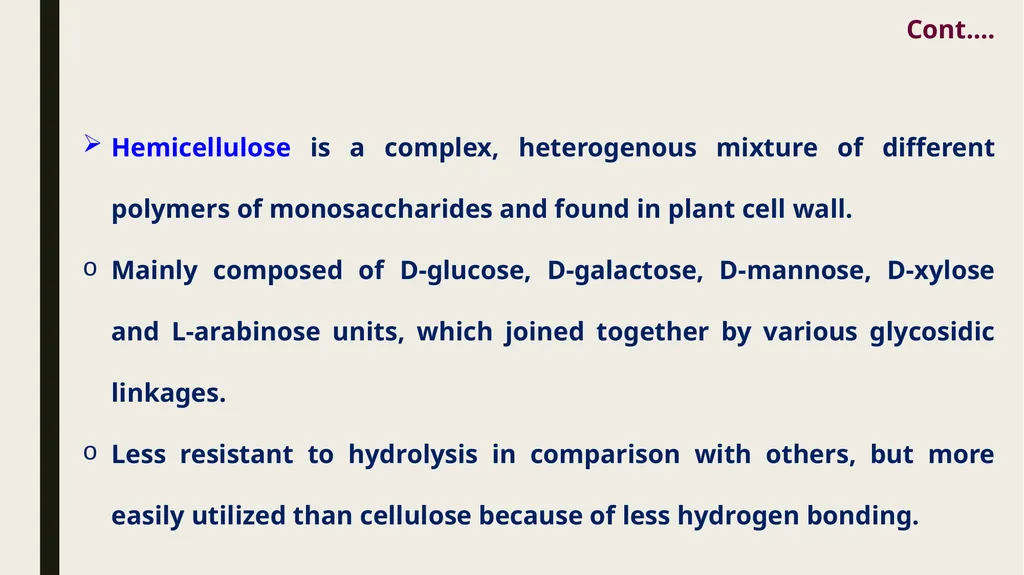
Cont.... Hemicellulose is a complex, heterogenous mixture of different polymers of monosaccharides and found in plant cell wall.
Mainly composed of D-glucose, D-galactose, D-mannose, D-xylose and L-arabinose units, which joined together by various glycosidic linkages.
Less resistant to hydrolysis in comparison with others, but more easily utilized than cellulose because of less hydrogen bonding.<br>
Mainly composed of D-glucose, D-galactose, D-mannose, D-xylose and L-arabinose units, which joined together by various glycosidic linkages.
Less resistant to hydrolysis in comparison with others, but more easily utilized than cellulose because of less hydrogen bonding.<br>
32
Cont....<br>
33
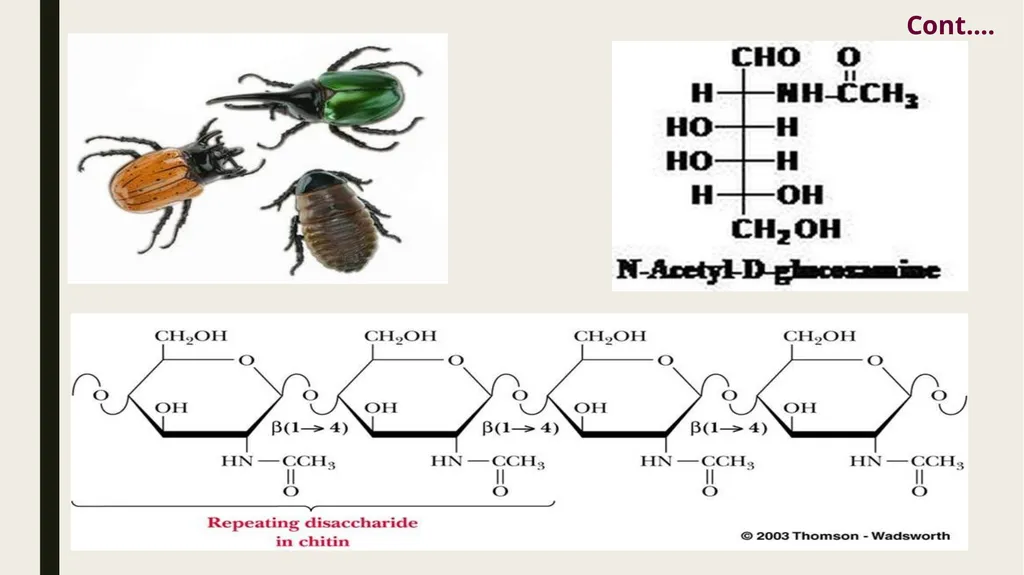
Chitin is the only known example of a homoglycan containing glucosamine.
It is a linear polymer of acetyl-D-glucosamine.
Chitin is widely occurring in lower animals (abundant in crustacea, fungi, green algae, etc).
Probably the most abundant polysaccharide of nature after cellulose. Cont....<br>
It is a linear polymer of acetyl-D-glucosamine.
Chitin is widely occurring in lower animals (abundant in crustacea, fungi, green algae, etc).
Probably the most abundant polysaccharide of nature after cellulose. Cont....<br>
34
Exudate gums and acid mucilage are produced from wounds of plants, and may arise as natural exudations from bark and leaves.
Occur naturally as salt, especially of calcium and magnesium, and in some cases as acetate.
Gum arabic (acacia gum) on hydrolysis yields arabinose, galactose, rhamnose and glucuronic acid. Cont....<br>
Occur naturally as salt, especially of calcium and magnesium, and in some cases as acetate.
Gum arabic (acacia gum) on hydrolysis yields arabinose, galactose, rhamnose and glucuronic acid. Cont....<br>
35
Hyaluronic acid and chondroitin are consisting of an amino sugar and D-glucuronic acid.
Hyaluronic acid contains acetyl-D-glucosamine & present in the skin, synovial fluid & umbilical cord & also play an important part in lubrication of joints.
Chondroitin contains galactosamine in place of glucosamine and sulphate esters of chondroitin are major structural components of cartilage, tendons and bones. Cont....<br>
36
Cont.... Lignin is not a carbohydrate but is closely associated with this group of compounds.
Provides biological resistance to the cell wall & mechanical strength to the plant.
Polymer that originates from three derivatives of phenylpropane (coumaryl alcohol, coniferyl alcohol and sinapyl alcohol) & are made up of many phenylpropanoid units associated in a complex cross-linked structure.
Wood product, mature hays and straws are rich in lignin.
Poorly digested unless treated chemically to break the bonds between lignin and other carbohydrates.<br>
37
THANKS Discussion..........
Questions, if any?<br>
Questions, if any?<br>