
Lesson 2.1 Human Genetics Human Genetics Figure 1
DJ
Published · 26 slides · 0 views

1 / 1


Description
Lesson 2.1 Human Genetics Human Genetics Figure 1 Psychological researchers study genetics in order to better understand the biological basis that contributes to certain behaviors. Important questions surrounding genetics: Why do two people
Related Topics
Share
Embed code
Download this presentation From Below
"Lesson 2.1 Human Genetics Human Genetics Figure 1" is the property of its rightful owner. Permission is granted to download and print the materials on this website for personal, non-commercial use only, and to display it on your personal computer provided you do not modify the materials and that you retain all copyright notices contained in the materials. By downloading content from our website, you accept the terms of this agreement.
Presentation Transcript
01
Lesson 2.1 Human Genetics<br>
02
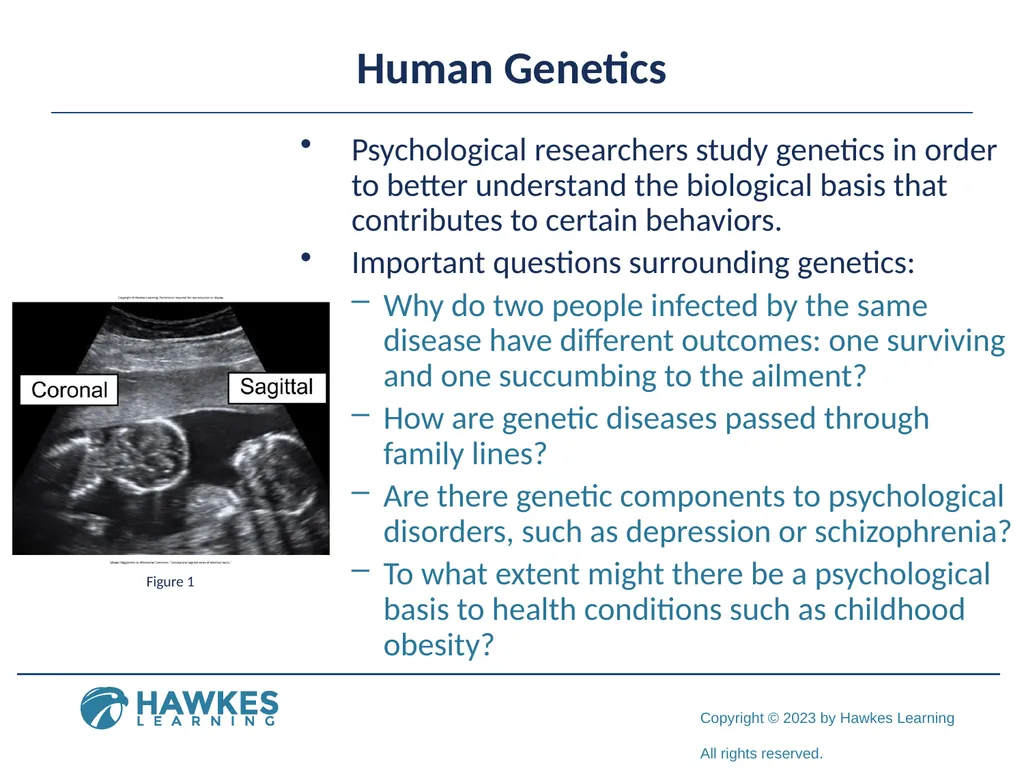
Human Genetics Figure 1 Psychological researchers study genetics in order to better understand the biological basis that contributes to certain behaviors.
Important questions surrounding genetics:
Why do two people infected by the same disease have different outcomes: one surviving and one succumbing to the ailment?
How are genetic diseases passed through family lines?
Are there genetic components to psychological disorders, such as depression or schizophrenia?
To what extent might there be a psychological basis to health conditions such as childhood obesity?<br>
Important questions surrounding genetics:
Why do two people infected by the same disease have different outcomes: one surviving and one succumbing to the ailment?
How are genetic diseases passed through family lines?
Are there genetic components to psychological disorders, such as depression or schizophrenia?
To what extent might there be a psychological basis to health conditions such as childhood obesity?<br>
03
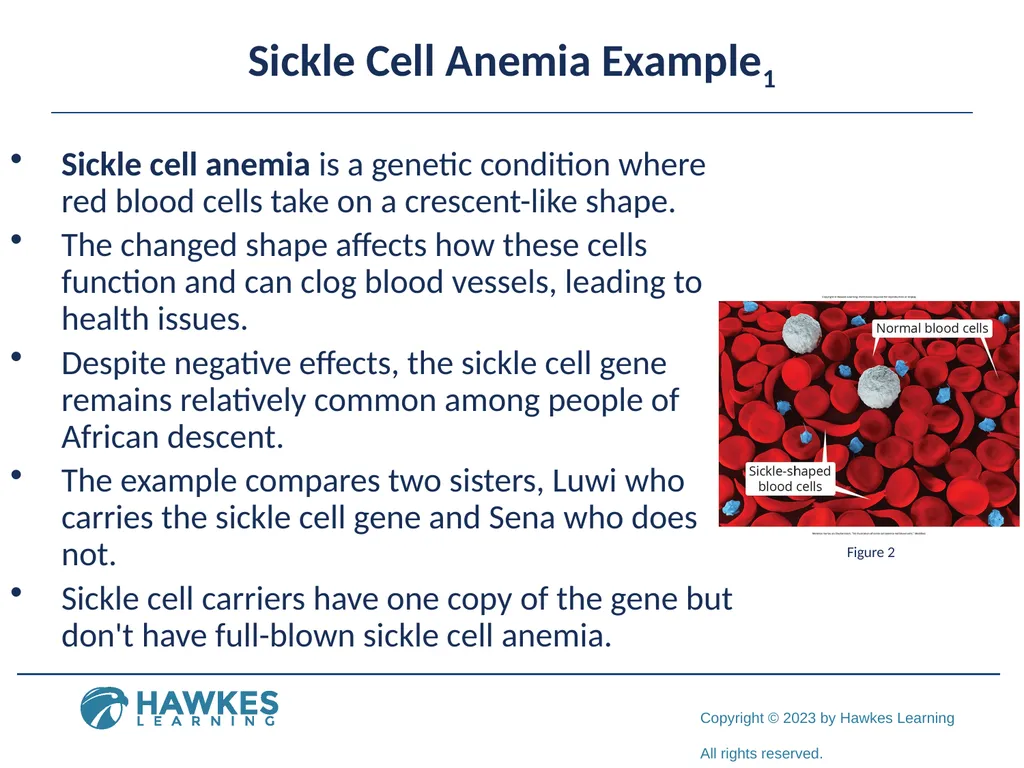
Sickle Cell Anemia Example1 Sickle cell anemia is a genetic condition where red blood cells take on a crescent-like shape.
The changed shape affects how these cells function and can clog blood vessels, leading to health issues.
Despite negative effects, the sickle cell gene remains relatively common among people of African descent.
The example compares two sisters, Luwi who carries the sickle cell gene and Sena who does not.
Sickle cell carriers have one copy of the gene but don't have full-blown sickle cell anemia. Figure 2<br>
The changed shape affects how these cells function and can clog blood vessels, leading to health issues.
Despite negative effects, the sickle cell gene remains relatively common among people of African descent.
The example compares two sisters, Luwi who carries the sickle cell gene and Sena who does not.
Sickle cell carriers have one copy of the gene but don't have full-blown sickle cell anemia. Figure 2<br>
04
Sickle Cell Anemia Example2 After being bitten by mosquitoes carrying malaria, Luwi did not get malaria due to carrying the sickle cell mutation.
However, Sena developed malaria and died just 2 weeks later.
Luwi survived and may pass on the sickle cell mutation to her children.
In areas where malaria is prevalent, having the sickle cell mutation provides health benefits for carriers - protection from malaria.
In the United States where malaria is rare, the sickle cell gene manifests primarily as health problems.<br>
However, Sena developed malaria and died just 2 weeks later.
Luwi survived and may pass on the sickle cell mutation to her children.
In areas where malaria is prevalent, having the sickle cell mutation provides health benefits for carriers - protection from malaria.
In the United States where malaria is rare, the sickle cell gene manifests primarily as health problems.<br>
05
Evolution Theory of evolution by natural selection states organisms better suited for their environment will survive and reproduce.
Those poorly suited for their environment will die off.
In the example, Luwi's sickle cell mutation is highly adaptive in her African homeland where malaria is prevalent.
If she resided in the United States where malaria is less common, her mutation could prove costly.
With her mutation, there is a high probability of the sickle cell disease in her descendants and minor health problems.<br>
Those poorly suited for their environment will die off.
In the example, Luwi's sickle cell mutation is highly adaptive in her African homeland where malaria is prevalent.
If she resided in the United States where malaria is less common, her mutation could prove costly.
With her mutation, there is a high probability of the sickle cell disease in her descendants and minor health problems.<br>
06
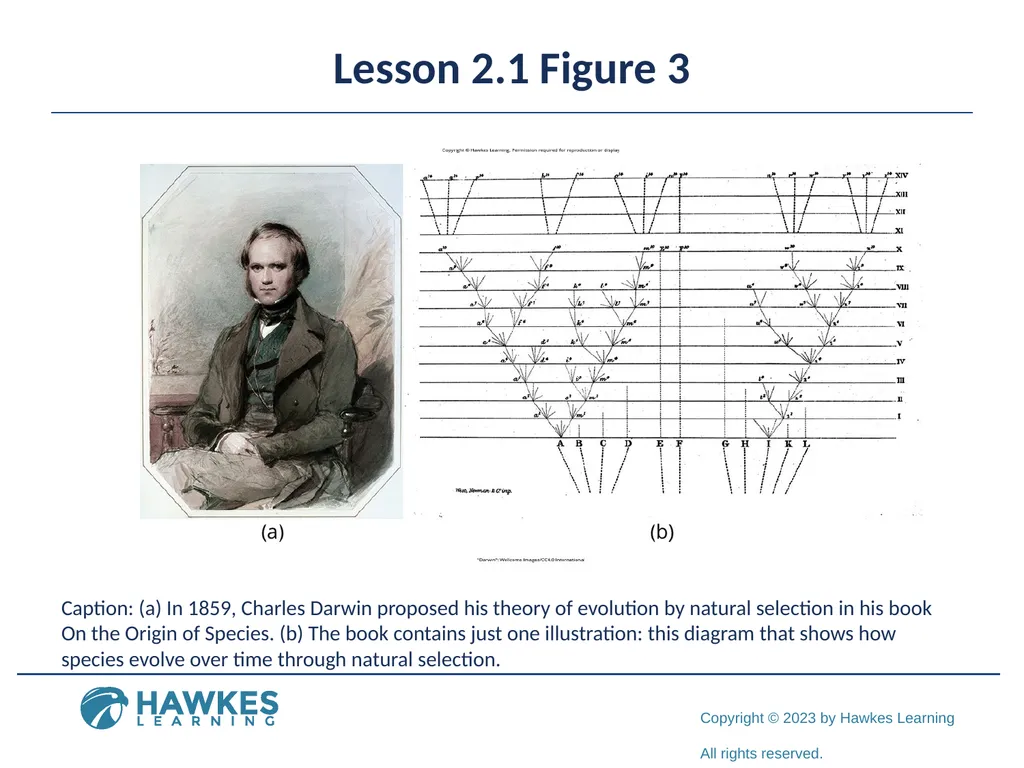
Lesson 2.1 Figure 3 Caption: (a) In 1859, Charles Darwin proposed his theory of evolution by natural selection in his book On the Origin of Species. (b) The book contains just one illustration: this diagram that shows how species evolve over time through natural selection.<br>
07
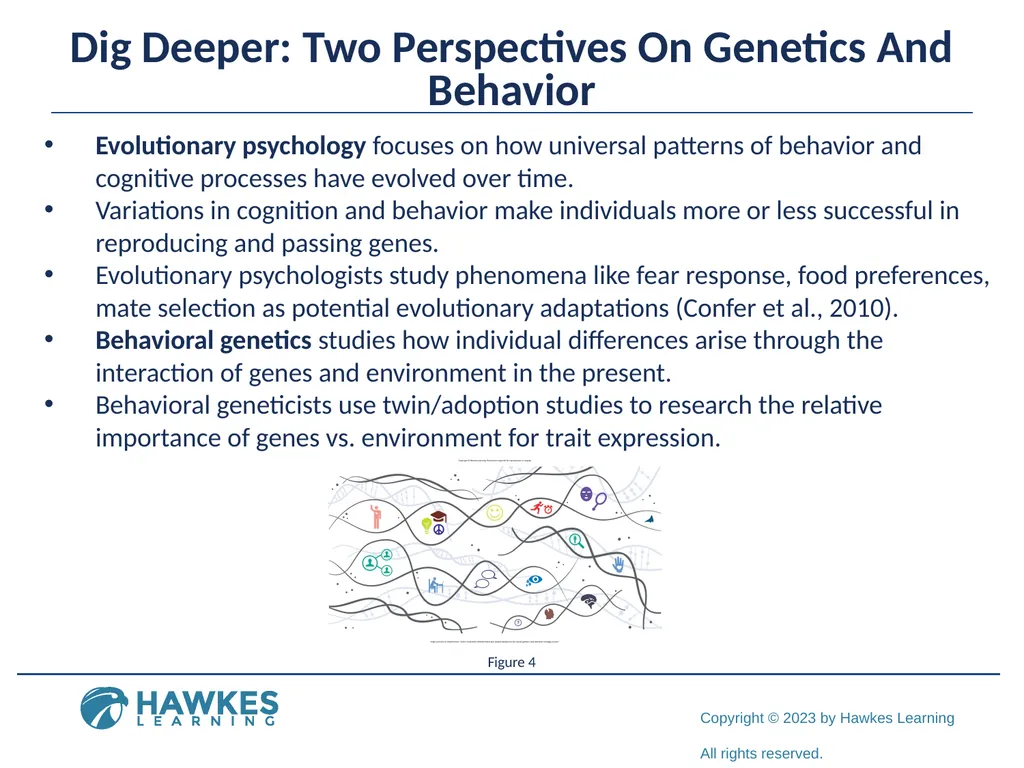
Dig Deeper: Two Perspectives On Genetics And Behavior Evolutionary psychology focuses on how universal patterns of behavior and cognitive processes have evolved over time.
Variations in cognition and behavior make individuals more or less successful in reproducing and passing genes.
Evolutionary psychologists study phenomena like fear response, food preferences, mate selection as potential evolutionary adaptations (Confer et al., 2010).
Behavioral genetics studies how individual differences arise through the interaction of genes and environment in the present.
Behavioral geneticists use twin/adoption studies to research the relative importance of genes vs. environment for trait expression. Figure 4<br>
Variations in cognition and behavior make individuals more or less successful in reproducing and passing genes.
Evolutionary psychologists study phenomena like fear response, food preferences, mate selection as potential evolutionary adaptations (Confer et al., 2010).
Behavioral genetics studies how individual differences arise through the interaction of genes and environment in the present.
Behavioral geneticists use twin/adoption studies to research the relative importance of genes vs. environment for trait expression. Figure 4<br>
08
Genetic Variation Genetic variation, the genetic difference between individuals, contributes to a species' adaptation to its environment.
In humans, genetic variation begins with an egg, sperm, and fertilization.
The egg and sperm each contain 23 chromosomes made up of DNA sequences that form genes.
Genes control or partially control visible traits like eye color and hair color.
Alleles are specific versions of a gene that affect the expression of a trait.<br>
In humans, genetic variation begins with an egg, sperm, and fertilization.
The egg and sperm each contain 23 chromosomes made up of DNA sequences that form genes.
Genes control or partially control visible traits like eye color and hair color.
Alleles are specific versions of a gene that affect the expression of a trait.<br>
09
Genotype When sperm and egg fuse, their 23 chromosome pairs create a zygote with 23 pairs.
Each parent contributes half the genetic information to the offspring.
A person's genotype is their genetic makeup inherited from the parents.
The genotype interacts to determine the phenotype - the individual's physical characteristics.<br>
Each parent contributes half the genetic information to the offspring.
A person's genotype is their genetic makeup inherited from the parents.
The genotype interacts to determine the phenotype - the individual's physical characteristics.<br>
10
Phenotype The phenotype refers to an individual's inherited physical characteristics displayed outwardly.
It is determined by the interaction of the genotype (genetic makeup) and environmental influences.
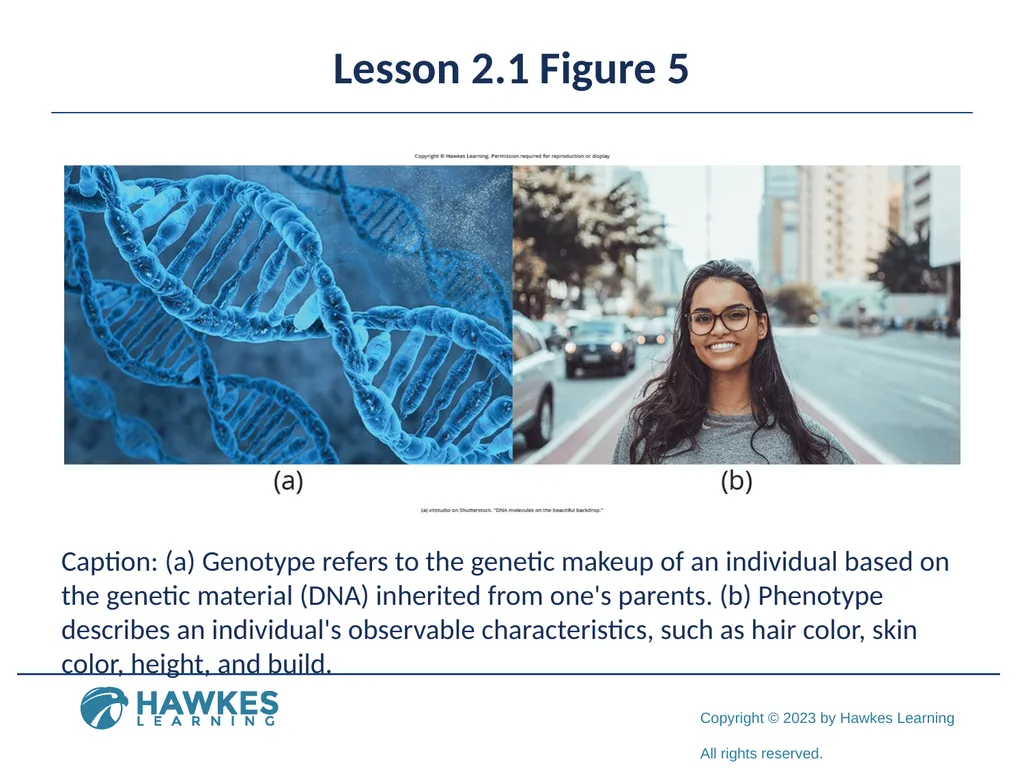
While genotype is inherited, phenotype is a combination of genetic and environmental factors (Figure 5).<br>
It is determined by the interaction of the genotype (genetic makeup) and environmental influences.
While genotype is inherited, phenotype is a combination of genetic and environmental factors (Figure 5).<br>
11
Lesson 2.1 Figure 5 Caption: (a) Genotype refers to the genetic makeup of an individual based on the genetic material (DNA) inherited from one's parents. (b) Phenotype describes an individual's observable characteristics, such as hair color, skin color, height, and build.<br>
12
Alleles Alleles are specific versions of a gene that affect the expression of a trait.
Some traits are controlled by one gene with different allele variations.
A dominant allele will be expressed over a recessive allele in the phenotype.
Example: Cleft chin is a dominant trait, the "B" allele, over the recessive "b" allele for smooth chin.
Having BB or Bb genotypes results in the cleft chin phenotype.<br>
Some traits are controlled by one gene with different allele variations.
A dominant allele will be expressed over a recessive allele in the phenotype.
Example: Cleft chin is a dominant trait, the "B" allele, over the recessive "b" allele for smooth chin.
Having BB or Bb genotypes results in the cleft chin phenotype.<br>
13
Homozygous Vs. Heterozygous When an individual has two copies of the same allele, they are homozygous for that allele.
When they have a combination of different alleles for a gene, they are heterozygous.
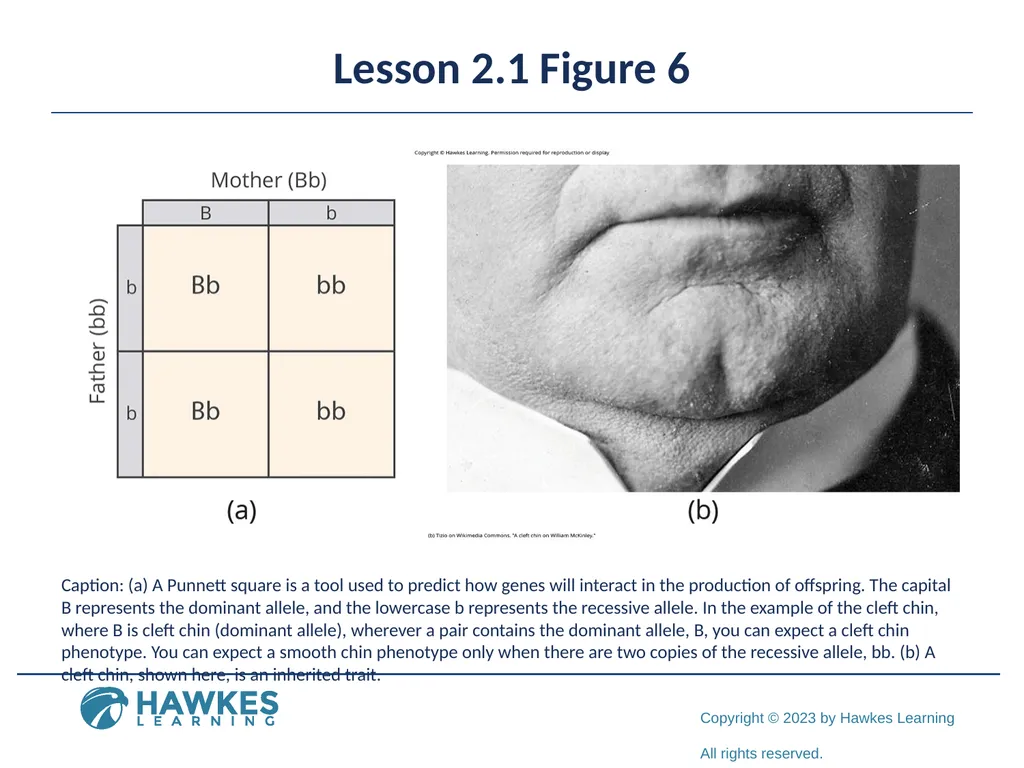
Example: For a recessive trait like smooth chin (bb), an individual must be homozygous recessive to show that phenotype.
Example: If a woman is Bb (heterozygous) and the man is bb, their offspring have a 50% chance of cleft or smooth chin.
Genetic outcome depends on which combinations of alleles are inherited from each parent.<br>
When they have a combination of different alleles for a gene, they are heterozygous.
Example: For a recessive trait like smooth chin (bb), an individual must be homozygous recessive to show that phenotype.
Example: If a woman is Bb (heterozygous) and the man is bb, their offspring have a 50% chance of cleft or smooth chin.
Genetic outcome depends on which combinations of alleles are inherited from each parent.<br>
14
Lesson 2.1 Figure 6 Caption: (a) A Punnett square is a tool used to predict how genes will interact in the production of offspring. The capital B represents the dominant allele, and the lowercase b represents the recessive allele. In the example of the cleft chin, where B is cleft chin (dominant allele), wherever a pair contains the dominant allele, B, you can expect a cleft chin phenotype. You can expect a smooth chin phenotype only when there are two copies of the recessive allele, bb. (b) A cleft chin, shown here, is an inherited trait.<br>
15
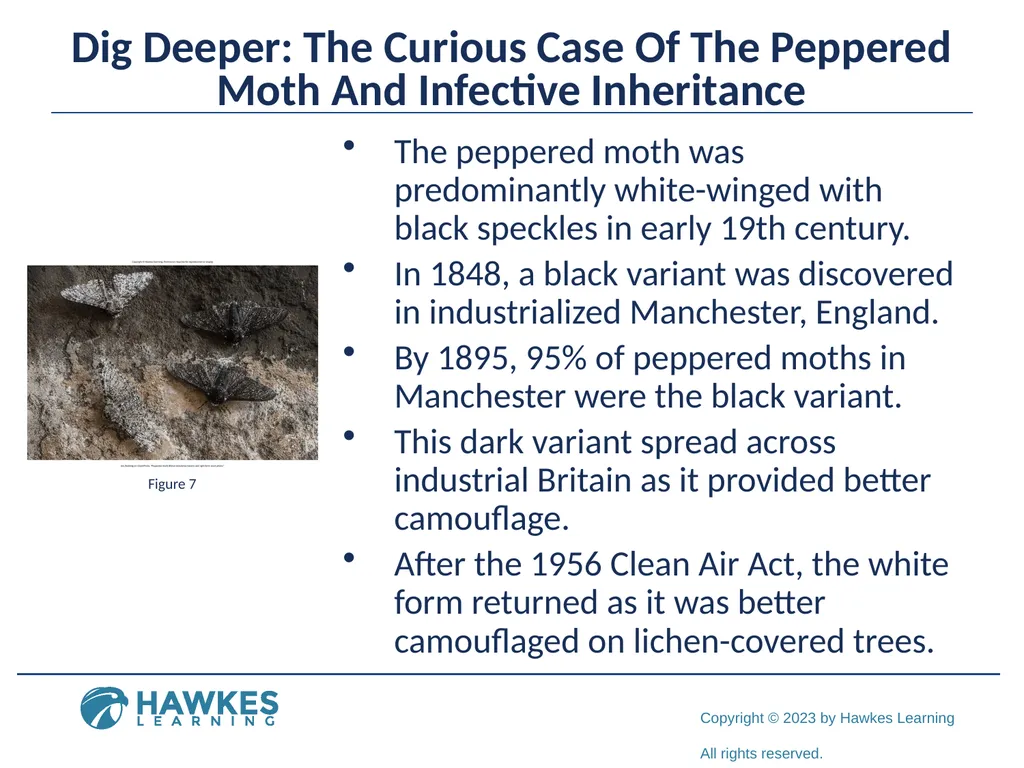
Dig Deeper: The Curious Case Of The Peppered Moth And Infective Inheritance Figure 7 The peppered moth was predominantly white-winged with black speckles in early 19th century.
In 1848, a black variant was discovered in industrialized Manchester, England.
By 1895, 95% of peppered moths in Manchester were the black variant.
This dark variant spread across industrial Britain as it provided better camouflage.
After the 1956 Clean Air Act, the white form returned as it was better camouflaged on lichen-covered trees.<br>
In 1848, a black variant was discovered in industrialized Manchester, England.
By 1895, 95% of peppered moths in Manchester were the black variant.
This dark variant spread across industrial Britain as it provided better camouflage.
After the 1956 Clean Air Act, the white form returned as it was better camouflaged on lichen-covered trees.<br>
16
Polygenic Traits Polygenic: multiple genes affecting a given trait
Most human traits are polygenic
Examples: Height, skin color, weight<br>
Most human traits are polygenic
Examples: Height, skin color, weight<br>
17
Mutations A mutation is a sudden, permanent change in a gene.
While many mutations can be harmful or lethal, some mutations can benefit an individual.
Mutations provide a source of variability in genes and associated traits.
According to the theory of evolution, individuals best adapted to their environment are more likely to reproduce.
Diversity in genes allows some individuals to perform better when faced with environmental changes.<br>
While many mutations can be harmful or lethal, some mutations can benefit an individual.
Mutations provide a source of variability in genes and associated traits.
According to the theory of evolution, individuals best adapted to their environment are more likely to reproduce.
Diversity in genes allows some individuals to perform better when faced with environmental changes.<br>
18
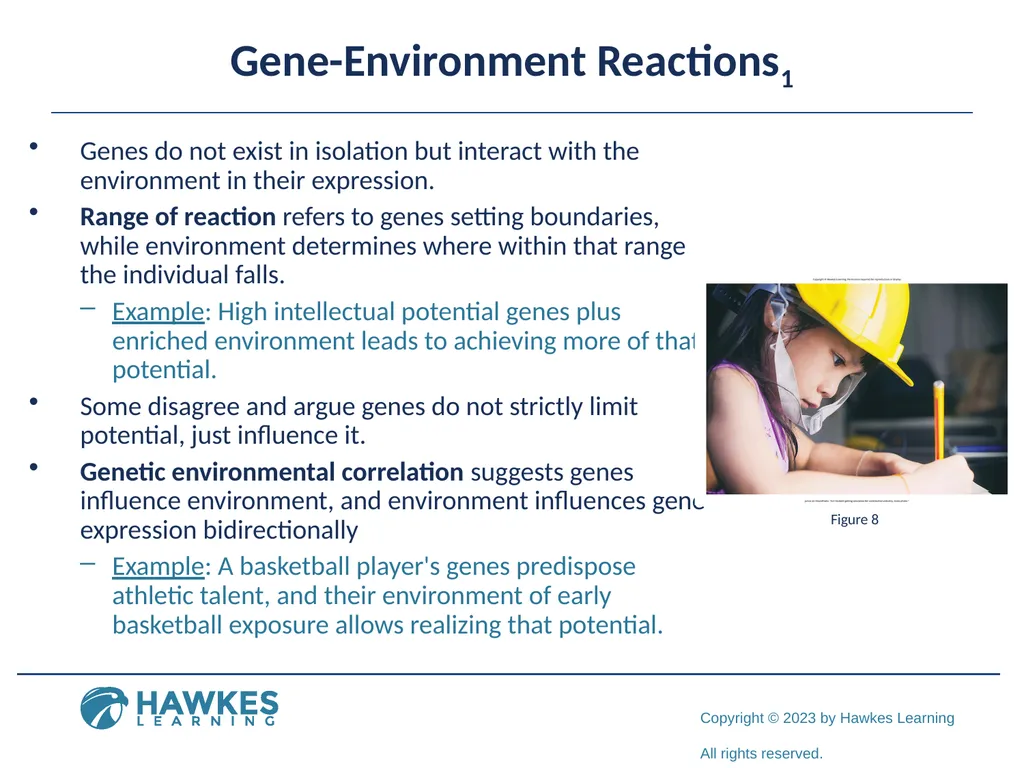
Gene-Environment Reactions1 Genes do not exist in isolation but interact with the environment in their expression.
Range of reaction refers to genes setting boundaries, while environment determines where within that range the individual falls.
Example: High intellectual potential genes plus enriched environment leads to achieving more of that potential.
Some disagree and argue genes do not strictly limit potential, just influence it.
Genetic environmental correlation suggests genes influence environment, and environment influences gene expression bidirectionally
Example: A basketball player's genes predispose athletic talent, and their environment of early basketball exposure allows realizing that potential. Figure 8<br>
Range of reaction refers to genes setting boundaries, while environment determines where within that range the individual falls.
Example: High intellectual potential genes plus enriched environment leads to achieving more of that potential.
Some disagree and argue genes do not strictly limit potential, just influence it.
Genetic environmental correlation suggests genes influence environment, and environment influences gene expression bidirectionally
Example: A basketball player's genes predispose athletic talent, and their environment of early basketball exposure allows realizing that potential. Figure 8<br>
19
Reflection Question How do you think genetics influence our body type?<br>
20
Epigenetics Epigenetics looks beyond the genotype and studies how the same genes can be expressed differently.
It examines how the same genotype can lead to different phenotypes based on environmental influences.
Identical twins share the exact same genetic information since they develop from one fertilized egg.
Fraternal twins develop from two separate eggs and have varying genetics like non-twin siblings.
Despite identical genes, identical twins can have variability in how those genes are expressed over their lifetimes.<br>
It examines how the same genotype can lead to different phenotypes based on environmental influences.
Identical twins share the exact same genetic information since they develop from one fertilized egg.
Fraternal twins develop from two separate eggs and have varying genetics like non-twin siblings.
Despite identical genes, identical twins can have variability in how those genes are expressed over their lifetimes.<br>
21
Twins Identical twins allow studying how the same genotype can manifest differently due to environmental factors.
Example: One identical twin developed cancer at age 7, while the other twin has not had cancer at 19.
Their differing phenotypes result from differences in gene expression over time, not their genotype.
The epigenetic perspective contrasts range of reaction, as the genotype itself is not fixed or limited.<br>
Example: One identical twin developed cancer at age 7, while the other twin has not had cancer at 19.
Their differing phenotypes result from differences in gene expression over time, not their genotype.
The epigenetic perspective contrasts range of reaction, as the genotype itself is not fixed or limited.<br>
22
Gene-Environment Interactions2 Studies find genetic linkages to behavioral traits like personality, sexual orientation, and spirituality.
Genes are associated with temperament and psychological disorders like depression and schizophrenia.
While genes provide biological blueprints, they also significantly impact experiences and behaviors.<br>
Genes are associated with temperament and psychological disorders like depression and schizophrenia.
While genes provide biological blueprints, they also significantly impact experiences and behaviors.<br>
23
Adoption Study1 An adoption study found adoptees whose biological mothers had schizophrenia and disturbed family environments were much more likely to develop schizophrenia.
This suggests both genetic vulnerability and environmental stress are necessary for schizophrenia to develop.
Genes alone do not fully explain schizophrenia - the interaction of genes and environment is important.<br>
This suggests both genetic vulnerability and environmental stress are necessary for schizophrenia to develop.
Genes alone do not fully explain schizophrenia - the interaction of genes and environment is important.<br>
24
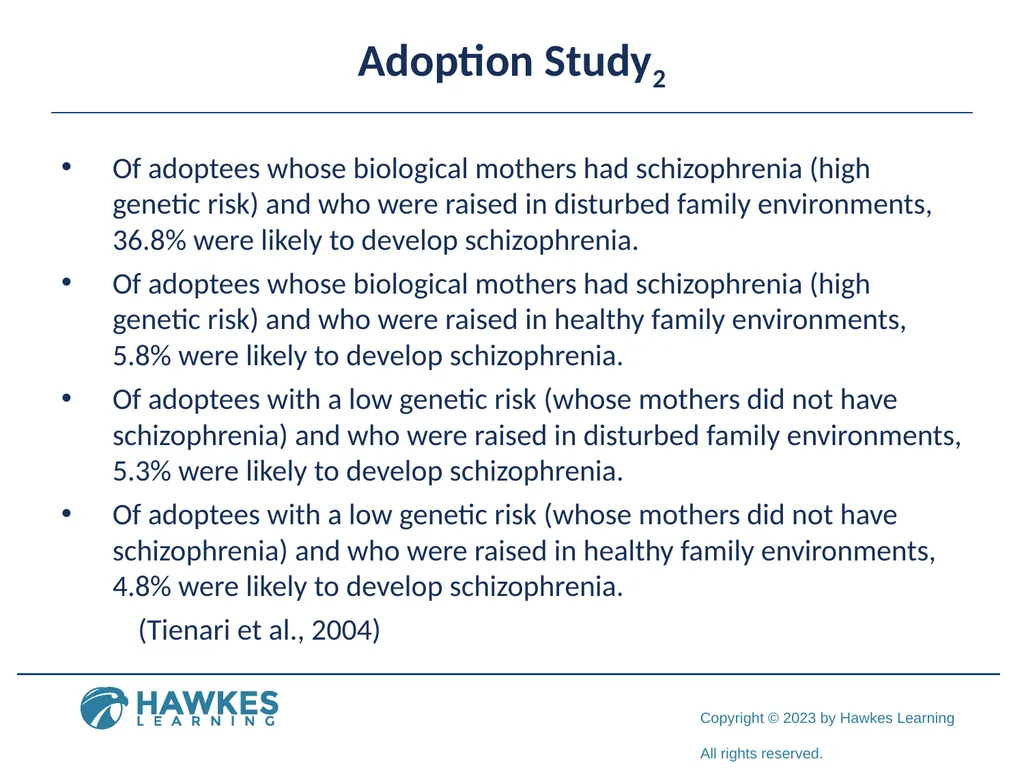
Adoption Study2 Of adoptees whose biological mothers had schizophrenia (high genetic risk) and who were raised in disturbed family environments, 36.8% were likely to develop schizophrenia.
Of adoptees whose biological mothers had schizophrenia (high genetic risk) and who were raised in healthy family environments, 5.8% were likely to develop schizophrenia.
Of adoptees with a low genetic risk (whose mothers did not have schizophrenia) and who were raised in disturbed family environments, 5.3% were likely to develop schizophrenia.
Of adoptees with a low genetic risk (whose mothers did not have schizophrenia) and who were raised in healthy family environments, 4.8% were likely to develop schizophrenia.
(Tienari et al., 2004)<br>
Of adoptees whose biological mothers had schizophrenia (high genetic risk) and who were raised in healthy family environments, 5.8% were likely to develop schizophrenia.
Of adoptees with a low genetic risk (whose mothers did not have schizophrenia) and who were raised in disturbed family environments, 5.3% were likely to develop schizophrenia.
Of adoptees with a low genetic risk (whose mothers did not have schizophrenia) and who were raised in healthy family environments, 4.8% were likely to develop schizophrenia.
(Tienari et al., 2004)<br>
25
Summary Genes are sequences of DNA that code for particular traits.
Different versions of a gene are called alleles.
A dominant allele always results in the dominant phenotype being expressed.
To exhibit a recessive phenotype, an individual must be homozygous for the recessive allele.
Genes affect both physical characteristics and psychological characteristics like personality and mental disorders.
How and when a gene is expressed, and the outcome, is determined by the interaction between genes and environment.<br>
Different versions of a gene are called alleles.
A dominant allele always results in the dominant phenotype being expressed.
To exhibit a recessive phenotype, an individual must be homozygous for the recessive allele.
Genes affect both physical characteristics and psychological characteristics like personality and mental disorders.
How and when a gene is expressed, and the outcome, is determined by the interaction between genes and environment.<br>
26
End of Hawkes Learning PowerPoint<br>