Local Angles for Reporting African Trade Issues Prof. Nixon K. Kariithi Tangaza Africa Media, Johannesburg, South Africa LocalNational Angles to African Trade Prerequisites: Sound understanding of national, regional and
"Local Angles for Reporting African Trade Issues" is the property of its rightful owner. Permission is granted to
download and print the materials on this website for personal, non-commercial use only, and to display it
on your personal computer provided you do not modify the materials and that you retain all copyright
notices contained in the materials. By downloading content from our website, you accept the terms of this
agreement.
Presentation Transcript
01
Local Angles for Reporting African Trade Issues Prof. Nixon K. Kariithi Tangaza Africa Media,
Johannesburg, South Africa<br>
02
Local/National Angles to African Trade… Prerequisites:
Sound understanding of national, regional and local/community-level government affairs
Understanding of the country’s political, economic and social history
Knowledge of current politics, social relations, ethnic/gender issues
Likely areas of specialization:
Political analysis
Economic analysis
Social development analysis
Gender/race relations analysis<br>
03
Local/National Angles to African Trade … Leather and related products
Raw spices
Processed spices
Salts
Art and crafts
Fabrics and textile products
Building materials
Entertainment Herbal medicines
Varieties of nuts
Fish and related products
Precious stones
Jewellery
Books
Religious items and artefacts<br>
04
New strengths needed for reporters … Knowledge of sources
Knowledge of how “the system” works
Accuracy, Clarity, Diligence
Breaking away from traditional newsroom routines and practices, e.g. what is news; penchant for soft, sensational news.
Anticipatory reporting vs ‘catch-up’ reporting
Explanatory reporting vs hard news reporting
Understanding and unpacking complex data while remaining relevant to audiences
Defenders of the public’s right to know
Does this mean warfare between reporters and public officials?
Radical shift from by journalists/media back to ordinary citizens as the core constituency (not powerful business or politicians).<br>
05
Developing sources within communities… Strategies for building trust:
Remain as professional as possible
Report accurately and thoroughly
Always treat community sources fairly
New approach - Going back to basics
Always be there: Don’t just show up because a story has broken
Understand their issues: Weather, Budgets, Leaders, Performance in education, economic trends, crime, health risks, environmental risks, etc.
Promote applause journalism (not sunshine) and small-town pastoralism
Highlight major community campaigns, especially when they challenge mainstream government policy
Appreciate and respect deep-seated political and ideological sensitivities.<br>
06
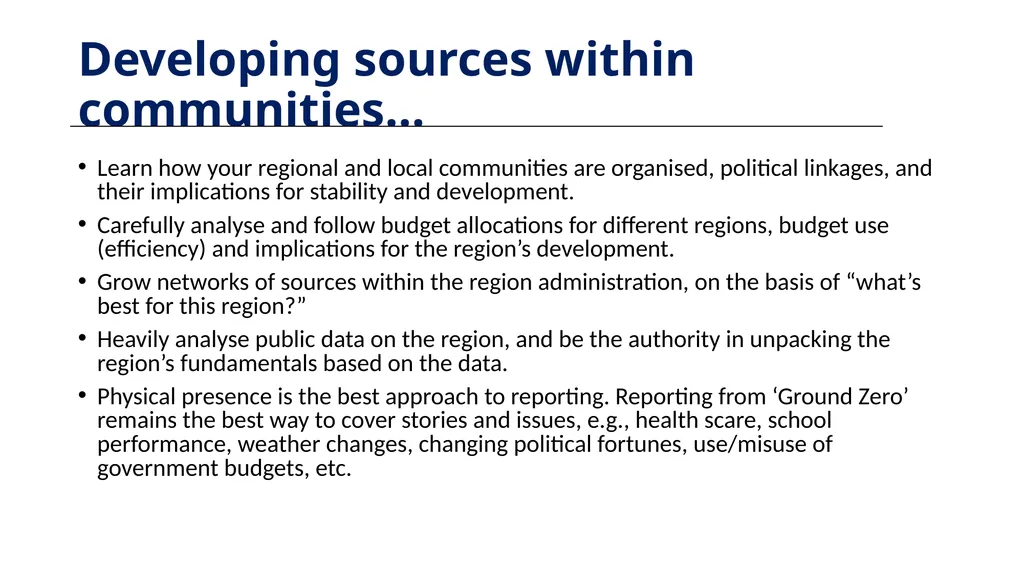
Developing sources within communities… Learn how your regional and local communities are organised, political linkages, and their implications for stability and development.
Carefully analyse and follow budget allocations for different regions, budget use (efficiency) and implications for the region’s development.
Grow networks of sources within the region administration, on the basis of “what’s best for this region?”
Heavily analyse public data on the region, and be the authority in unpacking the region’s fundamentals based on the data.
Physical presence is the best approach to reporting. Reporting from ‘Ground Zero’ remains the best way to cover stories and issues, e.g., health scare, school performance, weather changes, changing political fortunes, use/misuse of government budgets, etc.<br>
07
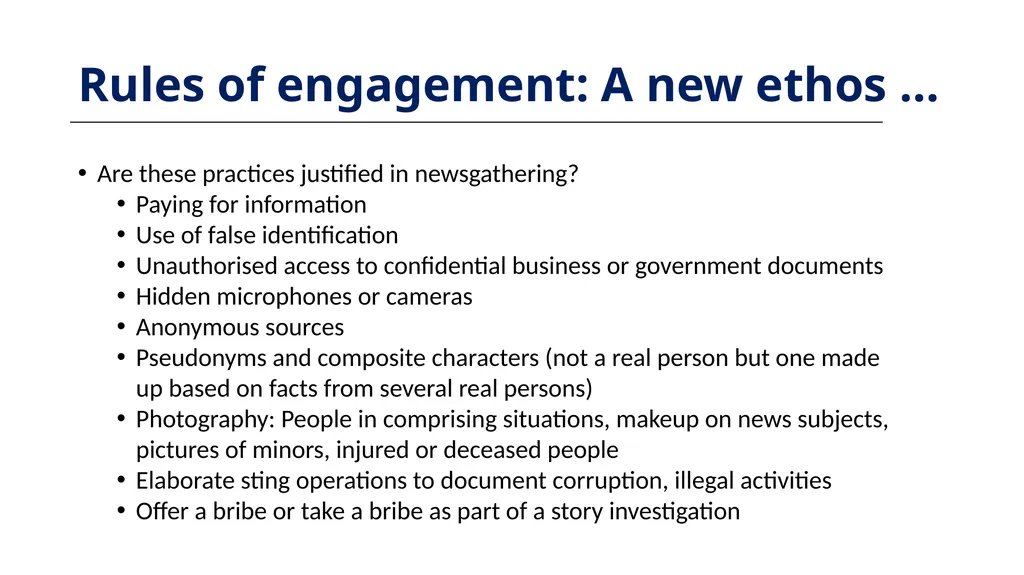
Rules of engagement: A new ethos … Are these practices justified in newsgathering?
Paying for information
Use of false identification
Unauthorised access to confidential business or government documents
Hidden microphones or cameras
Anonymous sources
Pseudonyms and composite characters (not a real person but one made up based on facts from several real persons)
Photography: People in comprising situations, makeup on news subjects, pictures of minors, injured or deceased people
Elaborate sting operations to document corruption, illegal activities
Offer a bribe or take a bribe as part of a story investigation<br>