Making Broadcasts Accessible Online A Study on the
Description: Making Broadcasts Accessible Online A Study on the Copyright- Related Environment and Industry Practice Instituut voor informatierecht (IViR) By: dr. Simone Schroff The conundrum: making TV broadcasts accessible online NISV holds 498,127 TV
Related Topics
Download Presentation
"Making Broadcasts Accessible Online A Study on the" is the property of its rightful owner. Permission is granted to download and print the materials on this website for personal, non-commercial use only, and to display it on your personal computer provided you do not modify the materials and that you retain all copyright notices contained in the materials. By downloading content from our website, you accept the terms of this agreement.
Presentation Transcript
slide1. Making Broadcasts Accessible Online A Study on the Copyright- Related Environment and Industry Practice Instituut voor informatierecht (IViR) By: dr. Simone Schroff<br>
slide2. The conundrum: making TV broadcasts accessible online NISV holds 498,127 TV broadcasts (~2015) made by public service broadcasters
Most have been digitised
Only 2% are accessible online
Main reason: uncertainty about the copyright status
Especially who can provide a license 2<br>
slide3. The copyright issue Making broadcasts accessible online requires 2 rights: reproduction and making available
No exemptions are available for large scale project
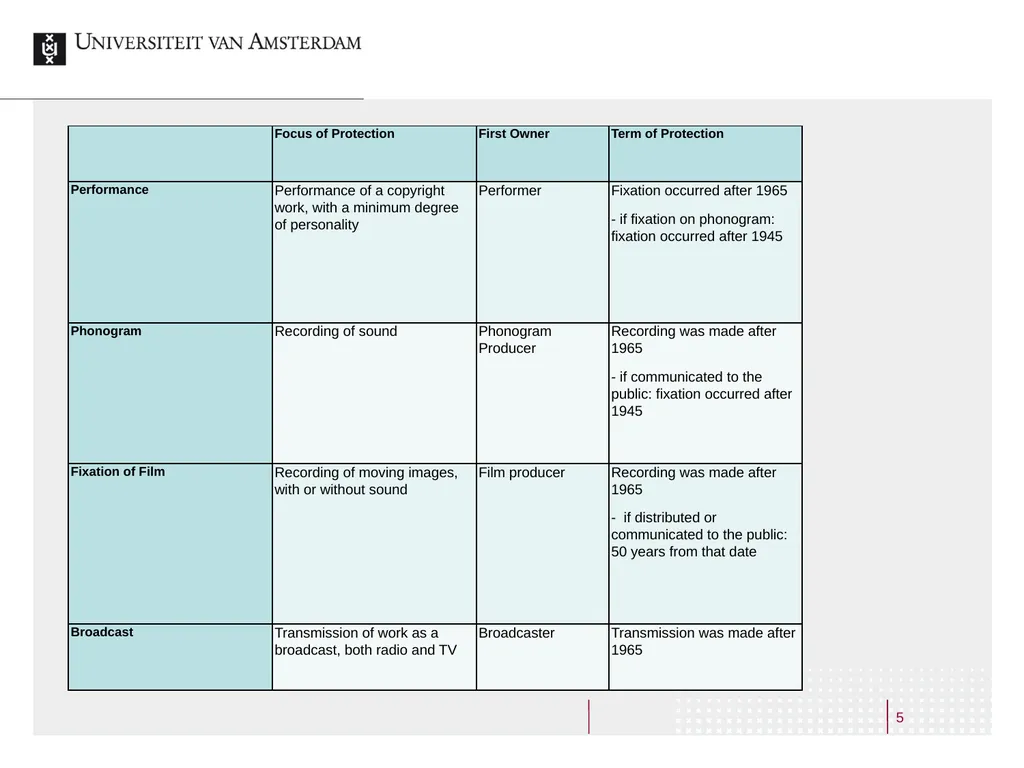
Each TV broadcast is made up of a combination of copyright works and neighbouring rights
Terms and right holders vary
Creator- doctrine
Need to identify the right holder 3<br>
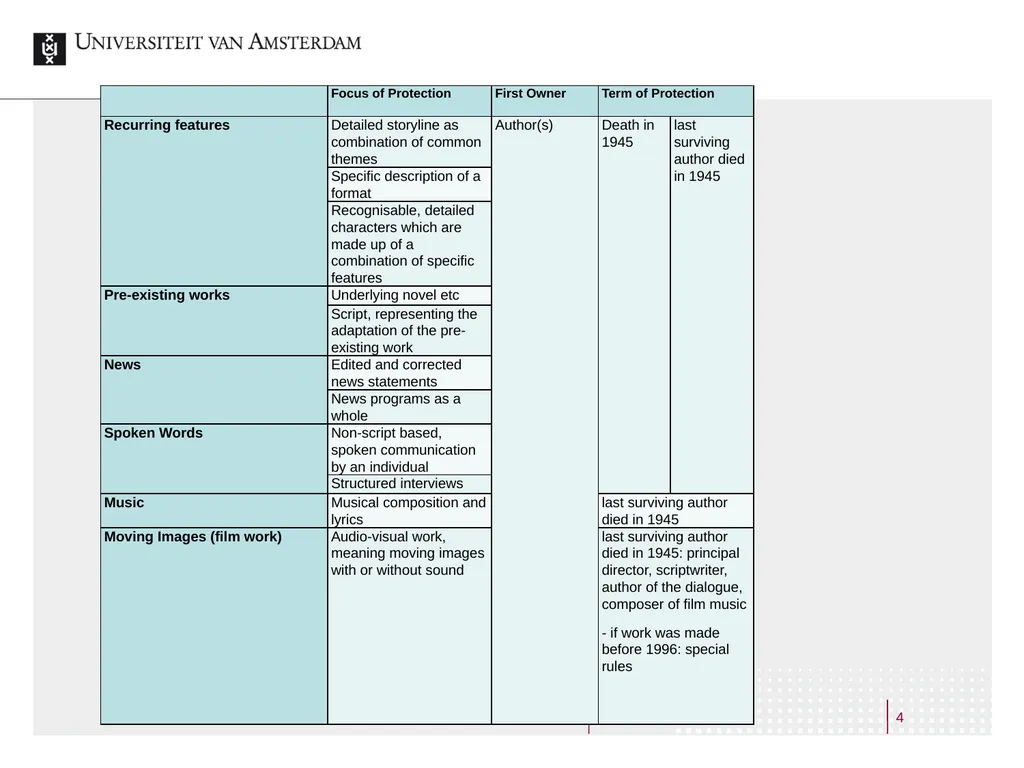
slide4. 4<br>
slide5. 5<br>
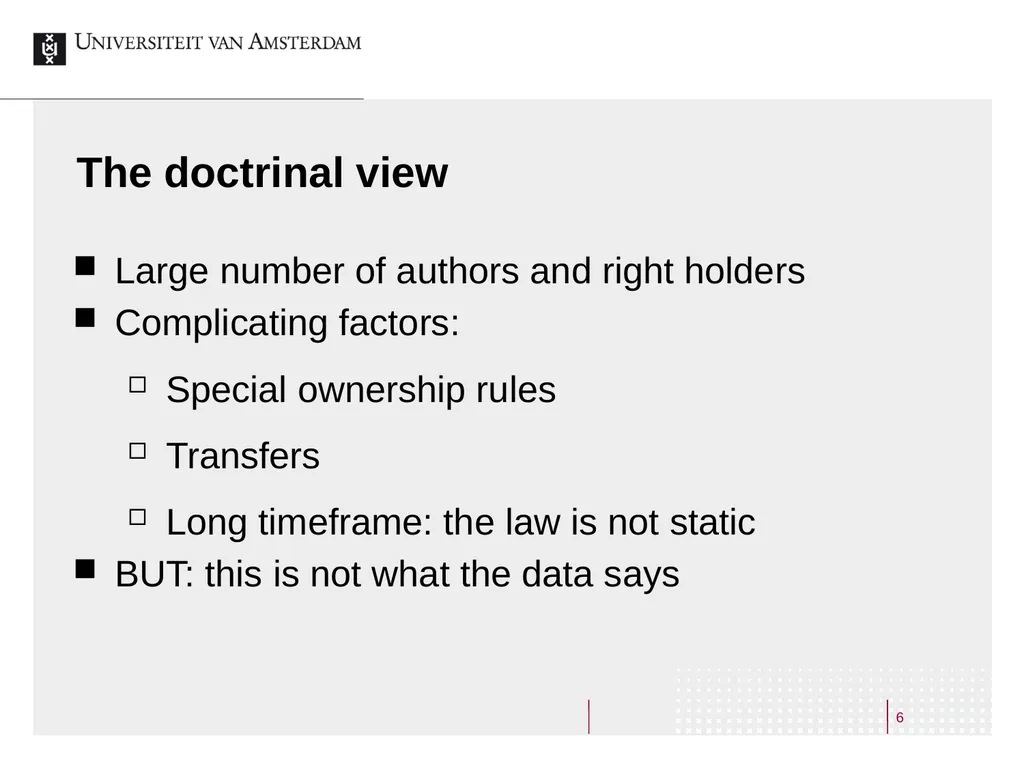
slide6. The doctrinal view Large number of authors and right holders
Complicating factors:
Special ownership rules
Transfers
Long timeframe: the law is not static
BUT: this is not what the data says 6<br>
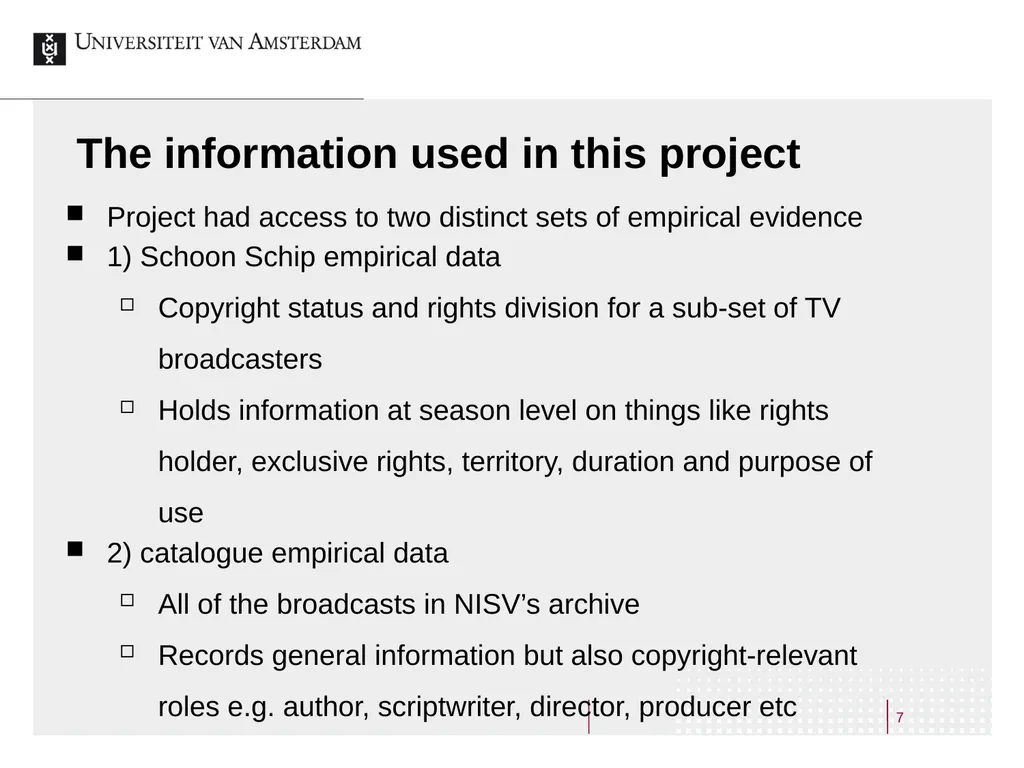
slide7. The information used in this project Project had access to two distinct sets of empirical evidence
1) Schoon Schip empirical data
Copyright status and rights division for a sub-set of TV broadcasters
Holds information at season level on things like rights holder, exclusive rights, territory, duration and purpose of use
2) catalogue empirical data
All of the broadcasts in NISV’s archive
Records general information but also copyright-relevant roles e.g. author, scriptwriter, director, producer etc 7<br>
slide8. 8<br>
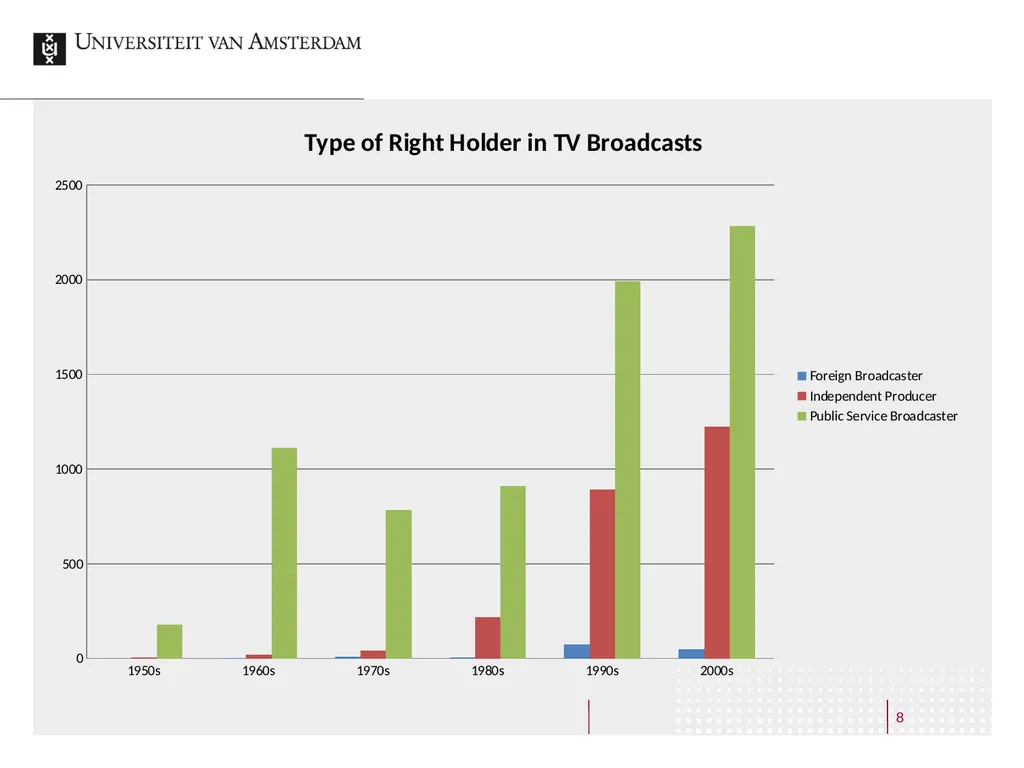
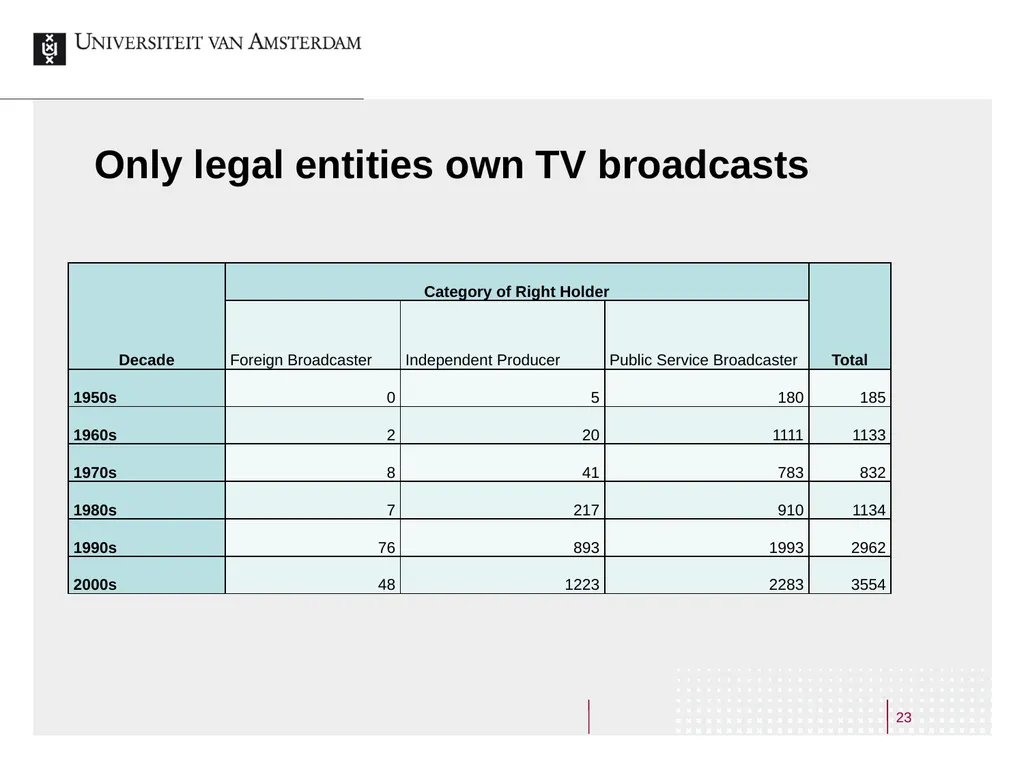
slide9. company ownership by especially public service broadcasters and independant producers
What we don‘t see: individual authors holding the rights
Conclusion:
The doctrinal analysis by itself is insufficient
Public service broadcasting market practice concentrates the rights into the hands of few people
However, how this happens is important Typ hier de footer 9<br>
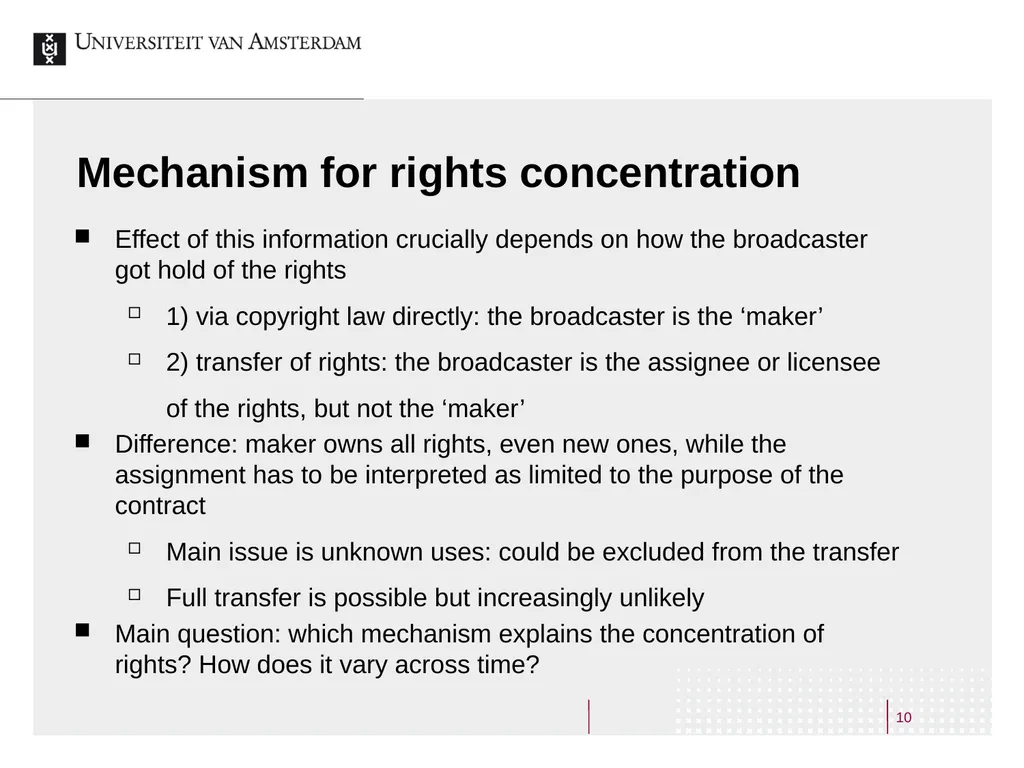
slide10. Mechanism for rights concentration Effect of this information crucially depends on how the broadcaster got hold of the rights
1) via copyright law directly: the broadcaster is the ‘maker’
2) transfer of rights: the broadcaster is the assignee or licensee of the rights, but not the ‘maker’
Difference: maker owns all rights, even new ones, while the assignment has to be interpreted as limited to the purpose of the contract
Main issue is unknown uses: could be excluded from the transfer
Full transfer is possible but increasingly unlikely
Main question: which mechanism explains the concentration of rights? How does it vary across time? 10<br>
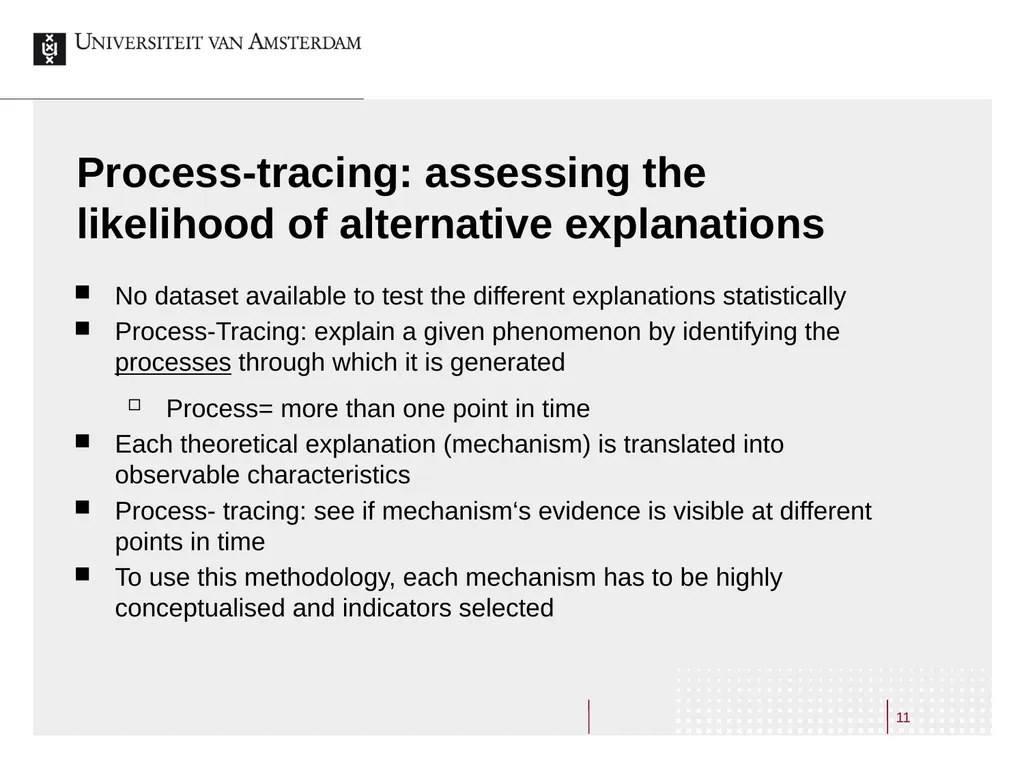
slide11. Process-tracing: assessing the likelihood of alternative explanations No dataset available to test the different explanations statistically
Process-Tracing: explain a given phenomenon by identifying the processes through which it is generated
Process= more than one point in time
Each theoretical explanation (mechanism) is translated into observable characteristics
Process- tracing: see if mechanism‘s evidence is visible at different points in time
To use this methodology, each mechanism has to be highly conceptualised and indicators selected 11<br>
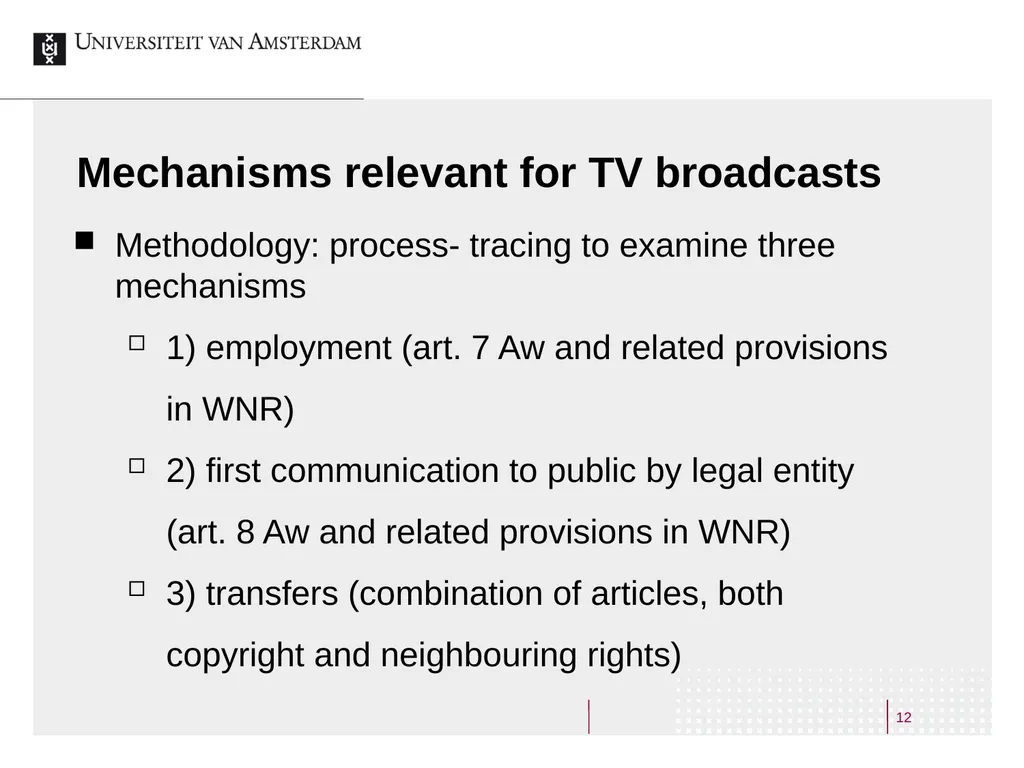
slide12. Mechanisms relevant for TV broadcasts Methodology: process- tracing to examine three mechanisms
1) employment (art. 7 Aw and related provisions in WNR)
2) first communication to public by legal entity (art. 8 Aw and related provisions in WNR)
3) transfers (combination of articles, both copyright and neighbouring rights) 12<br>
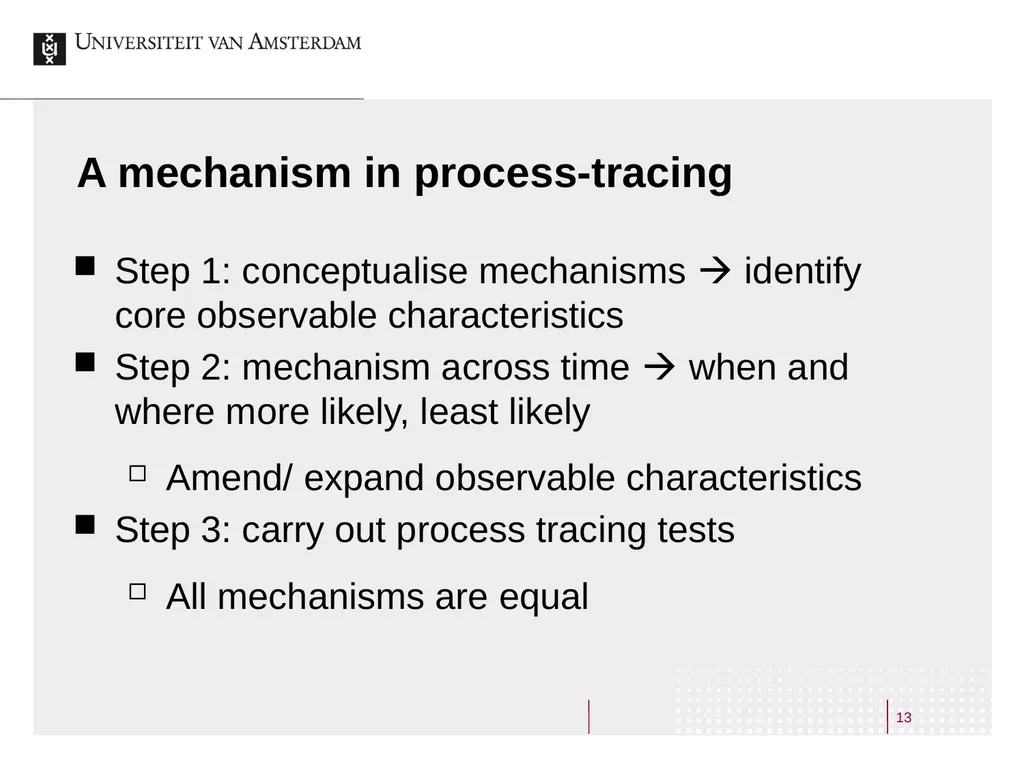
slide13. A mechanism in process-tracing Step 1: conceptualise mechanisms identify core observable characteristics
Step 2: mechanism across time when and where more likely, least likely
Amend/ expand observable characteristics
Step 3: carry out process tracing tests
All mechanisms are equal 13<br>
slide14. How does it work? (example: employment) Step 1: conceptualise the mechanism
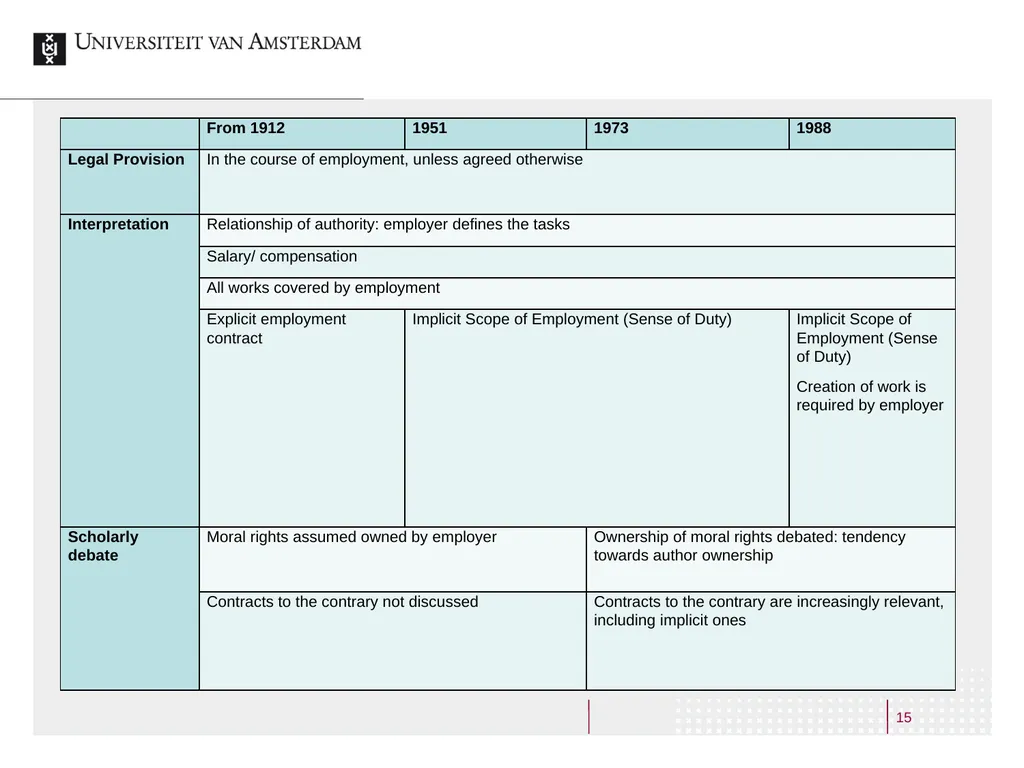
Detailed doctrinal analysis of how the rules on employment have changed since 1912
Focus on turning points table 14<br>
slide15. 15<br>
slide16. NWO Project: How does it work? (employment) Step 1: conceptualise the mechanism
Detailed doctrinal analysis
Step 2: identify observable characteristics that reflect the legal relevance
Always in the form of hypothesis
Special attention to turning points 16<br>
slide17. Examples of Hypotheses E3: Due to the financial resources required, the author will most likely be a legal entity. This will most likely be a single entity.
E8: Permitting the author to put his name on a work can indicate an implicit contract, acting as a disincentive to the naming of authors (especially after 1973). Works of employment are therefore more likely to not have any author information. 17<br>
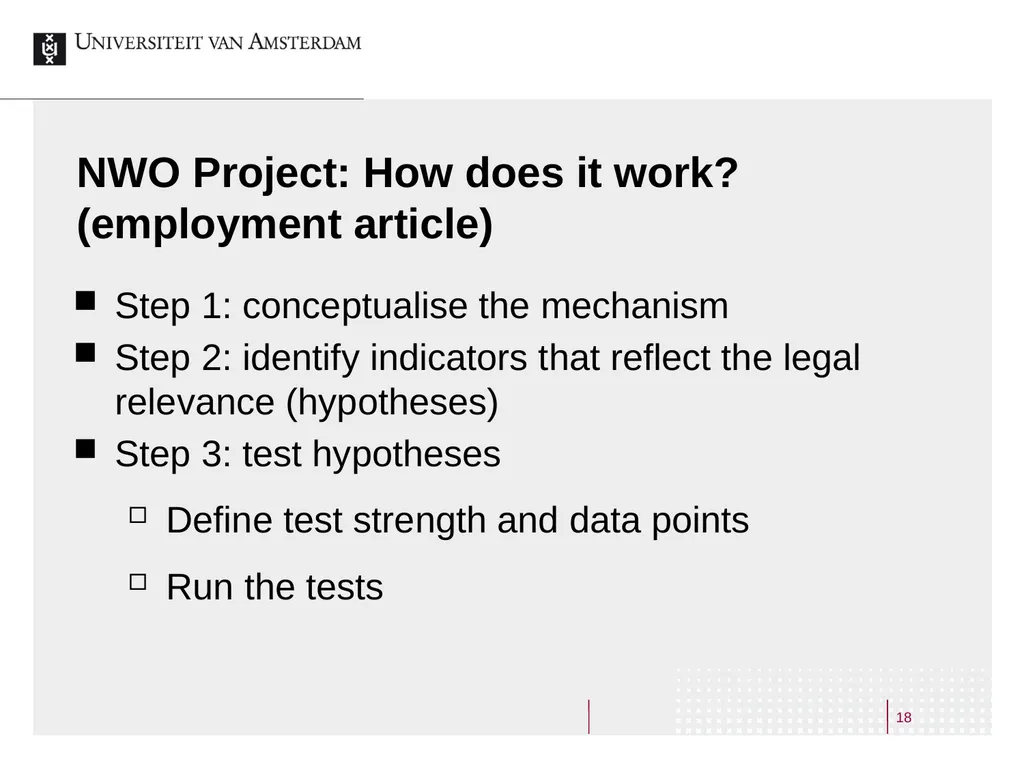
slide18. NWO Project: How does it work? (employment article) Step 1: conceptualise the mechanism
Step 2: identify indicators that reflect the legal relevance (hypotheses)
Step 3: test hypotheses
Define test strength and data points
Run the tests 18<br>
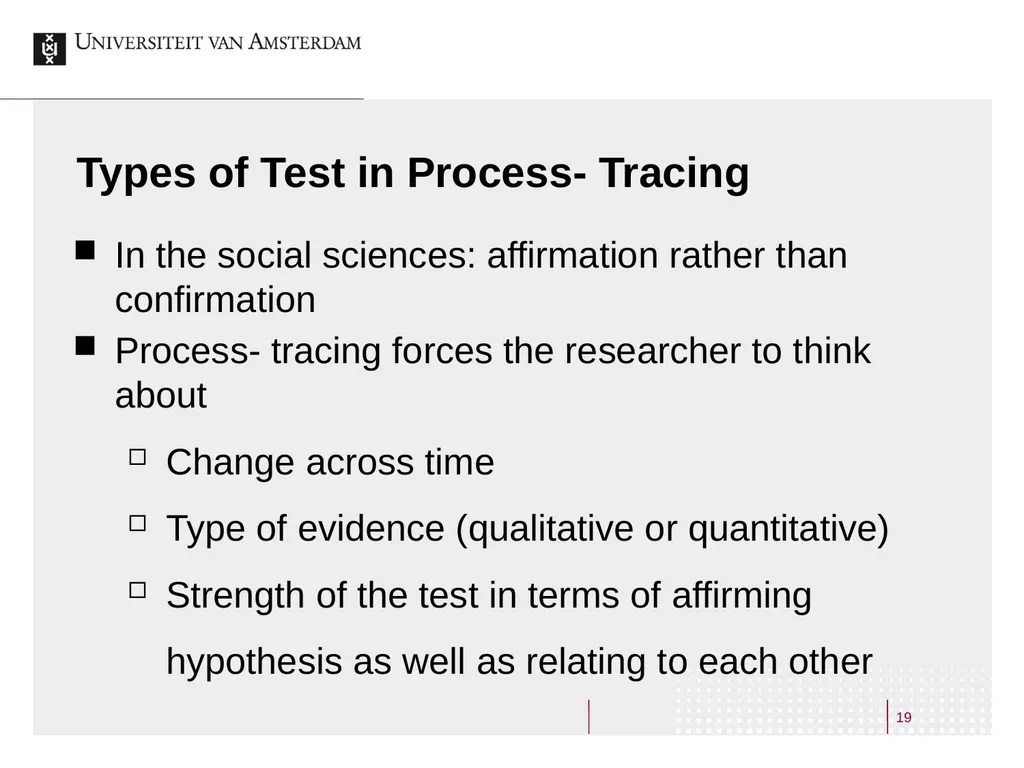
slide19. Types of Test in Process- Tracing In the social sciences: affirmation rather than confirmation
Process- tracing forces the researcher to think about
Change across time
Type of evidence (qualitative or quantitative)
Strength of the test in terms of affirming hypothesis as well as relating to each other 19<br>
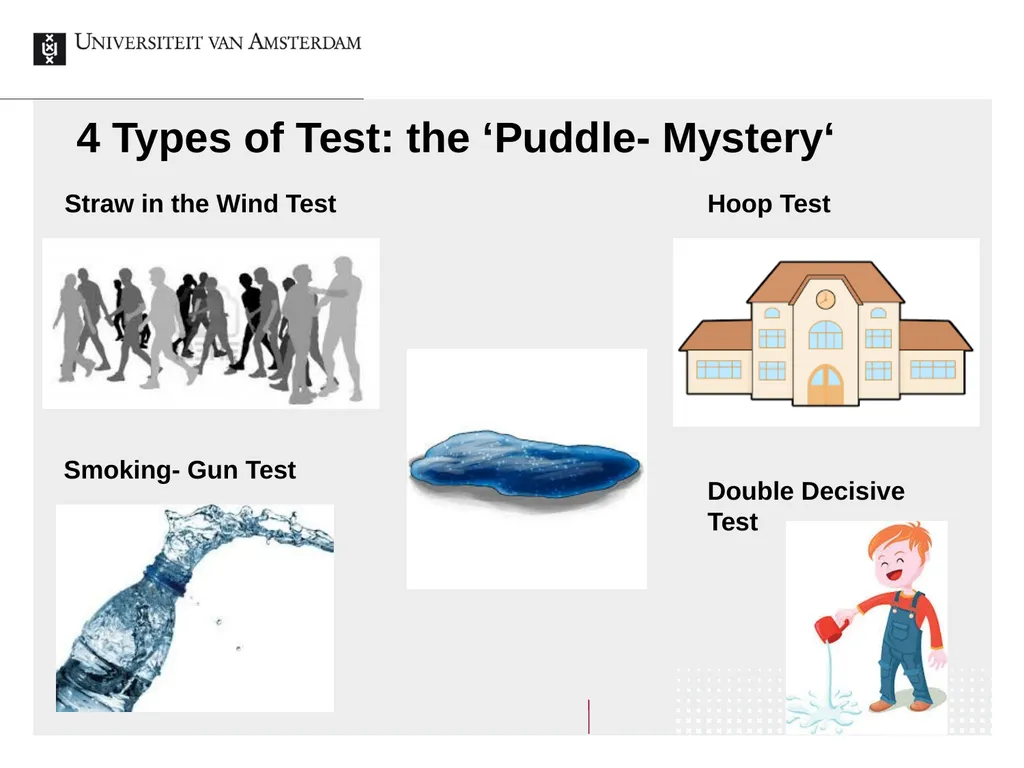
slide20. 4 Types of Test: the ‘Puddle- Mystery‘ 20 Straw in the Wind Test Smoking- Gun Test Hoop Test Double Decisive Test<br>
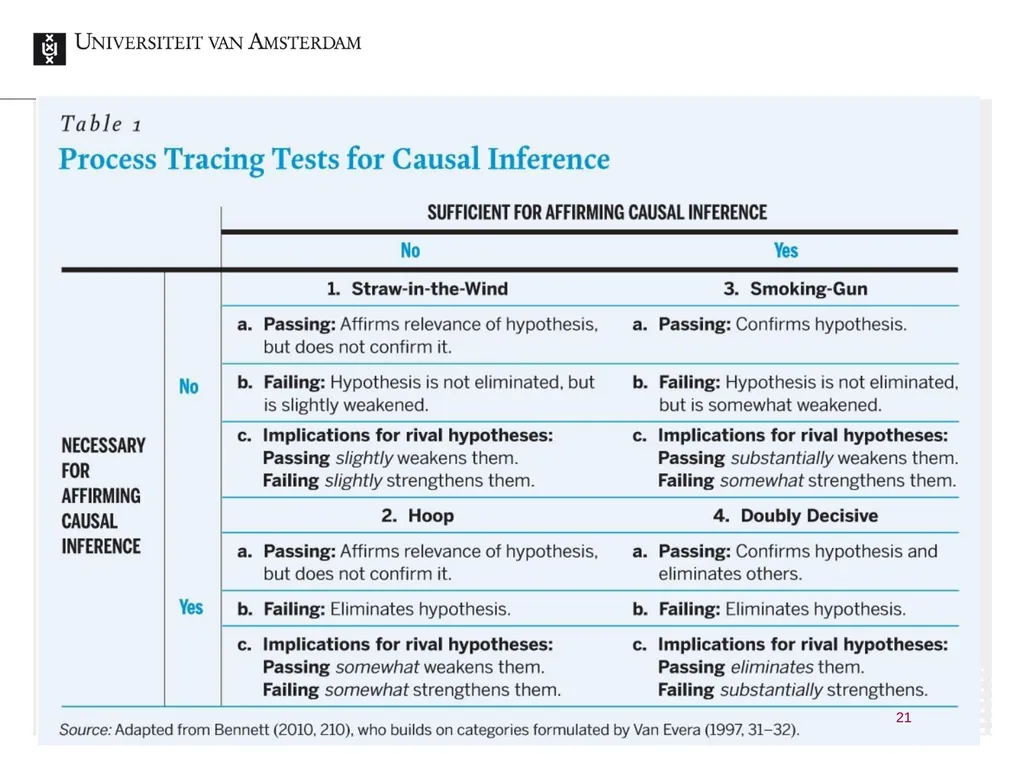
slide21. 21<br>
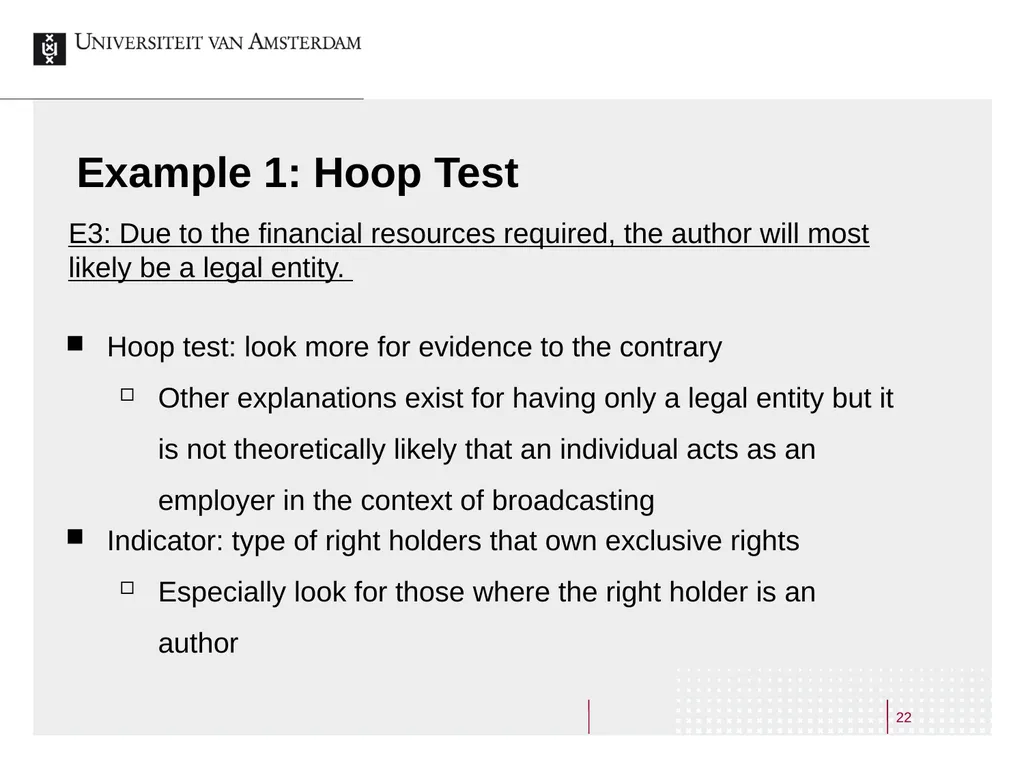
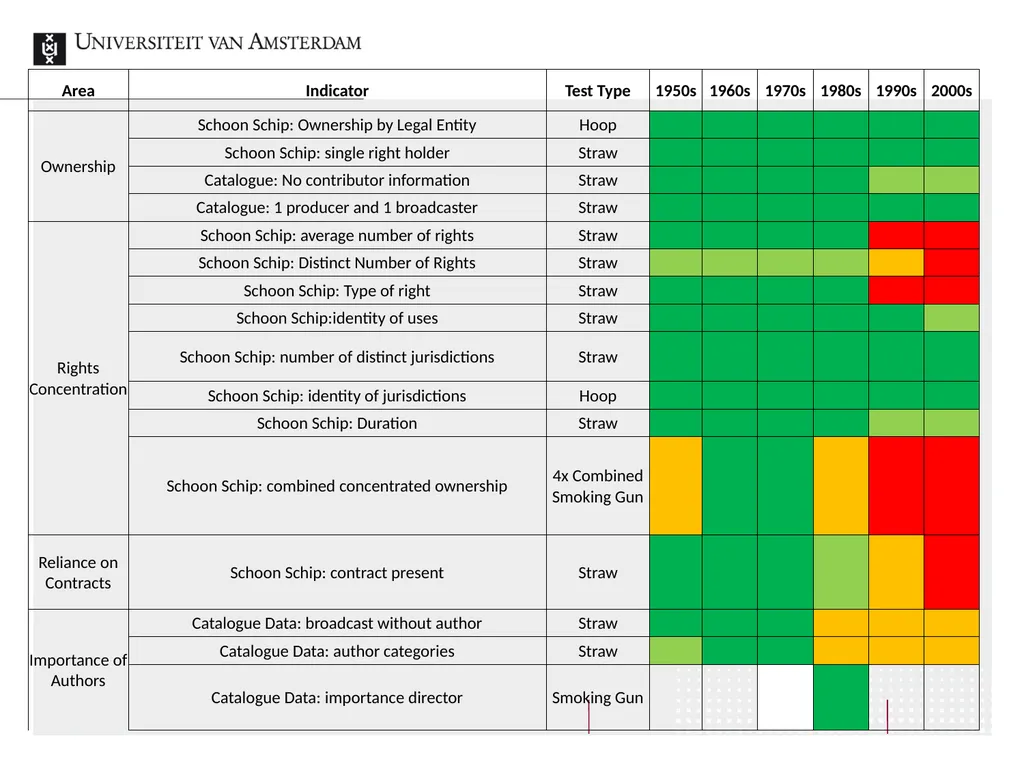
slide22. Example 1: Hoop Test E3: Due to the financial resources required, the author will most likely be a legal entity.
Hoop test: look more for evidence to the contrary
Other explanations exist for having only a legal entity but it is not theoretically likely that an individual acts as an employer in the context of broadcasting
Indicator: type of right holders that own exclusive rights
Especially look for those where the right holder is an author 22<br>
slide23. 23 Only legal entities own TV broadcasts<br>
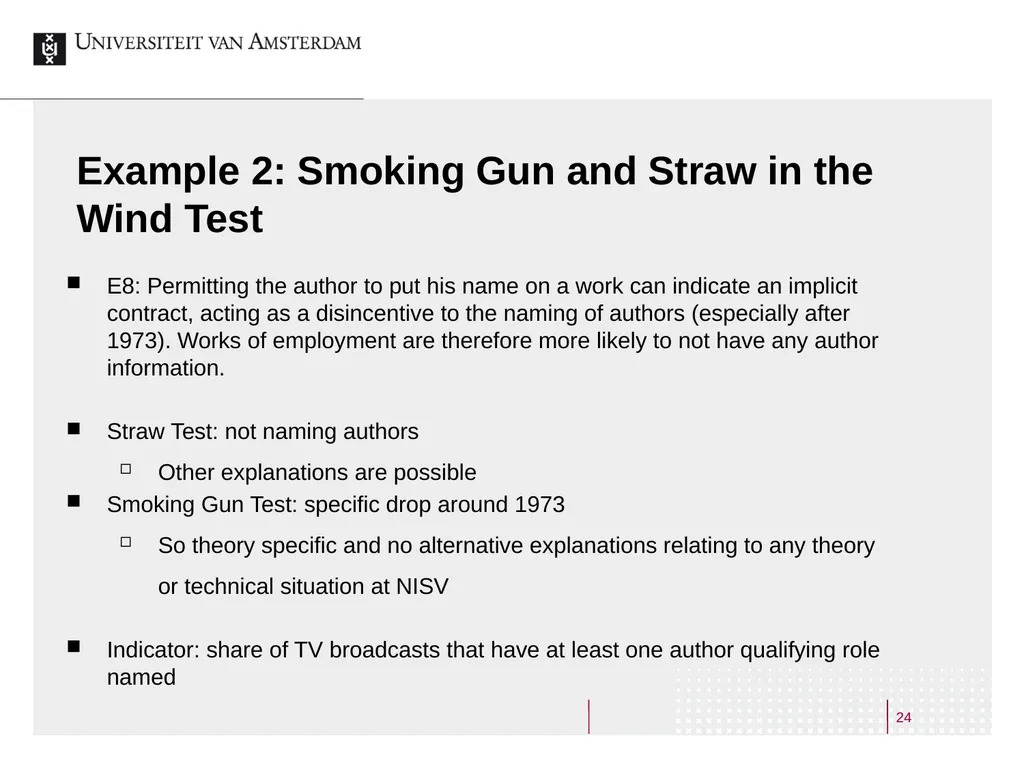
slide24. Example 2: Smoking Gun and Straw in the Wind Test E8: Permitting the author to put his name on a work can indicate an implicit contract, acting as a disincentive to the naming of authors (especially after 1973). Works of employment are therefore more likely to not have any author information.
Straw Test: not naming authors
Other explanations are possible
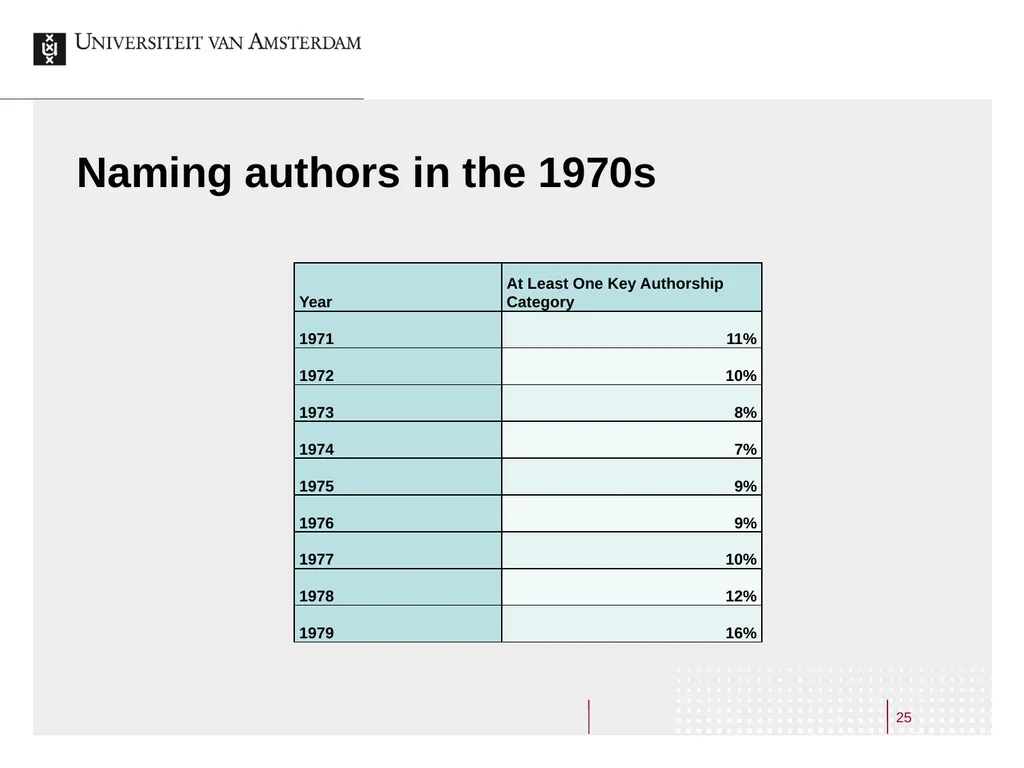
Smoking Gun Test: specific drop around 1973
So theory specific and no alternative explanations relating to any theory or technical situation at NISV
Indicator: share of TV broadcasts that have at least one author qualifying role named 24<br>
slide25. Naming authors in the 1970s 25<br>
slide26. Example 3: constructing a double decisive Under employment rules, the third party is the author: rights should be highly concentrated
Series of individually tested hypotheses but the strongest case if they all occur at the same time
Concentration highly unlikely under transfer rules
Indicator: combination of all exclusive rights, territory (at least the NL), full duration and all purposes of use 26<br>
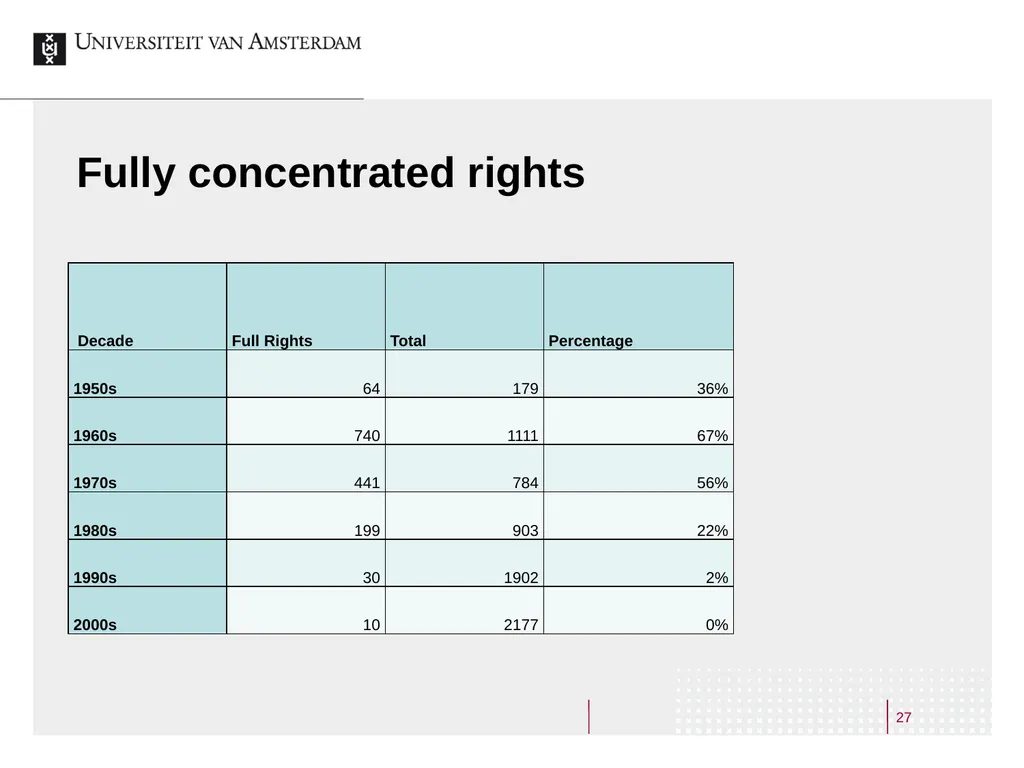
slide27. Fully concentrated rights 27<br>
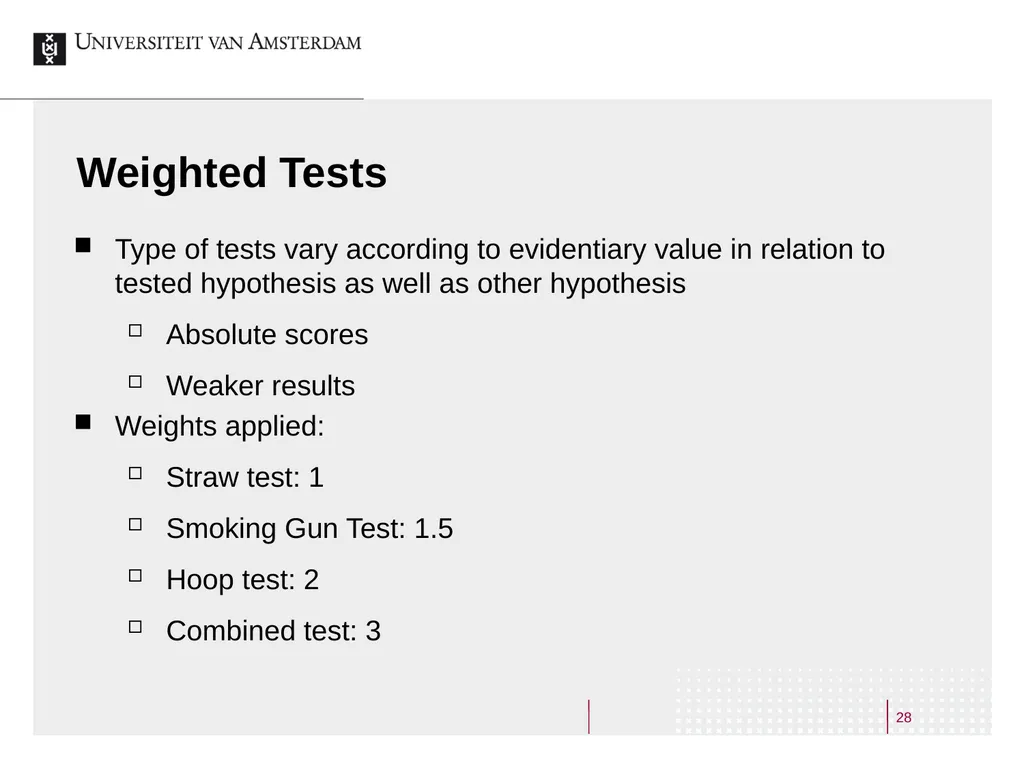
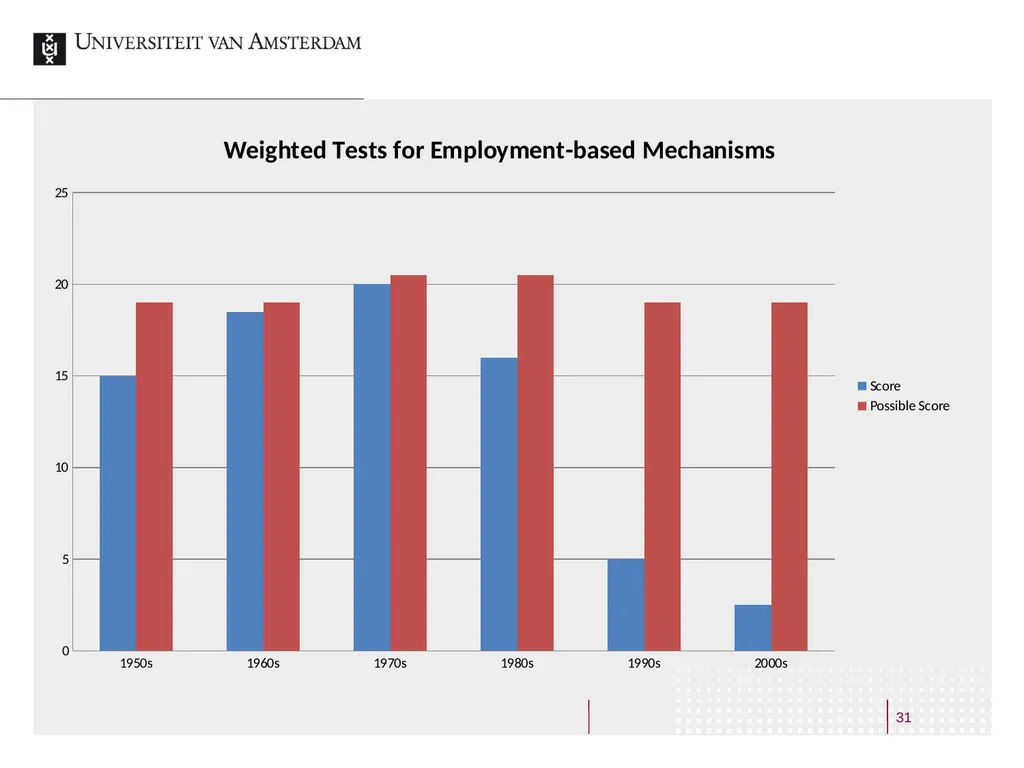
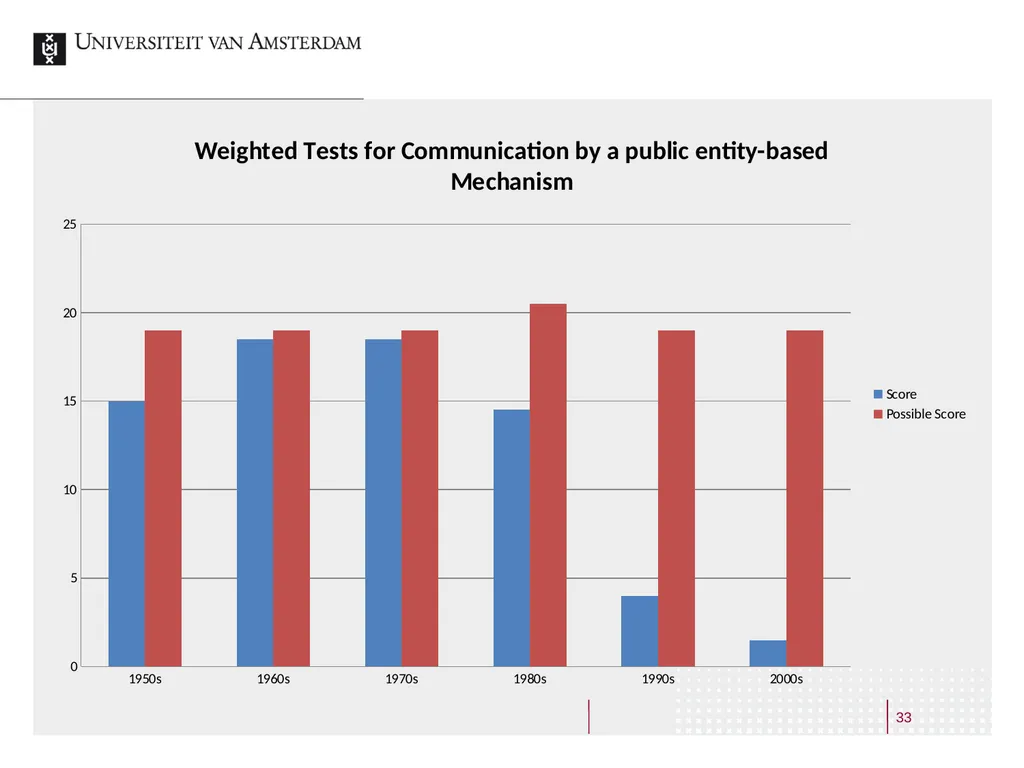
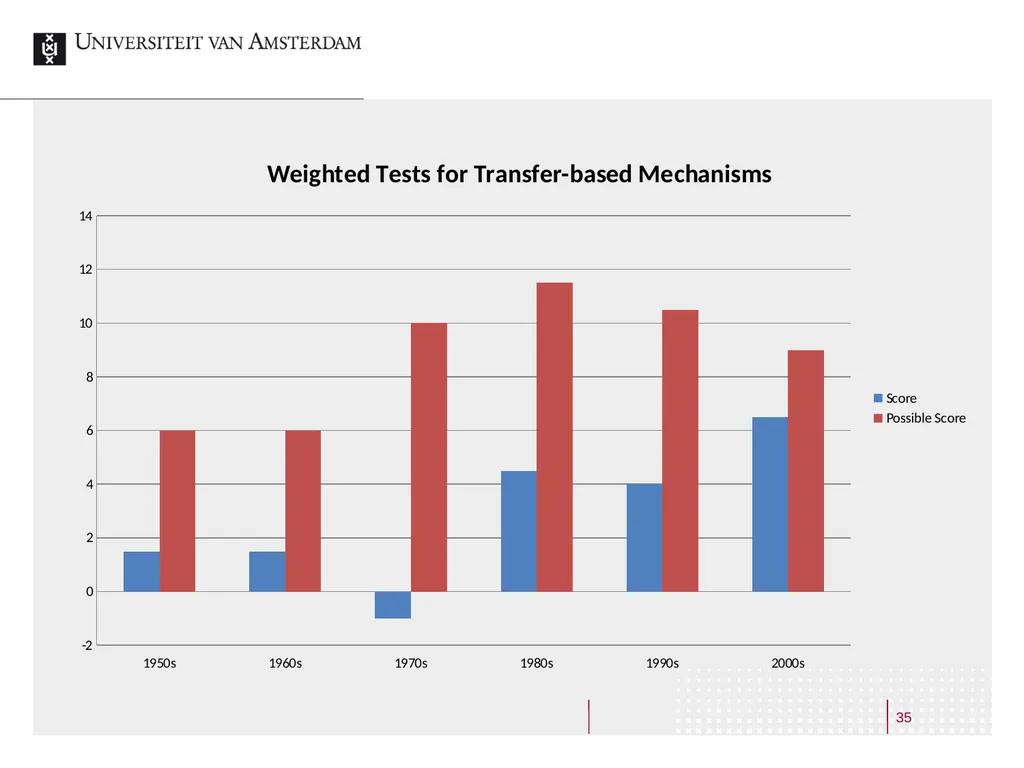
slide28. Weighted Tests Type of tests vary according to evidentiary value in relation to tested hypothesis as well as other hypothesis
Absolute scores
Weaker results
Weights applied:
Straw test: 1
Smoking Gun Test: 1.5
Hoop test: 2
Combined test: 3 28<br>
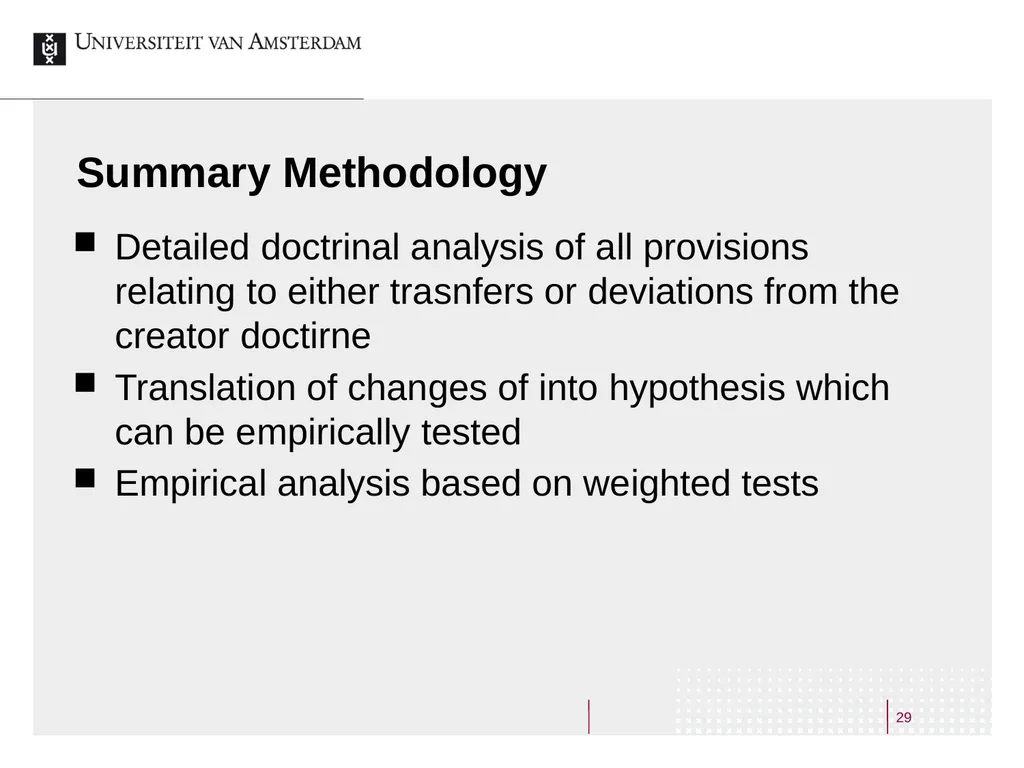
slide29. Summary Methodology Detailed doctrinal analysis of all provisions relating to either trasnfers or deviations from the creator doctirne
Translation of changes of into hypothesis which can be empirically tested
Empirical analysis based on weighted tests 29<br>
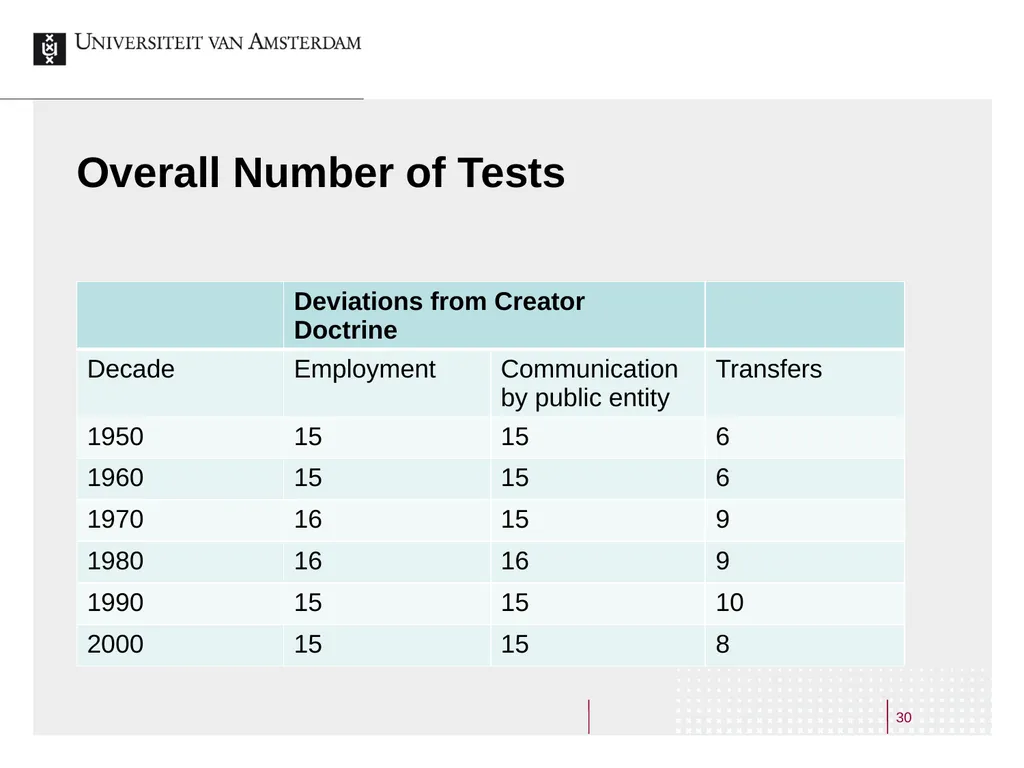
slide30. Overall Number of Tests 30<br>
slide31. 31<br>
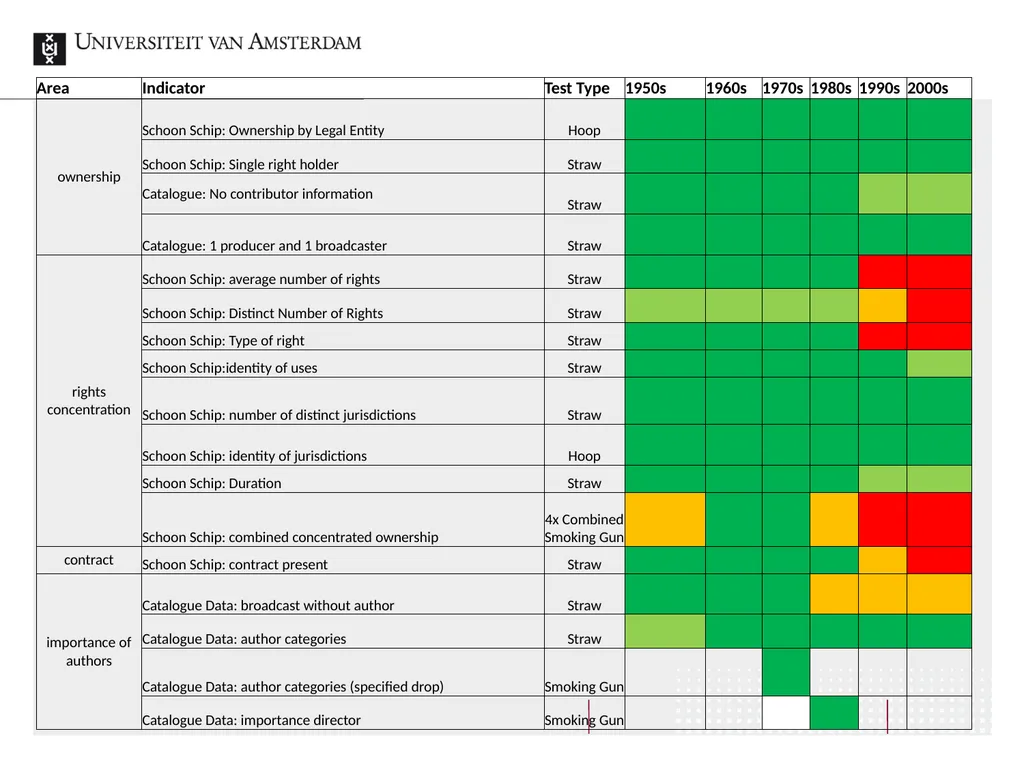
slide33. 33<br>
slide35. 35<br>
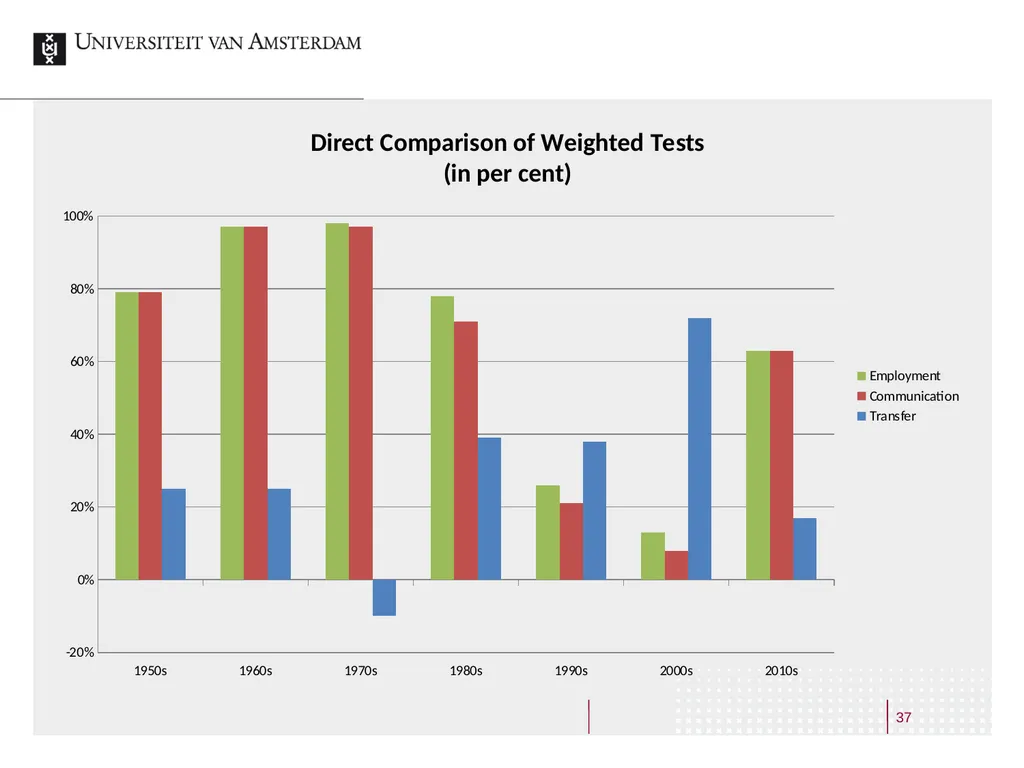
slide37. 37<br>
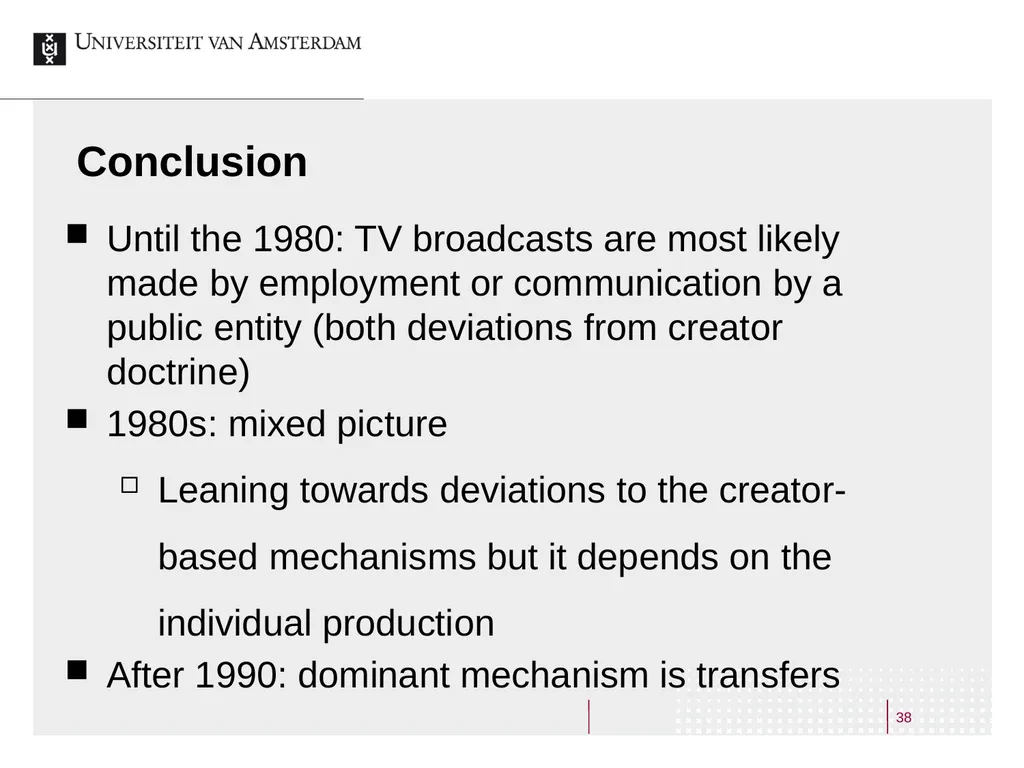
slide38. Conclusion Until the 1980: TV broadcasts are most likely made by employment or communication by a public entity (both deviations from creator doctrine)
1980s: mixed picture
Leaning towards deviations to the creator-based mechanisms but it depends on the individual production
After 1990: dominant mechanism is transfers 38<br>
slide39. Implications: who owns the making available right? Up until 1980: most likely the broadcaster
TV broadcasts made from the 1990s onwards
Making available online covered in contracts+ presumption of transfer
Troublesome:
TV broadcasts between 1980 and early 1990s: making available not likely to be part of contracts
The more authors, the more difficult it gets 39<br>
slide40. Thank you for your attention! 40<br>
slide2. The conundrum: making TV broadcasts accessible online NISV holds 498,127 TV broadcasts (~2015) made by public service broadcasters
Most have been digitised
Only 2% are accessible online
Main reason: uncertainty about the copyright status
Especially who can provide a license 2<br>
slide3. The copyright issue Making broadcasts accessible online requires 2 rights: reproduction and making available
No exemptions are available for large scale project
Each TV broadcast is made up of a combination of copyright works and neighbouring rights
Terms and right holders vary
Creator- doctrine
Need to identify the right holder 3<br>
slide4. 4<br>
slide5. 5<br>
slide6. The doctrinal view Large number of authors and right holders
Complicating factors:
Special ownership rules
Transfers
Long timeframe: the law is not static
BUT: this is not what the data says 6<br>
slide7. The information used in this project Project had access to two distinct sets of empirical evidence
1) Schoon Schip empirical data
Copyright status and rights division for a sub-set of TV broadcasters
Holds information at season level on things like rights holder, exclusive rights, territory, duration and purpose of use
2) catalogue empirical data
All of the broadcasts in NISV’s archive
Records general information but also copyright-relevant roles e.g. author, scriptwriter, director, producer etc 7<br>
slide8. 8<br>
slide9. company ownership by especially public service broadcasters and independant producers
What we don‘t see: individual authors holding the rights
Conclusion:
The doctrinal analysis by itself is insufficient
Public service broadcasting market practice concentrates the rights into the hands of few people
However, how this happens is important Typ hier de footer 9<br>
slide10. Mechanism for rights concentration Effect of this information crucially depends on how the broadcaster got hold of the rights
1) via copyright law directly: the broadcaster is the ‘maker’
2) transfer of rights: the broadcaster is the assignee or licensee of the rights, but not the ‘maker’
Difference: maker owns all rights, even new ones, while the assignment has to be interpreted as limited to the purpose of the contract
Main issue is unknown uses: could be excluded from the transfer
Full transfer is possible but increasingly unlikely
Main question: which mechanism explains the concentration of rights? How does it vary across time? 10<br>
slide11. Process-tracing: assessing the likelihood of alternative explanations No dataset available to test the different explanations statistically
Process-Tracing: explain a given phenomenon by identifying the processes through which it is generated
Process= more than one point in time
Each theoretical explanation (mechanism) is translated into observable characteristics
Process- tracing: see if mechanism‘s evidence is visible at different points in time
To use this methodology, each mechanism has to be highly conceptualised and indicators selected 11<br>
slide12. Mechanisms relevant for TV broadcasts Methodology: process- tracing to examine three mechanisms
1) employment (art. 7 Aw and related provisions in WNR)
2) first communication to public by legal entity (art. 8 Aw and related provisions in WNR)
3) transfers (combination of articles, both copyright and neighbouring rights) 12<br>
slide13. A mechanism in process-tracing Step 1: conceptualise mechanisms identify core observable characteristics
Step 2: mechanism across time when and where more likely, least likely
Amend/ expand observable characteristics
Step 3: carry out process tracing tests
All mechanisms are equal 13<br>
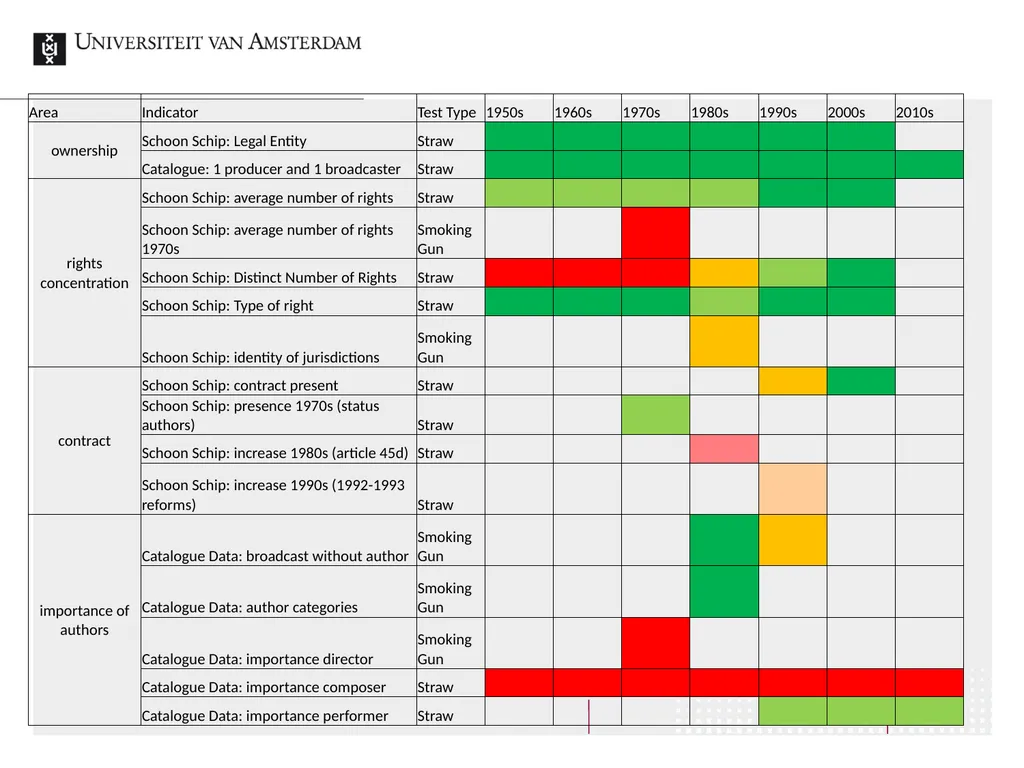
slide14. How does it work? (example: employment) Step 1: conceptualise the mechanism
Detailed doctrinal analysis of how the rules on employment have changed since 1912
Focus on turning points table 14<br>
slide15. 15<br>
slide16. NWO Project: How does it work? (employment) Step 1: conceptualise the mechanism
Detailed doctrinal analysis
Step 2: identify observable characteristics that reflect the legal relevance
Always in the form of hypothesis
Special attention to turning points 16<br>
slide17. Examples of Hypotheses E3: Due to the financial resources required, the author will most likely be a legal entity. This will most likely be a single entity.
E8: Permitting the author to put his name on a work can indicate an implicit contract, acting as a disincentive to the naming of authors (especially after 1973). Works of employment are therefore more likely to not have any author information. 17<br>
slide18. NWO Project: How does it work? (employment article) Step 1: conceptualise the mechanism
Step 2: identify indicators that reflect the legal relevance (hypotheses)
Step 3: test hypotheses
Define test strength and data points
Run the tests 18<br>
slide19. Types of Test in Process- Tracing In the social sciences: affirmation rather than confirmation
Process- tracing forces the researcher to think about
Change across time
Type of evidence (qualitative or quantitative)
Strength of the test in terms of affirming hypothesis as well as relating to each other 19<br>
slide20. 4 Types of Test: the ‘Puddle- Mystery‘ 20 Straw in the Wind Test Smoking- Gun Test Hoop Test Double Decisive Test<br>
slide21. 21<br>
slide22. Example 1: Hoop Test E3: Due to the financial resources required, the author will most likely be a legal entity.
Hoop test: look more for evidence to the contrary
Other explanations exist for having only a legal entity but it is not theoretically likely that an individual acts as an employer in the context of broadcasting
Indicator: type of right holders that own exclusive rights
Especially look for those where the right holder is an author 22<br>
slide23. 23 Only legal entities own TV broadcasts<br>
slide24. Example 2: Smoking Gun and Straw in the Wind Test E8: Permitting the author to put his name on a work can indicate an implicit contract, acting as a disincentive to the naming of authors (especially after 1973). Works of employment are therefore more likely to not have any author information.
Straw Test: not naming authors
Other explanations are possible
Smoking Gun Test: specific drop around 1973
So theory specific and no alternative explanations relating to any theory or technical situation at NISV
Indicator: share of TV broadcasts that have at least one author qualifying role named 24<br>
slide25. Naming authors in the 1970s 25<br>
slide26. Example 3: constructing a double decisive Under employment rules, the third party is the author: rights should be highly concentrated
Series of individually tested hypotheses but the strongest case if they all occur at the same time
Concentration highly unlikely under transfer rules
Indicator: combination of all exclusive rights, territory (at least the NL), full duration and all purposes of use 26<br>
slide27. Fully concentrated rights 27<br>
slide28. Weighted Tests Type of tests vary according to evidentiary value in relation to tested hypothesis as well as other hypothesis
Absolute scores
Weaker results
Weights applied:
Straw test: 1
Smoking Gun Test: 1.5
Hoop test: 2
Combined test: 3 28<br>
slide29. Summary Methodology Detailed doctrinal analysis of all provisions relating to either trasnfers or deviations from the creator doctirne
Translation of changes of into hypothesis which can be empirically tested
Empirical analysis based on weighted tests 29<br>
slide30. Overall Number of Tests 30<br>
slide31. 31<br>
slide33. 33<br>
slide35. 35<br>
slide37. 37<br>
slide38. Conclusion Until the 1980: TV broadcasts are most likely made by employment or communication by a public entity (both deviations from creator doctrine)
1980s: mixed picture
Leaning towards deviations to the creator-based mechanisms but it depends on the individual production
After 1990: dominant mechanism is transfers 38<br>
slide39. Implications: who owns the making available right? Up until 1980: most likely the broadcaster
TV broadcasts made from the 1990s onwards
Making available online covered in contracts+ presumption of transfer
Troublesome:
TV broadcasts between 1980 and early 1990s: making available not likely to be part of contracts
The more authors, the more difficult it gets 39<br>
slide40. Thank you for your attention! 40<br>