Media and Digital Platforms Market Inquiry Provisional Report Launch 24 February 2025 Scope and Background - MDPMI The Competition Commission launched the Media and Digital Platforms Market Inquiry following severe financial strain in the
"Media and Digital Platforms Market Inquiry" is the property of its rightful owner. Permission is granted to
download and print the materials on this website for personal, non-commercial use only, and to display it
on your personal computer provided you do not modify the materials and that you retain all copyright
notices contained in the materials. By downloading content from our website, you accept the terms of this
agreement.
Presentation Transcript
01
Media and Digital Platforms Market Inquiry Provisional Report Launch
24 February 2025<br>
02
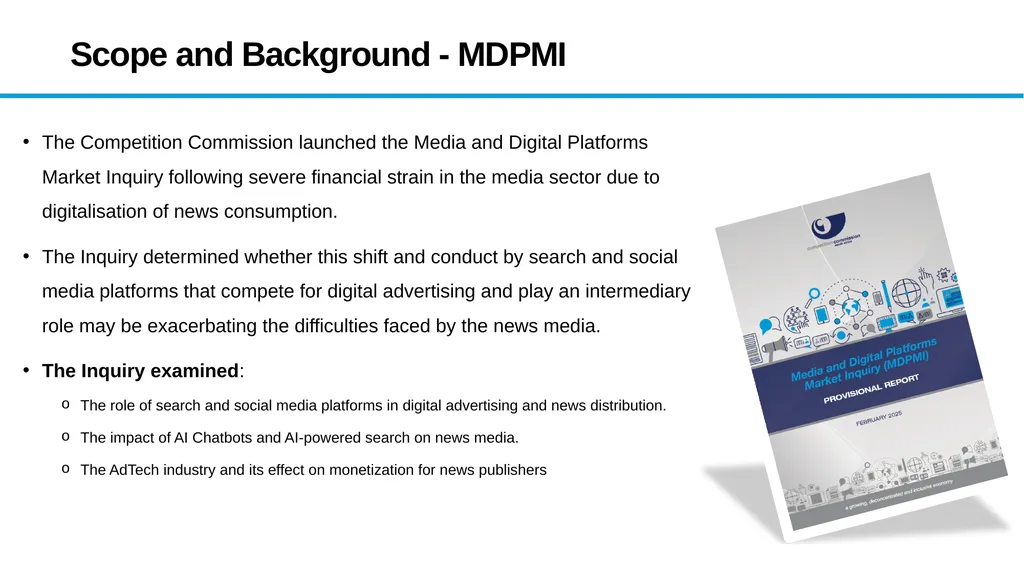
Scope and Background - MDPMI The Competition Commission launched the Media and Digital Platforms Market Inquiry following severe financial strain in the media sector due to digitalisation of news consumption.
The Inquiry determined whether this shift and conduct by search and social media platforms that compete for digital advertising and play an intermediary role may be exacerbating the difficulties faced by the news media.
The Inquiry examined:
The role of search and social media platforms in digital advertising and news distribution.
The impact of AI Chatbots and AI-powered search on news media.
The AdTech industry and its effect on monetization for news publishers<br>
03
The Constitutional & Competitive Implications The media plays a crucial role in upholding the Constitutional Right to Freedom of Expression.
Digital platforms do not create content but profit from news, potentially harming media sustainability.
Section 39(2) of the Constitution requires competition law to promote the Bill of Rights, prioritizing a strong, independent media.
This Inquiry also considered the role of the public broadcaster in media diversity and plurality.<br>
04
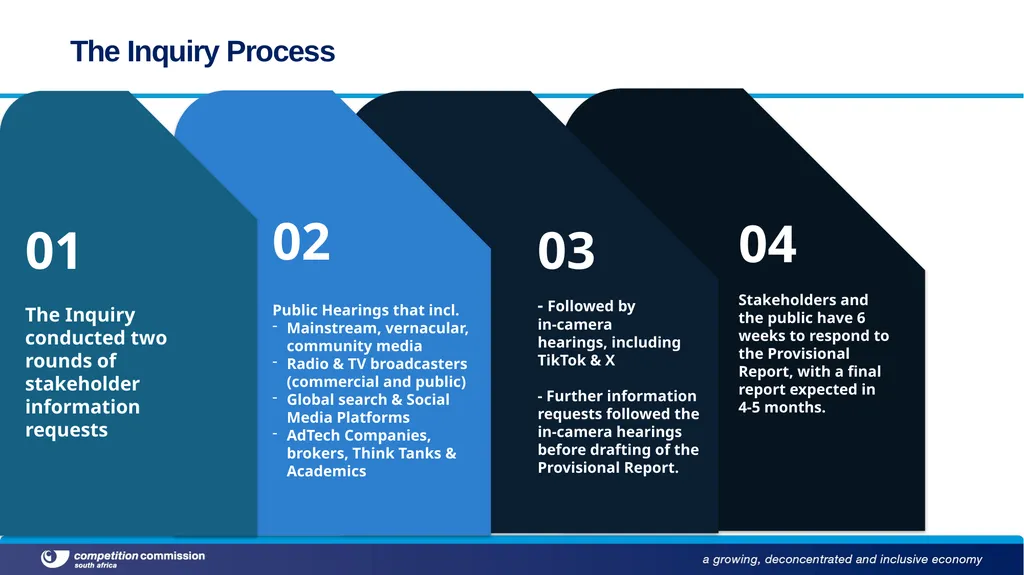
The Inquiry Process<br>
05
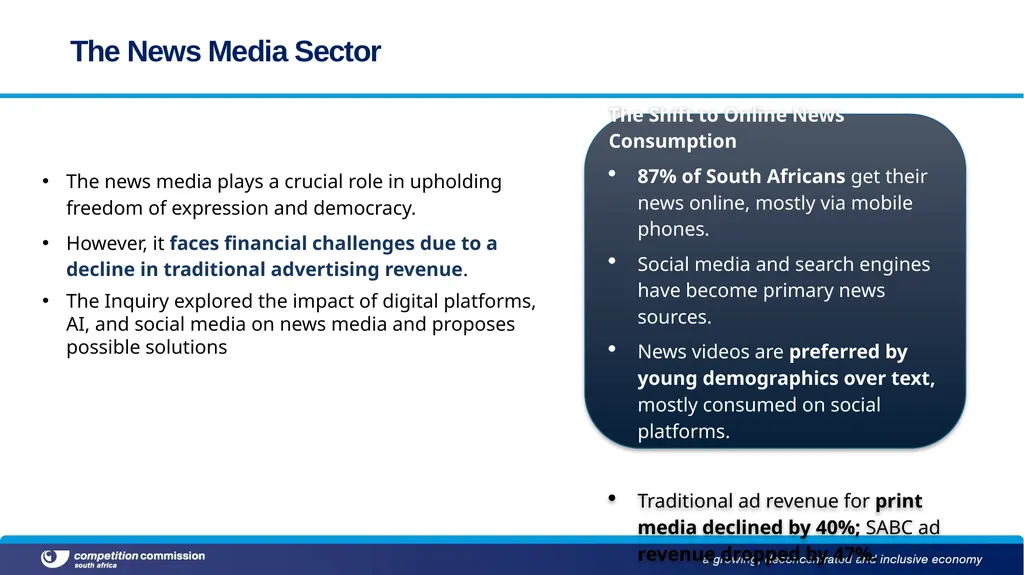
The News Media Sector The news media plays a crucial role in upholding freedom of expression and democracy.
However, it faces financial challenges due to a decline in traditional advertising revenue.
The Inquiry explored the impact of digital platforms, AI, and social media on news media and proposes possible solutions The Shift to Online News Consumption
87% of South Africans get their news online, mostly via mobile phones.
Social media and search engines have become primary news sources.
News videos are preferred by young demographics over text, mostly consumed on social platforms.
Traditional ad revenue for print media declined by 40%; SABC ad revenue dropped by 47%.<br>
06
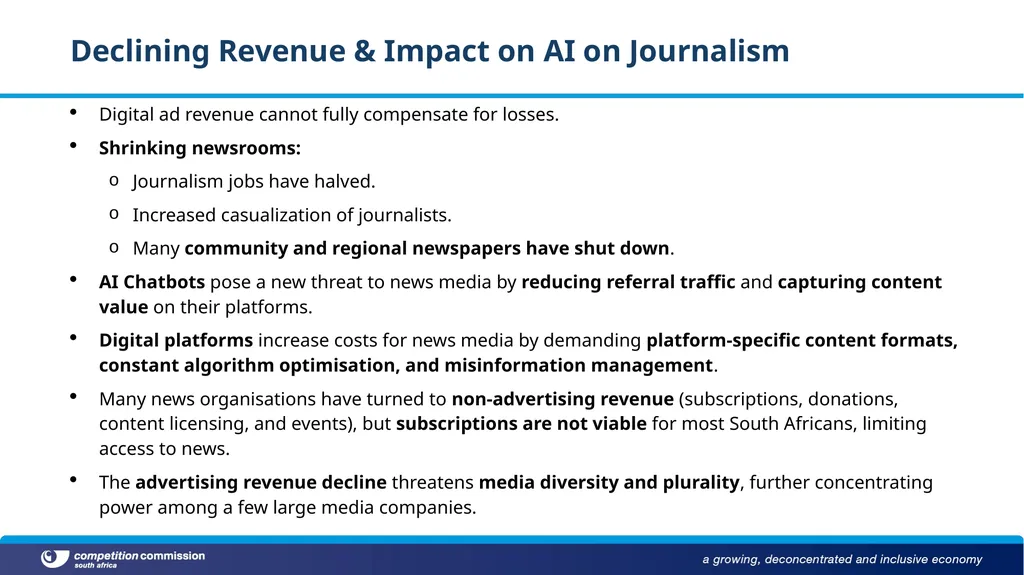
Declining Revenue & Impact on AI on Journalism Digital ad revenue cannot fully compensate for losses.
Shrinking newsrooms:
Journalism jobs have halved.
Increased casualization of journalists.
Many community and regional newspapers have shut down.
AI Chatbots pose a new threat to news media by reducing referral traffic and capturing content value on their platforms.
Digital platforms increase costs for news media by demanding platform-specific content formats, constant algorithm optimisation, and misinformation management.
Many news organisations have turned to non-advertising revenue (subscriptions, donations, content licensing, and events), but subscriptions are not viable for most South Africans, limiting access to news.
The advertising revenue decline threatens media diversity and plurality, further concentrating power among a few large media companies.<br>
07
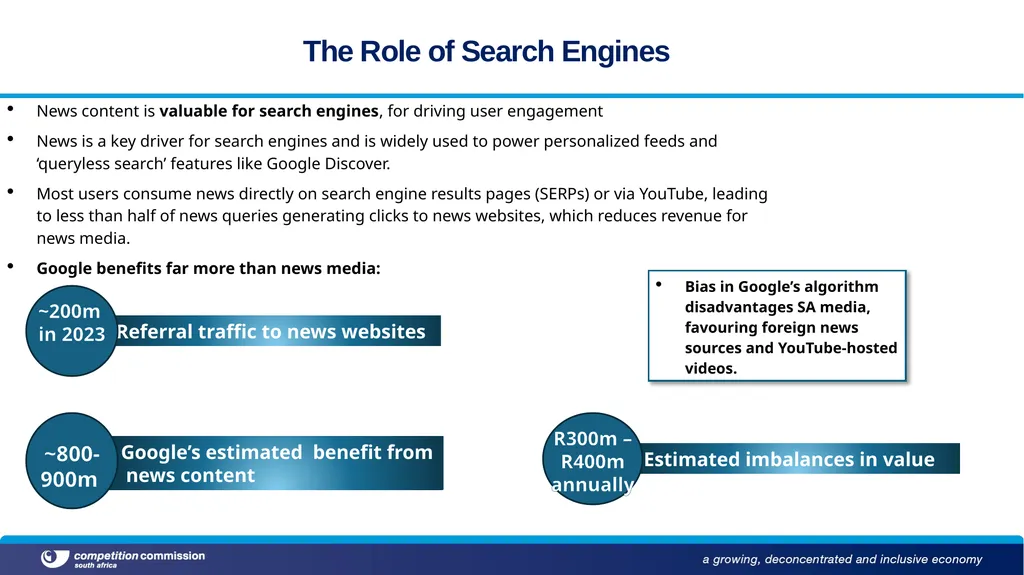
Estimated imbalances in value Google’s estimated benefit from news content Referral traffic to news websites The Role of Search Engines News content is valuable for search engines, for driving user engagement
News is a key driver for search engines and is widely used to power personalized feeds and ‘queryless search’ features like Google Discover.
Most users consume news directly on search engine results pages (SERPs) or via YouTube, leading to less than half of news queries generating clicks to news websites, which reduces revenue for news media.
Google benefits far more than news media: Bias in Google’s algorithm disadvantages SA media, favouring foreign news sources and YouTube-hosted videos.<br>
08
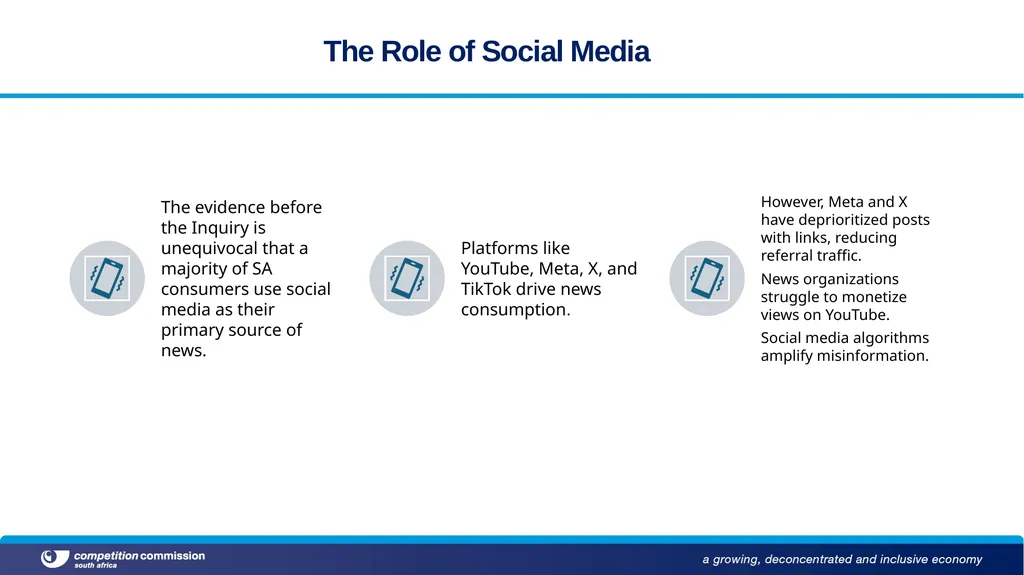
The Role of Social Media<br>
09
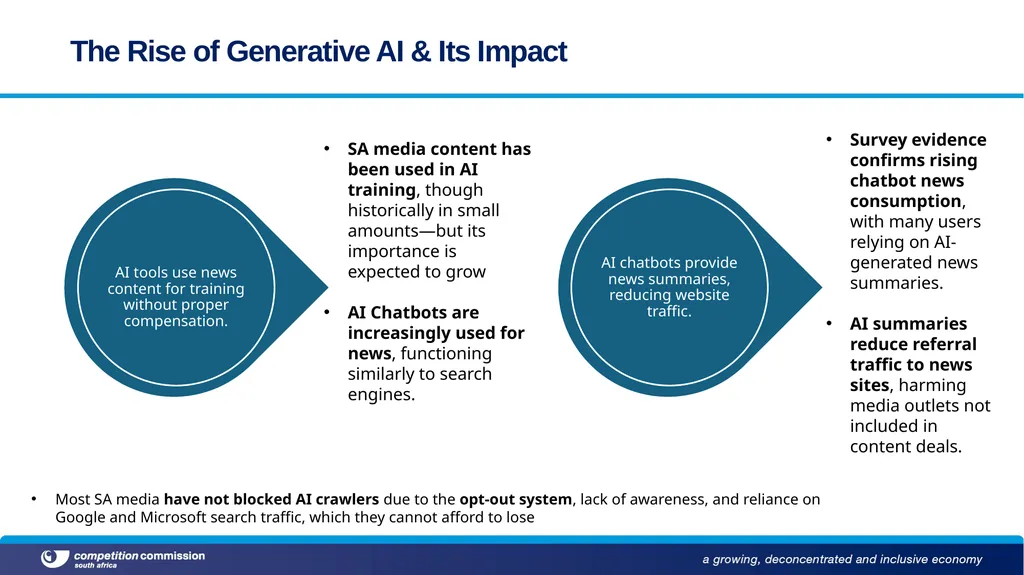
The Rise of Generative AI & Its Impact SA media content has been used in AI training, though historically in small amounts—but its importance is expected to grow
AI Chatbots are increasingly used for news, functioning similarly to search engines. Survey evidence confirms rising chatbot news consumption, with many users relying on AI-generated news summaries.
AI summaries reduce referral traffic to news sites, harming media outlets not included in content deals. Most SA media have not blocked AI crawlers due to the opt-out system, lack of awareness, and reliance on Google and Microsoft search traffic, which they cannot afford to lose<br>
10
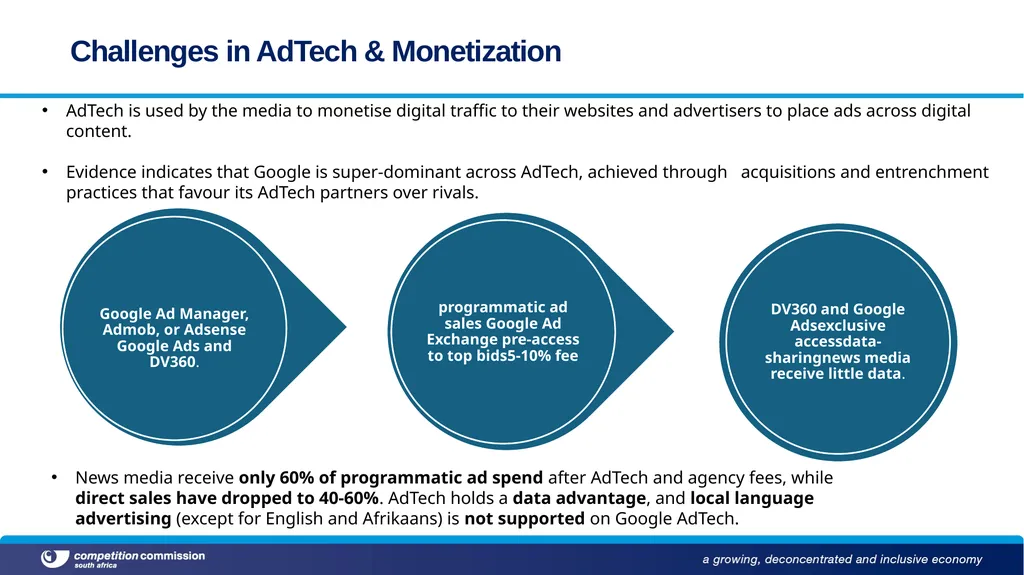
Challenges in AdTech & Monetization AdTech is used by the media to monetise digital traffic to their websites and advertisers to place ads across digital content.
Evidence indicates that Google is super-dominant across AdTech, achieved through acquisitions and entrenchment practices that favour its AdTech partners over rivals. News media receive only 60% of programmatic ad spend after AdTech and agency fees, while direct sales have dropped to 40-60%. AdTech holds a data advantage, and local language advertising (except for English and Afrikaans) is not supported on Google AdTech.<br>
11
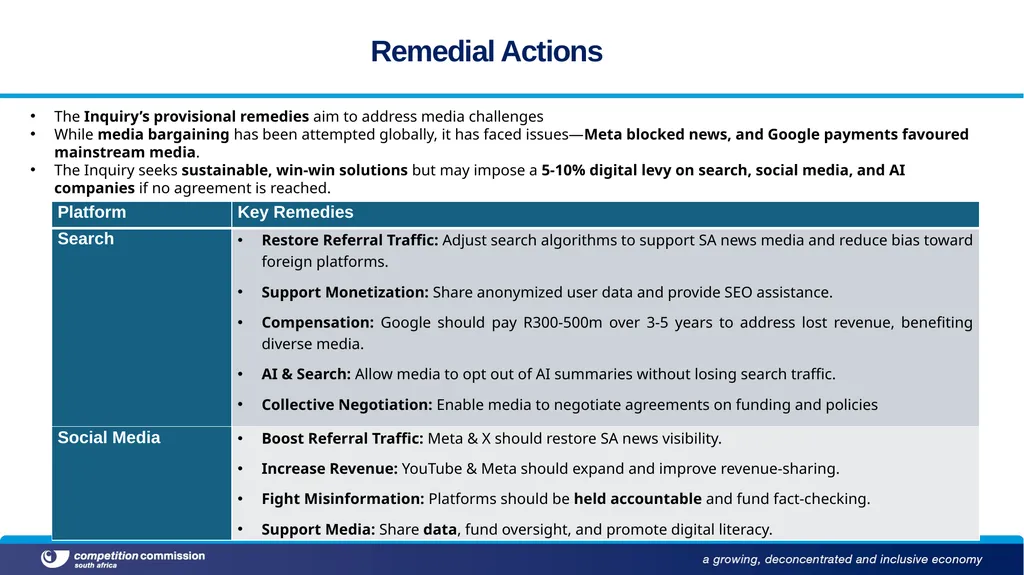
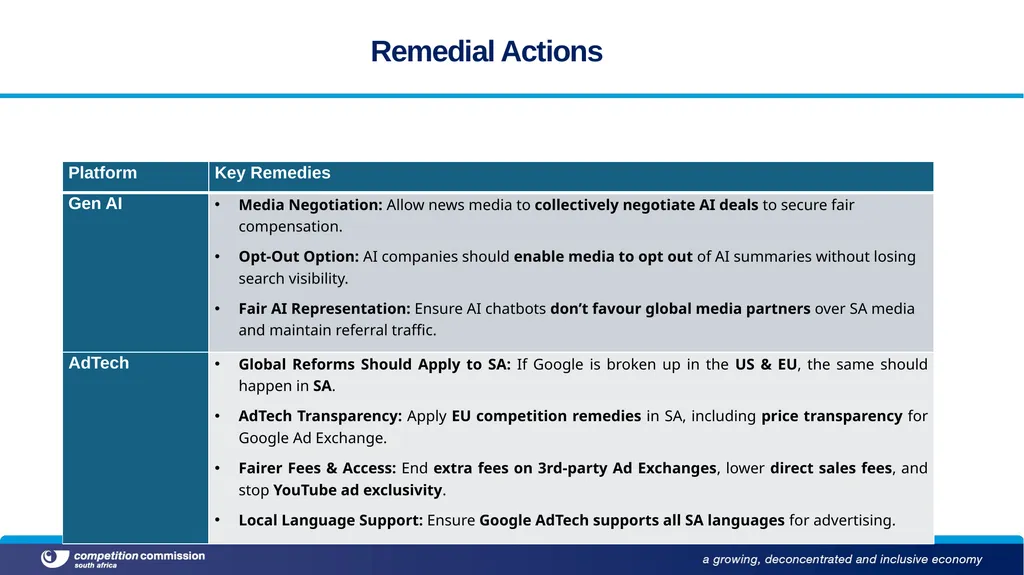
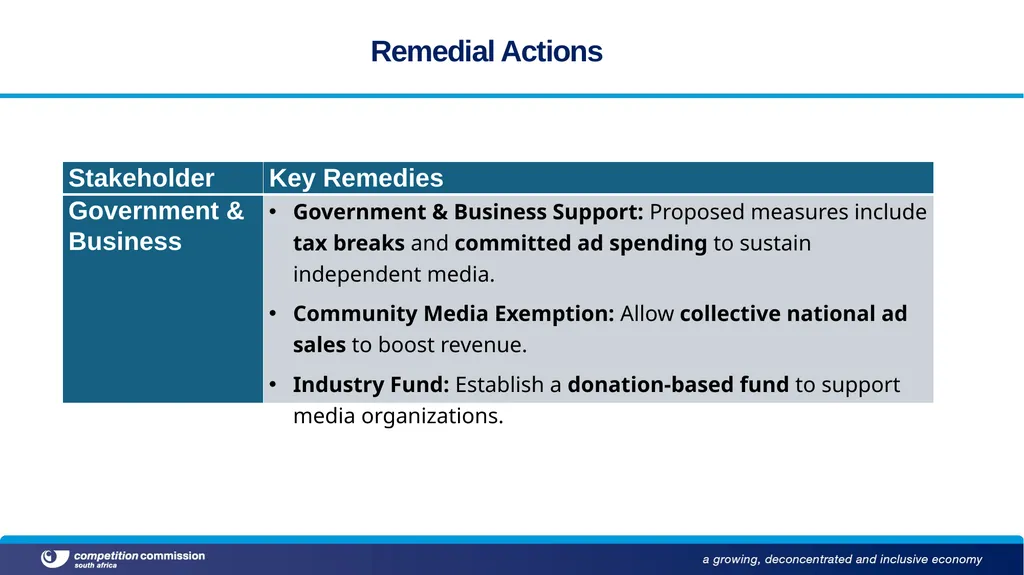
Remedial Actions The Inquiry’s provisional remedies aim to address media challenges
While media bargaining has been attempted globally, it has faced issues—Meta blocked news, and Google payments favoured mainstream media.
The Inquiry seeks sustainable, win-win solutions but may impose a 5-10% digital levy on search, social media, and AI companies if no agreement is reached.<br>