
MLIS/1/CT/02 Unit 3: Hazards to Library Materials
LS
Published · 29 slides · 0 views

1 / 1


Description
MLIS1CT02 Unit 3: Hazards to Library Materials and Control Measures Naveen Chaparwal Guest Faculty, DLISc, UCSSH, Mlsu Udaipur ENVIRONMENTAL FACTORS Essentially the library is a repository of books and other materials to be used by the
Related Topics
Share
Embed code
Download this presentation From Below
"MLIS/1/CT/02 Unit 3: Hazards to Library Materials" is the property of its rightful owner. Permission is granted to download and print the materials on this website for personal, non-commercial use only, and to display it on your personal computer provided you do not modify the materials and that you retain all copyright notices contained in the materials. By downloading content from our website, you accept the terms of this agreement.
Presentation Transcript
01
MLIS/1/CT/02
Unit 3: Hazards to Library Materials and Control Measures Naveen Chaparwal
Guest Faculty, DLISc, UCSSH, Mlsu Udaipur<br>
Guest Faculty, DLISc, UCSSH, Mlsu Udaipur<br>
02
ENVIRONMENTAL FACTORS Essentially the library is a repository of books and other materials to be used by the users.
The total collection of library materials is stored and preserved as long as the library exists. Books and other paper-based materials are the major constituents of the library. It is the social responsibility of the Librarian to keep all the books and other library materials physically fit to be used by the readers. In this unit, we are concerned with each library document as a physical entity. The basic materials and constituents of the physical entity of library materials are mostly organic and these are susceptible to natural decay and deterioration. If the environmental condition is adverse, the process of decay and deterioration is accelerated.
The environmental factors are mainly temperature, humidity, water, light, air-pollution, smoke dust and such other damaging agents. All these factors exceeding the optimum value continuously, affect the, physical composition of the library materials. It has been problem for the librarians through the centuries to preserve the library materials against these enemies and to take measures against all types of decay and deterioration.
In a modem library there are many printed or non-printed non-book materials which are paper based such as, journals, newspapers, theses, conference and seminar papers, pamphlets, reports, and the like. Special materials are also there in the libraries such as, maps, graphic materials, audio materials, audio-visual materials and various other types. The different types of materials and the characteristics of the substances used for the physical composition of such library materials pose different kinds of preservation problems. All these materials are acquired and kept in the library for a long time. Although, the
climatic condition is not the same in all the regions, our country is basically a tropical country. A tropical country has its own climatic problems particularly the humidity. Industrialization, especially heavy industries, growth of urban areas, combustion of natural oil for transport, cooking elements in urban areas, and such other situations are continuously affecting the atmospheric condition. These atmospheric and climatic conditions have great impact over the physical condition of the library materials which are kept in the libraries for a long period. Such conditions are hazardous to library materials.<br>
03
TEMPERATURE Being a tropical country, India is in the high temperature zone and the relative humidity is also very high. Except for a few months in winter, the longer period of the year experiences high temperature almost all over the country. Extreme variation in temperature such as 5° C in winter and 45° C in summer is experienced in many places in India. Such fluctuation of temperature affects the physical condition of the library materials. Increase in temperature causes an increase in the rate of deterioration.
Temperature is always considered along with relative humidity. High temperature or heat with low humidity causes dehydration of cellulose fibres and the paper becomes brittle and yellowish. On the other hand, high temperature with high humidity, if continued for a considerable time makes the paper soggy and creates the condition for the growth of moulds. In both the conditions paper loses its mechanical strength and the cellulose fibres disintegrate and degenerate.
Temperature over 35° C causes brittleness and dryness of paper. It also causes physical deterioration of paper, cloth, linen and leather. The adhesives also lose their binding strength. High temperature or heat accelerates photolysis, hydrolysis and oxidation. It also causes buckling of edges on films and tapes, as well as their embrittlement and curling. If these are kept in such a condition for a long time it will be difficult to use such materials. Usually the source of heat is the high atmospheric temperature. If electric bulbs are used for lighting purpose they increase the room temperature abnormally. High powerful bulbs generate more heat. The natural deterioration of ageing is accelerated by heat and increase of temperature in storage areas.<br>
04
LIGHT AND DARKNESS Light may be natural or artificial. Natural light is the sun light and artificial light may be fluorescent tube light or electric bulbs. In the natural light several kinds of rays are present. These are visible rays of light, Cosmic rays, gamma rays, X-Rays, far ultra-violet rays, near ultraviolet rays and infra-red rays. All rays are not harmful to library materials. The ultra-violet rays coming directly from the sun art harmful to library materials. Therefore, library materials should never be exposed to direct sun rays. The cellulose fibres of paper lose their mechanical strength and paper becomes brittle and yellowish under direct sun rays.
Both the natural and artificial light cause deterioration to bleaching ink, dyes and colour in illustration and maps. Ordinarily light does not affect cellulose molecules of paper but reacts photo chemically on the other ingredients and impurities in paper content such as lignin, acid, resins, glue, starch, dyes, etc. The effects of these reactions then attack the cellulose by breaking the molecular chain and weakening the paper. Cellulose fibres are bleached by light but lignin and other non-cellulose ingredients in paper become yellowish. Prolonged exposure to light results in photosensitised oxidization of paper which is vulnerable to other forms of deterioration. The presence of rosin, glue, lignin, iron, alum and other sizing and loading substances have a strong bearing on deterioration by light.
Like sunlight; artificial light also contains ultra violet rays. The florescent tube light radiates a high percentage of ultra-violet rays but the light is rather cool. The electric bulbs radiate minimum ultra-violet rays but are sources of much heat. They cause deterioration by yellowing the paper and embrittlement. Heat and light cause deterioration simultaneously, and long exposure to both natural and artificial light is destructive to library materials.<br>
05
HUMIDITY AND MOISTURE Like heat and .light, humidity acts both in favour of and against the preservation of library materials. A certain amount of humidity is necessary for keeping the flexibility of paper. But in prolonged humid condition where humidity is very high, particularly at the period of summer and monsoon, moisture is caused by high humidity. Such climatic conditions with moisture is a most dangerous and destructive factor for all kinds of library materials. Moisture itself causes physical deterioration but the worst situation is that it is the root cause for various types of chemical deterioration and biological damage and destruction.
Moisture makes the paper soggy and thus weakens the tissues of paper. The cellulose fibres lose their strength become disintegrated and make the document unworthy for handling. Moisture weakens the adhesives and makes the book binding loose. It also weakens the sizing elements and loading materials of paper. It causes spreading of ink. It causes stickiness in art paper, glazed paper with the help of sticky ink, dyes, colours and pigments. Moisturised pages of book-often stick together particularly with illustration which may not be restored to their original condition. Moisture causes softening of gelatin on film and sound tape. Rolled films tapes and microfiches can stick together while they are in contact under conditions of moisture.
Moisture accelerates various types of chemical deterioration. Because of chemical reaction paper becomes yellow and stained with coloured spots. The impurities in the ingredients of paper, the contaminants, usually the oxides of carbon, nitrogen and particularly of sulpher, the acidic residue in paper, under condition of moisture cause deterioration to documents. Moisture promotes the growth of micro-organisms like mildew and fungus which cause deterioration and damage to paper and book binding materials. Spores of micro-organisms which are present in the atmosphere in dormant stage, starts growing under favourable conditions of high humidity. They cause enormous damage by destroying the sizing elements, cellulose fibres, adhesives and other binding materials and make the documents unreadable. Dust in contact with moisture causes physical and chemical degradation.<br>
06
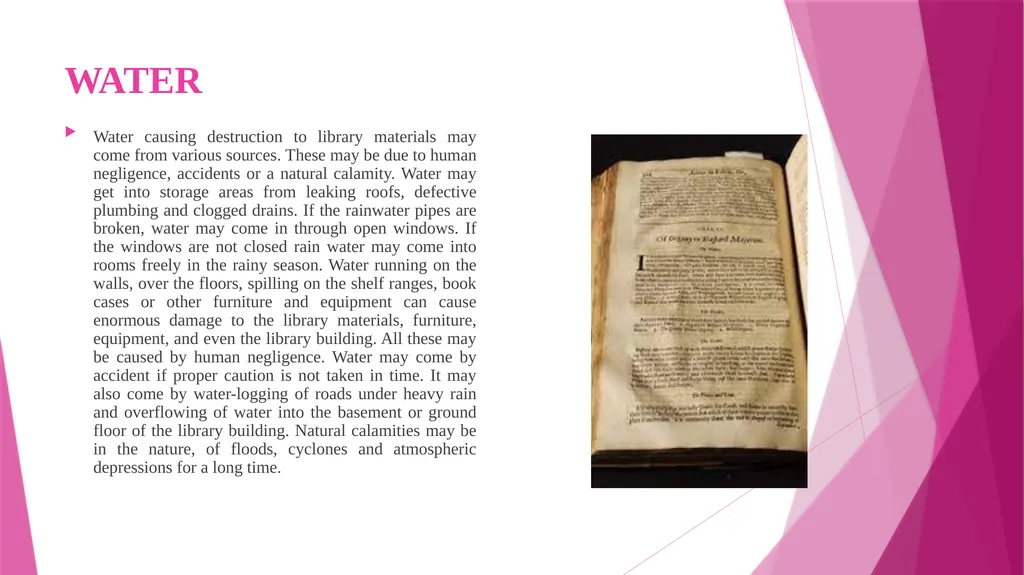
WATER Water causing destruction to library materials may come from various sources. These may be due to human negligence, accidents or a natural calamity. Water may get into storage areas from leaking roofs, defective plumbing and clogged drains. If the rainwater pipes are broken, water may come in through open windows. If the windows are not closed rain water may come into rooms freely in the rainy season. Water running on the walls, over the floors, spilling on the shelf ranges, book cases or other furniture and equipment can cause enormous damage to the library materials, furniture, equipment, and even the library building. All these may be caused by human negligence. Water may come by accident if proper caution is not taken in time. It may also come by water-logging of roads under heavy rain and overflowing of water into the basement or ground floor of the library building. Natural calamities may be in the nature, of floods, cyclones and atmospheric depressions for a long time.<br>
07
SMOKE Smoke is another destructive enemy to library materials. Visible or invisible, smoke exists in the air suspended in the lower strata of the atmosphere particularly in urban areas, densely populated habitations and industrial locations. Smoke contains unburnt particles of burning coal, carbon particles, burnt fuel, industrial coal smoke, fibre particles and any other particles suspended in the air. All these suspended particles make the air heavy, so smoke settles at the lower part of the air. When such particles are diffused and distributed in the air, smoke may not be visible, but traces of smoke are there. Atmospheric smoke is visible particularly in the mornings and evenings in winter when smoke mixed with mist or fog hinders even the visibility and looks like a solid object.
Smoke is responsible particularly for chemical degradation and damage to library materials. A large amount of smoke is released in our country combustion of coal and fuel of oil gas. These things are used in urban areas, slum areas and densely populated areas for cooking purposes. A large amount of natural gas particularly diesel is burnt everyday for vehicular transport. The exhausts of transports produce enormous quantities of smoke. Industrial furnaces produce an alarming amount of coal and other types of smoke with chemical impurities. The chemical contents of smoke, as a whole, contain various oxides of carbon nitrogen and particularly sulphur. Sulphur dioxide is absorbed by porous elements of library materials. Sulphur dioxide, a by-product of the combustion of coal and fuel oil, is not initself harmful to library materials. But under high humidity and moisture it reacts with metallic impurities in paper, particularly iron and copper, and forms sulphuric acid which is highlydestructive to paper. The metallic impurities are found in all kinds of modern paper. The oxides of carbon and nitrogen also act for chemical degeneration of cellulose molecules by causing oxidation. The physical deterioration is caused also by smoke while the suspended smoke particles of the air settle down on the surfaces of library materials as dust.<br>
Smoke is responsible particularly for chemical degradation and damage to library materials. A large amount of smoke is released in our country combustion of coal and fuel of oil gas. These things are used in urban areas, slum areas and densely populated areas for cooking purposes. A large amount of natural gas particularly diesel is burnt everyday for vehicular transport. The exhausts of transports produce enormous quantities of smoke. Industrial furnaces produce an alarming amount of coal and other types of smoke with chemical impurities. The chemical contents of smoke, as a whole, contain various oxides of carbon nitrogen and particularly sulphur. Sulphur dioxide is absorbed by porous elements of library materials. Sulphur dioxide, a by-product of the combustion of coal and fuel oil, is not initself harmful to library materials. But under high humidity and moisture it reacts with metallic impurities in paper, particularly iron and copper, and forms sulphuric acid which is highlydestructive to paper. The metallic impurities are found in all kinds of modern paper. The oxides of carbon and nitrogen also act for chemical degeneration of cellulose molecules by causing oxidation. The physical deterioration is caused also by smoke while the suspended smoke particles of the air settle down on the surfaces of library materials as dust.<br>
08
DUST AND DIRT Dust is a mass of suspended particles carried over by air coming from any source. It settles down on any surface of library materials which is exposed to air. Since this is airborne it can settle down even in closed files and boxes and closed areas where air can flow freely. Ordinarily dust cannot be seen but one can see it when it has settled down as a mass usually by discolouring the surface. When dust which is hygroscopic in nature is mixed with high humidity and moisture, it is transformed into dirt, a sticky substance over the surface which cannot be eliminated completely.
Dust and dirt substances aggravate the harmful action of sulphur compounds. These are sources of both chemical and physical deterioration. Dust hastens atmospheric acid reaction by attracting moisture to cause chemical degradation. Dust and dirt disco lour the pages of books and help to grow micro organisms. Dust and moisture combined loosen the cellulose fibres of paper. The deterioration caused by dust and dirt is visible on the exposed part of the books. Dust is very harmful to audio-visual materials. It is particularly responsible for sound degradation of tapes and discs. Dust and dirt also damage the equipment meant for using the audio-visual materials.<br>
Dust and dirt substances aggravate the harmful action of sulphur compounds. These are sources of both chemical and physical deterioration. Dust hastens atmospheric acid reaction by attracting moisture to cause chemical degradation. Dust and dirt disco lour the pages of books and help to grow micro organisms. Dust and moisture combined loosen the cellulose fibres of paper. The deterioration caused by dust and dirt is visible on the exposed part of the books. Dust is very harmful to audio-visual materials. It is particularly responsible for sound degradation of tapes and discs. Dust and dirt also damage the equipment meant for using the audio-visual materials.<br>
09
AIR-POLLUTION Clean and pure air is essential for any living being, so also for any organic material. Air is a mixture of Nitrogen, Oxygen, Argon, Water Vapour and Carbon Dioxide along with small quantities of Neon, Krypton, Xenon and Hydrogen. Some impurities like oxides of sulphur, carbon, etc. and suspended particulates in the form of soot, smoke and dust also exist in the air. When any of these impurities exceed the permissible level, it results in air pollution. But it is a fact that even clean air causes deterioration to some extent to organic materials kept in the library. The oxygen mixed with water vapour existing in the air causes hydrolysis and auto oxidation. Library materials cannot be preserved in the library for a longer time without clean air. The real enemy of the library materials is the impurities present in the air and the contamination of the air. All these create air pollution which is more or less a permanent affair in this modern age particularly for urbanisation, industrialisation, increase of slum areas, deforestation etc.
The impurities of air and the sources of air pollution causing damage to library materials are mainly sulphur dioxide, hydrogen sulphide, ammonia, nitrogen dioxide, carbon dioxide, ozone and aerosols.
The hydrogen sulphide in contaminated air is produced by industrial activities, industrial gases and wastage, activities in cities and biological activities. It causes deterioration, though the rate is not high, in comparison to sulphur dioxide. It affects paper, binding materials and metals. Ammonia released into air from many sources is harmful to cellulose fibres. Ozone is generated by the action of ultra-violet rays on oxygen in the upper atmosphere. Most of the nitrogen dioxide, carbon dioxide and carbon monoxide in polluted air come from automobile exhausts. The action of sunlight on nitrogen dioxide generates more ozone and in connection with smoke it causes more damage. Ozone destroys organic materials by breaking the bonds between carbon atoms. Moisturised cellulose is particularly vulnerable to ozone found in polluted air. If it is exposed for a longer time paper and textiles lose their strength, Ozone makes the colours of fabric book covers fade. The book binding materials such as, leather, gelatin, glue, paste are susceptible to deteriorationby ozone in humid atmosphere.<br>
10
ENVIRONMENTAL CONTROL Adequate measures should be taken so that the deterioration and decay of the library materials can be checked, retarded and not accelerated. Usually physical and chemical factors cause such deterioration. These causes of deterioration can be controlled to a great extent by the environmental control.
There are two aspects of preservation of library materials: the preventive measures and the curative measures. The preventive measures comprise all the methods of good housekeeping, adequate caretaking, dusting, cleaning, periodical supervision of the storage, prevention of any possibility of damage by physical, chemical, biological and other factors, use of repelling agents, chemicals and insecticides to drive away the biological factors, and, on the whole, the control of deterioration and damage of library materials. The curative measures are taken when it is found that the preventive measures have failed for some reasons and the, materials are affected and damaged by the causes of deterioration and the enemies of the materials. The curative measures include mending, repairing, strengthening, rehabilitation, deacidification, fumigation, lamination and other jobs which are required, considering the physical condition of an individual document. The damaged document can be made physically usable after all curative measures have been taken to restore the physical condition of the document.
Building
Light
Temperature
Humidity and Moisture
Housekeeping<br>
11
BIOLOGICAL FACTORS Almost all book components, be it paper, pulp or straw board used for binding, textiles and leather of varied colours and varieties used as covering materials are prone to attacks by groups of micro-organisms, insects and rodents. Very often library collections are damaged by pests, and the phenomenon is generally known as bio-deterioration.
A tropical climate which is hot and humid is congenial for the growth and propagation of pests, fungus, insects like silverfish, cockroach, psocid, bookworm, termite etc. They breed in the buildings housing public, institutional or special libraries. There is perhaps no library which at sometime or the other has not suffered the ravages of these agents of biodeterioration.
This problem has been studied in depth and the species that thrive specifically on book components have been identified. Their breeding cycles have been examined with a view to exterminate them and to apply effective control and remedial measures to check their incidence, thus preventing susceptibility of damage to library collections.<br>
12
COMMON BOOK PESTS Agents of Bio-deterioration include micro-organisms and insects, which are active living organisms found in normal housing environment. They sustain themselves with food derived from paper, board, binding cloth and leather. Sizing material in paper and binding textiles and vegetable tanning material in leather, e.g., starch, glues and gums are their special food.
Micro-organisms
A group of fungi or moulds which include Alternaria, Aspergillus, Penicillium, Mucor, Fusarium etc. grow in paper. These organisms are present in the environment in every habitat. They remain in a dormant state for long periods. But they appear as brown/ black vegetative growth on paper. This and leather in favourabte conditions of climate, high relative humidity (above 65 per cent) and high temperature (in the range of 27°-35° C) are conducive for their growth and propagation. Besides, other conditions which favour their growth are rugged dusty surfaces, stagnant air, damp materials and availability of food for sustaining their life.
The common fungus consists of a reproductive mycelium and a vegetative mycelium. The former extends into the air and is responsible for spore production, while the latter burrows into the substrate digesting and absorbing it.
Besides fungi, bacteria also play a role in decomposing cellulose in paper and binding textiles. These are known as aerobic cellulose decomposing bacteria, e.g., Cytophaga, Cellvibrio, Cellfascienla and Myscobacteria. These bring about discoloration and staining of books and other allied materials.
Insects
Common insects that are responsible for attacking and damaging paper and other book components are Silver Fish, Book lice (Psocid), Cockroach, Termite, Book Worm (Gastrallus Indicus). These insects are recognised by their characteristic appearance.<br>
13
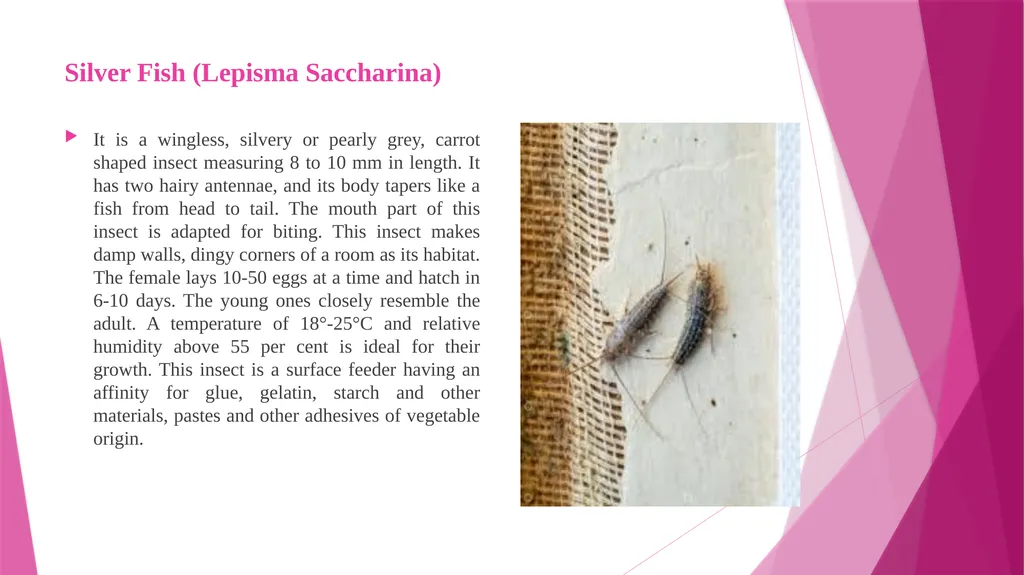
Silver Fish (Lepisma Saccharina) It is a wingless, silvery or pearly grey, carrot shaped insect measuring 8 to 10 mm in length. It has two hairy antennae, and its body tapers like a fish from head to tail. The mouth part of this insect is adapted for biting. This insect makes damp walls, dingy corners of a room as its habitat. The female lays 10-50 eggs at a time and hatch in 6-10 days. The young ones closely resemble the adult. A temperature of 18°-25°C and relative humidity above 55 per cent is ideal for their growth. This insect is a surface feeder having an affinity for glue, gelatin, starch and other materials, pastes and other adhesives of vegetable origin.<br>
14
Cockroach (Blatta-Orientalis)
It is a brown or blackish brown, shing flat bodied, foul smelling insect. It has two protruding antennae which help it feel objects. This insect is nocturnal, lives and hides in corners which are damp and dingy, crevices and cleavages in walls and floors, behind and beneath almirahs and shelves in wooden cupboards. It is a very common household insect breeding in kitchen drains and garbage. It is an omnivorous insect feeding on paper, board, binding textiles, leather, especially attracted by binding glues.
The female lays eggs in pouch (cocoon) containing 6 to 10 eggs, mostly in April-May to October. The young ones hatching out from eggs are called nymphs and these mature as fully winged insect adult. Moist air, warmth and darkness form most favourable condition for their breeding and growth.
Book-Lice (Psocids)
The insect is greyish white to brown in colour as long as the width of a pinhead (1 mm to 2.5mm). It is almost transparent with thread like antennae and mouth part. Its occurrence is noticed in dust laden and fungus infected materials. Dampness and warmth are the essential requirements for its rapid growth.
Termite (White-ant)
This insect is most destructive of the wood or cellulose feeding insects. It is a social insect living in a community which includes male, reproductive female (queen) and sterile workers. The workers are soft bodied, white or grey, wingless forms, and devote their energy to nest building and feeding the community. Broadly speaking this insect is of two groups:
i) Subterranean termites, so called because they maintain their contact with the soil.
ii) Non-subterranean termites, require no contact with the soil. They can exist in the wood they infest. These are also known as dry wood borers and are found in a tropical climate.
Subterranean termites travel in mud, covered runways, bore into poor masonry structure with bad quality of bricks and cement, reaching their food. They damage paper, board, wooden furniture, textiles and leather.<br>
15
Book Worm or Book Beetle (Coleoptera)
The Indian book worm has been identified as Gastrallus Indicuss Reitter and it has varied stages of growth e.g., egg, larva, pupa and adult beetle. A beetle is small slender and brown in colour and measures 2-3 mm in length and l mm in width. It lays eggs in joints of binding boards, and these eggs hatch out in 5-1 0 days as larva in summer. The larva is white, cylindrical and semicircular in shape, the head being retraced into the front segment of the body when at rest. They remain in pupa stage for 15 days or so at the end of which hey emerge as full grown insects. The larvae eat their way into the book and are responsible for major damage. The adult beetle flies out from infested material to build new nests and thus spreads infestation.
Rodents
Mice (Linnaeus) and Rats (Rathus) find their way into buildings through dry drains and openings in doors and windows. These foraging animals gnaw, eat and soil anything made of paper, board, textiles, leather, glue, gelatin etc. All rodents possess chisel like incisor teeth. These are cunning animals, swift to move, hiding in dark corners weak plastered joints in walls and floors. They move in darkness, and cause damage. Once they enter a room their eradication becomes difficult.<br>
16
IDENTIFICATION OF DAMAGE Damage caused by fungus or bacteria, and that which is caused by insects, is specific with each species. Often, the nature, extent and manifestation of damage make it possible to identify the damaging biological pest, making it convenient to apply appropriate control measures.
Fungus causes the following Damages:
i) Growth of black/brown patches which eat into the paper, textiles etc.
ii) Stinking smell.
iii) Discoloration.
iv} Staining due to acidic secretion reacting with iron and copper salt present as impurities in paper.
Surface feeders like Cockroach and Silver fish make their damage manifest in the form of discoloration accompanied by identification scratches appearing as patch work. The damage is mostly at the spine extending on the covers.
Subterranean Termites incise irregular tunnels starting from binding, penetrating deep in the text of the book. The edge of the tunnel are characterised by dusty margin due to dust and soil carried by these species.
Their emergence in a room is visible in the form of mud runways on walls, wooden furniture etc.
Bookworm or Book beetle travels in its larva or pupa stage from top to bottom of the text pages in the form of pinholes or narrow galleries running deep down. The damage usually
starts from the back side.
Rodents leave a good amount of blackish excreta at the site they frequent and leave a good amount of cutting at the site. They leave irregular incision or cutting marks on paper, textiles etc.<br>
17
Control Measures
Good House Keeping and General Hygiene
Use of Chemical Repellents
Use of Poisonous Dusts and Liquid Insecticides
Use of Fumigants
CLEANING AND STAIN REMOVAL
Books and other library collections get soiled or develop stains due to bio-deterioration e.g. fungus growth and foxing. Cleaning of these materials is necessary after thle infested materials have been fumigated. At times localised bleaching of the stain is necessary.
Cleaning
A few simple techniques of cleaning are:
i) Removal of mud or hard crust of dust mechanically with brush or blunt knife.
ii) Removal of foreign deposits with cotton moistened with water.
iii) Removal of fungus spores with cotton dipped in ethanol.
iv) Use of mild steam jet to soften hardened crust.
v) Drying damp materials under air current in shade (direct sunlight not to be used).<br>
18
CHEMICAL FACTORS Books and documents are created and produced to disseminate information and knowledge to man for developing his/ her intellect, and thus increase his/ her capacity to work and achieve desired goals, objectives or life pursuits.
With the diversification, and multiplication of knowledge in many directions, books and documents have been and are being produced in very large numbers. These materials are amassed in our libraries, manuscript repositories, archives and museums, and represent our cultural and library heritage. From loose handwritten or printed paper sheets loosely kept in a bundle to the shape of a book as we see today as a well stitched and bound physical unit, it has taken a long way.
PREVENTIVE CONSERVATION
Life and durability of books and documents depend on the chemical composition of constituents e.g., paper, ink or protective covering materials. The chief cause of decay of paper, textiles, leather etc. used in text and covering materials is acidity introduced during their manufacture or storage.
Preventive conservation which includes neutralising acidity imparts stability to these
materials.<br>
19
Chemicals used for Stabilising Paper
Deacidification or Neutralising acidity of text paper and ink. The techniques used for paper deacidification are:
i) Use of dry powders (alkaline chemical salts).
ii) Use of aqueous or non aqueous alkaline solutions.
iii) Use of alkaline vapours or gases.
The selection of a deacidification process depends on the physical condition of the document, and the quality of the ink e.g., water washable/resistant. Chemicals used are mild alkaline chemicals e.g. Calcium hydroxide and Methyl magnesium, Morpholine, Magnesium methoxide, Barium hydroxide, Ammonia (Dilute), Cyclohexylamins carbonate, Diethylzinc. These chemicals do not effect the chemical properties of paper. However, if left as excessive reserve in paper, they destabilise paper showing colour change and fragility. A satisfactory deacidification, or neutralisation process takes into consideration:
i) Whether the chemical has successfully removed acid content and what is the resultant pH. A pH between 5.5 to 9.5 is desirable lower-and higher pH than these are injurious to paper.
ii) What quantities of the chemicals are left as residual reactants and what effect these are likely to produce on subsequent aging.<br>
20
Chemicals used for Protecting Water Washable Writing
It may be necessary to treat and protect water colours and inks in documents before these arc subjected to deacidification. A variety of plastic emulsions are used in inert organic solvents for this purpose. A thin protective film is formed on the writing, drawing, painting etc. Some of these are: Soluble nylon, Polyvinyl acetate, Polyvinyl chloride, Polyamides and Acrylic esters. Inert solvents used are: Acetone, Xylene, tri and dichloroethylene, Chloroform etc. These emulsions do not react with paper or its constituents, yet modify surface properties such as smoothness, bonding, glare, opacity etc.
Chemicals used for Preventing Damage by Biological Pests
Numerous fungicides, poisonous dusts, fumigants and liquid emulsions are available for controlling insect pests.
For use in libraries and manuscript repositories only those preparations are safe which do not stain, damage or weaken paper and its components. Chemicals which liberate free sulphur, free chlorine is harmful to paper. Similarly, chemical formulations which contain mercury or arsenic are not safe. These preparations should in no case be used in contact with paper. Chemicals which can be used safely are:
Fungicides: Thymol, Formalin, Orthophenyl phenol, Salicylanilide.
Fumigants: Thymol, Paradichlorobenzene, Formaldehyde, Ethylene dichloride, carbon tetrachloride, carbondioxide; Ethylene oxide, Methyl bromide.
Insect Repellent: Camphor, Naphthalene, Paradichlorobenzene.
Use of chemical emulsions making use of Pyrethrum, D.D.T., Lindane, Dialdrine, Gammaxene should be avoided in direct contact with paper. These emulsions contain mineral oil or some terpines which may stain or affect paper adversely.<br>
21
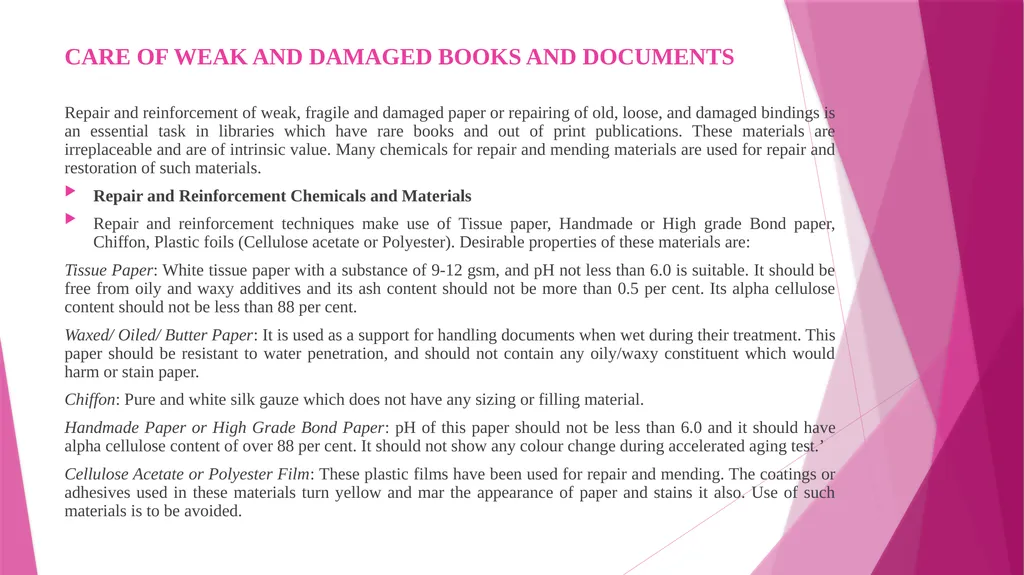
CARE OF WEAK AND DAMAGED BOOKS AND DOCUMENTS Repair and reinforcement of weak, fragile and damaged paper or repairing of old, loose, and damaged bindings is an essential task in libraries which have rare books and out of print publications. These materials are irreplaceable and are of intrinsic value. Many chemicals for repair and mending materials are used for repair and restoration of such materials.
Repair and Reinforcement Chemicals and Materials
Repair and reinforcement techniques make use of Tissue paper, Handmade or High grade Bond paper, Chiffon, Plastic foils (Cellulose acetate or Polyester). Desirable properties of these materials are:
Tissue Paper: White tissue paper with a substance of 9-12 gsm, and pH not less than 6.0 is suitable. It should be free from oily and waxy additives and its ash content should not be more than 0.5 per cent. Its alpha cellulose content should not be less than 88 per cent.
Waxed/ Oiled/ Butter Paper: It is used as a support for handling documents when wet during their treatment. This paper should be resistant to water penetration, and should not contain any oily/waxy constituent which would harm or stain paper.
Chiffon: Pure and white silk gauze which does not have any sizing or filling material.
Handmade Paper or High Grade Bond Paper: pH of this paper should not be less than 6.0 and it should have alpha cellulose content of over 88 per cent. It should not show any colour change during accelerated aging test.’
Cellulose Acetate or Polyester Film: These plastic films have been used for repair and mending. The coatings or adhesives used in these materials turn yellow and mar the appearance of paper and stains it also. Use of such materials is to be avoided.<br>
22
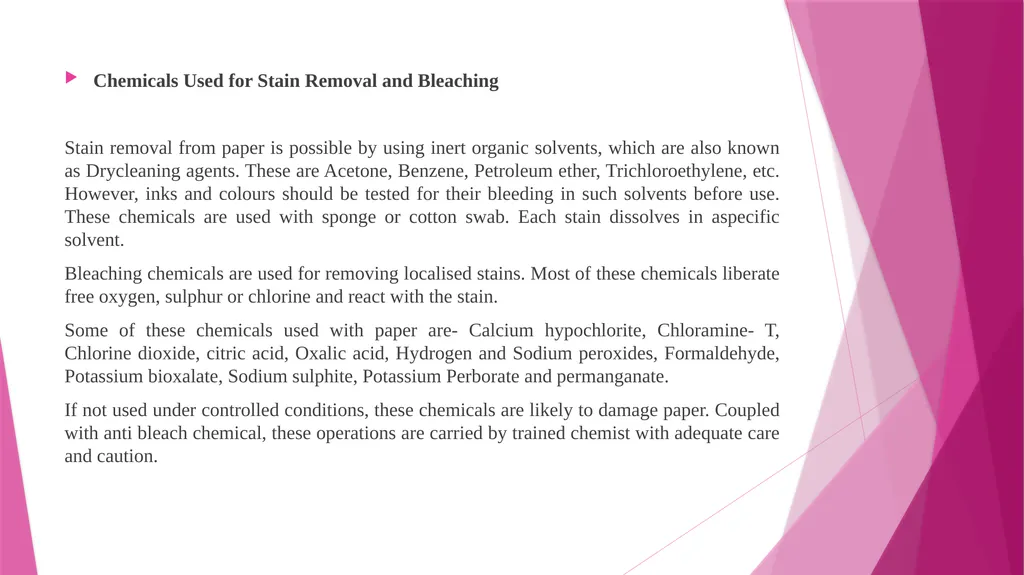
Chemicals Used for Stain Removal and Bleaching
Stain removal from paper is possible by using inert organic solvents, which are also known as Drycleaning agents. These are Acetone, Benzene, Petroleum ether, Trichloroethylene, etc. However, inks and colours should be tested for their bleeding in such solvents before use. These chemicals are used with sponge or cotton swab. Each stain dissolves in aspecific solvent.
Bleaching chemicals are used for removing localised stains. Most of these chemicals liberate free oxygen, sulphur or chlorine and react with the stain.
Some of these chemicals used with paper are- Calcium hypochlorite, Chloramine- T, Chlorine dioxide, citric acid, Oxalic acid, Hydrogen and Sodium peroxides, Formaldehyde, Potassium bioxalate, Sodium sulphite, Potassium Perborate and permanganate.
If not used under controlled conditions, these chemicals are likely to damage paper. Coupled with anti bleach chemical, these operations are carried by trained chemist with adequate care and caution.<br>
23
Chemicals Used for Glazing and Varnishing Covering Materials Many chemical varnishes and glazing solutions are now available for decoration and protective purpose.
Book Binding Textiles are treated with lacquers and plastic emulsions. Most of these chemicals are unstable and show cracking or aging. Some of these contain: Polyvinyl chloride, Nitrocellulose, Polyurethane, Polyacrylates and Polyamides.
A few varnishes are also available in the market which are described as insect repellents. These contain compounds of mercury/arsenic/sulphur etc. Use of these preparations is not advisable as they can contaminate the users’ hands.
Leather used for book binding needs restorative treatment when it becomes dry, shows cracking or rotting due to acidity. Waxes and oils which can be safely used are: Lanoline, Beeswax, Castor oil mixed in Hexane or Benzene.
Petroleum wax or mineral oils are avoided as these materials may prove harmful in the long run. Due to defective tanning (Vegetable or Chrome) leather develops acidity. For removal of acidity in leather 1 per cent Buffer solutions of Sodium benzoate or potassium lactate is satisfactory. Use of alkaline chemicals is likely to make leather dull, and damage its grain. Imitation leather is prepared by treating textile materials with polyamide emulsions and grain is embossed on these to give an appearance of leather. These materials can be treated like natural leather.<br>
24
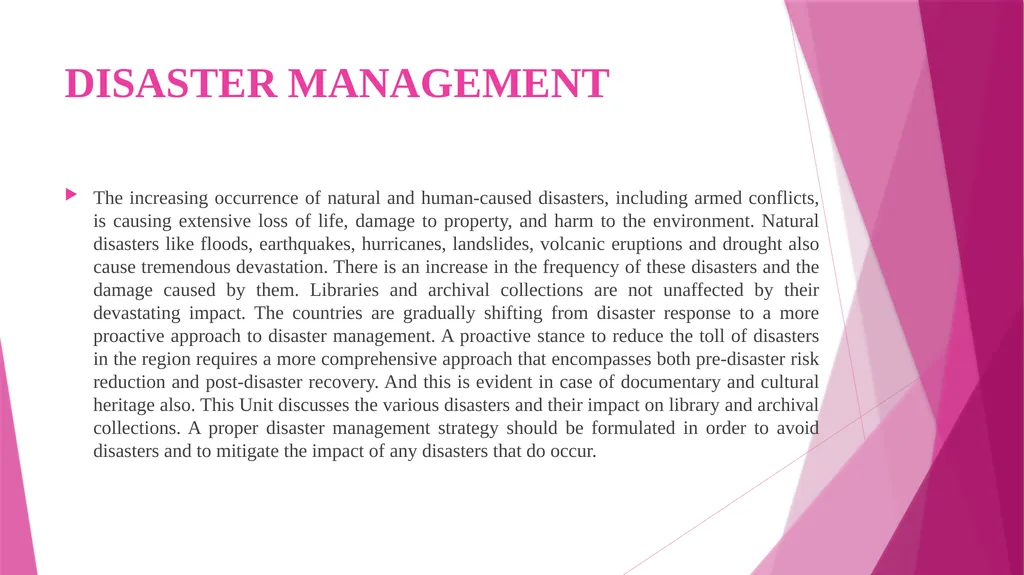
DISASTER MANAGEMENT The increasing occurrence of natural and human-caused disasters, including armed conflicts, is causing extensive loss of life, damage to property, and harm to the environment. Natural disasters like floods, earthquakes, hurricanes, landslides, volcanic eruptions and drought also cause tremendous devastation. There is an increase in the frequency of these disasters and the damage caused by them. Libraries and archival collections are not unaffected by their devastating impact. The countries are gradually shifting from disaster response to a more proactive approach to disaster management. A proactive stance to reduce the toll of disasters in the region requires a more comprehensive approach that encompasses both pre-disaster risk reduction and post-disaster recovery. And this is evident in case of documentary and cultural heritage also. This Unit discusses the various disasters and their impact on library and archival collections. A proper disaster management strategy should be formulated in order to avoid disasters and to mitigate the impact of any disasters that do occur.<br>
25
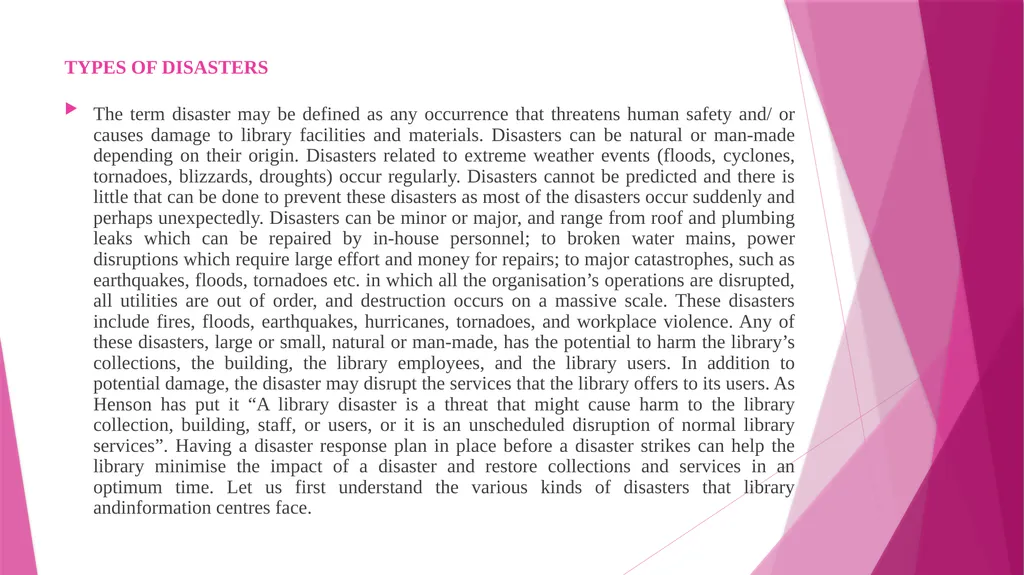
TYPES OF DISASTERS The term disaster may be defined as any occurrence that threatens human safety and/ or causes damage to library facilities and materials. Disasters can be natural or man-made depending on their origin. Disasters related to extreme weather events (floods, cyclones, tornadoes, blizzards, droughts) occur regularly. Disasters cannot be predicted and there is little that can be done to prevent these disasters as most of the disasters occur suddenly and perhaps unexpectedly. Disasters can be minor or major, and range from roof and plumbing leaks which can be repaired by in-house personnel; to broken water mains, power disruptions which require large effort and money for repairs; to major catastrophes, such as earthquakes, floods, tornadoes etc. in which all the organisation’s operations are disrupted, all utilities are out of order, and destruction occurs on a massive scale. These disasters include fires, floods, earthquakes, hurricanes, tornadoes, and workplace violence. Any of these disasters, large or small, natural or man-made, has the potential to harm the library’s collections, the building, the library employees, and the library users. In addition to potential damage, the disaster may disrupt the services that the library offers to its users. As Henson has put it “A library disaster is a threat that might cause harm to the library collection, building, staff, or users, or it is an unscheduled disruption of normal library services”. Having a disaster response plan in place before a disaster strikes can help the library minimise the impact of a disaster and restore collections and services in an optimum time. Let us first understand the various kinds of disasters that library andinformation centres face.<br>
26
Fire
Fire-related disasters are often even more destructive than those caused by water alone. Fires produce enormous amounts of heat, smoke, and toxic gases, and the process of extinguishing the fire sometimes causes as much or more damage than the fire itself. Causes of fire include natural phenomena such as lightning and earthquakes, as well as old or defective wiring or heating equipment, accumulations of combustible materials, and arson.
Water
Violent floods and storms that cause wind or water-related damage are typical natural disasters for libraries and information centres. The floods that may result from such events can be devastating. Besides natural occurrences such as hurricanes, tornadoes, and floods, water damage can come from malfunctioning plumbing, sprinkler, and air-conditioning systems. Floods, rain, sprinkler pipe breaks and other disasters can leave paper records, microfilm and other library materials soaked with water. Once water has entered the collection areas, a danger of a mold problem arises, especially if the humidity is high.
Earthquake
Earthquake is a natural catastrophe that may effect the collections in a library or museum. During an earthquake walls, ceilings, and shelves may collapse causing structural damage. The library buildings may be destroyed and the collections buried underneath covered in debris and mud. The damage to archival collections due to earthquake could be irreplaceable.
Theft and Vandalism
Library collections are also effected by theft and vandalism. Other man-made disasters are war, terrorism, rioting. All these lead to the destruction of collections of libraries and museums. During war a number of factors which affect libraries apart from the shelling are phenomena like the movement of people from the affected areas. Recent conflicts in Africa, in the former Yugoslavia, Iraq and Afghanistan have shown the risks to the archival heritage from the devastating effects of armed conflict.<br>
27
Chemicals
Plaster dust, sawdust, and other particulates filter into the atmosphere and then into the collections. They abrade the paper and act as a catalyst for chemical damage. Various chemicals present in the atmosphere, are spread from one area to another by air-handling systems, normal air currents, and traffic. When structural damage occurs, the person in charge of the over-all building maintenance should assess the structural damage and determine when it is safe to enter the building. After this preliminary assessment, damage to the affected materials needs to be assessed. In addition to the “traditional” disasters caused by wind, water, and fire, libraries and archives should be well prepared to face threats of terrorism in all forms. Bombings, and other terrorist acts are also capable of causing mass destruction. Disaster planning for these types of extreme events presents an enormous challenge for librarians.
PREPAREDNESS FOR DISASTERS
The basic principle of disaster preparedness is “to plan for a disaster that one hopes will never occur”. A disaster plan is a document that describes the procedures devised to prevent and prepare for disasters, and those proposed to respond to and recover from disasters when they occur. The responsibility for performing these tasks is allocated to various staff members who comprise ‘the disaster team’ (Lyall, 1993). The basic elements of a disaster management programme are a written document, both in paper and on the library’s website, and a well-trained Library staff. The document should be reviewed and updated at least annually. The various disaster management strategies should be discussed at any new staff orientation programme as well as in periodic refresher sessions for longterm staff. A well-documented disaster management programme enables to keep the staff members well prepared in the face of any emergency. Thus, formulating a written plan is abasic step towards preparing for disasters.<br>
28
Disaster planning is a complex process. The entire process must be supported at the highest level of the organisation if it is to be effective. Various guidelines for the Disaster Planning Process are mentioned below. The disaster plan should include, but not necessarily be limited to, the following steps.
Assigning responsibility
Conducting preliminary research.
Identification and Assessment of potential hazards
Identification of resources
Setting up liaisons with local emergency agencies
Establishment of goals and tasks for team members
Conduct a collection survey and determine salvage priorities
Financial Assessment
Documentation of the plan
Ease of Implementation
Maintaining the plan<br>
29
Reference
http://egyankosh.ac.in
THANKS<br>
http://egyankosh.ac.in
THANKS<br>