Modeling the MARVEL Microreactor Using NEAMS Tools NEAMS Annual Review: Micro-Reactors May 12th, 2025 Lise Charlot1, Stefano Terlizzi1,2, Vasileios Kyriakopoulos1 1 Idaho National Laboratory, 2 Pennsylvania State University MARVEL
"Modeling the MARVEL Microreactor Using NEAMS Tools" is the property of its rightful owner. Permission is granted to
download and print the materials on this website for personal, non-commercial use only, and to display it
on your personal computer provided you do not modify the materials and that you retain all copyright
notices contained in the materials. By downloading content from our website, you accept the terms of this
agreement.
Presentation Transcript
01
Modeling the MARVEL Microreactor Using NEAMS Tools NEAMS Annual Review: Micro-Reactors
May 12th, 2025
Lise Charlot1, Stefano Terlizzi1,2, Vasileios Kyriakopoulos1
1 Idaho National Laboratory, 2 Pennsylvania State University<br>
02
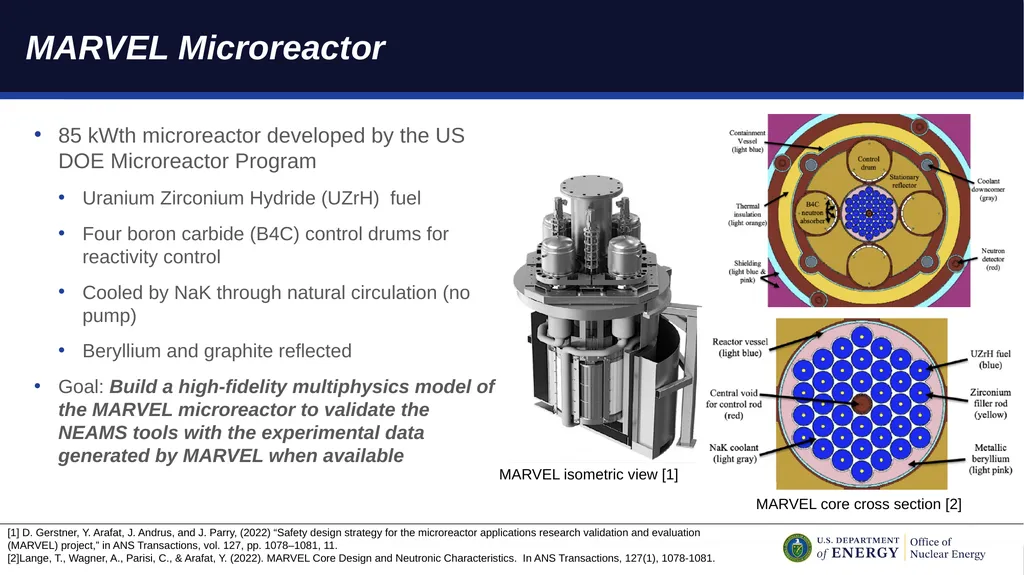
MARVEL Microreactor 85 kWth microreactor developed by the US DOE Microreactor Program
Uranium Zirconium Hydride (UZrH) fuel
Four boron carbide (B4C) control drums for reactivity control
Cooled by NaK through natural circulation (no pump)
Beryllium and graphite reflected
Goal: Build a high-fidelity multiphysics model of the MARVEL microreactor to validate the NEAMS tools with the experimental data generated by MARVEL when available [1] D. Gerstner, Y. Arafat, J. Andrus, and J. Parry, (2022) “Safety design strategy for the microreactor applications research validation and evaluation (MARVEL) project,” in ANS Transactions, vol. 127, pp. 1078–1081, 11.
[2]Lange, T., Wagner, A., Parisi, C., & Arafat, Y. (2022). MARVEL Core Design and Neutronic Characteristics. In ANS Transactions, 127(1), 1078-1081. MARVEL core cross section [2] MARVEL isometric view [1]<br>
03
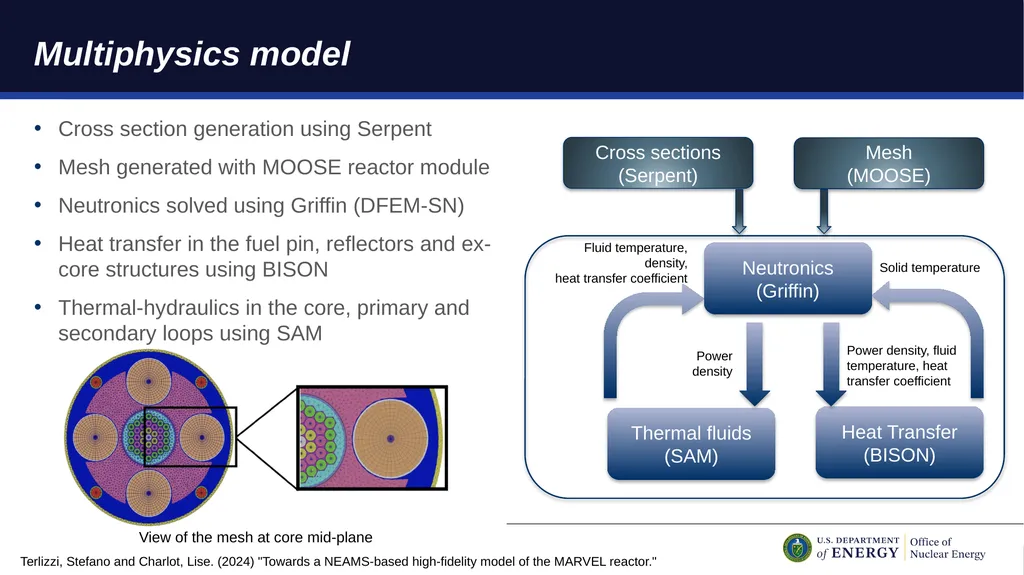
Cross section generation using Serpent
Mesh generated with MOOSE reactor module
Neutronics solved using Griffin (DFEM-SN)
Heat transfer in the fuel pin, reflectors and ex-core structures using BISON
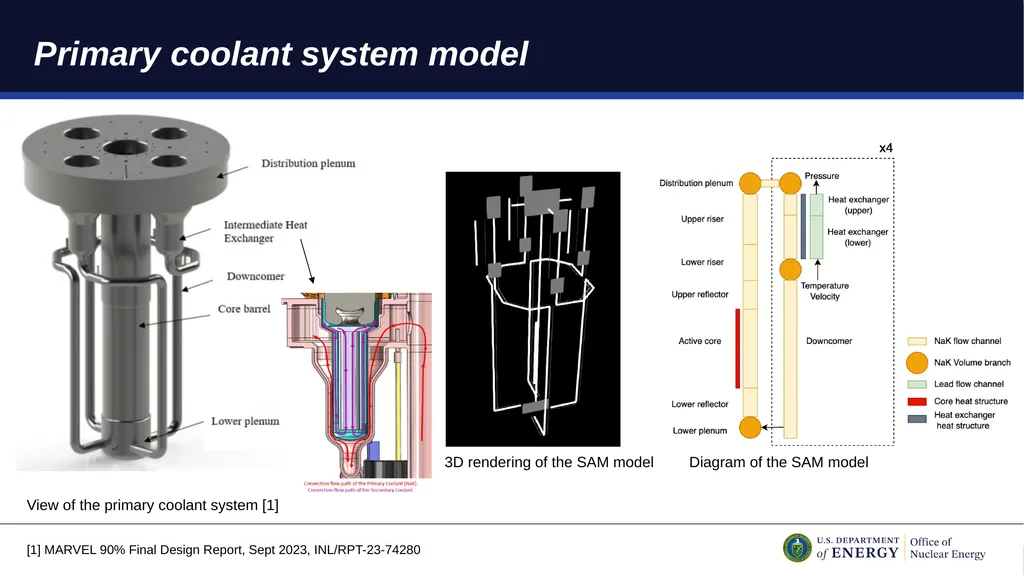
Thermal-hydraulics in the core, primary and secondary loops using SAM Multiphysics model Cross sections
(Serpent) Mesh
(MOOSE) View of the mesh at core mid-plane Terlizzi, Stefano and Charlot, Lise. (2024) "Towards a NEAMS-based high-fidelity model of the MARVEL reactor."<br>
04
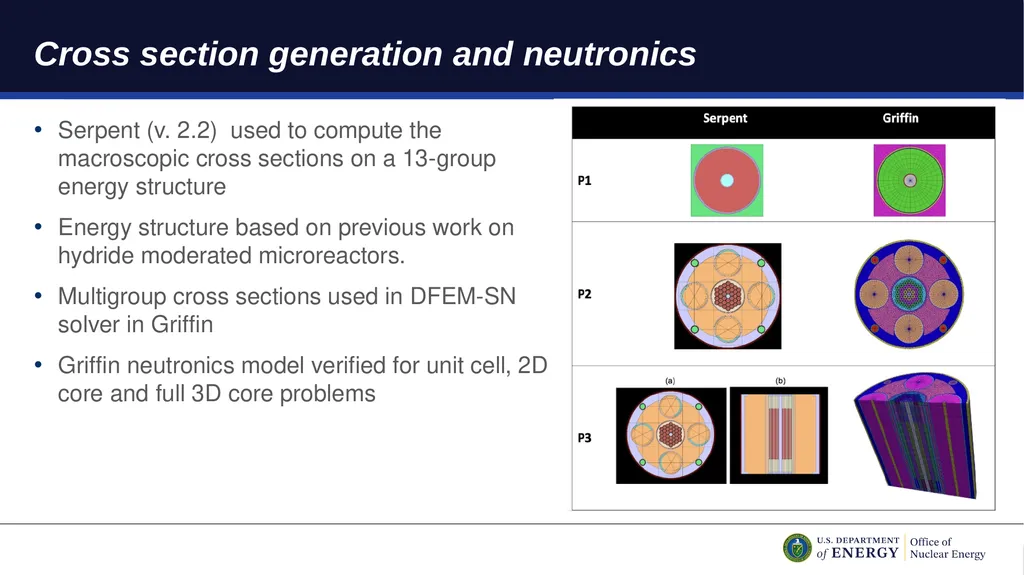
Serpent (v. 2.2) used to compute the macroscopic cross sections on a 13-group energy structure
Energy structure based on previous work on hydride moderated microreactors.
Multigroup cross sections used in DFEM-SN solver in Griffin
Griffin neutronics model verified for unit cell, 2D core and full 3D core problems Cross section generation and neutronics<br>
05
Primary coolant system model [1] MARVEL 90% Final Design Report, Sept 2023, INL/RPT-23-74280 View of the primary coolant system [1] 3D rendering of the SAM model Diagram of the SAM model<br>
06
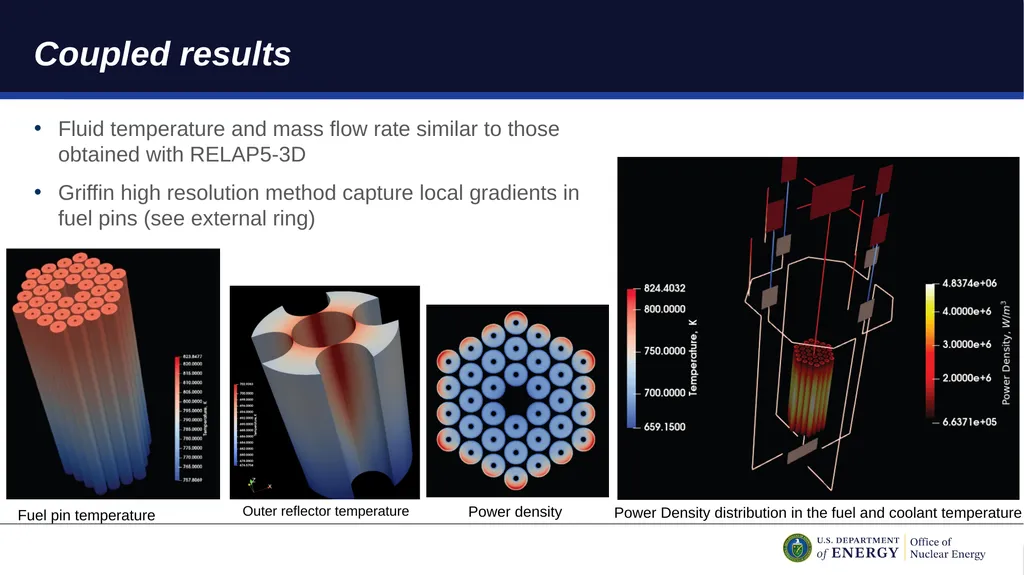
Coupled results Power density Power Density distribution in the fuel and coolant temperature Fluid temperature and mass flow rate similar to those obtained with RELAP5-3D
Griffin high resolution method capture local gradients in fuel pins (see external ring) Outer reflector temperature Fuel pin temperature<br>
07
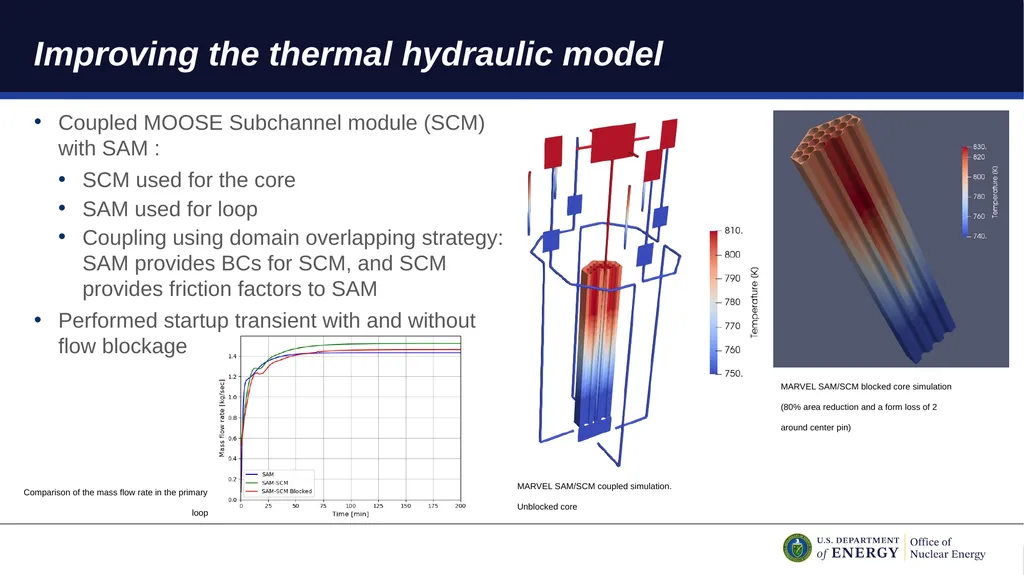
Coupled MOOSE Subchannel module (SCM) with SAM :
SCM used for the core
SAM used for loop
Coupling using domain overlapping strategy: SAM provides BCs for SCM, and SCM provides friction factors to SAM
Performed startup transient with and without flow blockage Improving the thermal hydraulic model MARVEL SAM/SCM coupled simulation.
Unblocked core MARVEL SAM/SCM blocked core simulation
(80% area reduction and a form loss of 2
around center pin) Comparison of the mass flow rate in the primary loop<br>
08
Developed a cutting-edge multiphysics model of the MARVEL microreactor
Future work:
Integrate the SAM/Subchannel thermal hydraulics model into the multiphysics model
Perform code-to-code comparisons with models developed by the Microreactor program
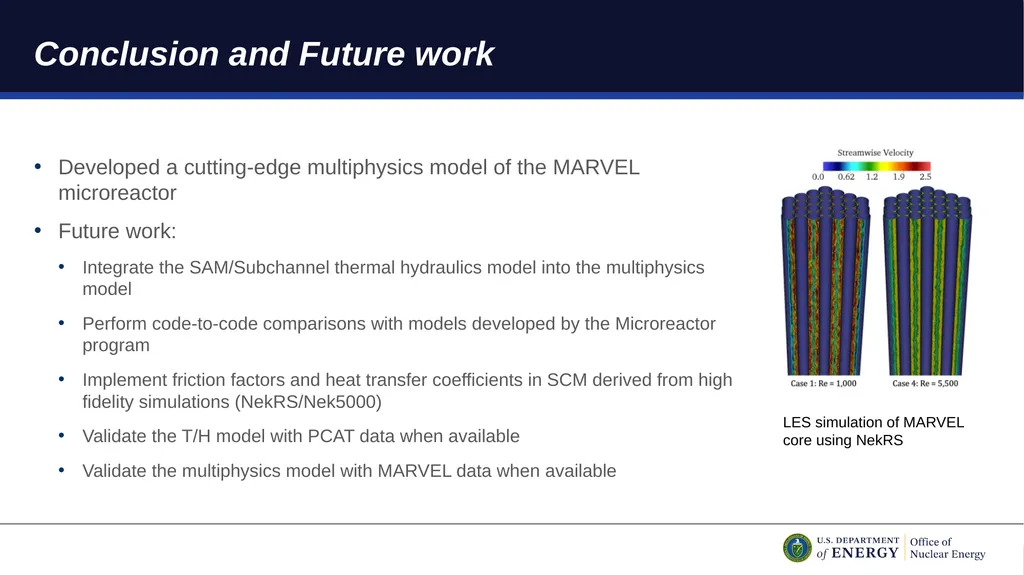
Implement friction factors and heat transfer coefficients in SCM derived from high fidelity simulations (NekRS/Nek5000)
Validate the T/H model with PCAT data when available
Validate the multiphysics model with MARVEL data when available Conclusion and Future work LES simulation of MARVEL core using NekRS<br>