
MODIFICATIONS TO ACCOMMODATE INDIVIDUALS WITH


Description: MODIFICATIONS TO ACCOMMODATE INDIVIDUALS WITH DISABILITIES IN COMMUNITY MEALS PROGRAMS 1 Agenda 2 Civil Rights - Legal and Program Authorities Disability Laws Disability Definitions Reasonable Modifications Fundamental Alteration Food
Related Topics
Download Presentation
"MODIFICATIONS TO ACCOMMODATE INDIVIDUALS WITH" is the property of its rightful owner. Permission is granted to download and print the materials on this website for personal, non-commercial use only, and to display it on your personal computer provided you do not modify the materials and that you retain all copyright notices contained in the materials. By downloading content from our website, you accept the terms of this agreement.
Presentation Transcript
slide1. MODIFICATIONS TO ACCOMMODATE INDIVIDUALS WITH DISABILITIES IN COMMUNITY MEALS PROGRAMS 1<br>
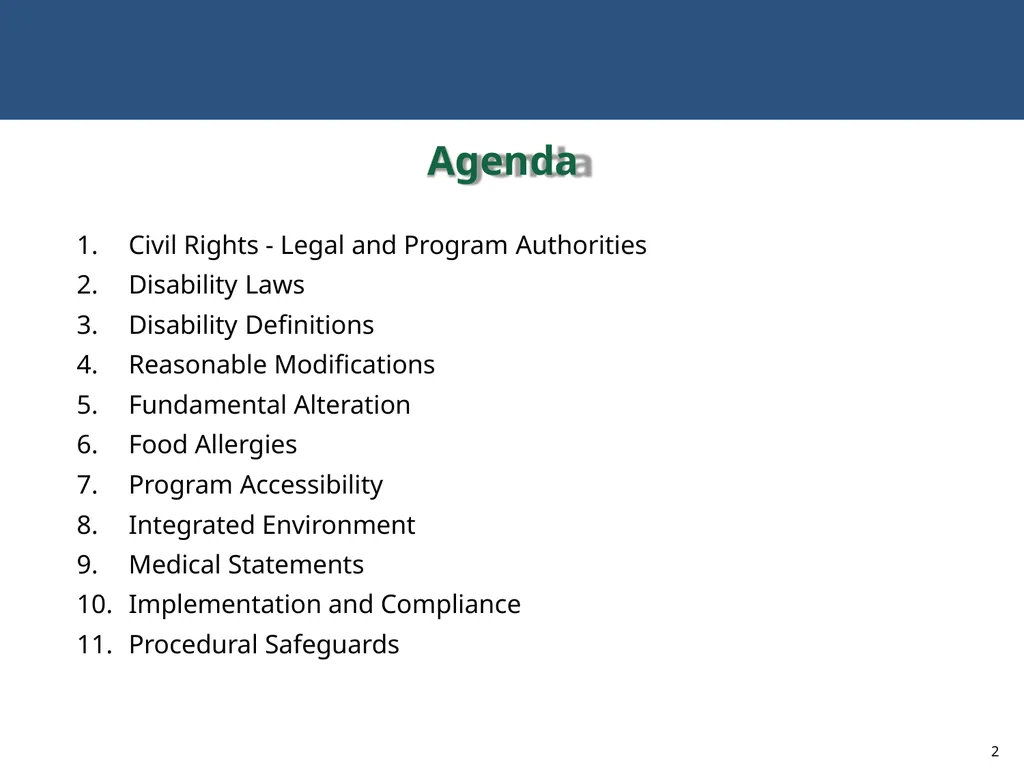
slide2. Agenda 2 Civil Rights - Legal and Program Authorities
Disability Laws
Disability Definitions
Reasonable Modifications
Fundamental Alteration
Food Allergies
Program Accessibility
Integrated Environment
Medical Statements
Implementation and Compliance
Procedural Safeguards<br>
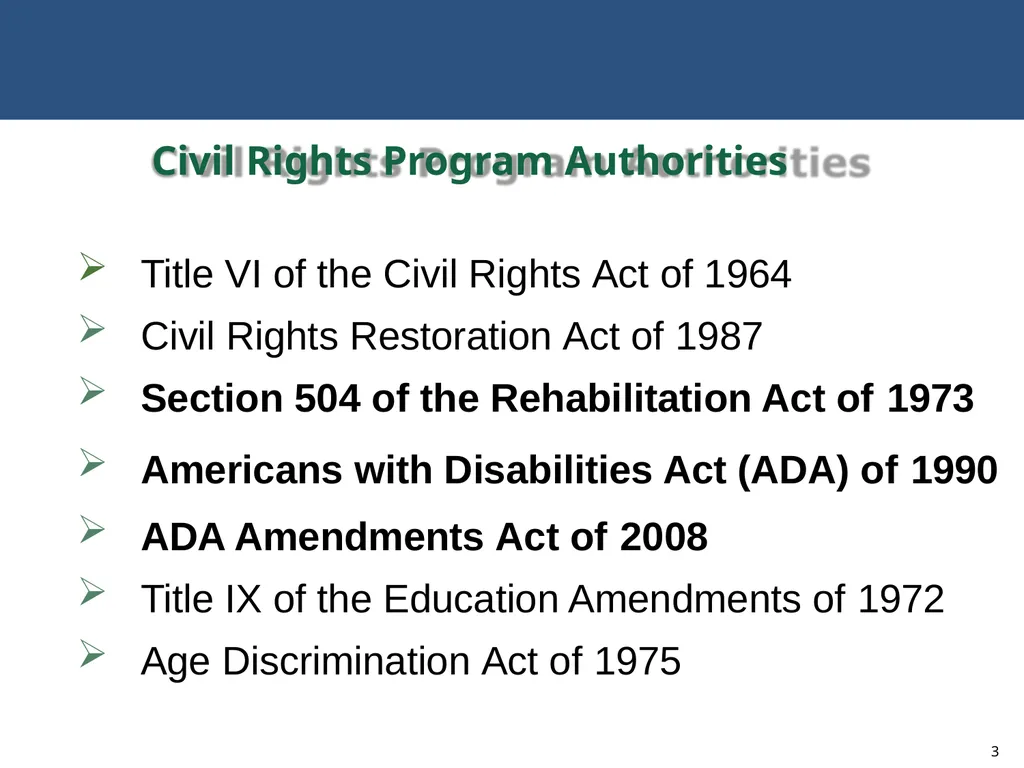
slide3. Civil Rights Program Authorities 3 Title VI of the Civil Rights Act of 1964
Civil Rights Restoration Act of 1987
Section 504 of the Rehabilitation Act of 1973
Americans with Disabilities Act (ADA) of 1990
ADA Amendments Act of 2008
Title IX of the Education Amendments of 1972
Age Discrimination Act of 1975<br>
slide4. Civil Rights Program Authorities (cont’d) 4 7 Parts 15, 15a, 15b and 15c
FNS 113-1 and its Appendices
Executive Order 12250 (Disability)
Executive Order 13166 – (LEP)
28 CFR 41 (Government-wide 504 Regulation)
USDA Departmental Regulation 4330-2 And many more…<br>
slide5. Disability Law 5 Legal Framework: Section 504, ADA, implementing regulations and policy guidance
Duty to Provide Reasonable Modifications: understand & accept that (sometimes) providing modifications is nebulous
Relationship between Section 504 and the ADA (Titles II & III) in light of the Americans with Disabilities Act Amendments Act<br>
slide6. Coverage of All Operations 6 Even one dollar of Federal money brings the entire scope of the operations within the jurisdiction of Section 504, even where the requested modification is not related to the part of the operations that receives Federal money.<br>
slide7. ADA Amendments Act of 2008 7 CLARIFIED the definition of Disability.
DID NOT change the expectation to provide a Reasonable Modification.
DID make very clear that the emphasis must be on providing the reasonable modification, and the disabled person does not carry a high burden of ‘proving’ he or she has a disability.<br>
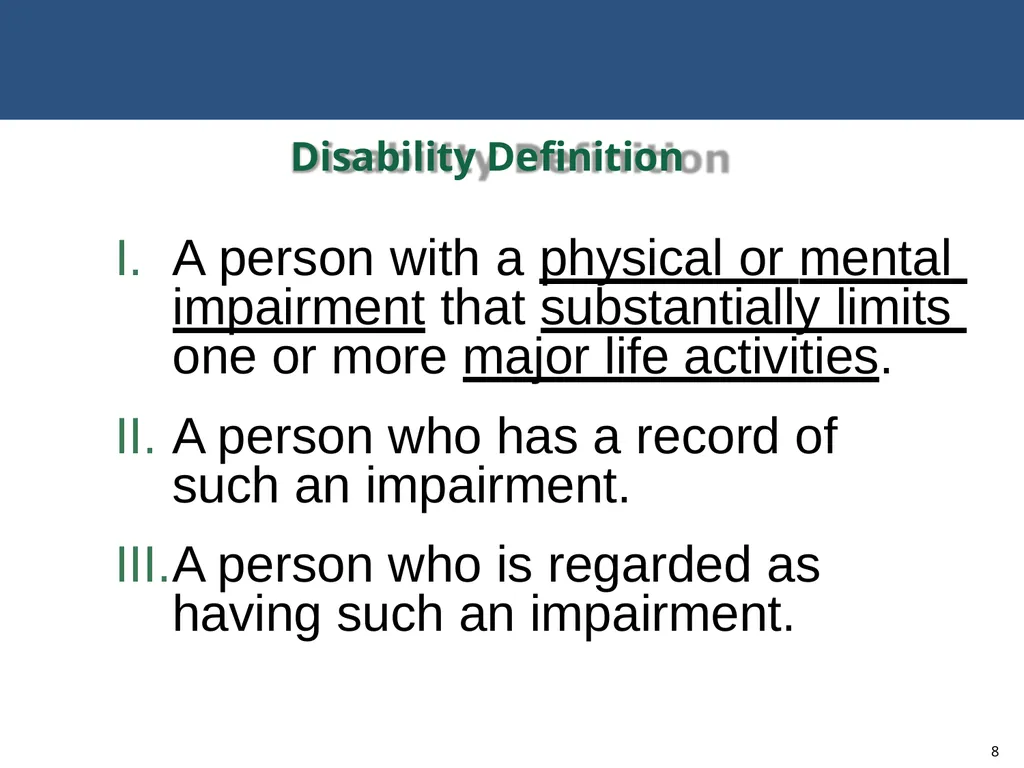
slide8. Disability Definition 8 A person with a physical or mental impairment that substantially limits one or more major life activities.
A person who has a record of such an impairment.
A person who is regarded as having such an impairment.<br>
slide9. Clarified Definition of Disability
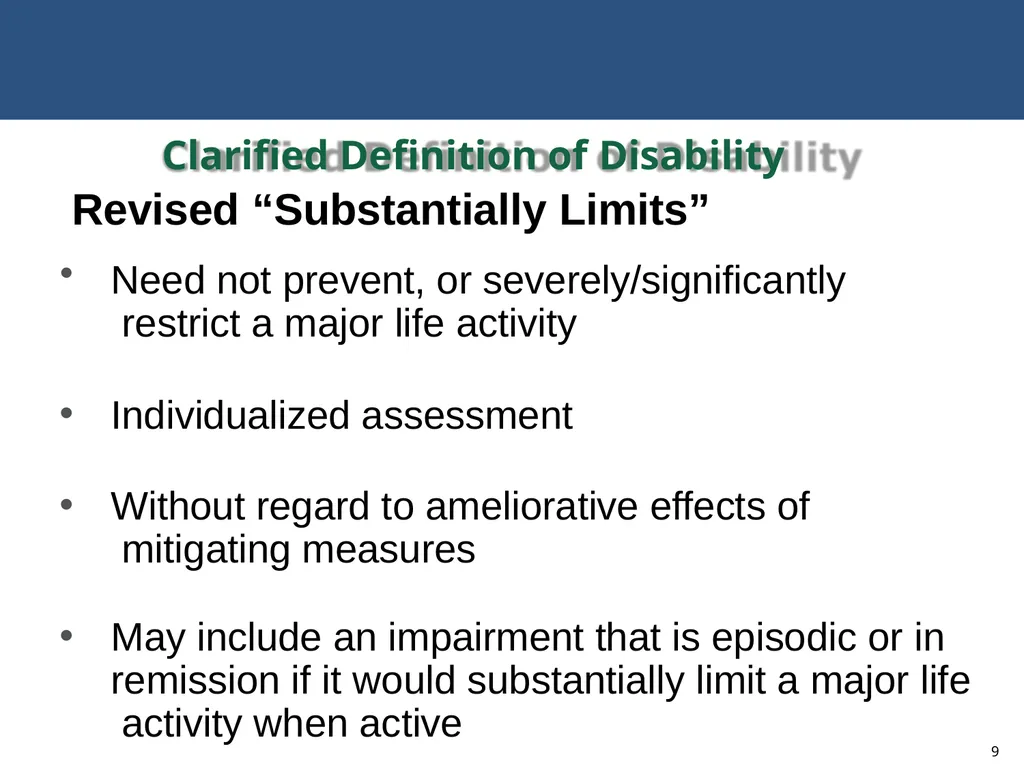
Revised “Substantially Limits” 9 Need not prevent, or severely/significantly restrict a major life activity
Individualized assessment
Without regard to ameliorative effects of mitigating measures
May include an impairment that is episodic or in remission if it would substantially limit a major life activity when active<br>
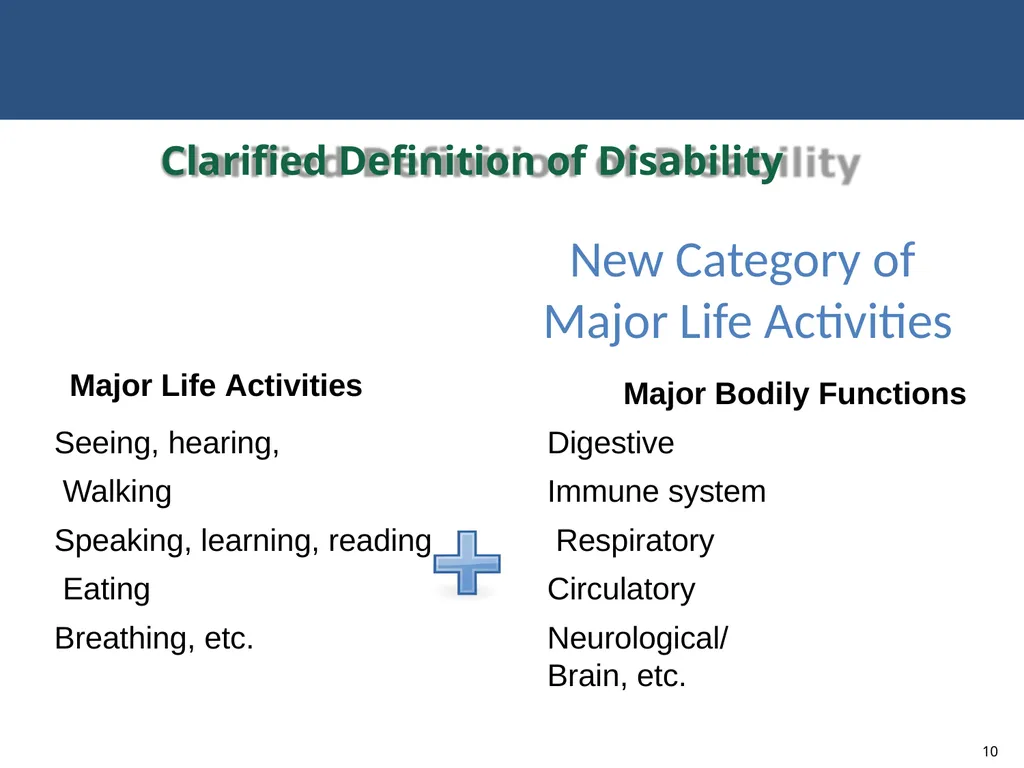
slide10. Major Life Activities Seeing, hearing, Walking
Speaking, learning, reading Eating
Breathing, etc. Major Bodily Functions
Digestive Immune system Respiratory Circulatory
Neurological/Brain, etc. Clarified Definition of Disability 10 New Category of
Major Life Activities<br>
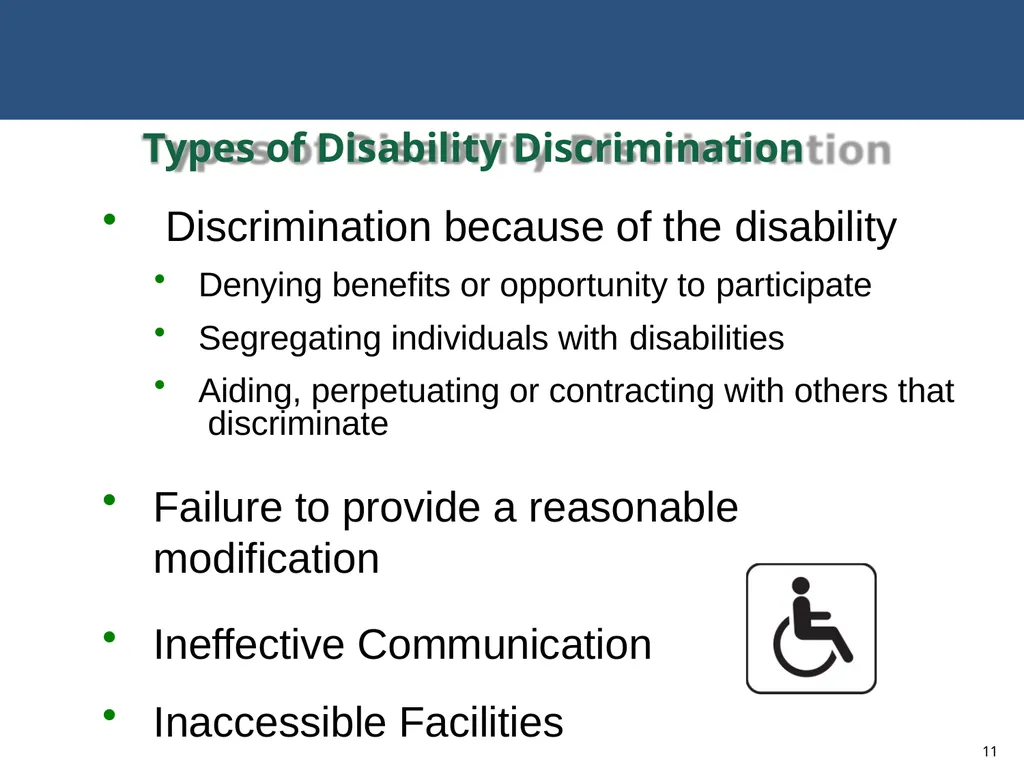
slide11. Types of Disability Discrimination Discrimination because of the disability
Denying benefits or opportunity to participate
Segregating individuals with disabilities
Aiding, perpetuating or contracting with others that discriminate
Failure to provide a reasonable modification
Ineffective Communication
Inaccessible Facilities 11<br>
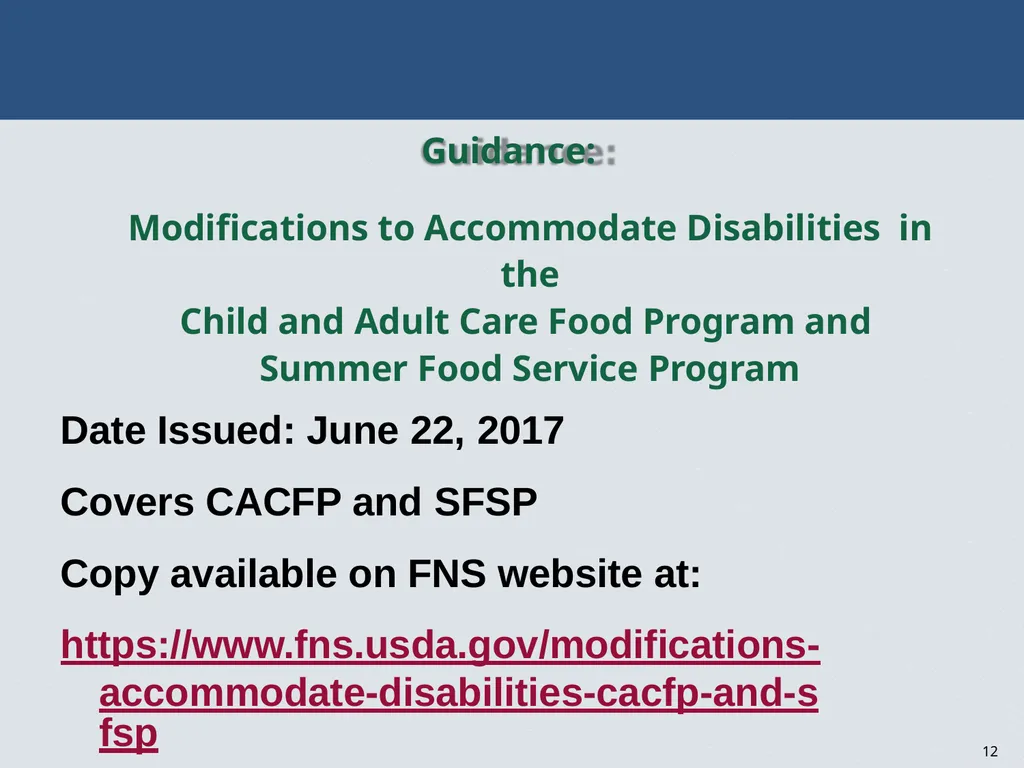
slide12. Guidance: Modifications to Accommodate Disabilities in the
Child and Adult Care Food Program and Summer Food Service Program
Date Issued: June 22, 2017
Covers CACFP and SFSP
Copy available on FNS website at: https://www.fns.usda.gov/modifications-
accommodate-disabilities-cacfp-and-sfsp 12<br>
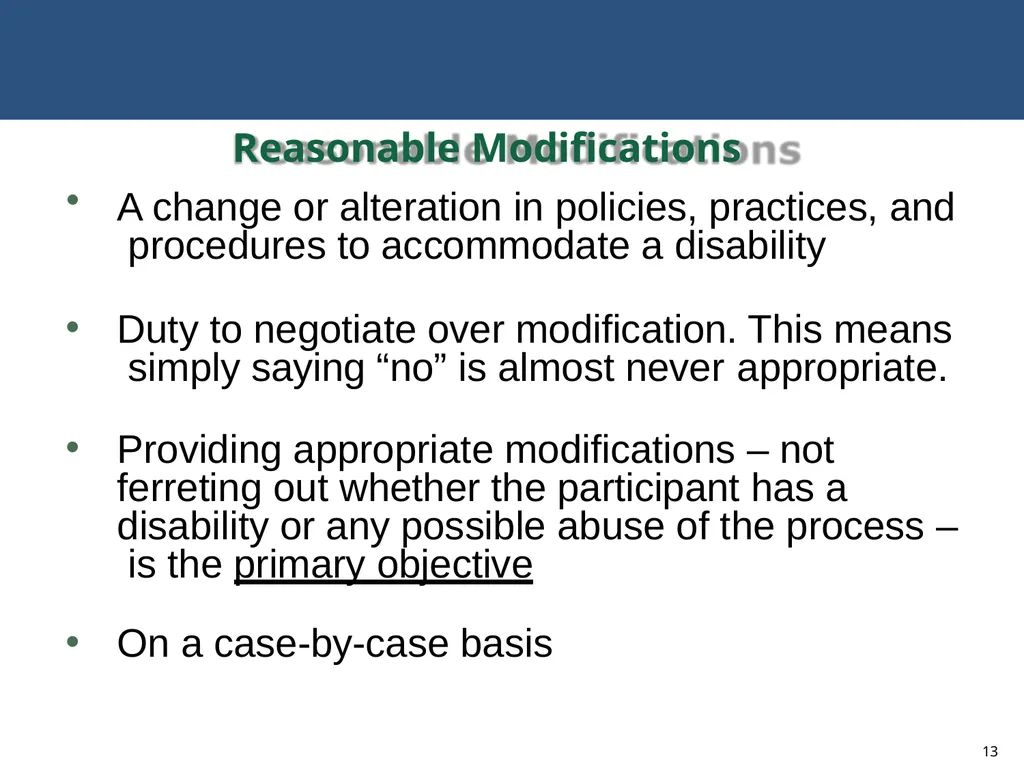
slide13. Reasonable Modifications 13 A change or alteration in policies, practices, and procedures to accommodate a disability
Duty to negotiate over modification. This means simply saying “no” is almost never appropriate.
Providing appropriate modifications – not ferreting out whether the participant has a disability or any possible abuse of the process – is the primary objective
On a case-by-case basis<br>
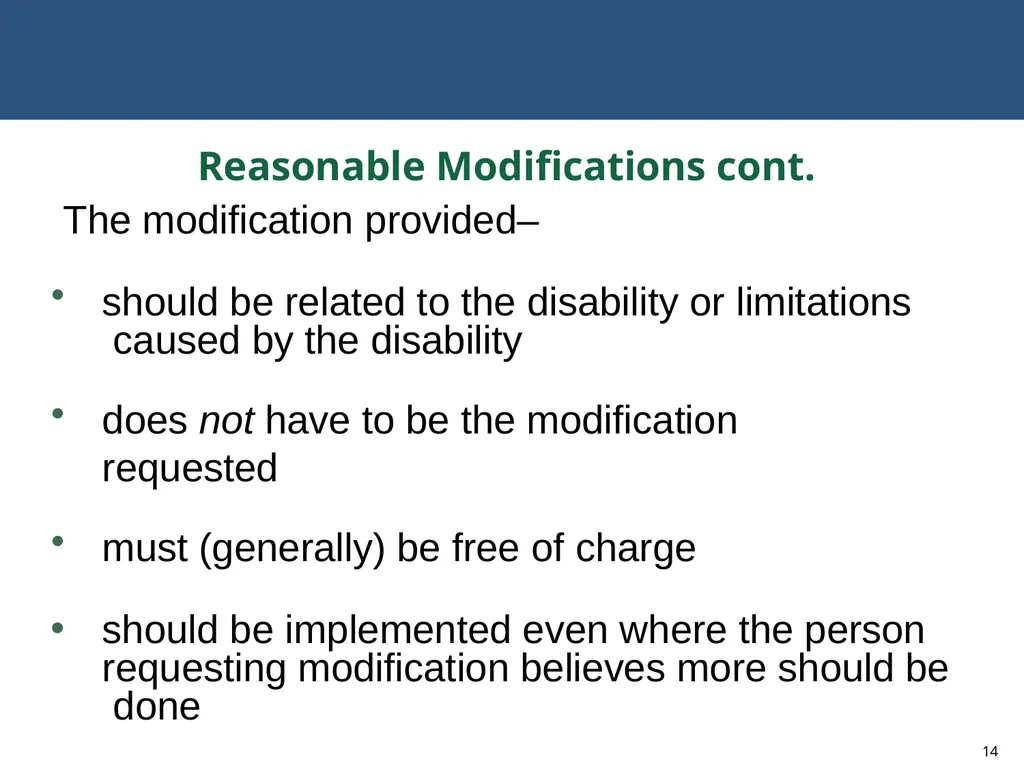
slide14. Reasonable Modifications cont. 14 The modification provided–
should be related to the disability or limitations caused by the disability
does not have to be the modification requested
must (generally) be free of charge
should be implemented even where the person requesting modification believes more should be done<br>
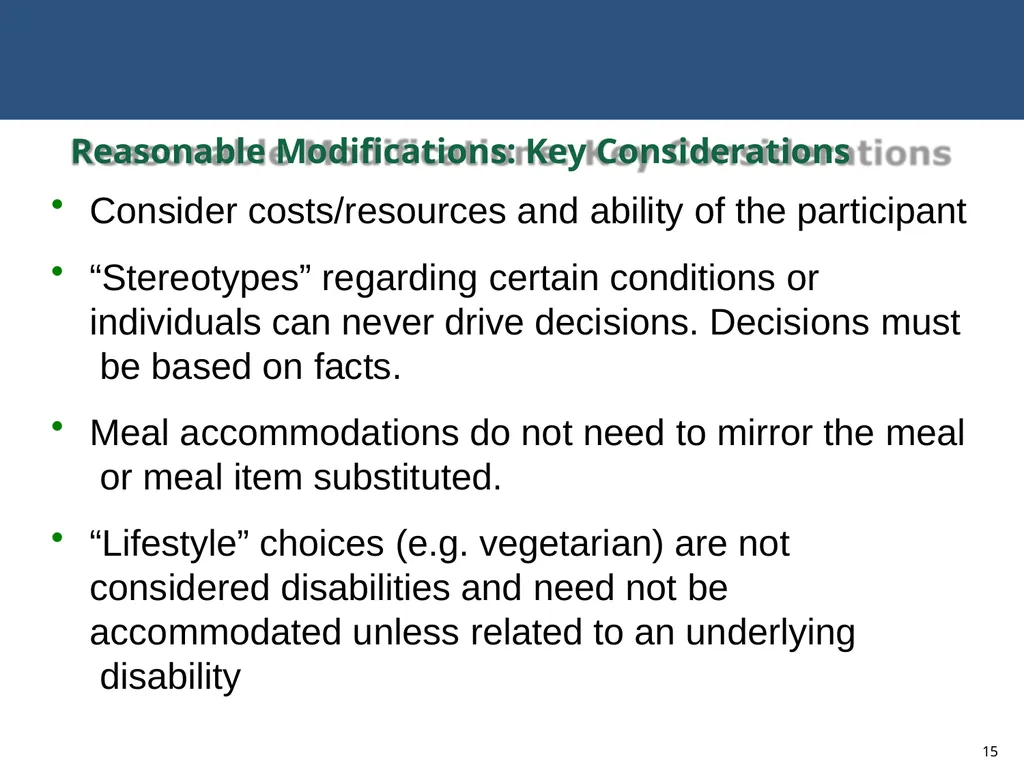
slide15. Reasonable Modifications: Key Considerations Consider costs/resources and ability of the participant
“Stereotypes” regarding certain conditions or individuals can never drive decisions. Decisions must be based on facts.
Meal accommodations do not need to mirror the meal or meal item substituted.
“Lifestyle” choices (e.g. vegetarian) are not considered disabilities and need not be accommodated unless related to an underlying disability 15<br>
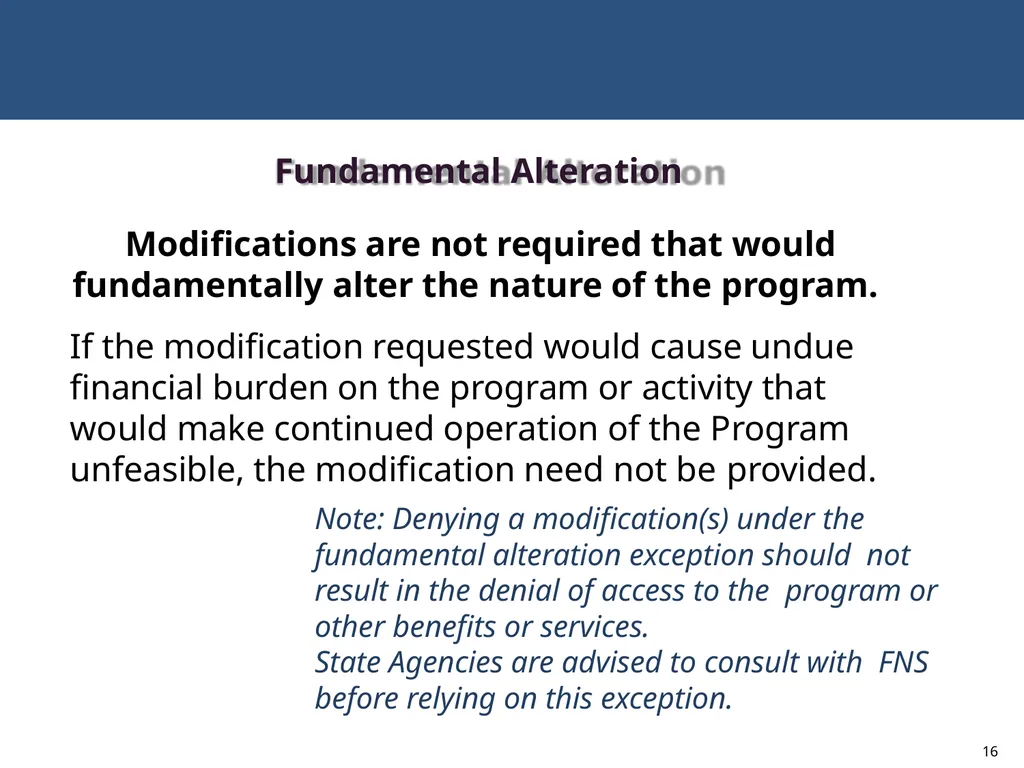
slide16. Fundamental Alteration Modifications are not required that would fundamentally alter the nature of the program.
If the modification requested would cause undue financial burden on the program or activity that would make continued operation of the Program unfeasible, the modification need not be provided.
Note: Denying a modification(s) under the fundamental alteration exception should not result in the denial of access to the program or other benefits or services.
State Agencies are advised to consult with FNS before relying on this exception. 16<br>
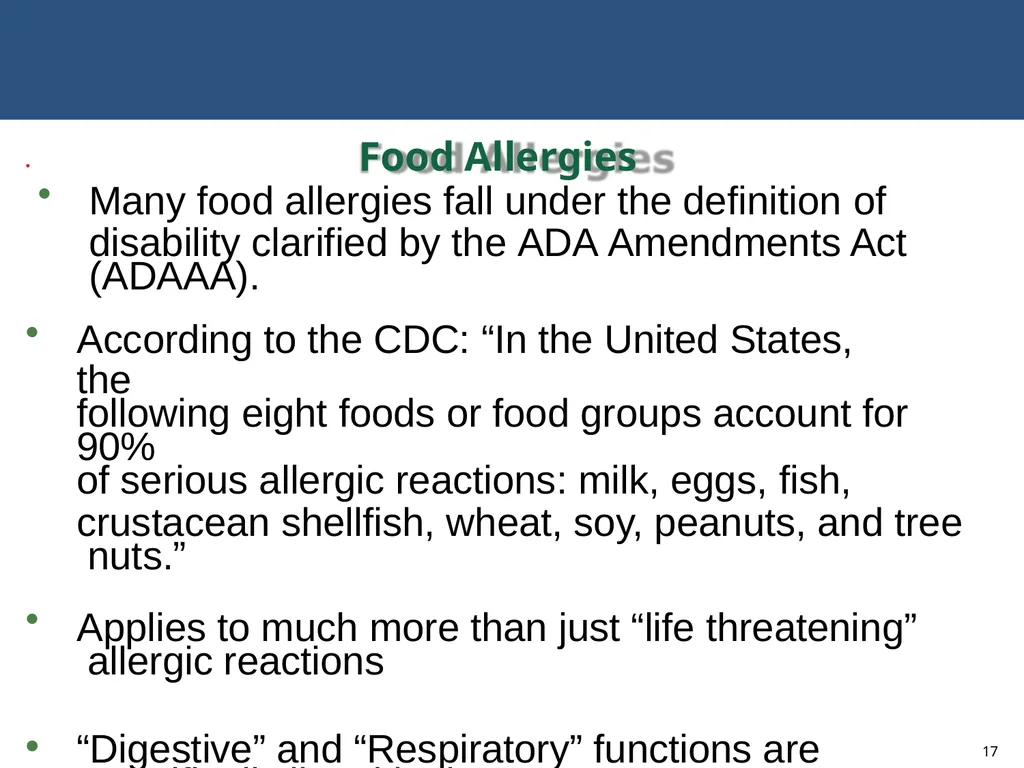
slide17. Food Allergies 17 • Many food allergies fall under the definition of
disability clarified by the ADA Amendments Act (ADAAA).
According to the CDC: “In the United States, the
following eight foods or food groups account for 90%
of serious allergic reactions: milk, eggs, fish,
crustacean shellfish, wheat, soy, peanuts, and tree nuts.”
Applies to much more than just “life threatening” allergic reactions
“Digestive” and “Respiratory” functions are specifically listed in the ADAAA<br>
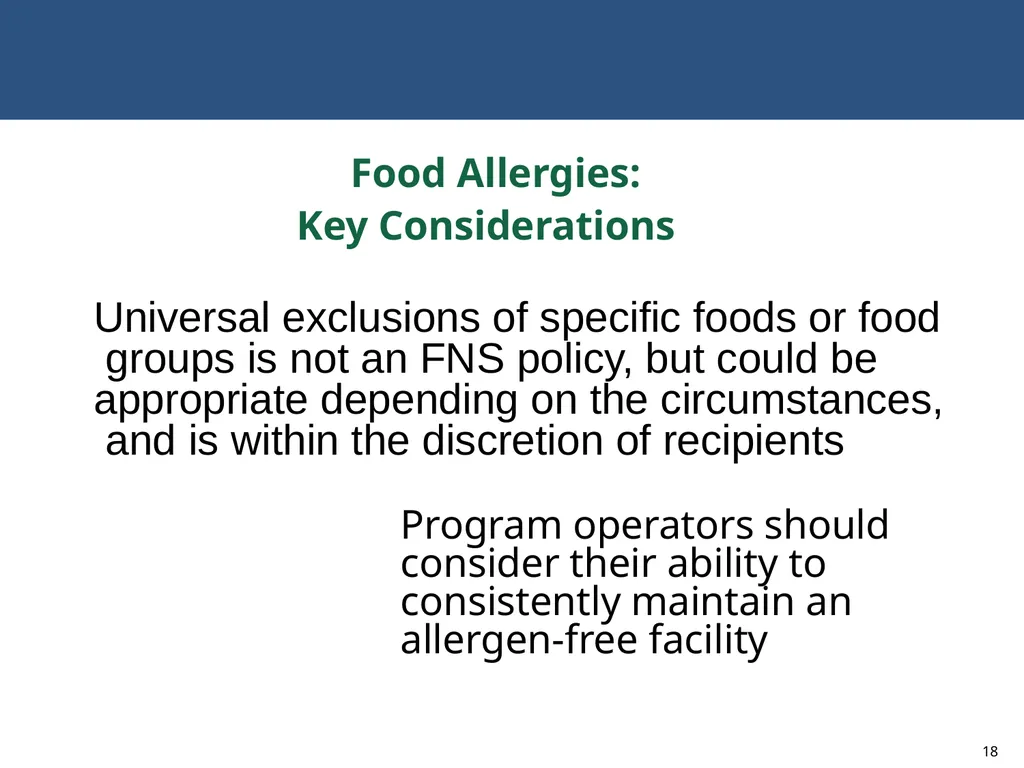
slide18. Food Allergies: Key Considerations Universal exclusions of specific foods or food groups is not an FNS policy, but could be appropriate depending on the circumstances, and is within the discretion of recipients
Program operators should consider their ability to consistently maintain an allergen-free facility 18<br>
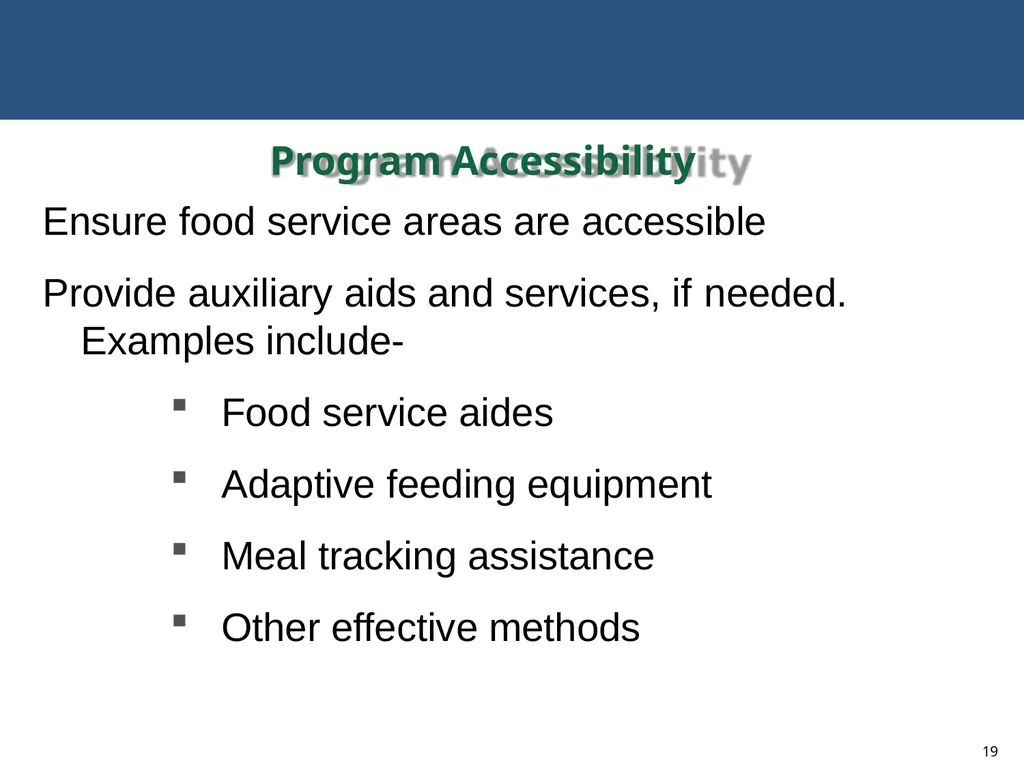
slide19. Program Accessibility 19 Ensure food service areas are accessible Provide auxiliary aids and services, if needed.
Examples include-
Food service aides
Adaptive feeding equipment
Meal tracking assistance
Other effective methods<br>
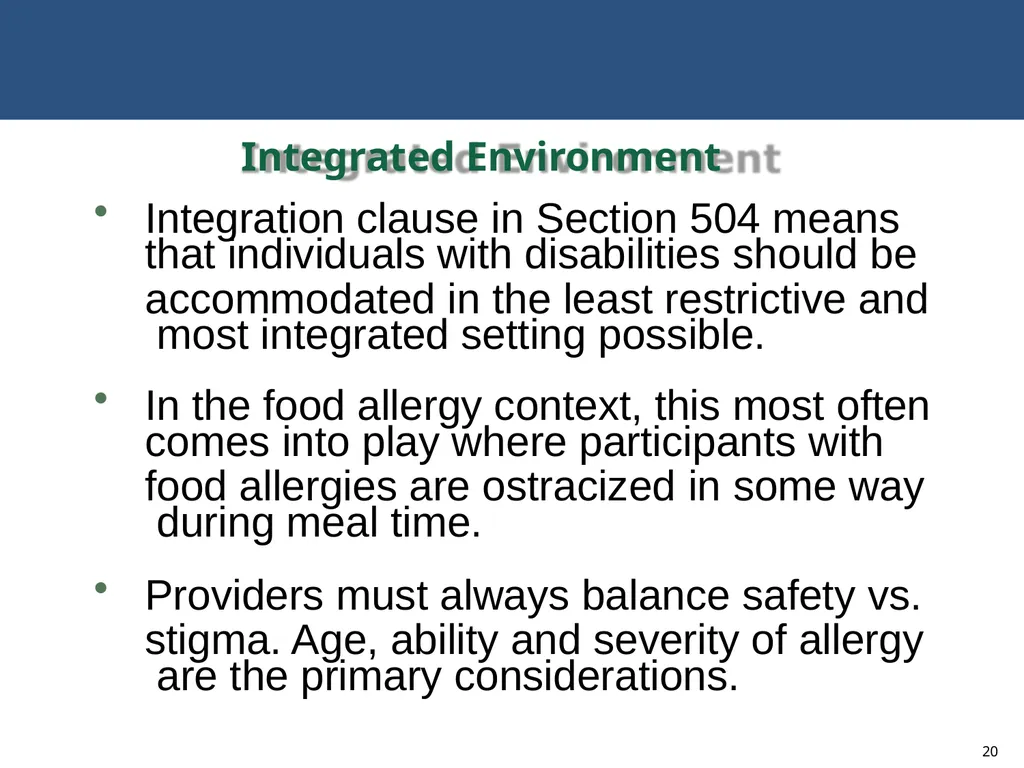
slide20. Integrated Environment 20 Integration clause in Section 504 means
that individuals with disabilities should be
accommodated in the least restrictive and most integrated setting possible.
In the food allergy context, this most often
comes into play where participants with
food allergies are ostracized in some way during meal time.
Providers must always balance safety vs.
stigma. Age, ability and severity of allergy are the primary considerations.<br>
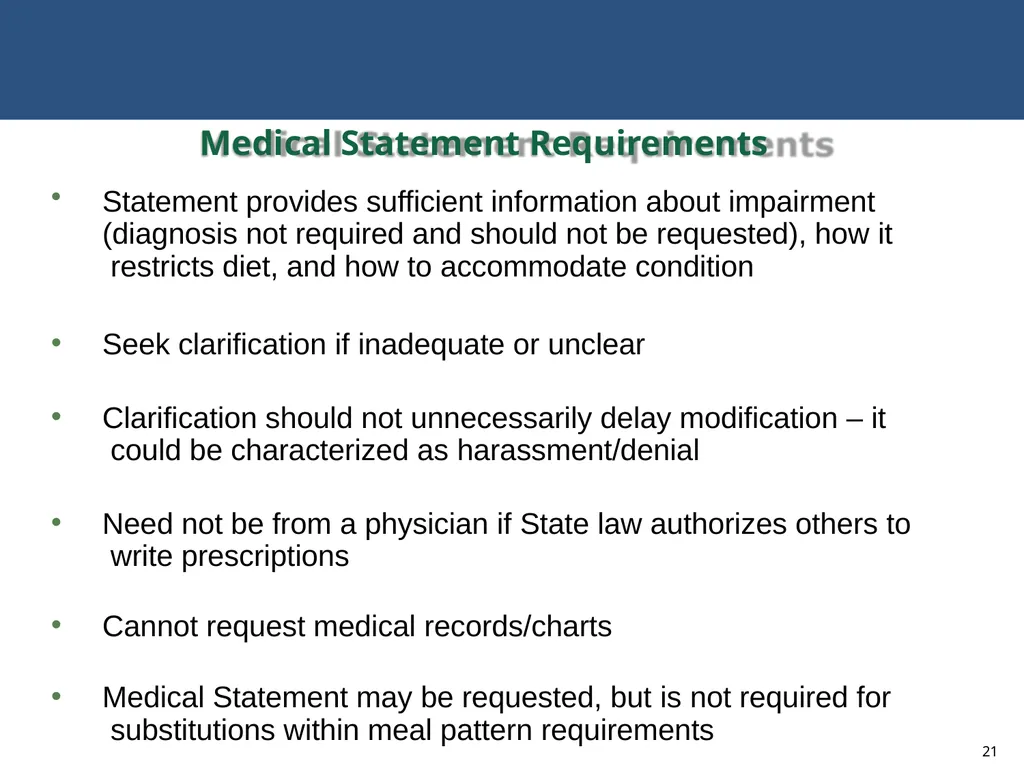
slide21. Medical Statement Requirements 21 Statement provides sufficient information about impairment (diagnosis not required and should not be requested), how it restricts diet, and how to accommodate condition
Seek clarification if inadequate or unclear
Clarification should not unnecessarily delay modification – it could be characterized as harassment/denial
Need not be from a physician if State law authorizes others to write prescriptions
Cannot request medical records/charts
Medical Statement may be requested, but is not required for substitutions within meal pattern requirements<br>
slide22. The food to be avoided (allergen)
Brief explanation of how exposure to the food affects the participant
Recommended substitute(s)* Example: Medical Statement Supporting Modification to Accommodate a Food Allergy Three essential components: 22<br>
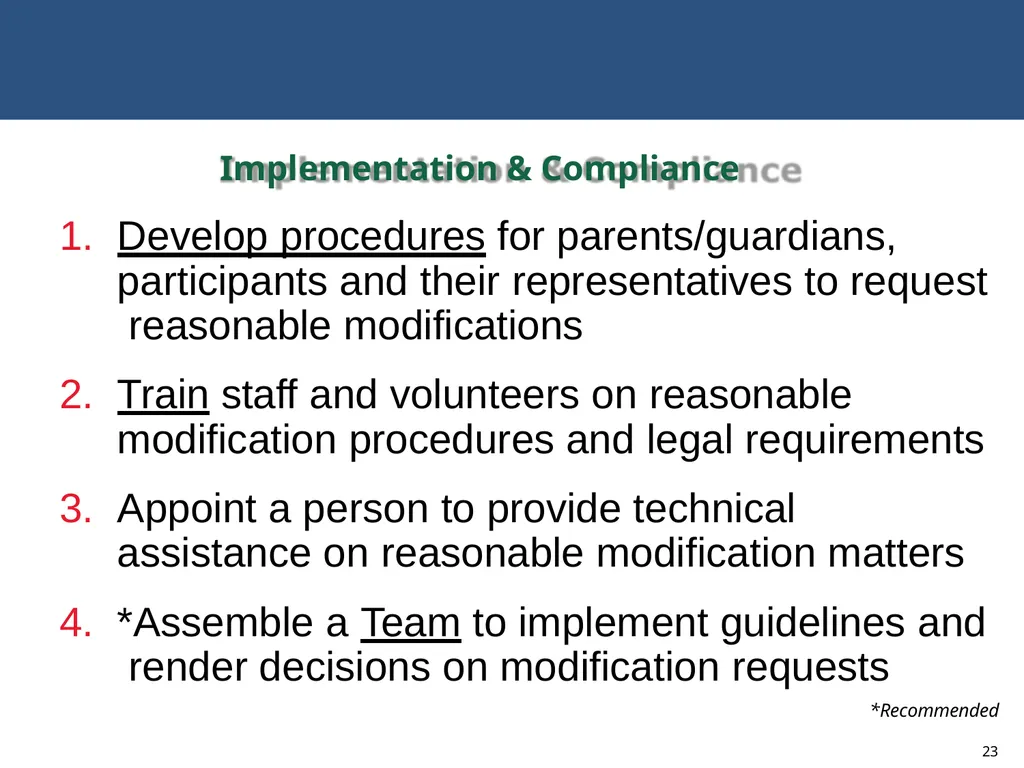
slide23. Implementation & Compliance 23 Develop procedures for parents/guardians, participants and their representatives to request reasonable modifications
Train staff and volunteers on reasonable modification procedures and legal requirements
Appoint a person to provide technical assistance on reasonable modification matters
*Assemble a Team to implement guidelines and render decisions on modification requests
*Recommended<br>
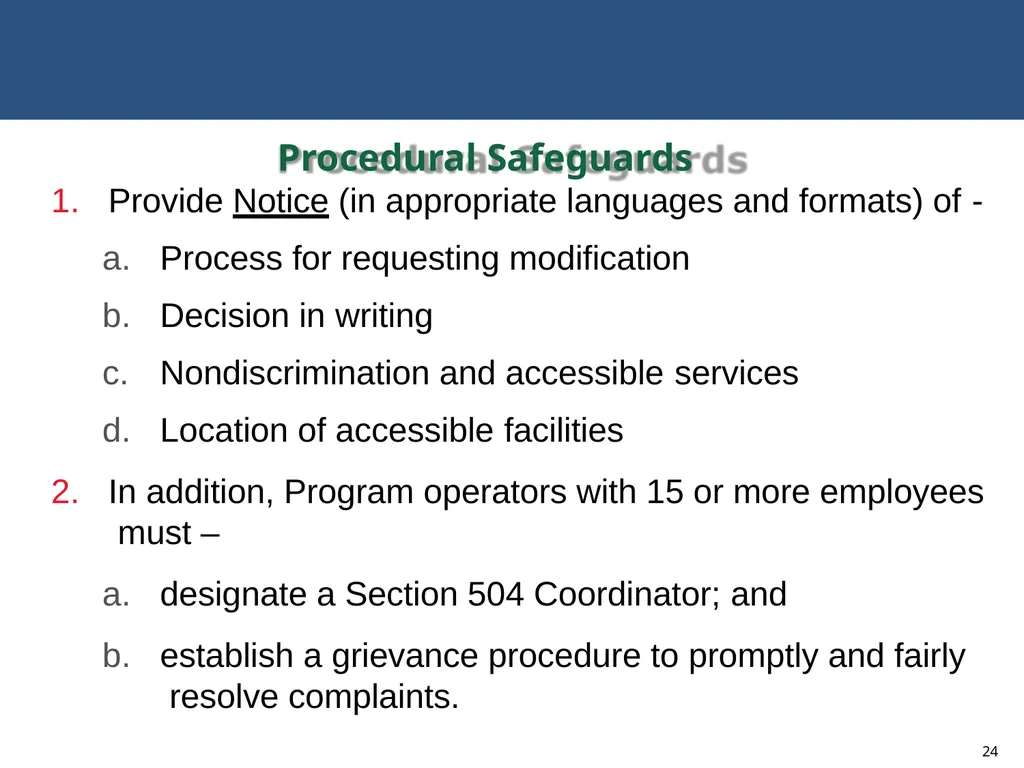
slide24. Procedural Safeguards 24 Provide Notice (in appropriate languages and formats) of -
Process for requesting modification
Decision in writing
Nondiscrimination and accessible services
Location of accessible facilities
In addition, Program operators with 15 or more employees must –
designate a Section 504 Coordinator; and
establish a grievance procedure to promptly and fairly resolve complaints.<br>
slide25. Office of Child Nutrition
www.cn.nysed.gov
Email: cntraining@nysed.gov with questions Contact Information 25<br>
slide2. Agenda 2 Civil Rights - Legal and Program Authorities
Disability Laws
Disability Definitions
Reasonable Modifications
Fundamental Alteration
Food Allergies
Program Accessibility
Integrated Environment
Medical Statements
Implementation and Compliance
Procedural Safeguards<br>
slide3. Civil Rights Program Authorities 3 Title VI of the Civil Rights Act of 1964
Civil Rights Restoration Act of 1987
Section 504 of the Rehabilitation Act of 1973
Americans with Disabilities Act (ADA) of 1990
ADA Amendments Act of 2008
Title IX of the Education Amendments of 1972
Age Discrimination Act of 1975<br>
slide4. Civil Rights Program Authorities (cont’d) 4 7 Parts 15, 15a, 15b and 15c
FNS 113-1 and its Appendices
Executive Order 12250 (Disability)
Executive Order 13166 – (LEP)
28 CFR 41 (Government-wide 504 Regulation)
USDA Departmental Regulation 4330-2 And many more…<br>
slide5. Disability Law 5 Legal Framework: Section 504, ADA, implementing regulations and policy guidance
Duty to Provide Reasonable Modifications: understand & accept that (sometimes) providing modifications is nebulous
Relationship between Section 504 and the ADA (Titles II & III) in light of the Americans with Disabilities Act Amendments Act<br>
slide6. Coverage of All Operations 6 Even one dollar of Federal money brings the entire scope of the operations within the jurisdiction of Section 504, even where the requested modification is not related to the part of the operations that receives Federal money.<br>
slide7. ADA Amendments Act of 2008 7 CLARIFIED the definition of Disability.
DID NOT change the expectation to provide a Reasonable Modification.
DID make very clear that the emphasis must be on providing the reasonable modification, and the disabled person does not carry a high burden of ‘proving’ he or she has a disability.<br>
slide8. Disability Definition 8 A person with a physical or mental impairment that substantially limits one or more major life activities.
A person who has a record of such an impairment.
A person who is regarded as having such an impairment.<br>
slide9. Clarified Definition of Disability
Revised “Substantially Limits” 9 Need not prevent, or severely/significantly restrict a major life activity
Individualized assessment
Without regard to ameliorative effects of mitigating measures
May include an impairment that is episodic or in remission if it would substantially limit a major life activity when active<br>
slide10. Major Life Activities Seeing, hearing, Walking
Speaking, learning, reading Eating
Breathing, etc. Major Bodily Functions
Digestive Immune system Respiratory Circulatory
Neurological/Brain, etc. Clarified Definition of Disability 10 New Category of
Major Life Activities<br>
slide11. Types of Disability Discrimination Discrimination because of the disability
Denying benefits or opportunity to participate
Segregating individuals with disabilities
Aiding, perpetuating or contracting with others that discriminate
Failure to provide a reasonable modification
Ineffective Communication
Inaccessible Facilities 11<br>
slide12. Guidance: Modifications to Accommodate Disabilities in the
Child and Adult Care Food Program and Summer Food Service Program
Date Issued: June 22, 2017
Covers CACFP and SFSP
Copy available on FNS website at: https://www.fns.usda.gov/modifications-
accommodate-disabilities-cacfp-and-sfsp 12<br>
slide13. Reasonable Modifications 13 A change or alteration in policies, practices, and procedures to accommodate a disability
Duty to negotiate over modification. This means simply saying “no” is almost never appropriate.
Providing appropriate modifications – not ferreting out whether the participant has a disability or any possible abuse of the process – is the primary objective
On a case-by-case basis<br>
slide14. Reasonable Modifications cont. 14 The modification provided–
should be related to the disability or limitations caused by the disability
does not have to be the modification requested
must (generally) be free of charge
should be implemented even where the person requesting modification believes more should be done<br>
slide15. Reasonable Modifications: Key Considerations Consider costs/resources and ability of the participant
“Stereotypes” regarding certain conditions or individuals can never drive decisions. Decisions must be based on facts.
Meal accommodations do not need to mirror the meal or meal item substituted.
“Lifestyle” choices (e.g. vegetarian) are not considered disabilities and need not be accommodated unless related to an underlying disability 15<br>
slide16. Fundamental Alteration Modifications are not required that would fundamentally alter the nature of the program.
If the modification requested would cause undue financial burden on the program or activity that would make continued operation of the Program unfeasible, the modification need not be provided.
Note: Denying a modification(s) under the fundamental alteration exception should not result in the denial of access to the program or other benefits or services.
State Agencies are advised to consult with FNS before relying on this exception. 16<br>
slide17. Food Allergies 17 • Many food allergies fall under the definition of
disability clarified by the ADA Amendments Act (ADAAA).
According to the CDC: “In the United States, the
following eight foods or food groups account for 90%
of serious allergic reactions: milk, eggs, fish,
crustacean shellfish, wheat, soy, peanuts, and tree nuts.”
Applies to much more than just “life threatening” allergic reactions
“Digestive” and “Respiratory” functions are specifically listed in the ADAAA<br>
slide18. Food Allergies: Key Considerations Universal exclusions of specific foods or food groups is not an FNS policy, but could be appropriate depending on the circumstances, and is within the discretion of recipients
Program operators should consider their ability to consistently maintain an allergen-free facility 18<br>
slide19. Program Accessibility 19 Ensure food service areas are accessible Provide auxiliary aids and services, if needed.
Examples include-
Food service aides
Adaptive feeding equipment
Meal tracking assistance
Other effective methods<br>
slide20. Integrated Environment 20 Integration clause in Section 504 means
that individuals with disabilities should be
accommodated in the least restrictive and most integrated setting possible.
In the food allergy context, this most often
comes into play where participants with
food allergies are ostracized in some way during meal time.
Providers must always balance safety vs.
stigma. Age, ability and severity of allergy are the primary considerations.<br>
slide21. Medical Statement Requirements 21 Statement provides sufficient information about impairment (diagnosis not required and should not be requested), how it restricts diet, and how to accommodate condition
Seek clarification if inadequate or unclear
Clarification should not unnecessarily delay modification – it could be characterized as harassment/denial
Need not be from a physician if State law authorizes others to write prescriptions
Cannot request medical records/charts
Medical Statement may be requested, but is not required for substitutions within meal pattern requirements<br>
slide22. The food to be avoided (allergen)
Brief explanation of how exposure to the food affects the participant
Recommended substitute(s)* Example: Medical Statement Supporting Modification to Accommodate a Food Allergy Three essential components: 22<br>
slide23. Implementation & Compliance 23 Develop procedures for parents/guardians, participants and their representatives to request reasonable modifications
Train staff and volunteers on reasonable modification procedures and legal requirements
Appoint a person to provide technical assistance on reasonable modification matters
*Assemble a Team to implement guidelines and render decisions on modification requests
*Recommended<br>
slide24. Procedural Safeguards 24 Provide Notice (in appropriate languages and formats) of -
Process for requesting modification
Decision in writing
Nondiscrimination and accessible services
Location of accessible facilities
In addition, Program operators with 15 or more employees must –
designate a Section 504 Coordinator; and
establish a grievance procedure to promptly and fairly resolve complaints.<br>
slide25. Office of Child Nutrition
www.cn.nysed.gov
Email: cntraining@nysed.gov with questions Contact Information 25<br>