
Module 16: Price Index Session I 2 Contents –
EM
Published · 33 slides · 0 views

1 / 1

Description
Module 16: Price Index Session I 2 Contents Session I Introduction purpose and use of Price Index What is an Index number Aggregate index Introduction Purpose and Use What is Price Index? Main uses Common price indices 4 Price The
Related Topics
Share
Embed code
Download this presentation From Below
"Module 16: Price Index Session I 2 Contents –" is the property of its rightful owner. Permission is granted to download and print the materials on this website for personal, non-commercial use only, and to display it on your personal computer provided you do not modify the materials and that you retain all copyright notices contained in the materials. By downloading content from our website, you accept the terms of this agreement.
Presentation Transcript
01
Module 16: Price Index Session I<br>
02
2 Contents – Session I Introduction – purpose and use of Price Index
What is an Index number
Aggregate index<br>
What is an Index number
Aggregate index<br>
03
Introduction – Purpose and Use
What is Price Index?
Main uses
Common price indices<br>
What is Price Index?
Main uses
Common price indices<br>
04
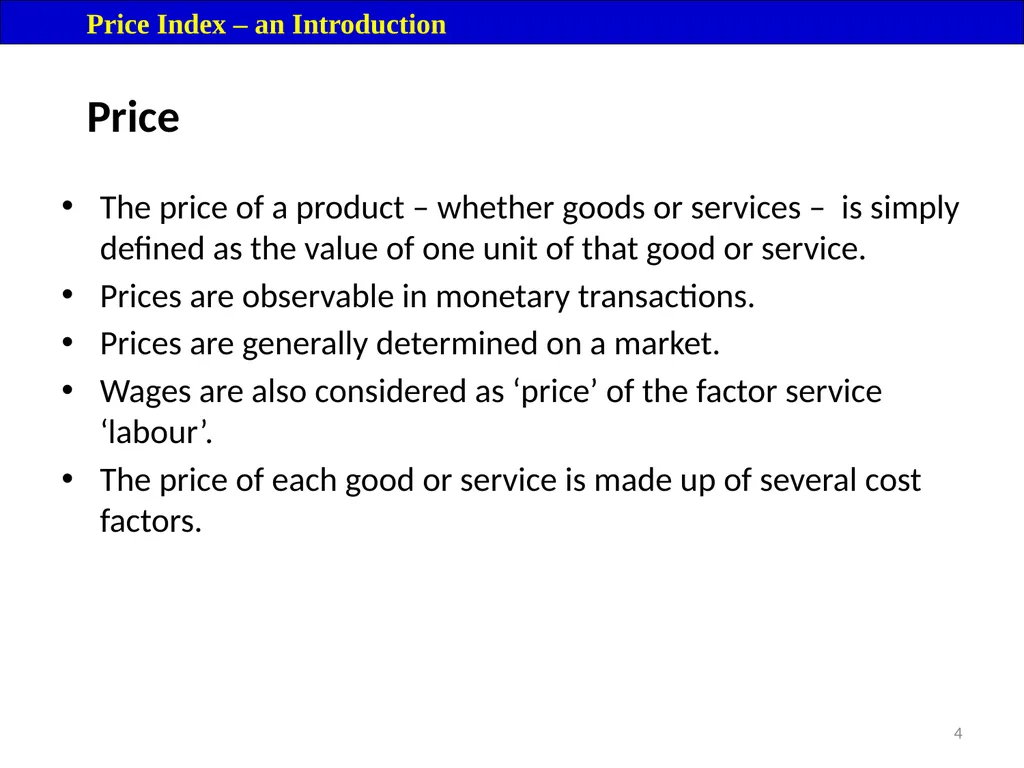
4 Price The price of a product – whether goods or services – is simply defined as the value of one unit of that good or service.
Prices are observable in monetary transactions.
Prices are generally determined on a market.
Wages are also considered as ‘price’ of the factor service ‘labour’.
The price of each good or service is made up of several cost factors. Price Index – an Introduction<br>
Prices are observable in monetary transactions.
Prices are generally determined on a market.
Wages are also considered as ‘price’ of the factor service ‘labour’.
The price of each good or service is made up of several cost factors. Price Index – an Introduction<br>
05
5 Price Index Of all the index numbers, price indices are the most important and are commonly used in various economic and business contexts.
Price index compares the prices of a group of commodities at a certain time or place with prices of the base period or place, respectively. Price Index – an Introduction<br>
Price index compares the prices of a group of commodities at a certain time or place with prices of the base period or place, respectively. Price Index – an Introduction<br>
06
What are Price Indices? A price index compares the prices of a set of products at different points in time, or at different locations.
It therefore measures price changes or price differentials rather than price levels.
Price indices capture changes in prices of a set of goods & services actually paid or received, at different stages of distribution, such as:
price paid by the customer (CPI) or
price received by the producer (output PPI). 6 6 Price Index – an Introduction<br>
It therefore measures price changes or price differentials rather than price levels.
Price indices capture changes in prices of a set of goods & services actually paid or received, at different stages of distribution, such as:
price paid by the customer (CPI) or
price received by the producer (output PPI). 6 6 Price Index – an Introduction<br>
07
Main Purpose As the price level goes up, the value of money goes down.
The main purpose of compiling a price index is to measure the change in purchasing power of the economy’s currency with respect to
the specified group of goods and services purchased or sold
by a specified type of purchasers or sellers. 7 7 Price Index – an Introduction<br>
The main purpose of compiling a price index is to measure the change in purchasing power of the economy’s currency with respect to
the specified group of goods and services purchased or sold
by a specified type of purchasers or sellers. 7 7 Price Index – an Introduction<br>
08
Use of Price Indices Main uses:
Measurement of inflation – changes in general level of prices over time.
Calculation of real values – National Accounts Statistics at constant prices.
Calculation of indexed values – adjustment of wages & salaries.
Contract escalation.
Determination of foreign exchange rates and for International studies. 8 8 Price Index – an Introduction<br>
Measurement of inflation – changes in general level of prices over time.
Calculation of real values – National Accounts Statistics at constant prices.
Calculation of indexed values – adjustment of wages & salaries.
Contract escalation.
Determination of foreign exchange rates and for International studies. 8 8 Price Index – an Introduction<br>
09
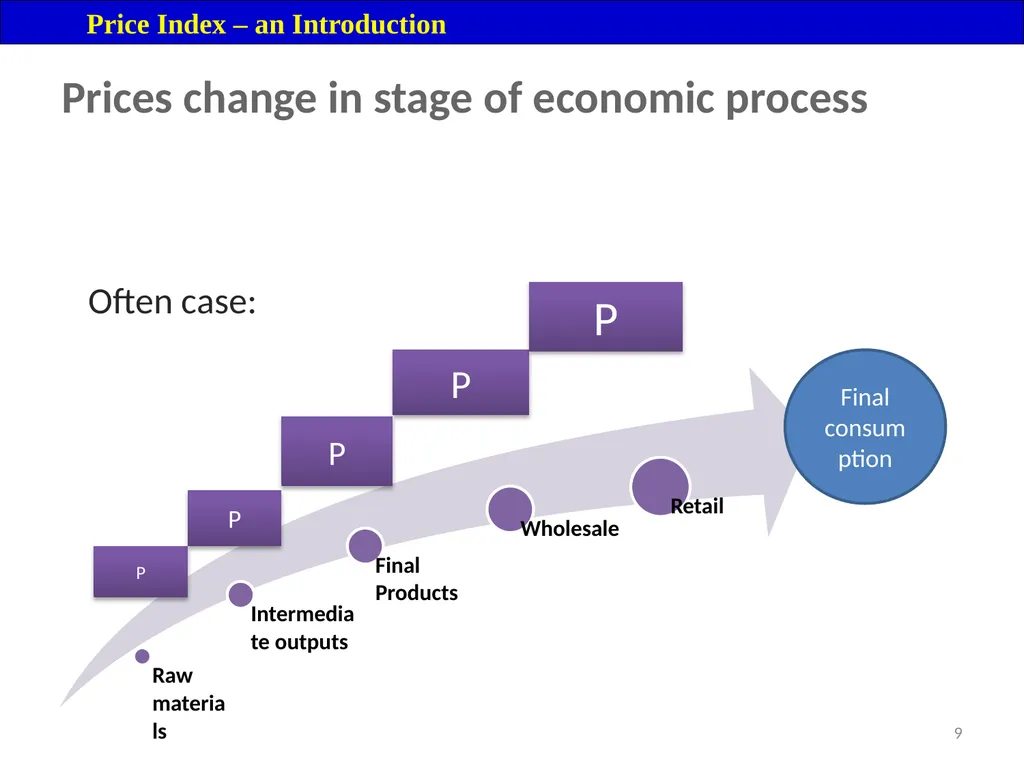
9 Prices change in stage of economic process Often case: Final consumption P P P P P Price Index – an Introduction<br>
10
Different Price Indices There are different kinds of price indexes. For each different stage of processing price indices are compiled.
These differ with respect to
items they take into account.
buyers or sellers involved in the transactions.
periodicity, i.e. whether the prices are observed weekly or monthly or yearly. 10 10 Price Index – an Introduction<br>
These differ with respect to
items they take into account.
buyers or sellers involved in the transactions.
periodicity, i.e. whether the prices are observed weekly or monthly or yearly. 10 10 Price Index – an Introduction<br>
11
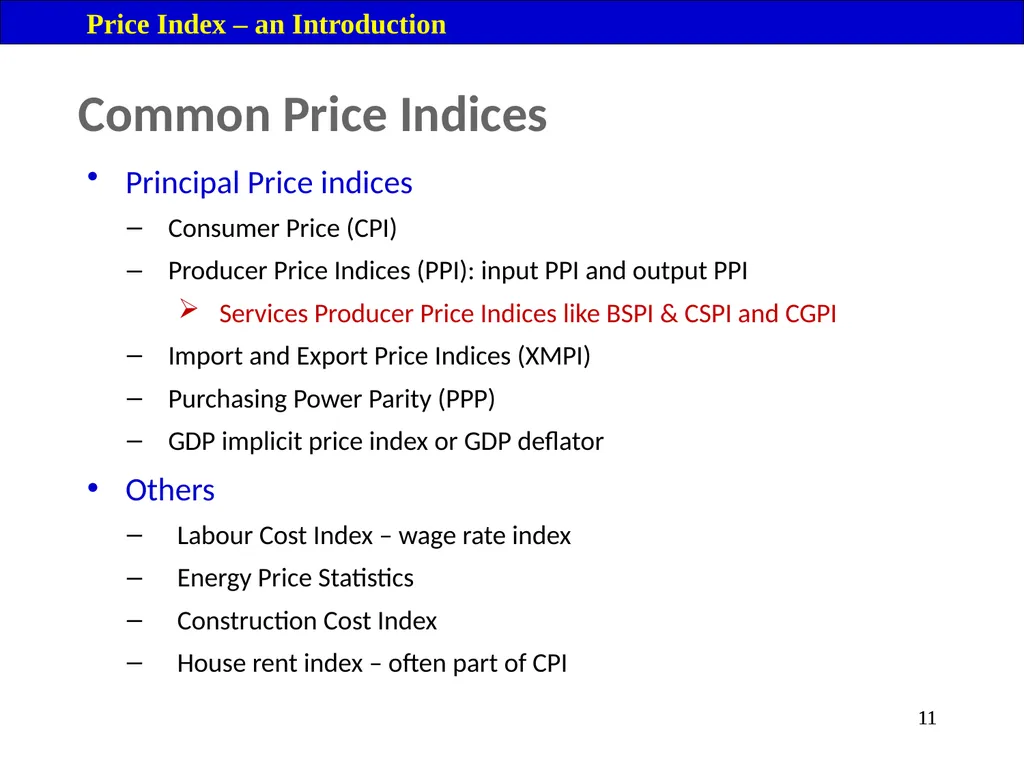
Common Price Indices Principal Price indices
Consumer Price (CPI)
Producer Price Indices (PPI): input PPI and output PPI
Services Producer Price Indices like BSPI & CSPI and CGPI
Import and Export Price Indices (XMPI)
Purchasing Power Parity (PPP)
GDP implicit price index or GDP deflator
Others
Labour Cost Index – wage rate index
Energy Price Statistics
Construction Cost Index
House rent index – often part of CPI 11 11 Price Index – an Introduction<br>
Consumer Price (CPI)
Producer Price Indices (PPI): input PPI and output PPI
Services Producer Price Indices like BSPI & CSPI and CGPI
Import and Export Price Indices (XMPI)
Purchasing Power Parity (PPP)
GDP implicit price index or GDP deflator
Others
Labour Cost Index – wage rate index
Energy Price Statistics
Construction Cost Index
House rent index – often part of CPI 11 11 Price Index – an Introduction<br>
12
12 Price Index in this module Of the various price indices mentioned in the previous slide, this module focusses on mainly on CPI.
The PPI and XMPI are also discussed briefly, especially in the context of weighting, product classification and interpretation.
We will start with a discussion on Index numbers in general, before turning to Price indices. Price Index – an Introduction<br>
The PPI and XMPI are also discussed briefly, especially in the context of weighting, product classification and interpretation.
We will start with a discussion on Index numbers in general, before turning to Price indices. Price Index – an Introduction<br>
13
What is an Index Number
Simple price index
Types of simple price index<br>
Simple price index
Types of simple price index<br>
14
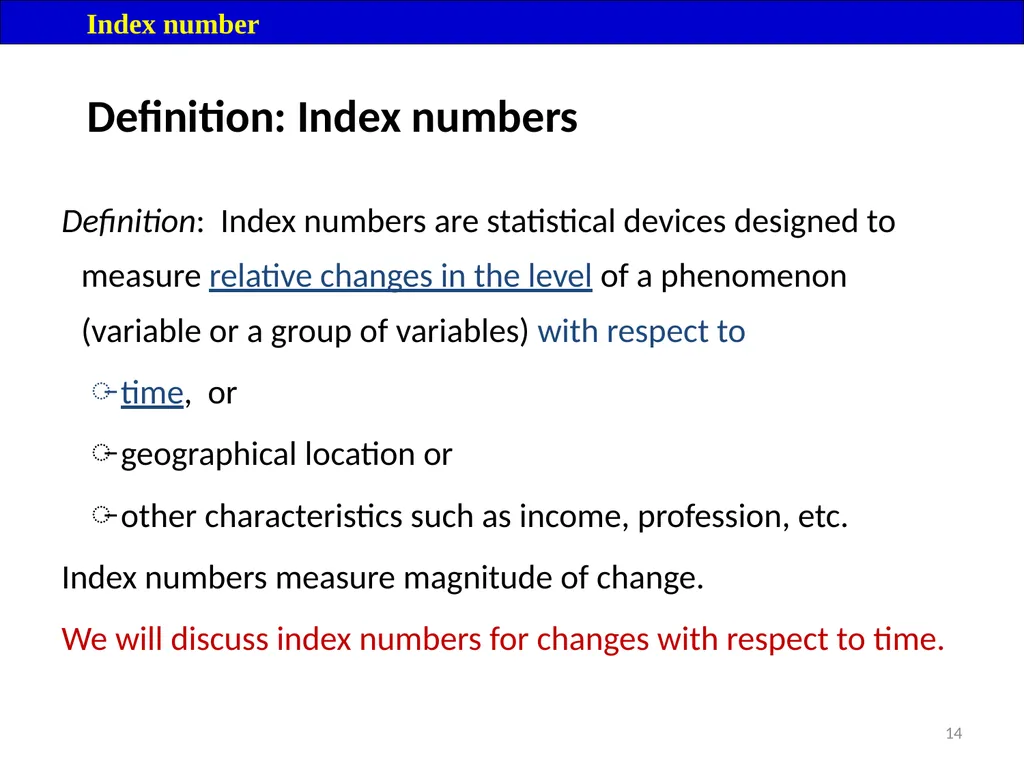
14 Definition: Index numbers Definition: Index numbers are statistical devices designed to measure relative changes in the level of a phenomenon (variable or a group of variables) with respect to
time, or
geographical location or
other characteristics such as income, profession, etc.
Index numbers measure magnitude of change.
We will discuss index numbers for changes with respect to time. Index number<br>
time, or
geographical location or
other characteristics such as income, profession, etc.
Index numbers measure magnitude of change.
We will discuss index numbers for changes with respect to time. Index number<br>
15
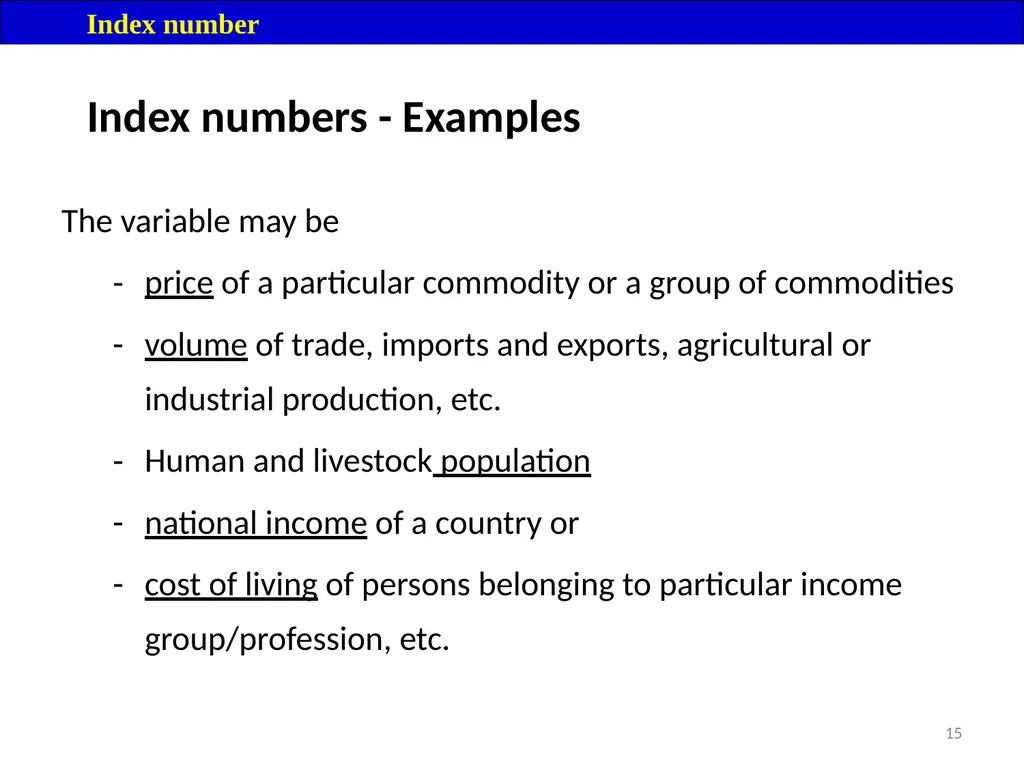
15 Index numbers - Examples The variable may be
price of a particular commodity or a group of commodities
volume of trade, imports and exports, agricultural or industrial production, etc.
Human and livestock population
national income of a country or
cost of living of persons belonging to particular income group/profession, etc. Index number<br>
price of a particular commodity or a group of commodities
volume of trade, imports and exports, agricultural or industrial production, etc.
Human and livestock population
national income of a country or
cost of living of persons belonging to particular income group/profession, etc. Index number<br>
16
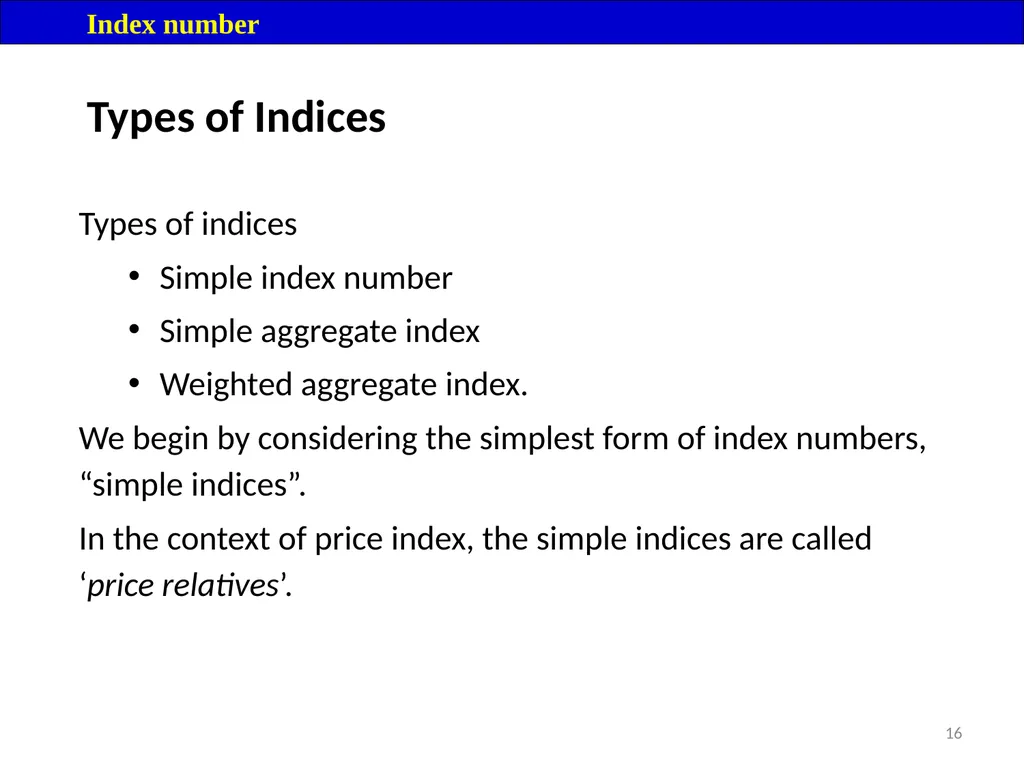
16 Types of Indices Types of indices
Simple index number
Simple aggregate index
Weighted aggregate index.
We begin by considering the simplest form of index numbers, “simple indices”.
In the context of price index, the simple indices are called ‘price relatives’. Index number<br>
Simple index number
Simple aggregate index
Weighted aggregate index.
We begin by considering the simplest form of index numbers, “simple indices”.
In the context of price index, the simple indices are called ‘price relatives’. Index number<br>
17
Simple Index<br>
18
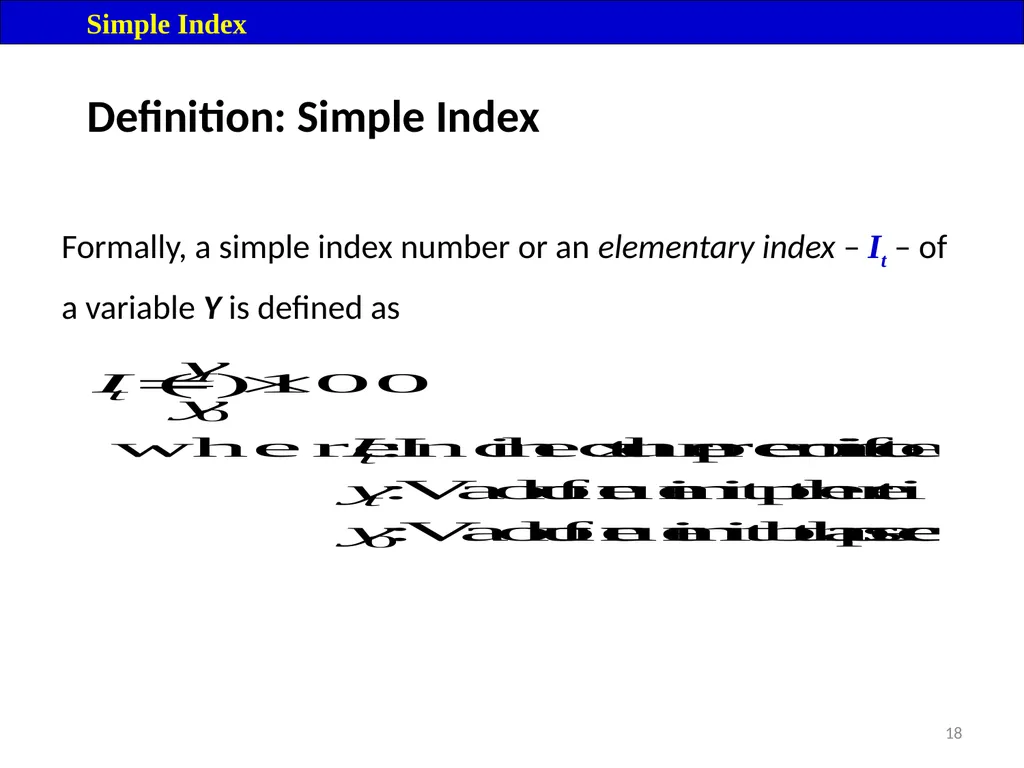
18 Definition: Simple Index Formally, a simple index number or an elementary index – It – of a variable Y is defined as Simple Index<br>
19
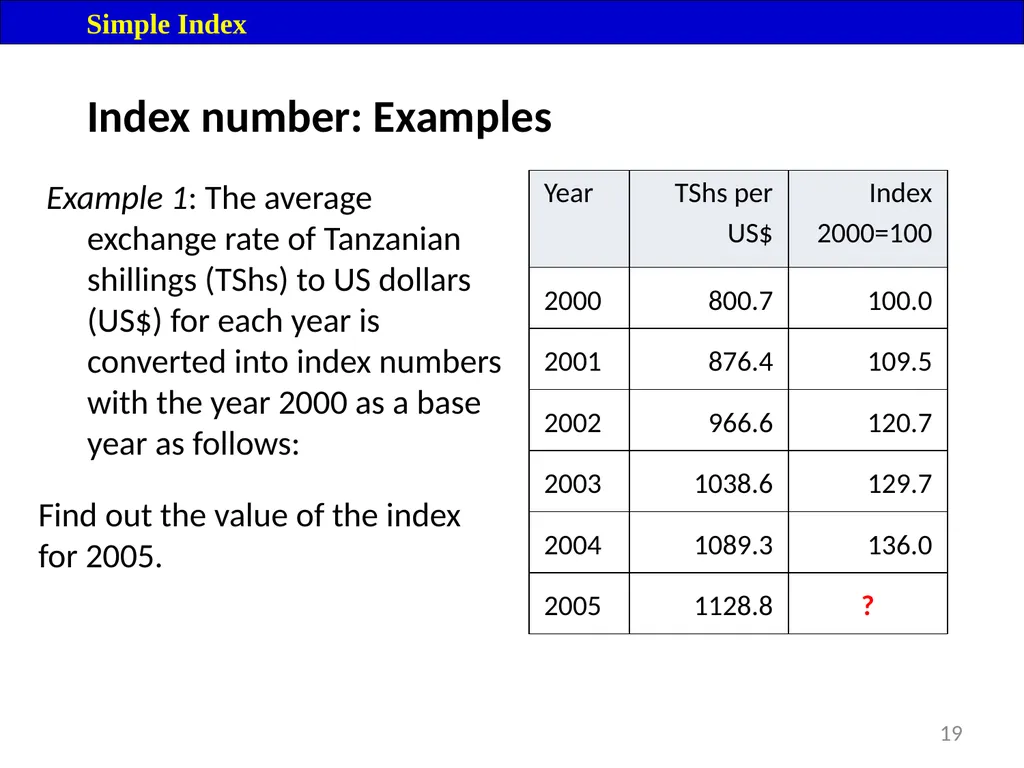
19 Index number: Examples Example 1: The average exchange rate of Tanzanian shillings (TShs) to US dollars (US$) for each year is converted into index numbers with the year 2000 as a base year as follows: Find out the value of the index for 2005. Simple Index<br>
20
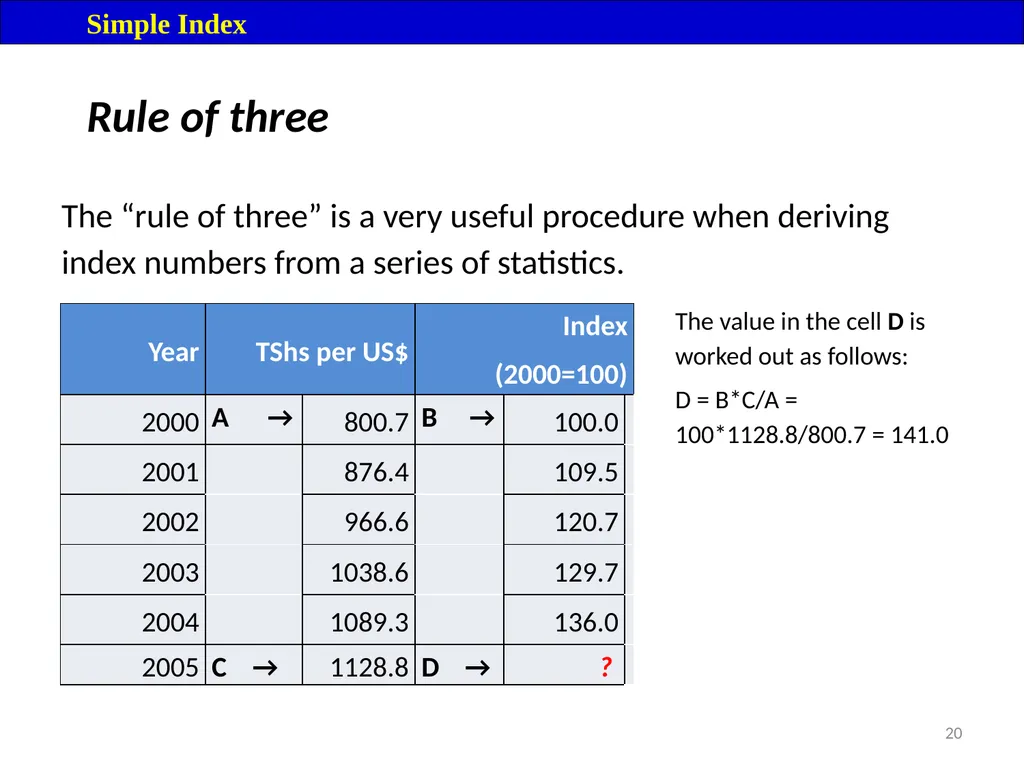
20 Rule of three The “rule of three” is a very useful procedure when deriving index numbers from a series of statistics. The value in the cell D is worked out as follows:
D = B*C/A = 100*1128.8/800.7 = 141.0 Simple Index<br>
D = B*C/A = 100*1128.8/800.7 = 141.0 Simple Index<br>
21
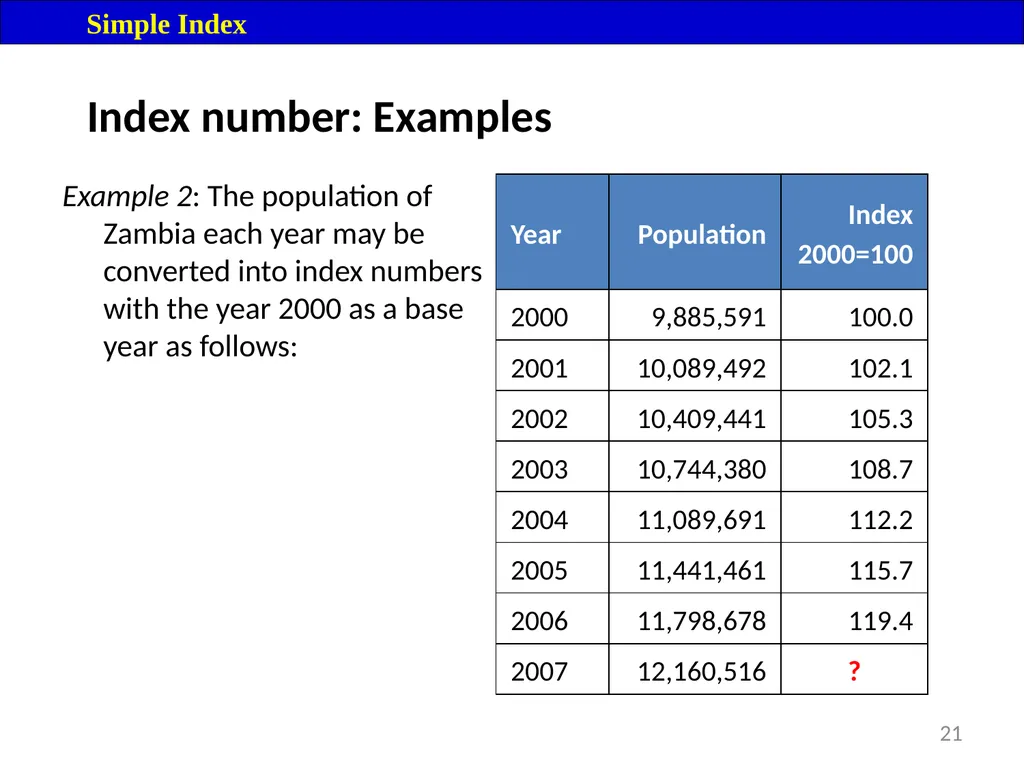
21 Index number: Examples Example 2: The population of Zambia each year may be converted into index numbers with the year 2000 as a base year as follows: Simple Index<br>
22
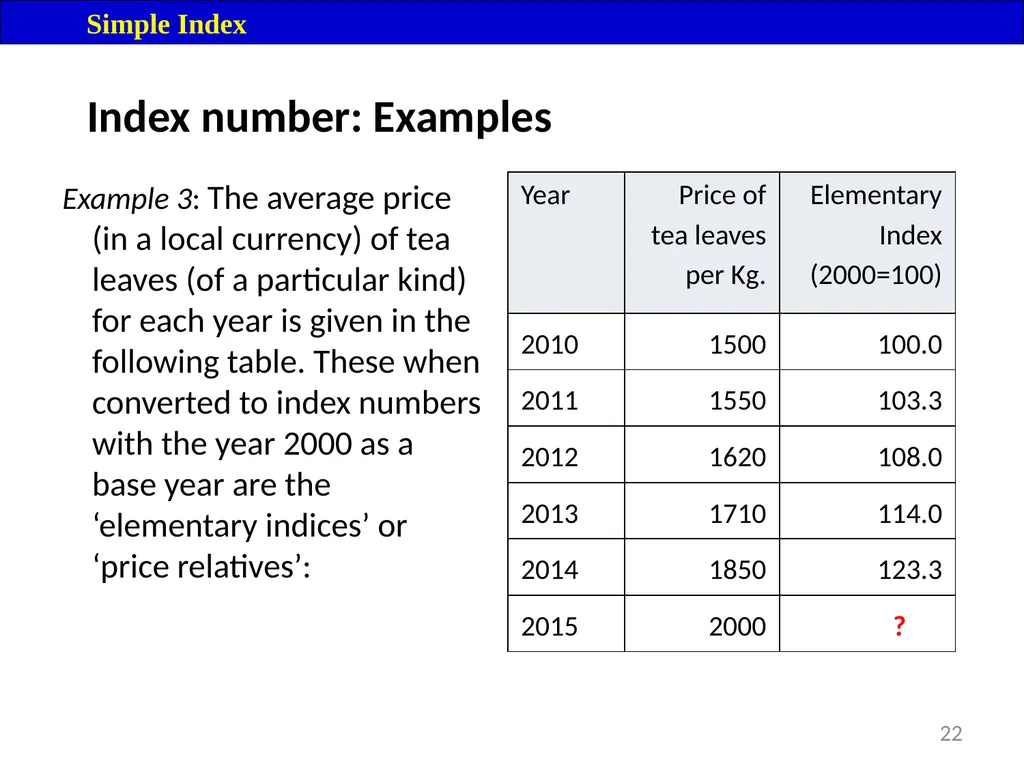
22 Index number: Examples Example 3: The average price (in a local currency) of tea leaves (of a particular kind) for each year is given in the following table. These when converted to index numbers with the year 2000 as a base year are the ‘elementary indices’ or ‘price relatives’: Simple Index<br>
23
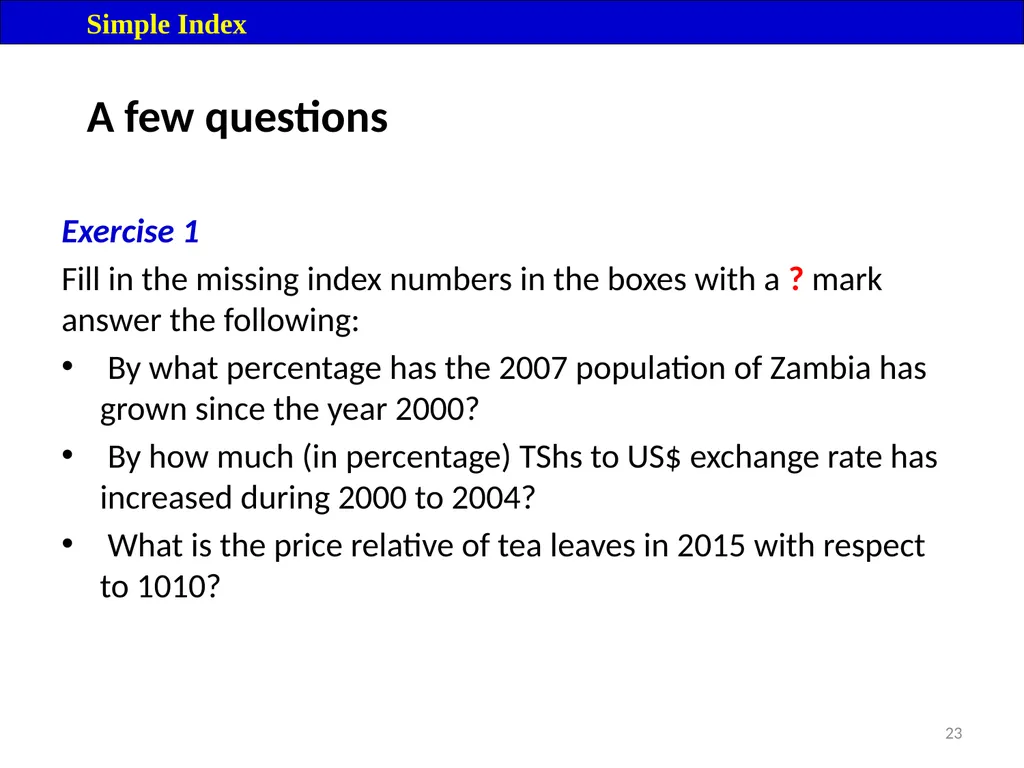
23 A few questions Exercise 1
Fill in the missing index numbers in the boxes with a ? mark answer the following:
By what percentage has the 2007 population of Zambia has grown since the year 2000?
By how much (in percentage) TShs to US$ exchange rate has increased during 2000 to 2004?
What is the price relative of tea leaves in 2015 with respect to 1010? Simple Index<br>
Fill in the missing index numbers in the boxes with a ? mark answer the following:
By what percentage has the 2007 population of Zambia has grown since the year 2000?
By how much (in percentage) TShs to US$ exchange rate has increased during 2000 to 2004?
What is the price relative of tea leaves in 2015 with respect to 1010? Simple Index<br>
24
Aggregate Index<br>
25
25 Why index numbers? Indices of the elementary kind, discussed above, have little value in themselves.
But they can be used to compile more complex “composite” indices, involving many different goods and services.
In economic statistics, the term “index numbers” is usually reserved for these more complex “composite” indices. Aggregate Index numbers<br>
But they can be used to compile more complex “composite” indices, involving many different goods and services.
In economic statistics, the term “index numbers” is usually reserved for these more complex “composite” indices. Aggregate Index numbers<br>
26
26 Need for Composite Index numbers When there is only one product, the elementary index (discussed above) serves well as a measure of change in price of the product or volume of its production.
Further, when there is a whole variety of products, with prices and volume of production / consumption changing at different rates, one can measure the change in money value of production / consumption by a single indicator, as shown in the next slide. Aggregate Index numbers<br>
Further, when there is a whole variety of products, with prices and volume of production / consumption changing at different rates, one can measure the change in money value of production / consumption by a single indicator, as shown in the next slide. Aggregate Index numbers<br>
27
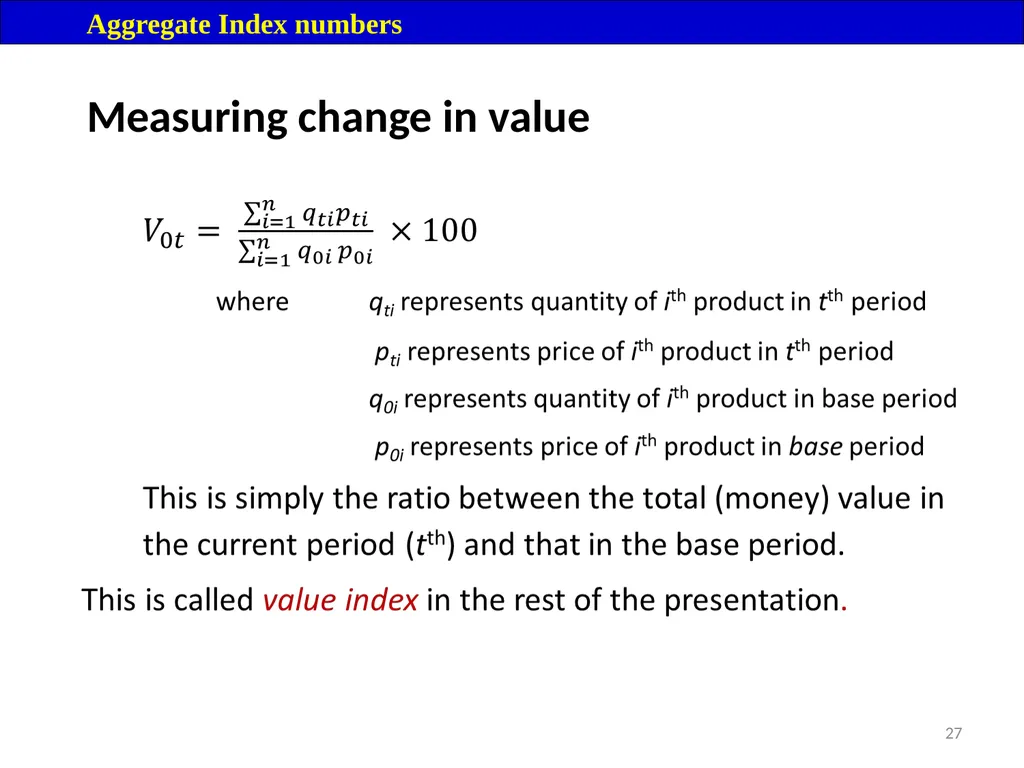
27 Measuring change in value Aggregate Index numbers<br>
28
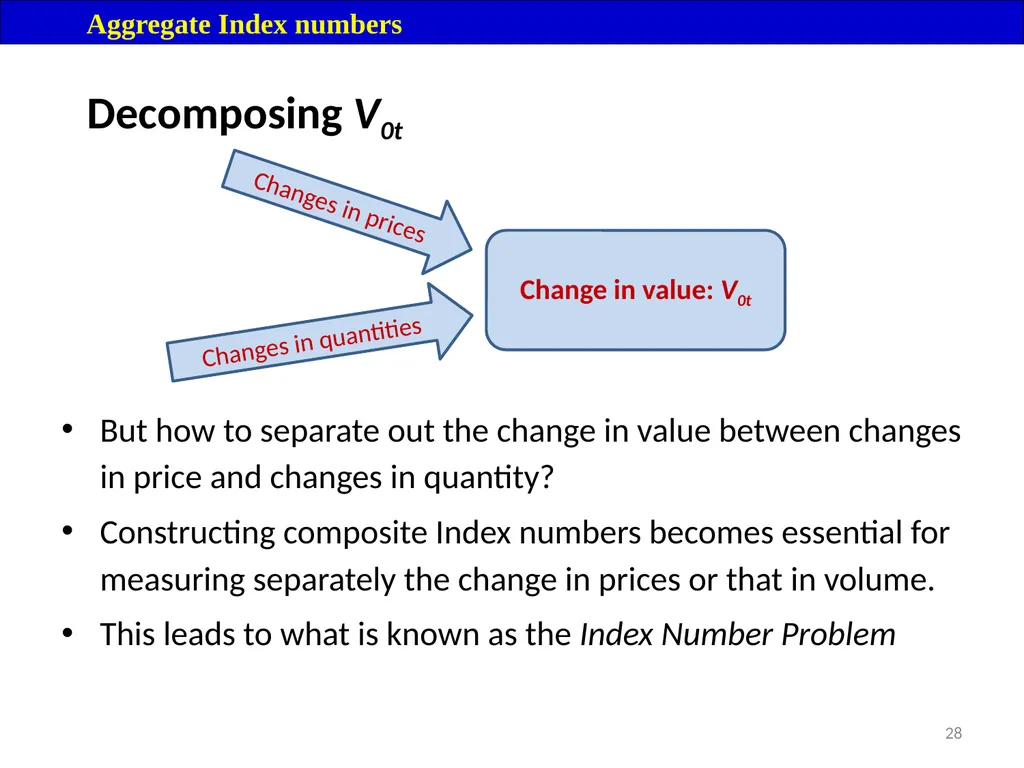
28 Decomposing V0t But how to separate out the change in value between changes in price and changes in quantity?
Constructing composite Index numbers becomes essential for measuring separately the change in prices or that in volume.
This leads to what is known as the Index Number Problem Changes in prices Changes in quantities Change in value: V0t Aggregate Index numbers<br>
Constructing composite Index numbers becomes essential for measuring separately the change in prices or that in volume.
This leads to what is known as the Index Number Problem Changes in prices Changes in quantities Change in value: V0t Aggregate Index numbers<br>
29
29 Index Number Problem (1) How to combine the relative changes in the prices and quantities of various products into a single measure of the relative change of the overall
price level and
quantity level. Aggregate Index numbers<br>
price level and
quantity level. Aggregate Index numbers<br>
30
30 Index Number Problem (2) Or, conversely, how a value ratio pertaining to two periods of time can be decomposed into
a component that measures the overall change in prices between the two periods— the price index and
a component that measures the overall change in quantities between the two periods— the quantity (volume) index.
There is no unique way to achieve this. Aggregate Index numbers<br>
a component that measures the overall change in prices between the two periods— the price index and
a component that measures the overall change in quantities between the two periods— the quantity (volume) index.
There is no unique way to achieve this. Aggregate Index numbers<br>
31
31 Types of composite indices There are only two types of composite indices, (because “value” indices are always simple relatives or ratios of value):
Price indices
Quantity (or volume) indices
Quantity and volume are synonyms here. In economic statistics, changes in quality are considered as changes in quantity and included with them.
Usually the index is assigned a value of 100 in some selected base period.
The values of the index for other periods indicate the average percentage change (in prices or quantities) from the base period. Composite Index numbers<br>
Price indices
Quantity (or volume) indices
Quantity and volume are synonyms here. In economic statistics, changes in quality are considered as changes in quantity and included with them.
Usually the index is assigned a value of 100 in some selected base period.
The values of the index for other periods indicate the average percentage change (in prices or quantities) from the base period. Composite Index numbers<br>
32
32 Price and Quantity Index A price index reflects the average of the proportionate changes (%) in the prices of the specified set of goods and services between two periods of time.
A quantity index reflects the average of the proportionate changes (%) in the quantities of the specified set of goods and services between two periods of time.
For the rest of this module, we will focus on Price Index only. Composite Index numbers<br>
A quantity index reflects the average of the proportionate changes (%) in the quantities of the specified set of goods and services between two periods of time.
For the rest of this module, we will focus on Price Index only. Composite Index numbers<br>
33
End of Session I<br>