
Module L Unit 1: Waves Lesson 1: Introduction to
Description: Module L Unit 1: Waves Lesson 1: Introduction to Waves 2 Lesson Vocabulary wave a disturbance that transfers energy from one place to another; a wave can be a single cycle, or it can be a repeating pattern amplitude the maximum distance
Related Topics
Download Presentation
"Module L Unit 1: Waves Lesson 1: Introduction to" is the property of its rightful owner. Permission is granted to download and print the materials on this website for personal, non-commercial use only, and to display it on your personal computer provided you do not modify the materials and that you retain all copyright notices contained in the materials. By downloading content from our website, you accept the terms of this agreement.
Presentation Transcript
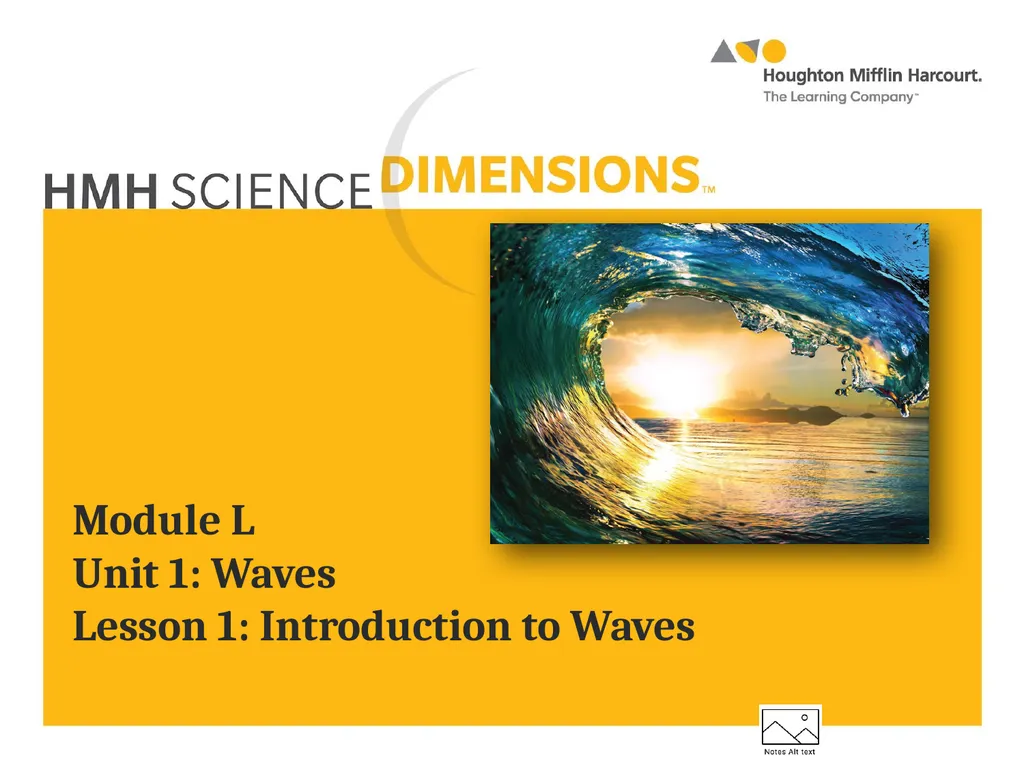
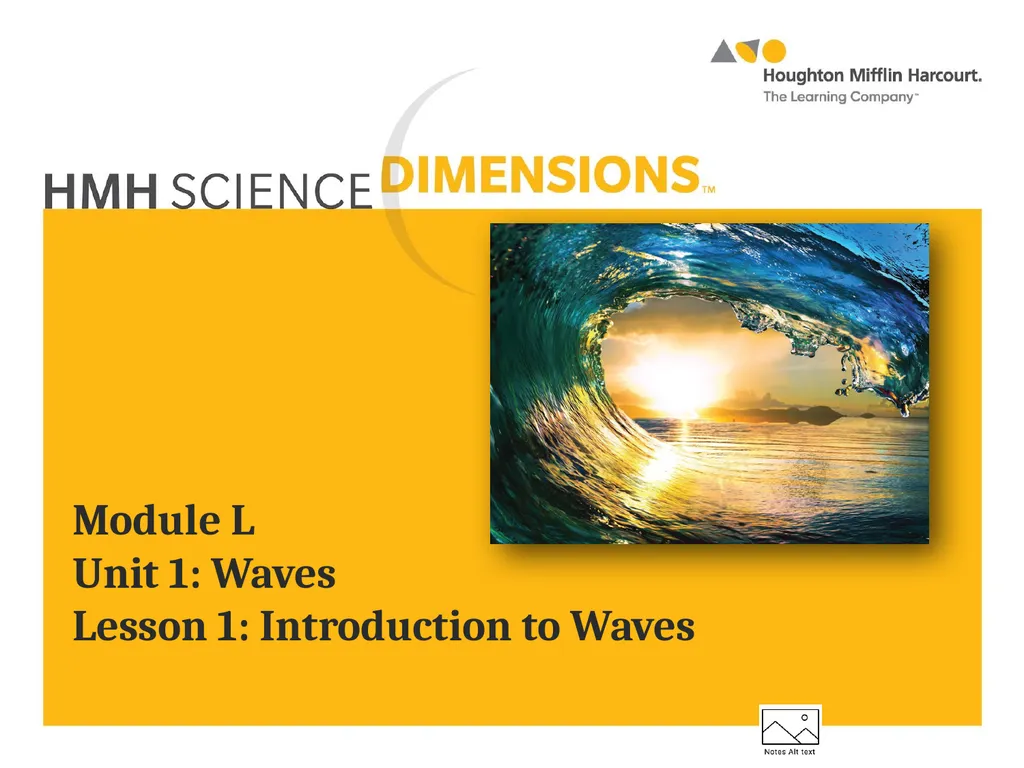
slide1. Module L
Unit 1: Waves
Lesson 1: Introduction to Waves<br>
slide2. 2 Lesson Vocabulary wave — a disturbance that transfers energy from one place to another; a wave can be a single cycle, or it can be a repeating pattern
amplitude — the maximum distance that the particles of a wave’s medium vibrate from their rest position
wavelength — the distance from any point on a wave to the corresponding point on the next wave Mod L Unit 1 Lesson 1<br>
slide3. 3 Lesson Vocabulary frequency — the number of cycles, or vibrations, per unit of time; the number of waves produced in a given amount of time
wave speed — the speed at which a wave travels through a medium Mod L Unit 1 Lesson 1<br>
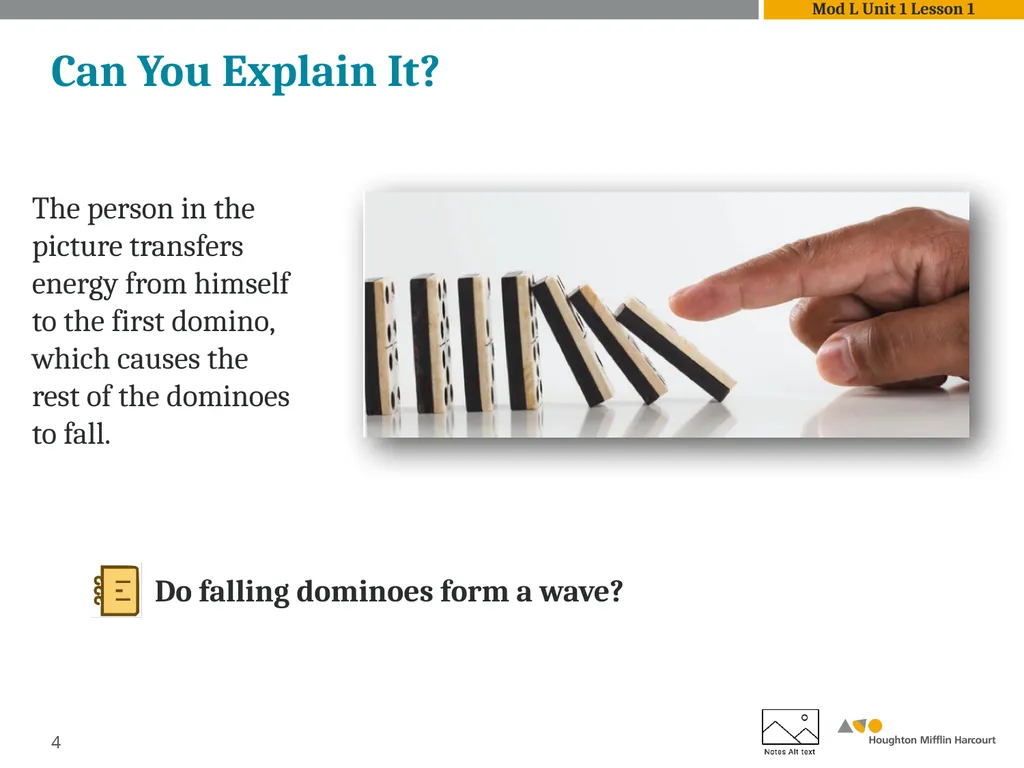
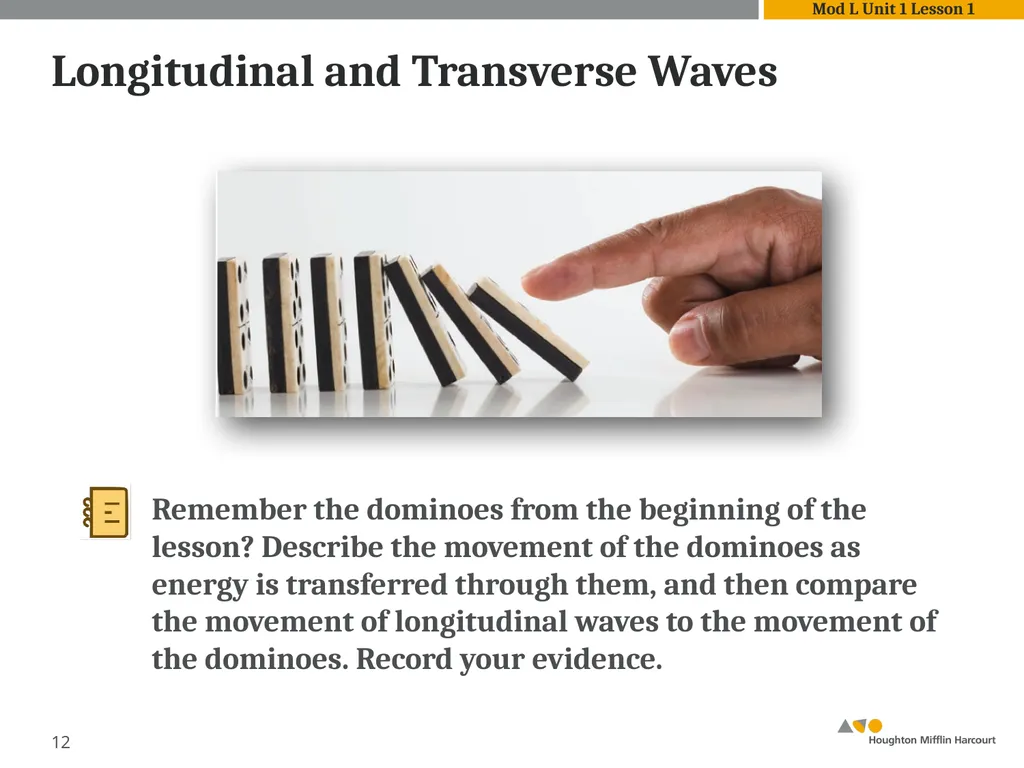
slide4. 4 Can You Explain It? Do falling dominoes form a wave? The person in the picture transfers energy from himself to the first domino, which causes the
rest of the dominoes to fall. Mod L Unit 1 Lesson 1<br>
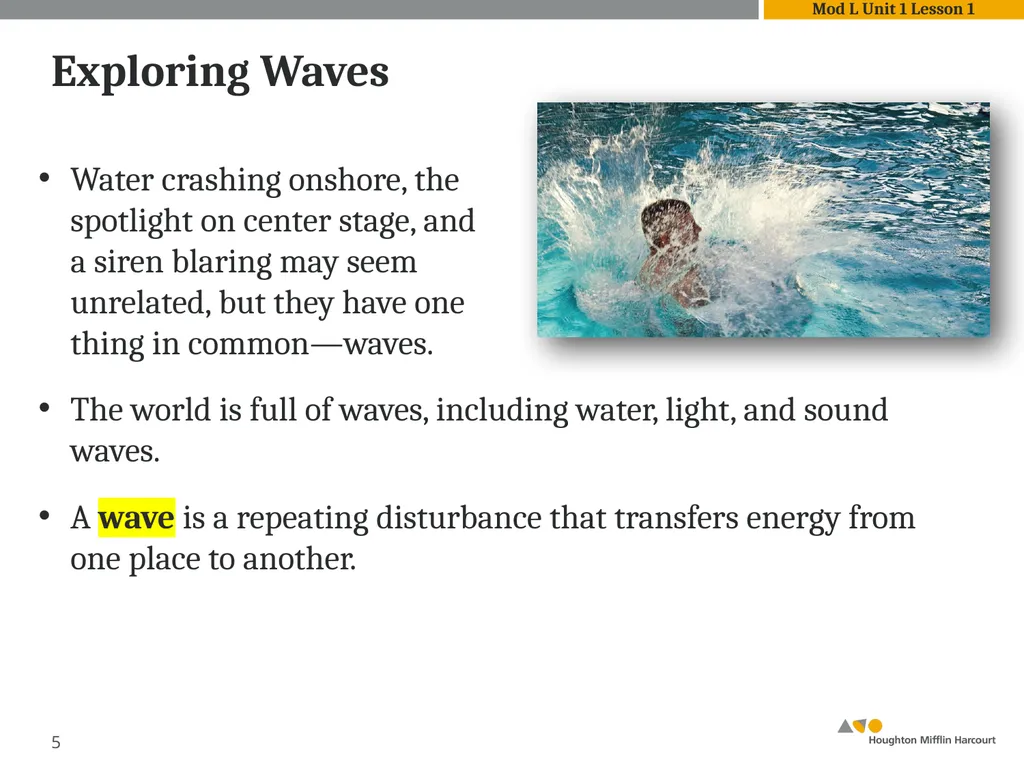
slide5. Water crashing onshore, the spotlight on center stage, and a siren blaring may seem unrelated, but they have one thing in common—waves.
The world is full of waves, including water, light, and sound waves.
A wave is a repeating disturbance that transfers energy from one place to another. 5 Exploring Waves Mod L Unit 1 Lesson 1<br>
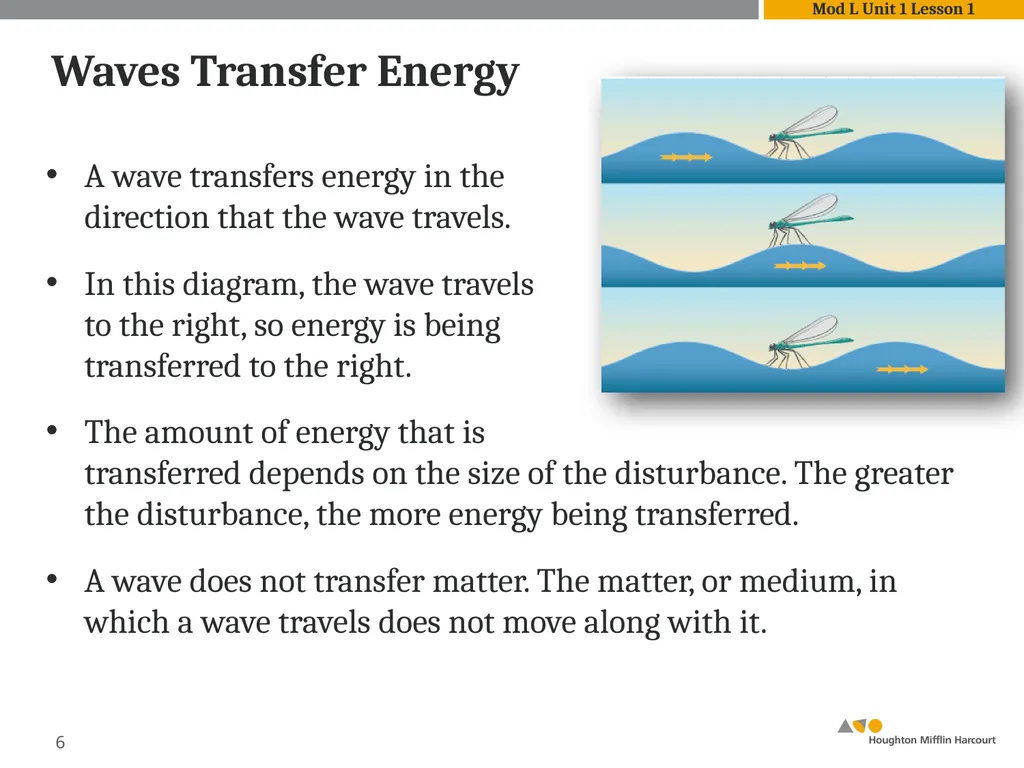
slide6. 6 Waves Transfer Energy A wave transfers energy in the direction that the wave travels.
In this diagram, the wave travels to the right, so energy is being transferred to the right.
The amount of energy that is transferred depends on the size of the disturbance. The greater the disturbance, the more energy being transferred.
A wave does not transfer matter. The matter, or medium, in which a wave travels does not move along with it. Mod L Unit 1 Lesson 1<br>
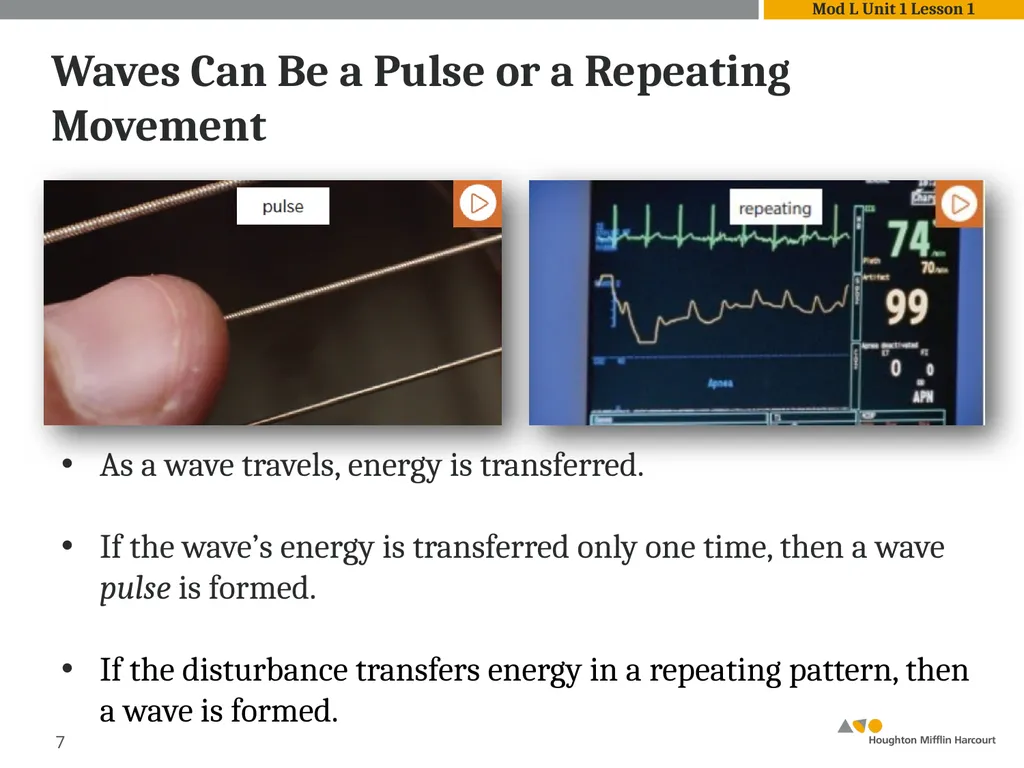
slide7. 7 Waves Can Be a Pulse or a Repeating Movement As a wave travels, energy is transferred.
If the wave’s energy is transferred only one time, then a wave pulse is formed.
If the disturbance transfers energy in a repeating pattern, then a wave is formed. Mod L Unit 1 Lesson 1<br>
slide8. As a wave travels through a medium, the particles of the medium move, or vibrate.
In a transverse wave, the particles vibrate perpendicularly to the direction the wave travels.
In a longitudinal wave, the particles vibrate parallel to the direction the wave travels.
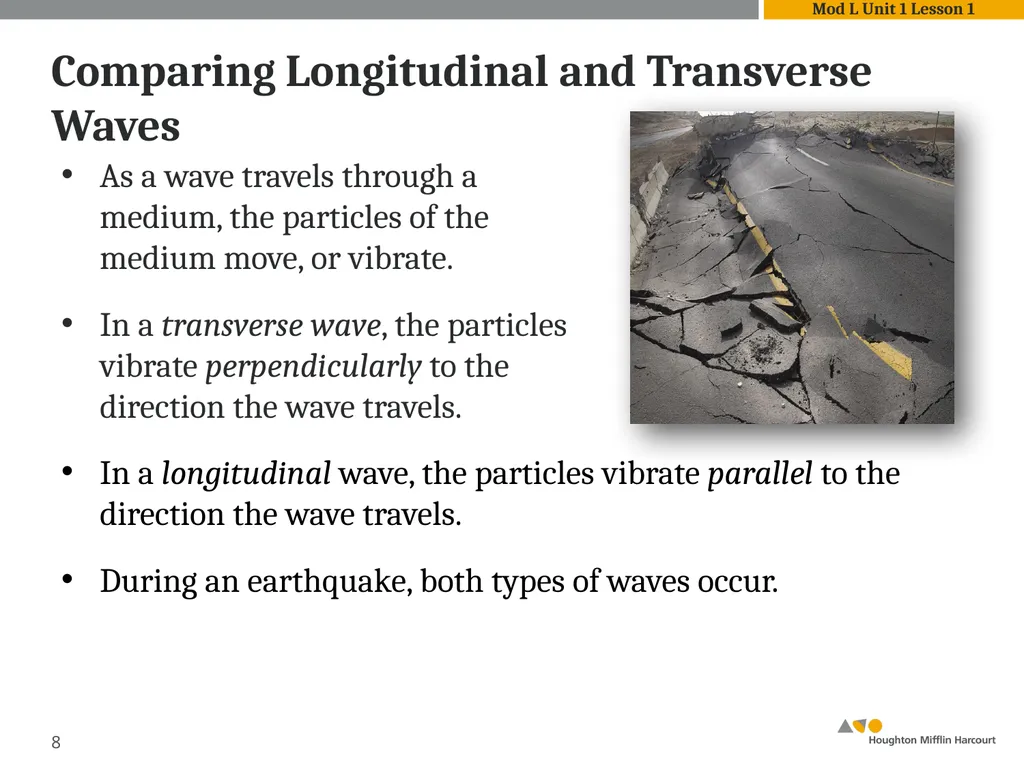
During an earthquake, both types of waves occur. 8 Comparing Longitudinal and Transverse Waves Mod L Unit 1 Lesson 1<br>
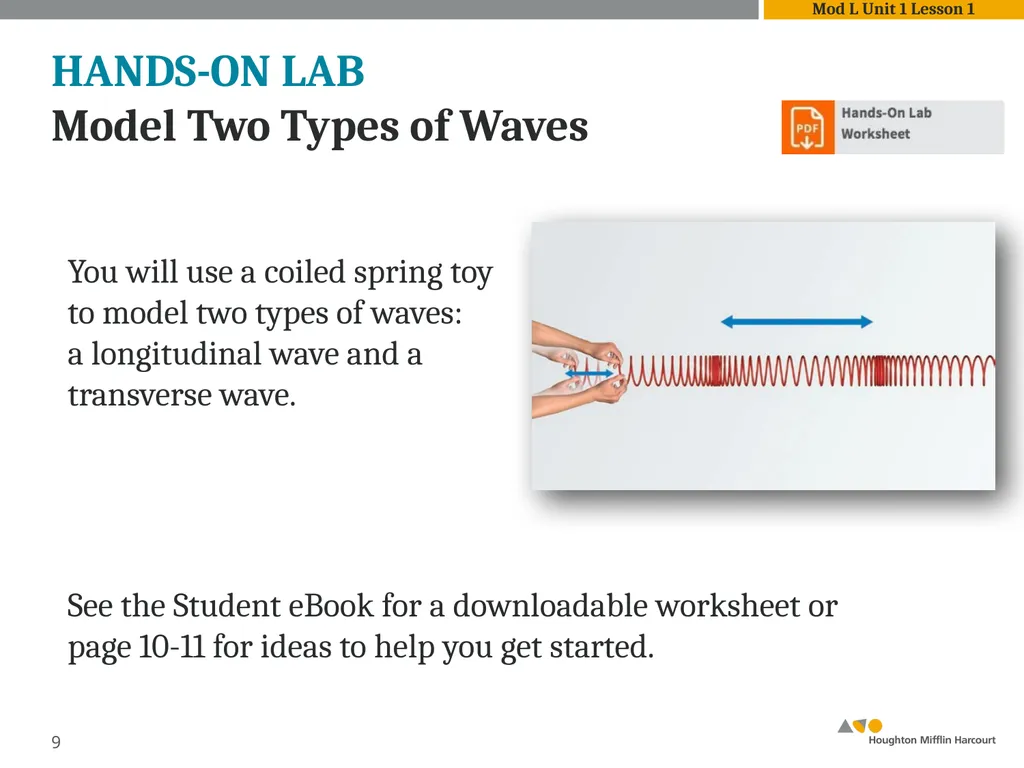
slide9. 9 HANDS-ON LAB Model Two Types of Waves You will use a coiled spring toy
to model two types of waves:
a longitudinal wave and a
transverse wave. See the Student eBook for a downloadable worksheet or page 10-11 for ideas to help you get started. Mod L Unit 1 Lesson 1<br>
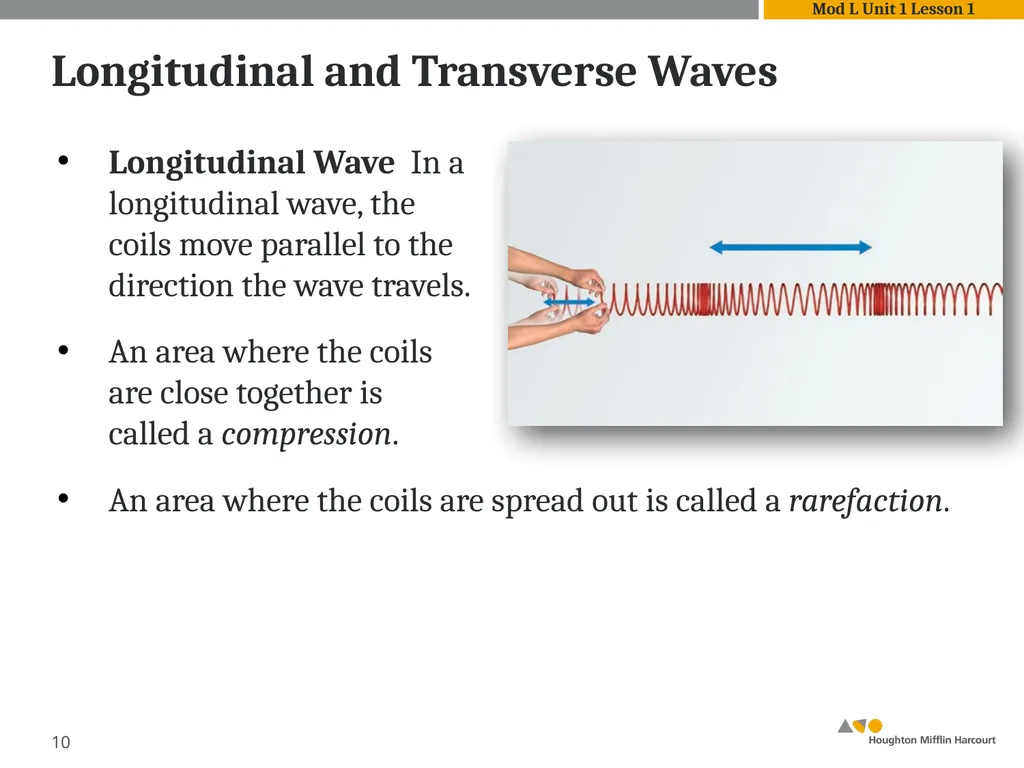
slide10. Longitudinal Wave In a longitudinal wave, the coils move parallel to the direction the wave travels.
An area where the coils are close together is called a compression.
An area where the coils are spread out is called a rarefaction. 10 Longitudinal and Transverse Waves Mod L Unit 1 Lesson 1<br>
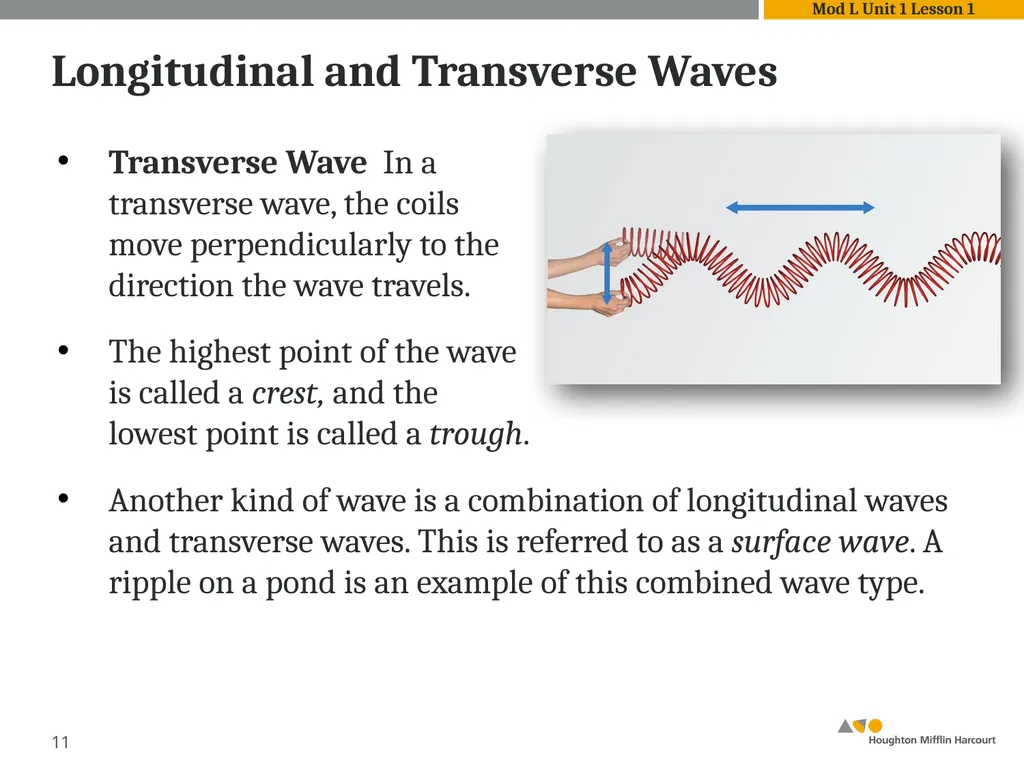
slide11. Transverse Wave In a transverse wave, the coils move perpendicularly to the direction the wave travels.
The highest point of the wave is called a crest, and the lowest point is called a trough.
Another kind of wave is a combination of longitudinal waves and transverse waves. This is referred to as a surface wave. A ripple on a pond is an example of this combined wave type. 11 Longitudinal and Transverse Waves Mod L Unit 1 Lesson 1<br>
slide12. 12 Longitudinal and Transverse Waves Remember the dominoes from the beginning of the lesson? Describe the movement of the dominoes as energy is transferred through them, and then compare the movement of longitudinal waves to the movement of the dominoes. Record your evidence. Mod L Unit 1 Lesson 1<br>
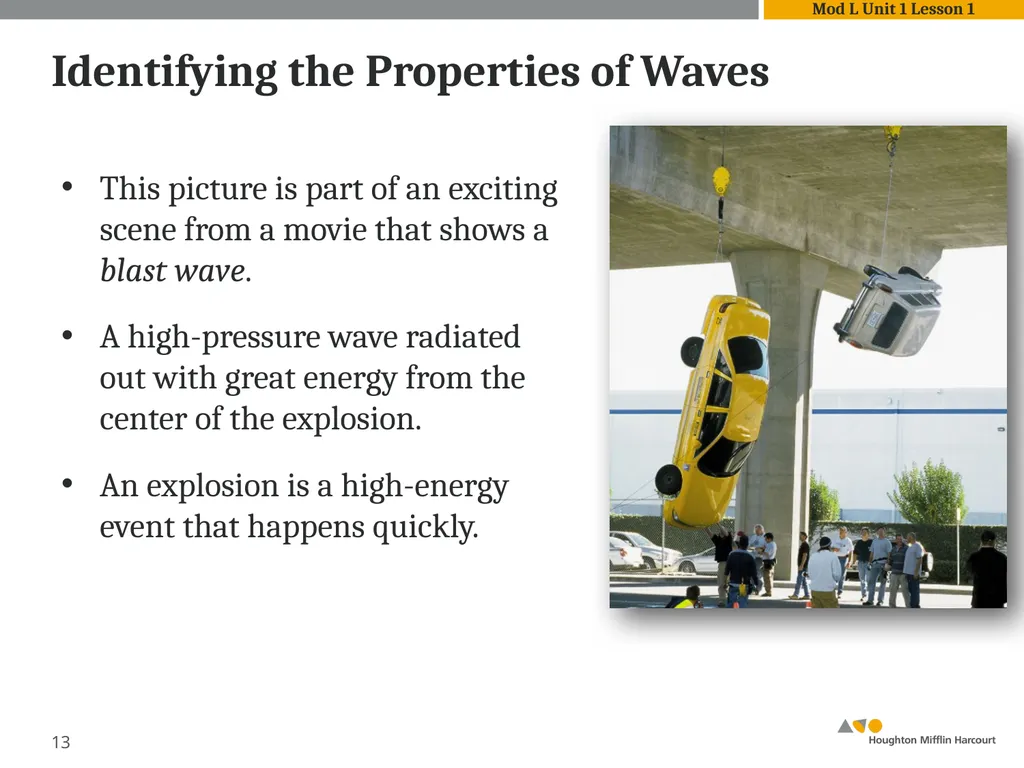
slide13. 13 Identifying the Properties of Waves This picture is part of an exciting scene from a movie that shows a blast wave.
A high-pressure wave radiated out with great energy from the center of the explosion.
An explosion is a high-energy event that happens quickly. Mod L Unit 1 Lesson 1<br>
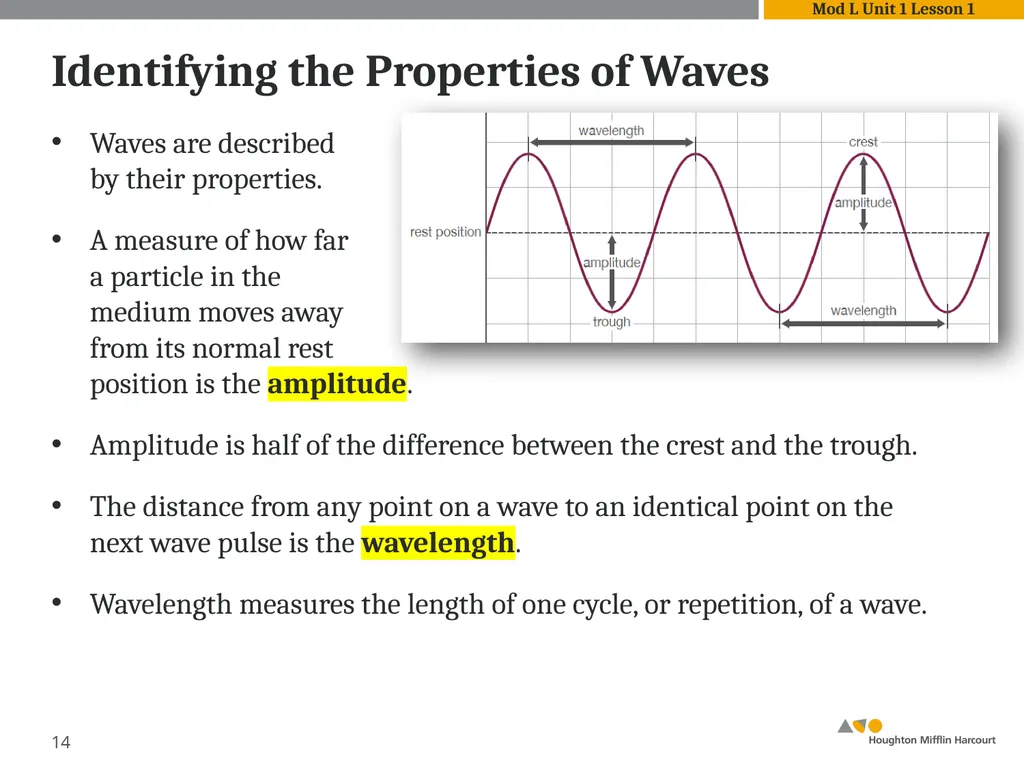
slide14. 14 Identifying the Properties of Waves Waves are described by their properties.
A measure of how far a particle in the medium moves away from its normal rest position is the amplitude.
Amplitude is half of the difference between the crest and the trough.
The distance from any point on a wave to an identical point on the next wave pulse is the wavelength.
Wavelength measures the length of one cycle, or repetition, of a wave. Mod L Unit 1 Lesson 1<br>
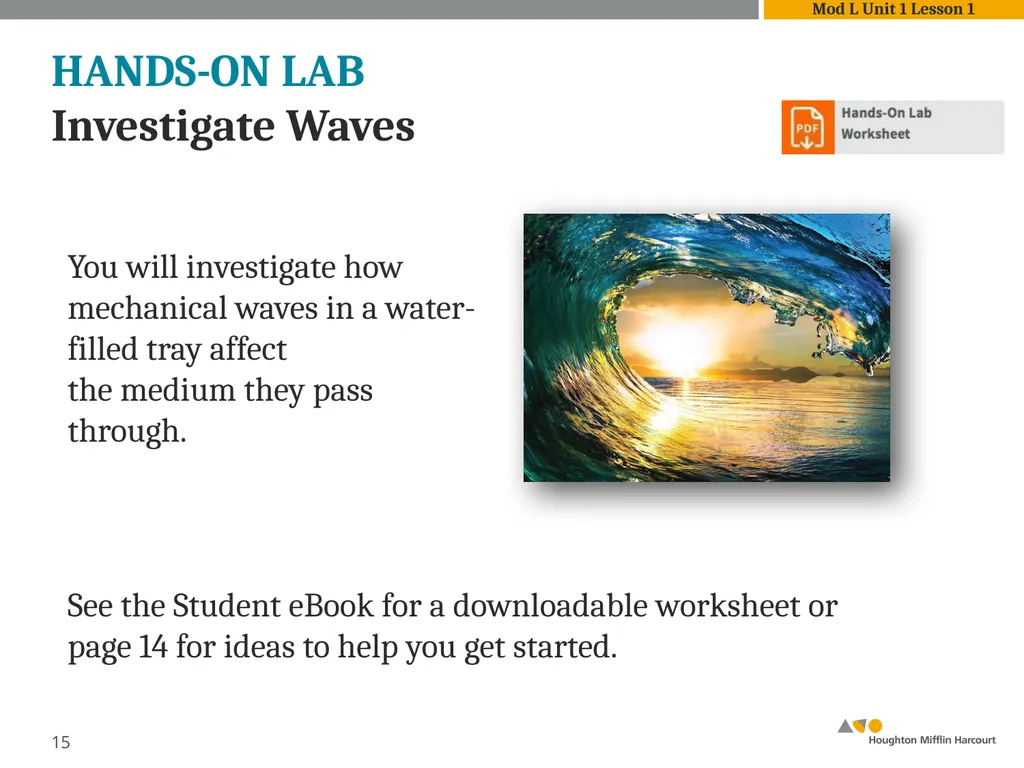
slide15. 15 HANDS-ON LAB Investigate Waves You will investigate how mechanical waves in a water-filled tray affect
the medium they pass through. See the Student eBook for a downloadable worksheet or page 14 for ideas to help you get started. Mod L Unit 1 Lesson 1<br>
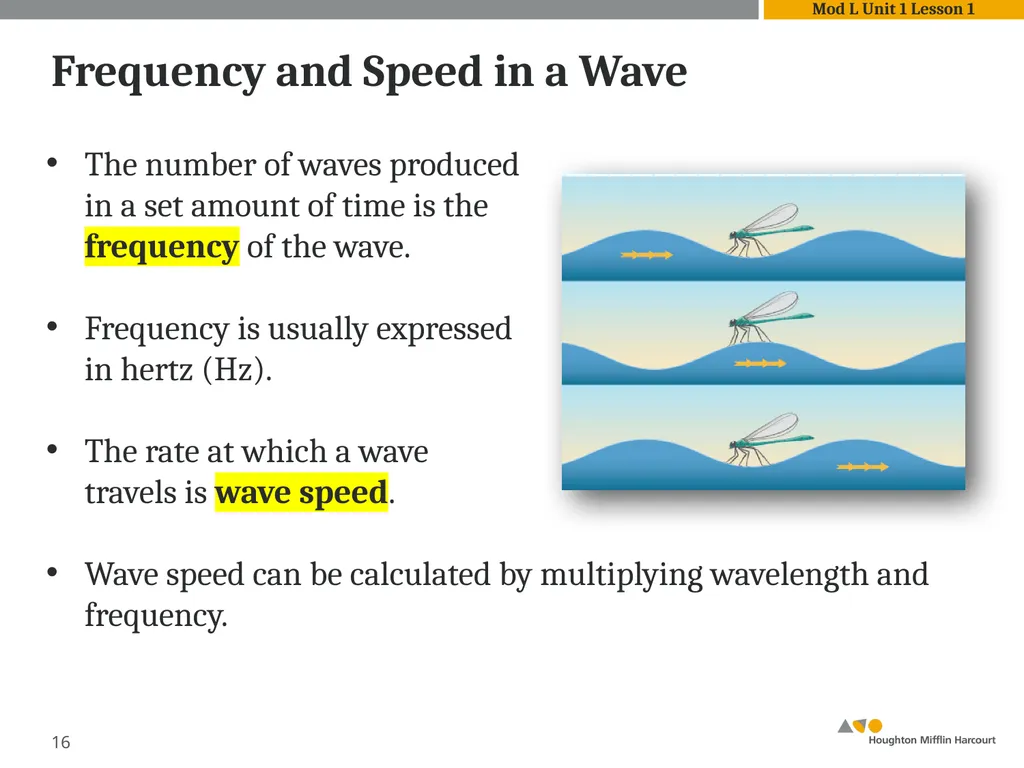
slide16. 16 Frequency and Speed in a Wave The number of waves produced in a set amount of time is the frequency of the wave.
Frequency is usually expressed in hertz (Hz).
The rate at which a wave travels is wave speed.
Wave speed can be calculated by multiplying wavelength and frequency. Mod L Unit 1 Lesson 1<br>
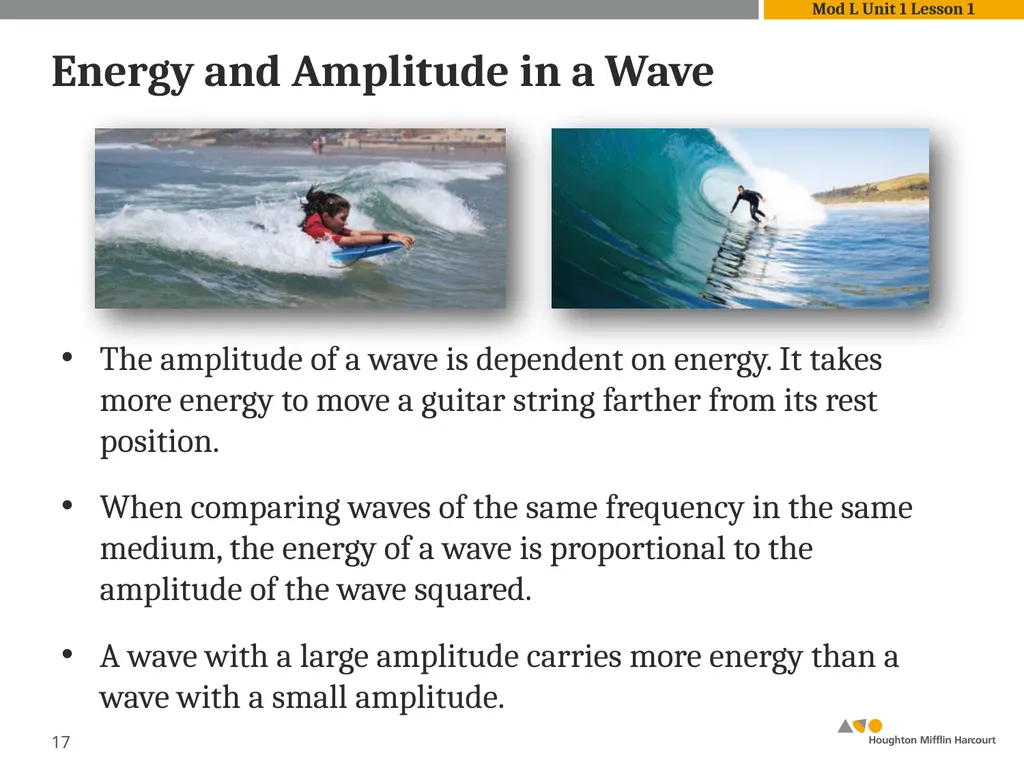
slide17. 17 Energy and Amplitude in a Wave The amplitude of a wave is dependent on energy. It takes more energy to move a guitar string farther from its rest position.
When comparing waves of the same frequency in the same medium, the energy of a wave is proportional to the amplitude of the wave squared.
A wave with a large amplitude carries more energy than a wave with a small amplitude. Mod L Unit 1 Lesson 1<br>
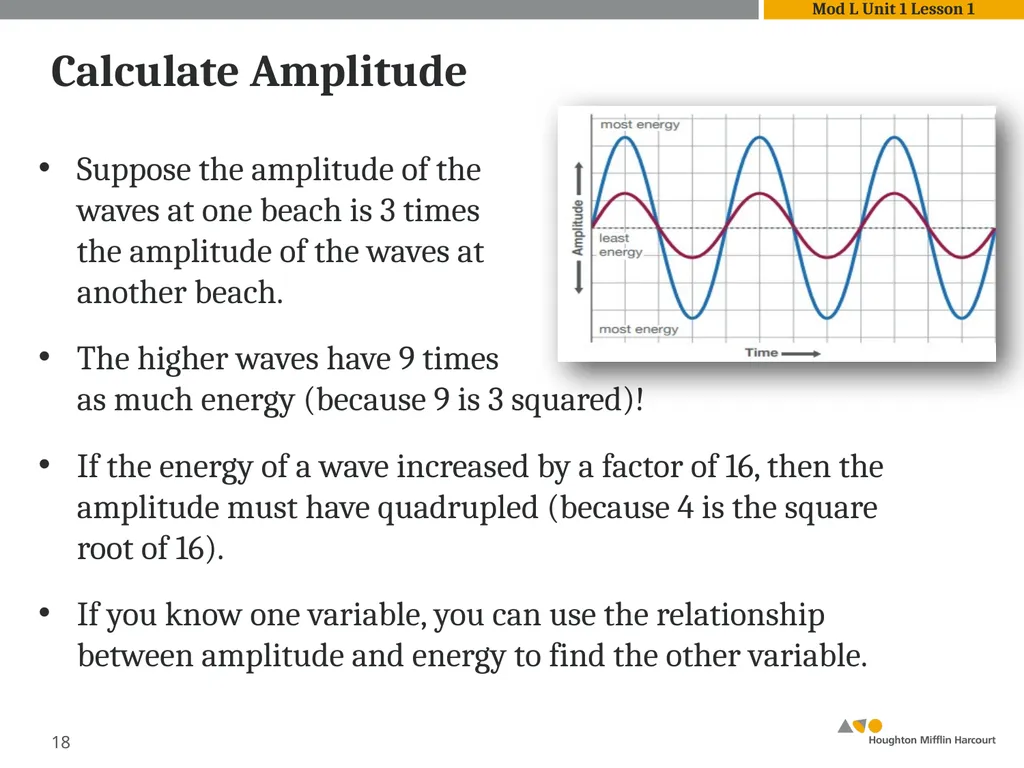
slide18. 18 Calculate Amplitude Suppose the amplitude of the waves at one beach is 3 times the amplitude of the waves at another beach.
The higher waves have 9 times as much energy (because 9 is 3 squared)!
If the energy of a wave increased by a factor of 16, then the amplitude must have quadrupled (because 4 is the square root of 16).
If you know one variable, you can use the relationship between amplitude and energy to find the other variable. Mod L Unit 1 Lesson 1<br>
Unit 1: Waves
Lesson 1: Introduction to Waves<br>
slide2. 2 Lesson Vocabulary wave — a disturbance that transfers energy from one place to another; a wave can be a single cycle, or it can be a repeating pattern
amplitude — the maximum distance that the particles of a wave’s medium vibrate from their rest position
wavelength — the distance from any point on a wave to the corresponding point on the next wave Mod L Unit 1 Lesson 1<br>
slide3. 3 Lesson Vocabulary frequency — the number of cycles, or vibrations, per unit of time; the number of waves produced in a given amount of time
wave speed — the speed at which a wave travels through a medium Mod L Unit 1 Lesson 1<br>
slide4. 4 Can You Explain It? Do falling dominoes form a wave? The person in the picture transfers energy from himself to the first domino, which causes the
rest of the dominoes to fall. Mod L Unit 1 Lesson 1<br>
slide5. Water crashing onshore, the spotlight on center stage, and a siren blaring may seem unrelated, but they have one thing in common—waves.
The world is full of waves, including water, light, and sound waves.
A wave is a repeating disturbance that transfers energy from one place to another. 5 Exploring Waves Mod L Unit 1 Lesson 1<br>
slide6. 6 Waves Transfer Energy A wave transfers energy in the direction that the wave travels.
In this diagram, the wave travels to the right, so energy is being transferred to the right.
The amount of energy that is transferred depends on the size of the disturbance. The greater the disturbance, the more energy being transferred.
A wave does not transfer matter. The matter, or medium, in which a wave travels does not move along with it. Mod L Unit 1 Lesson 1<br>
slide7. 7 Waves Can Be a Pulse or a Repeating Movement As a wave travels, energy is transferred.
If the wave’s energy is transferred only one time, then a wave pulse is formed.
If the disturbance transfers energy in a repeating pattern, then a wave is formed. Mod L Unit 1 Lesson 1<br>
slide8. As a wave travels through a medium, the particles of the medium move, or vibrate.
In a transverse wave, the particles vibrate perpendicularly to the direction the wave travels.
In a longitudinal wave, the particles vibrate parallel to the direction the wave travels.
During an earthquake, both types of waves occur. 8 Comparing Longitudinal and Transverse Waves Mod L Unit 1 Lesson 1<br>
slide9. 9 HANDS-ON LAB Model Two Types of Waves You will use a coiled spring toy
to model two types of waves:
a longitudinal wave and a
transverse wave. See the Student eBook for a downloadable worksheet or page 10-11 for ideas to help you get started. Mod L Unit 1 Lesson 1<br>
slide10. Longitudinal Wave In a longitudinal wave, the coils move parallel to the direction the wave travels.
An area where the coils are close together is called a compression.
An area where the coils are spread out is called a rarefaction. 10 Longitudinal and Transverse Waves Mod L Unit 1 Lesson 1<br>
slide11. Transverse Wave In a transverse wave, the coils move perpendicularly to the direction the wave travels.
The highest point of the wave is called a crest, and the lowest point is called a trough.
Another kind of wave is a combination of longitudinal waves and transverse waves. This is referred to as a surface wave. A ripple on a pond is an example of this combined wave type. 11 Longitudinal and Transverse Waves Mod L Unit 1 Lesson 1<br>
slide12. 12 Longitudinal and Transverse Waves Remember the dominoes from the beginning of the lesson? Describe the movement of the dominoes as energy is transferred through them, and then compare the movement of longitudinal waves to the movement of the dominoes. Record your evidence. Mod L Unit 1 Lesson 1<br>
slide13. 13 Identifying the Properties of Waves This picture is part of an exciting scene from a movie that shows a blast wave.
A high-pressure wave radiated out with great energy from the center of the explosion.
An explosion is a high-energy event that happens quickly. Mod L Unit 1 Lesson 1<br>
slide14. 14 Identifying the Properties of Waves Waves are described by their properties.
A measure of how far a particle in the medium moves away from its normal rest position is the amplitude.
Amplitude is half of the difference between the crest and the trough.
The distance from any point on a wave to an identical point on the next wave pulse is the wavelength.
Wavelength measures the length of one cycle, or repetition, of a wave. Mod L Unit 1 Lesson 1<br>
slide15. 15 HANDS-ON LAB Investigate Waves You will investigate how mechanical waves in a water-filled tray affect
the medium they pass through. See the Student eBook for a downloadable worksheet or page 14 for ideas to help you get started. Mod L Unit 1 Lesson 1<br>
slide16. 16 Frequency and Speed in a Wave The number of waves produced in a set amount of time is the frequency of the wave.
Frequency is usually expressed in hertz (Hz).
The rate at which a wave travels is wave speed.
Wave speed can be calculated by multiplying wavelength and frequency. Mod L Unit 1 Lesson 1<br>
slide17. 17 Energy and Amplitude in a Wave The amplitude of a wave is dependent on energy. It takes more energy to move a guitar string farther from its rest position.
When comparing waves of the same frequency in the same medium, the energy of a wave is proportional to the amplitude of the wave squared.
A wave with a large amplitude carries more energy than a wave with a small amplitude. Mod L Unit 1 Lesson 1<br>
slide18. 18 Calculate Amplitude Suppose the amplitude of the waves at one beach is 3 times the amplitude of the waves at another beach.
The higher waves have 9 times as much energy (because 9 is 3 squared)!
If the energy of a wave increased by a factor of 16, then the amplitude must have quadrupled (because 4 is the square root of 16).
If you know one variable, you can use the relationship between amplitude and energy to find the other variable. Mod L Unit 1 Lesson 1<br>