
Natural Selection Mutations Recombination Gene
BR
Published · 59 slides · 0 views
1 / 1


Description
Natural Selection Mutations Recombination Gene Flow Genetic Drift Artificial Selection Non-Random Mating Reproductive Isolation Exploring Darwin His Ideas Think about the following questions: What explains the explosion of living
Related Topics
Share
Embed code
Download this presentation From Below
"Natural Selection Mutations Recombination Gene" is the property of its rightful owner. Permission is granted to download and print the materials on this website for personal, non-commercial use only, and to display it on your personal computer provided you do not modify the materials and that you retain all copyright notices contained in the materials. By downloading content from our website, you accept the terms of this agreement.
Presentation Transcript
01
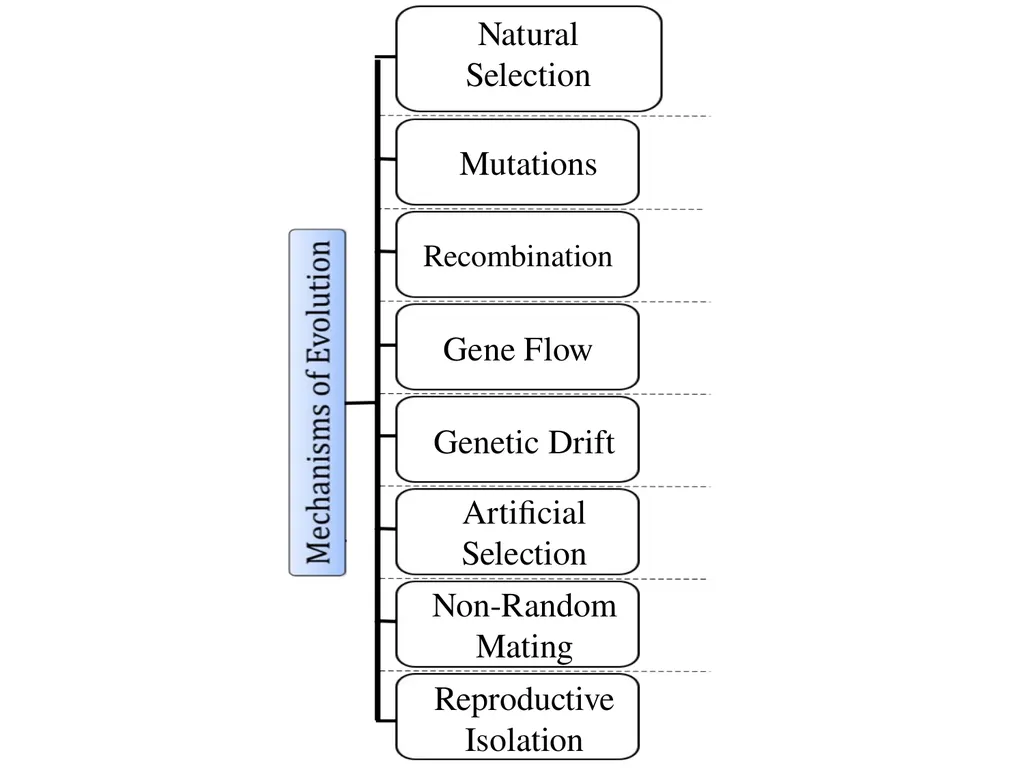
Natural Selection Mutations Recombination Gene Flow Genetic Drift Artificial Selection Non-Random Mating Reproductive Isolation<br>
02
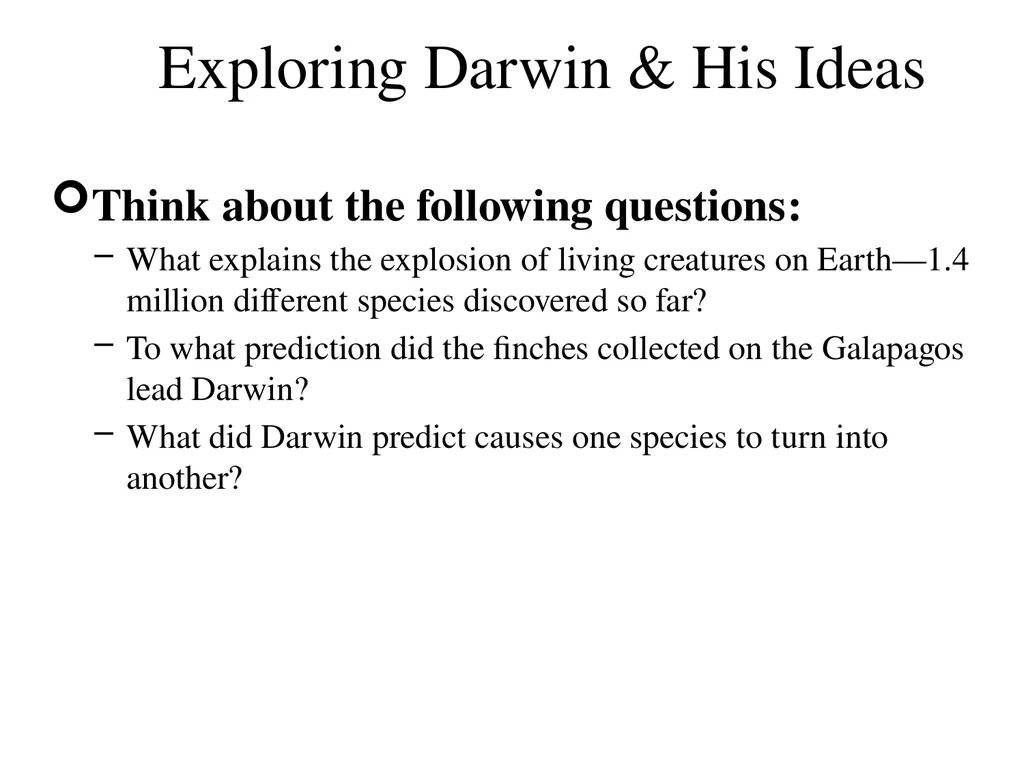
Exploring Darwin & His Ideas Think about the following questions:
What explains the explosion of living creatures on Earth—1.4 million different species discovered so far?
To what prediction did the finches collected on the Galapagos lead Darwin?
What did Darwin predict causes one species to turn into another?<br>
What explains the explosion of living creatures on Earth—1.4 million different species discovered so far?
To what prediction did the finches collected on the Galapagos lead Darwin?
What did Darwin predict causes one species to turn into another?<br>
03
Video of Darwin http://www.wfisd.net/Page/13303<br>
04
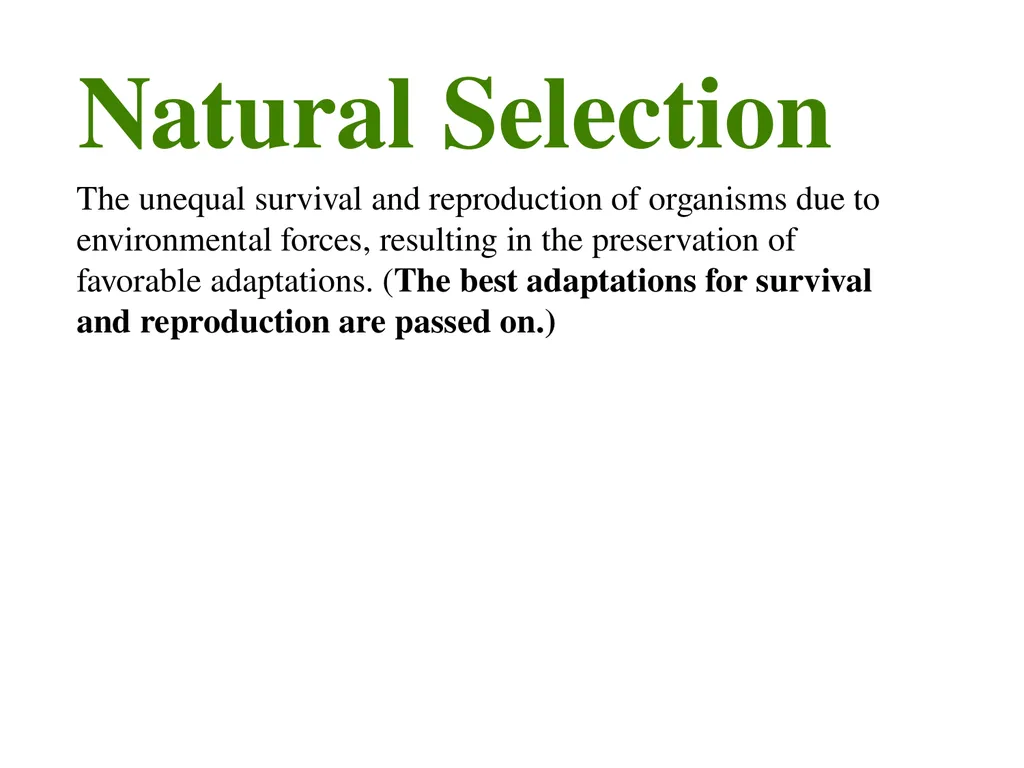
Natural Selection The unequal survival and reproduction of organisms due to environmental forces, resulting in the preservation of favorable adaptations. (The best adaptations for survival and reproduction are passed on.)<br>
05
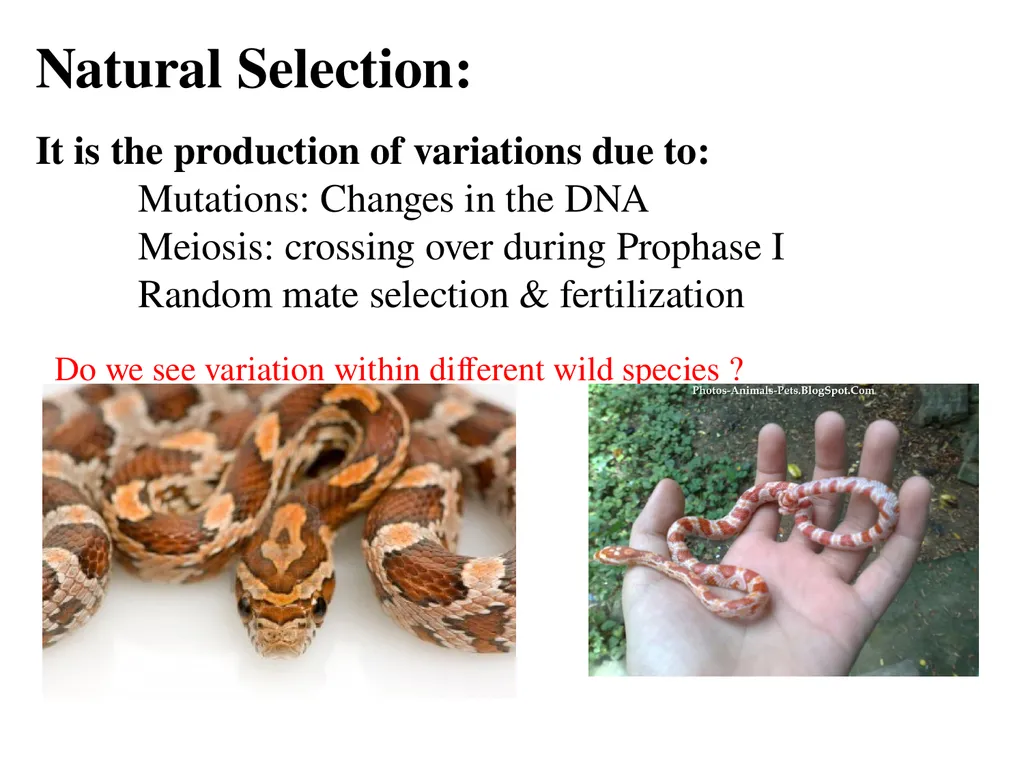
Do we see variation within different wild species ? Natural Selection: It is the production of variations due to:
Mutations: Changes in the DNA
Meiosis: crossing over during Prophase I
Random mate selection & fertilization<br>
Mutations: Changes in the DNA
Meiosis: crossing over during Prophase I
Random mate selection & fertilization<br>
06
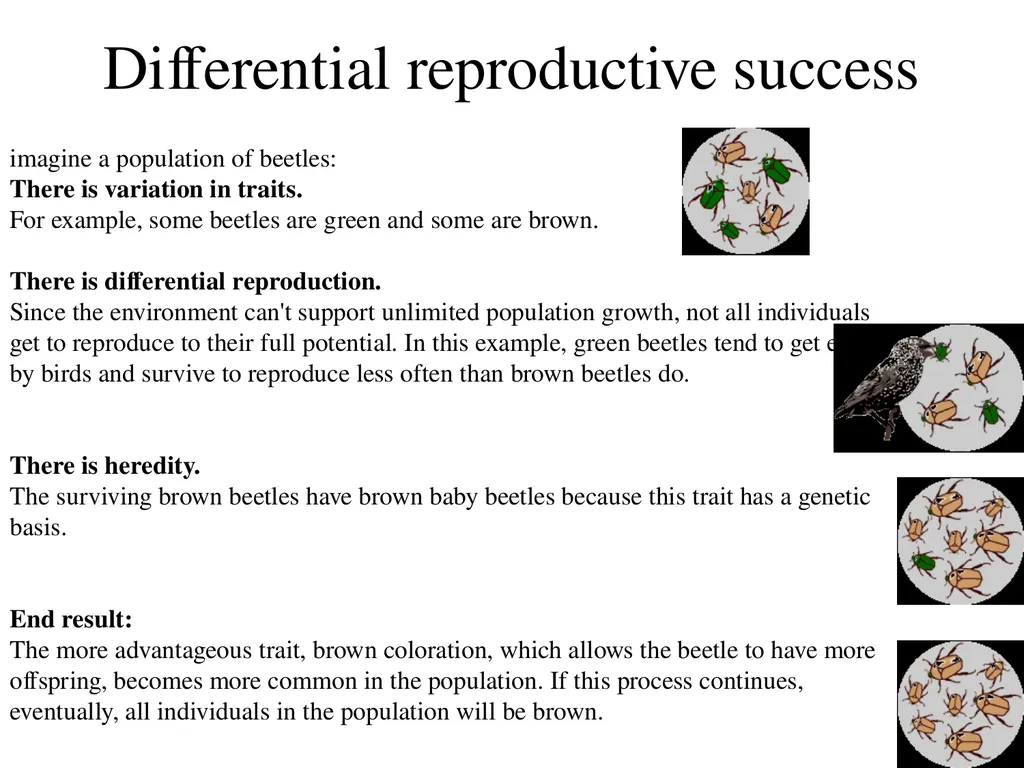
Differential reproductive success imagine a population of beetles:
There is variation in traits. For example, some beetles are green and some are brown.
There is differential reproduction. Since the environment can't support unlimited population growth, not all individuals get to reproduce to their full potential. In this example, green beetles tend to get eaten by birds and survive to reproduce less often than brown beetles do.
There is heredity. The surviving brown beetles have brown baby beetles because this trait has a genetic basis.
End result: The more advantageous trait, brown coloration, which allows the beetle to have more offspring, becomes more common in the population. If this process continues, eventually, all individuals in the population will be brown.<br>
There is variation in traits. For example, some beetles are green and some are brown.
There is differential reproduction. Since the environment can't support unlimited population growth, not all individuals get to reproduce to their full potential. In this example, green beetles tend to get eaten by birds and survive to reproduce less often than brown beetles do.
There is heredity. The surviving brown beetles have brown baby beetles because this trait has a genetic basis.
End result: The more advantageous trait, brown coloration, which allows the beetle to have more offspring, becomes more common in the population. If this process continues, eventually, all individuals in the population will be brown.<br>
07
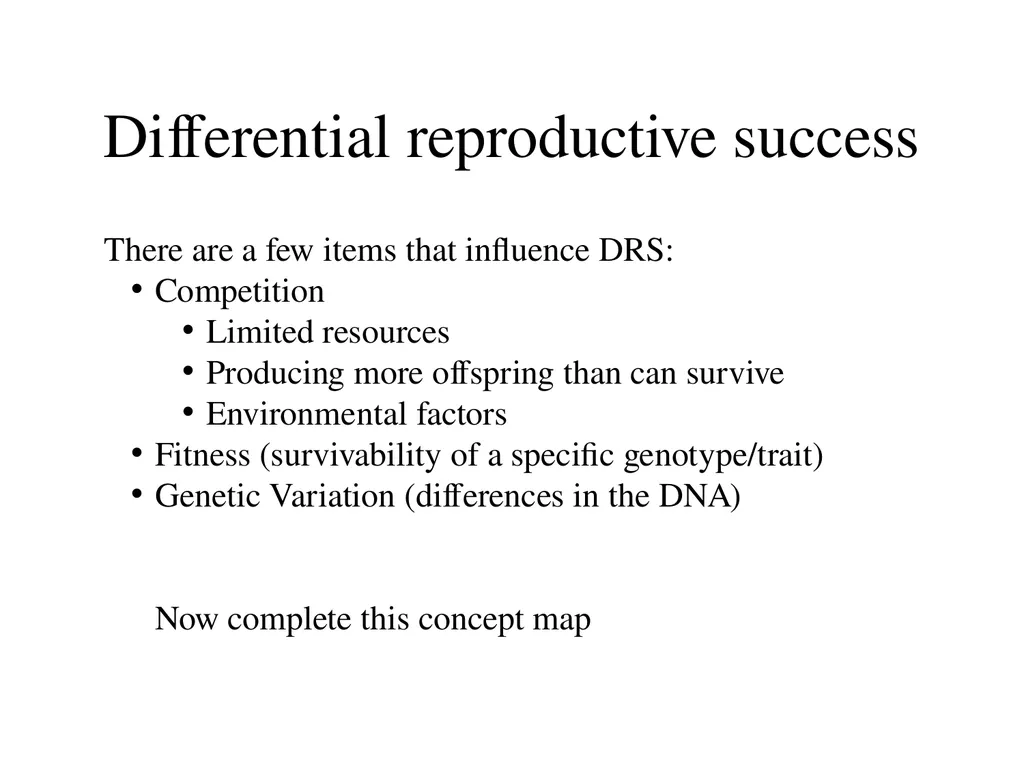
Differential reproductive success There are a few items that influence DRS:
Competition
Limited resources
Producing more offspring than can survive
Environmental factors
Fitness (survivability of a specific genotype/trait)
Genetic Variation (differences in the DNA)
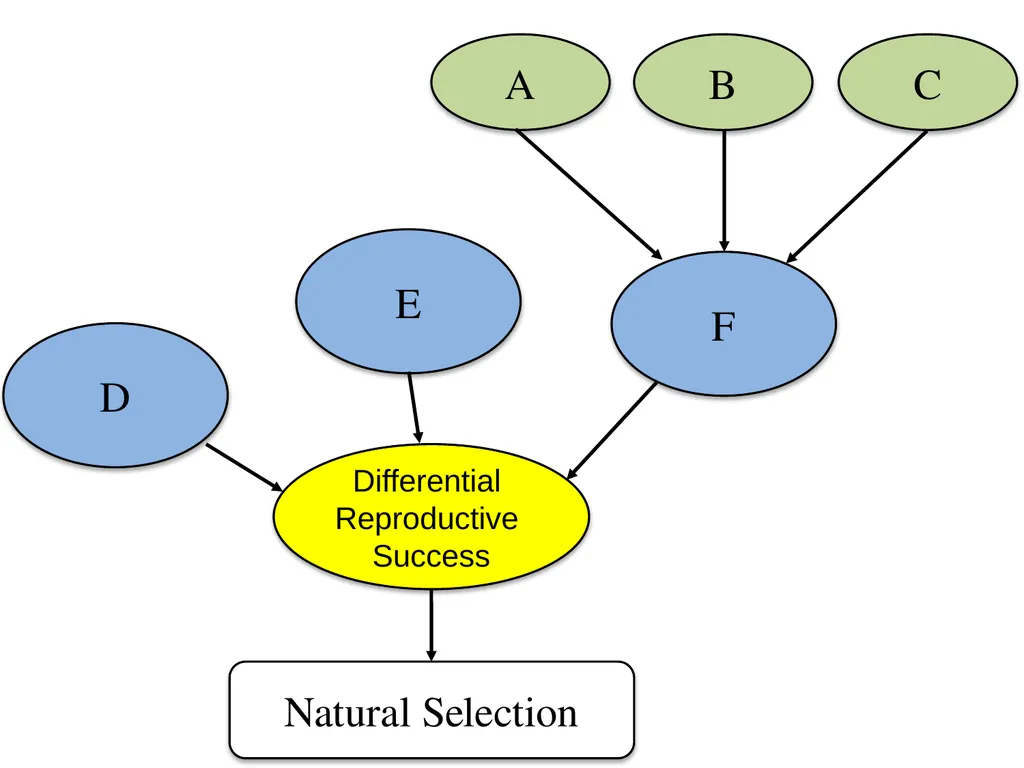
Now complete this concept map<br>
Competition
Limited resources
Producing more offspring than can survive
Environmental factors
Fitness (survivability of a specific genotype/trait)
Genetic Variation (differences in the DNA)
Now complete this concept map<br>
08
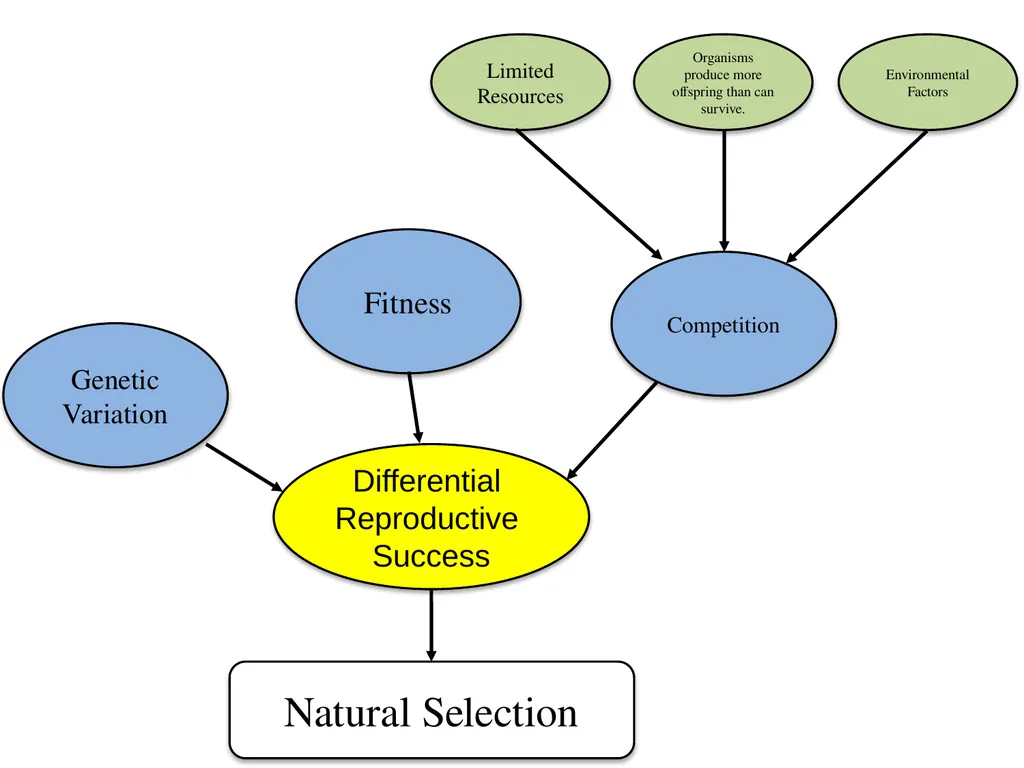
Genetic
Variation Fitness Competition Limited
Resources Organisms produce more offspring than can survive. Environmental Factors<br>
Variation Fitness Competition Limited
Resources Organisms produce more offspring than can survive. Environmental Factors<br>
09
Lemurs of Madagascar<br>
10
Amazonian Frogs<br>
11
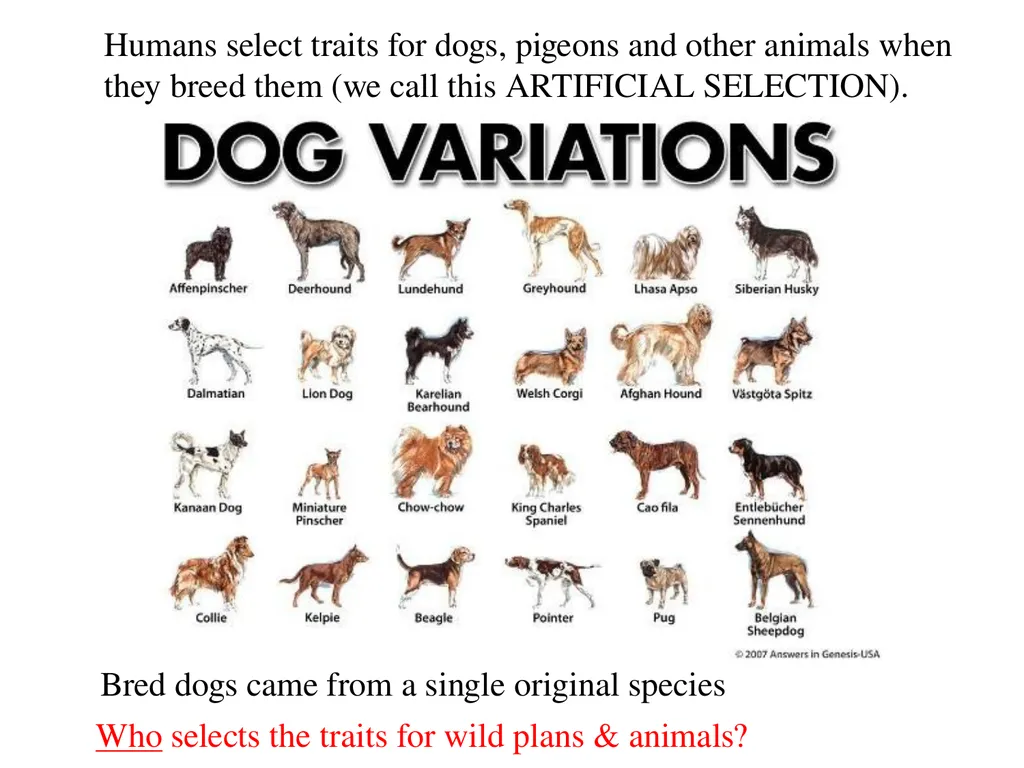
Bred dogs came from a single original species Humans select traits for dogs, pigeons and other animals when they breed them (we call this ARTIFICIAL SELECTION). Who selects the traits for wild plans & animals?<br>
12
INDIVIDUALS THAT HAVE TRAITS THAT ARE BEST ADAPTED FOR THE CURRENT ENVIRONMENT ARE THE ONES THAT SURVIVE TO BREED AND PASS ON THEIR GENES TO THE NEXT GENERATION. NOBODY!! Organisms not possessing the beneficial traits either die or don’t have as many offspring. There is no agent involved in natural selection.
Natural selection is a process of elimination Natural Selection is Survival of the fittest<br>
Natural selection is a process of elimination Natural Selection is Survival of the fittest<br>
13
Natural Selection is Survival of the fittest
This does not mean that the biggest gets to live. (Think David and Goliath)
“He who has the BEST trait/adaptation to survive has the best chance of doing so.”
Using Germ-X kills 99% of the bacteria, it’s the 1% that continues to live on. They possess a gene that makes them resilient to Germ-X and that gene is therefore passes on to the next generation.
Natural Selection is a mixture of both Chance and necessity<br>
This does not mean that the biggest gets to live. (Think David and Goliath)
“He who has the BEST trait/adaptation to survive has the best chance of doing so.”
Using Germ-X kills 99% of the bacteria, it’s the 1% that continues to live on. They possess a gene that makes them resilient to Germ-X and that gene is therefore passes on to the next generation.
Natural Selection is a mixture of both Chance and necessity<br>
14
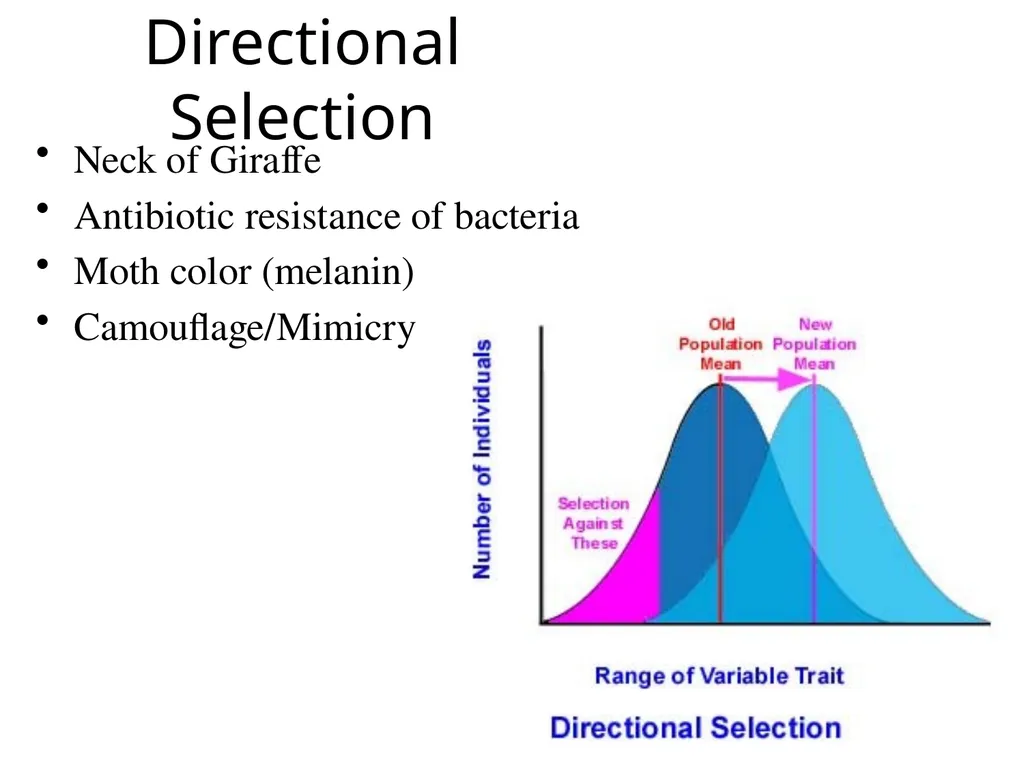
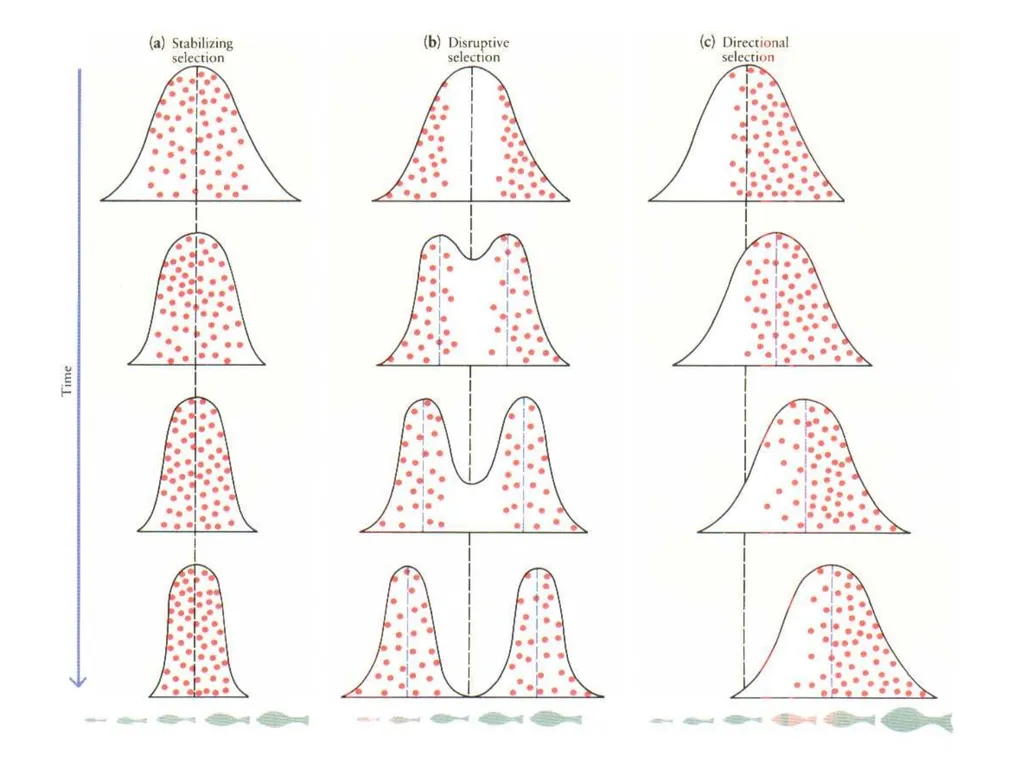
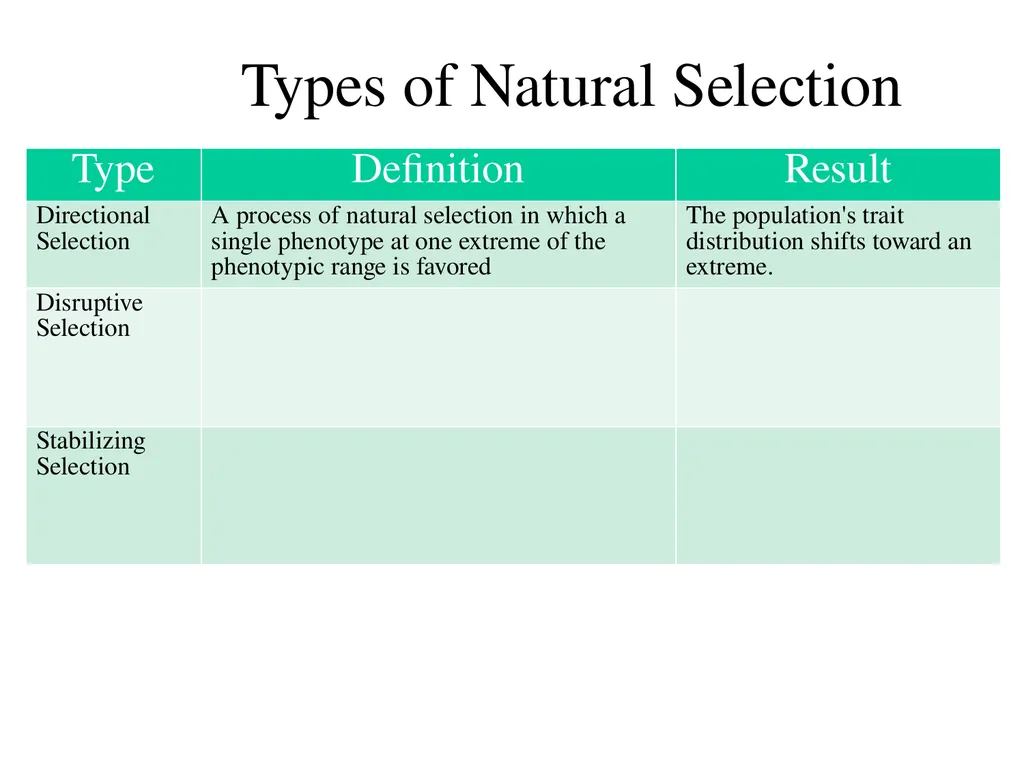
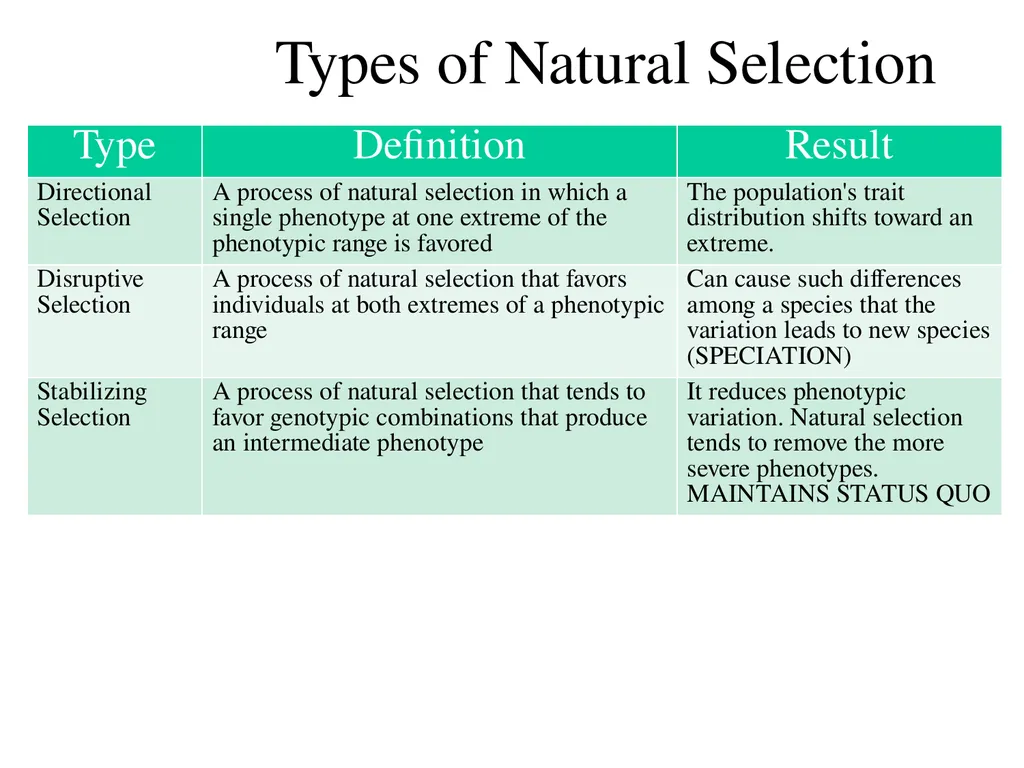
Main Types of Selection Pressures Directional Selection
Natural selection favors one extreme of the population for that trait
often happens when environment changes in a consistent way- e.g.climate gets colder.
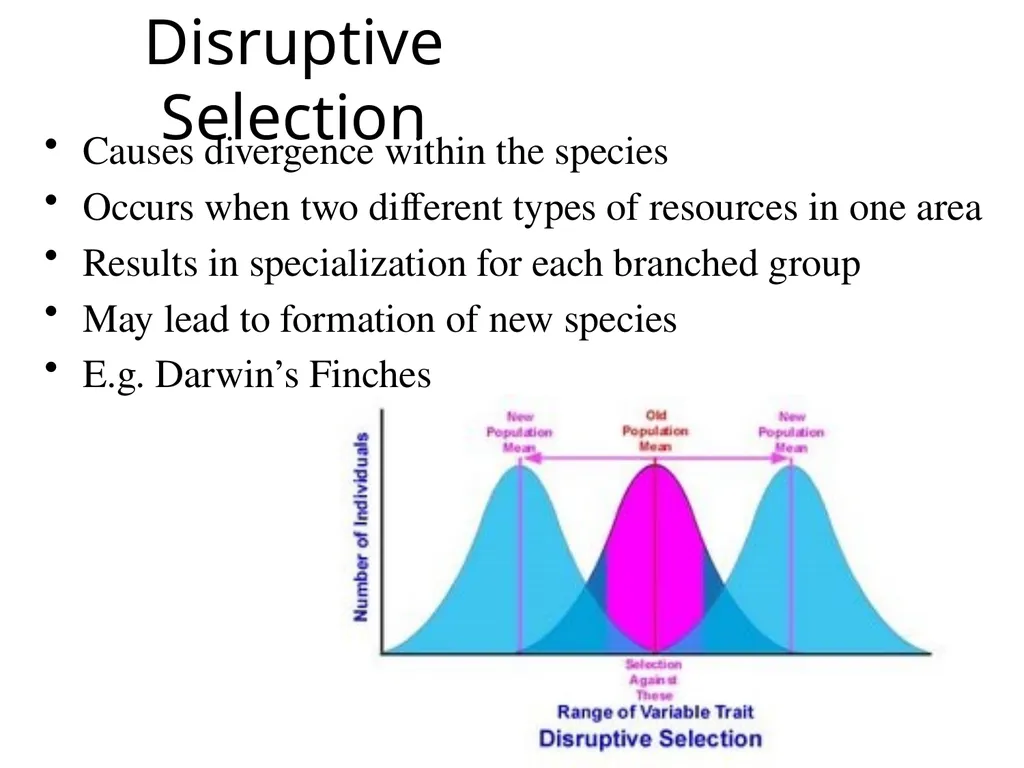
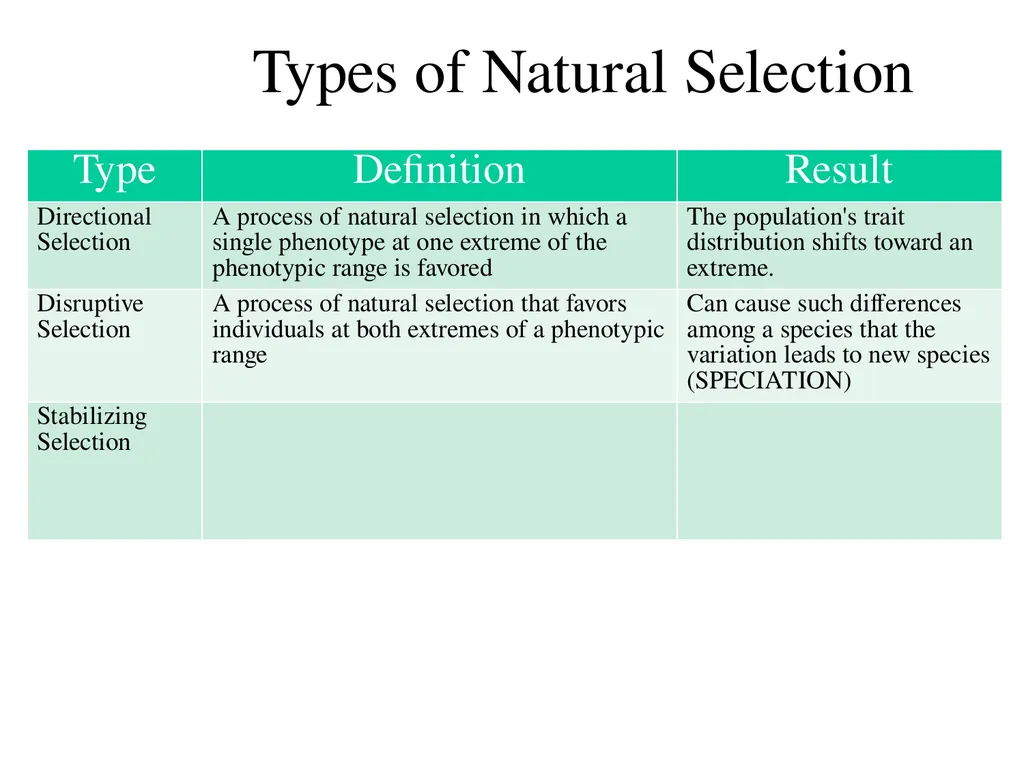
Disruptive Selection
Natural selection favors both extremes selected
Causes species to diverge
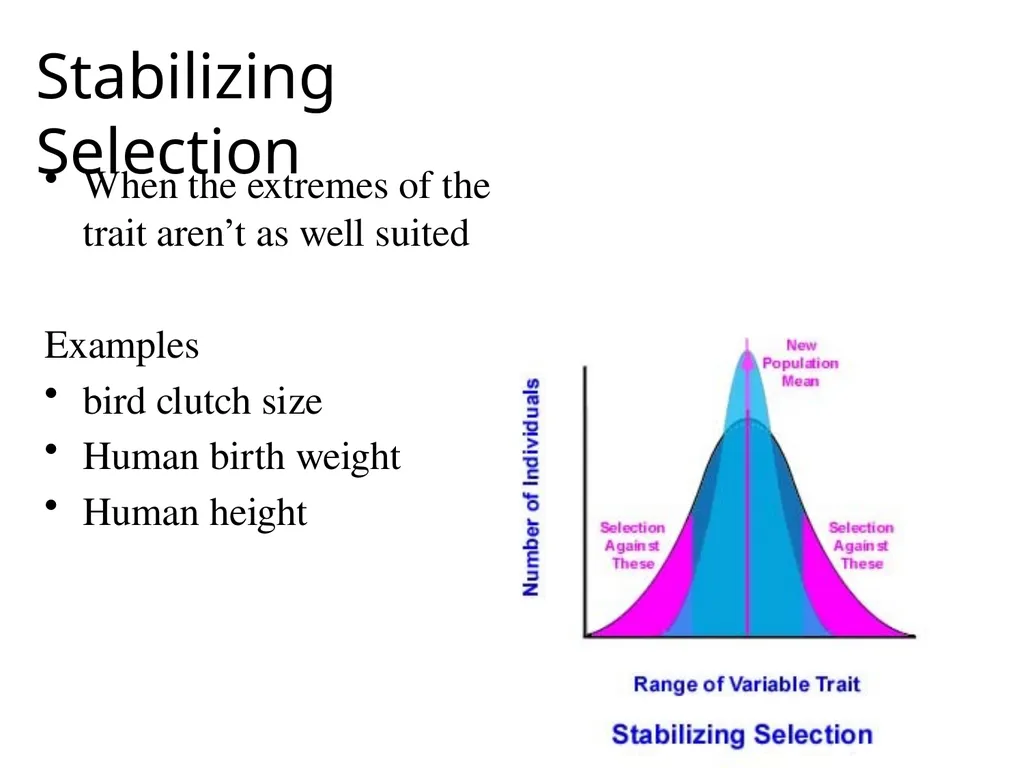
Stabilizing Selection
Natural selection favors the average for population selected<br>
Natural selection favors one extreme of the population for that trait
often happens when environment changes in a consistent way- e.g.climate gets colder.
Disruptive Selection
Natural selection favors both extremes selected
Causes species to diverge
Stabilizing Selection
Natural selection favors the average for population selected<br>
15
Original Population<br>
16
Directional Selection Neck of Giraffe
Antibiotic resistance of bacteria
Moth color (melanin)
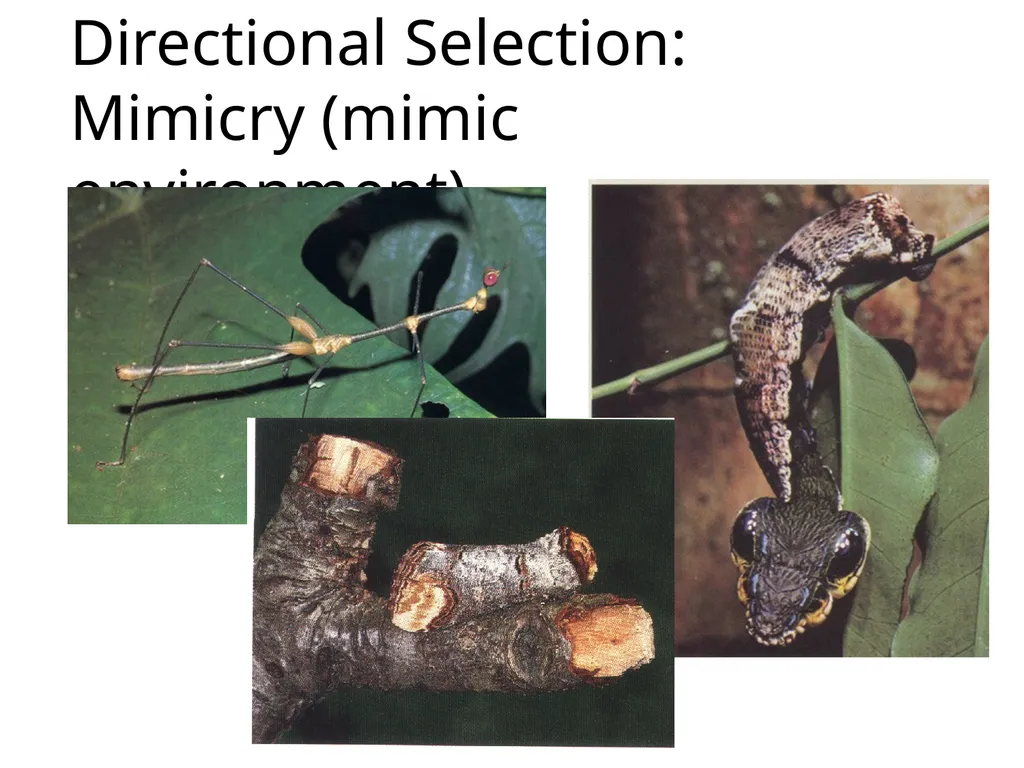
Camouflage/Mimicry<br>
Antibiotic resistance of bacteria
Moth color (melanin)
Camouflage/Mimicry<br>
17
Directional Selection: Mimicry (mimic environment)<br>
18
Stabilizing Selection When the extremes of the trait aren’t as well suited
Examples
bird clutch size
Human birth weight
Human height<br>
Examples
bird clutch size
Human birth weight
Human height<br>
19
Disruptive Selection Causes divergence within the species
Occurs when two different types of resources in one area
Results in specialization for each branched group
May lead to formation of new species
E.g. Darwin’s Finches<br>
Occurs when two different types of resources in one area
Results in specialization for each branched group
May lead to formation of new species
E.g. Darwin’s Finches<br>
20
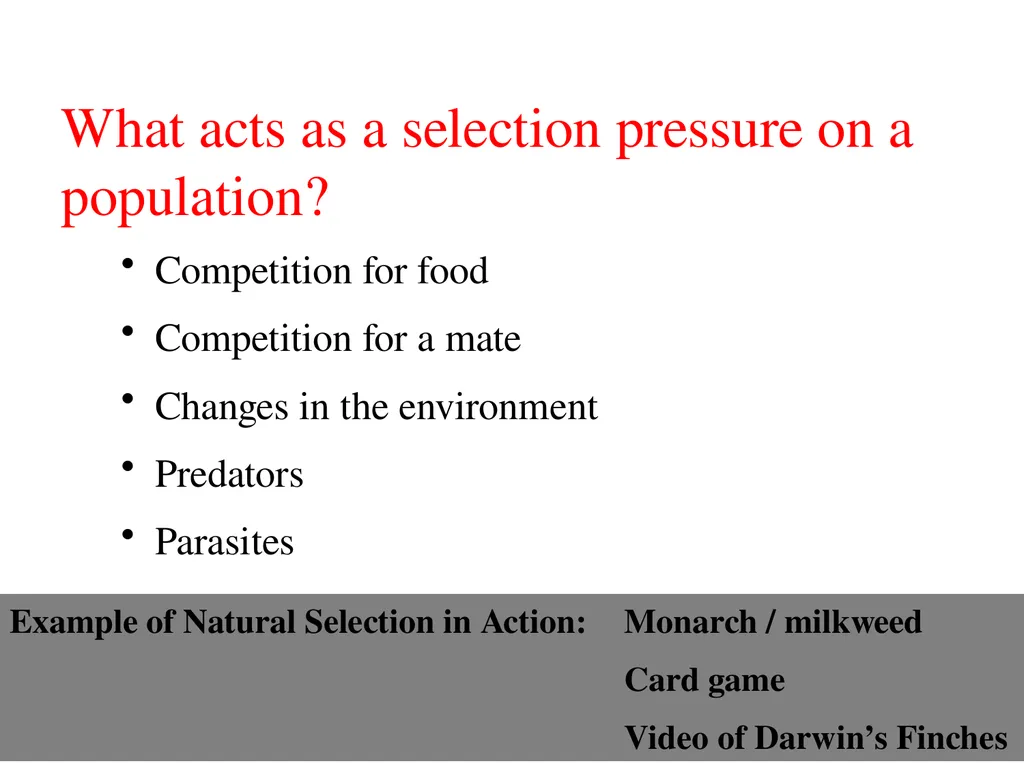
What acts as a selection pressure on a population? Competition for food
Competition for a mate
Changes in the environment
Predators
Parasites Example of Natural Selection in Action: Monarch / milkweed
Card game
Video of Darwin’s Finches<br>
Competition for a mate
Changes in the environment
Predators
Parasites Example of Natural Selection in Action: Monarch / milkweed
Card game
Video of Darwin’s Finches<br>
21
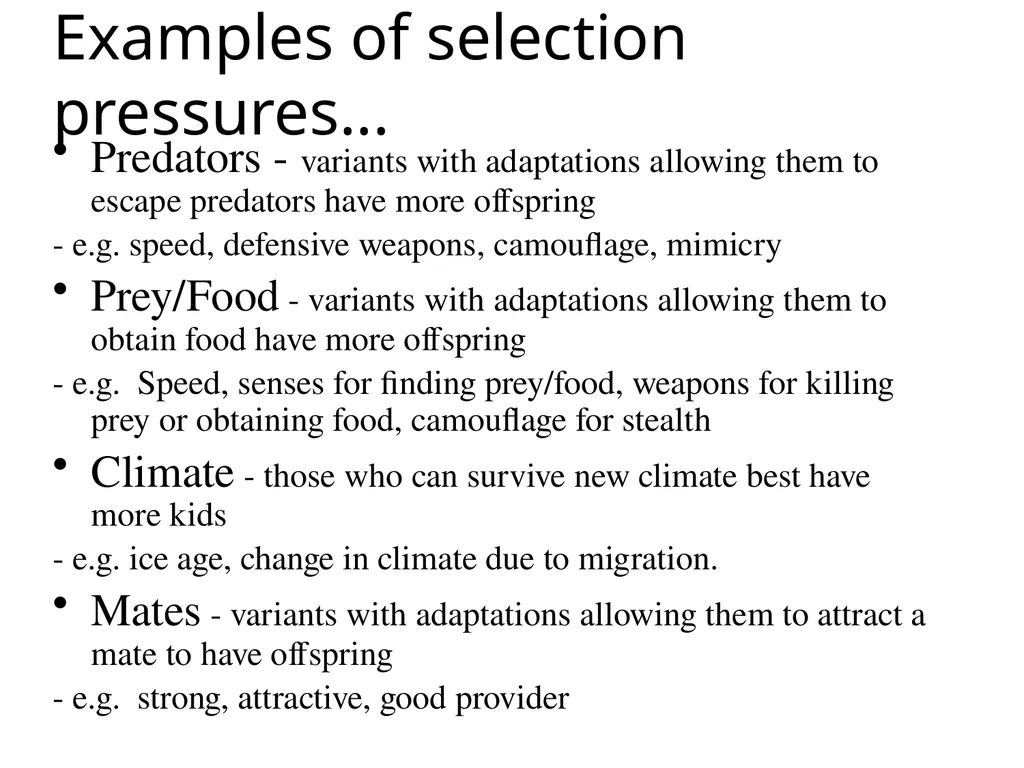
Examples of selection pressures... Predators - variants with adaptations allowing them to escape predators have more offspring
- e.g. speed, defensive weapons, camouflage, mimicry
Prey/Food - variants with adaptations allowing them to obtain food have more offspring
- e.g. Speed, senses for finding prey/food, weapons for killing prey or obtaining food, camouflage for stealth
Climate - those who can survive new climate best have more kids
- e.g. ice age, change in climate due to migration.
Mates - variants with adaptations allowing them to attract a mate to have offspring
- e.g. strong, attractive, good provider<br>
- e.g. speed, defensive weapons, camouflage, mimicry
Prey/Food - variants with adaptations allowing them to obtain food have more offspring
- e.g. Speed, senses for finding prey/food, weapons for killing prey or obtaining food, camouflage for stealth
Climate - those who can survive new climate best have more kids
- e.g. ice age, change in climate due to migration.
Mates - variants with adaptations allowing them to attract a mate to have offspring
- e.g. strong, attractive, good provider<br>
22
Types of Natural Selection<br>
23
Types of Natural Selection<br>
24
Types of Natural Selection<br>
25
Types of Natural Selection<br>
26
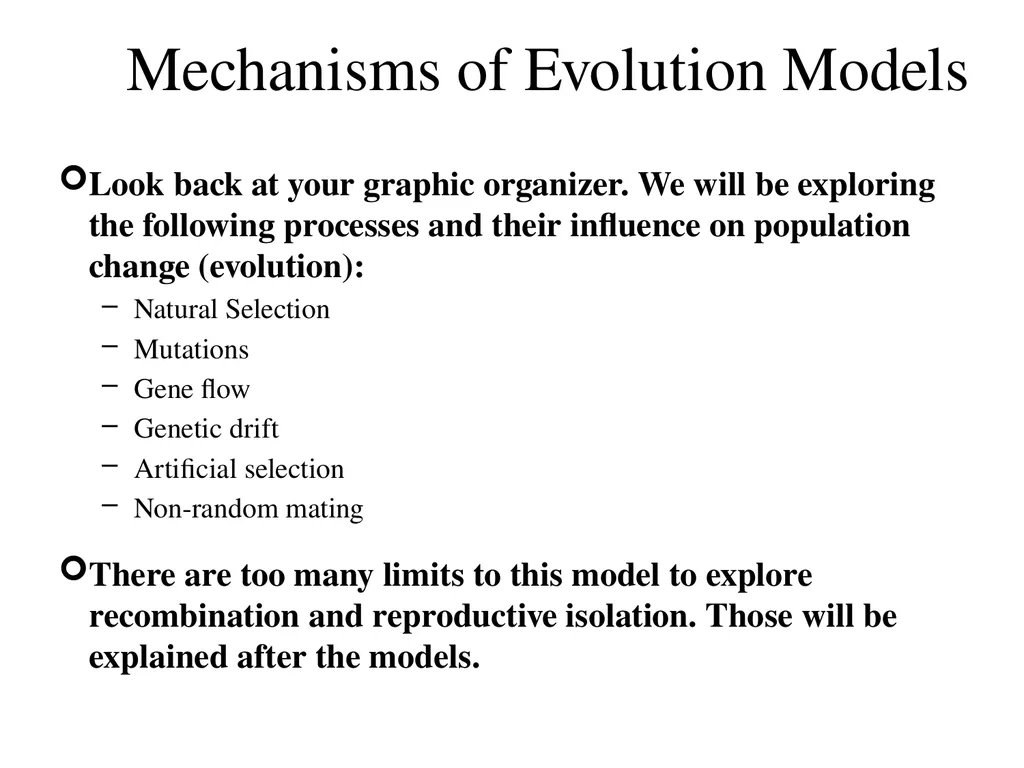
Look back at your graphic organizer. We will be exploring the following processes and their influence on population change (evolution):
Natural Selection
Mutations
Gene flow
Genetic drift
Artificial selection
Non-random mating
There are too many limits to this model to explore recombination and reproductive isolation. Those will be explained after the models. Mechanisms of Evolution Models<br>
Natural Selection
Mutations
Gene flow
Genetic drift
Artificial selection
Non-random mating
There are too many limits to this model to explore recombination and reproductive isolation. Those will be explained after the models. Mechanisms of Evolution Models<br>
27
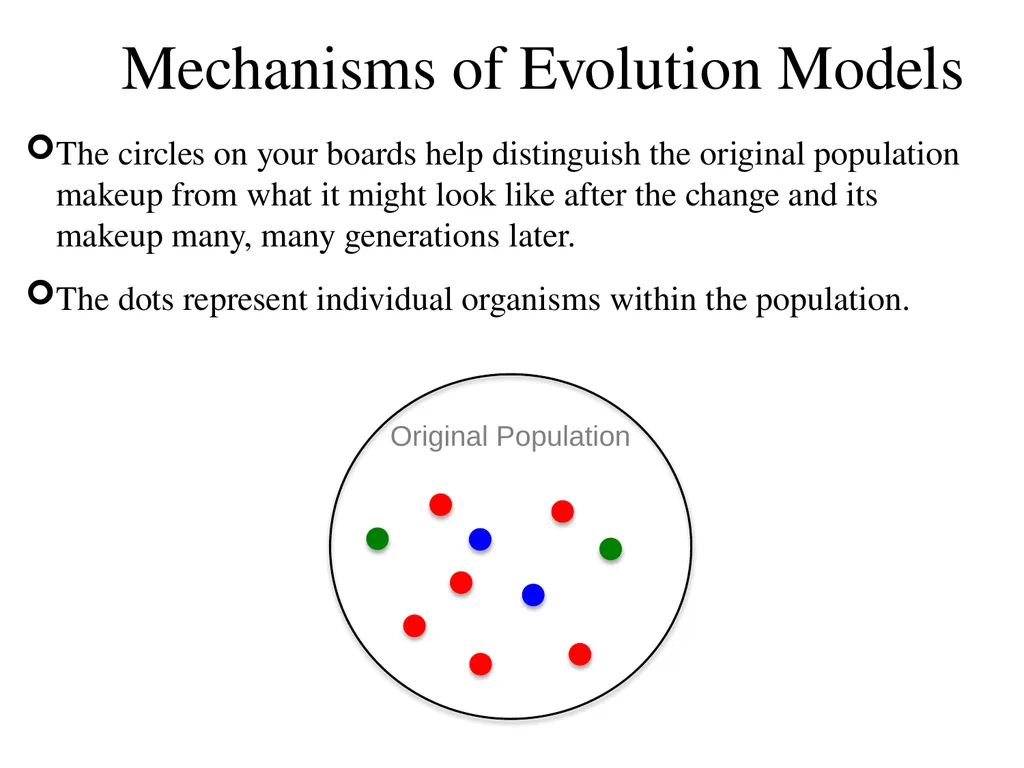
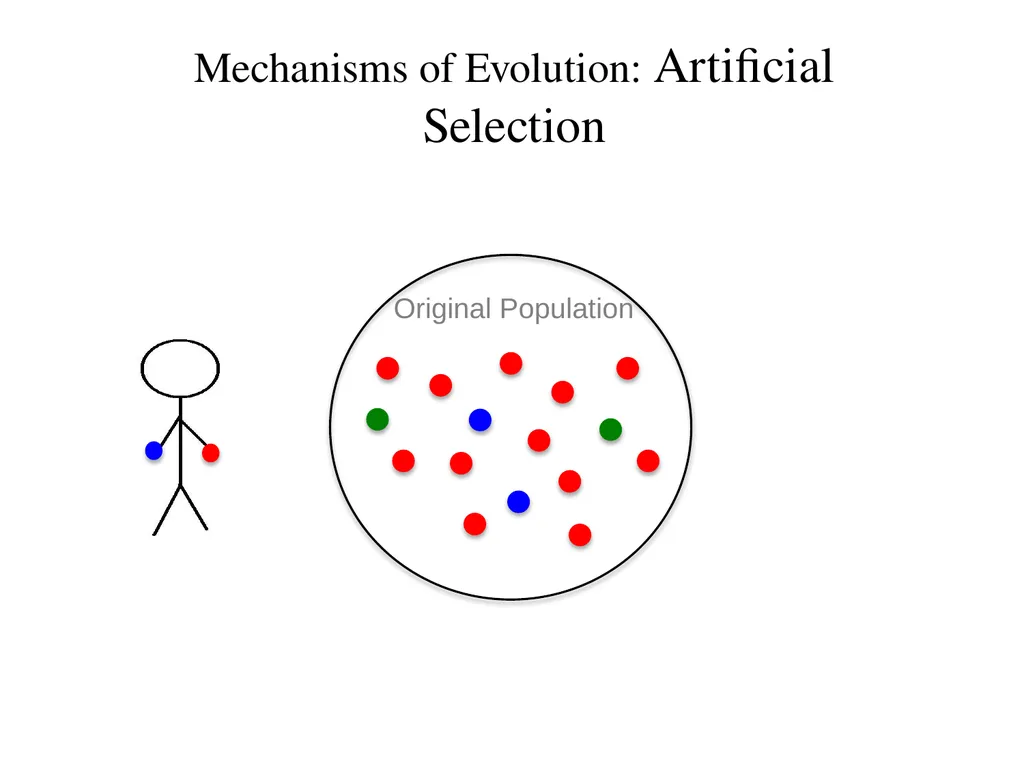
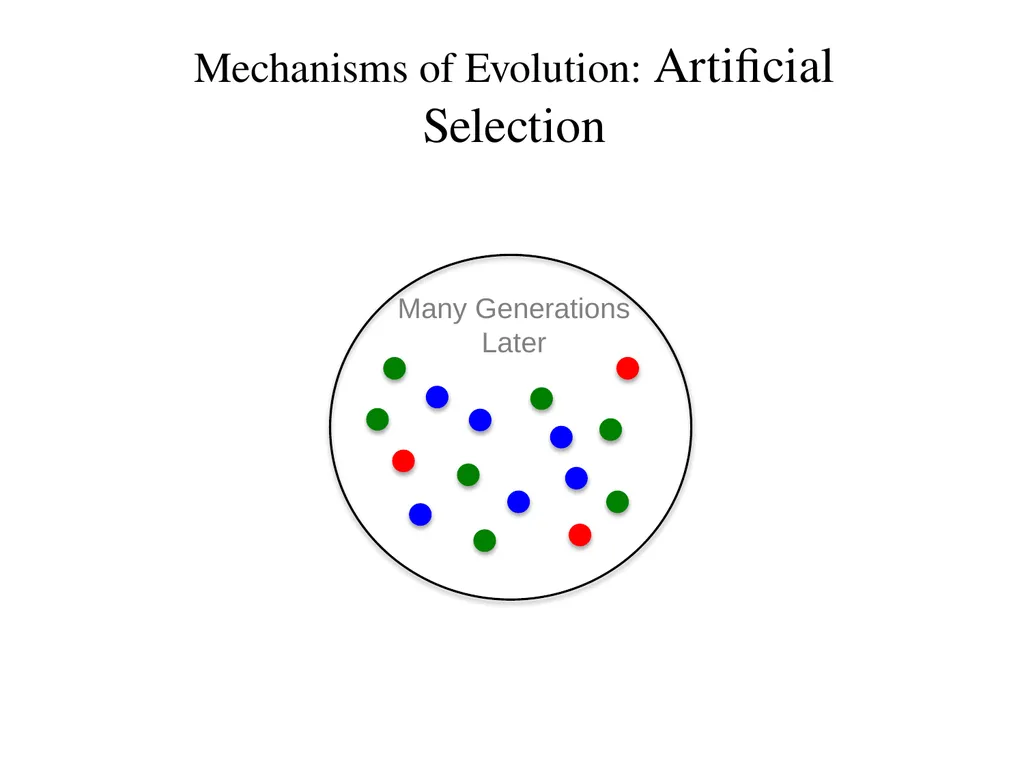
The circles on your boards help distinguish the original population makeup from what it might look like after the change and its makeup many, many generations later.
The dots represent individual organisms within the population. Mechanisms of Evolution Models Original Population<br>
The dots represent individual organisms within the population. Mechanisms of Evolution Models Original Population<br>
28
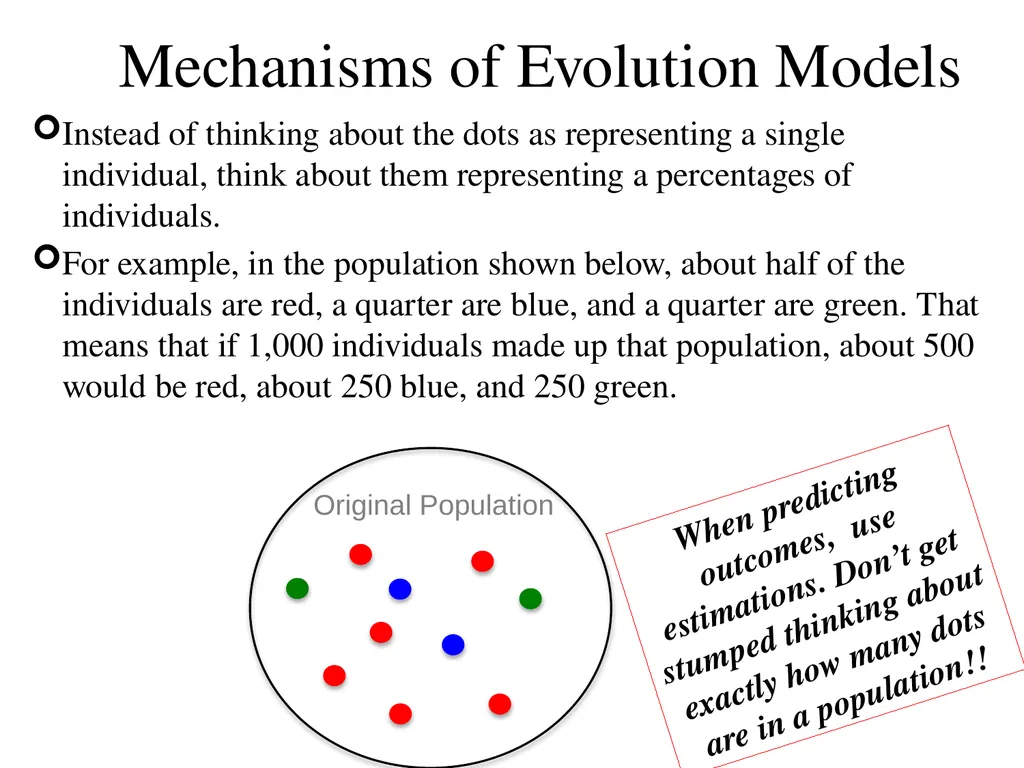
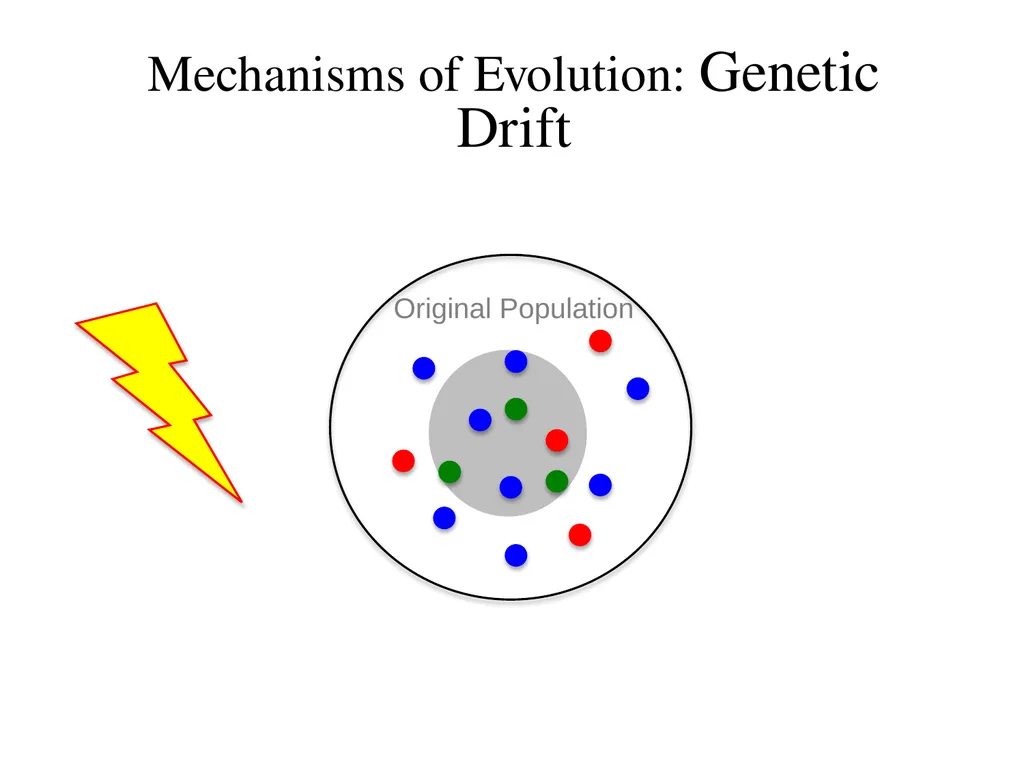
Instead of thinking about the dots as representing a single individual, think about them representing a percentages of individuals.
For example, in the population shown below, about half of the individuals are red, a quarter are blue, and a quarter are green. That means that if 1,000 individuals made up that population, about 500 would be red, about 250 blue, and 250 green. Mechanisms of Evolution Models Original Population When predicting outcomes, use estimations. Don’t get stumped thinking about exactly how many dots are in a population!!<br>
For example, in the population shown below, about half of the individuals are red, a quarter are blue, and a quarter are green. That means that if 1,000 individuals made up that population, about 500 would be red, about 250 blue, and 250 green. Mechanisms of Evolution Models Original Population When predicting outcomes, use estimations. Don’t get stumped thinking about exactly how many dots are in a population!!<br>
29
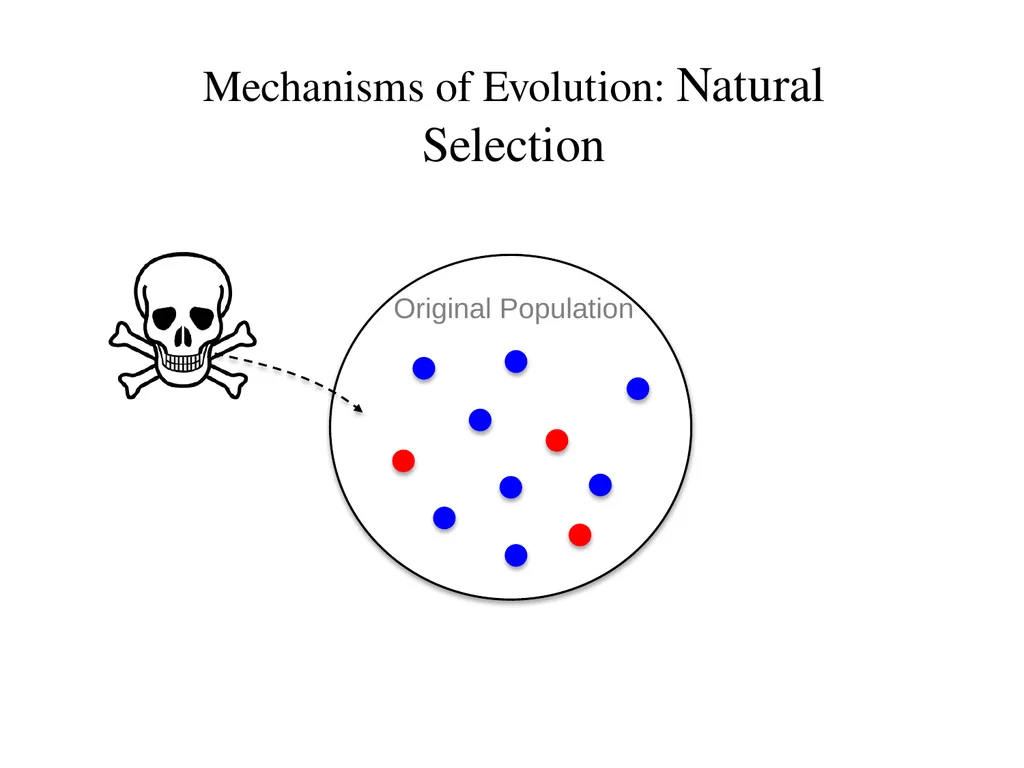
Original Population Mechanisms of Evolution: Natural Selection<br>
30
After Chemical Spill Mechanisms of Evolution: Natural Selection<br>
31
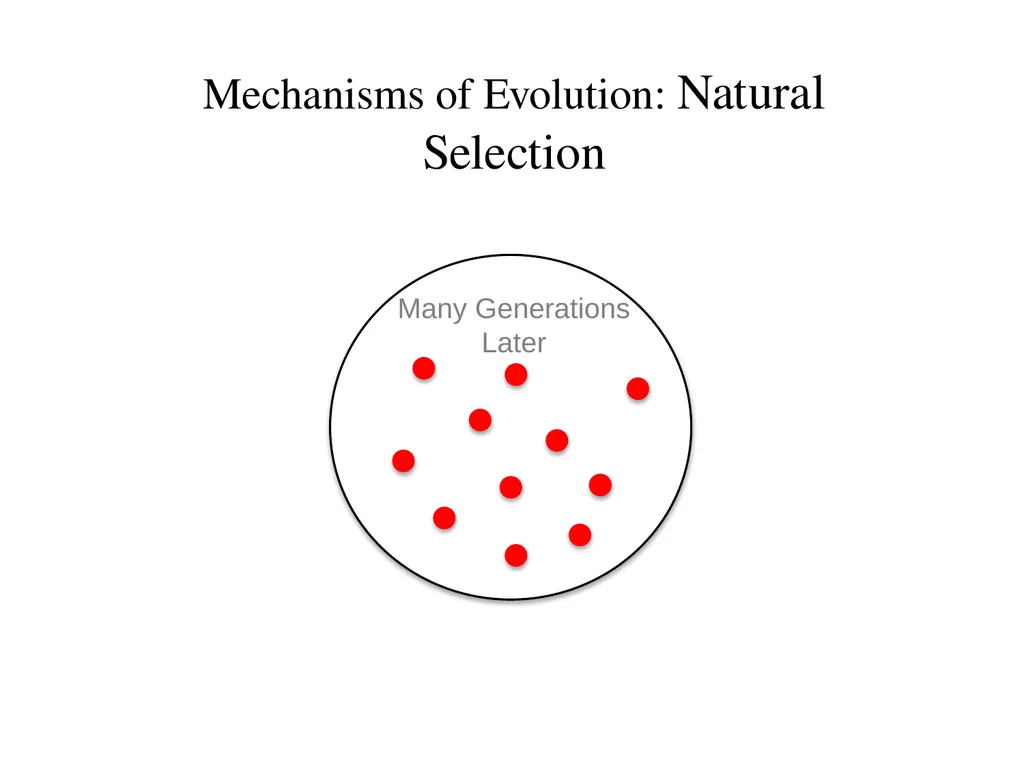
Many Generations Later Mechanisms of Evolution: Natural Selection<br>
32
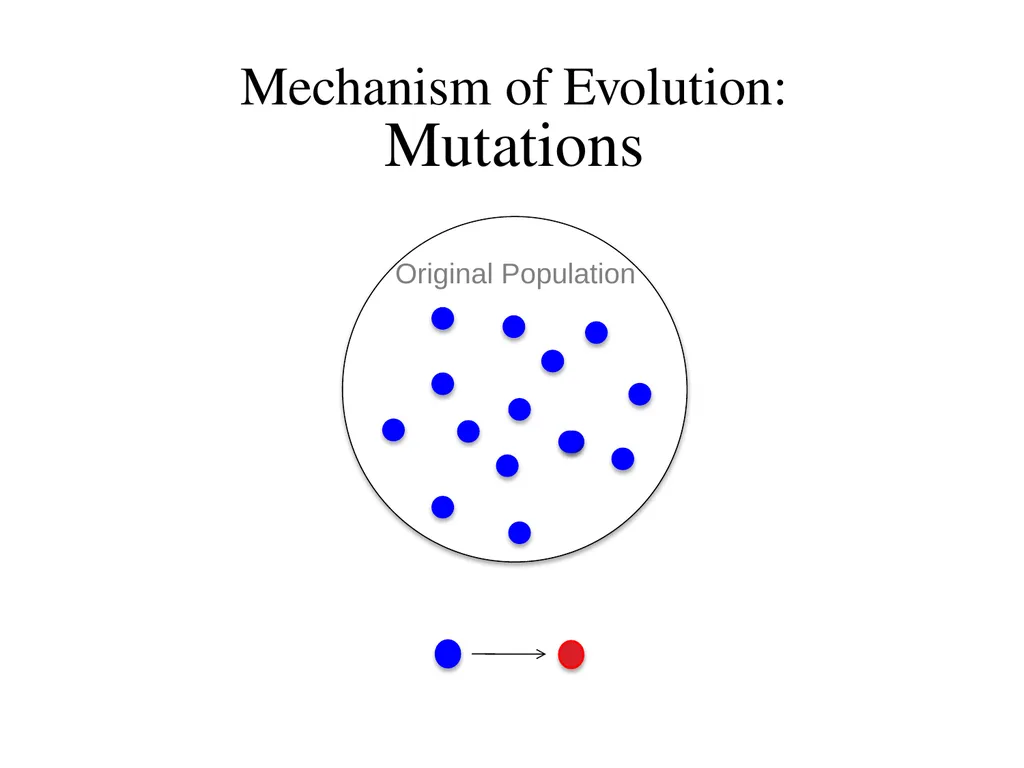
Mechanism of Evolution: Mutations Original Population<br>
33
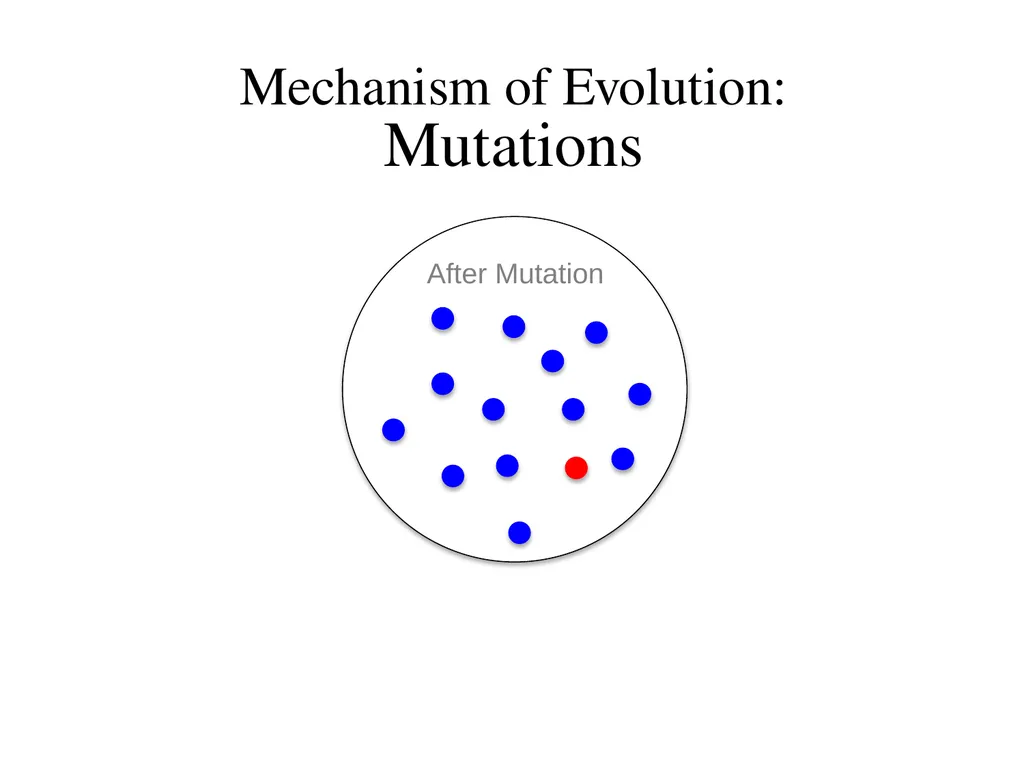
Mechanism of Evolution: Mutations After Mutation<br>
34
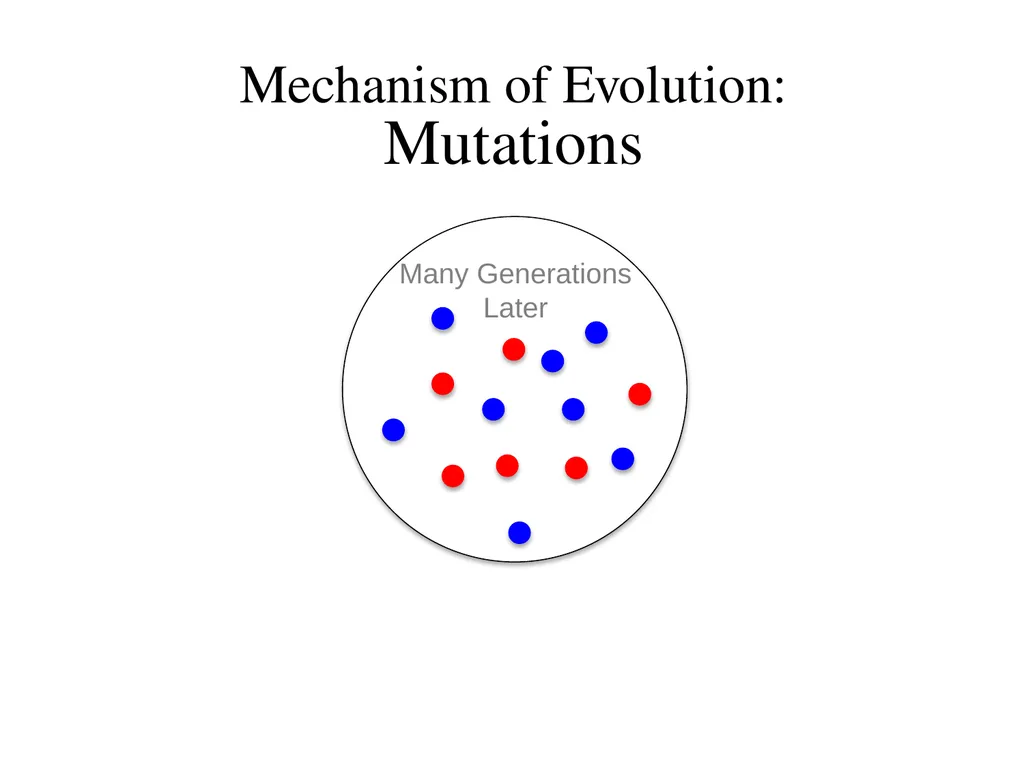
Mechanism of Evolution: Mutations Many Generations Later<br>
35
Real-World Examples:
http://evolution.berkeley.edu/evosite/evo101/IIIC2aCasestudy.shtml Mechanisms of Evolution: Mutations<br>
http://evolution.berkeley.edu/evosite/evo101/IIIC2aCasestudy.shtml Mechanisms of Evolution: Mutations<br>
36
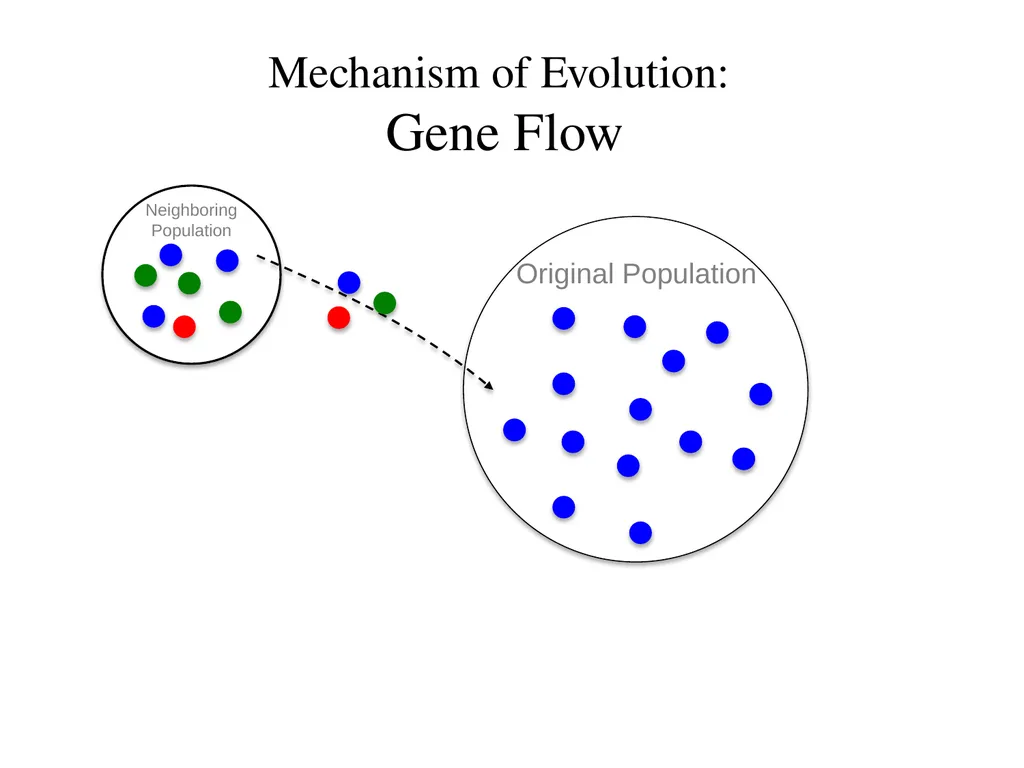
Mechanism of Evolution:
Gene Flow Original Population Neighboring
Population<br>
Population<br>
37
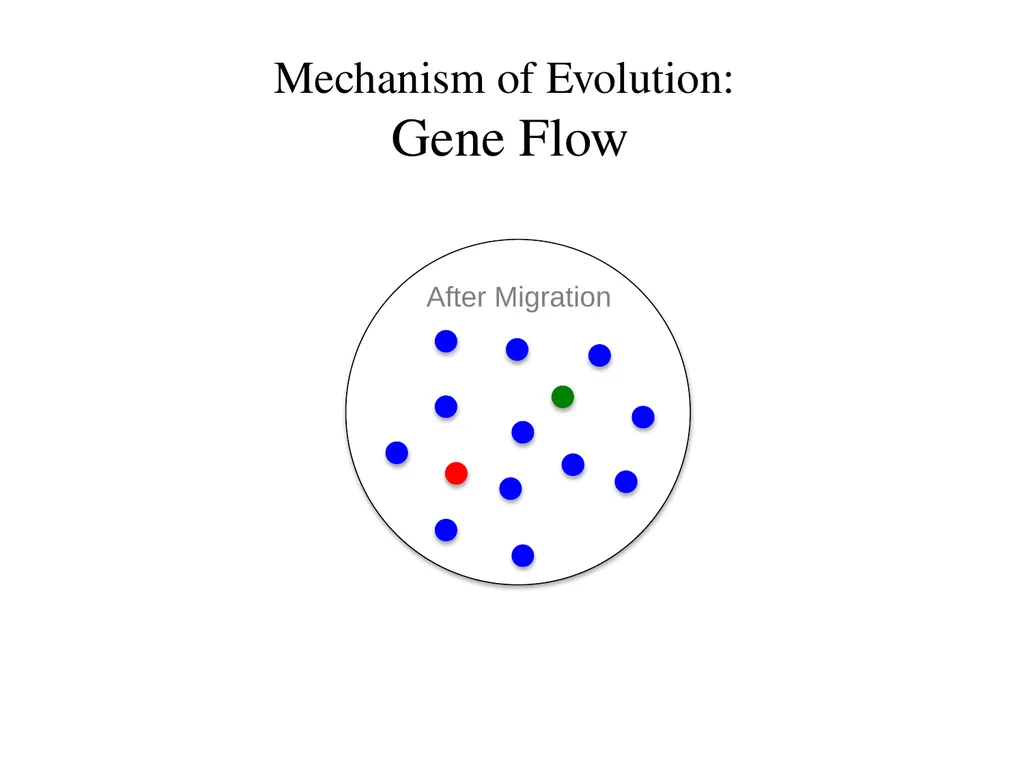
Mechanism of Evolution:
Gene Flow After Migration<br>
38
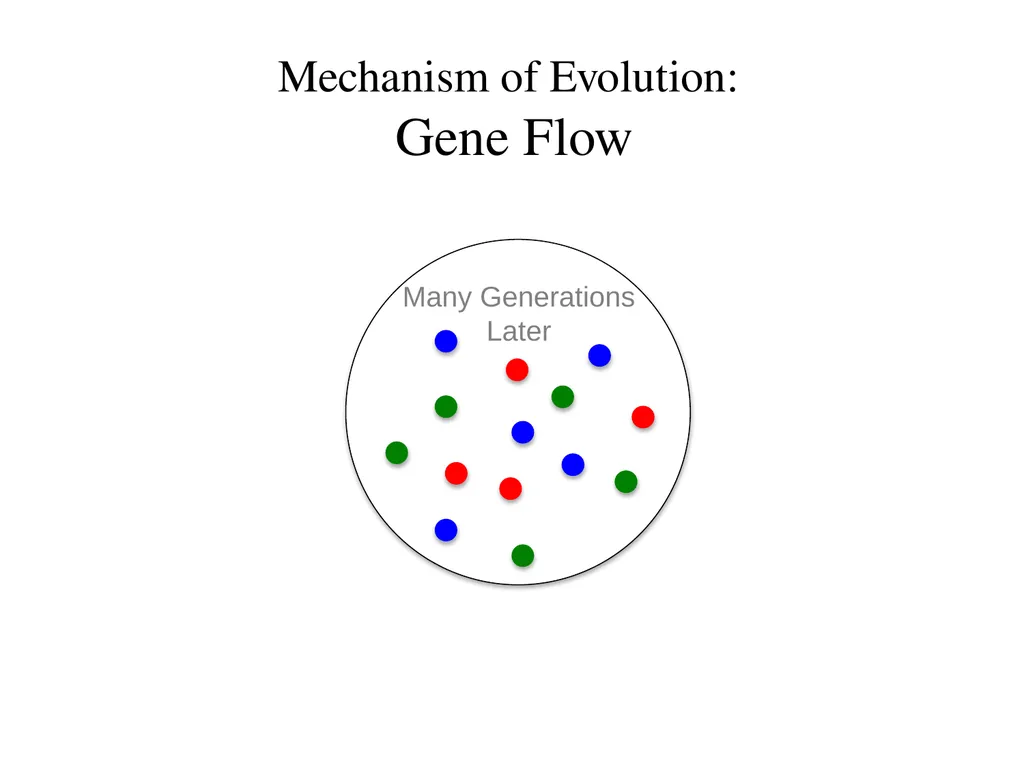
Mechanism of Evolution:
Gene Flow Many Generations Later<br>
39
Real-World Examples:
http://evolution.berkeley.edu/evosite/evo101/IIIC4aGeneflowdetails.shtml Mechanisms of Evolution: Gene Flow<br>
http://evolution.berkeley.edu/evosite/evo101/IIIC4aGeneflowdetails.shtml Mechanisms of Evolution: Gene Flow<br>
40
Original Population Mechanisms of Evolution: Genetic Drift<br>
41
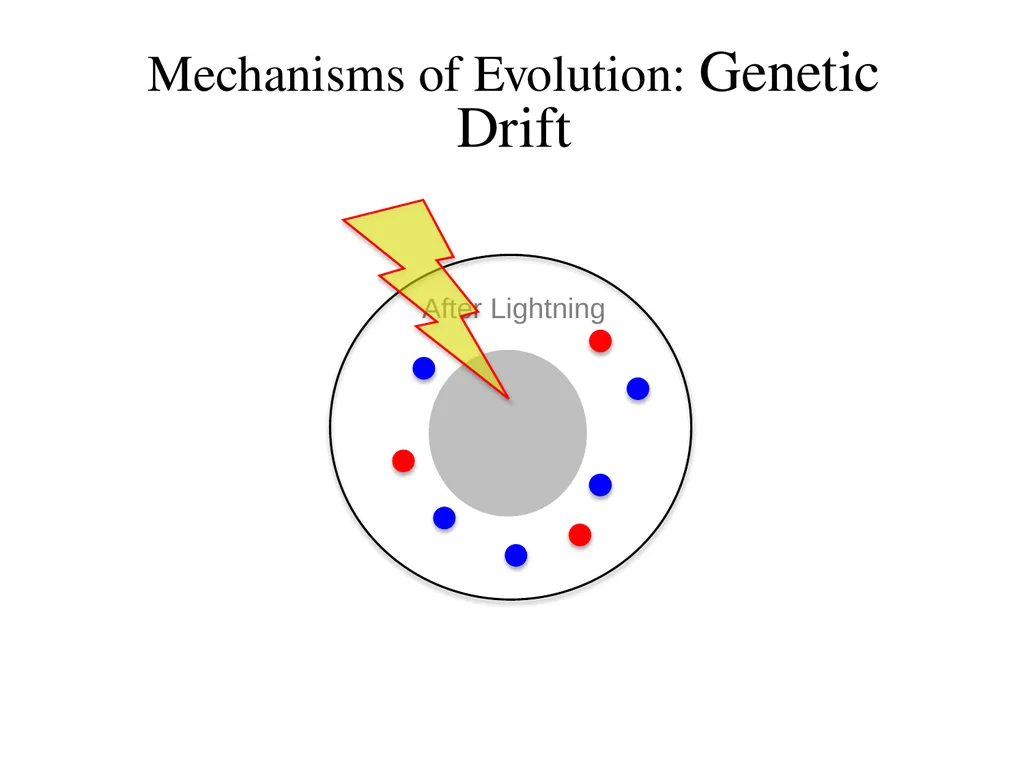
After Lightning Mechanisms of Evolution: Genetic Drift<br>
42
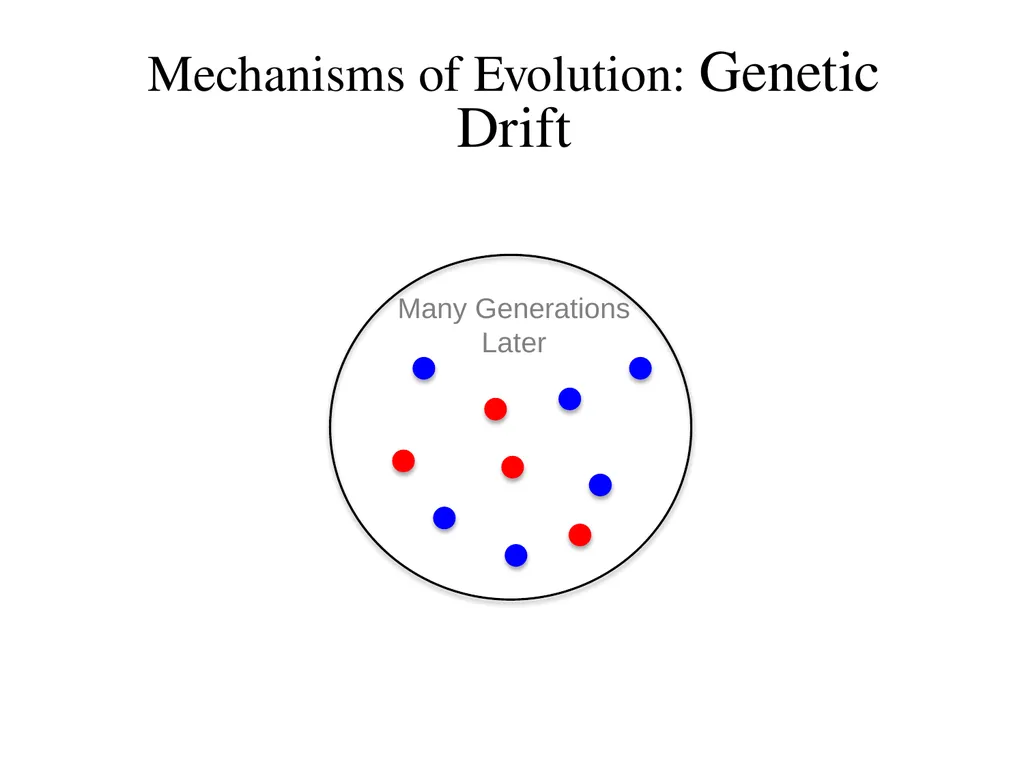
Many Generations Later Mechanisms of Evolution: Genetic Drift<br>
43
Real-World Examples:
http://www.bio.georgiasouthern.edu/bio-home/harvey/lect/lectures.html?flnm=nsln&ttl=Population%20change%20and%20natural%20selection&ccode=el&mda=scrn
http://highered.mcgraw-hill.com/sites/dl/free/0072835125/126997/animation45.html Mechanisms of Evolution: Genetic Drift<br>
http://www.bio.georgiasouthern.edu/bio-home/harvey/lect/lectures.html?flnm=nsln&ttl=Population%20change%20and%20natural%20selection&ccode=el&mda=scrn
http://highered.mcgraw-hill.com/sites/dl/free/0072835125/126997/animation45.html Mechanisms of Evolution: Genetic Drift<br>
44
Original Population Mechanisms of Evolution: Artificial Selection<br>
45
Many Generations Later Mechanisms of Evolution: Artificial Selection<br>
46
Real-World Examples:
http://learn.genetics.utah.edu/content/variation/artificial/ Mechanisms of Evolution: Artificial Selection<br>
http://learn.genetics.utah.edu/content/variation/artificial/ Mechanisms of Evolution: Artificial Selection<br>
47
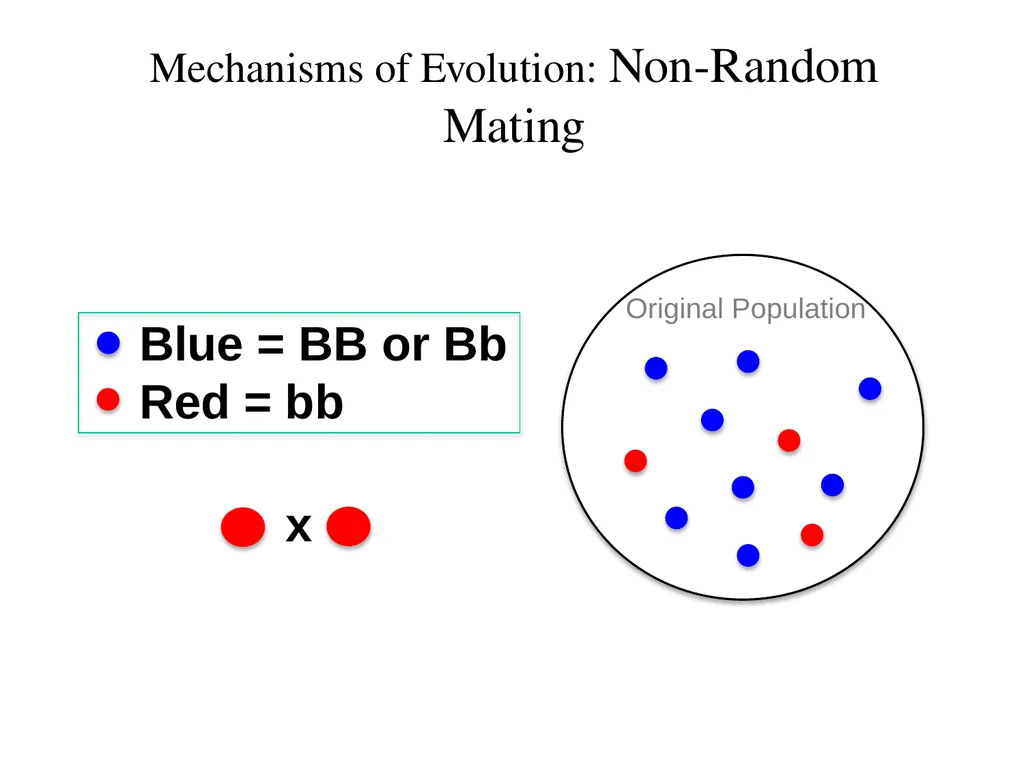
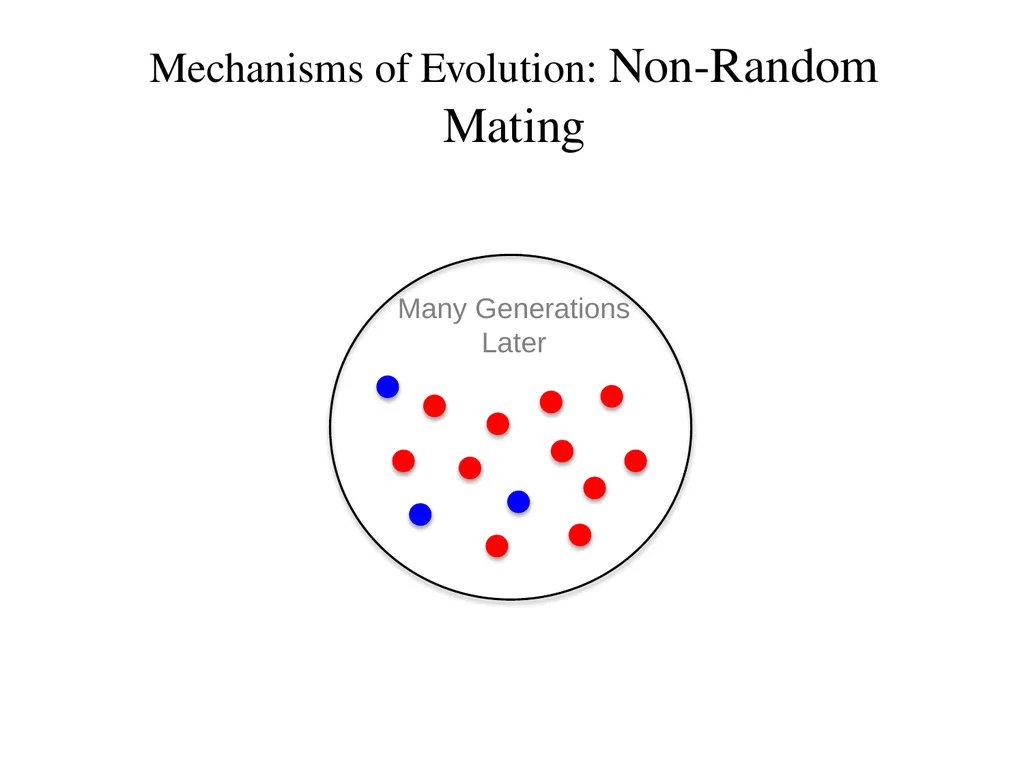
Original Population Mechanisms of Evolution: Non-Random Mating Blue = BB or Bb
Red = bb x<br>
Red = bb x<br>
48
Mechanisms of Evolution: Non-Random Mating Many Generations Later<br>
49
Real-World Examples:
http://www.bio.georgiasouthern.edu/bio-home/harvey/lect/lectures.html?flnm=nsln&ttl=Population%20change%20and%20natural%20selection&ccode=el&mda=scrn Mechanisms of Evolution: Non-Random Mating<br>
http://www.bio.georgiasouthern.edu/bio-home/harvey/lect/lectures.html?flnm=nsln&ttl=Population%20change%20and%20natural%20selection&ccode=el&mda=scrn Mechanisms of Evolution: Non-Random Mating<br>
50
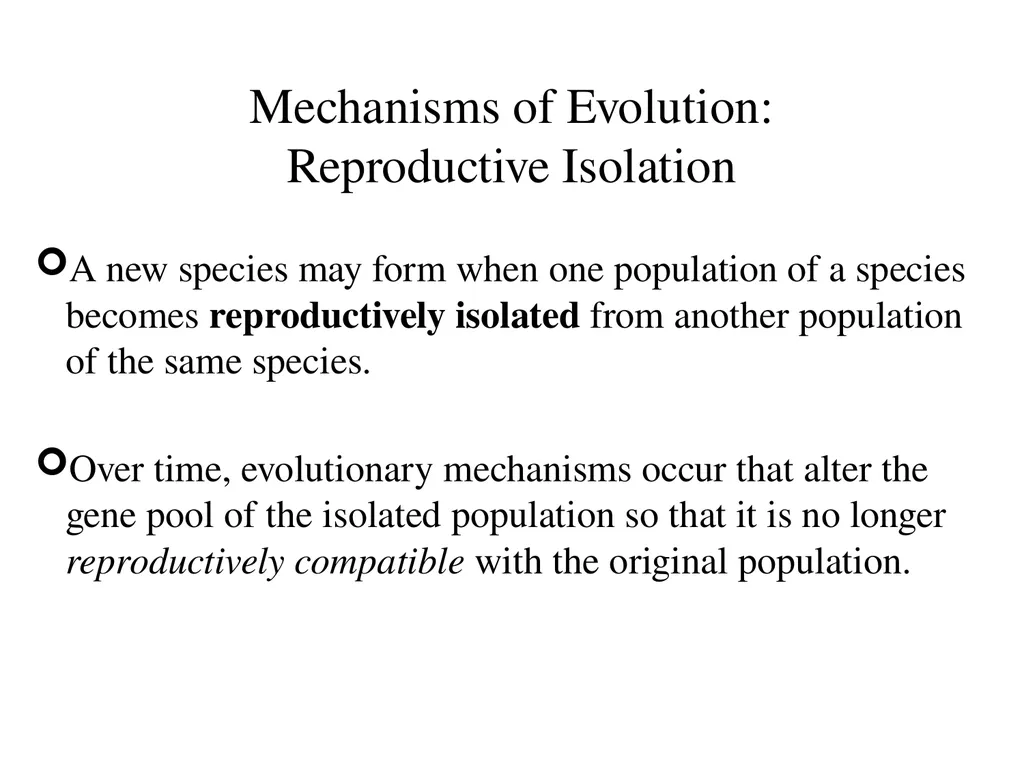
A new species may form when one population of a species becomes reproductively isolated from another population of the same species.
Over time, evolutionary mechanisms occur that alter the gene pool of the isolated population so that it is no longer reproductively compatible with the original population. Mechanisms of Evolution: Reproductive Isolation<br>
Over time, evolutionary mechanisms occur that alter the gene pool of the isolated population so that it is no longer reproductively compatible with the original population. Mechanisms of Evolution: Reproductive Isolation<br>
51
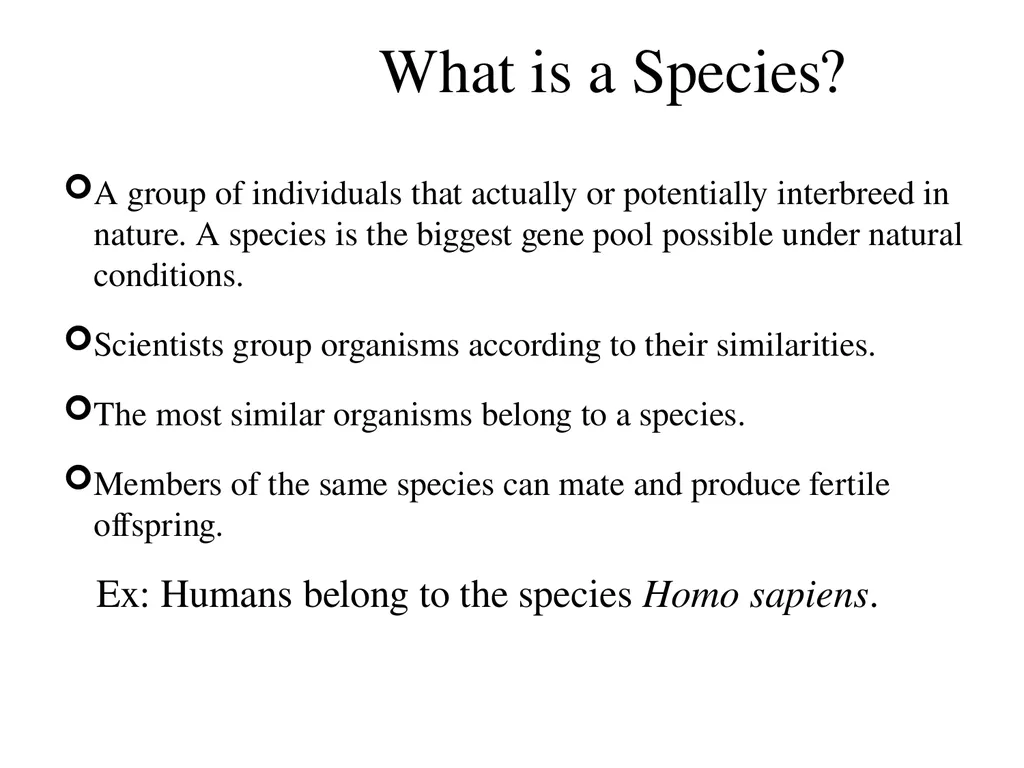
What is a Species? A group of individuals that actually or potentially interbreed in nature. A species is the biggest gene pool possible under natural conditions.
Scientists group organisms according to their similarities.
The most similar organisms belong to a species.
Members of the same species can mate and produce fertile offspring.
Ex: Humans belong to the species Homo sapiens.<br>
Scientists group organisms according to their similarities.
The most similar organisms belong to a species.
Members of the same species can mate and produce fertile offspring.
Ex: Humans belong to the species Homo sapiens.<br>
52
How Do New Species Evolve? Speciation is a lineage-splitting event that produces two or more separate species.
Since being a member of one species is defined by the ability to successfully reproduce, speciation (the formation of a different species) must involve an inability to successfully reproduce.<br>
Since being a member of one species is defined by the ability to successfully reproduce, speciation (the formation of a different species) must involve an inability to successfully reproduce.<br>
53
Reproductive Isolation Two way reproductive isolation occur:
Prezygotic mechanisms
Postzygotic mechanisms<br>
Prezygotic mechanisms
Postzygotic mechanisms<br>
54
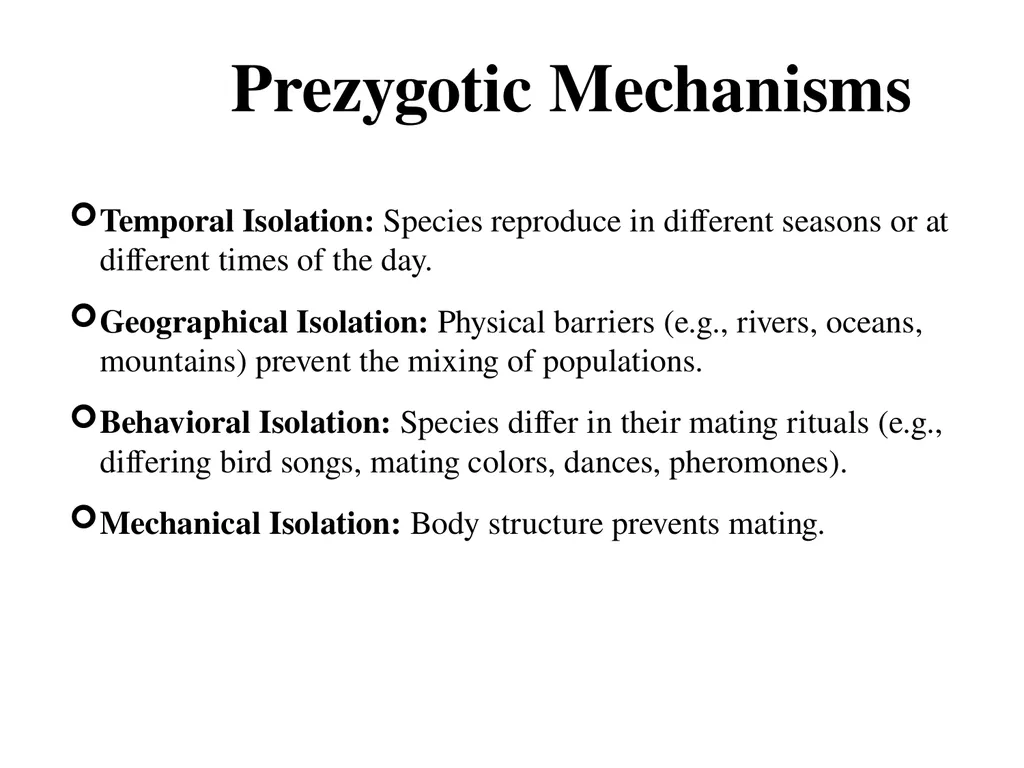
Temporal Isolation: Species reproduce in different seasons or at different times of the day.
Geographical Isolation: Physical barriers (e.g., rivers, oceans, mountains) prevent the mixing of populations.
Behavioral Isolation: Species differ in their mating rituals (e.g., differing bird songs, mating colors, dances, pheromones).
Mechanical Isolation: Body structure prevents mating. Prezygotic Mechanisms<br>
Geographical Isolation: Physical barriers (e.g., rivers, oceans, mountains) prevent the mixing of populations.
Behavioral Isolation: Species differ in their mating rituals (e.g., differing bird songs, mating colors, dances, pheromones).
Mechanical Isolation: Body structure prevents mating. Prezygotic Mechanisms<br>
55
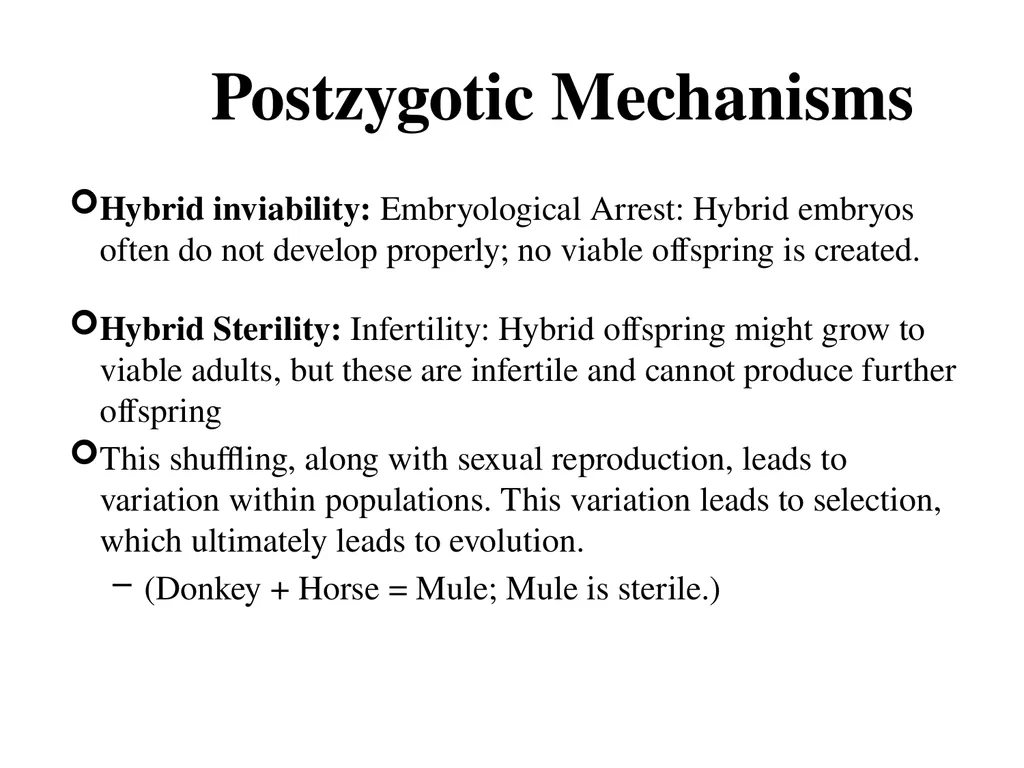
Hybrid inviability: Embryological Arrest: Hybrid embryos often do not develop properly; no viable offspring is created.
Hybrid Sterility: Infertility: Hybrid offspring might grow to viable adults, but these are infertile and cannot produce further offspring
This shuffling, along with sexual reproduction, leads to variation within populations. This variation leads to selection, which ultimately leads to evolution.
(Donkey + Horse = Mule; Mule is sterile.) Postzygotic Mechanisms<br>
Hybrid Sterility: Infertility: Hybrid offspring might grow to viable adults, but these are infertile and cannot produce further offspring
This shuffling, along with sexual reproduction, leads to variation within populations. This variation leads to selection, which ultimately leads to evolution.
(Donkey + Horse = Mule; Mule is sterile.) Postzygotic Mechanisms<br>
56
Cladogenesis Cladogenesis is the splitting of one species into two.
How does this happen?
Geographical (physical) isolation, which leads to reproductive isolation. This is also known as allopatric speciation.<br>
How does this happen?
Geographical (physical) isolation, which leads to reproductive isolation. This is also known as allopatric speciation.<br>
57
How Evolution Occurs There are two scientific theories regarding how evolution occurs.
Punctuated Equilibrium: This theory proposes that throughout geological time, biological species go through long periods of little change and then have brief periods of rapid change.
Gradualism: This theory proposes that throughout geological time, biological species gradually undergo changes that leads to speciation.<br>
Punctuated Equilibrium: This theory proposes that throughout geological time, biological species go through long periods of little change and then have brief periods of rapid change.
Gradualism: This theory proposes that throughout geological time, biological species gradually undergo changes that leads to speciation.<br>