
Never Let Them See You Sweat Classroom Management
CB
Published · 53 slides · 0 views

1 / 1









Description
Never Let Them See You Sweat Classroom Management Expanded Food and Nutrition Education Program Overview The importance of setting up the learning environment Understanding how kids learn Establishing classroom management Contributing
Related Topics
Share
Embed code
Download this presentation From Below
"Never Let Them See You Sweat Classroom Management" is the property of its rightful owner. Permission is granted to download and print the materials on this website for personal, non-commercial use only, and to display it on your personal computer provided you do not modify the materials and that you retain all copyright notices contained in the materials. By downloading content from our website, you accept the terms of this agreement.
Presentation Transcript
01
Never Let Them See You Sweat<br>
02
Classroom Management Expanded Food and Nutrition Education Program<br>
03
Overview The importance of setting up the learning environment
Understanding how kids learn
Establishing classroom management
Contributing factors to disengagement
Tips on getting and keeping kid’s attention
Wrapping up the lesson
Questions/Scenarios<br>
Understanding how kids learn
Establishing classroom management
Contributing factors to disengagement
Tips on getting and keeping kid’s attention
Wrapping up the lesson
Questions/Scenarios<br>
04
At your tables are colored sheets of paper. One person is scribe, go around the table and identify the best teacher you ever had and why they were the best.
And….what is one strategy that teacher used for classroom management.
Let’s Share….<br>
And….what is one strategy that teacher used for classroom management.
Let’s Share….<br>
05
Setting up the Learning Environment<br>
06
Make an appointment with teacher/director
Check out the space you have to teach
Ask about the “make-up” of the class
Behavior Issues
Inclusion kids/should only be 25% of the class
Does anyone need accommodations?
Sign out procedures
List of (first) names to make name tags<br>
Check out the space you have to teach
Ask about the “make-up” of the class
Behavior Issues
Inclusion kids/should only be 25% of the class
Does anyone need accommodations?
Sign out procedures
List of (first) names to make name tags<br>
07
Understanding How Kids Learn<br>
08
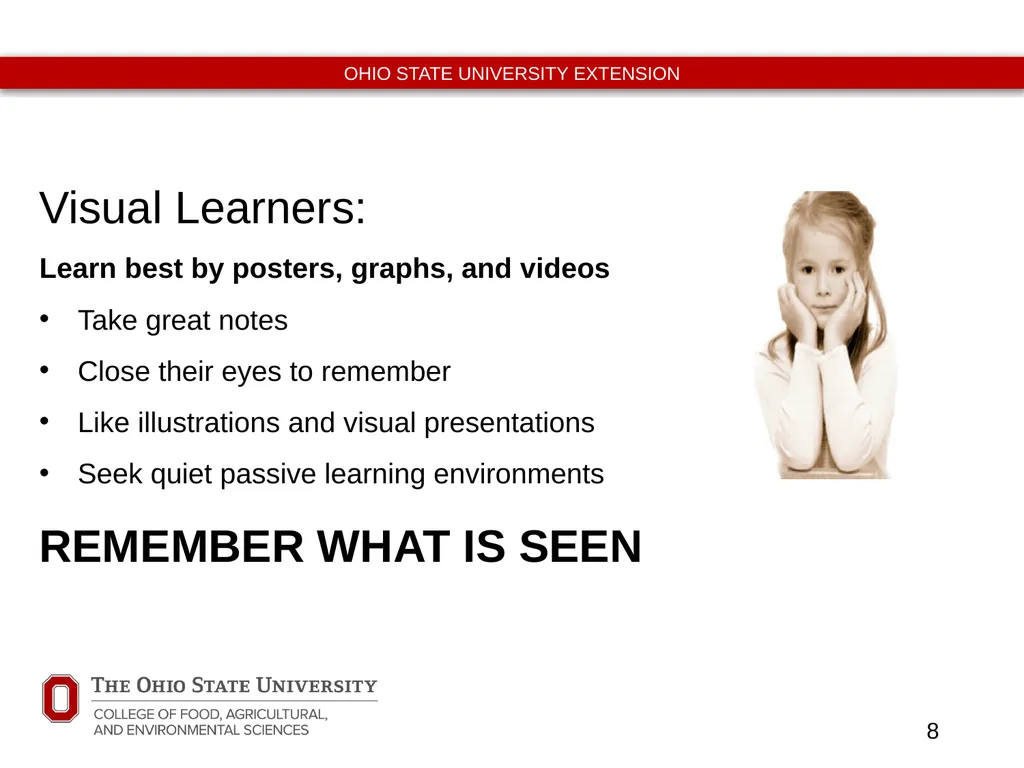
Visual Learners:
Learn best by posters, graphs, and videos
Take great notes
Close their eyes to remember
Like illustrations and visual presentations
Seek quiet passive learning environments
REMEMBER WHAT IS SEEN<br>
Learn best by posters, graphs, and videos
Take great notes
Close their eyes to remember
Like illustrations and visual presentations
Seek quiet passive learning environments
REMEMBER WHAT IS SEEN<br>
09
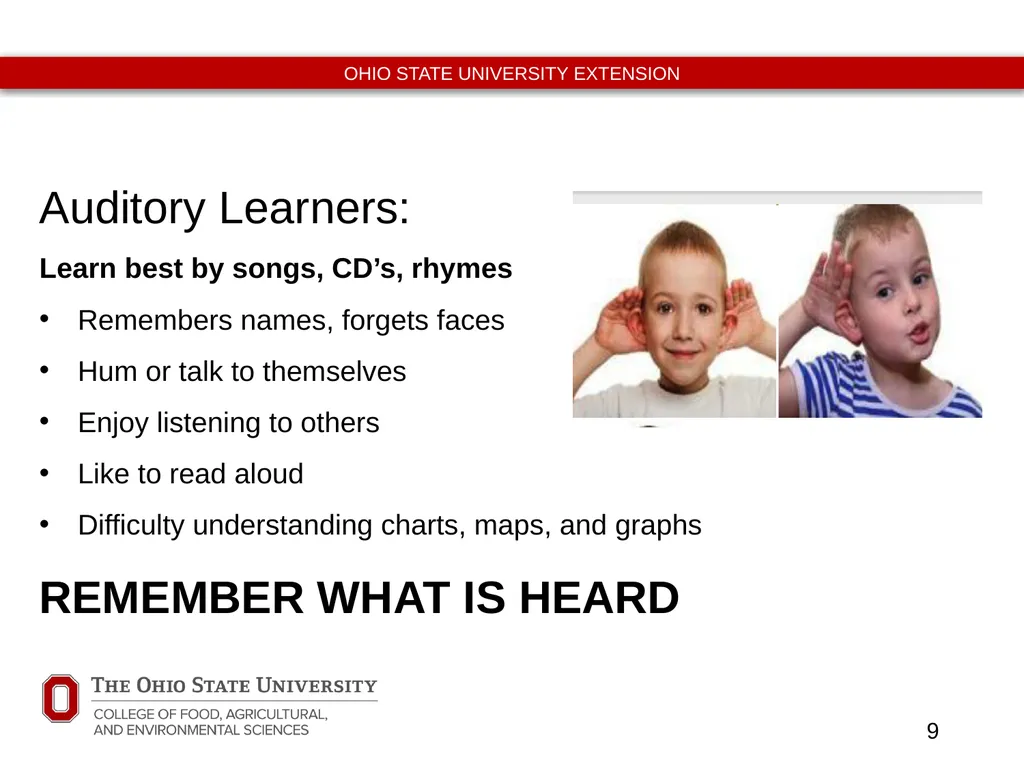
Auditory Learners:
Learn best by songs, CD’s, rhymes
Remembers names, forgets faces
Hum or talk to themselves
Enjoy listening to others
Like to read aloud
Difficulty understanding charts, maps, and graphs
REMEMBER WHAT IS HEARD<br>
Learn best by songs, CD’s, rhymes
Remembers names, forgets faces
Hum or talk to themselves
Enjoy listening to others
Like to read aloud
Difficulty understanding charts, maps, and graphs
REMEMBER WHAT IS HEARD<br>
10
Kinesthetic Learners:
Learn Best by hands on instruction, role playing, building things
Need to move around, be active
Speak with their hands and gestures
Seek out ways to move around
Enjoy playing with materials
Tinker when bored
REMEMBER WHAT THEY DID<br>
Learn Best by hands on instruction, role playing, building things
Need to move around, be active
Speak with their hands and gestures
Seek out ways to move around
Enjoy playing with materials
Tinker when bored
REMEMBER WHAT THEY DID<br>
11
10 CLASSROOM MANAGEMENT TIPS<br>
12
Meet and Greet
Engagement begins the moment students cross the classroom threshold
Engage them immediately
Get Everyone’s attention
Smooth and efficient transitions<br>
Engagement begins the moment students cross the classroom threshold
Engage them immediately
Get Everyone’s attention
Smooth and efficient transitions<br>
13
Set logical rules and consequences
Never promise anything you can not deliver
Never promise a consequence you can not enforce
Kids have fantastic memories
Reinforcements: praise, extra time playing games, available stickers, “Helper For the Day”, Student of the Week, Note Home to Parents
Consequences: Loss of privilege, Time Out,<br>
Never promise anything you can not deliver
Never promise a consequence you can not enforce
Kids have fantastic memories
Reinforcements: praise, extra time playing games, available stickers, “Helper For the Day”, Student of the Week, Note Home to Parents
Consequences: Loss of privilege, Time Out,<br>
14
Establish Rules Immediately and Enforce Consistently:
Have kids write their own rules
Review rules/consequences before every class
Be consistent
Catch the “being good”
At the end of class reinforce a few things they did really well
Be friendly but do not be their friend<br>
Have kids write their own rules
Review rules/consequences before every class
Be consistent
Catch the “being good”
At the end of class reinforce a few things they did really well
Be friendly but do not be their friend<br>
15
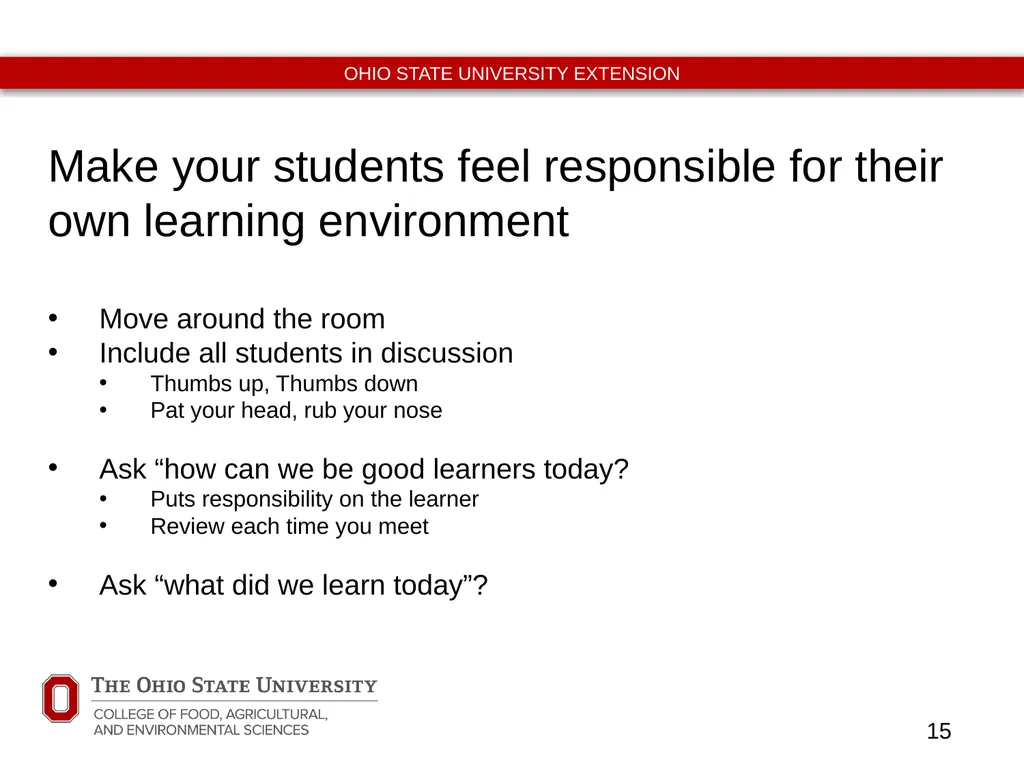
Make your students feel responsible for their own learning environment
Move around the room
Include all students in discussion
Thumbs up, Thumbs down
Pat your head, rub your nose
Ask “how can we be good learners today?
Puts responsibility on the learner
Review each time you meet
Ask “what did we learn today”?<br>
Move around the room
Include all students in discussion
Thumbs up, Thumbs down
Pat your head, rub your nose
Ask “how can we be good learners today?
Puts responsibility on the learner
Review each time you meet
Ask “what did we learn today”?<br>
16
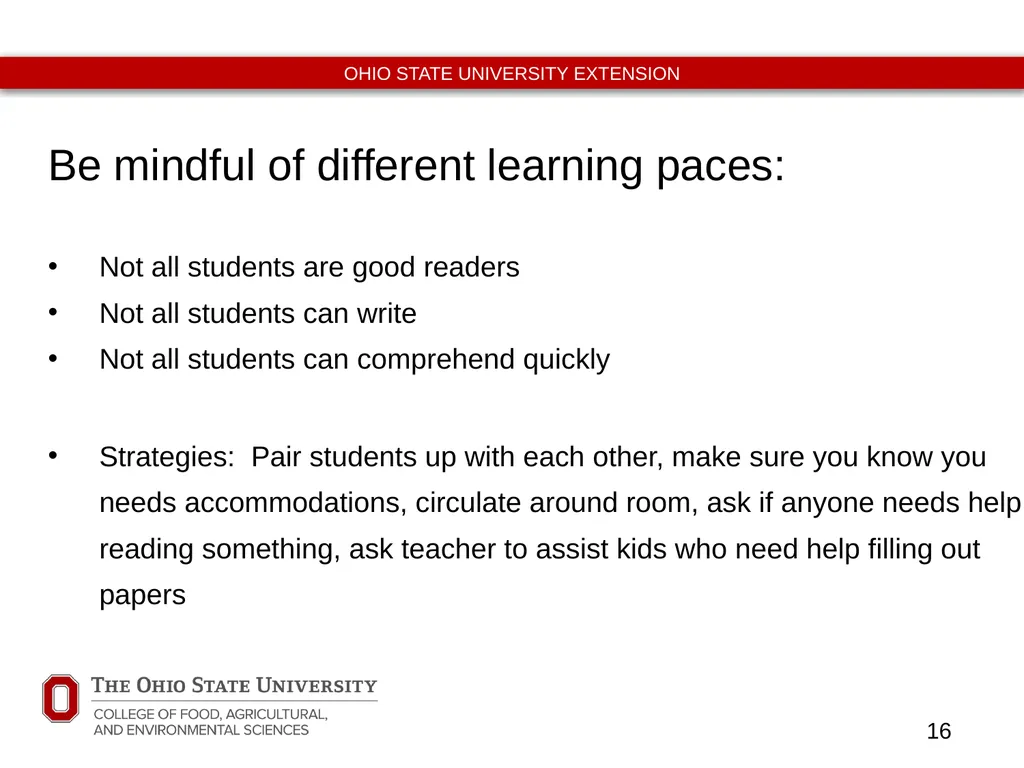
Be mindful of different learning paces:
Not all students are good readers
Not all students can write
Not all students can comprehend quickly
Strategies: Pair students up with each other, make sure you know you needs accommodations, circulate around room, ask if anyone needs help reading something, ask teacher to assist kids who need help filling out papers<br>
Not all students are good readers
Not all students can write
Not all students can comprehend quickly
Strategies: Pair students up with each other, make sure you know you needs accommodations, circulate around room, ask if anyone needs help reading something, ask teacher to assist kids who need help filling out papers<br>
17
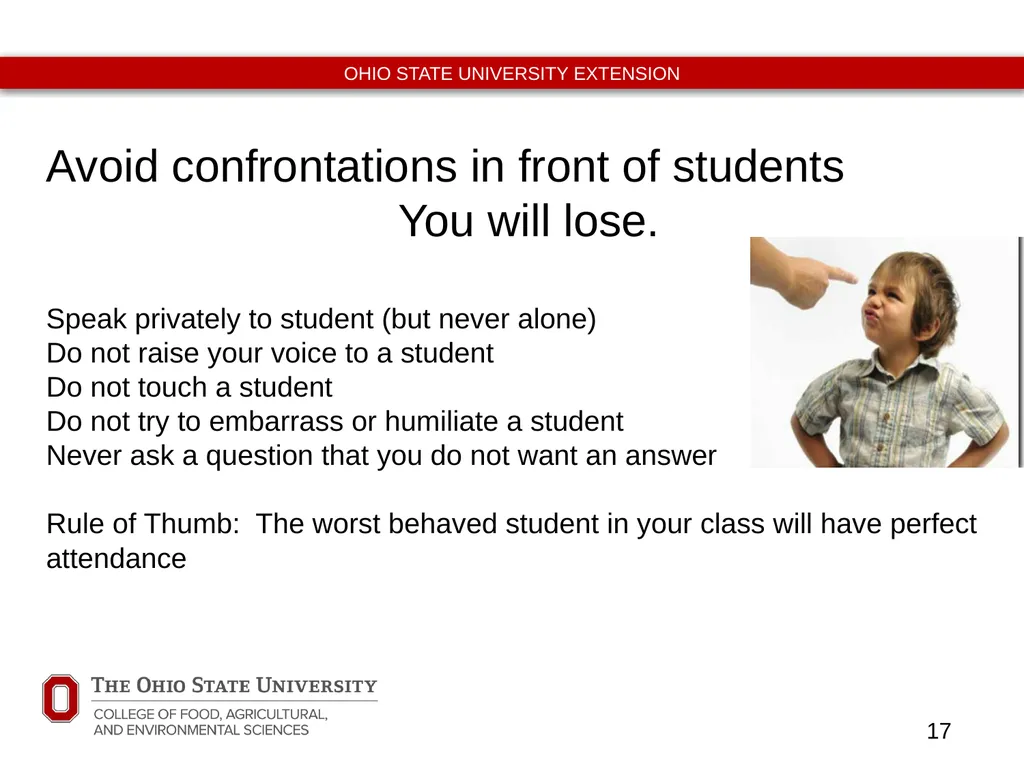
Avoid confrontations in front of students
You will lose.
Speak privately to student (but never alone)
Do not raise your voice to a student
Do not touch a student
Do not try to embarrass or humiliate a student
Never ask a question that you do not want an answer
Rule of Thumb: The worst behaved student in your class will have perfect attendance<br>
You will lose.
Speak privately to student (but never alone)
Do not raise your voice to a student
Do not touch a student
Do not try to embarrass or humiliate a student
Never ask a question that you do not want an answer
Rule of Thumb: The worst behaved student in your class will have perfect attendance<br>
18
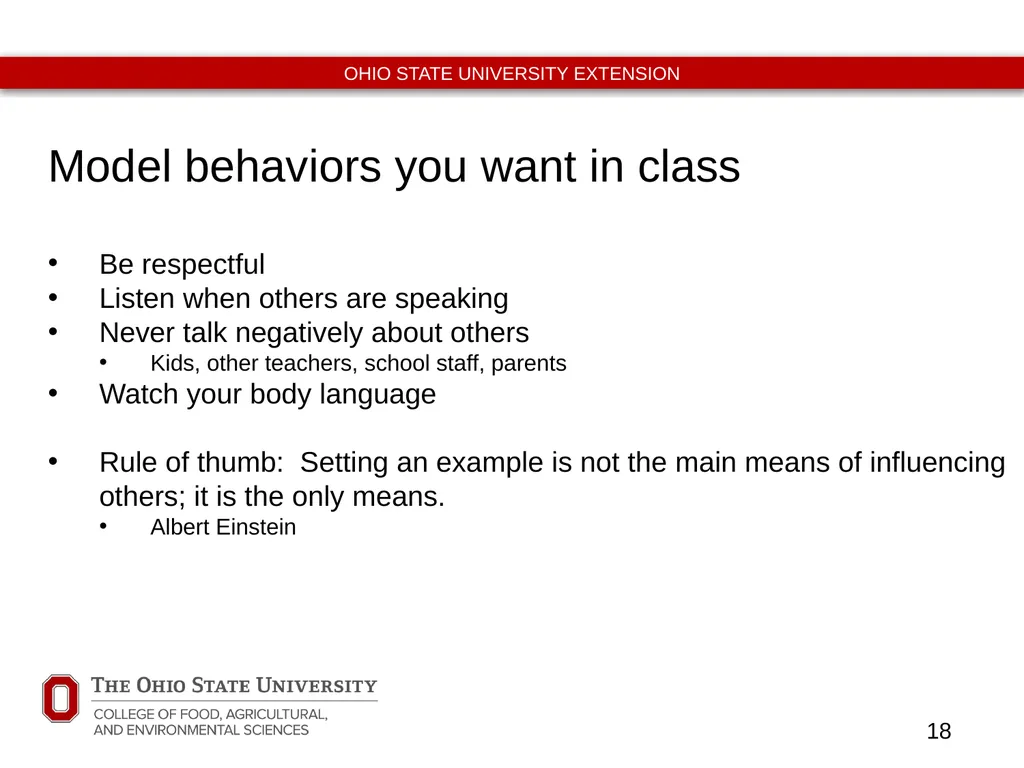
Model behaviors you want in class
Be respectful
Listen when others are speaking
Never talk negatively about others
Kids, other teachers, school staff, parents
Watch your body language
Rule of thumb: Setting an example is not the main means of influencing others; it is the only means.
Albert Einstein<br>
Be respectful
Listen when others are speaking
Never talk negatively about others
Kids, other teachers, school staff, parents
Watch your body language
Rule of thumb: Setting an example is not the main means of influencing others; it is the only means.
Albert Einstein<br>
19
Use proximity and directness to your advantage
Stand by a student
Ask a direct question (use name)
Teach from all points in the room, not just the front of the room
Say what you mean
Mean what you say
Then stop<br>
Stand by a student
Ask a direct question (use name)
Teach from all points in the room, not just the front of the room
Say what you mean
Mean what you say
Then stop<br>
20
Be organized
Have materials ready
Be on time
Look professional
Rule of thumb: Students will take advantage of any perceived weakness. This can be brutal and unrelenting in the best circumstances.<br>
Have materials ready
Be on time
Look professional
Rule of thumb: Students will take advantage of any perceived weakness. This can be brutal and unrelenting in the best circumstances.<br>
21
Hold High Expectations for Students<br>
22
Contributing Factors to Disengagement<br>
23
Environmental Factors
Poverty
Neighborhood violence
Family Discord
(Garcia-Reid et al., 2005; Warner, Weisst, &Krulak, 1999)<br>
Poverty
Neighborhood violence
Family Discord
(Garcia-Reid et al., 2005; Warner, Weisst, &Krulak, 1999)<br>
24
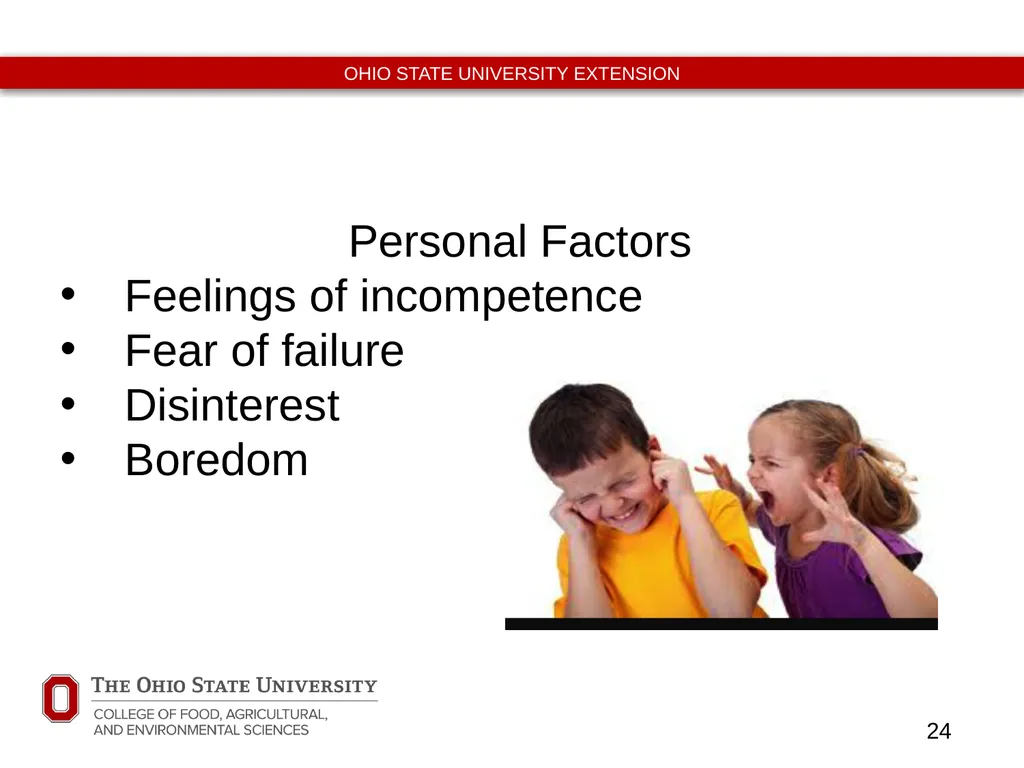
Personal Factors
Feelings of incompetence
Fear of failure
Disinterest
Boredom<br>
Feelings of incompetence
Fear of failure
Disinterest
Boredom<br>
25
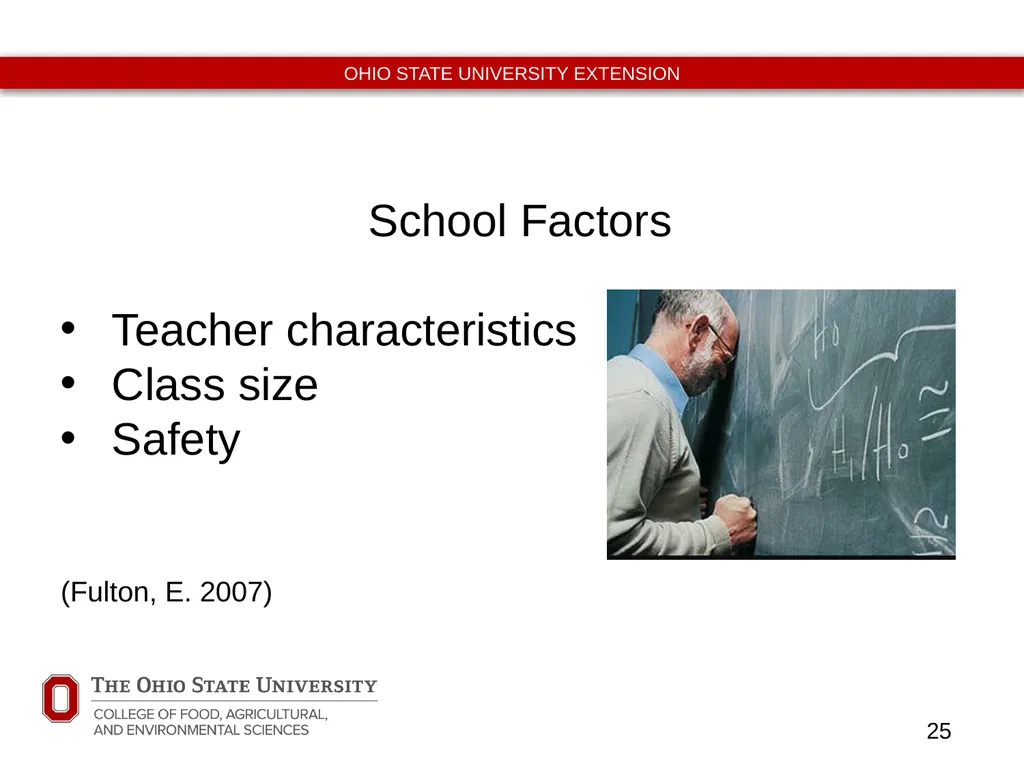
School Factors
Teacher characteristics
Class size
Safety
(Fulton, E. 2007)<br>
Teacher characteristics
Class size
Safety
(Fulton, E. 2007)<br>
26
How to get and keep kid’s attention<br>
27
Check with the counselor/teacher to see if there are any established routines that have been successful<br>
28
Start class with a joke:
How do you make an artichoke?
Strangle it
Why are bananas never lonely?
They come in bunches
Or a fact:
Green hot chili peppers have five times more Vitamin C than oranges
The minerals in our bodies that we need to stay healthy can be found on the moon and even on Mars.<br>
How do you make an artichoke?
Strangle it
Why are bananas never lonely?
They come in bunches
Or a fact:
Green hot chili peppers have five times more Vitamin C than oranges
The minerals in our bodies that we need to stay healthy can be found on the moon and even on Mars.<br>
29
Review:
Name three things we learned last week?
What is something that you changed this week that you learned in our last lesson?<br>
Name three things we learned last week?
What is something that you changed this week that you learned in our last lesson?<br>
30
Use a timer.
If you give kids an activity to do, set the timer. Or play a game to see how many seconds it will take them to be quiet. Keep a record of this and have encourage them to compete with themselves.<br>
If you give kids an activity to do, set the timer. Or play a game to see how many seconds it will take them to be quiet. Keep a record of this and have encourage them to compete with themselves.<br>
31
Assign time keeping duties to a student. Let them ring a bell etc. to get the attention of the rest of the class.<br>
32
Echo clapping
Call and Response:
Teacher: Ready to Rock? Class: Ready to Roll
Teacher: Pork chops Class: Applesauce
Teacher: Oh my goodness! Class: Sassafras and ginger beer
Oh my dear!<br>
Call and Response:
Teacher: Ready to Rock? Class: Ready to Roll
Teacher: Pork chops Class: Applesauce
Teacher: Oh my goodness! Class: Sassafras and ginger beer
Oh my dear!<br>
33
Knock, Knock Jokes
Teacher: Knock, Knock
Class: Who’s there?
Teacher: Bean
Class: Bean Who?
Teacher: Bean awhile since I’ve seen you!
Teacher: Knock, Knock
Class: Who’s there?
Teacher: Lettuce
Class: Lettuce who?
Teacher: Lettuce in, and you’ll find out<br>
Teacher: Knock, Knock
Class: Who’s there?
Teacher: Bean
Class: Bean Who?
Teacher: Bean awhile since I’ve seen you!
Teacher: Knock, Knock
Class: Who’s there?
Teacher: Lettuce
Class: Lettuce who?
Teacher: Lettuce in, and you’ll find out<br>
34
Use classroom lights to signal quiet
Give Me 5
Put hand in air and count down, 5,4,3,2,1
I need all eyes on me
wait until everyone is looking at you
Simon Says<br>
Give Me 5
Put hand in air and count down, 5,4,3,2,1
I need all eyes on me
wait until everyone is looking at you
Simon Says<br>
35
Use music to signal quiet
Mirror movements-
Put your hands on your head, on nose, etc.
Speak softly, whisper
Rule of Thumb: Don’t yell at kids. Lean in close and whisper. It’s much scarier.
Stand next to a disruptive student<br>
Mirror movements-
Put your hands on your head, on nose, etc.
Speak softly, whisper
Rule of Thumb: Don’t yell at kids. Lean in close and whisper. It’s much scarier.
Stand next to a disruptive student<br>
36
Hold up signs: (color coded)
Level 1: No Talking
Level 2: Whisper
Level 3: Normal Talking
Level 4: Recess Voice<br>
Level 1: No Talking
Level 2: Whisper
Level 3: Normal Talking
Level 4: Recess Voice<br>
37
Sing a song:
Shhh, Shhh
(If you’re happy and you know it)
Put your finger on your lips, shhh shhh
Put your finger on your lips, shhh shhh
Put your finger on your lips, and don’t let it slip
Put your finger on your lips, shhh shhh<br>
Shhh, Shhh
(If you’re happy and you know it)
Put your finger on your lips, shhh shhh
Put your finger on your lips, shhh shhh
Put your finger on your lips, and don’t let it slip
Put your finger on your lips, shhh shhh<br>
38
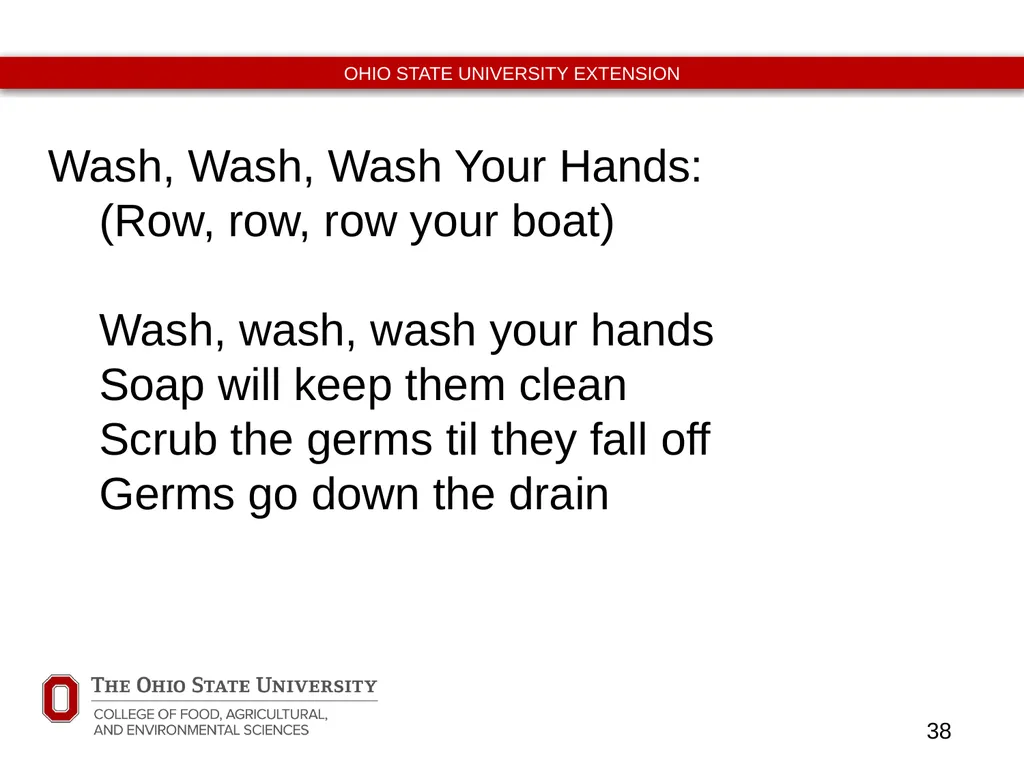
Wash, Wash, Wash Your Hands:
(Row, row, row your boat)
Wash, wash, wash your hands
Soap will keep them clean
Scrub the germs til they fall off
Germs go down the drain<br>
(Row, row, row your boat)
Wash, wash, wash your hands
Soap will keep them clean
Scrub the germs til they fall off
Germs go down the drain<br>
39
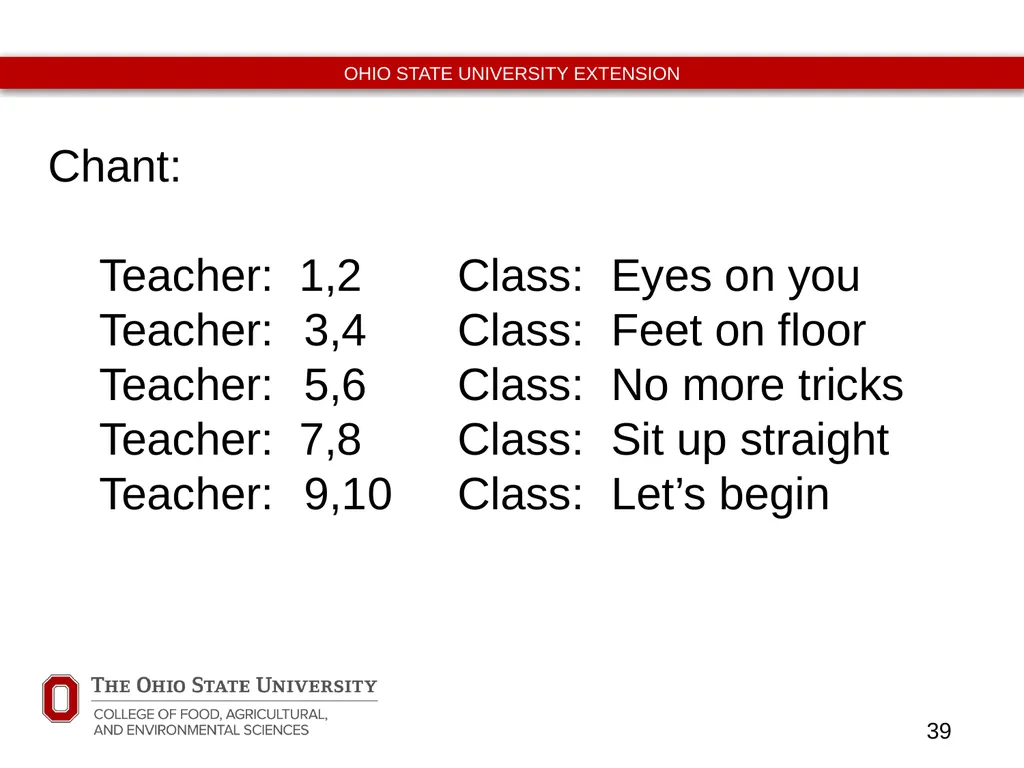
Chant:
Teacher: 1,2 Class: Eyes on you
Teacher: 3,4 Class: Feet on floor
Teacher: 5,6 Class: No more tricks
Teacher: 7,8 Class: Sit up straight
Teacher: 9,10 Class: Let’s begin<br>
Teacher: 1,2 Class: Eyes on you
Teacher: 3,4 Class: Feet on floor
Teacher: 5,6 Class: No more tricks
Teacher: 7,8 Class: Sit up straight
Teacher: 9,10 Class: Let’s begin<br>
40
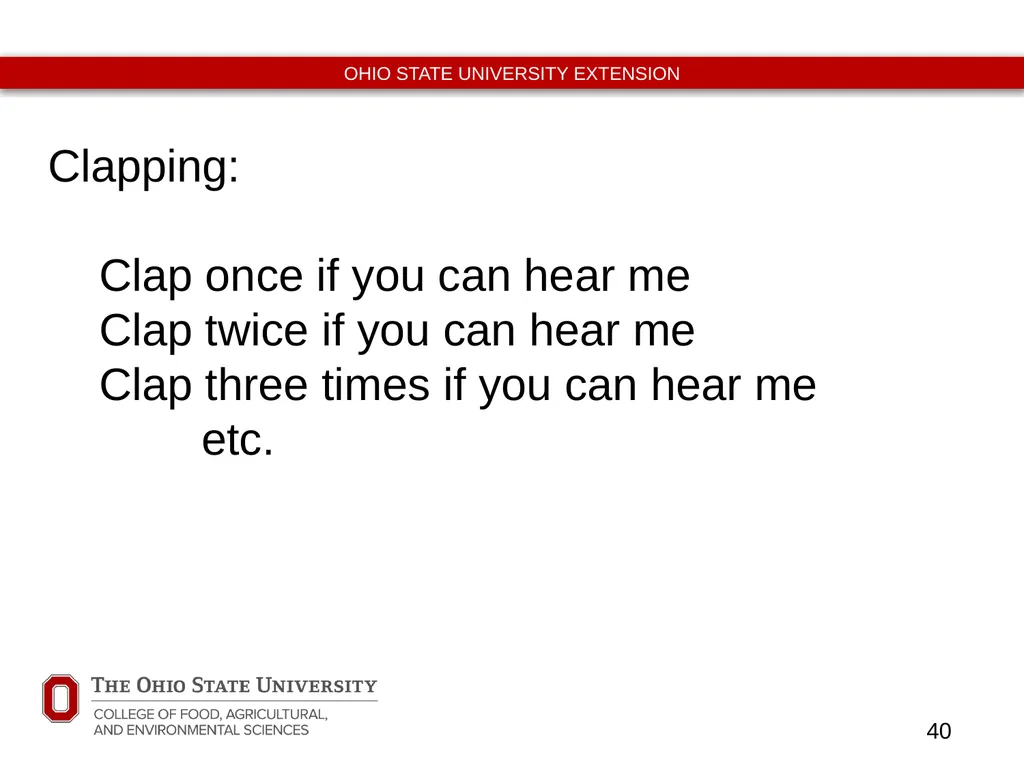
Clapping:
Clap once if you can hear me
Clap twice if you can hear me
Clap three times if you can hear me
etc.<br>
Clap once if you can hear me
Clap twice if you can hear me
Clap three times if you can hear me
etc.<br>
41
Stop talking, and simply wait<br>
42
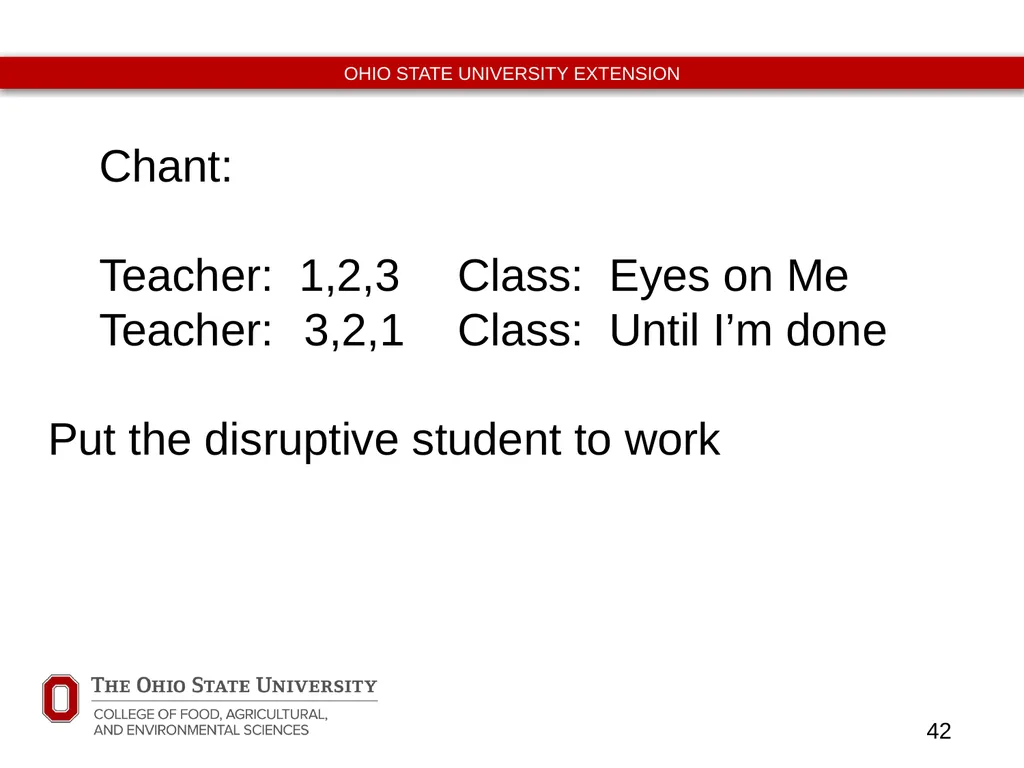
Chant:
Teacher: 1,2,3 Class: Eyes on Me
Teacher: 3,2,1 Class: Until I’m done
Put the disruptive student to work<br>
Teacher: 1,2,3 Class: Eyes on Me
Teacher: 3,2,1 Class: Until I’m done
Put the disruptive student to work<br>
43
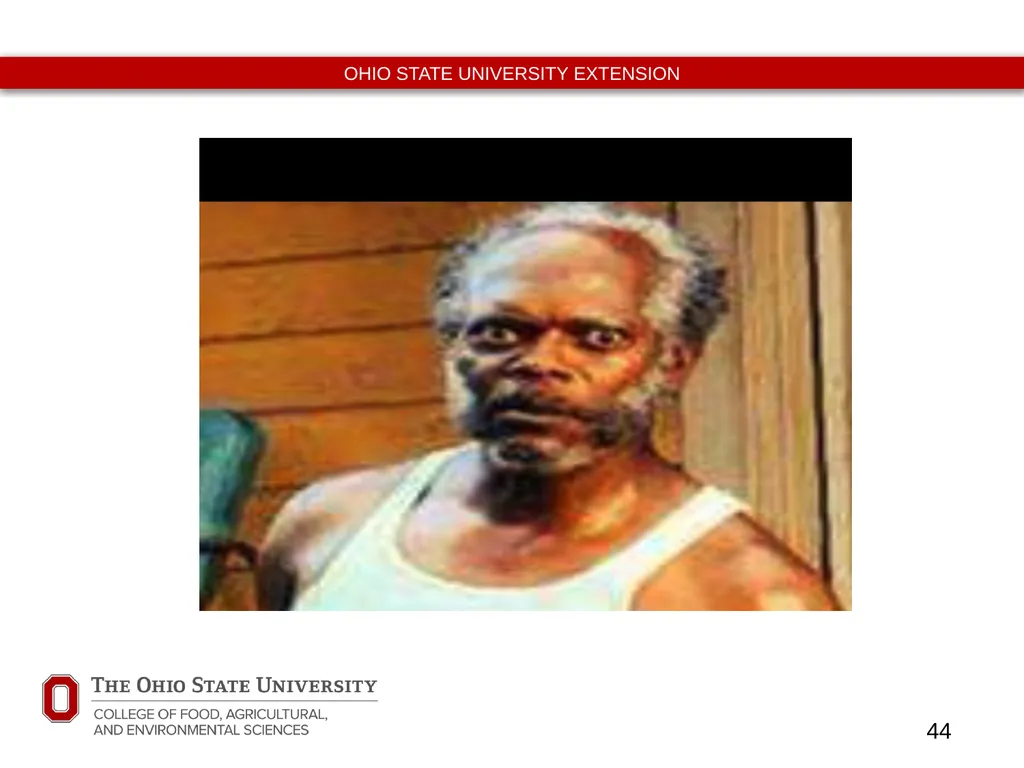
The Look<br>
44
Wrapping up the lesson<br>
45
Give information about what is going to happen next week
Describe the follow up activities
Explain your final goal<br>
Describe the follow up activities
Explain your final goal<br>
46
Scenarios<br>
47
Scenario 1:
Tommy is a likable student with lots of friends in the classroom. But he calls out answers in class without first raising his hand and waiting to be recognized. Tommy also tends to be out of his seat frequently, and disrupts the class by wandering around the room.
Any Ideas?<br>
Tommy is a likable student with lots of friends in the classroom. But he calls out answers in class without first raising his hand and waiting to be recognized. Tommy also tends to be out of his seat frequently, and disrupts the class by wandering around the room.
Any Ideas?<br>
48
Scenario 2:
Ebony does not pay attention to your lesson. She lays her head on the desk, sucks her thumb, and does not participate in any activities. When you ask her to join the class she becomes angry and unresponsive.
Any Ideas?<br>
Ebony does not pay attention to your lesson. She lays her head on the desk, sucks her thumb, and does not participate in any activities. When you ask her to join the class she becomes angry and unresponsive.
Any Ideas?<br>
49
Scenario 3:
Lucy often enters your class looking upset and angry. As you teach your lesson, she often mutters under her breath, gives you inappropriate hand gestures, and tries to trip you when you least suspect it.
Any Ideas?<br>
Lucy often enters your class looking upset and angry. As you teach your lesson, she often mutters under her breath, gives you inappropriate hand gestures, and tries to trip you when you least suspect it.
Any Ideas?<br>
50
Scenario 4:
Mrs. Lucas, the classroom teacher tries to sabotage the message of your lesson. She often sits in the corner drinking Mountain Dew eating potato chips, and making dinner reservations on her cell phone when you are trying to teach.
Any ideas?<br>
Mrs. Lucas, the classroom teacher tries to sabotage the message of your lesson. She often sits in the corner drinking Mountain Dew eating potato chips, and making dinner reservations on her cell phone when you are trying to teach.
Any ideas?<br>
51
Scenario 5:
Charlie is an inclusion student who has to leave your room frequently for tutoring. He has missed several classes but is still supposed to do the survey. He struggles while doing it and looks very frustrated.
Any ideas?<br>
Charlie is an inclusion student who has to leave your room frequently for tutoring. He has missed several classes but is still supposed to do the survey. He struggles while doing it and looks very frustrated.
Any ideas?<br>
52
Take Away:
I’ve come to the frightening conclusion that I am the decisive element in the classroom. It is my daily mood that makes the weather. As a teacher, I possess a tremendous power to make a child’s life miserable or joyous. I can be a tool of torture or an instrument of inspiration. I can humiliate or humor, hurt or heal. In all situations, it is my response that decides whether a crisis will be escalated or de-escalated and a child humanized or de-humanized
Dr. Haim Ginott<br>
I’ve come to the frightening conclusion that I am the decisive element in the classroom. It is my daily mood that makes the weather. As a teacher, I possess a tremendous power to make a child’s life miserable or joyous. I can be a tool of torture or an instrument of inspiration. I can humiliate or humor, hurt or heal. In all situations, it is my response that decides whether a crisis will be escalated or de-escalated and a child humanized or de-humanized
Dr. Haim Ginott<br>