
NEW DEAL DBQ Historical Thinking Skills:
LO
Published · 101 slides · 0 views

1 / 1











Description
NEW DEAL DBQ Historical Thinking Skills: Comparison How effective were these responses? Continuity and Change Over Time How did they change the role of the federal government? Open the New Deal DBQ Apply the following to each document:
Related Topics
Share
Embed code
Download this presentation From Below
"NEW DEAL DBQ Historical Thinking Skills:" is the property of its rightful owner. Permission is granted to download and print the materials on this website for personal, non-commercial use only, and to display it on your personal computer provided you do not modify the materials and that you retain all copyright notices contained in the materials. By downloading content from our website, you accept the terms of this agreement.
Presentation Transcript
01
NEW DEAL DBQ<br>
02
Historical Thinking Skills:
Comparison
How effective were these responses?
Continuity and Change Over Time How did they change the role of the federal government?
Open the New Deal DBQ
Apply the following to each document:
Main Idea (bullet point the message)
HAPP (apply one)
Historical Thinking Skill: Effectiveness? Role of Government Change?
Outside information (use your key terms)
Thesis Statement (Do this at the very end; after you analyzed each)
Outline 2003 New Deal DBQ<br>
Comparison
How effective were these responses?
Continuity and Change Over Time How did they change the role of the federal government?
Open the New Deal DBQ
Apply the following to each document:
Main Idea (bullet point the message)
HAPP (apply one)
Historical Thinking Skill: Effectiveness? Role of Government Change?
Outside information (use your key terms)
Thesis Statement (Do this at the very end; after you analyzed each)
Outline 2003 New Deal DBQ<br>
03
Main Idea Doc A
Meridel Lesueur, New Masses, Jan. 1932<br>
04
MAIN IDEA
Many women were unemployed
Women didn’t seek assistance as often as men.
Women suffered during the Great Depression too.
Focus is on unemployment in the city. Doc A Meridel Lesueur, New Masses, Jan. 1932<br>
Many women were unemployed
Women didn’t seek assistance as often as men.
Women suffered during the Great Depression too.
Focus is on unemployment in the city. Doc A Meridel Lesueur, New Masses, Jan. 1932<br>
05
Source:
A Communist magazine that originated in NYC.
Citation: In 1932, the magazine, New Masses published an article that focused on women’s hardships with unemployment. Women were also experiencing unemployment like men, but they were not able to take advantage of the same services, like homeless shelters, due to gender norms (Doc. A). Doc A Meridel Lesueur, New Masses, Jan. 1932<br>
Citation: In 1932, the magazine, New Masses published an article that focused on women’s hardships with unemployment. Women were also experiencing unemployment like men, but they were not able to take advantage of the same services, like homeless shelters, due to gender norms (Doc. A). Doc A Meridel Lesueur, New Masses, Jan. 1932<br>
06
HAPP Doc A
Meridel Lesueur, New Masses, Jan. 1932<br>
07
HAPP
Historical Context:
Women’s care was traditionally assumed by a male.
Due to the expected role for women, places like homeless shelters were unacceptable.
Women had limited work options and the Great Depression reduced those options more.
Males were expected to care for wives and females in their family. Doc A Meridel Lesueur, New Masses, Jan. 1932<br>
Historical Context:
Women’s care was traditionally assumed by a male.
Due to the expected role for women, places like homeless shelters were unacceptable.
Women had limited work options and the Great Depression reduced those options more.
Males were expected to care for wives and females in their family. Doc A Meridel Lesueur, New Masses, Jan. 1932<br>
08
Historical Thinking Skills:
Comparison
How effective were these responses?
Continuity and Change Over Time How did they change the role of the federal government? Doc A Meridel Lesueur, New Masses, Jan. 1932<br>
Comparison
How effective were these responses?
Continuity and Change Over Time How did they change the role of the federal government? Doc A Meridel Lesueur, New Masses, Jan. 1932<br>
09
The New Deal was not effective in relieving economic hardships for women. Doc A – (ineffective for women)
Meridel Lesueur, New Masses, Jan. 1932<br>
10
OUTSIDE INFORMATION Doc A – (ineffective for women)
Meridel Lesueur, New Masses, Jan. 1932<br>
11
Economy Act: (1933-repealed 1937)
prohibit both members of a married couple to hold federal jobs; women dismissed from employment to make room for men
Excluded women from benefits such as Social Security
States bar hiring of women whose husbands make a “living wage”
Banks and Public Schools systems bar employment of married women
United Auto Workers: bar women whose husbands provide support
Married Women barred from workforce on a massive scale Doc A – (ineffective for women) Meridel Lesueur, New Masses, Jan. 1932<br>
Excluded women from benefits such as Social Security
States bar hiring of women whose husbands make a “living wage”
Banks and Public Schools systems bar employment of married women
United Auto Workers: bar women whose husbands provide support
Married Women barred from workforce on a massive scale Doc A – (ineffective for women) Meridel Lesueur, New Masses, Jan. 1932<br>
12
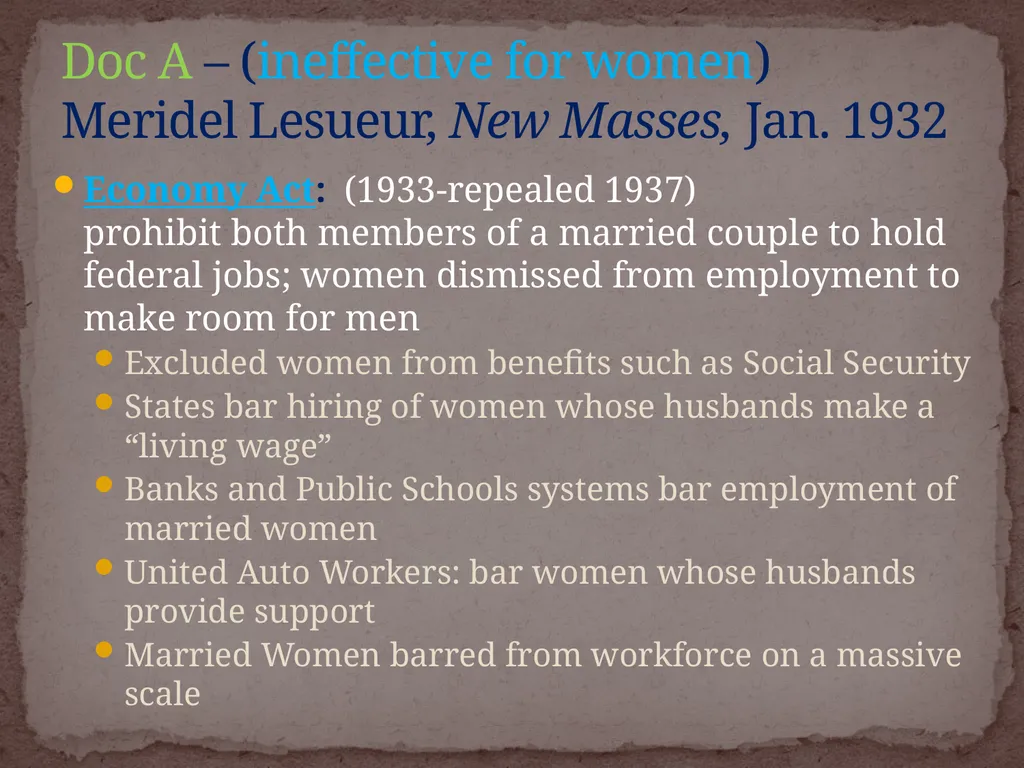
Eleanor Roosevelt:
Biography – 1st Lady worked to bring awareness to civil rights, human rights, and women’s rights Video (1:29) https://www.youtube.com/watch?v=kCmMuV-euJg
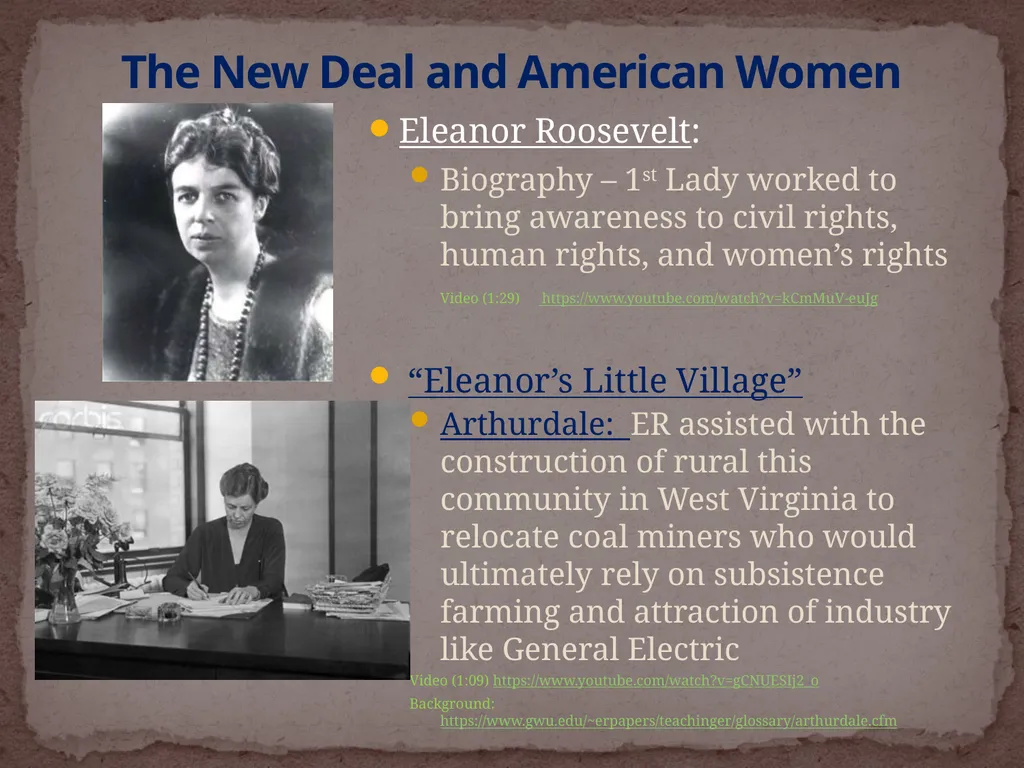
“Eleanor’s Little Village”
Arthurdale: ER assisted with the construction of rural this community in West Virginia to relocate coal miners who would ultimately rely on subsistence farming and attraction of industry like General Electric
Video (1:09) https://www.youtube.com/watch?v=gCNUESIj2_o
Background: https://www.gwu.edu/~erpapers/teachinger/glossary/arthurdale.cfm The New Deal and American Women<br>
Biography – 1st Lady worked to bring awareness to civil rights, human rights, and women’s rights Video (1:29) https://www.youtube.com/watch?v=kCmMuV-euJg
“Eleanor’s Little Village”
Arthurdale: ER assisted with the construction of rural this community in West Virginia to relocate coal miners who would ultimately rely on subsistence farming and attraction of industry like General Electric
Video (1:09) https://www.youtube.com/watch?v=gCNUESIj2_o
Background: https://www.gwu.edu/~erpapers/teachinger/glossary/arthurdale.cfm The New Deal and American Women<br>
13
Discrimination: brought attention to rampant issues of racial injustice (segregation, disenfranchisement, lynching), brought awareness to lower wages being paid to black workers in southern relief programs like the WPA and FDR’s executive orders to end this practice
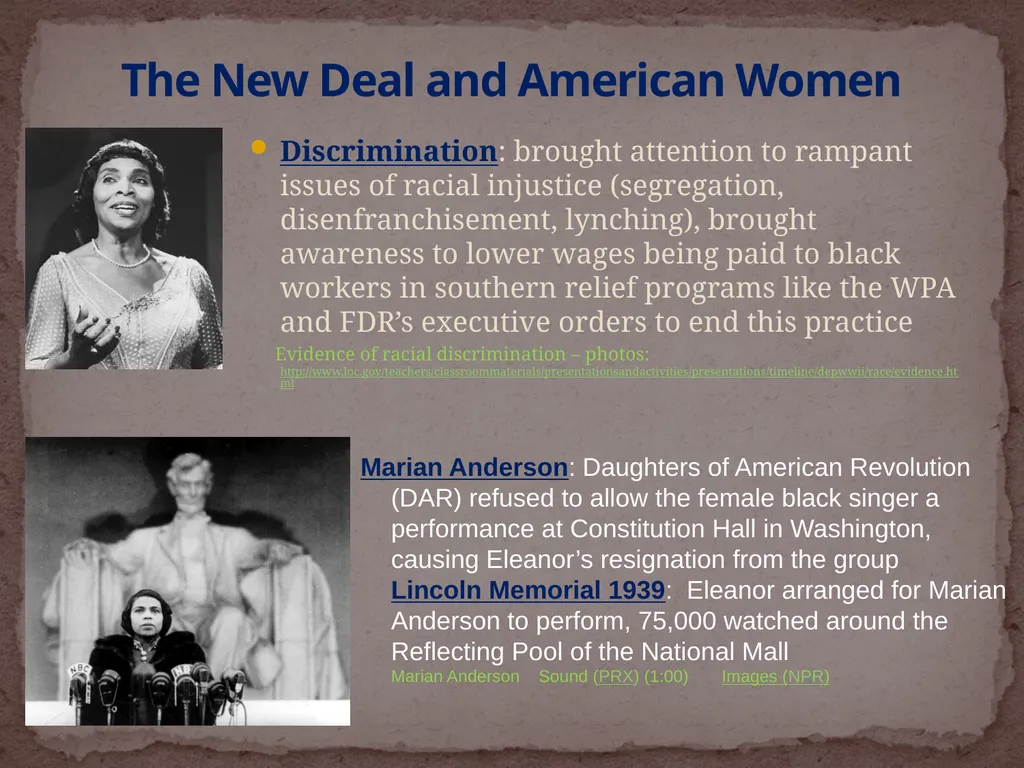
Evidence of racial discrimination – photos: http://www.loc.gov/teachers/classroommaterials/presentationsandactivities/presentations/timeline/depwwii/race/evidence.html The New Deal and American Women Marian Anderson: Daughters of American Revolution (DAR) refused to allow the female black singer a performance at Constitution Hall in Washington, causing Eleanor’s resignation from the group
Lincoln Memorial 1939: Eleanor arranged for Marian Anderson to perform, 75,000 watched around the Reflecting Pool of the National Mall
Marian Anderson Sound (PRX) (1:00) Images (NPR)<br>
Evidence of racial discrimination – photos: http://www.loc.gov/teachers/classroommaterials/presentationsandactivities/presentations/timeline/depwwii/race/evidence.html The New Deal and American Women Marian Anderson: Daughters of American Revolution (DAR) refused to allow the female black singer a performance at Constitution Hall in Washington, causing Eleanor’s resignation from the group
Lincoln Memorial 1939: Eleanor arranged for Marian Anderson to perform, 75,000 watched around the Reflecting Pool of the National Mall
Marian Anderson Sound (PRX) (1:00) Images (NPR)<br>
14
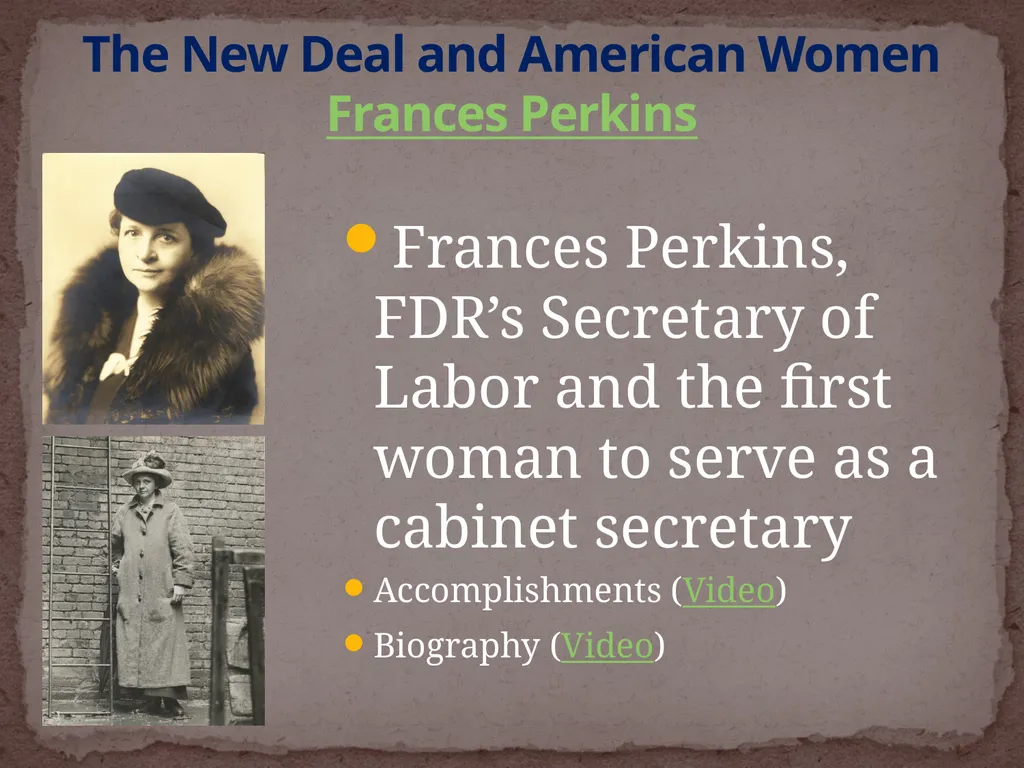
Frances Perkins, FDR’s Secretary of Labor and the first woman to serve as a cabinet secretary
Accomplishments (Video)
Biography (Video) The New Deal and American Women Frances Perkins<br>
Accomplishments (Video)
Biography (Video) The New Deal and American Women Frances Perkins<br>
15
MAIN IDEA Doc B
Letter to Senator Robert Wagner<br>
16
New Deal policy is harmful.
Fear growth of government power.
Favor less government involvement in the economy.
Socialism and Communism are promoted.
Policies discourage the growth of business. Doc B Letter to Senator Robert Wagner<br>
Fear growth of government power.
Favor less government involvement in the economy.
Socialism and Communism are promoted.
Policies discourage the growth of business. Doc B Letter to Senator Robert Wagner<br>
17
HAPP Doc B
Letter to Senator Robert Wagner<br>
18
Purpose:
Author wants to influence Senator Wagner .
Wants to convince the Senator that current policies are harmful to business. Doc B Letter to Senator Robert Wagner<br>
Author wants to influence Senator Wagner .
Wants to convince the Senator that current policies are harmful to business. Doc B Letter to Senator Robert Wagner<br>
19
Historical Thinking Skills:
Comparison
How effective were these responses?
Continuity and Change Over Time How did they change the role of the federal government? Doc B Letter to Senator Robert Wagner<br>
Comparison
How effective were these responses?
Continuity and Change Over Time How did they change the role of the federal government? Doc B Letter to Senator Robert Wagner<br>
20
Role of government is growing and changing in a negative way.
Too much government power and regulation will hurt business and the economy. Doc B – (critical of growing power of government) Letter to Senator Robert Wagner<br>
Too much government power and regulation will hurt business and the economy. Doc B – (critical of growing power of government) Letter to Senator Robert Wagner<br>
21
OUTSIDE INFORMATION Doc B
Letter to Senator Robert Wagner<br>
22
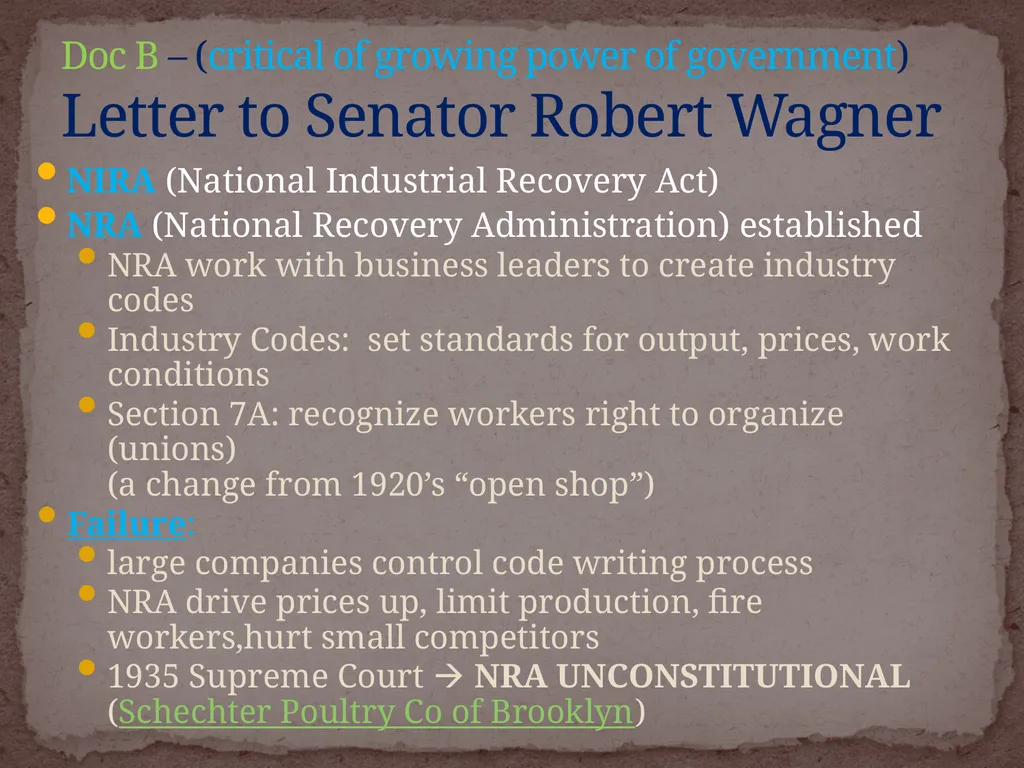
NIRA (National Industrial Recovery Act)
NRA (National Recovery Administration) established
NRA work with business leaders to create industry codes
Industry Codes: set standards for output, prices, work conditions
Section 7A: recognize workers right to organize (unions) (a change from 1920’s “open shop”)
Failure:
large companies control code writing process
NRA drive prices up, limit production, fire workers,hurt small competitors
1935 Supreme Court NRA UNCONSTITUTIONAL (Schechter Poultry Co of Brooklyn) Doc B – (critical of growing power of government) Letter to Senator Robert Wagner<br>
NRA (National Recovery Administration) established
NRA work with business leaders to create industry codes
Industry Codes: set standards for output, prices, work conditions
Section 7A: recognize workers right to organize (unions) (a change from 1920’s “open shop”)
Failure:
large companies control code writing process
NRA drive prices up, limit production, fire workers,hurt small competitors
1935 Supreme Court NRA UNCONSTITUTIONAL (Schechter Poultry Co of Brooklyn) Doc B – (critical of growing power of government) Letter to Senator Robert Wagner<br>
23
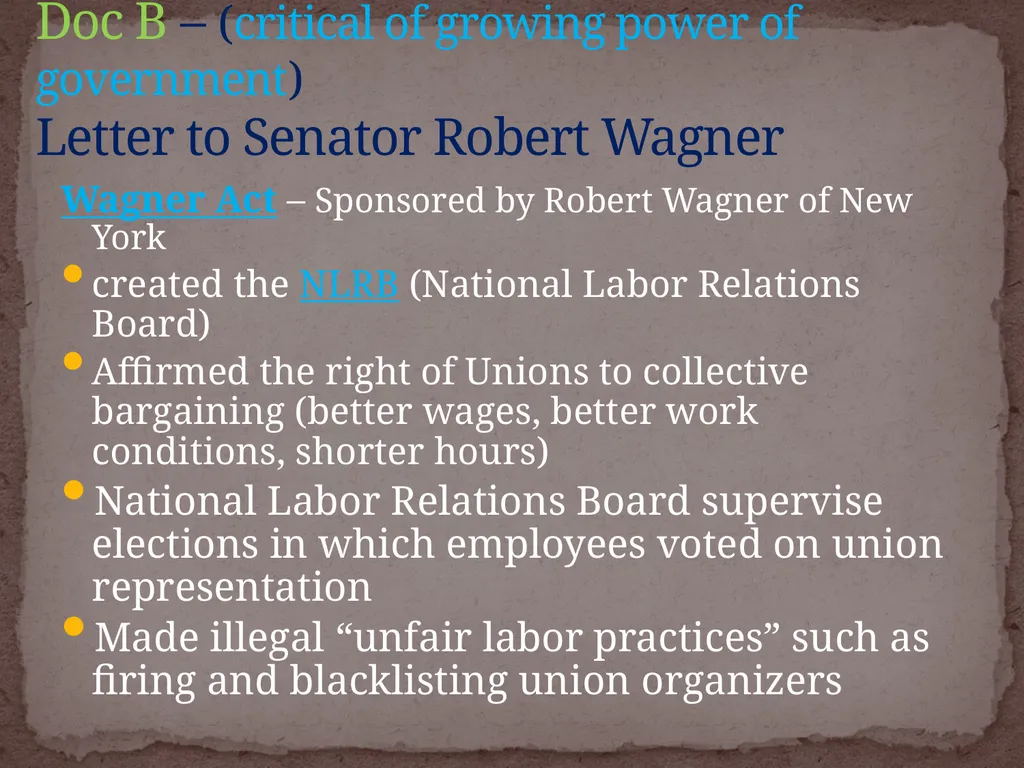
Wagner Act – Sponsored by Robert Wagner of New York
created the NLRB (National Labor Relations Board)
Affirmed the right of Unions to collective bargaining (better wages, better work conditions, shorter hours)
National Labor Relations Board supervise elections in which employees voted on union representation
Made illegal “unfair labor practices” such as firing and blacklisting union organizers Doc B – (critical of growing power of government) Letter to Senator Robert Wagner<br>
created the NLRB (National Labor Relations Board)
Affirmed the right of Unions to collective bargaining (better wages, better work conditions, shorter hours)
National Labor Relations Board supervise elections in which employees voted on union representation
Made illegal “unfair labor practices” such as firing and blacklisting union organizers Doc B – (critical of growing power of government) Letter to Senator Robert Wagner<br>
24
MAIN IDEA Doc C
Cartoon, The Evening Star (D.C.), April 26, 1934<br>
25
New Deal represents change, but not revolutionary change.
Reflects the natural progression of how the New Deal developed.
New Deal created many federal agencies.
Cartoonist supports New Deal. Doc C Cartoon, The Evening Star (D.C.), April 26, 1934<br>
Reflects the natural progression of how the New Deal developed.
New Deal created many federal agencies.
Cartoonist supports New Deal. Doc C Cartoon, The Evening Star (D.C.), April 26, 1934<br>
26
HAPP Doc C
Cartoon, The Evening Star (D.C.), April 26, 1934<br>
27
Purpose:
Convince critics of the New Deal that it isn’t a “revolution”
Not massive overhaul of Representative Democracy
New Deal is a gradual response to the economic crisis, not a the overthrow of our society. Doc C Cartoon, The Evening Star (D.C.), April 26, 1934<br>
Convince critics of the New Deal that it isn’t a “revolution”
Not massive overhaul of Representative Democracy
New Deal is a gradual response to the economic crisis, not a the overthrow of our society. Doc C Cartoon, The Evening Star (D.C.), April 26, 1934<br>
28
Historical Thinking Skills:
Comparison
How effective were these responses?
Continuity and Change Over Time How did they change the role of the federal government? Doc C Cartoon, The Evening Star (D.C.), April 26, 1934<br>
Comparison
How effective were these responses?
Continuity and Change Over Time How did they change the role of the federal government? Doc C Cartoon, The Evening Star (D.C.), April 26, 1934<br>
29
Role of government grows gradually by the progressive development of New Deal programs (alphabet agencies)
Federal agencies or the “alphabet agencies” have increase the power and function of the federal government in the economic welfare of citizens and business. Doc C - (Role of government has expanded.) Cartoon, The Evening Star (D.C.), April 26, 1934<br>
Federal agencies or the “alphabet agencies” have increase the power and function of the federal government in the economic welfare of citizens and business. Doc C - (Role of government has expanded.) Cartoon, The Evening Star (D.C.), April 26, 1934<br>
30
OUTSIDE INFORMATION Doc C
Cartoon, The Evening Star (D.C.), April 26, 1934<br>
31
“Brains Trust” – group of academics that included a number of Columbia University professors
Accepted that big business part of a modern economy
Regulation or Management of large business a role for government Doc C Cartoon, The Evening Star (D.C.), April 26, 1934<br>
Accepted that big business part of a modern economy
Regulation or Management of large business a role for government Doc C Cartoon, The Evening Star (D.C.), April 26, 1934<br>
32
MAIN IDEA Doc D –
William Lloyd Garrison Jr., “The Hand of Improvidence,” The Nation, Nov. 14, 1934<br>
33
New Deal a set of ideas and diverse programs.
Some programs are at odds with others.
National Debt increase
Federal Bureaucracy grow
Keynesian Economic theory used Doc D – William Lloyd Garrison Jr., “The Hand of Improvidence,” The Nation, Nov. 14, 1934<br>
Some programs are at odds with others.
National Debt increase
Federal Bureaucracy grow
Keynesian Economic theory used Doc D – William Lloyd Garrison Jr., “The Hand of Improvidence,” The Nation, Nov. 14, 1934<br>
34
HAPP Doc D –
William Lloyd Garrison Jr., “The Hand of Improvidence,” The Nation, Nov. 14, 1934<br>
35
Perspective
Author is critical of Keynesian economics = debt
Programs are impractical
Some programs fail an slow economy
Federal government expand too much Doc D – William Lloyd Garrison Jr., “The Hand of Improvidence,” The Nation, Nov. 14, 1934<br>
Author is critical of Keynesian economics = debt
Programs are impractical
Some programs fail an slow economy
Federal government expand too much Doc D – William Lloyd Garrison Jr., “The Hand of Improvidence,” The Nation, Nov. 14, 1934<br>
36
Historical Thinking Skills:
Comparison
How effective were these responses?
Continuity and Change Over Time How did they change the role of the federal government? Doc D – William Lloyd Garrison Jr., “The Hand of Improvidence,” The Nation, Nov. 14, 1934<br>
Comparison
How effective were these responses?
Continuity and Change Over Time How did they change the role of the federal government? Doc D – William Lloyd Garrison Jr., “The Hand of Improvidence,” The Nation, Nov. 14, 1934<br>
37
Mixed Effectiveness – some programs worked while others slowed economy
Federal government grew significantly. Doc D – mixed effectiveness / federal government expanded William Lloyd Garrison Jr., “The Hand of Improvidence,” The Nation, Nov. 14, 1934<br>
Federal government grew significantly. Doc D – mixed effectiveness / federal government expanded William Lloyd Garrison Jr., “The Hand of Improvidence,” The Nation, Nov. 14, 1934<br>
38
OUTSIDE INFORMATION Doc D –
William Lloyd Garrison Jr., “The Hand of Improvidence,” The Nation, Nov. 14, 1934<br>
39
Keynesian Economics – national debt increases
(increased government spending + lower taxes = increase consumer demand)
National Recovery Administration – did not provide economic recovery (industrial codes) and was found unconstitutional
Labor Unrest (UAW strike – sit-down)
CCC – employed young men through conservation projects, but segregated and excluded women
AAA – (Agriculture Adjustment Act) helped to increase farm prices and income, but tenant farmers were evicted and 6 million pigs slaughtered (quotas set) – unconstitutional (US v Butler)
PWA – Public Works Administration, built roads, schools, hospitals…
TVA – Tennessee Valley Authority, extended government into the market of selling electricity and competing with private companies (dams build along TN River to prevent flooding and power) Doc D – mixed effectiveness / federal government expanded William Lloyd Garrison Jr., “The Hand of Improvidence,” The Nation, Nov. 14, 1934<br>
National Recovery Administration – did not provide economic recovery (industrial codes) and was found unconstitutional
Labor Unrest (UAW strike – sit-down)
CCC – employed young men through conservation projects, but segregated and excluded women
AAA – (Agriculture Adjustment Act) helped to increase farm prices and income, but tenant farmers were evicted and 6 million pigs slaughtered (quotas set) – unconstitutional (US v Butler)
PWA – Public Works Administration, built roads, schools, hospitals…
TVA – Tennessee Valley Authority, extended government into the market of selling electricity and competing with private companies (dams build along TN River to prevent flooding and power) Doc D – mixed effectiveness / federal government expanded William Lloyd Garrison Jr., “The Hand of Improvidence,” The Nation, Nov. 14, 1934<br>
40
MAIN IDEA Doc E Poster for Social Security, 1935<br>
41
Federal government will provide monthly checks to those 65 and over
Encourage people to apply for SS#
Eligibility of SS
Some workers are not eligible for SS Doc E Poster for Social Security, 1935<br>
Encourage people to apply for SS#
Eligibility of SS
Some workers are not eligible for SS Doc E Poster for Social Security, 1935<br>
42
HAPP Doc E –
Poster for Social Security, 1935<br>
43
Purpose
Federal government assume some responsibility for economic well-being of citizens. Doc E – Poster for Social Security, 1935<br>
Federal government assume some responsibility for economic well-being of citizens. Doc E – Poster for Social Security, 1935<br>
44
Historical Thinking Skills:
Comparison
How effective were these responses?
Continuity and Change Over Time How did they change the role of the federal government? Doc E Poster for Social Security, 1935<br>
Comparison
How effective were these responses?
Continuity and Change Over Time How did they change the role of the federal government? Doc E Poster for Social Security, 1935<br>
45
Limited Effectiveness
Exclude unmarried women(3 million)
Exclude non whites (domestic/agricultural workers)
Federal government in charge of economic well being of Americans Doc E – (limited effects / expand the role of government) Poster for Social Security, 1935<br>
Exclude unmarried women(3 million)
Exclude non whites (domestic/agricultural workers)
Federal government in charge of economic well being of Americans Doc E – (limited effects / expand the role of government) Poster for Social Security, 1935<br>
46
OUTSIDE INFORMATION Doc E Poster for Social Security, 1935<br>
47
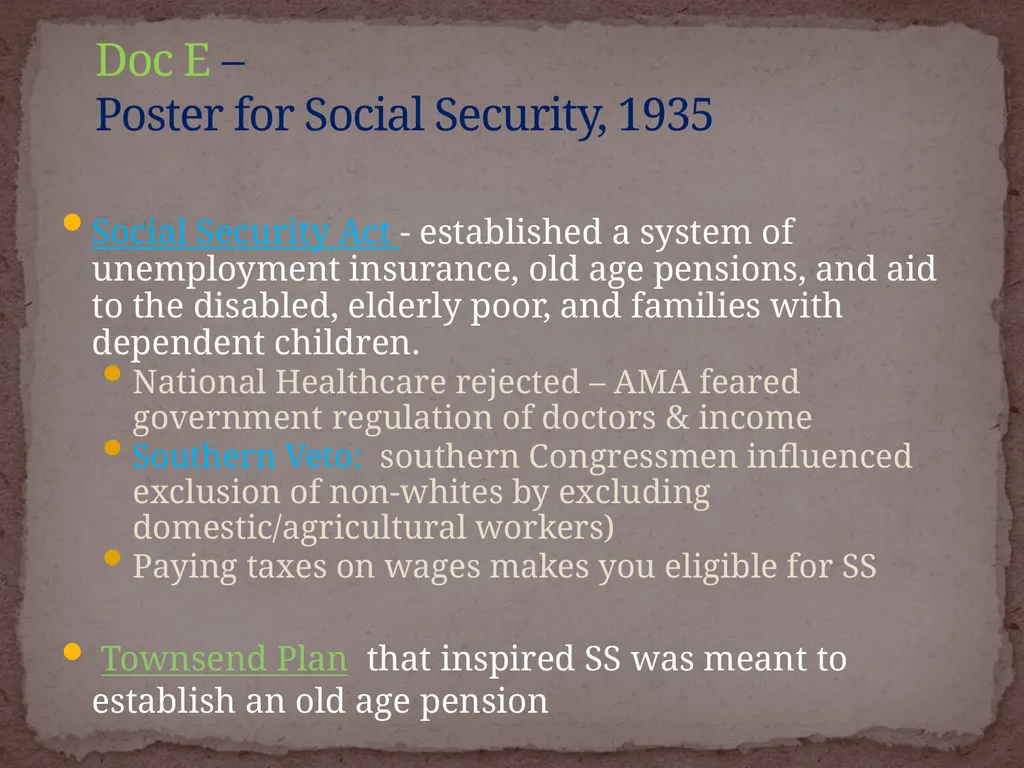
Social Security Act - established a system of unemployment insurance, old age pensions, and aid to the disabled, elderly poor, and families with dependent children.
National Healthcare rejected – AMA feared government regulation of doctors & income
Southern Veto: southern Congressmen influenced exclusion of non-whites by excluding domestic/agricultural workers)
Paying taxes on wages makes you eligible for SS
Townsend Plan that inspired SS was meant to establish an old age pension Doc E – Poster for Social Security, 1935<br>
National Healthcare rejected – AMA feared government regulation of doctors & income
Southern Veto: southern Congressmen influenced exclusion of non-whites by excluding domestic/agricultural workers)
Paying taxes on wages makes you eligible for SS
Townsend Plan that inspired SS was meant to establish an old age pension Doc E – Poster for Social Security, 1935<br>
48
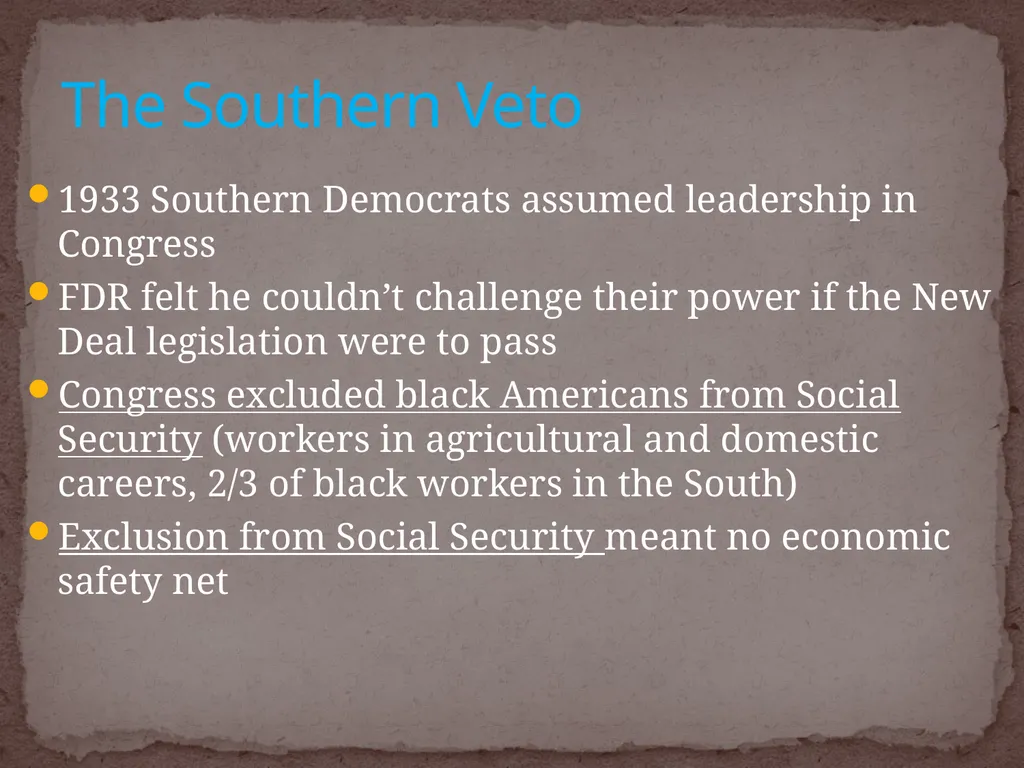
1933 Southern Democrats assumed leadership in Congress
FDR felt he couldn’t challenge their power if the New Deal legislation were to pass
Congress excluded black Americans from Social Security (workers in agricultural and domestic careers, 2/3 of black workers in the South)
Exclusion from Social Security meant no economic safety net The Southern Veto<br>
FDR felt he couldn’t challenge their power if the New Deal legislation were to pass
Congress excluded black Americans from Social Security (workers in agricultural and domestic careers, 2/3 of black workers in the South)
Exclusion from Social Security meant no economic safety net The Southern Veto<br>
49
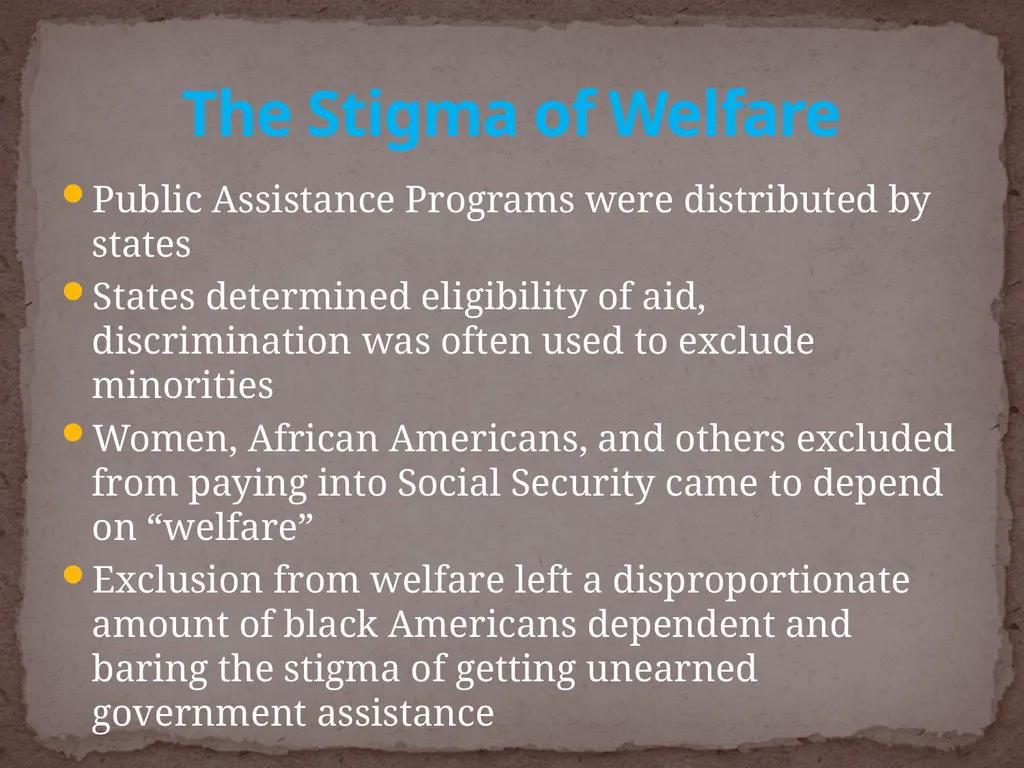
Public Assistance Programs were distributed by states
States determined eligibility of aid, discrimination was often used to exclude minorities
Women, African Americans, and others excluded from paying into Social Security came to depend on “welfare”
Exclusion from welfare left a disproportionate amount of black Americans dependent and baring the stigma of getting unearned government assistance The Stigma of Welfare<br>
States determined eligibility of aid, discrimination was often used to exclude minorities
Women, African Americans, and others excluded from paying into Social Security came to depend on “welfare”
Exclusion from welfare left a disproportionate amount of black Americans dependent and baring the stigma of getting unearned government assistance The Stigma of Welfare<br>
50
MAIN IDEA Doc F
Charles Evans Hughes, majority opinion, Schechter v US, 1935<br>
51
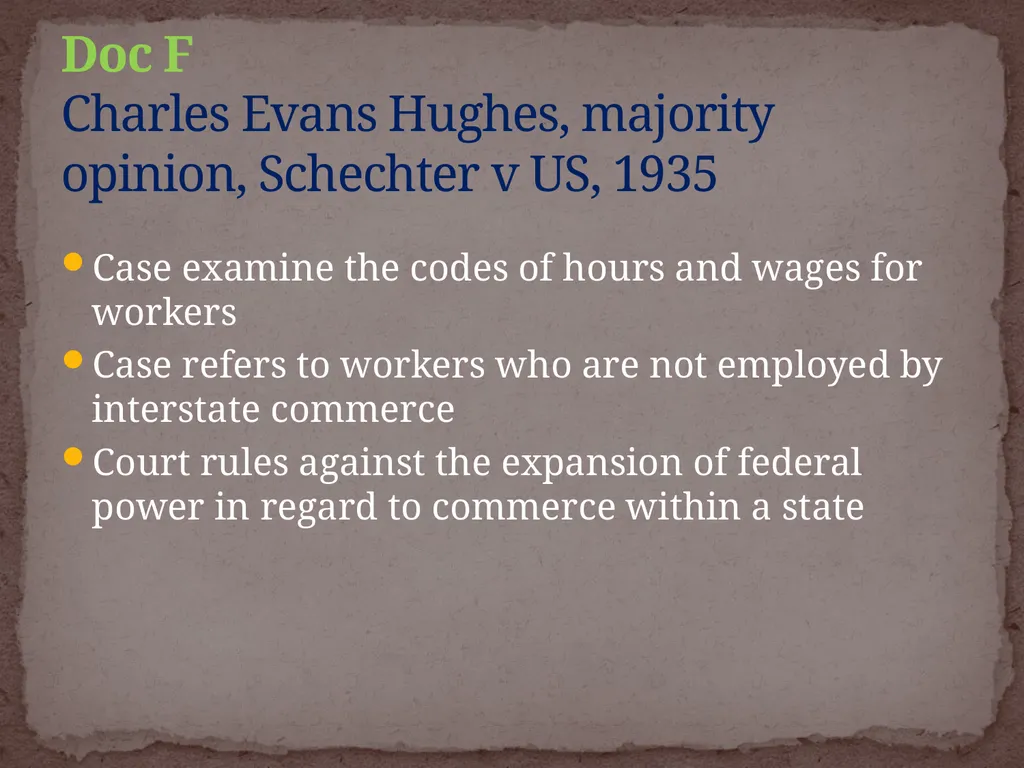
Case examine the codes of hours and wages for workers
Case refers to workers who are not employed by interstate commerce
Court rules against the expansion of federal power in regard to commerce within a state Doc F Charles Evans Hughes, majority opinion, Schechter v US, 1935<br>
Case refers to workers who are not employed by interstate commerce
Court rules against the expansion of federal power in regard to commerce within a state Doc F Charles Evans Hughes, majority opinion, Schechter v US, 1935<br>
52
HAPP Doc F
Charles Evans Hughes, majority opinion, Schechter v US, 1935<br>
53
Perspective
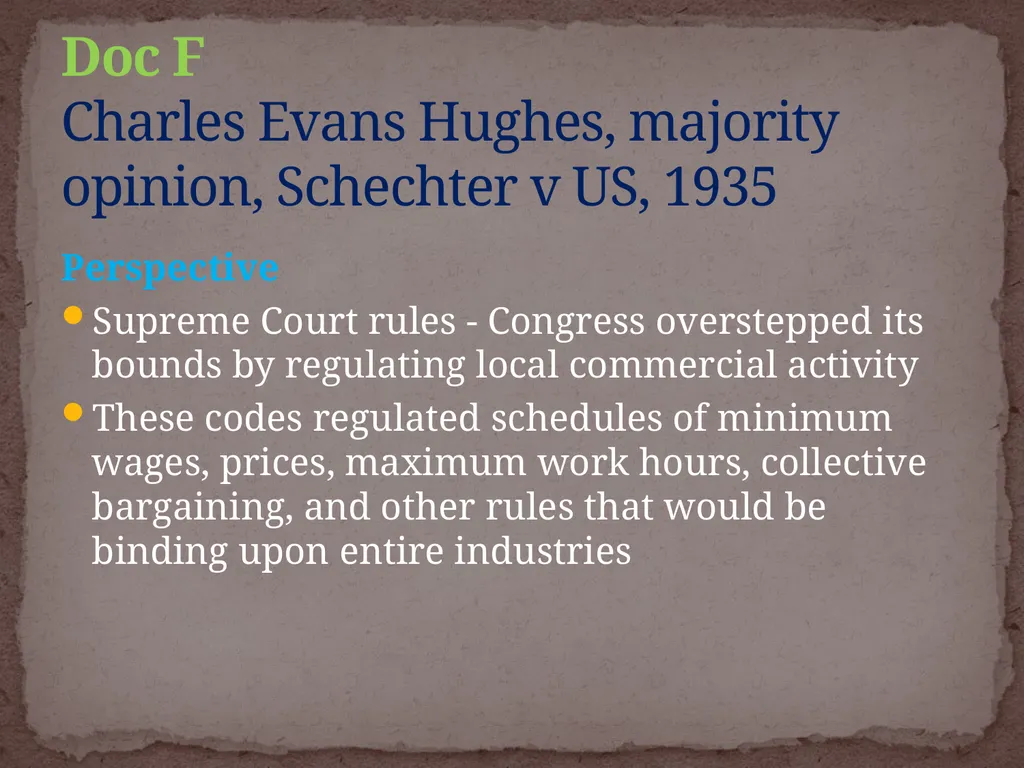
Supreme Court rules - Congress overstepped its bounds by regulating local commercial activity
These codes regulated schedules of minimum wages, prices, maximum work hours, collective bargaining, and other rules that would be binding upon entire industries Doc F Charles Evans Hughes, majority opinion, Schechter v US, 1935<br>
Supreme Court rules - Congress overstepped its bounds by regulating local commercial activity
These codes regulated schedules of minimum wages, prices, maximum work hours, collective bargaining, and other rules that would be binding upon entire industries Doc F Charles Evans Hughes, majority opinion, Schechter v US, 1935<br>
54
Historical Thinking Skills:
Comparison
How effective were these responses?
Continuity and Change Over Time How did they change the role of the federal government? Doc F Charles Evans Hughes, majority opinion, Schechter v US, 1935<br>
Comparison
How effective were these responses?
Continuity and Change Over Time How did they change the role of the federal government? Doc F Charles Evans Hughes, majority opinion, Schechter v US, 1935<br>
55
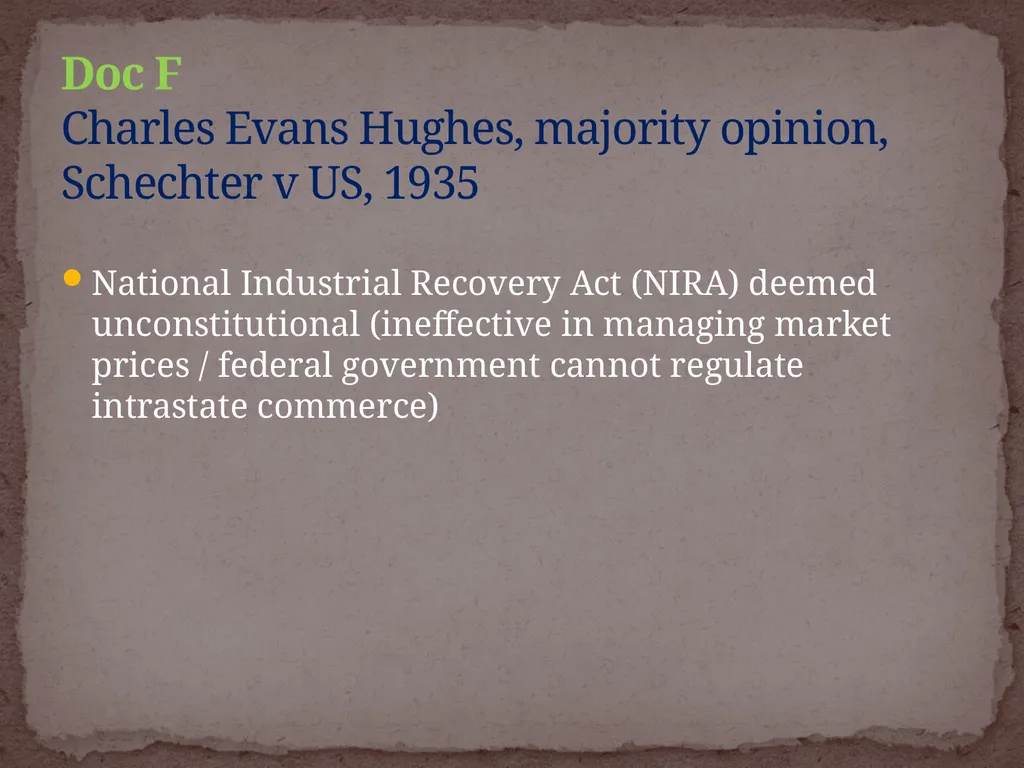
National Industrial Recovery Act (NIRA) deemed unconstitutional (ineffective in managing market prices / federal government cannot regulate intrastate commerce) Doc F
Charles Evans Hughes, majority opinion, Schechter v US, 1935<br>
56
OUTSIDE INFORMATION Doc F
Charles Evans Hughes, majority opinion, Schechter v US, 1935<br>
57
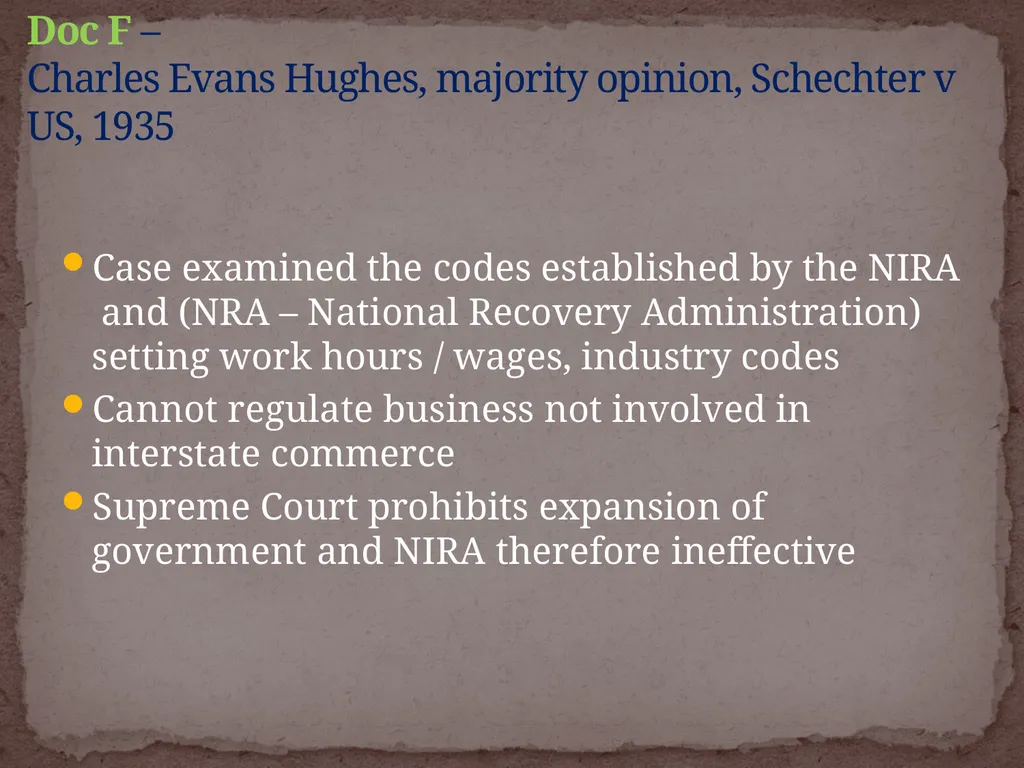
Case examined the codes established by the NIRA and (NRA – National Recovery Administration) setting work hours / wages, industry codes
Cannot regulate business not involved in interstate commerce
Supreme Court prohibits expansion of government and NIRA therefore ineffective Doc F – Charles Evans Hughes, majority opinion, Schechter v US, 1935<br>
Cannot regulate business not involved in interstate commerce
Supreme Court prohibits expansion of government and NIRA therefore ineffective Doc F – Charles Evans Hughes, majority opinion, Schechter v US, 1935<br>
58
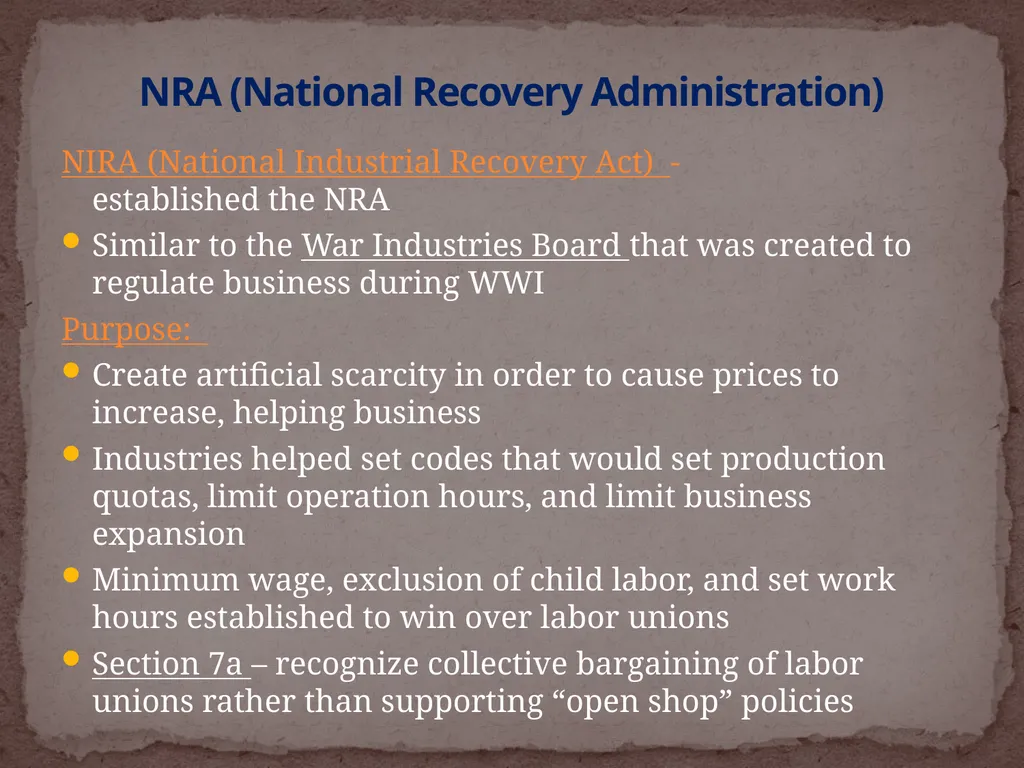
NIRA (National Industrial Recovery Act) -
established the NRA
Similar to the War Industries Board that was created to regulate business during WWI
Purpose:
Create artificial scarcity in order to cause prices to increase, helping business
Industries helped set codes that would set production quotas, limit operation hours, and limit business expansion
Minimum wage, exclusion of child labor, and set work hours established to win over labor unions
Section 7a – recognize collective bargaining of labor unions rather than supporting “open shop” policies NRA (National Recovery Administration)<br>
Similar to the War Industries Board that was created to regulate business during WWI
Purpose:
Create artificial scarcity in order to cause prices to increase, helping business
Industries helped set codes that would set production quotas, limit operation hours, and limit business expansion
Minimum wage, exclusion of child labor, and set work hours established to win over labor unions
Section 7a – recognize collective bargaining of labor unions rather than supporting “open shop” policies NRA (National Recovery Administration)<br>
59
Blue Eagle – symbol that companies who participated in the codes set by the NRA displayed
Problems:
Large Companies dominated establishment of codes
Large Companies created an unfair market where small business couldn’t compete with established codes
7a or collective bargaining wasn’t honored by all employers
Government Oversight was negligent
Economic Recovery did NOT result The NRA (National Recovery Administration)<br>
Problems:
Large Companies dominated establishment of codes
Large Companies created an unfair market where small business couldn’t compete with established codes
7a or collective bargaining wasn’t honored by all employers
Government Oversight was negligent
Economic Recovery did NOT result The NRA (National Recovery Administration)<br>
60
Schechter v United States (1935)
Supreme Court deemed the National Recovery Act unconstitutional
Schechter Poultry Company of Brooklyn did not adopt the codes established for the chicken industry
The President does not have the power to regulate local business
Congress has the power to regulate interstate commerce The NRA (National Recovery Administration)<br>
Supreme Court deemed the National Recovery Act unconstitutional
Schechter Poultry Company of Brooklyn did not adopt the codes established for the chicken industry
The President does not have the power to regulate local business
Congress has the power to regulate interstate commerce The NRA (National Recovery Administration)<br>
61
Summary:
Created by NIRA (National Industrial Recovery Act)
Worked with big business to develop industrial codes which would regulate production of goods in order to raise prices/profit (artificial scarcity)
Blue Eagle - “We Do Our Part”
Recognized the right of labor to collective bargaining (shorter hours, wages, work conditions)
Schechter Poultry Corp v United States (1935) – NRA found unconstitutional NRA (National Recovery Administration)<br>
Created by NIRA (National Industrial Recovery Act)
Worked with big business to develop industrial codes which would regulate production of goods in order to raise prices/profit (artificial scarcity)
Blue Eagle - “We Do Our Part”
Recognized the right of labor to collective bargaining (shorter hours, wages, work conditions)
Schechter Poultry Corp v United States (1935) – NRA found unconstitutional NRA (National Recovery Administration)<br>
62
MAIN IDEA Doc G –
NBC radio broadcast, John L. Lewis, Dec, 13, 1936<br>
63
Lack of acceptable working conditions leads to labor unrest
Employers oppose collective bargaining
Accuse large companies (GM, US Steel) of breaking labor laws
Workers have a right to collective bargaining Doc G – NBC radio broadcast, John L. Lewis, Dec, 13, 1936<br>
Employers oppose collective bargaining
Accuse large companies (GM, US Steel) of breaking labor laws
Workers have a right to collective bargaining Doc G – NBC radio broadcast, John L. Lewis, Dec, 13, 1936<br>
64
HAPP Doc G –
NBC radio broadcast, John L. Lewis, Dec, 13, 1936<br>
65
Perspective
Blames employers and companies for labor unrest
Supports National Labor Relations Act (Wagner Act)
Anticipates more sit-down strikes Doc G – NBC radio broadcast, John L. Lewis, Dec, 13, 1936<br>
Blames employers and companies for labor unrest
Supports National Labor Relations Act (Wagner Act)
Anticipates more sit-down strikes Doc G – NBC radio broadcast, John L. Lewis, Dec, 13, 1936<br>
66
Historical Thinking Skills:
Comparison
How effective were these responses?
Continuity and Change Over Time How did they change the role of the federal government? Doc G – NBC radio broadcast, John L. Lewis, Dec, 13, 1936<br>
Comparison
How effective were these responses?
Continuity and Change Over Time How did they change the role of the federal government? Doc G – NBC radio broadcast, John L. Lewis, Dec, 13, 1936<br>
67
Role of Government is now SUPPORTIVE OF LABOR FORCE AND COLLECTIVE BARGAINING Doc G –
NBC radio broadcast, John L. Lewis, Dec, 13, 1936<br>
68
OUTSIDE INFORMATION Doc G –
NBC radio broadcast, John L. Lewis, Dec, 13, 1936<br>
69
Wagner Act (NLRB - National Labor Relations Board) - support unions, supervise the election of union representatives
Outlaw “unfair labor practices” Example: Can’t fire & blacklist union organizers
Labor Unions grow in membership Doc G – Government support labor NBC radio broadcast, John L. Lewis, Dec, 13, 1936<br>
Outlaw “unfair labor practices” Example: Can’t fire & blacklist union organizers
Labor Unions grow in membership Doc G – Government support labor NBC radio broadcast, John L. Lewis, Dec, 13, 1936<br>
70
John L. Lewis – helped create CIO (Congress of Industrial Organizations, 1935)
1935 – he ran the United Mine Workers union (separated from AFL because wouldn’t allow workers to organize by industry over craft)
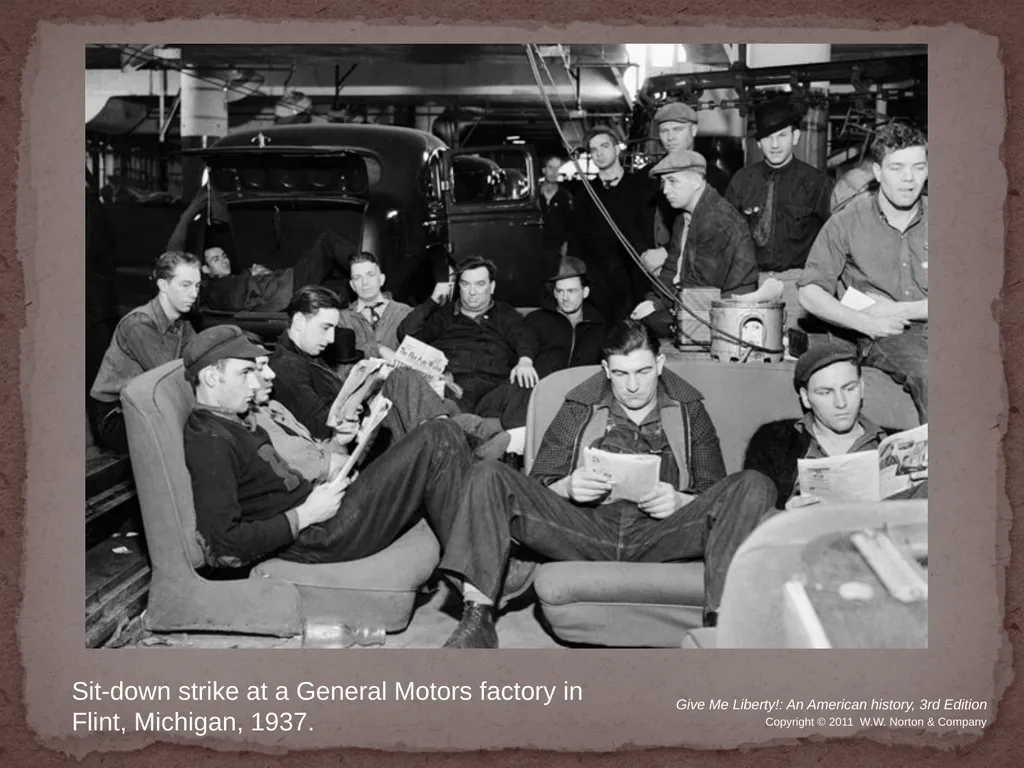
1936, United Auto Workers (UAW) sit-down strike
7,000 workers at General Motors halted production and remained inside the facility
Strike spread (Cleveland, OH to Flint, Michigan)
Workers maintained machinery, cleaned, prepared meals, held concerts of labor songs
GM negotiated with UAW
1937 – 400,000 members
1940 – 9 million members in CIO Doc G – Government support labor NBC radio broadcast, John L. Lewis, Dec, 13, 1936<br>
1935 – he ran the United Mine Workers union (separated from AFL because wouldn’t allow workers to organize by industry over craft)
1936, United Auto Workers (UAW) sit-down strike
7,000 workers at General Motors halted production and remained inside the facility
Strike spread (Cleveland, OH to Flint, Michigan)
Workers maintained machinery, cleaned, prepared meals, held concerts of labor songs
GM negotiated with UAW
1937 – 400,000 members
1940 – 9 million members in CIO Doc G – Government support labor NBC radio broadcast, John L. Lewis, Dec, 13, 1936<br>
71
Give Me Liberty!: An American history, 3rd Edition
Copyright © 2011 W.W. Norton & Company Sit-down strike at a General Motors factory in
Flint, Michigan, 1937.<br>
Copyright © 2011 W.W. Norton & Company Sit-down strike at a General Motors factory in
Flint, Michigan, 1937.<br>
72
MAIN IDEA Doc H –
“The New Deal in Review” editorial in The New Republic, May 20, 1940<br>
73
New Deal created many new agencies
Executive Branch more efficient Judicial Branch
revitalized by legislation and appointments Doc H – “The New Deal in Review” editorial in The New Republic, May 20, 1940<br>
Executive Branch more efficient Judicial Branch
revitalized by legislation and appointments Doc H – “The New Deal in Review” editorial in The New Republic, May 20, 1940<br>
74
HAPP Doc H –
“The New Deal in Review” editorial in The New Republic, May 20, 1940<br>
75
Perspective
Strong support of New Deal
New Deal will improve the country
Federal government is responsive to public need
Supreme Court wasn’t supportive in the 1st New Deal (AAA, NIRA), but is now supportive Doc H – “The New Deal in Review” editorial in The New Republic, May 20, 1940<br>
Strong support of New Deal
New Deal will improve the country
Federal government is responsive to public need
Supreme Court wasn’t supportive in the 1st New Deal (AAA, NIRA), but is now supportive Doc H – “The New Deal in Review” editorial in The New Republic, May 20, 1940<br>
76
Historical Thinking Skills:
Comparison
How effective were these responses?
Continuity and Change Over Time How did they change the role of the federal government? Doc H – “The New Deal in Review” editorial in The New Republic, May 20, 1940<br>
Comparison
How effective were these responses?
Continuity and Change Over Time How did they change the role of the federal government? Doc H – “The New Deal in Review” editorial in The New Republic, May 20, 1940<br>
77
New Deal expanded the role of government. Doc H –
“The New Deal in Review” editorial in The New Republic, May 20, 1940<br>
78
OUTSIDE INFORMATION Doc H –
“The New Deal in Review” editorial in The New Republic, May 20, 1940<br>
79
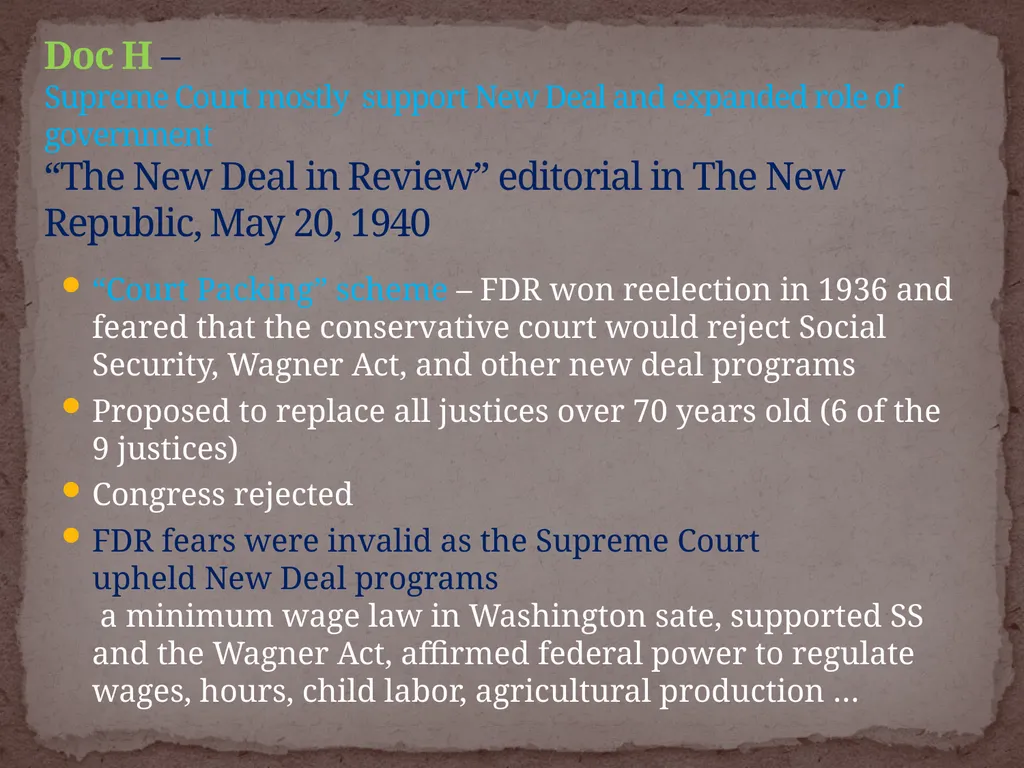
“Court Packing” scheme – FDR won reelection in 1936 and feared that the conservative court would reject Social Security, Wagner Act, and other new deal programs
Proposed to replace all justices over 70 years old (6 of the 9 justices)
Congress rejected
FDR fears were invalid as the Supreme Court upheld New Deal programs a minimum wage law in Washington sate, supported SS and the Wagner Act, affirmed federal power to regulate wages, hours, child labor, agricultural production … Doc H – Supreme Court mostly support New Deal and expanded role of government “The New Deal in Review” editorial in The New Republic, May 20, 1940<br>
Proposed to replace all justices over 70 years old (6 of the 9 justices)
Congress rejected
FDR fears were invalid as the Supreme Court upheld New Deal programs a minimum wage law in Washington sate, supported SS and the Wagner Act, affirmed federal power to regulate wages, hours, child labor, agricultural production … Doc H – Supreme Court mostly support New Deal and expanded role of government “The New Deal in Review” editorial in The New Republic, May 20, 1940<br>
80
MAIN IDEA Doc I –
“The Roosevelt Record,” editorial in The Crisis, Nov. 1940<br>
81
Roosevelt administration attempted to include African Americans in New Deal programs
Federal government segregated many programs Doc I – “The Roosevelt Record,” editorial in The Crisis, Nov. 1940<br>
Federal government segregated many programs Doc I – “The Roosevelt Record,” editorial in The Crisis, Nov. 1940<br>
82
HAPP Doc I –
“The Roosevelt Record,” editorial in The Crisis, Nov. 1940<br>
83
Perspective
African Americans now view the federal government as more supportive Doc I – “The Roosevelt Record,” editorial in The Crisis, Nov. 1940<br>
African Americans now view the federal government as more supportive Doc I – “The Roosevelt Record,” editorial in The Crisis, Nov. 1940<br>
84
Historical Thinking Skills:
Comparison
How effective were these responses?
Continuity and Change Over Time How did they change the role of the federal government? Doc I – “The Roosevelt Record,” editorial in The Crisis, Nov. 1940<br>
Comparison
How effective were these responses?
Continuity and Change Over Time How did they change the role of the federal government? Doc I – “The Roosevelt Record,” editorial in The Crisis, Nov. 1940<br>
85
New Deal created employment for African Americans
Long standing patterns of discrimination and segregation persisted
African Americans voted for FDR and Democratic party
FDR effective in gaining support of African Americans despite limitations Doc I – mixed effectiveness for African Americans “The Roosevelt Record,” editorial in The Crisis, Nov. 1940<br>
Long standing patterns of discrimination and segregation persisted
African Americans voted for FDR and Democratic party
FDR effective in gaining support of African Americans despite limitations Doc I – mixed effectiveness for African Americans “The Roosevelt Record,” editorial in The Crisis, Nov. 1940<br>
86
OUTSIDE INFORMATION Doc I –
“The Roosevelt Record,” editorial in The Crisis, Nov. 1940<br>
87
FDR attempted to include African Americans in New Deal programs
Discrimination & Segregation continued in some programs (CCC) Doc I – mixed effectiveness for African Americans “The Roosevelt Record,” editorial in The Crisis, Nov. 1940<br>
Discrimination & Segregation continued in some programs (CCC) Doc I – mixed effectiveness for African Americans “The Roosevelt Record,” editorial in The Crisis, Nov. 1940<br>
88
Last Hired, First Fired
Always “last hired and first fired,” African-Americans suffered the most in the Depression.
Competed with unemployed whites
Unemployment rate twice that of whites
Benefitted less from direct government relief and public works projects
The Depression forced blacks to make economic survival their primary demand. Even W. E. B. Du Bois surrendered his hopes for racial integration, and urged blacks to think of themselves as “a nation within a nation.” He urged blacks to build an independent, cooperative economy within their own communities and take control of separate schools. Limited impact for African Americans<br>
Always “last hired and first fired,” African-Americans suffered the most in the Depression.
Competed with unemployed whites
Unemployment rate twice that of whites
Benefitted less from direct government relief and public works projects
The Depression forced blacks to make economic survival their primary demand. Even W. E. B. Du Bois surrendered his hopes for racial integration, and urged blacks to think of themselves as “a nation within a nation.” He urged blacks to build an independent, cooperative economy within their own communities and take control of separate schools. Limited impact for African Americans<br>
89
While Roosevelt seemed little interested in race relations or civil rights, he appointed Mary McLeod Bethune, a well-known black educator, as his advisor on minority affairs and other blacks to positions.
Key members of his administration, including his wife and secretary of the interior Harold Ickes, criticized segregation, disenfranchisement, and lynching.
Blacks generally supported the New Deal and started voting for the Democratic Party, shifting away from their traditional support for Republicans.
Their hopes for broader changes were stymied by white southern Democrats’ influence in the party. A New Deal for Blacks<br>
Key members of his administration, including his wife and secretary of the interior Harold Ickes, criticized segregation, disenfranchisement, and lynching.
Blacks generally supported the New Deal and started voting for the Democratic Party, shifting away from their traditional support for Republicans.
Their hopes for broader changes were stymied by white southern Democrats’ influence in the party. A New Deal for Blacks<br>
90
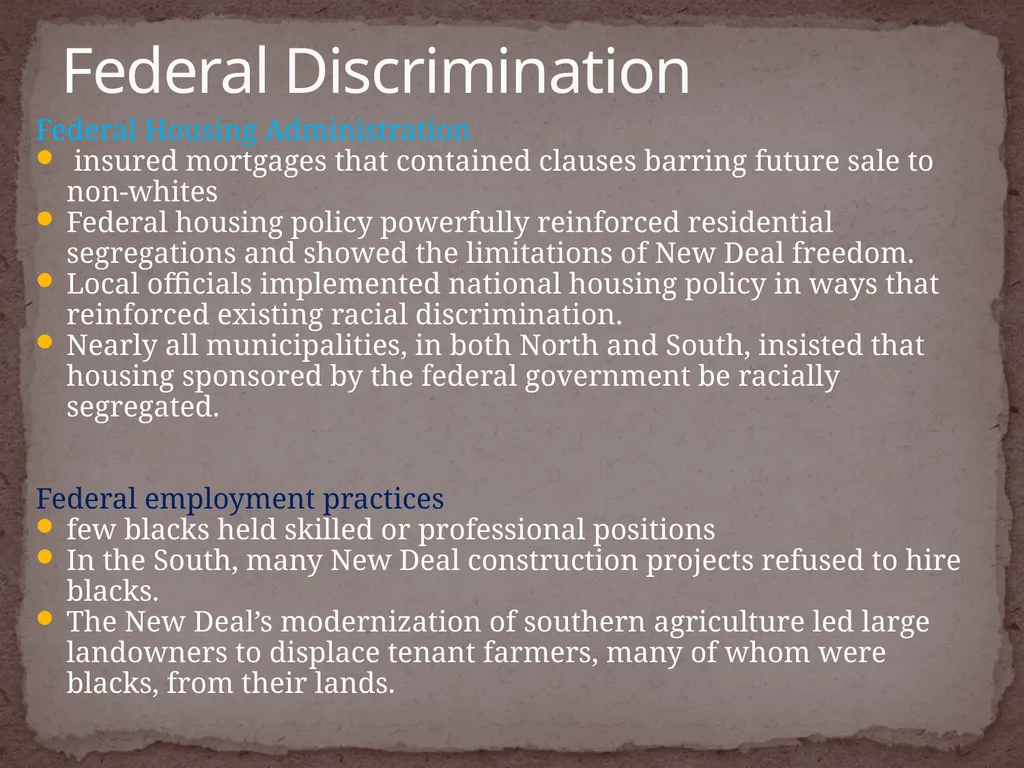
Federal Housing Administration
insured mortgages that contained clauses barring future sale to non-whites
Federal housing policy powerfully reinforced residential segregations and showed the limitations of New Deal freedom.
Local officials implemented national housing policy in ways that reinforced existing racial discrimination.
Nearly all municipalities, in both North and South, insisted that housing sponsored by the federal government be racially segregated.
Federal employment practices
few blacks held skilled or professional positions
In the South, many New Deal construction projects refused to hire blacks.
The New Deal’s modernization of southern agriculture led large landowners to displace tenant farmers, many of whom were blacks, from their lands. Federal Discrimination<br>
insured mortgages that contained clauses barring future sale to non-whites
Federal housing policy powerfully reinforced residential segregations and showed the limitations of New Deal freedom.
Local officials implemented national housing policy in ways that reinforced existing racial discrimination.
Nearly all municipalities, in both North and South, insisted that housing sponsored by the federal government be racially segregated.
Federal employment practices
few blacks held skilled or professional positions
In the South, many New Deal construction projects refused to hire blacks.
The New Deal’s modernization of southern agriculture led large landowners to displace tenant farmers, many of whom were blacks, from their lands. Federal Discrimination<br>
91
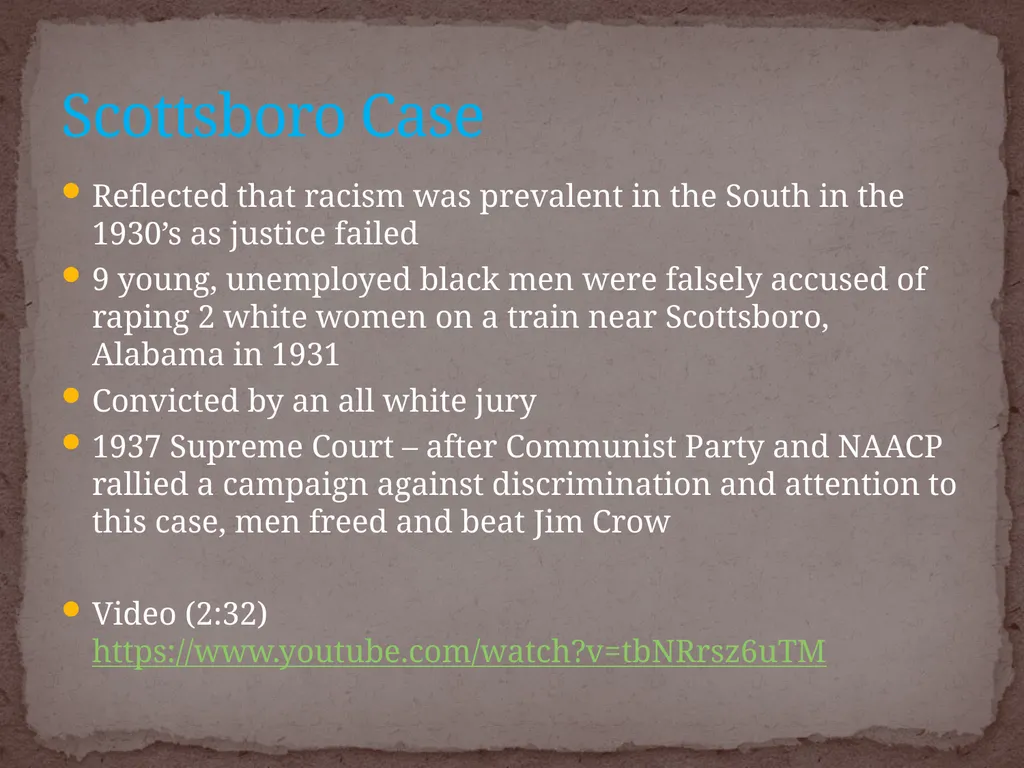
Reflected that racism was prevalent in the South in the 1930’s as justice failed
9 young, unemployed black men were falsely accused of raping 2 white women on a train near Scottsboro, Alabama in 1931
Convicted by an all white jury
1937 Supreme Court – after Communist Party and NAACP rallied a campaign against discrimination and attention to this case, men freed and beat Jim Crow
Video (2:32) https://www.youtube.com/watch?v=tbNRrsz6uTM Scottsboro Case<br>
9 young, unemployed black men were falsely accused of raping 2 white women on a train near Scottsboro, Alabama in 1931
Convicted by an all white jury
1937 Supreme Court – after Communist Party and NAACP rallied a campaign against discrimination and attention to this case, men freed and beat Jim Crow
Video (2:32) https://www.youtube.com/watch?v=tbNRrsz6uTM Scottsboro Case<br>
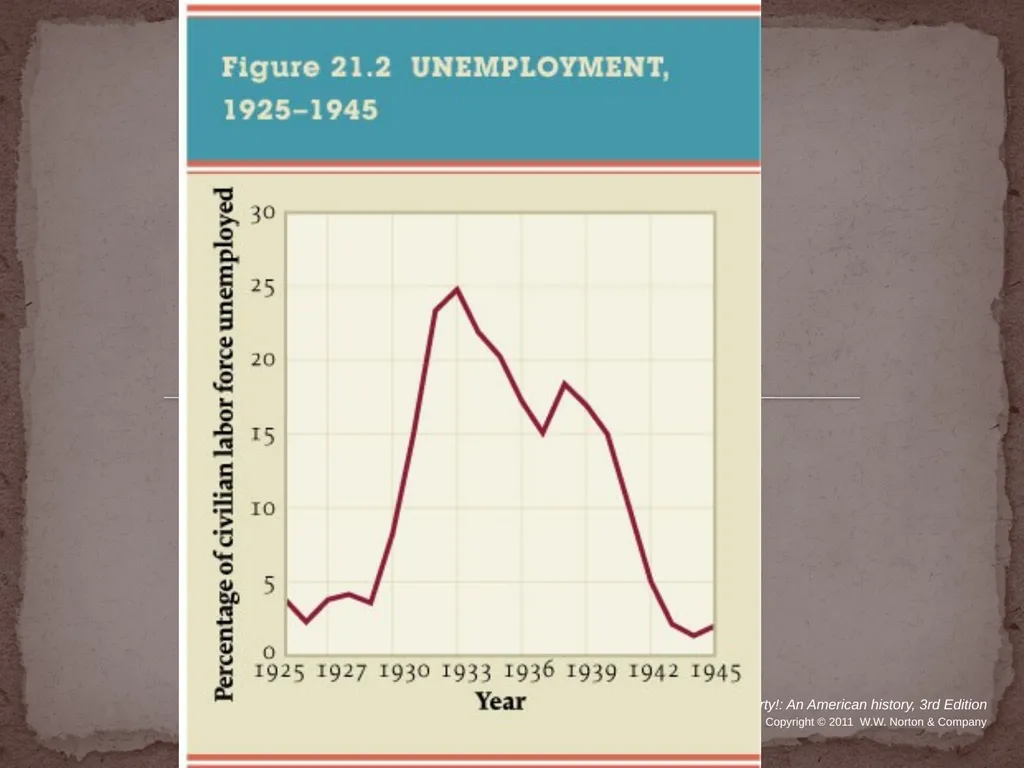
92
MAIN IDEA Doc J –
Chart, Unemployment of nonfarm workers by % and number<br>
93
Unemployment
Spiked in early 1920’s
Peaked in 1933
Rose in 1937-38
Decline significantly after 1938
1933 Numbers of unemployed (12.8 million) increased by nearly 40%
Chart doesn’t reflect unemployment of farm workers Doc J – Chart, Unemployment of nonfarm workers by % and number<br>
Spiked in early 1920’s
Peaked in 1933
Rose in 1937-38
Decline significantly after 1938
1933 Numbers of unemployed (12.8 million) increased by nearly 40%
Chart doesn’t reflect unemployment of farm workers Doc J – Chart, Unemployment of nonfarm workers by % and number<br>
94
HAPP Doc J –
Chart, Unemployment of nonfarm workers by % and number<br>
95
Purpose
Reflect effect of the New Deal on unemployment Doc J – Chart, Unemployment of nonfarm workers by % and number<br>
Reflect effect of the New Deal on unemployment Doc J – Chart, Unemployment of nonfarm workers by % and number<br>
96
Historical Thinking Skills:
Comparison
How effective were these responses?
Continuity and Change Over Time How did they change the role of the federal government? Doc J – Chart, Unemployment of nonfarm workers by % and number<br>
Comparison
How effective were these responses?
Continuity and Change Over Time How did they change the role of the federal government? Doc J – Chart, Unemployment of nonfarm workers by % and number<br>
97
New Deal not always effective Doc J –
Chart, Unemployment of nonfarm workers by % and number<br>
98
OUTSIDE INFORMATION Doc J –
Chart, Unemployment of nonfarm workers by % and number<br>
99
Unemployment -
Roosevelt Recession 1937-1938 caused by a reduction of federal spending (reduce farm subsidies and WPA) Doc J – Chart, Unemployment of nonfarm workers by % and number<br>
Roosevelt Recession 1937-1938 caused by a reduction of federal spending (reduce farm subsidies and WPA) Doc J – Chart, Unemployment of nonfarm workers by % and number<br>
100
Give Me Liberty!: An American history, 3rd Edition
Copyright © 2011 W.W. Norton & Company<br>
Copyright © 2011 W.W. Norton & Company<br>
101
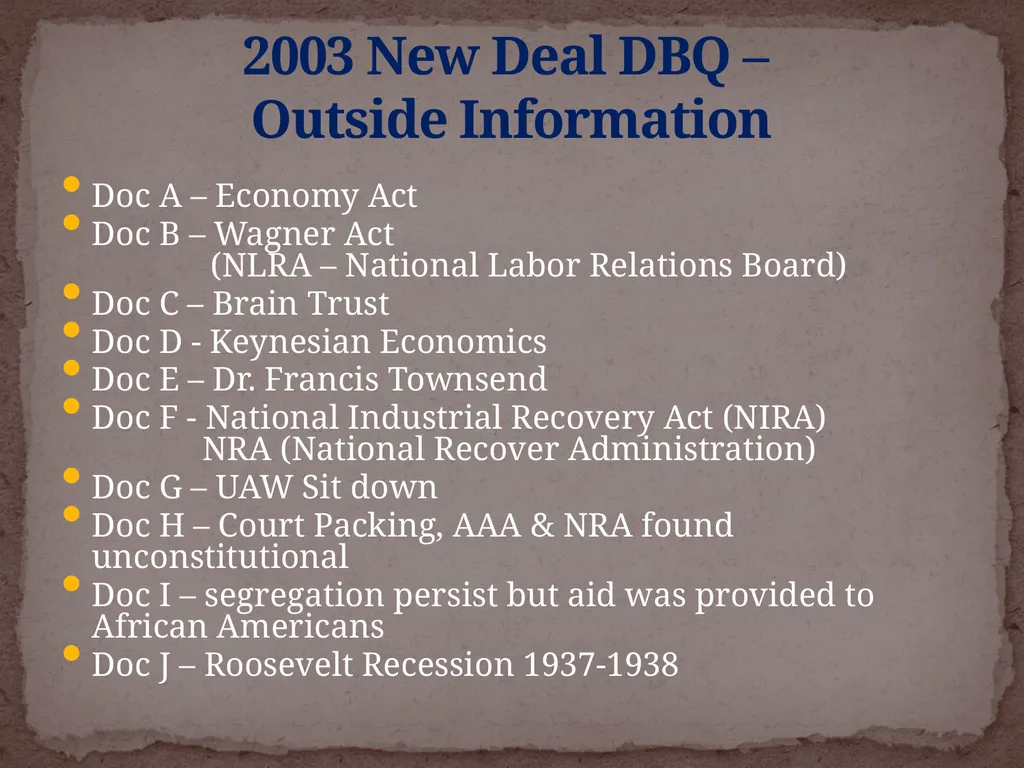
Doc A – Economy Act
Doc B – Wagner Act (NLRA – National Labor Relations Board)
Doc C – Brain Trust
Doc D - Keynesian Economics
Doc E – Dr. Francis Townsend
Doc F - National Industrial Recovery Act (NIRA) NRA (National Recover Administration)
Doc G – UAW Sit down
Doc H – Court Packing, AAA & NRA found unconstitutional
Doc I – segregation persist but aid was provided to African Americans
Doc J – Roosevelt Recession 1937-1938 2003 New Deal DBQ – Outside Information<br>
Doc B – Wagner Act (NLRA – National Labor Relations Board)
Doc C – Brain Trust
Doc D - Keynesian Economics
Doc E – Dr. Francis Townsend
Doc F - National Industrial Recovery Act (NIRA) NRA (National Recover Administration)
Doc G – UAW Sit down
Doc H – Court Packing, AAA & NRA found unconstitutional
Doc I – segregation persist but aid was provided to African Americans
Doc J – Roosevelt Recession 1937-1938 2003 New Deal DBQ – Outside Information<br>