NGS workflows Massively parallel sequencing of Plasmodium Workshop 28th November 2022 Abidjan Learning objectives Understand the major components of a typical (e.g Illumina) NGS workflow Understand how the data is acquired Understand the
"NGS workflows Massively parallel sequencing of" is the property of its rightful owner. Permission is granted to
download and print the materials on this website for personal, non-commercial use only, and to display it
on your personal computer provided you do not modify the materials and that you retain all copyright
notices contained in the materials. By downloading content from our website, you accept the terms of this
agreement.
Presentation Transcript
01
NGS workflows
Massively parallel sequencing of Plasmodium Workshop 28th November 2022
Abidjan<br>
02
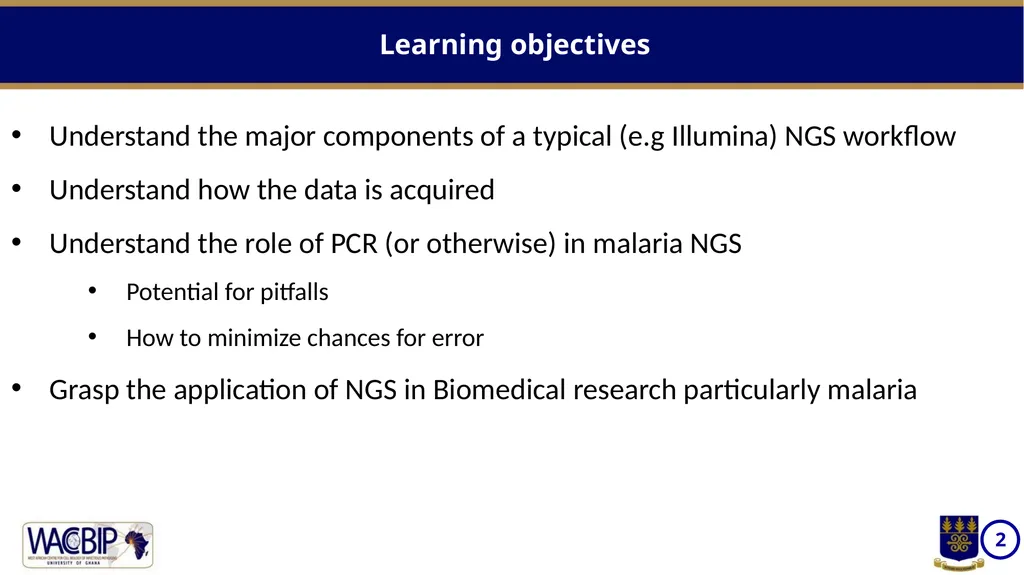
Learning objectives Understand the major components of a typical (e.g Illumina) NGS workflow
Understand how the data is acquired
Understand the role of PCR (or otherwise) in malaria NGS
Potential for pitfalls
How to minimize chances for error
Grasp the application of NGS in Biomedical research particularly malaria<br>
03
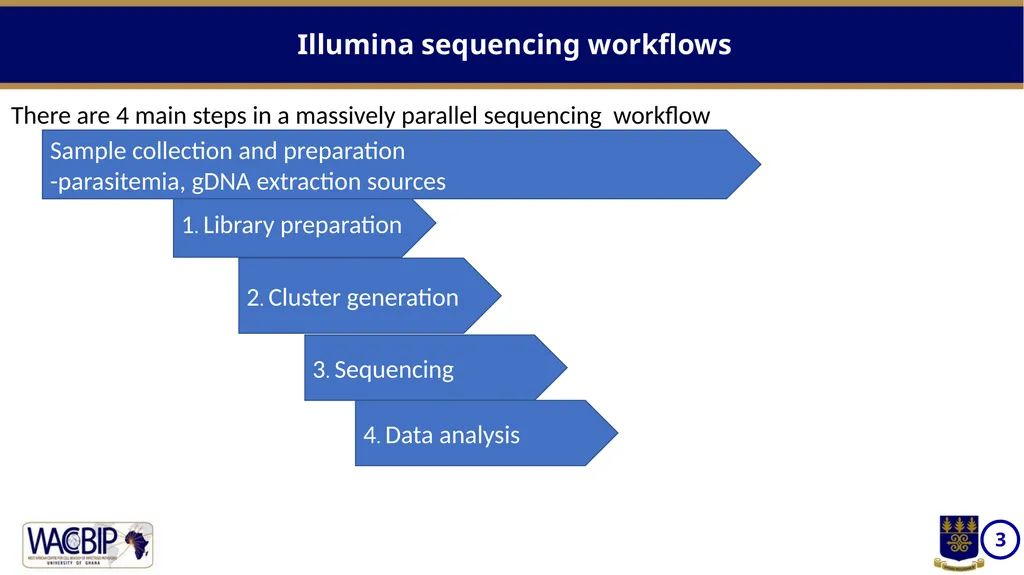
Illumina sequencing workflows 1. Library preparation There are 4 main steps in a massively parallel sequencing workflow 2. Cluster generation 3. Sequencing 4. Data analysis Sample collection and preparation
-parasitemia, gDNA extraction sources<br>
04
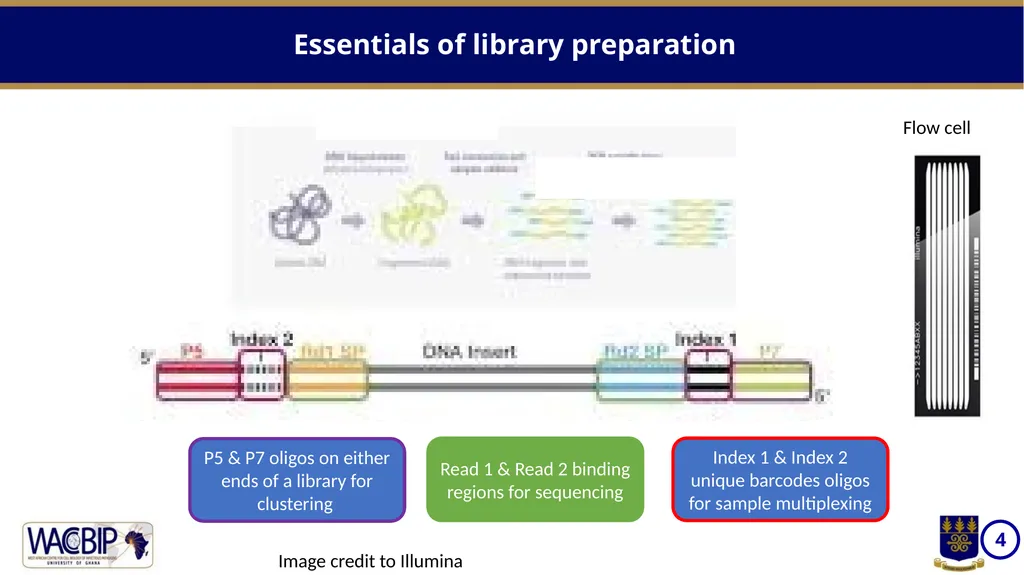
Essentials of library preparation P5 & P7 oligos on either ends of a library for clustering Index 1 & Index 2 unique barcodes oligos for sample multiplexing Read 1 & Read 2 binding regions for sequencing Image credit to Illumina Flow cell<br>
05
Potential pitfalls PCR is an effective DNA amplification process but not perfect
In library preps, PCR can introduce preferential amplification of certain fragments
Low amounts of starting DNA results in jackpotting due to low complexity of the fragment population ( Plasmodium spp)
Duplicate reads with exact start/stop alignments
Substitution errors by the polymerase may lead to false positive results
If substitution occurs in early PCR cycles, error appears as a true variant (in situ mutations)
If substitution occurs in later PCR cycles, error typically is drowned out by correctly copied fragments in the amplification cluster<br>
06
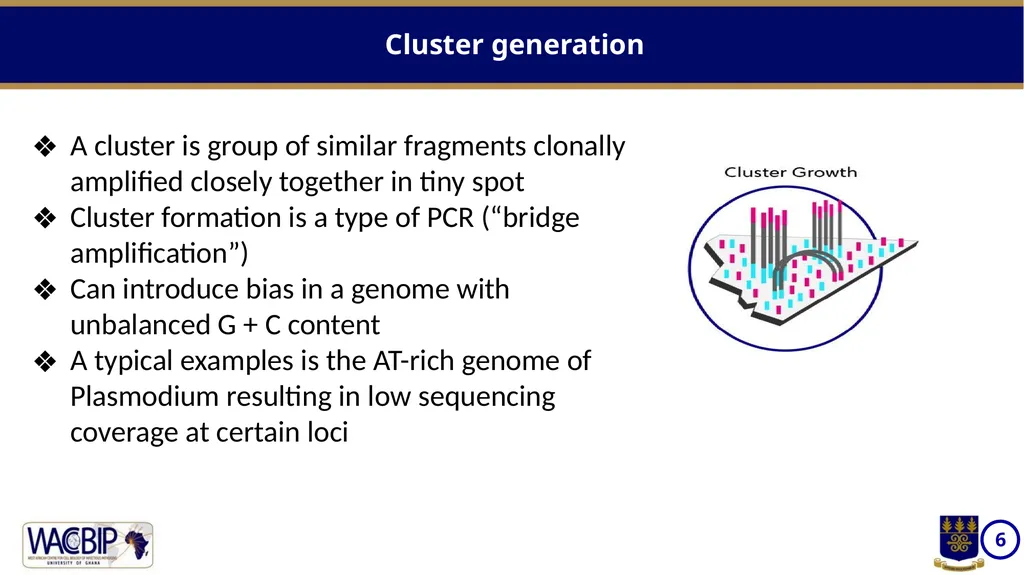
Cluster generation A cluster is group of similar fragments clonally amplified closely together in tiny spot
Cluster formation is a type of PCR (“bridge amplification”)
Can introduce bias in a genome with unbalanced G + C content
A typical examples is the AT-rich genome of Plasmodium resulting in low sequencing coverage at certain loci<br>
07
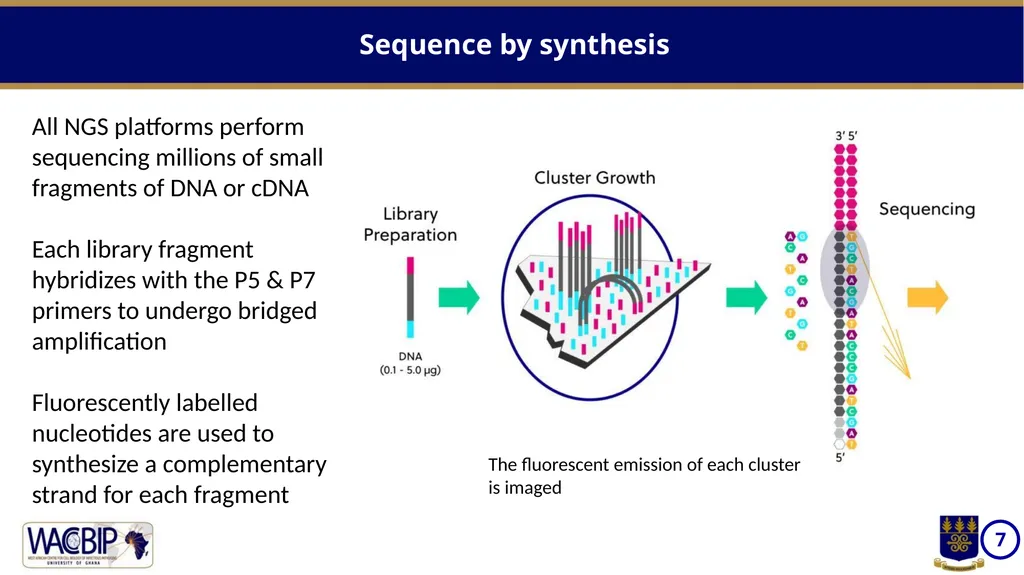
Sequence by synthesis All NGS platforms perform sequencing millions of small fragments of DNA or cDNA
Each library fragment hybridizes with the P5 & P7 primers to undergo bridged amplification
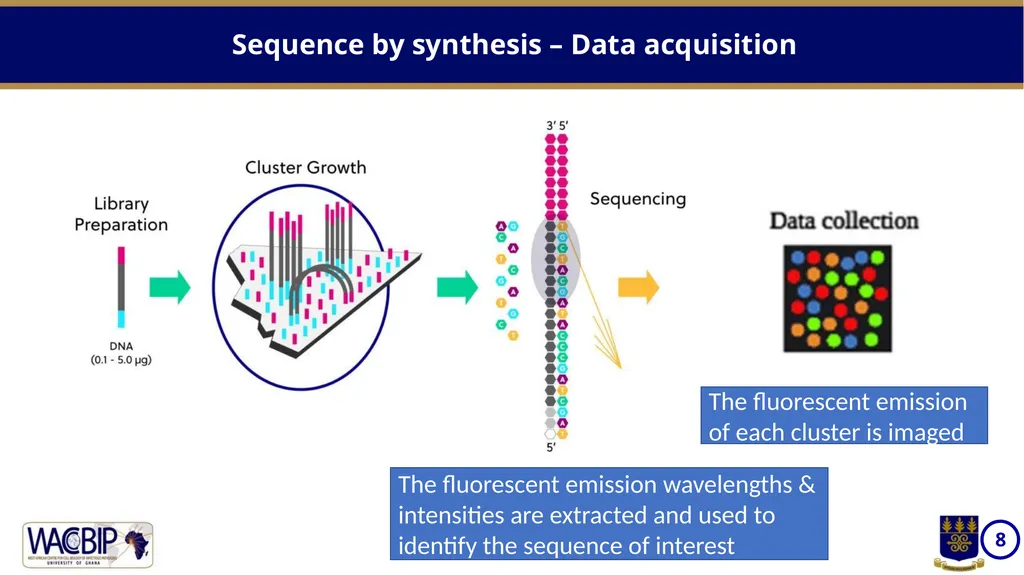
Fluorescently labelled nucleotides are used to synthesize a complementary strand for each fragment The fluorescent emission of each cluster is imaged<br>
08
Sequence by synthesis – Data acquisition The fluorescent emission of each cluster is imaged The fluorescent emission wavelengths & intensities are extracted and used to identify the sequence of interest<br>
09
Data Analysis Quality control (QC) is a key integral part of NGS workflows from library prep to sequencing and data analysis
The million to billions of reads obtained have to QC’ed using specialized software
Filtered for quality
Amplicon size
Agreement between paired ends (paired end sequencing)
Reads that pass quality filters are assembled and align to a reference genome<br>
10
Reference genomes variant identification Reference genomes are key component of NGS experiments
Alignment of filtered reads to a reference genome enables variant (SNPs) identification
Human reference genome
Plasmodium falciparum 3D7 reference genome
Reference genomes are version controlled
Mis-aligning sequences identify structural variations
Deletions, insertions, duplication etc
Alignment and analysis of RNA sequence data provides information about gene expression changes
De novo assembly of filtered reads without a reference genome<br>
11
Reading list Schuster 2008. Next-generation sequencing transforms today’s biology. Nature Methods - 5, 16 - 18 (2008). Published online: 19 December 2007; | doi:10.1038/nmeth1156.
Mardis ER. 2008. Next-generation DNA sequencing methods. Annu Rev Genomics Hum Genet. 2008;9:387-402. Review.
Mardis ER. 2008. The impact of next-generation sequencing technology on genetics.Trends Genet. 2008 Mar;24(3):133-41. Epub 2008 Feb 11. Review.
Shendure and Ji. 2008 Next-generation DNA sequencing. Nat Biotechnol. 2008 Oct;26(10):1135-45.
Wheeler DA et al. 2008. The complete genome of an individual by massively parallel DBA sequencing. Nature. 2008 Apr 17;452(7189):872-6.<br>