Non-Verbal Reasoning Tests © Laura Hooke,
Description: Non-Verbal Reasoning Tests Laura Hooke, Loughborough University of London. Reviewer: Dr Kinga Zaczek, Royal Holloway, University of London All mccp resources are released under a creative commons licence, www.mathcentre.ac.uk
Related Topics
Download Presentation
"Non-Verbal Reasoning Tests © Laura Hooke," is the property of its rightful owner. Permission is granted to download and print the materials on this website for personal, non-commercial use only, and to display it on your personal computer provided you do not modify the materials and that you retain all copyright notices contained in the materials. By downloading content from our website, you accept the terms of this agreement.
Presentation Transcript
slide1. Non-Verbal Reasoning Tests © Laura Hooke, Loughborough University of London. Reviewer: Dr Kinga Zaczek, Royal Holloway, University of London
All mccp resources are released under a creative commons licence, www.mathcentre.ac.uk www.sigma-network.ac.uk Non-Verbal Reasoning<br>
slide2. Recruitment process When applying for jobs you may come across some, if not all, of the following stages in the recruitment process:
Completion of an online application form
Submission of a CV and cover letter
Tests (assessing skills appropriate for the job)*
Interview (face to face, video or telephone)
Assessment Centre (online/virtual or actual)
* Tests can occur at any stage of the recruitment process<br>
slide3. Common assessment tools Ability or Aptitude Test
Including numerical reasoning, verbal reasoning, non-verbal reasoning
Personality Questionnaire
Less commonly used in recruitment
Situational Judgement Test (SJT)
Usually designed specifically for the needs of the job<br>
slide4. Current innovations in recruitment Some of the large organisations in the UK that recruit students and graduates to internships, placements or graduate schemes are using new methods of assessment during selection e.g.
Online games & videos mirroring typical work scenarios & requiring decisions
Video interviews recorded online by the applicants & reviewed by the recruiter<br>
slide5. Ability Tests Measure a specific ability or abilities required for a job
Often bought from specialist companies
Examples:
numerical reasoning
verbal reasoning
non-verbal reasoning (diagrammatical, inductive, logical)
critical thinking<br>
slide6. Non-Verbal Reasoning Tests Are often used to assess ability to problem solve & to think analytically
Do not require prior knowledge
Examples include:
diagrammatic reasoning
logical reasoning
inductive reasoning<br>
slide7. Non-Verbal Reasoning Tests: questions Questions may use a series of different configurations of shapes that form a logical sequence
The task is often to identify a missing shape in the sequence or decide which configuration should come next
The answer is often multiple choice
Similar questions may be used as part of the entrance exams for some schools in the UK<br>
slide8. Numerical Reasoning Practice Questions The examples on the following slides have been taken, with permission, from a practice test on the Assessment Day website www.assessmentday.co.uk<br>
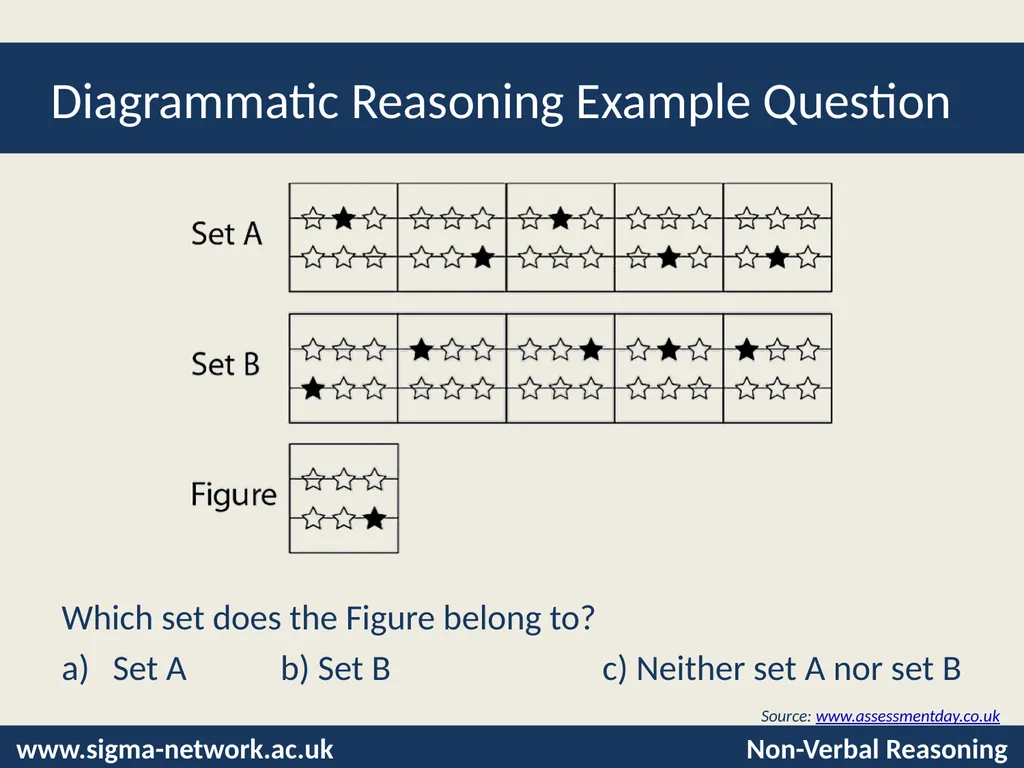
slide9. Diagrammatic Reasoning Example Question Which set does the Figure belong to?
Set A b) Set B c) Neither set A nor set B Source: www.assessmentday.co.uk<br>
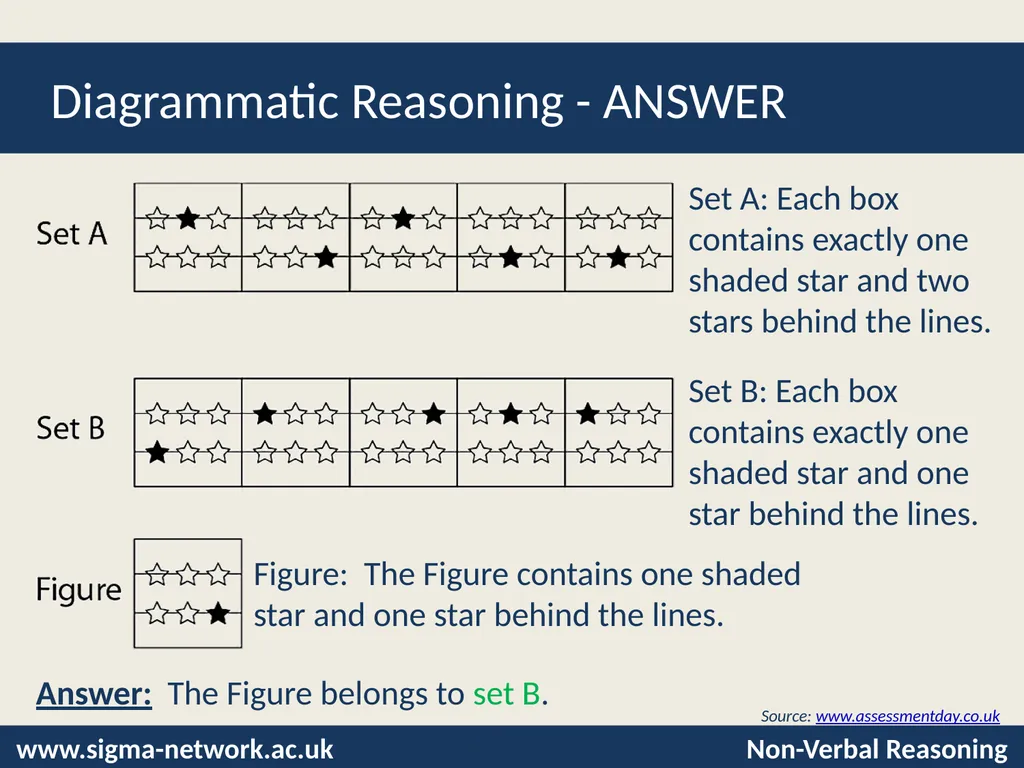
slide10. Diagrammatic Reasoning - ANSWER Set A: Each box contains exactly one shaded star and two stars behind the lines. Set B: Each box contains exactly one shaded star and one star behind the lines. Figure: The Figure contains one shaded star and one star behind the lines. Answer: The Figure belongs to set B. Source: www.assessmentday.co.uk<br>
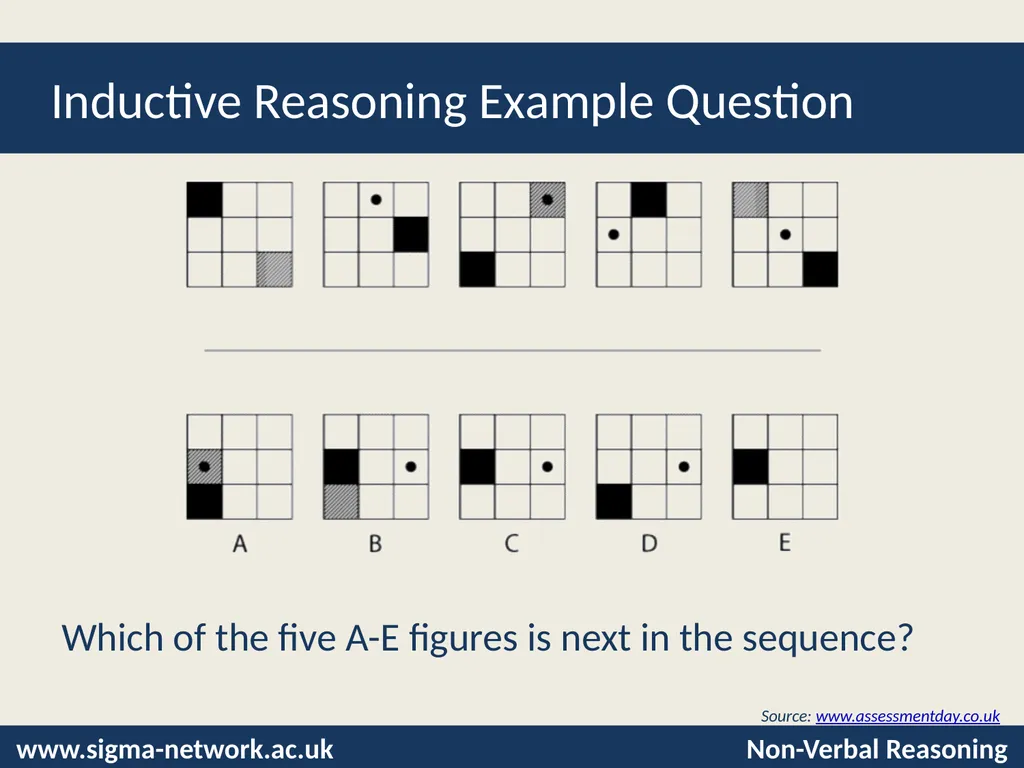
slide11. Inductive Reasoning Example Question Which of the five A-E figures is next in the sequence? Source: www.assessmentday.co.uk<br>
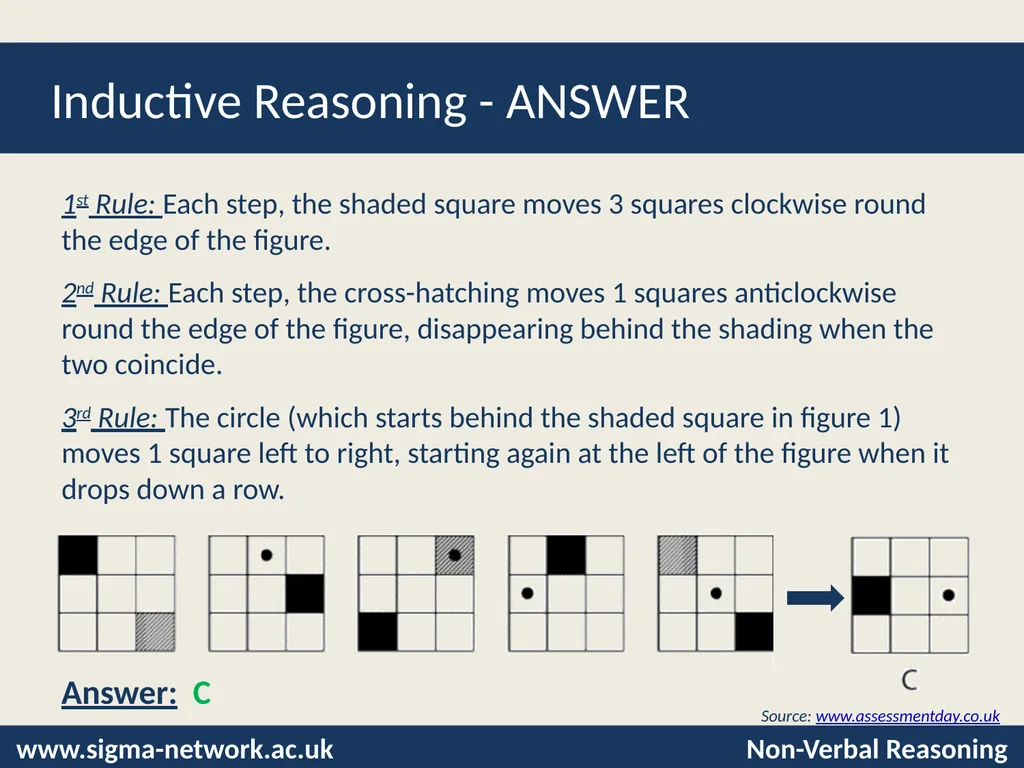
slide12. Inductive Reasoning - ANSWER 1st Rule: Each step, the shaded square moves 3 squares clockwise round the edge of the figure.
2nd Rule: Each step, the cross-hatching moves 1 squares anticlockwise round the edge of the figure, disappearing behind the shading when the two coincide.
3rd Rule: The circle (which starts behind the shaded square in figure 1) moves 1 square left to right, starting again at the left of the figure when it drops down a row. Answer: C Source: www.assessmentday.co.uk<br>
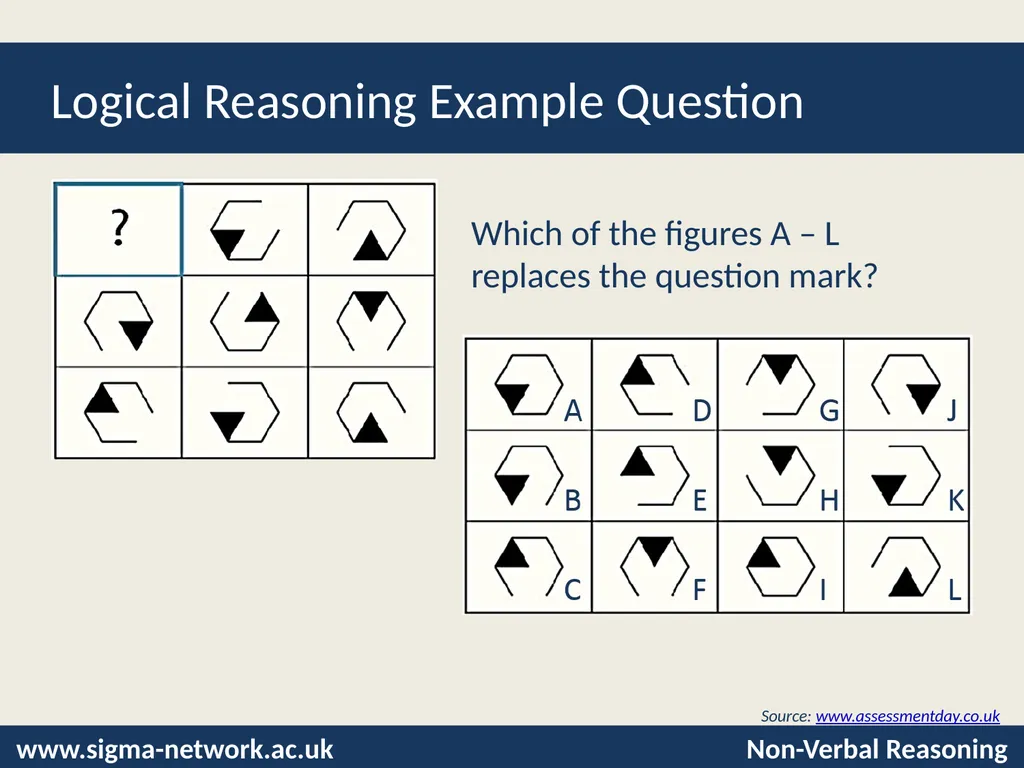
slide13. Logical Reasoning Example Question Which of the figures A – L replaces the question mark? Source: www.assessmentday.co.uk<br>
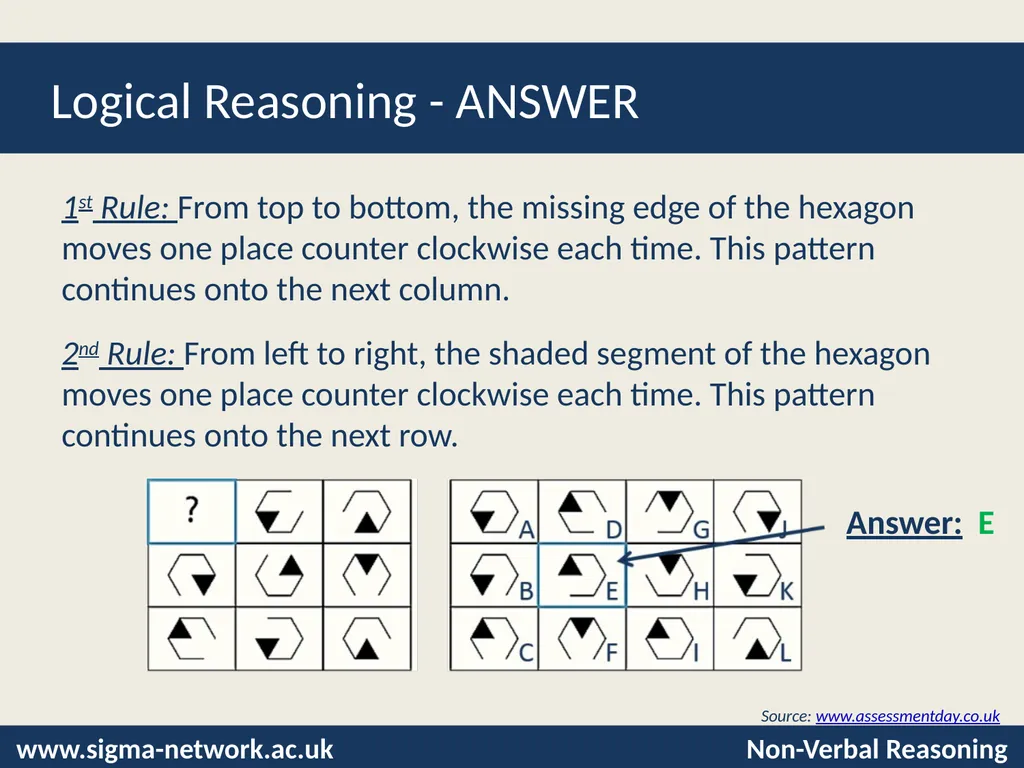
slide14. Logical Reasoning - ANSWER 1st Rule: From top to bottom, the missing edge of the hexagon moves one place counter clockwise each time. This pattern continues onto the next column.
2nd Rule: From left to right, the shaded segment of the hexagon moves one place counter clockwise each time. This pattern continues onto the next row. Answer: E Source: www.assessmentday.co.uk<br>
slide15. Preparing for Non-Verbal Reasoning Tests Research the type of test you may have to take
Try an appropriate practice test
If you find it difficult, look at the answers and tips
Take a practice test again
Have you improved?<br>
slide16. Preparing for tests – Research Look at employers’ websites to see the type of tests they use, e.g. logical reasoning, diagrammatic reasoning etc.
The website may also have example questions and tell you whose tests they use.
Look at websites like Glassdoor or Wikijobs for feedback from others who have already applied to the same employer.<br>
slide17. Preparing for tests – Practise When you know the type of test you may face, get some practice first, e.g. try the tests on the Assessment Day or Graduates First websites.
If you know which test producer the employer uses, see if there are example questions on the producer’s website. Many of these are listed later in this presentation.<br>
slide18. Preparing for tests – Improve Q: Not answering many questions but getting most or all
answers correct?
A: Take more practice tests and focus on increasing your speed.
Q: Answering most or all of the questions but getting a low
score?
A: Work on your accuracy e.g. check your answers
Q: Lacking knowledge/skills?
A: Look for resources that explain non-verbal reasoning tests and include practice questions (with answers). Some suggestions are on the slide ‘Other Useful Resources’.<br>
slide19. Preparing for tests – Try again When you have practised your speed, improved accuracy or developed your knowledge of non-verbal reasoning tests, try a test again.
With some tests, it is not always necessary to answer all of the questions to do well. You just need to get enough answers correct.<br>
slide20. General Practice Test Sites www.assessmentday.co.uk
www.graduatesfirst.com
Answers are provided after taking each test, so you can analyse where you are going wrong.
Tips and advice are also provided.
Both sites include practice tests of non-verbal reasoning<br>
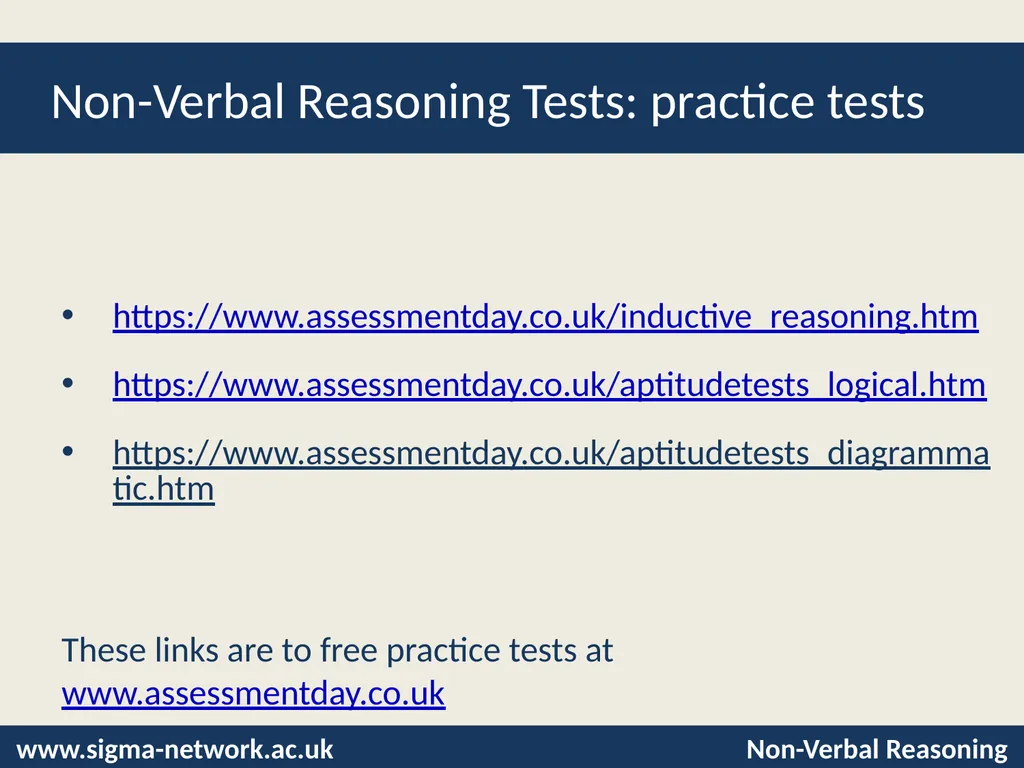
slide21. Non-Verbal Reasoning Tests: practice tests https://www.assessmentday.co.uk/inductive_reasoning.htm
https://www.assessmentday.co.uk/aptitudetests_logical.htm
https://www.assessmentday.co.uk/aptitudetests_diagrammatic.htm
These links are to free practice tests at www.assessmentday.co.uk<br>
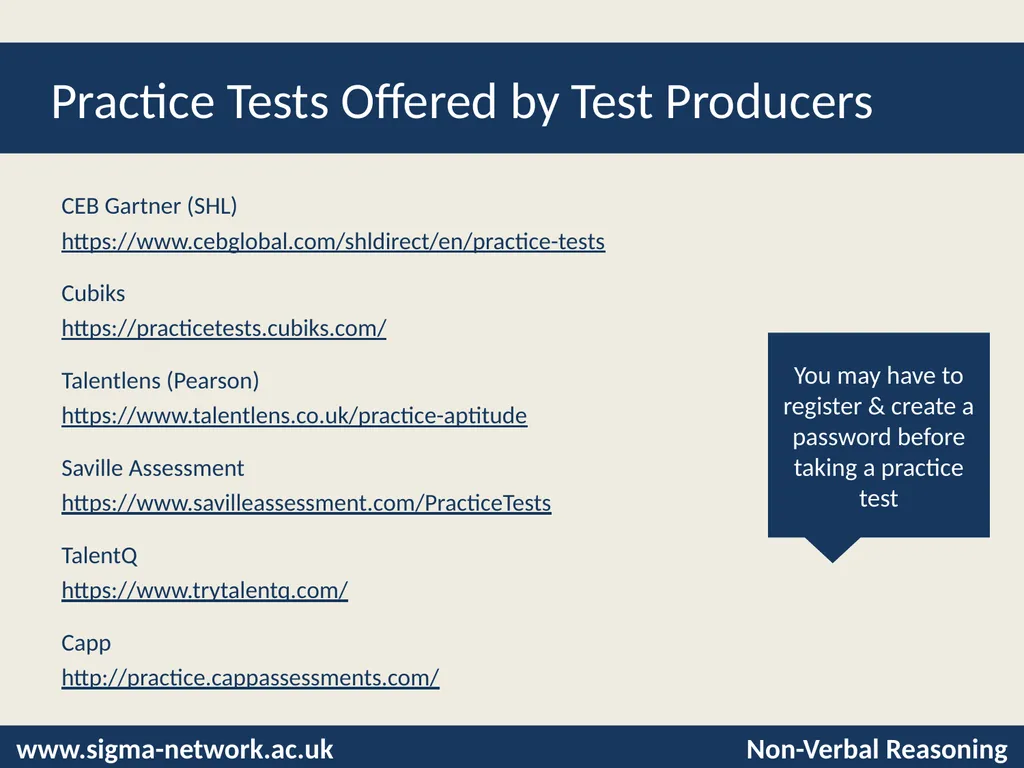
slide22. Practice Tests Offered by Test Producers CEB Gartner (SHL)
https://www.cebglobal.com/shldirect/en/practice-tests
Cubiks
https://practicetests.cubiks.com/
Talentlens (Pearson)
https://www.talentlens.co.uk/practice-aptitude
Saville Assessment
https://www.savilleassessment.com/PracticeTests
TalentQ
https://www.trytalentq.com/
Capp
http://practice.cappassessments.com/ You may have to register & create a password before taking a practice test<br>
slide23. Sources of Support in Your University Your careers service might offer:
Information about taking tests on their websites
Opportunities to practise tests and receive feedback
Discussion with an adviser to address your concerns
Links to websites with practice tests<br>
slide24. Other Useful Resources Online courses e.g.
https://www.futurelearn.com/courses/logical-and-critical-thinking
Books e.g.
‘How to Pass Graduate Psychometric Tests’ M Byron
‘How to Pass Diagrammatic Reasoning Tests’ M Byron
‘Inductive Reasoning Tests’ M Shepherd
‘Succeed at Psychometric Testing: practice tests for diagrammatic and abstract reasoning’ P Rhodes<br>

slide25. Thank you Any questions ???<br>
All mccp resources are released under a creative commons licence, www.mathcentre.ac.uk www.sigma-network.ac.uk Non-Verbal Reasoning<br>
slide2. Recruitment process When applying for jobs you may come across some, if not all, of the following stages in the recruitment process:
Completion of an online application form
Submission of a CV and cover letter
Tests (assessing skills appropriate for the job)*
Interview (face to face, video or telephone)
Assessment Centre (online/virtual or actual)
* Tests can occur at any stage of the recruitment process<br>
slide3. Common assessment tools Ability or Aptitude Test
Including numerical reasoning, verbal reasoning, non-verbal reasoning
Personality Questionnaire
Less commonly used in recruitment
Situational Judgement Test (SJT)
Usually designed specifically for the needs of the job<br>
slide4. Current innovations in recruitment Some of the large organisations in the UK that recruit students and graduates to internships, placements or graduate schemes are using new methods of assessment during selection e.g.
Online games & videos mirroring typical work scenarios & requiring decisions
Video interviews recorded online by the applicants & reviewed by the recruiter<br>
slide5. Ability Tests Measure a specific ability or abilities required for a job
Often bought from specialist companies
Examples:
numerical reasoning
verbal reasoning
non-verbal reasoning (diagrammatical, inductive, logical)
critical thinking<br>
slide6. Non-Verbal Reasoning Tests Are often used to assess ability to problem solve & to think analytically
Do not require prior knowledge
Examples include:
diagrammatic reasoning
logical reasoning
inductive reasoning<br>
slide7. Non-Verbal Reasoning Tests: questions Questions may use a series of different configurations of shapes that form a logical sequence
The task is often to identify a missing shape in the sequence or decide which configuration should come next
The answer is often multiple choice
Similar questions may be used as part of the entrance exams for some schools in the UK<br>
slide8. Numerical Reasoning Practice Questions The examples on the following slides have been taken, with permission, from a practice test on the Assessment Day website www.assessmentday.co.uk<br>
slide9. Diagrammatic Reasoning Example Question Which set does the Figure belong to?
Set A b) Set B c) Neither set A nor set B Source: www.assessmentday.co.uk<br>
slide10. Diagrammatic Reasoning - ANSWER Set A: Each box contains exactly one shaded star and two stars behind the lines. Set B: Each box contains exactly one shaded star and one star behind the lines. Figure: The Figure contains one shaded star and one star behind the lines. Answer: The Figure belongs to set B. Source: www.assessmentday.co.uk<br>
slide11. Inductive Reasoning Example Question Which of the five A-E figures is next in the sequence? Source: www.assessmentday.co.uk<br>
slide12. Inductive Reasoning - ANSWER 1st Rule: Each step, the shaded square moves 3 squares clockwise round the edge of the figure.
2nd Rule: Each step, the cross-hatching moves 1 squares anticlockwise round the edge of the figure, disappearing behind the shading when the two coincide.
3rd Rule: The circle (which starts behind the shaded square in figure 1) moves 1 square left to right, starting again at the left of the figure when it drops down a row. Answer: C Source: www.assessmentday.co.uk<br>
slide13. Logical Reasoning Example Question Which of the figures A – L replaces the question mark? Source: www.assessmentday.co.uk<br>
slide14. Logical Reasoning - ANSWER 1st Rule: From top to bottom, the missing edge of the hexagon moves one place counter clockwise each time. This pattern continues onto the next column.
2nd Rule: From left to right, the shaded segment of the hexagon moves one place counter clockwise each time. This pattern continues onto the next row. Answer: E Source: www.assessmentday.co.uk<br>
slide15. Preparing for Non-Verbal Reasoning Tests Research the type of test you may have to take
Try an appropriate practice test
If you find it difficult, look at the answers and tips
Take a practice test again
Have you improved?<br>
slide16. Preparing for tests – Research Look at employers’ websites to see the type of tests they use, e.g. logical reasoning, diagrammatic reasoning etc.
The website may also have example questions and tell you whose tests they use.
Look at websites like Glassdoor or Wikijobs for feedback from others who have already applied to the same employer.<br>
slide17. Preparing for tests – Practise When you know the type of test you may face, get some practice first, e.g. try the tests on the Assessment Day or Graduates First websites.
If you know which test producer the employer uses, see if there are example questions on the producer’s website. Many of these are listed later in this presentation.<br>
slide18. Preparing for tests – Improve Q: Not answering many questions but getting most or all
answers correct?
A: Take more practice tests and focus on increasing your speed.
Q: Answering most or all of the questions but getting a low
score?
A: Work on your accuracy e.g. check your answers
Q: Lacking knowledge/skills?
A: Look for resources that explain non-verbal reasoning tests and include practice questions (with answers). Some suggestions are on the slide ‘Other Useful Resources’.<br>
slide19. Preparing for tests – Try again When you have practised your speed, improved accuracy or developed your knowledge of non-verbal reasoning tests, try a test again.
With some tests, it is not always necessary to answer all of the questions to do well. You just need to get enough answers correct.<br>
slide20. General Practice Test Sites www.assessmentday.co.uk
www.graduatesfirst.com
Answers are provided after taking each test, so you can analyse where you are going wrong.
Tips and advice are also provided.
Both sites include practice tests of non-verbal reasoning<br>
slide21. Non-Verbal Reasoning Tests: practice tests https://www.assessmentday.co.uk/inductive_reasoning.htm
https://www.assessmentday.co.uk/aptitudetests_logical.htm
https://www.assessmentday.co.uk/aptitudetests_diagrammatic.htm
These links are to free practice tests at www.assessmentday.co.uk<br>
slide22. Practice Tests Offered by Test Producers CEB Gartner (SHL)
https://www.cebglobal.com/shldirect/en/practice-tests
Cubiks
https://practicetests.cubiks.com/
Talentlens (Pearson)
https://www.talentlens.co.uk/practice-aptitude
Saville Assessment
https://www.savilleassessment.com/PracticeTests
TalentQ
https://www.trytalentq.com/
Capp
http://practice.cappassessments.com/ You may have to register & create a password before taking a practice test<br>
slide23. Sources of Support in Your University Your careers service might offer:
Information about taking tests on their websites
Opportunities to practise tests and receive feedback
Discussion with an adviser to address your concerns
Links to websites with practice tests<br>
slide24. Other Useful Resources Online courses e.g.
https://www.futurelearn.com/courses/logical-and-critical-thinking
Books e.g.
‘How to Pass Graduate Psychometric Tests’ M Byron
‘How to Pass Diagrammatic Reasoning Tests’ M Byron
‘Inductive Reasoning Tests’ M Shepherd
‘Succeed at Psychometric Testing: practice tests for diagrammatic and abstract reasoning’ P Rhodes<br>
slide25. Thank you Any questions ???<br>