Optimization for ML CS771: Introduction to Machine Learning Nisheeth Todays class In the last class, we saw that parameter estimation for the linear regression model is possible in closed form This is not always the case for all ML models.
"Optimization for ML CS771: Introduction to Machine" is the property of its rightful owner. Permission is granted to
download and print the materials on this website for personal, non-commercial use only, and to display it
on your personal computer provided you do not modify the materials and that you retain all copyright
notices contained in the materials. By downloading content from our website, you accept the terms of this
agreement.
Presentation Transcript
01
Optimization for ML CS771: Introduction to Machine Learning
Nisheeth<br>
02
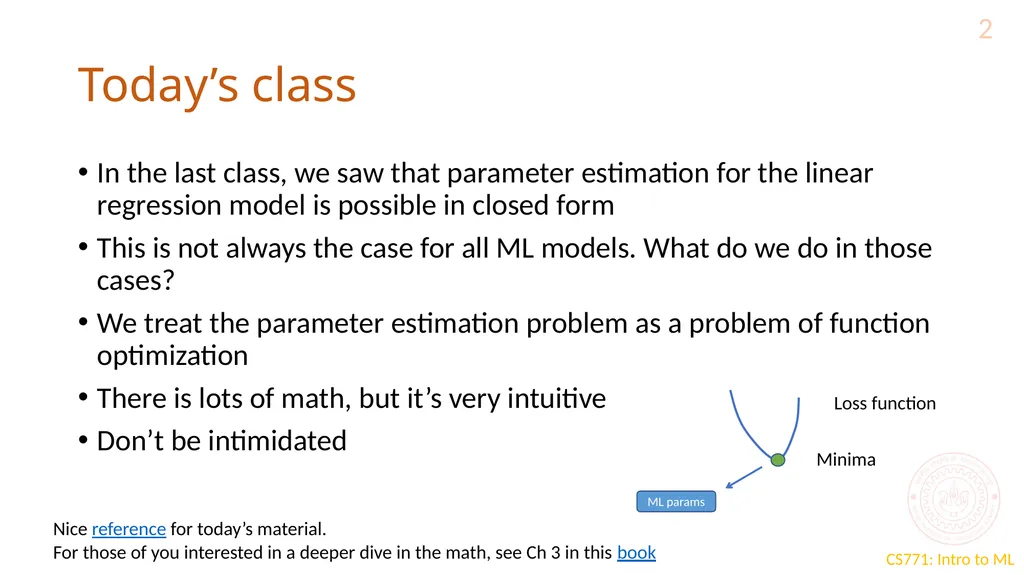
Today’s class In the last class, we saw that parameter estimation for the linear regression model is possible in closed form
This is not always the case for all ML models. What do we do in those cases?
We treat the parameter estimation problem as a problem of function optimization
There is lots of math, but it’s very intuitive
Don’t be intimidated 2 Nice reference for today’s material.
For those of you interested in a deeper dive in the math, see Ch 3 in this book<br>
03
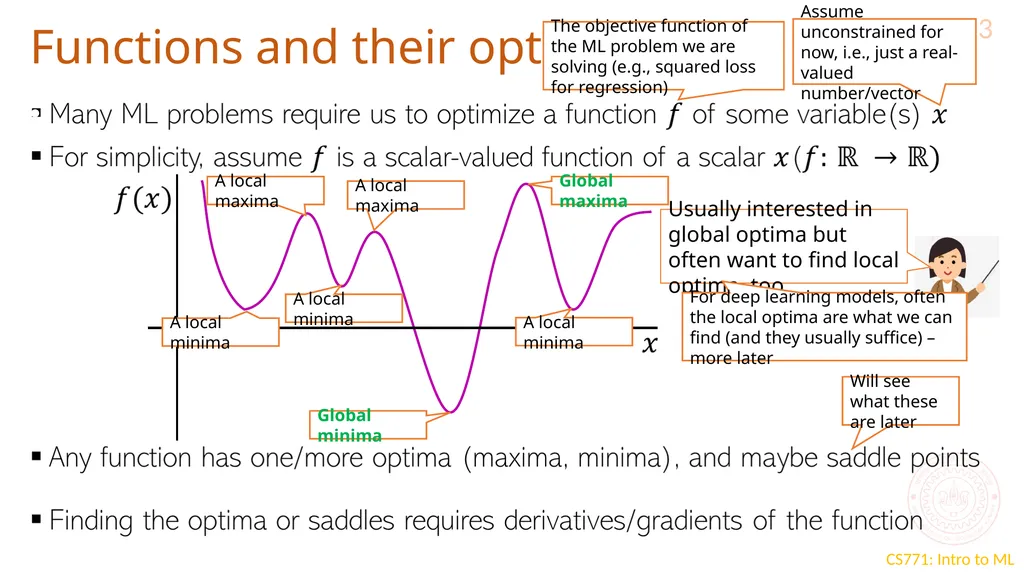
Functions and their optima 3 Global maxima A local maxima A local maxima A local minima A local minima A local minima Global minima Will see what these are later Usually interested in global optima but often want to find local optima, too The objective function of the ML problem we are solving (e.g., squared loss for regression) Assume unconstrained for now, i.e., just a real-valued number/vector For deep learning models, often the local optima are what we can find (and they usually suffice) – more later<br>
04
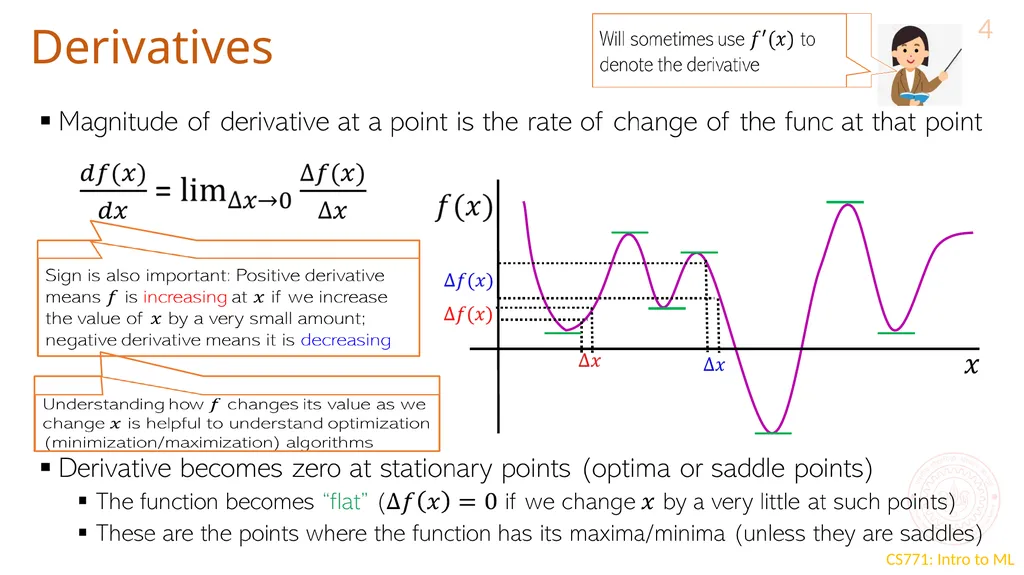
Derivatives 4<br>
05
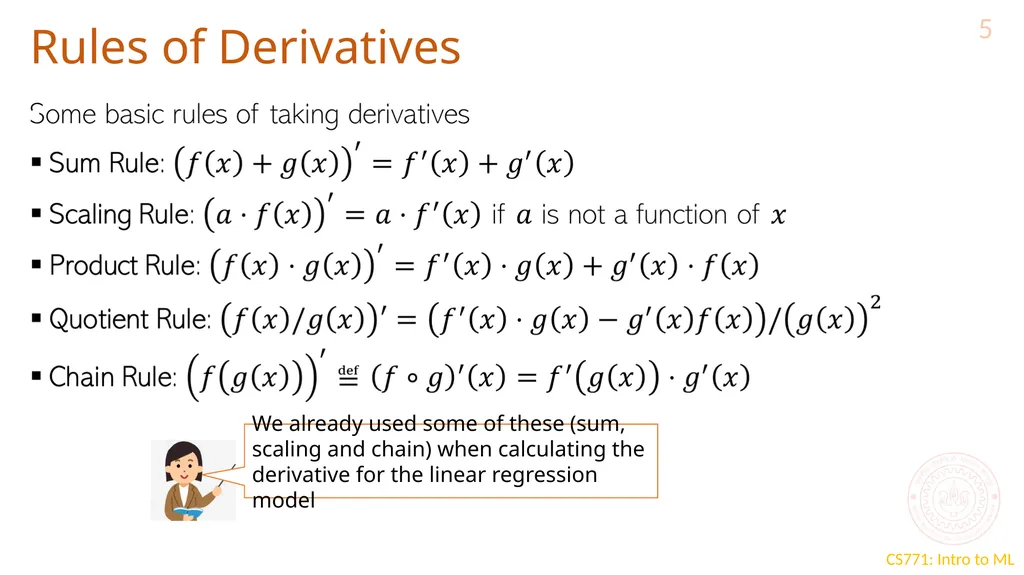
Rules of Derivatives 5 We already used some of these (sum, scaling and chain) when calculating the derivative for the linear regression model<br>
06
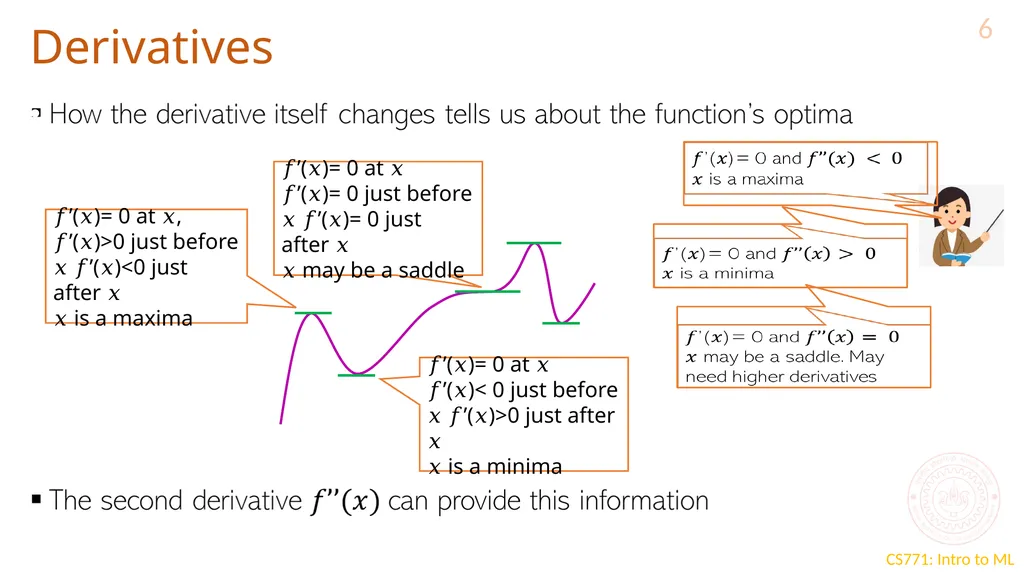
Derivatives 6 𝑓’(𝑥)= 0 at 𝑥, 𝑓’(𝑥)>0 just before 𝑥 𝑓’(𝑥)<0 just after 𝑥
𝑥 is a maxima 𝑓’(𝑥)= 0 at 𝑥
𝑓’(𝑥)< 0 just before 𝑥 𝑓’(𝑥)>0 just after 𝑥
𝑥 is a minima 𝑓’(𝑥)= 0 at 𝑥
𝑓’(𝑥)= 0 just before 𝑥 𝑓’(𝑥)= 0 just after 𝑥
𝑥 may be a saddle<br>
07
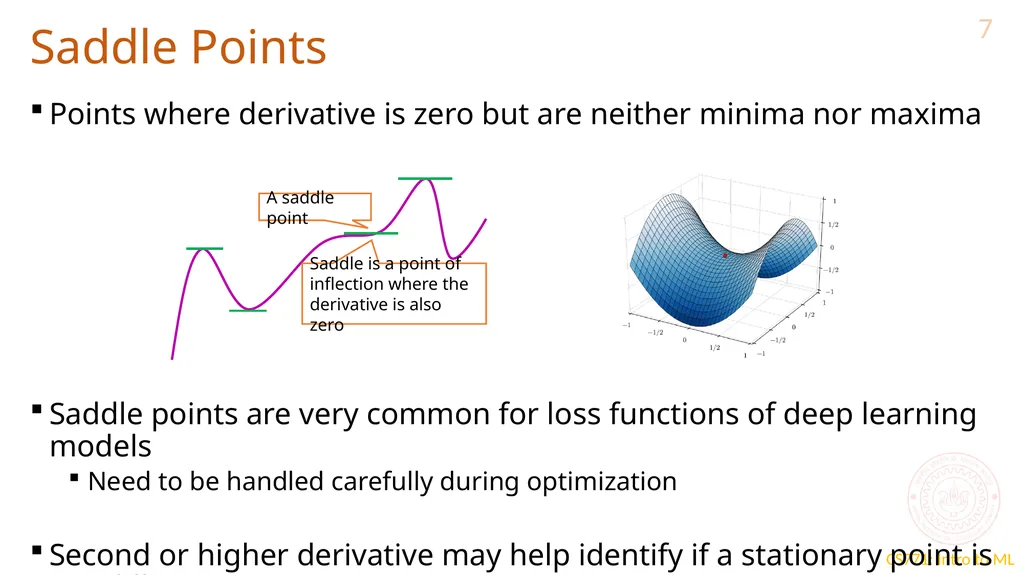
Saddle Points 7 Points where derivative is zero but are neither minima nor maxima
Saddle points are very common for loss functions of deep learning models
Need to be handled carefully during optimization
Second or higher derivative may help identify if a stationary point is a saddle Saddle is a point of inflection where the derivative is also zero A saddle point<br>
08
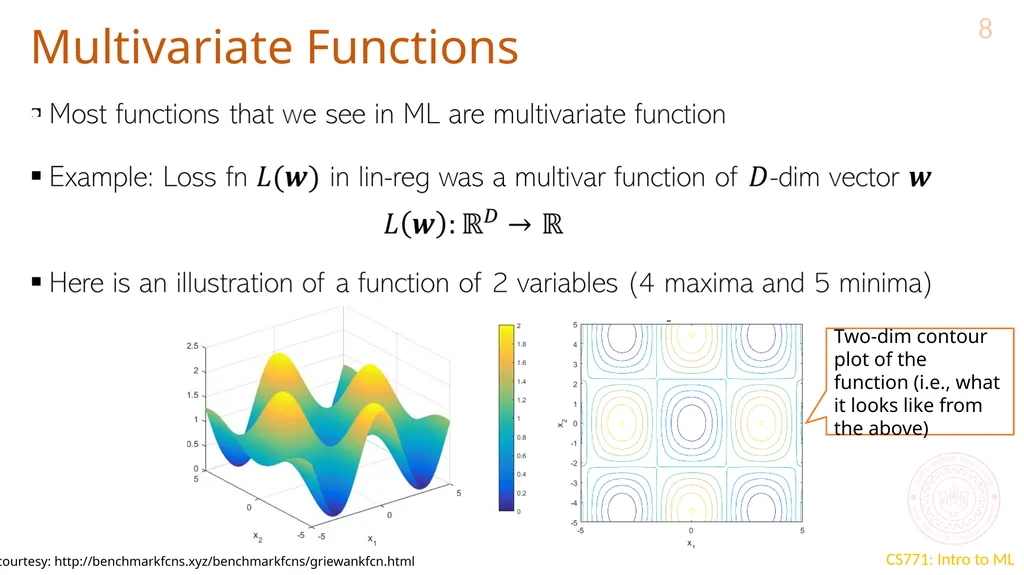
Multivariate Functions 8 Two-dim contour plot of the function (i.e., what it looks like from the above) Plot courtesy: http://benchmarkfcns.xyz/benchmarkfcns/griewankfcn.html<br>
09
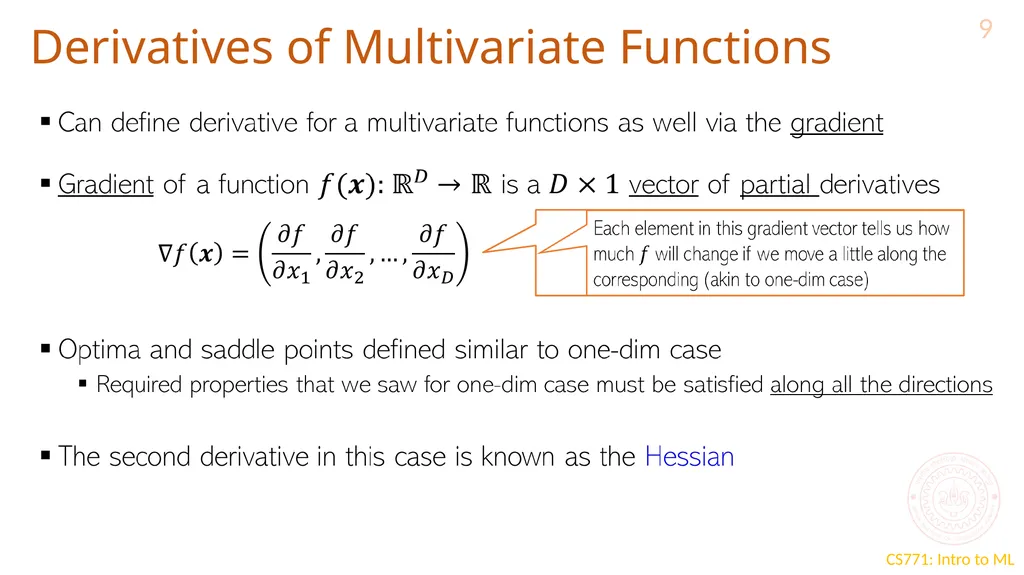
Derivatives of Multivariate Functions 9<br>
10
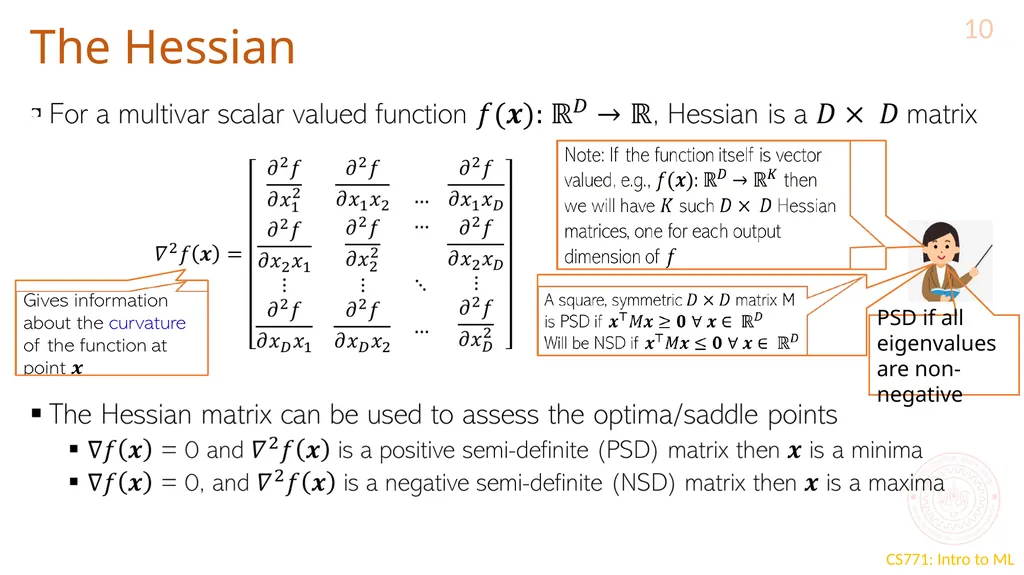
The Hessian 10 PSD if all eigenvalues are non-negative<br>
11
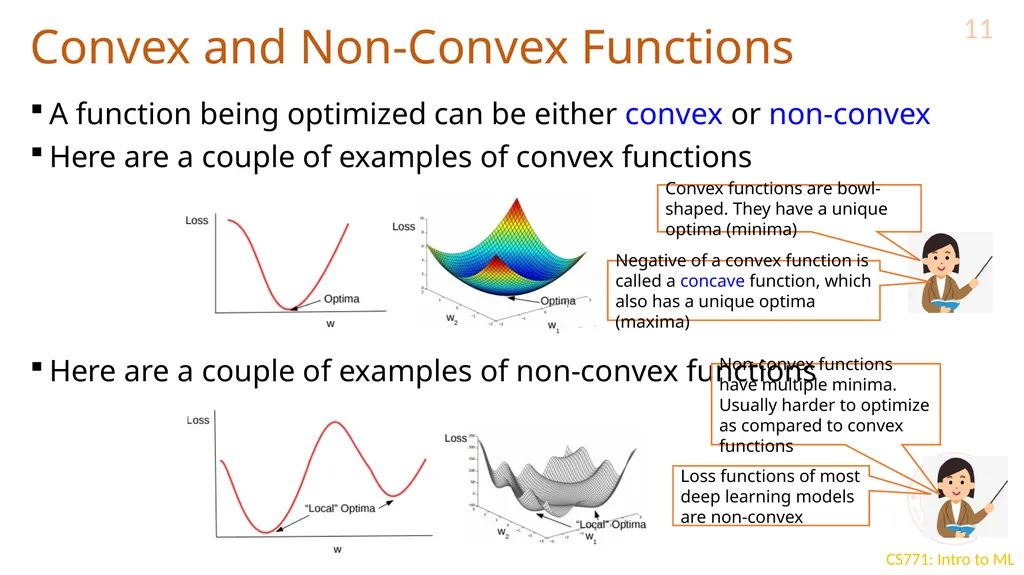
A function being optimized can be either convex or non-convex
Here are a couple of examples of convex functions
Here are a couple of examples of non-convex functions Convex and Non-Convex Functions 11 Convex functions are bowl-shaped. They have a unique optima (minima) Negative of a convex function is called a concave function, which also has a unique optima (maxima) Non-convex functions have multiple minima. Usually harder to optimize as compared to convex functions Loss functions of most deep learning models are non-convex<br>
12
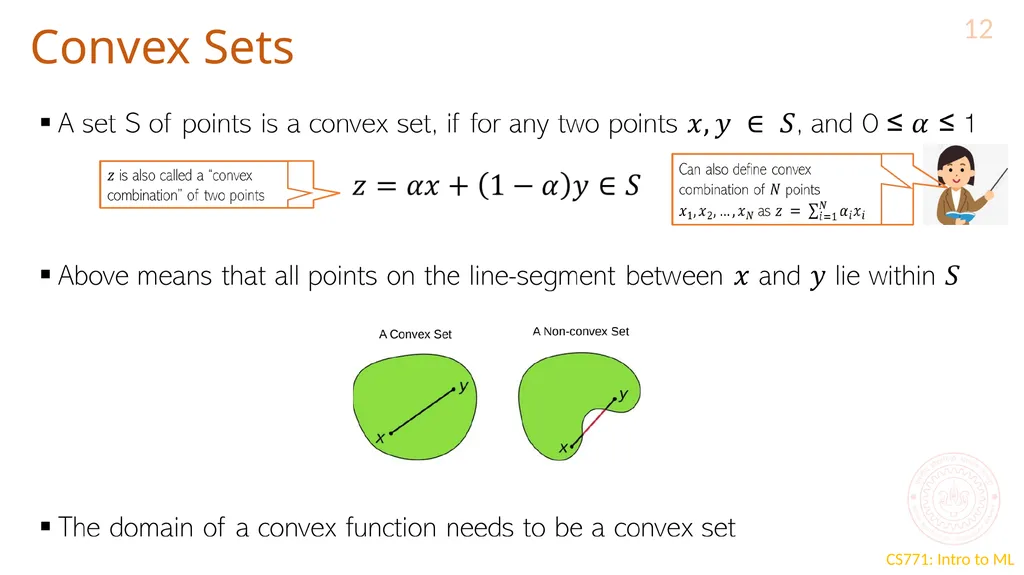
Convex Sets 12<br>
13
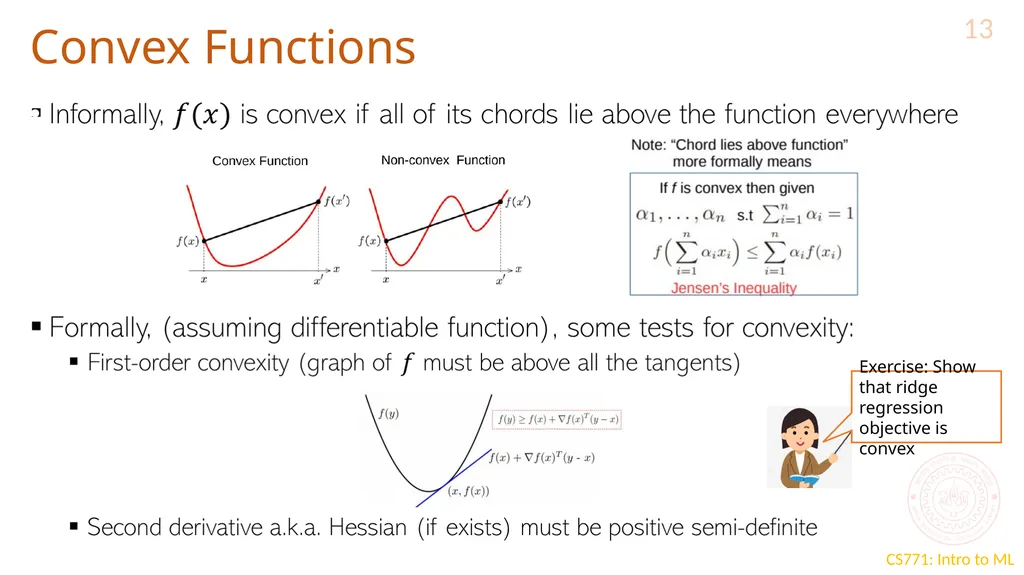
Convex Functions 13 Exercise: Show that ridge regression objective is convex<br>
14
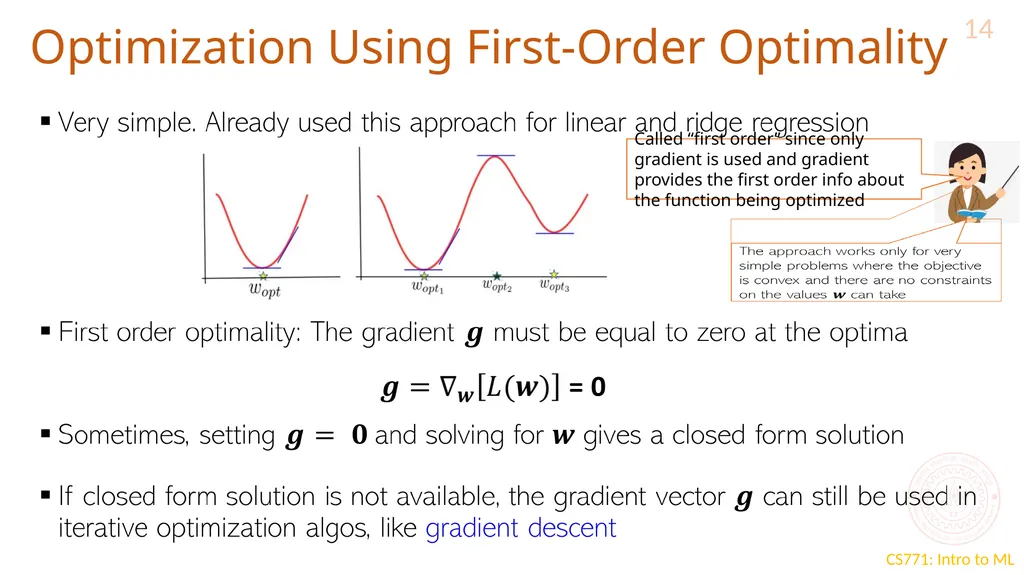
Optimization Using First-Order Optimality 14 Called “first order” since only gradient is used and gradient provides the first order info about the function being optimized<br>
15
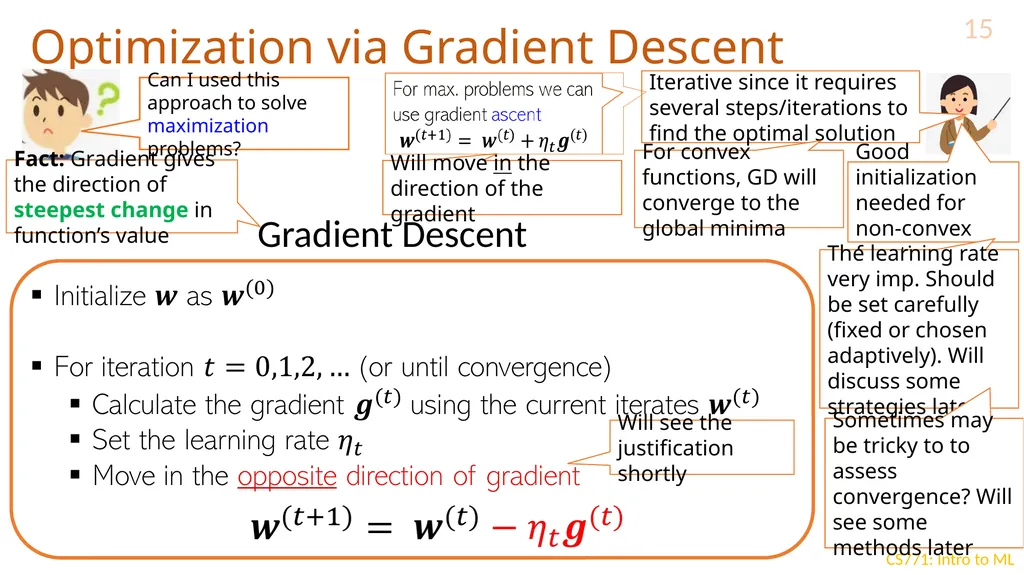
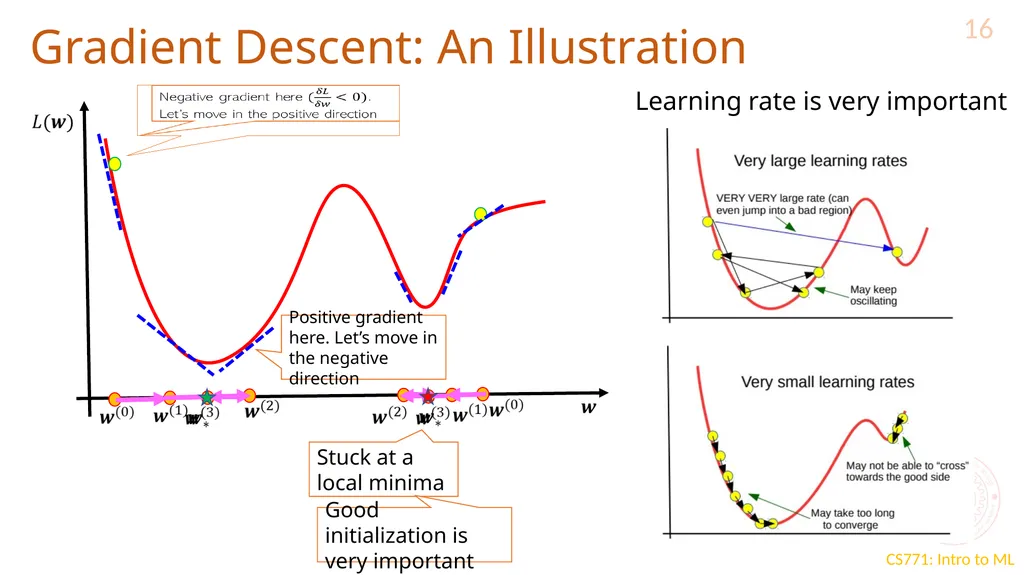
Optimization via Gradient Descent 15 Gradient Descent Can I used this approach to solve maximization problems? Iterative since it requires several steps/iterations to find the optimal solution For convex functions, GD will converge to the global minima Good initialization needed for non-convex functions The learning rate very imp. Should be set carefully (fixed or chosen adaptively). Will discuss some strategies later Will move in the direction of the gradient Will see the justification shortly Sometimes may be tricky to to assess convergence? Will see some methods later Fact: Gradient gives the direction of steepest change in function’s value<br>
16
Gradient Descent: An Illustration 16 Stuck at a local minima Positive gradient here. Let’s move in the negative direction Learning rate is very important Good initialization is very important<br>
17
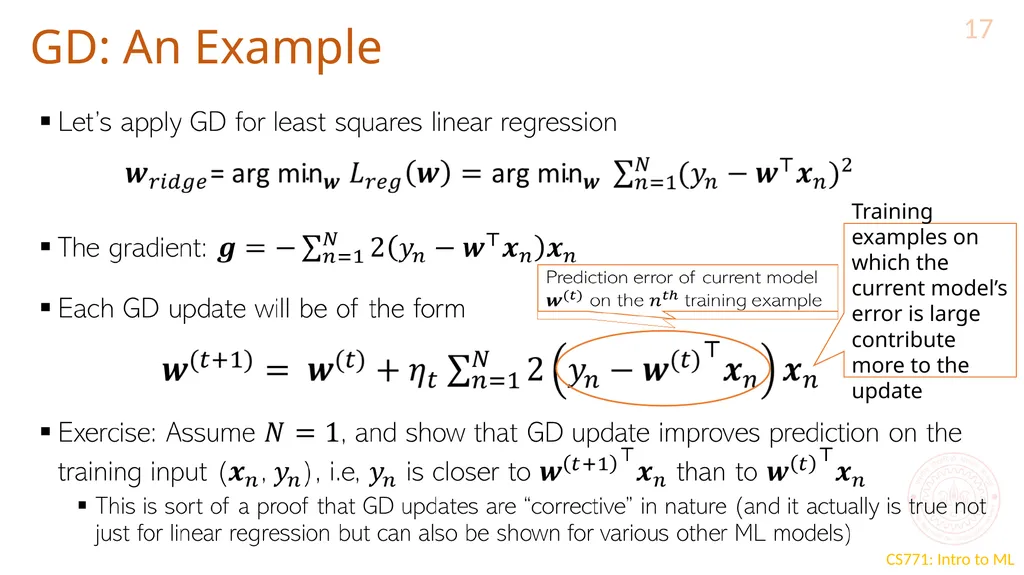
GD: An Example 17 Training examples on which the current model’s error is large contribute more to the update<br>
18
Coming up next 18 Gradients when the function is non-differentiable
Solving optimization problems
Iterative optimization algorithms, such as gradient descent and its variants<br>