
Sources of error CS771: Introduction to Machine


Description: Sources of error CS771: Introduction to Machine Learning Nisheeth Understanding error in machine learning Cross-validation Learning with Decision Trees Plan for today 2 Hyperparameter Selection 3 Generalization How well does a learned model
Related Topics
Download Presentation
"Sources of error CS771: Introduction to Machine" is the property of its rightful owner. Permission is granted to download and print the materials on this website for personal, non-commercial use only, and to display it on your personal computer provided you do not modify the materials and that you retain all copyright notices contained in the materials. By downloading content from our website, you accept the terms of this agreement.
Presentation Transcript
slide1. Sources of error CS771: Introduction to Machine Learning
Nisheeth<br>
slide2. Understanding error in machine learning
Cross-validation
Learning with Decision Trees Plan for today 2<br>
slide3. Hyperparameter Selection 3<br>
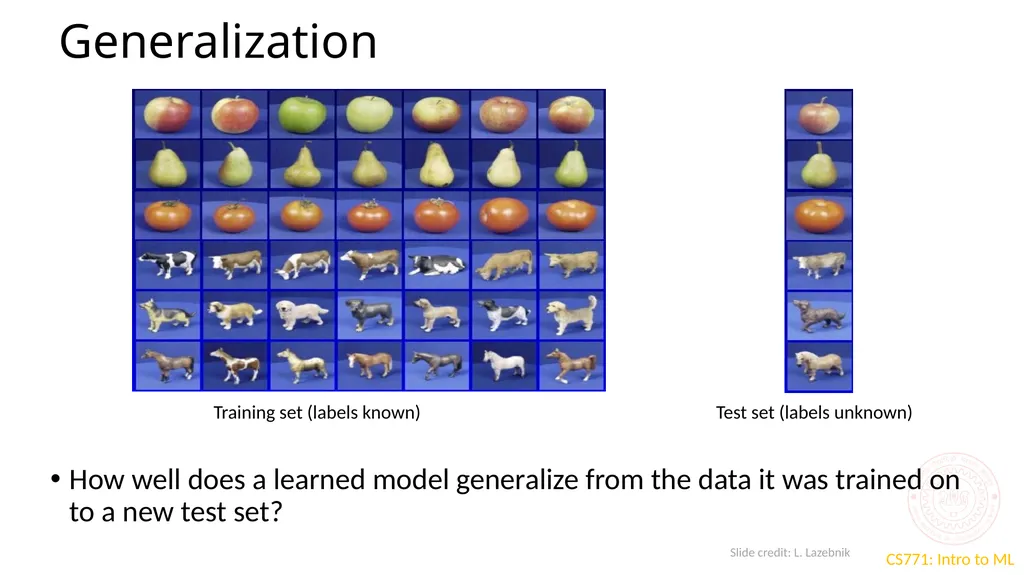
slide4. Generalization How well does a learned model generalize from the data it was trained on to a new test set? Training set (labels known) Test set (labels unknown) Slide credit: L. Lazebnik<br>
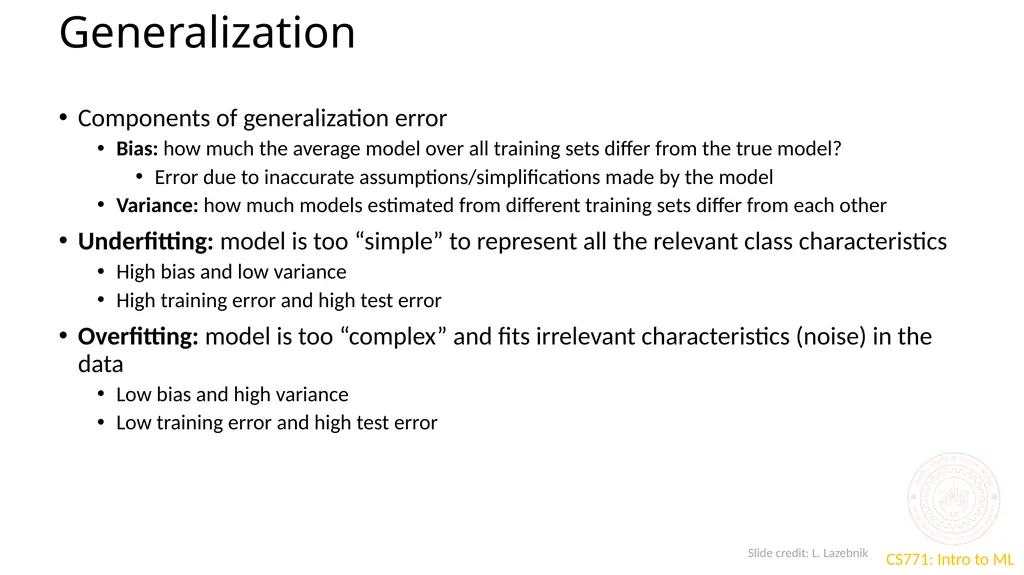
slide5. Generalization Components of generalization error
Bias: how much the average model over all training sets differ from the true model?
Error due to inaccurate assumptions/simplifications made by the model
Variance: how much models estimated from different training sets differ from each other
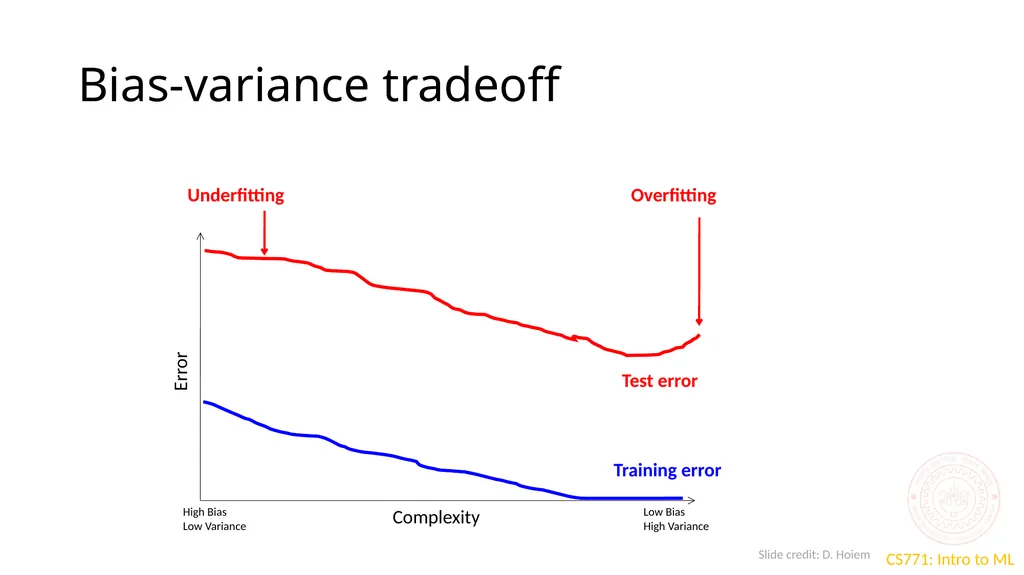
Underfitting: model is too “simple” to represent all the relevant class characteristics
High bias and low variance
High training error and high test error
Overfitting: model is too “complex” and fits irrelevant characteristics (noise) in the data
Low bias and high variance
Low training error and high test error Slide credit: L. Lazebnik<br>
slide6. No Free Lunch Theorem Slide credit: D. Hoiem<br>
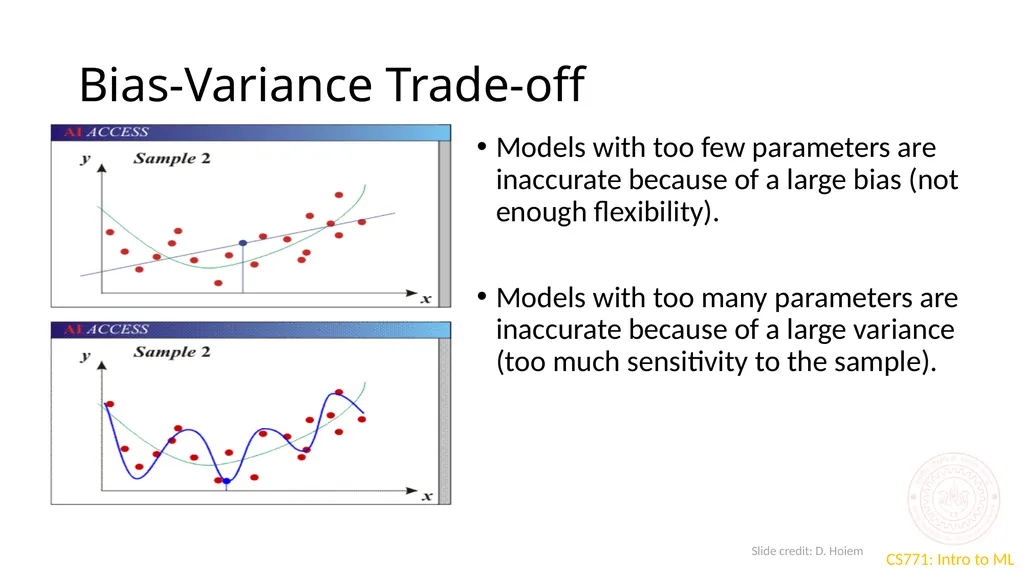
slide7. Bias-Variance Trade-off Models with too few parameters are inaccurate because of a large bias (not enough flexibility).
Models with too many parameters are inaccurate because of a large variance (too much sensitivity to the sample). Slide credit: D. Hoiem<br>
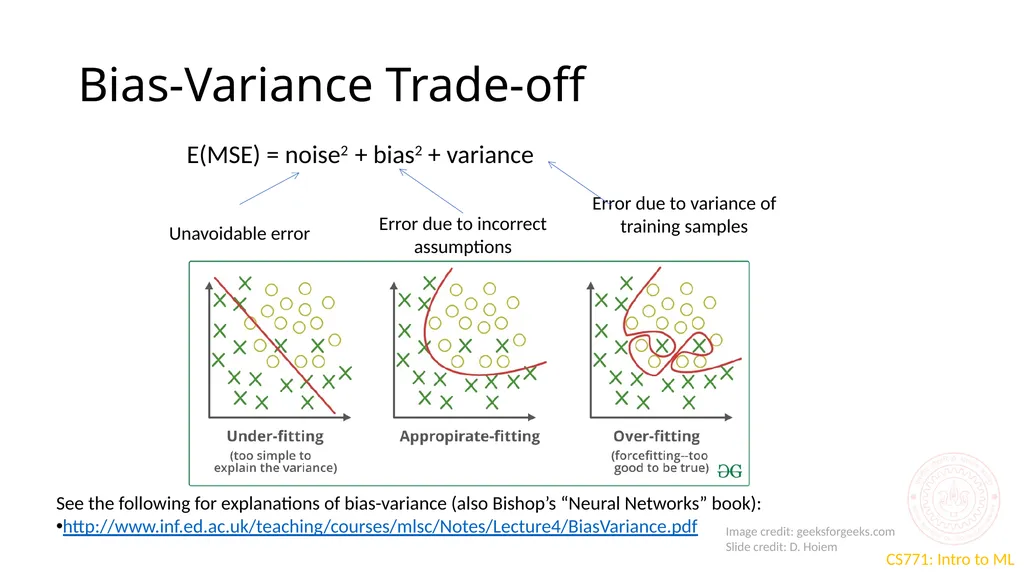
slide8. Bias-Variance Trade-off E(MSE) = noise2 + bias2 + variance See the following for explanations of bias-variance (also Bishop’s “Neural Networks” book):
http://www.inf.ed.ac.uk/teaching/courses/mlsc/Notes/Lecture4/BiasVariance.pdf Unavoidable error Error due to incorrect assumptions Error due to variance of training samples Image credit: geeksforgeeks.com
Slide credit: D. Hoiem<br>
slide9. Bias-variance tradeoff Training error Test error Underfitting Overfitting Slide credit: D. Hoiem<br>
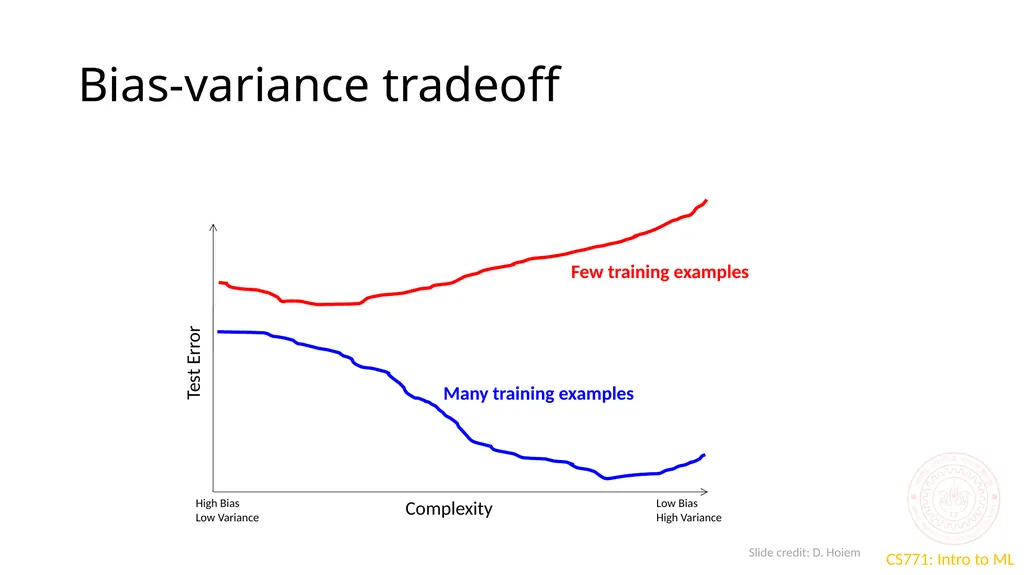
slide10. Bias-variance tradeoff Many training examples Few training examples Slide credit: D. Hoiem<br>
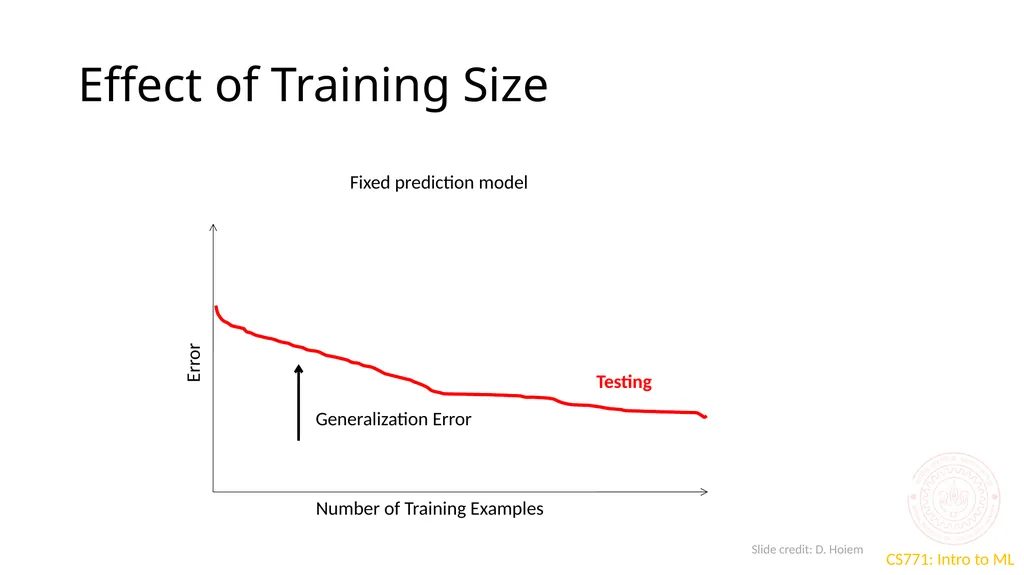
slide11. Effect of Training Size Testing Training Generalization Error Fixed prediction model Slide credit: D. Hoiem<br>
slide12. The perfect classification algorithm Objective function: encodes the right loss for the problem
Parameterization: makes assumptions that fit the problem
Regularization: right level of regularization for amount of training data
Training algorithm: can find parameters that maximize objective on training set
Inference algorithm: can solve for objective function in evaluation Slide credit: D. Hoiem<br>
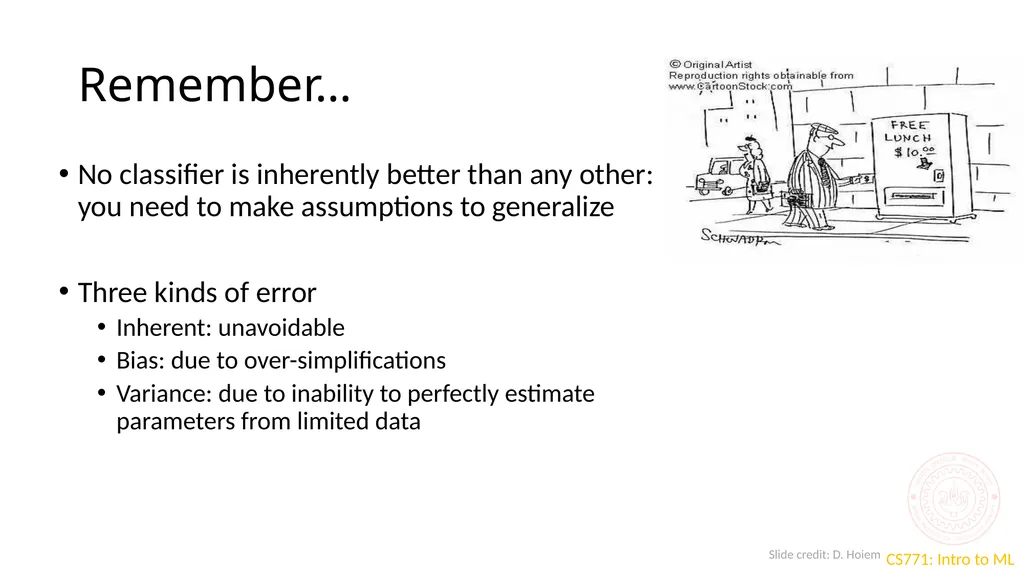
slide13. Remember… No classifier is inherently better than any other: you need to make assumptions to generalize
Three kinds of error
Inherent: unavoidable
Bias: due to over-simplifications
Variance: due to inability to perfectly estimate parameters from limited data Slide credit: D. Hoiem<br>
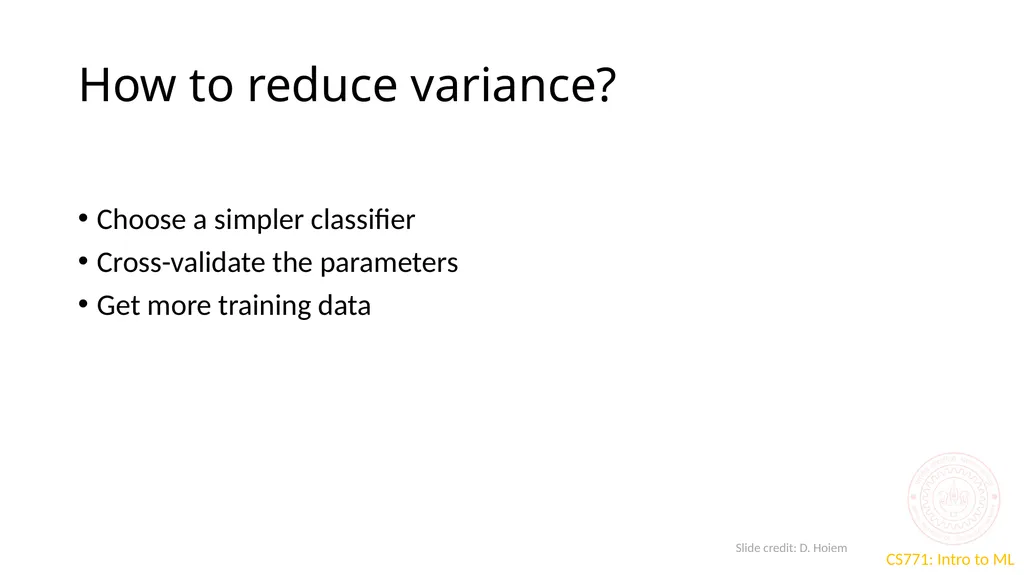
slide14. How to reduce variance? Choose a simpler classifier
Cross-validate the parameters
Get more training data Slide credit: D. Hoiem<br>
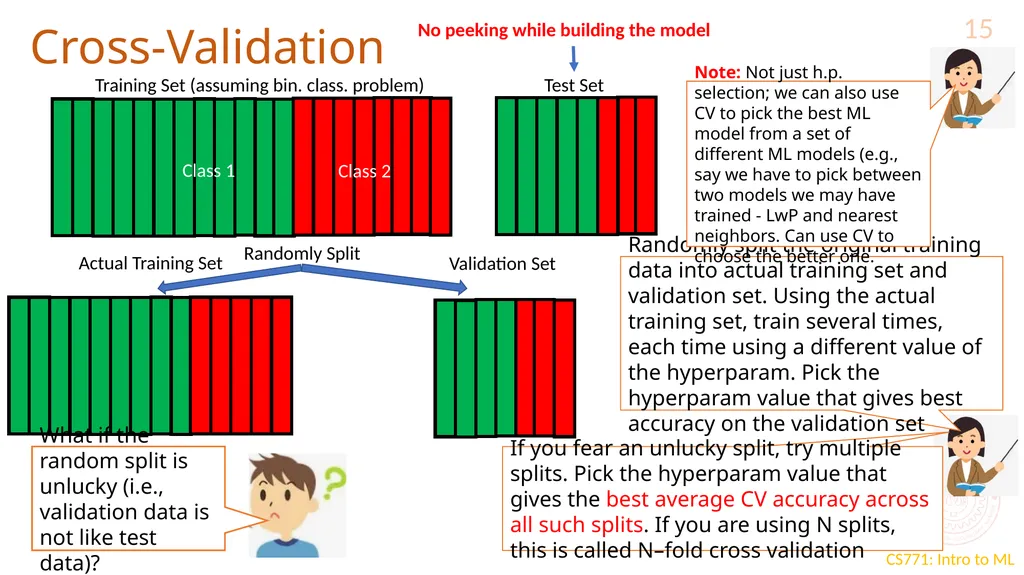
slide15. Cross-Validation 15 Randomly Split Test Set Validation Set Actual Training Set Training Set (assuming bin. class. problem) Randomly split the original training data into actual training set and validation set. Using the actual training set, train several times, each time using a different value of the hyperparam. Pick the hyperparam value that gives best accuracy on the validation set What if the random split is unlucky (i.e., validation data is not like test data)? If you fear an unlucky split, try multiple splits. Pick the hyperparam value that gives the best average CV accuracy across all such splits. If you are using N splits, this is called N–fold cross validation No peeking while building the model Note: Not just h.p. selection; we can also use CV to pick the best ML model from a set of different ML models (e.g., say we have to pick between two models we may have trained - LwP and nearest neighbors. Can use CV to choose the better one. Class 1 Class 2<br>
Nisheeth<br>
slide2. Understanding error in machine learning
Cross-validation
Learning with Decision Trees Plan for today 2<br>
slide3. Hyperparameter Selection 3<br>
slide4. Generalization How well does a learned model generalize from the data it was trained on to a new test set? Training set (labels known) Test set (labels unknown) Slide credit: L. Lazebnik<br>
slide5. Generalization Components of generalization error
Bias: how much the average model over all training sets differ from the true model?
Error due to inaccurate assumptions/simplifications made by the model
Variance: how much models estimated from different training sets differ from each other
Underfitting: model is too “simple” to represent all the relevant class characteristics
High bias and low variance
High training error and high test error
Overfitting: model is too “complex” and fits irrelevant characteristics (noise) in the data
Low bias and high variance
Low training error and high test error Slide credit: L. Lazebnik<br>
slide6. No Free Lunch Theorem Slide credit: D. Hoiem<br>
slide7. Bias-Variance Trade-off Models with too few parameters are inaccurate because of a large bias (not enough flexibility).
Models with too many parameters are inaccurate because of a large variance (too much sensitivity to the sample). Slide credit: D. Hoiem<br>
slide8. Bias-Variance Trade-off E(MSE) = noise2 + bias2 + variance See the following for explanations of bias-variance (also Bishop’s “Neural Networks” book):
http://www.inf.ed.ac.uk/teaching/courses/mlsc/Notes/Lecture4/BiasVariance.pdf Unavoidable error Error due to incorrect assumptions Error due to variance of training samples Image credit: geeksforgeeks.com
Slide credit: D. Hoiem<br>
slide9. Bias-variance tradeoff Training error Test error Underfitting Overfitting Slide credit: D. Hoiem<br>
slide10. Bias-variance tradeoff Many training examples Few training examples Slide credit: D. Hoiem<br>
slide11. Effect of Training Size Testing Training Generalization Error Fixed prediction model Slide credit: D. Hoiem<br>
slide12. The perfect classification algorithm Objective function: encodes the right loss for the problem
Parameterization: makes assumptions that fit the problem
Regularization: right level of regularization for amount of training data
Training algorithm: can find parameters that maximize objective on training set
Inference algorithm: can solve for objective function in evaluation Slide credit: D. Hoiem<br>
slide13. Remember… No classifier is inherently better than any other: you need to make assumptions to generalize
Three kinds of error
Inherent: unavoidable
Bias: due to over-simplifications
Variance: due to inability to perfectly estimate parameters from limited data Slide credit: D. Hoiem<br>
slide14. How to reduce variance? Choose a simpler classifier
Cross-validate the parameters
Get more training data Slide credit: D. Hoiem<br>
slide15. Cross-Validation 15 Randomly Split Test Set Validation Set Actual Training Set Training Set (assuming bin. class. problem) Randomly split the original training data into actual training set and validation set. Using the actual training set, train several times, each time using a different value of the hyperparam. Pick the hyperparam value that gives best accuracy on the validation set What if the random split is unlucky (i.e., validation data is not like test data)? If you fear an unlucky split, try multiple splits. Pick the hyperparam value that gives the best average CV accuracy across all such splits. If you are using N splits, this is called N–fold cross validation No peeking while building the model Note: Not just h.p. selection; we can also use CV to pick the best ML model from a set of different ML models (e.g., say we have to pick between two models we may have trained - LwP and nearest neighbors. Can use CV to choose the better one. Class 1 Class 2<br>