
Panel to Panel Transitions in Comics With examples
Description: Panel to Panel Transitions in Comics With examples from: THe Magic Fish by Trung Le Nguyen Panel to Panel Transitions According to Scott McCloud there are six basic types of panel to panel transitions found in comics: Moment to Moment
Related Topics
Download Presentation
"Panel to Panel Transitions in Comics With examples" is the property of its rightful owner. Permission is granted to download and print the materials on this website for personal, non-commercial use only, and to display it on your personal computer provided you do not modify the materials and that you retain all copyright notices contained in the materials. By downloading content from our website, you accept the terms of this agreement.
Presentation Transcript
slide1. Panel to Panel Transitions in Comics With examples from:
THe Magic Fish
by Trung Le Nguyen<br>
slide2. Panel to Panel Transitions According to Scott McCloud* there are six basic types of panel to panel transitions found in comics:
Moment to Moment
Action to Action
Subject to Subject
Scene to Scene
Aspect to Aspect
Non Sequitur
*See Scott McCloud’s book Understanding Comics pages 70-89 for information on transitions. See Scott McCloud’s book Making Comics pages 15-17 for information on transitions.<br>
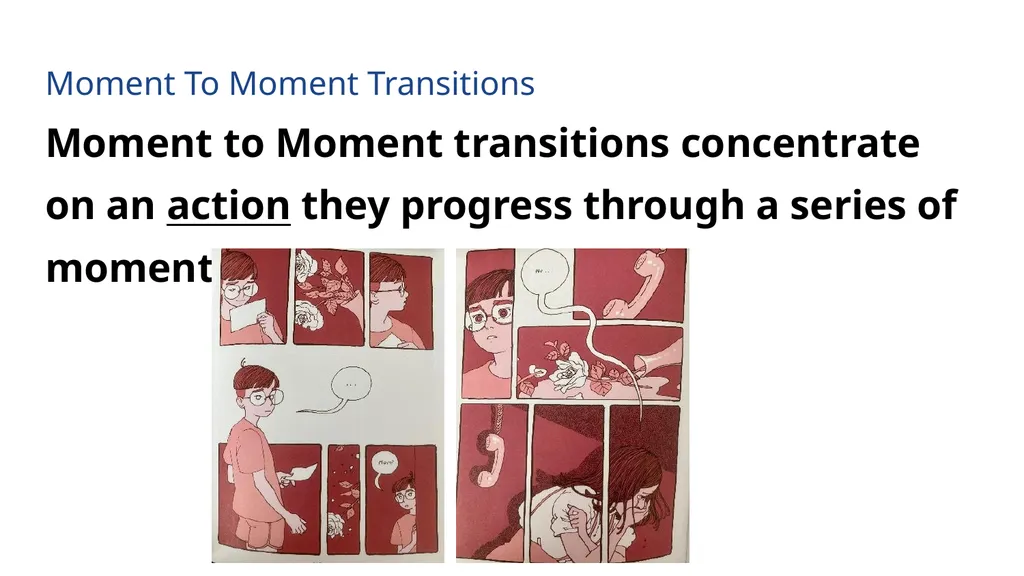
slide3. Moment To Moment Transitions Moment to Moment transitions concentrate on an action they progress through a series of moments.<br>
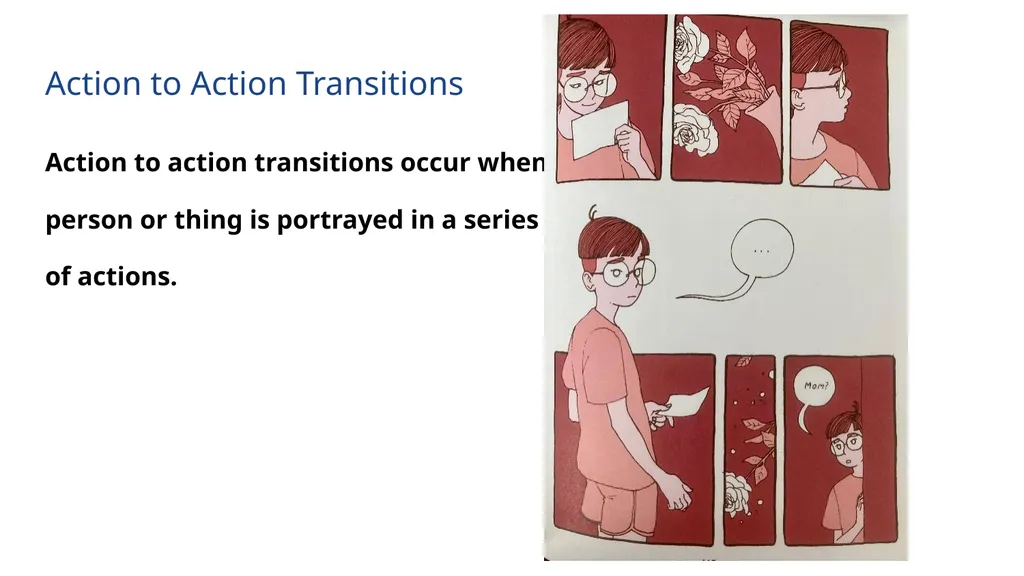
slide4. Action to Action Transitions Action to action transitions occur when
person or thing is portrayed in a series
of actions.<br>
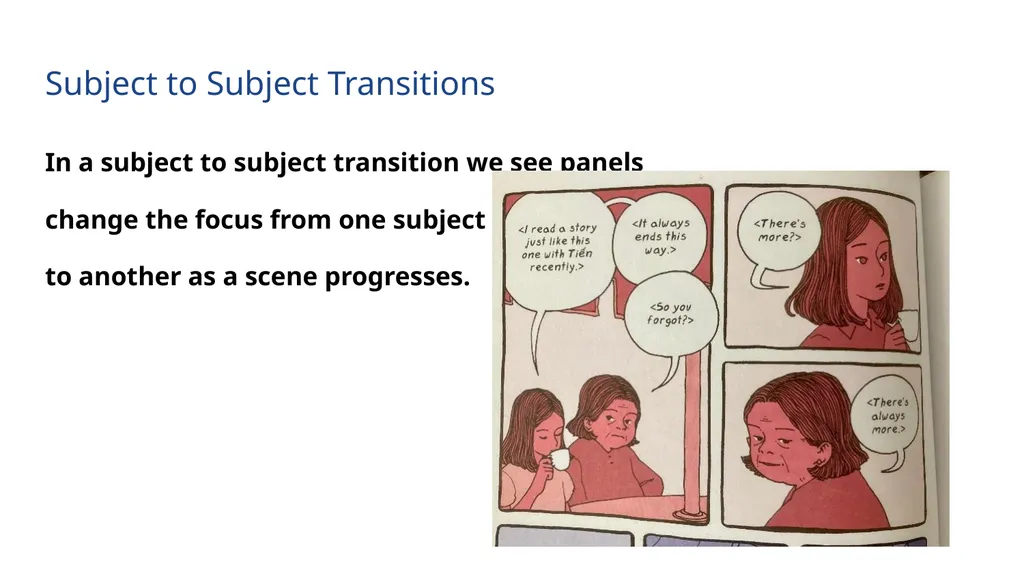
slide5. Subject to Subject Transitions In a subject to subject transition we see panels
change the focus from one subject
to another as a scene progresses.<br>
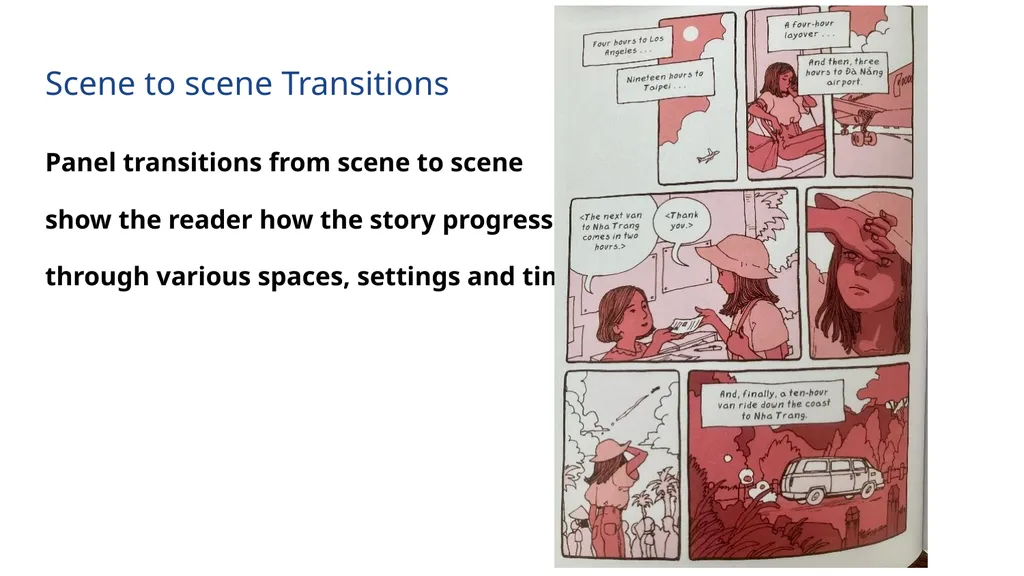
slide6. Scene to scene Transitions Panel transitions from scene to scene
show the reader how the story progresses
through various spaces, settings and times.<br>
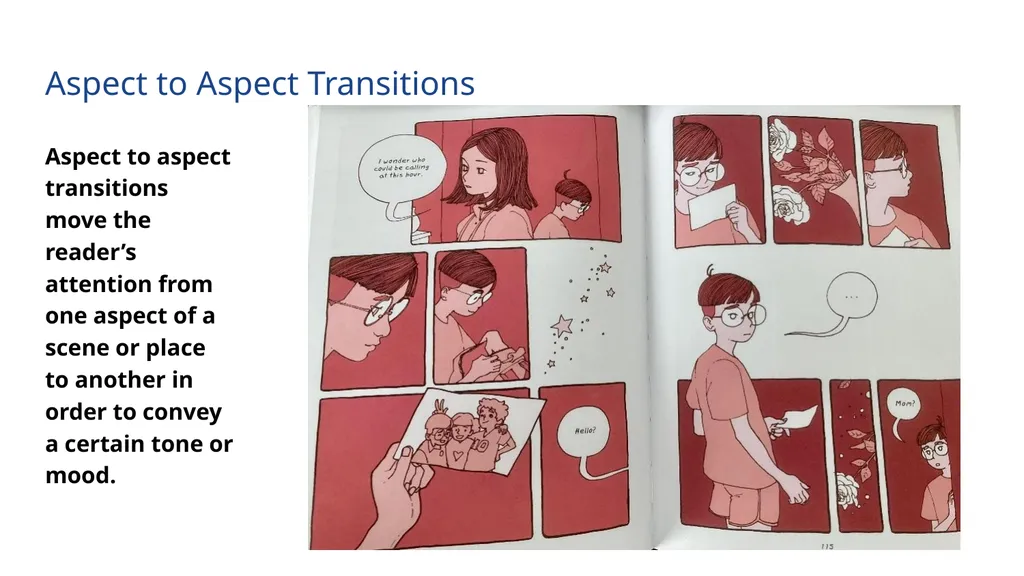
slide7. Aspect to Aspect Transitions Aspect to aspect transitions move the reader’s attention from one aspect of a scene or place to another in order to convey a certain tone or mood.<br>
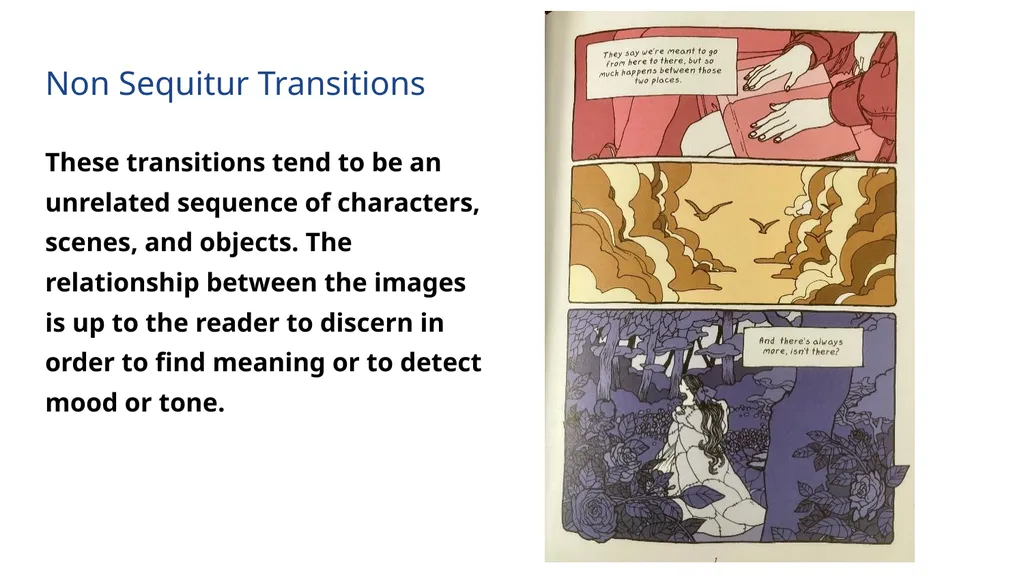
slide8. Non Sequitur Transitions These transitions tend to be an unrelated sequence of characters, scenes, and objects. The relationship between the images is up to the reader to discern in order to find meaning or to detect mood or tone.<br>
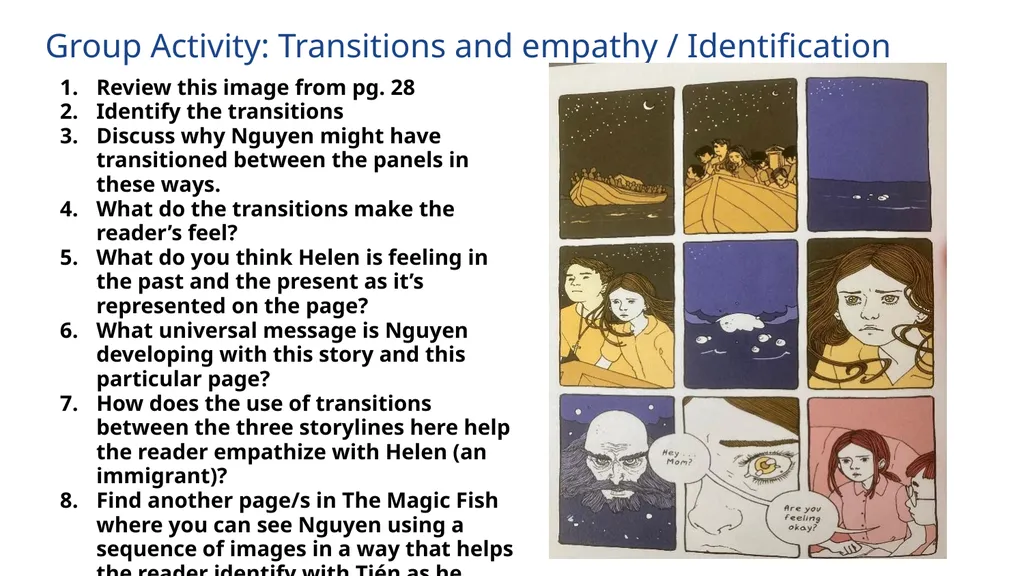
slide9. Group Activity: Transitions and empathy / Identification Review this image from pg. 28
Identify the transitions
Discuss why Nguyen might have transitioned between the panels in these ways.
What do the transitions make the reader’s feel?
What do you think Helen is feeling in the past and the present as it’s represented on the page?
What universal message is Nguyen developing with this story and this particular page?
How does the use of transitions between the three storylines here help the reader empathize with Helen (an immigrant)?
Find another page/s in The Magic Fish where you can see Nguyen using a sequence of images in a way that helps the reader identify with Tién as he struggles with his sexuality.<br>
THe Magic Fish
by Trung Le Nguyen<br>
slide2. Panel to Panel Transitions According to Scott McCloud* there are six basic types of panel to panel transitions found in comics:
Moment to Moment
Action to Action
Subject to Subject
Scene to Scene
Aspect to Aspect
Non Sequitur
*See Scott McCloud’s book Understanding Comics pages 70-89 for information on transitions. See Scott McCloud’s book Making Comics pages 15-17 for information on transitions.<br>
slide3. Moment To Moment Transitions Moment to Moment transitions concentrate on an action they progress through a series of moments.<br>
slide4. Action to Action Transitions Action to action transitions occur when
person or thing is portrayed in a series
of actions.<br>
slide5. Subject to Subject Transitions In a subject to subject transition we see panels
change the focus from one subject
to another as a scene progresses.<br>
slide6. Scene to scene Transitions Panel transitions from scene to scene
show the reader how the story progresses
through various spaces, settings and times.<br>
slide7. Aspect to Aspect Transitions Aspect to aspect transitions move the reader’s attention from one aspect of a scene or place to another in order to convey a certain tone or mood.<br>
slide8. Non Sequitur Transitions These transitions tend to be an unrelated sequence of characters, scenes, and objects. The relationship between the images is up to the reader to discern in order to find meaning or to detect mood or tone.<br>
slide9. Group Activity: Transitions and empathy / Identification Review this image from pg. 28
Identify the transitions
Discuss why Nguyen might have transitioned between the panels in these ways.
What do the transitions make the reader’s feel?
What do you think Helen is feeling in the past and the present as it’s represented on the page?
What universal message is Nguyen developing with this story and this particular page?
How does the use of transitions between the three storylines here help the reader empathize with Helen (an immigrant)?
Find another page/s in The Magic Fish where you can see Nguyen using a sequence of images in a way that helps the reader identify with Tién as he struggles with his sexuality.<br>