Pathway Guide Polycystic Ovarian syndrome in adults and in adolescents Initial Presentation in Primary Care Delayed or less frequent periodsmenarchecycle lengthduration of complaint(s)cycle lengthheaviness of bleedingLMP -
"Pathway Guide – Polycystic Ovarian syndrome in" is the property of its rightful owner. Permission is granted to
download and print the materials on this website for personal, non-commercial use only, and to display it
on your personal computer provided you do not modify the materials and that you retain all copyright
notices contained in the materials. By downloading content from our website, you accept the terms of this
agreement.
Presentation Transcript
01
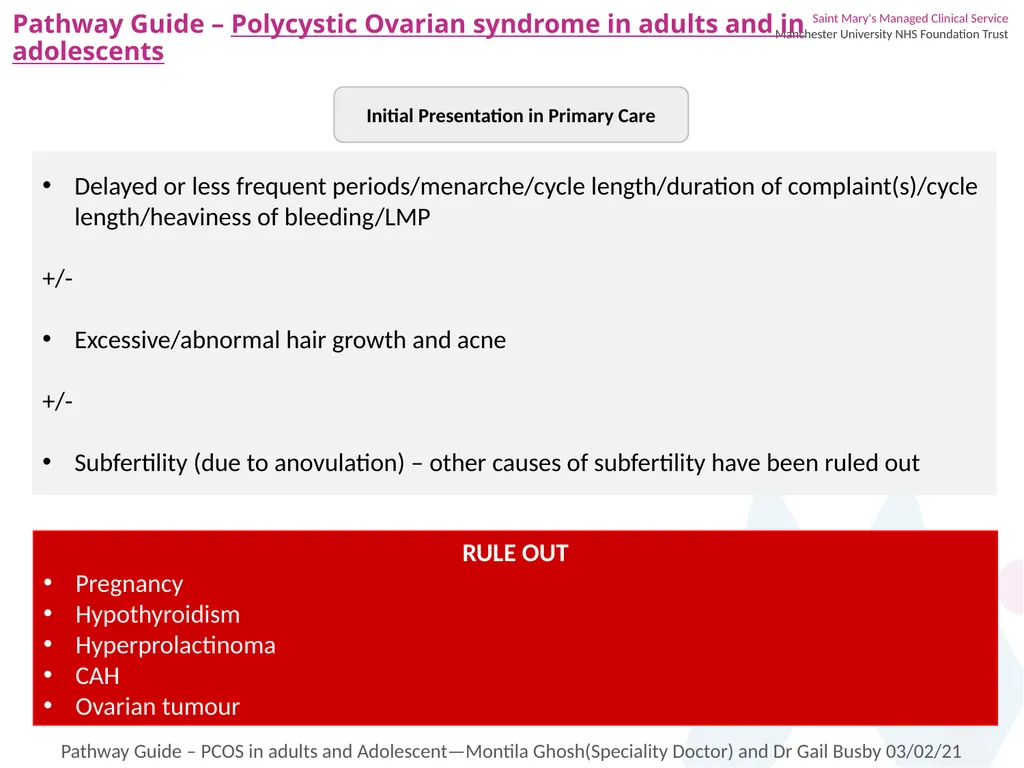
Pathway Guide – Polycystic Ovarian syndrome in adults and in adolescents Initial Presentation in Primary Care Delayed or less frequent periods/menarche/cycle length/duration of complaint(s)/cycle length/heaviness of bleeding/LMP
+/-
Excessive/abnormal hair growth and acne
+/-
Subfertility (due to anovulation) – other causes of subfertility have been ruled out RULE OUT
Pregnancy
Hypothyroidism
Hyperprolactinoma
CAH
Ovarian tumour Pathway Guide – PCOS in adults and Adolescent—Montila Ghosh(Speciality Doctor) and Dr Gail Busby 03/02/21<br>
02
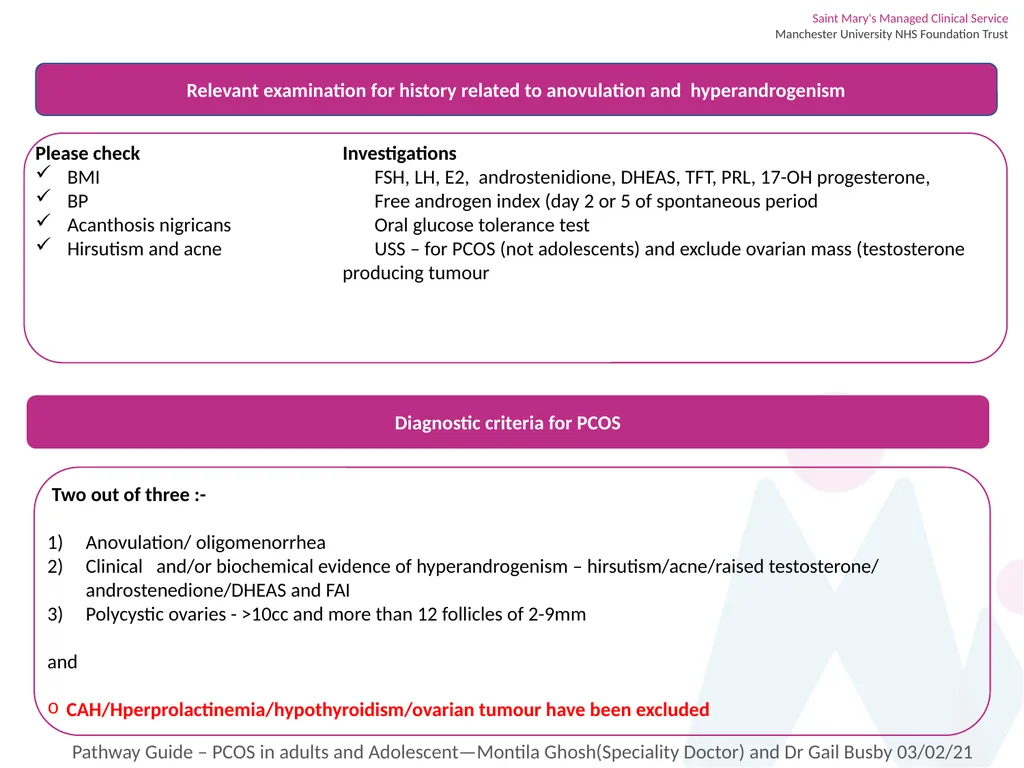
Two out of three :-
Anovulation/ oligomenorrhea
Clinical and/or biochemical evidence of hyperandrogenism – hirsutism/acne/raised testosterone/ androstenedione/DHEAS and FAI
Polycystic ovaries - >10cc and more than 12 follicles of 2-9mm
and
CAH/Hperprolactinemia/hypothyroidism/ovarian tumour have been excluded Relevant examination for history related to anovulation and hyperandrogenism Please check Investigations
BMI FSH, LH, E2, androstenidione, DHEAS, TFT, PRL, 17-OH progesterone,
BP Free androgen index (day 2 or 5 of spontaneous period
Acanthosis nigricans Oral glucose tolerance test
Hirsutism and acne USS – for PCOS (not adolescents) and exclude ovarian mass (testosterone
producing tumour Diagnostic criteria for PCOS Pathway Guide – PCOS in adults and Adolescent—Montila Ghosh(Speciality Doctor) and Dr Gail Busby 03/02/21<br>
03
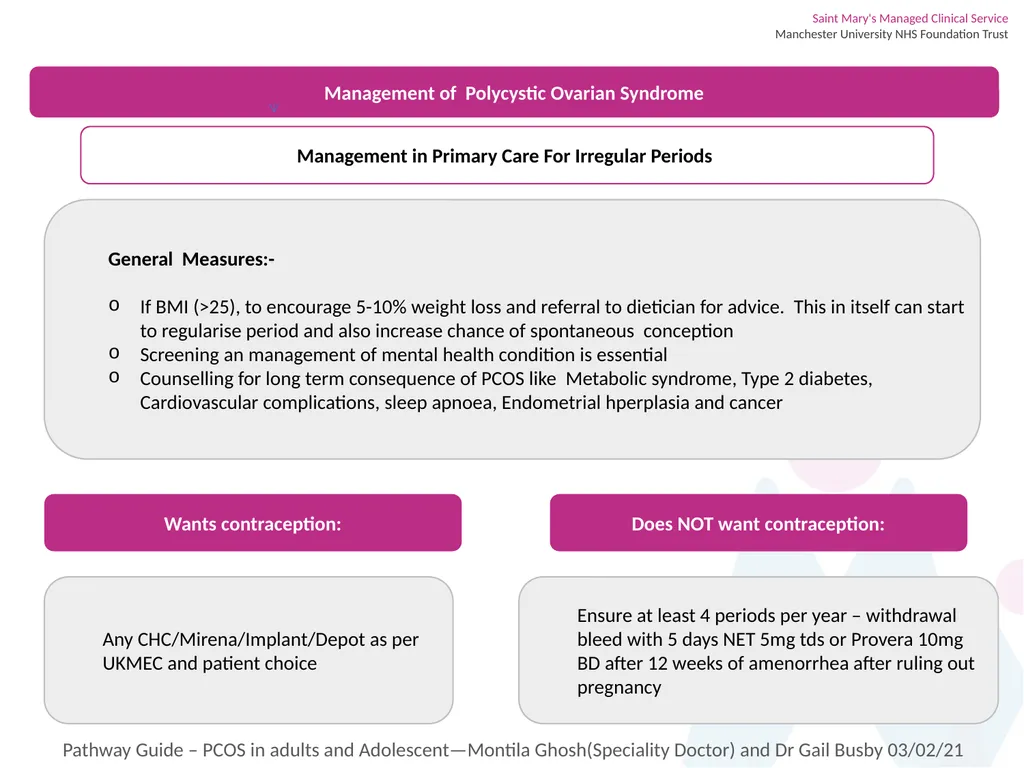
Management in Primary Care For Irregular Periods General Measures:-
If BMI (>25), to encourage 5-10% weight loss and referral to dietician for advice. This in itself can start to regularise period and also increase chance of spontaneous conception
Screening an management of mental health condition is essential
Counselling for long term consequence of PCOS like Metabolic syndrome, Type 2 diabetes, Cardiovascular complications, sleep apnoea, Endometrial hperplasia and cancer Ensure at least 4 periods per year – withdrawal bleed with 5 days NET 5mg tds or Provera 10mg BD after 12 weeks of amenorrhea after ruling out pregnancy Management of Polycystic Ovarian Syndrome Any CHC/Mirena/Implant/Depot as per UKMEC and patient choice Wants contraception: Does NOT want contraception: Pathway Guide – PCOS in adults and Adolescent—Montila Ghosh(Speciality Doctor) and Dr Gail Busby 03/02/21<br>
04
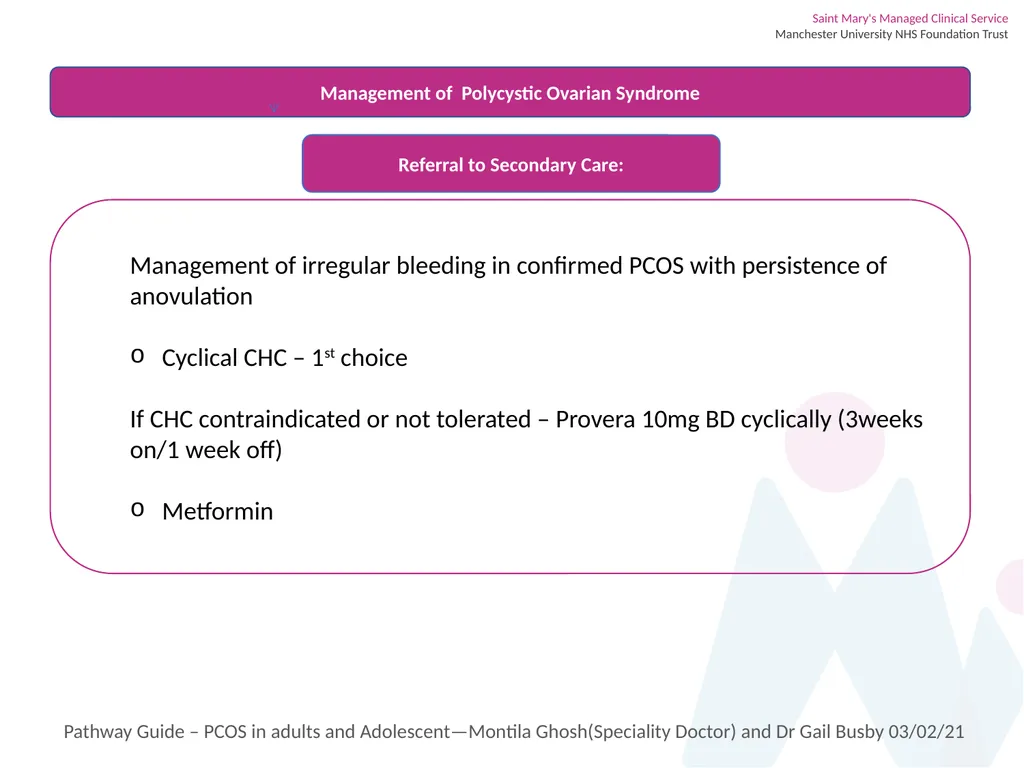
Management of irregular bleeding in confirmed PCOS with persistence of anovulation
Cyclical CHC – 1st choice
If CHC contraindicated or not tolerated – Provera 10mg BD cyclically (3weeks on/1 week off)
Metformin Referral to Secondary Care: Management of Polycystic Ovarian Syndrome Pathway Guide – PCOS in adults and Adolescent—Montila Ghosh(Speciality Doctor) and Dr Gail Busby 03/02/21<br>
05
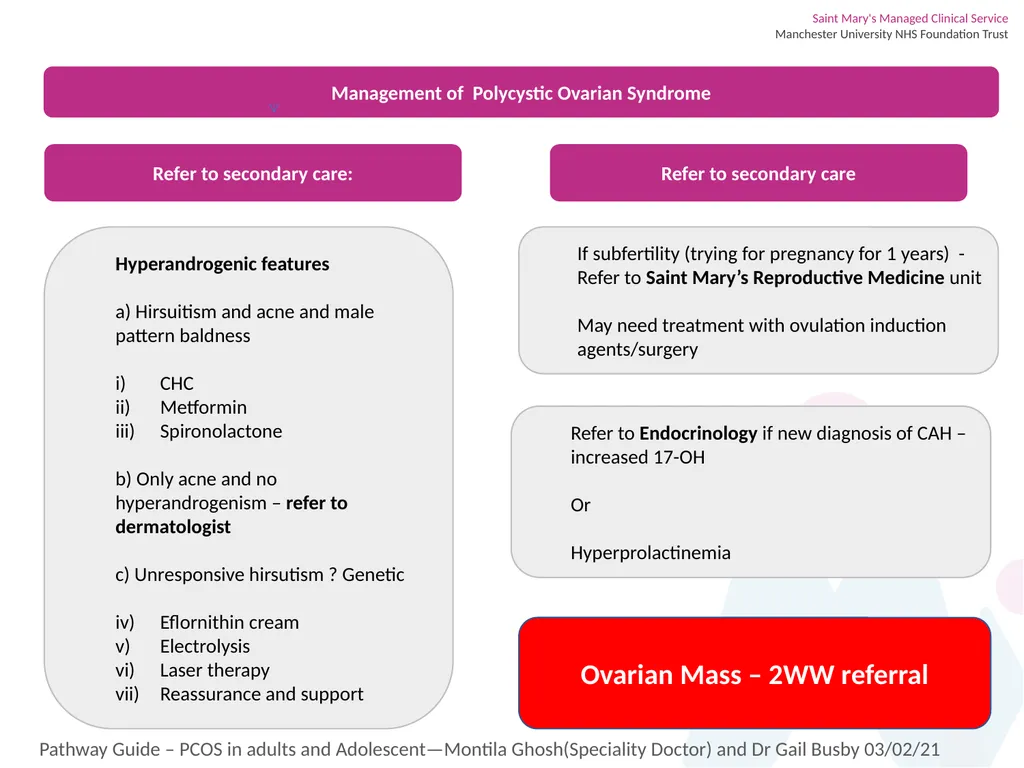
If subfertility (trying for pregnancy for 1 years) - Refer to Saint Mary’s Reproductive Medicine unit
May need treatment with ovulation induction agents/surgery Management of Polycystic Ovarian Syndrome Hyperandrogenic features
a) Hirsuitism and acne and male pattern baldness
CHC
Metformin
Spironolactone
b) Only acne and no hyperandrogenism – refer to dermatologist
c) Unresponsive hirsutism ? Genetic
Eflornithin cream
Electrolysis
Laser therapy
Reassurance and support Refer to secondary care: Refer to secondary care Refer to Endocrinology if new diagnosis of CAH – increased 17-OH
Or
Hyperprolactinemia Ovarian Mass – 2WW referral Pathway Guide – PCOS in adults and Adolescent—Montila Ghosh(Speciality Doctor) and Dr Gail Busby 03/02/21<br>
06
Pathway Guide – PCOS in adults and Adolescent—Montila Ghosh(Speciality Doctor) and Dr Gail Busby 03/02/21 National Guidance
ESRE 2018
NICE 2018
RCOG Patient Information
NHS website Referral Proforma
2WW where appropriate<br>