04
Protect the respiratory system from inhalation of harmful agents
Covers nose and mouth (at least)
Medical evaluation/clearance
Fit testing, if respirator forms a seal against the face USDA APHIS and CFSPH FAD PReP/NAHEMS Guidelines: Personal Protective Equipment - Types and Levels Respirators<br>
05
Air-purifying respirator (APR)
Remove contaminants from the air
Particles, chemical, gases
Self-contained breathing apparatus (SCBA)
Provides own air supply USDA APHIS and CFSPH FAD PReP/NAHEMS Guidelines: Personal Protective Equipment - Types and Levels Respirators<br>
06
Air-purifying respirators (APR)
Disposable particulate filtering
Elastomeric respirators
Powered air-purifying respirators (PAPRs) USDA APHIS and CFSPH FAD PReP/NAHEMS Guidelines: Personal Protective Equipment - Types and Levels Respirators<br>
07
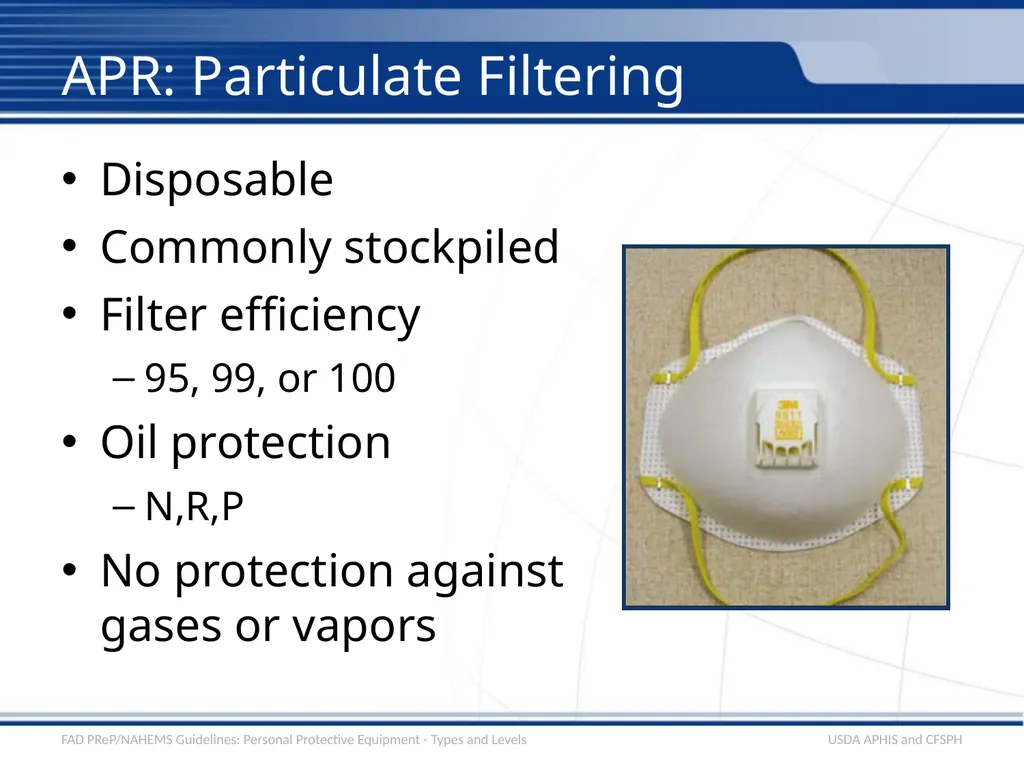
Disposable
Commonly stockpiled
Filter efficiency
95, 99, or 100
Oil protection
N,R,P
No protection against gases or vapors USDA APHIS and CFSPH FAD PReP/NAHEMS Guidelines: Personal Protective Equipment - Types and Levels APR: Particulate Filtering<br>
08
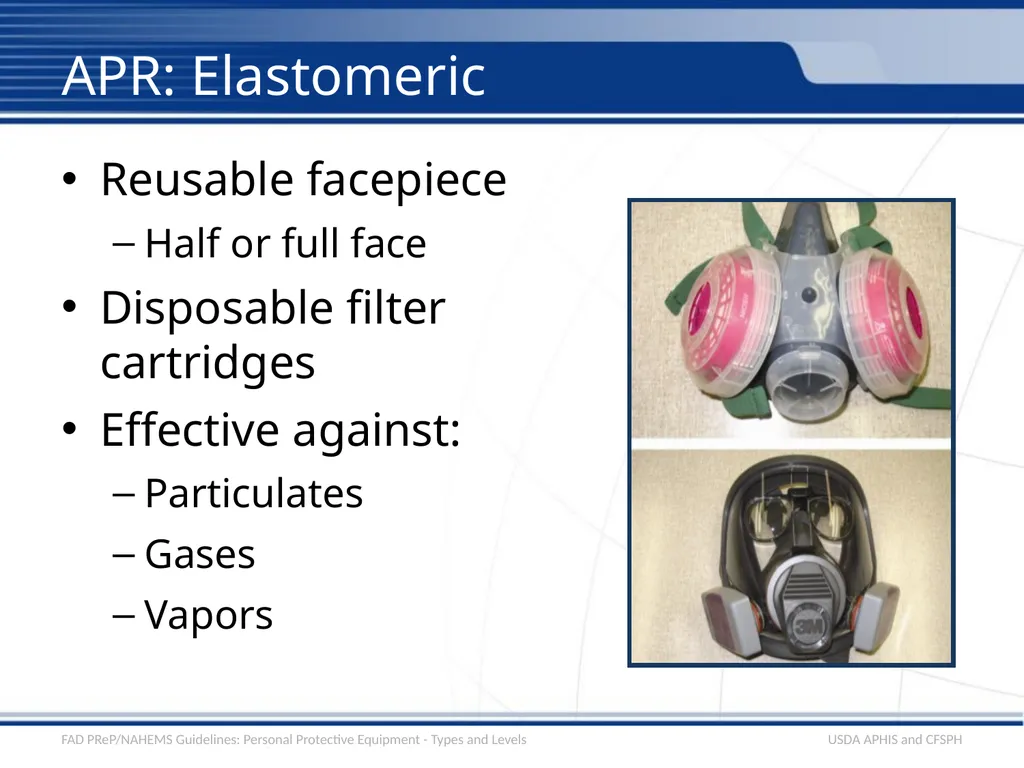
Reusable facepiece
Half or full face
Disposable filter cartridges
Effective against:
Particulates
Gases
Vapors USDA APHIS and CFSPH FAD PReP/NAHEMS Guidelines: Personal Protective Equipment - Types and Levels APR: Elastomeric<br>
09
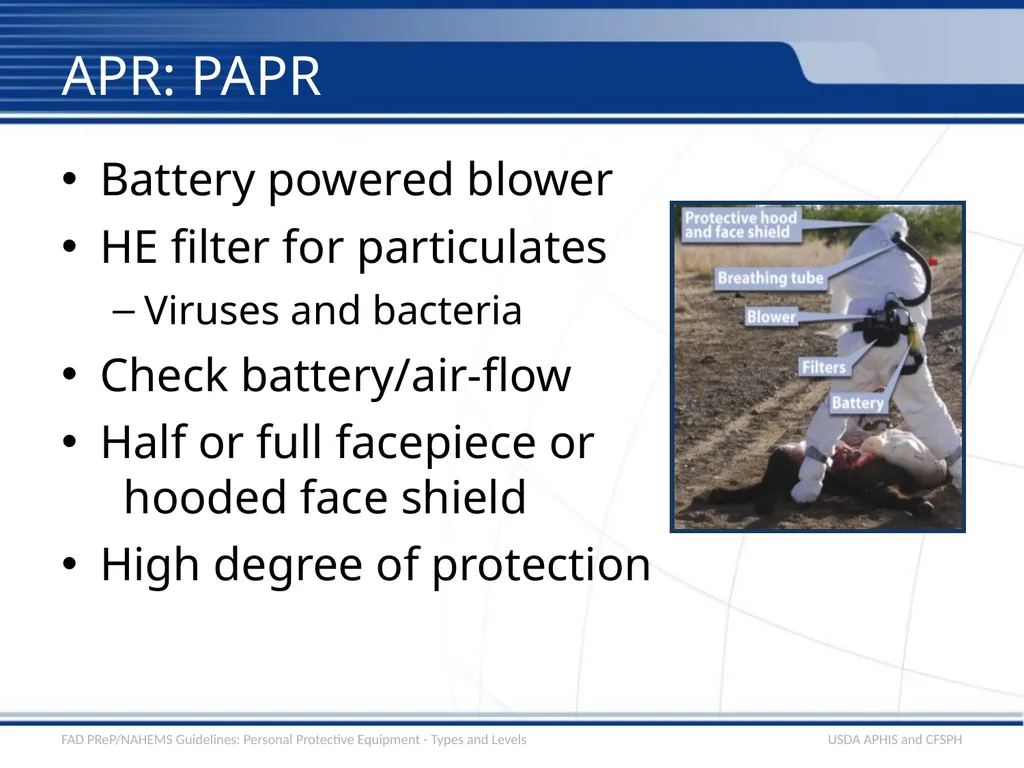
Battery powered blower
HE filter for particulates
Viruses and bacteria
Check battery/air-flow
Half or full facepiece or hooded face shield
High degree of protection USDA APHIS and CFSPH FAD PReP/NAHEMS Guidelines: Personal Protective Equipment - Types and Levels APR: PAPR<br>
10
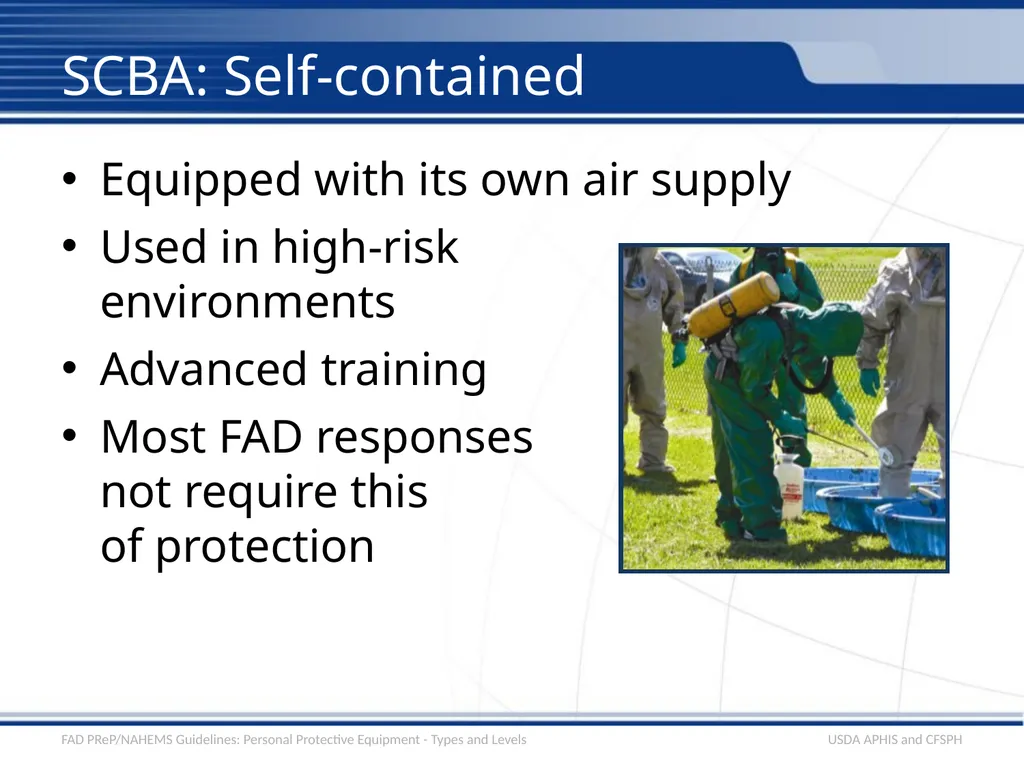
Equipped with its own air supply
Used in high-risk �environments
Advanced training
Most FAD responses will not require this level of protection USDA APHIS and CFSPH FAD PReP/NAHEMS Guidelines: Personal Protective Equipment - Types and Levels SCBA: Self-contained<br>
11
Minimizing Body Exposure USDA APHIS and CFSPH FAD PReP/NAHEMS Guidelines: Personal Protective Equipment - Types and Levels<br>
12
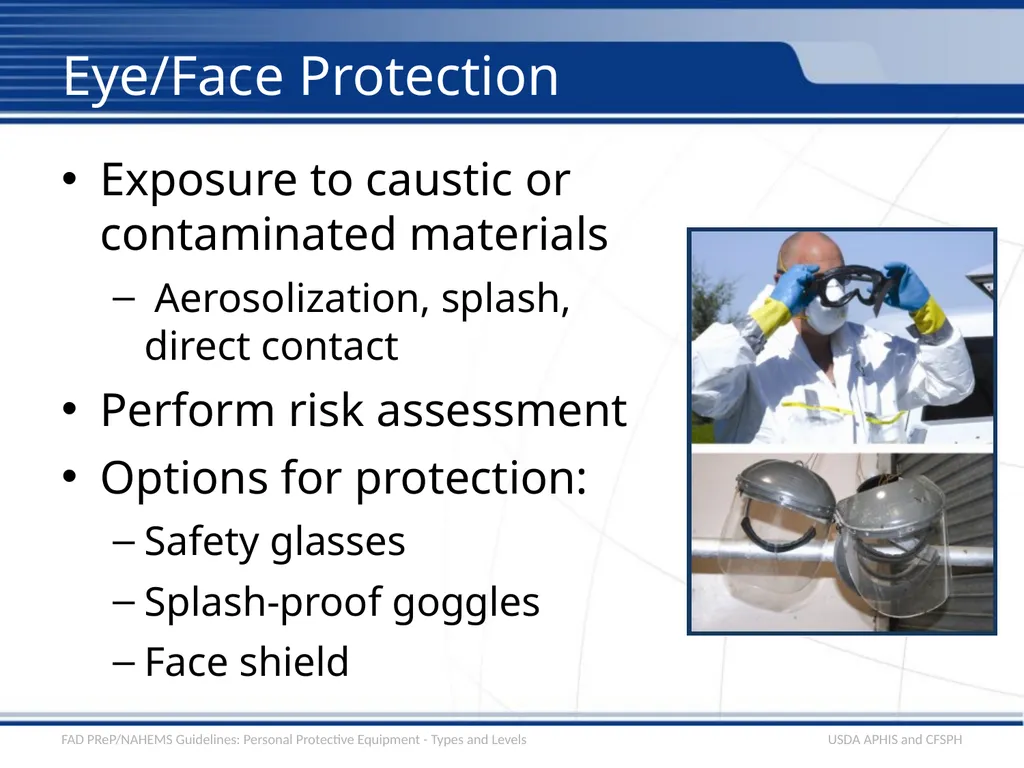
Exposure to caustic or contaminated materials
Aerosolization, splash, direct contact
Perform risk assessment
Options for protection:
Safety glasses
Splash-proof goggles
Face shield USDA APHIS and CFSPH FAD PReP/NAHEMS Guidelines: Personal Protective Equipment - Types and Levels Eye/Face Protection<br>
13
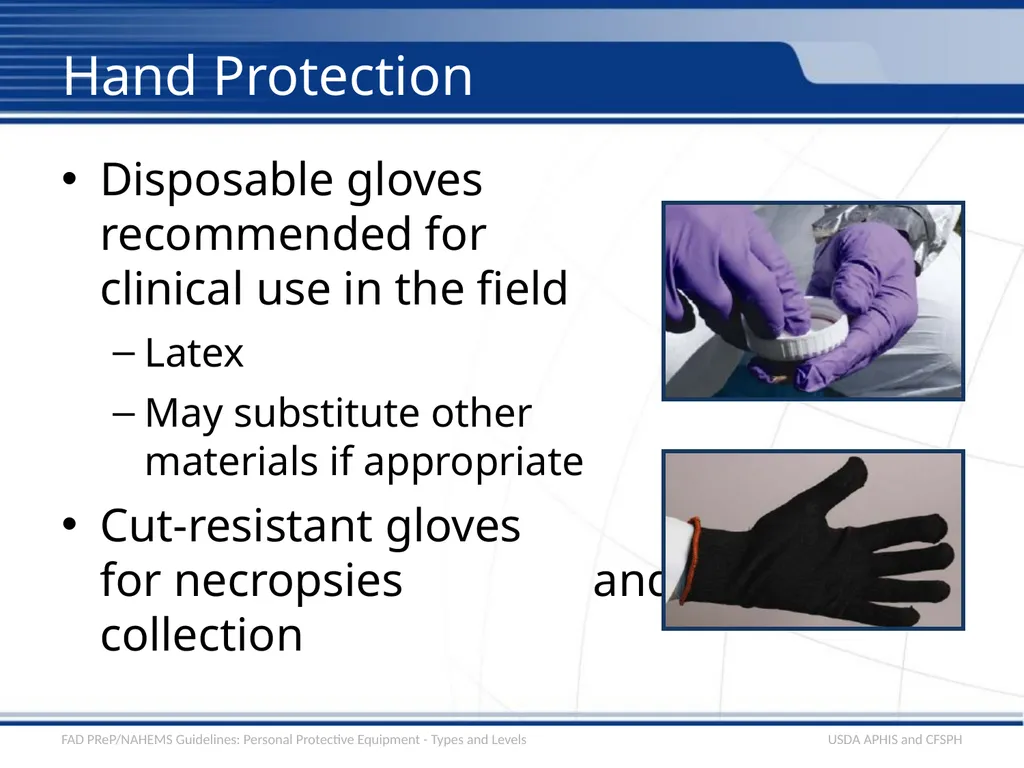
Disposable gloves recommended for clinical use in the field
Latex
May substitute other materials if appropriate
Cut-resistant gloves essential for necropsies and tissue collection USDA APHIS and CFSPH FAD PReP/NAHEMS Guidelines: Personal Protective Equipment - Types and Levels Hand Protection<br>
14
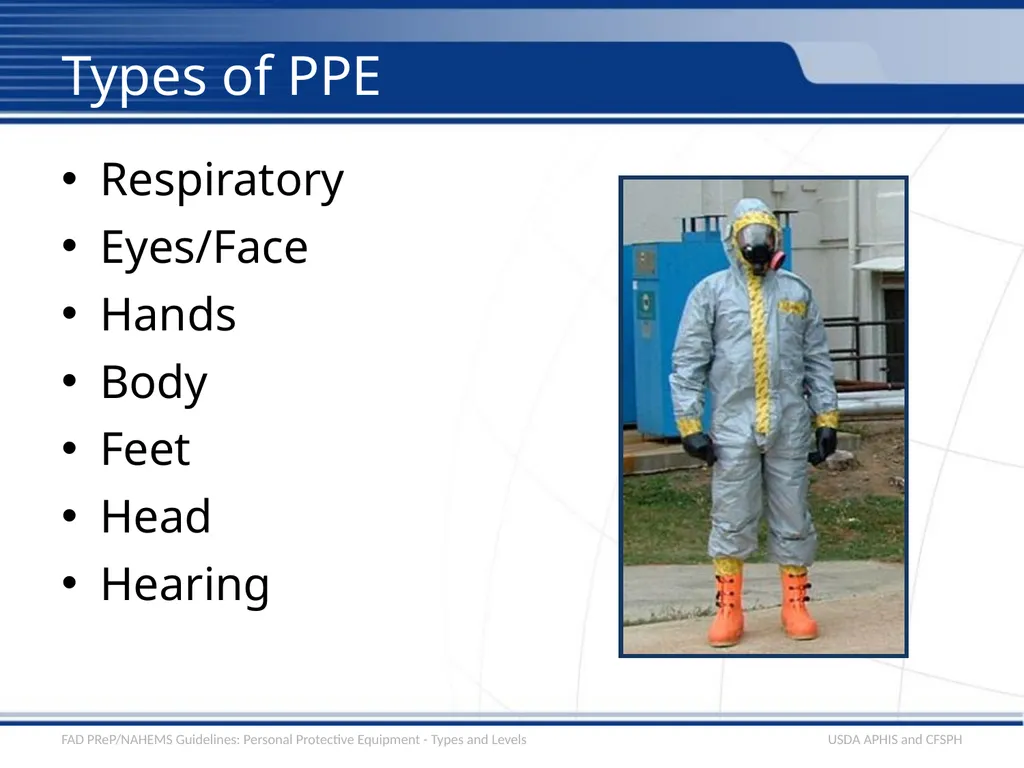
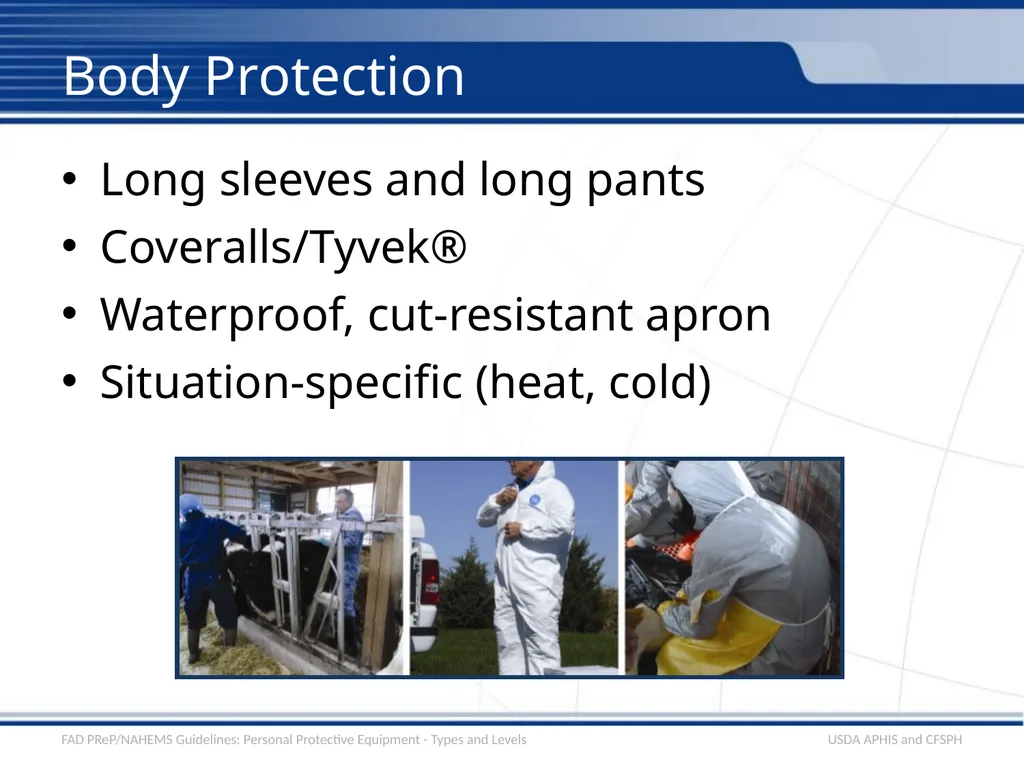
Long sleeves and long pants
Coveralls/Tyvek®
Waterproof, cut-resistant apron
Situation-specific (heat, cold) USDA APHIS and CFSPH FAD PReP/NAHEMS Guidelines: Personal Protective Equipment - Types and Levels Body Protection<br>
15
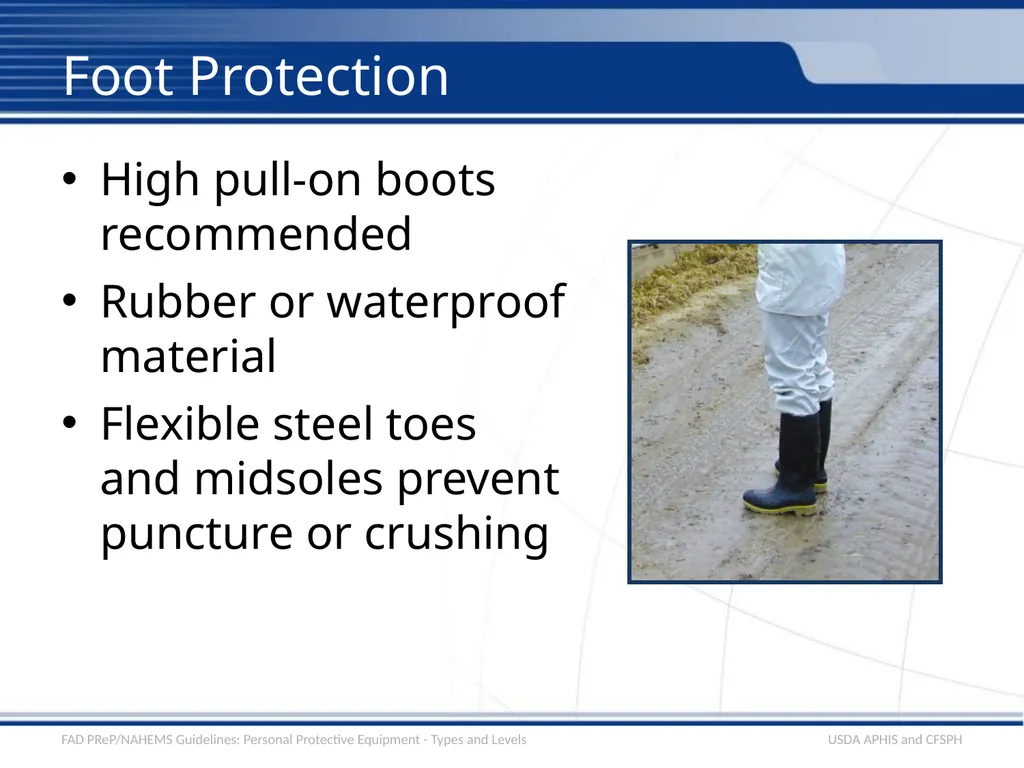
High pull-on boots recommended
Rubber or waterproof material
Flexible steel toes and midsoles prevent puncture or crushing USDA APHIS and CFSPH FAD PReP/NAHEMS Guidelines: Personal Protective Equipment - Types and Levels Foot Protection<br>
16
Hard hat for working around heavy machinery or equipment overhead
Hearing
Baseline audiogram
Hearing Conservation Program
Ear muffs, ear plugs
Consider biosecurity if reusing USDA APHIS and CFSPH FAD PReP/NAHEMS Guidelines: Personal Protective Equipment - Types and Levels Head/Hearing Protection<br>
17
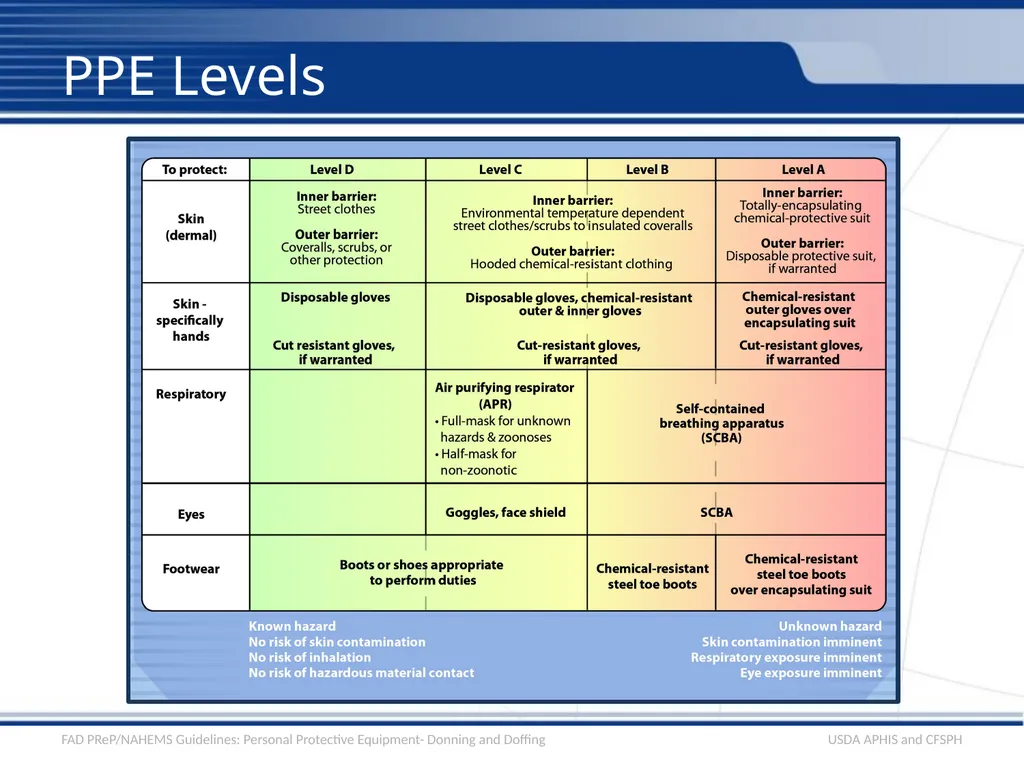
Levels of PPE USDA APHIS and CFSPH FAD PReP/NAHEMS Guidelines: Personal Protective Equipment - Types and Levels<br>
18
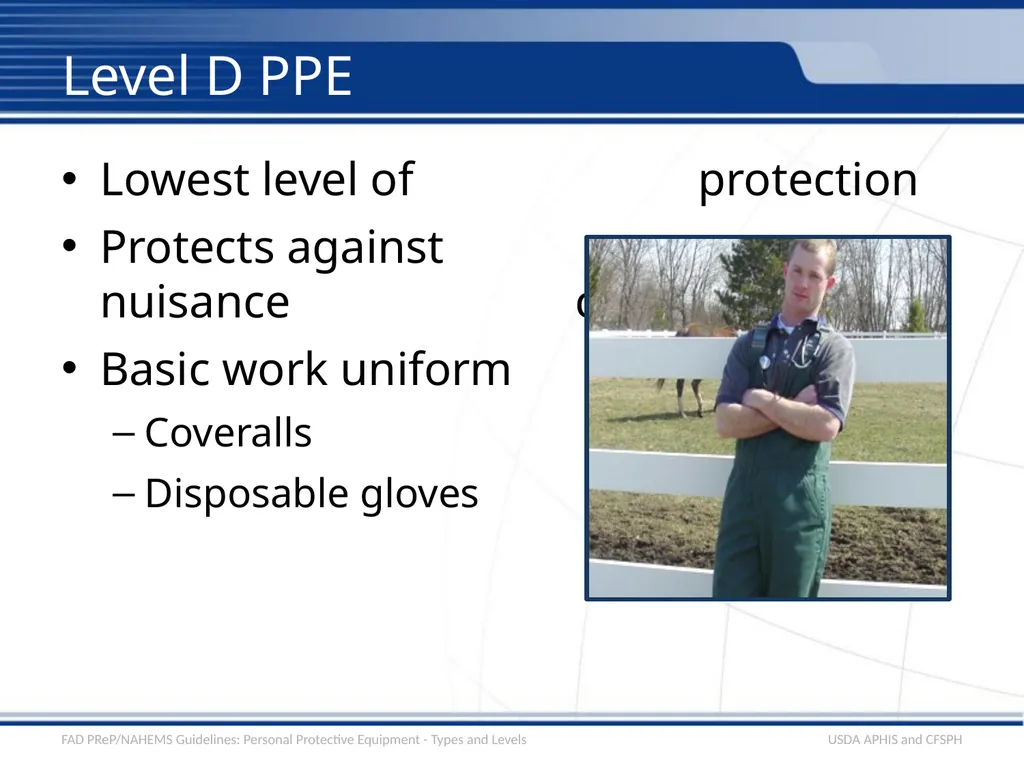
Lowest level of protection
Protects against nuisance contamination
Basic work uniform
Coveralls
Disposable gloves USDA APHIS and CFSPH FAD PReP/NAHEMS Guidelines: Personal Protective Equipment - Types and Levels Level D PPE<br>
19
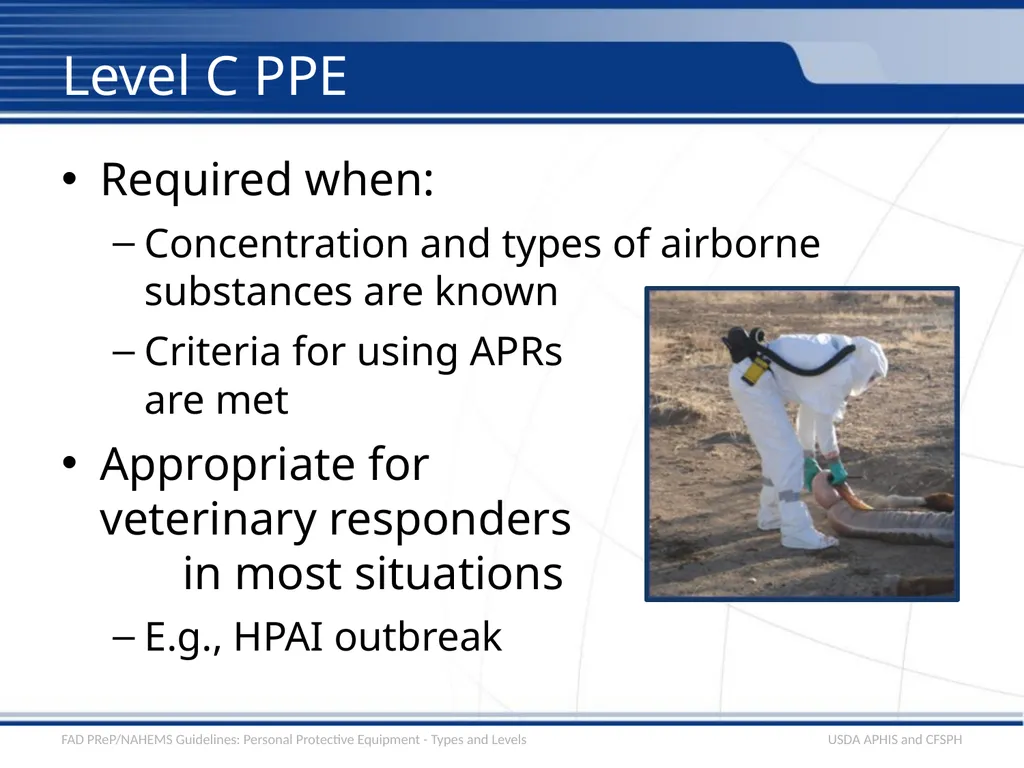
Required when:
Concentration and types of airborne substances are known
Criteria for using APRs are met
Appropriate for veterinary responders in most situations
E.g., HPAI outbreak USDA APHIS and CFSPH FAD PReP/NAHEMS Guidelines: Personal Protective Equipment - Types and Levels Level C PPE<br>
20
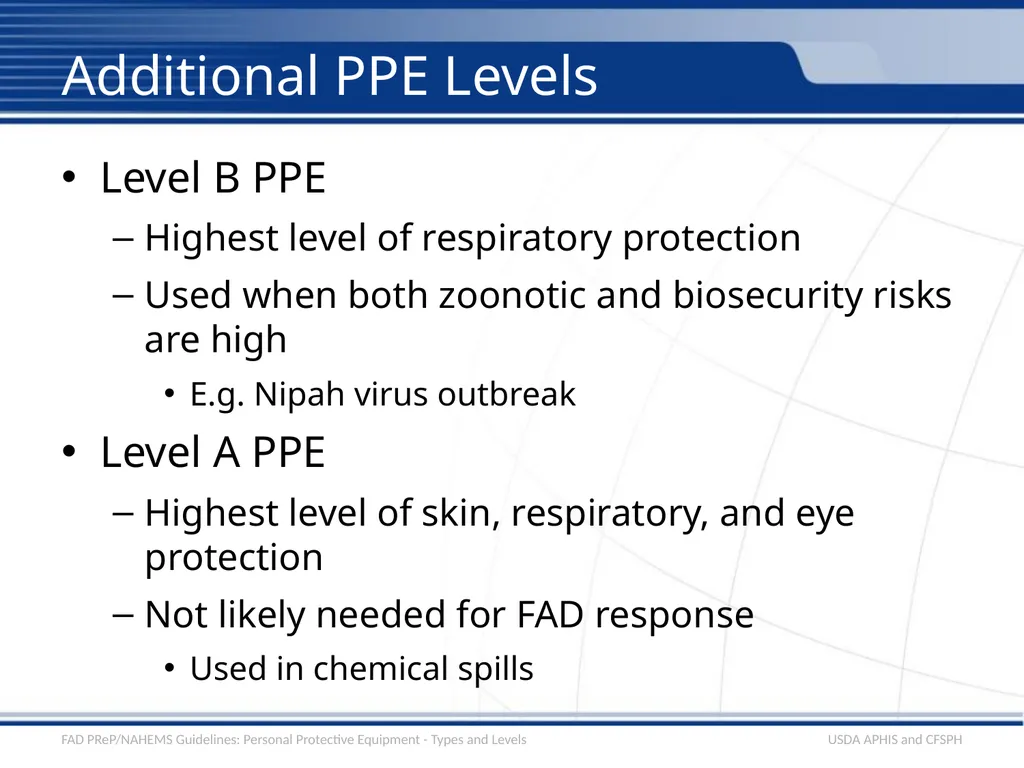
Level B PPE
Highest level of respiratory protection
Used when both zoonotic and biosecurity risks are high
E.g. Nipah virus outbreak
Level A PPE
Highest level of skin, respiratory, and eye protection
Not likely needed for FAD response
Used in chemical spills USDA APHIS and CFSPH FAD PReP/NAHEMS Guidelines: Personal Protective Equipment - Types and Levels Additional PPE Levels<br>
21
USDA APHIS and CFSPH FAD PReP/NAHEMS Guidelines: Personal Protective Equipment- Donning and Doffing PPE Levels<br>
22
FAD PReP/NAHEMS Guidelines & SOP: Personal Protective Equipment (2011)
http://www.aphis.usda.gov/animal_health/emergency_management/
Personal Protective Equipment web-based training module
http://naherc.sws.iastate.edu/ USDA APHIS and CFSPH FAD PReP/NAHEMS Guidelines: Personal Protective Equipment - Types and Levels For More Information<br>
23
Authors (CFSPH)
Janice Mogan, DVM
Gayle B. Brown, DVM, PhD
Elizabeth Wormley, Junior Veterinary Student
Reviewers (USDA)
Peter A. Petch, RPIH, CIPS, �CIMT, CHS-V
Stephen Goff, DVM USDA APHIS and CFSPH FAD PReP/NAHEMS Guidelines: Personal Protective Equipment - Types and Levels Guidelines Content<br>
24
Acknowledgments Development of this presentation was by the Center for Food Security and Public Health at Iowa State University through funding from the USDA APHIS Veterinary Services PPT Authors: Dawn Bailey, BS; Kerry Leedom Larson, DVM, MPH, PhD, DACVPM
Reviewers: Glenda Dvorak, DVM, MS, MPH, DACVPM; Patricia Futoma, Veterinary Student;
Janice Mogan, DVM<br>