
Personality Disorders An Introduction Maxym
LD
Published · 97 slides · 0 views
1 / 1



Description
Personality Disorders An Introduction Maxym Choptiany, MD FRCPC What is a personality disorder? Chronic, inflexible, and maladaptive pattern of relating to the world. Evident in the way a person thinks, feels, and behaves. The most
Related Topics
Share
Embed code
Download this presentation From Below
"Personality Disorders An Introduction Maxym" is the property of its rightful owner. Permission is granted to download and print the materials on this website for personal, non-commercial use only, and to display it on your personal computer provided you do not modify the materials and that you retain all copyright notices contained in the materials. By downloading content from our website, you accept the terms of this agreement.
Presentation Transcript
01
Personality Disorders
An Introduction Maxym Choptiany, MD FRCPC<br>
02
What is a personality disorder? Chronic, inflexible, and maladaptive pattern of relating to the world.
Evident in the way a person thinks, feels, and behaves.
The most noticeable and significant feature is their negative effect on interpersonal relationships.
Relationships they do form are often fraught with problems and difficulties.<br>
Evident in the way a person thinks, feels, and behaves.
The most noticeable and significant feature is their negative effect on interpersonal relationships.
Relationships they do form are often fraught with problems and difficulties.<br>
03
What is a personality disorder? Often those with personality disorders who experience difficulties in their relationships or in their functioning don’t believe that there is anything wrong with them (egosyntonic).
If anything, believe society (not them) should change –alloplastic thinking.
As a result maladaptive behaviour is repeated.<br>
If anything, believe society (not them) should change –alloplastic thinking.
As a result maladaptive behaviour is repeated.<br>
04
What is a personality disorder? Differ from personality traits (ie. features of personality that do not meet threshold for a PD).
Diagnosis is warranted only if personality traits are:
Inflexible, maladaptive, and enduring.
Start in childhood/adolescence.
Cause functional impairment/subjective distress.<br>
Diagnosis is warranted only if personality traits are:
Inflexible, maladaptive, and enduring.
Start in childhood/adolescence.
Cause functional impairment/subjective distress.<br>
05
History First formal attempt to classify personality disorders occurred in 1952 with the publication of DSM-I.
7 personality disorders identified.
Classification in various form throughout history.
Hippocrates described 4 temperaments:
earth, air, fire, and water
the optimistic sanguine, the irritable choleric, the sad melancholic, and the apathetic phlegmatic.
Variation on the temperaments up to 20th Century.<br>
7 personality disorders identified.
Classification in various form throughout history.
Hippocrates described 4 temperaments:
earth, air, fire, and water
the optimistic sanguine, the irritable choleric, the sad melancholic, and the apathetic phlegmatic.
Variation on the temperaments up to 20th Century.<br>
06
Epidemiology Up to 10-20% of the general population.
Greater in psychiatric samples – up to 30-50%.
Antisocial Personality Disorder is the only PD with an age specification (18 years) and that certain childhood behaviours be present (conduct disorder).
Some more frequent in men (ASPD).
Some more frequent in women (BPD).<br>
Greater in psychiatric samples – up to 30-50%.
Antisocial Personality Disorder is the only PD with an age specification (18 years) and that certain childhood behaviours be present (conduct disorder).
Some more frequent in men (ASPD).
Some more frequent in women (BPD).<br>
07
Epidemiology Associated with impaired social, personal, and occupational adjustment.
Family life, marriage, academic and work difficulties.
Increased rates of unemployment, homelessness, divorce and separation, domestic violence and substance misuse.
Increased rates of healthcare utilization.<br>
Family life, marriage, academic and work difficulties.
Increased rates of unemployment, homelessness, divorce and separation, domestic violence and substance misuse.
Increased rates of healthcare utilization.<br>
08
Epidemiology Individuals suffering from personality disorders are at high risk of early death from suicide or accident.
Suicide rate is as high as that seen for major depression.
Although personality disorders tend to be stable, some studies have shown that they tend to improve as a patient ages.<br>
Suicide rate is as high as that seen for major depression.
Although personality disorders tend to be stable, some studies have shown that they tend to improve as a patient ages.<br>
09
Epidemiology Presence of personality disorder is associated with poorer response to treatment, particularly antidepressant medication and electroconvulsive therapy.<br>
10
Etiology Historical psychoanalytical view theorized that personality disorders occurred when an individual failed to progress through appropriate psychosexual stage of development.
Adverse childhood experience (abuse, maltreatment, or neglect) is associated with risk for development of personality disorder.
Genetic association (eg. schizotypal and schizophrenia).<br>
Adverse childhood experience (abuse, maltreatment, or neglect) is associated with risk for development of personality disorder.
Genetic association (eg. schizotypal and schizophrenia).<br>
11
Etiology Neurobiological correlates – eg. low levels of 5-hydroxyindoleacetic acid (5-HIAA) a metabolite of serotonin – linked to impulsivity and aggression (ASPD and BPD)
Chronic nervous system under-arousal is thought to contribute to thrill seeking, impulsivity and dangerousness in ASPD.<br>
Chronic nervous system under-arousal is thought to contribute to thrill seeking, impulsivity and dangerousness in ASPD.<br>
12
Etiology Interaction between an individual’s genetic predisposition towards certain traits and an individual’s early experiences.
Over time people develop habits of interpreting and responding to the environment that influence the way they experience and interpret their world ("personality traits”).
Once these patterns have formed, they are maintained and become fairly stable.<br>
Over time people develop habits of interpreting and responding to the environment that influence the way they experience and interpret their world ("personality traits”).
Once these patterns have formed, they are maintained and become fairly stable.<br>
13
Etiology Overdeveloped and underdeveloped behavioural strategies specific to each personality disorder that are used across situations and across time; even when the strategies are dysfunctional.
Strategies are developed to cope with highly negative core beliefs.
Strategies may have been adaptive when first developed.<br>
Strategies are developed to cope with highly negative core beliefs.
Strategies may have been adaptive when first developed.<br>
14
DSM-5 Diagnostic Criteria An enduring pattern of inner experience and behaviour that deviates markedly from the expectations of the individual's culture.
Enduring pattern is inflexible and pervasive across range of personal and social situations.
Has an onset in adolescence or early adulthood and is stable over time.<br>
Enduring pattern is inflexible and pervasive across range of personal and social situations.
Has an onset in adolescence or early adulthood and is stable over time.<br>
15
DSM-5 Diagnostic Criteria Symptoms must cause impairment in social, occupational, or other important areas of functioning (ie. difficult for them to function well in society) and /or subjective distress.
Not better explained as a manifestation of another mental disorder.
Not attributable to substance or other medical condition (eg. head trauma).<br>
Not better explained as a manifestation of another mental disorder.
Not attributable to substance or other medical condition (eg. head trauma).<br>
16
DSM-5 Diagnostic Criteria NOT diagnosed in children due to the requirement that personality disorders represent enduring problems across time.<br>
17
DSM-5 Diagnostic Criteria This enduring pattern manifests in 2 or more of the following areas:
Thinking - distorted thinking patterns
Feeling - problematic emotional responses
Impulse control – over/under regulated impulse control
Interpersonal functioning - problematic relationships)<br>
Thinking - distorted thinking patterns
Feeling - problematic emotional responses
Impulse control – over/under regulated impulse control
Interpersonal functioning - problematic relationships)<br>
18
Distorted Thinking Patterns Distortions in the way they interpret and think about the world, and in the way they think about themselves.
Thinking patterns may be extreme and distorted.<br>
Thinking patterns may be extreme and distorted.<br>
19
Distorted Thinking Patterns Black-or-white thinking patterns
Idealizing then devaluing other people or themselves.
Distrustful, suspicious thoughts.
Unusual or odd beliefs (contrary to cultural standards).
Perceptual distortions and bodily illusions.<br>
Idealizing then devaluing other people or themselves.
Distrustful, suspicious thoughts.
Unusual or odd beliefs (contrary to cultural standards).
Perceptual distortions and bodily illusions.<br>
20
Diagnosis Thorough personal and social history
Mental Status Exam
Collateral information – especially where the individual denies or is unaware of their maladaptive traits.
Caution in diagnosing when individual is suffering from another mental disorder – eg depression (anxious, dependent).<br>
Mental Status Exam
Collateral information – especially where the individual denies or is unaware of their maladaptive traits.
Caution in diagnosing when individual is suffering from another mental disorder – eg depression (anxious, dependent).<br>
21
Diagnosis Objective psychological testing may be of assistance in diagnosing personality disorder.
Eg. Minnesota Multiphasic Personality Inventory II<br>
Eg. Minnesota Multiphasic Personality Inventory II<br>
22
DSM-5 10 specific personality disorders
3 clusters of personality disorders
Each disorder has a set criteria of observable characteristics.
Diagnosis requires that a minimum number of criteria are met.
Can be co-occurrence/overlap in personality disorders.<br>
3 clusters of personality disorders
Each disorder has a set criteria of observable characteristics.
Diagnosis requires that a minimum number of criteria are met.
Can be co-occurrence/overlap in personality disorders.<br>
23
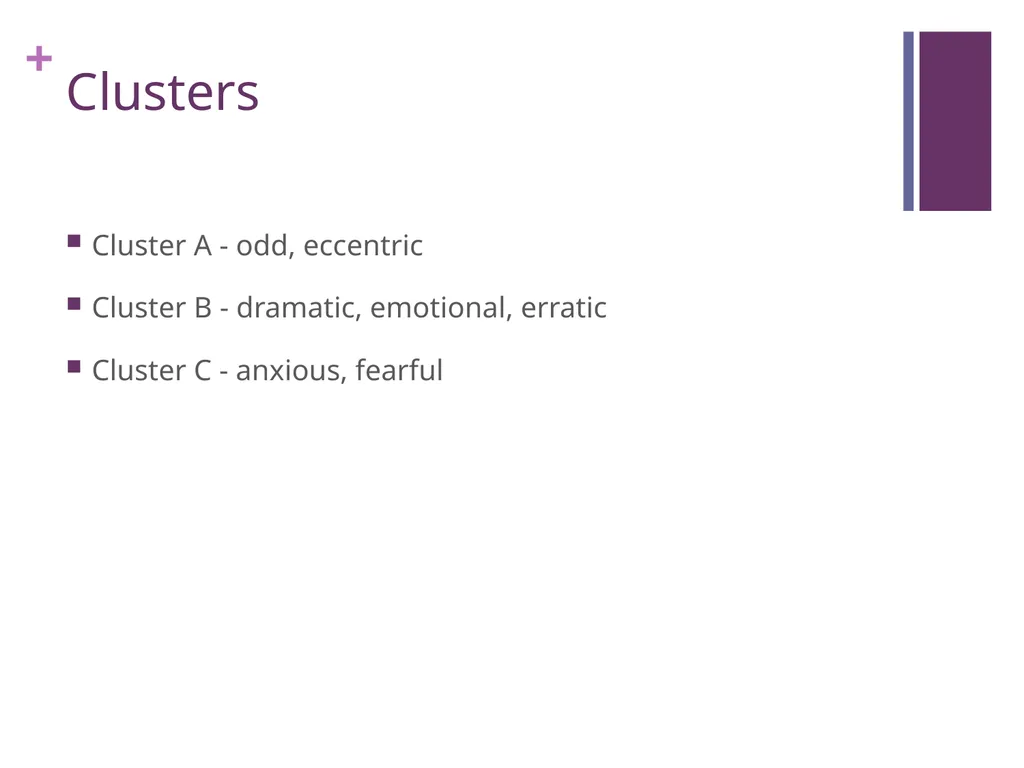
Clusters Cluster A - odd, eccentric
Cluster B - dramatic, emotional, erratic
Cluster C - anxious, fearful<br>
Cluster B - dramatic, emotional, erratic
Cluster C - anxious, fearful<br>
24
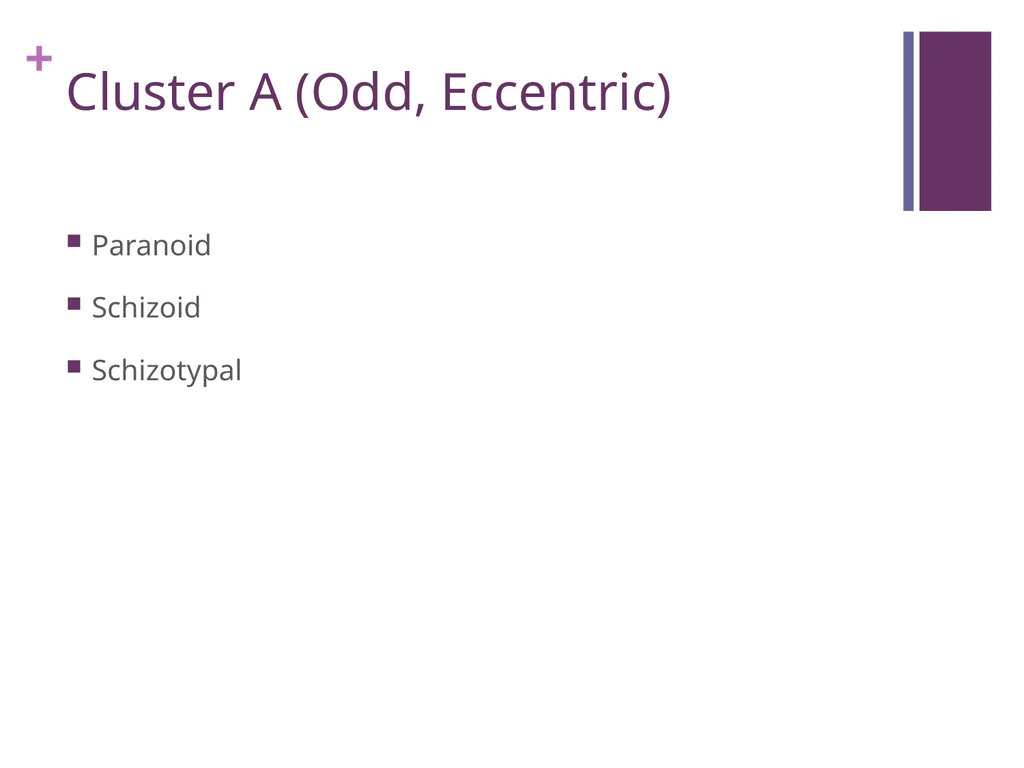
Cluster A (Odd, Eccentric) Paranoid
Schizoid
Schizotypal<br>
Schizoid
Schizotypal<br>
25
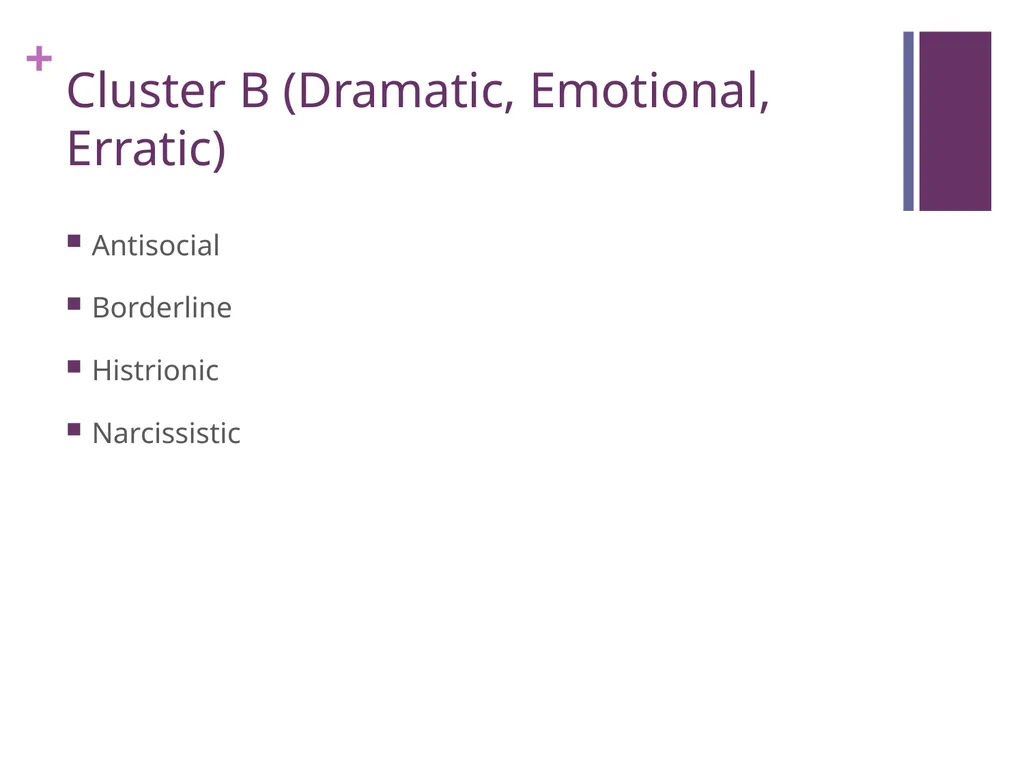
Cluster B (Dramatic, Emotional, Erratic) Antisocial
Borderline
Histrionic
Narcissistic<br>
Borderline
Histrionic
Narcissistic<br>
26
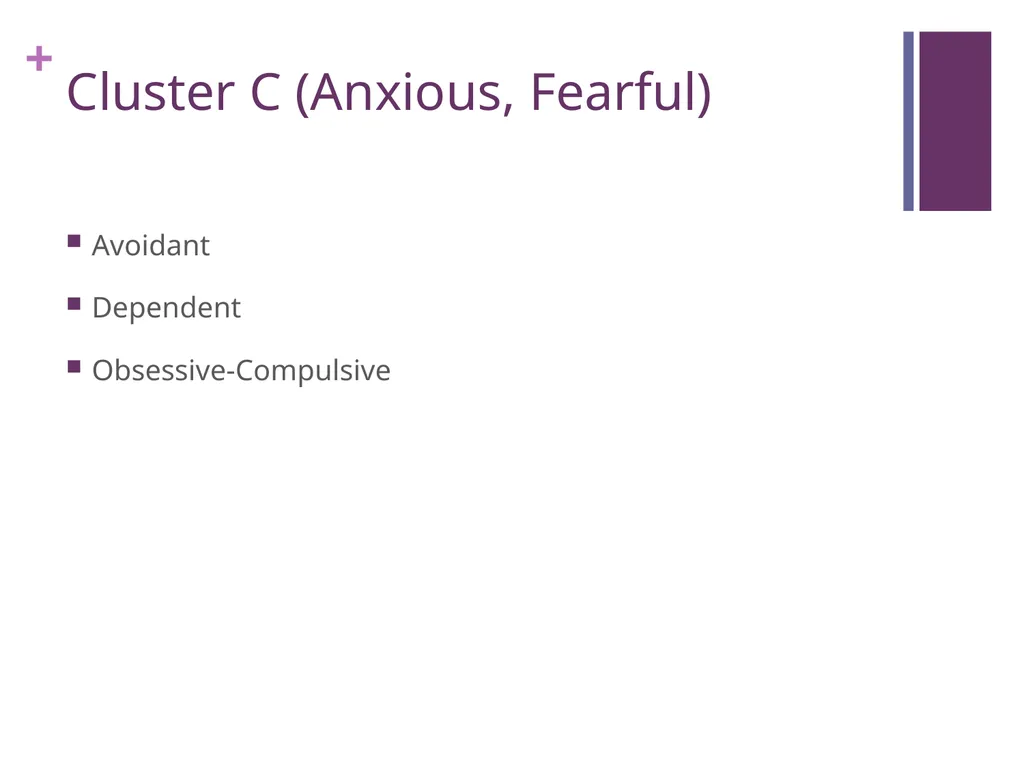
Cluster C (Anxious, Fearful) Avoidant
Dependent
Obsessive-Compulsive<br>
Dependent
Obsessive-Compulsive<br>
27
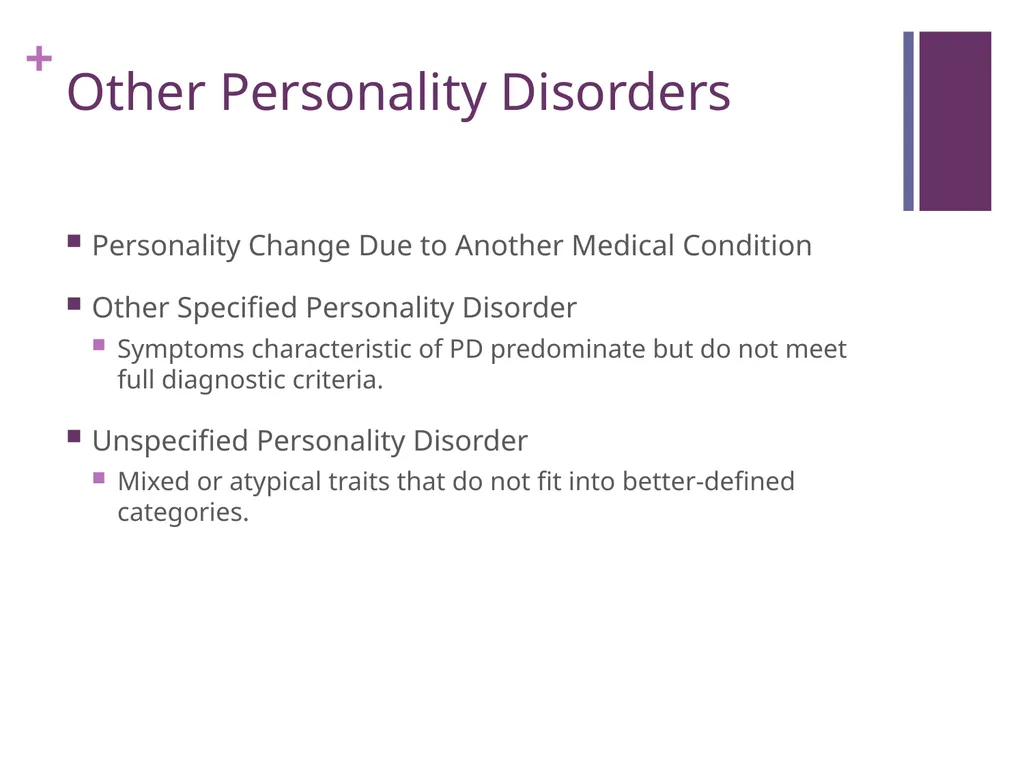
Other Personality Disorders Personality Change Due to Another Medical Condition
Other Specified Personality Disorder
Symptoms characteristic of PD predominate but do not meet full diagnostic criteria.
Unspecified Personality Disorder
Mixed or atypical traits that do not fit into better-defined categories.<br>
Other Specified Personality Disorder
Symptoms characteristic of PD predominate but do not meet full diagnostic criteria.
Unspecified Personality Disorder
Mixed or atypical traits that do not fit into better-defined categories.<br>
28
Cluster A (Odd, Eccentric) Paranoid
Schizoid
Schizotypal<br>
Schizoid
Schizotypal<br>
29
Cluster A Characterized by a pervasive pattern of abnormal cognition (eg. suspiciousness), self-expression (eg. odd speech), or relating to others (eg. seclusiveness).<br>
30
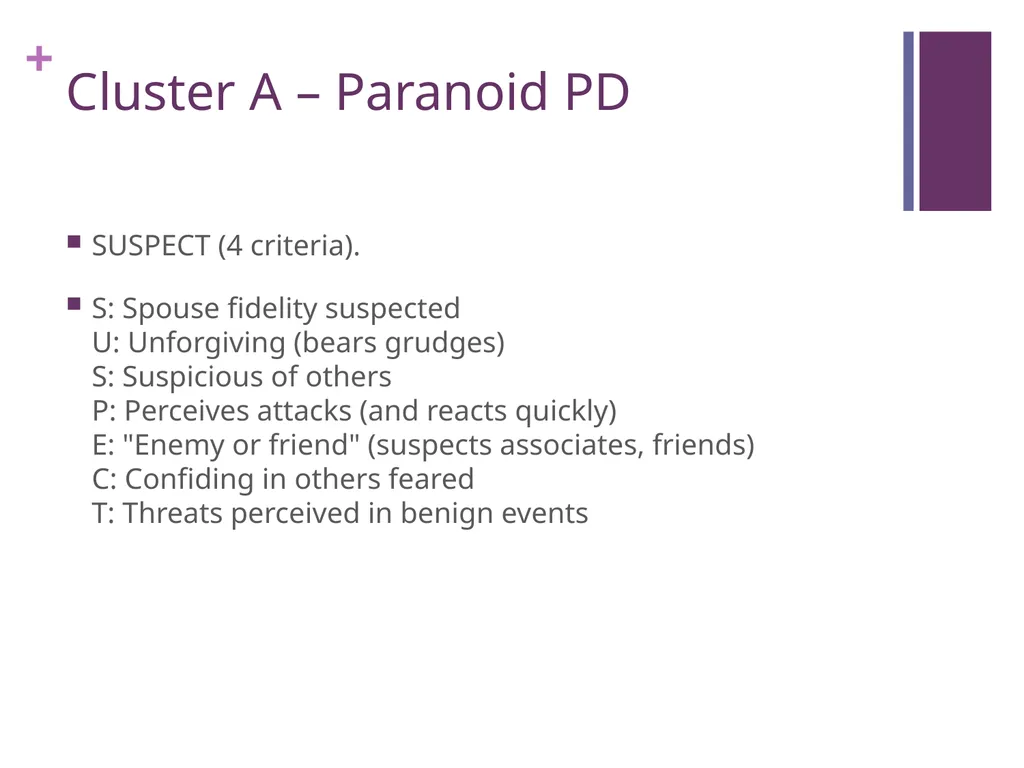
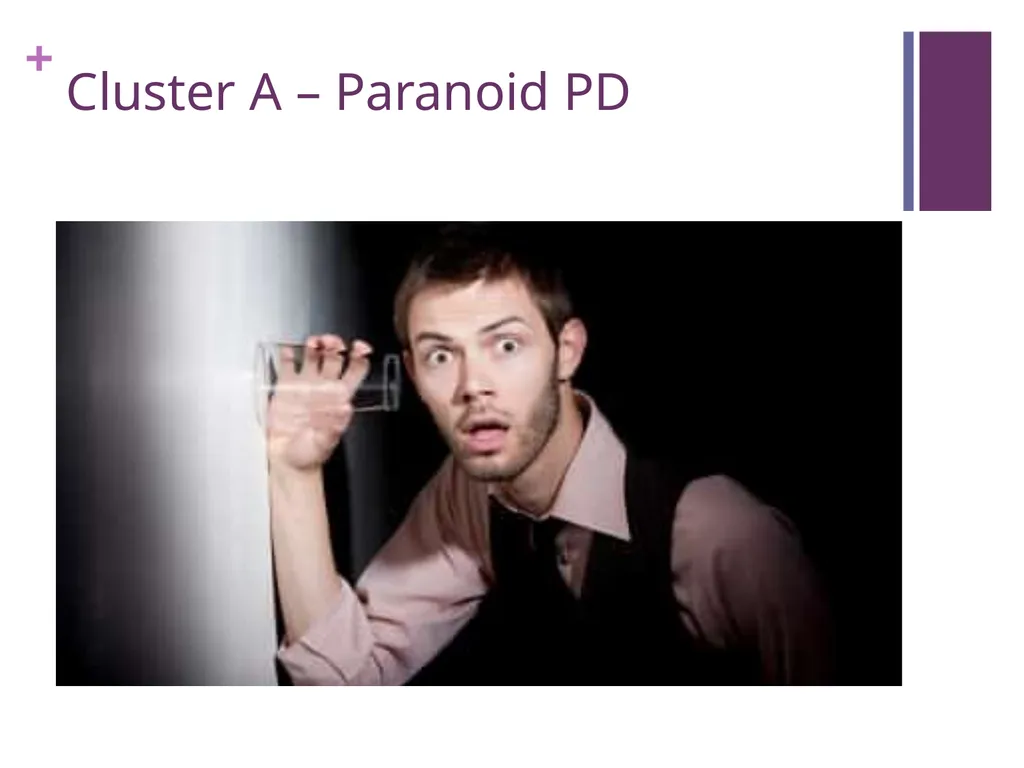
Cluster A – Paranoid PD SUSPECT (4 criteria).
S: Spouse fidelity suspected U: Unforgiving (bears grudges) S: Suspicious of others P: Perceives attacks (and reacts quickly) E: "Enemy or friend" (suspects associates, friends) C: Confiding in others feared T: Threats perceived in benign events<br>
S: Spouse fidelity suspected U: Unforgiving (bears grudges) S: Suspicious of others P: Perceives attacks (and reacts quickly) E: "Enemy or friend" (suspects associates, friends) C: Confiding in others feared T: Threats perceived in benign events<br>
31
Cluster A – Paranoid PD<br>
32
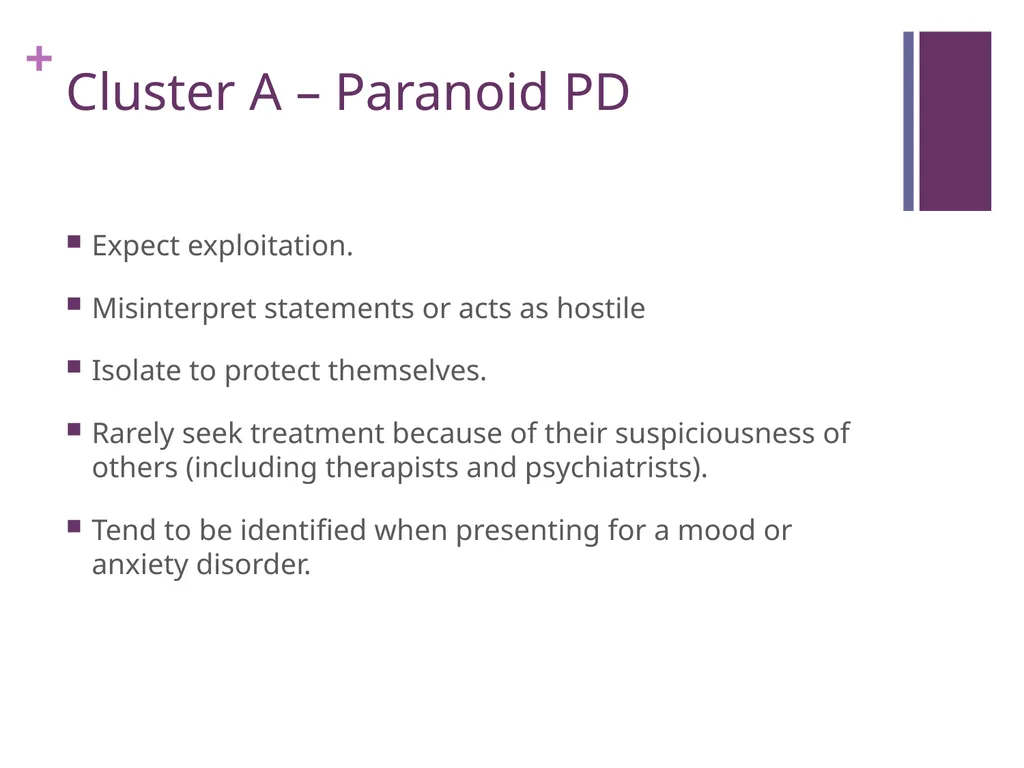
Cluster A – Paranoid PD Expect exploitation.
Misinterpret statements or acts as hostile
Isolate to protect themselves.
Rarely seek treatment because of their suspiciousness of others (including therapists and psychiatrists).
Tend to be identified when presenting for a mood or anxiety disorder.<br>
Misinterpret statements or acts as hostile
Isolate to protect themselves.
Rarely seek treatment because of their suspiciousness of others (including therapists and psychiatrists).
Tend to be identified when presenting for a mood or anxiety disorder.<br>
33
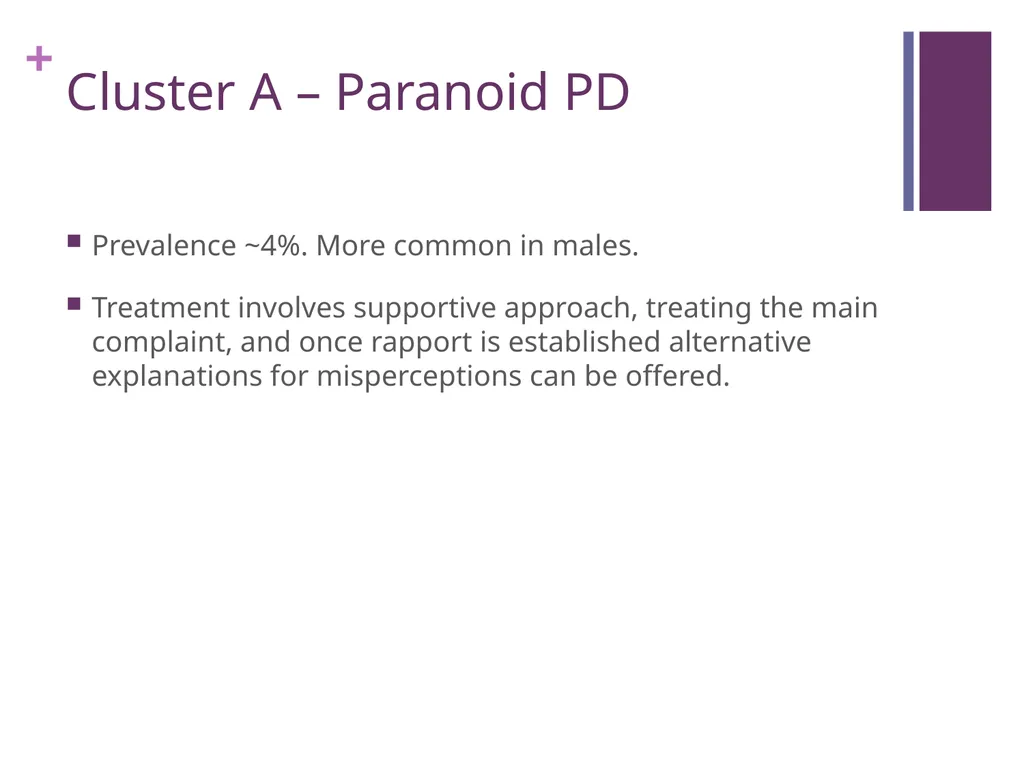
Cluster A – Paranoid PD Prevalence ~4%. More common in males.
Treatment involves supportive approach, treating the main complaint, and once rapport is established alternative explanations for misperceptions can be offered.<br>
Treatment involves supportive approach, treating the main complaint, and once rapport is established alternative explanations for misperceptions can be offered.<br>
34
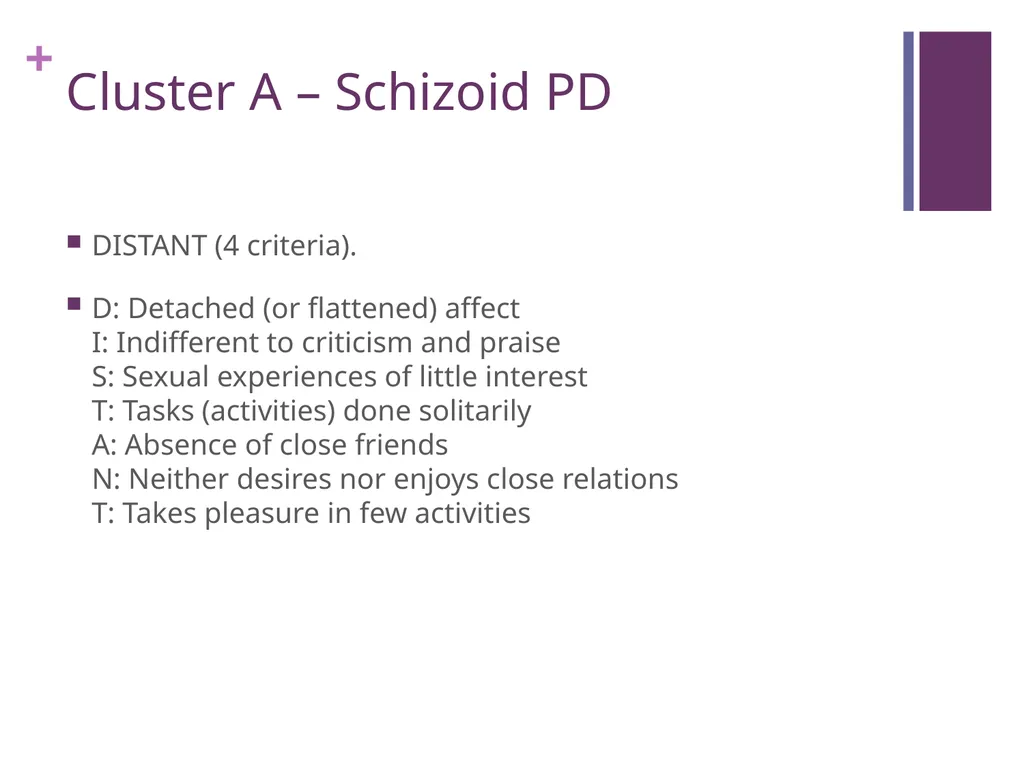
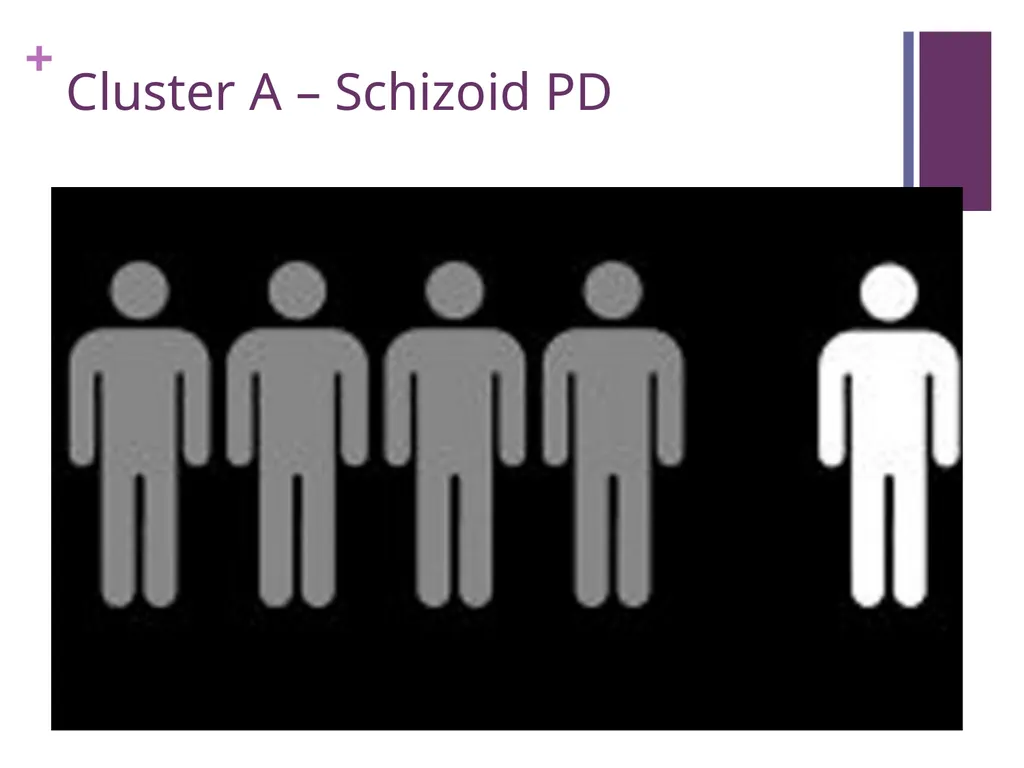
Cluster A – Schizoid PD DISTANT (4 criteria).
D: Detached (or flattened) affect I: Indifferent to criticism and praise S: Sexual experiences of little interest T: Tasks (activities) done solitarily A: Absence of close friends N: Neither desires nor enjoys close relations T: Takes pleasure in few activities<br>
D: Detached (or flattened) affect I: Indifferent to criticism and praise S: Sexual experiences of little interest T: Tasks (activities) done solitarily A: Absence of close friends N: Neither desires nor enjoys close relations T: Takes pleasure in few activities<br>
35
Cluster A – Schizoid PD<br>
36
Cluster A – Schizoid PD Profound defect in the ability to form personal relationships and to respond to others in a meaningful way.
No close relationships.
Choose solitary activities
Rarely experience strong emotions.
Express little desire for sexual experience with another person.<br>
No close relationships.
Choose solitary activities
Rarely experience strong emotions.
Express little desire for sexual experience with another person.<br>
37
Cluster A – Schizoid PD Indifferent to praise or criticism.
Display constricted affect.
Prevalence ~3%.
Uncommon in psychiatric setting because they rarely seek out psychiatric help except for co-occurring depression, anxiety, substance abuse, etc.<br>
Display constricted affect.
Prevalence ~3%.
Uncommon in psychiatric setting because they rarely seek out psychiatric help except for co-occurring depression, anxiety, substance abuse, etc.<br>
38
Cluster A – Schizoid PD Treat the identified disorder (eg. mood)
May benefit from day or drop in programs.<br>
May benefit from day or drop in programs.<br>
39
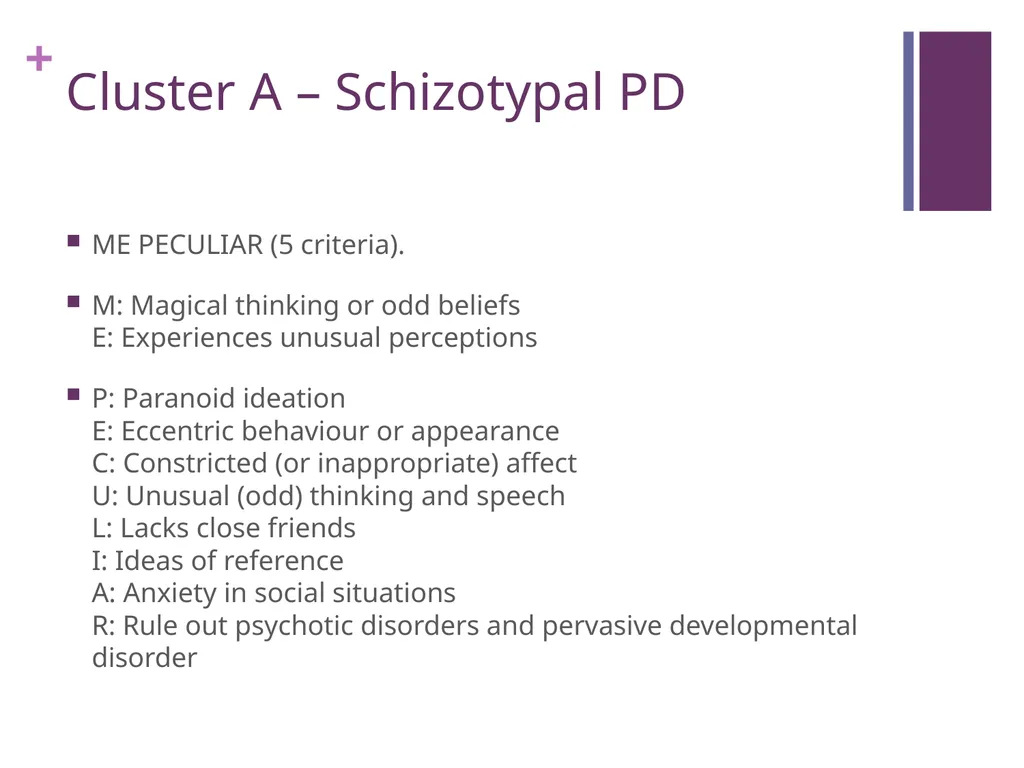
Cluster A – Schizotypal PD ME PECULIAR (5 criteria).
M: Magical thinking or odd beliefs E: Experiences unusual perceptions
P: Paranoid ideation E: Eccentric behaviour or appearance C: Constricted (or inappropriate) affect U: Unusual (odd) thinking and speech L: Lacks close friends I: Ideas of reference A: Anxiety in social situations R: Rule out psychotic disorders and pervasive developmental disorder<br>
M: Magical thinking or odd beliefs E: Experiences unusual perceptions
P: Paranoid ideation E: Eccentric behaviour or appearance C: Constricted (or inappropriate) affect U: Unusual (odd) thinking and speech L: Lacks close friends I: Ideas of reference A: Anxiety in social situations R: Rule out psychotic disorders and pervasive developmental disorder<br>
40
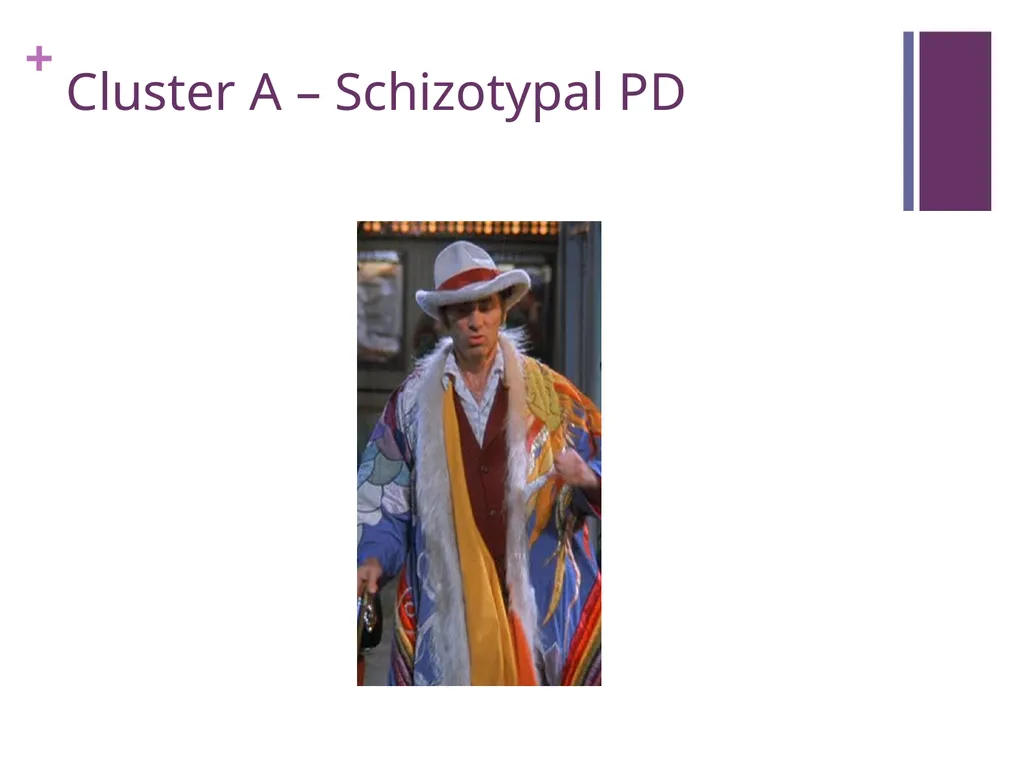
Cluster A – Schizotypal PD<br>
41
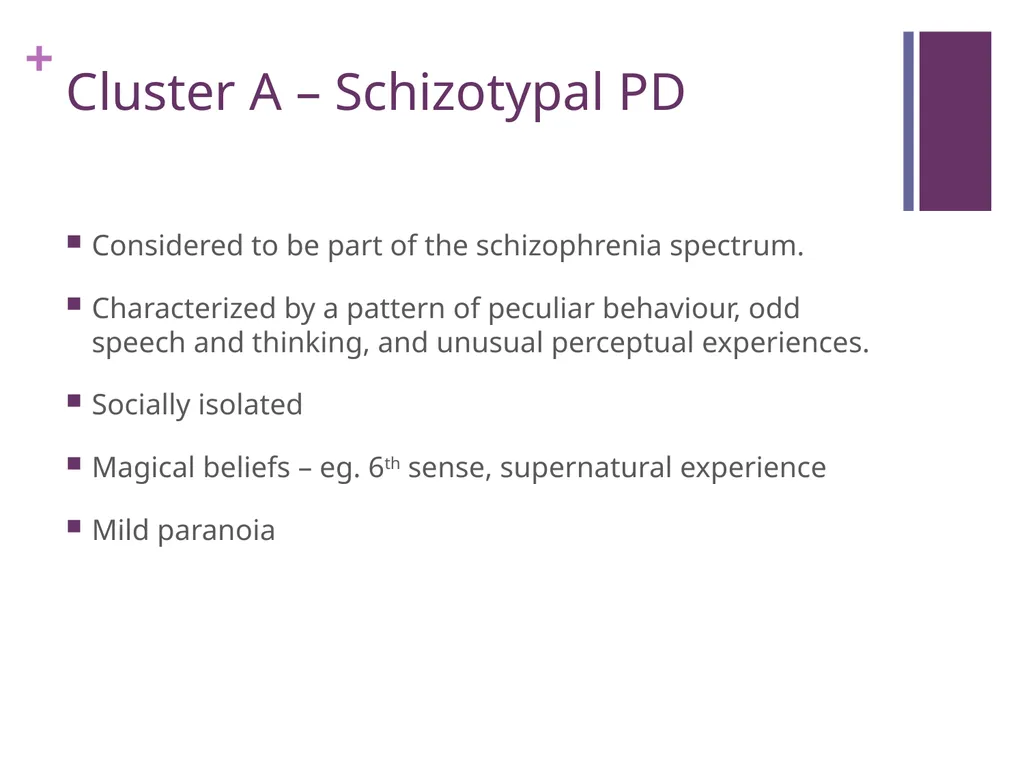
Cluster A – Schizotypal PD Considered to be part of the schizophrenia spectrum.
Characterized by a pattern of peculiar behaviour, odd speech and thinking, and unusual perceptual experiences.
Socially isolated
Magical beliefs – eg. 6th sense, supernatural experience
Mild paranoia<br>
Characterized by a pattern of peculiar behaviour, odd speech and thinking, and unusual perceptual experiences.
Socially isolated
Magical beliefs – eg. 6th sense, supernatural experience
Mild paranoia<br>
42
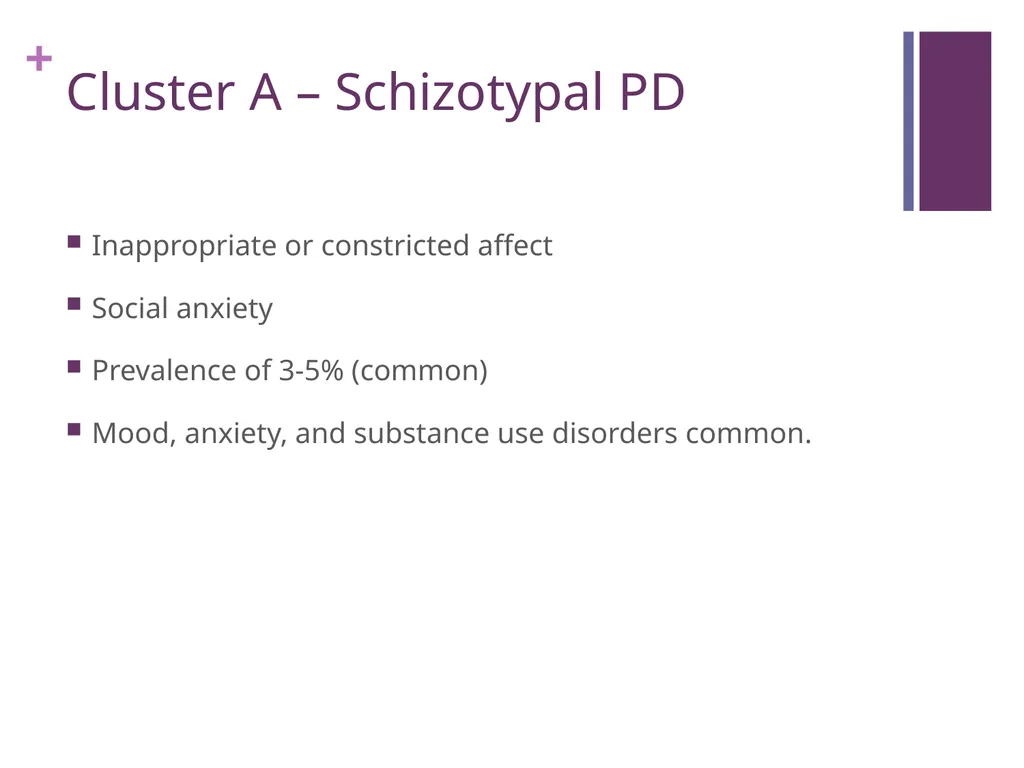
Cluster A – Schizotypal PD Inappropriate or constricted affect
Social anxiety
Prevalence of 3-5% (common)
Mood, anxiety, and substance use disorders common.<br>
Social anxiety
Prevalence of 3-5% (common)
Mood, anxiety, and substance use disorders common.<br>
43
Cluster A – Schizotypal PD Treat the identified disorder.
May benefit from social skills training.
Goal is to help individual develop insight into their behaviours and to develop repertoire of social skills.<br>
May benefit from social skills training.
Goal is to help individual develop insight into their behaviours and to develop repertoire of social skills.<br>
44
Cluster B (Dramatic, Emotional, Erratic) Antisocial
Borderline
Histrionic
Narcissistic<br>
Borderline
Histrionic
Narcissistic<br>
45
Cluster B (Dramatic, Emotional, Erratic) Characterized by a pervasive pattern of violating social norms (eg. criminal behaviour), impulsivity, excessive emotionality, grandiosity, “acting out” (eg. tantrums, self-abusive behaviour, angry outbursts), or violating the rights of others (eg. criminal behaviour).<br>
46
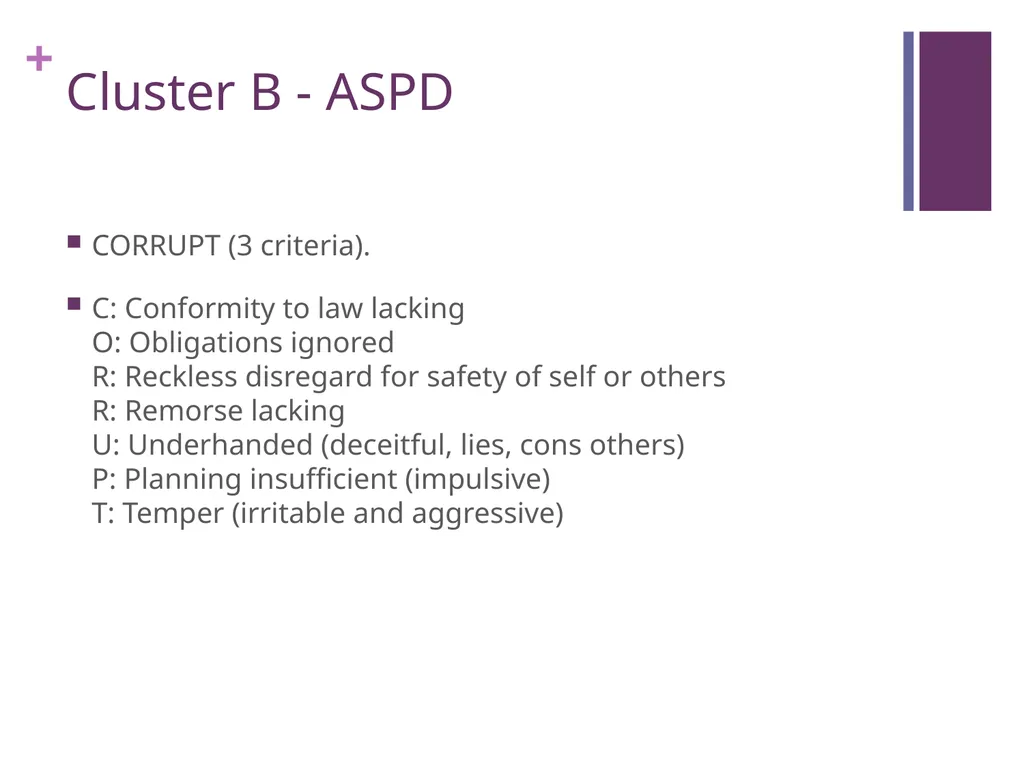
Cluster B - ASPD CORRUPT (3 criteria).
C: Conformity to law lacking O: Obligations ignored R: Reckless disregard for safety of self or others R: Remorse lacking U: Underhanded (deceitful, lies, cons others) P: Planning insufficient (impulsive) T: Temper (irritable and aggressive)<br>
C: Conformity to law lacking O: Obligations ignored R: Reckless disregard for safety of self or others R: Remorse lacking U: Underhanded (deceitful, lies, cons others) P: Planning insufficient (impulsive) T: Temper (irritable and aggressive)<br>
47
Cluster B - ASPD Pervasive pattern of disregard for and violation of the rights of others occurring since age 15 years.
The individual is at least age 18 years.
There is evidence of conduct disorder with onset before age 15 years.<br>
The individual is at least age 18 years.
There is evidence of conduct disorder with onset before age 15 years.<br>
48
Cluster B - ASPD Conduct Disorder - TRAP
T: Theft – B&E, deceiving, non-confrontational stealing
R: Rule Breaking – running away, skipping school, out late
A: Aggression – people, animals, weapons, forced sex
P: Property Destruction<br>
T: Theft – B&E, deceiving, non-confrontational stealing
R: Rule Breaking – running away, skipping school, out late
A: Aggression – people, animals, weapons, forced sex
P: Property Destruction<br>
49
Cluster B - ASPD<br>
50
Cluster B - ASPD First recognized in the early 19th century.
“Mania without delirium”
“Moral insanity”
Described immoral or guiltless behaviour in the absence of impaired reasoning.
20th Century – termed psychopathic personality
DSM-I – sociopathic personality<br>
“Mania without delirium”
“Moral insanity”
Described immoral or guiltless behaviour in the absence of impaired reasoning.
20th Century – termed psychopathic personality
DSM-I – sociopathic personality<br>
51
Cluster B - ASPD DSM-III – antisocial personality disorder.
Described in Hervey Cleckley’s – The Mask of Sanity (1941) – identified 16 traits descriptive of the disorder.<br>
Described in Hervey Cleckley’s – The Mask of Sanity (1941) – identified 16 traits descriptive of the disorder.<br>
52
Cluster B - ASPD Typical childhood behaviour of fighting, lying, cheating, stealing, fire setting, and cruelty to animals and other children.
As antisocial youth achieves adulthood, problems reflect age-appropriate responsibilities – uneven job performance, domestic abuse.<br>
As antisocial youth achieves adulthood, problems reflect age-appropriate responsibilities – uneven job performance, domestic abuse.<br>
53
Cluster B - ASPD Unreliability, reckless behaviour, inappropriate aggression, criminal behaviour, pathological lying, and use of aliases are characteristic.
Often act impulsively without thinking of long-term consequences. Legal issues common.<br>
Often act impulsively without thinking of long-term consequences. Legal issues common.<br>
54
Cluster B - ASPD 2-4% of men.
0.5 -1% of women.
Higher amongst psychiatric, prison, and homeless population.
Chronic disorder but worse early on.<br>
0.5 -1% of women.
Higher amongst psychiatric, prison, and homeless population.
Chronic disorder but worse early on.<br>
55
Cluster B - ASPD Comorbid substance use disorders, mood and anxiety disorders, ADHD, pathological gambling and other PDs (BPD).
Alcohol and SUD - 12 month prevalence
AUD 28.6%, SUD 47.7%
Any alcohol or SUD 84% lifetime
Depression and Anxiety (1 study)
35% MDE
27% phobic disorder<br>
Alcohol and SUD - 12 month prevalence
AUD 28.6%, SUD 47.7%
Any alcohol or SUD 84% lifetime
Depression and Anxiety (1 study)
35% MDE
27% phobic disorder<br>
56
Cluster B - ASPD High death rate – suicide, accidents, homicides.
No standard treatment.
Target aggression – eg. mood stabilizer and antipsychotics.
CBT to target distorted beliefs and attitudes.
Emotion regulation / anger management.
Difficult to treat due to treatment interfering traits – lie, blame others, impulsive, low frustration tolerance.<br>
No standard treatment.
Target aggression – eg. mood stabilizer and antipsychotics.
CBT to target distorted beliefs and attitudes.
Emotion regulation / anger management.
Difficult to treat due to treatment interfering traits – lie, blame others, impulsive, low frustration tolerance.<br>
57
Psychopathy Psychopathy is a personality construct involving a combination of both personality traits and behaviours.
Most offenders who are psychopaths meet criteria for ASPD.<br>
Most offenders who are psychopaths meet criteria for ASPD.<br>
58
Psychopathy 3 key symptom groupings:
Arrogant, interpersonally exploitative and deceitful interpersonal style of relating.
Shallow/deficient way of experiencing and expressing affect.
Irresponsible, impulsive, antisocial behavioural lifestyle<br>
Arrogant, interpersonally exploitative and deceitful interpersonal style of relating.
Shallow/deficient way of experiencing and expressing affect.
Irresponsible, impulsive, antisocial behavioural lifestyle<br>
59
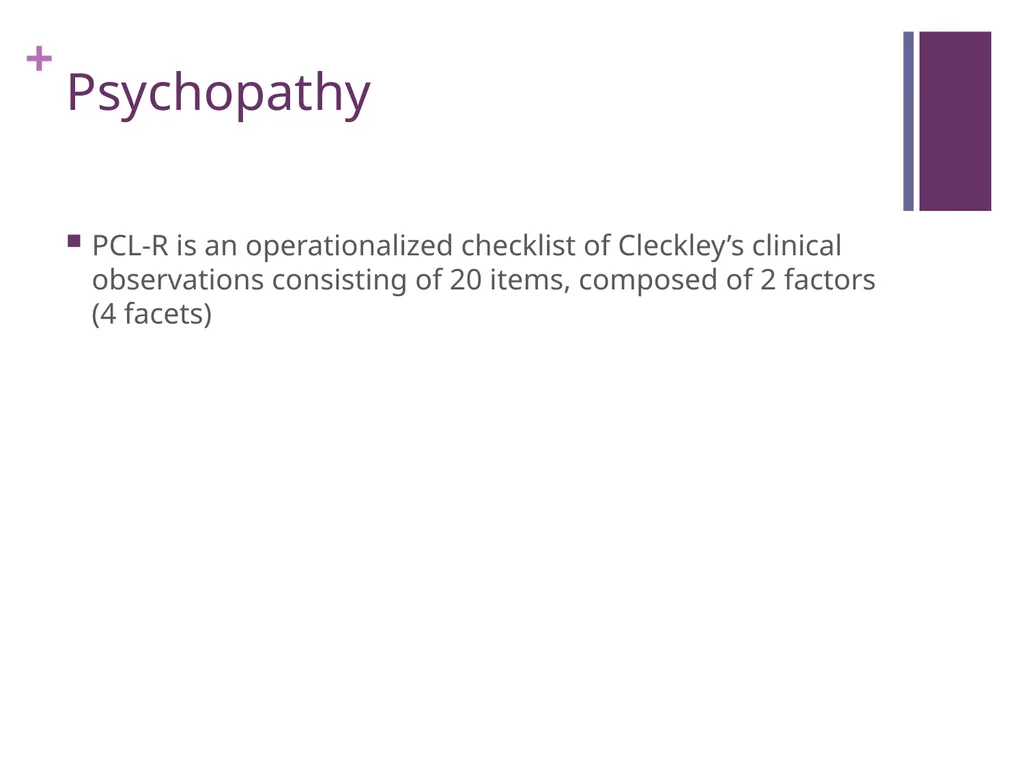
Psychopathy PCL-R is an operationalized checklist of Cleckley’s clinical observations consisting of 20 items, composed of 2 factors (4 facets)<br>
60
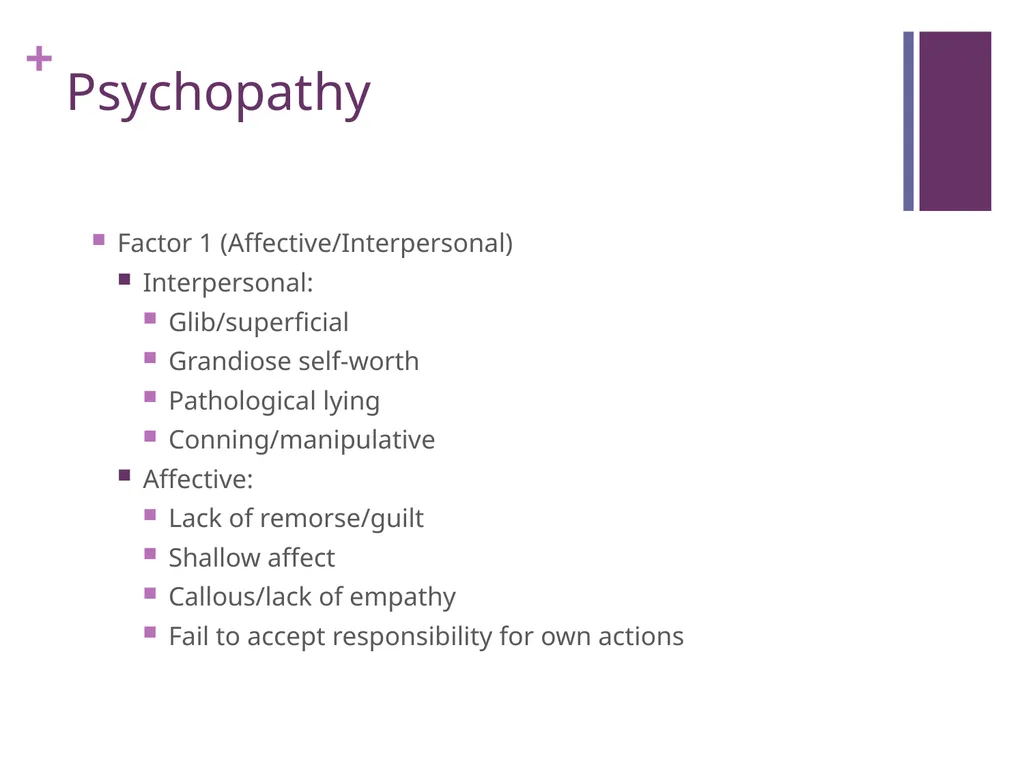
Psychopathy Factor 1 (Affective/Interpersonal)
Interpersonal:
Glib/superficial
Grandiose self-worth
Pathological lying
Conning/manipulative
Affective:
Lack of remorse/guilt
Shallow affect
Callous/lack of empathy
Fail to accept responsibility for own actions<br>
Interpersonal:
Glib/superficial
Grandiose self-worth
Pathological lying
Conning/manipulative
Affective:
Lack of remorse/guilt
Shallow affect
Callous/lack of empathy
Fail to accept responsibility for own actions<br>
61
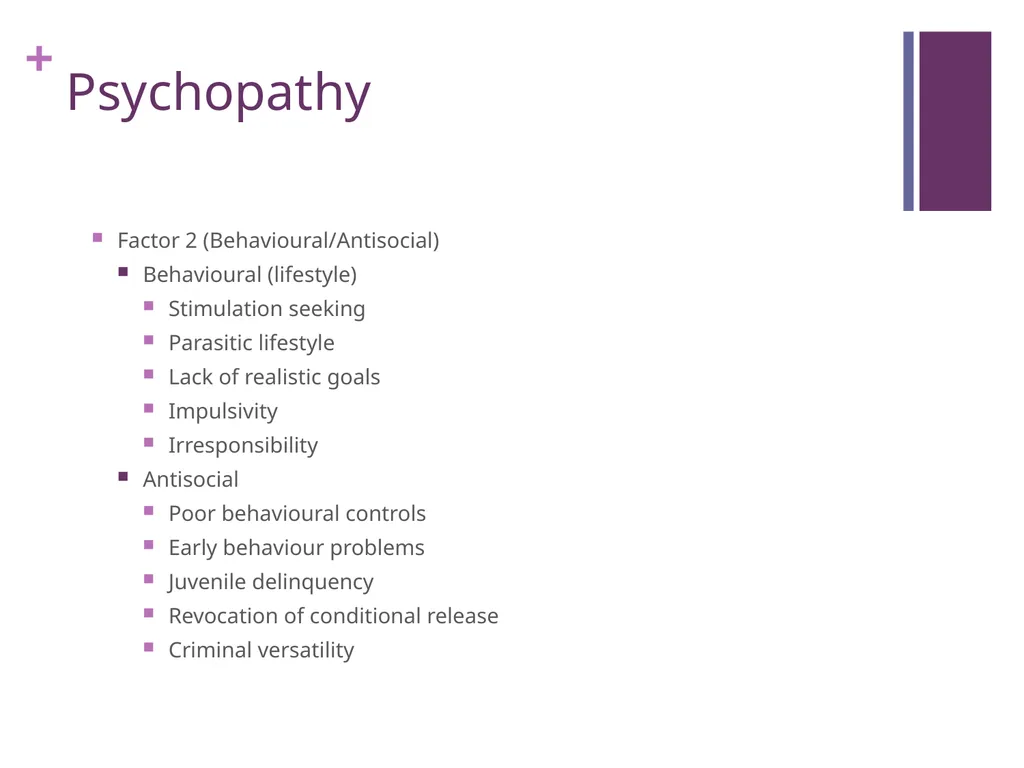
Psychopathy Factor 2 (Behavioural/Antisocial)
Behavioural (lifestyle)
Stimulation seeking
Parasitic lifestyle
Lack of realistic goals
Impulsivity
Irresponsibility
Antisocial
Poor behavioural controls
Early behaviour problems
Juvenile delinquency
Revocation of conditional release
Criminal versatility<br>
Behavioural (lifestyle)
Stimulation seeking
Parasitic lifestyle
Lack of realistic goals
Impulsivity
Irresponsibility
Antisocial
Poor behavioural controls
Early behaviour problems
Juvenile delinquency
Revocation of conditional release
Criminal versatility<br>
62
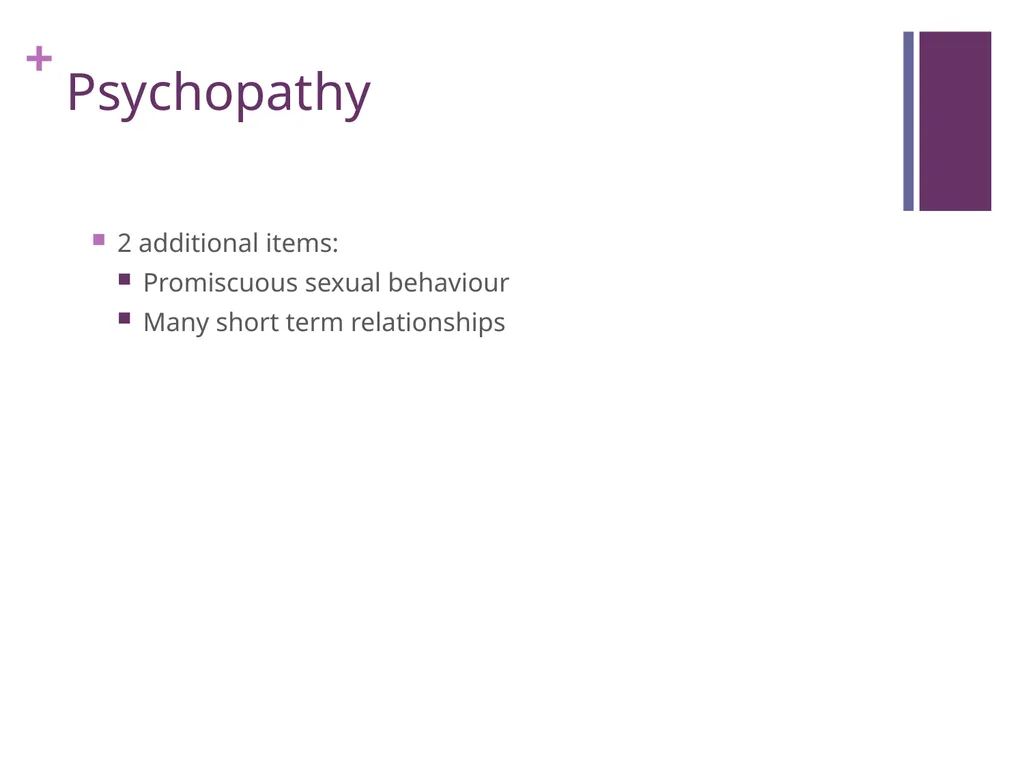
Psychopathy 2 additional items:
Promiscuous sexual behaviour
Many short term relationships<br>
Promiscuous sexual behaviour
Many short term relationships<br>
63
Cluster B - BPD “Stably unstable” Pervasive pattern of:
Mood instability
Unstable and intense interpersonal relationships
Impulsivity
Inappropriate or intense anger
Lack of control of anger
Recurrent suicidal threats and gestures
Self-mutilating behaviour<br>
Mood instability
Unstable and intense interpersonal relationships
Impulsivity
Inappropriate or intense anger
Lack of control of anger
Recurrent suicidal threats and gestures
Self-mutilating behaviour<br>
64
Cluster B - BPD Marked and persistent identity disturbance
Chronic feelings of emptiness or boredom
Frantic efforts to avoid real or imagined abandonment
Transient paranoid or dissociative symptoms<br>
Chronic feelings of emptiness or boredom
Frantic efforts to avoid real or imagined abandonment
Transient paranoid or dissociative symptoms<br>
65
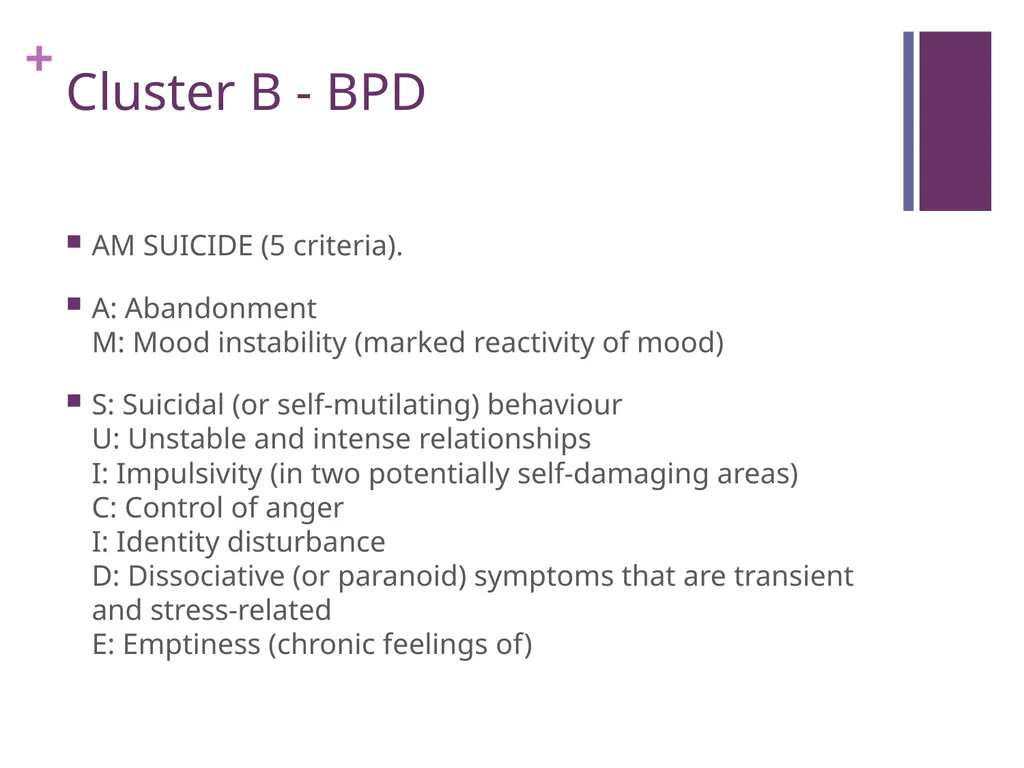
Cluster B - BPD AM SUICIDE (5 criteria).
A: Abandonment M: Mood instability (marked reactivity of mood)
S: Suicidal (or self-mutilating) behaviour U: Unstable and intense relationships I: Impulsivity (in two potentially self-damaging areas) C: Control of anger I: Identity disturbance D: Dissociative (or paranoid) symptoms that are transient and stress-related E: Emptiness (chronic feelings of)<br>
A: Abandonment M: Mood instability (marked reactivity of mood)
S: Suicidal (or self-mutilating) behaviour U: Unstable and intense relationships I: Impulsivity (in two potentially self-damaging areas) C: Control of anger I: Identity disturbance D: Dissociative (or paranoid) symptoms that are transient and stress-related E: Emptiness (chronic feelings of)<br>
66
Cluster B - BPD<br>
67
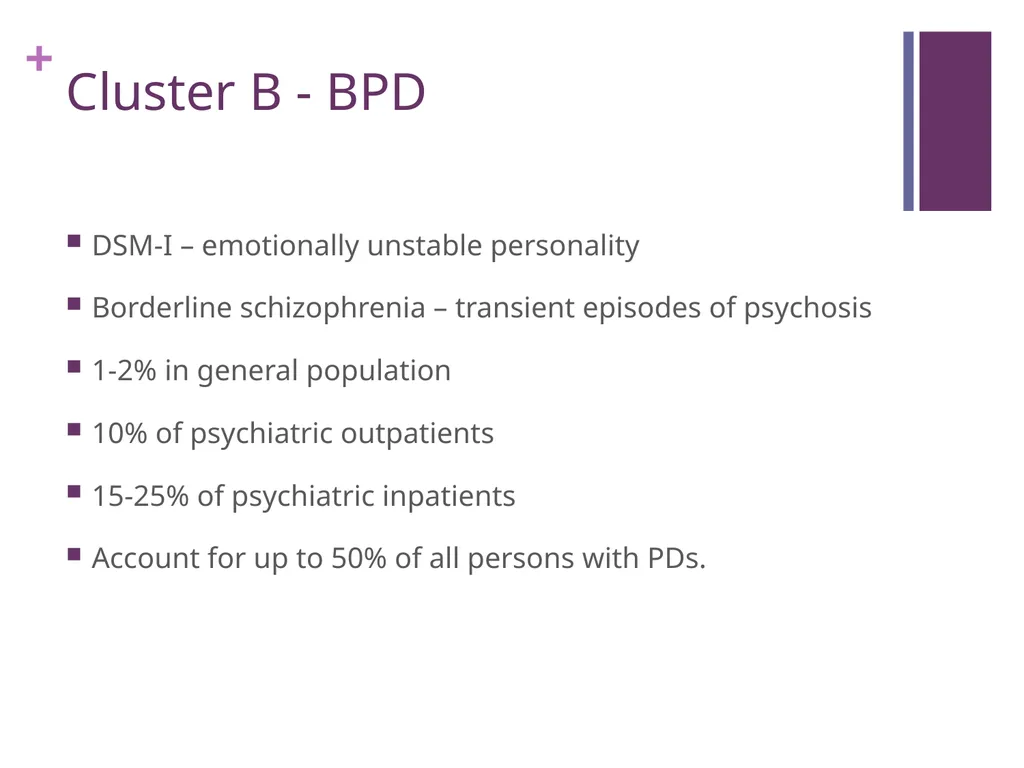
Cluster B - BPD DSM-I – emotionally unstable personality
Borderline schizophrenia – transient episodes of psychosis
1-2% in general population
10% of psychiatric outpatients
15-25% of psychiatric inpatients
Account for up to 50% of all persons with PDs.<br>
Borderline schizophrenia – transient episodes of psychosis
1-2% in general population
10% of psychiatric outpatients
15-25% of psychiatric inpatients
Account for up to 50% of all persons with PDs.<br>
68
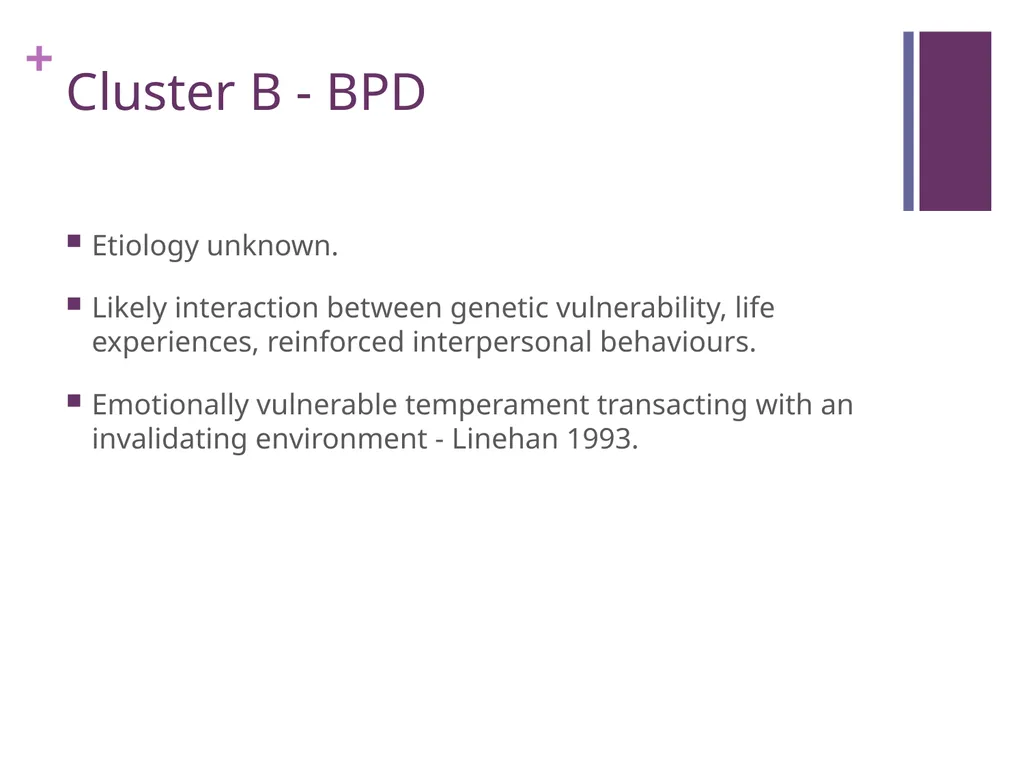
Cluster B - BPD Etiology unknown.
Likely interaction between genetic vulnerability, life experiences, reinforced interpersonal behaviours.
Emotionally vulnerable temperament transacting with an invalidating environment - Linehan 1993.<br>
Likely interaction between genetic vulnerability, life experiences, reinforced interpersonal behaviours.
Emotionally vulnerable temperament transacting with an invalidating environment - Linehan 1993.<br>
69
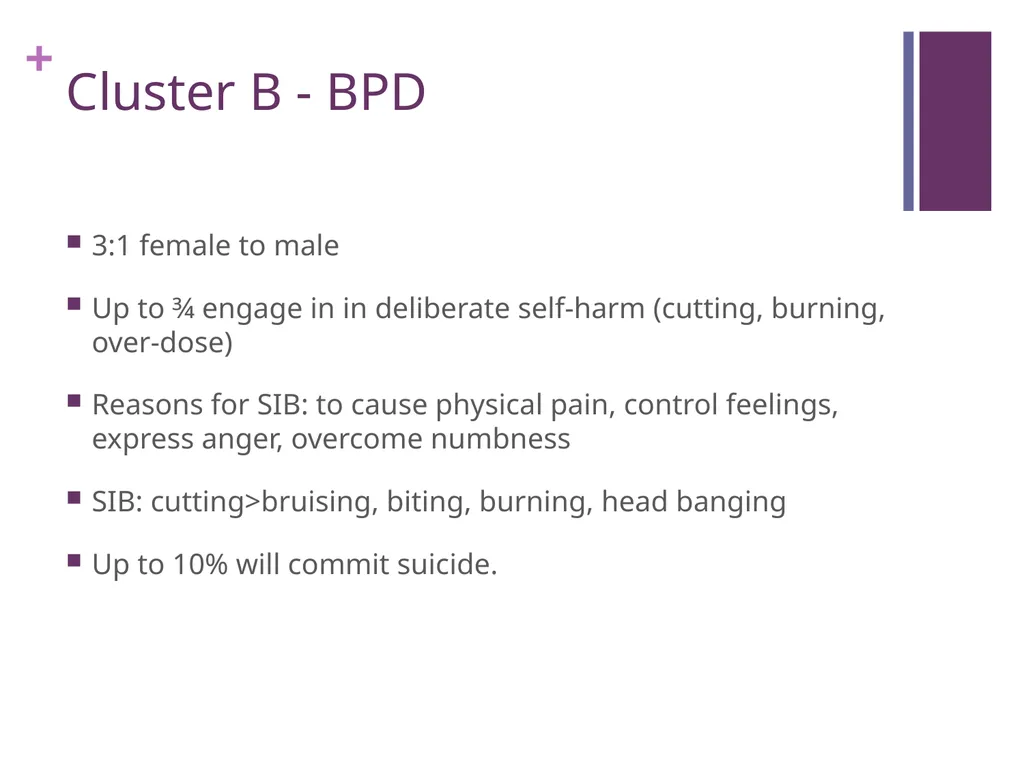
Cluster B - BPD 3:1 female to male
Up to ¾ engage in in deliberate self-harm (cutting, burning, over-dose)
Reasons for SIB: to cause physical pain, control feelings, express anger, overcome numbness
SIB: cutting>bruising, biting, burning, head banging
Up to 10% will commit suicide.<br>
Up to ¾ engage in in deliberate self-harm (cutting, burning, over-dose)
Reasons for SIB: to cause physical pain, control feelings, express anger, overcome numbness
SIB: cutting>bruising, biting, burning, head banging
Up to 10% will commit suicide.<br>
70
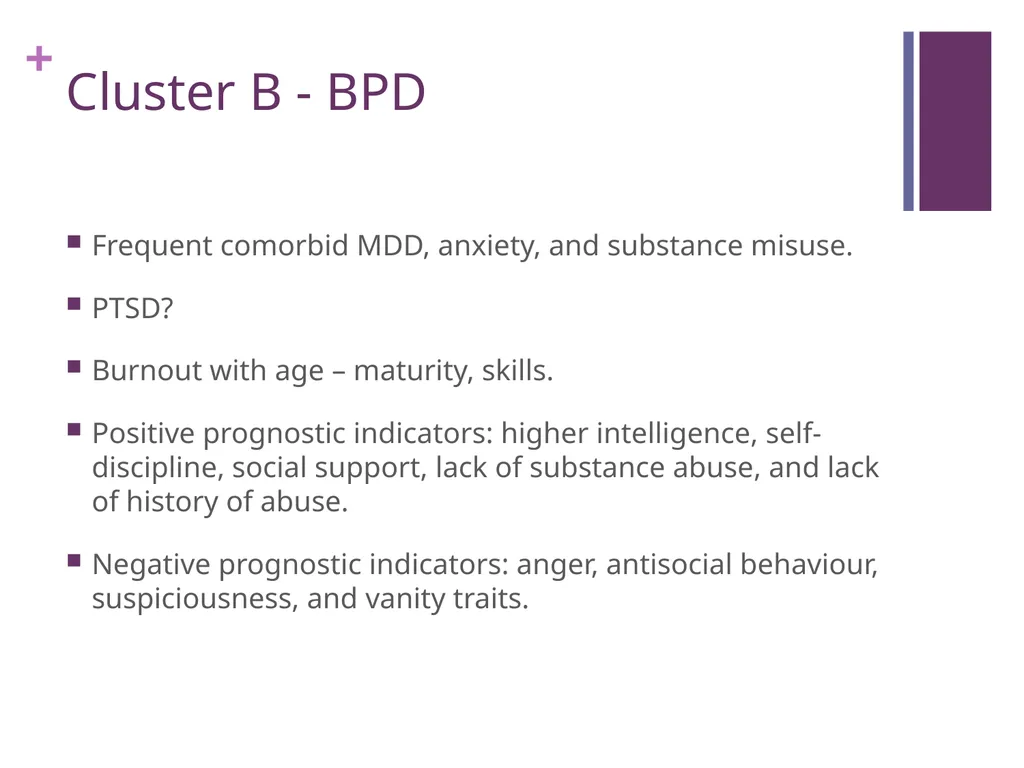
Cluster B - BPD Frequent comorbid MDD, anxiety, and substance misuse.
PTSD?
Burnout with age – maturity, skills.
Positive prognostic indicators: higher intelligence, self-discipline, social support, lack of substance abuse, and lack of history of abuse.
Negative prognostic indicators: anger, antisocial behaviour, suspiciousness, and vanity traits.<br>
PTSD?
Burnout with age – maturity, skills.
Positive prognostic indicators: higher intelligence, self-discipline, social support, lack of substance abuse, and lack of history of abuse.
Negative prognostic indicators: anger, antisocial behaviour, suspiciousness, and vanity traits.<br>
71
Cluster B - BPD Treatment involves targeting mood, anxiety etc.
DBT – reduces self-harm, hospitalization rates, and emotional dyscontrol.
DBT – targets dysfunctional attitudes and beliefs and improves coping skills, stress tolerance, and emotion regulation.
Frequent acting out in therapy.<br>
DBT – reduces self-harm, hospitalization rates, and emotional dyscontrol.
DBT – targets dysfunctional attitudes and beliefs and improves coping skills, stress tolerance, and emotion regulation.
Frequent acting out in therapy.<br>
72
Cluster B - BPD Treatment on an out-patient basis where patients can deal with their issues.
Hospitalization for acute/emergent issues. Risk of regression/acting out/destabilization in hospital.
Psychoeducation.<br>
Hospitalization for acute/emergent issues. Risk of regression/acting out/destabilization in hospital.
Psychoeducation.<br>
73
Cluster B – Histrionic PD PRAISE ME (5 criteria)
P: Provocative (or sexually seductive) behaviour R: Relationships (considered more intimate than they are) A: Attention (uncomfortable when not the center of attention) I: Influenced easily S: Style of speech (impressionistic, lacks detail) E: Emotions (rapidly shifting and shallow)
M: Made up (physical appearance used to draw attention to self) E: Emotions exaggerated (theatrical)<br>
P: Provocative (or sexually seductive) behaviour R: Relationships (considered more intimate than they are) A: Attention (uncomfortable when not the center of attention) I: Influenced easily S: Style of speech (impressionistic, lacks detail) E: Emotions (rapidly shifting and shallow)
M: Made up (physical appearance used to draw attention to self) E: Emotions exaggerated (theatrical)<br>
74
Cluster B – Histrionic PD<br>
75
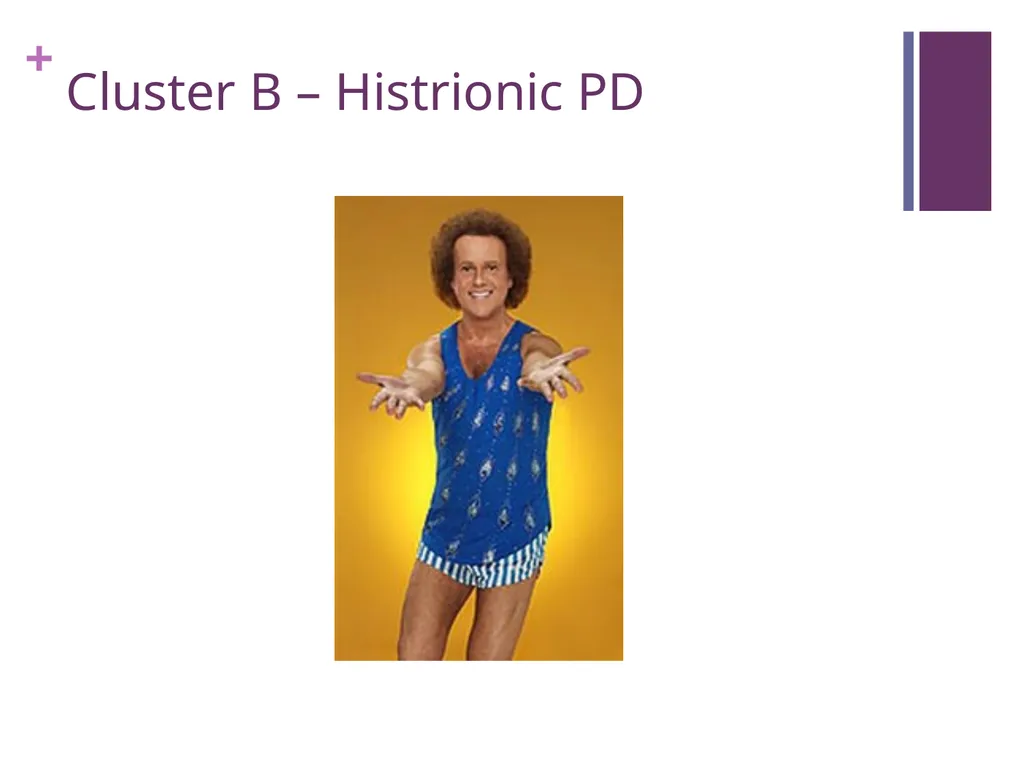
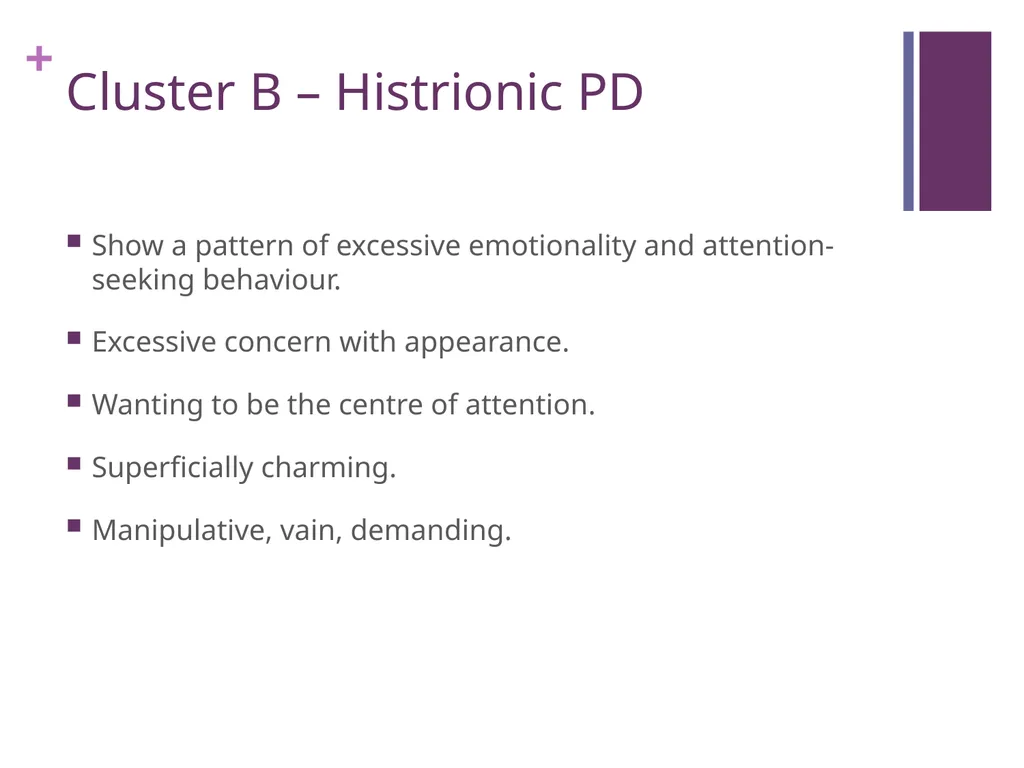
Cluster B – Histrionic PD Show a pattern of excessive emotionality and attention-seeking behaviour.
Excessive concern with appearance.
Wanting to be the centre of attention.
Superficially charming.
Manipulative, vain, demanding.<br>
Excessive concern with appearance.
Wanting to be the centre of attention.
Superficially charming.
Manipulative, vain, demanding.<br>
76
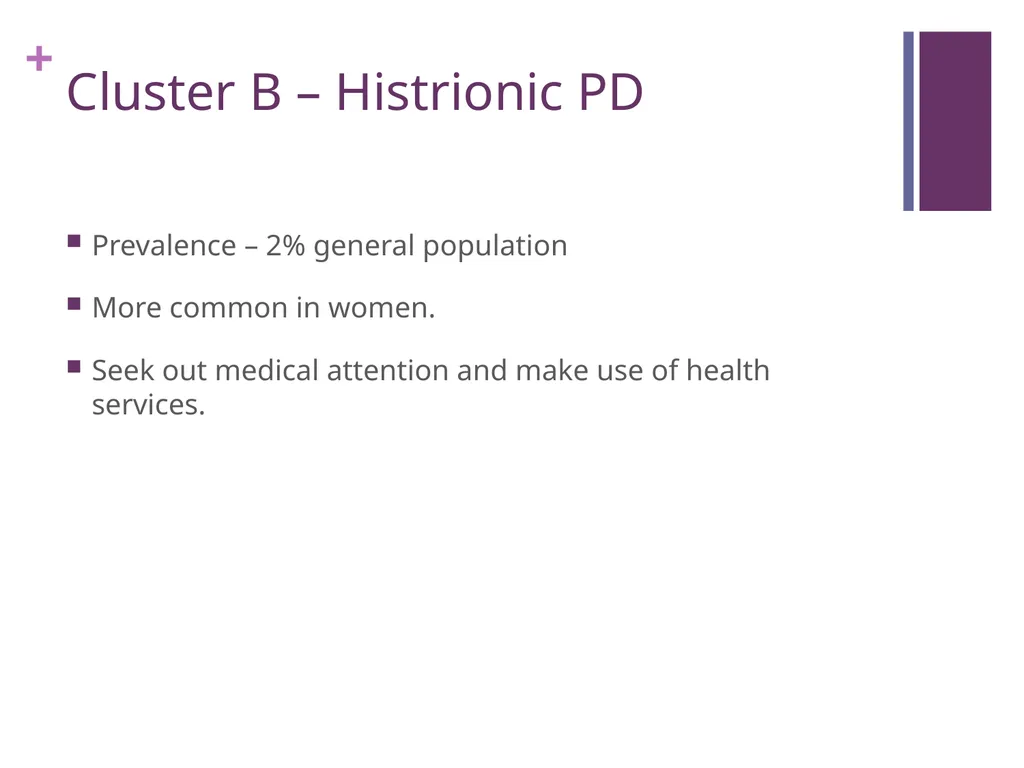
Cluster B – Histrionic PD Prevalence – 2% general population
More common in women.
Seek out medical attention and make use of health services.<br>
More common in women.
Seek out medical attention and make use of health services.<br>
77
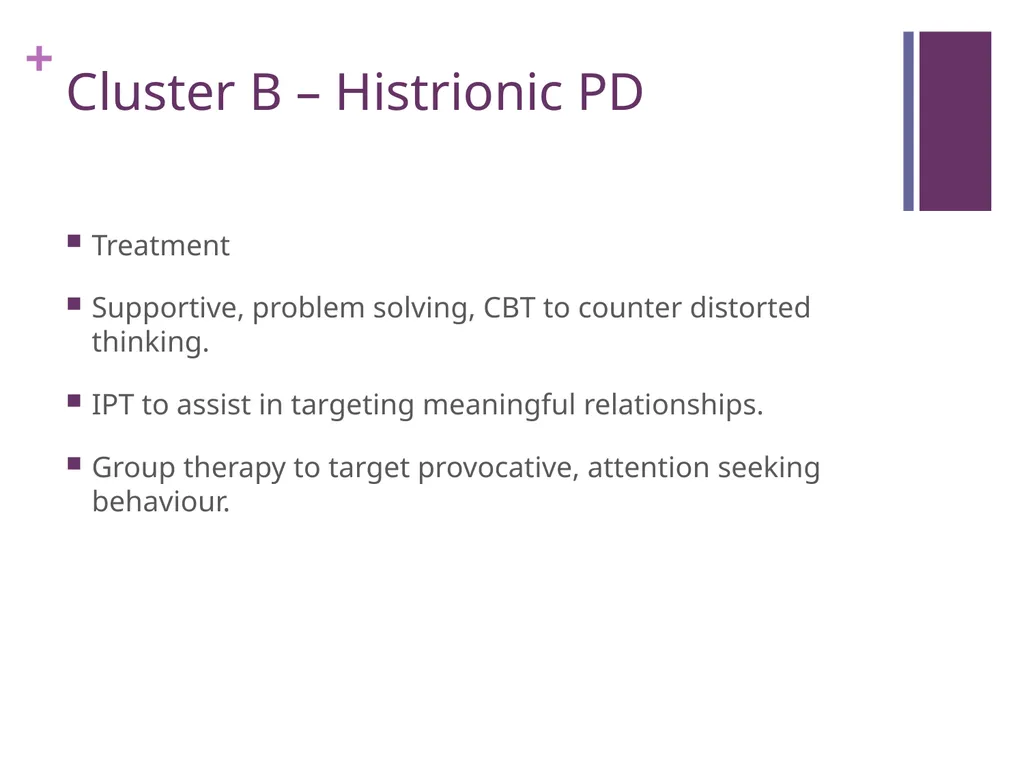
Cluster B – Histrionic PD Treatment
Supportive, problem solving, CBT to counter distorted thinking.
IPT to assist in targeting meaningful relationships.
Group therapy to target provocative, attention seeking behaviour.<br>
Supportive, problem solving, CBT to counter distorted thinking.
IPT to assist in targeting meaningful relationships.
Group therapy to target provocative, attention seeking behaviour.<br>
78
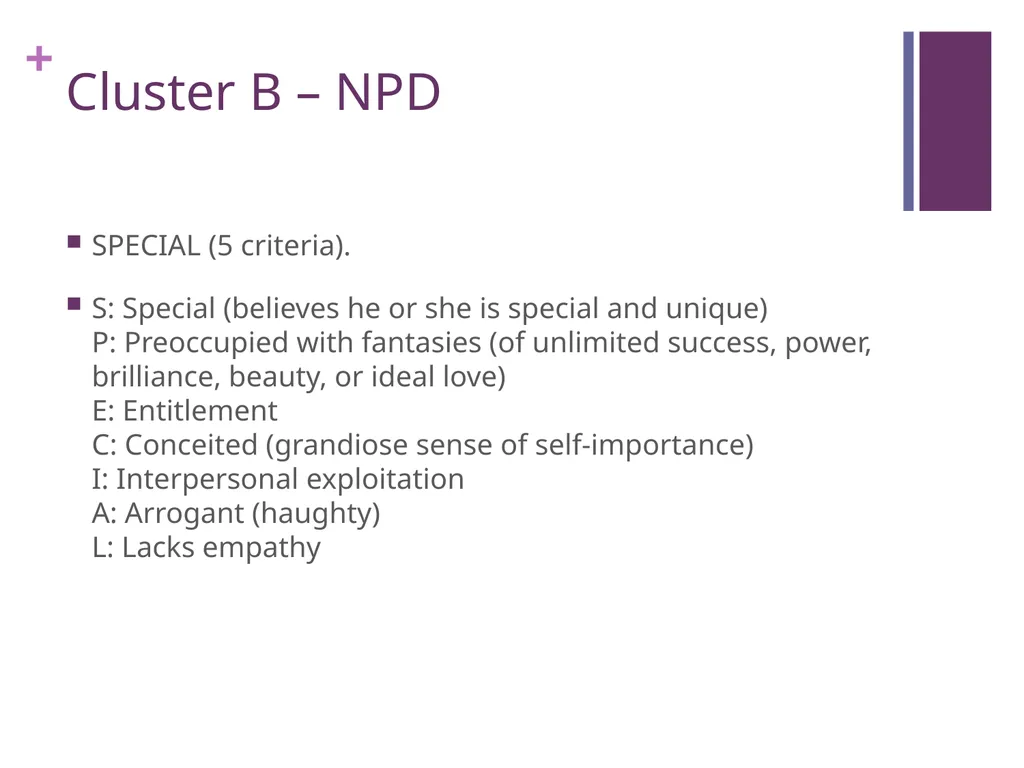
Cluster B – NPD SPECIAL (5 criteria).
S: Special (believes he or she is special and unique) P: Preoccupied with fantasies (of unlimited success, power, brilliance, beauty, or ideal love) E: Entitlement C: Conceited (grandiose sense of self-importance) I: Interpersonal exploitation A: Arrogant (haughty) L: Lacks empathy<br>
S: Special (believes he or she is special and unique) P: Preoccupied with fantasies (of unlimited success, power, brilliance, beauty, or ideal love) E: Entitlement C: Conceited (grandiose sense of self-importance) I: Interpersonal exploitation A: Arrogant (haughty) L: Lacks empathy<br>
79
Cluster B – NPD Introduced in DSM-III
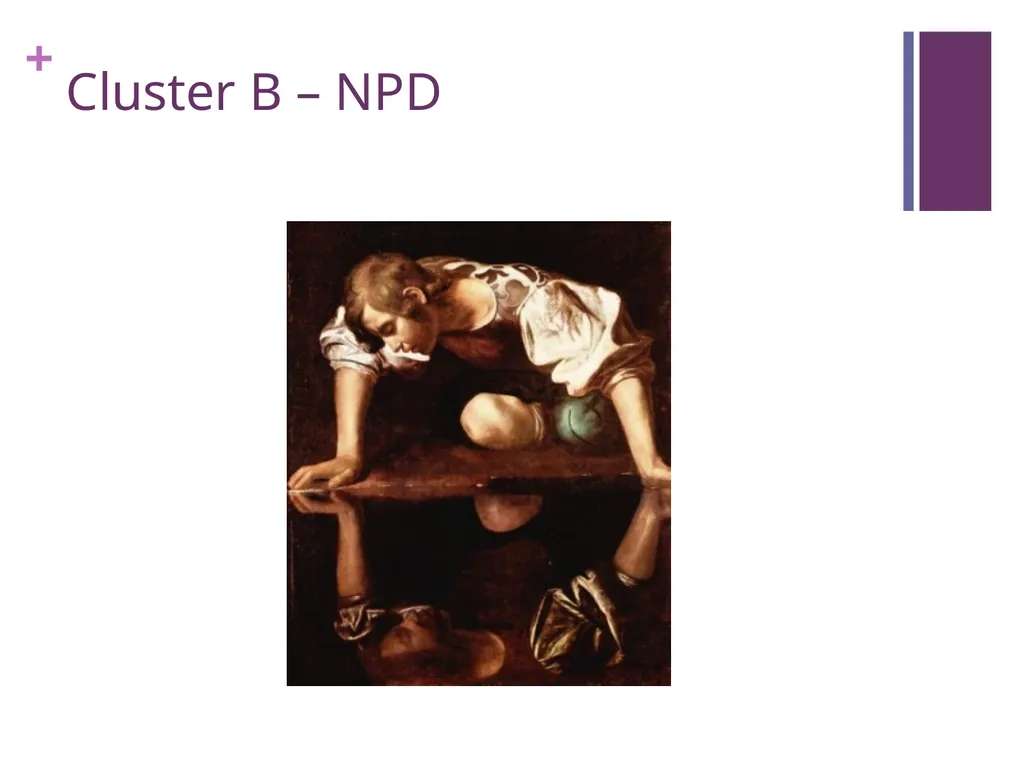
Named after Narcissus from Greek mythology, who fell in love with his own reflection.
Characterized by grandiosity, lack of empathy, and hypersensitivity to evaluation by others.
Tend to be egotistical, inflate their accomplishments, and manipulate/exploit those around them for their own aims.<br>
Named after Narcissus from Greek mythology, who fell in love with his own reflection.
Characterized by grandiosity, lack of empathy, and hypersensitivity to evaluation by others.
Tend to be egotistical, inflate their accomplishments, and manipulate/exploit those around them for their own aims.<br>
80
Cluster B – NPD<br>
81
Cluster B – NPD Have an exaggerated sense of entitlement.
Expect love and admiration but have little empathy for others.
Tend to have little insight into their own narcissism.
1% prevalence. More common in males.<br>
Expect love and admiration but have little empathy for others.
Tend to have little insight into their own narcissism.
1% prevalence. More common in males.<br>
82
Cluster B – NPD No consensus on treatment.
Difficult to work with.
Present after narcissistic injury sustained – anger or depression post humiliation in a situation that they did not get what they felt they were entitled to.
CBT, dynamic psychotherapy.
Treat comorbidities.<br>
Difficult to work with.
Present after narcissistic injury sustained – anger or depression post humiliation in a situation that they did not get what they felt they were entitled to.
CBT, dynamic psychotherapy.
Treat comorbidities.<br>
83
Cluster C (Anxious, Fearful) Avoidant
Dependent
Obsessive-Compulsive<br>
Dependent
Obsessive-Compulsive<br>
84
Cluster C (Anxious, Fearful) Characterized by a pervasive pattern of abnormal fears involving social relationships, separation, and need for control.<br>
85
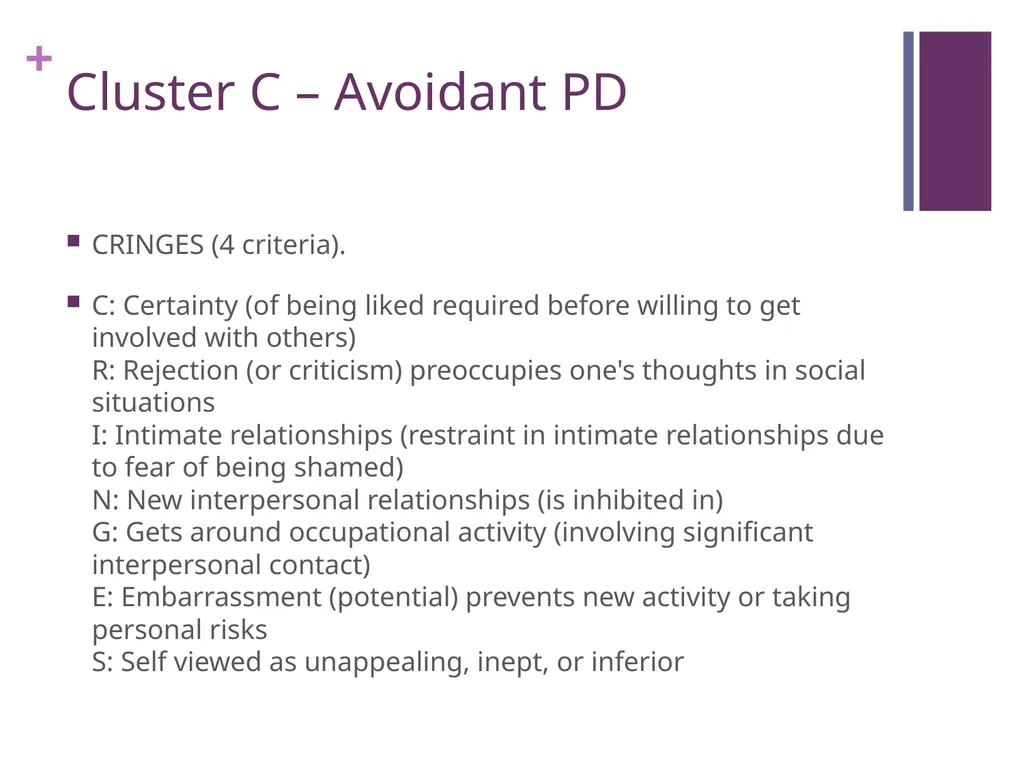
Cluster C – Avoidant PD CRINGES (4 criteria).
C: Certainty (of being liked required before willing to get involved with others) R: Rejection (or criticism) preoccupies one's thoughts in social situations I: Intimate relationships (restraint in intimate relationships due to fear of being shamed) N: New interpersonal relationships (is inhibited in) G: Gets around occupational activity (involving significant interpersonal contact) E: Embarrassment (potential) prevents new activity or taking personal risks S: Self viewed as unappealing, inept, or inferior<br>
C: Certainty (of being liked required before willing to get involved with others) R: Rejection (or criticism) preoccupies one's thoughts in social situations I: Intimate relationships (restraint in intimate relationships due to fear of being shamed) N: New interpersonal relationships (is inhibited in) G: Gets around occupational activity (involving significant interpersonal contact) E: Embarrassment (potential) prevents new activity or taking personal risks S: Self viewed as unappealing, inept, or inferior<br>
86
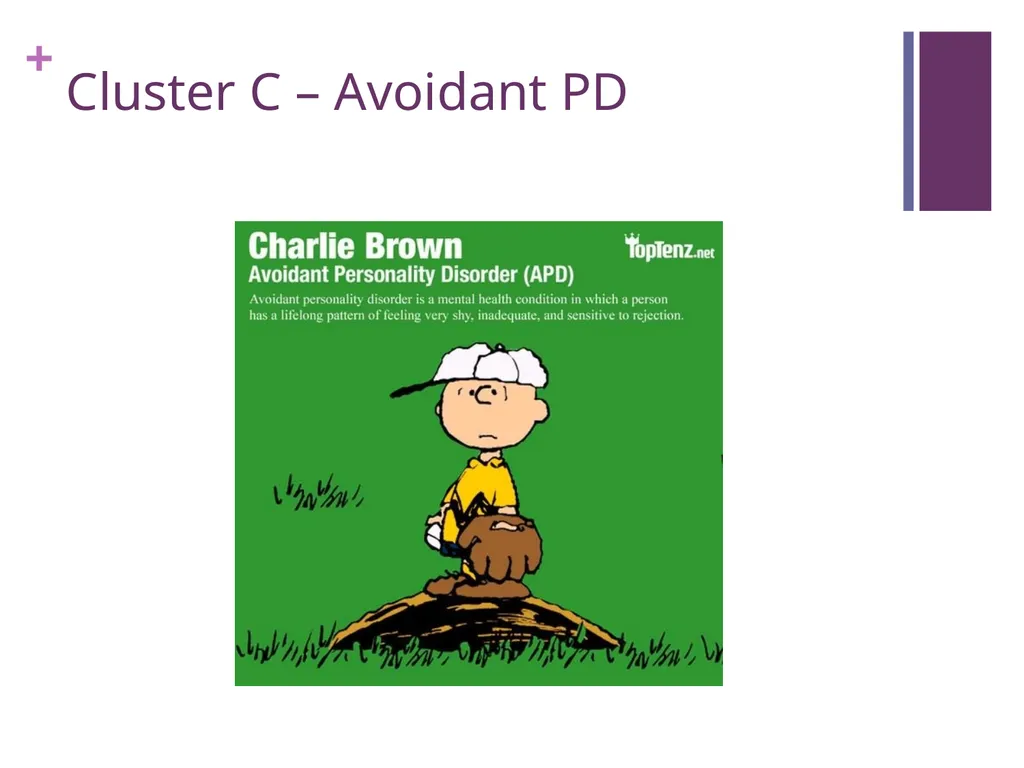
Cluster C – Avoidant PD<br>
87
Cluster C – Avoidant PD Predecessor – inadequate personality
Tend to be inhibited, introverted, and anxious.
Tend to have low self-esteem
Rejection hypersensitivity
Apprehensive and mistrustful
Socially awkward and timid
Fear being embarrassed or acting foolish in public.
Overlap with social anxiety disorder.<br>
Tend to be inhibited, introverted, and anxious.
Tend to have low self-esteem
Rejection hypersensitivity
Apprehensive and mistrustful
Socially awkward and timid
Fear being embarrassed or acting foolish in public.
Overlap with social anxiety disorder.<br>
88
Cluster C – Avoidant PD Treatment:
Assertiveness and social skills training.
CBT – focus on sensitization to treat anxiety, shyness and introversion.
CBT – to target dysfunctional attitudes / thought distortion.
Antidepressants (SSRIs) to target anxiety.<br>
Assertiveness and social skills training.
CBT – focus on sensitization to treat anxiety, shyness and introversion.
CBT – to target dysfunctional attitudes / thought distortion.
Antidepressants (SSRIs) to target anxiety.<br>
89
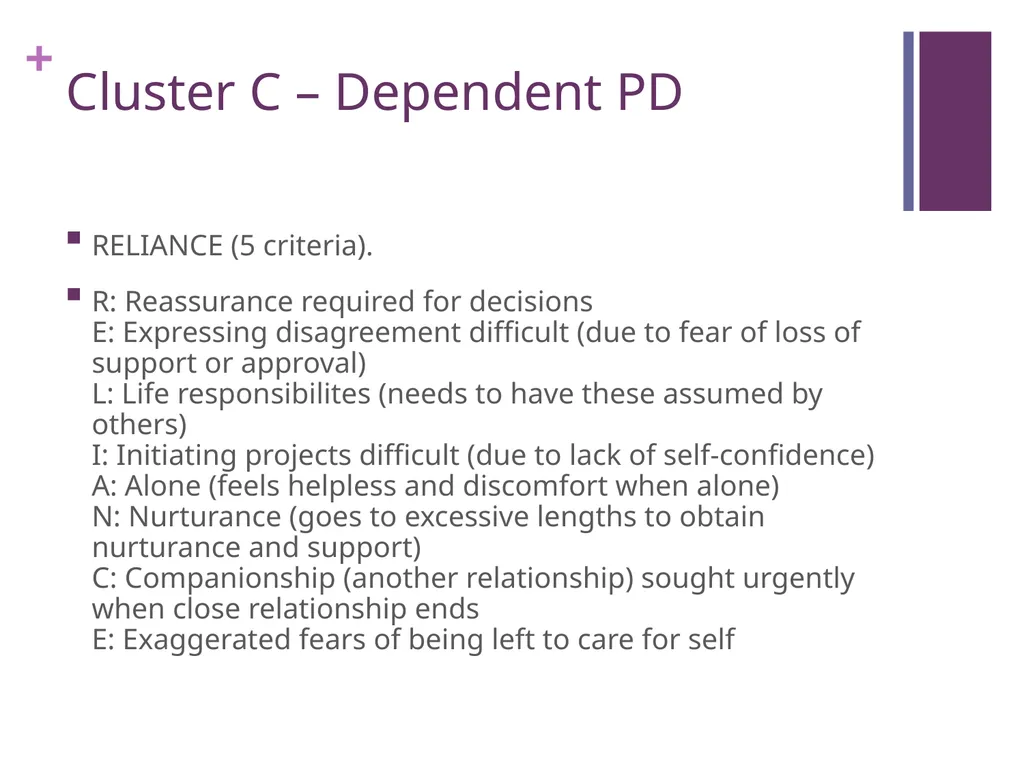
Cluster C – Dependent PD RELIANCE (5 criteria).
R: Reassurance required for decisions E: Expressing disagreement difficult (due to fear of loss of support or approval) L: Life responsibilites (needs to have these assumed by others) I: Initiating projects difficult (due to lack of self-confidence) A: Alone (feels helpless and discomfort when alone) N: Nurturance (goes to excessive lengths to obtain nurturance and support) C: Companionship (another relationship) sought urgently when close relationship ends E: Exaggerated fears of being left to care for self<br>
R: Reassurance required for decisions E: Expressing disagreement difficult (due to fear of loss of support or approval) L: Life responsibilites (needs to have these assumed by others) I: Initiating projects difficult (due to lack of self-confidence) A: Alone (feels helpless and discomfort when alone) N: Nurturance (goes to excessive lengths to obtain nurturance and support) C: Companionship (another relationship) sought urgently when close relationship ends E: Exaggerated fears of being left to care for self<br>
90
Cluster C – Dependent PD<br>
91
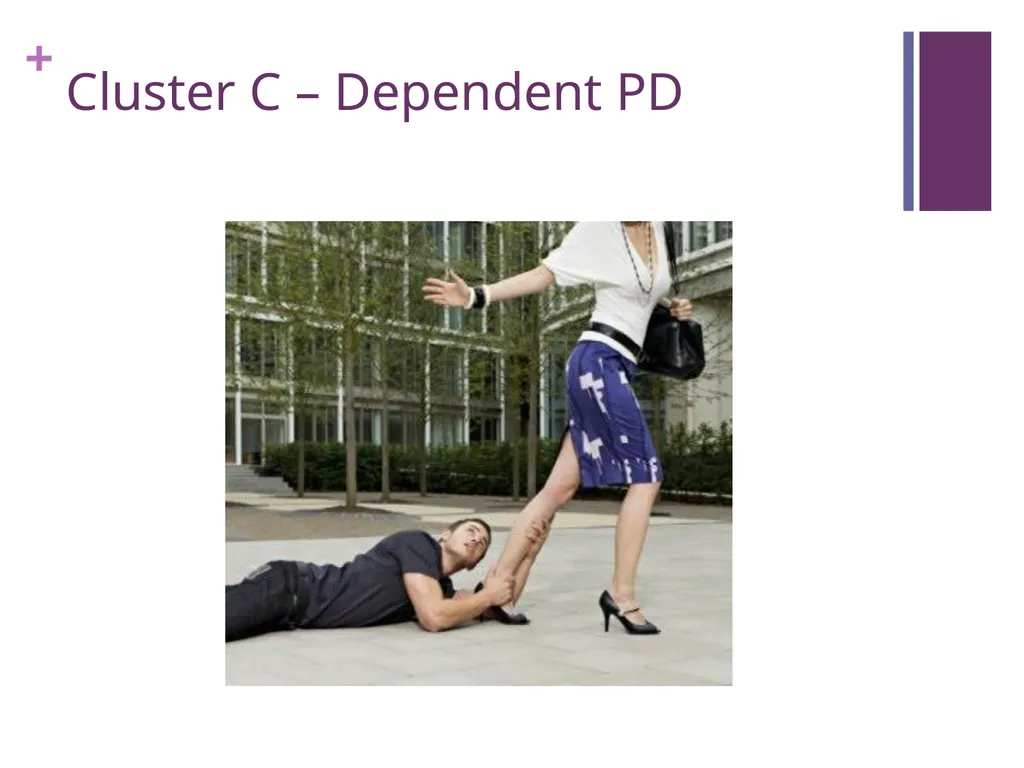
Cluster C – Dependent PD Predecessor – subtype of DSM-1 passive-aggressive personality
Characterized by a pattern of relying excessively on others for emotional support.
Comorbid psychiatric disorders are common – mood, anxiety, etc.
Tend to have poor social supports because their dependency promotes conflict.<br>
Characterized by a pattern of relying excessively on others for emotional support.
Comorbid psychiatric disorders are common – mood, anxiety, etc.
Tend to have poor social supports because their dependency promotes conflict.<br>
92
Cluster C – Dependent PD Treatment
Little consensus.
Target associated mental disorder (mood, anxiety, etc.)
CBT – assertiveness, effective decision making, and independence.
Assertiveness training and social skills training.<br>
Little consensus.
Target associated mental disorder (mood, anxiety, etc.)
CBT – assertiveness, effective decision making, and independence.
Assertiveness training and social skills training.<br>
93
Cluster C - OCPD LAW FIRMS (4 criteria).
L: Loses point of activity (due to preoccupation with detail) A: Ability to complete tasks (compromised by perfectionism) W: Worthless objects (unable to discard)
F: Friendships (and leisure activities) excluded (due to a preoccupation with work) I: Inflexible, scrupulous, overconscientious (on ethics, values, or morality, not accounted for by religion or culture) R: Reluctant to delegate (unless others submit to exact guidelines) M: Miserly (toward self and others) S: Stubbornness (and rigidity)<br>
L: Loses point of activity (due to preoccupation with detail) A: Ability to complete tasks (compromised by perfectionism) W: Worthless objects (unable to discard)
F: Friendships (and leisure activities) excluded (due to a preoccupation with work) I: Inflexible, scrupulous, overconscientious (on ethics, values, or morality, not accounted for by religion or culture) R: Reluctant to delegate (unless others submit to exact guidelines) M: Miserly (toward self and others) S: Stubbornness (and rigidity)<br>
94
Cluster C - OCPD<br>
95
Cluster C - OCPD Characterized by obstinacy, parsimony, and orderliness.
Lifelong pattern of perfectionism and inflexibility, associated with over-conscientiousness and constricted emotions.
No 1:1 relationship with OCD.
Very common. In one study prevalence was estimated at up to 8% of the general population.<br>
Lifelong pattern of perfectionism and inflexibility, associated with over-conscientiousness and constricted emotions.
No 1:1 relationship with OCD.
Very common. In one study prevalence was estimated at up to 8% of the general population.<br>
96
Cluster C - OCPD Patients suffering from OCPD are prone to major depression.
Difficult to treat.
CBT to target black and white thinking.
Antidepressants to target mood, anxiety, and possibly ritualized behaviour.<br>
Difficult to treat.
CBT to target black and white thinking.
Antidepressants to target mood, anxiety, and possibly ritualized behaviour.<br>
97
Summary Personality Disorders encompass maladaptive, pervasive, and deeply ingrained behaviour.
Given the enduring, long-term nature of the maladaptive patterns of behaviour, they cannot be easily reversed.<br>
Given the enduring, long-term nature of the maladaptive patterns of behaviour, they cannot be easily reversed.<br>