
Personality Disorders and Sensitivity: An Overview
Description: Personality Disorders and Sensitivity: An Overview Dr. Samuel Pfeifer What is a healthy personality? There are many possible answers models Excellent overview: Vaillant G.: Mental Health, American Journal of Psychiatry 2003; 160:13731384
Related Topics
Download Presentation
"Personality Disorders and Sensitivity: An Overview" is the property of its rightful owner. Permission is granted to download and print the materials on this website for personal, non-commercial use only, and to display it on your personal computer provided you do not modify the materials and that you retain all copyright notices contained in the materials. By downloading content from our website, you accept the terms of this agreement.
Presentation Transcript
slide1. Personality Disorders and Sensitivity:
An Overview Dr. Samuel Pfeifer<br>
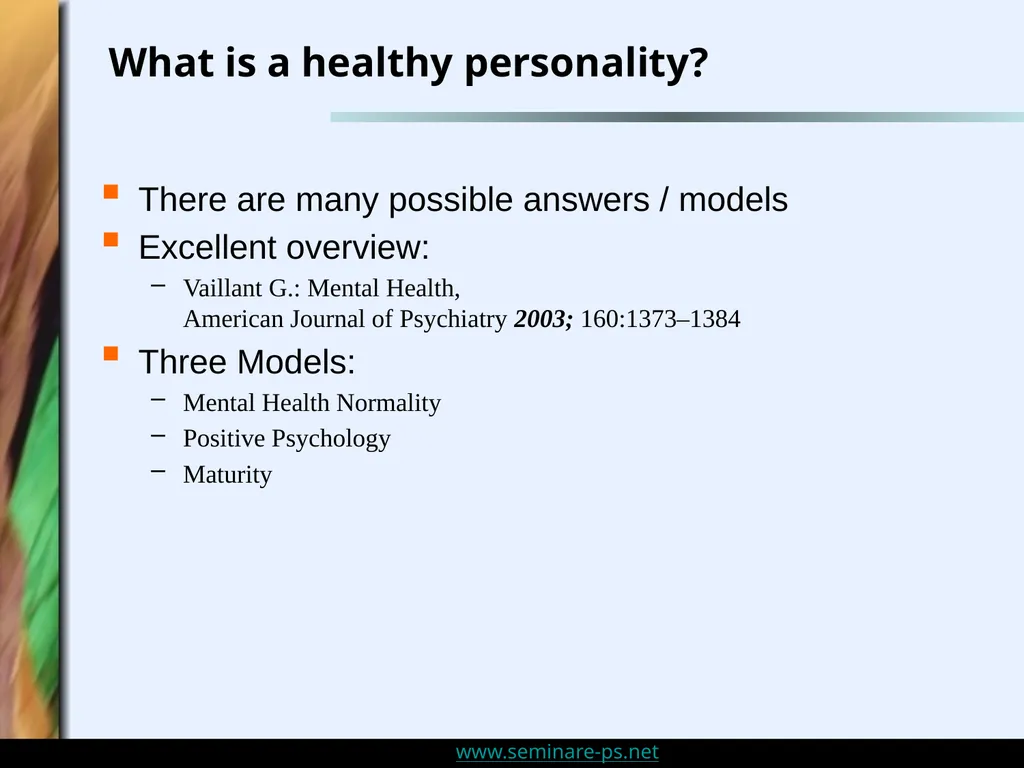
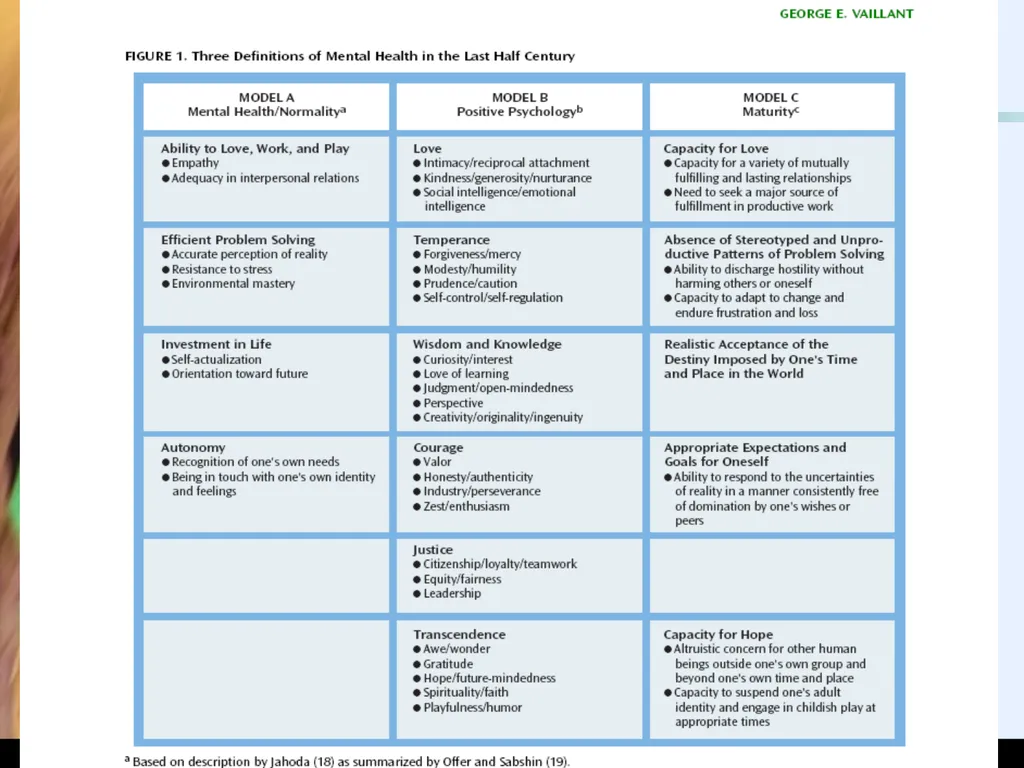
slide2. What is a healthy personality? There are many possible answers / models
Excellent overview:
Vaillant G.: Mental Health, American Journal of Psychiatry 2003; 160:1373–1384
Three Models:
Mental Health Normality
Positive Psychology
Maturity<br>
slide4. What purpose does personality serve? for myself or for society?
adaptation or creativity?
my wellbeing or survival?<br>
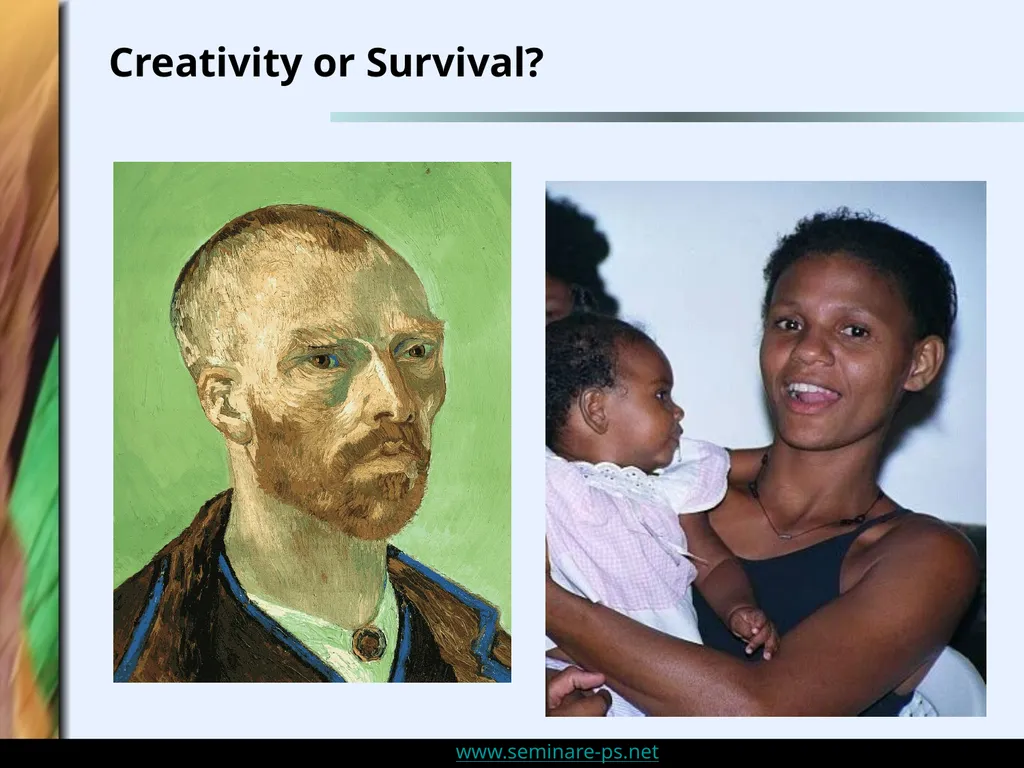
slide5. Creativity or Survival?<br>
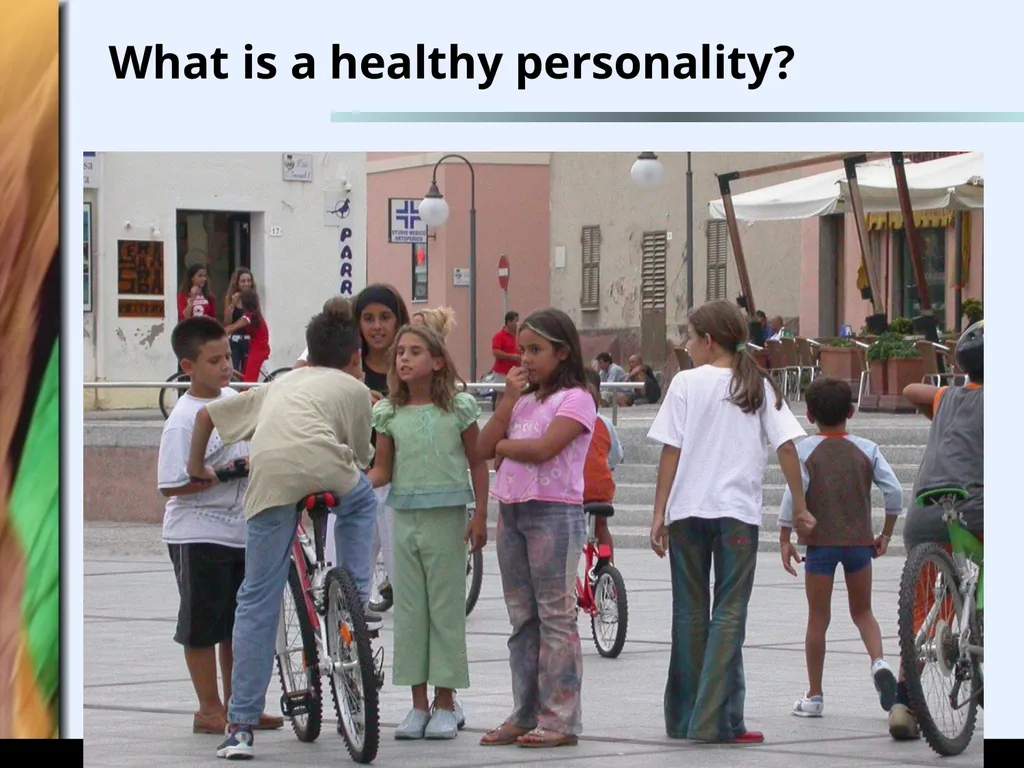
slide6. What is a healthy personality?<br>
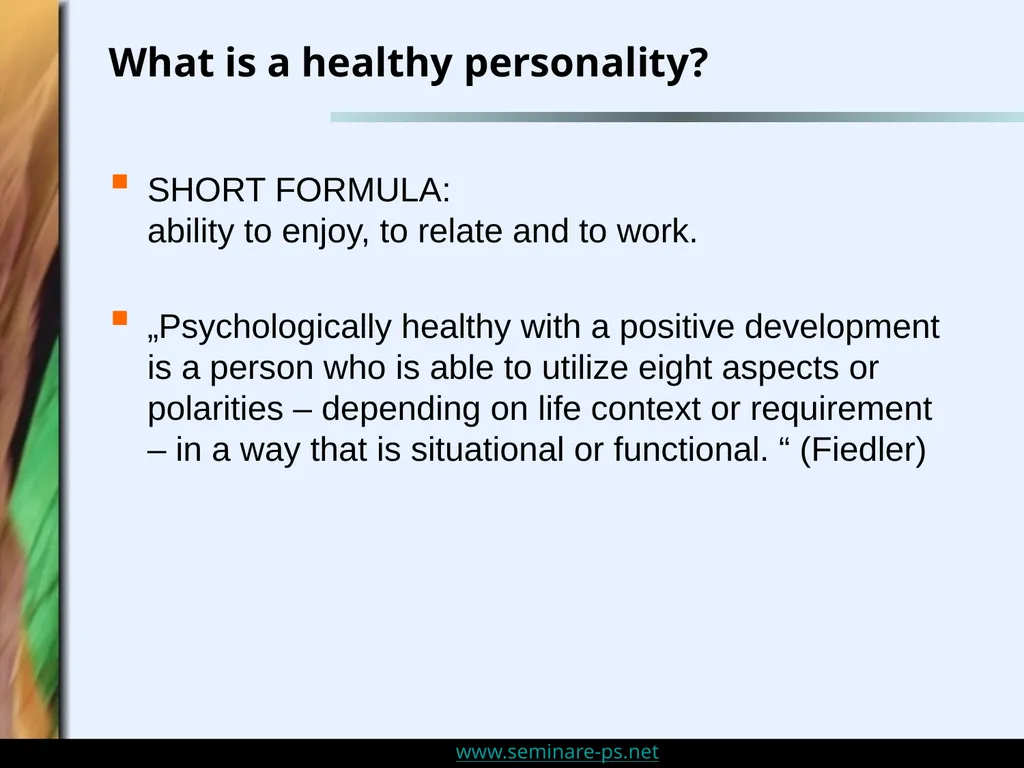
slide7. What is a healthy personality? SHORT FORMULA: ability to enjoy, to relate and to work.
„Psychologically healthy with a positive development is a person who is able to utilize eight aspects or polarities – depending on life context or requirement – in a way that is situational or functional. “ (Fiedler)<br>
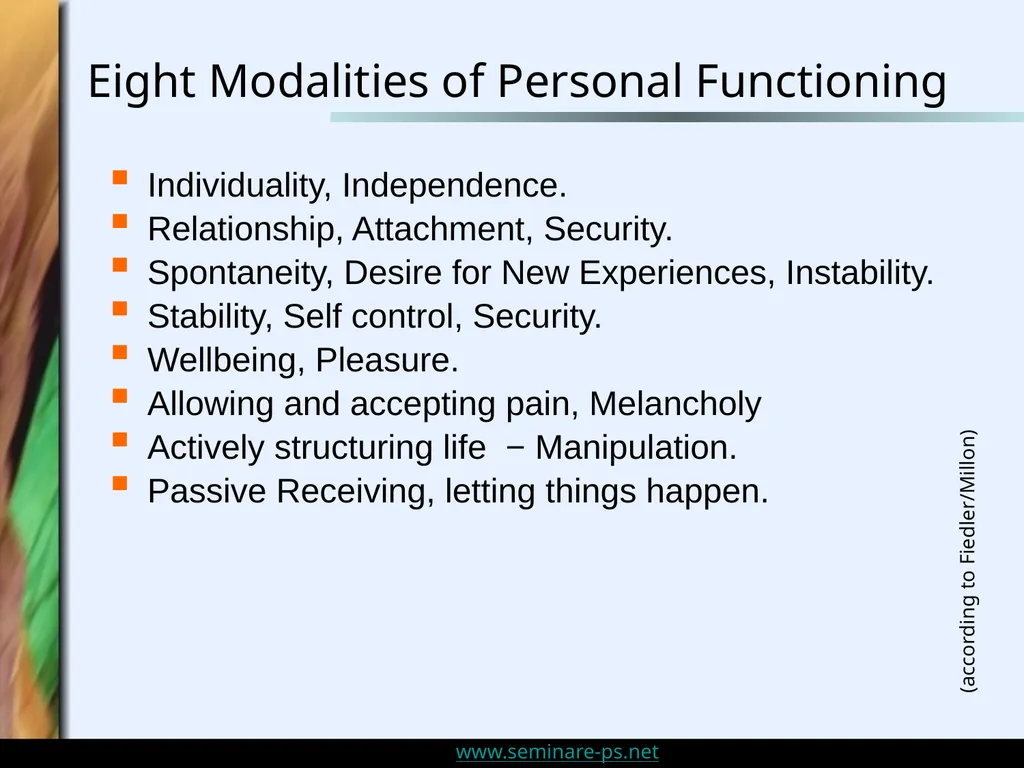
slide8. Individuality, Independence.
Relationship, Attachment, Security.
Spontaneity, Desire for New Experiences, Instability.
Stability, Self control, Security.
Wellbeing, Pleasure.
Allowing and accepting pain, Melancholy
Actively structuring life − Manipulation.
Passive Receiving, letting things happen. Eight Modalities of Personal Functioning (according to Fiedler/Millon)<br>
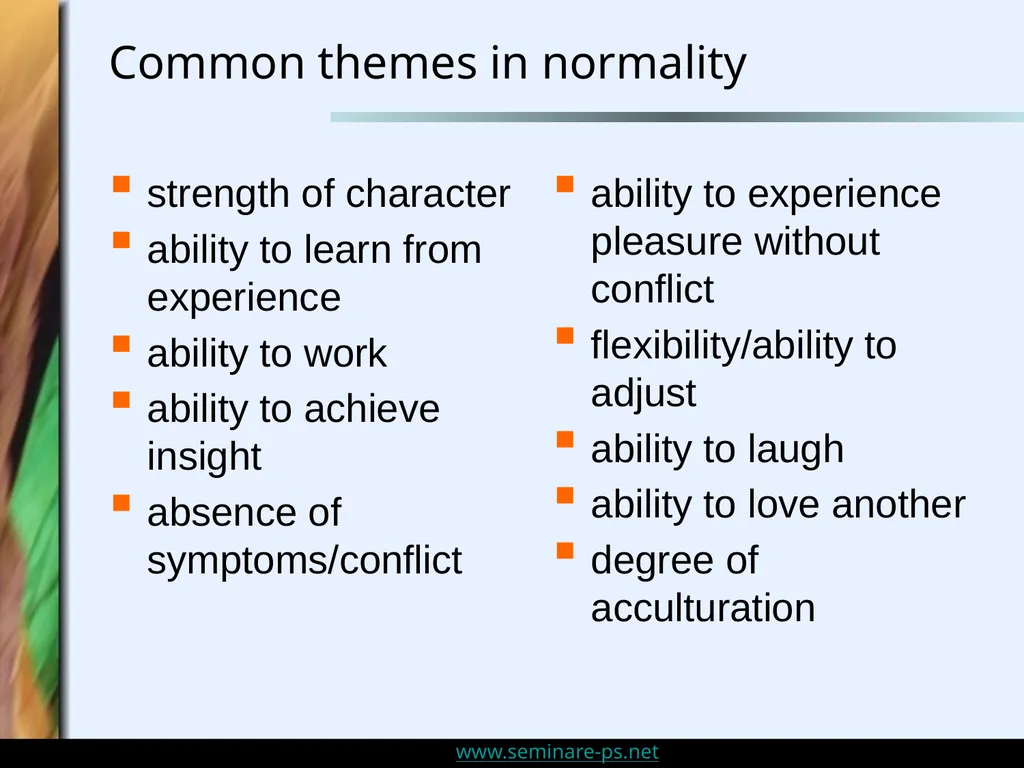
slide9. Common themes in normality strength of character
ability to learn from experience
ability to work
ability to achieve insight
absence of symptoms/conflict ability to experience pleasure without conflict
flexibility/ability to adjust
ability to laugh
ability to love another
degree of acculturation<br>
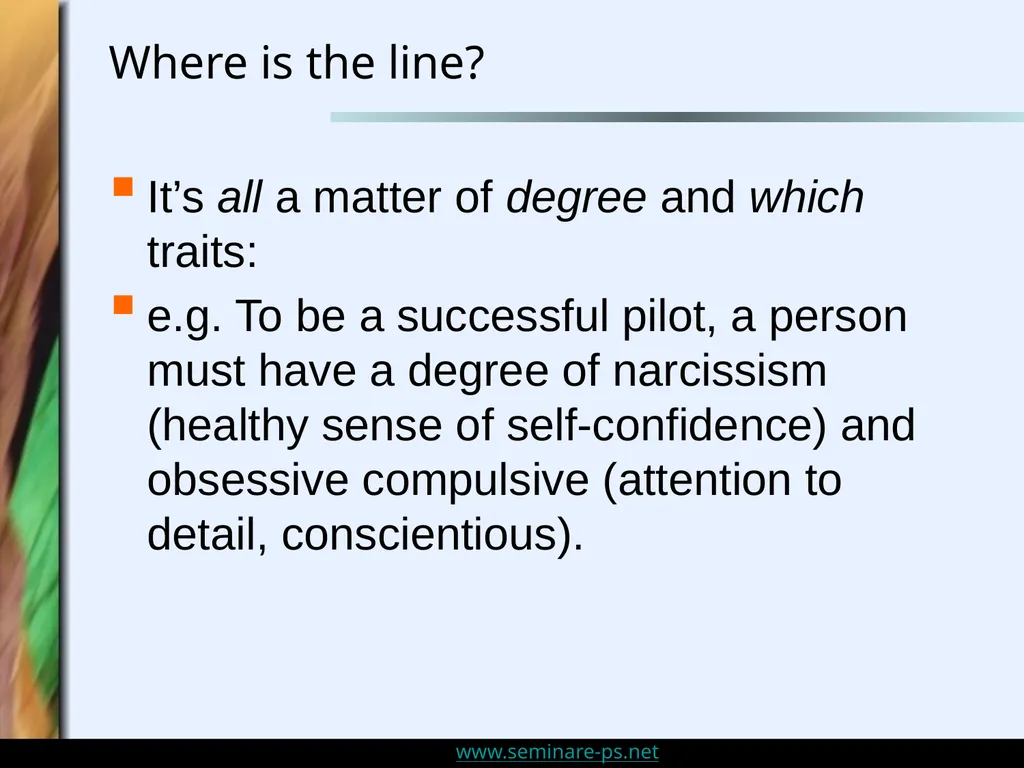
slide10. Where is the line? It’s all a matter of degree and which traits:
e.g. To be a successful pilot, a person must have a degree of narcissism (healthy sense of self-confidence) and obsessive compulsive (attention to detail, conscientious).<br>
slide11. See the whole person Therefore, don’t rely on a single, “slice-in-time” conclusion when considering traits
The most normal person can look pretty disordered at times when stressed<br>
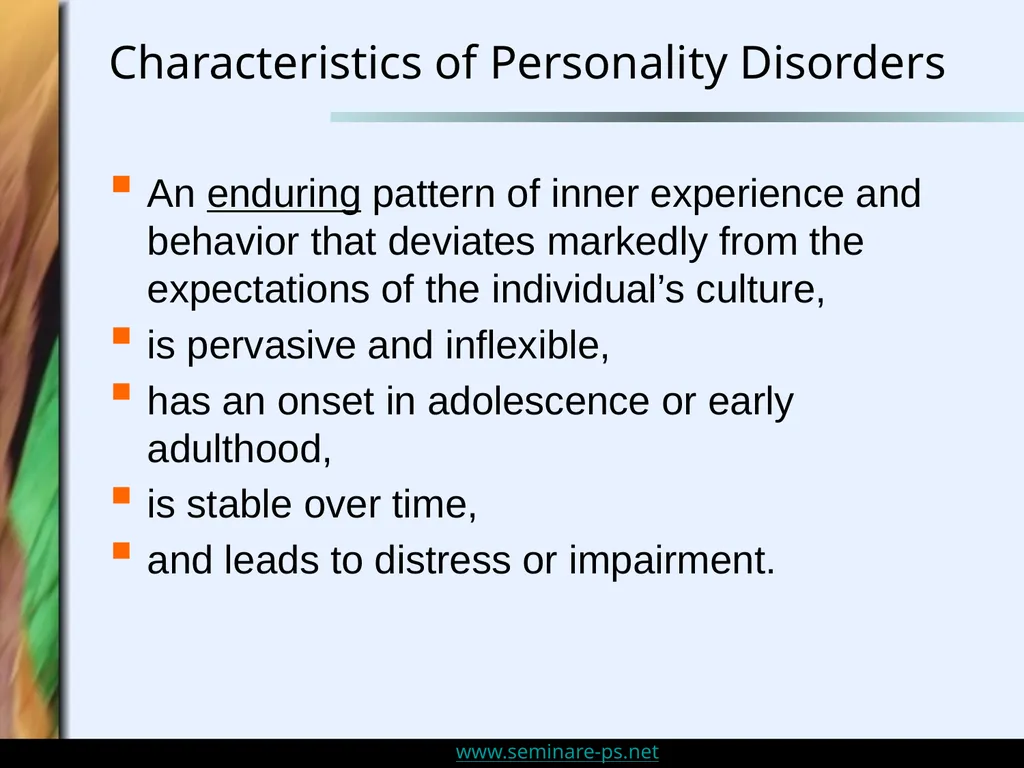
slide12. Characteristics of Personality Disorders An enduring pattern of inner experience and behavior that deviates markedly from the expectations of the individual’s culture,
is pervasive and inflexible,
has an onset in adolescence or early adulthood,
is stable over time,
and leads to distress or impairment.<br>
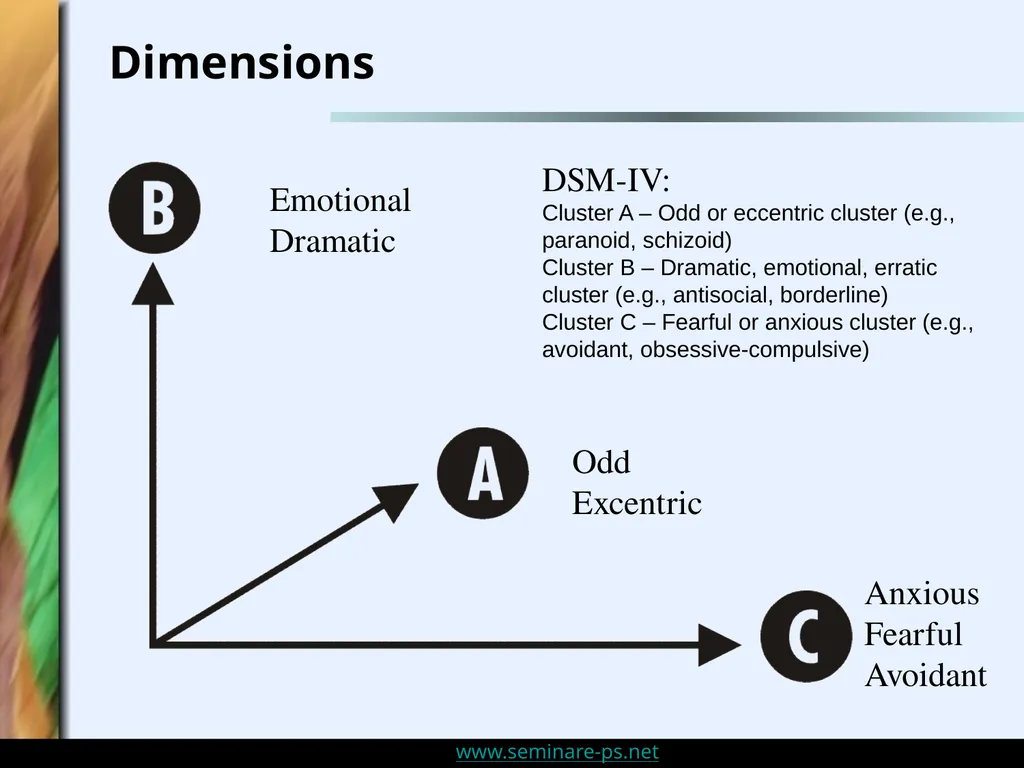
slide13. Dimensions Emotional Dramatic Odd Excentric Anxious Fearful Avoidant DSM-IV:
Cluster A – Odd or eccentric cluster (e.g., paranoid, schizoid)
Cluster B – Dramatic, emotional, erratic cluster (e.g., antisocial, borderline)
Cluster C – Fearful or anxious cluster (e.g., avoidant, obsessive-compulsive)<br>
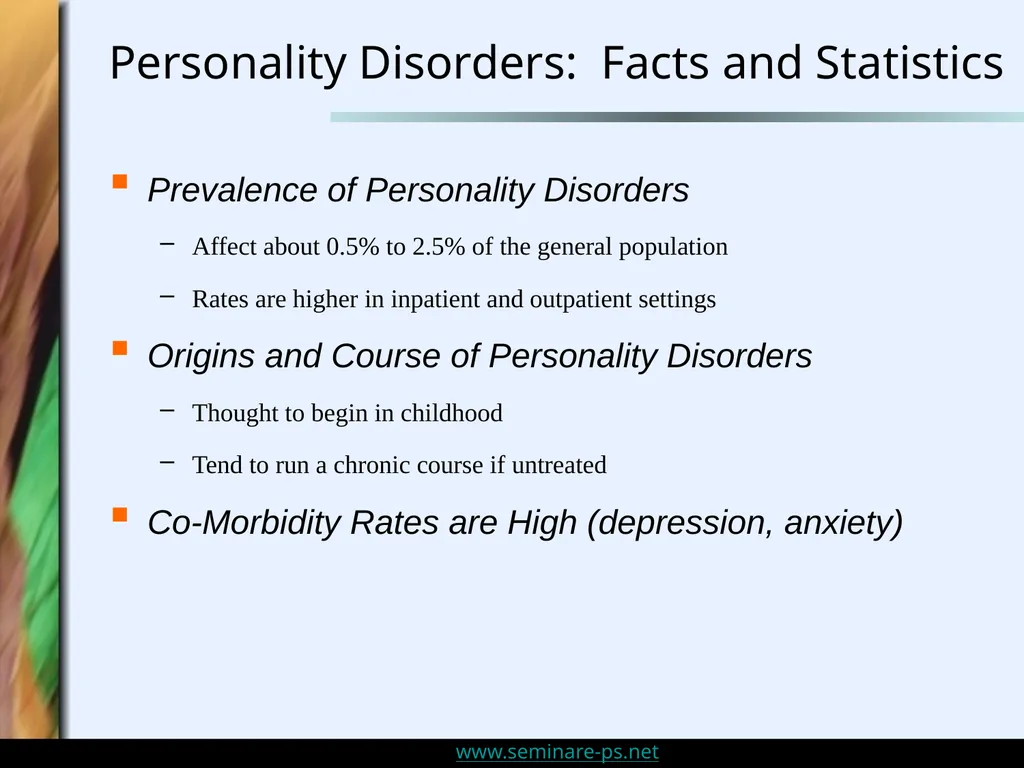
slide14. Personality Disorders: Facts and Statistics Prevalence of Personality Disorders
Affect about 0.5% to 2.5% of the general population
Rates are higher in inpatient and outpatient settings
Origins and Course of Personality Disorders
Thought to begin in childhood
Tend to run a chronic course if untreated
Co-Morbidity Rates are High (depression, anxiety)<br>
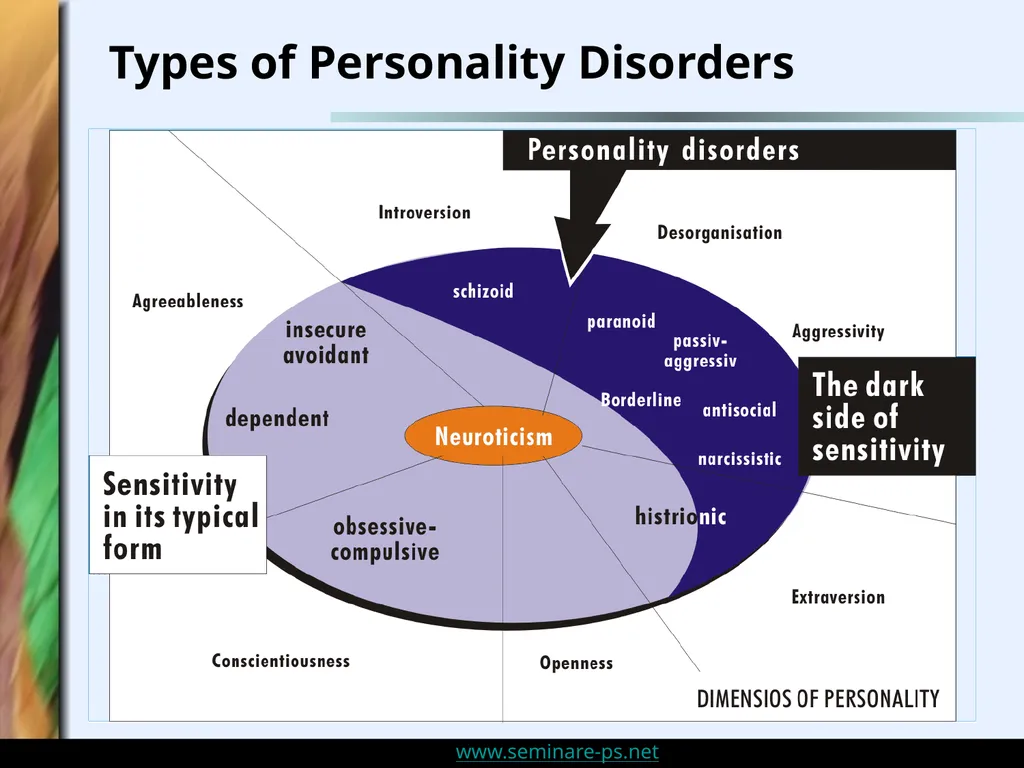
slide15. Types of Personality Disorders<br>
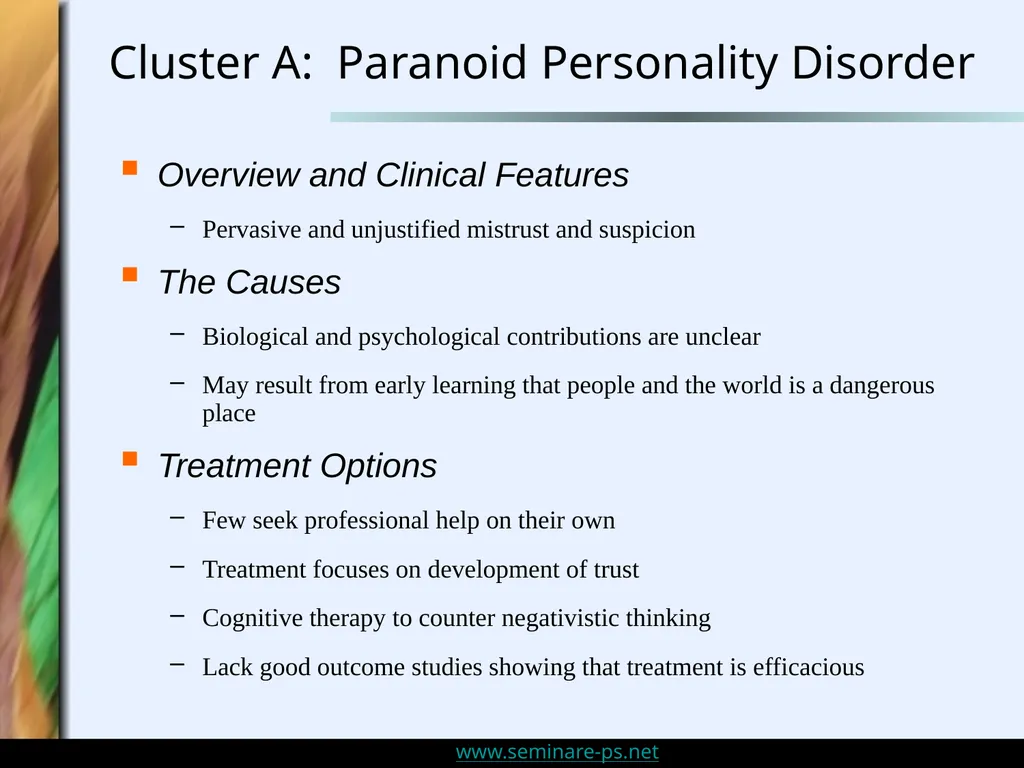
slide16. Cluster A: Paranoid Personality Disorder Overview and Clinical Features
Pervasive and unjustified mistrust and suspicion
The Causes
Biological and psychological contributions are unclear
May result from early learning that people and the world is a dangerous place
Treatment Options
Few seek professional help on their own
Treatment focuses on development of trust
Cognitive therapy to counter negativistic thinking
Lack good outcome studies showing that treatment is efficacious<br>
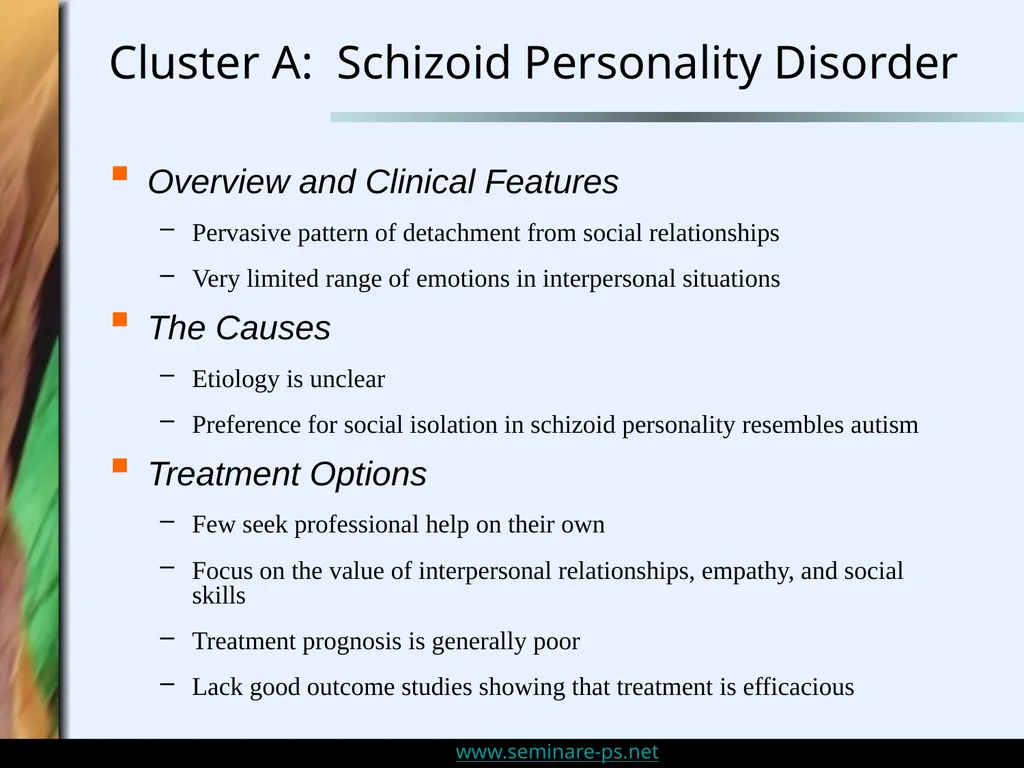
slide17. Cluster A: Schizoid Personality Disorder Overview and Clinical Features
Pervasive pattern of detachment from social relationships
Very limited range of emotions in interpersonal situations
The Causes
Etiology is unclear
Preference for social isolation in schizoid personality resembles autism
Treatment Options
Few seek professional help on their own
Focus on the value of interpersonal relationships, empathy, and social skills
Treatment prognosis is generally poor
Lack good outcome studies showing that treatment is efficacious<br>
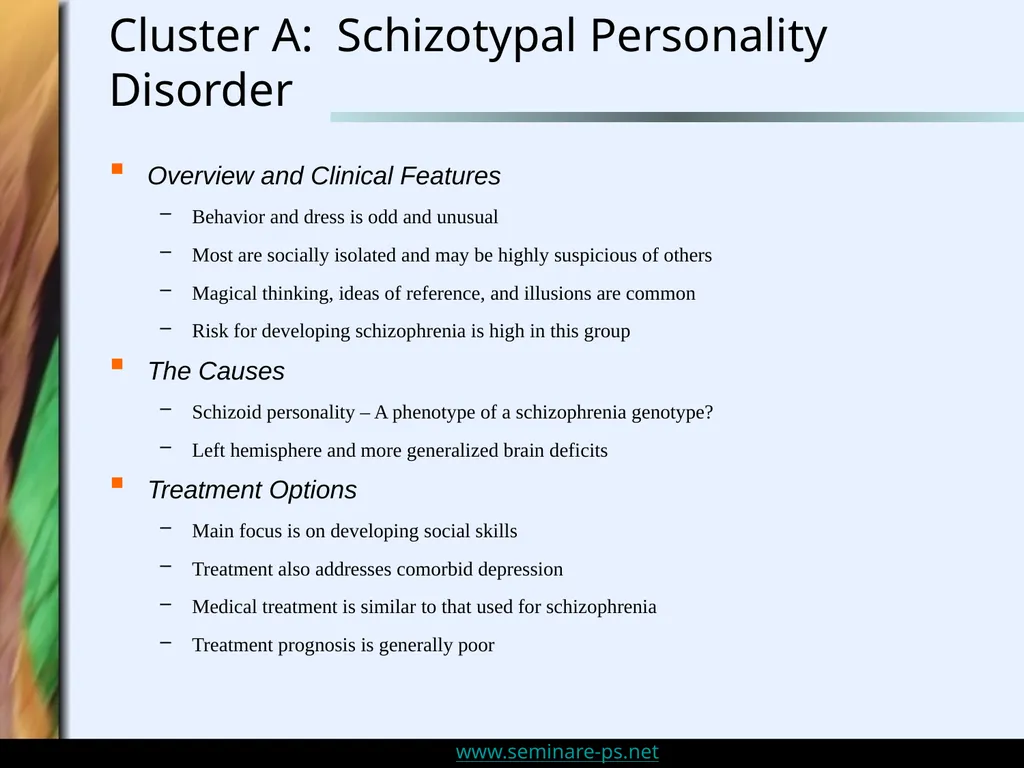
slide18. Cluster A: Schizotypal Personality Disorder Overview and Clinical Features
Behavior and dress is odd and unusual
Most are socially isolated and may be highly suspicious of others
Magical thinking, ideas of reference, and illusions are common
Risk for developing schizophrenia is high in this group
The Causes
Schizoid personality – A phenotype of a schizophrenia genotype?
Left hemisphere and more generalized brain deficits
Treatment Options
Main focus is on developing social skills
Treatment also addresses comorbid depression
Medical treatment is similar to that used for schizophrenia
Treatment prognosis is generally poor<br>
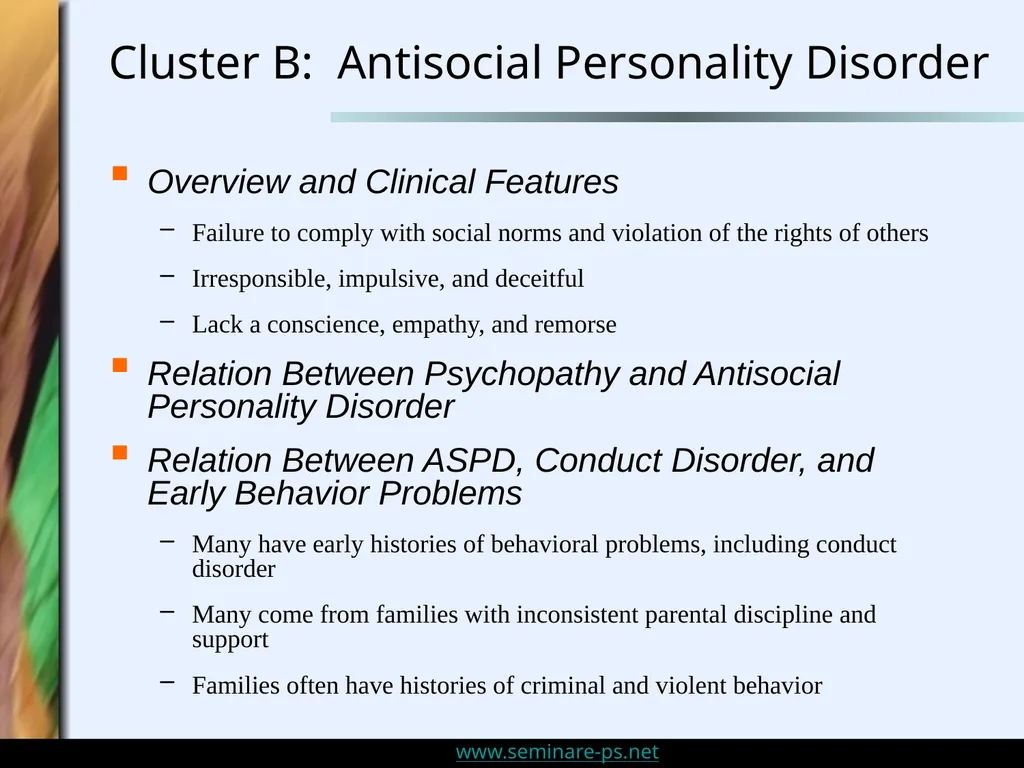
slide19. Cluster B: Antisocial Personality Disorder Overview and Clinical Features
Failure to comply with social norms and violation of the rights of others
Irresponsible, impulsive, and deceitful
Lack a conscience, empathy, and remorse
Relation Between Psychopathy and Antisocial Personality Disorder
Relation Between ASPD, Conduct Disorder, and Early Behavior Problems
Many have early histories of behavioral problems, including conduct disorder
Many come from families with inconsistent parental discipline and support
Families often have histories of criminal and violent behavior<br>
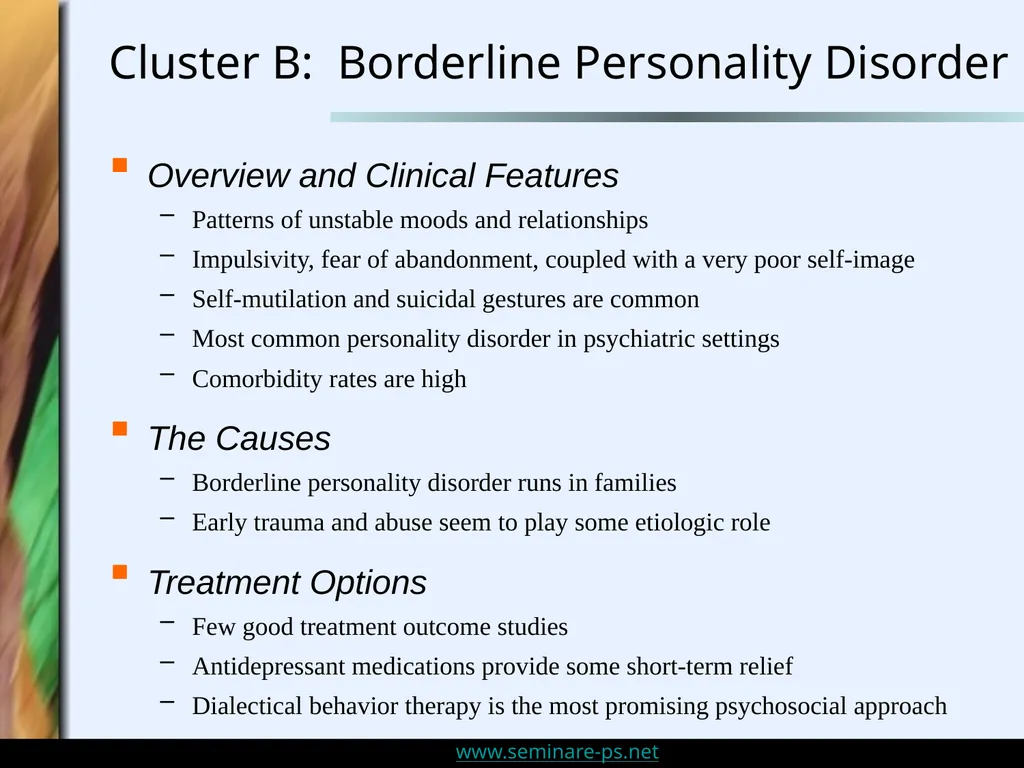
slide20. Cluster B: Borderline Personality Disorder Overview and Clinical Features
Patterns of unstable moods and relationships
Impulsivity, fear of abandonment, coupled with a very poor self-image
Self-mutilation and suicidal gestures are common
Most common personality disorder in psychiatric settings
Comorbidity rates are high
The Causes
Borderline personality disorder runs in families
Early trauma and abuse seem to play some etiologic role
Treatment Options
Few good treatment outcome studies
Antidepressant medications provide some short-term relief
Dialectical behavior therapy is the most promising psychosocial approach<br>
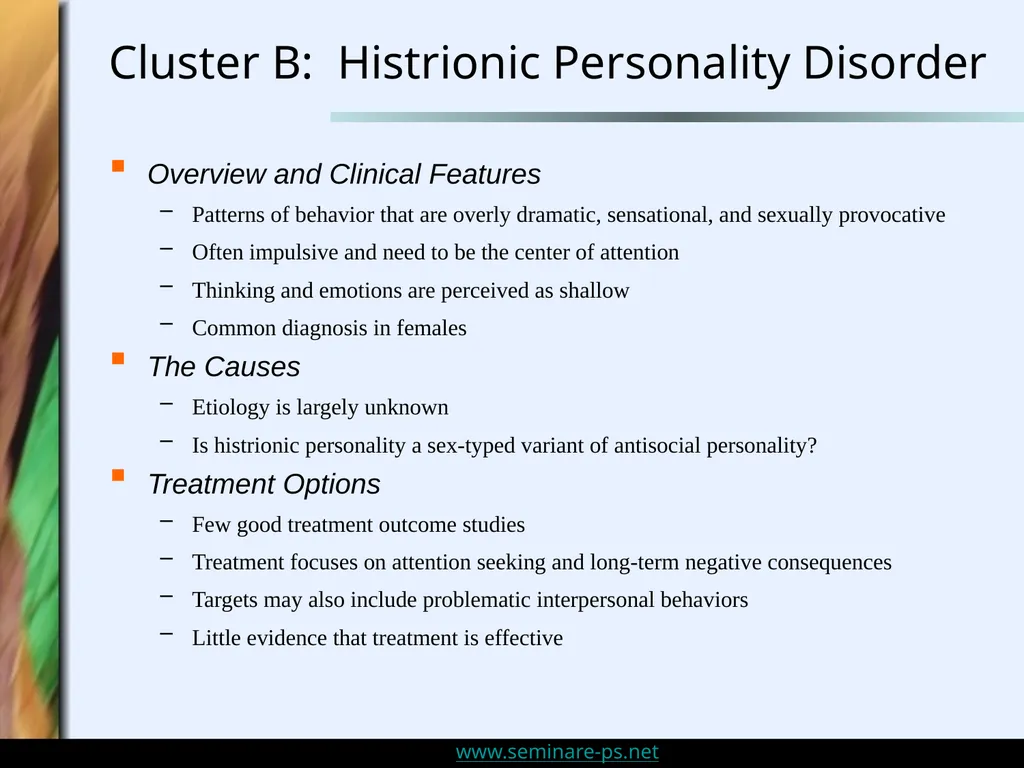
slide21. Cluster B: Histrionic Personality Disorder Overview and Clinical Features
Patterns of behavior that are overly dramatic, sensational, and sexually provocative
Often impulsive and need to be the center of attention
Thinking and emotions are perceived as shallow
Common diagnosis in females
The Causes
Etiology is largely unknown
Is histrionic personality a sex-typed variant of antisocial personality?
Treatment Options
Few good treatment outcome studies
Treatment focuses on attention seeking and long-term negative consequences
Targets may also include problematic interpersonal behaviors
Little evidence that treatment is effective<br>
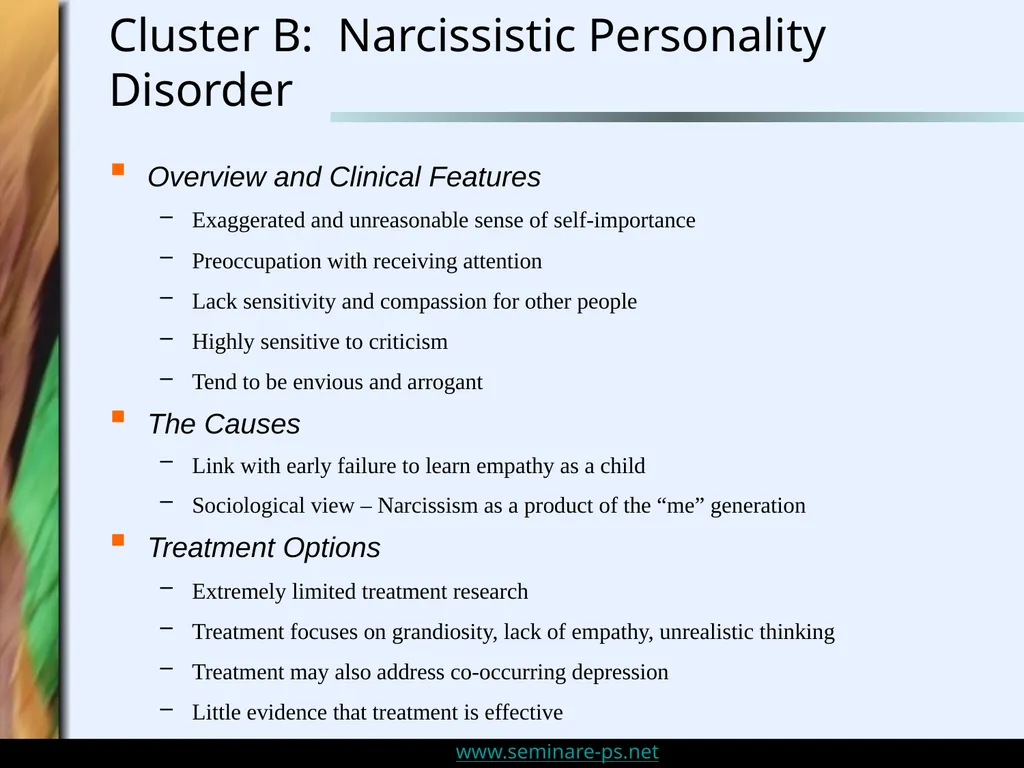
slide22. Cluster B: Narcissistic Personality Disorder Overview and Clinical Features
Exaggerated and unreasonable sense of self-importance
Preoccupation with receiving attention
Lack sensitivity and compassion for other people
Highly sensitive to criticism
Tend to be envious and arrogant
The Causes
Link with early failure to learn empathy as a child
Sociological view – Narcissism as a product of the “me” generation
Treatment Options
Extremely limited treatment research
Treatment focuses on grandiosity, lack of empathy, unrealistic thinking
Treatment may also address co-occurring depression
Little evidence that treatment is effective<br>
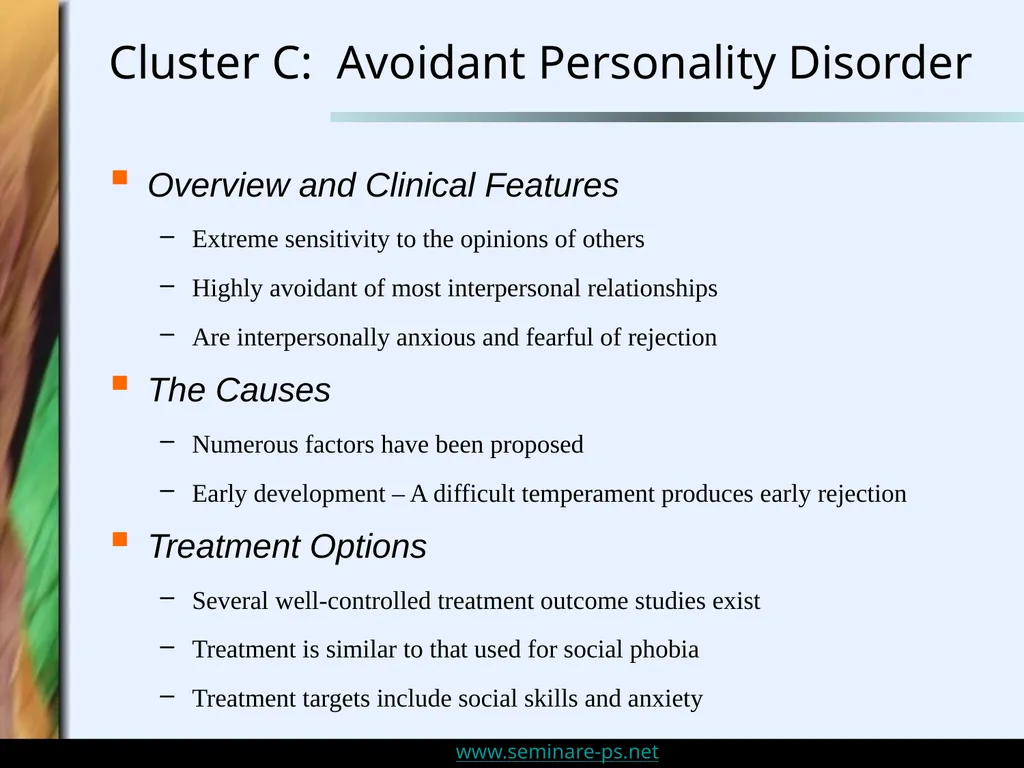
slide23. Cluster C: Avoidant Personality Disorder Overview and Clinical Features
Extreme sensitivity to the opinions of others
Highly avoidant of most interpersonal relationships
Are interpersonally anxious and fearful of rejection
The Causes
Numerous factors have been proposed
Early development – A difficult temperament produces early rejection
Treatment Options
Several well-controlled treatment outcome studies exist
Treatment is similar to that used for social phobia
Treatment targets include social skills and anxiety<br>
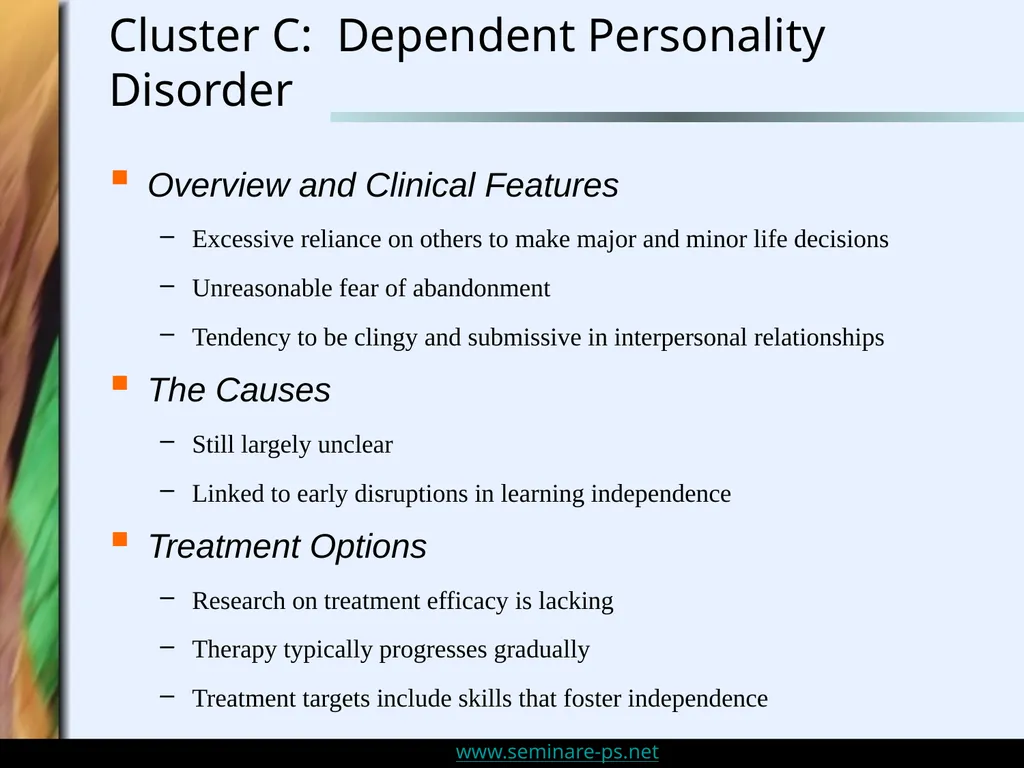
slide24. Cluster C: Dependent Personality Disorder Overview and Clinical Features
Excessive reliance on others to make major and minor life decisions
Unreasonable fear of abandonment
Tendency to be clingy and submissive in interpersonal relationships
The Causes
Still largely unclear
Linked to early disruptions in learning independence
Treatment Options
Research on treatment efficacy is lacking
Therapy typically progresses gradually
Treatment targets include skills that foster independence<br>
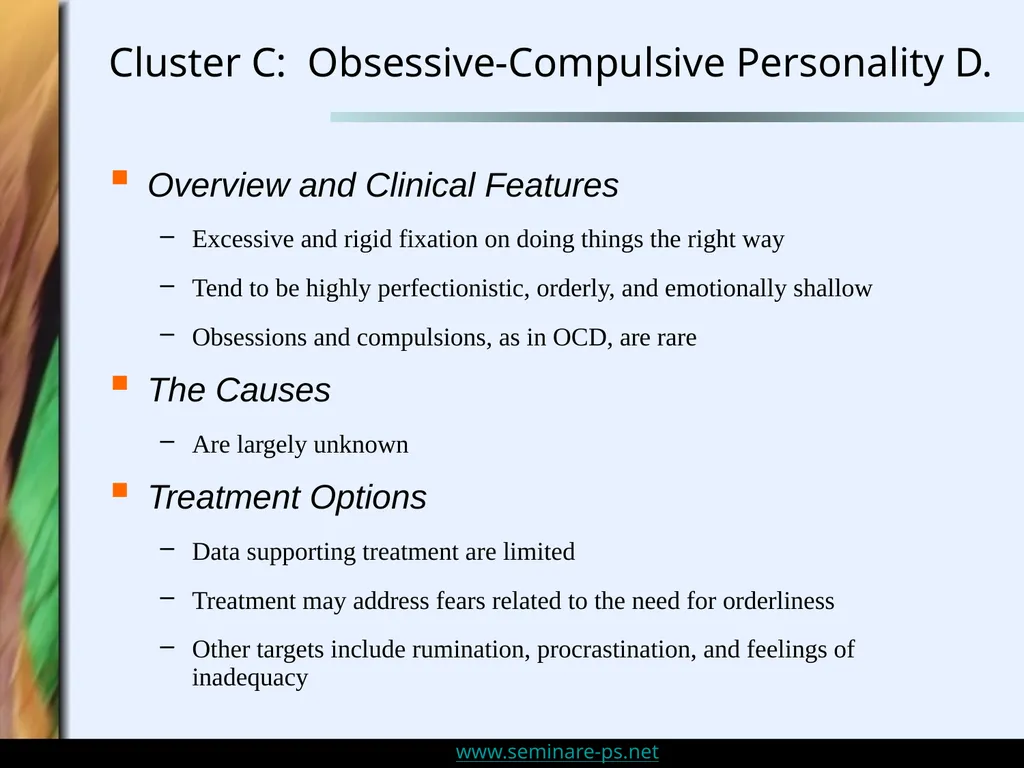
slide25. Cluster C: Obsessive-Compulsive Personality D. Overview and Clinical Features
Excessive and rigid fixation on doing things the right way
Tend to be highly perfectionistic, orderly, and emotionally shallow
Obsessions and compulsions, as in OCD, are rare
The Causes
Are largely unknown
Treatment Options
Data supporting treatment are limited
Treatment may address fears related to the need for orderliness
Other targets include rumination, procrastination, and feelings of inadequacy<br>
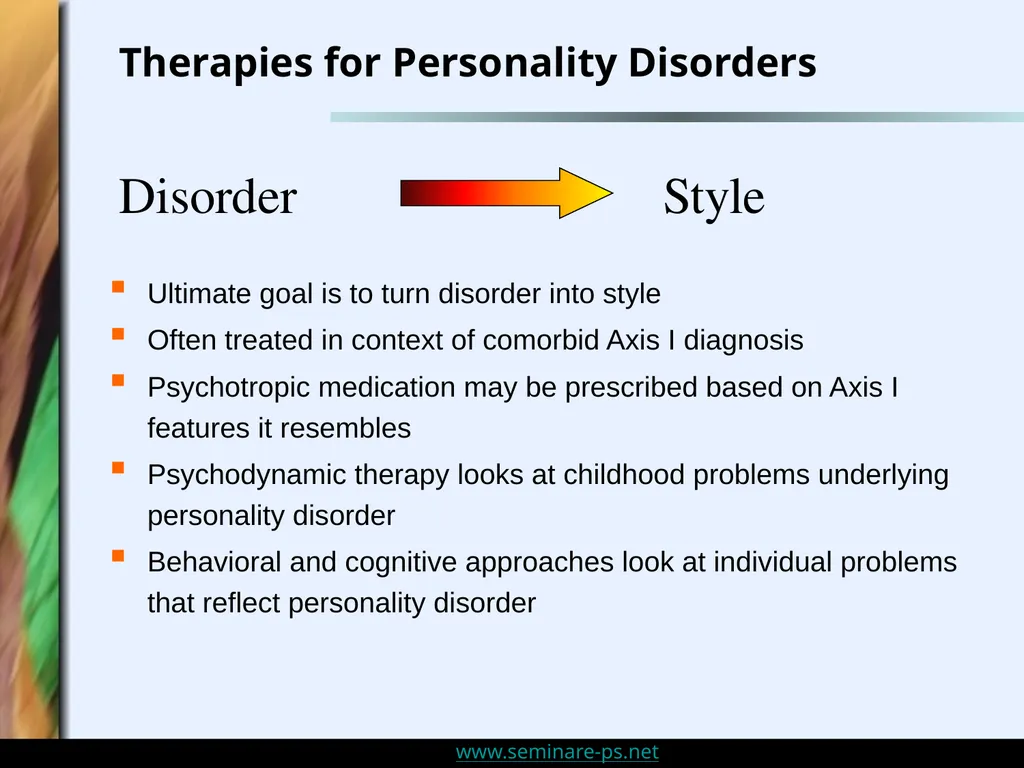
slide26. Therapies for Personality Disorders Ultimate goal is to turn disorder into style
Often treated in context of comorbid Axis I diagnosis
Psychotropic medication may be prescribed based on Axis I features it resembles
Psychodynamic therapy looks at childhood problems underlying personality disorder
Behavioral and cognitive approaches look at individual problems that reflect personality disorder Disorder Style<br>
slide27. The inner struggle „I find then a law, that, when I would do good, evil is present with me.
For I delight in the law of God after the inward man:
But I see another law in my members warring against the law of my mind, and bringing me into captivity to the law of sin which is in my members,
(The apostle Paul – Romans 7,21–23)<br>
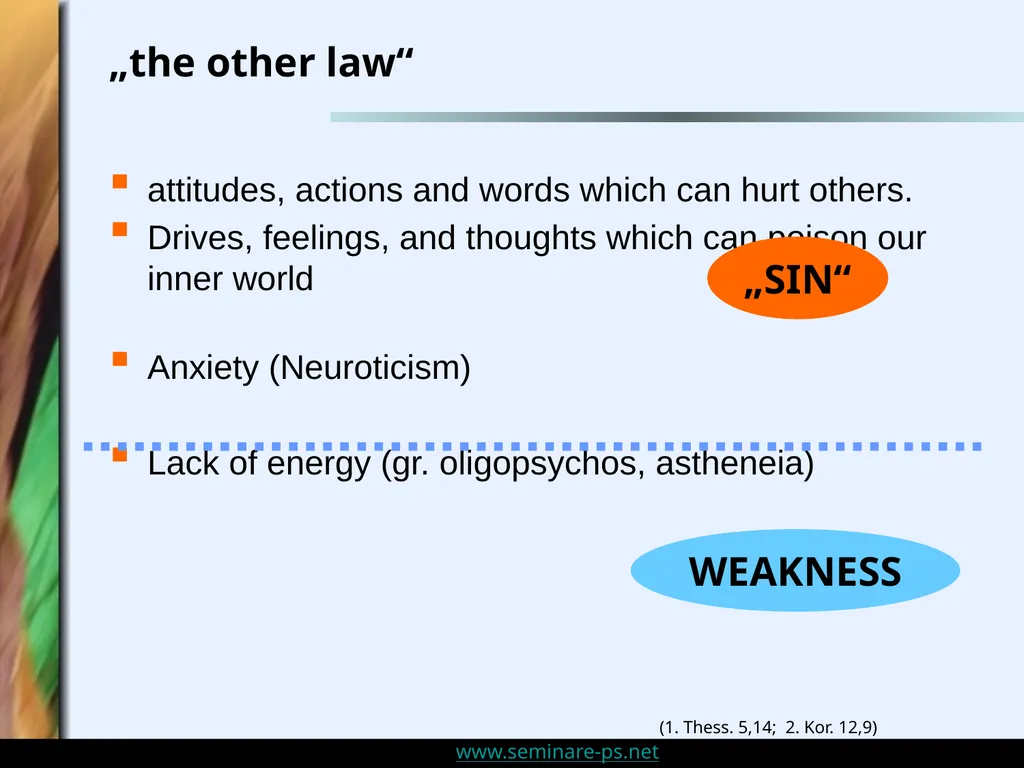
slide28. „the other law“ attitudes, actions and words which can hurt others.
Drives, feelings, and thoughts which can poison our inner world
Anxiety (Neuroticism)
Lack of energy (gr. oligopsychos, astheneia) WEAKNESS „SIN“ (1. Thess. 5,14; 2. Kor. 12,9)<br>
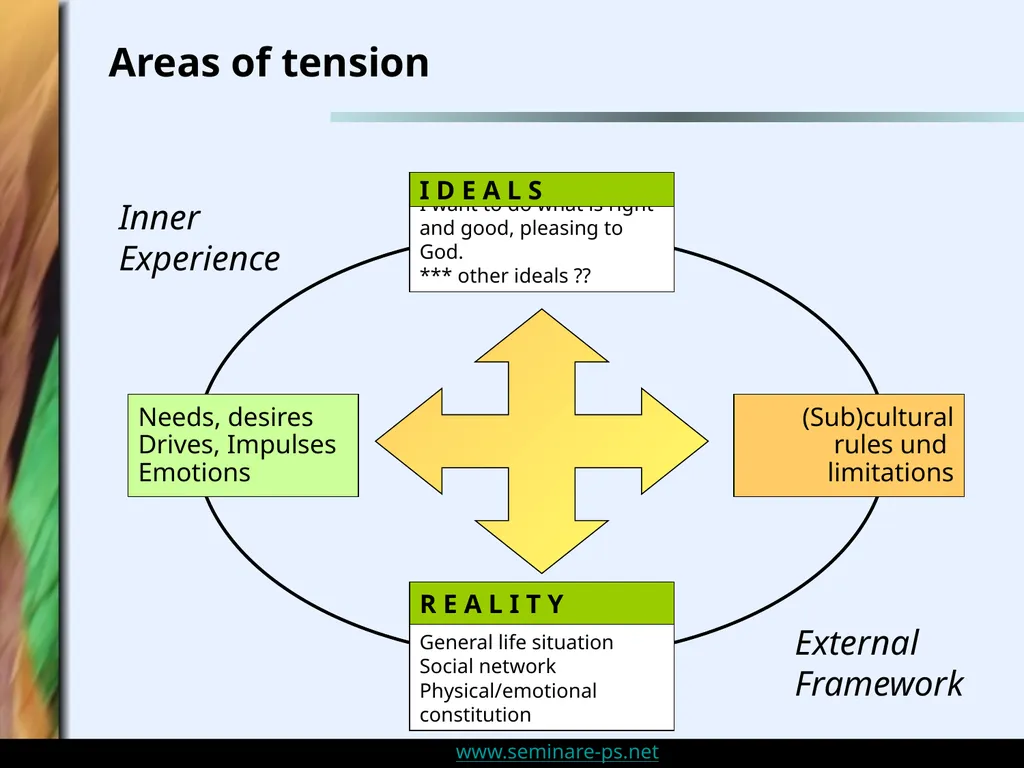
slide29. Areas of tension Needs, desires
Drives, Impulses
Emotions I want to do what is right and good, pleasing to God.
*** other ideals ?? I D E A L S General life situation
Social network
Physical/emotional constitution R E A L I T Y External Framework Inner Experience (Sub)cultural rules und limitations<br>
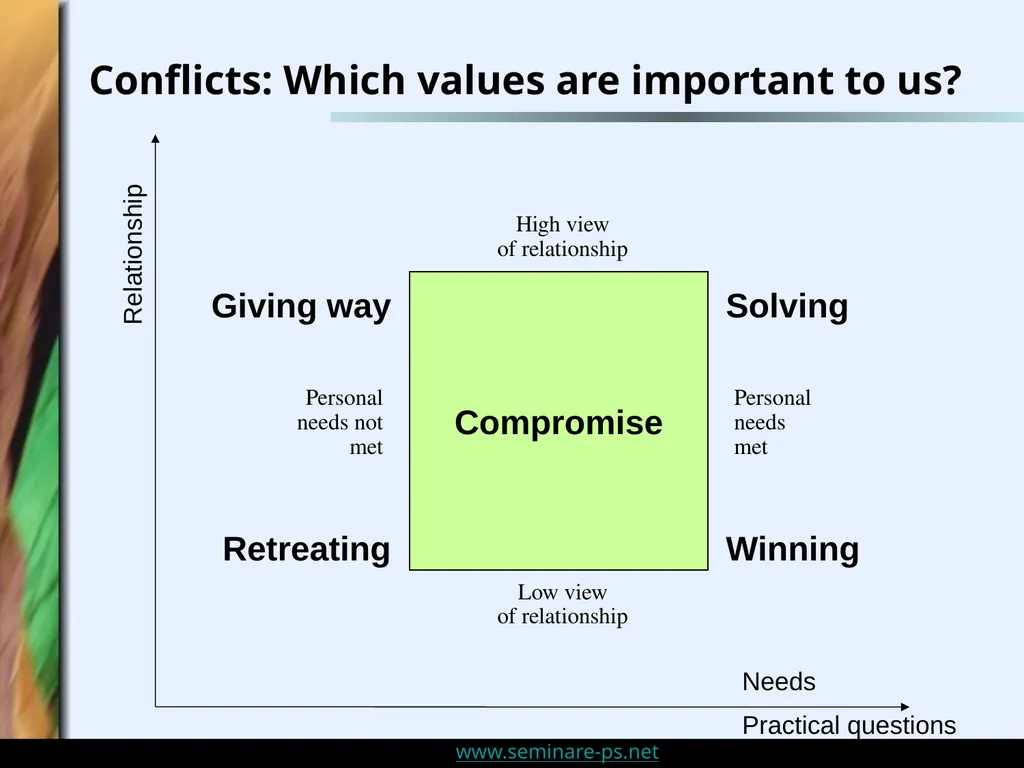
slide30. Conflicts: Which values are important to us? Relationship Needs
Practical questions<br>
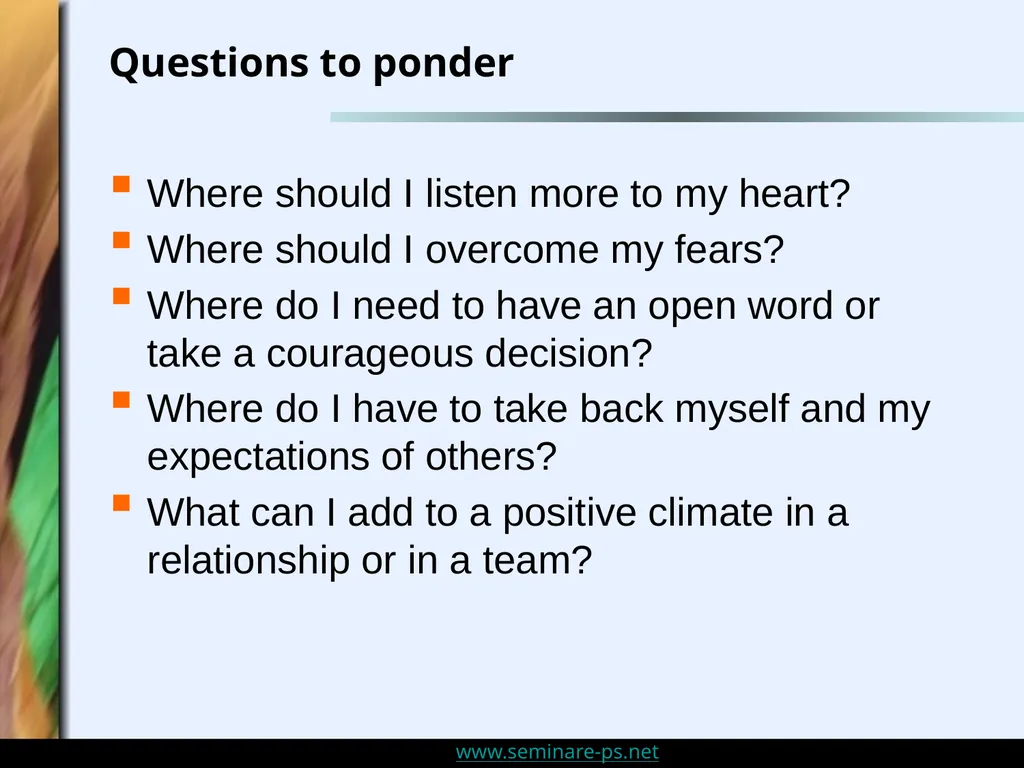
slide31. Questions to ponder Where should I listen more to my heart?
Where should I overcome my fears?
Where do I need to have an open word or take a courageous decision?
Where do I have to take back myself and my expectations of others?
What can I add to a positive climate in a relationship or in a team?<br>
slide32. Download this presentation from
www.seminare-ps.net<br>
slide2. What is a healthy personality? There are many possible answers / models
Excellent overview:
Vaillant G.: Mental Health, American Journal of Psychiatry 2003; 160:1373–1384
Three Models:
Mental Health Normality
Positive Psychology
Maturity<br>
slide4. What purpose does personality serve? for myself or for society?
adaptation or creativity?
my wellbeing or survival?<br>
slide5. Creativity or Survival?<br>
slide6. What is a healthy personality?<br>
slide7. What is a healthy personality? SHORT FORMULA: ability to enjoy, to relate and to work.
„Psychologically healthy with a positive development is a person who is able to utilize eight aspects or polarities – depending on life context or requirement – in a way that is situational or functional. “ (Fiedler)<br>
slide8. Individuality, Independence.
Relationship, Attachment, Security.
Spontaneity, Desire for New Experiences, Instability.
Stability, Self control, Security.
Wellbeing, Pleasure.
Allowing and accepting pain, Melancholy
Actively structuring life − Manipulation.
Passive Receiving, letting things happen. Eight Modalities of Personal Functioning (according to Fiedler/Millon)<br>
slide9. Common themes in normality strength of character
ability to learn from experience
ability to work
ability to achieve insight
absence of symptoms/conflict ability to experience pleasure without conflict
flexibility/ability to adjust
ability to laugh
ability to love another
degree of acculturation<br>
slide10. Where is the line? It’s all a matter of degree and which traits:
e.g. To be a successful pilot, a person must have a degree of narcissism (healthy sense of self-confidence) and obsessive compulsive (attention to detail, conscientious).<br>
slide11. See the whole person Therefore, don’t rely on a single, “slice-in-time” conclusion when considering traits
The most normal person can look pretty disordered at times when stressed<br>
slide12. Characteristics of Personality Disorders An enduring pattern of inner experience and behavior that deviates markedly from the expectations of the individual’s culture,
is pervasive and inflexible,
has an onset in adolescence or early adulthood,
is stable over time,
and leads to distress or impairment.<br>
slide13. Dimensions Emotional Dramatic Odd Excentric Anxious Fearful Avoidant DSM-IV:
Cluster A – Odd or eccentric cluster (e.g., paranoid, schizoid)
Cluster B – Dramatic, emotional, erratic cluster (e.g., antisocial, borderline)
Cluster C – Fearful or anxious cluster (e.g., avoidant, obsessive-compulsive)<br>
slide14. Personality Disorders: Facts and Statistics Prevalence of Personality Disorders
Affect about 0.5% to 2.5% of the general population
Rates are higher in inpatient and outpatient settings
Origins and Course of Personality Disorders
Thought to begin in childhood
Tend to run a chronic course if untreated
Co-Morbidity Rates are High (depression, anxiety)<br>
slide15. Types of Personality Disorders<br>
slide16. Cluster A: Paranoid Personality Disorder Overview and Clinical Features
Pervasive and unjustified mistrust and suspicion
The Causes
Biological and psychological contributions are unclear
May result from early learning that people and the world is a dangerous place
Treatment Options
Few seek professional help on their own
Treatment focuses on development of trust
Cognitive therapy to counter negativistic thinking
Lack good outcome studies showing that treatment is efficacious<br>
slide17. Cluster A: Schizoid Personality Disorder Overview and Clinical Features
Pervasive pattern of detachment from social relationships
Very limited range of emotions in interpersonal situations
The Causes
Etiology is unclear
Preference for social isolation in schizoid personality resembles autism
Treatment Options
Few seek professional help on their own
Focus on the value of interpersonal relationships, empathy, and social skills
Treatment prognosis is generally poor
Lack good outcome studies showing that treatment is efficacious<br>
slide18. Cluster A: Schizotypal Personality Disorder Overview and Clinical Features
Behavior and dress is odd and unusual
Most are socially isolated and may be highly suspicious of others
Magical thinking, ideas of reference, and illusions are common
Risk for developing schizophrenia is high in this group
The Causes
Schizoid personality – A phenotype of a schizophrenia genotype?
Left hemisphere and more generalized brain deficits
Treatment Options
Main focus is on developing social skills
Treatment also addresses comorbid depression
Medical treatment is similar to that used for schizophrenia
Treatment prognosis is generally poor<br>
slide19. Cluster B: Antisocial Personality Disorder Overview and Clinical Features
Failure to comply with social norms and violation of the rights of others
Irresponsible, impulsive, and deceitful
Lack a conscience, empathy, and remorse
Relation Between Psychopathy and Antisocial Personality Disorder
Relation Between ASPD, Conduct Disorder, and Early Behavior Problems
Many have early histories of behavioral problems, including conduct disorder
Many come from families with inconsistent parental discipline and support
Families often have histories of criminal and violent behavior<br>
slide20. Cluster B: Borderline Personality Disorder Overview and Clinical Features
Patterns of unstable moods and relationships
Impulsivity, fear of abandonment, coupled with a very poor self-image
Self-mutilation and suicidal gestures are common
Most common personality disorder in psychiatric settings
Comorbidity rates are high
The Causes
Borderline personality disorder runs in families
Early trauma and abuse seem to play some etiologic role
Treatment Options
Few good treatment outcome studies
Antidepressant medications provide some short-term relief
Dialectical behavior therapy is the most promising psychosocial approach<br>
slide21. Cluster B: Histrionic Personality Disorder Overview and Clinical Features
Patterns of behavior that are overly dramatic, sensational, and sexually provocative
Often impulsive and need to be the center of attention
Thinking and emotions are perceived as shallow
Common diagnosis in females
The Causes
Etiology is largely unknown
Is histrionic personality a sex-typed variant of antisocial personality?
Treatment Options
Few good treatment outcome studies
Treatment focuses on attention seeking and long-term negative consequences
Targets may also include problematic interpersonal behaviors
Little evidence that treatment is effective<br>
slide22. Cluster B: Narcissistic Personality Disorder Overview and Clinical Features
Exaggerated and unreasonable sense of self-importance
Preoccupation with receiving attention
Lack sensitivity and compassion for other people
Highly sensitive to criticism
Tend to be envious and arrogant
The Causes
Link with early failure to learn empathy as a child
Sociological view – Narcissism as a product of the “me” generation
Treatment Options
Extremely limited treatment research
Treatment focuses on grandiosity, lack of empathy, unrealistic thinking
Treatment may also address co-occurring depression
Little evidence that treatment is effective<br>
slide23. Cluster C: Avoidant Personality Disorder Overview and Clinical Features
Extreme sensitivity to the opinions of others
Highly avoidant of most interpersonal relationships
Are interpersonally anxious and fearful of rejection
The Causes
Numerous factors have been proposed
Early development – A difficult temperament produces early rejection
Treatment Options
Several well-controlled treatment outcome studies exist
Treatment is similar to that used for social phobia
Treatment targets include social skills and anxiety<br>
slide24. Cluster C: Dependent Personality Disorder Overview and Clinical Features
Excessive reliance on others to make major and minor life decisions
Unreasonable fear of abandonment
Tendency to be clingy and submissive in interpersonal relationships
The Causes
Still largely unclear
Linked to early disruptions in learning independence
Treatment Options
Research on treatment efficacy is lacking
Therapy typically progresses gradually
Treatment targets include skills that foster independence<br>
slide25. Cluster C: Obsessive-Compulsive Personality D. Overview and Clinical Features
Excessive and rigid fixation on doing things the right way
Tend to be highly perfectionistic, orderly, and emotionally shallow
Obsessions and compulsions, as in OCD, are rare
The Causes
Are largely unknown
Treatment Options
Data supporting treatment are limited
Treatment may address fears related to the need for orderliness
Other targets include rumination, procrastination, and feelings of inadequacy<br>
slide26. Therapies for Personality Disorders Ultimate goal is to turn disorder into style
Often treated in context of comorbid Axis I diagnosis
Psychotropic medication may be prescribed based on Axis I features it resembles
Psychodynamic therapy looks at childhood problems underlying personality disorder
Behavioral and cognitive approaches look at individual problems that reflect personality disorder Disorder Style<br>
slide27. The inner struggle „I find then a law, that, when I would do good, evil is present with me.
For I delight in the law of God after the inward man:
But I see another law in my members warring against the law of my mind, and bringing me into captivity to the law of sin which is in my members,
(The apostle Paul – Romans 7,21–23)<br>
slide28. „the other law“ attitudes, actions and words which can hurt others.
Drives, feelings, and thoughts which can poison our inner world
Anxiety (Neuroticism)
Lack of energy (gr. oligopsychos, astheneia) WEAKNESS „SIN“ (1. Thess. 5,14; 2. Kor. 12,9)<br>
slide29. Areas of tension Needs, desires
Drives, Impulses
Emotions I want to do what is right and good, pleasing to God.
*** other ideals ?? I D E A L S General life situation
Social network
Physical/emotional constitution R E A L I T Y External Framework Inner Experience (Sub)cultural rules und limitations<br>
slide30. Conflicts: Which values are important to us? Relationship Needs
Practical questions<br>
slide31. Questions to ponder Where should I listen more to my heart?
Where should I overcome my fears?
Where do I need to have an open word or take a courageous decision?
Where do I have to take back myself and my expectations of others?
What can I add to a positive climate in a relationship or in a team?<br>
slide32. Download this presentation from
www.seminare-ps.net<br>