
Personality Disorders Dr Andrea Williams
PM
Published · 54 slides · 0 views

1 / 1






Description
Personality Disorders Dr Andrea Williams Consultant Psychiatrist in Psychotherapy Personality Disorder and Homelessness Team NHS Greater Glasgow and Clyde What we will cover Overview Definitions Prevalence and course Types of personality
Related Topics
Share
Embed code
Download this presentation From Below
"Personality Disorders Dr Andrea Williams" is the property of its rightful owner. Permission is granted to download and print the materials on this website for personal, non-commercial use only, and to display it on your personal computer provided you do not modify the materials and that you retain all copyright notices contained in the materials. By downloading content from our website, you accept the terms of this agreement.
Presentation Transcript
01
Personality Disorders Dr Andrea Williams
Consultant Psychiatrist in Psychotherapy
Personality Disorder and Homelessness Team
NHS Greater Glasgow and Clyde<br>
Consultant Psychiatrist in Psychotherapy
Personality Disorder and Homelessness Team
NHS Greater Glasgow and Clyde<br>
02
What we will cover Overview
Definitions
Prevalence and course
Types of personality disorder
Dissocial
Borderline
Attachment basis
Treatment/ management
PD and Legislation<br>
Definitions
Prevalence and course
Types of personality disorder
Dissocial
Borderline
Attachment basis
Treatment/ management
PD and Legislation<br>
03
Overview<br>
04
Personality Disorder:
What’s in a name? Stigma
Untreatable?
Excluded from Services<br>
Untreatable?
Excluded from Services<br>
05
Stigma People with a PD can be seen as troublesome patients in medical terms/ troublesome people in society.
They do not improve rapidly; offer few rewards to those treating them; can make us feel impotent/ guilty/ angry and many other things.<br>
They do not improve rapidly; offer few rewards to those treating them; can make us feel impotent/ guilty/ angry and many other things.<br>
06
Stigma – changing? All of this improves if more effort to UNDERSTAND and ADDRESS the nature of the difficulty
Requires attention to how services delivered
User groups claiming the diagnosis as a useful tool for accessing services<br>
Requires attention to how services delivered
User groups claiming the diagnosis as a useful tool for accessing services<br>
07
Untreatable? not true
Emerging evidence that a number of psychological approaches can help – particularly in BORDERLINE PD
Mentalisation Based Therapy
DBT(Dialectical behavioural therapy)<br>
Emerging evidence that a number of psychological approaches can help – particularly in BORDERLINE PD
Mentalisation Based Therapy
DBT(Dialectical behavioural therapy)<br>
08
Excluded from Services ? shouldn’t be
“Personality Disorder – no longer a diagnosis of exclusion” document in England
NICE guidelines for treatment
Scotland – “Personality Disorder – Demanding patients or Deserving People?” (CCI, 2005)<br>
“Personality Disorder – no longer a diagnosis of exclusion” document in England
NICE guidelines for treatment
Scotland – “Personality Disorder – Demanding patients or Deserving People?” (CCI, 2005)<br>
09
Excluded from Services ? Scottish Personality Disorder Network (SPDN) co-ordinates regular conferences to share expertise and good practice
More recently- Borderline PD included as one of categories in Integrated Care Pathways being implemented across all Health Boards in Scotland.<br>
More recently- Borderline PD included as one of categories in Integrated Care Pathways being implemented across all Health Boards in Scotland.<br>
10
Definitions<br>
11
What Do we mean by Personality Disorder? Deeply ingrained maladaptive patterns of behaviour
Extreme/ significant deviation from the way the average person in that culture perceives/ thinks/ feels and relates to others. (MAKES THEM DIFFERENT)
Recognisable from adolescence<br>
Extreme/ significant deviation from the way the average person in that culture perceives/ thinks/ feels and relates to others. (MAKES THEM DIFFERENT)
Recognisable from adolescence<br>
12
What Does it Mean? Disturbed ways of RELATING
Difficulties with MOOD CONTROL and IMPULSIVITY
Disturbed ways of THINKING<br>
Difficulties with MOOD CONTROL and IMPULSIVITY
Disturbed ways of THINKING<br>
13
What Does it Mean? Enduring – long lasting
Pervasive – affects all areas of person’s life
Considerable personal distress<br>
Pervasive – affects all areas of person’s life
Considerable personal distress<br>
14
Prevalence
and
Course<br>
and
Course<br>
15
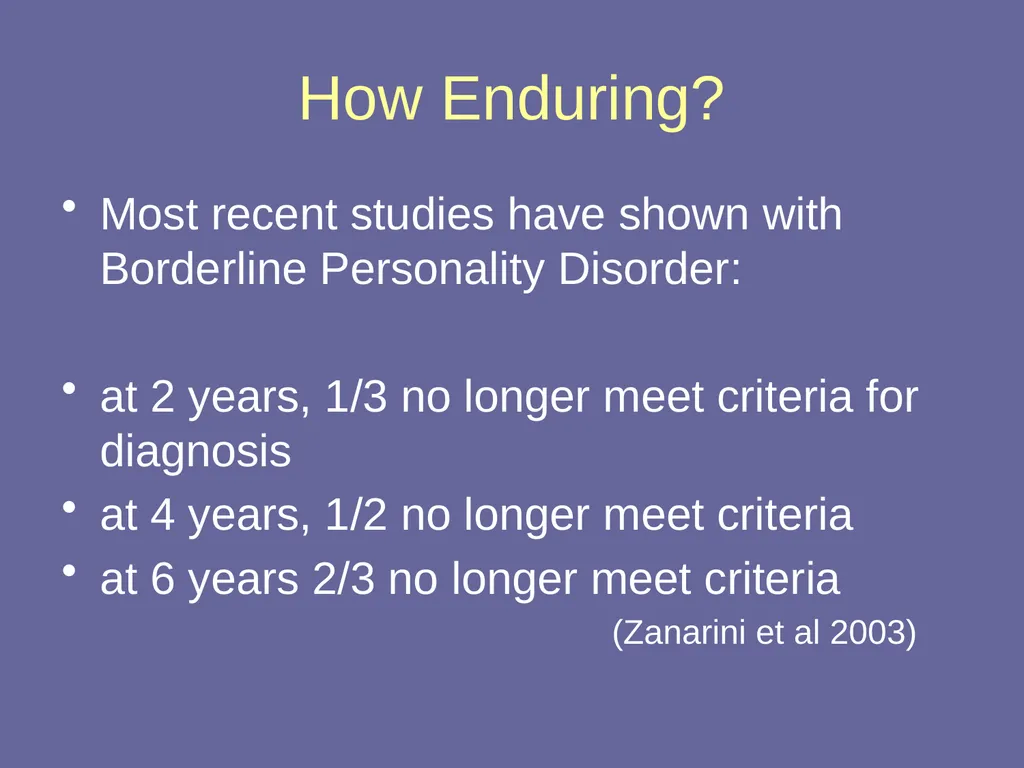
How Enduring? Most recent studies have shown with Borderline Personality Disorder:
at 2 years, 1/3 no longer meet criteria for diagnosis
at 4 years, 1/2 no longer meet criteria
at 6 years 2/3 no longer meet criteria
(Zanarini et al 2003)<br>
at 2 years, 1/3 no longer meet criteria for diagnosis
at 4 years, 1/2 no longer meet criteria
at 6 years 2/3 no longer meet criteria
(Zanarini et al 2003)<br>
16
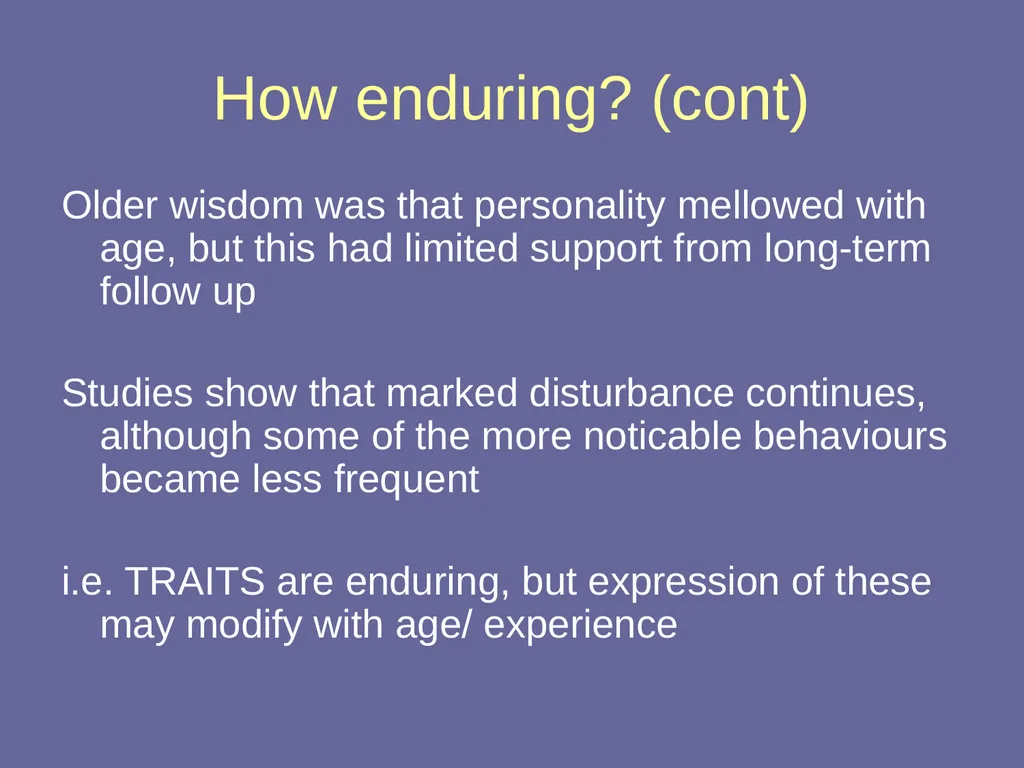
How enduring? (cont) Older wisdom was that personality mellowed with age, but this had limited support from long-term follow up
Studies show that marked disturbance continues, although some of the more noticable behaviours became less frequent
i.e. TRAITS are enduring, but expression of these may modify with age/ experience<br>
Studies show that marked disturbance continues, although some of the more noticable behaviours became less frequent
i.e. TRAITS are enduring, but expression of these may modify with age/ experience<br>
17
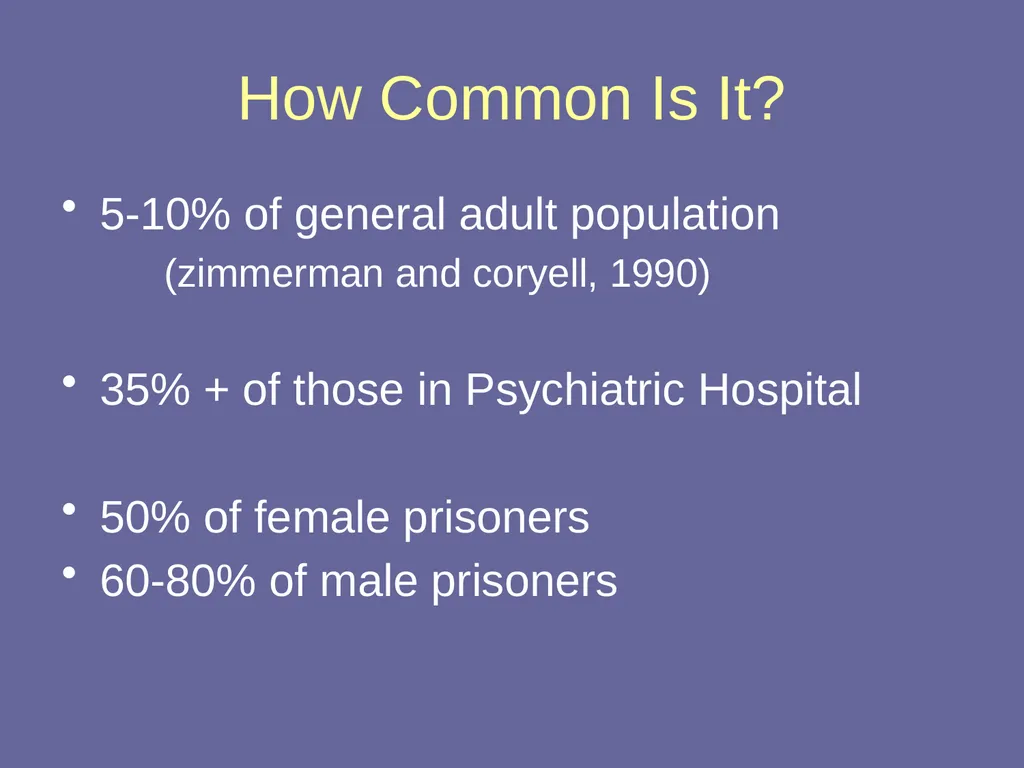
How Common Is It? 5-10% of general adult population
(zimmerman and coryell, 1990)
35% + of those in Psychiatric Hospital
50% of female prisoners
60-80% of male prisoners<br>
(zimmerman and coryell, 1990)
35% + of those in Psychiatric Hospital
50% of female prisoners
60-80% of male prisoners<br>
18
Types of Personality Disorder<br>
19
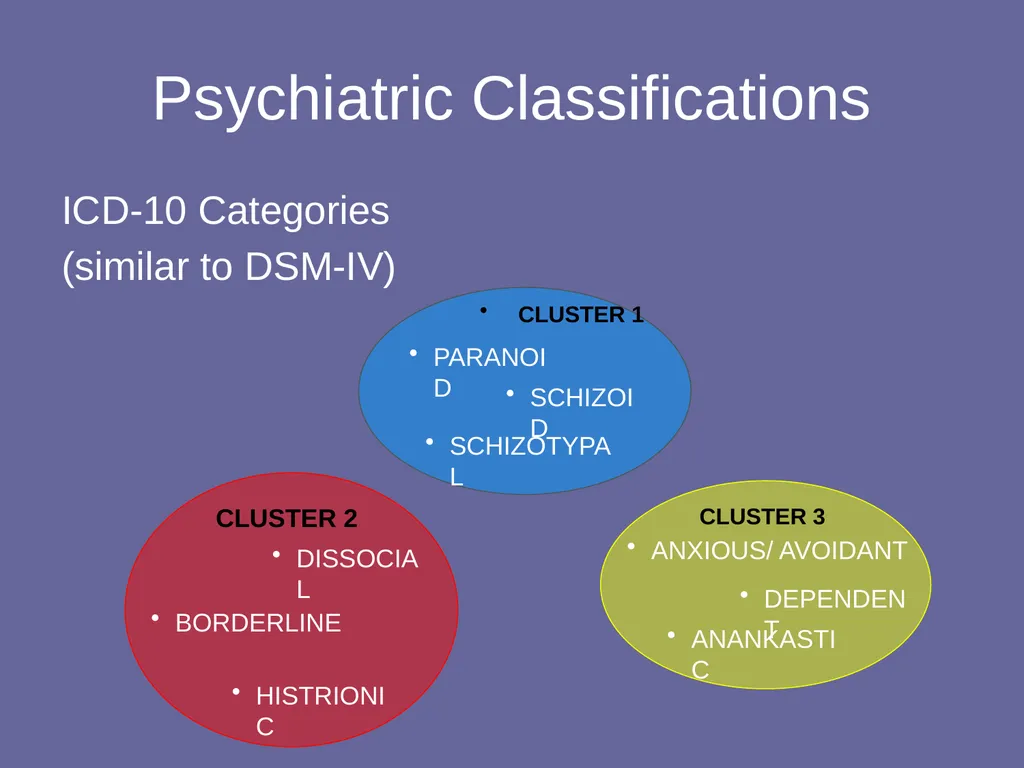
Psychiatric Classifications ICD-10 Categories
(similar to DSM-IV) PARANOID SCHIZOID CLUSTER 2 CLUSTER 3 DISSOCIAL BORDERLINE DEPENDENT ANXIOUS/ AVOIDANT ANANKASTIC HISTRIONIC SCHIZOTYPAL<br>
(similar to DSM-IV) PARANOID SCHIZOID CLUSTER 2 CLUSTER 3 DISSOCIAL BORDERLINE DEPENDENT ANXIOUS/ AVOIDANT ANANKASTIC HISTRIONIC SCHIZOTYPAL<br>
20
New DSM – V due May 2013
After much debate – little change to classifications
New ICD – 11 due 2015
Likely to move to Dimensions (how badly affected is the person) rather than Categories (what type)<br>
After much debate – little change to classifications
New ICD – 11 due 2015
Likely to move to Dimensions (how badly affected is the person) rather than Categories (what type)<br>
21
Dissocial Personality Disorder Callous unconcern for the feelings of others
Irresponsible. No regard for social norms, rules and obligations.
Unable to maintain lasting relationships, though having no difficulty in starting them.<br>
Irresponsible. No regard for social norms, rules and obligations.
Unable to maintain lasting relationships, though having no difficulty in starting them.<br>
22
Dissocial Personality Disorder Easily becomes frustrated, angry or violent.
Not able to feel guilt or to profit from experience or punishment.
Tends to blame others, or to offer explanations, for the behaviours that has brought the patient into conflict with society.<br>
Not able to feel guilt or to profit from experience or punishment.
Tends to blame others, or to offer explanations, for the behaviours that has brought the patient into conflict with society.<br>
23
“Psychopathy” Extreme form of antisocial/ dissocial personality disorder
Psychopathy Check-List – Revised
Cold, callous self-centred, predatory individuals
Strongly correlated with risk of future violence
Narrower group than dissocial category – often also fulfil antisocial/ narcissistic/ histrionic and paranoid<br>
Psychopathy Check-List – Revised
Cold, callous self-centred, predatory individuals
Strongly correlated with risk of future violence
Narrower group than dissocial category – often also fulfil antisocial/ narcissistic/ histrionic and paranoid<br>
24
Borderline Personality Disorder Does NOT mean the person may or may not have a PD
Historical terminology designating a condition on the “borderline” between Neurotic (anxiety/ phobias/ depression) and Psychotic (schizophrenia) conditions<br>
Historical terminology designating a condition on the “borderline” between Neurotic (anxiety/ phobias/ depression) and Psychotic (schizophrenia) conditions<br>
25
Borderline Personality Disorder BPD is called
Emotionally Unstable Personality Disorder in the ICD-10 classification
It is sub-divided into
Impulsive Type
And
Borderline Type<br>
Emotionally Unstable Personality Disorder in the ICD-10 classification
It is sub-divided into
Impulsive Type
And
Borderline Type<br>
26
Borderline Personality Disorder Emotionally unstable.
Person’s self-image, aims and internal preferences (including sexual) are often unclear or disturbed.
Chronic feelings of emptiness.<br>
Person’s self-image, aims and internal preferences (including sexual) are often unclear or disturbed.
Chronic feelings of emptiness.<br>
27
Borderline Personality Disorder Becomes involved in intense and unstable relationships, with repeated emotional crisis.
Extreme efforts to avoid real or imagined abandonment.
Recurrent suicidal threats, gestures and behaviours or self-harming behaviours.<br>
Extreme efforts to avoid real or imagined abandonment.
Recurrent suicidal threats, gestures and behaviours or self-harming behaviours.<br>
28
Borderline Personality Disorder Tend to act without considering consequences
Lack of Impulse control
Transient stress-related paranoid ideas or severe dissociative symptoms.<br>
Lack of Impulse control
Transient stress-related paranoid ideas or severe dissociative symptoms.<br>
29
Psychiatric Model of Personality Disorder Not very accurate, despite all efforts to pin categories down
Looked at again for ICD-11 and DSM-V
People often fit more than one category
2 people with BPD might have very different symptoms
Types have been shown to alter and change<br>
Looked at again for ICD-11 and DSM-V
People often fit more than one category
2 people with BPD might have very different symptoms
Types have been shown to alter and change<br>
30
PSYCHODYNAMIC APPROACH WHAT DOES IT OFFER?
Theory of Unconscious motivations – not all “manipulative” behaviour is consciously under the person’s control
Takes a developmental view
Defence mechanisms – the way people have to act at times to protect themselves from overwhelming emotional states<br>
Theory of Unconscious motivations – not all “manipulative” behaviour is consciously under the person’s control
Takes a developmental view
Defence mechanisms – the way people have to act at times to protect themselves from overwhelming emotional states<br>
31
What does it offer? (cont) The way the person’s internal state impacts emotionally on others
The importance of Attachment
THESE ARE ALL TOOLS TO INCREASE UNDERSTANDING<br>
The importance of Attachment
THESE ARE ALL TOOLS TO INCREASE UNDERSTANDING<br>
32
ATTACHMENT<br>
33
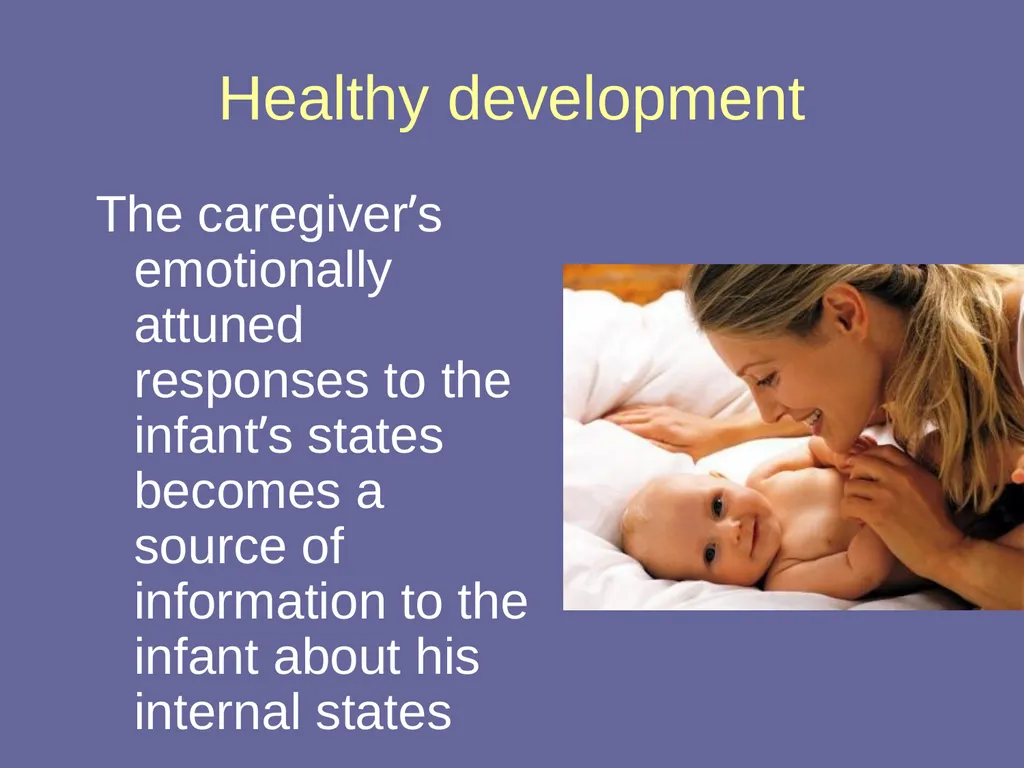
Healthy development The caregiver’s emotionally attuned responses to the infant’s states becomes a source of information to the infant about his internal states<br>
34
When things go wrong Still face experiment<br>
35
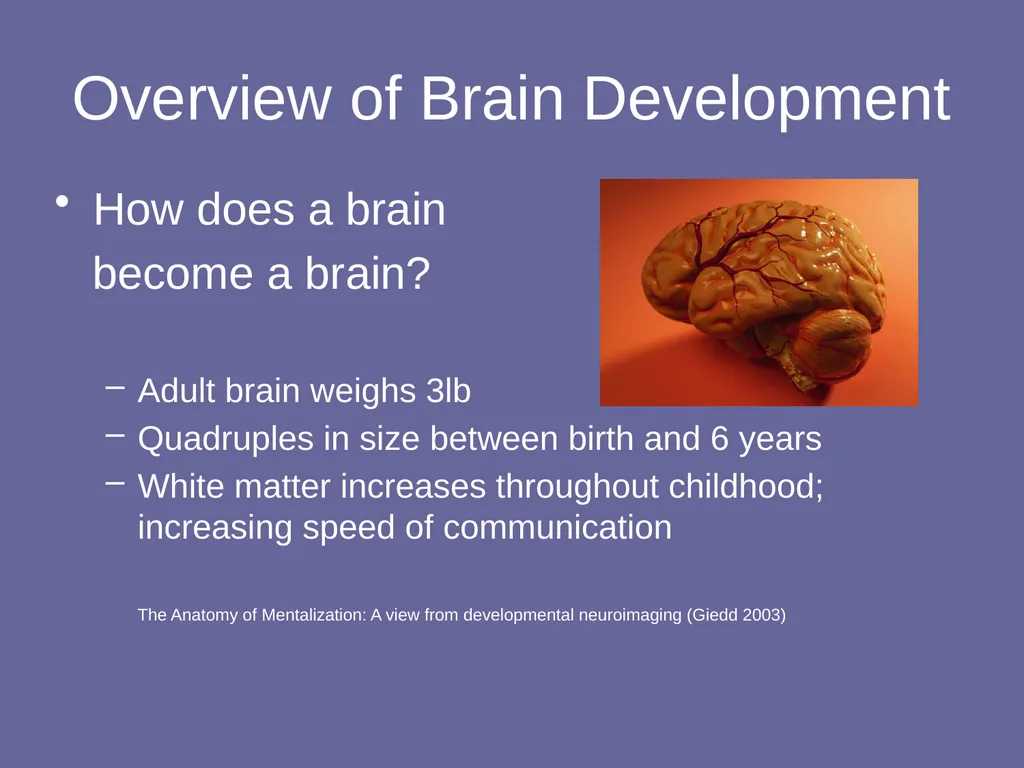
Overview of Brain Development How does a brain
become a brain?
Adult brain weighs 3lb
Quadruples in size between birth and 6 years
White matter increases throughout childhood; increasing speed of communication
The Anatomy of Mentalization: A view from developmental neuroimaging (Giedd 2003)<br>
become a brain?
Adult brain weighs 3lb
Quadruples in size between birth and 6 years
White matter increases throughout childhood; increasing speed of communication
The Anatomy of Mentalization: A view from developmental neuroimaging (Giedd 2003)<br>
36
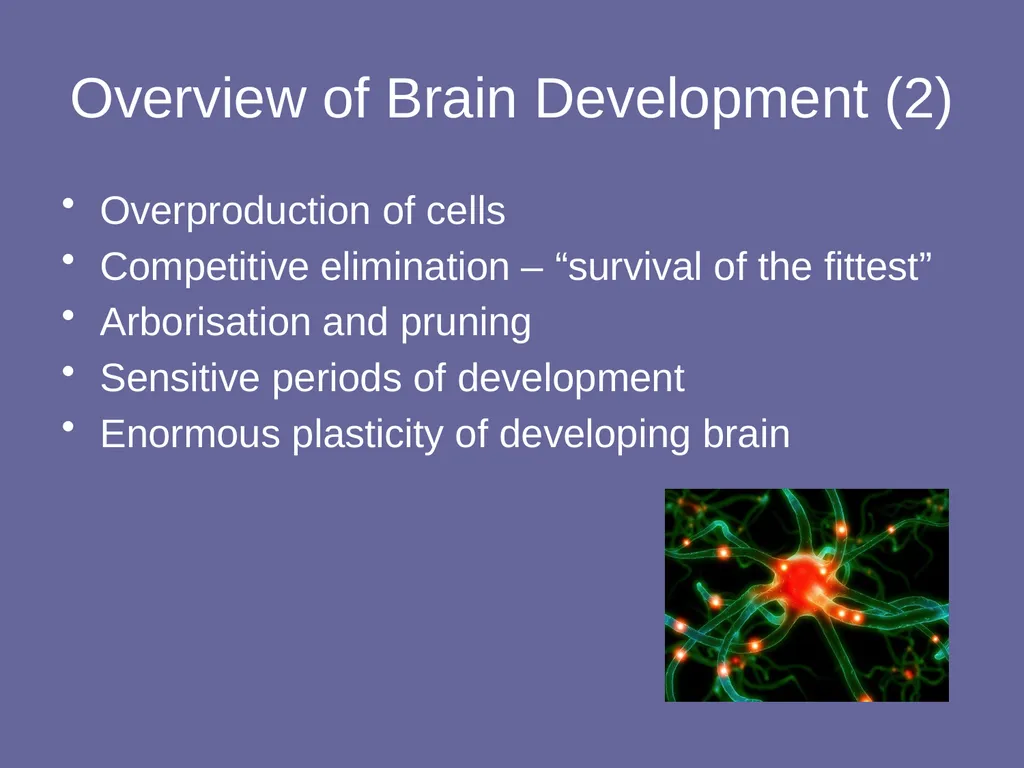
Overview of Brain Development (2) Overproduction of cells
Competitive elimination – “survival of the fittest”
Arborisation and pruning
Sensitive periods of development
Enormous plasticity of developing brain<br>
Competitive elimination – “survival of the fittest”
Arborisation and pruning
Sensitive periods of development
Enormous plasticity of developing brain<br>
37
This means that brain pathway development is affected by environmental (particularly Attachment) factors.
People with Personality disorder have problems with how their brain functions, particularly under stress<br>
People with Personality disorder have problems with how their brain functions, particularly under stress<br>
38
Treatment/ Management<br>
39
Treatment/ Management Growing evidence for psychotherapy approaches – MBT, DBT
Long-term, fairly intensive treatment
Not widely available
Growing consensus on general principles for good management – NICE guidelines, Integrated Care Pathway (ICP)
Above mainly for BPD<br>
Long-term, fairly intensive treatment
Not widely available
Growing consensus on general principles for good management – NICE guidelines, Integrated Care Pathway (ICP)
Above mainly for BPD<br>
40
Management principles - NICE Manage endings and transitions
Training, supervision and support of staff
Specialist Psychological Treatment
PLUS
Structured care (incl. crisis management)
SHARED theoretical approach
No short term psychotherapy (<3 months)
Crisis – explore reason for distress/ empathic/ open questioning<br>
Training, supervision and support of staff
Specialist Psychological Treatment
PLUS
Structured care (incl. crisis management)
SHARED theoretical approach
No short term psychotherapy (<3 months)
Crisis – explore reason for distress/ empathic/ open questioning<br>
41
Management principles (from ICP for BPD) Promote reflection
Tolerate intense aggression/ hate
Set necessary limits
Understand dynamics and monitor the relationship, thereby reducing the potential for splitting
Monitor countertransference feelings with a view to using this to understand the patient’s difficulties<br>
Tolerate intense aggression/ hate
Set necessary limits
Understand dynamics and monitor the relationship, thereby reducing the potential for splitting
Monitor countertransference feelings with a view to using this to understand the patient’s difficulties<br>
42
Treatment/ Management Little evidence that standard psychiatric in-patient care is helpful – may be harmful
Limited role for medication – poor evidence base
Important to treat co-morbid conditions
May be groups of symptoms that respond to some medications<br>
Limited role for medication – poor evidence base
Important to treat co-morbid conditions
May be groups of symptoms that respond to some medications<br>
43
Legislation<br>
44
Mental Health (care and treatment) (Scotland) Act 2003<br>
45
Use of Compulsory Measures and Personality Disorder PD is included in 2003 Mental Health Act, but people with PD often not thought to meet criteria for compulsory measures
Requires that
“person has a mental disorder which causes their ability to make decisions about treatment to be significantly impaired”
? Impaired decision making<br>
Requires that
“person has a mental disorder which causes their ability to make decisions about treatment to be significantly impaired”
? Impaired decision making<br>
46
Use of Compulsory Measures and Personality Disorder CTO
– requires that “medical treatment is available which is likely to prevent disorder worsening or likely to alleviate the symptoms or effects of the disorder”
- and that there is significant risk to the patient or any other person if the patient were not provided with such treatment<br>
– requires that “medical treatment is available which is likely to prevent disorder worsening or likely to alleviate the symptoms or effects of the disorder”
- and that there is significant risk to the patient or any other person if the patient were not provided with such treatment<br>
47
“Medical treatment” is defined as :
Pharmacological or physical treatment (such as ECT)
Psychological and social interventions
Nursing
Care
Habilitation – including education and training in work, social and independent living skills
Rehabilitation<br>
Pharmacological or physical treatment (such as ECT)
Psychological and social interventions
Nursing
Care
Habilitation – including education and training in work, social and independent living skills
Rehabilitation<br>
48
Criminal Procedures (Scot) Act 1995, amended by MH(C&Tr)(Scot) Act 2003 PD included in 2003 Act as mental disorder
Criterion of “significantly impaired ability to make decisions about treatment” is EXCLUDED for mentally disordered offenders,
therefore
Issues of treatability are prominent
Treatability harder to argue for antisocial/ psychopathic disorders<br>
Criterion of “significantly impaired ability to make decisions about treatment” is EXCLUDED for mentally disordered offenders,
therefore
Issues of treatability are prominent
Treatability harder to argue for antisocial/ psychopathic disorders<br>
49
Treatability of Dissocial/ Antisocial disorders Many treatment models thought to be useful to some degree
anger management,
CBT approaches,
therapeutic community models
No great evidence base for any of these<br>
anger management,
CBT approaches,
therapeutic community models
No great evidence base for any of these<br>
50
Use of Compulsory Measures and Personality Disorder - FORENSIC Routine practice in Scotland NOT to admit on compulsory basis, individuals with a primary diagnosis of PD to forensic units
Focus of forensic mental health services is on psychotic disorders
1976 Carstairs incident (Darjee and Crichton 2003)<br>
Focus of forensic mental health services is on psychotic disorders
1976 Carstairs incident (Darjee and Crichton 2003)<br>
51
(cont) Challenges re “treatability” – unconditional discharge of a patient from Carstairs on grounds that he was untreatable - 1999
Led to MH(public safety and appeals)(Scotland) Act 1999 – changed legislative definition of mental illness to include PD and added a criterion of serious risk to others – so untreatable restricted pts could still be detained<br>
Led to MH(public safety and appeals)(Scotland) Act 1999 – changed legislative definition of mental illness to include PD and added a criterion of serious risk to others – so untreatable restricted pts could still be detained<br>
52
Adults with Incapacity (Scotland) Act 2000 Usually applies to people with Dementia/ Learning Disability/ Brain Injury
Can also be used in other severe and enduring mental disorders where CAPACITY shown to be impaired<br>
Can also be used in other severe and enduring mental disorders where CAPACITY shown to be impaired<br>
53
AWI (Scotland) 2000 (cont.) For the purposes of the Act, 'incapable' means incapable of:
acting on decisions; or
making decisions; or
communicating decisions; or
understanding decisions; or
retaining the memory of decisions
in relation to any particular matter due to mental disorder<br>
acting on decisions; or
making decisions; or
communicating decisions; or
understanding decisions; or
retaining the memory of decisions
in relation to any particular matter due to mental disorder<br>
54
Adult Support and Protection (Scotland) Act 2007 Adult is engaging (or is likely to engage) in conduct which causes (or is likely to cause) self-harm
Almost the definition of many personality disorders
Principles
Must provide benefit
Least restrictive<br>
Almost the definition of many personality disorders
Principles
Must provide benefit
Least restrictive<br>