Philosophical behaviourism and consciousness
Description: Philosophical behaviourism and consciousness Michael Lacewing enquiriesalevelphilosophy.co.uk Michael Lacewing Philosophical behaviourism A family of theories that claim that we can analyse mental concepts in terms of concepts that
Related Topics
Download Presentation
"Philosophical behaviourism and consciousness" is the property of its rightful owner. Permission is granted to download and print the materials on this website for personal, non-commercial use only, and to display it on your personal computer provided you do not modify the materials and that you retain all copyright notices contained in the materials. By downloading content from our website, you accept the terms of this agreement.
Presentation Transcript
slide1. Philosophical behaviourism and consciousness Michael Lacewing
enquiries@alevelphilosophy.co.uk © Michael Lacewing<br>
slide2. Philosophical behaviourism A family of theories that claim that we can analyse mental concepts in terms of concepts that relate to the body, and in particular, the concept of ‘behaviour’
Focus not on metaphysics – what exists – but on language – mental concepts
Before we do metaphysics of mind, we need conceptual analysis © Michael Lacewing<br>
slide3. Methodological behaviourism A theory about how a scientific psychology works (Watson, Skinner)
To be properly scientific, psychology must deal with what can be observed, not what cannot
Therefore, psychology should aim only at the explanation and prediction of behaviour without appealing to ‘inner’ mental states
A claim about science and about how we know about mental states © Michael Lacewing<br>
slide4. Philosophical behaviourism What we are talking about when we are talking about the mind and mental states is behaviour
Our psychological terms are about what people do, and how they react
‘The mind’ is not a thing
Different kinds of philosophical behaviourism
Hempel: ‘logical’, ‘analytical’, ‘hard’ behaviourism
But sometimes ‘logical’ = ‘philosophical’!
Ryle: ‘soft’ behaviourism © Michael Lacewing<br>
slide5. Knowledge of the mind Dualism thinks of mental states as ‘inner’ and defends an asymmetry of knowledge
Our mental states are inaccessible to other people
But known to us through conscious introspection (c) Michael Lacewing<br>
slide6. Knowledge of the mind Behaviourism rejects this
We don’t have to infer that someone has a mind from their behaviour
To say that someone has certain behaviour dispositions just is to say they have a mind
So we can know other people’s mental states
But now, can I only know my own mental states by observing my behaviour??
If they are behavioural dispositions, how could ‘introspection’ reveal them? (c) Michael Lacewing<br>
slide7. Knowledge of the mind Hempel approaches psychological concepts only from the scientific (third-person) point of view
He says nothing about how we can talk about and understand our own mental states
Ryle: conscious introspection is a myth
We pay attention to ourselves just as we pay attention to others’ behaviour
To know what you think is just to be ready to say what you think
We just have more evidence – thinking is inner speech (c) Michael Lacewing<br>
slide8. Distinctness of mental states from behaviour Many conscious mental states, e.g. pain, have a particular feeling, ‘what it is like’ – this cannot be understood just as a behavioural disposition
Nor can they be captured in terms of conditions of verification
Behaviourism misses the phenomenology of the mind
Hempel: this ‘feeling’ side of mental states is still tied up in behaviour
We can talk meaningfully about it, but all we have to go on is behaviour and physical states (c) Michael Lacewing<br>

slide9. Distinctness of mental states from behaviour Objection: what about a perfect actor or someone living a lie?
They express the behaviour, but don’t have the (usual) mental state
Ryle: mental states aren’t just expressing certain behaviours but having the disposition to do so
There are ‘if…then…’ statements that are true of the person in pain that are not true of the actor (even if the conditions that show this never occur) © Michael Lacewing<br>
slide10. Distinctness of mental states from behaviour But all this still misses the intrinsic phenomenology of consciousness – what it is like to experience pain
Putnam’s ‘super-spartans’
Through culture, they have no disposition to express pain at all
Yet they feel pain
Hempel: there will be a difference in physiology
There must be some identifiable difference, or there would be no difference between being in pain and not!
But this takes us toward type identity theory © Michael Lacewing<br>
enquiries@alevelphilosophy.co.uk © Michael Lacewing<br>
slide2. Philosophical behaviourism A family of theories that claim that we can analyse mental concepts in terms of concepts that relate to the body, and in particular, the concept of ‘behaviour’
Focus not on metaphysics – what exists – but on language – mental concepts
Before we do metaphysics of mind, we need conceptual analysis © Michael Lacewing<br>
slide3. Methodological behaviourism A theory about how a scientific psychology works (Watson, Skinner)
To be properly scientific, psychology must deal with what can be observed, not what cannot
Therefore, psychology should aim only at the explanation and prediction of behaviour without appealing to ‘inner’ mental states
A claim about science and about how we know about mental states © Michael Lacewing<br>
slide4. Philosophical behaviourism What we are talking about when we are talking about the mind and mental states is behaviour
Our psychological terms are about what people do, and how they react
‘The mind’ is not a thing
Different kinds of philosophical behaviourism
Hempel: ‘logical’, ‘analytical’, ‘hard’ behaviourism
But sometimes ‘logical’ = ‘philosophical’!
Ryle: ‘soft’ behaviourism © Michael Lacewing<br>
slide5. Knowledge of the mind Dualism thinks of mental states as ‘inner’ and defends an asymmetry of knowledge
Our mental states are inaccessible to other people
But known to us through conscious introspection (c) Michael Lacewing<br>
slide6. Knowledge of the mind Behaviourism rejects this
We don’t have to infer that someone has a mind from their behaviour
To say that someone has certain behaviour dispositions just is to say they have a mind
So we can know other people’s mental states
But now, can I only know my own mental states by observing my behaviour??
If they are behavioural dispositions, how could ‘introspection’ reveal them? (c) Michael Lacewing<br>
slide7. Knowledge of the mind Hempel approaches psychological concepts only from the scientific (third-person) point of view
He says nothing about how we can talk about and understand our own mental states
Ryle: conscious introspection is a myth
We pay attention to ourselves just as we pay attention to others’ behaviour
To know what you think is just to be ready to say what you think
We just have more evidence – thinking is inner speech (c) Michael Lacewing<br>
slide8. Distinctness of mental states from behaviour Many conscious mental states, e.g. pain, have a particular feeling, ‘what it is like’ – this cannot be understood just as a behavioural disposition
Nor can they be captured in terms of conditions of verification
Behaviourism misses the phenomenology of the mind
Hempel: this ‘feeling’ side of mental states is still tied up in behaviour
We can talk meaningfully about it, but all we have to go on is behaviour and physical states (c) Michael Lacewing<br>
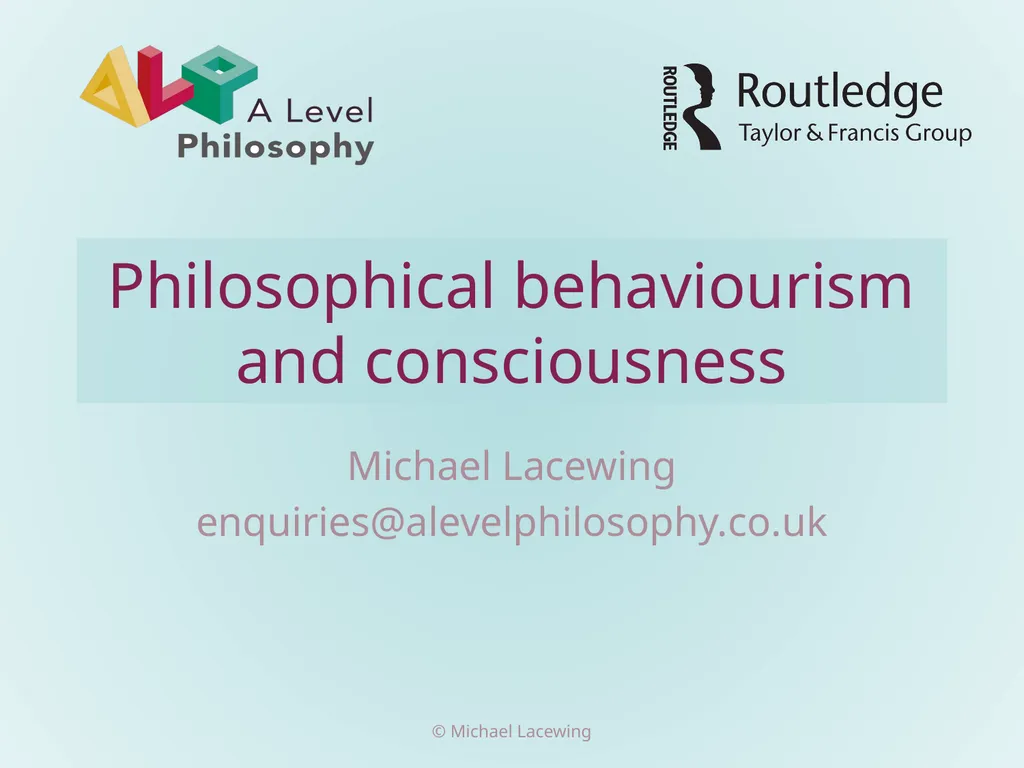
slide9. Distinctness of mental states from behaviour Objection: what about a perfect actor or someone living a lie?
They express the behaviour, but don’t have the (usual) mental state
Ryle: mental states aren’t just expressing certain behaviours but having the disposition to do so
There are ‘if…then…’ statements that are true of the person in pain that are not true of the actor (even if the conditions that show this never occur) © Michael Lacewing<br>
slide10. Distinctness of mental states from behaviour But all this still misses the intrinsic phenomenology of consciousness – what it is like to experience pain
Putnam’s ‘super-spartans’
Through culture, they have no disposition to express pain at all
Yet they feel pain
Hempel: there will be a difference in physiology
There must be some identifiable difference, or there would be no difference between being in pain and not!
But this takes us toward type identity theory © Michael Lacewing<br>