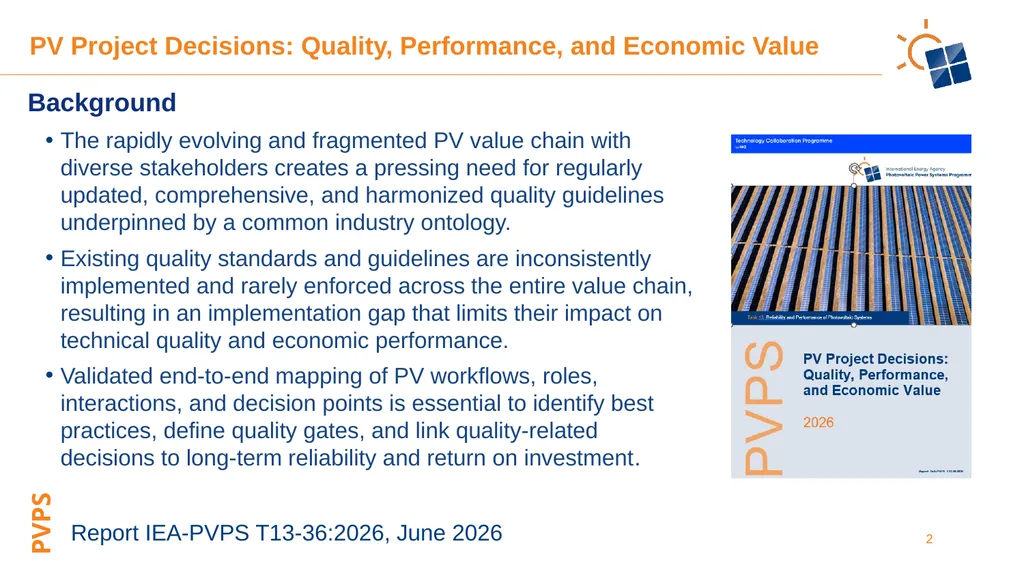
Photovoltaic Project Decisions: Quality, Performance, and Economic Value Ulrike Jahn, Fraunhofer CSP, DEU; David Moser, Becquerel Institute Italia, Italy June 2026 Task 13 Reliability and Performance of PV Systems PV Project Decisions:
"Photovoltaic Project Decisions: Quality," is the property of its rightful owner. Permission is granted to
download and print the materials on this website for personal, non-commercial use only, and to display it
on your personal computer provided you do not modify the materials and that you retain all copyright
notices contained in the materials. By downloading content from our website, you accept the terms of this
agreement.
Presentation Transcript
01
Photovoltaic Project Decisions: Quality, Performance, and Economic Value Ulrike Jahn, Fraunhofer CSP, DEU; David Moser, Becquerel Institute Italia, Italy June 2026 Task 13 Reliability and Performance of PV Systems<br>
02
PV Project Decisions: Quality, Performance, and Economic Value The rapidly evolving and fragmented PV value chain with diverse stakeholders creates a pressing need for regularly updated, comprehensive, and harmonized quality guidelines underpinned by a common industry ontology.
Existing quality standards and guidelines are inconsistently implemented and rarely enforced across the entire value chain, resulting in an implementation gap that limits their impact on technical quality and economic performance.
Validated end-to-end mapping of PV workflows, roles, interactions, and decision points is essential to identify best practices, define quality gates, and link quality-related decisions to long-term reliability and return on investment. Report IEA-PVPS T13-36:2026, June 2026 Background<br>
03
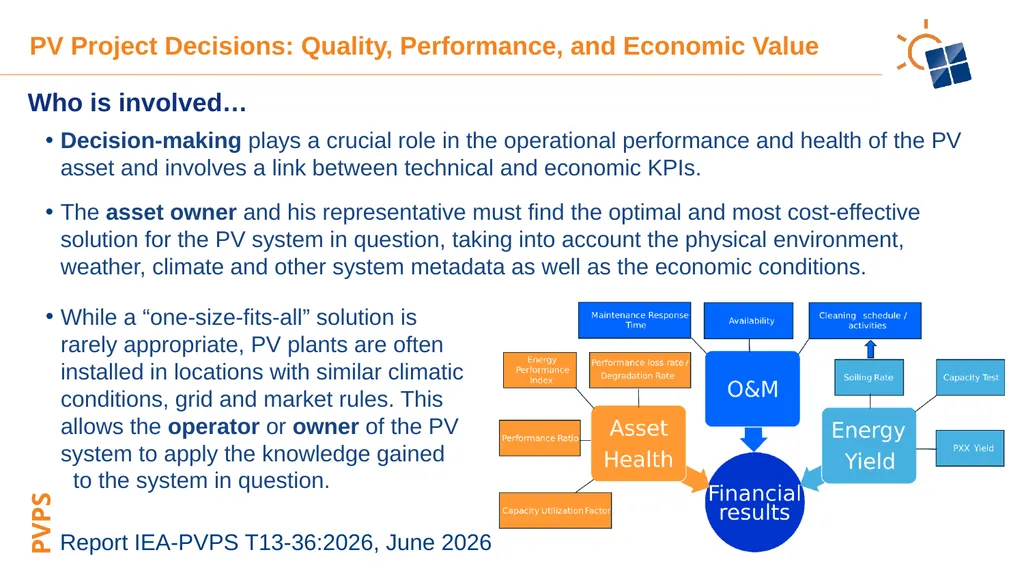
PV Project Decisions: Quality, Performance, and Economic Value Decision-making plays a crucial role in the operational performance and health of the PV asset and involves a link between technical and economic KPIs.
The asset owner and his representative must find the optimal and most cost-effective solution for the PV system in question, taking into account the physical environment, weather, climate and other system metadata as well as the economic conditions. Report IEA-PVPS T13-36:2026, June 2026 While a “one-size-fits-all” solution is rarely appropriate, PV plants are often installed in locations with similar climatic conditions, grid and market rules. This allows the operator or owner of the PV system to apply the knowledge gained to the system in question. Who is involved…<br>
04
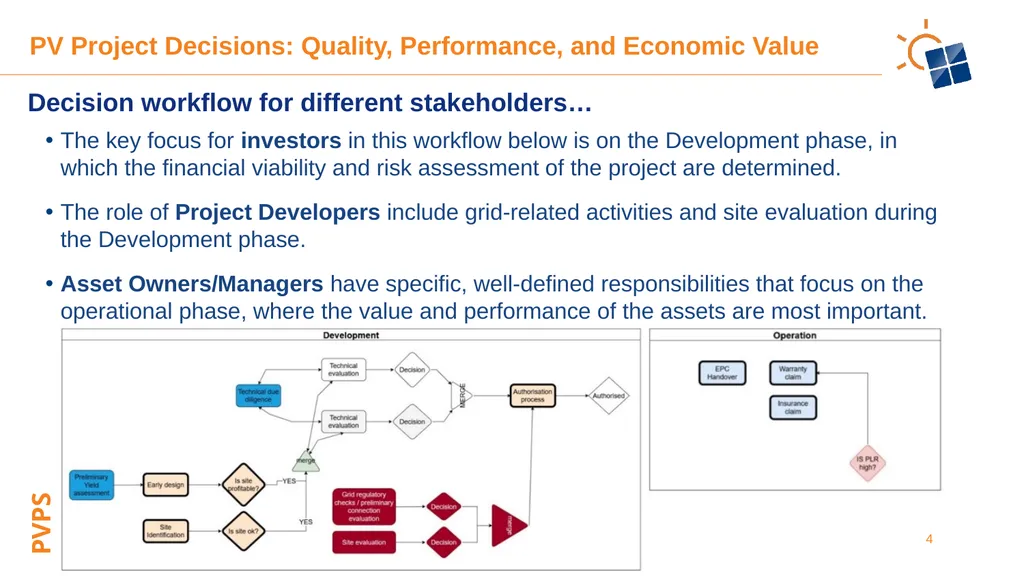
PV Project Decisions: Quality, Performance, and Economic Value The key focus for investors in this workflow below is on the Development phase, in which the financial viability and risk assessment of the project are determined.
The role of Project Developers include grid-related activities and site evaluation during the Development phase.
Asset Owners/Managers have specific, well-defined responsibilities that focus on the operational phase, where the value and performance of the assets are most important. Report IEA-PVPS T13-36:2026, April 2026 Decision workflow for different stakeholders…<br>
05
PV Project Decisions: Quality, Performance, and Economic Value Technical and economic decisions along the PV value chain are tightly coupled. An integrated KPI framework (performance, reliability, losses, economics, circularity, agrivoltaics) plus shared ontologies is essential for consistent, data‑driven decision‑making.
The decision matrix and quality‑gate concept show that early checks in development and engineering (due diligence, site/grid assessment, realistic soiling and yield modelling, component qualification) are the most cost‑effective leverage points for long‑term performance and risk reduction.
Case studies demonstrate that rigorous quality control and monitoring (e.g. mobile post‑shipment testing, optimized rooftop design, soiling‑aware cleaning strategies, data‑driven corrective and predictive maintenance) deliver quantifiable gains in energy yield, reduced OPEX and improved asset value. Report IEA-PVPS T13-36:2026, June 2026 Key Takeaways (1)<br>
06
PV Project Decisions: Quality, Performance, and Economic Value Two application‑ and region‑specific strategies are required: bifacial tracking, floating PV and agrivoltaics introduce distinct design, monitoring and O&M requirements, while geographic factors (e.g. remoteness, grid topology, climate) strongly influence failure patterns, OPEX and spare‑parts strategies.
Climate change and natural hazards (hail, storms, floods, wildfire) follow heavy‑tailed statis-tics; robust project valuation therefore requires climate‑adjusted modelling of probable maximum loss (PML) and of average annual loss (AAL), explicit treatment of grid and market curtailment, and realistic capture‑price projections.
The result of this work is an INTERACTIVE TOOL on PV Quality & Risk Decisions, which will be available in June 2026. Report IEA-PVPS T13-36:2026, June 2026 Key Takeaways (2)<br>