
Physiology The Body as an Organized "Solution”
DP
Published · 45 slides · 0 views
1 / 1

Description
Physiology The Body as an Organized Solution Lecture:1 Dr. Shaimaa Munther Physiology The science that is concerned with the function of the living organism and its parts, and of the physical and chemical processes involved. General
Related Topics
Share
Embed code
Download this presentation From Below
"Physiology The Body as an Organized "Solution”" is the property of its rightful owner. Permission is granted to download and print the materials on this website for personal, non-commercial use only, and to display it on your personal computer provided you do not modify the materials and that you retain all copyright notices contained in the materials. By downloading content from our website, you accept the terms of this agreement.
Presentation Transcript
01
Physiology
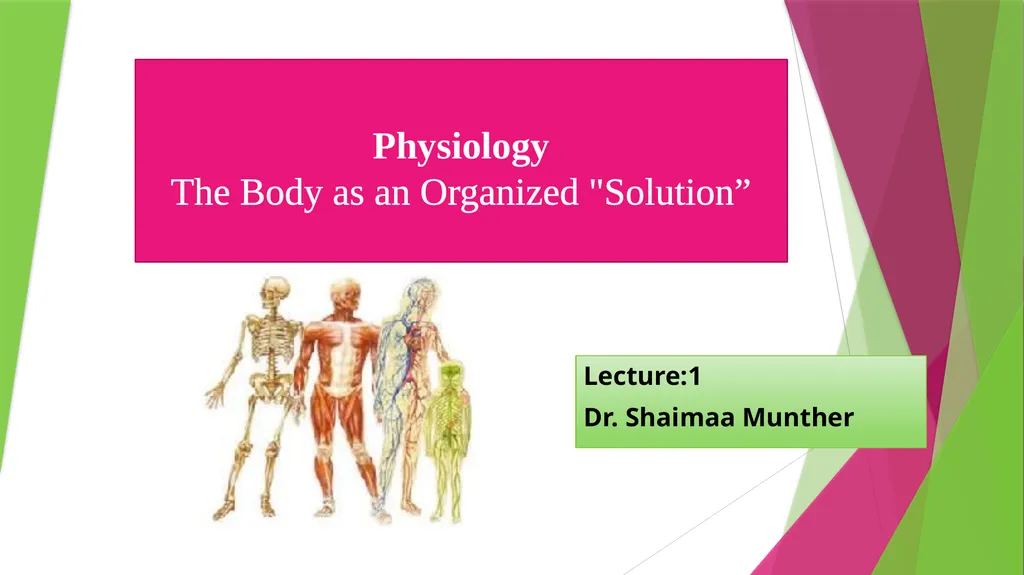
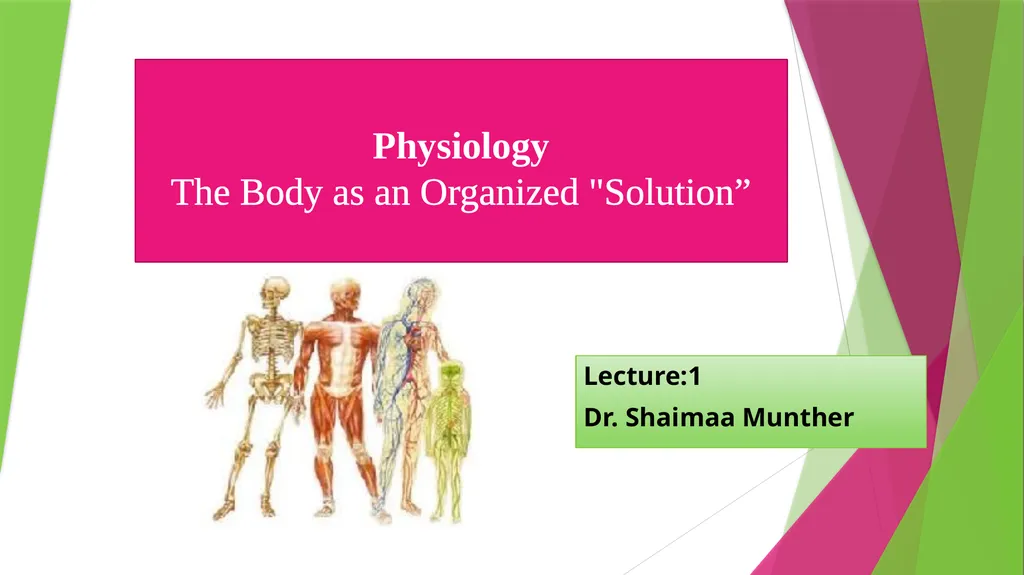
The Body as an Organized "Solution” Lecture:1
Dr. Shaimaa Munther<br>
Dr. Shaimaa Munther<br>
02
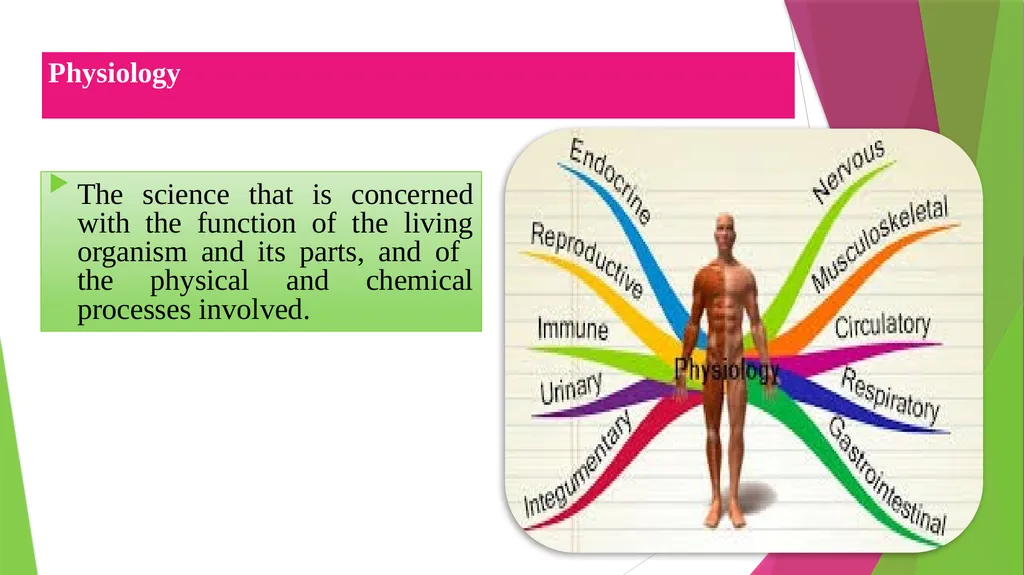
Physiology The science that is concerned with the function of the living organism and its parts, and of the physical and chemical processes involved.<br>
03
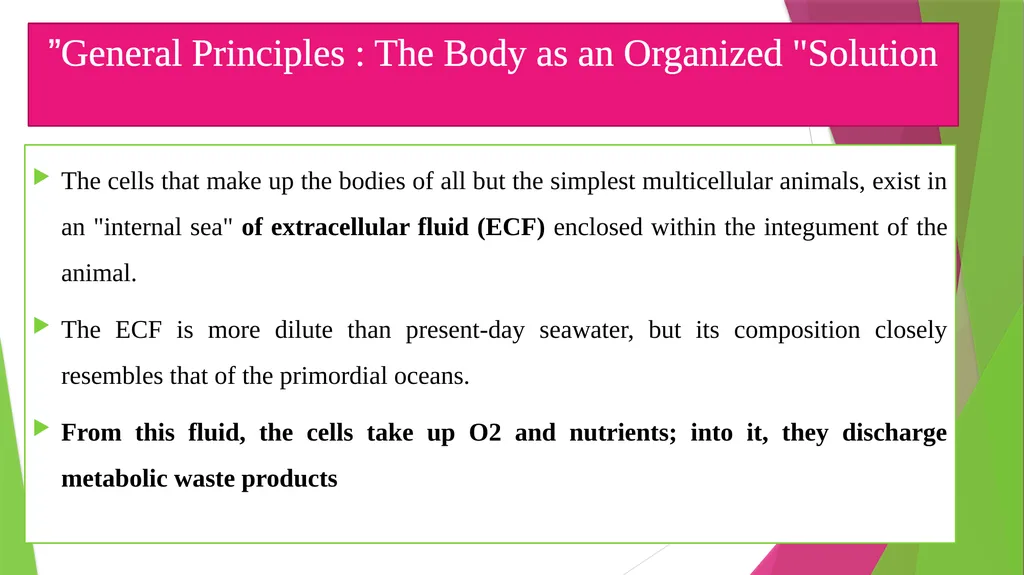
General Principles : The Body as an Organized "Solution” The cells that make up the bodies of all but the simplest multicellular animals, exist in an "internal sea" of extracellular fluid (ECF) enclosed within the integument of the animal.
The ECF is more dilute than present-day seawater, but its composition closely resembles that of the primordial oceans.
From this fluid, the cells take up O2 and nutrients; into it, they discharge metabolic waste products<br>
The ECF is more dilute than present-day seawater, but its composition closely resembles that of the primordial oceans.
From this fluid, the cells take up O2 and nutrients; into it, they discharge metabolic waste products<br>
04
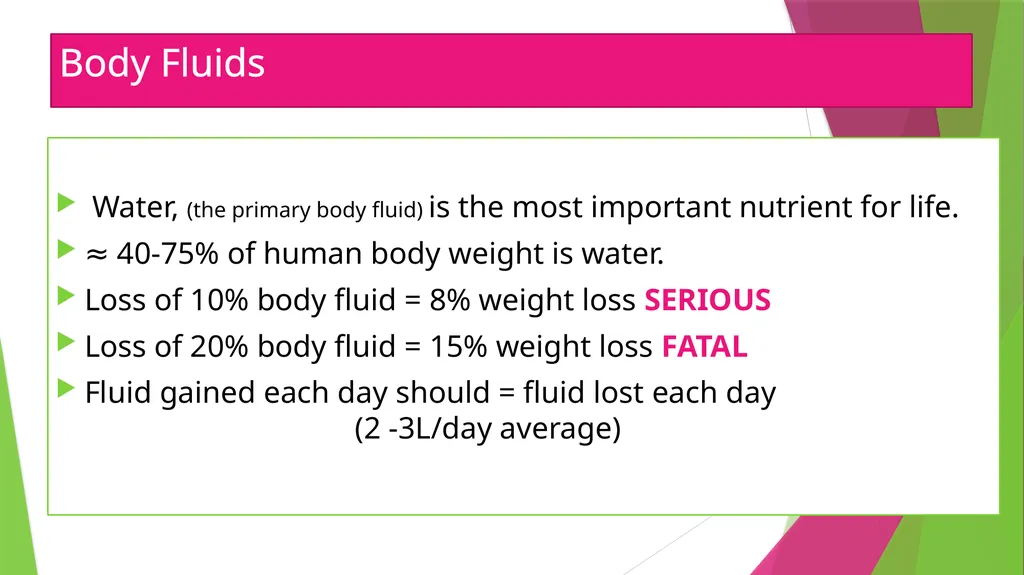
Body Fluids Water, (the primary body fluid) is the most important nutrient for life.
≈ 40-75% of human body weight is water.
Loss of 10% body fluid = 8% weight loss SERIOUS
Loss of 20% body fluid = 15% weight loss FATAL
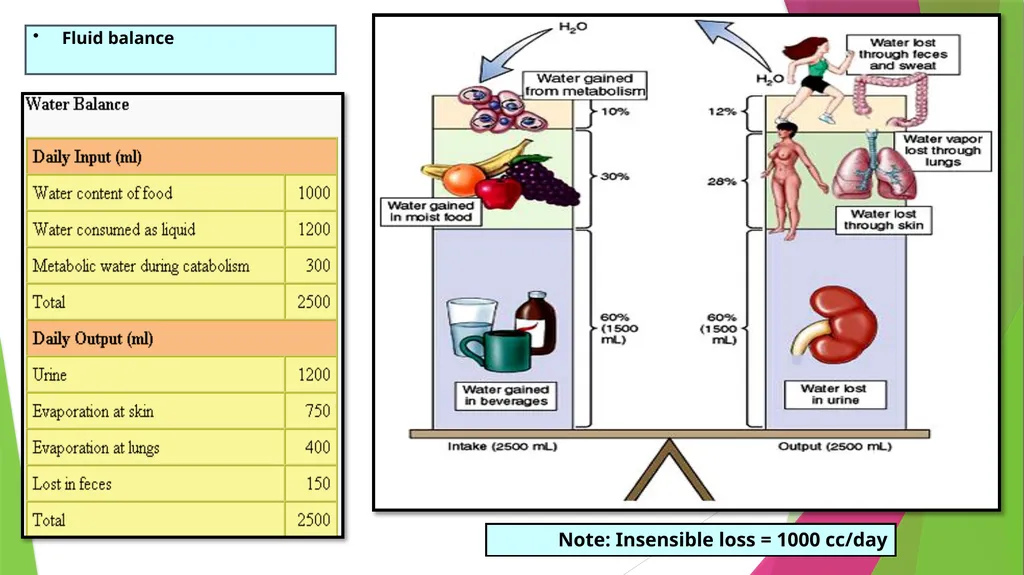
Fluid gained each day should = fluid lost each day (2 -3L/day average)<br>
≈ 40-75% of human body weight is water.
Loss of 10% body fluid = 8% weight loss SERIOUS
Loss of 20% body fluid = 15% weight loss FATAL
Fluid gained each day should = fluid lost each day (2 -3L/day average)<br>
05
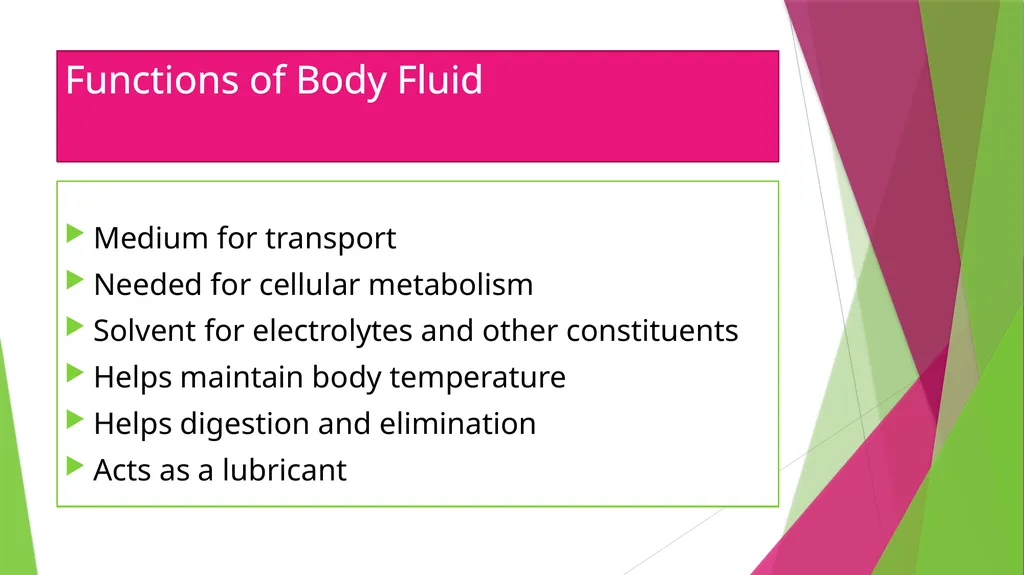
Functions of Body Fluid Medium for transport
Needed for cellular metabolism
Solvent for electrolytes and other constituents
Helps maintain body temperature
Helps digestion and elimination
Acts as a lubricant<br>
Needed for cellular metabolism
Solvent for electrolytes and other constituents
Helps maintain body temperature
Helps digestion and elimination
Acts as a lubricant<br>
06
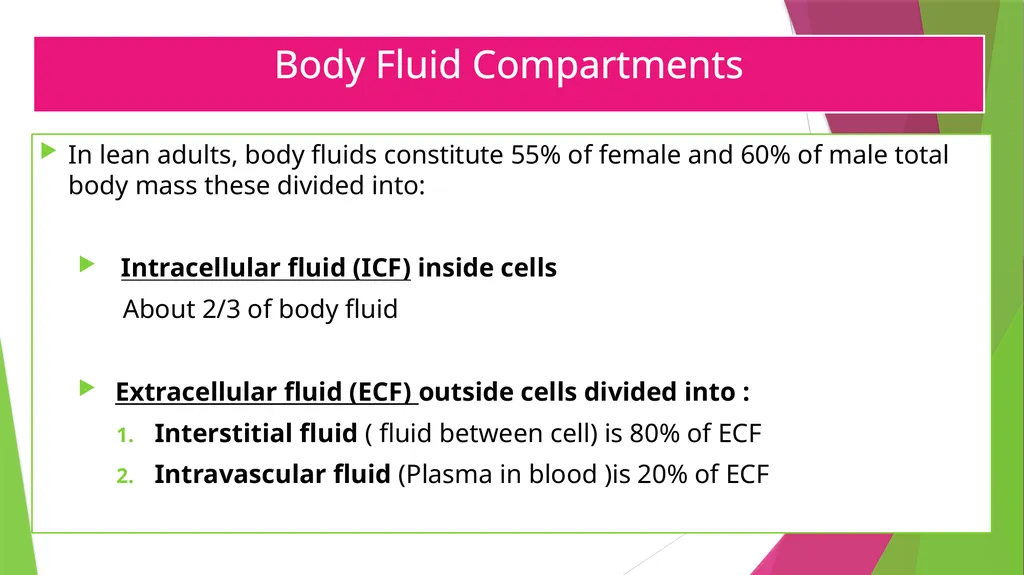
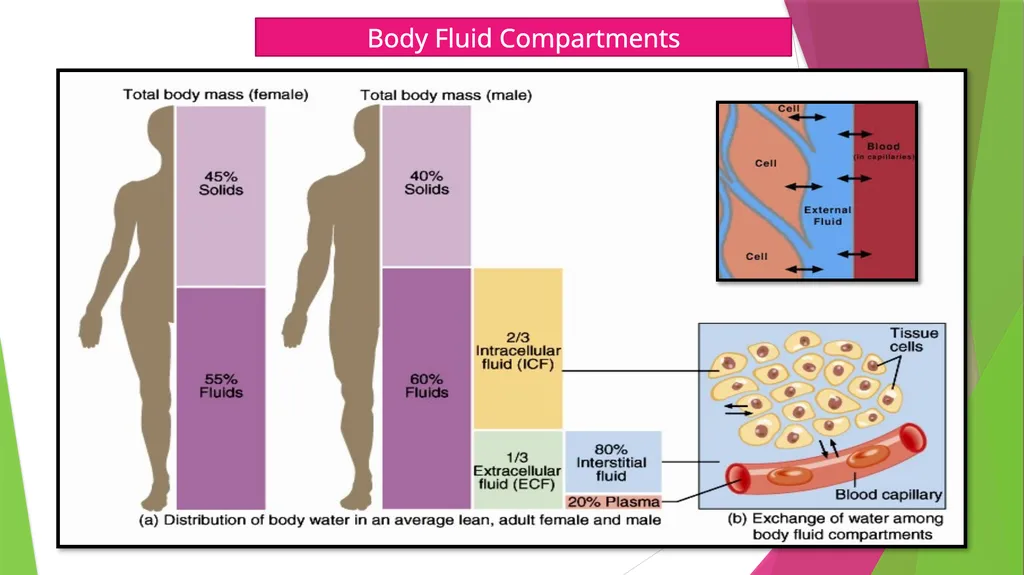
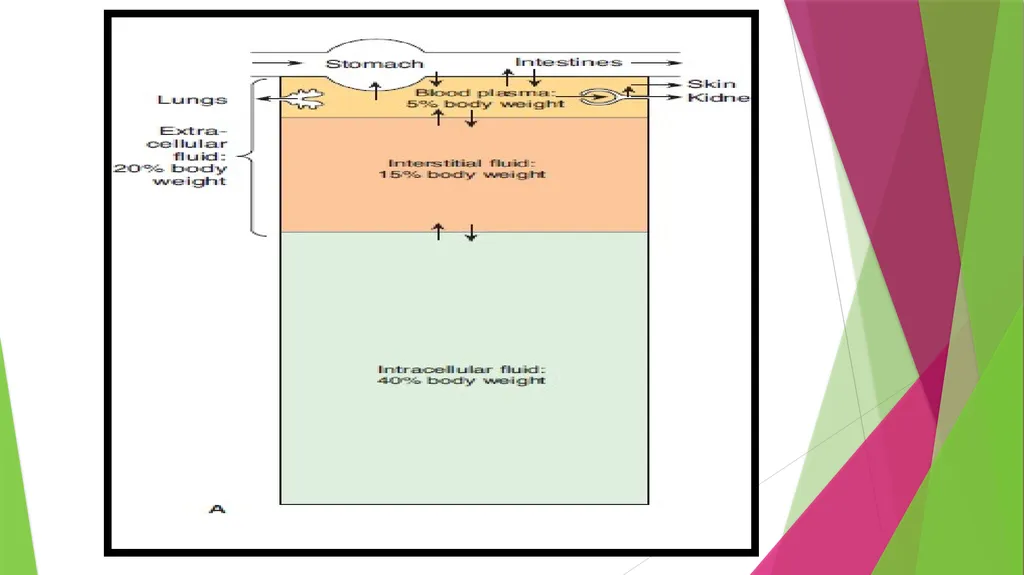
Body Fluid Compartments In lean adults, body fluids constitute 55% of female and 60% of male total body mass these divided into:
Intracellular fluid (ICF) inside cells
About 2/3 of body fluid
Extracellular fluid (ECF) outside cells divided into :
Interstitial fluid ( fluid between cell) is 80% of ECF
Intravascular fluid (Plasma in blood )is 20% of ECF<br>
Intracellular fluid (ICF) inside cells
About 2/3 of body fluid
Extracellular fluid (ECF) outside cells divided into :
Interstitial fluid ( fluid between cell) is 80% of ECF
Intravascular fluid (Plasma in blood )is 20% of ECF<br>
07
Body Fluid Compartments<br>
08
Fluid balance Note: Insensible loss = 1000 cc/day<br>
09
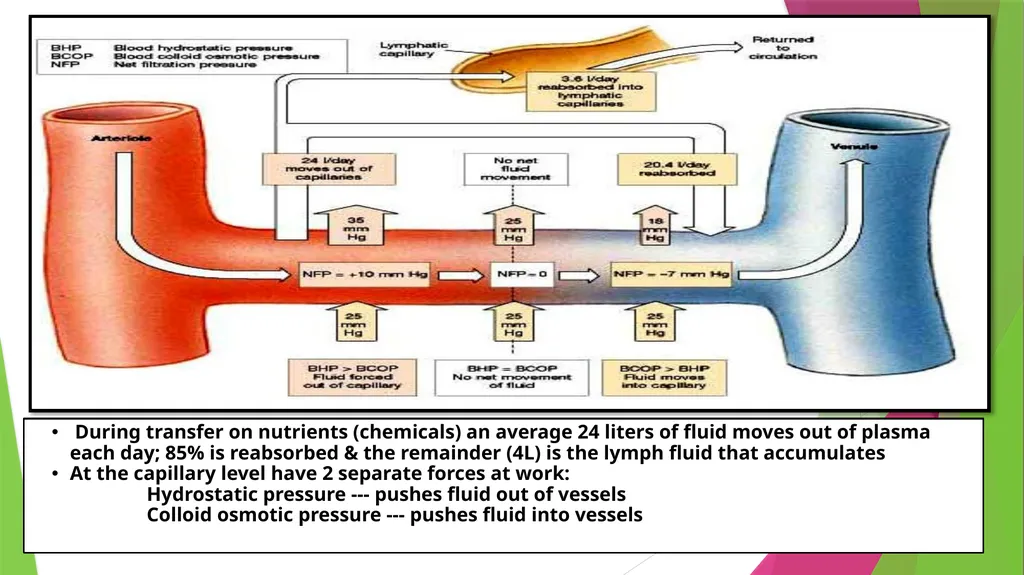
During transfer on nutrients (chemicals) an average 24 liters of fluid moves out of plasma each day; 85% is reabsorbed & the remainder (4L) is the lymph fluid that accumulates
At the capillary level have 2 separate forces at work:
Hydrostatic pressure --- pushes fluid out of vessels
Colloid osmotic pressure --- pushes fluid into vessels<br>
At the capillary level have 2 separate forces at work:
Hydrostatic pressure --- pushes fluid out of vessels
Colloid osmotic pressure --- pushes fluid into vessels<br>
10
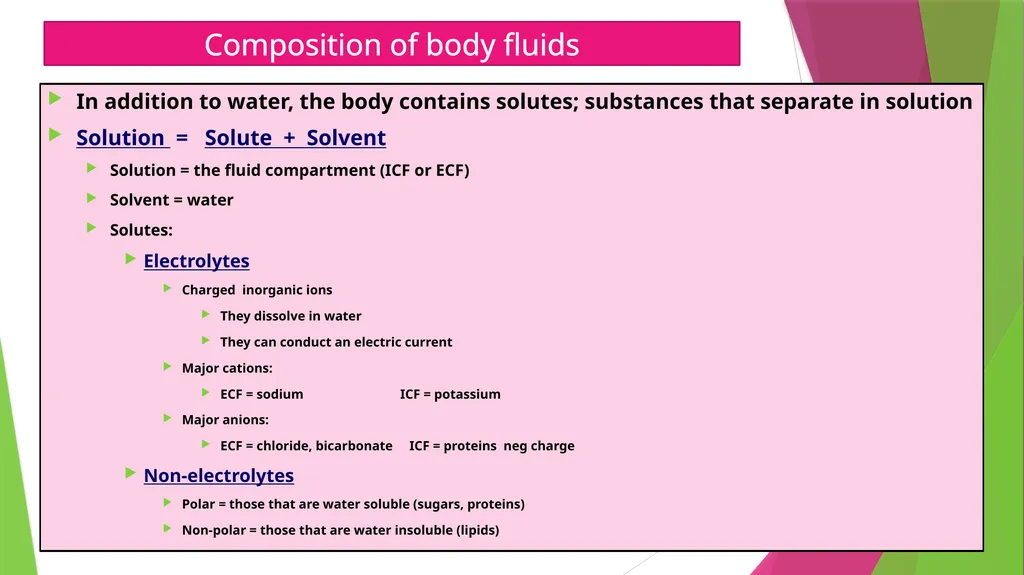
In addition to water, the body contains solutes; substances that separate in solution
Solution = Solute + Solvent
Solution = the fluid compartment (ICF or ECF)
Solvent = water
Solutes:
Electrolytes
Charged inorganic ions
They dissolve in water
They can conduct an electric current
Major cations:
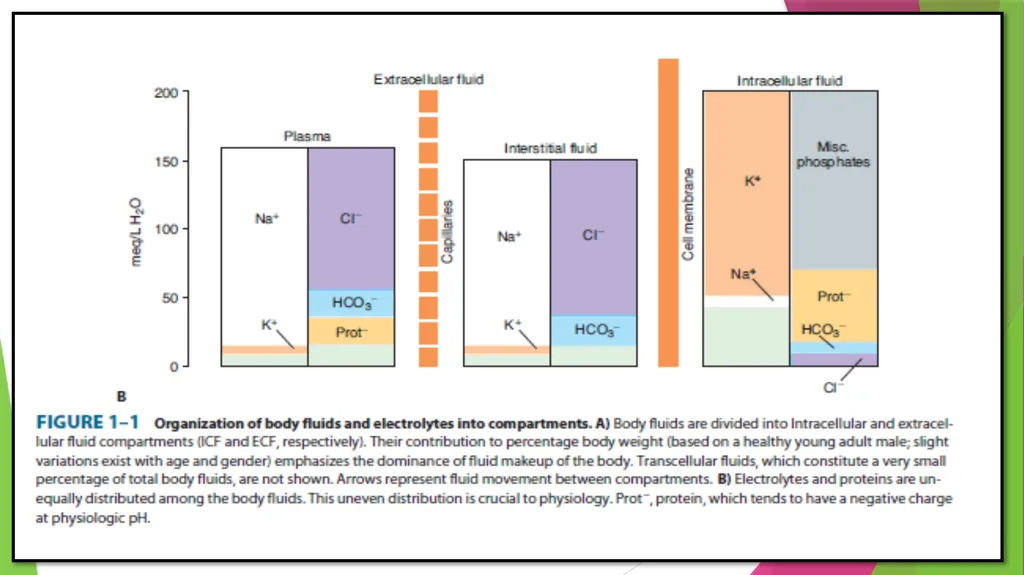
ECF = sodium ICF = potassium
Major anions:
ECF = chloride, bicarbonate ICF = proteins neg charge
Non-electrolytes
Polar = those that are water soluble (sugars, proteins)
Non-polar = those that are water insoluble (lipids) Composition of body fluids<br>
Solution = Solute + Solvent
Solution = the fluid compartment (ICF or ECF)
Solvent = water
Solutes:
Electrolytes
Charged inorganic ions
They dissolve in water
They can conduct an electric current
Major cations:
ECF = sodium ICF = potassium
Major anions:
ECF = chloride, bicarbonate ICF = proteins neg charge
Non-electrolytes
Polar = those that are water soluble (sugars, proteins)
Non-polar = those that are water insoluble (lipids) Composition of body fluids<br>
11
Water, Electrolytes,
&
Acid/Base<br>
12
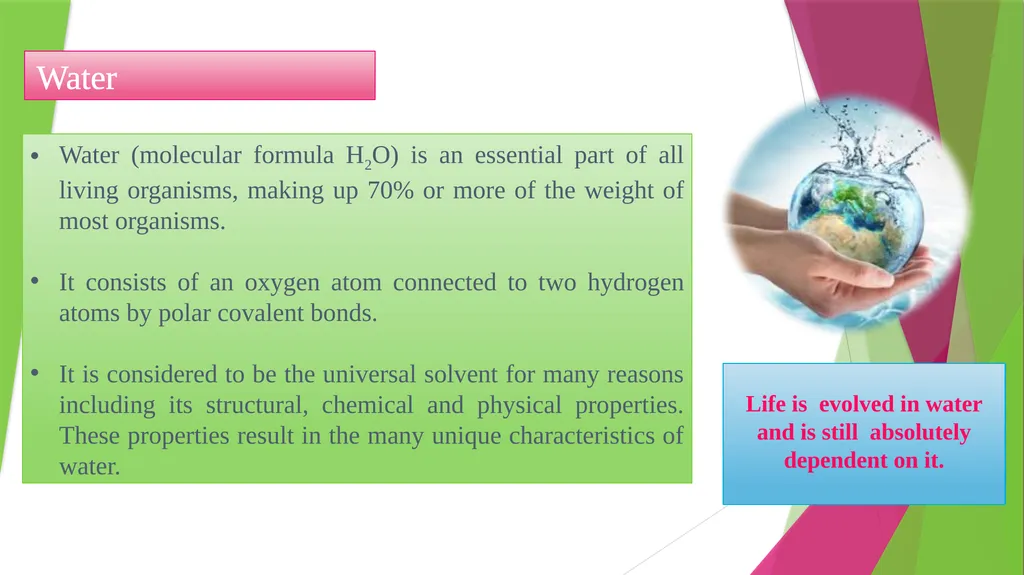
Life is evolved in water and is still absolutely dependent on it. Water Water (molecular formula H2O) is an essential part of all living organisms, making up 70% or more of the weight of most organisms.
It consists of an oxygen atom connected to two hydrogen atoms by polar covalent bonds.
It is considered to be the universal solvent for many reasons including its structural, chemical and physical properties. These properties result in the many unique characteristics of water.<br>
It consists of an oxygen atom connected to two hydrogen atoms by polar covalent bonds.
It is considered to be the universal solvent for many reasons including its structural, chemical and physical properties. These properties result in the many unique characteristics of water.<br>
13
Properties of water Very polar
Oxygen is highly electronegative
H-bond donor and acceptor
High boiling point , melting point, heat of vaporization, surface tension<br>
Oxygen is highly electronegative
H-bond donor and acceptor
High boiling point , melting point, heat of vaporization, surface tension<br>
14
Polarity of Water In a water molecule two hydrogen atoms form single polar covalent bonds with an oxygen atom. Gives water more structure than other liquids
Because oxygen is more electronegative, the region around oxygen has a partial negative charge.
The region near the two hydrogen atoms has a partial positive charge.
A water molecule is a polar molecule with opposite ends of the molecule with opposite charges.<br>
Because oxygen is more electronegative, the region around oxygen has a partial negative charge.
The region near the two hydrogen atoms has a partial positive charge.
A water molecule is a polar molecule with opposite ends of the molecule with opposite charges.<br>
15
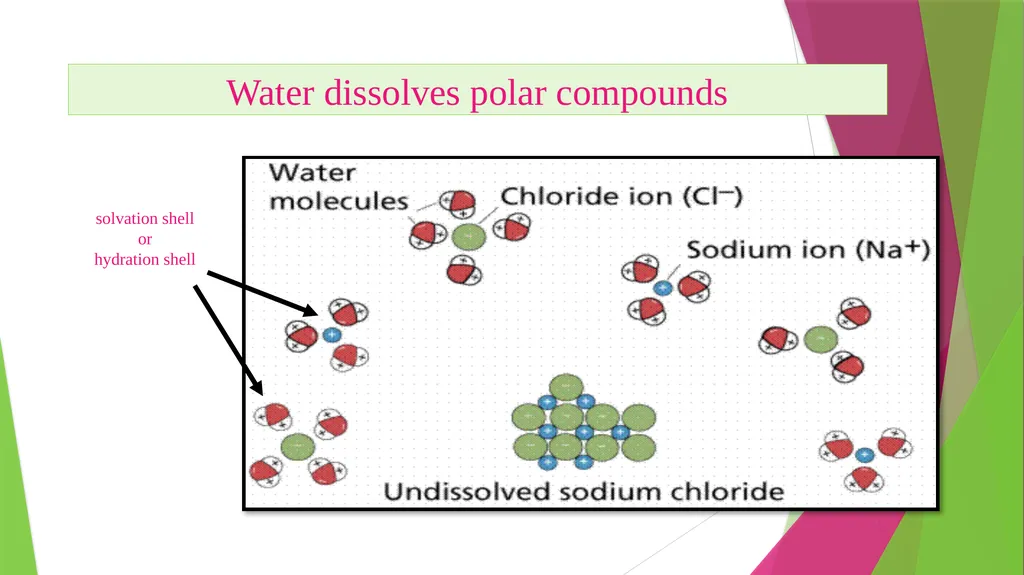
Water dissolves polar compounds solvation shell
or
hydration shell<br>
or
hydration shell<br>
16
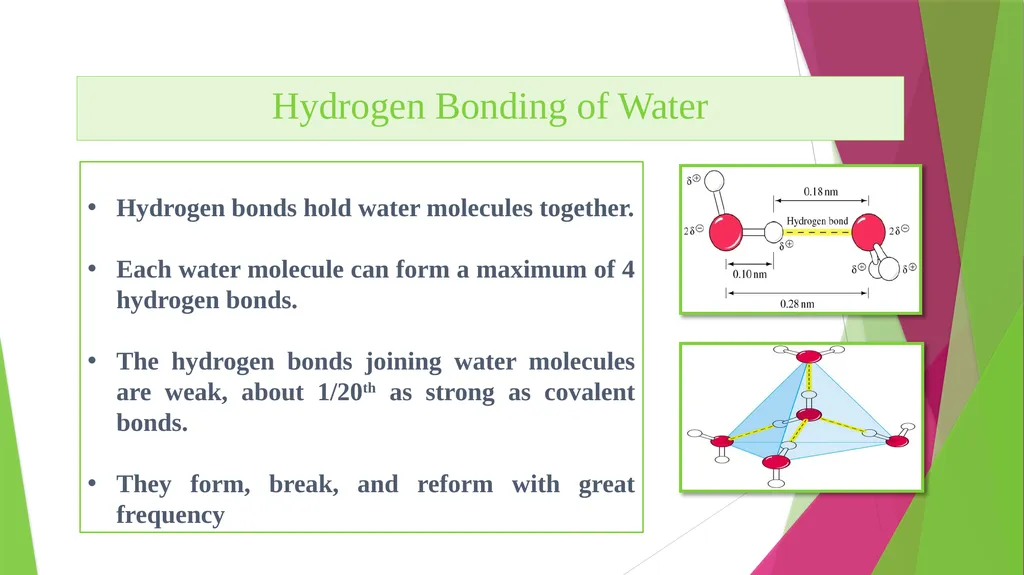
Hydrogen Bonding of Water Hydrogen bonds hold water molecules together.
Each water molecule can form a maximum of 4 hydrogen bonds.
The hydrogen bonds joining water molecules are weak, about 1/20th as strong as covalent bonds.
They form, break, and reform with great frequency<br>
Each water molecule can form a maximum of 4 hydrogen bonds.
The hydrogen bonds joining water molecules are weak, about 1/20th as strong as covalent bonds.
They form, break, and reform with great frequency<br>
17
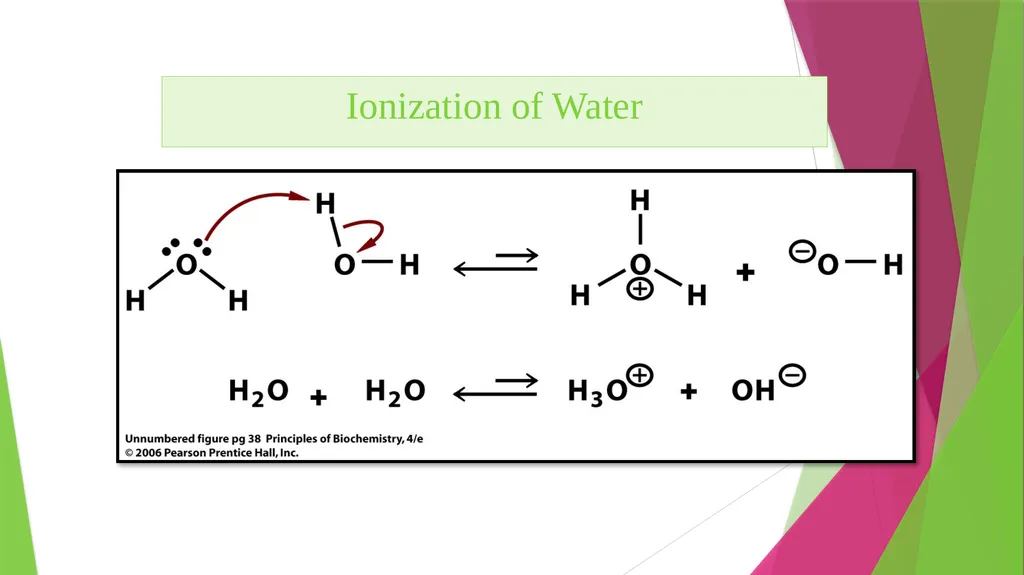
Ionization of Water<br>
18
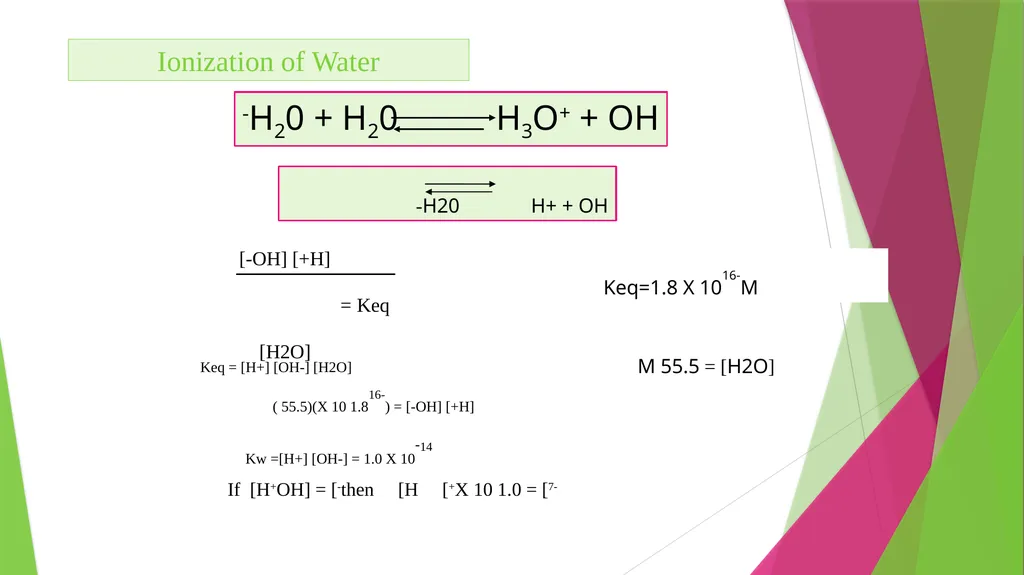
[H+] [OH-]
Keq =
[H2O] H20 H+ + OH- Keq=1.8 X 10⁻¹⁶M [H2O] = 55.5 M If [H+] = [OH-] then [H+] = 1.0 X 10⁻⁷ Ionization of Water [H+] [OH-] = (1.8 X 10⁻¹⁶)(55.5 ) [H2O] Keq = [H+] [OH-] Kw =[H+] [OH-] = 1.0 X 10⁻¹⁴<br>
Keq =
[H2O] H20 H+ + OH- Keq=1.8 X 10⁻¹⁶M [H2O] = 55.5 M If [H+] = [OH-] then [H+] = 1.0 X 10⁻⁷ Ionization of Water [H+] [OH-] = (1.8 X 10⁻¹⁶)(55.5 ) [H2O] Keq = [H+] [OH-] Kw =[H+] [OH-] = 1.0 X 10⁻¹⁴<br>
19
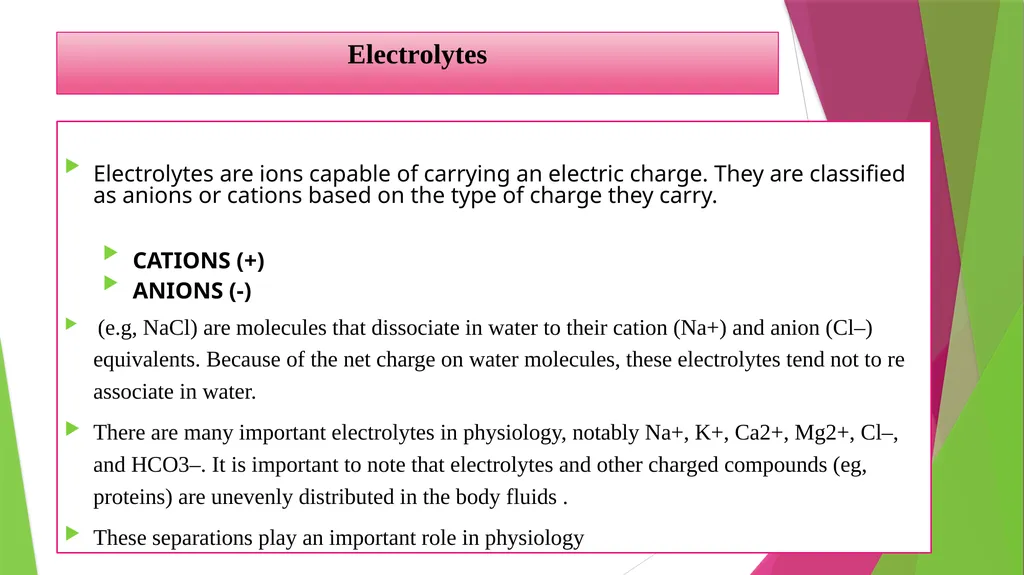
Electrolytes Electrolytes are ions capable of carrying an electric charge. They are classified as anions or cations based on the type of charge they carry.
CATIONS (+)
ANIONS (-)
(e.g, NaCl) are molecules that dissociate in water to their cation (Na+) and anion (Cl–) equivalents. Because of the net charge on water molecules, these electrolytes tend not to re associate in water.
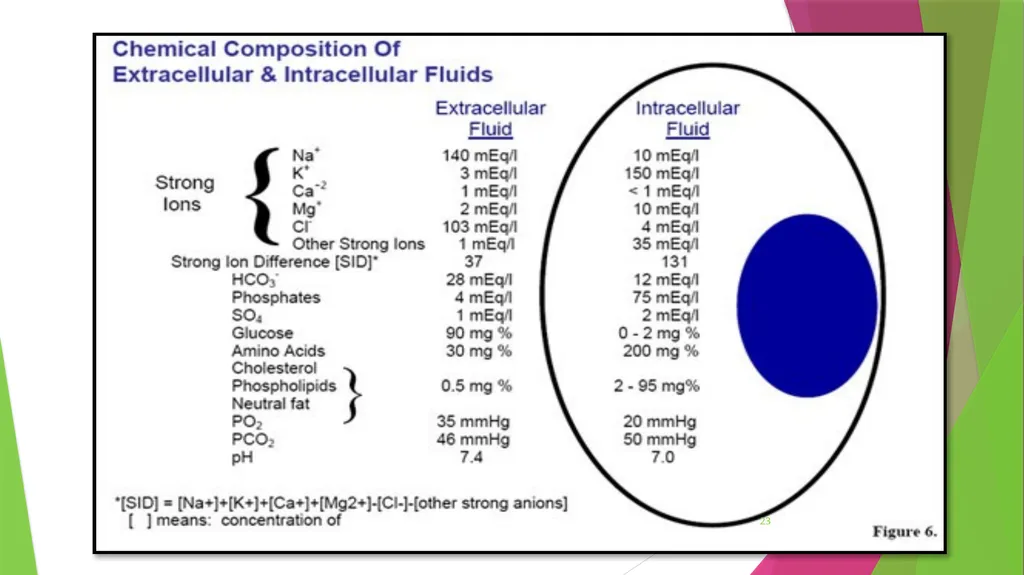
There are many important electrolytes in physiology, notably Na+, K+, Ca2+, Mg2+, Cl–, and HCO3–. It is important to note that electrolytes and other charged compounds (eg, proteins) are unevenly distributed in the body fluids .
These separations play an important role in physiology<br>
CATIONS (+)
ANIONS (-)
(e.g, NaCl) are molecules that dissociate in water to their cation (Na+) and anion (Cl–) equivalents. Because of the net charge on water molecules, these electrolytes tend not to re associate in water.
There are many important electrolytes in physiology, notably Na+, K+, Ca2+, Mg2+, Cl–, and HCO3–. It is important to note that electrolytes and other charged compounds (eg, proteins) are unevenly distributed in the body fluids .
These separations play an important role in physiology<br>
20
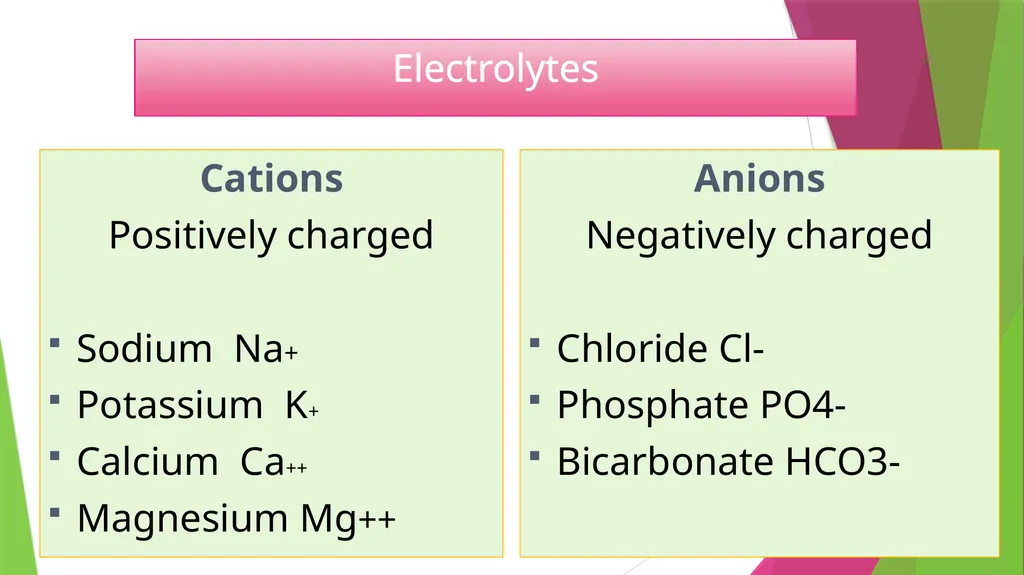
Electrolytes Cations
Positively charged
Sodium Na+
Potassium K+
Calcium Ca++
Magnesium Mg++ Anions
Negatively charged
Chloride Cl-
Phosphate PO4-
Bicarbonate HCO3-<br>
Positively charged
Sodium Na+
Potassium K+
Calcium Ca++
Magnesium Mg++ Anions
Negatively charged
Chloride Cl-
Phosphate PO4-
Bicarbonate HCO3-<br>
21
23<br>
22
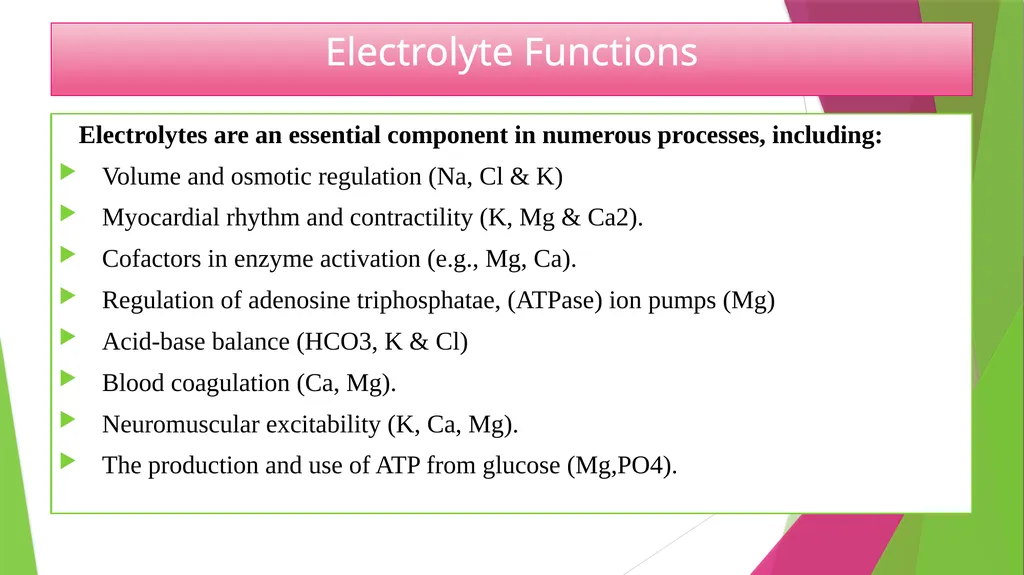
Electrolyte Functions Electrolytes are an essential component in numerous processes, including:
Volume and osmotic regulation (Na, Cl & K)
Myocardial rhythm and contractility (K, Mg & Ca2).
Cofactors in enzyme activation (e.g., Mg, Ca).
Regulation of adenosine triphosphatae, (ATPase) ion pumps (Mg)
Acid-base balance (HCO3, K & Cl)
Blood coagulation (Ca, Mg).
Neuromuscular excitability (K, Ca, Mg).
The production and use of ATP from glucose (Mg,PO4).<br>
Volume and osmotic regulation (Na, Cl & K)
Myocardial rhythm and contractility (K, Mg & Ca2).
Cofactors in enzyme activation (e.g., Mg, Ca).
Regulation of adenosine triphosphatae, (ATPase) ion pumps (Mg)
Acid-base balance (HCO3, K & Cl)
Blood coagulation (Ca, Mg).
Neuromuscular excitability (K, Ca, Mg).
The production and use of ATP from glucose (Mg,PO4).<br>
23
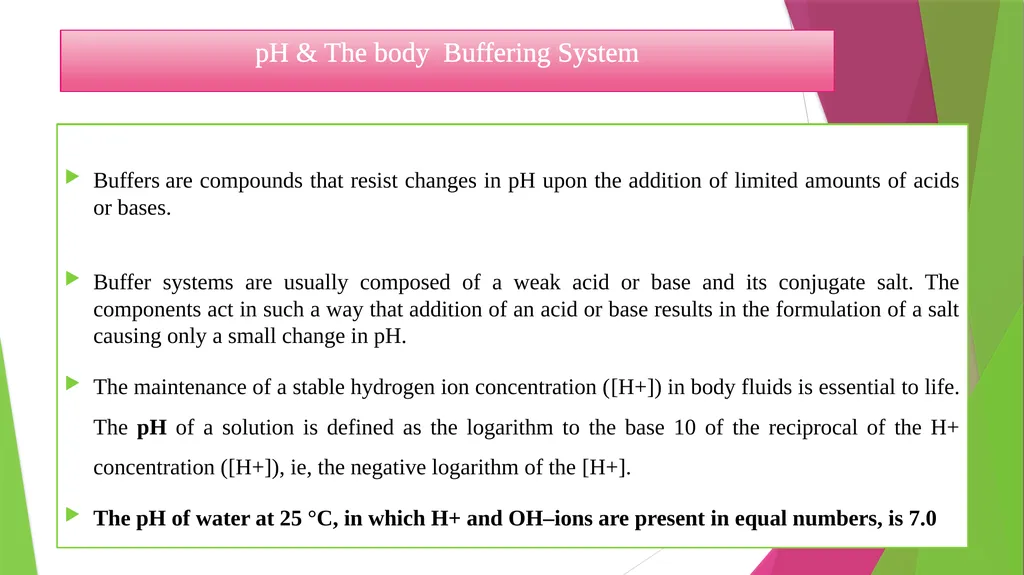
pH & The body Buffering System Buffers are compounds that resist changes in pH upon the addition of limited amounts of acids or bases.
Buffer systems are usually composed of a weak acid or base and its conjugate salt. The components act in such a way that addition of an acid or base results in the formulation of a salt causing only a small change in pH.
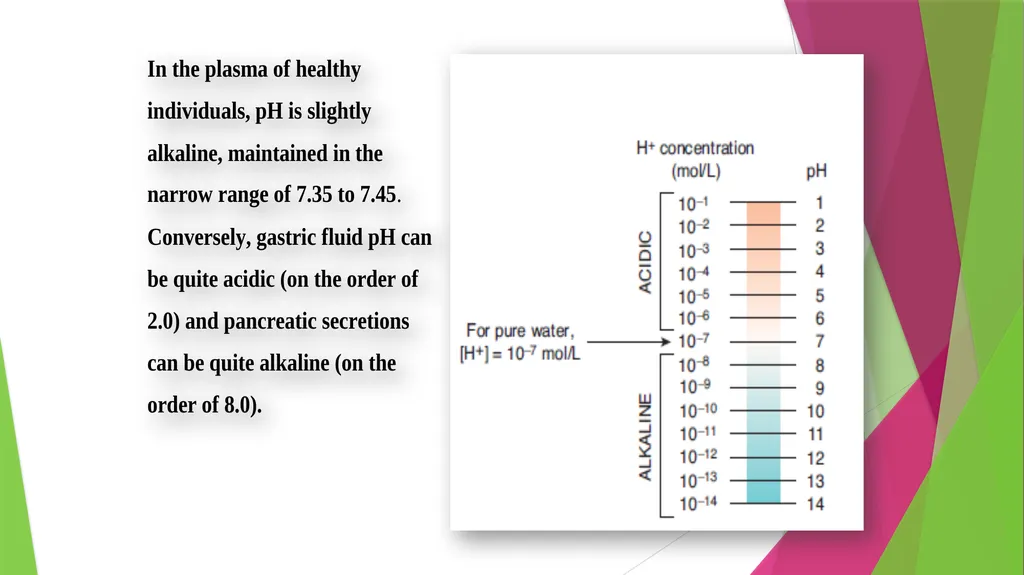
The maintenance of a stable hydrogen ion concentration ([H+]) in body fluids is essential to life. The pH of a solution is defined as the logarithm to the base 10 of the reciprocal of the H+ concentration ([H+]), ie, the negative logarithm of the [H+].
The pH of water at 25 °C, in which H+ and OH–ions are present in equal numbers, is 7.0<br>
Buffer systems are usually composed of a weak acid or base and its conjugate salt. The components act in such a way that addition of an acid or base results in the formulation of a salt causing only a small change in pH.
The maintenance of a stable hydrogen ion concentration ([H+]) in body fluids is essential to life. The pH of a solution is defined as the logarithm to the base 10 of the reciprocal of the H+ concentration ([H+]), ie, the negative logarithm of the [H+].
The pH of water at 25 °C, in which H+ and OH–ions are present in equal numbers, is 7.0<br>
24
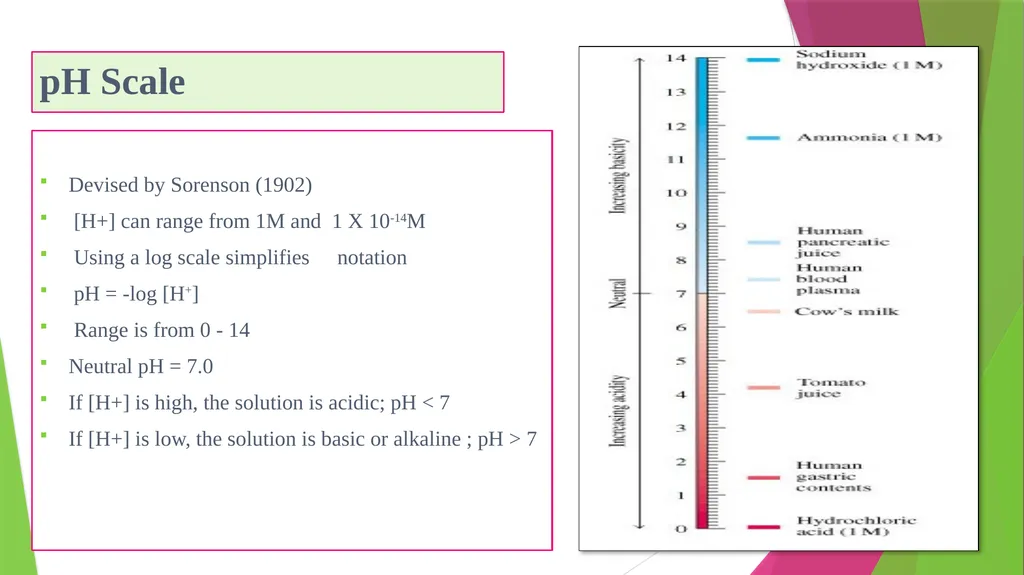
pH Scale Devised by Sorenson (1902)
[H+] can range from 1M and 1 X 10-14M
Using a log scale simplifies notation
pH = -log [H+]
Range is from 0 - 14
Neutral pH = 7.0
If [H+] is high, the solution is acidic; pH < 7
If [H+] is low, the solution is basic or alkaline ; pH > 7<br>
[H+] can range from 1M and 1 X 10-14M
Using a log scale simplifies notation
pH = -log [H+]
Range is from 0 - 14
Neutral pH = 7.0
If [H+] is high, the solution is acidic; pH < 7
If [H+] is low, the solution is basic or alkaline ; pH > 7<br>
25
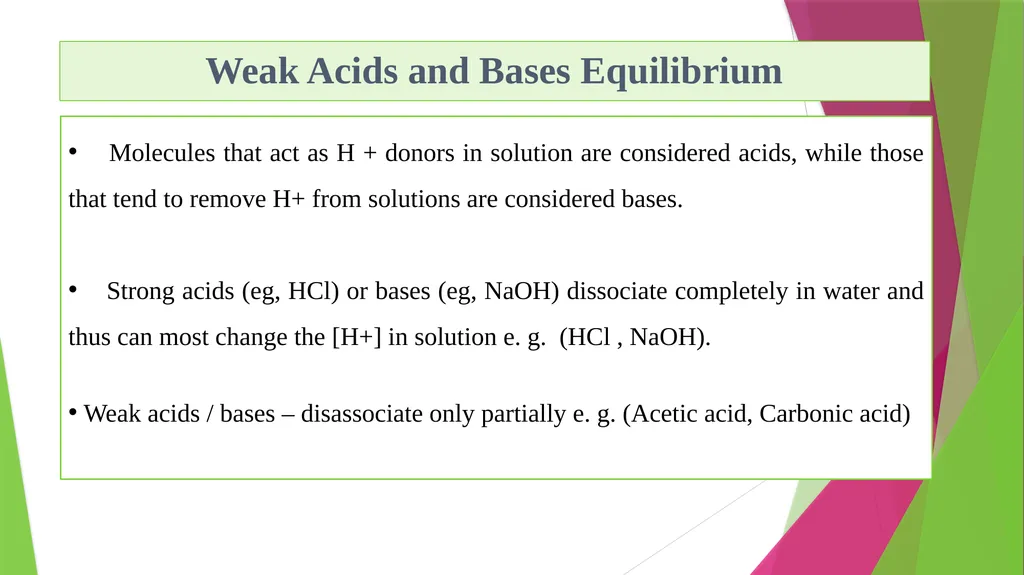
Weak Acids and Bases Equilibrium Molecules that act as H + donors in solution are considered acids, while those that tend to remove H+ from solutions are considered bases.
Strong acids (eg, HCl) or bases (eg, NaOH) dissociate completely in water and thus can most change the [H+] in solution e. g. (HCl , NaOH).
Weak acids / bases – disassociate only partially e. g. (Acetic acid, Carbonic acid)<br>
Strong acids (eg, HCl) or bases (eg, NaOH) dissociate completely in water and thus can most change the [H+] in solution e. g. (HCl , NaOH).
Weak acids / bases – disassociate only partially e. g. (Acetic acid, Carbonic acid)<br>
26
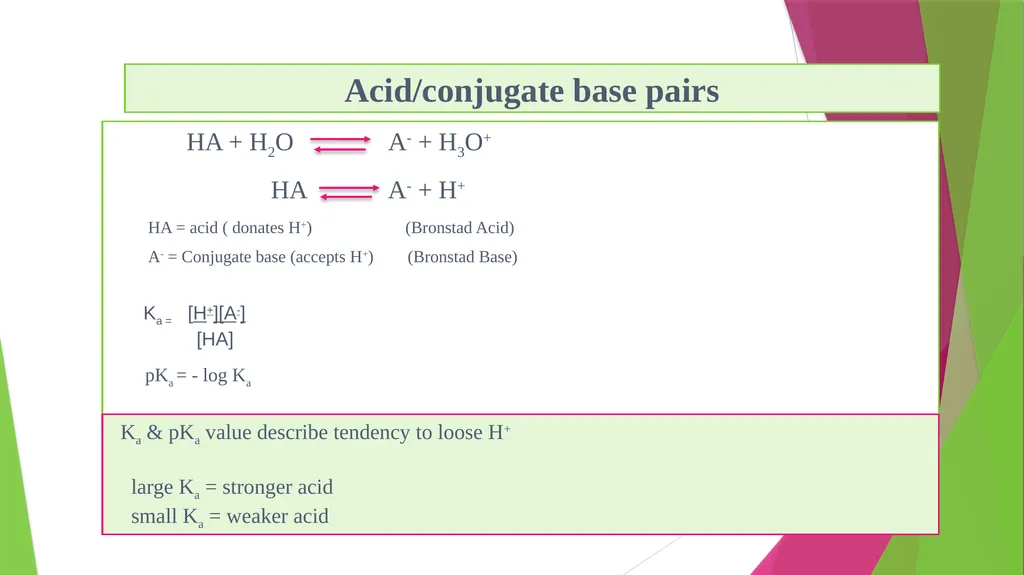
Acid/conjugate base pairs HA + H2O A- + H3O+
HA A- + H+
HA = acid ( donates H+) (Bronstad Acid)
A- = Conjugate base (accepts H+) (Bronstad Base) Ka & pKa value describe tendency to loose H+
large Ka = stronger acid
small Ka = weaker acid Ka = [H+][A-]
[HA] pKa = - log Ka<br>
HA A- + H+
HA = acid ( donates H+) (Bronstad Acid)
A- = Conjugate base (accepts H+) (Bronstad Base) Ka & pKa value describe tendency to loose H+
large Ka = stronger acid
small Ka = weaker acid Ka = [H+][A-]
[HA] pKa = - log Ka<br>
27
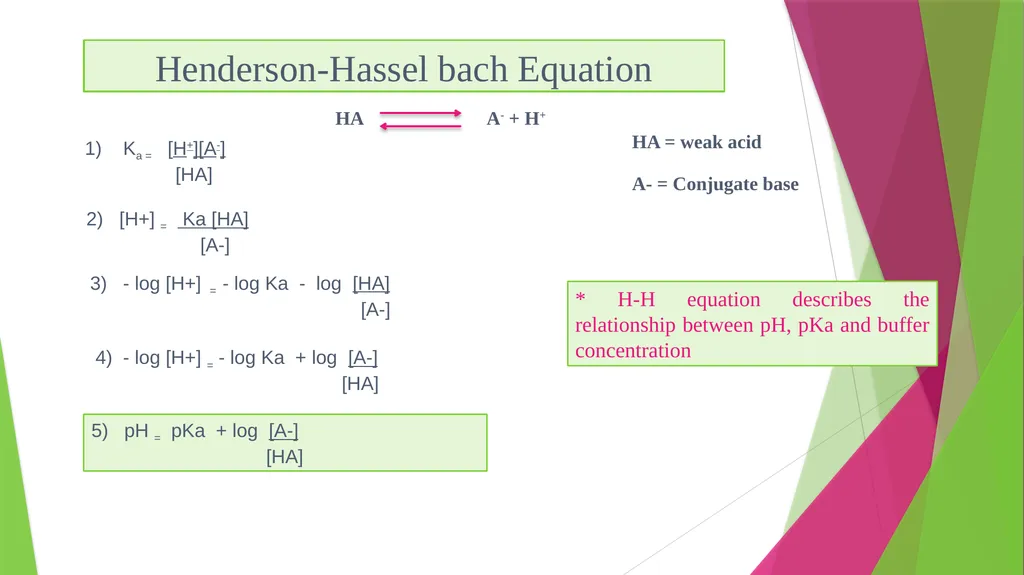
Henderson-Hassel bach Equation 2) [H+] = Ka [HA]
[A-] 3) - log [H+] = - log Ka - log [HA]
[A-] 4) - log [H+] = - log Ka + log [A-]
[HA] 5) pH = pKa + log [A-]
[HA] HA = weak acid
A- = Conjugate base * H-H equation describes the relationship between pH, pKa and buffer concentration HA A- + H+ 1) Ka = [H+][A-]
[HA]<br>
[A-] 3) - log [H+] = - log Ka - log [HA]
[A-] 4) - log [H+] = - log Ka + log [A-]
[HA] 5) pH = pKa + log [A-]
[HA] HA = weak acid
A- = Conjugate base * H-H equation describes the relationship between pH, pKa and buffer concentration HA A- + H+ 1) Ka = [H+][A-]
[HA]<br>
28
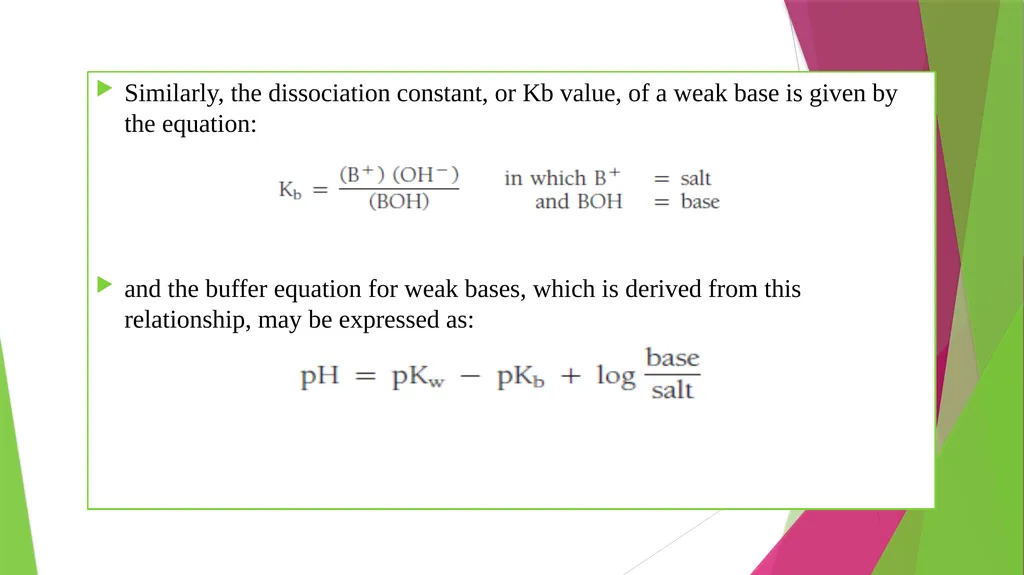
Similarly, the dissociation constant, or Kb value, of a weak base is given by the equation:
and the buffer equation for weak bases, which is derived from this relationship, may be expressed as:<br>
and the buffer equation for weak bases, which is derived from this relationship, may be expressed as:<br>
29
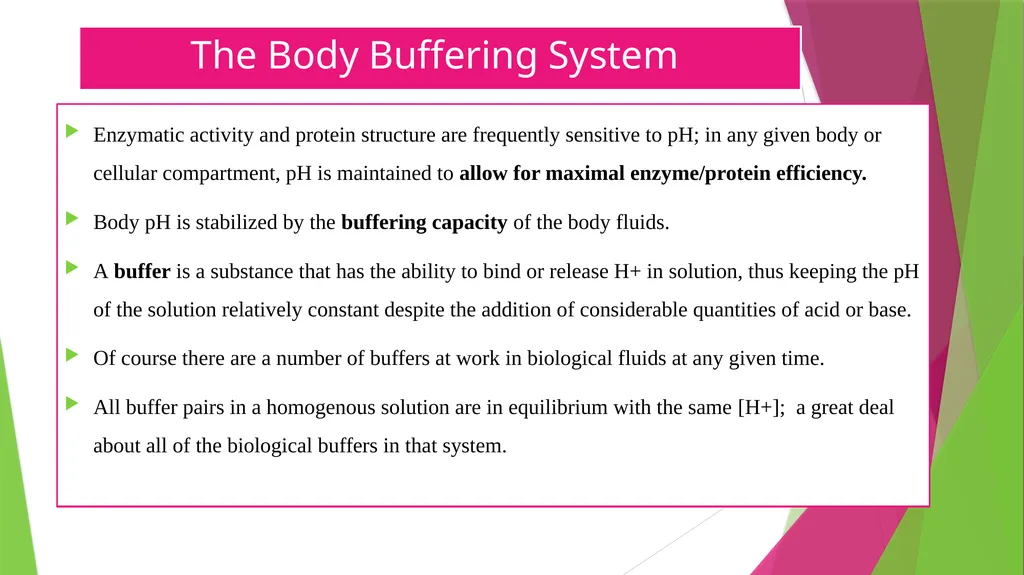
The Body Buffering System Enzymatic activity and protein structure are frequently sensitive to pH; in any given body or cellular compartment, pH is maintained to allow for maximal enzyme/protein efficiency.
Body pH is stabilized by the buffering capacity of the body fluids.
A buffer is a substance that has the ability to bind or release H+ in solution, thus keeping the pH of the solution relatively constant despite the addition of considerable quantities of acid or base.
Of course there are a number of buffers at work in biological fluids at any given time.
All buffer pairs in a homogenous solution are in equilibrium with the same [H+]; a great deal about all of the biological buffers in that system.<br>
Body pH is stabilized by the buffering capacity of the body fluids.
A buffer is a substance that has the ability to bind or release H+ in solution, thus keeping the pH of the solution relatively constant despite the addition of considerable quantities of acid or base.
Of course there are a number of buffers at work in biological fluids at any given time.
All buffer pairs in a homogenous solution are in equilibrium with the same [H+]; a great deal about all of the biological buffers in that system.<br>
30
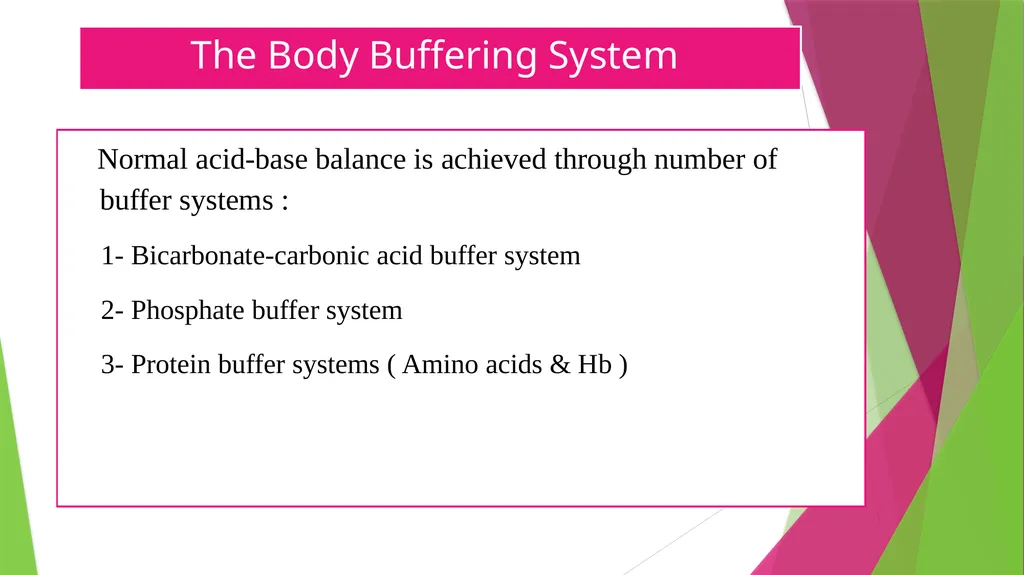
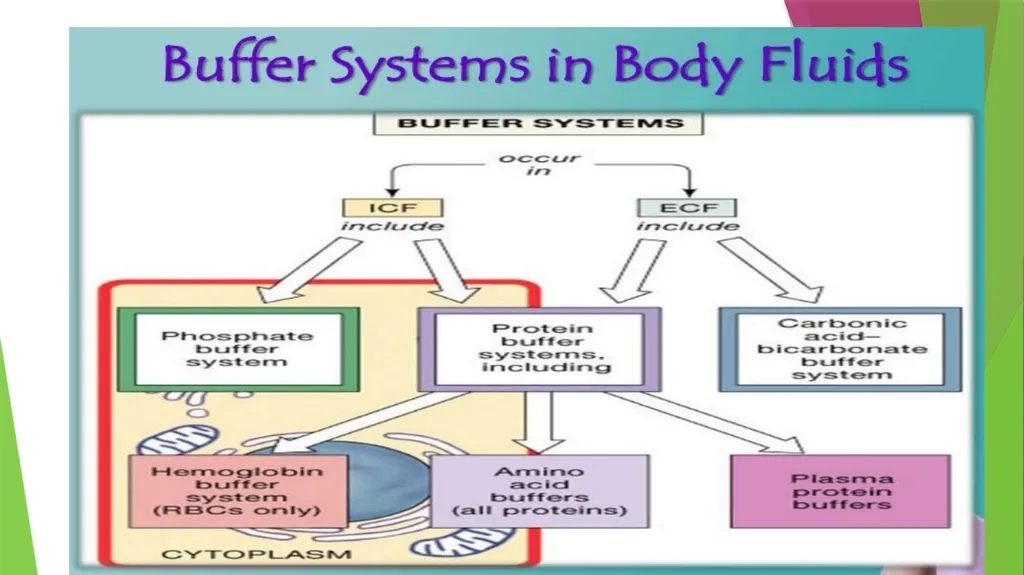
Normal acid-base balance is achieved through number of buffer systems :
1- Bicarbonate-carbonic acid buffer system
2- Phosphate buffer system
3- Protein buffer systems ( Amino acids & Hb ) The Body Buffering System<br>
1- Bicarbonate-carbonic acid buffer system
2- Phosphate buffer system
3- Protein buffer systems ( Amino acids & Hb ) The Body Buffering System<br>
31
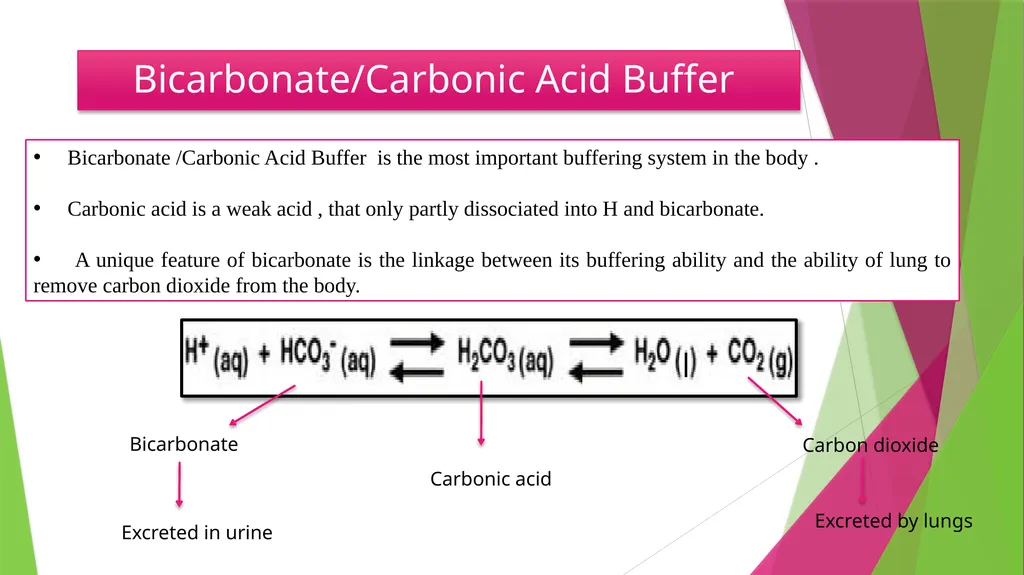
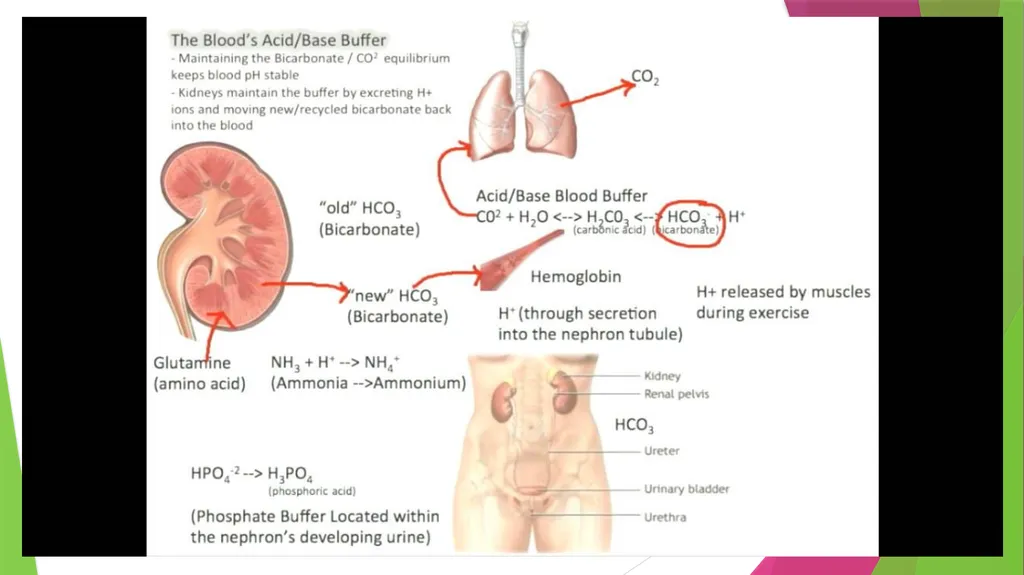
Bicarbonate/Carbonic Acid Buffer Carbonic acid Bicarbonate Excreted in urine Excreted by lungs Carbon dioxide Bicarbonate /Carbonic Acid Buffer is the most important buffering system in the body .
Carbonic acid is a weak acid , that only partly dissociated into H and bicarbonate.
A unique feature of bicarbonate is the linkage between its buffering ability and the ability of lung to remove carbon dioxide from the body.<br>
Carbonic acid is a weak acid , that only partly dissociated into H and bicarbonate.
A unique feature of bicarbonate is the linkage between its buffering ability and the ability of lung to remove carbon dioxide from the body.<br>
32
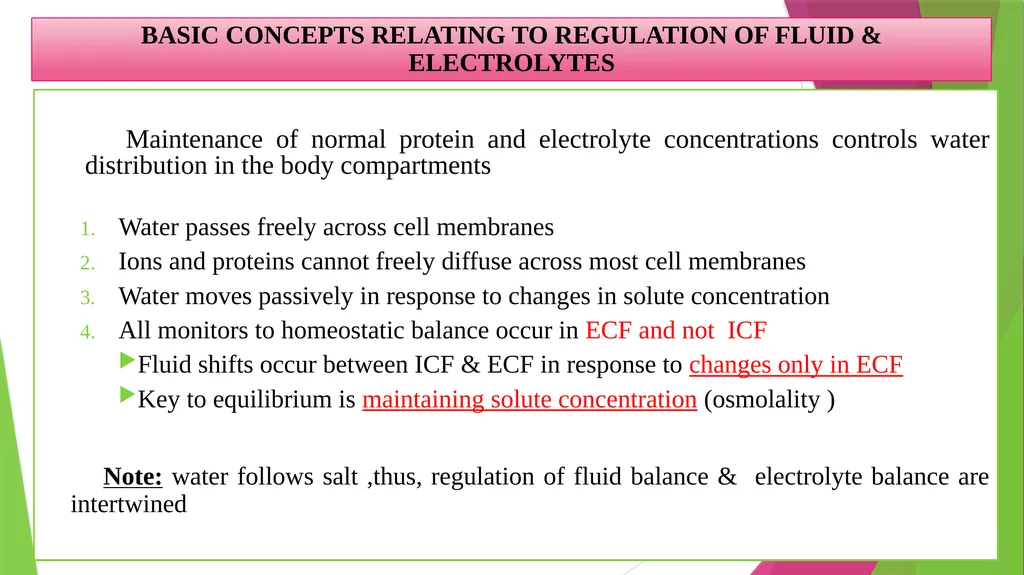
Maintenance of normal protein and electrolyte concentrations controls water distribution in the body compartments
Water passes freely across cell membranes
Ions and proteins cannot freely diffuse across most cell membranes
Water moves passively in response to changes in solute concentration
All monitors to homeostatic balance occur in ECF and not ICF
Fluid shifts occur between ICF & ECF in response to changes only in ECF
Key to equilibrium is maintaining solute concentration (osmolality )
Note: water follows salt ,thus, regulation of fluid balance & electrolyte balance are intertwined Basic concepts relating to regulation of fluid & electrolytes<br>
Water passes freely across cell membranes
Ions and proteins cannot freely diffuse across most cell membranes
Water moves passively in response to changes in solute concentration
All monitors to homeostatic balance occur in ECF and not ICF
Fluid shifts occur between ICF & ECF in response to changes only in ECF
Key to equilibrium is maintaining solute concentration (osmolality )
Note: water follows salt ,thus, regulation of fluid balance & electrolyte balance are intertwined Basic concepts relating to regulation of fluid & electrolytes<br>
33
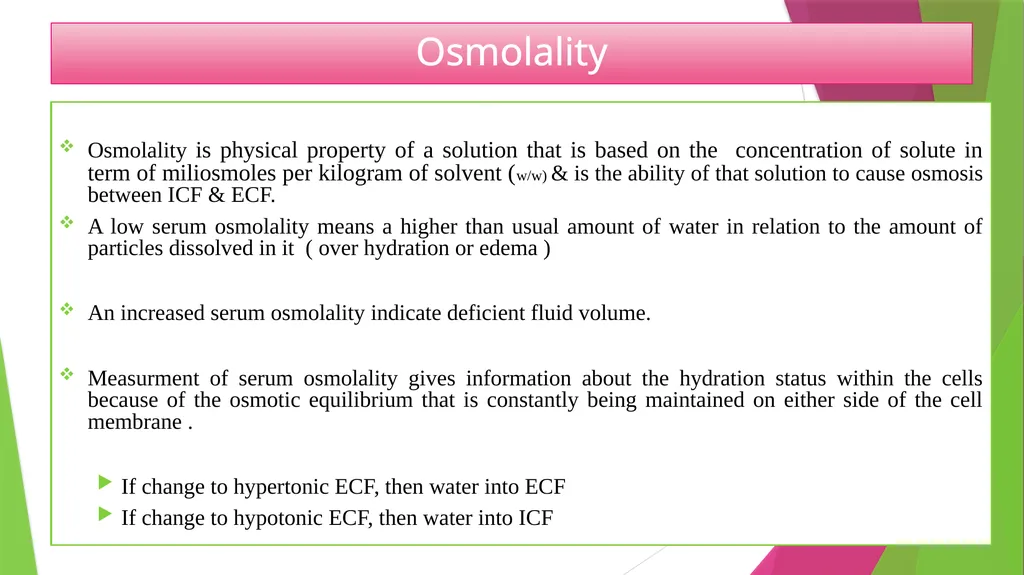
Osmolality Osmolality is physical property of a solution that is based on the concentration of solute in term of miliosmoles per kilogram of solvent (w/w) & is the ability of that solution to cause osmosis between ICF & ECF.
A low serum osmolality means a higher than usual amount of water in relation to the amount of particles dissolved in it ( over hydration or edema )
An increased serum osmolality indicate deficient fluid volume.
Measurment of serum osmolality gives information about the hydration status within the cells because of the osmotic equilibrium that is constantly being maintained on either side of the cell membrane .
If change to hypertonic ECF, then water into ECF
If change to hypotonic ECF, then water into ICF<br>
A low serum osmolality means a higher than usual amount of water in relation to the amount of particles dissolved in it ( over hydration or edema )
An increased serum osmolality indicate deficient fluid volume.
Measurment of serum osmolality gives information about the hydration status within the cells because of the osmotic equilibrium that is constantly being maintained on either side of the cell membrane .
If change to hypertonic ECF, then water into ECF
If change to hypotonic ECF, then water into ICF<br>
34
Osmosis Movement of water between two compartments by a membrane permeable to water but not to solute
Water moves from low solute to high solute concentration , requires no energy<br>
Water moves from low solute to high solute concentration , requires no energy<br>
35
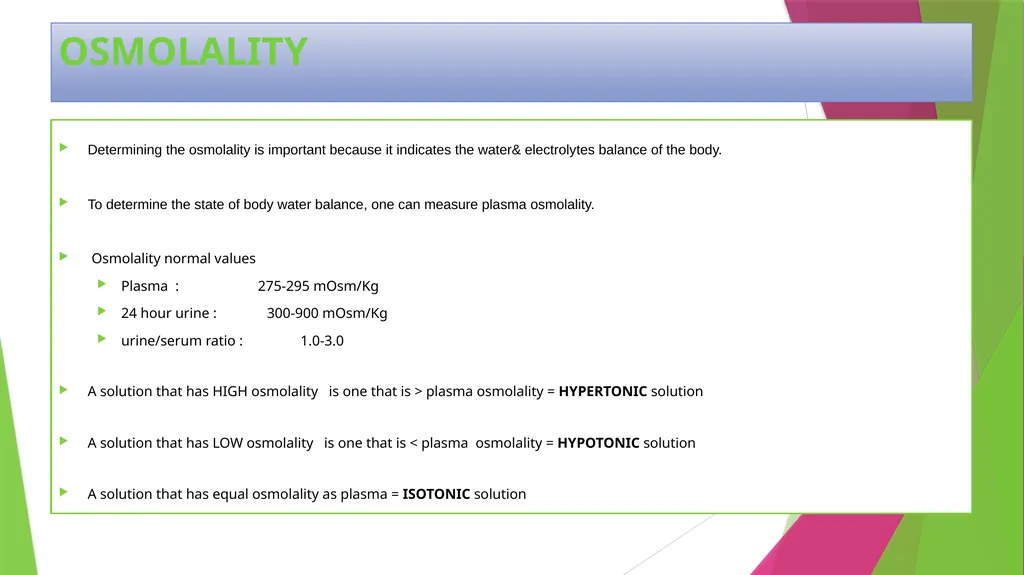
osmolality Determining the osmolality is important because it indicates the water& electrolytes balance of the body.
To determine the state of body water balance, one can measure plasma osmolality.
Osmolality normal values
Plasma : 275-295 mOsm/Kg
24 hour urine : 300-900 mOsm/Kg
urine/serum ratio : 1.0-3.0
A solution that has HIGH osmolality is one that is > plasma osmolality = HYPERTONIC solution
A solution that has LOW osmolality is one that is < plasma osmolality = HYPOTONIC solution
A solution that has equal osmolality as plasma = ISOTONIC solution<br>
To determine the state of body water balance, one can measure plasma osmolality.
Osmolality normal values
Plasma : 275-295 mOsm/Kg
24 hour urine : 300-900 mOsm/Kg
urine/serum ratio : 1.0-3.0
A solution that has HIGH osmolality is one that is > plasma osmolality = HYPERTONIC solution
A solution that has LOW osmolality is one that is < plasma osmolality = HYPOTONIC solution
A solution that has equal osmolality as plasma = ISOTONIC solution<br>
36
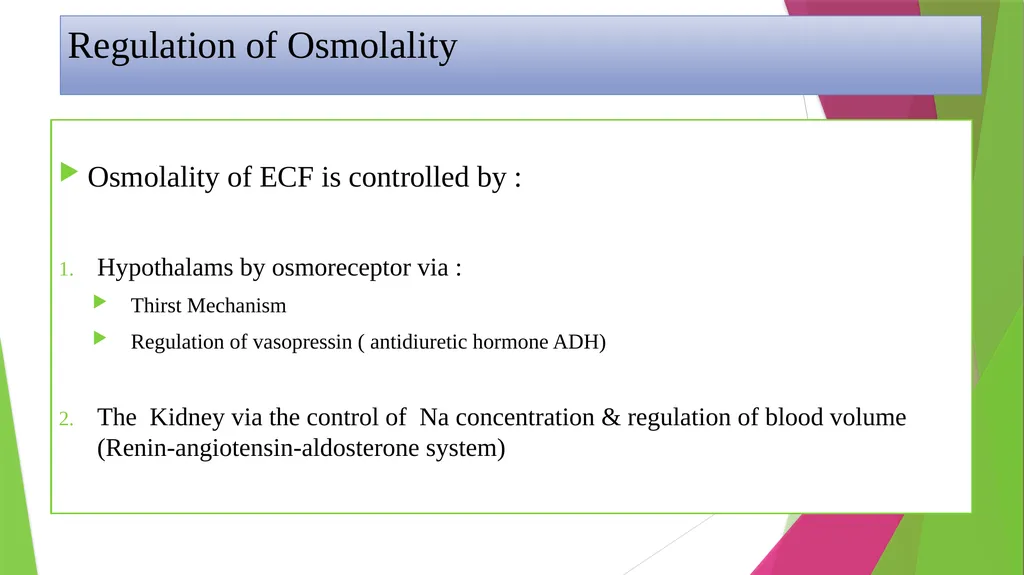
Regulation of Osmolality Osmolality of ECF is controlled by :
Hypothalams by osmoreceptor via :
Thirst Mechanism
Regulation of vasopressin ( antidiuretic hormone ADH)
The Kidney via the control of Na concentration & regulation of blood volume (Renin-angiotensin-aldosterone system)<br>
Hypothalams by osmoreceptor via :
Thirst Mechanism
Regulation of vasopressin ( antidiuretic hormone ADH)
The Kidney via the control of Na concentration & regulation of blood volume (Renin-angiotensin-aldosterone system)<br>
37
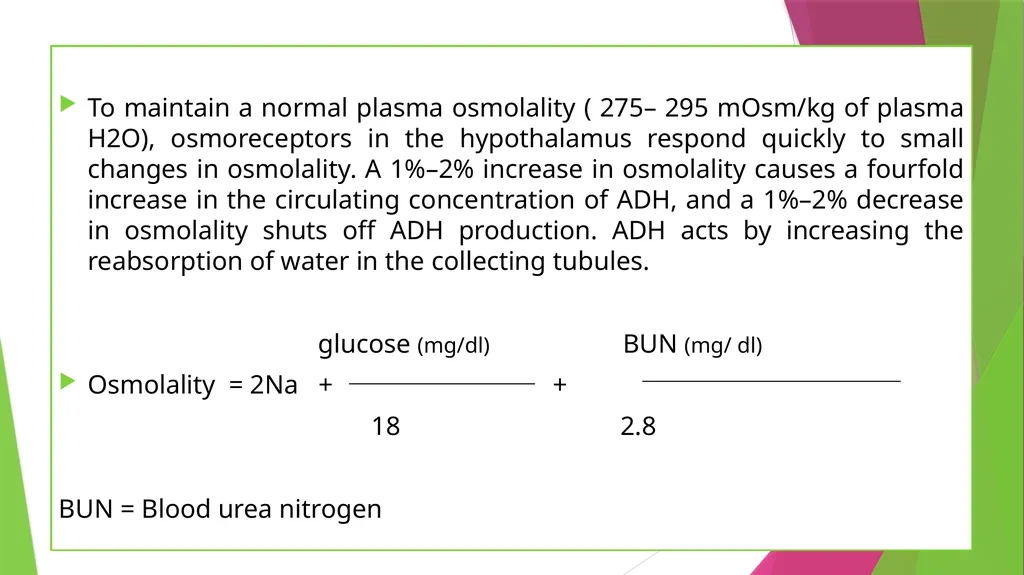
To maintain a normal plasma osmolality ( 275– 295 mOsm/kg of plasma H2O), osmoreceptors in the hypothalamus respond quickly to small changes in osmolality. A 1%–2% increase in osmolality causes a fourfold increase in the circulating concentration of ADH, and a 1%–2% decrease in osmolality shuts off ADH production. ADH acts by increasing the reabsorption of water in the collecting tubules.
glucose (mg/dl) BUN (mg/ dl)
Osmolality = 2Na + +
18 2.8
BUN = Blood urea nitrogen<br>
glucose (mg/dl) BUN (mg/ dl)
Osmolality = 2Na + +
18 2.8
BUN = Blood urea nitrogen<br>
38
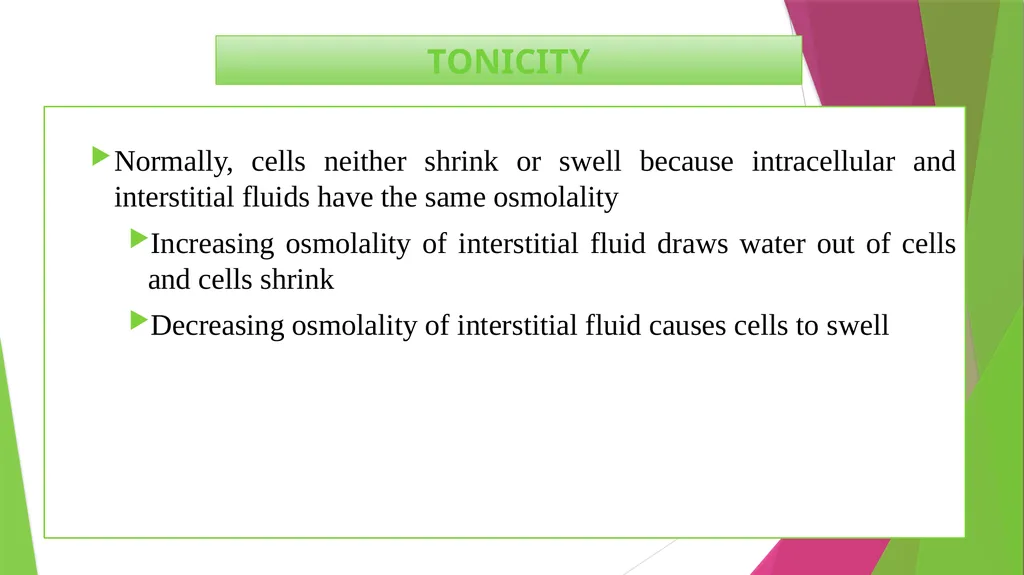
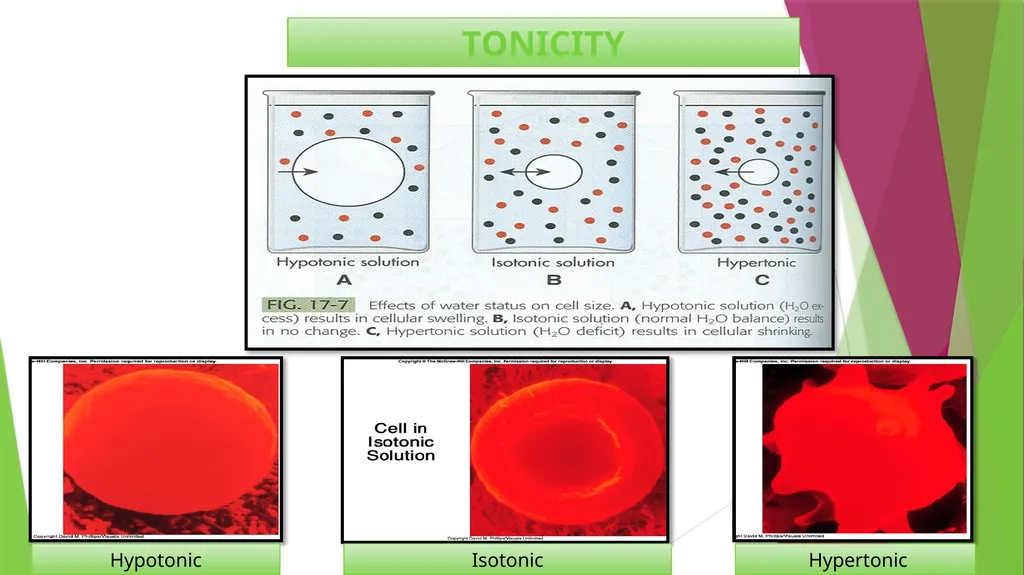
Tonicity Normally, cells neither shrink or swell because intracellular and interstitial fluids have the same osmolality
Increasing osmolality of interstitial fluid draws water out of cells and cells shrink
Decreasing osmolality of interstitial fluid causes cells to swell<br>
Increasing osmolality of interstitial fluid draws water out of cells and cells shrink
Decreasing osmolality of interstitial fluid causes cells to swell<br>
39
Tonicity Isotonic Hypertonic Hypotonic<br>