Presented by: Insert Yourname Date: date togo inhere GM Approach to Patient Led Ordering of Medicines (PLO) PLO is a GM-wide initiative that empowers patients (who are able to do so) to take control of ordering their own repeat medication
"Presented by: Insert Yourname Date: date togo" is the property of its rightful owner. Permission is granted to
download and print the materials on this website for personal, non-commercial use only, and to display it
on your personal computer provided you do not modify the materials and that you retain all copyright
notices contained in the materials. By downloading content from our website, you accept the terms of this
agreement.
Presentation Transcript
01
Presented by: Insert Yourname Date: date togo inhere GM Approach to Patient Led Ordering of Medicines (PLO)<br>
02
PLO is a GM-wide initiative that empowers patients (who are able to do so) to take control of ordering their own repeat medication using the NHS app
From a national perspective, the delivery plan for recovering access to primary care (NHS England » PCARP) commits GM to a target of 179,550 NHS app repeat prescription orders enabling patients in over 90% of practices to order repeat prescriptions using the NHS App by March 2025
The GM Primary Care Blueprint outlines the importance of the adoption and embedding of the use of the NHS app across GM to empower patients to order repeat prescriptions, access their prospective medical records and where available, make routine appointments PLO Background<br>
03
Time Saving – For both GP practices and community pharmacies, PLO will free up valuable time currently spent on ordering, chasing and processing repeat prescriptions or responding to related queries
Building relationships – PLO supports the relationship between community pharmacy and general practice/ PCN across GM
Reduced Medicine Waste – By enabling patients to order only the medications they need; PLO will help significantly reduce unnecessary medicine waste
Better Patient Control – Patients will have greater autonomy and understanding of their repeat medication, fostering improved medication management
Improved Safety – Avoiding unnecessary stockpiling of medication reduces the risk of confusion and misuse, improving patient safety Benefits of Implementing PLO<br>
04
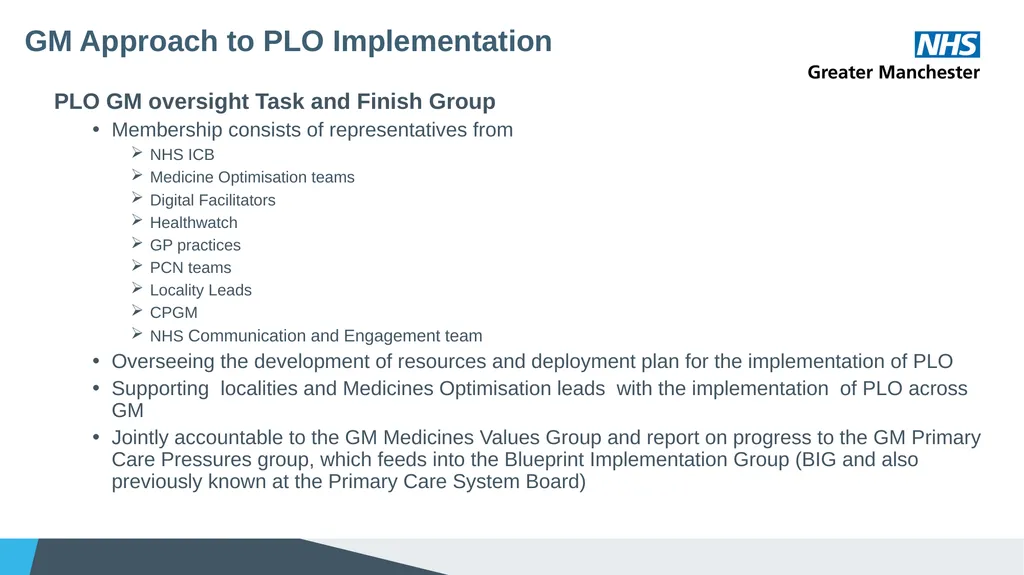
PLO GM oversight Task and Finish Group
Membership consists of representatives from
NHS ICB
Medicine Optimisation teams
Digital Facilitators
Healthwatch
GP practices
PCN teams
Locality Leads
CPGM
NHS Communication and Engagement team
Overseeing the development of resources and deployment plan for the implementation of PLO
Supporting localities and Medicines Optimisation leads with the implementation of PLO across GM
Jointly accountable to the GM Medicines Values Group and report on progress to the GM Primary Care Pressures group, which feeds into the Blueprint Implementation Group (BIG and also previously known at the Primary Care System Board) GM Approach to PLO Implementation<br>
05
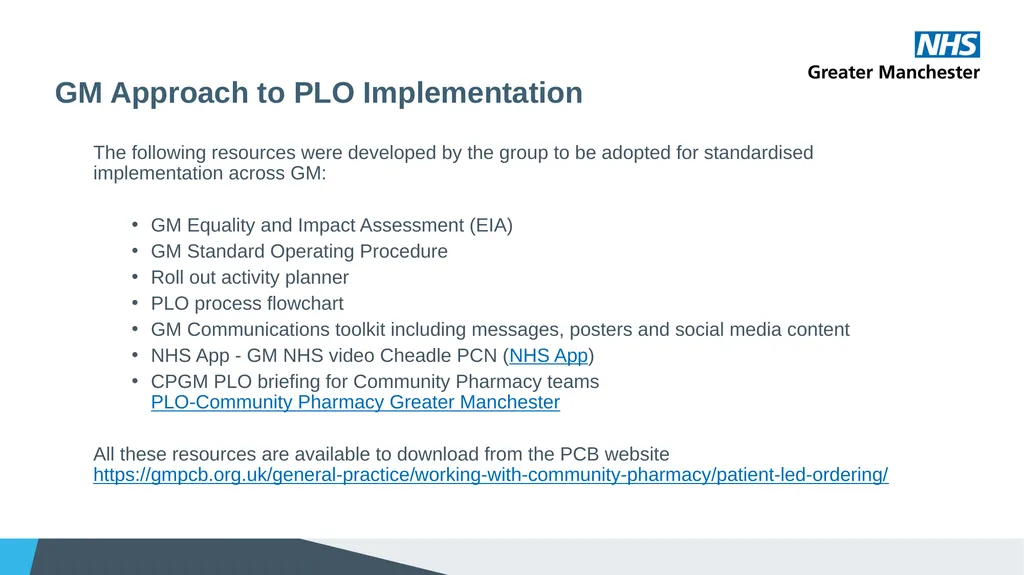
The following resources were developed by the group to be adopted for standardised implementation across GM:
GM Equality and Impact Assessment (EIA)
GM Standard Operating Procedure
Roll out activity planner
PLO process flowchart
GM Communications toolkit including messages, posters and social media content
NHS App - GM NHS video Cheadle PCN (NHS App)
CPGM PLO briefing for Community Pharmacy teams PLO-Community Pharmacy Greater Manchester
All these resources are available to download from the PCB website https://gmpcb.org.uk/general-practice/working-with-community-pharmacy/patient-led-ordering/ GM Approach to PLO Implementation<br>
06
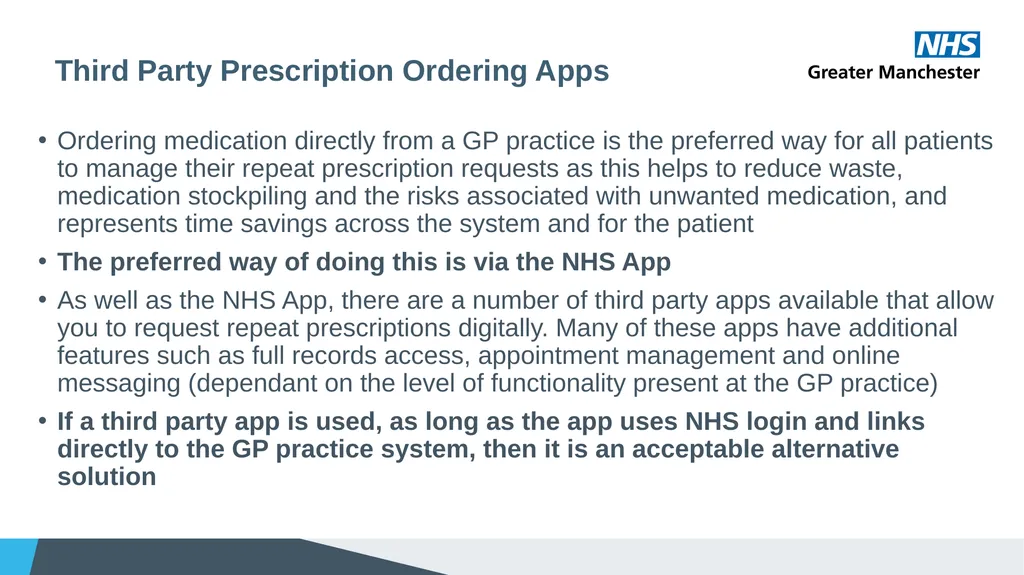
Ordering medication directly from a GP practice is the preferred way for all patients to manage their repeat prescription requests as this helps to reduce waste, medication stockpiling and the risks associated with unwanted medication, and represents time savings across the system and for the patient
The preferred way of doing this is via the NHS App
As well as the NHS App, there are a number of third party apps available that allow you to request repeat prescriptions digitally. Many of these apps have additional features such as full records access, appointment management and online messaging (dependant on the level of functionality present at the GP practice)
If a third party app is used, as long as the app uses NHS login and links directly to the GP practice system, then it is an acceptable alternative solution Third Party Prescription Ordering Apps<br>
07
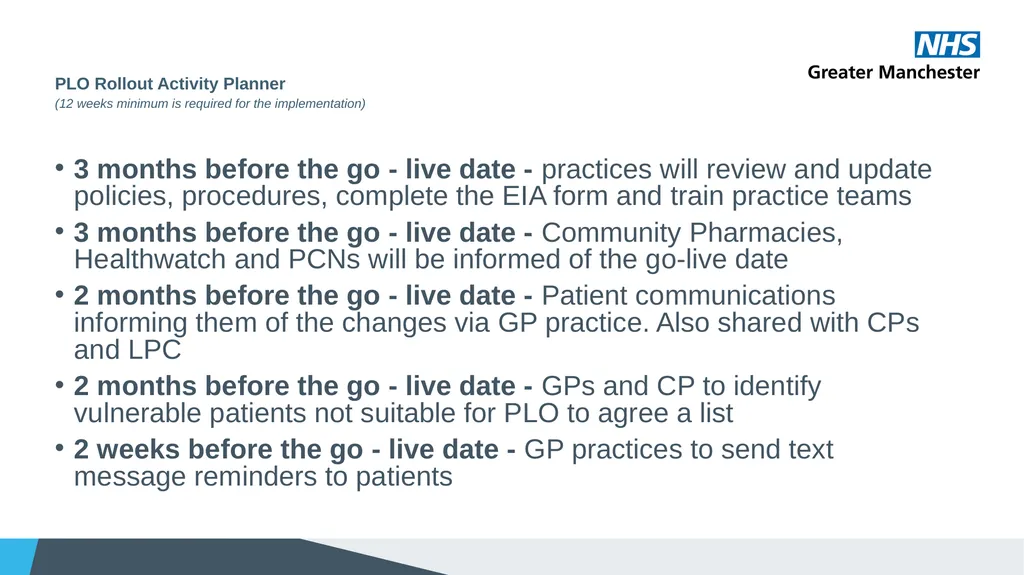
3 months before the go - live date - practices will review and update policies, procedures, complete the EIA form and train practice teams
3 months before the go - live date - Community Pharmacies, Healthwatch and PCNs will be informed of the go-live date
2 months before the go - live date - Patient communications informing them of the changes via GP practice. Also shared with CPs and LPC
2 months before the go - live date - GPs and CP to identify vulnerable patients not suitable for PLO to agree a list
2 weeks before the go - live date - GP practices to send text message reminders to patients PLO Rollout Activity Planner (12 weeks minimum is required for the implementation)<br>
08
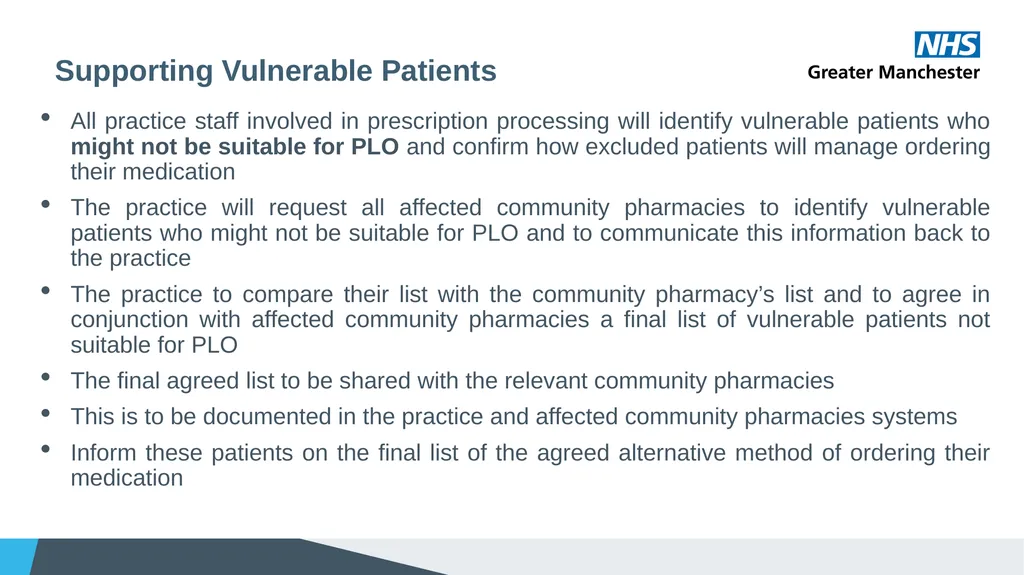
All practice staff involved in prescription processing will identify vulnerable patients who might not be suitable for PLO and confirm how excluded patients will manage ordering their medication
The practice will request all affected community pharmacies to identify vulnerable patients who might not be suitable for PLO and to communicate this information back to the practice
The practice to compare their list with the community pharmacy’s list and to agree in conjunction with affected community pharmacies a final list of vulnerable patients not suitable for PLO
The final agreed list to be shared with the relevant community pharmacies
This is to be documented in the practice and affected community pharmacies systems
Inform these patients on the final list of the agreed alternative method of ordering their medication Supporting Vulnerable Patients<br>
09
Care home teams can currently order residents prescriptions using one the following:
Using a third-party app e.g. Patient Access for EMIS practices
Directly from the GP practices using email, repeat slips or any other locally agreed manual process
Through their community pharmacy (not recommended)
When the GP practice is implementing PLO using the NHS app, the practice will need to support their care homes to use option 1 above
Care home teams can not use the NHS app to order their residents’ medication as this function is currently unavailable Care Home Residents<br>
10
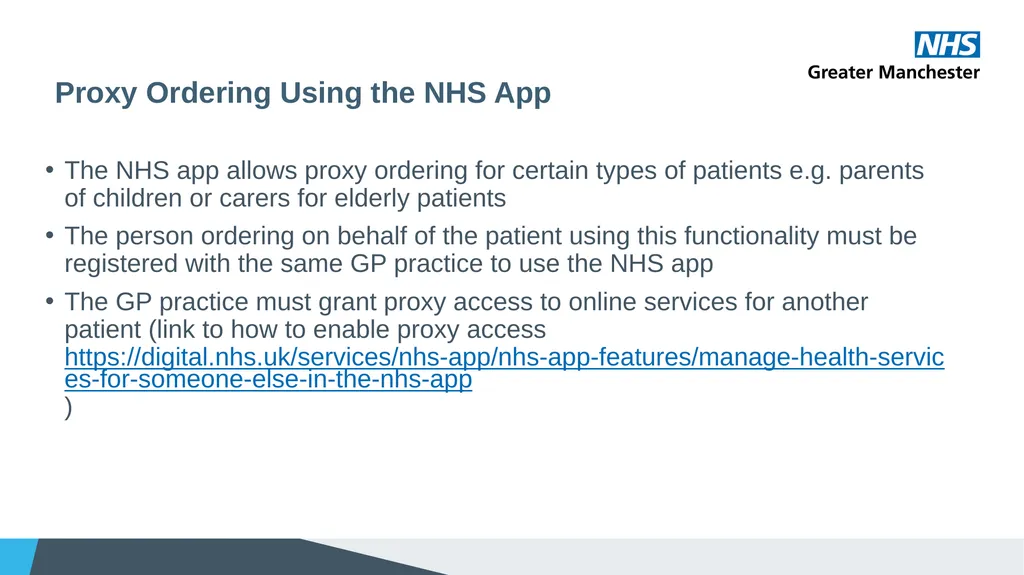
The NHS app allows proxy ordering for certain types of patients e.g. parents of children or carers for elderly patients
The person ordering on behalf of the patient using this functionality must be registered with the same GP practice to use the NHS app
The GP practice must grant proxy access to online services for another patient (link to how to enable proxy access https://digital.nhs.uk/services/nhs-app/nhs-app-features/manage-health-services-for-someone-else-in-the-nhs-app) Proxy Ordering Using the NHS App<br>
11
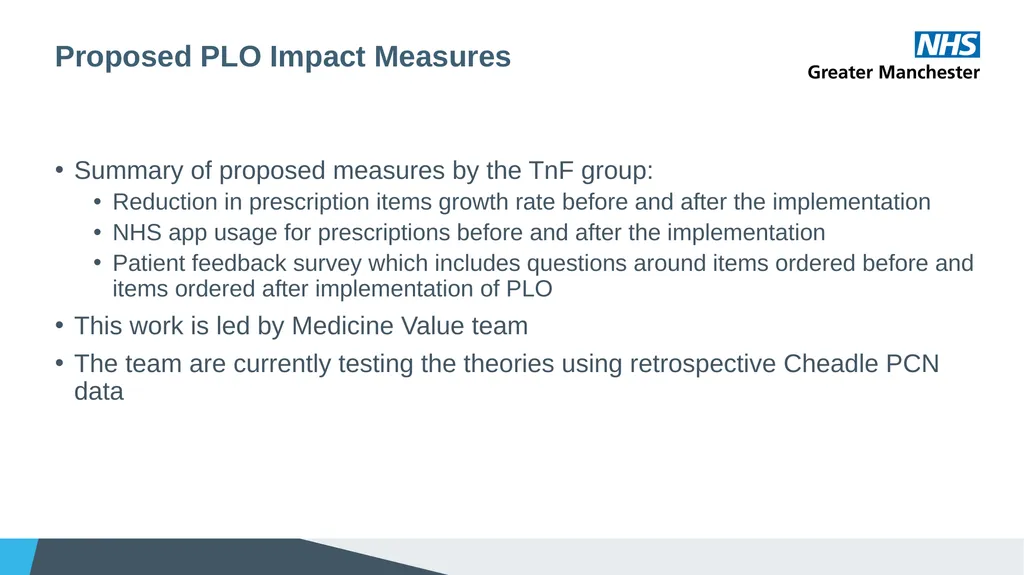
Summary of proposed measures by the TnF group:
Reduction in prescription items growth rate before and after the implementation
NHS app usage for prescriptions before and after the implementation
Patient feedback survey which includes questions around items ordered before and items ordered after implementation of PLO
This work is led by Medicine Value team
The team are currently testing the theories using retrospective Cheadle PCN data Proposed PLO Impact Measures<br>
12
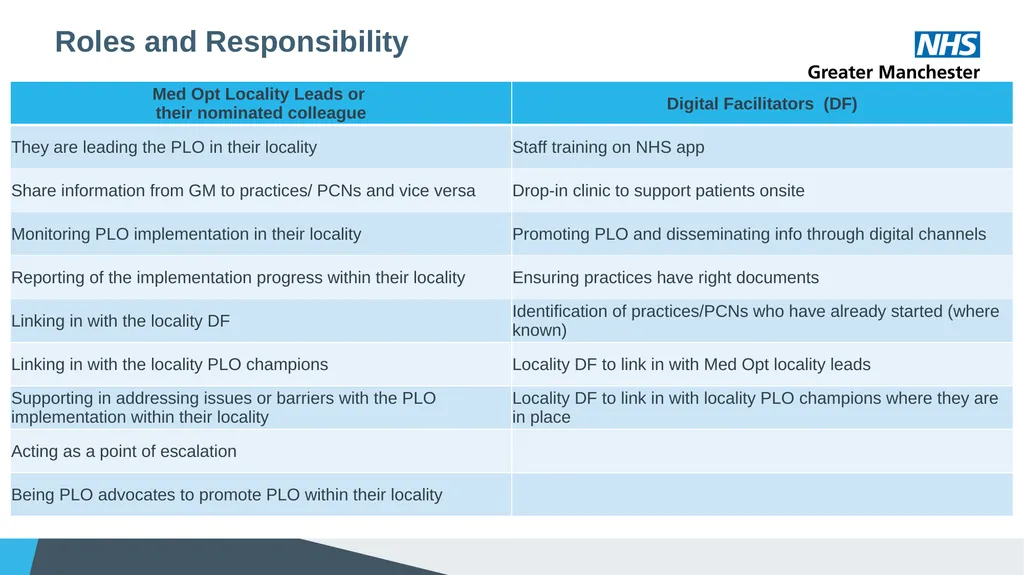
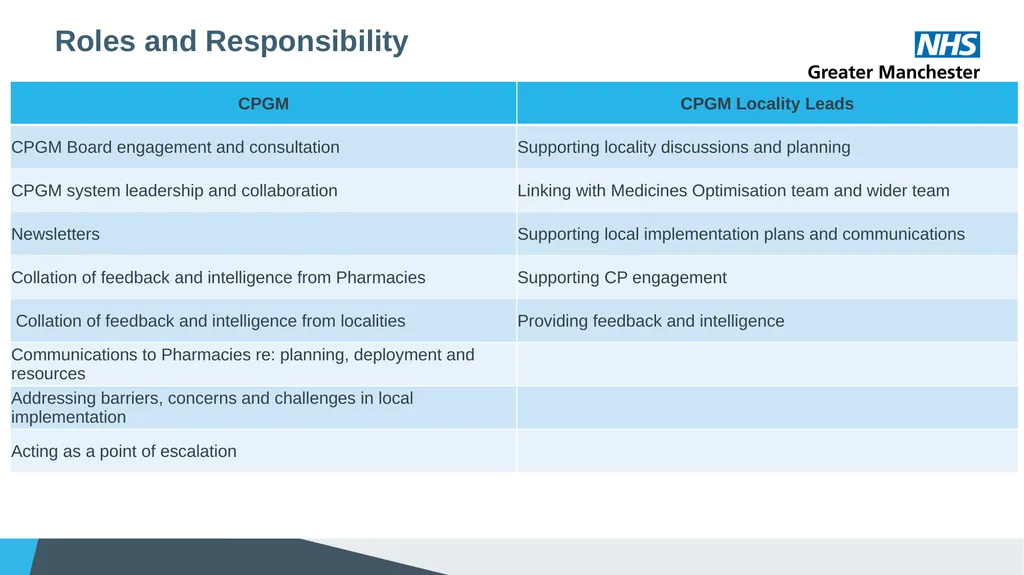
Roles and Responsibility<br>
13
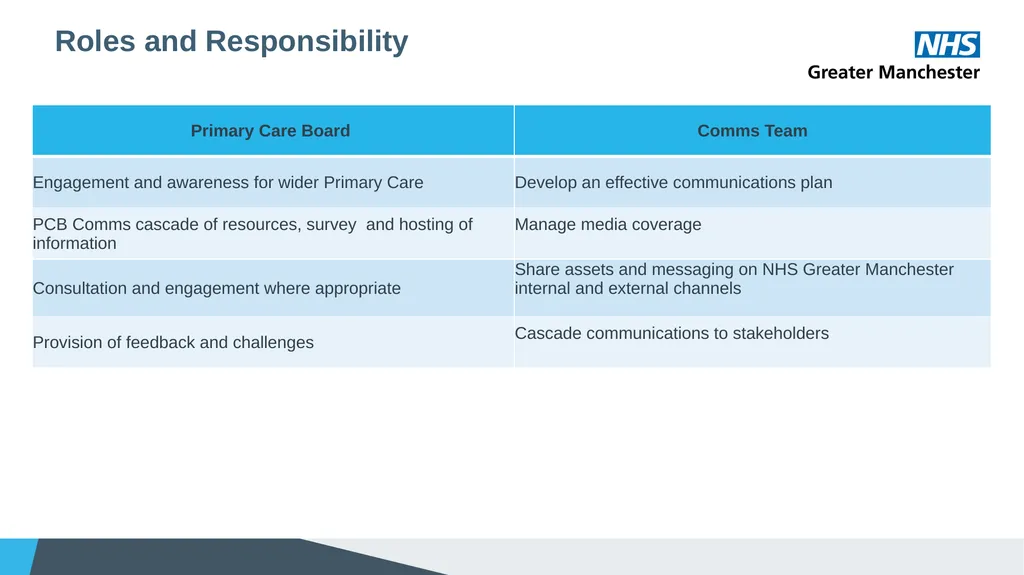
Roles and Responsibility<br>
14
Roles and Responsibility<br>
15
Contact Detail<br>
16
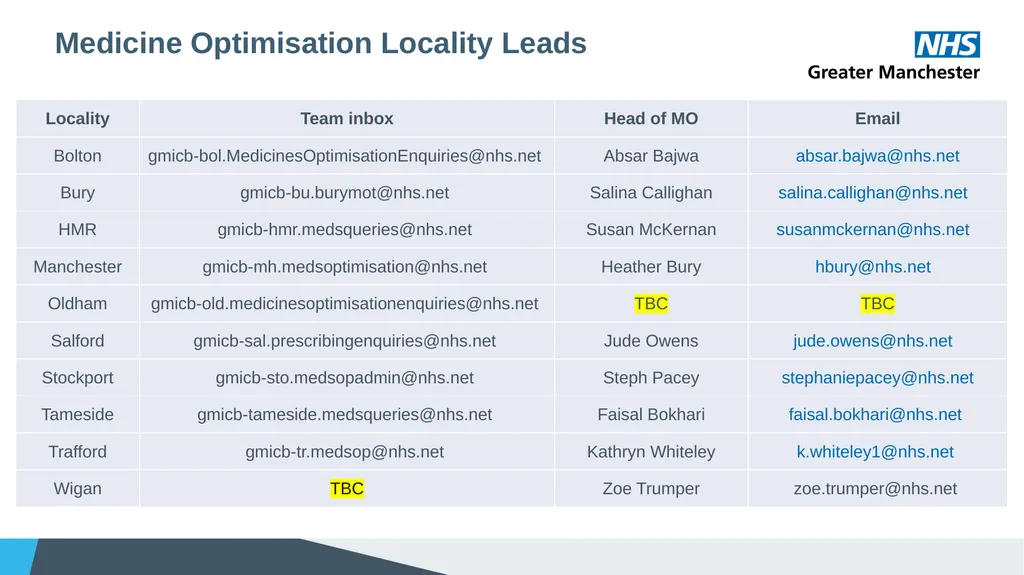
Medicine Optimisation Locality Leads<br>
17
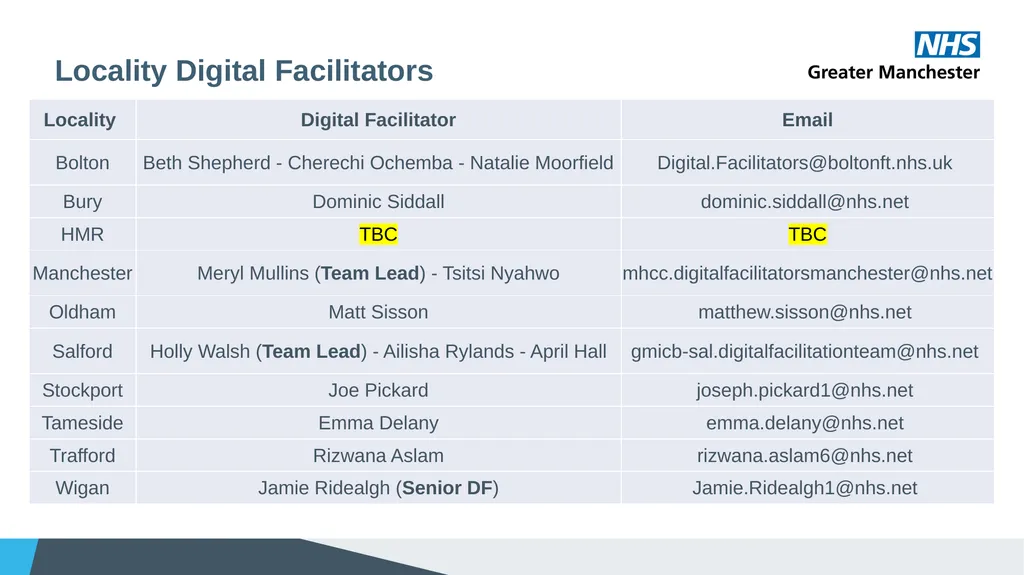
Locality Digital Facilitators<br>
18
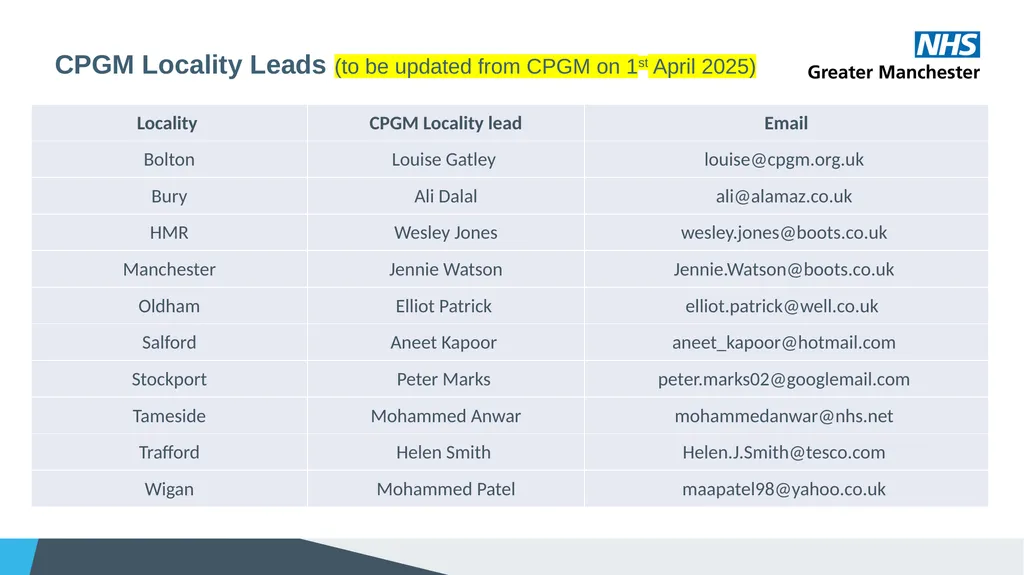
CPGM Locality Leads (to be updated from CPGM on 1st April 2025)<br>