
Preventing Future Pandemics. Nipah Virus “Bat with
PC
Published · 32 slides · 0 views

1 / 1






Description
Preventing Future Pandemics. Nipah Virus Bat with Seasonal Itch Dr. Diva Singh DSM Centre Ba 2021 Thought for the Day: The Single Biggest threat to mans continued dominance on the planet is the virus Josua Lederberg Emerging
Related Topics
Share
Embed code
Download this presentation From Below
"Preventing Future Pandemics. Nipah Virus “Bat with" is the property of its rightful owner. Permission is granted to download and print the materials on this website for personal, non-commercial use only, and to display it on your personal computer provided you do not modify the materials and that you retain all copyright notices contained in the materials. By downloading content from our website, you accept the terms of this agreement.
Presentation Transcript
01
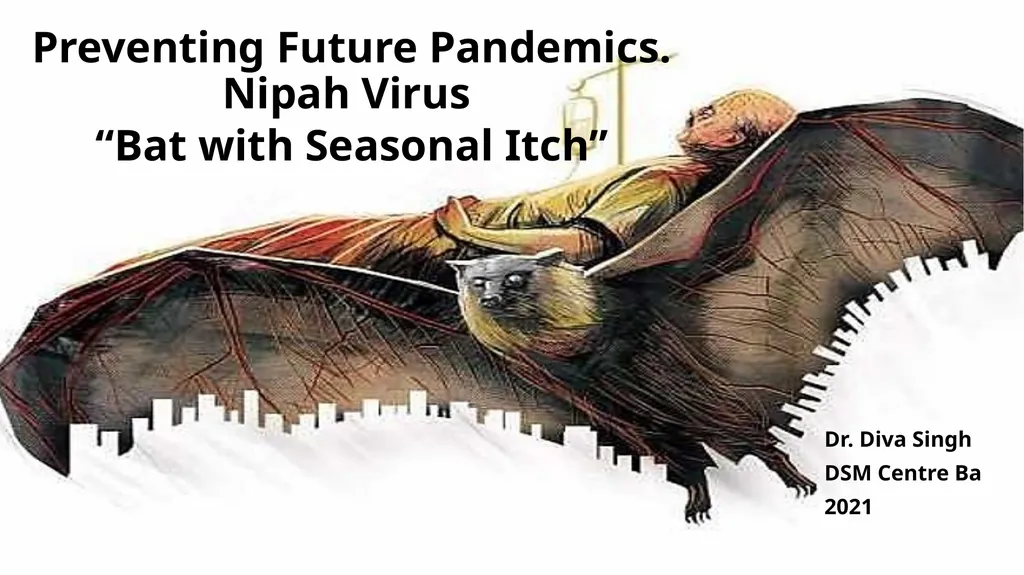
Preventing Future Pandemics.
Nipah Virus
“Bat with Seasonal Itch” Dr. Diva Singh
DSM Centre Ba
2021<br>
“Bat with Seasonal Itch” Dr. Diva Singh
DSM Centre Ba
2021<br>
02
Thought for the Day: “The Single Biggest threat to man’s continued dominance on the planet is the virus” –Josua Lederberg<br>
03
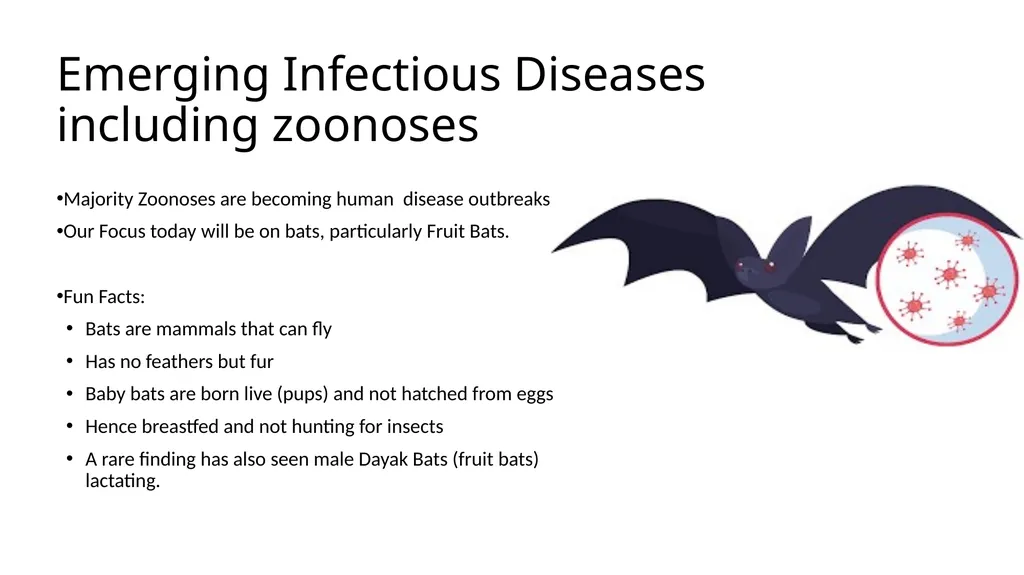
Emerging Infectious Diseases including zoonoses Majority Zoonoses are becoming human disease outbreaks
Our Focus today will be on bats, particularly Fruit Bats.
Fun Facts:
Bats are mammals that can fly
Has no feathers but fur
Baby bats are born live (pups) and not hatched from eggs
Hence breastfed and not hunting for insects
A rare finding has also seen male Dayak Bats (fruit bats) lactating.<br>
Our Focus today will be on bats, particularly Fruit Bats.
Fun Facts:
Bats are mammals that can fly
Has no feathers but fur
Baby bats are born live (pups) and not hatched from eggs
Hence breastfed and not hunting for insects
A rare finding has also seen male Dayak Bats (fruit bats) lactating.<br>
04
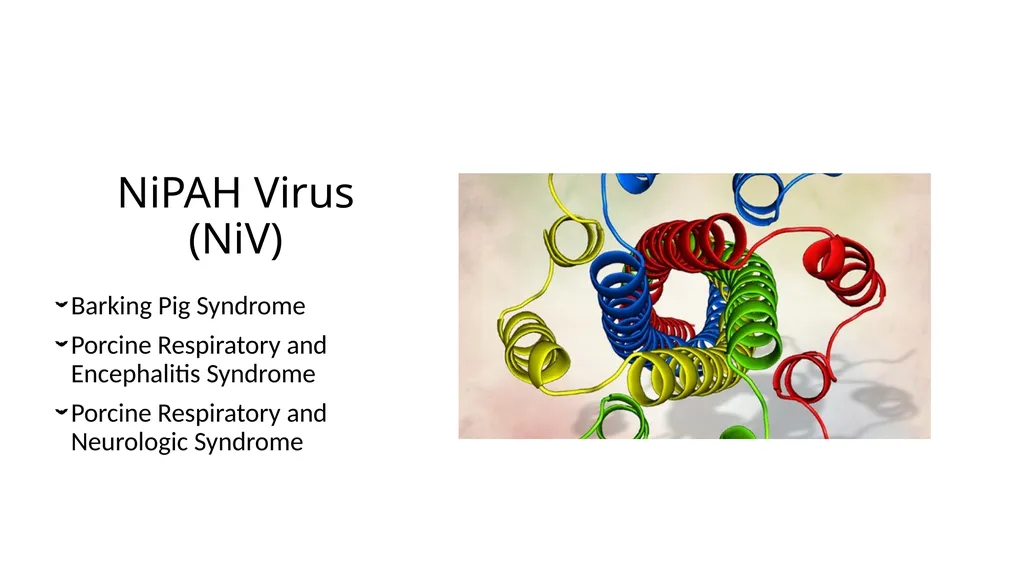
NiPAH Virus (NiV) Barking Pig Syndrome
Porcine Respiratory and Encephalitis Syndrome
Porcine Respiratory and Neurologic Syndrome<br>
Porcine Respiratory and Encephalitis Syndrome
Porcine Respiratory and Neurologic Syndrome<br>
05
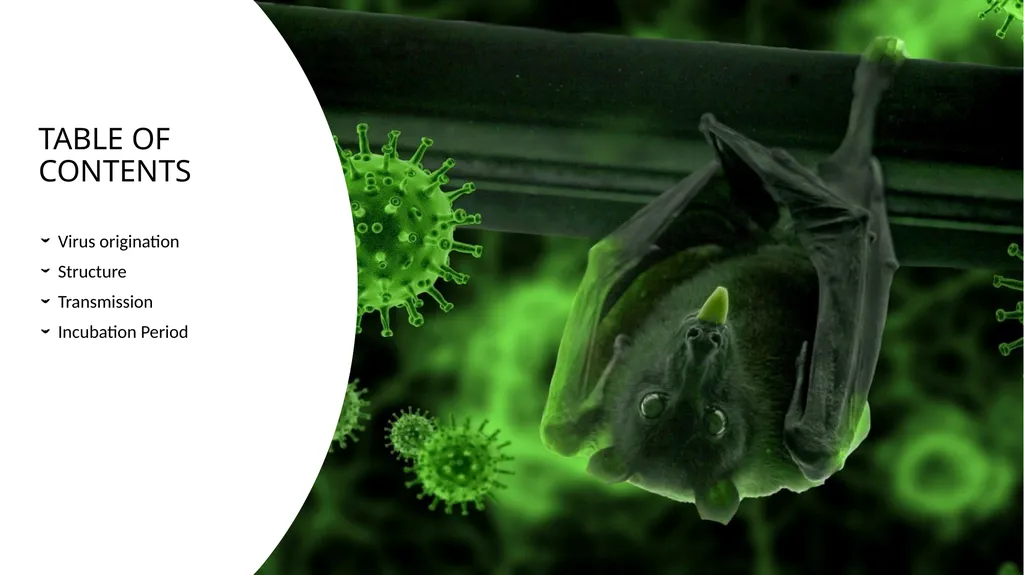
TABLE OF CONTENTS Virus origination
Structure
Transmission
Incubation Period<br>
Structure
Transmission
Incubation Period<br>
06
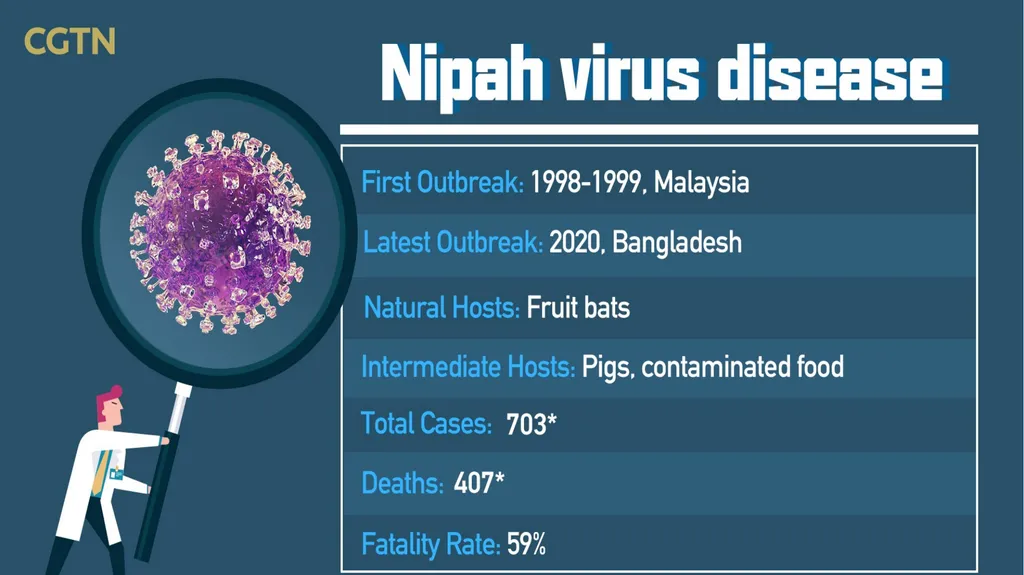
Origination NiV was first identified during an outbreak of disease that took place in Kampung Sungai Nipah, Malaysia in 1999 hence, the name originated from the village.
On this occasion, pigs were the intermediate hosts.
However, in subsequent NiV outbreaks, there were no intermediate hosts.
In Bangladesh in 2004, humans became infected with NiV as a result of consuming date palm sap that had been contaminated by infected fruit bats.
Human-to-human transmission has also been documented, including in a hospital setting in India.
Hence an outbreak in India in the past 2 months have caused deaths due to NiV.<br>
On this occasion, pigs were the intermediate hosts.
However, in subsequent NiV outbreaks, there were no intermediate hosts.
In Bangladesh in 2004, humans became infected with NiV as a result of consuming date palm sap that had been contaminated by infected fruit bats.
Human-to-human transmission has also been documented, including in a hospital setting in India.
Hence an outbreak in India in the past 2 months have caused deaths due to NiV.<br>
07
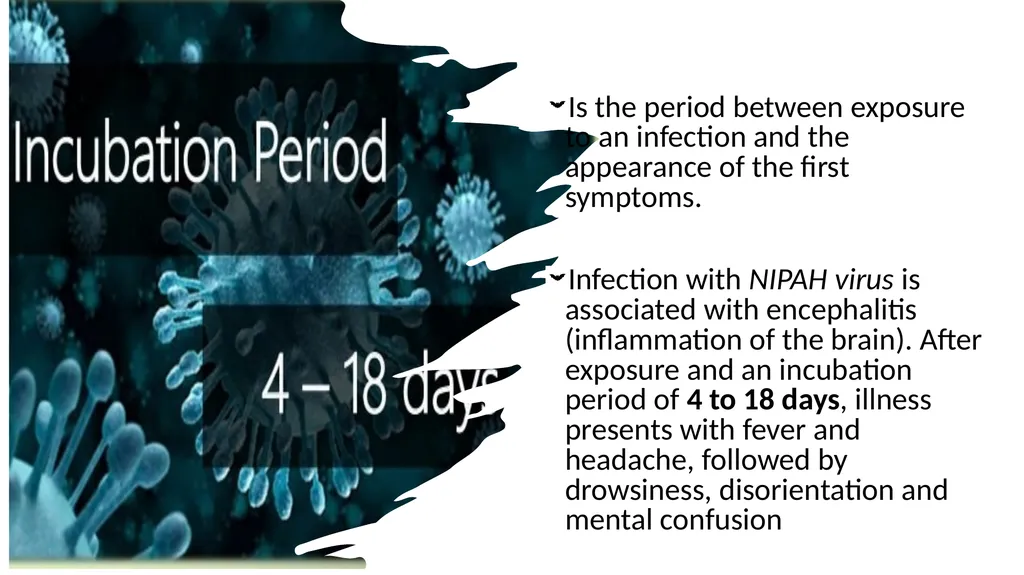
Is the period between exposure to an infection and the appearance of the first symptoms.
Infection with NIPAH virus is associated with encephalitis (inflammation of the brain). After exposure and an incubation period of 4 to 18 days, illness presents with fever and headache, followed by drowsiness, disorientation and mental confusion<br>
Infection with NIPAH virus is associated with encephalitis (inflammation of the brain). After exposure and an incubation period of 4 to 18 days, illness presents with fever and headache, followed by drowsiness, disorientation and mental confusion<br>
08
Cycle of events From September 1998 to April 1999, human cases of febrile encephalitis with high mortality were reported by the Malaysian Ministry of Health. Initially Japanese encephalitis (JE) was suspected; however, serological tests and the disease epidemiology suggested a different disease. Tissue culture isolation from cases identified an unrecognized paramyxovirus closely related to Hendra virus. Nipah virus was named after the village (Sungai Nipah) where the first cases were reported<br>
09
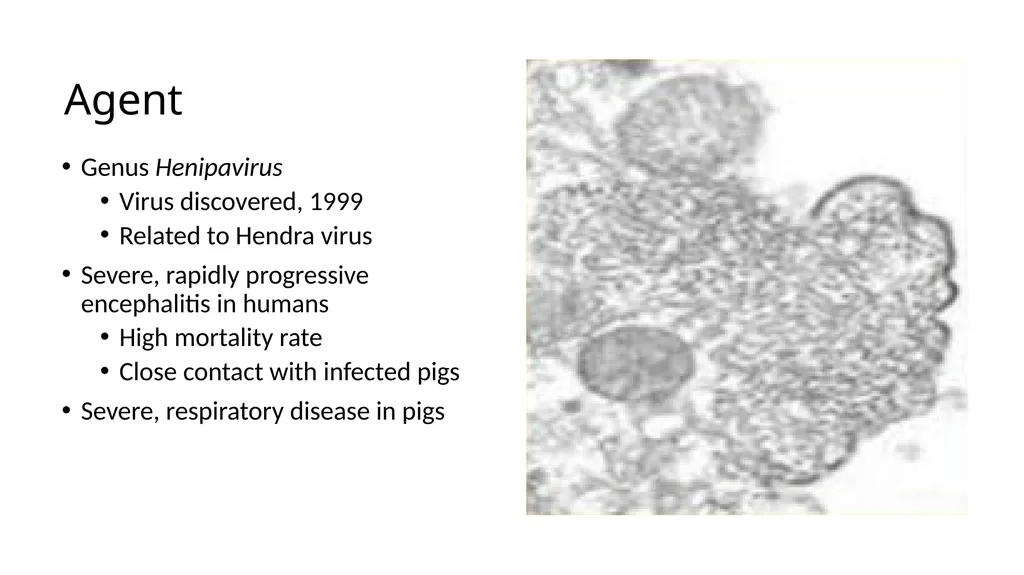
Agent Genus Henipavirus
Virus discovered, 1999
Related to Hendra virus
Severe, rapidly progressive encephalitis in humans
High mortality rate
Close contact with infected pigs
Severe, respiratory disease in pigs<br>
Virus discovered, 1999
Related to Hendra virus
Severe, rapidly progressive encephalitis in humans
High mortality rate
Close contact with infected pigs
Severe, respiratory disease in pigs<br>
10
Hendra virus is a severe respiratory and encephalitic disease causing virus that affects humans and horses. In March 1999, a similar outbreak occurred in Singapore. The disease affected abattoir workers that had been exposed to pigs imported from Malaysia for slaughter. Since 2001, human outbreaks and clusters of cases have been reported periodically in Bangladesh and a neighboring region of northern India.<br>
11
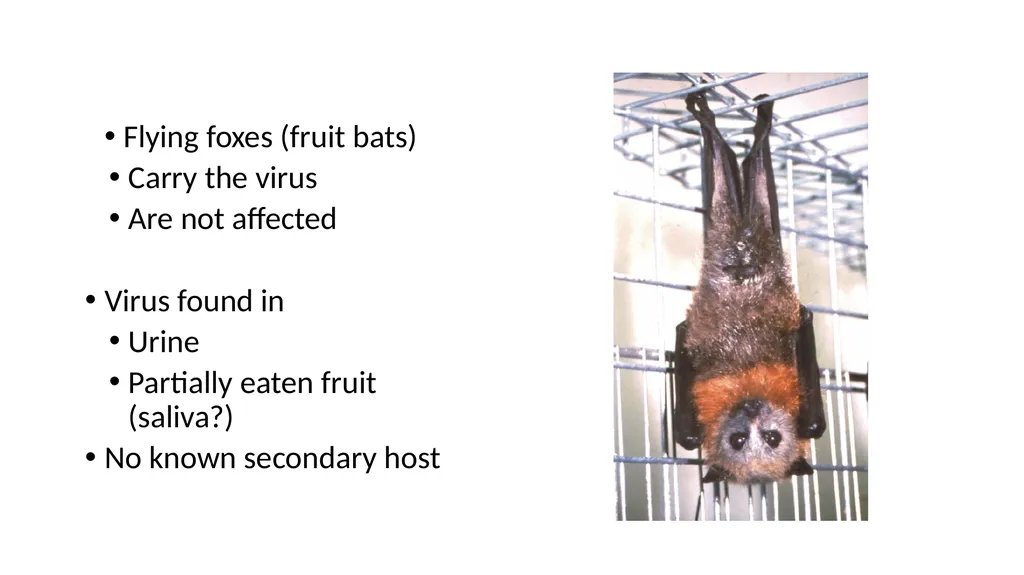
Flying foxes (fruit bats)
Carry the virus
Are not affected
Virus found in
Urine
Partially eaten fruit (saliva?)
No known secondary host<br>
Carry the virus
Are not affected
Virus found in
Urine
Partially eaten fruit (saliva?)
No known secondary host<br>
12
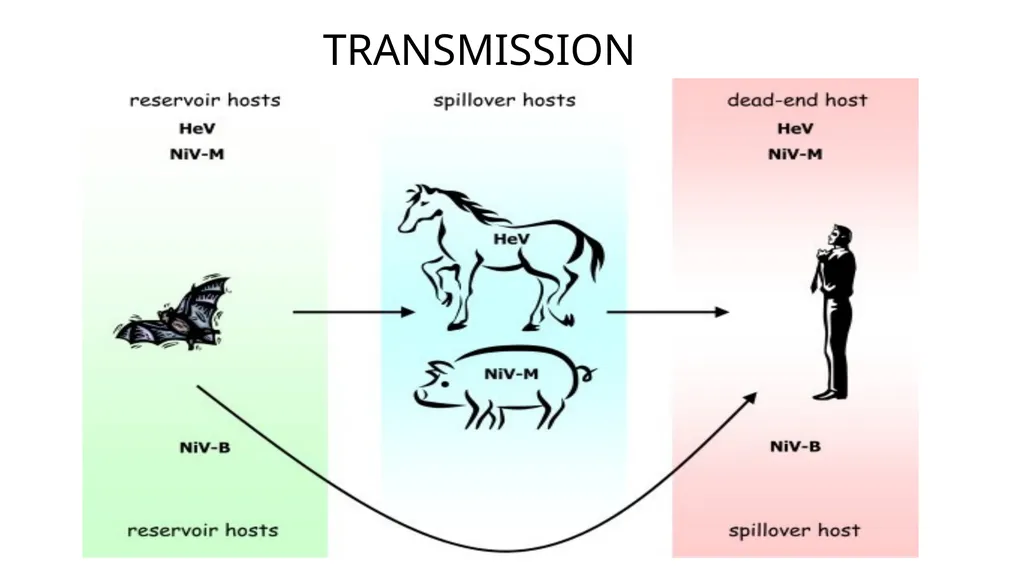
TRANSMISSION<br>
13
Transmission of NiPAH virus to humans may occur after direct contact with infected bats, infected pigs, or from other NiV infected people.
In Malaysia and Singapore, humans were apparently infected with NiPAH virus only through close contact with infected pigs.
The NiPAH virus strain identified in this outbreak appeared to have been transmitted initially from bats to pigs, with subsequent spread within pig populations. Incidental human infections resulted after exposure to infected pigs.<br>
In Malaysia and Singapore, humans were apparently infected with NiPAH virus only through close contact with infected pigs.
The NiPAH virus strain identified in this outbreak appeared to have been transmitted initially from bats to pigs, with subsequent spread within pig populations. Incidental human infections resulted after exposure to infected pigs.<br>
14
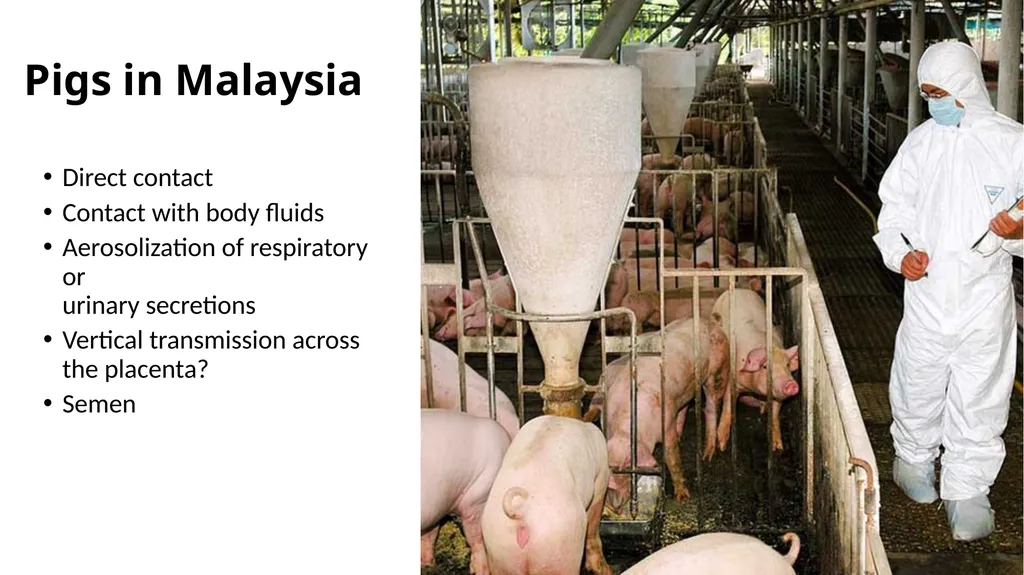
Pigs in Malaysia
Direct contact
Contact with body fluids
Aerosolization of respiratory or urinary secretions
Vertical transmission across the placenta?
Semen<br>
Direct contact
Contact with body fluids
Aerosolization of respiratory or urinary secretions
Vertical transmission across the placenta?
Semen<br>
15
Person-to-person
Not reported in Malaysia
Likely in Bangladesh and India
Nosocomial infections
Bat-to-person
Not reported in Malaysia
Common in Bangladesh and India
Contaminated fruit, unpasteurized date palm juice<br>
Not reported in Malaysia
Likely in Bangladesh and India
Nosocomial infections
Bat-to-person
Not reported in Malaysia
Common in Bangladesh and India
Contaminated fruit, unpasteurized date palm juice<br>
16
No occurrence of person-to-person transmission was reported in this outbreak.
Conversely, person-to-person transmission of Nipah virus in Bangladesh and India is regularly reported.
This is most commonly seen in the family and caregivers of Nipah virus-infected patients.
Transmission also occurs from direct exposure to infected bats. A common example is consumption of raw date palm sap contaminated with infectious bat excretions.<br>
Conversely, person-to-person transmission of Nipah virus in Bangladesh and India is regularly reported.
This is most commonly seen in the family and caregivers of Nipah virus-infected patients.
Transmission also occurs from direct exposure to infected bats. A common example is consumption of raw date palm sap contaminated with infectious bat excretions.<br>
17
To determine the potential for person-to-person transmission in Malaysia, a survey of persons involved with case-patients was conducted. Family members, physicians, nurses, and pathologists who had direct contact with infected persons had no signs of illness or serological evidence of Nipah virus infection. Additionally, there was no serological evidence of human infection among bat handlers, although children who ate contaminated fruit did become sick in Bangladesh. Ingestion of virus in contaminated, unpasteurized date palm juice may have been the source of an outbreak in Bangladesh in 2005. Since 2001, human outbreaks and clusters of cases have been reported periodically in Bangladesh and a neighboring region of northern India. In some of these outbreaks, Nipah virus seems to have been transmitted directly from bats to humans, with person-to-person transmission the most significant means of spread. Humans can shed Nipah virus in upper respiratory secretions and urine. Nipah virus may be transmitted on fomites. Nipah virus survives in the environment for long periods in favorable conditions; it survives for days in fruit bat urine and contaminated fruit juice<br>
18
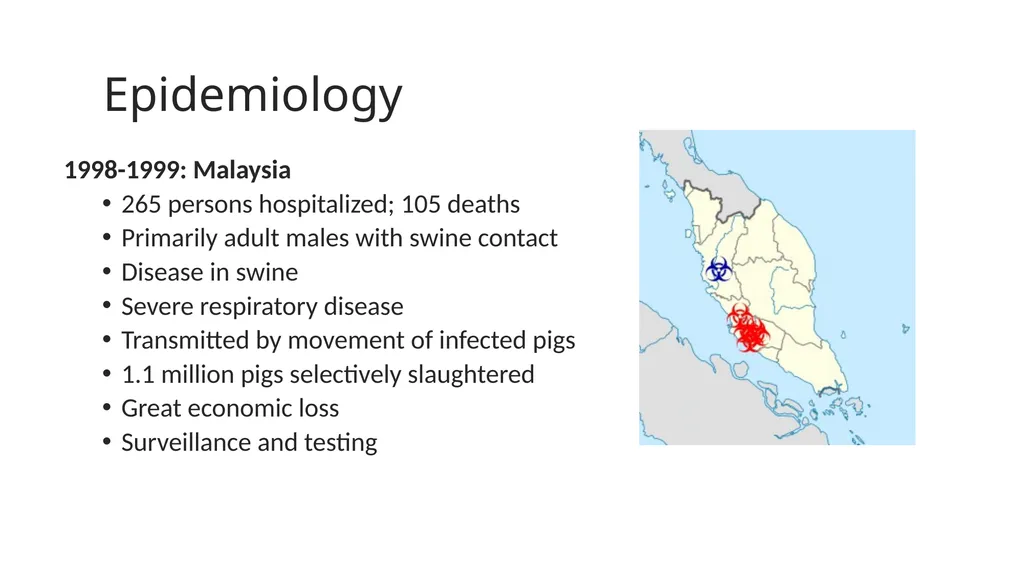
Epidemiology 1998-1999: Malaysia
265 persons hospitalized; 105 deaths
Primarily adult males with swine contact
Disease in swine
Severe respiratory disease
Transmitted by movement of infected pigs
1.1 million pigs selectively slaughtered
Great economic loss
Surveillance and testing Center for Food Security and Public Health, Iowa State University, 2011<br>
265 persons hospitalized; 105 deaths
Primarily adult males with swine contact
Disease in swine
Severe respiratory disease
Transmitted by movement of infected pigs
1.1 million pigs selectively slaughtered
Great economic loss
Surveillance and testing Center for Food Security and Public Health, Iowa State University, 2011<br>
19
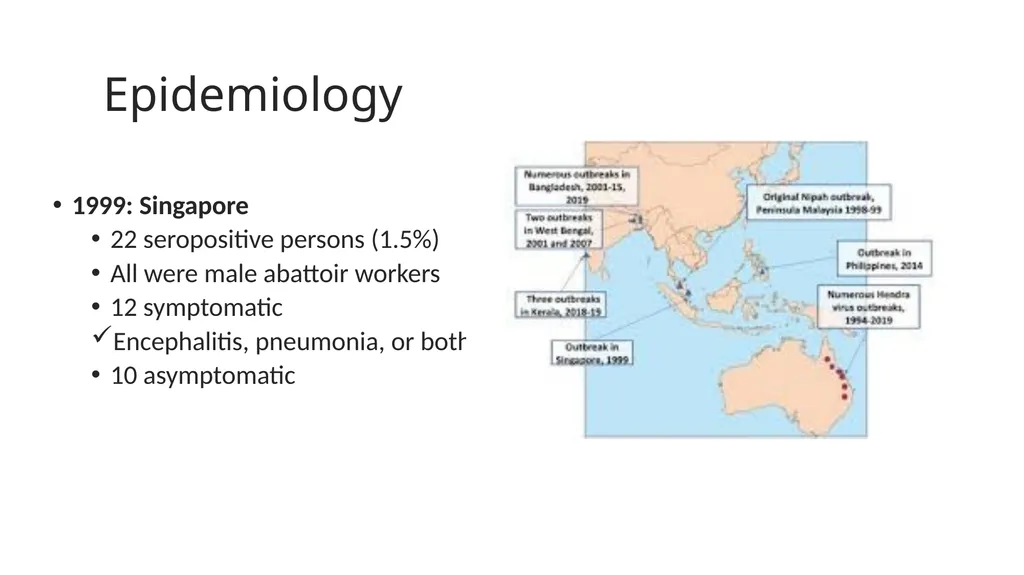
Epidemiology 1999: Singapore
22 seropositive persons (1.5%)
All were male abattoir workers
12 symptomatic
Encephalitis, pneumonia, or both
10 asymptomatic Center for Food Security and Public Health, Iowa State University, 2011<br>
22 seropositive persons (1.5%)
All were male abattoir workers
12 symptomatic
Encephalitis, pneumonia, or both
10 asymptomatic Center for Food Security and Public Health, Iowa State University, 2011<br>
20
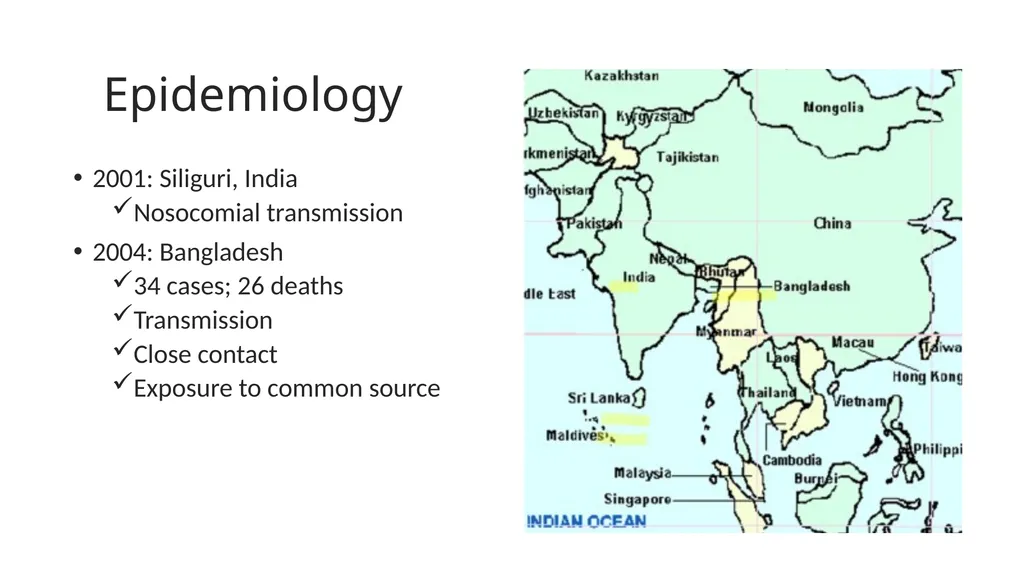
Epidemiology 2001: Siliguri, India
Nosocomial transmission
2004: Bangladesh
34 cases; 26 deaths
Transmission
Close contact
Exposure to common source<br>
Nosocomial transmission
2004: Bangladesh
34 cases; 26 deaths
Transmission
Close contact
Exposure to common source<br>
21
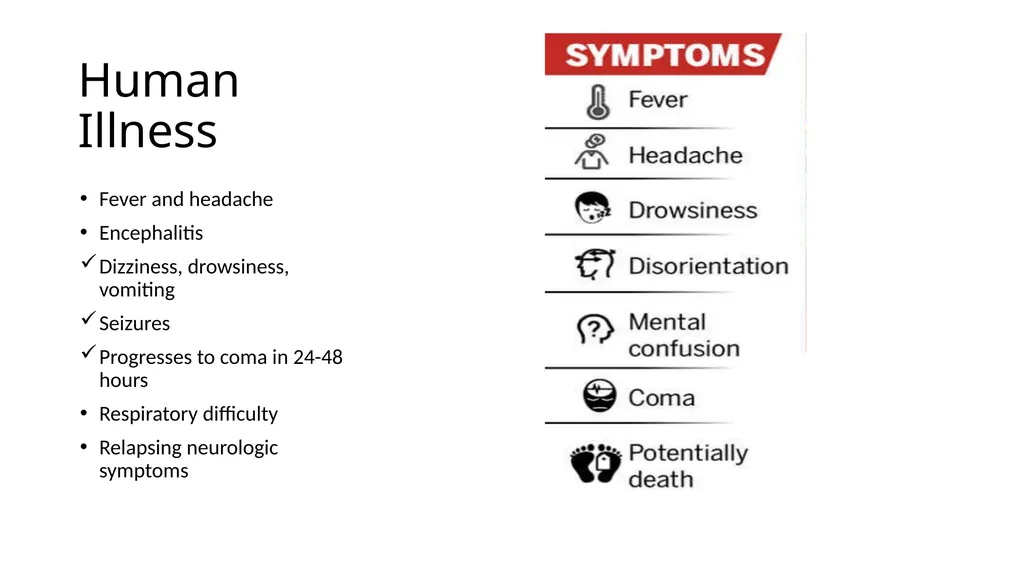
Human Illness Fever and headache
Encephalitis
Dizziness, drowsiness, vomiting
Seizures
Progresses to coma in 24-48 hours
Respiratory difficulty
Relapsing neurologic symptoms<br>
Encephalitis
Dizziness, drowsiness, vomiting
Seizures
Progresses to coma in 24-48 hours
Respiratory difficulty
Relapsing neurologic symptoms<br>
22
Human Illness Complications (Malaysian outbreak)
Septicemia (24%)
GI bleeding (5%)
Renal impairment (4%)
Asymptomatic
Relapse or late-onset encephalitis
Residual neurological deficits
Treatment: Supportive, ribavirin<br>
Septicemia (24%)
GI bleeding (5%)
Renal impairment (4%)
Asymptomatic
Relapse or late-onset encephalitis
Residual neurological deficits
Treatment: Supportive, ribavirin<br>
23
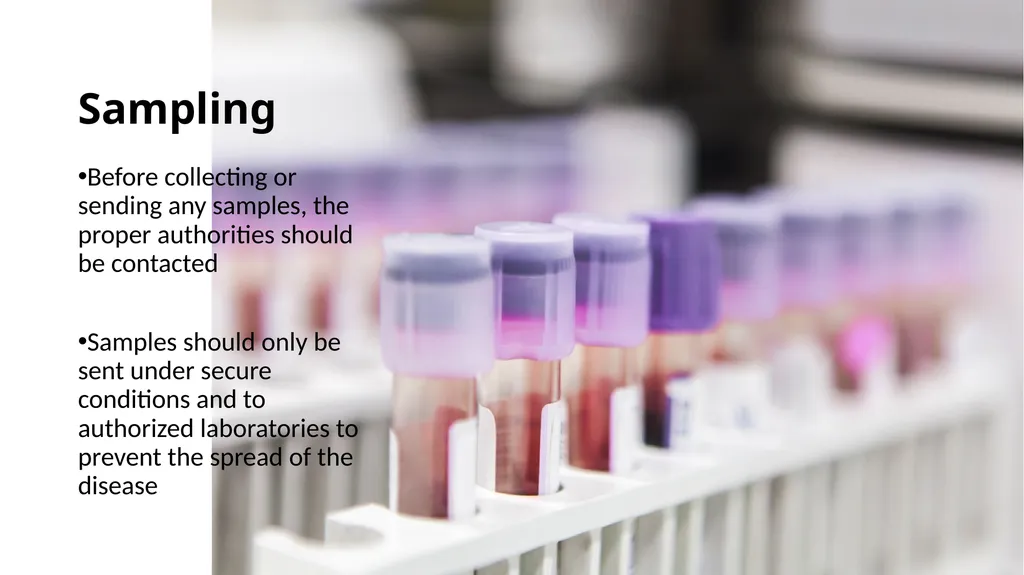
Sampling Before collecting or sending any samples, the proper authorities should be contacted
Samples should only be sent under secure conditions and to authorized laboratories to prevent the spread of the disease<br>
Samples should only be sent under secure conditions and to authorized laboratories to prevent the spread of the disease<br>
24
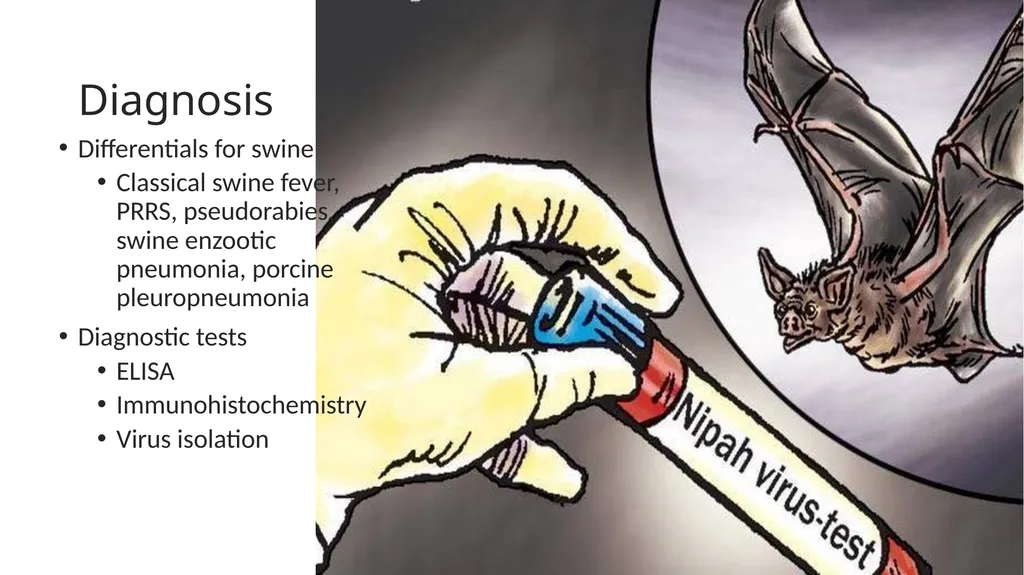
Diagnosis Differentials for swine
Classical swine fever, PRRS, pseudorabies, swine enzootic pneumonia, porcine pleuropneumonia
Diagnostic tests
ELISA
Immunohistochemistry
Virus isolation<br>
Classical swine fever, PRRS, pseudorabies, swine enzootic pneumonia, porcine pleuropneumonia
Diagnostic tests
ELISA
Immunohistochemistry
Virus isolation<br>
25
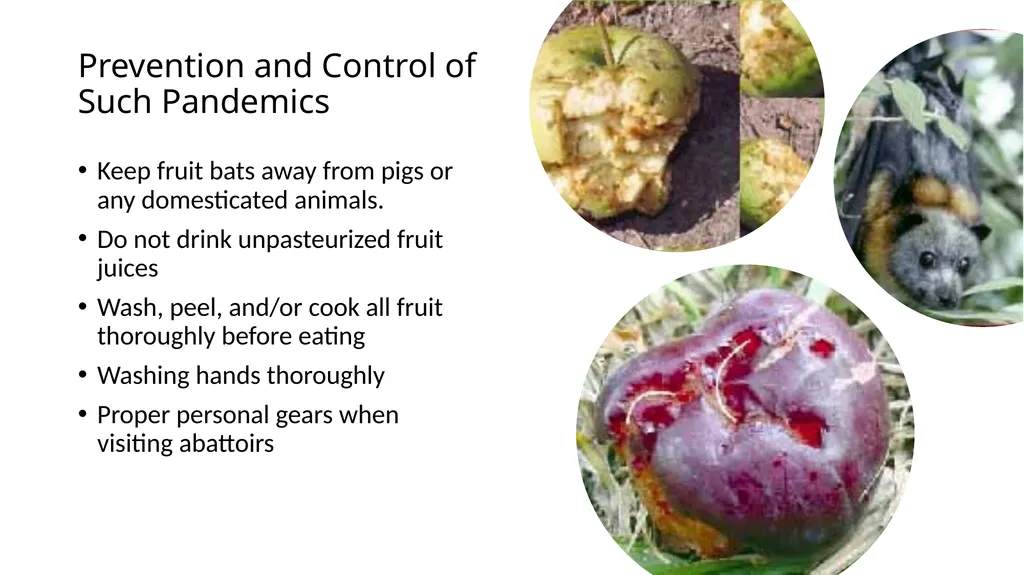
Prevention and Control of Such Pandemics Keep fruit bats away from pigs or any domesticated animals.
Do not drink unpasteurized fruit juices
Wash, peel, and/or cook all fruit thoroughly before eating
Washing hands thoroughly
Proper personal gears when visiting abattoirs Center for Food Security and Public Health, Iowa State University, 2011<br>
Do not drink unpasteurized fruit juices
Wash, peel, and/or cook all fruit thoroughly before eating
Washing hands thoroughly
Proper personal gears when visiting abattoirs Center for Food Security and Public Health, Iowa State University, 2011<br>
26
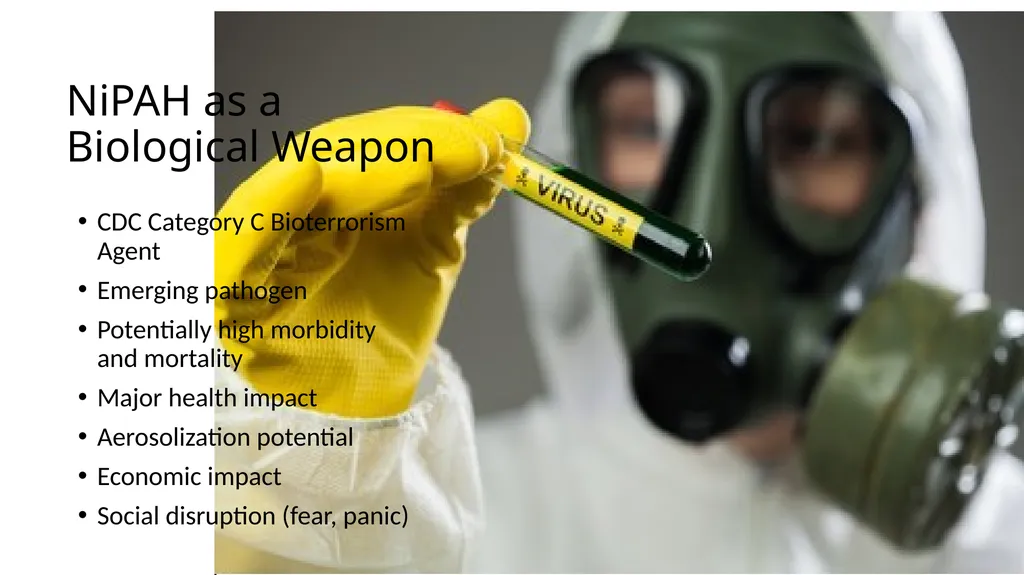
NiPAH as a
Biological Weapon CDC Category C Bioterrorism Agent
Emerging pathogen
Potentially high morbidity and mortality
Major health impact
Aerosolization potential
Economic impact
Social disruption (fear, panic)<br>
Emerging pathogen
Potentially high morbidity and mortality
Major health impact
Aerosolization potential
Economic impact
Social disruption (fear, panic)<br>
27
In Conclusion NiV was on its way into the history books as an emerging pandemic but it was identified and contained, however, its Covid and its various mutated forms that showed the world what its like living in a crisis created by human beings themselves. We need to work together as a team to identify the break of chain before we as decedents of neanderthal take a bow in to historic oblivion.<br>
28
Reference Morin, B., Rahmeh, A.A. & Whelan, S.P. Mechanism of RNA synthesis initiation by the vesicular stomatitis virus polymerase. EMBO J. 31, 1320–1329 (2012).
Communie, G. et al. Atomic resolution description of the interaction between the nucleoprotein and phosphoprotein of Hendra virus. PLoS Pathog. 9, e1003631 (2013).
Mounts AW, Kaur H, Parashar UD, et al. A cohort study of health care workers to assess nosocomial transmissibility of Nipah virus, Malaysia, 1999. Journal of Infectious Disease 2019.
Wong KT, Shieh WJ, Kumar S, et al. Nipah virus infection. Pathology and pathogenesis of an emerging paramyxoviral zoonosis. American Journal of Pathology 2019.<br>
Communie, G. et al. Atomic resolution description of the interaction between the nucleoprotein and phosphoprotein of Hendra virus. PLoS Pathog. 9, e1003631 (2013).
Mounts AW, Kaur H, Parashar UD, et al. A cohort study of health care workers to assess nosocomial transmissibility of Nipah virus, Malaysia, 1999. Journal of Infectious Disease 2019.
Wong KT, Shieh WJ, Kumar S, et al. Nipah virus infection. Pathology and pathogenesis of an emerging paramyxoviral zoonosis. American Journal of Pathology 2019.<br>