Private Information Retrieval Amir Houmansadr
Description: Private Information Retrieval Amir Houmansadr CS660: Advanced Information Assurance Spring 2015 Content may be borrowed from other resources. See the last slide for acknowledgements! AOL search data scandal (2006) 4417749: clothes for age
Related Topics
Download Presentation
"Private Information Retrieval Amir Houmansadr" is the property of its rightful owner. Permission is granted to download and print the materials on this website for personal, non-commercial use only, and to display it on your personal computer provided you do not modify the materials and that you retain all copyright notices contained in the materials. By downloading content from our website, you accept the terms of this agreement.
Presentation Transcript
slide1. Private Information Retrieval Amir Houmansadr
CS660: Advanced Information Assurance
Spring 2015 Content may be borrowed from other resources.
See the last slide for acknowledgements!<br>
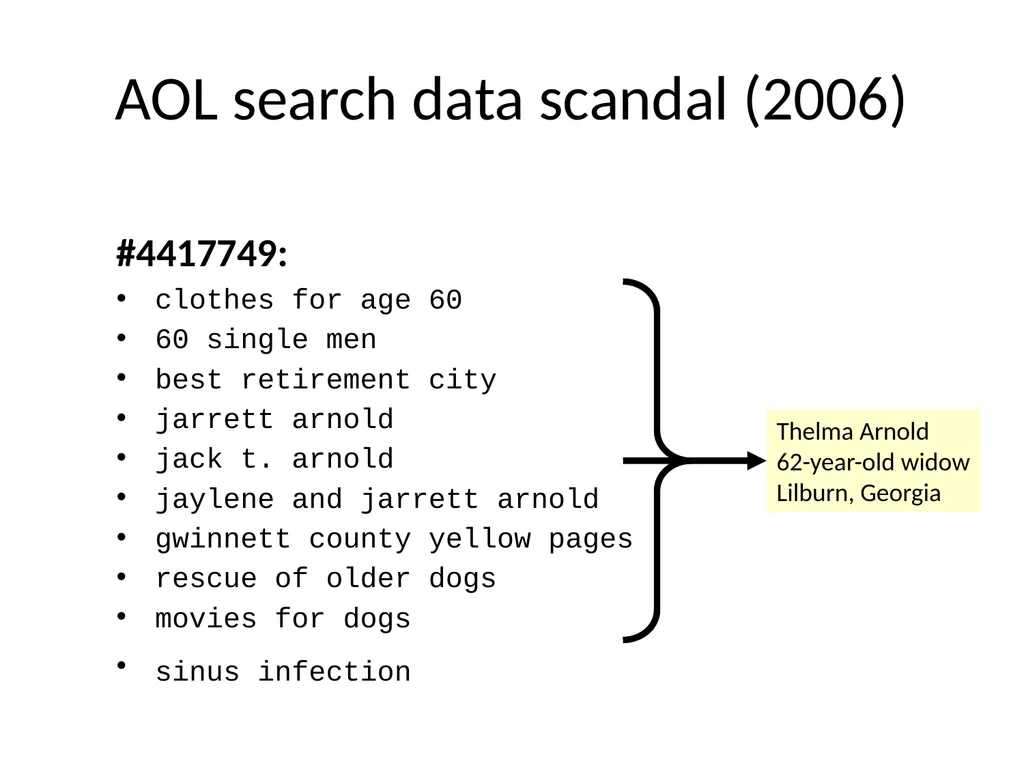
slide2. AOL search data scandal (2006) #4417749:
clothes for age 60
60 single men
best retirement city
jarrett arnold
jack t. arnold
jaylene and jarrett arnold
gwinnett county yellow pages
rescue of older dogs
movies for dogs
sinus infection Thelma Arnold
62-year-old widow
Lilburn, Georgia<br>
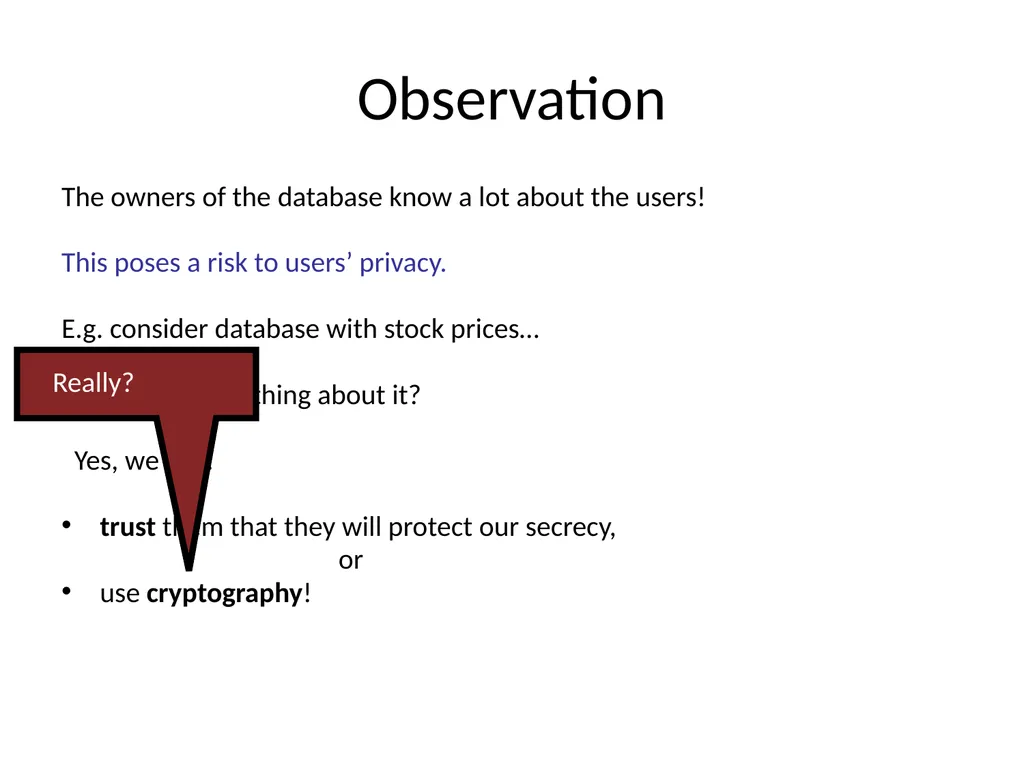
slide3. Observation The owners of the database know a lot about the users!
This poses a risk to users’ privacy.
E.g. consider database with stock prices…
Can we do something about it?
Yes, we can:
trust them that they will protect our secrecy,
or
use cryptography! Really?<br>
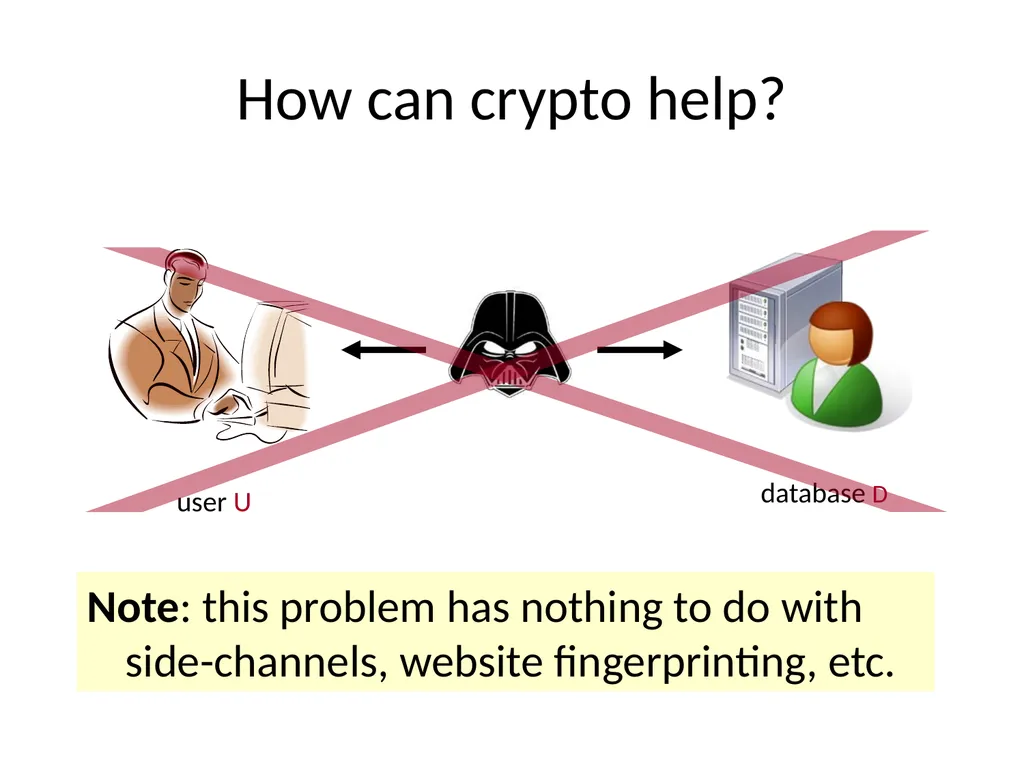
slide4. How can crypto help? Note: this problem has nothing to do with side-channels, website fingerprinting, etc. user U database D<br>
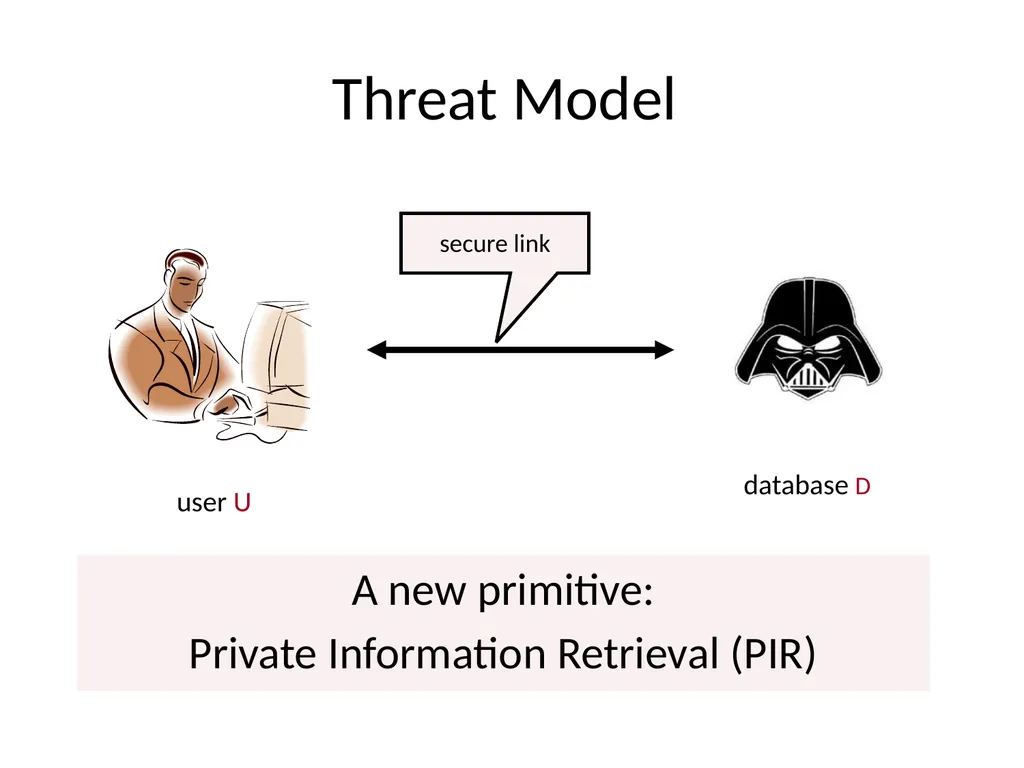
slide5. Threat Model user U database D A new primitive:
Private Information Retrieval (PIR) secure link<br>
slide6. Private Information Retrieval (PIR) [CGKS95] Goal: allow user to query database while hiding the identity of the data-items she is after.
Note: hides identity of data-items; not existence of interaction with the user.
Motivation: patient databases; stock quotes; web access; many more....
Paradox(?): imagine buying in a store without the seller knowing what you buy.
(Encrypting requests is useful against third parties; not against owner of data.)<br>
slide7. Model Server: holds n-bit string x
n should be thought of as very large
User: wishes
to retrieve xi
and
to keep i private<br>
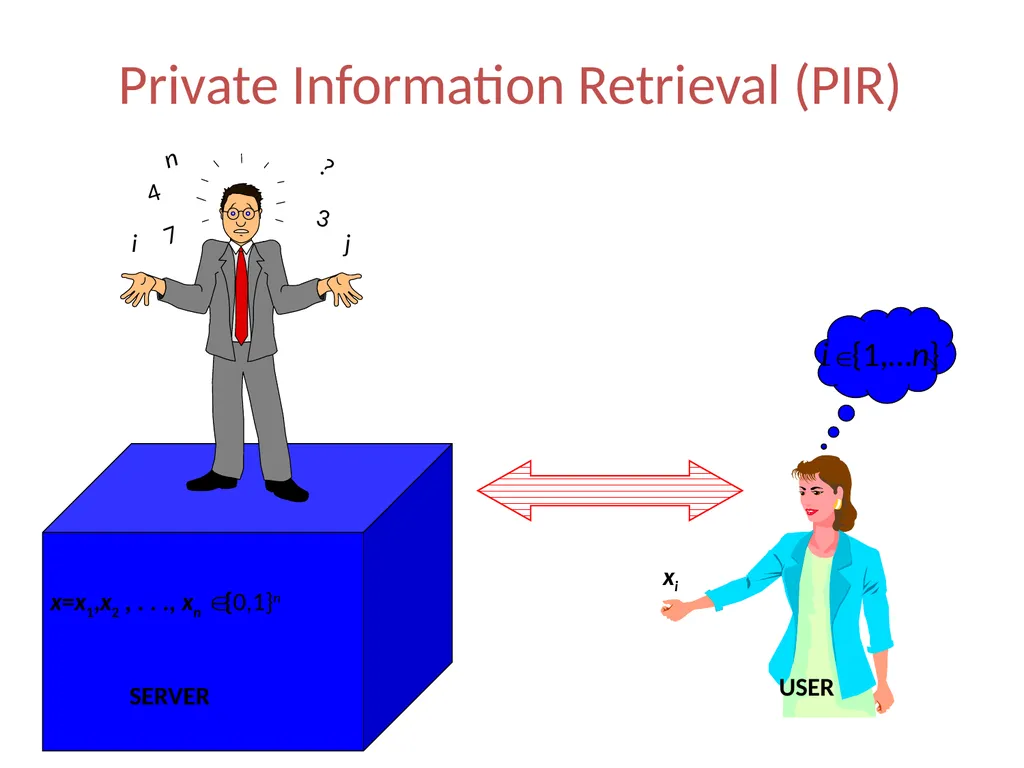
slide8. Private Information Retrieval (PIR) x=x1,x2 , . . ., xn {0,1}n SERVER i {1,…n} xi USER i j ? 7 4 3 n<br>
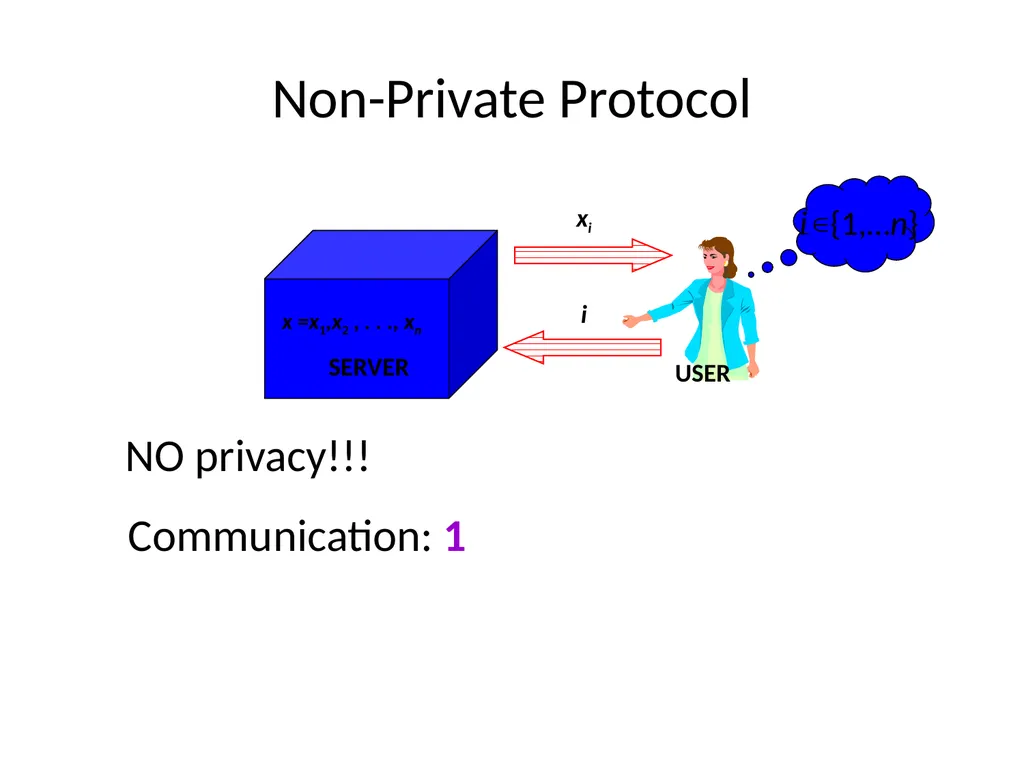
slide9. NO privacy!!!
Communication: 1 SERVER USER x =x1,x2 , . . ., xn xi Non-Private Protocol i i {1,…n}<br>
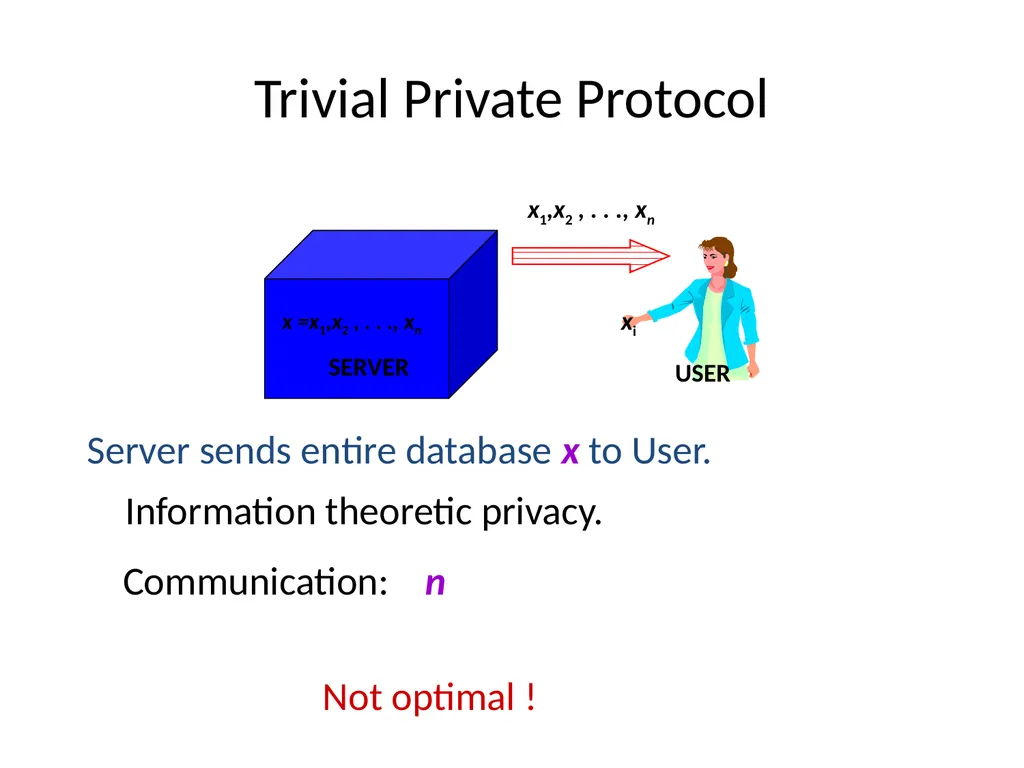
slide10. Server sends entire database x to User.
Information theoretic privacy.
Communication: n SERVER xi USER x =x1,x2 , . . ., xn x1,x2 , . . ., xn Trivial Private Protocol Not optimal !<br>
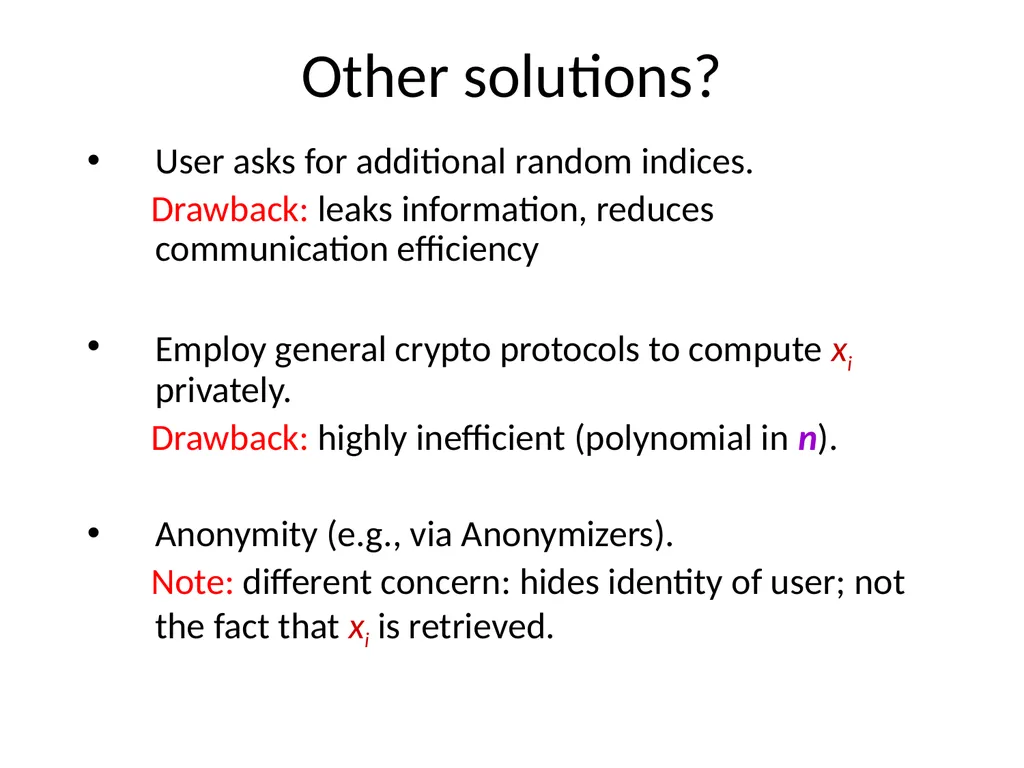
slide11. Other solutions? User asks for additional random indices.
Drawback: leaks information, reduces communication efficiency
Employ general crypto protocols to compute xi privately.
Drawback: highly inefficient (polynomial in n).
Anonymity (e.g., via Anonymizers).
Note: different concern: hides identity of user; not the fact that xi is retrieved.<br>
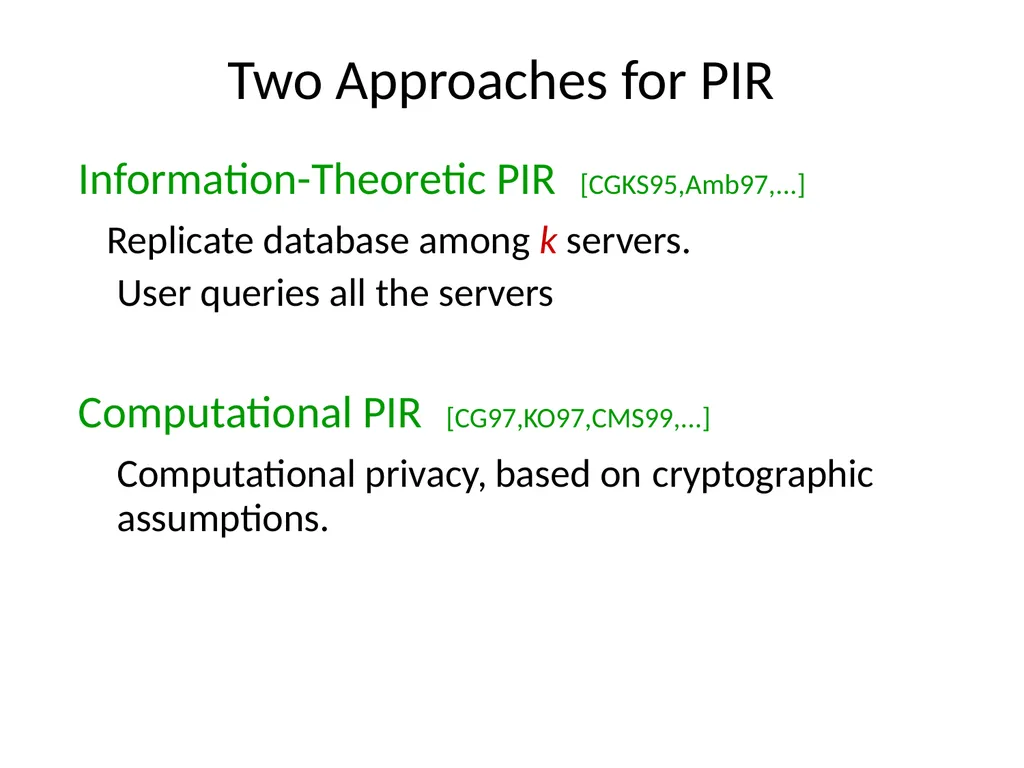
slide12. Two Approaches for PIR Information-Theoretic PIR [CGKS95,Amb97,...]
Replicate database among k servers.
User queries all the servers
Computational PIR [CG97,KO97,CMS99,...]
Computational privacy, based on cryptographic assumptions.<br>
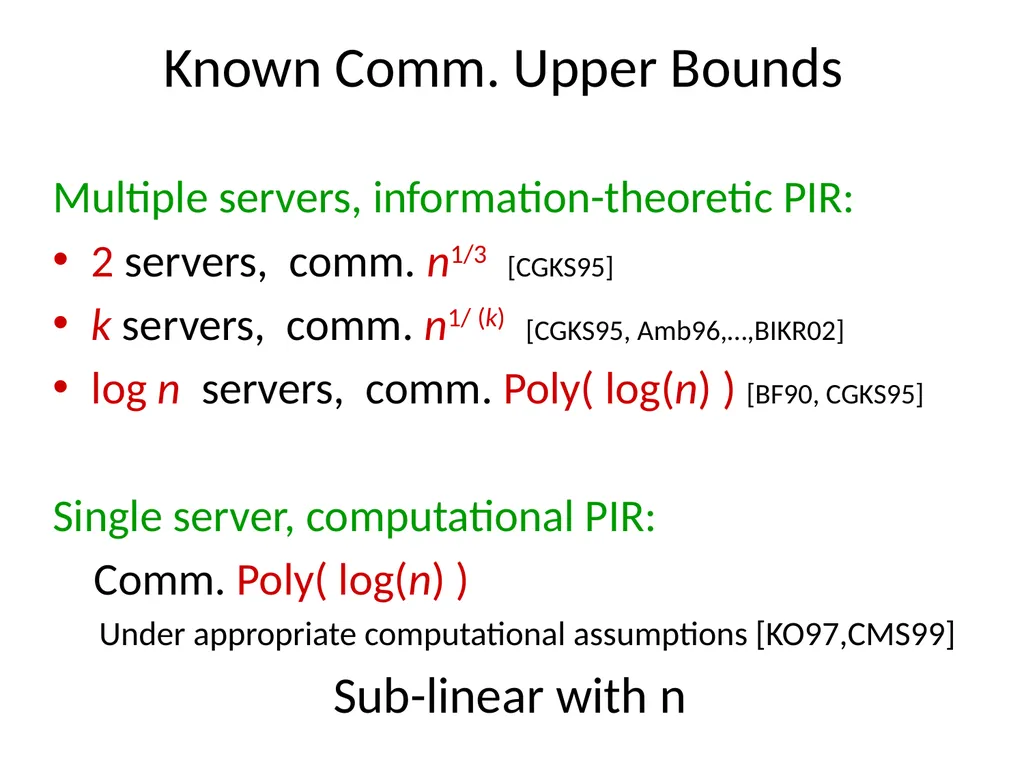
slide13. Known Comm. Upper Bounds Multiple servers, information-theoretic PIR:
2 servers, comm. n1/3 [CGKS95]
k servers, comm. n1/(k) [CGKS95, Amb96,…,BIKR02]
log n servers, comm. Poly( log(n) ) [BF90, CGKS95]
Single server, computational PIR:
Comm. Poly( log(n) )
Under appropriate computational assumptions [KO97,CMS99] Sub-linear with n<br>
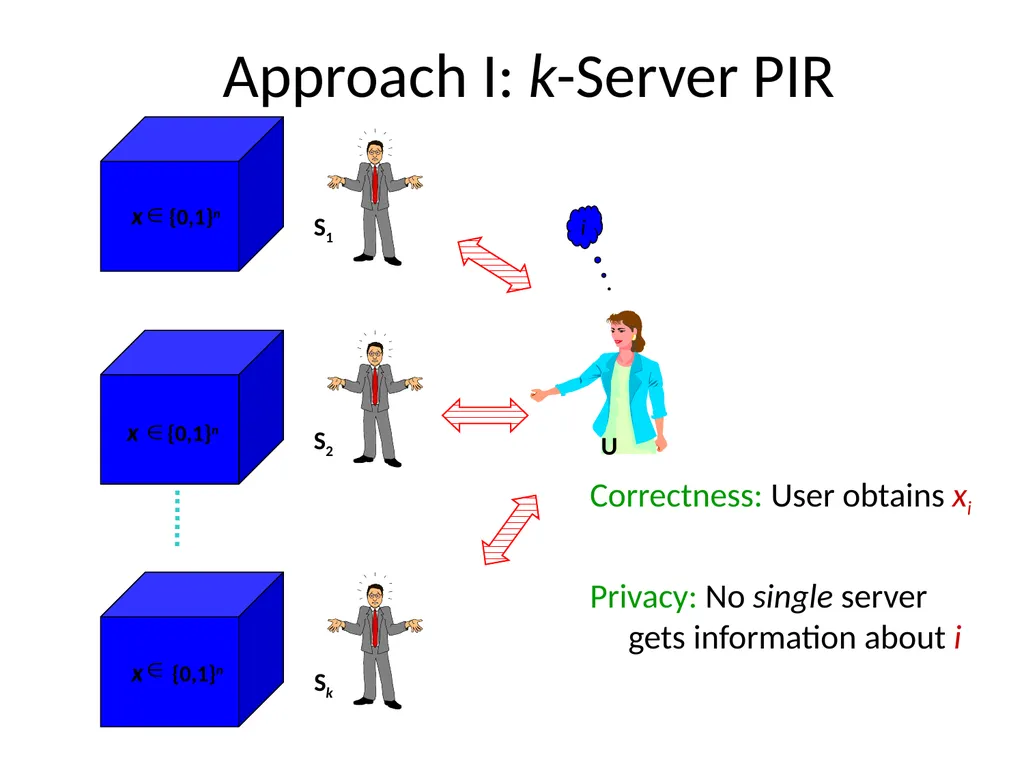
slide14. Approach I: k-Server PIR Correctness: User obtains xi
Privacy: No single server gets information about i S1 x {0,1}n S2 x {0,1}n i x {0,1}n Sk<br>
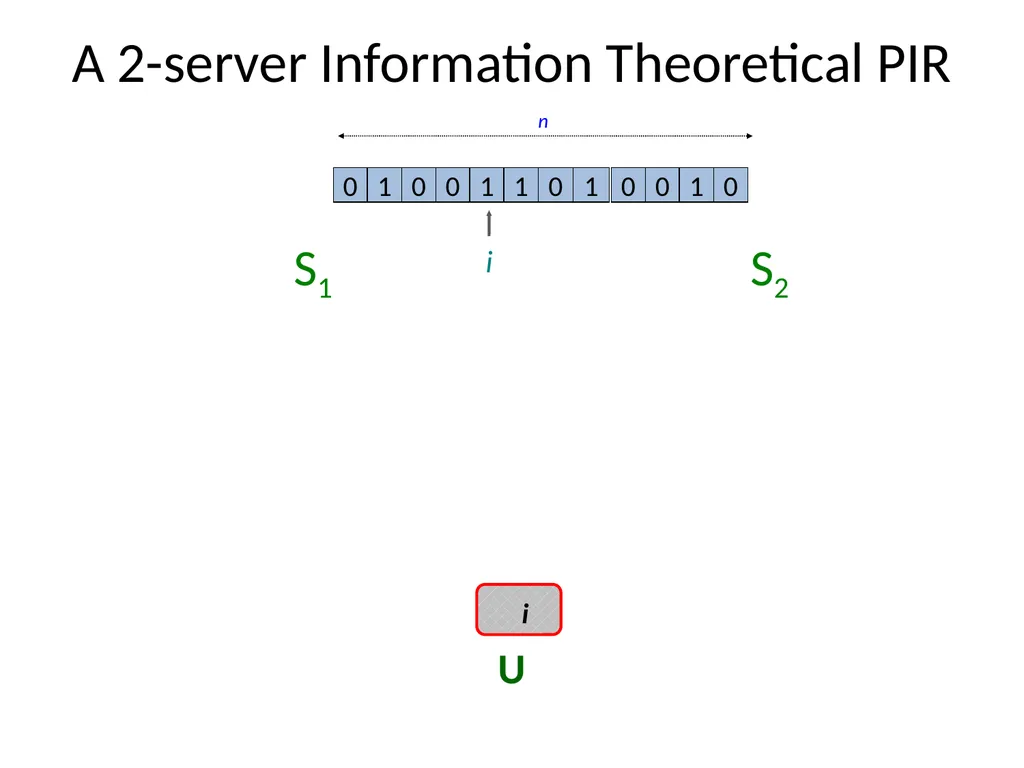
slide15. A 2-server Information Theoretical PIR S2 i U i n S1 0 0 1 1 0 0 1 1 1 0 0 0<br>
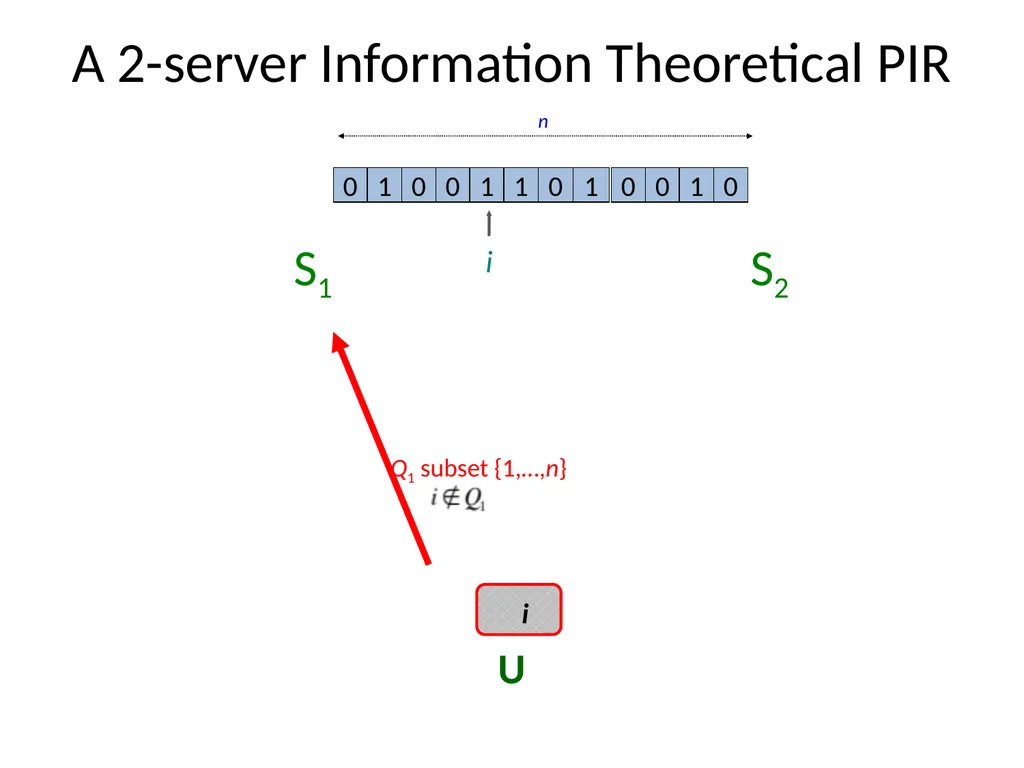
slide16. A 2-server Information Theoretical PIR S2 i U i n Q1 subset {1,…,n} S1 0 0 1 1 0 0 1 1 1 0 0 0<br>
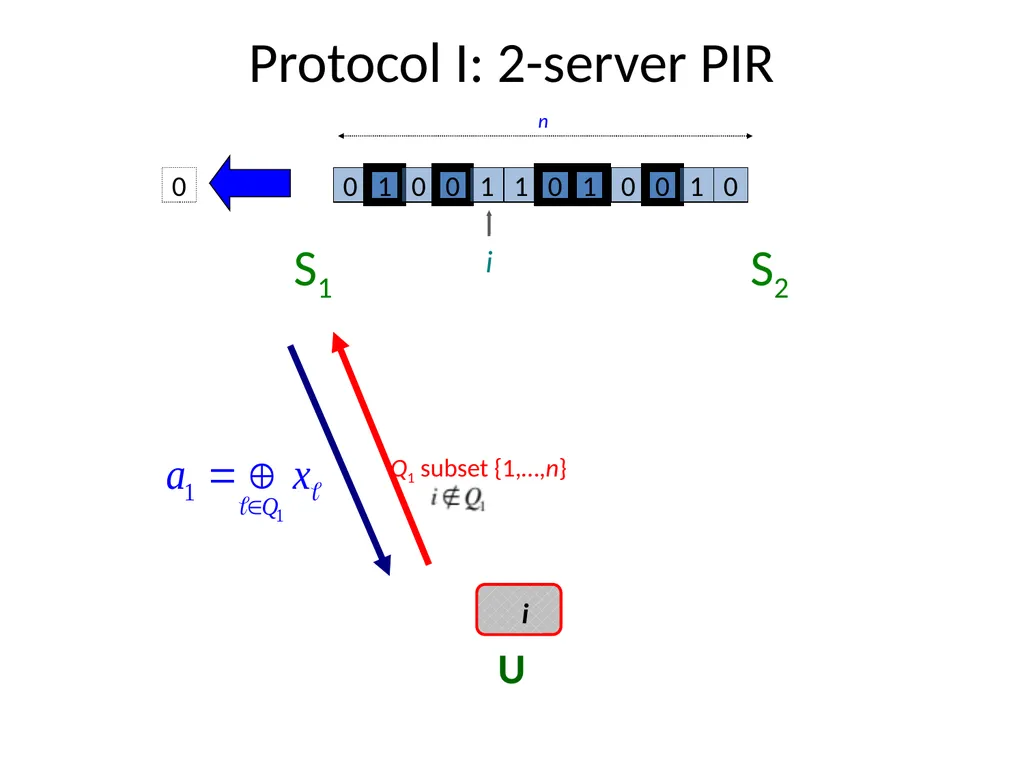
slide17. Protocol I: 2-server PIR S2 i U i n Q1 subset {1,…,n} S1 0 1 0 0 1 1 0 1 0 0 0 1 0<br>
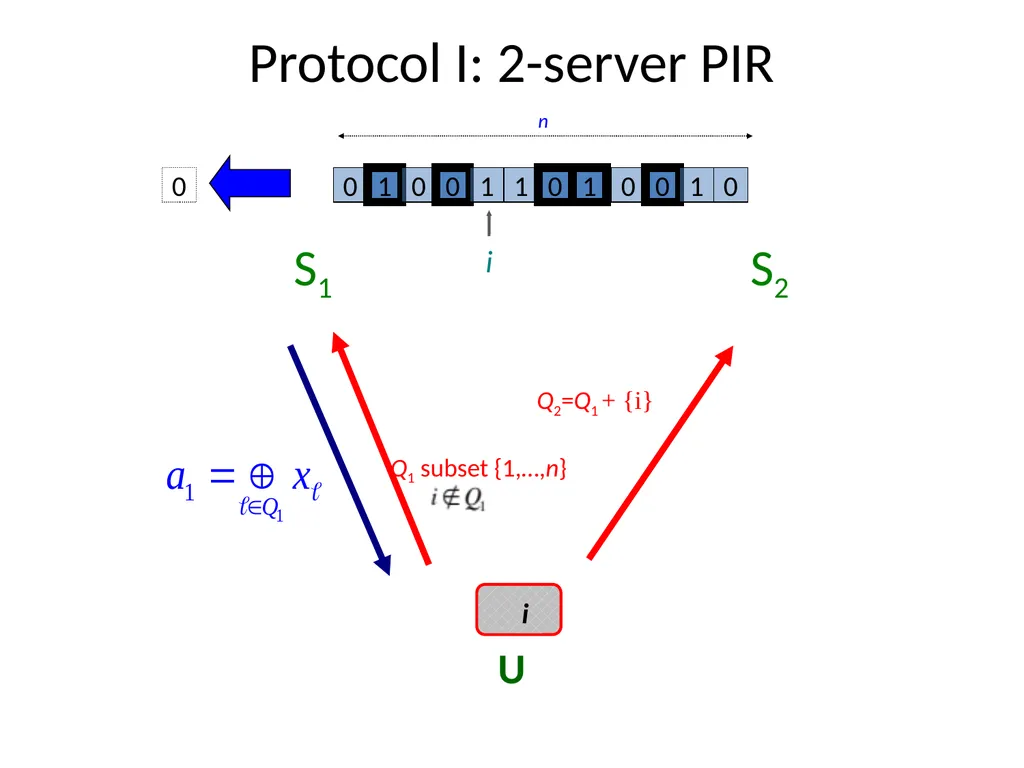
slide18. Protocol I: 2-server PIR S2 i U i n Q1 subset {1,…,n} S1 Q2=Q1 + {i} 0 1 0 0 1 1 0 1 0 0 0 1 0<br>
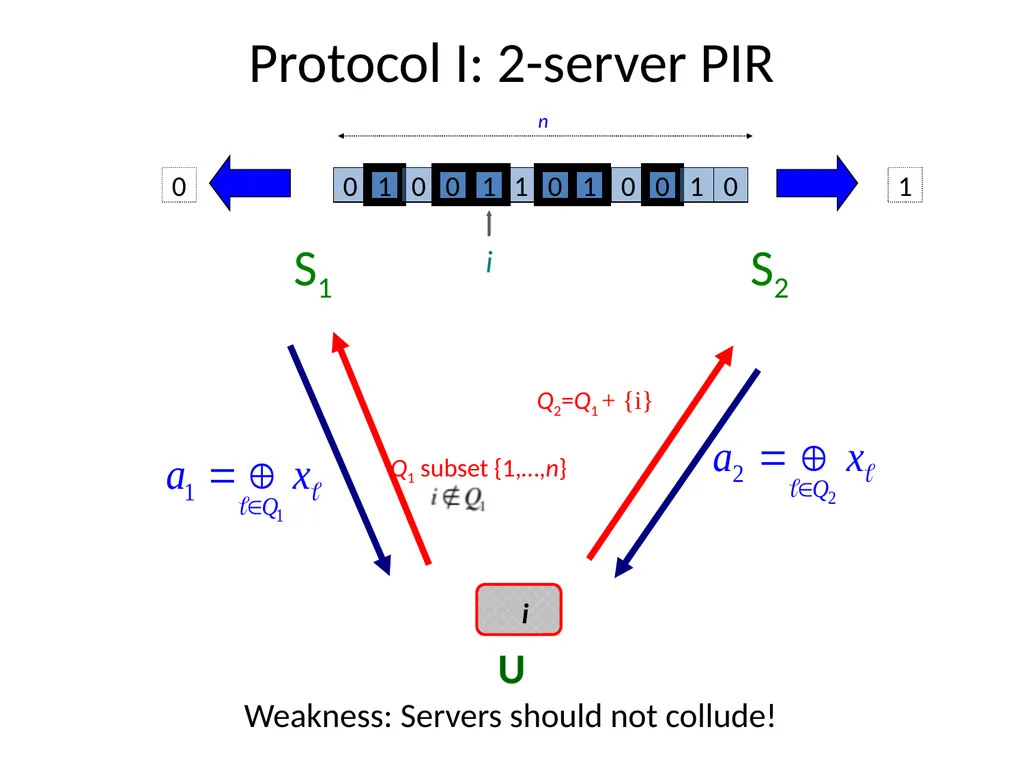
slide19. Protocol I: 2-server PIR S2 i U i n Q1 subset {1,…,n} S1 Q2=Q1 + {i} 0 1 0 0 1 0 1 0 0 0 1 1 1 0 Weakness: Servers should not collude!<br>
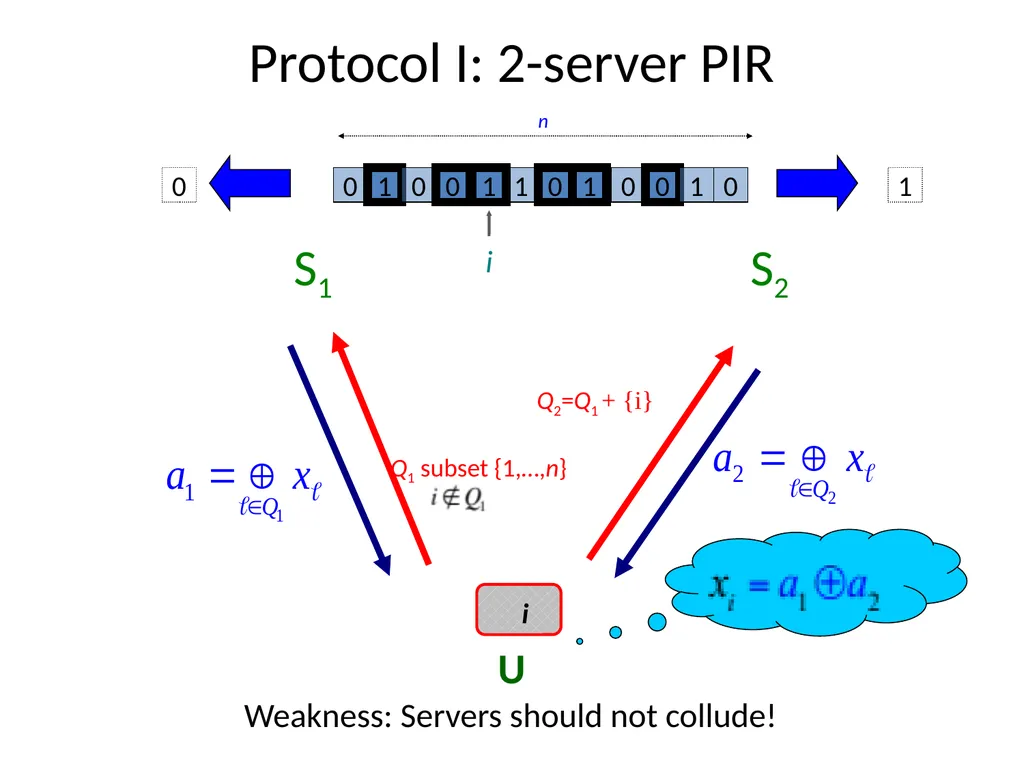
slide20. Protocol I: 2-server PIR S2 i U i n Q1 subset {1,…,n} S1 Q2=Q1 + {i} 0 1 0 0 1 0 1 0 0 0 1 1 1 0 Weakness: Servers should not collude!<br>
slide21. Computation PIR Only one server, no need to trust
Based on cryptographic assumptions
Downside: Server has to run over the whole database, otherwise leaks information
High computation load on the server CS660 - Advanced Information Assurance - UMassAmherst 21<br>
slide22. PIR-Tor: Scalable Anonymous Communication Using Private Information Retrieval Prateek Mittal
University of Illinois Urbana-Champaign
Joint work with: Femi Olumofin (U Waterloo)
Carmela Troncoso (KU Leuven)
Nikita Borisov (U Illinois)
Ian Goldberg (U Waterloo) 22 Original slides from the authors
USENIX Security 2011<br>
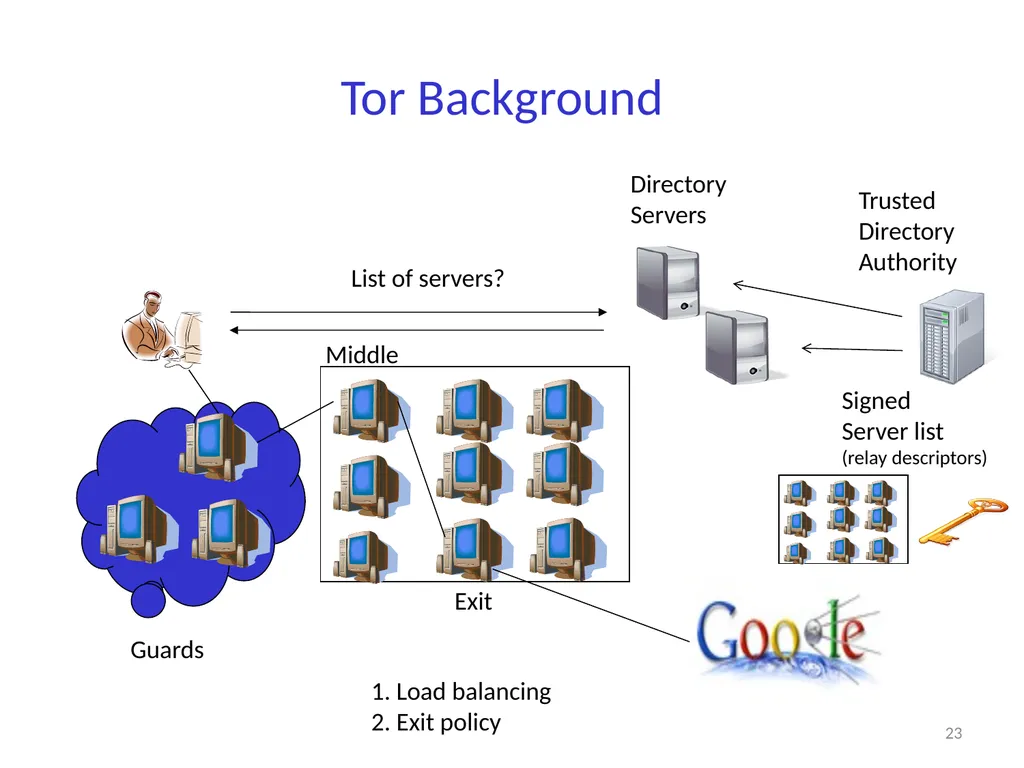
slide23. Tor Background List of servers? 23 Trusted
Directory
Authority Guards Exit Middle 1. Load balancing
2. Exit policy<br>
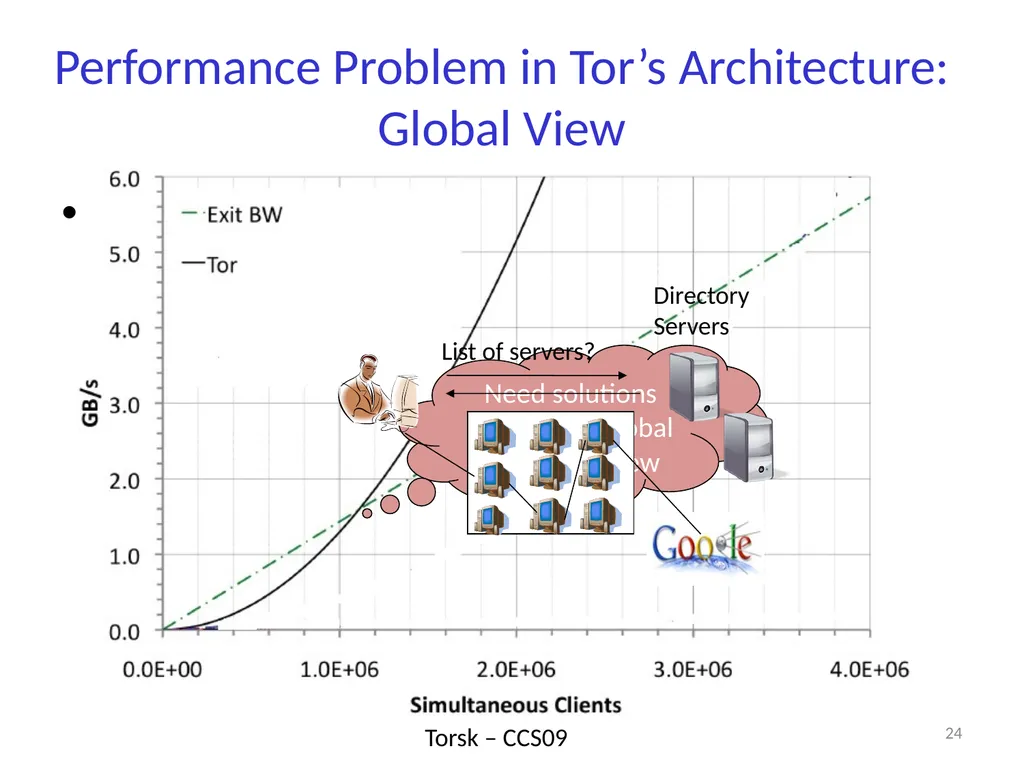
slide24. Performance Problem in Tor’s Architecture: Global View Global view
Not scalable Need solutions without global system view 24 Torsk – CCS09<br>
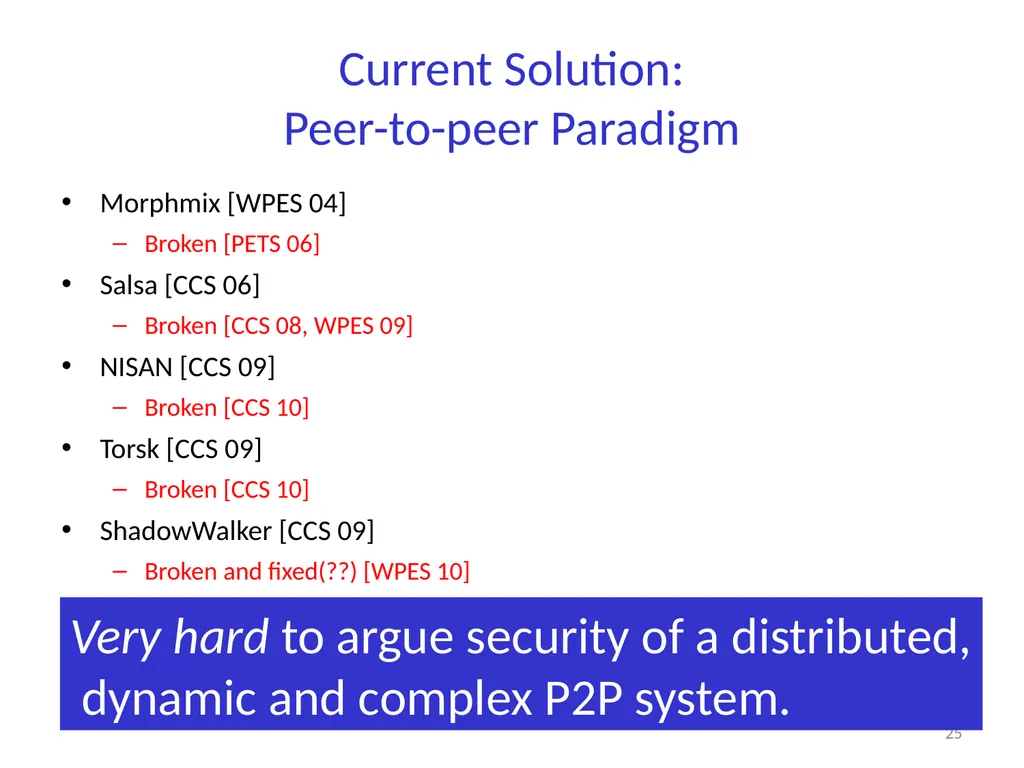
slide25. Current Solution:Peer-to-peer Paradigm Morphmix [WPES 04]
Broken [PETS 06]
Salsa [CCS 06]
Broken [CCS 08, WPES 09]
NISAN [CCS 09]
Broken [CCS 10]
Torsk [CCS 09]
Broken [CCS 10]
ShadowWalker [CCS 09]
Broken and fixed(??) [WPES 10] Very hard to argue security of a distributed,
dynamic and complex P2P system. 25<br>
slide26. Design Goals A scalable client-server architecture with easy to analyze security properties.
Avoid increasing the attack surface
Equivalent security to Tor
Preserve Tor’s constraints
Guard/middle/exit relays,
Load balancing
Minimal changes
Only relay selection algorithm 26<br>
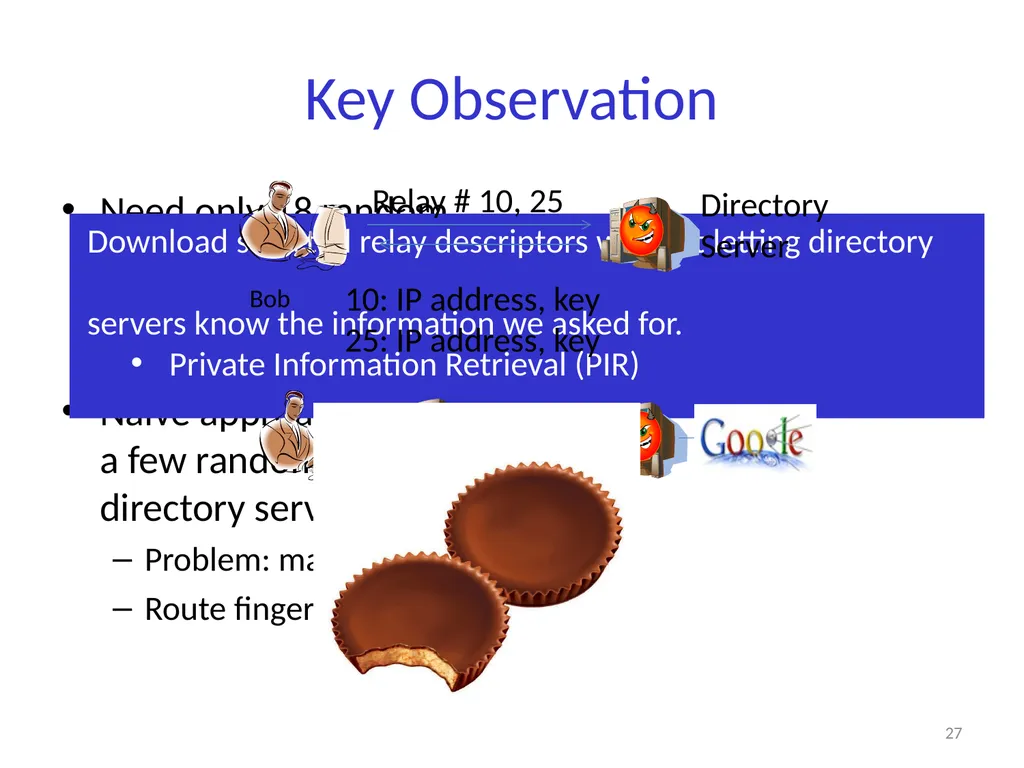
slide27. Key Observation Need only 18 random middle/exit relays in 3 hours
So don’t download all 2000!
Naïve approach: download a few random relays from directory servers
Problem: malicious servers
Route fingerprinting attacks Download selected relay descriptors without letting directory
servers know the information we asked for.
Private Information Retrieval (PIR) 27 Inference: User likely
to be Bob<br>
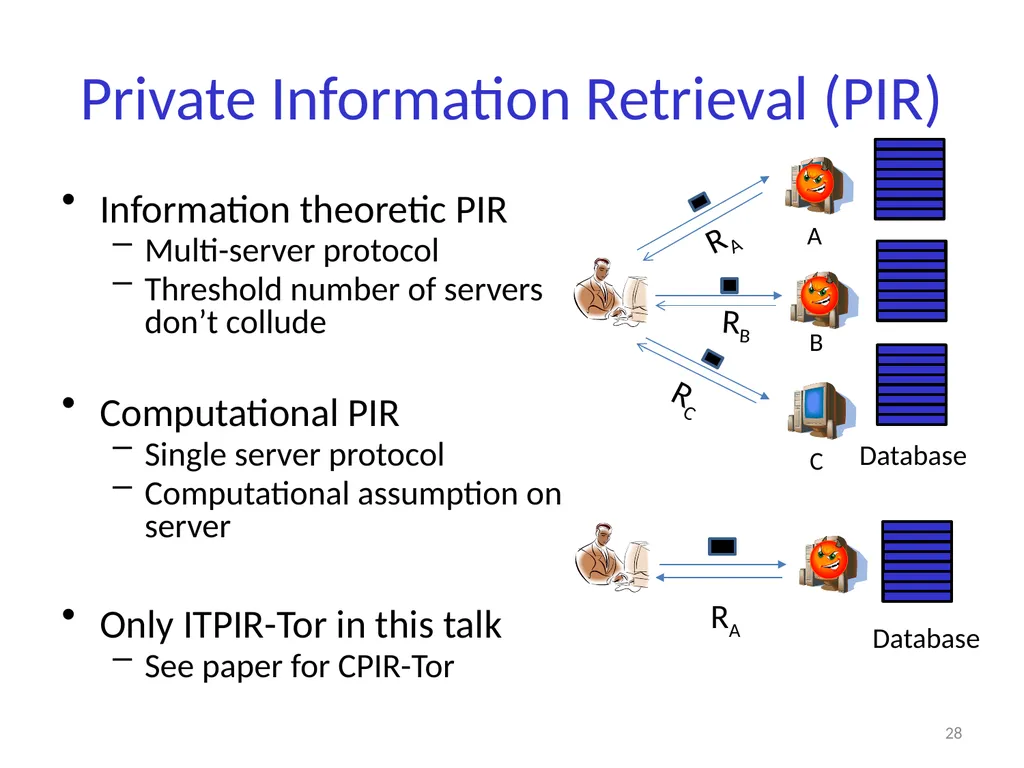
slide28. Private Information Retrieval (PIR) Information theoretic PIR
Multi-server protocol
Threshold number of servers don’t collude
Computational PIR
Single server protocol
Computational assumption on server
Only ITPIR-Tor in this talk
See paper for CPIR-Tor 28 RC A B A Database C Database RB RA RA<br>
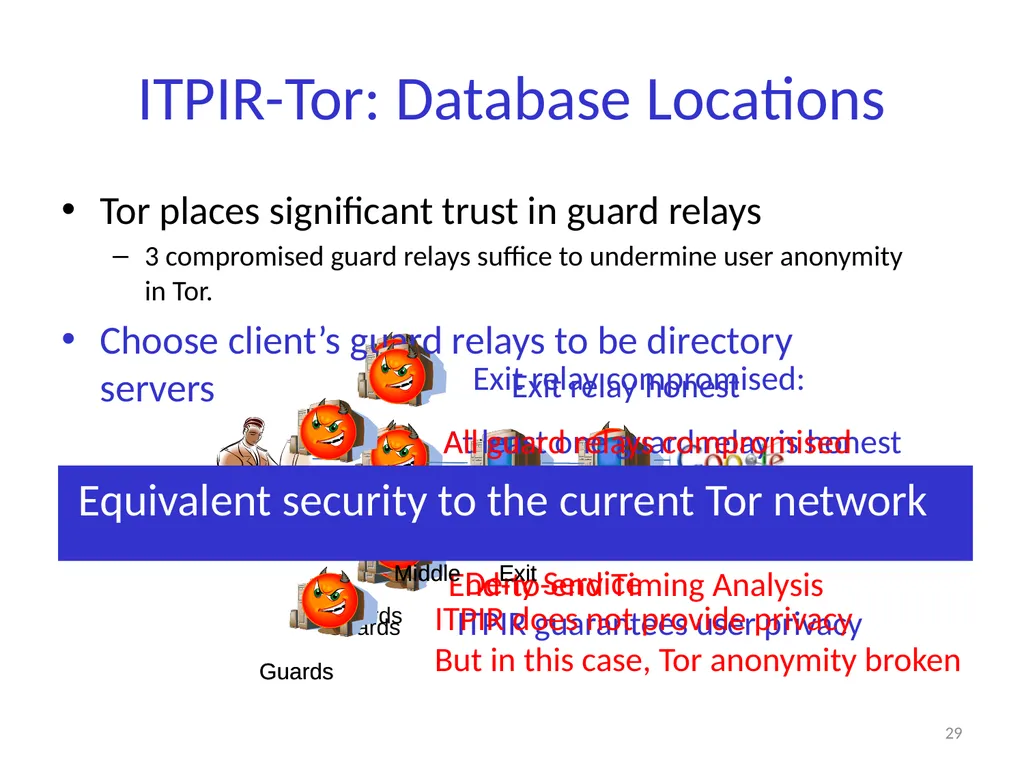
slide29. ITPIR-Tor: Database Locations Tor places significant trust in guard relays
3 compromised guard relays suffice to undermine user anonymity in Tor.
Choose client’s guard relays to be directory servers 29 End-to-end Timing Analysis Deny Service ITPIR guarantees user privacy ITPIR does not provide privacy
But in this case, Tor anonymity broken Equivalent security to the current Tor network<br>
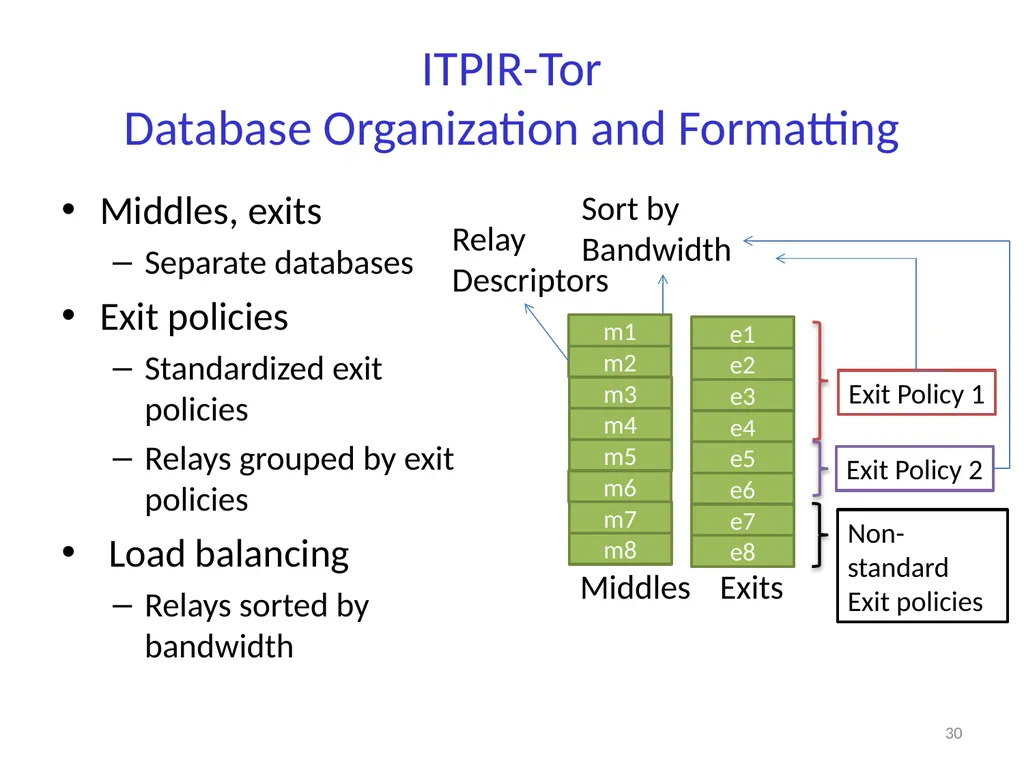
slide30. ITPIR-TorDatabase Organization and Formatting Middles, exits
Separate databases
Exit policies
Standardized exit policies
Relays grouped by exit policies
Load balancing
Relays sorted by bandwidth Relay
Descriptors 30<br>
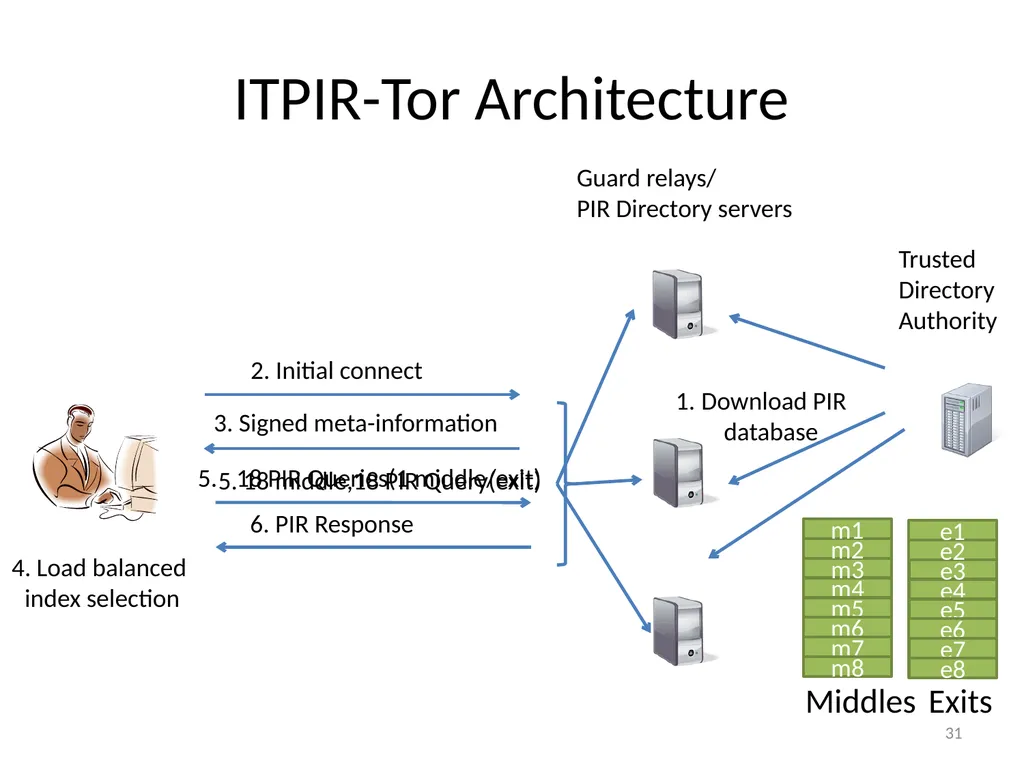
slide31. ITPIR-Tor Architecture 31 Trusted
Directory
Authority Guard relays/
PIR Directory servers 18 PIR Queries(1 middle/exit) 2. Initial connect 3. Signed meta-information 6. PIR Response Download PIR database 4. Load balanced
index selection 5. 18 middle,18 PIR Query(exit)<br>
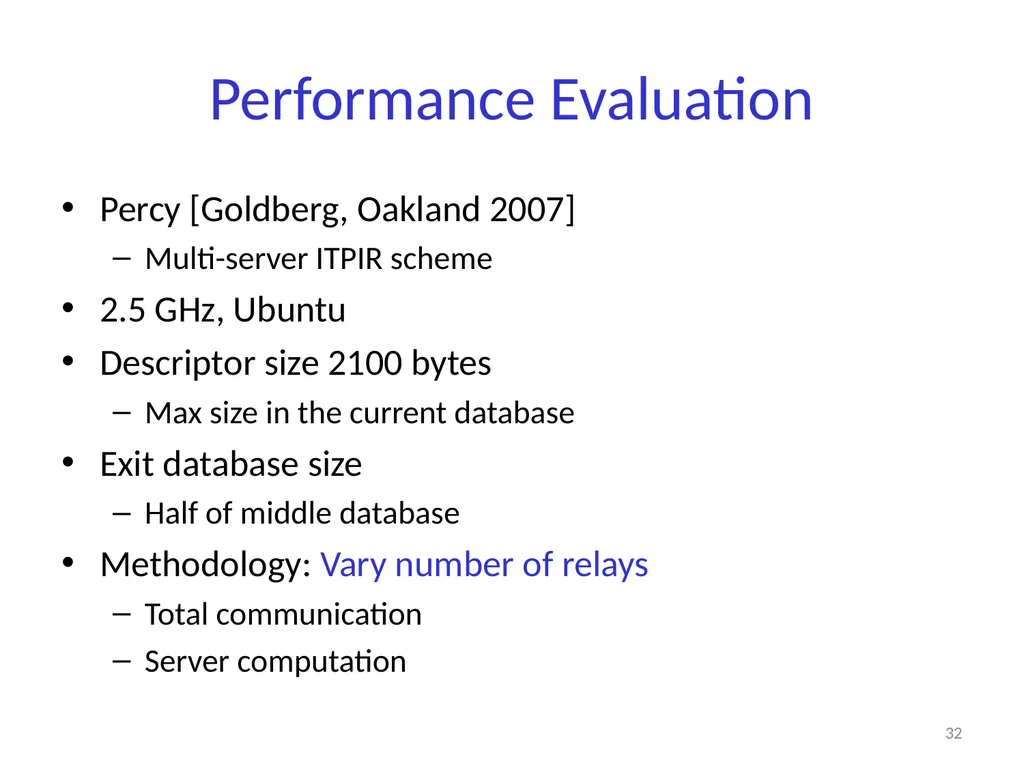
slide32. Performance Evaluation Percy [Goldberg, Oakland 2007]
Multi-server ITPIR scheme
2.5 GHz, Ubuntu
Descriptor size 2100 bytes
Max size in the current database
Exit database size
Half of middle database
Methodology: Vary number of relays
Total communication
Server computation 32<br>
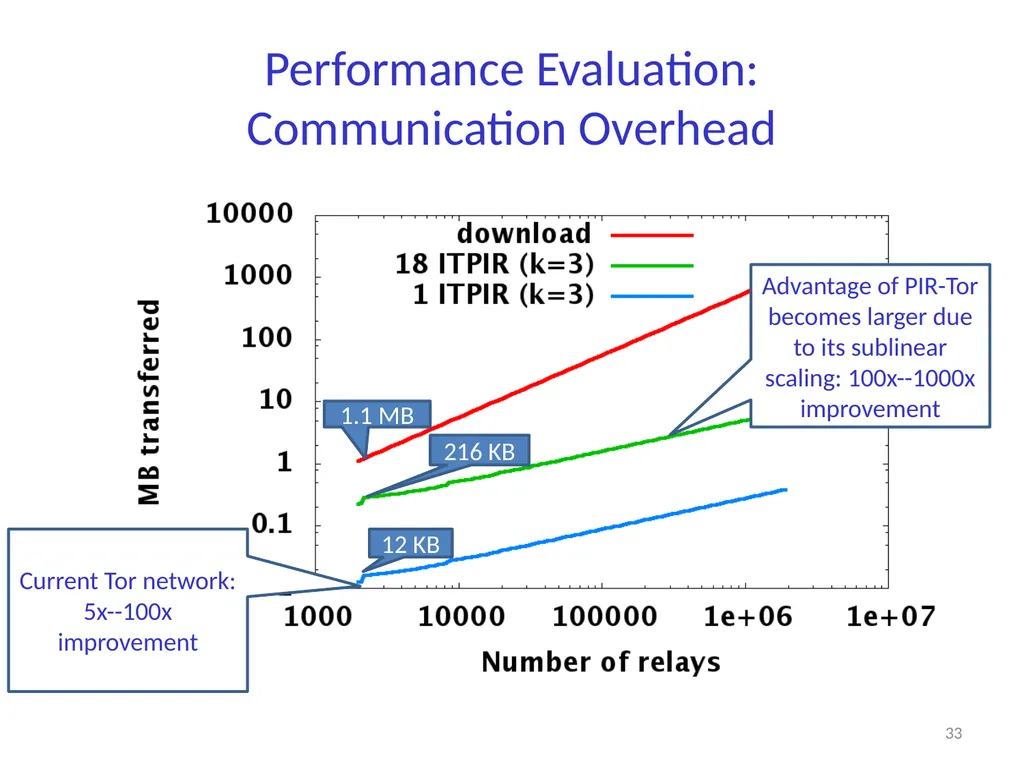
slide33. Performance Evaluation:Communication Overhead 33 Current Tor network: 5x--100x improvement Advantage of PIR-Tor becomes larger due to its sublinear scaling: 100x--1000x improvement 1.1 MB 216 KB 12 KB<br>
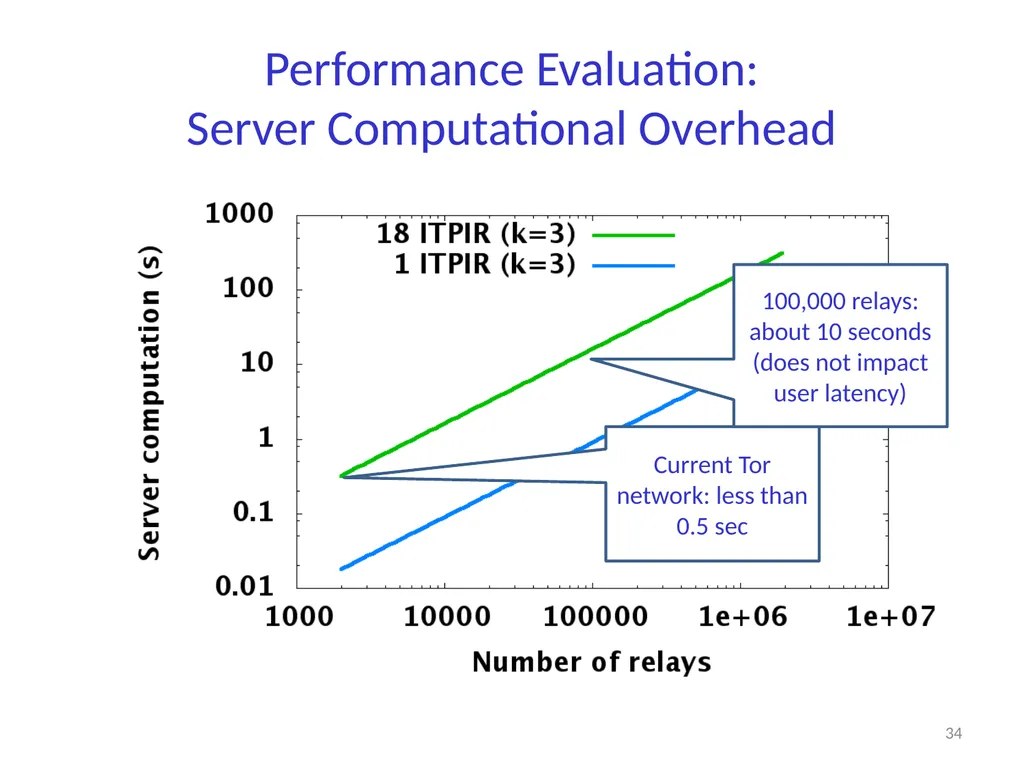
slide34. Performance Evaluation:Server Computational Overhead 34 Current Tor network: less than 0.5 sec 100,000 relays: about 10 seconds (does not impact user latency)<br>
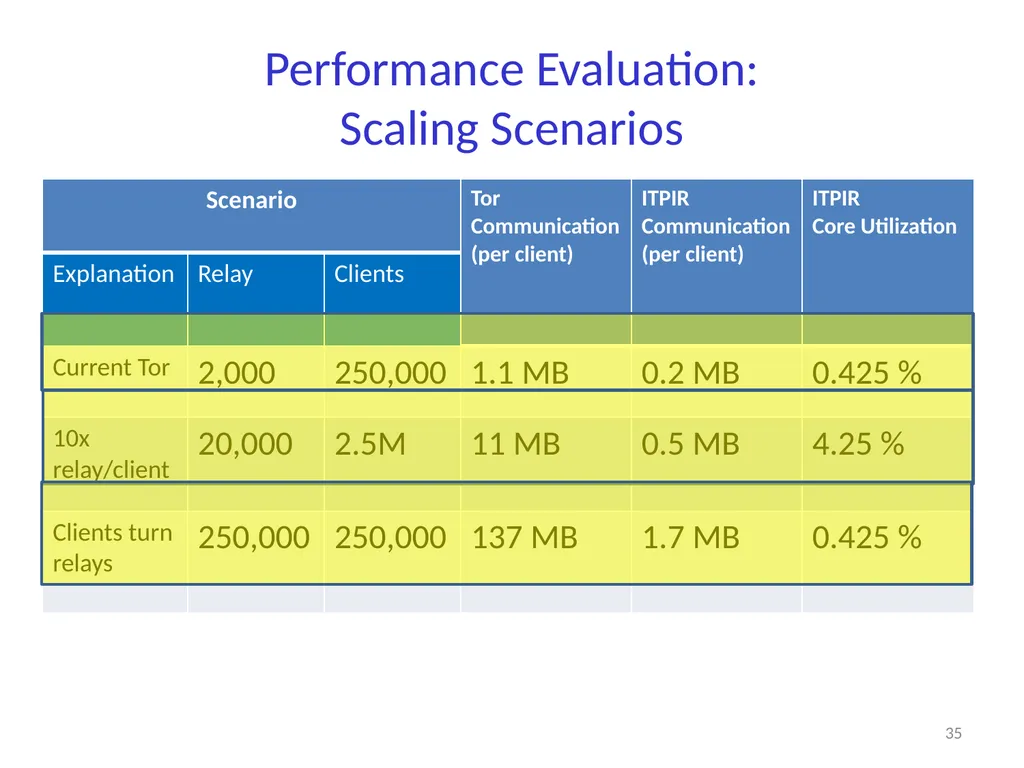
slide35. Performance Evaluation:Scaling Scenarios 35<br>
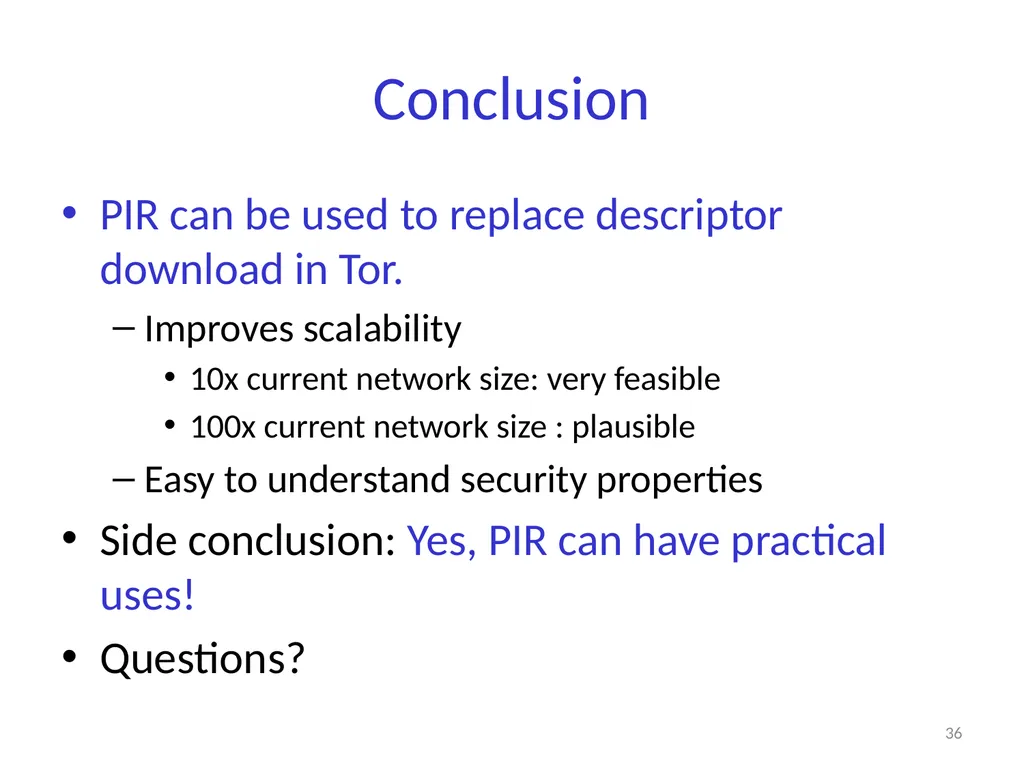
slide36. Conclusion PIR can be used to replace descriptor download in Tor.
Improves scalability
10x current network size: very feasible
100x current network size : plausible
Easy to understand security properties
Side conclusion: Yes, PIR can have practical uses!
Questions? 36<br>
slide37. Acknowledgement Some of the slides, content, or pictures are borrowed from the following resources, and some pictures are obtained through Google search without being referenced below:
Stefan Dziembowski, Private Information Retrieval
Amos Beimel, Private Information Retrieval
Prateek Mittal, PIR-Tor 37 CS660 - Advanced Information Assurance - UMassAmherst<br>

CS660: Advanced Information Assurance
Spring 2015 Content may be borrowed from other resources.
See the last slide for acknowledgements!<br>
slide2. AOL search data scandal (2006) #4417749:
clothes for age 60
60 single men
best retirement city
jarrett arnold
jack t. arnold
jaylene and jarrett arnold
gwinnett county yellow pages
rescue of older dogs
movies for dogs
sinus infection Thelma Arnold
62-year-old widow
Lilburn, Georgia<br>
slide3. Observation The owners of the database know a lot about the users!
This poses a risk to users’ privacy.
E.g. consider database with stock prices…
Can we do something about it?
Yes, we can:
trust them that they will protect our secrecy,
or
use cryptography! Really?<br>
slide4. How can crypto help? Note: this problem has nothing to do with side-channels, website fingerprinting, etc. user U database D<br>
slide5. Threat Model user U database D A new primitive:
Private Information Retrieval (PIR) secure link<br>
slide6. Private Information Retrieval (PIR) [CGKS95] Goal: allow user to query database while hiding the identity of the data-items she is after.
Note: hides identity of data-items; not existence of interaction with the user.
Motivation: patient databases; stock quotes; web access; many more....
Paradox(?): imagine buying in a store without the seller knowing what you buy.
(Encrypting requests is useful against third parties; not against owner of data.)<br>
slide7. Model Server: holds n-bit string x
n should be thought of as very large
User: wishes
to retrieve xi
and
to keep i private<br>
slide8. Private Information Retrieval (PIR) x=x1,x2 , . . ., xn {0,1}n SERVER i {1,…n} xi USER i j ? 7 4 3 n<br>
slide9. NO privacy!!!
Communication: 1 SERVER USER x =x1,x2 , . . ., xn xi Non-Private Protocol i i {1,…n}<br>
slide10. Server sends entire database x to User.
Information theoretic privacy.
Communication: n SERVER xi USER x =x1,x2 , . . ., xn x1,x2 , . . ., xn Trivial Private Protocol Not optimal !<br>
slide11. Other solutions? User asks for additional random indices.
Drawback: leaks information, reduces communication efficiency
Employ general crypto protocols to compute xi privately.
Drawback: highly inefficient (polynomial in n).
Anonymity (e.g., via Anonymizers).
Note: different concern: hides identity of user; not the fact that xi is retrieved.<br>
slide12. Two Approaches for PIR Information-Theoretic PIR [CGKS95,Amb97,...]
Replicate database among k servers.
User queries all the servers
Computational PIR [CG97,KO97,CMS99,...]
Computational privacy, based on cryptographic assumptions.<br>
slide13. Known Comm. Upper Bounds Multiple servers, information-theoretic PIR:
2 servers, comm. n1/3 [CGKS95]
k servers, comm. n1/(k) [CGKS95, Amb96,…,BIKR02]
log n servers, comm. Poly( log(n) ) [BF90, CGKS95]
Single server, computational PIR:
Comm. Poly( log(n) )
Under appropriate computational assumptions [KO97,CMS99] Sub-linear with n<br>
slide14. Approach I: k-Server PIR Correctness: User obtains xi
Privacy: No single server gets information about i S1 x {0,1}n S2 x {0,1}n i x {0,1}n Sk<br>
slide15. A 2-server Information Theoretical PIR S2 i U i n S1 0 0 1 1 0 0 1 1 1 0 0 0<br>
slide16. A 2-server Information Theoretical PIR S2 i U i n Q1 subset {1,…,n} S1 0 0 1 1 0 0 1 1 1 0 0 0<br>
slide17. Protocol I: 2-server PIR S2 i U i n Q1 subset {1,…,n} S1 0 1 0 0 1 1 0 1 0 0 0 1 0<br>
slide18. Protocol I: 2-server PIR S2 i U i n Q1 subset {1,…,n} S1 Q2=Q1 + {i} 0 1 0 0 1 1 0 1 0 0 0 1 0<br>
slide19. Protocol I: 2-server PIR S2 i U i n Q1 subset {1,…,n} S1 Q2=Q1 + {i} 0 1 0 0 1 0 1 0 0 0 1 1 1 0 Weakness: Servers should not collude!<br>
slide20. Protocol I: 2-server PIR S2 i U i n Q1 subset {1,…,n} S1 Q2=Q1 + {i} 0 1 0 0 1 0 1 0 0 0 1 1 1 0 Weakness: Servers should not collude!<br>
slide21. Computation PIR Only one server, no need to trust
Based on cryptographic assumptions
Downside: Server has to run over the whole database, otherwise leaks information
High computation load on the server CS660 - Advanced Information Assurance - UMassAmherst 21<br>
slide22. PIR-Tor: Scalable Anonymous Communication Using Private Information Retrieval Prateek Mittal
University of Illinois Urbana-Champaign
Joint work with: Femi Olumofin (U Waterloo)
Carmela Troncoso (KU Leuven)
Nikita Borisov (U Illinois)
Ian Goldberg (U Waterloo) 22 Original slides from the authors
USENIX Security 2011<br>
slide23. Tor Background List of servers? 23 Trusted
Directory
Authority Guards Exit Middle 1. Load balancing
2. Exit policy<br>
slide24. Performance Problem in Tor’s Architecture: Global View Global view
Not scalable Need solutions without global system view 24 Torsk – CCS09<br>
slide25. Current Solution:Peer-to-peer Paradigm Morphmix [WPES 04]
Broken [PETS 06]
Salsa [CCS 06]
Broken [CCS 08, WPES 09]
NISAN [CCS 09]
Broken [CCS 10]
Torsk [CCS 09]
Broken [CCS 10]
ShadowWalker [CCS 09]
Broken and fixed(??) [WPES 10] Very hard to argue security of a distributed,
dynamic and complex P2P system. 25<br>
slide26. Design Goals A scalable client-server architecture with easy to analyze security properties.
Avoid increasing the attack surface
Equivalent security to Tor
Preserve Tor’s constraints
Guard/middle/exit relays,
Load balancing
Minimal changes
Only relay selection algorithm 26<br>
slide27. Key Observation Need only 18 random middle/exit relays in 3 hours
So don’t download all 2000!
Naïve approach: download a few random relays from directory servers
Problem: malicious servers
Route fingerprinting attacks Download selected relay descriptors without letting directory
servers know the information we asked for.
Private Information Retrieval (PIR) 27 Inference: User likely
to be Bob<br>
slide28. Private Information Retrieval (PIR) Information theoretic PIR
Multi-server protocol
Threshold number of servers don’t collude
Computational PIR
Single server protocol
Computational assumption on server
Only ITPIR-Tor in this talk
See paper for CPIR-Tor 28 RC A B A Database C Database RB RA RA<br>
slide29. ITPIR-Tor: Database Locations Tor places significant trust in guard relays
3 compromised guard relays suffice to undermine user anonymity in Tor.
Choose client’s guard relays to be directory servers 29 End-to-end Timing Analysis Deny Service ITPIR guarantees user privacy ITPIR does not provide privacy
But in this case, Tor anonymity broken Equivalent security to the current Tor network<br>
slide30. ITPIR-TorDatabase Organization and Formatting Middles, exits
Separate databases
Exit policies
Standardized exit policies
Relays grouped by exit policies
Load balancing
Relays sorted by bandwidth Relay
Descriptors 30<br>
slide31. ITPIR-Tor Architecture 31 Trusted
Directory
Authority Guard relays/
PIR Directory servers 18 PIR Queries(1 middle/exit) 2. Initial connect 3. Signed meta-information 6. PIR Response Download PIR database 4. Load balanced
index selection 5. 18 middle,18 PIR Query(exit)<br>
slide32. Performance Evaluation Percy [Goldberg, Oakland 2007]
Multi-server ITPIR scheme
2.5 GHz, Ubuntu
Descriptor size 2100 bytes
Max size in the current database
Exit database size
Half of middle database
Methodology: Vary number of relays
Total communication
Server computation 32<br>
slide33. Performance Evaluation:Communication Overhead 33 Current Tor network: 5x--100x improvement Advantage of PIR-Tor becomes larger due to its sublinear scaling: 100x--1000x improvement 1.1 MB 216 KB 12 KB<br>
slide34. Performance Evaluation:Server Computational Overhead 34 Current Tor network: less than 0.5 sec 100,000 relays: about 10 seconds (does not impact user latency)<br>
slide35. Performance Evaluation:Scaling Scenarios 35<br>
slide36. Conclusion PIR can be used to replace descriptor download in Tor.
Improves scalability
10x current network size: very feasible
100x current network size : plausible
Easy to understand security properties
Side conclusion: Yes, PIR can have practical uses!
Questions? 36<br>
slide37. Acknowledgement Some of the slides, content, or pictures are borrowed from the following resources, and some pictures are obtained through Google search without being referenced below:
Stefan Dziembowski, Private Information Retrieval
Amos Beimel, Private Information Retrieval
Prateek Mittal, PIR-Tor 37 CS660 - Advanced Information Assurance - UMassAmherst<br>